Category: News

Bill aimed at encouraging new housing passes Indiana House
House Bill 1001, which aims to loosen local zoning guidelines to encourage new housing starts, passed the House Tuesday.
The bill, a House Republican priority for this session, was amended on second reading Jan. 22 to include the elements of the housing reports that local governments will file to the legislature annually.
State Rep. Doug Miller, R-Elkhart, the bill author, said the goal of the bill is to expand the state’s housing supply and decrease the cost of homeownership by rolling back costly regulations that impede development.
Indiana faces a housing shortage of 50,000 units to meet current demand, Miller said. The average first-time homeowner age is 40 years old, he said.
The bill gives communities the option to opt in to certain requirements of the bill, Miller said. Overall, reducing red tape around home ownership will bring more housing to Indiana, he said.
The bill addresses long permitting processes, zoning restrictions, and minimum parking requirements. For example, one of the provisions includes expanding permitted uses that are approved without a hearing to single family dwellings and townhouses in residential areas, an accessory dwelling unit within a single family home, and affordable housing on property purchased by a religious institution before Jan. 1, 2025 in a residential or commercial zone.
The bill also restricts a unit of government’s ability to impose and increase fees related to building approval and permits, among other design-element limitations.
“Indiana faces a challenge in this state, just like there’s challenges across the rest of the United States, for housing. It’s been years in the making. There’s no one silver bullet. There’s no single proposal that’s going to bring housing to the market fast enough,” Miller said.
When the bill was heard in the House Local Government Committee, Amy Krieg, government affairs director with Accelerate Indiana Municipalities, said the organization supports increasing housing opportunities and addressing barriers to housing production in Indiana.
But, the organization has concerns with the bill because it “extends beyond setting statewide guardrails into areas that remove local decision making in ways that have unintended consequences,” Krieg said.
Miller said there has been a perception that the bill removes local control. But, there are portions of the bill that local officials could opt out of, he said.
In the last 48 hours, he’s had conversations with county commissioners and other community organizations about the bill and received “positive feedback,” Miller said.
House Speaker Todd Huston, R-Fishers, said the bill “is a work in progress,” particularly with local officials.
“There’s a bevy of research that says part of the problem in this, not the only problem, is that there are way too many regulations and rules,” Huston said. “Some of those we own and we’re working through trying to get that resolved.”
State and local officials all want to make housing more accessible, Huston said, but the challenge is finding that “middle ground.” Both state and local officials are working to find that common ground, he said.
“It’s a very important issue. It’s been a bipartisan issue all across the country to try and solve this because it frankly impacts all of us,” Huston said. “There’s a place to find that spot with our local elected officials as it goes across the Senate.”
State Rep. Wendy Dant Chesser, D-Jeffersonville, said she has three concerns with the bill: protections for homeowners who invested in communities where housing rules may change; approvals of accessory dwellings without parking requirements; and the timeline for local governments to adjust building and construction fees.
“I appreciate the complexity of this bill. I hope we can continue to find ways local government can partner in not only increasing the availability of housing but also ensuring lower housing costs for all of our residents,” Dant Chesser said.
State Rep. Chris Campbell, D-West Lafayette, said the bill takes away local control from mayors and commissioners who know their communities best. West Lafayette is densely populated, she said, so portions of the bill — concerning accessory dwellings and rentals — won’t work there.
“Taking away that local decision is not good for my community,” Campbell said. “When you create legislation that is a one-size-fits-all bill throughout the state, this isn’t going to fit for my community. We need to make sure that if we’re going to protect local decisions that we address these issues.”
The bill passed 76-15, with State Rep. Craig Haggard, R-Mooresville, voting with 14 Democrats against the measure. The bill moves to the Senate for consideration.

Liga de Campeones: quiénes se han clasificado, quiénes están en repesca y quiénes están fuera
LONDRES (AP) — ¿Cómo queda la situación de la Liga de Campeones una vez concluida la primera fase?
Equipos clasificados automáticamente a los octavos de final
Arsenal, Bayern Múnich, Liverpool, Tottenham, Barcelona, Chelsea, Sporting de Lisboa, Manchester City.
Cómo luce el repechaje para definir los lugares restantes en los octavos de final
Mónaco o Qarabag vs. Paris Saint-Germain o Newcastle (por el derecho a jugar contra Barcelona o Chelsea)
Brujas o Galatasaray vs. Juventus o Atlético de Madrid (por el derecho a jugar contra Liverpool o Tottenham)
Bodo/Glimt o Benfica vs. Real Madrid o Inter de Milán (por el derecho a jugar contra Sporting de Lisboa o Manchester City)
Borussia Dortmund u Olympiakos vs. Atalanta o Bayer Leverkusen (por el derecho a jugar contra Arsenal o Bayern Múnich)
Qarabag o Mónaco vs. Newcastle o Paris Saint-Germain (por el derecho a jugar contra Chelsea o Barcelona)
Galatasaray o Brujas vs. Atlético de Madrid o Juventus (por el derecho a jugar contra Tottenham o Liverpool)
Benfica o Bodo/Glimt vs. Inter de Milán o Real Madrid (por el derecho a jugar contra Manchester City o Sporting de Lisboa)
Olympiakos o Borussia Dortmund vs. Bayer Leverkusen o Atalanta (por el derecho a jugar contra Bayern Múnich o Arsenal)
Equipos eliminados de la Liga de Campeones
Marsella, Pafos, Union Saint-Gilloise, PSV Eindhoven, Athletic de Bilbao, Napoli, FC Copenhague, Ajax, Eintracht Fráncfort, Slavia Praga, Villarreal, Kairat.
_____
Deportes AP: https://apnews.com/hub/deportes
Multiple Polls Show Majority Of Americans Want All Illegals Deported
Multiple Polls Show Majority Of Americans Want All Illegals Deported
For months the political left and a small cadre of centrists (and some libertarians) have been denying reality on immigration and border controls. They claim (as if they are mind readers) that when Donald Trump ran his 2024 election campaign on mass deportations of illegals, voters actually thought he would only deport “violent criminal” illegal aliens, or migrants who committed crimes after crossing the border without permission.
This was never Trump’s policy or promise. It is a carefully crafted propaganda narrative designed to shift the Overton Window and change the nature of the debate. The original point being that all illegal migrants are, in fact, criminals by default and should be deported.
The “criminal” policy manipulation is an attempt to override the prevailing reason for majority support of strict immigration controls: It’s not only about crime – Americans oppose cultural replacement.
The fight is against multiculturalism and the erasure of western civilization. But leftists and their allies want to divert the discussion into a debate over whether or not each particular migrant “deserves” to be deported. It does not matter. Maybe they a friendly illegal migrant. Maybe not. Either way, they get the boot.
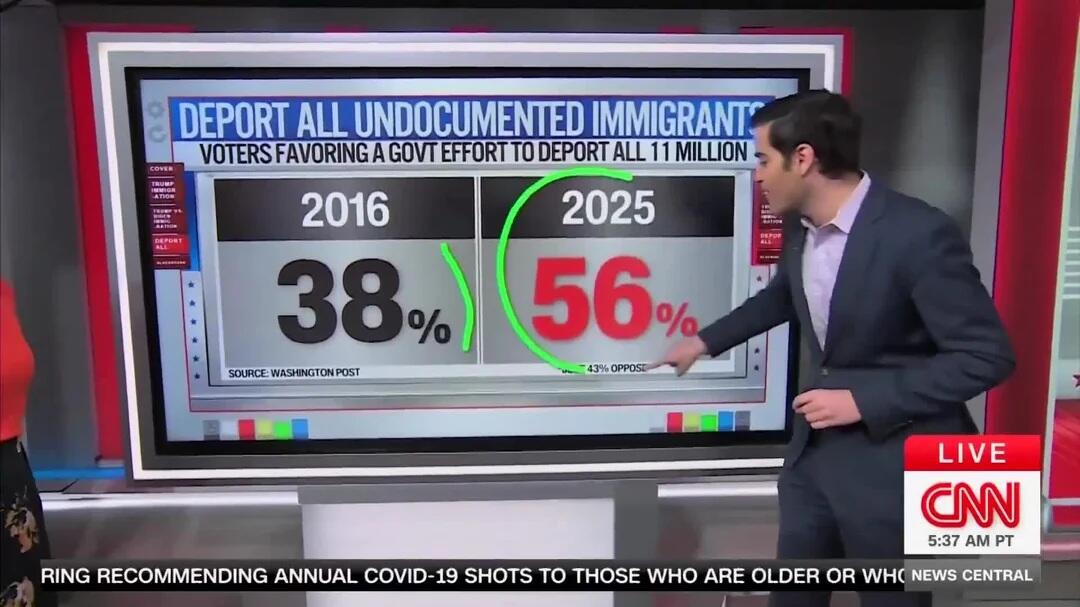
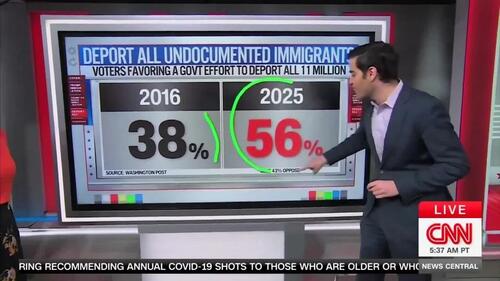
This is the prevailing position of most Americans, as CNN recently discovered in a segment which outlined a series of different polls from different media outlets. All of the polls say the same thing, around 55% to 65% of the US public wants mass deportations of illegal immigrants without question and without qualification. If they are not an official citizen, then they must go.
Normie America has weighed in on mass deportations.
Between 55% to 64% want ALL illegals deported. No exceptions.
Don’t let the anti-ICE thugs fool you. They are for chaos, criminals, and corruption. They are against democracy, the rule of law, and YOU.pic.twitter.com/98ulHhFpCK
— Kyle Becker (@kylenabecker) January 27, 2026
The polling results expose a few inconvenient truths for Democrats and deportation critics. First, the public has not changed their stance on immigration since the elections. The stats on deportations are very similar to those taken in 2024.
Second, the NGO engineered chaos in cities like Minneapolis have not changed anything. Public opinion is not moving in favor of leftists. In other words, a small minority of activists are trying to override public policy on immigration and rule the country through insurgency.
Third, Americans are not buying into the rhetoric that just because a migrant has been in the US illegally for a long time, that means he or she deserves to stay. Just because a migrant obeyed the law after sneaking across the border, that does not mean they get to stay. The law is the law.
Finally, the overarching motivation of Americans who want deportations is not simply to reduce crime. As many surveys and polls have shown in the past, the public is also concerned about the economy, price inflation caused by high demand, tax dollars being devoured by migrants seeking welfare handouts, not to mention millions of American jobs going to foreigners who work for 30% less under the table.
Then there’s the US census and the fact that mass immigration affects voting districts in favor of Democrats cities and states.
And above all else, there’s the agenda to erase western culture and replace it with a multicultural, globalist socialism. The root purpose behind mass immigration from the third world is to deconstruct the west. People are waking up to this reality, and they’re not going accept it.
Tyler Durden
Wed, 01/28/2026 – 18:20

¿Cómo se eligen a los miembros del Salón de la Fama del Fútbol Americano Profesional?
Por JOSH DUBOW
El supuesto desaire a Bill Belichick por parte del Salón de la Fama del Fútbol Americano Profesional, a pesar de haber ganado un récord de seis títulos de Super Bowl como entrenador en jefe, ha puesto bajo escrutinio el proceso de selección de los miembros del recinto de los inmortales.
Aunque se desconocen las razones específicas por las que Belichick no ingresó al Salón en su primer año de elegibilidad, hay algunas posibles explicaciones de por qué al menos 11 de los 50 votantes no eligieron a uno de los entrenadores más exitosos del deporte.
El papel de Belichick en el escándalo conocido como “Spygate” en 2007 podría haber tenido un impacto similar en su candidatura al que los esteroides han tenido en el Salón de la Fama del béisbol, manteniendo a estrellas como Barry Bonds y Roger Clemens fuera de Cooperstown.
Los cambios en las reglas que entraron en vigor el año pasado por el Salón de la Fama también podrían haber influido, incluyendo la posible frustración de algunos votantes por la decisión de eliminar el período de espera de cinco años para los entrenadores, lo que hizo que Belichick fuera elegible después de estar fuera solo una temporada como entrenador de la NFL.
Los cambios también hicieron más difícil para cualquiera —incluido Belichick— el ingresar al recinto, como lo demuestra el hecho de que solo cuatro personas fueron votadas el año pasado, la clase más pequeña en 20 años. Ahora los entrenadores compiten directamente con los jugadores en la categoría de veteranos en lugar de ser evaluados por separado.
Aquí hay un vistazo a cómo las nuevas reglas han impactado la votación:
¿Cómo se convierten los entrenadores en finalistas?
Además de eliminar el período de espera de cinco años, los entrenadores también fueron separados de los contribuyentes en términos de convertirse en finalistas. Un comité de expertos reduce el número de entrenadores a un finalista, y Belichick fue el elegido este año. El único entrenador fue agrupado con un contribuyente, que fue el propietario de los Patriots, Robert Kraft, y tres jugadores veteranos que no han jugado en las últimas 25 temporadas. Ken Anderson, Roger Craig y L.C. Greenwood son los finalistas este año.
¿Qué pasa con los jugadores de la era moderna?
El grupo más grande de finalistas proviene de la categoría de la era moderna, con 15 jugadores seleccionados después de un proceso de reducción de nominados que comienza con un comité de selección que elige a 50. El comité de selección completo de 50 personas reduce eso a 25 semifinalistas y luego a 15 finalistas, con cualquier jugador que haya llegado a los últimos siete y que no haya ingresado el año pasado teniendo garantizado un lugar en los últimos 15.
¿Quiénes son los votantes?
El comité de selección consta de 50 votantes, con 32 elegidos como representantes de los medios de cada equipo y el resto compuesto por votantes generales, incluidos algunos miembros del Salón de la Fama como Bill Polian, Tony Dungy, Dan Fouts y James Lofton. Todos los votantes participaron en una videoconferencia a principios de este mes, con un votante haciendo una presentación y luego permitiendo que otros ofrecieran sus opiniones en un debate. La votación se realiza mediante voto secreto, y los resultados se anuncian el 5 de febrero en el evento “NFL Honors” en San Francisco.
¿Cómo ingresa alguien?
El umbral para ingresar al Salón es del 80% — se requieren 40 de los 50 votos—, pero no es tan simple como una votación de sí o no.
Antes de los cambios en las reglas del año pasado, se seleccionaban cinco finalistas de la era moderna para una votación de sí o no, así como los finalistas veteranos y cualquier entrenador o contribuyente que llegara a la etapa final. Eso típicamente llevaba a que cinco jugadores de la era moderna ingresaran, con la mayoría —pero no todos— de los veteranos, entrenadores y contribuyentes también ingresando.
Ahora, es mucho más difícil.
Los votantes reducirán la lista de candidatos de la era moderna de 15 a diez y luego a siete. Se llevará a cabo una votación final para esos siete, y cada votante podrá votar solo por cinco jugadores. Si algunos candidatos como Drew Brees y Larry Fitzgerald obtienen un amplio apoyo, eso dejaría menos votos disponibles para cualquier otro candidato potencial en los últimos siete para alcanzar el 80%. Eso llevó a que solo tres jugadores de la era moderna —Eric Allen, Jared Allen y Antonio Gates— ingresaran el año pasado.
Es un proceso similar para los veteranos, entrenadores y contribuyentes. Los votantes pueden votar solo por tres de los finalistas definitivos, con el que obtenga más votos y cualquier otro que obtenga el 80% de apoyo ingresando al Salón. Sterling Sharpe fue la única persona que alcanzó ese umbral el año pasado del grupo de finalistas, mientras que los jugadores Maxie Baughan y Jim Tyrer, el entrenador Mike Holmgren y el contribuyente Ralph Hay no lo lograron.
___
Deportes AP: https://apnews.com/hub/deportes

DOJ Announces 31 New Indictments in Alleged Tren de Aragua ATM ‘Jackpotting’ Scheme
DOJ Announces 31 New Indictments in Alleged Tren de Aragua ATM ‘Jackpotting’ Scheme
Authored by Joseph Lord via The Epoch Times,
The Department of Justice (DOJ) on Jan. 26 said that a grand jury had returned an additional indictment against 31 people allegedly involved in a scheme to steal millions of dollars from ATMs through the use of malware.
“This indictment alleges 32 counts including conspiracy to commit bank fraud, conspiracy to commit bank burglary and computer fraud, bank fraud, bank burglary, and damage to computers,” the DOJ said in a statement.
These individuals join 56 others who have already been charged in connection with the case, bringing the total number charged to 87.
According to the DOJ, the 87 people are “Venezuelan and Colombian nationals including illegal alien Tren de Aragua (TdA) members.”
The DOJ said the alleged conspiracy “developed and deployed a variant of malware known as Ploutus, which was used to hack into ATMs and force ATMs to dispense cash.”
According to the additional indictment, members of the conspiracy would conduct reconnaissance and take notes of security features at targeted banks and ATMs. After initially removing the hood or door of an ATM, they allegedly waited nearby to see whether the action had triggered an alarm or alerted law enforcement.
After confirming no immediate response, the members of the conspiracy allegedly removed the ATM hard drives directly, replacing them with one pre-loaded with Ploutus malware, or connecting an external device such as a thumb drive to deploy the malware.
“The Ploutus malware’s primary purpose was to issue unauthorized commands associated with the Cash Dispensing Module of the ATM in order to force withdrawals of currency,” the DOJ said.
“The Ploutus malware was also designed to delete evidence of malware in an effort to conceal, create a false impression, mislead, or otherwise deceive employees of the banks and credit unions from learning about the deployment of the malware on the ATM.”
The indictment is the latest in an expanding investigation into so-called ATM jackpotting, following an Oct. 21 filing related to the case.
That indictment charged 32 individuals and alleged 56 counts, including one count of conspiracy to commit bank fraud, one count of conspiracy to commit bank burglary and computer fraud, 18 counts of bank fraud, 18 counts of bank burglary, and 18 counts of damage to computers.
Another indictment returned on Dec. 9 charged 22 individuals. The charges in that indictment included 13 counts of conspiracy to provide material support to terrorists, 10 counts of conspiracy to commit bank fraud, 10 counts of conspiracy to commit bank burglary and fraud, and related activity in connection with computers, and 22 counts of conspiracy to commit money laundering.
The indictment alleged that Tren de Aragua “used jackpotting to steal millions of dollars in the United States and then transferred the proceeds among its members and associates to conceal the illegally obtained cash.”
Attorney General Pam Bondi said in a Jan. 26 statement that Tren de Aragua is a complex terrorist organization that commits “serious financial crimes in addition to horrific rapes, murders, and drug trafficking.”
“This Department of Justice has already prosecuted more than 290 members of Tren de Aragua and will continue working tirelessly to put these vicious terrorists behind bars after the prior administration let them infiltrate our country,” Bondi said.
The DOJ said that if convicted, the defendants in the Jan. 26 indictment face maximum prison terms ranging from 20 years to 335 years.
Tyler Durden
Wed, 01/28/2026 – 18:00
Waukegan woman’s Holocaust speech touches on cousin Einstein
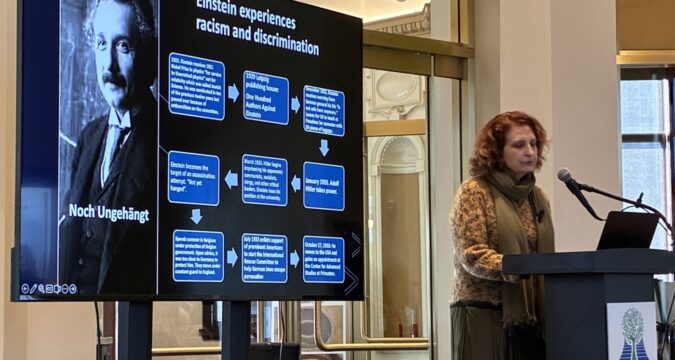
As longtime Waukegan resident Karen Glinert Carlson, the daughter and granddaughter of Holocaust survivors, told how a cousin — Albert Einstein — helped save her family, she paused for a moment to compare 1930s Nazi Germany to contemporary America.
Spending significant time in Germany researching her family’s history over the last eight years, Carlson talked about the few who survived, and the scores who were murdered. Growing up in the Sauganash neighborhood of Chicago, her only family was her parents and brother.
She talked about how Jews were stripped of their rights, their property and their citizenship in Nazi Germany. German Chancellor Adolf Hitler not only changed the laws but also removed all opposition, she said. The first concentration camp prisoners were those who opposed him.
“It is said history repeats itself,” Carlson said. “Mark Twain said, ‘History does not repeat, but it rhymes.’ We are living in precarious times. What can we learn from history? What can we learn from Einstein? What might he do today? What can we do?”
She talked about her family history, the role her cousin Einstein played in saving who he could and more during an International Holocaust Remembrance Day talk Tuesday at the Waukegan History Museum at the Carnegie, sharing her story with more than 60 in attendance.
International Holocaust Remembrance Day was established by the United Nations General Assembly on Nov. 1, 2005, commemorating the liberation of the Auschwitz-Birkenau Death Camp in Poland on Jan. 27, 1945.
More than 60 people listened to Karen Glinert Carlson share the story about how Albert Einstein saved her family from the Nazi Holocaust during International Holocaust Remembrance Day on Tuesday in Waukegan. (Steve Sadin/For the Lake County News-Sun)
Though Carlson does not know what Einstein — her grandmother’s first cousin, making him “my first cousin twice-removed” — she knows how he felt and what he did about racism in the United States.
“He felt what he saw about the treatment of Black people in America was like how the Jews were treated in Germany,” Carlson said of Einstein, who said in 1955 that “He helped a lot of Black people.”
Seeing parallels between the treatment of Jews in Nazi Germany and how some of her Waukegan neighbors who immigrated from Latin America have been treated recently, Carlson said she is uncomfortable with what is happening.
“For me, ‘deportation’ is a trigger word,” she said. “People who came here and followed the rules are being deported. That’s what happened to so many members of my family under the Nazi regime who were never heard from again.”
Karen Glinert Carlson shares the story about how Albert Einstein saved her family from the Nazi Holocaust during International Holocaust Remembrance Day talk on Tuesday in Waukegan. (Steve Sadin/For the Lake County News-Sun)
When her mother left Germany for the U.S., Carlson said Einstein was her sponsor, something all immigrants needed at the time. He did the same for her maternal grandparents and four other family members. Her grandparents were forced to take the long route to the U.S. through Siberia, Korea and Japan.
“When they landed in San Francisco, there was a large crowd at the dock,” she said, “People there learned Einstein was the sponsor of someone on the ship, and my grandmother was interviewed about her famous cousin.”
As a child, Carlson said she had no idea her parents escaped the Holocaust or that they were Jewish. All she knew was they had European accents. Only English was spoken at home. They did not talk about their past. However, during her childhood, there were a few hints.
“My teacher asked why I was in school one day,” Carlson said, not understanding the question. “I came home from school, and my father was not at work. My mother said, Be quiet.’ He was in the basement praying and fasting,” she added, not mentioning it was Yom Kippur. “There were New Year’s cards on the table.”
While a freshman at Von Steuben High School in Chicago, Carlson said she got another hint. A boy who wanted to date her — she liked the idea — asked if she was Jewish, explaining he could only date Jewish girls.
“I asked my mother if I was Jewish, and she said, ‘You’re half-Jewish. Your father is Jewish,” Carlson said. “I told the boy I was half-Jewish. ‘My father is Jewish.’ He said, ‘Wrong half.’ We never dated.”
As a junior in high school, Carlson said students learned about World War II and the Holocaust. She asked her parents if it was true. She got a three-word answer.
“Read the book,” Carlson said. “I had no idea the Holocaust had anything to do with me.”
On her 18th birthday, Carlson said her parents told her she was 100% Jewish. Now she was an adult, and it was up to her to decide what she wanted to be.
After finishing high school, she said she participated in a program in Mexico helping people. She learned Spanish and developed strong feelings about the Latino culture. When she returned, she began studies at Northwestern University, becoming an educator, including time as an administrator in the Waukegan Public Schools.
Along with her mother and grandparents, Carlson said Einstein helped save four other family members. He did the same for dozens of colleagues and friends. Upon her arrival in the U.S., Carlson said her mother lived in Einstein’s home in New Jersey for a period of time.
Already a Nobel Prize winner — he won the award in 1921 — Einstein was a renowned scientist and mathematician when the Nazis came to power in Germany. He taught at the California Institute of Technology during the summers. Before he left in 1932, Carlson said there was a knock on his door.
“It was an officer,” she said. “He told him, ‘I understand you’re leaving the country. Don’t come back. You will not be safe here if you do.’”
Starting in 2018, Carlson said she began spending more and more time in Ulm, Germany, and other parts of Europe learning about both her mother’s and father’s families. Ulm was Einstein’s birthplace. She was involved in the dedication of a museum honoring Einstein and other members of the city’s Jewish community.
Toward the end of her talk, Carlson said it was also a time to remember those who did not survive the Holocaust and World War II. In all, approximately 65 family members were killed by the Nazis, she said.
https://www.chicagotribune.com/2026/01/28/holocaust-remembrance-day/
South Side residents protest rejection of Quantum Shore nonbinding referendum
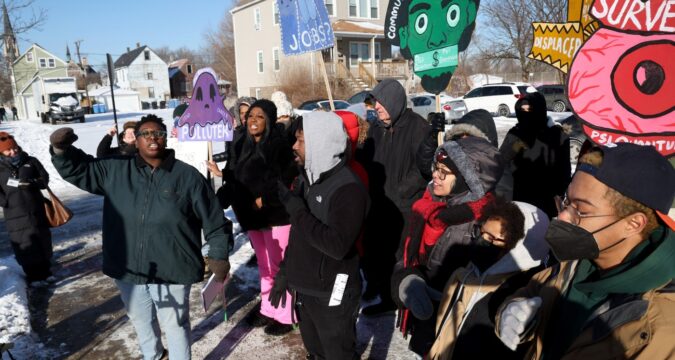
On a brisk Wednesday morning, South Side residents gathered outside New Sullivan Elementary School to demand their voices be heard about a major development rising just across the street: Quantum Shore Chicago.
“No quantum facility, invest in community,” demonstrators chanted.
New Sullivan Elementary will serve as a polling site for the March primary election, where Chicagoans can vote on a variety of federal, state and local races. For over 300 South Side residents, however, one question they hoped to see on the ballot will be missing.
Southside Together, a local activist group, proposed a nonbinding referendum asking whether Ald. Gregory Mitchell, Ald. Peter Chico, Mayor Brandon Johnson and Gov. JB Pritzker should halt the multibillion-dollar Quantum Shore project on the former South Works site.
On Jan. 13, the Chicago Board of Elections rejected the petition, citing problems with the phrasing of the question.
“I’m being told that I can’t even vote to express my opinion on a project in my backyard using my taxes,” said Stephanie Williams, a lifelong South Chicago resident and member of Southside Together who spoke at Wednesday’s demonstration.
Organizers argued that investors influenced the decision.
“Our opposition paid lawyers to challenge our referendum and remove it from the ballots, saying that the question was too confusing,” Williams said. “I, and over 300 of my neighbors, understood it and signed it.”
According to Board of Election spokesperson Max Bever, the board rejected the question because it contained too many propositions. Illinois election law allows only one distinct question per referendum.
“The Illinois election code can be complicated, and even good faith efforts can fall by the wayside,” Bever said.
He compared the case to the 2024 Bring Chicago Home case, which faced similar challenges over questionable phrasing.
In Southside Together’s proposed language, voters were asked whether elected officials should stop the Quantum Shore development because it could lead to displacement, further pollution and higher energy bills, and because it was proposed without community consent despite costing billions in taxpayer dollars.
Organizers say the massive development, which spans three Chicago precincts, is already driving up rent, property taxes, utility and water bills for a community long burdened by legacy pollution.
Williams said she’s seen her own property taxes increase by $1,000 since the Quantum Shore broke ground.
“This facility will use enough power for a third of a nuclear power plant that’s going to be offloaded into our electricity bills, just like data centers around this country,” said Akele Spencer, a lifelong Pill Hill resident and new homeowner who also spoke at the rally. “We don’t need a quantum facility in our community. … We need resources that uplift our community so that we don’t have to leave to go get what we need.”
The referendum question was intended to elevate community concerns about the Quantum Shore project and provide residents their first formal opportunity to voice opposition on the estimated $9 billion project.
Nonbinding referendums are rarely rejected, said Bever, making this case unusual.
“This is something that we just generally do not see, but have to follow the same type of process, and it’s something that can be frustrating for proponents, especially when it is a nonbinding referendum question,” Bever said.
Local precinct referendum questions are more often rejected due to insufficient signatures, but that wasn’t the case here. Having over 329 signatures, the petition met the board’s requirements, said Bever.
“What’s the problem with allowing people to vote?” Williams said. “They don’t want us to have a say in what’s happening in our own neighborhoods, and they never have.”
The Quantum Shore Chicago campus construction site on Jan. 28, 2026. (Antonio Perez/Chicago Tribune)
This rejected referendum comes as other South Side advocacy groups continue to push for a community benefits agreement with the Quantum Shore developers.
Bever advised organizers to hire an election attorney and appeal the decision in court, but Southside Together organizers said the cost is prohibitive for local grassroots groups like theirs.
Organizers can also resubmit the petition for the November election, but would need to collect signatures again. Bever noted that voter turnout is typically higher in November and encouraged the organizers to try again.
For Williams, Spencer and other organizers, waiting is not an option.
On March 7 at noon, Southside Together plans to host its own community referendum on the matter and will invite lawmakers and the mayor to attend.
“Proponents of this facility wouldn’t spend money to prevent residents from voting on a nonbinding referendum unless they were scared of our ability to stop the project,” Spencer said. “Our community deserves to have our voices shared, to be received and heard. We will not be overlooked.”
https://www.chicagotribune.com/2026/01/28/south-side-quantum-campus-referendum/
Tesla Surges After Reporting $2BN Investment In xAI, Stronger Than Expected Profit
Tesla Surges After Reporting $2BN Investment In xAI, Stronger Than Expected Profit
Going into Tesla earnings, we wrote in our preview that Morgan Stanley saw a “particularly wide dispersion in financial KPIs into the 4Q print and for 2026.” The bank said that the stock reaction will depend on the incrementality of updates around scaling robotaxi/Cybercab, launching Unsupervised FSD, Optimus Gen 3, and AI5 on the earnings call.
It is no secret, that the automotive business remains Tesla’s biggest challenge: vehicle deliveries have fallen sharply in the fourth quarter, and the loss of key tax credits, rising competition, and heavier use of discounts have all weighed on demand and margins. Analysts are closely watching automotive gross margin, excluding regulatory credits, as a measure of Tesla’s true pricing power. Many expect it to come in near 14% to 15%, down from recent quarters. This reflects a reality that Tesla is no longer operating in a wide-open EV market and must now fight harder for every sale.
In contrast, Tesla’s energy division is widely expected to be a bright spot. While auto sales have faced headwinds, energy storage deployments hit a record high last quarter at 14.2 gigawatt hours. Energy storage is still a relatively small part of the business, but it continues to be the sleeper hit for a company not known primarily for its batteries. The company continues to see strong demand for its Megapack battery systems, especially from data centers and AI companies building out massive computing infrastructure. Tesla deployed a record amount of energy storage during the quarter, and analysts expect revenue from the segment to approach $4 billion, up more than 20% from a year ago. Some analysts believe this business could become a steady, high-margin growth engine over time, helping offset weakness in car sales.
Robotics and artificial intelligence remain more speculative but are central to Tesla’s long-term story. Optimus, the company’s humanoid robot, is still largely in the prototype stage, but investors are eager to hear whether it is getting closer to real production.
Analysts also want updates on manufacturing readiness, cost, and practical use cases inside Tesla’s factories. Elon Musk has said he expects robot sales to begin next year, but his history of aggressive timelines makes many on Wall Street cautious.
The biggest wild card, however, is robotaxis and full self-driving technology. Tesla has begun limited unsupervised rides in Austin, removing safety drivers in some vehicles, which Musk has called a major milestone. Analysts are watching closely to see how quickly Tesla can expand this service to other cities and whether regulators will allow broader use.
It’s no surprise, then, why Tesla wants this quarterly report to be a story about robotaxis and robots. And lot of investors have already bought in to that framing, assigning a good chunk of the company’s present and future valuation to its AI-driven products. But selling electric vehicles to consumers and regulatory credits to automakers pays the bills today.
It’s worth noting therefore, with a potential $1 trillion pay package approved by Tesla shareholders in the quarter the company is about to report, the board needs Musk to sell cars. One of the targets set for Musk over the term of the package is to sell 20 million EVs. In the time he has left, that requires him to average 500,000 a quarter. Last quarter, Tesla delivered about 418,000.
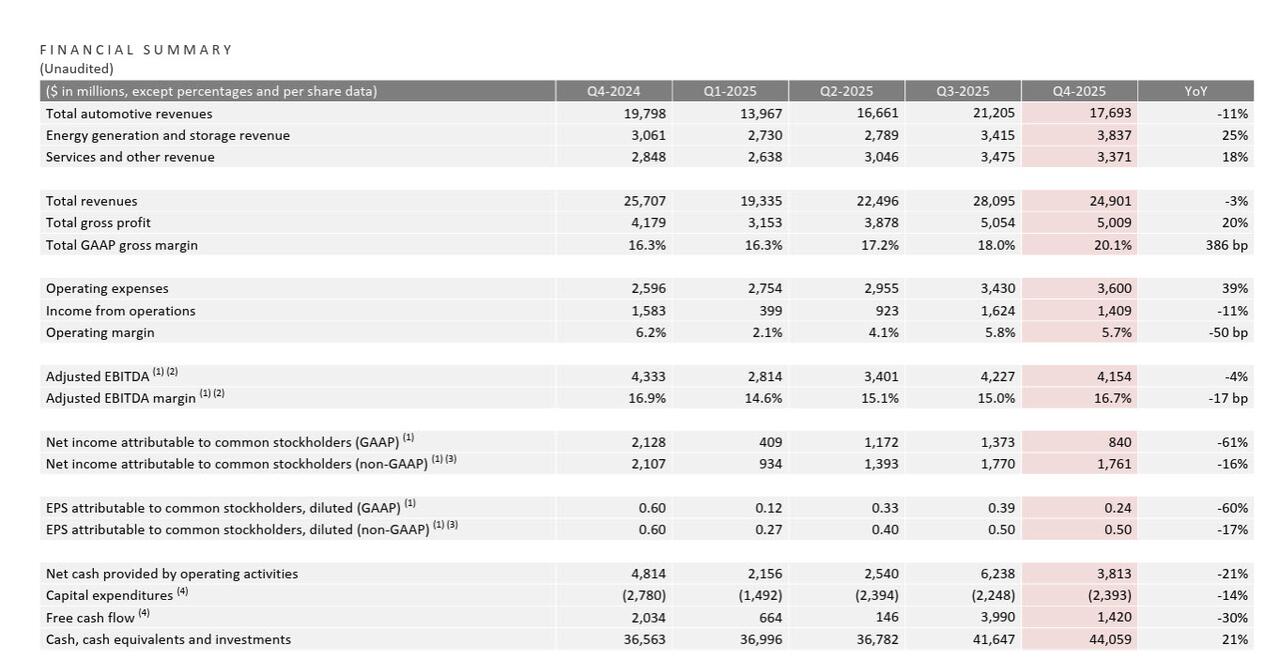
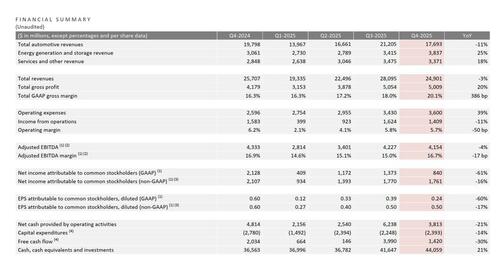
With all that in mind, here is what Tesla reported for Q4 2025:
Adjusted EPS 50c vs. 73c y/y, beating estimates 45c
Revenue $24.90 billion, -3.1% y/y, missing estimate $25.11 billion
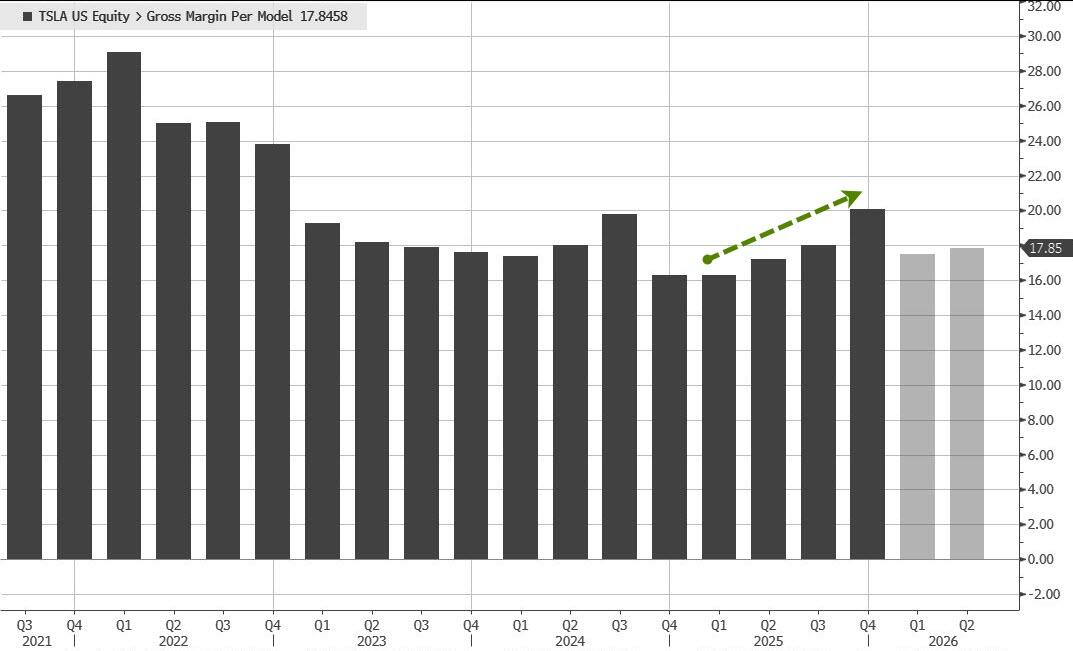
Gross margin 20.1% vs. 16.3% y/y, beating estimate 17.1%
Operating income $1.41 billion, -11% y/y, beating estimate $1.32 billion
Free cash flow $1.42 billion, -30% y/y, missing estimate $1.59 billion
Capital expenditure $2.39 billion vs. $2.78 billion y/y, below estimates of $2.83 billion
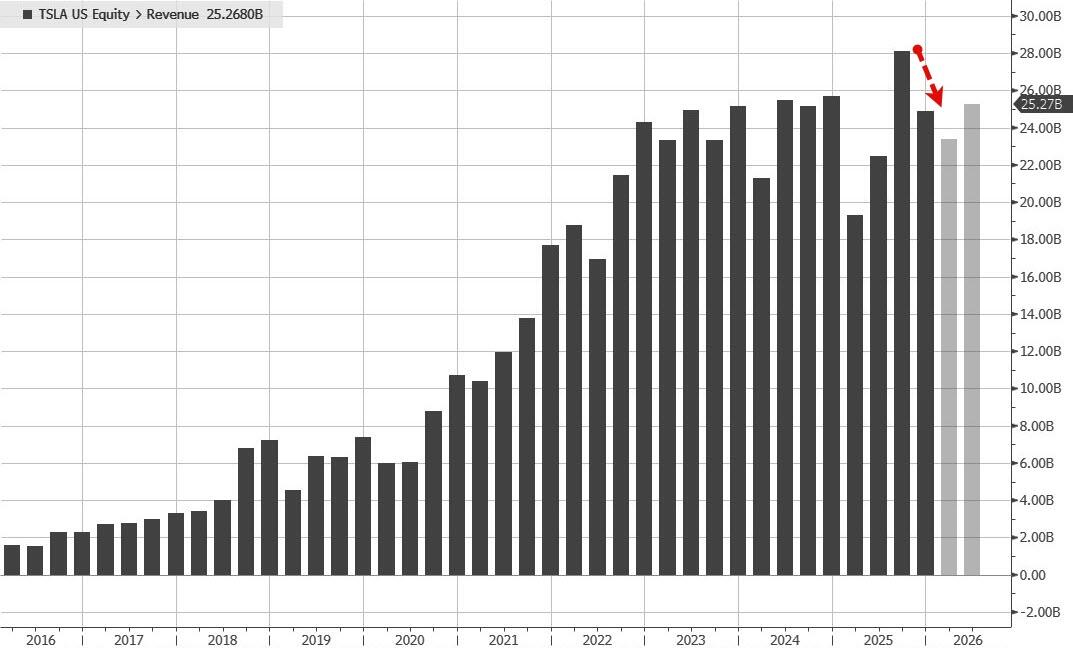
While TSLA sales have gone nowhere for years now, and 2025 even saw the first drop in full-year revenues (down 3%)…
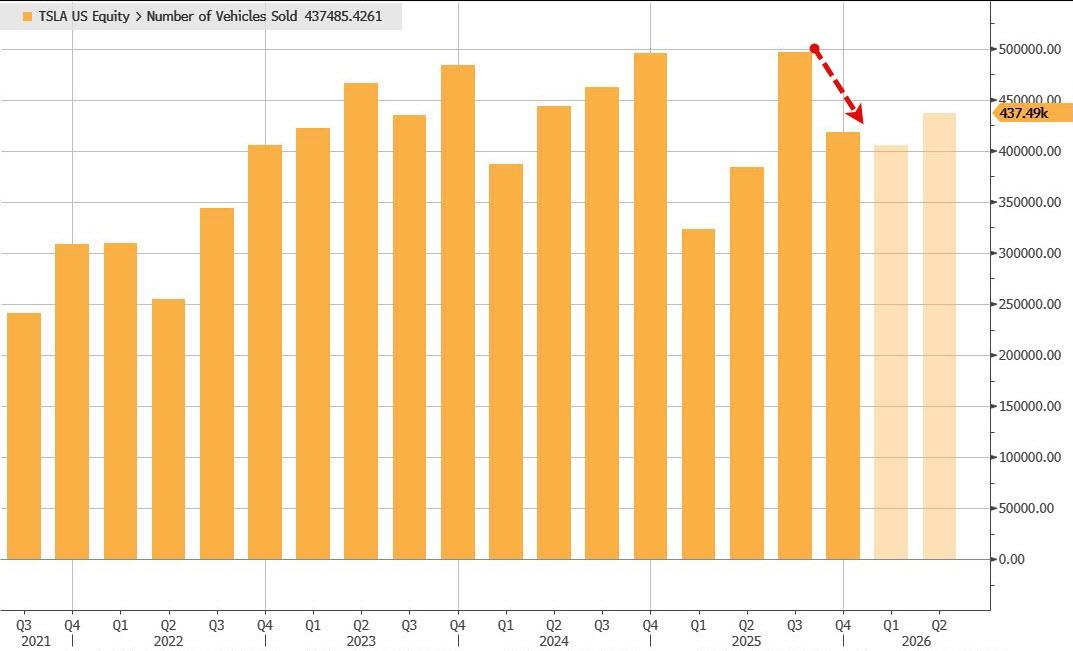
… and automotive sales declined sequentially as global vehicle inventory (days of supply) grew to 15 days, up from 10 days at the end of 3Q (as consumers raced to take advantage of expiring federal tax credits at the end of 3Q)…
… agross margin (when excluding the impact of regulatory credits) improved as TSLA continued the rollout of Model Y variants across markets in Q4, including the standard and performance versions.
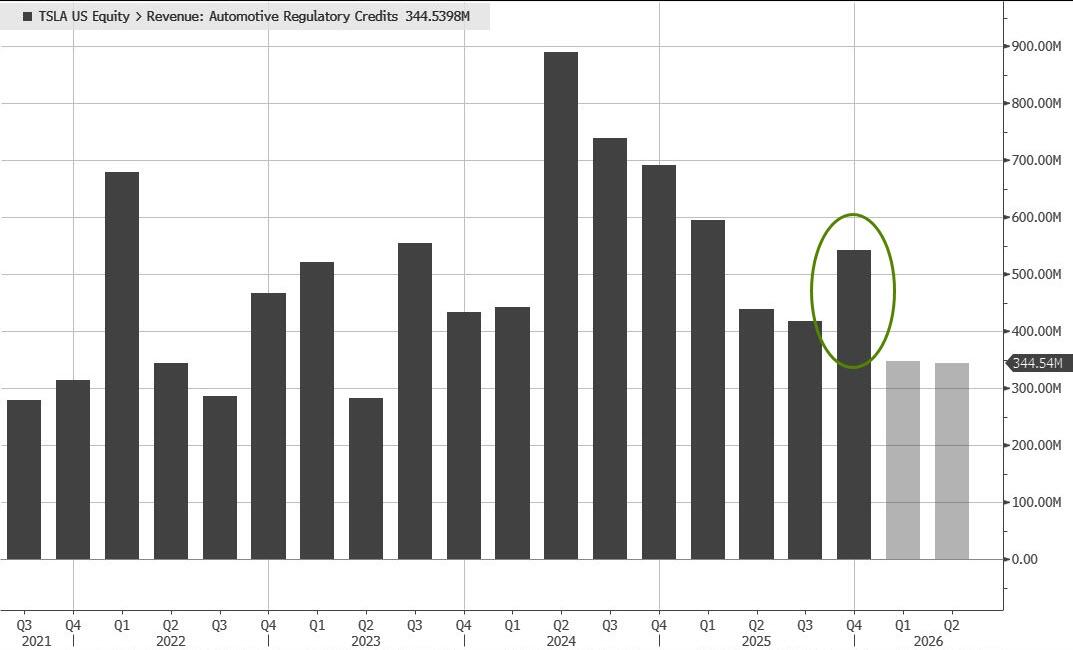
The better-than-expected profit is a positive sign as Tesla navigates lower EV demand and pivots to robotics and autonomy products. Musk has previously warned the company faces a rough patch while it works on these new priority areas. Rising profits are especially important since regulatory credit revenues will continue to decline, even if Q4 enjoyed a transitory jump.
As Ivan Feinseth, CIO at Tigress Financial Partners writes, Tesla “delivered a narrow beat on lowered expectations” noting that “EV deliveries declined and margins stayed compressed, keeping the legacy auto outlook challenging. At the same time, the quarter sharply advanced the ‘physical AI’ narrative.”
He added that the update is “positioning robotaxis, FSD, and Optimus as the key long‑term value drivers beyond cars.” The jury is still out on how valuable/profitable all those long shots will end up being.
Some of the more notable comments from the investor letter:
To Invest Further in Clean Transport Infrastructure
To Invest Further in Autonomous Robots Infrastructure
To Ramp Six New Production Lines Across Products
Cybercab, Tesla Semi and Megapack 3 are on schedule for volume production starting in 2026. First generation production lines for Optimus are being installed in anticipation of volume production.
Tesla also said that preparations continue in North America for the production ramps of Tesla Semi and Cybercab, both commencing 1H26, and production of the next-generation Roadster.
The company also “made further progress on the Optimus program in 2025. In Q1 of this year” and plans to unveil the Gen 3 version of Optimus, which will include major upgrades from version 2.5, including our latest hand design. The Gen 3 is our first design meant for mass production. Preparations are underway for the first production line, including supply chain readiness, with start of production planned before the end of 2026 and eventual planned capacity of 1 million robots per year.
Turning to energy, Tsla achieved its highest quarterly energy storage deployments, driven by record Megapack deployments. Total gross profit rose, both sequentially and year-over-year, to a record $1.1 billion, marking the fifth consecutive record quarter. Tesla plans to begin Megapack 3 and Megablock production at Megafactory Houston in 2026.
In 2025, the company’s global Powerwall network supported more than 89,000 Virtual Power Plant events across over 1 million installed units, allowing homeowners to save over $1 billion in electricity bills as Virtual Power Plant participation continues to scale rapidly.
While earnings were mediocre at best, and relied entirely on narrative and Musk’s vision, perhaps the biggest news was that Tesla made an investment in xAI, Musk’s AI company. In the deck, Tesla says:
On January 16, 2026, Tesla entered into an agreement to invest approximately $2 billion to acquire shares of Series E Preferred Stock of xAI as part of their recent publicly-disclosed financing round. Tesla’s investment was made on market terms consistent with those previously agreed to by other investors in the financing round…. Together, the investment and the related framework agreement are intended to enhance Tesla’s ability to develop and deploy AI products and services into the physical world at scale.
The investment underscores the deepening ties between Musk’s business interests and highlights Tesla’s growing focus on AI. The EV maker has been increasingly emphasizing AI, driverless technology and humanoid robots as its traditional business of selling automobiles has struggled.
In November, Tesla’s board said it would look further into the investment after investors didn’t formally approve it in a vote at the annual shareholders meeting. The two companies already work together. Tesla sells megapacks to xAI and xAI’s Grok chatbot is integrated into some Tesla vehicles. Bloomberg also reported that xAI told told investors that its aims to build AI that will eventually power humanoid robots such as Optimus.
This little factoid buried at the end of the investor letter is what sent the stock sharply higher after hours (after it dumped in kneejerk response at first). An investment in xAI, and leverage of its work in AI, is what a lot of Tesla shareholders have been calling for. Those that advocated for the idea saw it as a way for Tesla to accelerate progress in humanoid robotics and autonomous driving. But there’s plenty of bullish Tesla followers concerned over that. AI development is capital intensive — in xAI’s case many billions of dollars — and some wonder for how long Tesla might be holding the bag on those losses.
While we wait for the mamangement call, the sell-side analyst notes are rolling in. This is what Ben Kallo of R.W. Baird wants to know on the call:
Key points we are monitoring include:
Timing of product ramps for production of Cybercab/Semi/Megapack 3
Updates on early driver-out robotaxi runs
Cadence of potential Europe and China robotaxi approvals
Margin impacts to Automotive & Energy from rise in lithium prices
Demand signals for the post consumer credit environment in the US
Meanwhile, Matt Maley, chief market strategist for Miller Tabak + Co., said that though Tesla beat consensus estimates, it was the $2 billion xAI investment is what’s pushing the stock higher. “If Tesla is going to do as well as the bulls are thinking, it’s going to be with the Robotaxi and robotics. So, this investment is exactly what the bulls wanted to hear.”
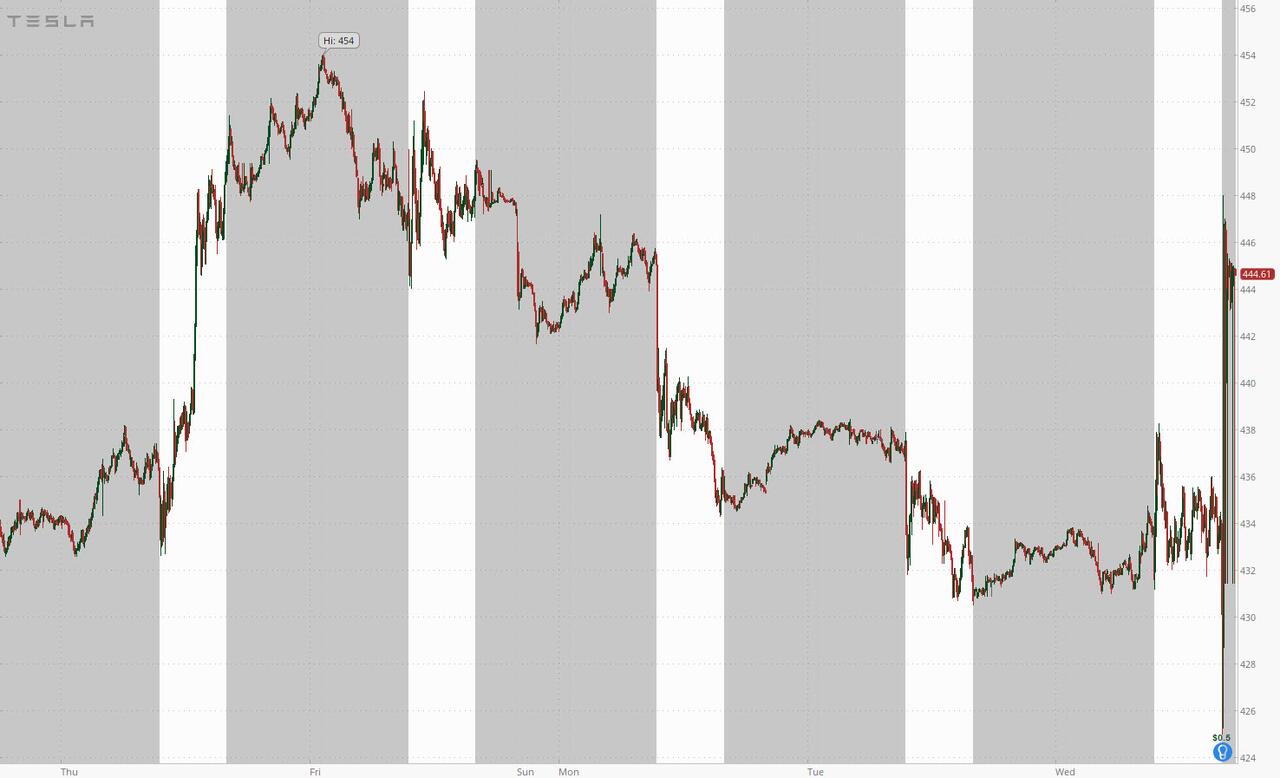
And indeed, after initially dumping after hours, TSLA stock has since managed to rebound and is now trading near session highs…
… up about 3% in postmarket trading, which is a significantly muted move compared with the 5% in either direction that options traders were pricing in. Still, if that move holds through the end of regular trading tomorrow, it will be larger than the stock reaction seen after the third-quarter results came out in October.
Tyler Durden
Wed, 01/28/2026 – 17:35
Fallecen 15 personas en accidente de avioneta en Colombia, incluido congresista, confirman autoridades
BOGOTÁ (AP) — Fallecen 15 personas en accidente de avioneta en Colombia, incluido congresista, confirman autoridades.
Fugitive ex-Loretto Hospital exec Anosh Ahmed arrested in Serbia on fraud charges
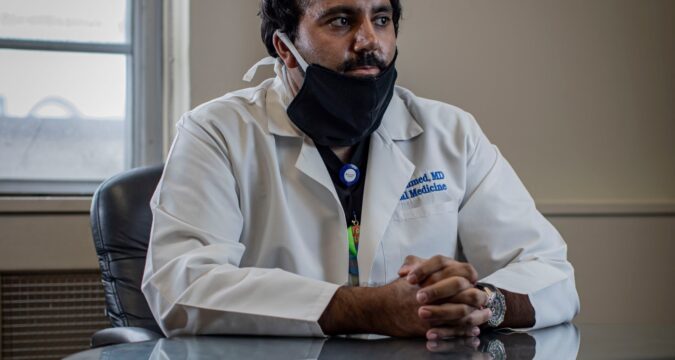
Fugitive former Loretto Hospital executive Anosh Ahmed, who fled to Dubai before his indictment on massive fraud charges, has been arrested in Serbia and is awaiting possible extradition to stand trial in Chicago, federal prosecutors disclosed in a court filing Wednesday.
Ahmed, Loretto’s onetime chief financial officer, was indicted in 2024 on charges he stole more than $15 million from the small, West Side safety net facility in a phony billing scheme.
Last year, he was charged in a separate case alleging a massive $290 million fraud scheme that allegedly used stolen patient data to bill nearly a billion dollars worth of bogus COVID-19 tests for purportedly uninsured patients at the height of the pandemic.
By the time of the first charges, were filed, Ahmed had fled to Dubai, where he’s since waged a bizarre public relations campaign touting himself as, among other things ,a Chicago-based entrepreneur determined to break the cycle of poverty by bringing high-tech jobs to the city’s historically underserved West Side.
Ahmed has been declared a fugitive. Meanwhile, a trial for two of his co-defendants in the COVID-19 fraud case had been set for June.
In a motion filed Wednesday, Assistant U.S. Attorney Sheri Mecklenburg revealed the U.S. was told on Nov. 30 that Ahmed had been arrested in Serbia pursuant to a “Red Notice,” which is a global alert seeking his arrest on a national warrant. A Serbian court later denied Ahmed’s petition to be released to a hotel in Belgrade and ordered he remain in custody, according to the filing.
Last week, the U.S. last week sent its package requesting Ahmed’s extradition to the U.S. to stand trial, which is pending, Mecklenburg said.
“The United States will advise the Court of any updates and may ask for a continuance of the trial date to serve the interests of trying all defendants together and preserving resources to avoid having to try the case twice,” she wrote.
A lawyer for Ahmed could not immediately be reached for comment Wednesday.
Loretto Hospital became a lighting rod of controversy during the coronavirus pandemic for administering vaccinations to connected insiders and paying millions in contracts to companies with close ties to facility administrators.
In 2021, following reporting by Block Club Chicago and WBEZ, Loretto admitted it had improperly vaccinated workers at Trump Tower in downtown Chicago and had also improperly given shots to Cook County judges at a time when the vaccines were still scarce.
Ahmed resigned from his position as chief financial officer in 2021 after the hospital’s board voted to terminate him.
Among those charged in the embezzlement case was former Loretto CEO George Miller; Heather Bergdahl, a friend of Ahmed’s from Houston whom he hired in 2020 to serve as Loretto’s chief transformation officer; and Sameer Suhail, 47, of Chicago, a doctor and medical supply company owner accused of serving as a front for millions of dollars in bogus payments by Loretto for invoices that were never fulfilled.
Miller, who left the hospital amid the fallout in 2022, is cooperating and is expected to plead guilty.
Suhail was also believed to be living in Dubai, where he traveled before his indictment. Bergdahl, meanwhile, was arrested after boarding a private jet in Houston that was bound for Dubai. She has pleaded not guilty and is awaiting trial.
jmeisner@chicagotribune.com
https://www.chicagotribune.com/2026/01/28/fugitive-ex-loretto-hospital-exec-anosh-ahmed-arrested/