


Posted in News

Trump’s SWIFT Hint And The Decline Of The Euro

Trump’s SWIFT Hint And The Decline Of The Euro

Submitted by Thomas Kolbe

In a post on Truth Social, US President Donald Trump indicates the imminent return of Russia to the SWIFT payment system. It would mark the end of sanctions against Russia. But the Prussians are not shooting that fast anymore.

Currency policy is geopolitics. This is especially true as soon as the US dollar is involved. And that is almost everywhere and at any time on the globe, no matter how often European and Chinese media sound the death knell over King Dollar. It may specifically be an annoyance to European politics and Beijing, but for the time being the US dollar remains the world’s leading and reserve currency, giving the United States the leeway to defend their market dominance while rolling their debt burden relatively smoothly into the future. 

Washington is working under high pressure not to let this monetary configuration change, at least for the moment.

In this context, one must interpret the Truth‑Social post by US President Donald Trump from the weekend: Trump indicated in a video that Russia is ready to return to the US‑regulated global financial system SWIFT.

In essence, Trump is saying that Russia has understood that SWIFT and the dollar represent the future – not the dream of a BRICS currency. Indeed, one has heard little from the BRICS project in recent years; it seems the two main actors, China and Russia, are failing to anchor a currency system that ultimately depends on the monetary credibility of Beijing and Moscow. Who would really be willing to hold large portfolio shares and cash reserves in a Chinese CBDC that is exposed to Beijing’s political whims?

Back to Truth Social: it is well known that the US president often behaves erratically in his media work. Yet this posting still offers an important clue as to the strategic line of American currency policy.

It is quite possible that the meeting of the two presidents, Donald Trump and Vladimir Putin, last year in Alaska marked the visible beginning of a gradual coordination of currency and energy policy between the United States, Russia and China. It fits this narrative that the US is again and again permitting Russia the sanction‑free sale of its oil in recent weeks and thereby signaling above all to Europe: ARC is real – America, Russia and China are coordinating their activities, not least on the energy markets.

And the strategy is lying quite openly on the table: in the context of the Iran conflict and precisely at a moment of scarcity on the energy markets, Washington granted Russia the sanction‑free sale of its oil through the sales channel of its shadow fleet. US Treasury Secretary Scott Bessent extended this special arrangement last week for another month in order to relieve pressure from the oil and gas price cauldron. That turns the spotlight on the question of how energy is factored globally, and which currency dominates. At this point, the full power of the dollar empire unfolds.

The lion’s share of invoicing is, of course, carried out in US dollars; somewhat more than eighty percent of global energy trade runs in US dollars.

The creditworthiness of the United States is still beyond doubt. And demand for US government bonds is currently higher than ever. The largest purchases of US government debt come from Great Britain, the EU and Japan. All three seek to ward off possible dollar shortages in a crisis. If flight to the greenback takes hold, these flows drive currency costs through the roof.

In addition, the attempt by European politics to use its own Euro currency to push into a potential vacuum left by the US dollar has failed. The ill‑considered power‑political escapism of Brussels and London prevented them from using the global bond markets via the euro lever as a kind of dumping ground for the enormous state debts of European countries.

In Europe, one has shot oneself in the knee 20‑times in a row with a torrent of sanctions packages against Russia, possibly once even in the head. Moscow was the dominant international customer whose energy transactions were willingly settled in euros, thus stabilizing demand for the common currency. Russia settled its entire gas trade with Europe in euros. But this is history.

The idea of the euro as a leading currency is now history; after European policymakers decided to put their economies on renewable “flutter power,” there is no turning back. Ideology has consequences, and this is particularly true for the currency market, which prices in national risks faster than others. For about three years now, the role of the euro in the international currency system has been eroding – slowly but steadily. Looking at a bloodless, over‑regulated and no longer internationally competitive European industry, this trend is unlikely to reverse in the foreseeable future.

At this point I want to restate my thesis from last year: the US dollar as the world’s reserve and leading currency will survive even during the transformation phase towards a multipolar order. At the same time, a new trade and negotiating balance will emerge between the United States and China. The fact that the United States will not be used as a pawn by Beijing in the future will be secured by the reordering of the Middle East, including control of the world’s most important maritime choke point, the Strait of Hormuz. The coming weeks and months will show who will dominate the geopolitical chessboard in this multipolar world.

For Europe there is one certainty: energy prices will, in the long run, settle on a higher plateau, ushering in an extended phase of inflation and industrial contraction.

About the author: Thomas Kolbe, a German graduate economist, has worked as a journalist and media producer for clients from various industries and business associations. As a publicist, he focuses on economic processes and observes geopolitical events from the perspective of the capital markets. His publications follow a philosophy that focuses on the individual and their right to self-determination

Tyler Durden
Sat, 04/25/2026 – 10:30

https://www.zerohedge.com/economics/trumps-swift-hint-and-decline-euro 

Posted in News

‘Cautious Optimism’ Amid Stalemated Pakistan Talks, Even As Iran FM Insists No Meeting Planned With US Side

‘Cautious Optimism’ Amid Stalemated Pakistan Talks, Even As Iran FM Insists No Meeting Planned With US Side

Summary

Iran denies that FM Abbas Araghchi’s trip to Pakistan will include new talks with US, rejecting reports that Trump is sent his negotiating team to restart negotiations.

24/7 shuttle diplomacy (via Al Jazeera): There’’ been shuttle diplomacy, and as one diplomat said, it’s been relentless diplomacy that has been put forward by Pakistan from all sides.

Iran’s military says finger on the trigger: “greater power & readiness than before.”

Pakistani mediators are “cautiously optimistic” despite it being clear negotiations have been at a stalemate.

US x Iran permanent peace deal by June 30, 2026?
Yes 53% · No 48%
View full market & trade on Polymarket

*  *  *

Iran Foreign Ministry Insists ‘No Meeting is Planned’ Even With US Delegation En Route

Not too much that’s new or bombshell happened overnight, with a second round of US-Iran negotiations still in limbo, but with the US delegation led by Witkoff-Kushner said to be departing Saturday or else en route. A small Iranian team has already been there since Friday, engaging the Pakistanis, also amid reports that they will submit a written presentation of their conditions for ceasefire and where things stand from Tehran’s point of view.

Iran has denied that Foreign Minister Abbas Araghchi’s trip to Pakistan will include new talks with Washington, rejecting reports that President Trump is sending envoys Steve Witkoff and Jared Kushner to actually restart negotiations. So once the US side arrives, it would be interesting to see what happens next. Potentially they could start in separate rooms with messages delivered, and thus the interaction would be indirect.

Foreign Ministry spokesman Esmaeil Baqaei said in a post on X early Saturday that “no meeting is planned to take place between Iran and the US” during the visit and that Tehran’s positions will instead be conveyed to Pakistan. Araghchi said earlier he is undertaking a “timely tour” of Islamabad, Muscat, and Moscow to “closely coordinate” with partners on bilateral issues and consult on regional developments. Iranian state media said the three-leg trip forms part of Tehran’s ongoing diplomatic push to secure an end to US-Israeli aggression.

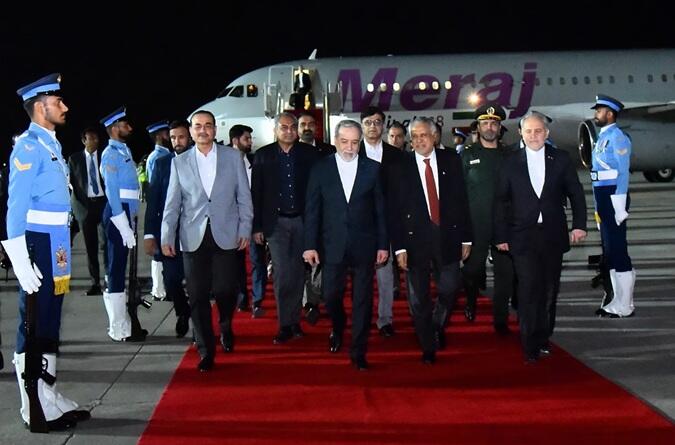
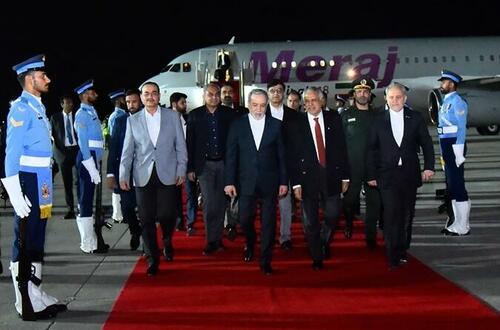
Iran FM’s arrival earlier, via Pakistan PM office/AFP, Getty Images

Reports of ‘Optimism’ amid ‘Stalemate’ in Talks

At the moment there’s no direct contact between Tehran in Washington on the diplomatic front. The Pakistanis have been back at the center of shuttling messages back and forth between US and Iranian officials. Al Jazeera has presented commentary Saturday citing “optimism” but also an ongoing stalemated situation:

So we are still in that stalemate, but Pakistani officials are telling us that their presence here and the Americans coming is an indication that behind-the-scenes diplomacy is working.

There’s been shuttle diplomacy, and as one diplomat said, it’s been relentless diplomacy that has been put forward by Pakistan from all sides.

There’s been, in the last 24 hours, conversations that have been held not just between the Pakistanis and Iranians, but also between the Pakistanis and the Russians – Russia is going to be one more stop when the Iranian foreign minister leaves.

An important overnight headline: Sources close to Pakistan-Iran talks say negotiations are progressing through “Iranian concessions” in exchange for “American flexibility regarding the issue of frozen funds,” according to Al Hadath.

And also this: Al Jazeera’s correspondent in Islamabad said Pakistani mediators are “cautiously optimistic” regarding Iran-US talks.

Iran’s President Masoud Pezeshkian:

The enemy is attacking our infrastructure and putting us under siege so that people become dissatisfied.

We currently do not need the people’s sacrifice, but we request that people reduce electricity and energy consumption.

For example, at… pic.twitter.com/Nq2A8WMqPC

— Ariel Oseran أريئل أوسيران (@ariel_oseran) April 25, 2026

Iran Military: Ready & Waiting To Fight

Iran’s military warned the United States it will face the “reaction of Iran’s powerful armed forces” if the blockade of Iranian ports continues, according to Tasnim News Agency.

The Khatam al-Anbiya Central Headquarters said the armed forces possess “greater power and readiness than before to defend sovereignty, territory, and national interests, which the country’s army experienced part of this power and offensive capability during the Third Imposed War.” 

This is actually consistent with what even Trump predicted – that the ceasefire has been used by Iran to regroup, rearm, and reposition its forces.

Currently the only regional fighting remains in Lebanon between Israel and Hezbollah, despite there technically being a Trump-backed three week Lebanon ceasefire:

Israel is exporting its Gaza model to Lebanon.
Demolition by demolition, the Israeli military is changing the face of southern Lebanon, razing towns and villages to create a buffer zone. Israeli officials say it’s necessary to protect its residents from Hezbollah threats. pic.twitter.com/64qAebvKOl

— Jeremy Diamond (@JDiamond1) April 24, 2026

“We are ready and determined, while monitoring the behavior and movements of enemies in the region and continuing to manage and control the strategic Strait of Hormuz, to inflict even heavier damage on the American Zionist enemies in case of another aggression,” the Iranian military statement added.

US Law Set 60-day Limit on Unauthorized Wars, So What Next?

CNN reports that “A post-Vietnam law puts a 60-day clock on the use of military force without congressional authorization.” Congress has indeed been missing in action, with several efforts of a handful of members on the House and Senate sides having put forth War Powers resolutions, which keep getting defeated. But the 60-day mark comes up on May 1, but it’s anyone’s guess what happens next. 

According to the CNN report, the law lays out a timeline for undeclared wars:

First, 48 hours. The president must notify Congress within 48 hours of introducing the armed forces “into hostilities” and explain the scope, justification and likely duration of the effort.

In his notification to Congress about Iran, Trump, like other presidents, said he committed troops under a president’s inherent authority in the Constitution to “conduct United States foreign relations.”

Second, 60 days. Congress must authorize the use of force within 60 days of receiving that notification or, the law says, the military action must be terminated by the president.

Third, a possible extra 30 days. Trump can extend the 60-day clock for another 30 days if he argues that continued military action is needed to keep service members safe while withdrawing from the war. Trump has said he won’t be rushed into making a bad deal to end the war.

It goes without saying that the longer this drags on, and with an open-ended timeline, the more politically costly it will likely be for Republicans headed into next Fall’s midterms.

Tyler Durden
Sat, 04/25/2026 – 09:55

https://www.zerohedge.com/geopolitical/cautious-optimism-amid-stalemated-pakistan-talks-even-iran-fm-insists-no-meeting 

Posted in News

Germany’s Debt Spiral Warning Ignored As Berlin Doubles Down On Spending

Germany’s Debt Spiral Warning Ignored As Berlin Doubles Down On Spending

Submitted by Thomas Kolbe

Finance Minister Lars Klingbeil is a sensitive character. Such personalities tend to react irrationally and extremely defensively to criticism. They are prone to resentment and quick retaliatory reflexes.

So it was only a matter of time before the Federal Court of Auditors, too, felt the cold anger of the thin-skinned Social Democrat. Late last year, criticism from the auditors was promptly followed by a budget cut imposed by the Finance Ministry. The move was meant as a public warning shot across the bow of the recalcitrant watchdog, which traditionally plays the role of post-mortem critic. This comes with the unpleasant habit of describing the state of public finances as they actually are — not as Berlin prefers to imagine them.

The Court’s budget was subsequently reduced from €52 million to €47 million, officially on efficiency grounds. What Klingbeil failed to achieve, however, was to silence the auditors entirely.

It has become a bad tradition: as in every year, the Court again warned of an ever-accelerating debt spiral and a fiscal policy that appears to have lost all restraint. The state is living beyond its means, said President Kay Scheller. On the contrary, one might reply: this state is living beyond our means.

The current draft budget foresees total spending of €630 billion, with nearly every third euro financed through borrowing. By 2029, another €850 billion in new debt is planned — pushing visible public debt to €2.7 trillion, or roughly 67% of GDP.

Unfortunately, the Court’s analysis of debt dynamics remains superficial. In its assessment, however, it aligns with recent criticism from the Ifo Institute.

Both institutions criticize how the state handles new debt. We know from Ifo analysis that roughly 95% of the funds from special off-budget vehicles have been diverted to cover deficits across various layers of the welfare state. Germany is not investing — and the private sector is now running on negative net investment, effectively consuming its capital base.

Dig deeper into Germany’s debt swamp and it becomes clear why Berlin consistently avoids the issue.

A recent Ifo paper calculated non-contributory benefits in the statutory pension system. Economists concluded that these hidden costs could amount to as much as 50% of GDP in the long run. This explains why the overstretched state apparatus now acts merely as a firefighter, no longer capable of maintaining infrastructure. Even Scheller’s call to raise the public investment ratio from 8% to 10% is unlikely to materialize.

One can almost be grateful that the Court of Auditors is among the few institutions still attempting to describe the fiscal reality. Yet even it avoids addressing the root causes — deindustrialization, overstretched public finances, and structurally broken budgets at all levels of government. Unsurprisingly, Scheller and his team also steer clear of politically sensitive issues such as open-border policies, which are pushing the welfare state toward implosion.

There is no mention of the costs of the self-destructive Ukraine war, nor any call to halt funding for the sprawling NGO complex or dismantle the green subsidy machine.

The debate misses the core issue. The state is operating an unlimited welfare machine while committing itself to building eco-socialist economic structures. Under such conditions, a return to a lean state is impossible.

Those calling for a return to sound fiscal policy without naming the underlying causes only make it harder to reverse the ideological crash course. Their superficial criticism suggests that the current trajectory can be maintained with cosmetic reforms. The design of the state itself is not to be questioned.

Pressure for change will only arise when rising public debt — largely financed through new bond issuance — drives up refinancing costs. If bond markets eventually turn against Germany’s debt binge, the European Central Bank will likely step in as lender of last resort, pushing inflation sharply higher.

Already, around 8% of federal spending goes toward servicing interest on the growing debt pile.

Meanwhile, the government has outlined how it intends to deal with the incoming debt crisis — by targeting households. Family co-insurance in public health care will be scrapped, as will income splitting for married couples. Inheritance taxes will be broadly increased, and expect debate over a wealth tax alongside significantly higher social security contributions.

Extraction via the CO₂ mechanism will intensify, and wealthy individuals and capable businesses will leave the country. This is not a theoretical scenario but the result of a political relapse into socialist ideology. The spiral of impoverishment is accelerating.

About the author: Thomas Kolbe, a German graduate economist, has worked as a journalist and media producer for clients from various industries and business associations. As a publicist, he focuses on economic processes and observes geopolitical events from the perspective of the capital markets. His publications follow a philosophy that focuses on the individual and their right to self-determination

Tyler Durden
Sat, 04/25/2026 – 09:20

https://www.zerohedge.com/economics/germanys-debt-spiral-warning-ignored-berlin-doubles-down-spending 

Posted in News

Global Inflation Scare: Chinese Exporters Hike Prices As Iran War Triggers Ethane Shortage, Plastics Crunch

Global Inflation Scare: Chinese Exporters Hike Prices As Iran War Triggers Ethane Shortage, Plastics Crunch

Chinese exporters are finally passing on the pain – right as they’re experiencing a major shortage of a key industrial material. After years of cutting prices amid overcapacity and cutthroat competition, manufacturers are now raising prices on everything from swimsuits and ski suits to medical syringes and air conditioners. The culprit: the Iran war’s energy shock, which has sent oil-linked input costs skyrocketing and is now rippling straight through to global store shelves.

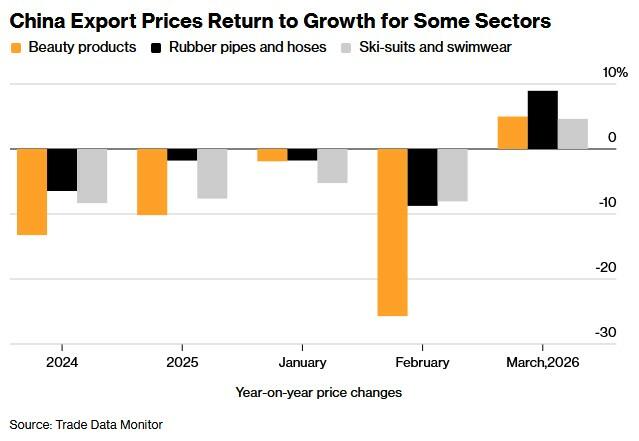
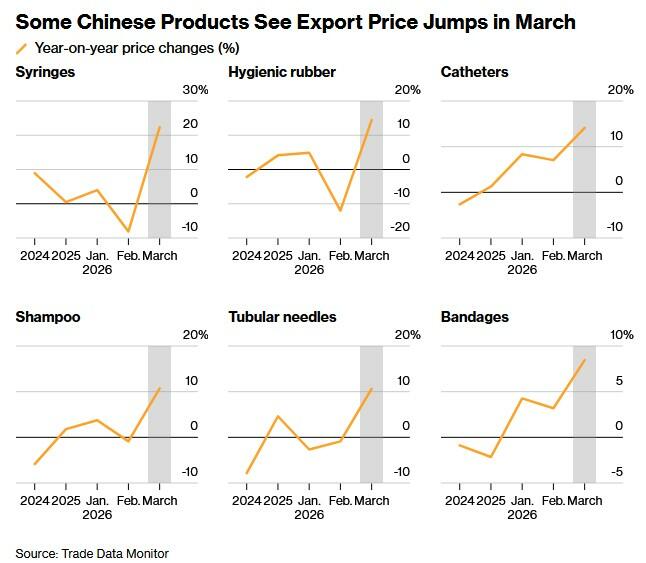
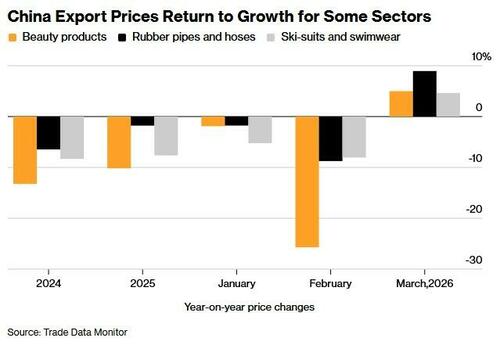
Customs data compiled by Trade Data Monitor and analyzed by Bloomberg reveal sharp year-on-year price jumps in March across more than a dozen categories of household goods – the first sustained reversal in a disinflationary trend that had helped keep a lid on inflation from the U.S. to Europe for nearly three years.

I held off raising prices for as long as I could in March, but in the end I had no choice,” said Pang Ling, sales manager at a Shanghai-based medical catheter maker. “I panicked watching plastic costs climb almost every single day.”

Products reliant on rubber, plastic, and oil-derived chemicals were hit hardest. Syringes saw prices surge as much as 20%. Synthetic-fiber goods – including swimsuits, women’s trousers, and ski suits – rose in the low- to mid-single digits as polyester and fiber suppliers hiked prices daily. Home appliances faced a double squeeze from higher metals and semiconductor costs. Even as some sectors like toys cut prices under weak demand, the broader picture is clear: the era of ultra-cheap Chinese goods is ending.

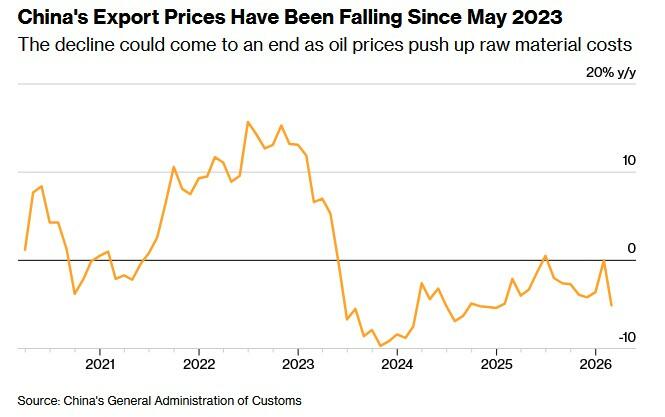
The numbers tell the story. China’s export prices had been falling steadily since May 2023, shaving an estimated 0.3–0.5 percentage points off headline inflation in advanced economies, according to Capital Economics. That buffer is now vanishing. Bloomberg Economics says above-3% inflation in 2026 is “back in play” across the euro area, U.S., and U.K. – a dramatic reversal from pre-war forecasts of cooling prices. Goldman Sachs expects overall Chinese export prices to turn positive as soon as March data, due out around April 25.

A 10% rise in oil costs typically lifts Chinese export prices by about 50 basis points over the following year, with the peak impact hitting four to five months later, Goldman estimates. The full effect hasn’t hit consumers yet – many March shipments were ordered weeks or months earlier – but the pipeline is filling with higher costs.

The Ethane Shock: Why Plastic Prices Are Set to Soar

Nowhere is the pressure more acute – or more politically explosive – than in plastics.

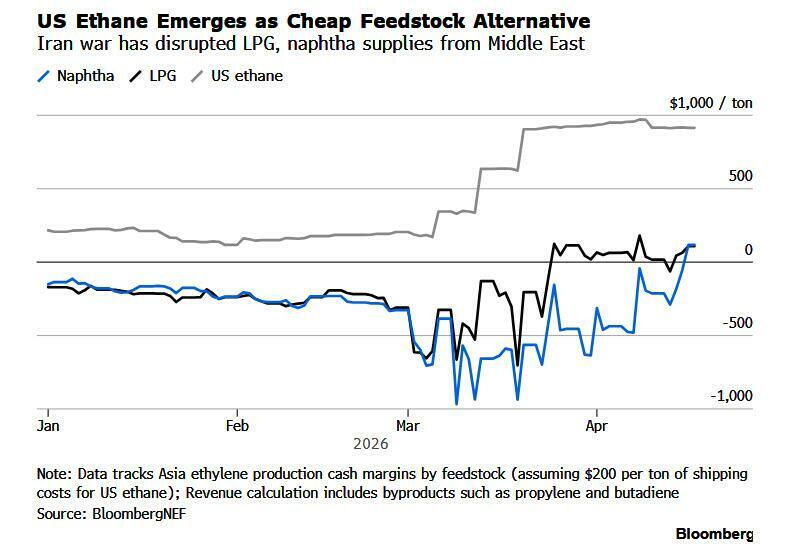
As we noted earlier this week, China is facing a severe ethane shortage that is about to supercharge costs across the entire plastics supply chain. Ethane, a natural gas liquid, is the primary feedstock for producing ethylene, the essential building block for plastics used in everything from medical catheters and syringes to clothing fibers, packaging, and consumer goods.

For years, China relied heavily on naphtha and liquefied petroleum gas (LPG) from the Middle East. In February, just before the war, more than 50% of China’s naphtha imports and over 40% of its LPG purchases came from Persian Gulf nations. That supply line has now been severed for as long as the Strait of Hormuz remains blocked. China holds massive strategic petroleum reserves – 1.5 billion barrels of crude – but it has virtually no stockpiles of naphtha or ethane. Its petrochemical industry is suddenly, dangerously exposed.

The International Energy Agency warned last week that “petrochemical feedstocks display the most immediate effects of the war by far,” with Asian supply chains thrown into “disarray.” Naphtha-fed crackers still account for 57% of China’s ethylene capacity, compared with just 16% for ethane-based units.

Desperate for alternatives, Chinese petrochemical producers are turning to the United States in record volumes. Shipments of U.S. ethane are expected to hit an all-time high of 800,000 tons in April – roughly 60% above the monthly average – according to Chinese consultant JLC. Some crackers can switch to ethane, helping offset the naphtha and LPG shortfall.

But this lifeline comes at a steep and rising price. Ethane has become the preferred feedstock because it is cheaper and more stable than crude-linked naphtha right now – profits from ethane-based ethylene were tenfold those of naphtha as of April 15, JLC data show. New capacity, including Wanhua Chemical Group’s ethane unit and Sinopec Ineos’s multi-feed cracker, has also boosted demand.

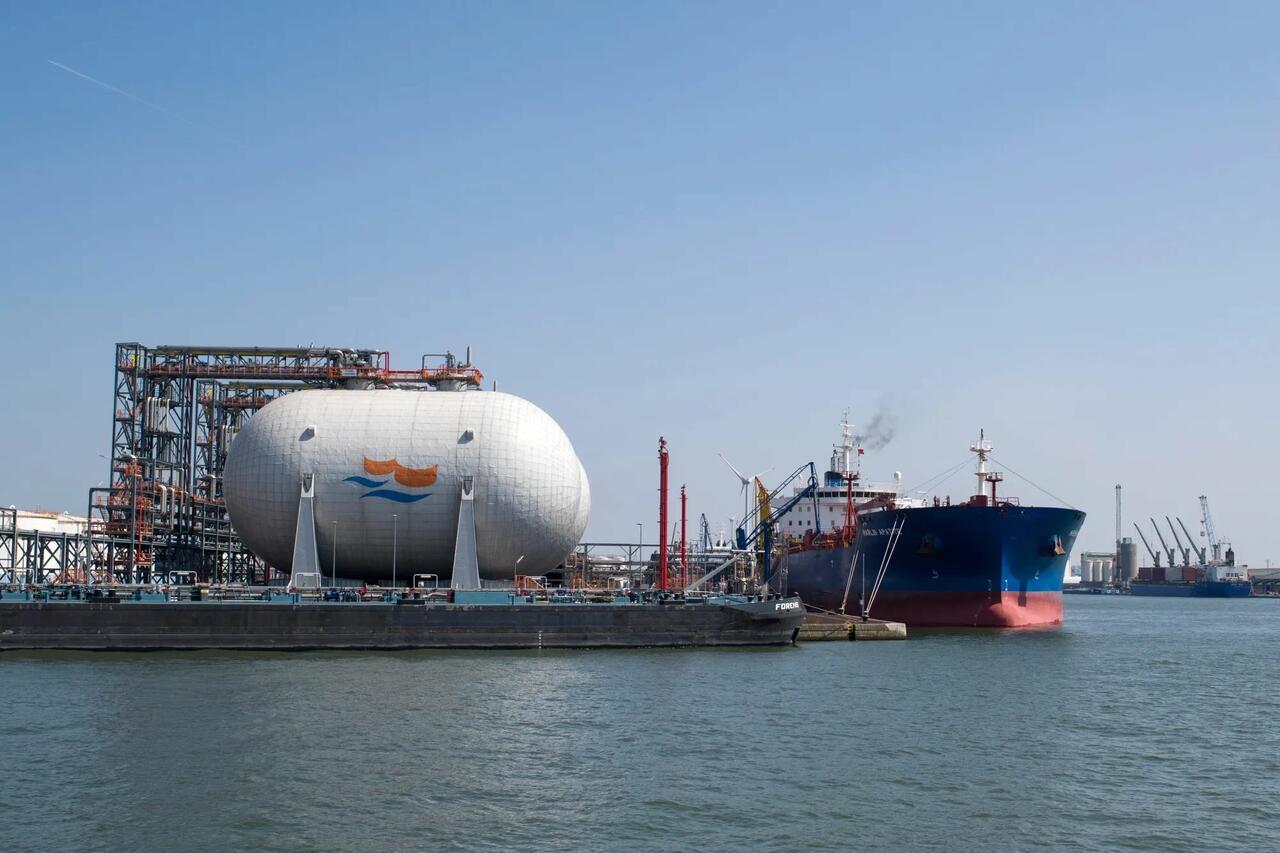
A tanker docked at liquid petroleum gas-ethane storage tanks. Photographer: Nathan Laine/Bloomberg

The result? Polyvinyl chloride (PVC) – Pang’s key input – surged as much as 80% in March from pre-war levels and remains about 50% higher even after a partial pullback. With naphtha alternatives cut off and ethane imports surging, plastic resin and downstream product prices are poised to climb sharply in the coming months. Competition and weak domestic demand may limit how much Chinese firms can pass on, but the input-cost pressure is now structural, not temporary.

The timing adds a geopolitical layer. China’s buying spree comes just weeks before President Donald Trump’s planned mid-May visit to Beijing. U.S. energy exports are expected to feature prominently in talks — especially if the Iran conflict drags on. One year ago, during the height of U.S.-China tariff tensions, analysts openly debated the mutual dependencies: America’s need for Chinese rare earths versus China’s near-total reliance on U.S. ethane for its plastics industry. 

Tyler Durden
Sat, 04/25/2026 – 08:45

https://www.zerohedge.com/economics/global-inflation-scare-chinese-exporters-hike-prices-iran-war-triggers-ethane-shortage 

Posted in News

EU Ministers Fail To Suspend EU-Israeli Cooperation Agreement; Germany Calls ‘Inappropriate’

EU Ministers Fail To Suspend EU-Israeli Cooperation Agreement; Germany Calls ‘Inappropriate’

Via Remix News,

A move to end the EU-Israel Association Agreement has been struck down, led by objections from Germany, Austria, and Italy. The accord, in existence since 2000, has served as the framework for EU-Israeli relations pertaining to both trade and foreign policy, with a key pillar being Israel’s access to the markets of EU member states.

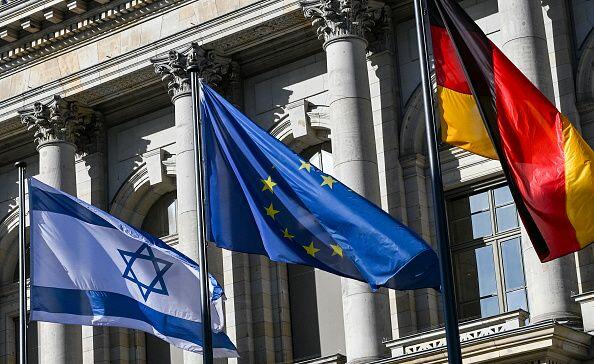
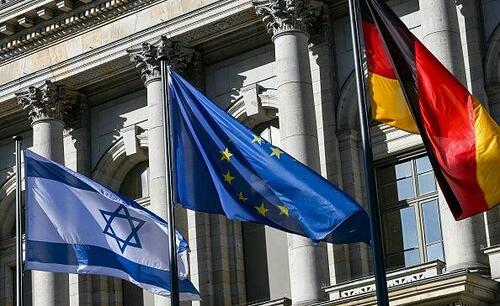
13 October 2025, Berlin: The flags of Israel, the EU and Germany fly in front of the Berlin House of Representatives. Following the release of the hostages held in Gaza, the House of Representatives also raised the flag of Israel as a sign of solidarity with the state of Israel and its people. Photo: Jens Kalaene/dpa (Photo by Jens Kalaene/picture alliance via Getty Images)

Last week, Spain, Ireland and Slovenia wrote a letter to the EU High Representative for Foreign Affairs Kaja Kallas, citing Israel’s decisions by Prime Minister Benjamin Netanyahu, as well as laws passed by its parliament and actions taken by its military.

It cited, most recently, the death penalty approved by the Israeli parliament as evidence of “systematic persecution, oppression, violence and discrimination exerted against the Palestinian population.”

“In such a grave situation, we call on the European Union to uphold its moral and political responsibility, and to defend the very core values that have underpinned the European project since its foundation,” they wrote.

Going even further, the letter highlighted that Israel has essentially broken its agreement with the European Union. “Not only a grave violation of fundamental human rights, but also a step backwards in Israel’s commitment to democratic principles, as underlined by your March 31 statement, and therefore a violation of Article 2 of the EU-Israel Association Agreement.”

Spain has cited Article 2 for more than two years to take action against Israel and attempt to invalidate the agreement.

“Bold and immediate action is required, and all actions must remain on the table. The European Union can no longer remain on the sidelines,” the letter concluded.

However, the ministers gathered at the  Foreign Affairs Council meeting in Luxembourg ultimately rejected the proposal.

German Foreign Minister Johann Wadephul called any move to suspend the agreement “inappropriate,” reports Politico, joined by his Austrian counterpart in a push for “critical, constructive dialogue.” 

Before the meeting, Italian Foreign Minister Antonio Tajani told reporters that “There are neither the numerical nor the political conditions” for such a measure to be taken.  

A partial suspension requiring majority approval would also not have passed, given Italy and Germany’s objections. According to Politico, Kallas did raise the possibility of targeted measures that do not dismantle the wider trade agreement and do not require unanimity, with Tajani reportedly supporting her on this. “I believe it is better to sanction individually those responsible, I am thinking of violent settlers,” he stated.

Tyler Durden
Sat, 04/25/2026 – 08:10

https://www.zerohedge.com/political/eu-ministers-fail-suspend-eu-israeli-cooperation-agreement-germany-calls-inappropriate 

Posted in News

Interceptor-Drone Arms-Race Emerges

Interceptor-Drone Arms-Race Emerges

The next type of aerial system likely to be stockpiled at scale by militaries worldwide is the interceptor drone. We’ve already seen early evidence of this across Eurasia, with Ukraine selling its interceptor drones to the highest bidder.

The Russia-Ukraine war accelerated the development of cheap one-way attack drones. Early in the war, missile interceptors used by Ukraine were too costly and drained the stockpiles of Western militaries at dangerous rates.

The proliferation of cheap interceptor drones levels the playing field and provides a low-cost solution against Russian-produced Geran and Iranian-designed Shahed attack drones.

Ukraine’s interceptor drones are emerging as a cheap solution, costing roughly $1,000 to $3,000 each versus about $4 million for a Patriot missile used to down $20,000 Shahed drones. In the economics of war, this mismatch matters because missile use, especially in the U.S.-Iran conflict, has already outstripped the U.S.’ annual production capacity.

Ukrainian President Volodymyr Zelensky has previously stated that Ukraine can produce at least 2,000 interceptors per day and could double that with more investment, supplying another 1,000 daily to allies.

First, we are capable of producing at least 2,000 effective and combat-proven interceptors every day. We can produce more – it depends on investment. We need about 1,000 interceptors a day, and we can supply at least another 1,000 a day to our allies.

Second, we know how to… pic.twitter.com/vIB2qRho8P

— Volodymyr Zelenskyy / Володимир Зеленський (@ZelenskyyUa) March 17, 2026

This comes as Zelensky has emerged as a “Lord of War,” with Ukraine pitching its highly developed, low-cost drones and robotic warfare technology to the highest bidder.

According to war blog UNITED24 Media, these are the four main interceptors Ukraine is offering to its allies around the world:

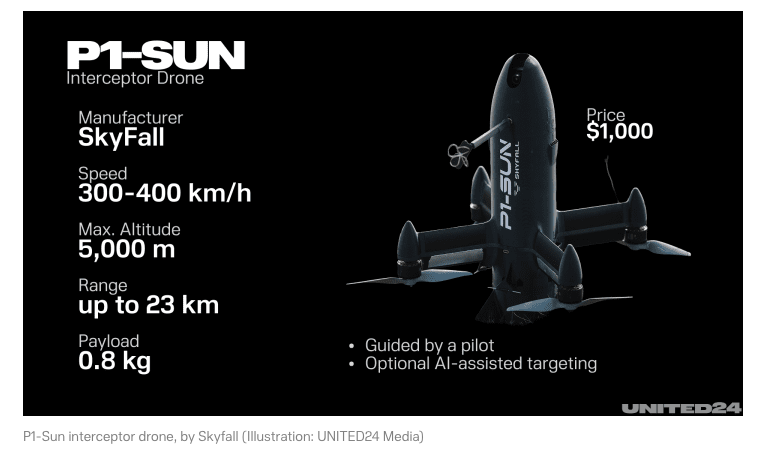
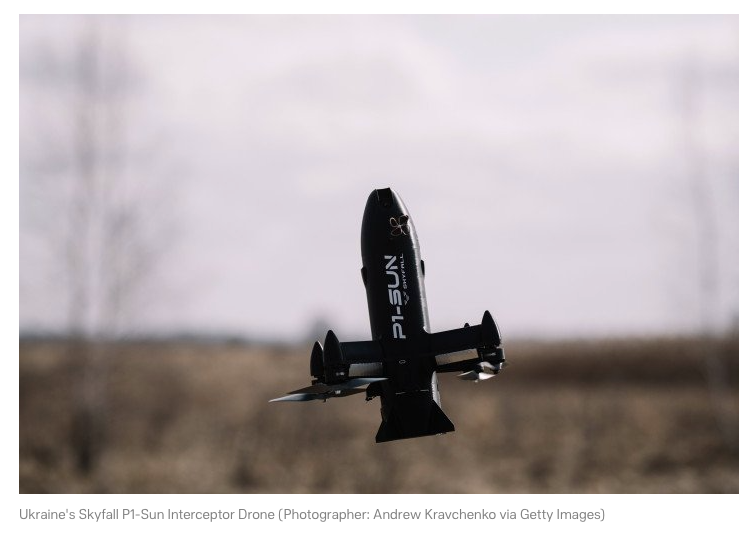
P1-SUN, by Skyfall

The most publicized yet is the P1-SUN, a Ukrainian play on words referring to its phallic bullet shape.

Created by SkyFall, it’s a high-speed drone designed to take off vertically. At a speed of between 300 km/h, typical, and 450 km/h for its upper estimate, it’s one of the fastest drones on the market, able to take out the most common models of Shahed-136 that cruise at roughly 185 km/ hour.

However, the new jet-powered Shahed-238, which can reach up to 550-600 km/h, can prove much more difficult to stop in the long run. The P1-SUN can reach an altitude of up to 5 kilometers. It is also guided by a pilot and has optional AI-assisted targeting.

The drone costs roughly $1,000 to produce and can carry a small modular charge, depending on the needs and the target. The company estimated it could manufacture up to 50,000 interceptor drones a month and export 5,000 to 10,000 without hampering local needs, Reuters reported.

As of March, SkyFall appears to be the clearest large-scale commercial player, described by Reuters as a major drone maker, with the P1-SUN interceptor among the main anti-Shahed systems now drawing foreign demand.

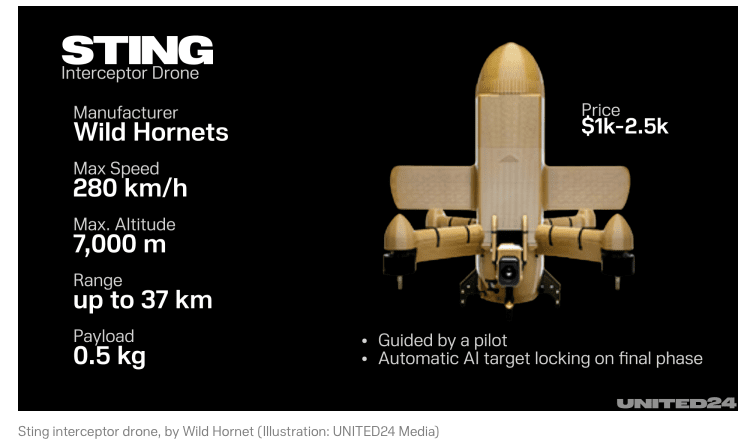
STING, by Wild Hornet

The STING, produced by Wild Hornet, is also a serious contender for international exports. Also bullet-shaped, the STING looks roughly the same as the P1-SUN, with its four high-trust motors, designed to maximize forward acceleration but not hover efficiency.

Tuned to outrun Shahed drones, this model has a proven speed of roughly 280 km/h, can reach up to 7 kilometers in altitude, has a range of up to 37 kilometers, and has an endurance of up to 15 minutes, the company says.  

The interceptor can be guided by a pilot and, through AI, automatically lock the target during its final phase. The model has a daylight and a thermal camera, allowing it to detect Shahed engine heat at night. It can hold some warheads weighing 500 grams, according to the company.

Combat-proven and priced between $1,000 and $2,500, it’s cheap and scalable, producing 10,000 units or more per month, says the company representative.

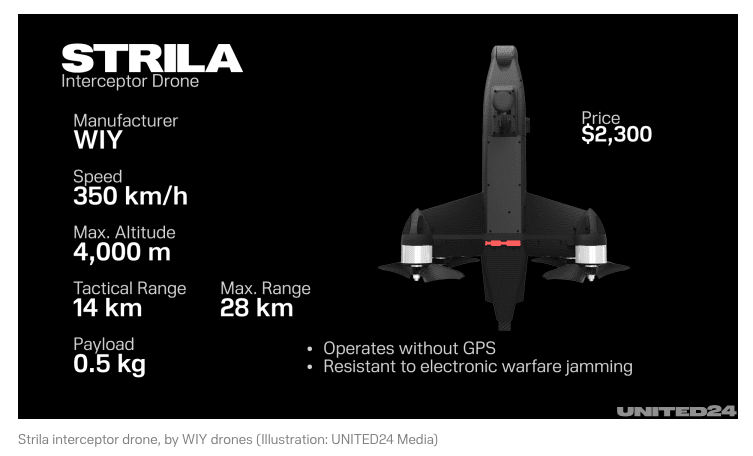
STRILA, by WIY DRONES

The STRILA, described by its manufacturer, WIY DRONES, as a “rocket-type air-defense” interceptor despite its four motors, can reach speeds of over 350 km/h and, during testing, was accelerated to 400 km/h, the company said.

The interceptor is reportedly capable of operating at a distance of up to 14 km in tactical mode and covering up to 28 km at maximum range, reaching altitudes of up to 4 kilometers.

Its latest Strila system version features a communication system that enables operation without GPS and increases resistance to electronic warfare jamming.

The operator can now also switch communication channels during flight. The daytime and night cameras have also been upgraded.

The company says it is currently manufacturing about 100 interceptors per day, has begun serial deliveries under government contracts, and cut the unit price to roughly $2,300 in January 2026.

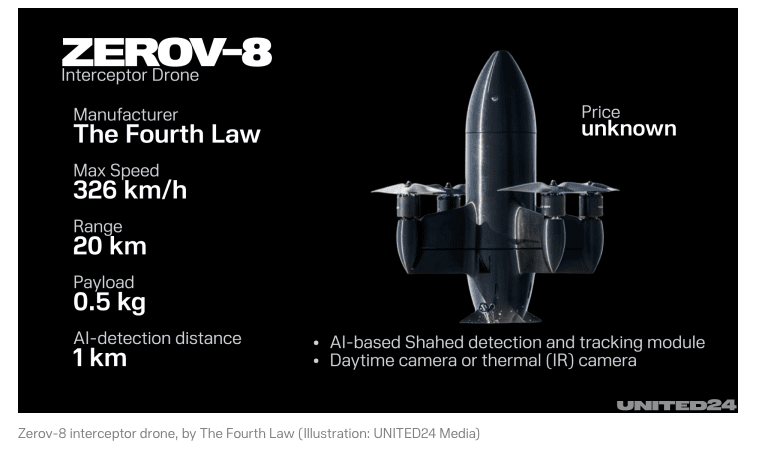
Zerov-8, by The Fourth Law

The Fourth Law recently unveiled the Zerov-8, a vertical takeoff and landing interceptor that can turn mid-flight horizontally, resembling a small quadrimotor airplane.

Compared to the P1-SUN and the STING, it trades agility for efficiency and range, with a 20-kilometer radius, the company says. It can reach a maximum speed of 326 km/h, making it slower than its quadcopter challengers but more efficient in cruise mode during horizontal flight.

Its core feature? An AI-based detection and tracking module that allows it to identify Shahed, track them autonomously, and guide the interceptor on its own during its terminal phase before impact, according to the company.

The Zerov-8 can carry a 0.5 kg warhead and thermal cameras, but the company didn’t disclose its price, as it’s still at an experimental state.

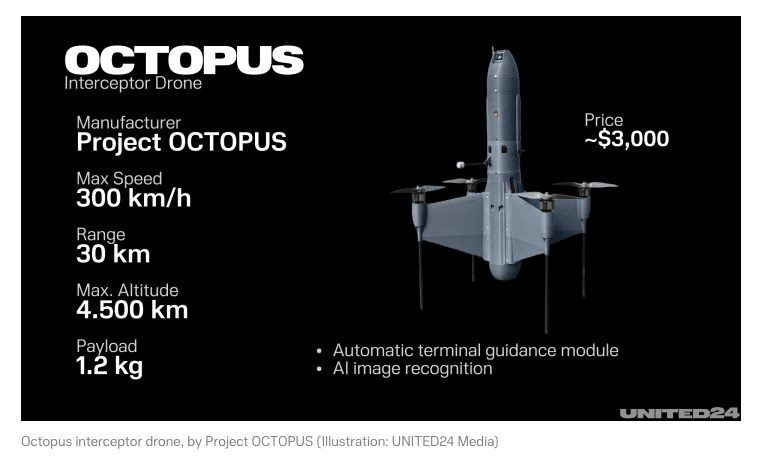
Octopus, by Project OCTOPUS

The Octopus, a high-speed quadcopter interceptor, has a maximum speed of 300 km/h, a combat radius of roughly 30 km, can reach up to 4.5 kilometers in altitude and has an endurance of 15 minutes with a payload of 1.2 kg, Ukrainian military-tech company TAF Drones Industries said.

Thanks to its automatic terminal guidance module and AI image recognition, it can pick a target and finish it off without pilot output, according to the Royal United Service Institute (RUSI).

Ukraine and the UK were set to begin the joint production of 1,000 Octopus interceptor drones per month starting in February 2026, Ukraine’s former Defense Minister Denys Shmyhal announced in January. The drones themselves were presented in London by Zelenskyy in late October 2025.

Separate from Ukraine, war news outlet Defense Blog has revealed that Russia has “begun front-line deployment of the fixed-wing Lys-2 counter-drone interceptor after a test phase, distributing it directly to combat units.”

Russia has begun deploying the Lys-2 counter-drone interceptor to front-line units, marking a move from testing to operational use.

Read more: https://t.co/R9kInuTN35 pic.twitter.com/CFuJLTvJhj

— Dylan Malyasov | 🧐 (@DylanMalyasov) April 20, 2026

Not to be the bearer of bad news, but stopping the rise of ‘Skynet’ looks nearly impossible at this point.

Ukraine Becomes World’s AI Weapons Laboratory

Russia’s deployment of next-generation counter-drone interceptors highlights the hyperdevelopment now underway in low-cost aerial warfare, where both interceptor drones and Shahed-style one-way attack drones are increasingly likely to be stockpiled by the millions across the world’s militaries.

Tyler Durden
Sat, 04/25/2026 – 07:35

https://www.zerohedge.com/military/interceptor-drone-arms-race-emerges 

Posted in News

The EU ‘Democracy Shield’ Is The End Of Freedom In Europe

The EU ‘Democracy Shield’ Is The End Of Freedom In Europe

Via Remix News,

The year 2026 will go down in the history of European integration as a special moment. The European Union, under the banner of protecting democracy, has begun systematically restricting freedom of speech and real political pluralism. Thus, it embarks on the well-trodden historical paths of every authoritarian regime, resorting to violence and censorship as public support wanes.

A report recently published by the Ordo Iuris Institute leaves no doubt: we are dealing with a project for a profound overhaul of the public sphere that will primarily target conservative communities, including Catholics.

Jerzy Kwasniewski, the head of the conservative institute Ordo Iuris. (AP Photo/Czarek Sokolowski)

The new EU mechanisms, ironically referred to as the “Democracy Shield,” are not a single piece of legislation. This is a coordinated regulatory system—from the Digital Services Act (DSA), through codes of conduct on “hate speech” and “disinformation,” to the regulation on political advertising. Their common denominator is the now-official departure from the European cult of free speech and its replacement with a system of preventive restrictions, in the name of… true freedom and democracy.

The European Commission claims that its aim is to create a “safe” information space in which “reliable” messages are meant to dominate, that is, in practice, narratives aligned with the liberal consensus . The problem is that the criteria for the EU’s “credibility,” for what is considered prohibited “disinformation,” and—what is particularly harmful—”divisive speech” are extremely vague and prone to ideological interpretation. As a result, it will not even be independent courts, but online platforms cooperating with non-governmental organizations selected by Brussels that will decide what content may reach citizens of the European Union. Including Polish citizens.

This system is multi-stage. First—mechanisms for reporting and removing content that, in practice, incentivize rapid takedowns, even at the expense of freedom of expression. Secondly—a labeling system under which statements labeled as “unverified,” “misleading,” or “political” are subject to mandatory restrictions on platforms such as Facebook or X. Thirdly—there is to be algorithmic intervention that limits the reach of content deemed problematic.

It is worth emphasizing the role of so-called trusted flaggers and fact-checker networks. It is precisely these entities, often financed with public funds from the European Union or the Member States and ideologically uniform, that gain a privileged position in the content moderation process. In practice, this means cleverly delegating censorship to entities that are not subject to any democratic oversight.

Even more troubling are the regulations concerning political advertising. The definition of “political speech” has been framed so broadly that it encompasses not only the activities of political parties but also public awareness campaigns concerning the protection of life, the family, or national identity. This means that Catholic pro-life organizations or movements defending marriage as the union between a woman and a man may be subjected to restrictive requirements and even sanctions. Even now, our own Ordo Iuris Institute and Center for Life and Family, as well as our friends from Polonia Christiana’s PCH24 news portal and their editorial team should start preparing to implement a “replacement language.” The censorship game, well known here in Poland from the communist era, is making a comeback.

At the same time, restrictions on the targeting and funding of political messages make it much more difficult to reach voters. In practice, the largest platforms, such as Facebook, have already stopped running “political” ads to avoid legal risk. It is no longer possible to freely promote petitions opposing abortion or same-sex unions there.

The Polish political context cannot be ignored. The introduction of these instruments specifically in 2026, just before the crucial parliamentary campaign in Poland, is no coincidence. Restricting the reach of conservative speech, making it harder to organize public-interest campaigns, and selectively labeling content as “problematic” will have a real impact on election results.

From the perspective of socially engaged Catholics, this is particularly dangerous. Unequivocal assessments concerning the protection of life from conception, the indissolubility of marriage, the condemnation of the aberrations of gender ideology, and even clear support for national sovereignty within the European Union will increasingly be classified as “controversial” or “divisive.” In the new regulatory model, such content may be restricted not directly—through a ban—but through invisible mechanisms of reach reduction and stigmatization.

This does not, of course, mean that the state has no right to combat crimes online or to protect citizens from real threats. The problem is that the European Union has crossed the line between protection and control, between security and social engineering.

Therefore today, more than ever, courage is needed to defend freedom and the right to publicly proclaim one’s faith. Not as a privilege for the select few, but as the foundation of a healthy society. If we allow, under the pretext of combating “disinformation,” the voices of those who defend life, the family, and sovereignty to be curtailed, democracy will quickly become a grim dictatorship hidden behind a facade of apparent diversity and tolerance.

Tyler Durden
Sat, 04/25/2026 – 07:00

https://www.zerohedge.com/political/eu-democracy-shield-end-freedom-europe 

Posted in News

Where Homosexuality Is Still Punishable By Death

Where Homosexuality Is Still Punishable By Death

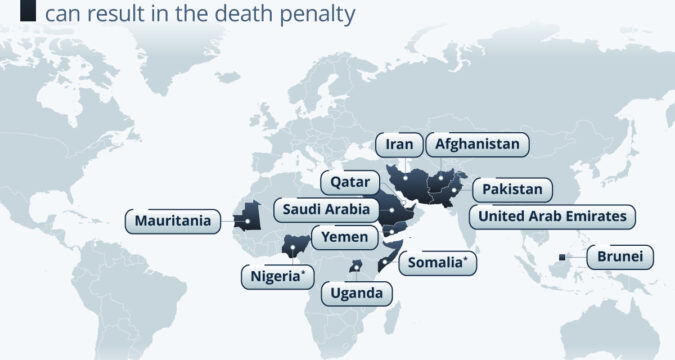
The latest data from ILGA – the International Lesbian, Gay, Bisexual, Trans and Intersex Association, a global federation that monitors laws and rights affecting LGBT people – show that consensual same‑sex relations remain criminalized in a significant number of countries, with a small but deadly minority still prescribing the death penalty.

You will find more infographics at Statista“>As Statista’s Tristan Gaudiat shows in the chart below, according to ILGA’s database, over 60 countries around the world still criminalize consensual same‑sex activity, mostly through prison sentences of varying lengths (from fines and short terms to long jail terms). A smaller group of roughly a dozen countries even retains the death penalty for such acts.

This includes national laws in countries such as Afghanistan, Iran, Saudi Arabia and the United Arab Emirates, as well as regional sharia provisions applied in parts of Nigeria and Somalia.

You will find more infographics at Statista

Enforcement varies widely: in some places, the statutes are rarely applied but create a pervasive climate of legal insecurity and social stigma, while in others, capital punishment is actively enforced.

Recent spikes in prosecutions have sharpened human‑rights concerns in certain regions.

Uganda significantly stepped up enforcement after a controversial law was introduced in 2023, and renewed legislative pressure in 2025 led to several high‑profile prosecutions.

In Southeast Asia, Brunei’s expanded sharia penalties – first announced in 2019 and subsequently rolled out in stages, including provisions allowing death by stoning – continue to provoke international condemnation.

Tyler Durden
Fri, 04/24/2026 – 23:30

https://www.zerohedge.com/geopolitical/where-homosexuality-still-punishable-death 

Posted in News

UAE To Move 50% Of Government Services To AI By 2028

UAE To Move 50% Of Government Services To AI By 2028

Finally a practical use of AI.

In a world swimming in debt and overrun by government bloat and corruption, Dubai is taking a big step into the future. On Thursday, Sheikh Mohammed bin Rashid Al Maktoum, Vice-President of the UAE and Ruler of Dubai, announced that in two years, 50% of UAE’s government sectors, services, and operations will run on Agentic AI, arguably the best use of the new technology yet. 

The new “government model” was launched under the directive of UAE President Sheikh Mohamed bin Zayed Al Nahyan. It will make the UAE the first government globally to operate at this scale through autonomous systems. 

“AI is no longer a tool. It analyses, decides, executes, and improves in real time. It will become our executive partner to enhance services, accelerate decisions, and raise efficiency,” the Dubai Ruler said in a post on X.

“This transformation has a clear timeline. Two years. Performance across government will be measured by speed of adoption, quality of implementation, and mastery of AI in redesigning government work,” he continued.

“We are investing in our people. Every federal employee will be trained to master AI, building one of the world’s strongest capabilities in AI-driven government. Implementation will be overseen by Sheikh Mansour bin Zayed, with a dedicated taskforce chaired by Mohammad Al Gergawi driving execution.

“The world is changing. Technology is accelerating. Our principle remains constant. People come first. Our goal is a government that is faster, more responsive, and more impactful,” Sheikh Mohammed added.

Under the directives of the President of the UAE, we launch a new government model. Within two years, 50% of government sectors, services, and operations will run on Agentic AI, making the UAE the first government globally to operate at this scale through autonomous systems.

AI… pic.twitter.com/53OQLe7RXl

— HH Sheikh Mohammed (@HHShkMohd) April 23, 2026

The project includes a phased implementation across ministries and federal entities, based on continuous performance and impact assessment. This will pave the way for wider rollout, ensuring optimal results across the federal government.

Special attention is placed on developing national capabilities by training and empowering government employees to master generative artificial intelligence technologies and their applications. Which of course is reflexive, so in effect government employees are supposed to train their own replacements. 

Accroding to Khaleej Times, the move to adopt Agentic AI across government operations builds on 20 years of digital transformation in the UAE’s government, from the early adoption of eGovernment and service digitalization to mobile government and integrated systems such as the UAE Pass identity verification system to full-service redesign and integration, supported by programs such as Government Services 2.0, which introduced proactive, data driven service delivery.

In 2017, the UAE became the first country in the world to appoint a Minister of State for Artificial Intelligence and launched the UAE Artificial Intelligence Strategy 2031 under the UAE Centennial 2071 vision. The establishment of the Ministry of Artificial Intelligence, Digital Economy and Remote Work Applications in 2020 further strengthened this direction.

The UAE is especially well suited for agentic implementation: the Gulf state has spent more than a decade building digital infrastructure that connects government entities, making it one of the most advanced public service ecosystems globally. Platforms developed under entities such as UAE Government and Digital Dubai already allow residents to access hundreds of services online, from paying fines to registering businesses.

The latest plan shifts the focus from digitizing services to redesigning them, allowing AI systems to manage entire workflows rather than just assisting at specific stages. For residents, this changes the experience from navigating systems to simply requesting outcomes, with the complexity handled behind the scenes.

While the progression reflects a broader pattern seen across advanced economies, the UAE is moving faster than most.

The first phase involved putting services online, which reduced paperwork and eliminated many in-person visits.

The second phase introduced mobile apps, automation, and AI tools, improving speed and accessibility while still requiring users to manage processes themselves.

The next phase moves beyond interfaces, with systems designed to complete tasks independently, meaning the user defines the objective and the system handles execution.

Back in the US, a recent attempt through Elon Musk’s DOGE to cut back on government inefficiency and corruption came to an abrupt halt last summer when it became obvious that the deep state would fight to the death (or at least hire assassins to effect the death of others) to prevent any change in the well-paid status quo. Perhaps AI will succeed where everyone else has failed. 

Tyler Durden
Fri, 04/24/2026 – 23:00

https://www.zerohedge.com/markets/uae-move-50-government-services-ai-2028 

Posted in News

Muted Demand During India’s Second-Biggest Gold-Buying Festival, After Prices Surge

Muted Demand During India’s Second-Biggest Gold-Buying Festival, After Prices Surge

Gold demand during one of India’s key buying festivals stayed muted on Sunday as record prices curbed jewellery purchases, ​offsetting a modest uptick in investment demand, according to Reuters

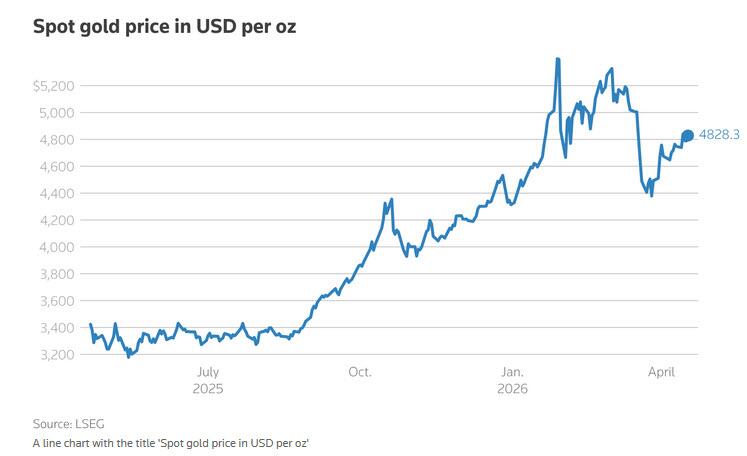
Indians celebrated Akshaya Tritiya, the ‌second-biggest gold-buying festival after Dhanteras, when purchasing precious metals is considered auspicious. Only this time near record gold prices – the precious metal closed just over $4800 – kept buyer enthusiasm rather subdued. 

“The sharp rally in prices curbed jewellery demand. In volume terms, buying was lower as consumers ​held back, though in value terms spending was higher due to ​elevated prices,” said Amit Modak, chief executive of PN Gadgil ⁠and Sons, a Pune-based jeweller.

Since consumers are, like everyone else, subject to the laws of supply and demand, it is natural that a higher price will lead to lower demand. Gold prices hit a record high of $5,594.82 ​per ounce on January 29 and are now trading just over $4,800.

Gold futures in ​India, the world’s second-biggest gold consumer, closed at 154,609 rupees ($1,670) per 10 grams on Friday, nearly 63% higher than at the last Akshaya Tritiya festival. Except in a few ​southern Indian states, demand was lower than normal across the rest ​of the country, said Surendra Mehta, national secretary at the India Bullion and Jewellers Association. Meanwhile retail ‌buyers ⁠have been stacking shifting toward gold coins, which are easier to liquidate, even as jewellers offered discounts on fees for crafting jewellery to attract buyers, said a Mumbai-based jeweller.

The latest decline in demand is an extension of recent trends: India’s jewellery demand in 2025 fell 24% from a year ​earlier, partially offset by a 17% rise in investment , the highest since 2013, according World Gold Council data.

Gold-buying patterns in India are ​changing, with purchases no longer concentrated only during festivals ​as price-sensitive ⁠buyers make purchases throughout the year whenever prices dip, said a Mumbai-based bullion dealer with a private bank.

India issued an order on Friday listing banks ⁠authorized to ​import gold and silver, providing relief for ​banks that were forced to halt imports because the list’s publication was delayed.

Tyler Durden
Fri, 04/24/2026 – 22:30

https://www.zerohedge.com/precious-metals/muted-demand-during-indias-second-biggest-gold-buying-festival-after-prices-surge