Category: News

UE hará donación a Bolivia en el marco de visita de delegación en respaldo al gobierno de Paz
LA PAZ, Bolivia (AP) — La Unión Europea donará 10,4 millones de dólares para respaldar el gobierno del presidente centroderechista Rodrigo Paz, quien asumió en noviembre tras casi 20 años de gobiernos de izquierda, informó el Ministerio de Hidrocarburos el miércoles. Una misión de alto nivel del bloque arribó la víspera a la nación andina.
La UE es un socio estratégico de Bolivia desde los gobiernos del expresidente Evo Morales (2006-2019) y Luis Arce (2020-2025), durante los cuales financiaron programas para la lucha antidrogas, aunque en los últimos años se fueron enfriando las relaciones.
Paz ha intentado dar un giro en las relaciones diplomáticas y se ha acercado a Estados Unidos, país con el que también busca recomponer las relaciones. Bolivia para el mundo y el mundo para Bolivia es la política que promueve Paz con el objetivo de promover el comercio, las inversiones y apoyo financiero para sacar a la nación andina de la peor crisis económica en 40 años.
La donación por parte de la UE será con el fin de impulsar las energías renovables, indicó la cartera de Hidrocarburos en un comunicado, al día siguiente de la llegada de la nutrida delegación del bloque liderada por Félix Fernández-Shaw, director para América Latina y el Caribe de la Comisión Europea.
Fernández-Shaw señaló que el gobierno de Bolivia busca iniciar una nueva etapa en materia de energías renovables, entre otras medidas. “En ese marco, se busca traducir la planificación del Ministerio de Hidrocarburos y Energías en acciones concretas para atraer a empresas e inversiones europeas”, destacó.
El martes unas 70 personas, entre representantes institucionales y de 40 empresas europeas, participaron de una visita a las plantas experimentales de litio en el salar de Uyuni, en el sur de Bolivia. En ese salar están las reservas más importantes de litio del país.
El gobierno de Paz anunció la semana pasada que revisarán algunos acuerdos firmados por los anteriores gobiernos de izquierda con empresas de China y de Rusia para extraer litio, un energético que es utilizado en las baterías de litio.
Will The New Fed Chair Fix The Money?
Will The New Fed Chair Fix The Money?
Authored by Jeffrey Tucker via The Epoch Times,
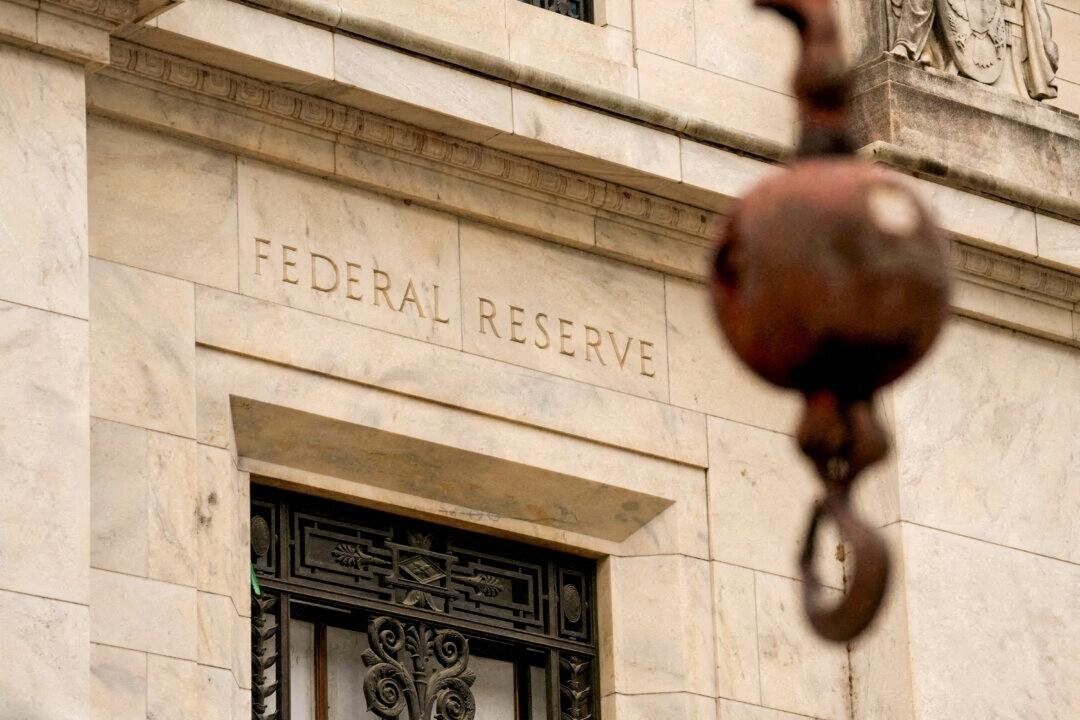
The choice of Kevin Warsh as the new chairman of the Federal Reserve has received mixed reviews, as can be expected. His professional connections lean establishment in every way, which is perhaps not what Trump’s base expected.
More interesting is that Warsh is on record as an inflation hawk, a critic of zero-interest rate policies, and a critic of the war on cryptocurrency. All of this strikes me as a good sign, even if he has since hinted in the direction of favoring lower rates.
In 2023, he wrote the following:
“History will give a full accounting of the grave errors committed in recent years in economic policy. A central lesson is already clear: Nothing is as expensive as free money. The costs of the Federal Reserve’s zero-interest policy are multiplying: The misallocation of capital—goosing the price of the riskiest and least-productive of assets—set the conditions for boom and bust. The financing of the ‘big state’ set the country on an unsustainable fiscal trajectory. The extraordinarily loose financial conditions created herd behavior among market participants and firms and complacency among policy makers, including regulators. The surge in inflation substantially raised the cost of living for citizens and undermined business planning.”
Every word of that is true. Having someone at the Fed who believes that way should come as a great relief.
The surprising part is that Trump himself has spent years denouncing the Fed for having raised interest rates faster than ever before in Fed history. He has also called for a dramatic lowering of rates to make the United States more competitive, thoughts that have people like me worried that such a policy would kick off a second wave of inflation.
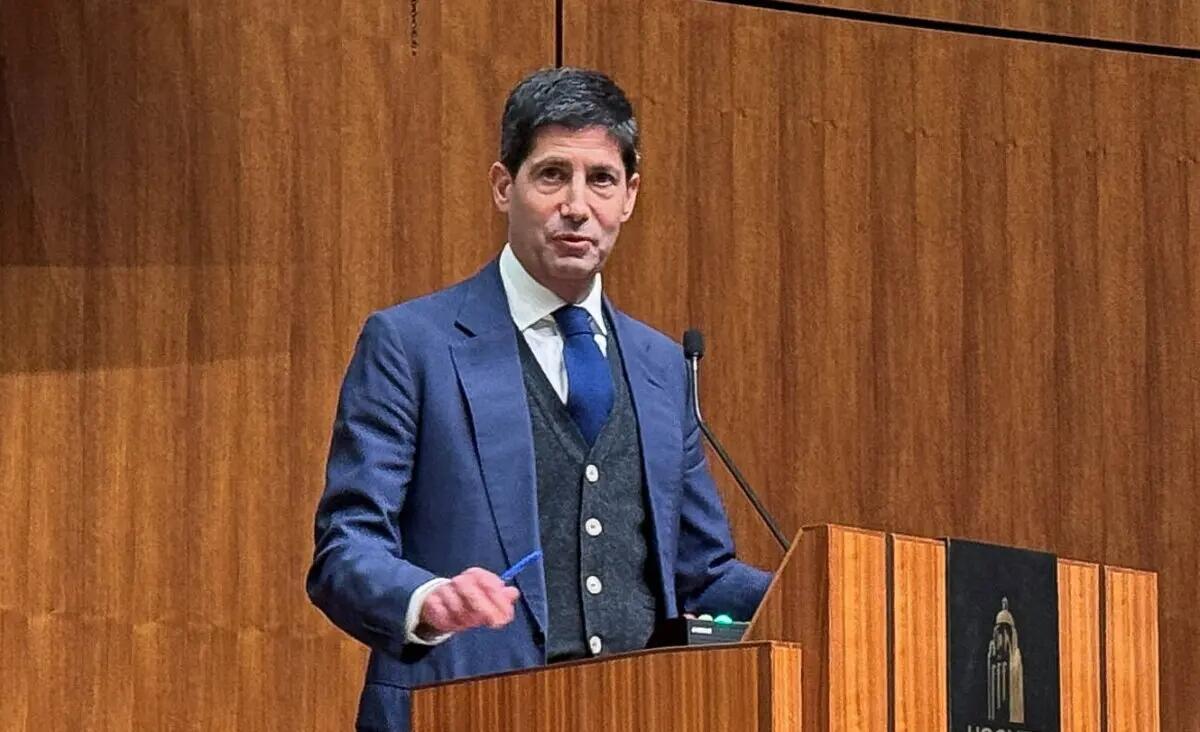
Former Federal Reserve board member Kevin Warsh speaks during a monetary policy conference at Stanford University’s Hoover Institution in Palo Alto, Calif., on May 9, 2025. Ann Saphir/Reuters
Warsh seems to have his doubts about such a policy:
“The Fed seeks to fix interest rates and control foreign-exchange rates simultaneously—an impossible task with the free flow of capital. Its ‘forward guidance,’ promising low interest rates well into the future, offers ambiguity in the name of clarity. It licenses a cacophony of communications in the name of transparency. And it expresses grave concern about income inequality while refusing to acknowledge that its policies unfairly increased asset inequality.”
In the backdrop of all of this is what has been a disastrous policy at the Fed from 2020 onward, creating some $6 trillion in new money in service of a congressional plan to shower the country with money directly into people’s bank accounts. That this would lead to a devastating inflation is hardly a surprise. No student of money and finance could possibly doubt that this would be the result.
Why did this not happen with a similar quantitative easing back in 2008? Because in those days, the policy of then-Chairman Ben Bernanke was to pay more than the market rate for bank deposits, thus keeping hot money off the streets and safely in the bank vaults.
Warsh identifies the underlying problems with such a policy:
“The misallocation of capital—goosing the price of the riskiest and least-productive of assets—set the conditions for boom and bust.”
What he has identified here is a pattern known since the 1930s. John Maynard Keynes imagined that the central bank could drive rates to zero and generate prosperity as if by magic. The American and Austrian critics of that policy drew attention to deeper complexities. Interest rates serve a crucial role as a signaling system for investment. Artificially low rates essentially send false signals that set up conditions for a subsequent bust.
In other words, the policy of discretion designed to blow countervailing winds toward business cycle trends actually ends up creating and worsening the thing it was designed to fix. When that happens, the only possible way out is to let the recession happen, rebalance the capital structure, and clear the table to enable a new round of prosperity and growth.
To be sure, it’s been 40 years since the Fed has permitted a recession to happen without wild interventions designed to prevent them.
The layers upon layers of interventions keep piling up higher and higher, all built on a false foundation of debt. This is not only a national problem; the entire world economy is now addicted to debt finance, with no end in sight.
Let’s please take a step back and understand how this whole system is supposed to work in a genuine free market with sound money and no central bank.
In a state of nature, you consume what you produce: You catch a fish and eat it. If you want to grow more prosperous, you have to spend your time making a capital good such as a net that enables you to catch more fish. That little story illustrates the central point: All prosperity grows out of deferred consumption.
What about loan markets? When capital grows and the funds become available for lending, the price at which they are lent is called the interest rate. It is a measure of risk that the loan won’t be paid back and also a sign of time horizons. Longer time horizons would typically involve paying a higher rate rather than a lower rate of interest. This is what creates the yield curve, which is typically upward-sloping.
What about a base interest rate? It should be exactly what the market of supply and demand determine it should be, no higher and no lower. For example, if there is a vast amount of saved capital in the banking system—because people are really socking away funds for the future—there is a great quantity available for borrowers. This higher savings will lead to a lower rate of interest.
That’s the supply side of the equation. On the demand side, lower interest rates will intensify the desire for loaned funds from businesses and consumers. In effect, loan markets make it possible for savers to profit from lending to borrowers and be rewarded for doing so. All told, this is a beautiful system from which everyone benefits—provided it is not abused or manipulated for political purposes.
When interest rates are suppressed by the central bank or when government issues debt instruments below market rates, they are effectively gaming the system. It sends a signal that there are more savings, more capital, more loanable funds available in the loan markets than really exist. This affects capital investment in particular, as the most enterprising sector takes on liabilities with the intention of servicing them from future revenue streams.
When the plans flip in the other direction is when consumers lack the savings to justify the level of investment. That’s essentially what recession is: a reset toward reality. But if the central bank tries to ride through the recession with more and more cheap money, it risks more inflation unless there is a market for the funds. This is when the debt contagion spreads to more enterprises, more consumers, and more financial companies looking for a sure return. So long as the increase in financial outpaces the burden of debt obligations, this crazy system can create the appearance of something that works.
In case you haven’t guessed, that’s where we are right now, not just in the first stages but in very advanced stages. This is the world that the new Fed chair inherits. It makes his job even harder that the Fed’s own balance sheet is still out of whack from the 2008 rescue that saddled the Fed with mispriced debt assets that it still has not off-loaded.
People ask whether I’m optimistic or pessimistic about the new Fed chair. I’m neither. My prediction is that he will do a competent job at what he is supposed to do, which is keep the whole system of banking and finance afloat and out of crisis. All of Warsh’s editorializing at this point becomes mere theory as compared with the burdens of actually performing this job.
The Fed is not really a stabilizer of macroeconomic policy. It is a banking cartel designed to protect the financial system and government against the consequences of mismanagement.
In general, my sense is that Trump could have done better or he could have done worse. The real problem is that the job exists at all. Ideally, we would move back toward an honest system of enterprise, with a correctly priced loan market, sound money, competitive banks, and honest economic structures that are not so debt addicted. On that score, there is no reason for very high expectations.
Tyler Durden
Wed, 02/04/2026 – 20:55
https://www.zerohedge.com/political/will-new-fed-chair-fix-money

Muerte de recién nacido en EEUU podría deberse a consumo de leche sin pasteurizar durante embarazo
Por JONEL ALECCIA
Un recién nacido murió en Estados Unidos a causa de una infección por listeria probablemente vinculada a que la madre del niño bebió leche bronca (sin pasteurizar) durante el embarazo, según informaron las autoridades de salud.
Luego de que se reportó la muerte del pequeño, las autoridades de Nuevo México advirtieron esta semana a la población que evite consumir productos lácteos no pasteurizados. El interés y las ventas de leche cruda han estado aumentando en los últimos años, impulsados por las redes sociales y el creciente apoyo del movimiento Make America Healthy Again (Hacer a Estados Unidos Saludable de Nuevo) del secretario de Salud estadounidense Robert F. Kennedy Jr.
Las autoridades estatales proporcionaron pocos detalles sobre el recién nacido, debido a cuestiones de privacidad. Aunque los investigadores dijeron que no pudieron determinar la causa exacta de la muerte del bebé, “la fuente más probable de infección fue la leche no pasteurizada”. Esa conclusión se basó en la información recopilada durante la investigación, incluyendo el momento de la infección y los informes de que la madre bebió leche cruda durante el embarazo, expresó un funcionario.
La leche cruda puede contener varios gérmenes causantes de enfermedades, como la listeria. Este es un tipo de bacteria que puede causar aborto espontáneo, muerte fetal, parto prematuro o infecciones letales en recién nacidos, incluso si la madre sólo presenta síntomas leves.
La pasteurización —el proceso de calentar la leche a una temperatura lo suficientemente alta como para matar gérmenes— puede prevenir infecciones por listeria, así como otros tipos de bacterias y virus. La leche bronca puede contener gérmenes que causan infecciones por influenza aviar, brúcela, tuberculosis, salmonela, campylobacter, cryptosporidium y E. coli. Muchas de esas infecciones son particularmente peligrosas para los niños pequeños, las personas mayores de 65 años y aquellos con sistemas inmunológicos debilitados. ___
El Departamento de Salud y Ciencia de The Associated Press recibe apoyo del Departamento de Educación Científica del Instituto Médico Howard Hughes y de la Fundación Robert Wood Johnson. La AP es la única responsable de todo el contenido.
___
Esta historia fue traducida del inglés por un editor de AP con la ayuda de una herramienta de inteligencia artificial generativa.
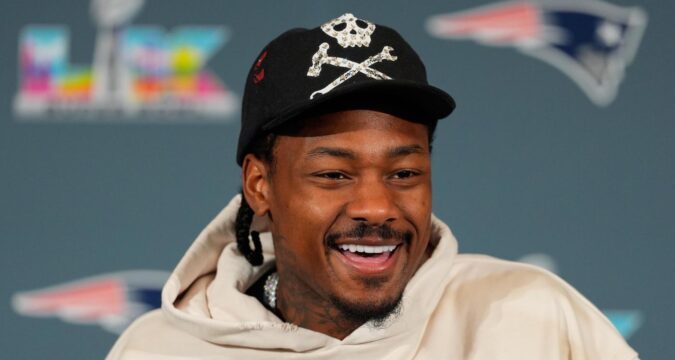
Con su pasión en el campo Stefon Diggs lidera el viaje de los Patriots al Super Bowl
Por KYLE HIGHTOWER
SANTA CLARA, California, EE.UU. (AP) — Junto al pequeño poste anaranjado que delimita a la izquierda la zona de anotación, pondrá una rodilla en tierra. Agachará la cabeza y cerrará los ojos.
Así, Stefon Diggs pasará algunos de sus últimos momentos antes del inicio del primer Super Bowl de su carrera.
Ha sido una parte fundamental de la rutina del receptor abierto antes de cada partido de esta temporada con los Patriots de Nueva Inglaterra.
Después de los calentamientos previos al juego, también llama a sus compañeros de equipo para que se reúnan a su alrededor mientras lidera una serie de discursos apasionados, enérgicos y a menudo virales.
“Solo digo lo que siento que debo hacer y simplemente me dejo ir”, expresó Diggs. “No se trata tanto de las palabras, sino más bien de la tenacidad”.
Luego, ora en voz baja sobre la esquina de la zona de anotación.
“Tomo un segundo para apreciar dónde estoy y dar gracias a Dios y tener mi pequeño momento con él. Agradeciéndole por las pruebas y tribulaciones”, manifestó Diggs. “Construyendo mi carácter un poco como persona y haciendo que estos hombros soporten peso, supongo”.
Ambos hombros son necesarios para el jugador a quien sus compañeros llaman el centro emocional del equipo en su camino hacia el Super Bowl. Y para Diggs, el ritual ha sido el combustible durante una temporada de regreso inesperado después de que su estadía en Houston la temporada pasada se acortó por una lesión de rodilla.
Pero, después de registrar su séptima temporada de 1.000 yardas recibidas en su undécimo año en la liga, también puede ser el arma no tan secreta para un ataque que necesitará estar en su mejor momento contra una defensa de Seattle que permitió 17,2 puntos por encuentro durante la temporada regular, la menor cifra en la NFL.
Muchas de las cosas que llevaron a Diggs a este punto surgieron de un sentido inicial de confianza que encontró como agente libre el verano pasado.
En 2024, cuando Diggs firmó con Houston, reconoció que buscaba ganar el título. Pero en el momento en que firmó con Nueva Inglaterra, Diggs no tenía muchas expectativas.
Lo que inicialmente lo atrajo a los Patriots fue la confianza que sintió después de conectar con el entrenador de receptores abiertos Todd Downing, quien fue el entrenador de alas cerradas en Minnesota en 2018 cuando Diggs estaba allí.
Obtuvo lo mismo del “tipo sincero” al que descubrió en el entrenador Mike Vrabel y también en el coordinador ofensivo Josh McDaniels. Es McDaniels a quien Diggs da el mérito por desbloquear una ética de trabajo que no había tenido durante su carrera profesional.
McDaniels dijo que el receptor veterano ha sido la pareja perfecta para el quarterback de segundo año Drake Maye.
“Creo que es genial para Drake estar cerca de un jugador tan logrado como Stef”, comentó McDaniels. “Drake ha aprendido a trabajar junto a un jugador de experiencia y que ha estado con muchos buenos mariscales de campo. Creo que ha sido genial para el crecimiento y desarrollo de Drake”.
Después de que Diggs superó las 1.000 yardas en la victoria sobre Miami, la mente de Maye regresó a la pretemporada cuando invitó a todos los receptores a su estado natal de Carolina del Norte para algunas sesiones de lanzamiento.
No pensó que alguien tan “importante” como Diggs tendría tiempo para participar. Pero lo hizo.
“Desde ese momento, deseé estar con él en el campo y verlo hacer lo suyo, y ha hecho lo suyo una y otra vez”, dijo Maye.
El receptor abierto DeMario Douglas dijo que Diggs también ha sido clave para la unión de su grupo.
“Antes de que comenzara esta temporada, nos acercamos”, comentó Douglas. “Esa fue una gran razón para no ser egoístas. Por supuesto, todos somos receptores, todos queremos tocar el balón. Pero… como tus hermanos, tus hermanos de sangre, quieres verlos hacerlo bien sin importar qué ocurra. Así es nuestra sala”.
Diggs espera traer la misma voz para su equipo que ha tenido toda la temporada.
_____
Deportes AP: https://apnews.com/hub/deportes
Security Expert: Illegal Minneapolis Checkpoints Trace Back To Marxist, Anarchist Movements
Security Expert: Illegal Minneapolis Checkpoints Trace Back To Marxist, Anarchist Movements
The eruption of “Signal-Gate” revealed the organizational structure and command-and-control nodes of left-wing activists operating within encrypted messaging apps to unleash pressure campaigns against federal agents in Minneapolis. This structure is very revealing and, according to some security experts, is deeply rooted in revolutionary tradition.
Anti-Immigration and Customs Enforcement checkpoints have sprung up across the sanctuary city of Minneapolis in recent weeks. These makeshift checkpoints on city streets are operated by left-wing activists who track traffic in and out of specific areas, searching for ICE vehicles, and there are reports from Fox News that some agitators even have the ability to check license plates.
INSURRECTION: ICE Watch, with the support of MPD, is expanding their checkpoints in Minneapolis. Masked men without warrants detain American drivers with out-of-state plates or rental cars to determine if they work for the federal government. pic.twitter.com/TUUa5PZA5G
— @amuse (@amuse) February 3, 2026
Far-left extremists in Minneapolis are again setting up street blockades and check points, with the city’s blessing, to slow down and check vehicles they suspect are driven by DHS agents and officers.
Photos published by revolutionary group, Minneapolis Spring: pic.twitter.com/4vzRVhOvvD
— Andy Ngo (@MrAndyNgo) February 1, 2026
Antifa in Minneapolis is literally building checkpoints and stopping vehicles on the road to run their license plates to see if they are affiliated with ICE before they let them through.
See the caption of this video in the reply. pic.twitter.com/Otkn44NQe4
— Karlyn Borysenko, anti-communist cult leader (@DrKarlynB) February 1, 2026
Crazy! Anti-ICE blockade check points in Minneapolis. Stopping cars to check if anyone in the car is a federal agent. Remind me again who the Nazi’s are? pic.twitter.com/oiF05bztFA
— Andie (@AndieTruthRules) February 3, 2026
J. Michael Waller, senior analyst for Strategy at the Center for Security Policy, provided important color on the emergence of “illegal checkpoints” in Minneapolis.
Waller explained:
Illegal checkpoints on public streets have a long history in Marxist and anarchist tradition.
They symbolize organized self-defense against “oppressors,” an empowerment of “the people” to seize urban space to confront the class enemy.
When organized as barricades to block passage, they become instruments of insurrection, dating back to the 1848 revolutions of Europe and the 1871 Paris Commune.
Marxists treat barricades as symbols of transition from civil protest to armed struggle.
Barricades mark the point when Marxists stop appealing to constitutional authority, and build structures for alternative power.
For anarchists, the barricade represents “direct action” and “horizontal self-organization” – the building of defenses without formal hierarchies or central leaders.
Anarchists view barricades as a reclaimed public space. Checkpoints and barricades turn the streets from channels of commerce and state control into zones of collective autonomy and mutual aid during insurrections or insurgencies.
Illegal checkpoints on public streets have a long history in Marxist and anarchist tradition.
They symbolize organized self-defense against “oppressors,” an empowerment of “the people” to seize urban space to confront the class enemy.
When organized as barricades to block… pic.twitter.com/BD1JvzBBe9
— J Michael Waller (@JMichaelWaller) February 3, 2026
We have profiled the rise of left-wing chaos, warning last year that billionaire-funded NGOs were funneling money into the protest industrial complex seeking revolution. In other words, a color revolution …
Last week, Joe Rogan and guest Andrew Wilson, a conservative podcaster, framed the chaos emanating from Minneapolis as a “color revolution.”
There is good news on multiple fronts. Tom Homan announced early Wednesday that an unprecedented number of counties in Minnesota are now cooperating with the federal government on the deportation of illegal aliens. That coordination has allowed Homan to authorize an immediate reduction in the federal agents across the metro area, a move viewed by us as a deliberate effort by the administration to de-escalate tensions and defuse the chaotic situation.
The second piece of good news came last month when Treasury Secretary Scott Bessent sat down with journalist Christopher Rufo and discussed plans to investigate dark-money-funded NGOs sowing chaos nationwide.
What the Trump administration has shown, and effectively forced into the open by surging federal agents into Minneapolis, is that the Democratic Party’s left-wing militant arm, such as Antifa, operates within an organizational structure pushing a revolutionary agenda.
Returning to Waller’s comments above about barricades and Marxist movements, the revolutionary picture should now be clearer than ever for the American public and for the White House about what’s really going on.
It may also be time for the White House to take seriously the remarks made by retired Lt. Gen. Michael Flynn in late November:
General Flynn Calls For National Address From Trump On Color Revolution Threat
From our view, elements within the Democratic Party are encouraging a rolling cycle of mass mobilization through the nonprofit world aimed at revolution against Trump and all-things ‘America First’. The focus of agitation appears to rotate by topic, moving from the George Floyd riots earlier this decade to more recent pro-Palestinian protests, and now to anti-ICE actions, while relying on the same activist network of nonprofits, propaganda channels, and street-level tactics. The deeper understanding here is that there’s a left-wing revolution brewing.
Tyler Durden
Wed, 02/04/2026 – 20:30
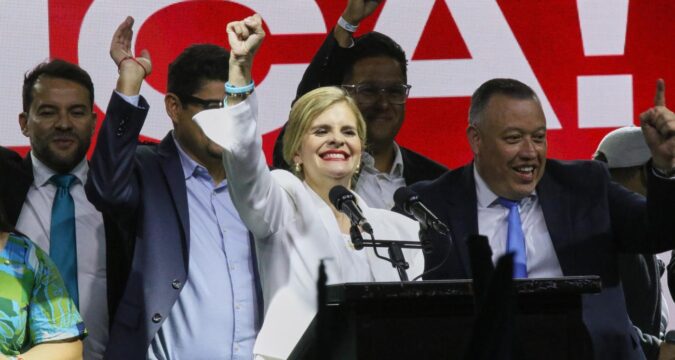
Presidenta electa de Costa Rica retomará su trabajo como ministra hasta fin del gobierno de Chaves
Por JAVIER CÓRDOBA
SAN JOSÉ, Costa Rica (AP) — La presidenta electa de Costa Rica, Laura Fernández, volverá a ocupar desde el miércoles el cargo de ministra de la Presidencia para lo que resta del gobierno del mandatario Rodrigo Chaves, que terminará el 8 de mayo.
En un movimiento inédito en la historia política costarricense, la vencedora de las elecciones presidenciales del 1 de febrero volverá al cargo al que renunció hace un año para iniciar su carrera electoral.
En la conferencia usual tras el consejo de gobierno, Chaves apareció junto a Fernández en la casa presidencial, donde primero la felicitó por el resultado “contundente” con el que venció en las urnas.
Chaves comentó que hace cuatro años tuvo muchas dificultades en la transición con el presidente anterior, Carlos Alvarado, por lo que no desea que Fernández pase por lo mismo en esta ocasión.
“No podemos, el país no debe aceptar una ruptura de esa transición. Y por eso le estoy comunicando al pueblo de Costa Rica que el día de hoy (miércoles) he nombrado a doña Laura Fernández Delgado como ministra de la Presidencia”, dijo el actual mandatario.
“¿Qué mejor muestra, compatriotas, de que estamos comprometidos a trabajar juntos? A que haya una transición sin baches, sin costuras, sin huecos. Una transición efectiva. Como ministra de la Presidencia, doña Laura va a ser la coordinadora del gabinete”, agregó Chaves.
El presidente agregó que revisará con Fernández los programas gubernamentales que están en ejecución y recordó que esta es la primera vez que un presidente electo recibe un nombramiento de este tipo en el gobierno que está a pocas semanas de terminar.
Chaves recomendó a Fernández tomarse primero unos días de vacaciones tras la intensa campaña electoral que acaba de terminar, para que luego retome las funciones que había dejado el 30 de enero de 2025.
“Me entusiasma sobremanera incorporarme de lleno en el proceso de transición como ministra, a colaborar con el desarrollo de proyectos, a trabajar codo con codo con los jerarcas del gabinete, como ya lo he hecho en el pasado”, dijo la presidente electa.
Sobre la posibilidad que ha mencionado Fernández de ofrecer a Chaves el puesto de ministro de la Presidencia cuando termine su periodo, el mandatario aseguró que ha tomado la decisión de quedarse en Costa Rica y rechazar ofertas en el extranjero, pero que la conversación con Fernández sobre ese tema aún está pendiente.
“De mi parte yo no digo que no, no digo que sí tampoco, porque falta esa conversación en detalle. Veremos, le tocará a ella hacer el anuncio como tuve yo el honor y el placer de hacer hoy, de nombrarla si es que llegamos a ese acuerdo”, indicó Chaves.
De acuerdo con expertos, un nombramiento de Chaves como ministro de la Presidencia le daría una nueva inmunidad legal que impediría procesarlo por las causas que aún tiene pendiente en su contra la Fiscalía General y el Tribunal Supremo de Elecciones, luego de que fracasaran en la Asamblea Legislativa los dos intentos de levantarle el fuero legal.
Operación militar deja al menos siete presuntos guerrilleros muertos en el noreste de Colombia
Associated Press
BOGOTÁ (AP) — Al menos siete presuntos miembros de la guerrilla del Ejército de Liberación Nacional (ELN) murieron el miércoles en una intensa ofensiva militar en una convulsa zona del noreste de Colombia, cerca de la frontera con Venezuela, informaron las autoridades colombianas.
La acción militar, calificada en la red social X por el ejército colombiano como “de alta precisión” y que continúa en desarrollo, se desplegó en la región del Catatumbo, en el departamento del Norte de Santander, un día después de la reunión entre los presidentes Gustavo Petro y su par estadounidense Donald Trump, donde dialogaron principalmente sobre seguridad y la lucha contra el narcotráfico.
Tras varias horas del intenso ataque en el que los militares usan “fuego de artillería”, el ejército reportó en X la muerte de siete presuntos integrantes del ELN y la captura de uno más.
En esa zona se libran continuos enfrentamientos entre las estructuras armadas del ELN y el frente 33, una de las disidencias de las desparecidas Fuerzas Armadas Revolucionarias de Colombia (FARC), por la disputa del estratégico territorio donde se cultiva la hoja de coca, han señalado las autoridades.
“Este es el bombardeo 14 en mi gobierno”, destacó en su cuenta de X el presidente Petro, quien instó al ELN a entregar “toda la infraestructura que sirva al narcotráfico multinacional y recobrar el sendero de la paz”.
El gobernante de izquierda añadió que se debe “desnarcotizar la frontera Colombo/venezolana para que el pueblo venezolano construya allí su progreso en libertad”.
Hasta el momento se ha incautado “material de guerra” como armas cortas y largas, municiones, explosivos, drones y granadas, señaló el ejército.
Un reciente informe de la Defensoría del Pueblo aseguró que un año después del mayor combate entre los dos grupos armados en el Catatumbo, que dejó cerca de un centenar de muertos, la región continúa cercada por la violencia.
La población civil vive en zozobra por el ruido permanente de drones sobre sus casas, con miedo a que los ilegales que los manejan lancen explosivos, mientras la movilidad es restringida en medio de amenazas de los armados, detalló el reporte.
El comandante de las fuerzas militares, general Alejandro López, dijo que la ofensiva continúa pues el compromiso es hasta lograr el “control territorial”, la estabilización y la protección de la población civil.
Run It Hot: Trump, The Fed, & The Coming Currency Debasement
Run It Hot: Trump, The Fed, & The Coming Currency Debasement
Authored by Nick Giambruno via InternationalMan.com,
The Trump administration has made no secret of its desire to push the monetary easing pedal to the metal, even as the engine is already near the red line. They intend to push the system as hard as possible today and worry about the consequences later. One reason may be to inflate the stock market ahead of the 2026 midterm elections.
There are several indicators that the Trump administration intends to run it hot in 2026.
The first — and most important — is that Trump will likely succeed in consolidating control over the Federal Reserve.
Jerome Powell’s term as Chair of the Federal Reserve is scheduled to expire in May 2026, allowing Trump to appoint his replacement. Powell attempted — largely unsuccessfully — to resist Trump’s pressure for easier monetary conditions.
I expect Trump will get his way with the Fed in 2026, and that the central bank will bend to his demands. By replacing Powell, Trump will further stack the Fed with loyalists. The result will be money printing on a scale we’ve never seen before.
Further, Stephen Miran — another of Trump’s recent successful nominees to the Federal Reserve Board — has been pushing the idea of what he calls the Fed’s “third mandate.”
Traditionally, the Fed has two mandates: price stability and maximum employment. Miran’s proposed third mandate would be for the Fed to “moderate long-term interest rates.”
What that really means is that the Fed would openly finance the federal government by creating new dollars to buy long-term debt, keeping yields artificially low. In other words, the so-called third mandate is an explicit admission that the Fed is no longer independent. It would become a political tool used to fund government spending.
Without this support, massive federal spending would flood the market with Treasuries, pushing interest rates much higher. But with the Fed stepping in, Washington can keep borrowing while holding rates down — at least for a while. The catch is that this comes at the cost of debasing the dollar. Eventually, that debasement will force investors to demand higher yields anyway, only worsening the problem.
Remember, after Nixon severed the dollar’s last link to gold in 1971, the unspoken promise was that Washington would act as a responsible steward of its fiat currency. Central to that promise was the illusion that the Federal Reserve would remain independent of political pressure.
The idea was simple: without at least the appearance of independence, investors would see the Fed for what it is — a funding arm for spendthrift politicians — and confidence in the dollar would collapse.
That illusion is now shattering.
Let’s be clear: central banks were never truly independent. That’s why it was always an illusion — a societal myth. They exist to siphon wealth from the public through inflation and funnel it to the politically connected. The Fed’s independence was always a mirage — and now it’s disappearing fast.
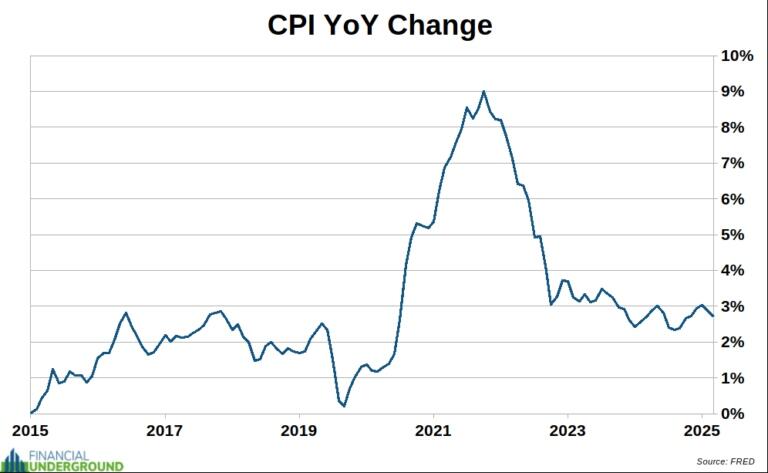
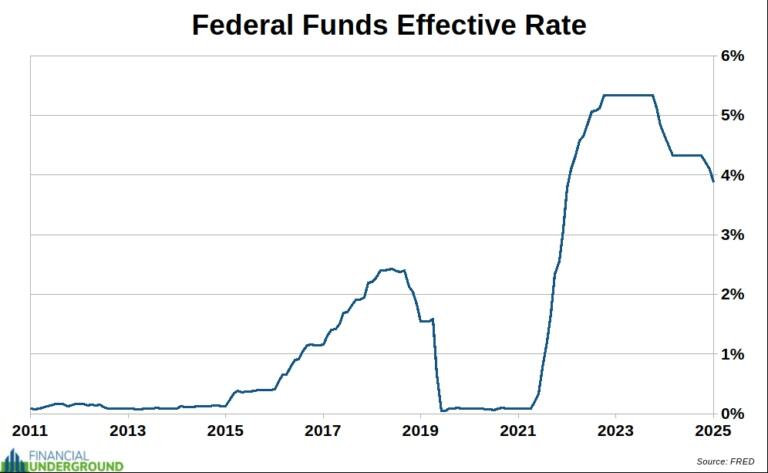
Further, late last year, the Fed embarked on a new interest rate cutting cycle, even though, according to their own rigged CPI metrics, prices are rising at 2.7%, well above their 2% target.
The Fed has already cut rates by around 50 basis points in 2025 and signaled that more rate cuts are coming in 2026.
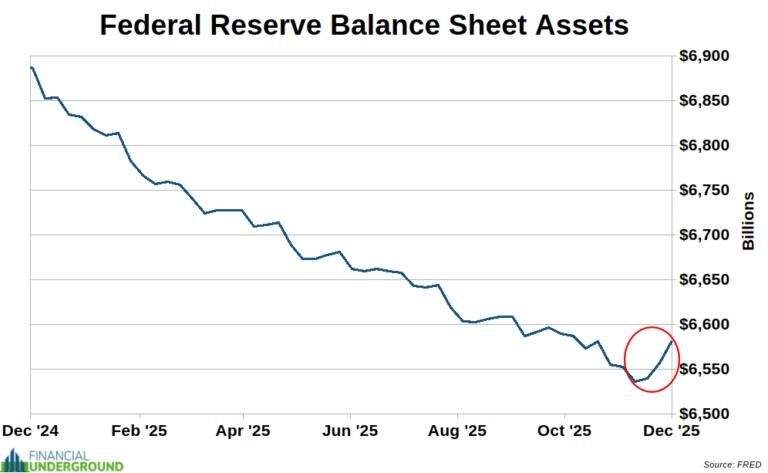
The Fed recently announced that it has ended the shrinking of its balance sheet and will now begin expanding it again, starting with the purchase of $40 billion in Treasuries in December.
The Fed insists this isn’t quantitative easing, calling it “reserve management” and pointing out that it isn’t explicitly targeting long-term Treasuries. That’s just wordplay. Buying Treasuries with newly created money is money printing, regardless of what label they attach to it. The Fed’s balance sheet is expanding again. A new printing cycle has begun.
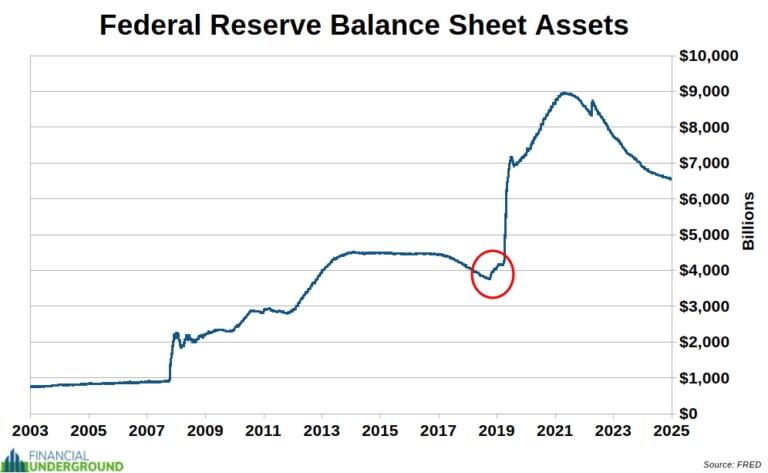
We’ve seen this pattern repeatedly. The Fed expands its balance sheet, then tries to shrink it. Something eventually breaks in the financial system, and the Fed pivots right back to easing and money creation. Each time this happens, the balance sheet never returns to its prior level. It ratchets permanently higher with every cycle of debasement.
What makes the current situation especially telling is that the Fed is entering another balance-sheet expansion phase even though the balance sheet is still more than 50% larger than it was before the Covid mass psychosis. Before 2020, the Fed’s balance sheet was roughly $4 trillion. It exploded to nearly $9 trillion during the Covid response. Even after so-called “quantitative tightening,” it remains around $6.5 trillion — nowhere near its pre-Covid level.
This completely contradicts the Fed’s long-standing claim that programs like QE are temporary.
Remember when former Fed Chair Ben Bernanke promised the balance sheet would eventually normalize after the 2008 financial crisis? That promise was made nearly 15 years ago, when the Fed’s balance sheet was around $2.5 trillion and was supposed to shrink back toward pre-crisis levels below $1 trillion. Instead, today the balance sheet is more than double what it was when Bernanke made that pledge — and now the Fed is entering yet another expansion cycle that threatens to push it even higher.
The long-term trend is obvious. The balance sheet only goes one direction: up. And the implication is unavoidable. Every time the Fed expands its balance sheet, it debases the currency. This isn’t an accident or a temporary policy error — it’s the core feature of the system.
If you’re wondering what comes next, look at the red circle on the chart below—and note what followed the last time the Fed shifted from shrinking its balance sheet to expanding it.
We are now in the top of the first inning of what may become the most aggressive balance sheet expansion cycle in the Fed’s history.
So let’s put it all together.
The midterms are coming in 2026, and Trump wants to boost the stock market.
Trump will get to replace Fed Chair Powell with a loyalist, consolidating control over the central bank.
The Fed has embarked on a new rate-cutting cycle, despite inflation still running well above its stated targets.
The Fed has ended the shrinking of its balance sheet and has begun expanding it again, buying tens of billions of dollars’ worth of Treasuries each month.
All signs point to a continued nominal melt-up in the stock market in 2026 — and ever-accelerating currency debasement.
The trajectory is clear. When monetary policy becomes a political tool and money printing turns permanent, the risks aren’t abstract — they’re personal. Currency debasement doesn’t just distort markets; it quietly erodes savings, purchasing power, and individual freedom.
The real question isn’t whether this process continues — it’s how prepared you are when it accelerates.
That’s why I’ve put together a free PDF report: The Most Dangerous Economic Crisis in 100 Years… the Top 3 Strategies You Need Right Now. Inside, you’ll learn: How the economic, political, and cultural forces now in motion are converging into a single systemic crisis, what the coming risks really mean for your money, your security, and your personal freedom, and the three concrete strategies you can use right now to position yourself ahead of what’s coming. This isn’t about fear. It’s about clarity — and taking action before the consequences become unavoidable. Click here to download the free PDF report and get prepared while you still can.
Tyler Durden
Wed, 02/04/2026 – 20:05
https://www.zerohedge.com/political/run-it-hot-trump-fed-coming-currency-debasement
Hornets adquieren a Coby White en intercambio con Bulls, según fuente AP
Por STEVE REED y TIM REYNOLDS
CHARLOTTE, Carolina del Norte, EE.UU. (AP) — Los Hornets de Charlotte traerán a Coby White de vuelta a Carolina del Norte, donde sigue siendo el líder anotador de secundarias del estado y donde también jugó para los Tar Heels.
Los Hornets acordaron adquirir el miércoles a White, procedente de los Bulls de Chicago, según una persona familiarizada con la situación. La fuente habló bajo condición de anonimato porque el acuerdo aún no había sido aprobado por la liga.
ESPN informó que los Hornets también obtendrán a Mike Conley Jr. en el acuerdo, mientras que los Bulls recibirán a Collin Sexton, Ousmane Dieng y tres de las selecciones de segunda ronda del draft de Charlotte.
White, la séptima selección general en el draft de 2019, se une a unos Hornets que podrían disputar los playoffs por primera vez en una década, habiendo ganado siete partidos consecutivos con un núcleo joven de jugadores.
Promedió 18,6 puntos, 4,7 asistencias y 3,7 rebotes por partido para los Bulls, acertando el 34,6% de tiros desde la línea de tres puntos, ligeramente por debajo de su promedio de por vida, de 36,8%.
Aunque no está claro dónde encajará en la rotación de los Hornets, White jugará al lado de LaMelo Ball, Brandon Miller, Kon Knueppel y Miles Bridges. Los Hornets cuentan con un récord de 23-28 y actualmente están en el 11mo puesto en la Conferencia Este, pero tienen una foja de 12-1 cuando figuran en su alineación titular Ball, Miller, Knueppel, Bridges y el pívot Moussa Diabate, todos los cuales ahora están saludables.
Knueppel ha ganado tres premios consecutivos al Novato del Mes de la Conferencia Este, mientras que Miller fue nombrado Jugador de la Semana pasada en la conferencia.
White, de 25 años, ha pasado siete temporadas con los Bulls, promediando 15,4 unidades, 3,9 asistencias y 3,7 tablas.
Sexton ha sido el principal suplente de Ball como base esta temporada y ha dado un impulso a los Hornets desde el banquillo, promediando 14,2 puntos y 3,7 asistencias en 42 duelos, atinando el 39,3% de triples.
White anotó 3.573 puntos para la escuela secundaria Greenfield en Wilson, Carolina del Norte, de 2014 a 2018.
Jugó una temporada en la universidad en Carolina del Norte antes de saltar a la NBA. Continúa organizando campamentos de baloncesto juvenil en el campus cuando no hay temporada.
___
Reynolds informó desde Miami.
___
Deportes AP: https://apnews.com/hub/deportes
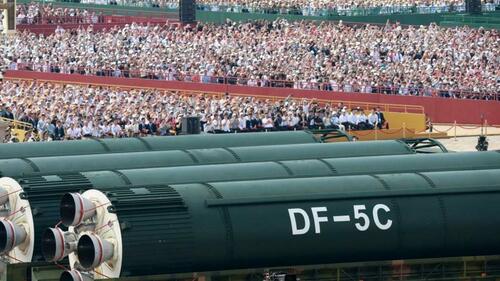
Putin Notifies Xi Of New START Status As Trump Ready To Let Go Of Nuclear Arms Control With Russia
Putin Notifies Xi Of New START Status As Trump Ready To Let Go Of Nuclear Arms Control With Russia
President Putin in his Wednesday video call with Chinese President Xi Jinping underscored that the last major nuclear treaty with the United States is on the eve of collapse.
New START is set to expire on Thursday. Putin notified Xi that Washington has not yet responded. “As you know, on September 22, 2025, we proposed to the Americans to extend the key quantitative limits for one year as voluntary self-restrictions. However, we have not yet received an official response from the Americans,” Putin said, as quoted in state media.
Despite the situation with the New START Treaty, Russia remains open “to seeking negotiated ways to ensure strategic stability” – the Russian leader explained.
Putin further stated his country will act “in a measured and responsible manner, based on a thorough analysis of the overall security situation.”
Over several years going back to his first term, Trump has signaled a desire to forge a broader deal which would bring China into the agreement, which hearkens back to the Obama administration.
Politico is meanwhile reporting that the Trump administration is preparing to “let go of arms control with Russia”:
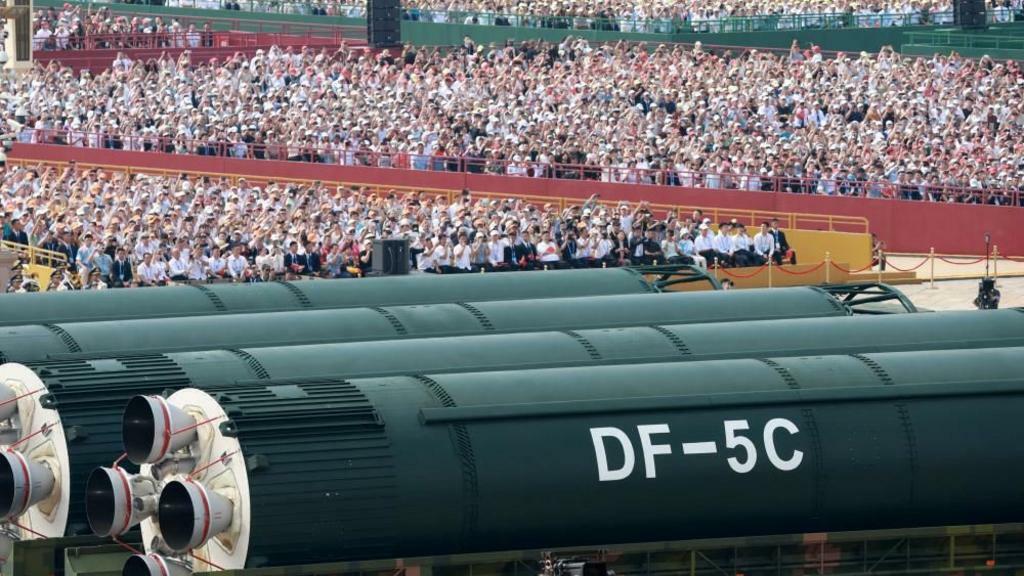
The likely dissolution of the agreement comes at an especially fraught time. Russia and China are expanding their strategic arsenals and the Kremlin has threatened to use nuclear weapons on Ukraine. The Defense Department has held a series of internal meetings in preparation for a post-New START world, according to the two people and another person familiar — all of whom were granted anonymity to discuss internal talks — although it’s not clear what was discussed in the meetings.
“We’re looking at a very uncertain path ahead,” said Daryl Kimball, the executive director of the Arms Control Association. “Unless Trump and Putin reach some sort of understanding soon, it’s not unlikely that Russia and the U.S. will start to upload more warheads on their missiles.”
The Kremlin has made clear Russia is willing to extend it for another year, to allow more robust negotiations and for a longer deal to be finalized. But again, unless it is renewed or extended at the last minute, the landmark treaty will expire on Thursday, February 5.
Former Russian president Dmitry Medvedev, now deputy chairman of the country’s Security Council, on Monday made clear that Russia’s offer to quickly extend “remains on the table, and the treaty has not even expired yet, and if the American side wants to extend it, then this can be done.”
He also confirmed that Moscow has received no response on this offer from Washington:
Medvedev told the newspaper Kommersant that Moscow might have to wait until the expiry of the treaty on February 5 for a U.S. response to the Russian initiative.
When contacted for comment, a White House official told Newsweek Monday: “The president will decide the path forward on nuclear arms control, which he will clarify on his own timeline.”
Indeed, the Trump White House has yet to issue anything official. Of course, President Trump is also known for making key decisions at the last moment, building suspense and leverage, based on also on his notorious unpredictable decision-making style.
The New START treaty, which has contained the risk of a nuclear standoff between America and Russia, expires soon. To make matters more dangerous, there is a new player in the game—China: https://t.co/w2LZ59AbYu pic.twitter.com/xNySz54I0V
— The Economist (@TheEconomist) February 4, 2026
According to Monica Duffy Toft, professor of international politics and director of the Center for Strategic Studies at The Fletcher School, “By providing transparency into the world’s two largest nuclear arsenals, New START has lowered the risk that either side will misinterpret normal military activity as preparation for a nuclear strike.”
It was signed in 2010 by Presidents Barack Obama and Dmitry Medvedev, and limits the number of deployed strategic warheads to 1,550 per side, and caps deployed delivery systems – including of missiles, bombers, and submarines – at 700. There’s also a mutual inspection regimen, allowing each side to monitor the other’s sites.
Tyler Durden
Wed, 02/04/2026 – 19:40