Category: News
Ofertas de empleo en EEUU caen al nivel más bajo desde 2020, con mercado laboral lento
Por PAUL WISEMAN
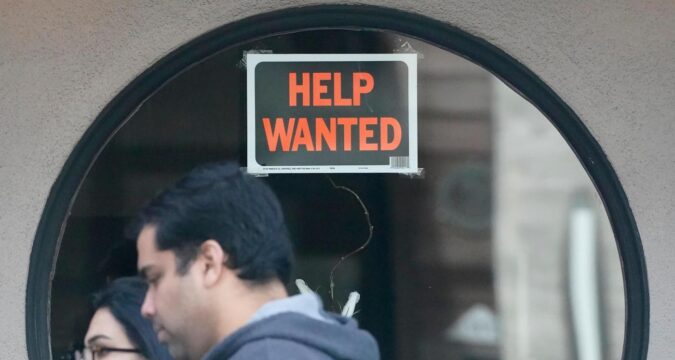
WASHINGTON (AP) — Las ofertas de empleo en Estados Unidos cayeron al nivel más bajo en más de cinco años, otro indicio de que el mercado laboral estadounidense sigue siendo débil.
El Departamento de Trabajo informó el jueves que las vacantes cayeron a 6,5 millones en diciembre, desde 6,9 millones en noviembre, siendo la cifra más baja desde septiembre de 2020. Los despidos aumentaron ligeramente. El número de personas que renunciaron a sus empleos —lo que muestra confianza en sus perspectivas— se mantuvo básicamente sin cambios en 3,2 millones.
Las vacantes de diciembre fueron inferiores a lo que los economistas habían pronosticado.
La economía se encuentra en una situación desconcertante. El crecimiento es fuerte: el producto interno bruto —la producción nacional de bienes y servicios— avanzó de julio a septiembre al ritmo más rápido en dos años. Pero el mercado laboral es mediocre: los empleadores han añadido solo 28.000 empleos al mes desde marzo. En contraste, durante el auge de contrataciones de 2021-2023 que siguió a los confinamientos por COVID-19, se estaban creando 400.000 empleos al mes.
Cuando el Departamento de Trabajo publique las cifras de contratación y desempleo de enero el próximo miércoles, se espera que muestren que las empresas, agencias gubernamentales y organizaciones sin fines de lucro añadieron alrededor de 70.000 empleos el mes pasado, una cifra modesta pero superior a los 50.000 de diciembre.
El miércoles, el procesador de nóminas ADP indicó que los empleadores privados añadieron apenas 22.000 empleos el mes pasado, mucho menos de lo que los analistas habían esperado. Y la firma de recolocación Challenger, Gray & Christmas señaló el jueves que las empresas recortaron más de 108.000 empleos el mes pasado, la cifra más alta desde octubre y el peor enero para recortes de empleo desde 2009.
“La recesión de contrataciones no va a terminar pronto. Las ofertas de empleo en diciembre cayeron a su nivel más bajo desde septiembre de 2020. Es otro signo de lo poco que se está contratando —o del interés en contratar— en esta economía”, escribió en un comentario Heather Long, economista jefa de Navy Federal Credit Union.
Los economistas intentan averiguar si la contratación se acelerará para ponerse al día con el fuerte crecimiento, o si el crecimiento se desacelerará para reflejar un mercado laboral débil, o si los avances en inteligencia artificial y automatización significan que la economía puede avanzar sin crear muchos empleos. ___
Esta historia fue traducida del inglés por un editor de AP con la ayuda de una herramienta de inteligencia artificial generativa.
DHS Secretary Noem Identifies Another Leaker, Refers To DOJ For Prosecution
DHS Secretary Noem Identifies Another Leaker, Refers To DOJ For Prosecution
Authored by ‘sundance’ via The Last Refuge,
The good news is the process to identify the subversive agents inside the various offices of the administration continues to yield results. The bad news is there’s a lot of them to identify and remove.
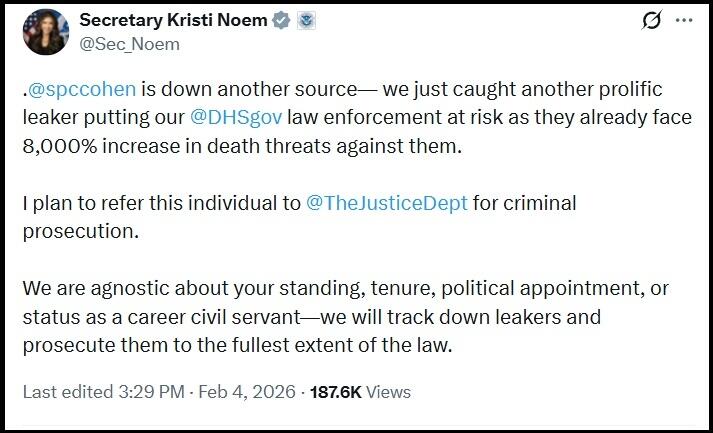
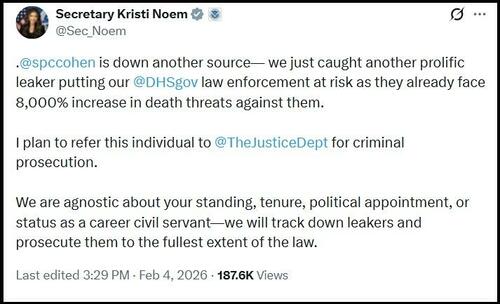
Dept of Homeland Security Secretary Kristi Noem shares another leaker has been identified and removed.
Additionally, she is referring their conduct to the Dept of Justice for criminal prosecution.
[SOURCE]
Both Noem and Gabbard appear to be continuing their methodical approach without fear or favor.
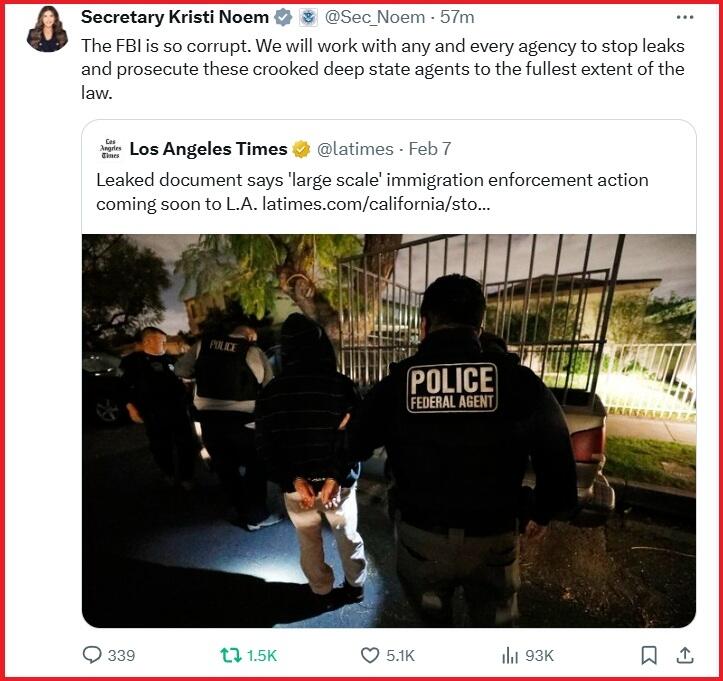
Secretary Noem facing down the internal resistors within the FBI, who have been leaking about ICE enforcement operations.
Director Gabbard working through the tentacles of the Intelligence Community to identify similarly minded IC agents.
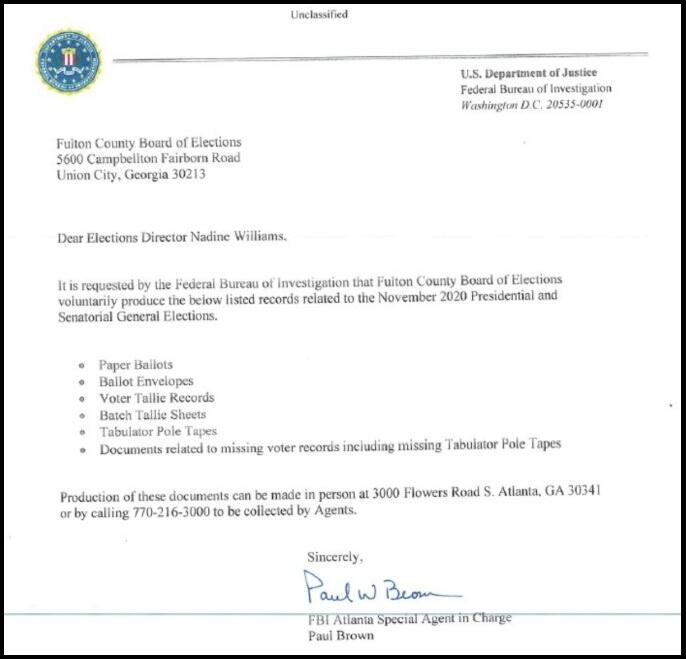
Meanwhile there was some media controversy about the FBI Special Agent in charge of the Atlanta Field office being removed from his position just prior to the execution of a federal search warrant in Fulton County.
The reason for that removal now seems to come to light with the release of letter former Agent Paul Brown sent to Elections Director Nadine Williams giving her a head’s-up on the material the FBI was going to seize.
FBI Agent Brown asks Ms Williams to voluntarily hand over the material, which has the result of giving Fulton County a heads-up about the specifics of the material the FBI were going to gather and review in their search warrant.
Another positive outcome amid all of this, is honestly exposing FBI Director Kash Patel’s lack of operational control over the agency he heads.
Each day more people are starting to realize what many of us have noted from the outset.
Without first admitting the scale and scope of the problem within the FBI, there was no way Kash Patel was ever going to address it.
The issues with the FBI are obvious; a few examples:
There were 40 FBI agents on the Robert Mueller investigation into Trump-Russia collusion. Why would any of them still be employed?
Additionally, think about the J6 investigations and Arctic Frost, are those FBI agents still employed within the FBI?
There is no apple, it’s all worms.
Tyler Durden
Thu, 02/05/2026 – 11:40

Indiana House committee discusses, hears testimony on welfare fraud bill
The House Ways and Means committee discussed and heard testimony Wednesday on a welfare fraud bill, with the majority of those testifying speaking against the bill while the bill author and state officials doubled down on the need for the bill.
Senate Bill 1, authored by State Sen. Chris Garten, R-Charlestown, was filed to prevent fraud and contain state spending on welfare programs because “Americans are outraged by the billions of dollars of welfare fraud in our nation – and the Minnesota scandal is Exhibit A,” according to a press release.
Minnesota has been under the spotlight for years for Medicaid fraud, including a massive $300 million pandemic fraud case involving the nonprofit Feeding Our Future. Prosecutors said it was the country’s largest COVID-19-related fraud scam and that defendants exploited a state-run, federally funded program intended to provide food for children.
In 2022, during President Joe Biden’s administration, 47 people were charged. The number of defendants has grown to 78 throughout the ongoing investigation. So far, 57 people have been convicted, either because they pleaded guilty or lost at trial.
Most of the defendants are of Somali descent. Numerous other fraud cases are being investigated, including new allegations focused on child care centers.
In news interviews and press releases over the summer, prosecutor Joe Thompson estimated the total loss from all fraud cases could exceed $1 billion. Earlier this month, a federal prosecutor alleged that half or more of the roughly $18 billion in federal funds that supported 14 programs in Minnesota since 2018 may have been stolen.
Garten said the purpose of the bill is to close loopholes within Medicaid and Supplemental Nutrition Assistance Program as well as complying with federal requirements under President Donald Trump’s budget bill that passed over the summer.
“By tightening these loopholes and aligning our programs with federal law we guarantee that our safety net remains sustainable for the poor, the disabled, our elderly and our Hoosier children who rely on it and need it the most,” Garten said.
The 24-page bill will end the state’s participation in the use of expanded categorical eligibility within the federal Supplemental Nutrition Assistance Program, set gross income standards and countable resources for SNAP eligibility, and establish immigration eligibility requirements for SNAP.
Under the bill, if a SNAP applicant’s immigration status can’t be verified, the applicant’s information will be “immediately referred to the U.S. Department of Homeland Security for investigation and potential deportation proceedings,” Garten said in a release.
Senate Bill 1 also establishes the time frame for Medicaid eligibility redeterminations, and requires the secretary of the Family and Social Services Administration to transmit certain information to the federal government to prevent multiple state Medicaid enrollment.
The bill further sets income requirements for Medicaid, and modifies immigration status requirements for Medicaid, including presumptive eligibility, including an increase to 80 hours of work or volunteering per month, and the Healthy Indiana Plan, and requires the office to verify compliance with the requirements and report information to the federal government.
Under HIP, the bill modifies work and exemption requirements and requires the conditions to be met in the three preceding months before an individual applies. The bill directs the secretary of FSSA to verify compliance with the work requirements on an ongoing basis and at least quarterly.
Senate Bill 1 removes the 12-month eligibility period for HIP and requires semiannual renewal, and it sets an additional copayment for the use of an emergency room for nonemergency services and other services under HIP.
Family and Social Services Administration Secretary Mitch Roob said currently, there are no undocumented immigrants receiving benefits.
The department “is in violent agreement with this legislation,” Roob said. “In the words of Lady Gaga, FSSA is here for the applause, applause, applause,” Roob said, as the department applauded the work requirement for the Medicaid expansion population, the codification of Gov. Mike Braun’s Smart SNAP program, the end of the broad-based categorical eligibility for SNAP, the codification of the rural health transformation program, the efforts to prevent multi-state Medicaid enrollment and measures to enhance verification of citizenship.
Garten said he added the portion of the bill to report an undocumented immigrant to DHS as “a deterrent” to prevent undocumented immigrants from applying for benefits.
“My hope is anybody that’s thinking about this in the future won’t do it,” Garten said.
State Rep. Mike Andrade, D-Munster, said Indiana doesn’t provide benefits to undocumented immigrants. Garten said that didn’t matter.
“To me, that’s irrelevant. We’re legislating for the future and from this day forward, and so what we need to make sure is that we safeguard these safety nets and that they are only eligible for our poor and our disabled citizens,” Garten said.
State Rep. Ed DeLaney, R-Indianapolis, asked about a mixed-status household – where one parent is a citizen, one parent is undocumented and they have children who are citizens – applying for benefits.
DeLaney asked if the application would ask for information about the undocumented parent, and if so, then the undocumented parent would be reported to DHS. Garten said yes to both questions.
“The consequence is that a U.S. citizen who is the mother, for example, of two U.S. citizens is basically ineligible or has to take the risk of having their spouse removed from the home,” DeLaney said.
Garten said the reason the bill calls for the information about the undocumented parent is because immigrant households are “scrutinized at a lower level than Hoosier households,” because an immigrant household’s total income isn’t counted when determining eligibility for programs.
Garten said that portion of the bill aims to align all household income totals. DeLaney said there’s “one big exception” because the immigrant home faces the possibility of having a family member deported.
Later in the hearing, Garten clarified that the only people who would be referred to DHS would be undocumented immigrants who applied for benefits. So, in a mixed-status household, the undocumented parent wouldn’t be reported to DHS, he said.
State Rep. Danny Lopez, R-Carmel, said the bill states “promptly refer the applicant, recipient or household member of an applicant or recipient to the Department of Homeland Security.”
“If the household members are undocumented, I think I’m reading that right, they would be referred, which is inconsistent with how y’all answered,” Lopez said, addressing Garten and Roob, who was testifying before the committee at the time.
Roob said he focused on the Medicaid portion of the bill, not the SNAP portion, which has the immigration reporting requirement.
To further address fraud, Roob said Braun signed an executive order Monday to create an Indiana council on fraud detection and prevention in federal programs that state agencies administer.
State Rep. Gregory Porter, D-Indianapolis, said the executive order creating the council was “a 2.0” version of the executive order Braun signed in 2025 that stated a waste, fraud and abuse report would be released by Oct. 31, 2025, but it wasn’t.
“There is no report, nothing has been established,” Porter said. “I would like to see the original report, if there is one.”
Roob laughed and said he shouldn’t have brought up the executive order.
Along with Roob, 15 people testified before the House Ways and Means committee, with the majority of people testifying against the bill.
Tracey Hutchings-Goetz, with Hoosier Action, said the organization opposes the bill because it will leave Hoosiers “hungrier, sicker and poorer while making our Medicaid and SNAP programs more expensive to run.”
In talking to residents, Hutchings-Goetz said the organization has found that residents are scared of losing healthcare coverage and food because of paperwork errors and the increased complexity in the systems the bill establishes.
“Implementing the bureaucratic barriers to care in S.B. 1 will cause unnecessary suffering for Medicaid members as well as undue pressure on FSSA,” Hutchings-Goetz said.
Tiffany Nichols, with the American Lung Association, said that patients with lung conditions can’t afford gaps in coverage, which S.B. 1 does because “it creates harmful Medicaid coverage barriers.”
“These policies will increase the risk of people losing coverage because of administrative barriers, not because they are ineligible,” Nichols said. “There will be consequences if patients lose coverage or experience gaps in their care.”
State Rep. Christopher Judy, R-Fort Wayne, shared the story of his mother, a single mother of three, using food stamps in 1986 and feeling so embarrassed by it. In 1989, she went to college and became a nurse, he said.
“These work requirements are needed. This program is not to live off of. This program is to lift you up out of poverty,” Judy said. “My mother could’ve did nothing. We could’ve just sat on the government dole my whole childhood.”
Judy said the bill will help Hoosiers because he’s “seen it personally 40 years ago to see what my mother did to get us out of poverty.”
The House Ways and Means committee will discuss Senate Bill 1 again at a future committee meeting.
akukulka@post-trib.com

Declaran alerta por brote de sarampión en Jalisco, sede mexicana del Mundial
CIUDAD DE MÉXICO (AP) — Ante el aumento de los casos de sarampión en el estado de Jalisco, que será una de las sedes mexicanas de la Copa del Mundo, las autoridades estatales declararon el alerta sanitaria y ordenaron a partir del jueves el uso obligatorio de cubrebocas en las escuelas de la capital estatal.
La decisión coincide con el alerta epidemiológica que emitió la víspera la Organización Panamericana de la Salud (OPS) ante el avance de los contagios de la enfermedad en las Américas y en particular en México, que se mantiene a la cabeza en la región con 740 casos.
La Secretaría de Salud del Jalisco dijo en un comunicado que se acordó “el uso obligatorio de cubrebocas” en los centros educativos de siete municipios de la capital estatal, Guadalajara, en los siguientes 30 días.
Las autoridades estatales no ofrecieron cifras del número de contagios que llevaron a tomar esa decisión en Jalisco, que se convirtió en el primer estado de México en extremar los controles. Desde la pandemia de coronavirus no se imponía una medida sanitaria de este tipo en México.
En Jalisco y el estado central de Aguascalientes se suspendieron recientemente las clases en 15 escuelas ante la aparición de casos de sarampión.
Esta semana la Asociación Mexicana de Vacunología instó al gobierno a tomar “acciones urgentes de prevención” contra el brote de sarampión en Jalisco al asegurar que en ese estado había 829 casos confirmados, lo que representa más de la mitad de los enfermos diagnosticados en el país en lo que va del año.
Desde 2025 comenzaron a reportarse casos de sarampión en México, en particular en el estado de Chihuahua, donde se registró un pico de la enfermedad.
El brote de sarampión en Guadalajara se da en momentos en los que se está disputando allí la Serie del Caribe de béisbol y a cuatro meses de que esa ciudad, de cinco millones de habitantes, sea una de las 16 sedes del Mundial de Fútbol que se jugará de manera simultánea en Estados Unidos, México y Canadá. Uno de los partidos más sobresalientes será el Uruguay-España el 26 de junio.
En noviembre pasado, Canadá perdió el estatus de país libre de sarampión y Estados Unidos y México enfrentan el riesgo de correr la misma suerte. Sus respectivos gobiernos pidieron una prórroga de dos meses para intentar controlar el brote, aunque en enero la administración de Donald Trump se retiró de la Organización Mundial de la Salud, bajo cuyo paraguas está la OPS.
En las primeras tres semanas de este año se confirmaron 1.031 casos adicionales de sarampión en siete países de las Américas sin ninguna muerte notificada, una cifra que es 43 veces más de la registrada en el mismo periodo del año previo, informó el miércoles la OPS en un comunicado.
El gobierno mexicano lleva semanas alentando a la población a vacunarse contra esta enfermedad altamente contagiosa, pero prevenible con las dos dosis de la vacuna, y anunció la puesta en marcha de puntos de vacunación en lugares como aeropuertos o estaciones de autobuses.
___
Deportes AP: https://apnews.com/hub/deportes

Entre cortes de energía y sanciones, cubanos luchan por mantener la alegría de vivir
Por DÁNICA COTO
SANTA CRUZ DEL NORTE, Cuba (AP) — El olor a azufre es intenso en este pueblo costero que produce petróleo y alberga una de las mayores plantas termoeléctricas de Cuba. Sin embargo, aun mientras la planta vuelve poco a poco a la vida, los residentes permanecen en la oscuridad, rodeados de fuentes de energía que no pueden usar.
A medida que se profundizan las tensiones entre Cuba y Estados Unidos tras los ataques de Washington a Venezuela y la interrupción de los envíos de petróleo a la isla, también crecen los problemas de Santa Cruz del Norte.
Los habitantes de este pueblo al este de La Habana se sumergen diariamente en la oscuridad y se ven obligados a cocinar con carbón y leña, pero no todos pueden permitirse esta nueva realidad.
Kenia Montoya dijo que recientemente arrancó la puerta de madera de su baño en la deteriorada casa de bloques de cemento que comparte con sus hijos porque necesitaba leña, y ellos necesitaban comer.
“Con esta situación ahora estamos empeorando nosotros”, afirmó. “No nos suministran petróleo. No nos suministran la comida. ¿Y entonces?”
Una descolorida sábana púrpura cuelga ahora sobre su baño. Cerca de ahí, solo queda un puñado de carbón en una pequeña bolsa.
La madre de 50 años no sabe cómo cocinará una vez que se acabe el carbón porque los suministros en la región han disminuido.
Es una de las muchas incertidumbres que afectan a pueblos como este en toda Cuba, después de que el presidente de Estados Unidos, Donald Trump, amenazara con imponer aranceles a cualquier país que venda o proporcione petróleo a Cuba.
“Bueno, ahora es una nación fallida”, dijo Trump esta semana. “Y no reciben dinero de Venezuela, y no reciben dinero de ningún lado”.
“¿Cómo vamos a vivir?”
Cerca de la entrada principal de Santa Cruz del Norte, un amplio mural está adornado con el siguiente mensaje en mayúsculas: “AQUÍ NO SE RINDE NADIE. VIVA CUBA LIBRE”.
Pero la gente se pregunta cuánto tiempo podrán resistir.
La crisis de la isla es cada vez más profunda: apagones severos, precios más altos y escasez de bienes básicos.
Mientras tanto, el gobierno cubano permanece en silencio sobre sus reservas de petróleo, sin ofrecer información sobre si Rusia u otro país aumentaría sus envíos tras la interrupción de los suministros de petróleo venezolano cuando Estados Unidos atacó y arrestó a su presidente a principios de enero.
Recientemente, las autoridades cubanas elogiaron una llamada telefónica que sostuvieron con el ministro de Relaciones Exteriores de Rusia, Serguéi Lavrov, aunque no compartieron detalles. Mientras tanto, México se comprometió a enviar ayuda humanitaria, incluyendo alimentos, después de que Trump dijera que pidió la suspensión de los envíos de petróleo a la isla.
Muchos habitantes de Santa Cruz del Norte sienten que lo peor está por venir.
“Con todos esos aranceles que le van a poner a los países, no va a entrar petróleo, ¿y de qué vamos a vivir?”, dijo Gladys Delgado.
Hace poco, en una fría tarde, la mujer, de 67 años, abrió su puerta principal para tomar un poco de aire fresco mientras cosía pequeñas y coloridas alfombras hechas de retazos de ropa para ganar algo de dinero extra porque su pensión asciende a solo 6 dólares al mes.
Un par de casas más abajo, Minorkys Hoyos dejaba caer un puñado de cubos de yuca en una vieja olla que llenó con agua de un barril y la colocaba sobre una pequeña parrilla improvisada dentro de su hogar.
“Uno vive con lo que tú tengas en tus manos”, comentó, señalando que no tenía más comida disponible en ese momento.
Los pocos artículos recargables que solían iluminar su pequeño y desordenado hogar se han descompuesto, y comenzó a tropezar con las cosas hasta que un vecino le regaló una linterna improvisada hecha con combustible y un frasco de alimento para bebés.
“Yo oscuro no veo”, dijo la mujer de 53 años, que además padece diabetes.
Eran las últimas horas de la tarde mientras cocinaba, pero su hogar ya estaba oscuro.
Afuera, dos niños se sentaban en una polvorienta acera. Apilaban fichas de dominó una sobre otra para ver hasta dónde podían llegar antes de que todo se derrumbara.
“Si pudiéramos hacer algo”
En los últimos tres meses, Santa Cruz del Norte tenía electricidad mientras la mayor parte de Cuba sufría constantes apagones debido a la envejecida infraestructura y a la escasez de combustible en las centrales eléctricas.
Personas como Iván Amores se regocijaban con cautela, temerosas de que volvieran a quedar sumergidas en la oscuridad como la mayor parte del año pasado. Sus temores se materializaron hace una semana, cuando volvieron los apagones.
“Esto era una maravilla”, dijo sobre su pueblo cuando tenía electricidad. “Ahora es una verdadera tortura”.
Amores utiliza una pequeña parrilla improvisada para cocinar para él, su hija y su pequeña nieta, comprando carbón más caro, a 3 dólares la bolsa, porque genera menos humo dentro de su impecable hogar.
También invirtió en una luz tubular que un cubano en otro pueblo construye y vende; se puede cargar e incluso viene con un puerto USB.
Pero hasta esos brillantes inventos que han hecho famosos a los cubanos están fuera del alcance de personas como Mariela Viel, de 67 años; ella y su esposo aún no pueden permitirse agregar un baño a su casa de bloques de cemento con piso de tierra.
Mientras crecía, Viel dijo que nunca supo lo que era un apagón: “Y estábamos bien. Teníamos comida, el dinero”.
Trabajó más de 40 años en la cafetería de la compañía eléctrica de Cuba y ahora recibe una pensión mensual equivalente a 8 dólares.
“¿Qué me puede alcanzar? Para nada. Ni un paquete de pollo”, comentó.
Cuando hay electricidad, cocina arroz y frijoles y escucha su música favorita: las grandes orquestas cubanas.
Viel se sentó afuera una reciente tarde, observando a un par de vecinos caminar rápidamente con cubos de agua caliente para que sus familias pudieran ducharse durante una ola de frío que comenzó a finales de enero, con un récord de 0 grados Celsius (32 grados Fahrenheit) registrado en un pueblo al sureste de Santa Cruz del Norte.
Las celebraciones también comienzan más temprano ahora, y una familia organizó el cumpleaños número 15 de un niño —una edad importante en toda América Latina— a media tarde antes de que él y sus amigos optaran por terminar la fiesta al aire libre bajo una gran luna amarilla.
El astro brillaba sobre un grupo de personas cercanas que bailaban y cantaban afuera junto a un scooter que reproducía música desde sus altavoces para celebrar el cumpleaños de Olga Lilia Laurenti, ahora de 61 años.
“Realmente le digo que lo que tenga que venir, que venga, porque nosotros no podemos pararlo”, dijo mientras hacía una pausa en el baile.
“No le vas a perder parte de tu vida con algo que no está en tus manos. Si nosotros pudiéramos hacer algo, pero ¿qué vamos a hacer? No podemos sufrir. La risa no puede faltar, la alegría no nos puede faltar”.
___
Esta historia fue traducida del inglés por un editor de AP con la ayuda de una herramienta de inteligencia artificial generativa.

San Siro, el icónico estadio de Milán que albergará la apertura de los Juegos Olímpicos de Invierno
Por DANIELLA MATAR
MILÁN (AP) — El estadio San Siro de Milán se prepara para una despedida.
La ceremonia de apertura de l os Juegos Olímpicos de Invierno de Milán-Cortina probablemente será el último evento de importancia global que se celebre en el icónico estadio antes de que sea demolido en los próximos años.
El recinto, con 99 años de existencia, es el feudo de los clubes de fútbol Inter de Milán y AC Milan, que completaron la compra de San Siro y el área circundante a la ciudad en noviembre.
Los clubes planean derribarlo y construir un nuevo estadio, listo para cuando Italia coorganice el Campeonato Europeo de 2032 con Turquía.
San Siro tiene una capacidad de poco menos de 76.000, aunque se reducirá a 60.000 para la ceremonia de apertura.
Aquí hay algunas cosas que saber sobre el histórico recinto:
Técnicamente no es San Siro
El estadio fue originalmente nombrado por el distrito de San Siro de Milán donde se encuentra. Sin embargo, el nombre fue oficialmente cambiado a Stadio Giuseppe Meazza en 1980, varios meses después de la muerte del legendario jugador de fútbol milanés.
Meazza, dos veces campeón mundial con Italia, pasó la mayor parte de su carrera en el Inter y una etapa de dos años en el Milan.
También dirigió al Inter en tres ocasiones distintas. Es más común que los aficionados del Inter se refieran al estadio como el Meazza, que los aficionados del Milan, aunque la mayoría todavía lo llama simplemente San Siro.
También se le apoda “La Scala del calcio” (La Scala del fútbol) en honor a la famosa casa de ópera milanesa.
El ascenso de un ícono
El estadio fue construido en un tiempo récord de 13 meses, entre agosto de 1925 y septiembre de 1926, convirtiéndolo en el quinto estadio más antiguo aún en uso en Italia.
Sin embargo, se parecía poco a lo que es actualmente.
El entonces presidente del AC Milan, Piero Pirelli, era un gran fanático del fútbol inglés y se inspiró en esos estadios. San Siro originalmente tenía cuatro gradas separadas y fue diseñado exclusivamente para el fútbol, sin pista de atletismo.
Sin embargo, tenía vínculos con otro deporte, ya que satisfacía las necesidades del cercano hipódromo. Mientras que algunos de los espacios bajo las gradas se usaban como vestuarios, duchas y oficinas de gestión, otros funcionaban como establos, graneros y almacenes para forraje.
San Siro originalmente tenía una capacidad de 35.000, aunque se amplió a 55.000 en 1935 cuando se construyeron los bordes curvos que unían las gradas, poco después de que el ayuntamiento comprara el estadio al Milan.
En 1947, el Inter se unió al Milan como inquilino de San Siro y poco después se añadió el segundo anillo, con el trabajo completado en 1955, llevando la capacidad a más de 80.000.
Durante más de tres décadas, San Siro permaneció en gran medida sin cambios hasta su última gran renovación, justo antes de la Copa del Mundo de 1990, que le dio la forma que es reconocida globalmente.
Se construyó un tercer nivel (solo en tres lados), sostenido por las ahora icónicas torres cilíndricas dispuestas alrededor del estadio que dan acceso a las gradas. Cuatro de esas 11 torres también sostienen las grandes vigas de soporte para el nuevo techo.
No solo fútbol
San Siro fue inaugurado el 19 de septiembre de 1926 cuando el Inter venció 6-2 al Milan en un partido amistoso. Albergó su primer partido de liga el mes siguiente, cuando el Milan también perdió 2-1 contra Sampierdarenese.
El estadio también ha sido sede de varios partidos de Italia, así como de tres partidos durante la Copa del Mundo de 1934 y seis durante la edición de 1990. Tres partidos durante la Eurocopa de 1980 tuvieron lugar en San Siro.
El rugby y el boxeo también han tenido lugar en San Siro, que también ha acogido numerosos conciertos con artistas italianos e internacionales como: Vasco Rossi, Bob Marley, Bruce Springsteen, Michael Jackson, Madonna y The Rolling Stones.
Se suponía que el estadio albergaría la final de la Liga de Campeones de 2027, pero la incertidumbre sobre el calendario de las obras planificadas provocó que la UEFA renunciará a la idea hace dos años.
___
Deportes AP: https://apnews.com/hub/deportes
Desnutrición alcanza niveles de hambruna en 2 poblados de Darfur, Sudán, según expertos, sin llegar a confirmar hambruna
EL CAIRO (AP) — Desnutrición alcanza niveles de hambruna en 2 poblados de Darfur, Sudán, según expertos, sin llegar a confirmar hambruna.

Democrats Just Gave Away The Real Reason They’re Fighting Immigration Enforcement
Democrats Just Gave Away The Real Reason They’re Fighting Immigration Enforcement
Authored by Matt Margolis via PJ Media,
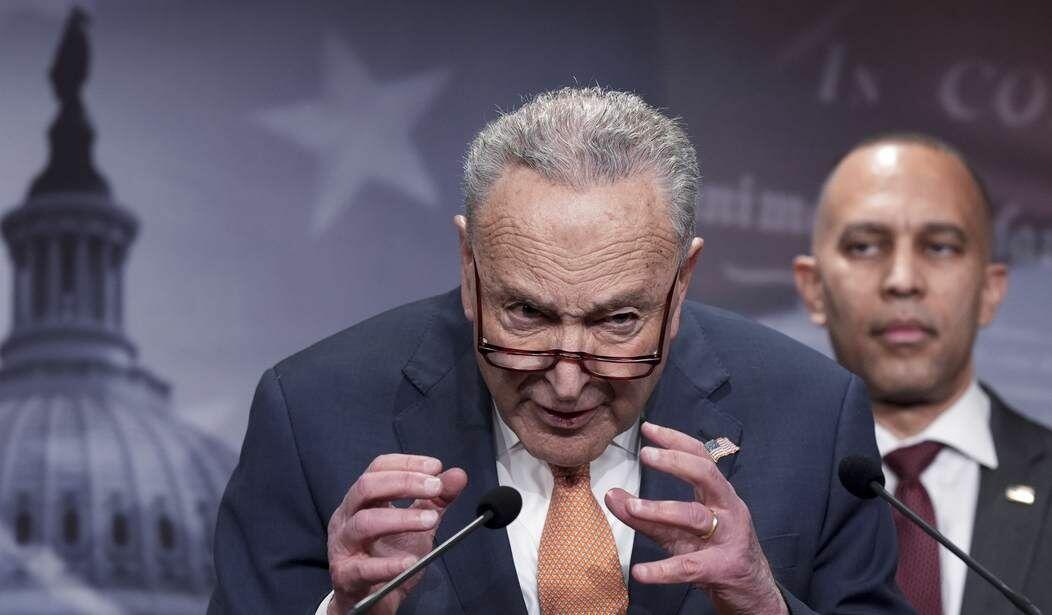
Democrats have spent years insisting illegal immigrants do not vote, yet Senate Minority Leader Chuck Schumer and House Minority Leader Hakeem Jeffries just gave the whole game away.
In a letter to GOP leadership, they demanded a slate of “reforms” to immigration enforcement as the price for funding the Department of Homeland Security, including targeted enforcement, no masks, mandatory use of body cameras, and other demands, several of which I suspect are nonstarters.
NEW: Schumer and Jeffries lay out 10 demands for DHS reforms pic.twitter.com/bKfVg1Ctbb
— Max Cohen (@maxpcohen) February 5, 2026
I don’t see Democrats getting anywhere with these, but the big thing is that buried in that list is a rather revealing demand:
Protect Sensitive Locations – Prohibit funds from being used to conduct enforcement near sensitive locations, including medical facilities, schools, child-care facilities, churches, polling places, courts, etc.
Polling places?
They went out of their way to include polling places right alongside hospitals, courts, and churches. There is only one thing that happens at polling places that would matter to illegal immigrants, and it is not the bake sale.
Democrats have insisted for years that illegal immigrants cannot and do not vote, and that the whole issue is a right-wing myth. If that is true, then why is “polling places” even on their list of protected zones for immigration violators? No one accidentally adds “polling places” to a policy letter being negotiated at the leadership level. This is deliberate. It gives away what they are worried about… and what they are counting on.
“Democrats just admitted they think illegal aliens need to be protected at polling places. Why exactly would illegal aliens be at polling places? We MUST fully fund DHS AND pass the SAVE America Act,” Senator Katie Britt (R-Ala.) posted on X.
That is the obvious question Democrats do not want to answer. If illegal immigrants are not supposed to be anywhere near the ballot box, then immigration enforcement near polling sites ought to be a non-issue.
This comes as Republicans are pushing election reform through Congress with the SAVE Act. The SAVE Act is a straightforward concept: safeguard federal elections by ensuring only American citizens can cast ballots, and that an ID is required to vote.
Schumer’s response has been to smear the SAVE Act as “Jim Crow 2.0” and brand it “racist” and “dead on arrival.” That is the Democrats’ go-to play whenever Democrats feel threatened: slap a “Jim Crow” label on common-sense election rules and scare minorities into thinking Republicans are trying to stop them from voting.
The problem is that even minorities aren’t buying it. As PJ Media previously reported, polling has shown consistent and overwhelming support for Voter ID laws for years. That consensus cuts across both party and race, with huge majorities of Republicans, Democrats, whites, Latinos, and black Americans all agreeing that you should show a photo ID to vote.
Why are Democrats pushing so hard against common sense and trying to help illegal immigrants vote even though they’re not supposed to? Recent census projections show blue states are bleeding population while red states are gaining it, which will shift House seats and electoral votes after the 2030 reapportionment. As people flee high-tax, crime-ridden, Democrat-run states for freer red states, Democrats face shrinking power at the national level. That gives them every incentive to import a new population, shield it from enforcement, and eventually convert them into votes, one way or another.
That’s why Democrats have no qualms fighting so aggressively against overwhelmingly popular election reforms. For them, it’s a matter of survival.
Want to support fearless journalism that exposes the Left and tells the stories the media won’t? PJ Media delivers the truth and holds the powerful accountable. Become a VIP member today—your support fuels our mission and unlocks exclusive content, podcasts, an ad-free experience, and more.
Tyler Durden
Thu, 02/05/2026 – 11:05

Jon Hamm habla sobre presentar los NFL Honors y el momento de Bad Bunny: “Lo aplaudo como artista”
Por JONATHAN LANDRUM Jr.
SAN FRANCISCO (AP) — Cuando Jon Hamm asistió por primera vez a los NFL Honors, la premiación anual de la liga aún estaba encontrando su camino. Era una adición relativamente nueva a la semana del Super Bowl que aún no había definido completamente en qué se convertiría.
Ahora, el actor ganador del Emmy subirá al escenario como anfitrión mientras los NFL Honors celebran su 15º aniversario el jueves por la noche en San Francisco. El espectáculo, que se transmitirá por NBC y NFL Network, servirá como colofón a la temporada, solo unos días antes del Super Bowl.
“No sabían realmente en qué se iba a convertir, pero fue divertido”, dijo Hamm el miércoles después de los ensayos en el Palacio de Bellas Artes. El actor comentó que disfrutó viendo a Alec Baldwin presentar la primera ceremonia en 2012.
Hamm aporta una amplia experiencia como anfitrión, habiendo liderado previamente programas que van desde Saturday Night Live hasta los ESPYs. Pero expresó que los NFL Honors requieren un enfoque específico.
“No estamos tratando de innovar en la comedia ni de hacer algo que vaya a ofender a alguien”, manifestó Hamm, quien ganó un Emmy en 2015 por su interpretación de Don Draper en “Mad Men” de AMC. También ha aparecido en proyectos como “30 Rock”, “The Morning Show” y ahora en la serie de Apple TV Plus “Your Friends & Neighbors”.
“Estamos aquí para celebrar a los jugadores y su temporada y luego poner a todos de buen humor… Creo que va a ser un Super Bowl bastante bueno”, expresó.
Más allá del fútbol, Hamm comentó que la semana del Super Bowl refleja un momento cultural más amplio, incluyendo el ascenso de estrellas de la música global como Bad Bunny, quien encabezará el espectáculo de medio tiempo del Super Bowl después de una gran noche en los Grammy, donde su disco “Debí tirar más fotos” ganó el premio al álbum del año. Es la primera vez que un álbum completamente en español se lleva el premio principal.
“Me alegró ver su éxito en los Grammy”, dijo Hamm, quien asistió a la histórica residencia de Bad Bunny en 2025. Él y el superastro puertorriqueño se han hecho amigos e incluso cumplen años el mismo día.
“Fue elocuentemente hermoso… Es un tipo muy inteligente. Es un artista maravilloso, el artista más escuchado en el mundo por una razón”, comentó. “Es lo suficientemente inteligente como para darse cuenta de que el compromiso es la clave. Así que lo aplaudo como artista y como compañero Piscis y compañero de cumpleaños del 10 de marzo. Es un buen tipo”.
Hamm señaló que los NFL Honors se han convertido en algo significativo para los jugadores de toda la liga, especialmente aquellos cuyos logros no siempre están vinculados al éxito en la postemporada. Destacó resultados individuales sobresalientes que aún merecen reconocimiento.
“Tienes a tipos como Myles Garrett rompiendo el récord de capturas”, dijo Hamm. “No está cerca del Super Bowl, pero sigue siendo algo que celebrar, ¿verdad?”.
Los NFL Honors han evolucionado hasta convertirse en una noche que los jugadores anticipan, comentó Hamm, en parte por la rara oportunidad que les brinda de reunirse en un solo lugar.
“Están en una sala con sus compañeros. Todos conocen a todos”, expresó. “Solo juegan 17, 18 partidos… Es agradable para ellos ser celebrados como deberían”.
Fanático del fútbol de toda la vida, Hamm creció en St. Louis siguiendo a los Cardinals y Rams antes de apoyar a los Chiefs de Kansas City. Presentar la ceremonia, dijo, significa dejar de lado las lealtades a los equipos.
“No se trata de un equipo”, dijo Hamm. “Se trata de honrar la temporada”.
Aunque los NFL Honors celebran logros anuales, Hamm comentó que la noche se trata, en última instancia, de reunir a las personas antes del enfrentamiento del Super Bowl entre los Seahawks de Seattle y los Patriots de Nueva Inglaterra. Dijo que la ceremonia es un punto de encuentro durante la semana.
“El aperitivo”, comentó. “Eso es lo que es”.
___
Para más información sobre el Super Bowl, visita https://apnews.com/hub/nfl.
___
Esta historia fue traducida del inglés por un editor de AP con la ayuda de una herramienta de inteligencia artificial generativa.
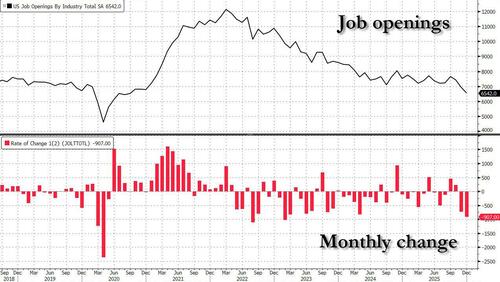
Job Openings Crater Most Since 2023 To Lowest In 5 Years As Payrolls Set For Negative Print
Job Openings Crater Most Since 2023 To Lowest In 5 Years As Payrolls Set For Negative Print
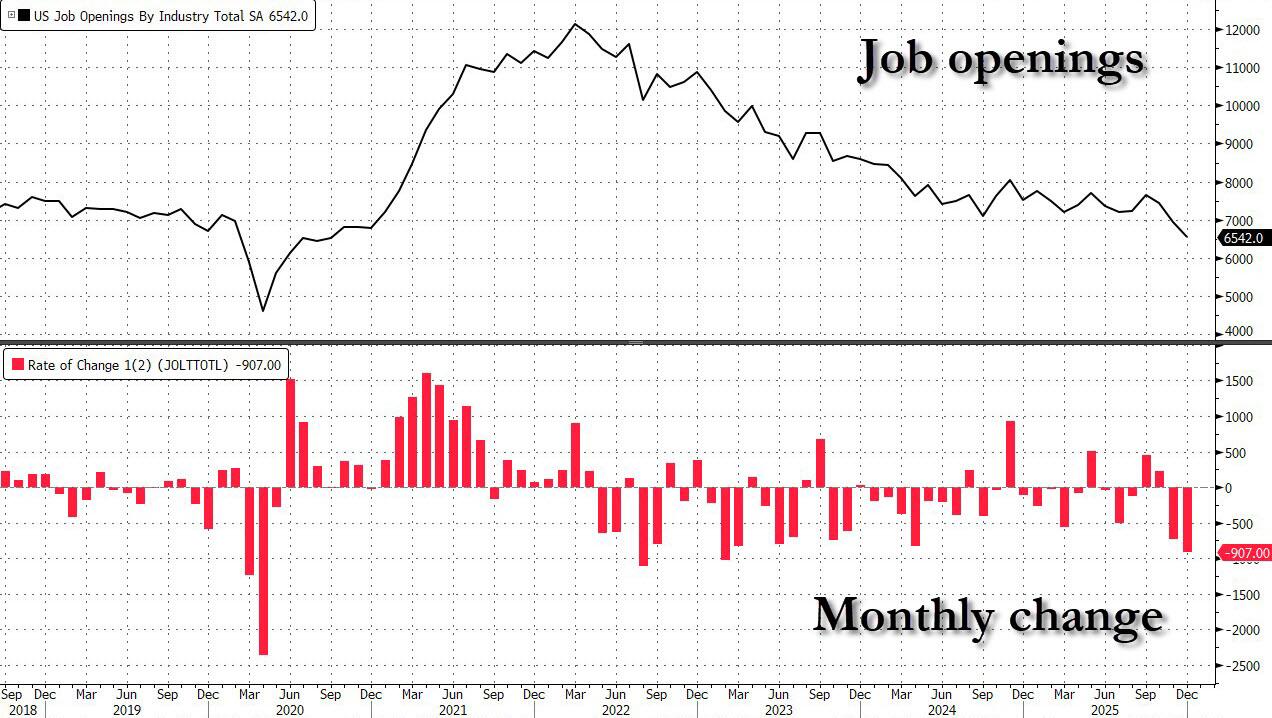
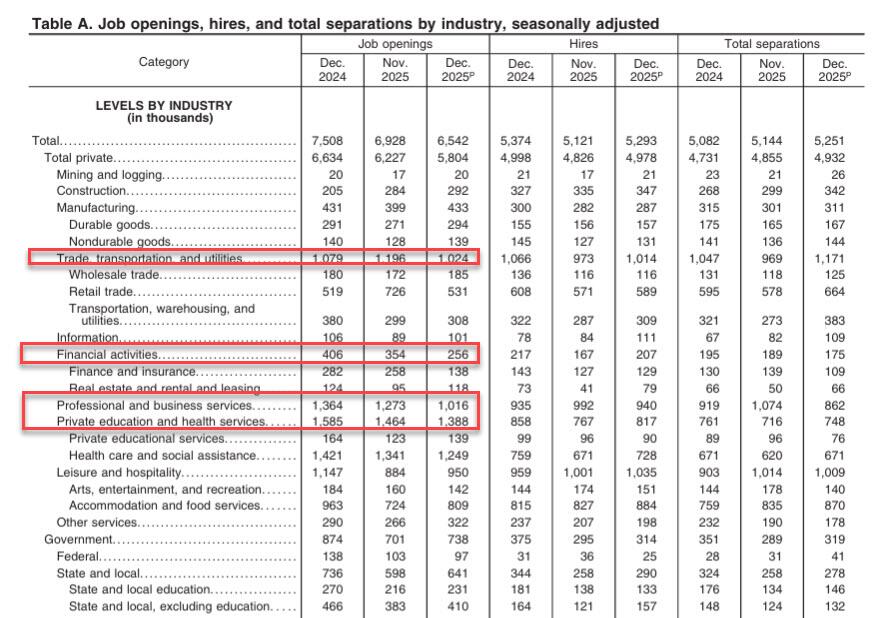
We warned earlier today that the US labor market was rolling over sharply again when we observed the surge in initial jobless claims and the near record January for job cuts (biggest since 2009). Moments ago the BLS confirmed that the US job market is indeed falling off a cliff, when the latest JOLTS report (job openings and labor turnover) showed that in December the number of US job openings crashed by 604K to 6.542 million from 7.146 million, the biggest one month drop since Oct 2023. Of course, to make the drop a bit more palatable, the DOL decided to dramatically revised the November number lower (of course), from 7.146 million to 6.928 million, which however would have made the November plunge even worse. So to keep the monthly changes on an apple to apple basis, we take the cumulative drop from the past 2 months and find that the past two months saw a massive 907k drop in job openings, the biggest since March 2023!
According to the BLS, the number of job openings decreased in professional and business services (-257,000), retail trade (-195,000), and finance and insurance (-120,000).
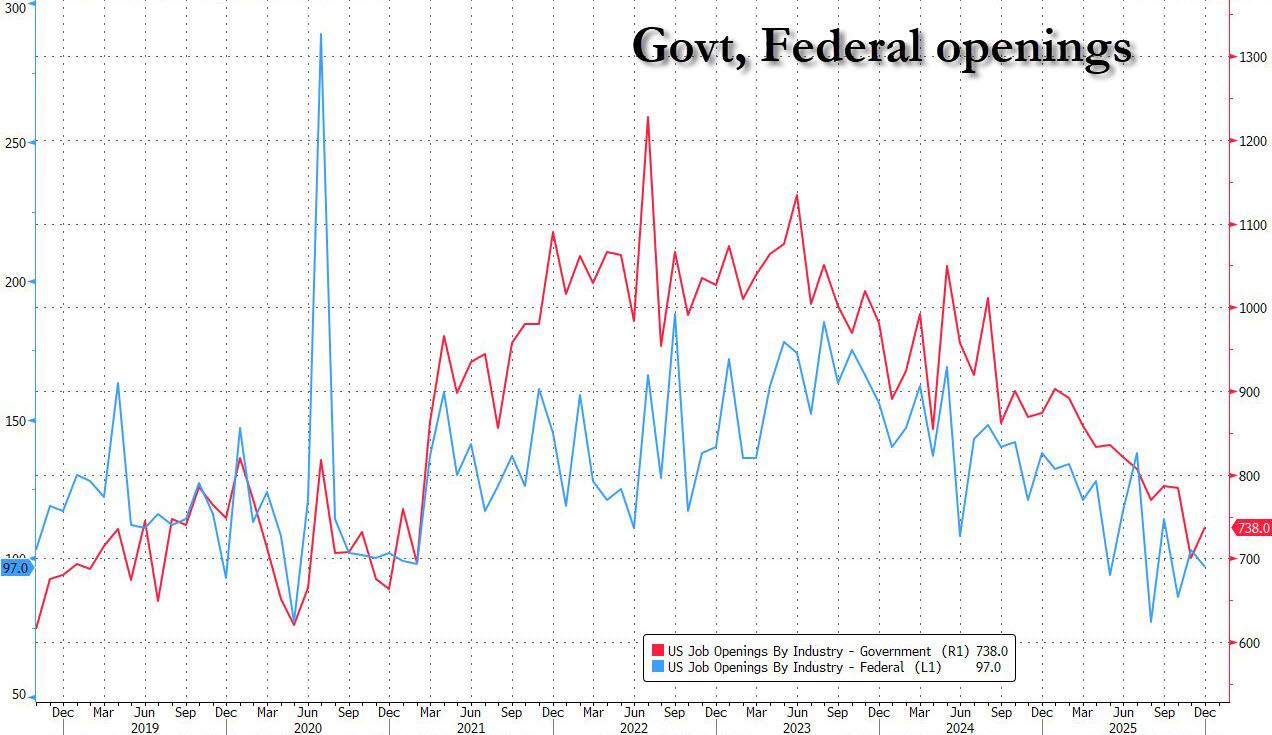
One curious observation: after tumbling to a 4 year low, the number of government job openings rose from 701K to 738K.
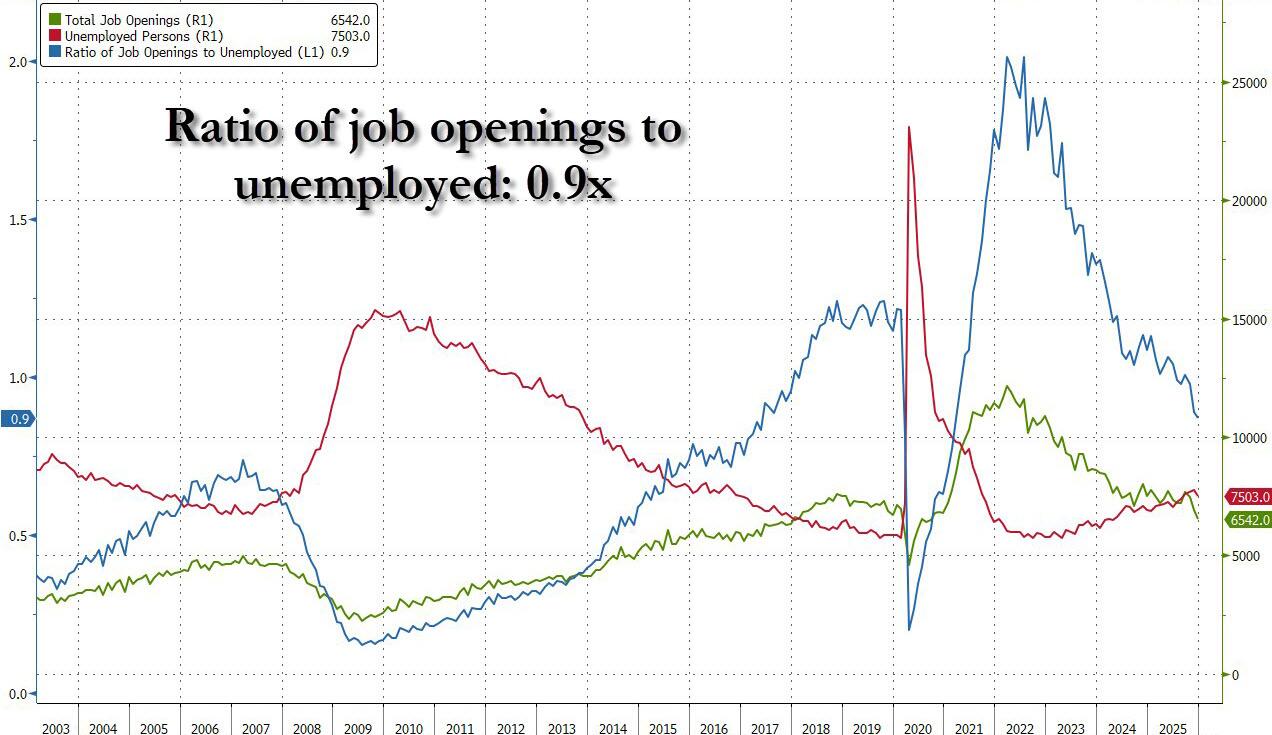
The collapse in job openings also means that the 4 year period of more job openings than unemployed is now a distant memory: in December, the number of job openings was almost one million (961K to be precise) lower than the number of unemployed workers.
As a result of the deteriorating job openings picture, the ratio of job openings to unemployed workers tumbled to 0.9x, the lowest since early 2021.
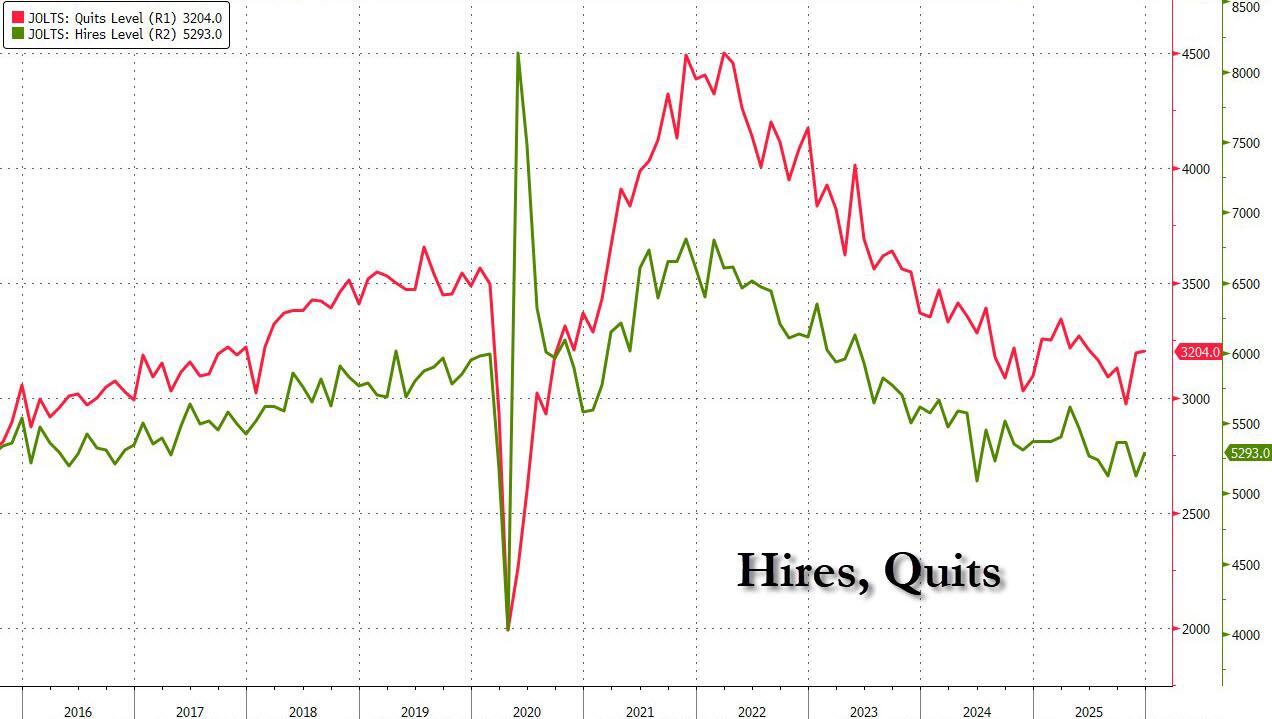
The small silver lining to today’s otherwise terrible JOLTS print was that the number of hires and quits both rose modestly, the former up to 5.293 million from 5.121 million, while the latter rose from 3.204 million from 3,193 million.
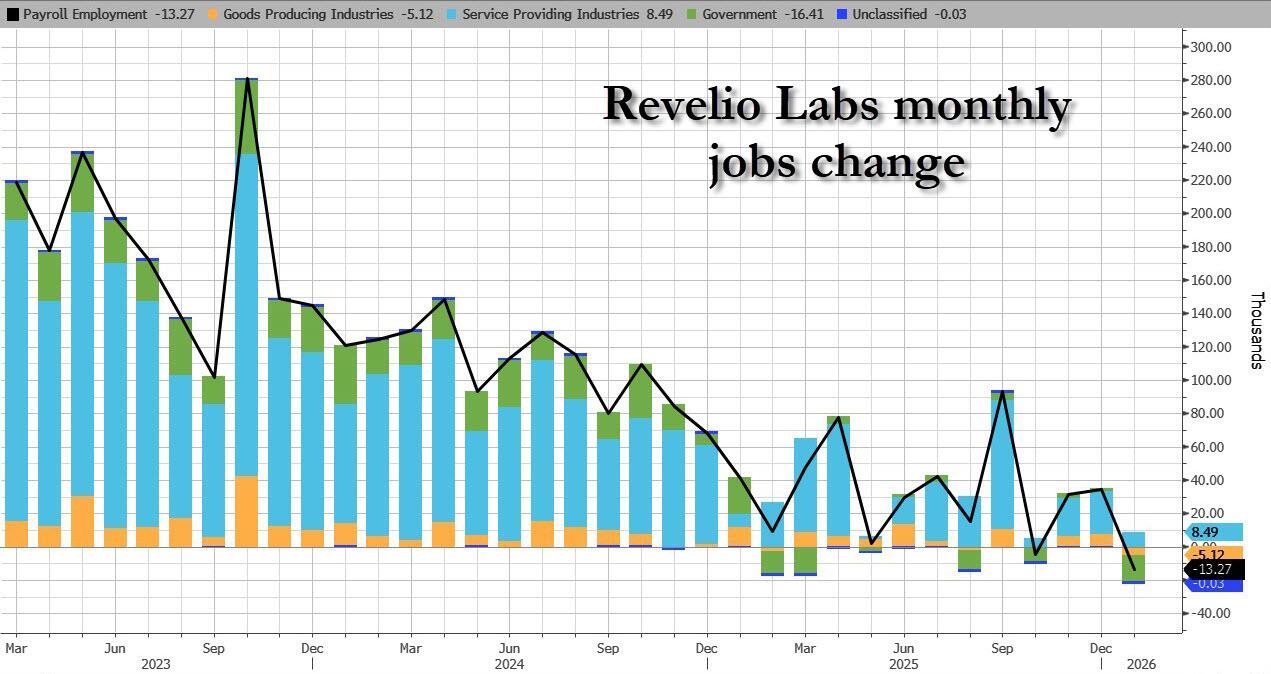
But while hiring may have rebounded (which is meaningless if layoffs rise even more), another labor market indicator that hit today suggested that next week’s delayed January payrolls report will be a complete bloodbath. Earlier this morning, Revelio Labs – which had become the go to alternative while the govt data was suspended during the shutdown – reported that in January payrolls plunged by 13,270, driven by goods producing jobs which dropped by 5.1K but mostly a plunge in govt jobs, which declined by 16.4K.
While this number uses a different methodology than the BLS, if we get anything even remotely close in next week’s jobs report, not only will the US jobs recession be confirmed but the Fed will rush to cut rates as soon as March, well before Kevin Warsh can “shrink the Fed’s balance sheet” as has become trendy, if completely false, to say these days.
Tyler Durden
Thu, 02/05/2026 – 10:53