Category: News

USW prepared to strike at BP refinery, leadership announces
The United Steelworkers Union announced on Thursday that its workers should prepare for a strike or lockout at the BP Whiting refinery.
USW 7-1 members authorized an initial financial transfer from its reserves into a strike and defense fund, according to a Thursday USW news release.
On Jan. 5, BP and the union started negotiations for a new collective bargaining agreement because the former one expired at 11:59 p.m. on Jan. 31, according to the BP website. The union operated under a three-year agreement.
The parties were unable to reach an agreement by the deadline.
According to the USW, both parties agreed to rolling 24-hour extensions of the agreement for refinery workers. Since then, the union alleged BP “would not honor any contract extension for pipeline employees across the Midwest and there has been no meaningful progress in negotiations.”
“BP has rejected almost all of our proposals with very little discussion,” Eric Schultz, president of USW 7-1, said in the news release. “We have heard from many of our members who are ready to strike, in order to move the company toward a fair agreement, but this is not an option that we take lightly. We will continue to bargain in good faith and stand united in demanding a fair contract for all of our local union members.”
BP responded to the union’s intent to strike in a Thursday statement.
“We remain focused on reaching a fair and equitable agreement and avoiding a work stoppage,” the statement said. “Allegations that there has been little dialogue between BP and the union are inaccurate. BP continues to bargain in good faith with the USW to improve the long-term competitiveness of our business and create a sustainable future for our workforce, company and community. The BP Whiting Refinery is committed to safe, compliant, and efficient operations. We value our employees and their contributions.”
In preparation of a strike or lockout, the union encourages its members to remove personal belongings from the workplace, schedule any medical, dental or vision appointments, refill prescriptions with 90-day supplies, and postpone major purchases or financial obligations until an agreement is reached.
The USW claims that BP’s proposal would “gut the union,” alleging that they asked the union to waive many of their legal bargaining rights and allow for tracking and artificial intelligence surveillance of the refinery’s union employees.
Ten years ago, the USW went on strike for 99 days at 12 refineries nationwide, concerned with safety, training and manpower. According to the union, BP had about 1,100 USW workers, and today about 300 fewer union workers are at the refinery.
“We’ve seen firsthand the impact of the cuts BP has made since our last contract and how it has impacted operations,” Schultz said. “Our friends and neighbors in Northwest Indiana have personally experienced the impacts of those cuts, as well. We’re not willing to bargain away a safe workplace and good, stable union jobs so that BP can be more profitable.”
BP first provided online updates on Jan. 8, and it said the goal is to make sure the refinery remains safe and competitive for decades to come. The company did not specifically share its 11 proposals online but said they focus on three themes: safety, operational excellence and workforce optimization; market competitiveness and cost efficiency; and future risk mitigation.
On its website, BP denied that it’s seeking to remove 200 jobs from the refinery.
“The company has proposed reclassifying console operators to become salaried supervisory personnel, which is common in the industry and supports improved safety focus,” the website says. “The company has also proposed to outsource non-core activities such as builders and HVAC consistent with practices at other U.S. refineries.”
BP has held 42 documented bargaining sessions with the union since Jan. 5, according to an email from the company’s spokesperson. The parties have also met in informal settings to discuss the proposals.
BP has also trained replacement workers, consisting of current and former employees, to operate the refinery safely and in compliance with regulations if a work stoppage occurs, according to a Thursday email.
BP last provided online updates on its current proposals on Tuesday, according to its website. The company has regularly provided updates online since negotiations began.
According to the BP website, if employees are absent from work because of a strike or lockout, they will not be eligible for employee benefits. They can still receive benefits through alternative means, according to BP, including COBRA.
“While it may be a difficult message for our employees, it is consistent with the treatment of other union-represented employees who have been on strike, or locked out, at other refineries, chemical plants or other petrochemical complexes,” the website says. “This has also been true for non-represented BP employees when they have changed to a similar status. We encourage employees to carefully review this information and take necessary action should a strike or lockout occur.”
More updates on negotiations from BP are available online at whitingnegotiations.com.

New York City Joins WHO’s Global Outbreak Response Network After US Exit
New York City Joins WHO’s Global Outbreak Response Network After US Exit
Authored by Tom Ozimek via The Epoch Times (emphasis ours),
New York City’s health department said on Feb. 4 it has joined the World Health Organization’s (WHO) Global Outbreak Alert and Response Network, becoming the latest Democratic-led jurisdiction to link up with the United Nations-coordinated public health system following President Donald Trump’s decision to withdraw the United States from the WHO.
Alexander Spatari/Getty Images
The move places New York City alongside California and Illinois, whose leaders have said they will participate in the global outbreak network despite the federal government’s formal exit from the WHO last month.
The WHO-coordinated Global Outbreak Alert and Response Network (GOARN) links hundreds of public health institutions worldwide to detect and respond to emerging disease threats.
“By joining GOARN, New York City gains access to a global network of over 360 institutions and organizations that respond to acute public health events with the deployment of staff and resources to affected countries,” the New York City Health Department said in a statement.
“Infectious diseases know no boundaries, and nor should the information and resources that help us protect New Yorkers,” Acting Health Commissioner and Chief Medical Officer Michelle Morse added.
Trump formally pulled the United States out of the WHO on Jan. 22 after completing a one-year withdrawal process triggered by a January 2025 executive order. The order suspended all U.S. funding to the organization and directed the recall of U.S. personnel working with the agency.
The president’s order cited the WHO’s “mishandling of the COVID-19 pandemic that arose out of Wuhan, China, and other global health crises” as reasons behind the U.S. withdrawal. It also singled out the WHO’s failure to adopt reforms and what Trump described as inappropriate political influence by member states as additional reasons for pulling out.
The United States had been the organization’s largest financial contributor, providing roughly $1.28 billion during the 2022–2023 biennium, according to the WHO.
Secretary of State Marco Rubio and Health Secretary Robert Kennedy Jr. said in a joint statement announcing the U.S. withdrawal that the organization had acted against U.S. interests despite Washington’s role as a founding member.
“This action responds to the WHO’s failures during the COVID-19 pandemic and seeks to rectify the harm from those failures inflicted on the American people,” the two officials said. “Promises made, promises kept.”
Democratic-led States Defy WHO Withdrawal
Democratic leaders in several states have criticized the administration’s decision and moved to maintain direct ties with the global health network.
Illinois Gov. JB Pritzker said on Feb. 3 that his state would join GOARN, making Illinois the second state, after California, to do so. Pritzker said Trump’s withdrawal undermined science and weakened the country’s ability to respond to global health threats.
“I refuse to sit idly by and let that happen,” Pritzker said in a statement, adding that GOARN membership would give Illinois access to global early-warning alerts, outbreak intelligence, technical collaboration, and surge support during major public health events.
California Gov. Gavin Newsom announced his state’s participation on Jan. 23, calling the U.S. withdrawal from the WHO “reckless” and saying it would harm Americans. California became the first U.S. state to join the network after the federal exit.
“California will not bear witness to the chaos this decision will bring,“ Newsom said in a statement. ”We will continue to foster partnerships across the globe and remain at the forefront of public health preparedness.”
Newsom announced the collaboration after meeting WHO Director-General Tedros Adhanom Ghebreyesus at the World Economic Forum in Davos, Switzerland, and said he is weighing a 2028 presidential run.
The White House did not respond to a request for comment on New York City’s decision by publication time.
Reuters contributed to this report.
Tyler Durden
Thu, 02/05/2026 – 17:00

Man charged with murder in drowning death of Chicago charter boat captain at DuSable Harbor
Cook County prosecutors have charged a man with murder in the August drowning death of a beloved Chicago charter boat captain, alleging that the man trespassed onto the DuSable Harbor docks and then punched the captain, causing him to fall and slip into the water.
Cook County Judge John Hock on Thursday ordered Alexis Trader, 34, detained while awaiting trial, noting in a court order that Trader allegedly has a pattern of assaulting random people. He is also charged with aggravated battery, accused of punching a gas station employee in the face last January.
Nabil Abzal, 63, known to many around DuSable Harbor as “Captain Bill,” drowned on Aug. 30 in Lake Michigan near where his yacht was moored.
“He loved being ‘Captain Bill,’” his wife, Laura Abzal, previously told the Tribune. “But he was so much more than that. (He) was a humble man who would be a bit embarrassed by all the attention he is receiving.”
According to a proffer by prosecutors, Trader and three others approached a gated area where boats are kept at DuSable Harbor around 2:43 a.m. Though the harbor is accessible to the public, the docks are locked and only accessible by keypad.
Trader scaled a gate, the proffer said, and then let the three others onto the dock.
Abzal would sleep on a yacht there four to five times a week during the summer, prosecutors said.
While Trader and another man waited by the gate, two women board Abzal’s yacht and took photos of themselves on the watercraft on the social media platform Snapchat.
Abzal discovered them, told them to get off the boat and escorted them back to the gate, the proffer said. Abzal did not have any weapons, nor did he make any threats or physical contact with the women.
As Abzal opened the gate, Trader raised his arm and hit him, causing him to hit his head and fall into the water, the proffer alleges.
Nabil Abzal, 63, of Plainfield, was pulled from the water early Aug. 30, 2025, at DuSable Harbor in Chicago. (Family photo)
A fisherman heard a splash and called 911. Trader also called 911 and reported that someone fell into the water, the proffer said, but did not elaborate on how he ended up in the lake.
Trader and the others with him gave statements to the police before leaving the area, according to the proffer.
Divers recovered Abzal from the water, but were not able to revive him. An autopsy found that he died by drowning.
Later in the morning, Abzal’s first mate found a vape pen and blunt wrapper on the boat, according to the proffer. Detectives located surveillance video that showed the alleged attack, the proffer said.
Abzal left behind his wife, a daughter, three granddaughters and a great-grandson, who called him “Grand Poo” and “Poo Poo.”
https://www.chicagotribune.com/2026/02/05/slain-boat-captain-charges/
Amazon Plunges After Forecasting 50% Surge In Capex To $200BN
Amazon Plunges After Forecasting 50% Surge In Capex To $200BN
In our AMZN earnings preview, we said that the price reaction from META and GOOGL “leaves Amazon in a precarious place as it prepares to report earnings after the close today: does it project some berserk number or does it risk being conservative? After all, the only thing that will matter is the capex forecast (the earnings will likely be good enough).”
Well, we were wrong: the earnings were not good enough: the company missed on earnings and its guidance was rather week. And so before we even get to the biggest shock of the report – the company’s CapEx guidance – here is what the company reported for Q4:
EPS $1.95, missing estimates of $1.96… an ugly miss at the very top.
Revenue was a bit better, and even though several items (physical stores, third party sellers missed), AWS was stronger than expected.
Net sales $213.39 billion, beating estimate $211.49 billion
Online stores net sales $82.99 billion, beating estimate $82.3 billion
Physical Stores net sales $5.86 billion, missing estimate $5.88 billion
Third-Party Seller Services net sales $52.82 billion, missing estimate $53.16 billion, net sales excluding F/X +10%, estimate +11.2%
Subscription Services net sales $13.12 billion, beating estimate $12.74 billion, net sales excluding F/X +12%, estimate +10.4%
The good news is that the most important revenue item, AWS, beat:
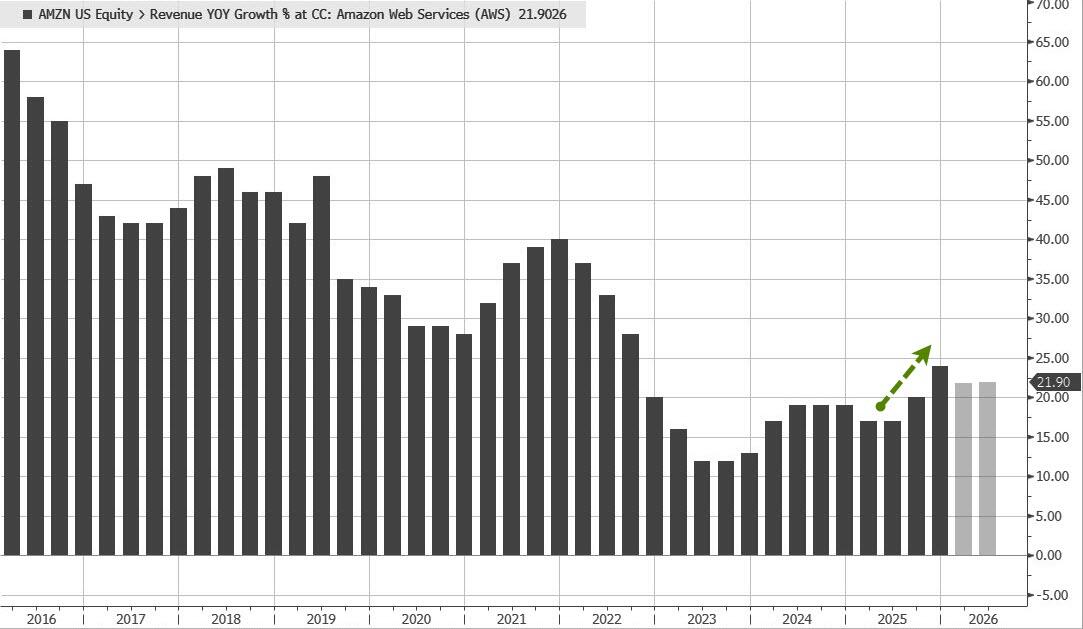
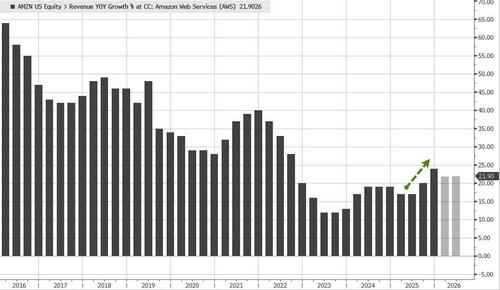
AWS net sales $35.58 billion, beating estimate $34.88 billion; net sales excluding F/X +24%, estimate +21%
This was an impressive number as the 24% YoY increase in AWS revenue not only smashed estimates, but was the highest in three years: remarkable growth for a business that keeps growing and has a more difficult base effect to “beat” every quarter.
Geographically the results were disappointing with North America missing, offset by strength in International
North America net sales $127.08 billion, missing estimates of $127.21 billion
International net sales $50.72 billion, beating estimates of $49.74 billion
Going down the line:
Operating income $24.98 billion, beating estimate of $24.82 billion; this included charges of $1.1 BN
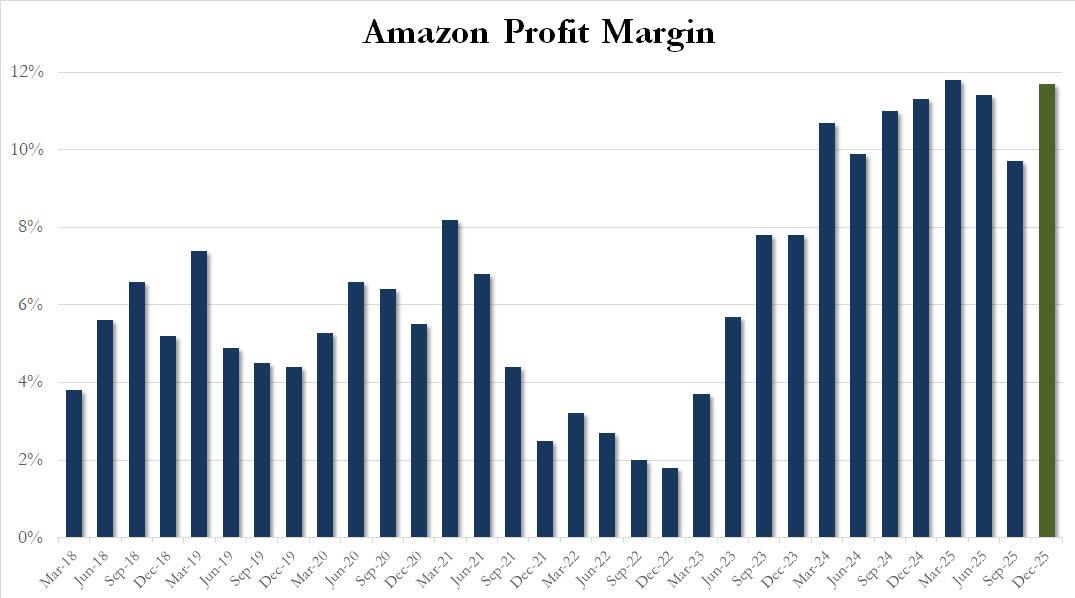
Operating margin 11.7%, in line with the estimate of 11.7%
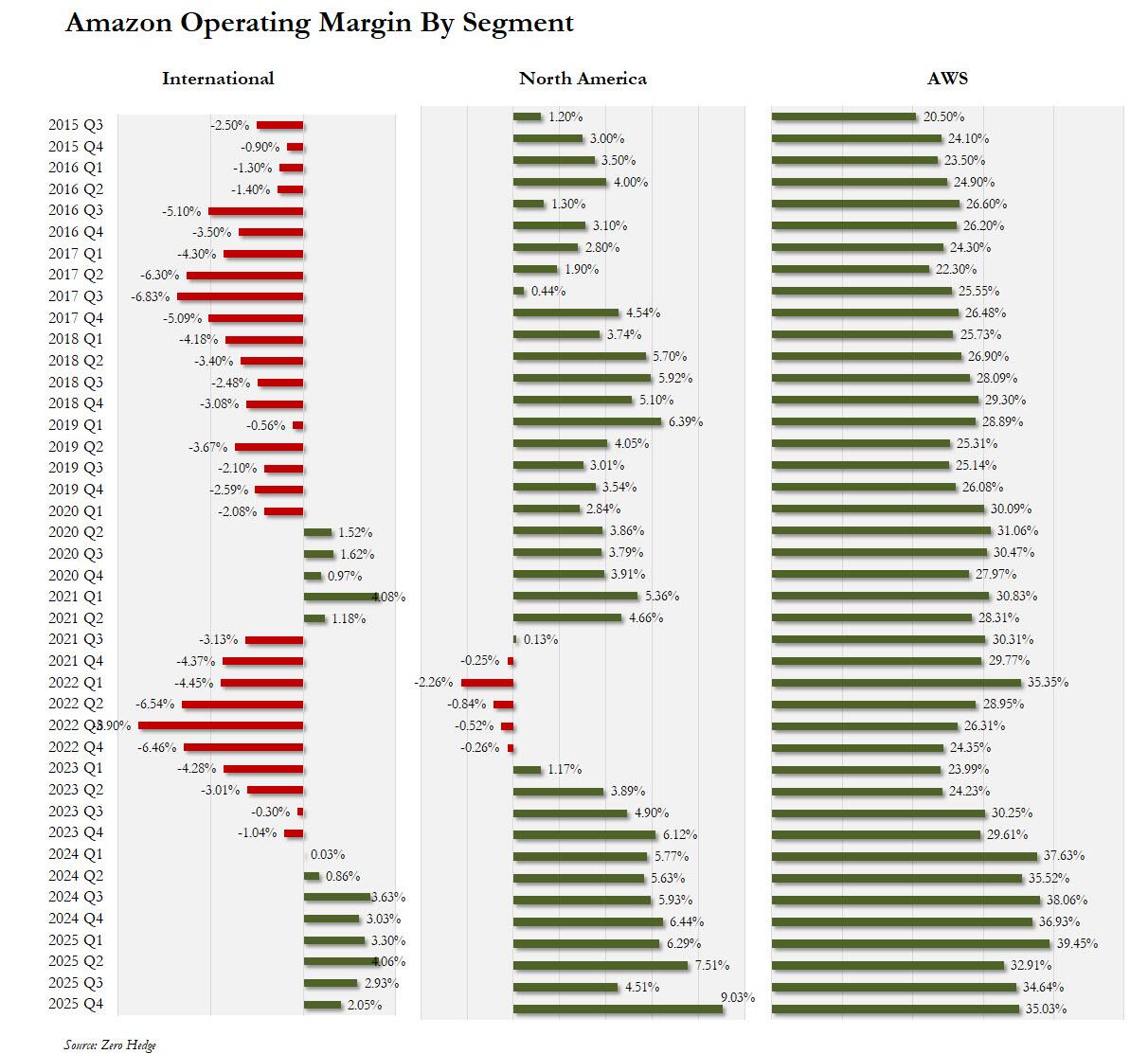
North America operating margin +9%, beating estimate +8.51%
International operating margin 2.1%, missing estimate 4.27%
Fulfillment expense $30.83 billion, below estimate $31.42 billion
In its release, the company said that demand was strong for AI, Chips, Robotics, and all other Existing Offerings.
While AWS sales growth was solid, just as impressive was the the margin for the segment also increased from 34.64% in Q3 to 35.03%, just beating the median Wall Street estimate of 35%. Elsewhere, North American profit unexpectedly jumped to $11.472 billion, resulting in a profit margin of 9.03%, beating estimates of 8.51%, while international margins dropped to to 2.05% from 2.93%, missing estimates of an increase to 4.27%.
As a result of the drop in AWS profits, Amazon’s consolidated operating margin posted a notable jump and in Q4 increased 9.7% to 11.7%, just shy of an all time high.
However, while the above data was ok, it was the company’s guidance that led to an immediate collapse in the stock price after hours. No, it wasn’t the revenue, although that did come in a bit weak:
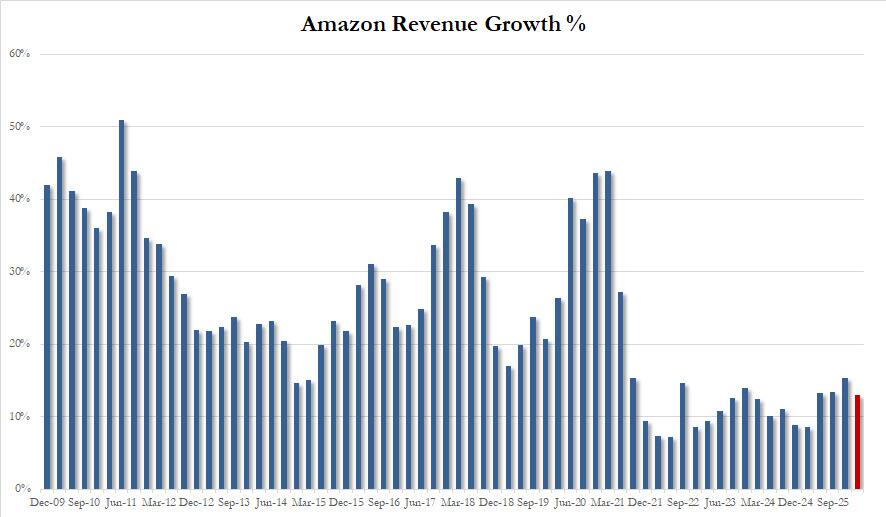
Net sales are expected to be between $173.5 billion and $178.5 billion, or to grow between 11% and 15% compared with first quarter 2025. The midpoint is a bit weak compared to the median estimate of $175.54 billion.
The projected 13% revenue growth is on the low-end of where the company has been in the past year.
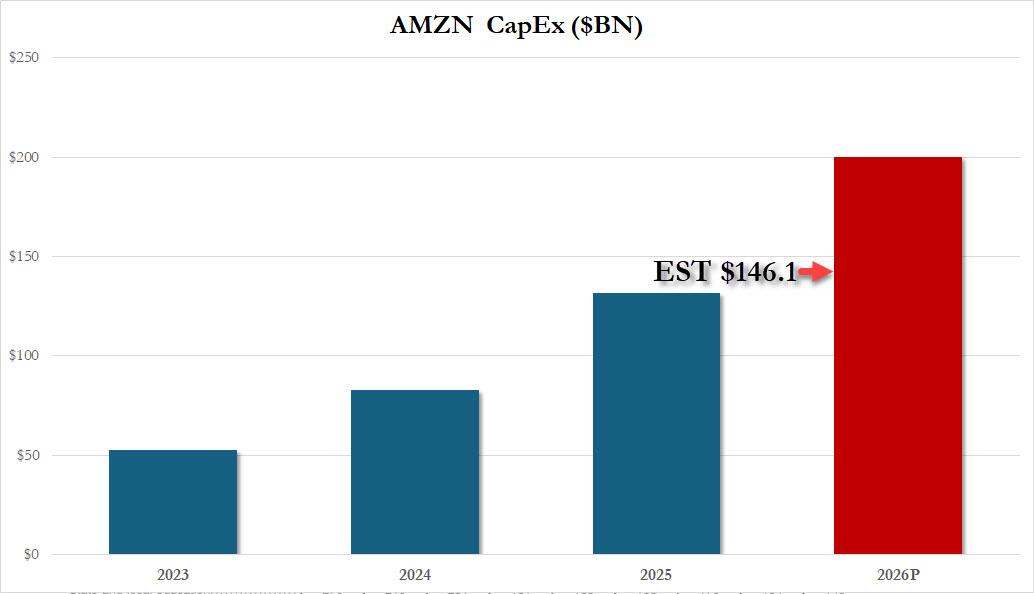
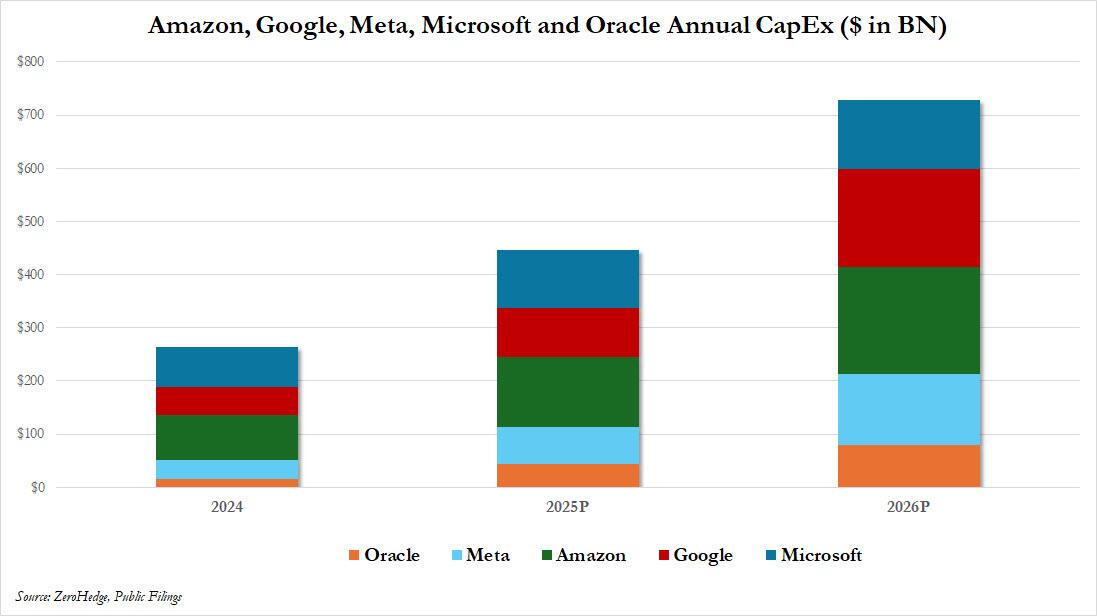
But while revenue guidance was disappointing, if a bit muted, it was the company’s capex guidance – a first for AMZN – that stole the show, because with Wall Street estimates of $146.1 billion in 2026 capex, the company went and reported that it expects to invest about $200 billion in capital expenditures in 2026, a 50% increase from 2025 and an openly ridiculous number, one which is more than a quarter higher than the consensus estimate! Needless to say, there is just not enough grid capacity and electrical power to satisfy the $700BN in CapEx guidance among the Mag7s.
The number was so shocking that even though Wall Street may have been ready to give AMZN the benefit of the doubt for its solid AWS performance and impressive margin bounce, the CapEx guidance was just so gargantuan, there was no way the stock would jump especially after yesterday’s GOOGL debacle. Putting the updated capex numbers in context, the 5 bighyperscalers now expect to spend over $700BN in capex next year. The only problem: there is nowhere near enough electrical capacity to feed all these brand new data centers.
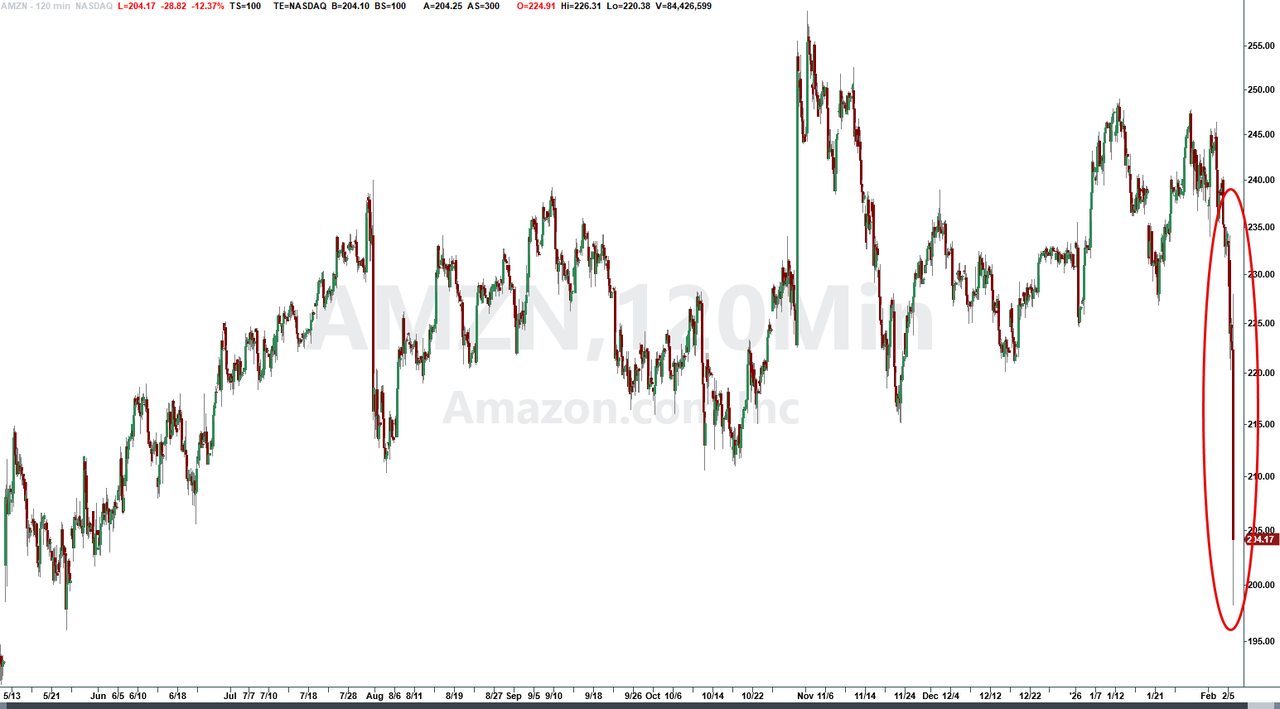
And so AMZN crashed after hours, sliding as much as 11%, and trading around $200. Another $15 drop from here, and the stock will be where it last traded in 2021…
Tyler Durden
Thu, 02/05/2026 – 16:50
https://www.zerohedge.com/markets/amazon-plunges-after-forecasting-50-surge-capex-200bn

How a campaign contribution loss in CHKN tokens has made crypto an issue in Illinois’ comptroller race
SPRINGFIELD — Months before Lake County Treasurer Holly Kim announced her bid for Illinois comptroller, she used about $8,300 in previously contributed campaign funds to invest in a cryptocurrency she founded called CHKN token — a digital asset inspired by her backyard flock of chickens.
By the end of 2025, the investment — totaling roughly 8.87 million tokens — had lost nearly all its value, dropping to just $34.59, according to filings with the Illinois State Board of Elections.
Kim, a Democrat seeking to succeed Comptroller Susana Mendoza as the state’s chief fiscal officer, said the loss should not be viewed as a reflection of her ability to oversee Illinois’ finances. Instead, she described the investment as a learning experience that reflected her efforts to better understand emerging financial technologies.
“I’m someone who learns things by doing, and this is, you know, entirely why I would have converted crypto into a token, because, you know, it depends what’s popular,” Kim said in an interview late last month with the Tribune about the investment. “But voters can absolutely trust me because I’m trying to stay on top and learn about emerging industries.”
“No government money was spent. No (regular) dollars were turned into the crypto and no personal money was spent on that crypto,” she said, adding that the decision was comparable to a campaign choosing to invest in traditional financial instruments.
Kim’s campaign contribution loss has put a spotlight on cryptocurrencies in the battle for Illinois comptroller, one of the bigger statewide races in 2026 following Mendoza’s decision last year not to run for a fourth term. In addition to Kim’s issue with crypto, comptroller candidate Margaret Croke, a Democratic state representative from Chicago, introduced legislation years ago to benefit and regulate the crypto industry.
Both issues have led to Kim and Croke criticizing each other over the topic, with a Croke spokesperson hammering Kim for the “botched” crypto investment and saying, “It’s abundantly clear Illinoisans can’t afford her failed leadership,” while Kim argues Croke’s bill, which did not pass, could have benefited Croke’s husband’s law firm.
Unlike the state treasurer, who is responsible for investing state funds, the state comptroller manages the state’s finances, pays its bills and serves as a fiscal watchdog to ensure payments comply with the law.
Kim’s campaign rejected suggestions that CHKN token’s loss in value raises concerns about her stewardship of public funds. As Lake County treasurer, Kim oversees the investment of county revenues, and her campaign officials said she produced strong returns in that role and reinvested revenue generated from interest on investments in fiscal years 2023 and 2024.
“In those two years, through smart investing, Holly was able to give back over $6M to taxpayers to fund schools, parks and libraries,” a Kim campaign spokesperson said.
In addition to Kim and Croke, two others seeking the Democratic nomination for comptroller in the March 17 primary are state Rep. Stephanie Kifowit of Oswego and state Sen. Karina Villa of West Chicago.
Underscoring the importance — and occasionally the silliness — of the crypto issue in the race, Kim on Wednesday put out a short, lighthearted campaign video on Instagram about her CHKN token, saying, “The rumors are true” about her starting her own cryptocurrency before noting it was “worth less than a penny, and five feathers, with zero scandals,” while surrounded by a flock of chickens. The digital ad was released a little over a week after the Tribune began asking Kim’s campaign questions about the investment loss.
“Clearly, my flock and I weren’t trying to get rich, but what I was trying to do as a member of the Bank On commission against predatory lending was teach people about crypto,” said Kim, referring to her role on a commission overseen by the Illinois comptroller’s office. “I wanted to make sure I understood the ins and outs so that I could protect people from their scams.”
Cryptocurrencies are digital assets that are not issued or backed by the federal government or a central bank. They rely on blockchain technology to facilitate transactions and are typically bought and sold through online exchanges. Well-known cryptocurrencies include Bitcoin, Dogecoin and Litecoin.
While proponents argue crypto represents financial innovation, critics often point to its volatility and limited regulation. Prices can fluctuate sharply over short periods, and the industry has faced repeated scrutiny over fraud, market manipulation and consumer protection failures.
In Illinois, cryptocurrency has drawn political attention before. In 2022, several Democratic members of Congress — including U.S. Reps. Jesús “Chuy” García and Nikki Budzinski — faced questions after it was revealed they had accepted campaign donations from Sam Bankman-Fried, the former CEO of crypto exchange FTX. Bankman-Fried was later convicted and sentenced to prison for orchestrating a massive fraud scheme.
Kim was among the first Illinois politicians to accept cryptocurrency-based campaign contributions when she ran for reelection as Lake County treasurer in 2022, a position she has held since 2018.
“Somebody needs to be out there warning people and teaching them about what this is. And again, it’s irresponsible for anyone who works in finance or wants to be the fiscal watchdog of the state to not understand all forms of currency,” Kim said in the interview. “But crypto isn’t gambling. And I think you and I can agree there’s a market. And it’s an investment, but it’s not like a slot machine.”
Campaign finance records show that as of the end of December, Kim had about $241,000 on hand. Kifowit reported just under $100,000, while Villa reported slightly more than $300,000. Croke led the field with more than $830,000 in campaign cash.
Croke was the main sponsor of the 2021 legislation that would have allowed financial services companies that deal with crypto assets to work with the state to create a more stable business environment.
Kim says the bill “championed the expansion of crypto in Illinois,” while Croke’s husband’s law firm, Croke Fairchild Duarte and Beres, had a professional interest in working with crypto-related businesses.
The Croke campaign spokesperson said the firm “did not have the person on staff leading the crypto work when (Croke) introduced the bill.” But, according to the firm’s website, the firm at the time offered and still offers services to help clients navigate government regulations and structure deals and investments in the cryptocurrency space.
The 2021 legislation had more than two dozen other sponsors, Kifowit included, and passed the Illinois House 117-0. It failed to pass the state Senate, where it had about two dozen co-sponsors, including Villa.
Last year, though, the General Assembly passed and Gov. JB Pritzker signed into law sweeping legislation that regulates cryptocurrency through oversight from the Illinois Department of Financial and Professional Regulation. Croke, who heads the House Financial Institutions and Licensing Committee, which hears debate on crypto-related legislation, supported the measure, as did Kifowit and Villa.
Crypto regulation was pushed during last spring’s legislative session as Republican President Donald Trump’s administration has been supportive of the industry, with the Securities and Exchange Commission stopping probes into crypto businesses and litigation against at least one company last year, The New York Times has reported. The president even started a business offering cryptocurrency and, shortly before he was inaugurated last year, started selling a “memecoin,” meant to be a play on online jokes or celebrities, the newspaper reported.
Andrew Gordon, a Skokie-based attorney who has practiced in the cryptocurrency space for over a decade, said political candidates accepting crypto can be a positive thing for their campaigns because there’s a population of investors that don’t have cash but are willing to donate their crypto, and the fees are cheaper for candidates than if they accept credit card payments.
But he also said it can be “extremely dangerous” for a campaign to accept crypto contributions and invest in “highly speculative currency” unless it’s more reputable, such as Bitcoin, or other long-standing crypto brands.
“For many businesses and campaigns, they convert the cryptocurrency into cash as soon as they receive it,” said Gordon, who also founded a political action committee called Main Street Crypto PAC. “As a fiduciary, or being responsible for the funds, you don’t want to speculate necessarily and invest in the market. You just want to be able to have that cash as part of your budget. So most people will convert it to cash or have a limited treasury of (cryptocurrencies) … that have been around the longest.”
In the interview, Kim said she looks back on the CHKN token investment as an education of how crypto can work, an experience that could help her in the future.
“I’m the most experienced candidate in this race, and some of it is experience by doing, right?” she said. “The chief fiscal officer needs to understand all currencies in circulation, even the ones we don’t like. Someone needs to be the expert.”

What to know as the US and Iran prepare for nuclear talks in Oman
MUSCAT, Oman — Iran and the United States will hold talks Friday in Oman, their latest over Tehran’s nuclear program after Israel launched a 12-day war on the country in June and the Islamic Republic launched a bloody crackdown on nationwide protests.
U.S. President Donald Trump has kept up pressure on Iran, moving aircraft carriers and other military assets to the Gulf and suggesting the U.S. could attack Iran over the killing of peaceful demonstrators or if Tehran launches mass executions over the protests. Trump has pushed Iran’s nuclear program back into the frame as well after the June war disrupted five rounds of talks held in Rome and Muscat, Oman, last year.
Iranian Foreign Minister Abbas Araghchi departed for Oman for the talks with the United States on Thursday evening, his spokesperson Esmail Baghaei confirmed.
Baghaei wrote in a post on social platform X that despite previous breakdown of talks between Tehran and Washington and military action last June, Iranian officials are hoping to reach an “honorable” agreement on the nuclear issue.
“At the same time, we have a responsibility not to miss any opportunity to utilize diplomacy in order to secure the interests of the Iranian nation and safeguard peace and tranquility in the region,” Baghaei said.
Just hours ahead of Friday’s meeting, many questions hovered over the talks, including the scope of the agenda. While negotiations are expected to focus on Iran’s nuclear program, Secretary of State Marco Rubio this week said the U.S. hoped to discuss other concerns, including Iran’s ballistic missiles, support for proxy networks across the region and the “treatment of their own people.” Iran has said it wants talks to focus solely on the nuclear issue.
Trump began the diplomacy initially by writing a letter last year to Iran’s 86-year-old Supreme Leader Ayatollah Ali Khamenei to jump start these talks. Khamenei has warned Iran would respond to any attack with an attack of its own, particularly as the theocracy he commands reels following the protests.
Here’s what to know about Iran’s nuclear program and the tensions that have stalked relations between Tehran and Washington since the 1979 Islamic Revolution.
Trump writes letter to Khamenei
Trump dispatched the letter to Khamenei on March 5, 2025, then gave a television interview the next day in which he acknowledged sending it. He said: “I’ve written them a letter saying, ‘I hope you’re going to negotiate because if we have to go in militarily, it’s going to be a terrible thing.’”
Since returning to the White House, the president has been pushing for talks while ratcheting up sanctions and suggesting a military strike by Israel or the U.S. could target Iranian nuclear sites.
A previous letter from Trump during his first term drew an angry retort from the supreme leader.
But Trump’s letters to North Korean leader Kim Jong Un in his first term led to face-to-face meetings, though no deals to limit Pyongyang’s atomic bombs and a missile program capable of reaching the continental U.S.
Oman mediated previous talks
Oman, a sultanate on the eastern edge of the Arabian Peninsula, has mediated talks between Araghchi and U.S. Mideast envoy Steve Witkoff. The two men have met face to face after indirect talks, a rare occurrence due to the decades of tensions between the countries.
It hasn’t been all smooth, however. Witkoff at one point made a television appearance in which he suggested 3.67% enrichment for Iran could be something the countries could agree on. But that’s exactly the terms set by the 2015 nuclear deal struck under former U.S. President Barack Obama, from which Trump unilaterally withdrew America. Witkoff, Trump and other American officials in the time since have maintained Iran can have no enrichment under any deal, something to which Tehran insists it won’t agree.
Those negotiations ended, however, with Israel launching the war in June on Iran.
The 12-day war and nationwide protests
Israel launched what became a 12-day war on Iran in June that included the U.S. bombing Iranian nuclear sites. Iran later acknowledged in November that the attacks saw it halt all uranium enrichment in the country, though inspectors from the International Atomic Energy Agency have been unable to visit the bombed sites.
Iran soon experienced protests that began in late December over the collapse of the country’s rial currency. Those demonstrations soon became nationwide, sparking Tehran to launch a bloody crackdown that killed thousands and saw tens of thousands detained by authorities.
Iran’s nuclear program worries the West
Iran has insisted for decades that its nuclear program is peaceful. However, its officials increasingly threaten to pursue a nuclear weapon. Iran now enriches uranium to near weapons-grade levels of 60%, the only country in the world without a nuclear weapons program to do so.
Under the original 2015 nuclear deal, Iran was allowed to enrich uranium up to 3.67% purity and to maintain a uranium stockpile of 300 kilograms (661 pounds). The last report by the International Atomic Energy Agency on Iran’s program put its stockpile at some 9,870 kilograms (21,760 pounds), with a fraction of it enriched to 60%.
U.S. intelligence agencies assess that Iran has yet to begin a weapons program, but has “undertaken activities that better position it to produce a nuclear device, if it chooses to do so.” Iranian officials have threatened to pursue the bomb.
Israel, a close American ally, believes Iran is pursuing a weapon. It wants to see the nuclear program scrapped, as well as a halt in its ballistic missile program and support for anti-Israel groups such as Hezbollah in Lebanon and Hamas.
Decades of tense relations between Iran and the US
Iran was once one of the U.S.’s top allies in the Mideast under Shah Mohammad Reza Pahlavi, who purchased American military weapons and allowed CIA technicians to run secret listening posts monitoring the neighboring Soviet Union. The CIA had fomented a 1953 coup that cemented the shah’s rule.
But in January 1979, the shah, fatally ill with cancer, fled Iran as mass demonstrations swelled against his rule. The Islamic Revolution followed, led by Grand Ayatollah Ruhollah Khomeini, and created Iran’s theocratic government.
Later that year, university students overran the U.S. Embassy in Tehran, seeking the shah’s extradition and sparking the 444-day hostage crisis that saw diplomatic relations between Iran and the U.S. severed. The Iran-Iraq war of the 1980s saw the U.S. back Saddam Hussein. The “Tanker War” during that conflict saw the U.S. launch a one-day assault that crippled Iran at sea, while the U.S. later shot down an Iranian commercial airliner that the U.S. military said it mistook for a warplane.
Iran and the U.S. have seesawed between enmity and grudging diplomacy in the years since, with relations peaking when Tehran made the 2015 nuclear deal with world powers. But Trump unilaterally withdrew the U.S. from the accord in 2018, sparking tensions in the Mideast that persist today.
https://www.chicagotribune.com/2026/02/05/us-iran-nuclear-talks-oman-explainer/

Xi Used Latest 2-Hour Call To Warn Trump On Taiwan Red Lines
Xi Used Latest 2-Hour Call To Warn Trump On Taiwan Red Lines
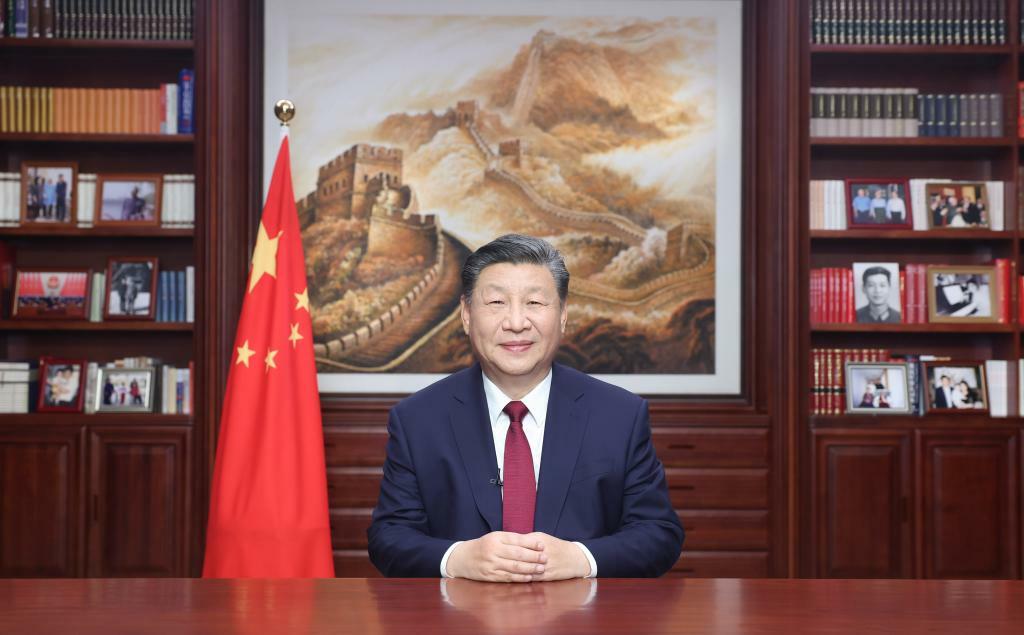
More details have emerged from Wednesday’s Trump-Xi phone call, which it turns out was quite lengthy for the two leaders, lasting about two hours. We reviewed previously that President Trump hailed the “excellent” call, which was “long and thorough” – but Chinese version which was issued later presents something more contentious.
China’s official readout made clear that President Xi in the conversation focused heavily on Taiwan, and ways Washington can dial back the tensions over the self-ruled island.
Xi called the US approach to Taiwan “the most important issue in China-U.S. relations,” declaring that China “will never allow Taiwan to be separated from China.”
“The US must handle arms sales to Taiwan with extreme caution” Xi said, in reference to the billions in arms packages the US has signed off on over several years, spanning multiple administrations.
Taiwan was quick to respond to the contents of this call, with Taiwan’s president, Lai Ching-te, telling reporters Thursday: “The Taiwan-US relationship is rock solid, and all cooperation projects will continue uninterrupted.”
Separately Taiwan’s foreign ministry also pointed out that US weapons sales to Taiwan continue unabated, Xi’s warnings notwithstanding. Another key part of the call is seen in the following:
China is considering buying more U.S.-farmed soybeans, President Donald Trump said after what he called “very positive” talks with President Xi Jinping on Wednesday, even as Beijing warned Washington about arms sales to Taiwan.
In a goodwill gesture two months before Trump’s expected visit to Beijing, Trump said Xi would consider hiking soybean purchases from the United States to 20 million metric tons in the current season, up from 12 million tons previously. Soybean futures rallied.
Trump has repeatedly stressed the need to keep lines of communication open with Beijing, even as he insists on safeguarding American interests and regional security, and as Washington continues arms support to Taipei.
“The relationship with China, and my personal relationship with President Xi, is an extremely good one, and we both realize how important it is to keep it that way,” Trump had written on Truth Social Wednesday, soon after the call was conclued.
“I believe that there will be many positive results achieved over the next three years of my Presidency having to do with President Xi, and the People’s Republic of China!” – he followed with.
I read a CIA assessment of Xi Jinping and it said that he was “incorruptible, doesn’t care about money, doesn’t drink or participate in any vices, and always knows the right answer”.
Can you imagine what the Chinese assessment of Trump is?
— Mike from PA (@Mike_from_PA) January 27, 2026
But to review of Xi’s red lines and Washington’s proneness to testing them: “In December, the US state department announced its largest-ever arms sales package to Taiwan, valued at more than $11.1bn and including missiles, artillery systems and drones,” writes The Guardian. “The package is yet to be approved by Congress.”
“China reacted angrily to the proposed arms sales, conducting two days of military drills around the island in late December, for which it dispatched air, navy and missile units,” report recalls.
Tyler Durden
Thu, 02/05/2026 – 16:40
https://www.zerohedge.com/geopolitical/xi-used-latest-2-hour-call-warn-trump-taiwan-red-lines

Column: Kane County Board member from Aurora receives Conservation Foundation award
Mavis Bates was seeing green when she threw her hat into the primary ring for the Kane County Board’s 2020 election. And after winning the District 4 seat, she eagerly took her “passion” for the environment into this public role.
So it seems only fitting that on Feb. 19 the Naperville-based Conservation Foundation is presenting Bates with the Thomas Weisner Memorial Award, named after Aurora’s late mayor who put the environment near the top of his own to-do list as an elected official.
Conservation Foundation President and CEO Brook McDonald described Bates as someone who’s “practiced environmental advocacy her whole life” and has “taken that knowledge, spirit and passion and put it into play” by shaping local policy.
Past winners of the award include Dundee Township Supervisor Susan Harney for her work on open space preservation and conservation and John Hoscheit, longtime Kane County Forest Preserve District president, who during his tenure increased the district’s open space from 7,000 to 20,000 acres through voter-approved referendum questions.
“It’s one thing to stand on one side of the podium and advocate for the local environment and another to stand on the elected side,” McDonald told me. “I’d like to see more of that.”
So would Bates.
Sustainability and climate change have been important issues to this 77-year-old former educator and software designer for as long as she can remember. Among her memories is being in charge of the 10 educational booths at the county’s first Earth Day event at Fabyan Forest Preserve in 1990.
“It was pretty basic,” Bates recalled of those show-and-tell displays, which included a wooden clothes rack where kids could hang wet socks to give them an idea of how to save energy and a table that used a red gasoline container, bushel of field corn and a pound of hamburger to illustrate our everyday environmental impact.
Other, more sophisticated Bates-led initiatives soon followed: She helped organize the Aurora Solid Waste Advisory Committee to educate residents on how to save money by recycling. And, as a member of the independent citizens group called Aurora Green Lights, she founded the city’s first GreenFest in 2010, with the goal of “spreading the idea of sustainability throughout the Fox Valley.”
Two years later and with what she described as “gentle nagging” on her part, Aurora Mayor Tom Weisner created the city’s Sustainability Advisory Board. And in 2013, Bates became chair of the Sierra Club Valley of the Fox group that focuses on programs, outings, lobbying and political activism.
But Bates, who was an acupuncturist and worked in computer programming and marketing at Bell Labs for 20 years, long had her sights on a political office. After losing in an Aurora aldermanic election in 2012, Bates was elected to the Fox Valley Park District Board in 2018, but bided her time until a position on the Kane County Board “seemed to have my name on it,” she told me.
Elected in 2020 with “strong Democratic values,” including that green vision, Bates jumped at the chance to chair the board’s Energy and Environmental Committee. Among her proudest accomplishments is the installation of an eight-acre solar panel field behind the old Kane County Sheriff’s Office that she says will save taxpayers up to $6 million over the next 25 years.
Bates insists she’s feeling better than ever about what’s going on locally. Not only is GreenFest coming back after a year hiatus – it will be held May 2 in the former Sci-Tech Building on Benton Street in downtown Aurora – the city’s sustainability board is making real progress, in large part, she added, thanks to the support of Aurora’s progressive Mayor John Laesch, who after he was elected last April appointed both a sustainability director and coordinator.
“We’ve gone from zero people to two full-time people so we have more support, more visibility,” she said.
And that’s critical, Bates added, pointing to a recent survey of the top 20 things Americans care about that lists climate change as number 19 and the economy at the top.
While those solar panels may not “be as visible” as other conservation work, Bates is convinced those savings will resonate with people who are worried about their financial survival.
“We need to make sure people keep climate change front in their minds,” she said.
While the current federal administration has taken a different stance, McDonald, who’s been an environmental leader for over 40 years in the Chicago area, reminded me that “conservation is local” and has “historically done well” in the Chicago area.
Consider the fact DuPage County had the first storm water management program in the country and that referendum questions for open space “have not failed to pass in the last 25 years,” he said.
“We have a well-educated voter base,” McDonald insisted. “People understand how open spaces and clean air and water add to our quality of life.”
Bates has certainly done her part in bringing awareness to the Fox Valley.
“Mavis is an amazing positive force in our community … her work is so crucially important now as we see increasing extreme weather events, melting glaciers and water shortages related to our changing natural environment,” said Marilyn Weisner, when asked about the recipient of her late husband’s memorial award. “She has been calmly and persistently addressing the problem from all angles for many years,” doing so “without expecting any accolades.”
Which is why this recognition was so appreciated by Bates, but also unexpected.
“It’s exciting,” she said. “It’s what I was born to do.”
dcrosby@tribpub.com

How the Chicago White Sox plan to utilize new outfielder Austin Hays: ‘I’ve got a lot to give’
Outfielder Austin Hays used the word “opportunity” to describe what made the Chicago White Sox an attractive option during free agency.
“I’m 30 years old, coming off a strong season last year, unfortunately I had the kidney infection the year before and wasn’t able to play as much as I would’ve wanted to,” Hays said during a videoconference call Thursday. “Last year I was able to get my health back and reestablish myself after feeling like I had a lost year.
“So going back into free agency I really wanted to go somewhere where I would have an opportunity to do that. Play every day. Get back to being able to play both sides of the ball. Play defense every day as well. There’s a tremendous opportunity with Chicago to be able to do that. I’ve got a lot to give, and I’m going to be able to give that here with this team.”
Hays and the Sox officially agreed to a one-year, $6 million contract Wednesday.
“To have that offensive force, especially against left-handed pitching, Hays is a name that (manager) Will (Venable) is going to enjoy having in that lineup,” general manager Chris Getz said during the videoconference call. “He had some health setbacks and perhaps now that the health stuff is behind him, his body is feeling really good, we can tap back into him being the All-Star he was in 2023.
“That was the enticing part of bringing in Austin Hays, let alone the individual, the quality of, the high character, makeup, that we wanted to also bring into our clubhouse.”
Under terms of the agreement, Hays will receive $5 million in 2026, with an $8 million mutual option for 2027 or $1 million buyout. To make room for Hays on the 40-man roster, the Sox designated left-handed pitcher Bryan Hudson for assignment.
Reports of the signing first surfaced on Saturday.
Hays has a career .262/.313/.435 slash line with 142 doubles, 83 home runs, 312 RBIs and 337 runs in 682 games over eight major-league seasons with the Baltimore Orioles (2017, 2019-24), Philadelphia Phillies (2024) and Cincinnati Reds (2025). He has a .282/.340/.479 career slash line (207-for-733) against left-handers.
“He mashes lefties,” Getz said. “And it’s not that he can’t handle righties either. It’s just it really jumped out to us the ability to hit left-handed pitching. When he’s healthy, he’s locked in and he’s got a relationship with (Sox director of hitting) Ryan Fuller from his Baltimore days.”
Phillies outfielder Austin Hays slides safely into second on a double against the Yankees on July 31, 2024, in Philadelphia. (Chris Szagola/AP)
Hays earned an All-Star honor with the Orioles in 2023, finishing that season with a .275/.325/.444 slash line, 36 doubles, 16 home runs, 67 RBIs and 76 runs in 144 games.
“I love Fuller,” Hays said. “Had a great relationship with him in Baltimore (where Fuller was the co-hitting coach). We made a couple of swing adjustments that I really felt helped me make the All-Star team in 2023. I’ve been through the trenches with him. He’s helped me through a lot of things.”
Related Articles
Former Chicago White Sox All-Star outfielder Avisaíl García announces his retirement
Column: Chicago White Sox drop the ball in latest snub of Frank Thomas — and the divorce might be permanent
3 takeaways from SoxFest Live, including the team’s most intriguing competition and Kyle Teel’s WBC team
Chicago White Sox trade for ‘high-octane arms:’ Pitchers Jordan Hicks and David Sandlin from Boston
Column: A spark is kindled at SoxFest — and Chicago White Sox players agree it’s time to believe
Hays comes to the Sox ready to help at any outfield spot. The Sox plan on largely utilizing him in right or left field. There is an opening in right field, while left fielder Andrew Benintendi is the most-experienced returning outfielder on the club.
“He’s a guy who can play pretty good defense on both wings, so a lot of it is going to be dependent on how Will wants to put together a lineup,” Getz said. “Are we going to be more defensive focused (or) more offense today? The optimal lineup. It’s tough to tell if it’s going to be just left field or right field or which one he finds more playing time.”
Getz later said of Benintendi: “We still really like Benintendi, the left-handed bat. He’s hit 20-plus home runs the last two years. And he’s a guy that you feel good about in the lineup. What has held him back are his legs. Being able to cover ground like he used to. I know he feels good athletically right now. And that’s going to be what really dictates the amount of outfield play that he’ll get.”
After being limited to 85 games in 2024, Hays looks to build on some of his 2025 production — when he slashed .266/.315/.453 with 16 doubles, 15 home runs and 64 RBIs in 103 games.
“I had to dig deep going through what I went through with the kidney infection,” Hays said. “That was a really tough year in 2024. Last year it was a very rewarding season for me. We made the playoffs and we won a lot of games. It was a really fun season. I dealt with some stuff in the beginning of the year, a little lasting effects of the kidney infection. Once I really got going, it was a great year. I felt really good.
“This year I feel like I’m way ahead of where I was starting out last year. Being able to finish the year healthy and really just feel like myself mentally and physically, being all the way back now, I’m really excited for this year.”
https://www.chicagotribune.com/2026/02/05/chicago-white-sox-austin-hays-outfield/

South, West Side officials back Pat Hynes for Cook County assessor over Fritz Kaegi
A group of Black elected officials and pastors backed Pat Hynes’ bid for Cook County assessor on Thursday, highlighting still-fresh anger over home assessments that skyrocketed on Chicago’s South and West sides under Assessor Fritz Kaegi.
Among those who joined Hynes at a news conference was a major defection: former Rep. Bobby Rush, who previously endorsed Kaegi over then-Cook County Democratic Party chair and incumbent Assessor Joe Berrios.
Back in 2018, Rush said the assessment process under Berrios “unfairly penalizes Black and brown communities. Some homeowners in the 1st District are losing their homes because of a system that is designed to fail them.”
On Thursday, Rush joined several aldermen who felt betrayed by Kaegi after their neighborhoods saw massive hikes to assessments and property tax bills last year, triggering fears that homeowners would lose their properties because they can’t keep up with the payments.
South Side Ald. Stephanie Coleman and Ald. David Moore and West Side Ald. “Red” Burnett and Ald. Jason Ervin also joined Hynes at IBEW Local 134, pledging to turn out their communities to vote.
The assessment increases were a “breaking point” for many elected officials, Hynes told the Tribune. A home “is the most personal and emotional asset that anyone will ever own … and as assessor, Kaegi is flat-out pushing people out of their homes.”
Former U.S. Rep. Bobby Rush attends an event on July 26, 2025, in Chicago. Rush previously endorsed Kaegi. (John J. Kim/Chicago Tribune)
“He’s not our friend anymore,” Rush said of Kaegi. “He’s disappointed us now for two terms. We’ve seen our property taxes go up and up and up. It seems like this guy believes that the sky’s the limit.”
Median bills for Chicago homeowners jumped by a record 16.7% last year, fueled by a drop in big commercial building values and sharp increases to sales prices in neighborhoods like Englewood, West Garfield Park and North Lawndale.
In an emailed statement, Kaegi said, “These tax increases are real, they aren’t fair, and they’re disproportionately hitting Black communities, so I share the frustration folks are voicing. That’s why I’ve been sounding the alarm on the root cause of these increases, and that’s the enormous tax cuts given out to big corporations and commercial properties in the Loop. I’m committed to making these companies pay their fair share, I’m working every day to get more tax relief to the families who need it, and it’s my hope that these are reforms we can all unite behind.”
Kaegi’s attempts to keep commercial assessments higher have been stymied by successful appeals at the county’s Board of Review. Without those breaks for downtown property owners, bills would have gone down or stayed flat in two-thirds of Black and Latino neighborhoods in Chicago, according to Kaegi.
“It is a fact that cuts to commercial assessments shifted half a billion dollars of levies onto homeowners, which translates to about $700 per Chicago homeowner, which constitutes almost the entire increase that was felt in neighborhoods like Englewood, Austin and South Shore,” he told the Tribune Editorial Board late last month.
Cities, schools, libraries and other public agencies are responsible for levying taxes. The assessor’s job is to value property to determine how much each property owner pays. Kaegi said he’s worked to undo assessment problems like the undervaluation of expensive homes and trophy business buildings and the overvaluation of homes in lower-income neighborhoods.
But Rush echoed criticism of other elected officials, saying Kaegi had missed the mark and didn’t take accountability for mistakes the office had made.
“He failed to deliver on his promises,” Rush said. “And to add insult to injury, he keeps blaming everybody else when the problem rests solely with him because he is incompetent and he don’t care. And he will lie and he will make excuses. I tell you, we are sick and tired of the excuse-making and the finger-pointing.”
Cook County Assessor Fritz Kaegi answers questions during the Cook County Democratic Party primary slating on July 17, 2025, in Chicago. (Stacey Wescott/Chicago Tribune)
Kaegi’s campaign noted his office held outreach events across the South Side and West Side and processed 1.5 million property tax exemptions for homeowners last year. They also touted endorsements from other Black leaders across the county, including U.S. Rep. Danny Davis, U.S. Rep. Robin Kelly, U.S. Rep. Jonathan Jackson, and several members of the Chicago City Council, including Ald. Maria Hadden, Ald. Anthony Beale and Ald. Chris Taliaferro.
Hynes, a former field inspector in the assessor’s office, has highlighted his efforts to correct Kaegi’s failures to catch new construction as a township assessor in Lyons. One of his priorities as assessor, he said, would be to update property records across the office to ensure assessments reflect property conditions on the ground.
A 2024 Tribune and Illinois Answers Project investigation found Kaegi had failed to capture new construction or significant renovations at 620 properties during the 2023 tax year. As of last March, Kaegi’s office had fixed the vast majority, adding $489 million in taxable property value back to the county’s rolls, and committed to other reforms to ensure they were catching new builds and teardowns, but downplayed the missing properties as a major problem. Kaegi told the editorial board that adding those properties back had made $1-$2 difference on bills.
The office now has 40 people on the data integrity team that includes field inspectors, plus four openings. At its peak under Berrios, there were 38 budgeted spots.
Kaegi has said a Hynes win would represent a step backward on ethics and accountability measures he’d delivered over his two terms, pointing to roughly $97,000 in donations Hynes has accepted from property tax attorneys as a major conflict of interest.
Thursday’s endorsements come on top of the endorsement for Hynes by the Cook County Democratic Party this summer and the Chicago Federation of Labor, the umbrella organization for Chicagoland unions.