Category: News
Convenient ordering option or ‘sidewalk hog’? Food delivery robots get mixed reception in Chicago
The rise of autonomous food delivery in Chicago has made colorful, flag-bearing robotic carts a familiar sight as they steadily roll along busy sidewalks and crosswalks on a last-mile mission to transport tacos.
But as their robotic ranks swell, there have been an increasing number of incidents pitting man against machine, from sidewalk standoffs and traffic jams to a handful of collisions. Just ask DePaul-area resident Janice Hughes, who claims she was rear-ended by a Coco robot while raking the parkway in front of her home.
“They’re sidewalk hogs,” said Hughes, 66. “They don’t have the education or ability to recognize how to curb themselves.”
The red Coco robots, which have been traversing Chicago since late 2024, were joined last fall by a fleet of green units from Serve Robotics. Together, dozens of self-driving robots have already logged more than 29,000 sidewalk miles and delivered nearly 28,000 food orders, according to city statistics.
While some Chicagoans have taken to the futuristic delivery service, others have not exactly rolled out the welcome wagon for the army of AI-driven meals on wheels. Notably, one Coco robot ended up sleeping with the fishes last summer after it was apparently abducted by unknown assailants and dumped in a canal, according to a company report to the city.
The companies behind the robots say they are safe, and only a few incidents involving the devices have been reported to the city. But amid anecdotal struggles to share the sidewalk, there is a growing movement to slow the robot rollout, including petition drives, residential meetings and rumblings of political pressure to reexamine the pilot program.
Josh Robertson, a Lincoln Park resident who organized NoSidewalkBots.org, has garnered more than 3,300 online petition signatures in an effort to keep the delivery robots from taking over the pedestrian pathways in Chicago.
“Our sidewalks are a precious resource, but it’s so easy to take them for granted,” Robertson said. “We have reason to think that there’s a ripple effect, that the public way itself is less safe, more chaotic with the robots than without.”
Approved in 2022 under then-Mayor Lori Lightfoot, the personal delivery device pilot program enabled companies to partner with restaurants to deliver food orders to customers using small robots traveling on sidewalks and in crosswalks.
The pioneering program started with a fleet of black and white robots from Starship Technologies tooling around the campus at the University of Illinois Chicago.
In November 2024, California-based Coco Robotics launched a broader rollout in Chicago, with plucky food delivery carts blazing new trails across the city.
Founded in 2020, Coco operates about 1,000 units in Los Angeles, Chicago, Miami, Jersey City and Helsinki, Finland. There are about 50 robots currently on the sidewalks of Chicago.
The Coco robot was designed to travel the last mile between restaurants and other retailers to deliver everything from pizzas to groceries, adding such late-night favorites as White Castle sliders last year. Employees put the food inside a locking cooler and the robot sets off on its solo journey to the customer’s door.
Beyond touted environmental benefits, the robots eliminate the need for human delivery drivers — and the prerequisite tip.
A Coco food delivery robot maneuvers along North Aberdeen Street at West Washington Boulevard in Chicago on Sept. 4, 2025. (Terrence Antonio James/Chicago Tribune)
Working with partners such as DoorDash and Uber Eats, Coco now operates across 34 square miles of Chicago, covering neighborhoods including River West and Lincoln Park, serving food from 125 restaurants and retailers, according to the company.
In September, Serve Robotics launched delivery service from over 100 restaurants with dozens of robots traversing 14 Chicago neighborhoods on the North and West sides in collaboration with Uber Eats. The California-based Uber spinoff ramped up quickly last year to deploy more than 2,000 robots across markets that also include Los Angeles, Atlanta and Alexandria, Virginia.
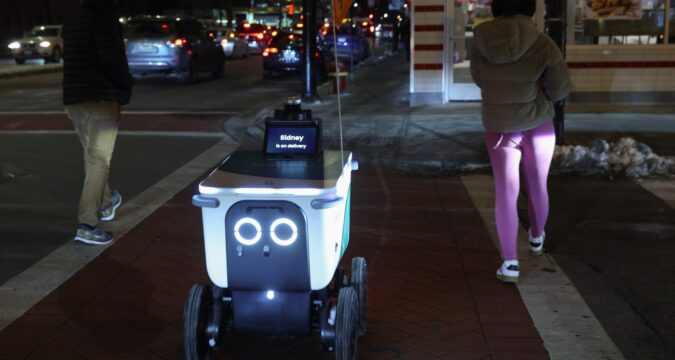
The green and white Serve robots have headlights resembling eyes and each bears a distinctive name. Serve is licensed to operate up to 60 robots in Chicago.
A woman walking a dog sidesteps a delivery robot from Serve Robotics as it navigates the intersection of Hoyne and Wabansia Avenues in Chicago on Dec. 17, 2025. (John J. Kim/Chicago Tribune)
Nationwide, with more than 3,000 robots delivering food between the two leading companies, the robots are gaining traction, visibility and some notoriety. A few prominent mishaps have gone viral.
In January, a surprisingly gleeful witness captured a much-shared video of a Coco food delivery robot that got stuck on the tracks and obliterated by a passing commuter train in Miami.
“The Coco robot experienced a rare hardware failure while crossing railroad tracks,” Carl Hansen, Coco’s head of government relations, said in an email. “We’re reviewing the situation carefully to ensure it doesn’t happen again.”
While some online pundits conjectured it was carrying a smashburger, the Coco robot was not making a delivery at the time, according to Hansen.
In Chicago, the two companies reported five safety incidents to the city last year — three involving Serve robots and two with Coco — despite logging nearly 30,000 sidewalk delivery miles between them.
“We have now driven thousands of miles since we began operating in Chicago, and we have not had any serious injuries,” Hansen said during a virtual meeting last Monday with residents of the 1st Ward on the Northwest Side, a hot zone for robotic delivery.
Some of the incidents have been pretty colorful, however.
In July, a Coco robot was “recovered” from a canal, according to the city’s records. The company offered more details, but few answers as to why.
“This was not an operational incident,” Hansen told the Tribune. “A parked, inactive robot was tampered with and intentionally moved by an unknown third party and placed into a canal. There were no injuries or safety concerns, and the robot was recovered after Coco notified the city.”
Then in November, a pedestrian darted out of a “blind alleyway” on West Diversey Parkway, tripping into a Serve robot and stumbling, according to the company’s report to the city.
Anthony Jonas in the 1200 block of West Diversey Parkway in Chicago on Feb. 6, 2026. The 33-year-old needed stitches and has a scar near his left eye after getting hit by a visibility flag while tripping over a delivery robot at this location last fall. (Chris Sweda/Chicago Tribune)
Anthony Jonas shows off an image of the injury near his left eye he suffered after getting hit by a visibility flag while tripping over a delivery robot in the 1200 block of West Diversey Parkway in Chicago last fall. (Chris Sweda/Chicago Tribune)
Anthony Jonas, 33, said he was trying to catch the bus when he tripped over the robot , making contact with its visibility flag as he fell. The Lincoln Park resident said he needed stitches and a tetanus shot. “My eye was swollen for about two weeks,” he said. He retains a scar near his left eye.
Jonas, a speech language pathologist, said that separately from his own case, he had concerns about the impact robots have on his neighbors who use wheelchairs or strollers.
Serve has downplayed the severity of the collision.
“That situation was not listed as a serious incident, because the person simply walked away, and there were no visible marks on that person,” Yariel Diaz, head of government relations for Serve, said during the meeting with 1st Ward residents. “They later did reach out to us, and we did go and process a claim on their behalf.”
The most recent incident happened on the evening of Dec. 20, when an assailant “flipped and attempted to damage” three Serve robots. Two of the robots — Cassius and Sandra — were stationary, but a third named Valerie was making a food delivery. A police officer was on the scene when a Serve field agent arrived to assist the assaulted robots, according to the report.
While the city has received only a handful of safety incidents involving delivery robots, the online campaign started by Robertson has generated hundreds of complaints ranging from sidewalk collisions to idled robots congregating in front of buildings, blocking egress for residents and passersby.
Robertson, a designer by trade, launched the site last year after dodging a robot on a summer walk near Belden Avenue and Halsted Street in Lincoln Park with his wife and their two small children.
“My family and I were out for a stroll and looked ahead, and suddenly a robot was coming toward us,” said Roberston, 40. “We stepped aside and got out of the way. And to me, something about that whole experience felt a bit off. We were in the space designated for pedestrians, yet we were deferring to this vehicle that was using the same lane as us.”
The website gained momentum after the Serve fleet essentially doubled the number of robots in Chicago last fall, Robertson said.
Reports of stumbling, slipping on the ice or just the indignity of having to yield to a robot were among common complaints submitted, Robertson said. Some said the robots, which can weigh more than 200 pounds, ran over their feet during an encounter.
Perhaps the most striking complaint came from Hughes.
Last spring, soon after the launch of the Coco robots in the DePaul area, Hughes was using a small hand rake to tidy up the fenced-in parkway on the sidewalk in front of her Webster Avenue home. Hughes noticed a woman pushing a stroller who seemed to be hesitating as she came closer. Meanwhile, she didn’t see a Coco robot approaching at a steady 5 mph from the opposite direction.
Hoping to make it easier for the woman to pass, Hughes rose up and was promptly rear-ended by the robot, which may have perceived the hunched-over human gardener as part of the landscape as it swung away from the oncoming stroller, she said.
“It clipped my legs and I sat down on it,” Hughes said. “It sort of stung a little bit in the back of my knees there. I didn’t have severe bruising or anything, but it was scary.”
Janice Hughes sits near her fenced-in front yard in Lincoln Park on Feb. 4, 2026. She was tending to her yard last spring when she was rear-ended by a food delivery robot. (Eileen T. Meslar/Chicago Tribune)
Subsequent altercations included grappling with an ostensibly wounded Coco robot that wailed in distress for hours one night in front of her house. She went out at 2 a.m. in a bathrobe trying in vain to move it, and at one point considered using a baseball bat to commit roboticide, but instead went back to bed. It was gone in the morning.
Hughes said she did not report any of the incidents to the police, and was unable to reach a human at the company when she called the phone number on the robot.
Coco said the company was unaware of the alleged incidents involving Hughes.
“This is the first time we’re hearing about this matter,” Hansen said. “We would have escalated it immediately with a full record in our system, since safety is a top priority for Coco and we remain committed to safe operations. After conducting a full retrospective review, however, we found no records or evidence of an incident matching the description provided or involving Coco during that time or in that ward.”
Hughes brought up her concerns during a visit to Ald. Timmy Knudsen’s office in the 43rd Ward when she stopped in to buy some parking stickers, and said the alderman’s staff was neither helpful nor particularly concerned.
Knudsen did not return a request for comment.
Meanwhile, Ald. Daniel La Spata, 1st, fielded an hour of questions and concerns from residents during the meeting last Monday, which included representatives from Coco and Serve.
Coco operates in his ward, La Spata said. But the alderman said he was surprised last fall when Serve started deploying robots there, too. La Spata said he reached out to the city’s Department of Business Affairs and Consumer Protection (BACP) and found that his ward had been included in the Serve pilot without his knowledge. Soon after, La Spata said he had the 1st Ward taken out of Serve’s operating area.
In an interview, La Spata said he felt that the delivery robots meant “trading one version of congestion for another.” They may take vehicles off the road, he acknowledged. “But the robots are operating on a much more limited public way, which is the sidewalk,” he said.
Almost 79% of 1st Ward residents who responded to a survey his office put out opposed to the robots, he said.
Ali Kashani, Serve’s co-founder and CEO, told the Tribune Friday that he hopes to have permission to get his robots up and running in the 1st Ward soon.
“As we earn that trust, my hope is that we will continue to expand,” Kashani said.
Elisa Sledzinska, a spokesperson for BACP, said the pilot program is assessing “both the benefits and risks” of the robots. In December, the city added a personal delivery device category to its 311 service to encourage public feedback and has received 63 reports on the robots this year, she said.
BACP has issued “emerging business” permits to both Coco and Serve, Sledzinska said. Those permits allow new types of businesses to operate “while the city determines what new policies and or even legislation (is) needed to support them long-term,” she said in an emailed statement.
The robot delivery pilot program, which BACP administers jointly with the Chicago Department of Transportation, will end in May 2027 without further action from the City Council.
That gives restaurants and customers more than a year to try out robotic delivery service. Meanwhile, Coco and Serve, whose robots ostensibly grow smarter and more street savvy with each passing day, may learn to better adapt to navigating the city.
Bobby Brooks, 33, an accountant for a Loop financial firm, has been getting groceries delivered by a Coco robot for months. The novelty of it has given way to a new normal for Brooks.
The robot brings the groceries to the front door of his apartment building in Old Town without fail, he said. Brooks said he’s amazed the robot even finds the front door, which is on the side of the building — something that repeatedly stumped human delivery drivers.
“It’s been a great experience every time so far,” Brooks said. “It’s usually quick and I like how when they deliver it, you know it’s secured.”
The robots have already proved hearty enough to deliver the goods on most days this winter, despite heavy snow and a prolonged cold snap, although a few have gotten stuck in snowbanks and other weather-related sidewalk hazards.
“If a bot becomes stuck, a remote Coco operator will alert the Coco Chicago Field Operations team, who would be immediately deployed to recover the bot,” Hansen said. “And in the event of exceptionally heavy snowfall, Coco may temporarily pause deployment until sidewalks are safe and navigable.”
For opponents of the pilot program, rescuing food delivery robots from snowbanks should never become a priority.
“Sidewalks are for people, not for robots,” said Kyle Lucas of the group Better Streets Chicago, which advocates for pedestrians and bicyclists.
rchannick@chicagotribune.com
tasoglin@chicagotribune.com
https://www.chicagotribune.com/2026/02/09/food-delivery-robots-safety-chicago/

Chipotle CEO Reveals Customers Have Money, Sets Stage For Price Hikes
Chipotle CEO Reveals Customers Have Money, Sets Stage For Price Hikes
Chipotle Mexican Grill shares chopped around last week after the fast-casual chain delivered an underwhelming outlook for annual comparable sales forecast. But by week’s end, it was not the earnings print making the rounds on social media; it was a snippet from the CEO’s remarks on the earnings call that went viral on X.
*CHIPOTLE SEES 2026 COMP SALES ABOUT 0%, EST. +1.84%
— zerohedge (@zerohedge) February 3, 2026
First off, X users framed CEO Scott Boatwright’s remarks as if he’d been “caught on a recording.” That’s complete nonsense. He said it openly on an earnings call with Wall Street analysts. But sure, whatever fuels the engagement algo machine on X.
On the call, Evercore ISI analyst David Palmer asked Boatwright:
And I wonder, you’re going to be existing among these giant fast-food players that are rolling out value menus, and you’ve done some things along the way. You have an entry price point cup with the new protein menu. You said you have some price-pointed things. It looks like you have a new style of advertising, where you’ve pointed out, pretty clearly, there’s a difference in the way Chipotle makes its food versus what you’d see at a traditional fast-food place.
I just wonder, is there any, do you feel like, the offense might be working with these price-pointed things and the messaging? And I’m just wondering, if there’s anything you can do to really shorten this cycle — this, reinvestment cycle, rather than just wait for your price to underprice inflation for a while? And thank you.
… and here’s where the outrage on X was triggered.
Boatwright responded:
Yes. Thanks, David. I’ll tell you, with what the momentum we saw in early January, the first part of January, it gives us confidence that the strategy is exactly what our consumer is looking for. I talked earlier about doing this deep-dive on the core Chipotle consumer to really parse out, who that consumer is and what they want.
What we’ve learned is the guest skews younger, a little more higher income is typically a digital native, and that their grounded purpose aligns with our Northstar as a brand around clean food, clean ingredients, high protein, and we are the way they want to eat. And we’re going to lean into that in the most meaningful way.
Now, I’ll tell you, after looking at the data last week, we learned that 60% of our core users are over $100,000 a year in income — in average household income. That gives us confidence that we can lean into that group in a more meaningful way, whether it’s the solo occasion and or group occasions to really drive meaningful transaction performance in the year.
Chipotle CEO: 60% of users make over $100,000 a year in income. 🌯💰 pic.twitter.com/cuezE5rv1K
— Yahoo Finance (@YahooFinance) February 7, 2026
Translation: Chipotle will raise burrito bowl prices even higher. There was a time when these bowls were sub $10 – even less.
Not a great look for the CEO at a moment when the Trump administration is pushing ahead with affordability. But there’s a simple solution for the youngsters: eat at home.
Tyler Durden
Mon, 02/09/2026 – 05:45
https://www.zerohedge.com/markets/chipotle-ceo-reveals-customers-have-money-sets-stage-price-hikes

Today in Chicago History: Bears’ Steve McMichael selected for Pro Football Hall of Fame
Here’s a look back at what happened in the Chicago area on Feb. 9, according to the Tribune’s archives.
Is an important event missing from this date? Email us.
Sports front page flashback: Feb. 10, 2024
Former Chicago Bears defensive tackle Steve McMichael was elected to the Pro Football Hall of Fame on Feb. 8, 2024. (Chicago Tribune)
2024: Former Chicago Bears defensive tackle Steve McMichael, who was fighting against amyotrophic lateral sclerosis (ALS), was feted by bagpipes and drums outside his Homer Glen home after his election to the Pro Football Hall of Fame.
Ranking the 100 best Bears players ever: No. 18, Steve McMichael
McMichael, who did not make the trip to Canton, Ohio, and fellow Bears great Devin Hester were inducted into the Hall of Fame on Aug. 3, 2024.
From Halas to Hester: The 32 Chicago Bears inducted into the Pro Football Hall of Fame
Weather records (from the National Weather Service, Chicago)
High temperature: 56 degrees (2024)
Low temperature: Minus 21 degrees (1899)
Precipitation: 1.56 inches (1876)
Snowfall: 12.6 inches (2010)
1911: The Infant Welfare Society of Chicago was established.
Dianne Holum captured the first Olympic gold medal for the United States at the 1972 Winter Olympics in Sapporo, Japan. The Northbrook speed skater shattered the record in the 1,500-meter race. Anne Henning — “Queen of the 500” — won the second gold medal for the U.S. “She not only won, she won it twice, breaking the Olympic mark each time,” the Tribune reported. (Chicago Tribune)
1972: Sixteen-year-old Anne Henning of Northbrook won gold and set an Olympic record of 43.73 in 500-meter speed skating at the Winter Olympics in Sapporo, Japan.
Vintage Chicago Tribune: 4 Illinois athletes who won GOLD at the Winter Olympics
Dianne Holum, also of Northbrook, captured the first Olympic gold medal for the United States at that Games. The speed skater shattered the record in the 1,500-meter race.
Both were treated to a hero’s welcome when they returned to Illinois.
Vintage Chicago Tribune: Our local Winter Olympians of Games past
Topping out ceremonies for the new O’Hare International Tower Hotel on June 14, 1972. (William Kelly/Chicago Tribune)
1973: The on-site hotel opened at O’Hare International Airport in a project that cost $25 million.
O’Hare International Airport: From farm to global terminal
With 10 stories and 979 rooms, the O’Hare International Tower Hotel (now Hilton Chicago O’Hare Airport Hotel) was built to suppress jet noise due to its design of thick floor-to-ceiling windows and thick walls containing acoustical batting and heavy draperies.
Want more vintage Chicago?
Subscribe to the free Vintage Chicago Tribune newsletter, join our Chicagoland history Facebook group, stay current with Today in Chicago History and follow us on Instagram for more from Chicago’s past.
Have an idea for Vintage Chicago Tribune? Share it with Kori Rumore and Marianne Mather at krumore@chicagotribune.com and mmather@chicagotribune.com
https://www.chicagotribune.com/2026/02/09/february-9-chicago-history/

Today in History: ‘Parasite’ wins Academy Award for Best Picture
Today is Sunday, Feb. 9, the 40th day of 2025. There are 325 days left in the year.
Today in history:
On Feb. 9, 2020, “Parasite,” a film from South Korea, won the Academy Award for Best Picture, becoming the first non-English language film to do so.
Also on this date:
In 1825, the House of Representatives elected John Quincy Adams president after no candidate received a majority of electoral votes.
In 1943, the World War II Battle of Guadalcanal in the southwest Pacific ended with an Allied victory over Japanese forces.
In 1950, in a speech to the Women’s Republican Club in Wheeling, West Virginia, Republican Sen. Joseph McCarthy of Wisconsin charged that the State Department was riddled with Communists.
In 1964, the Beatles made their first live American television appearance on “The Ed Sullivan Show,” broadcast from New York on CBS. The quartet played five songs, including “She Loves You” and “I Want to Hold Your Hand,” to a crowd of screaming teenagers in person and more than 70 million viewers across the country.
In 1971, a magnitude 6.6 earthquake in California’s San Fernando Valley claimed 65 lives.
In 1984, Soviet leader Yuri Andropov, 69, died 15 months after succeeding Leonid Brezhnev; he was followed by Konstantin Chernenko, who would only be in power for 13 months before his own death in office.
In 1986, Halley’s Comet made its closest pass by Earth since 1910. (The comet’s next appearance will be in 2061).
In 2009, New York Yankees third baseman Alex Rodriguez admitted to taking performance-enhancing drugs, telling ESPN he’d used banned substances while with the Texas Rangers for three years.
Related Articles
Today in Chicago History: Bears’ Steve McMichael selected for Pro Football Hall of Fame
Today in History: First US execution using lethal gas takes place
Today in Chicago History: WGN-AM’s Bob Collins killed in midair plane collision in Zion
Today in History: Great Baltimore Fire begins
Today in Chicago History: Michael Jordan signs baseball contract with White Sox
In 2021, the Senate moved ahead with a second impeachment trial of former President Donald Trump, rejecting arguments that the chamber could not proceed because Trump was no longer in office.
Today’s birthdays: Artist Gerhard Richter is 93. Nobel Prize-winning author J.M. Coetzee is 85. Singer-songwriter Carole King is 83. Actor Joe Pesci is 82. Nobel Prize-winning economist Joseph Stiglitz is 82. Author Alice Walker is 81. Actor Mia Farrow is 80. Actor Judith Light is 76. Golf Hall of Famer Sandy Lyle is 67. Writer-producer David Simon (TV: “The Wire”) is 65. Country singer Travis Tritt is 62. Baseball Hall of Famer Vladimir Guerrero is 50. Actor Charlie Day is 49. Actor Zhang Ziyi is 46. Actor Tom Hiddleston is 44. Actor Michael B. Jordan is 38. Actor Rose Leslie is 38. NFL running back Saquon Barkley is 28.

Europe’s Chemical Sector ‘Will Disappear’ Under Weight Of EU Green Deal, CEOs Sound Alarm
Europe’s Chemical Sector ‘Will Disappear’ Under Weight Of EU Green Deal, CEOs Sound Alarm
The visible decline in production in Europe’s chemical sector could soon have far more serious consequences. Production capacity is disappearing, and the further consequences will be alarming, warn leaders of the largest companies in an industry that recently experienced a period of prosperity.
They are calling for swift and far-reaching changes to EU law, writes Polish Business Insider.
In just a few years, nearly 10 percent of production capacity on the Old Continent has disappeared. Industry representatives are warning that cheaper products from Asia and the Middle East are taking their place, as European companies suffocate under the weight of energy prices, CO2 costs, and a thicket of regulations. This is the view of both state-owned (Azoty), private (Qemetica), and foreign companies operating in Poland (BASF).
The chemical sector accounts for approximately 7 percent of the EU’s total industry and generates over 1 million direct jobs, with 3-5 times as many indirect jobs, primarily in small and medium-sized companies. Meanwhile, according to Katarzyna Byczkowska, CEO of BASF Polska, over the last three years, approximately 9 percent of chemical production capacity has been liquidated in Europe, and in 2023-2024, the European chemical industry alone will shrink by 14 percent. During this same period, chemical production grew in countries such as China, Russia, and the United States.
“In Europe, we’re playing a different game than the rest of the world, but on the same playing field. We’re starting to lose,” warns Kamil Majczak, CEO of Qemetika (formerly Ciech), during a debate organized by Siemens with other representatives of the chemical sector. In his opinion, Europe still believes it can impose its rules on others, while China, the U.S., and India view the world as a field for expanding their spheres of influence and taking over markets.
“We can’t expect developing countries to suddenly make everything green, three times more expensive, because we think it’s the right thing to do,” he adds.
Majczak emphasizes that the consequences of rising costs are already tangible. More and more plants are closing in Europe, and some companies have survived the last two or three years by leveraging previous profits. “This buffer is running out, and once a plant closes, it won’t reopen. People will leave, production capacity will disappear, and it won’t return after a year or two,” warns the CEO of Qemetica.
In the case of fertilizers, the price of gas accounts for 75-80 percent of the product’s production cost. For years, Europe has been an importer, now forced to use much more expensive sources than before. This poses a significant challenge for fertilizer companies like Azoty.
This is especially an issue for the chemical sector, as it is such an energy-intensive industry, says Paweł Bielski, vice-president of Grupa Azoty.
“At certain points, gas in the U.S. was 4-6 times cheaper than in Europe,” recalls Katarzyna Byczkowska, CEO of BASF Poland. The differences in energy costs are immediately visible in the profit and loss accounts of European and American plants, admits Kamil Majczak, CEO of Qemetica, who compares the results of factories in Europe and the US. CO2 emissions fees must also be added to the total, which, Majczak says, are practically nonexistent outside of Europe, with the exception of a specific system in California.
Industry representatives emphasize that they are not questioning the direction of decarbonization, but the pace, scale, and structure of regulatory burdens in a situation where Europe is already starting from a worse position, because it is more expensive in terms of energy.
Katarzyna Byczkowska highlights two levels of regulatory costs.
First, there are direct costs resulting from regulatory compliance, as in the case of the EU’s CLP regulation. The change in font on chemical labels was reportedly costing her company over €300 million before, after a year of intense negotiations, some of the provisions were withdrawn.
Second, there is the increasing structural burden resulting from the sheer number and volatility of regulations, which generate chaos, reduce predictability, and drain resources from research and development.
“In Europe, we already spend twice as much on regulatory compliance as on research and development,” notes the head of BASF Poland. Across the continent, this translates to an 8 percent decline in R&D spending, while in China and the US, spending is rising year over year.
Paweł Bielski, Vice President of Grupa Azoty, points out that the EU climate package and subsequent elements of Fit for 55 were developed under completely different conditions than those in which the industry operates today. “The Green Deal was adopted when no one took into account the pandemic, the war in Ukraine, or the rapid change in Europe’s energy balance,” he argues. In his opinion, the direction of decarbonization will remain unchanged, even if some regulations are formally suspended, but the rules themselves should be improved.
A symbolic example is the ETS system, or emissions trading. Free allowances are shrinking every year, and, as Byczkowska explains, companies are unable to “add” another billion euros a year to purchase certificates in a time of crisis and blocked new investments. “We need someone to stop tightening their grip on us even more,” she says.
The clash between European climate ambitions and the realities of global competition is most acute in the clash with Asian production. “We used to be an exporter, now we’re an importer, and that fundamentally disrupts the balance,” says Majczak. China has built vast, modern production capacities in recent years to satisfy its own market, but the slowdown in demand has freed up a significant portion of this capacity for export.
Taking advantage of cheaper energy and less restrictive regulations, Chinese producers are aggressively entering the European market, from fertilizers to plastics.
Paweł Bielski points out that until recently, Europe had a strong polymer industry, including the production of polyamides for automotive, construction, and packaging. Today, China’s dominance is overwhelming in many segments — in one of them, as he points out, as much as 67 percent of global production capacity is already located in China. He believes a similar trend is visible in fertilizers: Massive installations are being built in Russia, the U.S., and the Persian Gulf countries, which will not consume all of their production domestically, but will instead direct it to Europe, among other countries.
One positive sign is that technological advances reduce costs. “We’re seeing increased activity from companies investing in solutions that enable faster, cheaper, and safer production,” says Maciej Zieliński, CEO of Siemens Polska.
Tyler Durden
Mon, 02/09/2026 – 05:00

El príncipe Guillermo y la princesa Catherine expresan su preocupación por las víctimas de Epstein
Associated Press
LONDRES (AP) — El príncipe Guillermo y la princesa Catherine expresaron su preocupación por las víctimas de Jeffrey Epstein en un comunicado emitido el lunes, el último movimiento de la monarquía británica para distanciarse de las revelaciones sobre la relación del expríncipe Andrés con el delincuente sexual condenado.
Los miembros más populares de la realeza británica dijeron haber quedado horrorizados por el contenido de más de tres millones de páginas de documentos publicados a principios de este mes por el Departamento de Justicia de Estados Unidos.
“Puedo confirmar que el príncipe y la princesa de Gales han estado profundamente preocupados por las continuas revelaciones. Sus pensamientos siguen centrados en las víctimas”, indicó el palacio en un comunicado.
El comunicado, emitido antes del viaje de tres días de Guillermo a Arabia Saudí, que comienza el lunes, es parte de la respuesta de la monarquía a la creciente crisis en torno al expríncipe, quien fue despojado de sus títulos reales en octubre tras revelaciones previas sobre su relación con Epstein. El hermano de 65 años del rey Carlos III ahora es conocido simplemente como Andrés Mountbatten-Windsor.
La semana pasada, el rey obligó a Mountbatten-Windsor a dejar su hogar de toda la vida en Royal Lodge, cerca del Castillo de Windsor, acelerando un traslado que se anunció por primera vez en octubre pero que no se esperaba completar hasta más adelante este año.
Mountbatten-Windsor ahora vive en la finca de Sandringham del rey en el este de Inglaterra. Vivirá temporalmente en Wood Farm Cottage mientras su hogar permanente en la finca se somete a reparaciones.
Mountbatten-Windsor ha negado repetidamente cualquier conducta indebida en su relación con Epstein.
___
Esta historia fue traducida del inglés por un editor de AP con la ayuda de una herramienta de inteligencia artificial generativa.
Visualizing The Changing Political Affiliation By Generation In The US
Visualizing The Changing Political Affiliation By Generation In The US
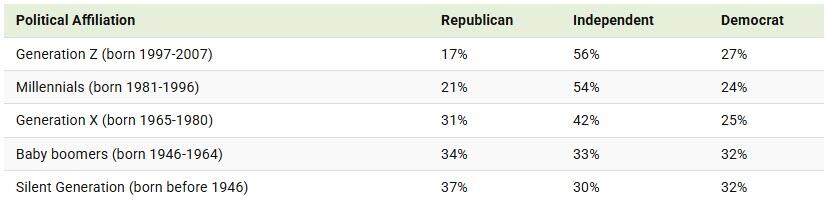
Political identity in the U.S. is changing, and the divide is increasingly generational.
Younger Americans are stepping away from traditional party labels, while older generations remain more closely tied to the two-party system.
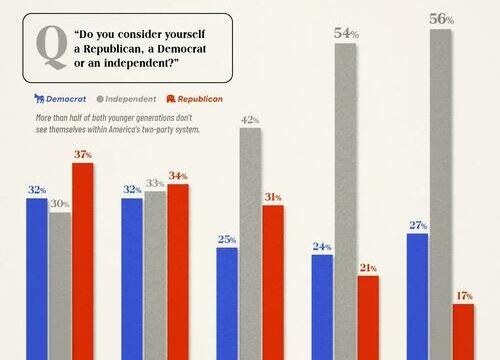
This visualization, via Visual Capitalist’s Niccolo Conte, shows how political affiliation varies across generations, highlighting the growing role of independents in American politics.
The data comes from Gallup. It is based on annual averages from Gallup’s telephone interviews, asking respondents whether they identify as Republican, Democrat, or independent. “No opinion” responses are excluded, and figures may not total 100% due to rounding.
Younger Generations Favor Being Independents
A majority of both Generation Z and Millennials identify as independents. Among Gen Z, 56% say they are independent, compared with just 17% identifying as Republican and 27% as Democrat. Millennials show a similar pattern, with 54% identifying as independent.
Party Loyalty Rises With Age
Political affiliation becomes more evenly split among older generations. Generation X shows a more balanced distribution, with 31% Republican, 25% Democrat, and 42% independent. Among Baby Boomers, party identification nearly overtakes independence altogether.
The Silent Generation is the most partisan group, with roughly seven in 10 identifying as either Republican or Democrat. This cohort came of age during periods when party affiliation was more stable and closely tied to identity, such as the New Deal era and the Cold War.
Implications for U.S. Politics
The rise of independents among younger generations has major implications for elections and governance. While independents may still lean toward one party, their lack of formal affiliation makes voter behavior less predictable. It also complicates messaging for political parties trying to mobilize younger voters.
If you enjoyed today’s post, check out The Distribution of Income in America (2024 vs 1974) on Voronoi, the new app from Visual Capitalist.
Tyler Durden
Mon, 02/09/2026 – 04:15
https://www.zerohedge.com/political/visualizing-changing-political-affiliation-generation-us

Fuerzas israelíes capturan a un funcionario islamista suní y aliado de Hamás en el sur de Líbano
Associated Press
BEIRUT (AP) — En una operación en el sur de Líbano la madrugada del lunes, las fuerzas israelíes capturaron a un funcionario local de un grupo islamista suní y aliado del grupo armado palestino Hamás y lo llevaron a Israel para ser interrogado, informaron el ejército israelí y medios estatales libaneses.
También el lunes, un dron israelí atacó un automóvil en la aldea libanesa sureña de Yanouh, matando a tres personas, incluido un niño, según la Agencia Nacional de Noticias de Líbano. No hubo comentarios inmediatos de Israel sobre el ataque.
Según la agencia NNA, Atwi Atwi, un funcionario local del grupo islamista suní al-Jamaa al-Islamiya, o Grupo Islámico, fue capturado en la aldea sureña de Hebbarieh, en la región de Hasbaya y cerca de la frontera con Israel.
Un comunicado del ejército israelí dijo que las tropas israelíes aprehendieron a un funcionario del Grupo Islámico en una “operación dirigida basada en inteligencia”. No se dio a conocer el nombre del funcionario.
El Grupo Islámico condenó la captura, diciendo que era parte de los ataques diarios de Israel y las violaciones de la soberanía libanesa. Hizo un llamado al estado libanés para que trabaje por la liberación de Atwi.
Grupo Islámico es la rama libanesa de la Hermandad Musulmana, un grupo político panislamista, con un ala armada en Líbano conocida como las Fuerzas Fajr.
Después del estallido de la guerra entre Israel y Hamás en octubre de 2023, las Fuerzas Fajr se sumaron al grupo militante chií libanés Hezbollah, lanzando cohetes a través de la frontera hacia Israel que, según dijeron, eran una forma de apoyo a Hamás en Gaza.
La Hermandad ha sido proscrita en gran parte del Oriente Medio y designada como un grupo terrorista. El mes pasado, el gobierno de Trump designó a las ramas libanesa, jordana y egipcia de la Hermandad como organizaciones terroristas.
El líder de Al-Jamaa al-Islamiya, Mohammed Takkoush, dijo durante la guerra de 14 meses entre Hezbollah e Israel que su grupo y Hezbollah dejaron de lado sus diferencias sobre los conflictos en Siria y Yemen para unirse contra Israel.
Hezbollah comenzó a atacar a Israel el 8 de octubre de 2023, un día después de que Hamás atacara el sur de Israel, desencadenando la última guerra entre Israel y Hamás. Israel luego lanzó un bombardeo generalizado sobre Líbano que debilitó severamente a Hezbollah, seguido de una invasión terrestre.
El conflicto terminó con un alto el fuego mediado por Estados Unidos en 2024, y desde entonces, Israel ha realizado ataques aéreos e incursiones terrestres casi a diario en Líbano. Israel dice que está llevando a cabo las operaciones para eliminar los bastiones de Hezbollah y las amenazas contra Israel.
La guerra entre Israel y Hezbollah mató a más de 4.000 personas en Líbano, incluidos cientos de civiles, y causó un daño y destrucción estimados en 11.000 millones de dólares, según el Banco Mundial. En Israel murieron 127 personas, incluidos 80 soldados.
___
Esta historia fue traducida del inglés por un editor de AP con la ayuda de una herramienta de inteligencia artificial generativa.

Spain’s Prime Minister Tries To Cover Up Corruption With Censorship
Spain’s Prime Minister Tries To Cover Up Corruption With Censorship
The Spanish Prime Minister, Pedro Sánchez, has appeared at a summit along with autocratic and undemocratic leaders from Georgia and Burundi to talk about protecting citizens and democracy. Fascinating. It is very revealing.
The president talks about protecting minors from the harms of social networks and launches tirades against alleged techno-oligarchs. However, the evidence shows that beneath the supposedly “noble” goal of protecting minors, there is an agenda that includes the introduction of digital identities, biometric control for all, and prior censorship accompanied by state surveillance.
It is obvious to everyone that the objective is to silence independent media.
If the digital control law had been implemented in 2018, the corruption scandals surrounding the Socialist government would never have come to light. Koldo García, accused of embezzlement, would still be a member of the board of public train company Renfe today; Jose Luis Ábalos, under investigation for various corruption scandals, would still be minister; Salazar, investigated for sexual assault, would be an exemplary socialist; Venezuela’s dictatorship’s Delcy Rodriguez would be a VIP nighttime visitor; and the Socialist party’s number two, Santos Cerdán, would still be “Super Santos.” For Sánchez, all those cases were “disinformation” and “fake news” from the “far right”; do not forget it.
If he really cared about teenagers, he would not condemn them to unemployment and ruin and would give greater responsibility to parents, based on freedom. But he wants to ban access to social media because the goal is to silence dissenters.
It is no surprise that his words have been met with enormous enthusiasm by millionaires such as Alex, the son of George Soros, or by defenders of censorship and propaganda who see their dream of social engineering and control slipping away these days.
Hadn’t this inquisition shifted to Bluesky, with the intention of ending X and establishing the true social majority? They treat Bluesky as though it were a non-governmental organization.
Curiously, what Sánchez calls techno-oligarchs does not bother him if they serve his interests. Elon Musk, when aligned with the Democrats, set a global example. Sánchez courted Soros, Gates, Fink, and anyone he could for years. If anyone has used social networks to spread hate, division, polarization, and disinformation, it has been his government and his far‑left partners. However, it is important to note that his objective is not to restrict young people’s access to communist propaganda messages, but rather to prevent them from voting for the right. They thought teens were ideal and wanted them to vote when they thought they’d vote left. Now, when they see that young people are of no use to them, they launch their other favorite social‑engineering tool: the mass regularization of irregular immigrants.
Sanchez lies on immigration policy by deliberately misleading the public about the regularization of illegal immigrants in the country with the highest unemployment rate in the euro area. This tactic serves as a form of social engineering and control, similar to his digital protection strategy, rather than being based on economic logic.
This is not solidarity. The objective is to create a dependent subclass, buy votes, and inflate GDP through immigration, which is why, according to the IMF, Spain’s per capita GDP is expected to increase by only 1.1% from 2017 to 2026 with 10% “official” unemployment (14% real). It delays all those trying to enter legally and passes the enormous cost and social challenges to taxpayers.
Cornered by corruption and the disastrous management of infrastructure and public services, Sánchez launches yet another smokescreen operation to try to silence independent opinions.
The reality? His flagship socialist propaganda projects have failed, TikTok has not helped them win elections, and freedom is advancing. That is what bothers them.
The far left perceives X as a threat, yet none of their criticisms mention TikTok. One is free, and the other is controlled by a dictatorship. Fascinating.
The left loves social networks and billionaires when they serve its purpose of control.
Just remember how thrilled they were with Davos a few years ago. What bothers them is freedom and diversity of opinion. Furthermore, what fills them with uncontrollable rage is that the Grok community dismantles their propaganda in the notes section.
If Musk calls Sánchez a traitor and a tyrant, it is a grave insult against an elected president and against Spain, according to the extreme left, but if socialists and the far left call the elected president of the United States or of Argentina a murderer, dictator, fascist, Nazi, terrorist, and racist, that is fantastic and normal.
The evidence of X’s independence and plurality is that every time I open the app, I see posts from socialist cheerleaders, whom I neither follow nor search for.
All this crisis is yet another example of Sánchez’s mastery in applying the 11 principles of propaganda, especially that of the single enemy and reversal: demonizing a supposed all‑powerful enemy to present himself as victim and savior, and accusing everyone else of being guilty of corruption and negligence, pointing at others to cover his government’s issues.
Whenever corruption scandals or negligence in infrastructure management put the Spanish government under fire, Sanchez creates a smokescreen and applies the main propaganda principles to shift attention. His favorite tactic is to select a “special enemy” for vilification. The far-left government even fabricated a fake “bomb threat” to portray Sanchez as both a victim and a savior to stay in power at any cost. Sanchez has targeted various groups for vilification, including tech companies, energy companies, banks, supermarkets, social media, the independent press, specific nations, and any political opponent, as well as the far-left government’s favorite tactic, promoting antisemitism. Choose one. Divert attention. Move on.
A man who is incapable of winning elections presents himself as the voice of the social majority. It is ridiculous when he is held hostage by the minorities that keep him in power. And power is the only thing he cares about. That is why he seeks censorship at all costs, to silence the majority that does not suit him.
Sánchez wants to create a state of surveillance and censorship in Spain under the pretext of digital “protection.” To all the Sánchez-aligned press that is defending this outrage against freedom of expression, maybe thinking that being political commissars will benefit them, I would like to remind them that purges come afterwards.
If you believe that supporting Sánchez’s totalitarian whims will be advantageous for you, remember that actions you consider acceptable when “your side” does them can also be used by the opposing side against you.
Disinformation and polarization may happen in a free society, but those risks are 100% certain when information is controlled by the state.
Tyler Durden
Mon, 02/09/2026 – 03:30
https://www.zerohedge.com/geopolitical/spains-prime-minister-tries-cover-corruption-censorship

La represión iraní contra la disidencia tras las protestas se amplía y alcanza a figuras reformistas
Por JON GAMBRELL
DUBÁI, Emiratos Árabes Unidos (AP) — Las fuerzas de seguridad iraníes han emprendido una campaña para arrestar a personas conocidas del movimiento reformista del país, informaron el lunes.
El operativo amplía una represión contra la disidencia después de que las autoridades sofocaran unas protestas nacionales, una violenta persecución que dejó miles de muertos y decenas de miles de detenidos.
La laureada con el Nobel de la Paz Narges Mohammadi, que ya estaba detenida, recibió otra sentencia de prisión de más de siete años. La condena refleja un esfuerzo creciente por silenciar a cualquiera que se oponga a la sangrienta represión de disturbios por parte de la teocracia iraní mientras enfrenta nuevas conversaciones nucleares con Estados Unidos. El presidente Donald Trump ha advertido repetidamente que podría lanzar un ataque contra el país si no se alcanza un acuerdo.
Reportes en los medios citaron a funcionarios dentro del movimiento reformista, que busca cambiar la teocracia de Irán desde adentro, diciendo que al menos cuatro de sus miembros habían sido arrestados. Incluyen a Azar Mansouri, la líder del Frente Reformista, que representa a múltiples facciones reformistas; y al exdiplomático Mohsen Aminzadeh, quien sirvió bajo el presidente reformista Mohammad Jatami.
También fue detenido Ebrahim Asgharzadeh, quien lideró a los estudiantes que asaltaron la embajada de Estados Unidos en Teherán en 1979, provocando la crisis de rehenes de 444 días.
Sus arrestos probablemente derivan de una declaración reformista en enero que pedía que el líder supremo de Irán, el ayatolá Alí Jamenei, de 86 años, renunciara a su cargo y que un consejo de gobierno transitorio supervisara el país.
La agencia de noticias estatal de Irán, IRNA, citó una declaración de la fiscalía en Teherán, la capital del país, diciendo que cuatro personas habían sido arrestadas y otras citadas para reunirse con las autoridades. Acusó a los supuestamente involucrados de “organizar y liderar… actividades destinadas a perturbar la situación política y social en el país en medio de amenazas militares de Estados Unidos y el régimen sionista”.
“Después de haber silenciado las calles con una crueldad ejemplar, el régimen ha centrado su atención hacia adentro, fijando su mirada en su oposición leal”, escribió Ali Vaez, un experto en Irán del International Crisis Group.
“Los reformistas, sintiendo que el terreno se movía bajo ellos, habían comenzado a desviarse, y el poder, siempre paranoico, ahora está decidido a cauterizar la disidencia antes de que aprenda a caminar”.
Sin embargo, sigue sin estar claro cuánta apoyo político tienen los reformistas dentro de Irán. Durante las manifestaciones se oyó a la gente gritar “¡Muerte a Jamenei!” y expresar apoyo al príncipe heredero exiliado del país, y la indignación de la gente parecía agrupar a los reformistas con todos los demás políticos que ahora trabajan en la República Islámica.
Irán y Estados Unidos mantuvieron nuevas conversaciones nucleares la semana pasada en Omán. El ministro de Relaciones Exteriores, Abbas Araghchi, señaló el domingo en un discurso a diplomáticos en una cumbre en Teherán que Irán se mantendría en su posición de que debe poder enriquecer uranio, un punto de gran controversia con Trump, quien bombardeó recintos atómicos iraníes en junio durante la guerra de 12 días entre Irán e Israel.
El primer ministro israelí, Benjamin Netanyahu, viajará a Washington esta semana, con Irán como el principal tema de discusión, dijo su oficina.
Estados Unidos ha llevado el portaviones USS Abraham Lincoln, barcos y aviones de guerra al Oriente Medio para presionar a Irán a un acuerdo y tener la potencia de fuego necesaria para atacar a la República Islámica si Trump decide hacerlo.
Mientras tanto, Irán emitió una advertencia a los pilotos de que planeaba “lanzamientos de cohetes” del lunes al martes en un área sobre la provincia de Semnan del país, hogar del Puerto Espacial Imam Jomeini. Tales lanzamientos han coincidido en el pasado con la conmemoración por parte de Irán del aniversario de su Revolución Islámica de 1979.
___
Esta historia fue traducida del inglés por un editor de AP con la ayuda de una herramienta de inteligencia artificial generativa.