Category: News
Justicia argentina acusa a exfuncionario de Milei por corrupción en área de discapacidad
Por SERGIO FARELLA y DÉBORA REY
BUENOS AIRES (AP) — Un juez argentino acusó formalmente al extitular de la Agencia Nacional de Discapacidad, a otros exfuncionarios y a empresarios de droguerías por el cobro de sobornos y fraude al Estado, entre otros delitos, en el marco de una causa por irregularidades en la compra de medicamentos para discapacitados. La medida representa el primer avance concreto de la justicia contra el gobierno del ultraliberal Javier Milei por corrupción.
El juez federal Sebastián Casanello procesó el lunes sin prisión preventiva a Diego Spagnuolo por negociaciones incompatibles con la función pública, defraudación por administración fraudulenta agravada por haber sido cometida en perjuicio de la administración pública nacional, cohecho pasivo (recibir sobornos) y asociación ilícita en calidad de jefe, según la resolución a la que tuvo acceso The Associated Press.
“Además de haber colocado en puestos claves a personas que respondían a intereses ajenos a la administración —los de la organización delictiva—, (Spagnuolo) articuló y supervisó el direccionamiento de las compulsas de precios en beneficio de determinadas droguerías a cambio de sobornos”, determinó Casanello.
Spagnuolo, quien fue abogado de Milei antes de que éste asumiera la presidencia a fines de 2023, se desempeñaba al frente de la Agencia Nacional de Discapacidad hasta que en agosto fue desplazado del cargo tras la difusión en medios periodísticos de audios en los que aludía al pago de sobornos a la secretaria general de la Presidencia y hermana del mandatario, Karina Milei, como paso previo para autorizar la adquisición de medicinas.
“A Karina le llega el 3% y el 1% se va en la operatoria”, se escucha en uno de los mensajes del exfuncionario sobre la hermana del mandatario.
Tras salir a la luz los audios Milei removió a Spagnuolo y ordenó la intervención de la dependencia oficial. El mandatario ha negado en reiteradas ocasiones que su hermana esté implicada y apuntó a una “utilización política” del caso por parte de la oposición.
Si bien Karina Milei no está imputada en la causa, el caso representó una mancha para un gobierno que llegó al poder con la promesa de poner fin a los negociados de la política tradicional. Además estalló en el marco de los fuertes recortes que dispuso el mandatario ultraliberal en el área de discapacidad.
En su fallo, Casanello advirtió que el esquema de corrupción “no se trató de algo encapsulado y que podría tener otro nivel de complicidades. La investigación no debiera dejar tales aspectos de lado, sino que deberán ser esclarecidos y profundizados”.
Además de Spagnuolo, el juez acusó formalmente a Daniel Garbellini y Pablo Atchabahian, subalternos de Spagnuolo en la agencia de discapacidad; a Miguel Ángel Calvete, un lobista que oficiaba de nexo entre la dependencia oficial y las droguerías, y a otros 17 imputados.
“La organización estuvo abocada a generar millonarias sumas de dinero para sus integrantes de manera ilegal en detrimento del erario público y en particular de la población con discapacidad y especialmente vulnerable”, expresó el magistrado en su fallo.
Según el juez, “la maniobra se completó con pagos indebidos a determinados funcionarios públicos de ANDIS (Agencia Nacional de Discapacidad), como contraprestación a que se digitaran —en favor de intereses particulares ajenos a los de la administración— las contrataciones y se garantizaran agilidad y prioridad en el cobro”.
Dos de las droguerías involucradas resultaron beneficiarias de estas licitaciones irregulares por un monto superior a los 30.000 millones de pesos (equivalentes a unos 21 millones de dólares), según estimaciones de la justicia.
En noviembre pasado cuando fue citado a declarar, Spagnuolo negó los cargos.
Si bien los acusados seguirán el proceso en libertad, Casanello dispuso un embargo sobre sus bienes y la prohibición de salida del país.

EEUU niega que trató de poner fin a pedido de asilo de familia de niño en Minneapolis
MINNEAPOLIS (AP) — Las autoridades federales han negado intentar acelerar el fin de las solicitudes de asilo de la familia de un niño de 5 años que fue detenido con su padre durante la represión migratoria que ha sacudido el área de Minneapolis.
Imágenes de Liam Conejo Ramos con un sombrero de conejo y una mochila de Spider-Man rodeado de policías migratorios provocaron amplia indignación.
Danielle Molliver, abogada del niño y su padre, dijo al New York Times que el gobierno estaba intentando acelerar los procedimientos de deportación, calificando las acciones de “extraordinarias” y posiblemente “de represalia”.
El gobierno lo negó.
“Estos son procedimientos de expulsión regulares. No están en expulsión acelerada”, declaró Tricia McLaughlin, funcionaria del Departamento de Seguridad Nacional, en un comunicado, añadiendo “no hay nada de represalia en hacer cumplir las leyes de inmigración del país”.
El niño y su padre, Adrian Conejo Arias, quien es originario de Ecuador, fueron detenidos en un suburbio de Minneapolis el 20 de enero. Fueron llevados a un centro de detención en Dilley, Texas.
Fueron liberados tras la orden de un juez y regresaron a Minnesota el 1 de febrero.
Vecinos y funcionarios escolares han acusado a las autoridades de inmigración de usar al niño como “cebo” al decirle que llamara a la puerta de su casa para que su madre saliera. El Departamento de Seguridad Nacional ha calificado esa descripción de los eventos como una “mentira absoluta”. Dijo que el padre huyó a pie y dejó al niño en un vehículo en marcha en su entrada.
El gobierno dice que el padre del niño ingresó a Estados Unidos ilegalmente desde Ecuador en diciembre de 2024. La abogada de la familia dijo que tiene una solicitud de asilo pendiente que le permite quedarse en el país.
___________________________________
Esta historia fue traducida del inglés por un editor de AP con ayuda de una herramienta de inteligencia artificial generativa.

This year’s Super Bowl commercials: The good, the bad and the good-stupid
Here’s one thing I hated about the commercials for the Super Bowl this year: Apparently, if I can trust the PR campaigns behind many of these ads, to get the full “experience” of their commercials, I had to start following their campaigns in January. I had to catch the teaser for the teaser, then follow a social-media rollout hinting at more, watch the teaser, then finally, on game day, see why they spent $8 to $10 million (a record) for airtime alone.
Does anyone really want to be this invested in Pringles or Skittles or Hellmann’s mayonnaise? Surely there must be easier ways for advertising professionals to meet Sabrina Carpenter or Andy Samberg or get Elijah Wood to sign their Blu-Ray of “Return of the King.” Celebrity was the focus Sunday, of course, as it is most Super Bowls, but why does it seem like partnering with celebrities is now the only inspiration for these ads?
Some thoughts on the good and the bad, what soared and what landed like a drop of guac on the carpet.
Bad: Gag me with rural sincerity
Budweiser, to celebrate its 150th year, paired another Clydesdale with 30 seconds of the most lazy Super Bowl marketing cliches ever: a bald eagle learning to fly (and CGI-looking), the soft strums of “Free Bird,” a couple of teary-eyed farmers and honey-kissed fields. The subtext is: Cringe at this unintentional parody and you probably hate sentiment, family farms and America. I’ll take that risk. (Lays, on the other hand, playing in the same ballpark with a salute to American potato farms, developed recognizable people — same emotions, smarter results. Even better was the teaser for the upcoming “Mandalorian” movie, satirizing Clydesdales with Tauntauns.)
Good: Best use of a high-ticket celebrity
OK, maybe landing Samberg was perfect for Hellmann’s, which let him channel his inspired Lonely Island days into a demented and pretty funny twist on Neil Diamond’s “Sweet Caroline.” Samberg plays Meal Diamond as the Phantom of the Deli, shouting that he lives in the walls and “Sometimes I wonder who my parents are!” Who cares that it makes zero sense? Whenever you hear Diamond now, you’ll hear: “Ham …. touching ham … touching cheese … touch-ing you!”
Bad: Sub-Second City
On the other hand, sometimes letting famous faces riff looks as aimless as it sounds. Ben Stiller and Benson Boone, as a hapless Europop duo for Instacart, never pushed further than Looney-Tunes accents and pratfalls, sending up Benson’s real-life stage flips. (To add insult to faux injury, it was directed by Spike Jonez, usually known for his charm and invention.) Even more meandering: Matthew McConaughey, still going on and on for Uber Eats.
Good: An elevated dad joke
Novartis made clever use of a stupid pun: NFL tight ends (Rob Gronkowski, former Chicago Bear Greg Olsen) urging men to “relax your tight end” and get a prostate screening. Narrated by former coach Bruce Arians, explaining he caught his own cancer diagnosis early. Enya on the soundtrack. Unformed tight ends birding. But genuinely useful. As Spinal Tap put it: There is a fine line between stupid and clever.
Bad: Let them eat chicken wings
Sure, TV commercials could not seem more meaningless in 2026. But did they at least take the nation’s temperature on its biggest stage? Of course not. You might even argue that a few looked more out of touch than usual: The telehealth platform Hims & Hers started out admirably blunt (“Rich people live longer”) only to cheapen its message (affordable healthcare for everyone else) into a muddy calculus — the rich are ogres and the rest of us are satisfied getting the bare minimum. Even more tone-deaf: Fanatics Sportsbook’s Kendall Jenner ad. The joke is this: The Kardashian Kurse that supposedly dooms athletes who dates Jenner has also been a windfall. She bets against boyfriends and walks off with an even richer life of private jets and vintage cars. Remember the rightfully-scorned 2017 Pepsi ad in which Jenner joined a protest, easing tensions with a Pepsi? I’m starting to wonder if there IS a Kardashian Kurse.
Good: Saying the quiet part out loud
Other than a hilariously simplistic ad for TrumpAccounts.gov (“That’s free money!”), and a couple of spots poking fun at the Bad Bunny controversy (Melissa McCarthy and Owen Wilson, learning Spanish), you didn’t have to worry about politics invading Super Bowl ads this year. Except for this subtle, powerful message, which beamed in from a distant planet: I couldn’t tell you what it has to do with Rocket Mortgage, but Lady Gaga turning Fred Rogers’ “Won’t You Be My Neighbor?” into a teary call for community itself arrives at exactly the right moment. A contemporary upgrading of “I’d Like to Teach the World to Sing.”
Bad: Blah new world
Some Super Bowls, the ads are all about crypto, or, in Jurassic times, light beer. The theme this year was the joy of AI. You’d expect a tech industry that’s set society on edge to promise blue skies, but most of these ads looked laughably at odds with reality. Apparently, Oakley Meta AI Glasses are best for… extreme sports? AI-coding platform Base44 will be used in fully staffed offices. Ring cameras find lost dogs using AI and your neighbor’s porch cameras. (What could go wrong?) Ramp, a financial company pushing AI-driven efficiency, went with Brian Baumgartner of “The Office” multiplying himself, doing everything. (Do they teach metaphor to marketing professionals?) Svedka Vodka boasted an AI-made ad with robot dancers, as creepy as that sounds. At least AI platform Artlist cut through the hype, revealing its parody of this year’s Super Bowl ads was made in just three days using AI. Bonus points to AI assistant Claude, which trolled OpenAI’s decision to include advertising in AI answers. (As for OpenAI: At last year’s Super Bowl, they compared AI to the discovery of fire; this year, they merely reminded us of the power of curiosity, which sounds like progress.)
Good: Good-dumb
You know, piles of singing anthropomorphic hair only sound disgusting. Manscaped, the makers of electric razors, featured adorable googly-eyed clumps of hairs in shower drains and on toilet seats, crooning a terrifically perverse song that veered into more almost-profanity than an Austin Powers movie. (The advertising company behind the spot is Quality Meats, a rising industry star based in Chicago.) A couple of additional good-dumbs: Sabrina Carpenter’s crumbly boyfriend, made of Pringles; and Colin Jost and Michael Che espousing the thrill of a live Super Bowl show, while broadcasting from a janitor’s closet. (And one bummer: Jeep produced a darkly hilarious ad for the Super Bowl starring a Big Mouth Billy Bass novelty fish who is sweetly released into the wild, only to be devoured by grizzly bears and eagles; last week, at the 11th hour, Jeep decided not to spend $8 million for 30 seconds. So you can find it online right now.)
Bad: Dumb-dumb
Bud Light cast its ad well — there is a fair amount of easy charm and chemistry between Post Malone, Payton Manning and Shane Gillis. So why squander it on a slow-motion tumble down a hill to rescue a keg? Ritz was even more witless: They hired Bowen Yang, Jon Hamm and Scarlett Johansson and made their entire joke about Yang shouting “Let’s party!” from a jet ski. (Like you, I thought I missed something.)
Good: Best in Show
Squarespace’s entire campaign starring Emma Stone, directed by filmmaker Yorgos Lanthimos (who also made “Poor Things” and the Oscar nominee “Bugonia” with Stone). The premise is simple: Emma Stone is having trouble getting EmmaStone.com because someone claimed it first. In one of the ads, she’s weeping and smashing laptops; in another, she’s threatening the owner of the domain with violence; in yet another, she’s rattling off every variation of EmmaStone.com she can imagine. The follow-though is sincerely funny, not funny-for-a-commercial funny — but elegantly shot, part homage to ‘70s David Lynch, part monochrome Bergman dream.
What was that I said again about celebrity?
cborrelli@chicagotribune.com
Column: Most Super Bowl halftimes are bonkers. Bad Bunny’s was close to art.
https://www.chicagotribune.com/2026/02/09/super-bowl-commercials-2026/
China Tells Banks To Limit Exposure To US Treasuries, But To Some This Is “Hardly An Issue At All”
China Tells Banks To Limit Exposure To US Treasuries, But To Some This Is “Hardly An Issue At All”
Treasury yields hit session highs shortly after midnight ET, when Bloomberg reported that Chinese regulators had advised financial institutions to rein in their holdings of US Treasuries, citing concerns over concentration risks and market volatility.
Citing anonymous “people familiar with the matter” Bloonberg added that officials urged banks to limit purchases of US government bonds and instructed those with high exposure to pare down their positions. The directive doesn’t apply to China’s state holdings of US Treasuries.
Communicated verbally to some of the nation’s biggest banks in recent weeks, the guidance reflects growing wariness among officials that large holdings of US government debt may expose banks to sharp swing . The worries echo those made by governments and fund managers elsewhere amid a brewing debate over the safe haven status of US debt and the appeal of the dollar.
The move, which otherwise would have been seen as a clear escalation in the US-China trade war, was framed around “diversifying market risk” rather than anything to do with geopolitical maneuvering or a fundamental loss of confidence in US creditworthiness, the sources said, adding that officials didn’t given any specific target on size or timing. While significant tensions remain between Beijing and Washington, relations have steadied in the wake of a trade truce last year.
Treasuries slipped on the news, with yields edging higher across maturities in Asian afternoon trading. The dollar weakened slightly against major peers.
According to data from the State Administration of Foreign Exchange, Chinese banks held about $298 billion worth of dollar-denominated bonds as of September, It’s unclear how much of those were Treasuries.
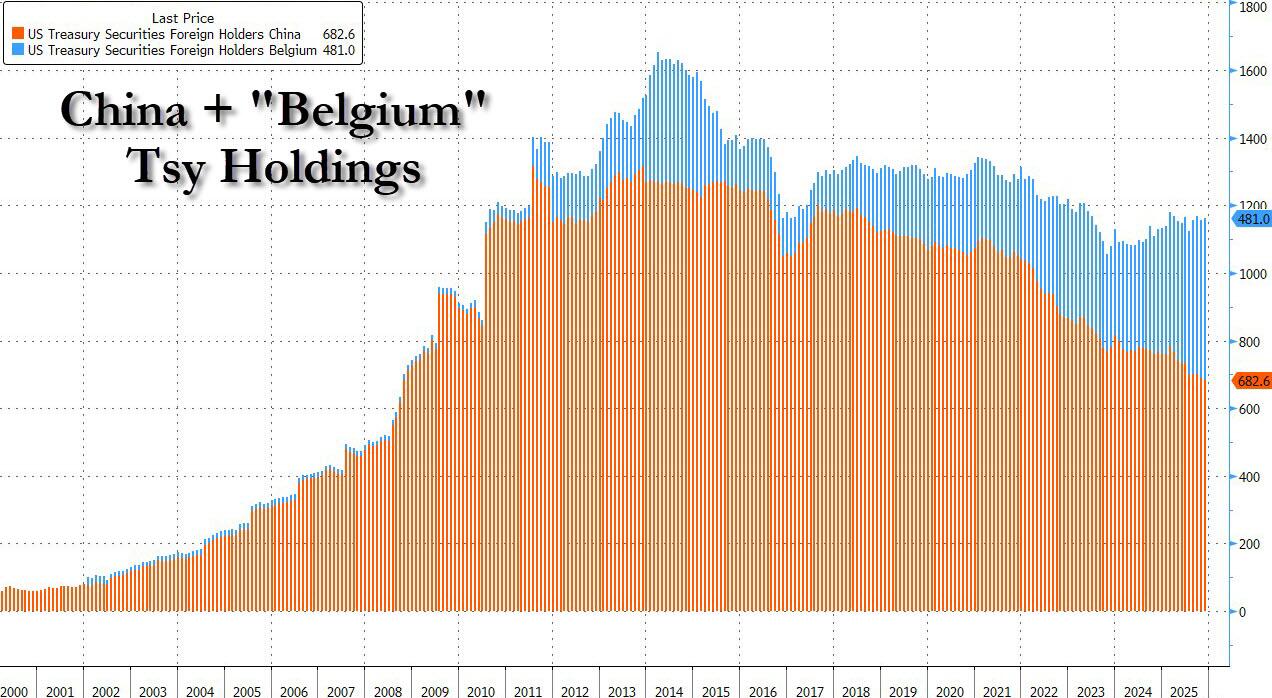
Largely dismissing the report, Westpac’s Martin Whetton said that China’s holdings of US Treasuries peaked in 2017, and what’s left is small relative to the size of the overall market.Now at $682 billion, China’s holdings represent “hardly an issue at all,” says Martin Whetton, head of financial markets strategy.
“If you include Belgium and Luxembourg, which can be proxies for some of their holdings, you’d barely make it over $750 billion”, which actually is completely incorrect since Belgium alone holds $481 billion in TSYs, as shown below.
A lot of US debt will be held by China’s official institutions and is likely short-dated for liquidity reasons, Whetton said. “So what is left for the banks is small, and China doesn’t exactly set the Treasury market on fire at the monthly auctions”
Donald Trump, who held a phone call with Xi Jinping last week, plans to meet the Chinese leader at a presidential summit in Beijing as soon as April. The regulatory guidance to Chinese banks on Treasuries came before last week’s call, the people said.
China’s warning comes as global investors question Washington’s fiscal discipline. Concerns have mounted regarding Trump’s commitment to a strong dollar and the continued independence of the Federal Reserve. Last month, Deutsche Bank’s FX analyst George Saravelos warned that money managers in Europe could choose to trim their holdings in response to Trump’s threats on tariffs and the proposed acquisition of Greenland, a call which sparked an international scandal with Deutsche Bank washing its hands off his comments.
Still, Scott Bessent said last week that “despite the popular narrative,” the Treasuries market last year delivered its best performance since 2020 and saw record foreign demand at auctions.
For context, foreign holdings of US Treasuries rose to a record $9.4 trillion in November, more than $500 billion higher than a year earlier, according to the latest official data.
Tyler Durden
Mon, 02/09/2026 – 10:55
The Arms Race In The Indo-Pacific Is Just Getting Started As Participants Pick Sides
The Arms Race In The Indo-Pacific Is Just Getting Started As Participants Pick Sides
By Benjamin Picton, senior market strategist at Rabobank
US stocks rallied hard on Friday and the VIX index had its biggest one-day fall since April of last year. The rally broke three-straight days of losses where crypto was dumped and two-year Treasury bonds had tightened 19bps. Yields on two-year US treasuries rose almost 5bps on Friday to 3.50% in the broader risk-on rally.
Prime Minister Takaichi has won a landslide victory in Japan’s general election over the weekend. Takaichi’s Liberal Democratic Party now has a two-thirds supermajority in the lower house of the Diet, granting it the power to override the upper house.
The Nikkei is up 4.7% today and 12.9% YTD, trailing only the KOSPI among major Asian indices. Asian equity markets are mostly outperforming counterparts in Europe and the United States this year. The so-called ‘Takaichi-trade’ has seen Japanese equities well bid in reaction to Takaichi’s predilection for looser fiscal settings, greater investments in technology and defence, and pressure on the Bank of Japan not to raise interest rates too quickly.
Despite this cocktail of accommodative policy, USDJPY is dealing a little softer as Finance Minister Katayama indicated that she had been in close contact with US Treasury Secretary Bessent regarding stabilisation of the exchange rate. Katayama also said that she is prepared to take measures to stabilize markets today if necessary. 10-year JGBs are underperforming, with yields up 4.9bps on the day and the 2s10s curve steepening ~3bps.
Beyond the immediate implications for JGBs, the Japanese Yen and – by extension – the Yen carry trade, this is a momentous development geopolitically. Takaichi is a China hawk who sparked something of a diplomatic crisis late last year when she suggested that a Chinese invasion of Taiwan could be considered existential for Japan. That would be sufficient to justify intervention by the Japanese self-defence force under the country’s pacifist constitution – a point that was not lost on Chinese diplomats, who reacted furiously to the implication that Japan could resist efforts to reunify Taiwan with the mainland.
According to the Financial Times, Takaichi has signaled that she is ready to test her mandate by pursuing changes to Japan’s constitution. If successful, that could see Japan re-arming more rapidly and moving to acquire offensive capabilities that have heretofore remained restricted. This would suit the strategic aims of the Trump administration – who were supportive of Takaichi in her re-election bid – but is certain to further inflame the diplomatic row with China and also runs the risk of stoking tensions with other countries who retain misgivings over the behavior of Imperial Japan during and prior to World War Two.
In short, the arms race in the Indo-Pacific may just be getting started as third parties begin to pick sides in the contest between the United States and China, and also take steps to hedge against each other.
To underline this point, Indonesia and Australia have just signed a common security pact. This might ordinarily be considered an unremarkable development, except it marks something of a shift in Indonesia’s traditional non-aligned policy toward a more integrated defence posture and comes in the context of friction between Indonesia and China over territorial claims in the South China Sea.
The new agreement is particularly interesting because it is made with a Western country with whom Indonesia has not always seen eye-to-eye. Though it falls short of a mutual-defence pact, the agreement will see a significant step-up in military cooperation that highlights the strategic re-evaluation that is underway across the Indo-Pacific.
For its part, Australia has been busily upgrading its diplomatic and security ties in the region for several years now. Major agreements have recently been signed with Papua New Guinea, Fiji, the Solomon Islands, Vanuatu and Timor-Leste, while the AUKUS pact with the United States and the UK will soon see the Henderson shipyard in Western Australia used for maintenance and sustainment of nuclear submarines. Australia has also recently signed a deal to purchase eleven upgraded Mogami-class general purpose frigates from Japan – marking Japan’s first major defence export contract and a deepening of military ties between the two nations.
Needless to say, these agreements are implicitly understood as an effort to hedge against a more assertive China. This thinking is clear in the economic sphere also, as the Financial Review today reports that Australia has been quietly increasing tariffs on Chinese steel imports to protect what remains of its own domestic industry even as hopes for the conclusion of a long-awaited trade deal with the EU are rising. The pattern of freer trade for friends and restricted trade elsewhere is a template that is now being repeated globally as the world coalesces into interest blocs with geopolitical hedgerows erected in between. Those hedgerows are not impermeable, but they are growing denser over time.
Finally, while Takaichi’s political star is rising in the east another appears to be setting in the west. British Prime Minister Starmer is scheduled to address the nation today as speculation increases that he will soon be forced out of Number 10 Downing Street. Starmer’s Chief of Staff recently resigned over his role in recommending the appointment of Lord Mandelson as ambassador to the United States, despite his known links to Jeffrey Epstein.
The decision by his most senior advisor to fall on his sword may buy Starmer some time, but signs of widespread discontent on the backbench compounded by diabolically bad poll results are creating the impression that his days are numbered.
Tyler Durden
Mon, 02/09/2026 – 10:40
Colombia atiende inundaciones por un frente frío que dejan miles de familias afectadas
Associated Press
BOGOTÁ (AP) — Colombia seguía lidiando el lunes con las inundaciones que se han registrado especialmente en el norte y en el noroeste del país, ocasionadas por lluvias asociadas al ingreso de un frente frío al mar Caribe y que han dejado más de 69.000 familias afectadas en un centenar de municipios.
“La emergencia continúa. Los organismos de socorro mantienen las evacuaciones en las zonas afectadas para proteger la vida de las familias, que es la prioridad en estos momentos”, indicó el lunes en la red social X la gobernación de Córdoba, uno de los departamentos más afectados por las lluvias.
El Instituto de Hidrología, Meteorología y Estudios Ambientales advirtió la semana pasada de un nuevo frente frío que ingresó al mar Caribe colombiano, lo que causaría un incremento en las precipitaciones, la intensidad del viento y el oleaje.
Además de Córdoba, hay emergencias por lluvias en otros departamentos como Antioquia, Sucre, Bolívar, Santander, Magdalena y Chocó.
“El frente frío deja en Colombia 131 eventos y más de 69.000 familias afectadas en 104 municipios de 16 departamentos”, indicó la Unidad Nacional para la Gestión del Riesgo de Desastres (UNGRD) durante el fin de semana.
El pasado viernes el presidente Gustavo Petro alertó que además de miles de afectados, registraron al menos 14 personas muertas por las lluvias.
El 80% del departamento de Córdoba permanece inundado desde la semana pasada por un incremento de las lluvias que ha causado aumentos en los caudales de los ríos. El gobernador cordobés, Erasmo Zuleta, dijo la víspera que más de “120.000 personas lo han perdido todo” por las inundaciones.
Imágenes de Montería, la capital de Córdoba, muestran el agua de las inundaciones cubriendo hasta la mitad de algunas casas y a sus habitantes caminando con el agua hasta las rodillas. La gobernación ha dicho que en las zonas rurales hay gran afectación para las familias que se sostienen de la agricultura y el ganado.
La UNGRD informó el lunes que envió a Córdoba 10 toneladas de ayuda humanitaria en un vuelo de la Fuerza Aeroespacial Colombiana.
La entidad agregó que serán enviadas otras 11 toneladas de alimentos e insumos veterinarios para atender a los animales afectados por las inundaciones, incluyendo perros, gatos, cerdos, aves, vacas y caballos.
En Córdoba la emergencia es causada por la creciente del río Sinú, debido a las precipitaciones. El Instituto de Hidrología ha explicado que se están generando aumentos significativos en los caudales, con valores por encima de lo normal para la época.
Ghislaine Maxwell se niega a responder sobre Epstein ante comité legislativo, cita la 5ta Enmienda
Associated Press
WASHINGTON (AP) — Ghislaine Maxwell se niega a responder sobre Epstein ante comité legislativo, cita la 5ta Enmienda.

Steve Reaven’s high school boys basketball rankings and player of the week for Lake County
No. 1 Warren marks two milestones in one game, and Lake Zurich’s Kain Kretschmar is the player of the week.
TOP 10
With records through Sunday and previous rankings in parentheses.
1. Warren 24-2 (1): Jaxson Davis scores his 2,000th career point and coach Zack Ryan records his 100th win with the North Suburban Conference leader in a win over Evanston.
2. Waukegan 19-7 (3): Jaali “Rico” Love scores 31 points in the Bulldogs’ NSC win over Libertyville, part of a three-game winning streak.
3. Deerfield 17-9 (4): Evan Nagler scores 27 points in the Warriors’ victory over Oak Park-River Forest, their fourth win in five games.
4. Stevenson 17-8 (2): Donny Williams averages 19.0 points in the Patriots’ two conference losses ahead of three more conference games in a four-day span.
5. Wauconda 20-7 (5): Alex Ortega scores 27 points with five 3-pointers and 8-of-9 free-throw shooting in the Northern Lake County Conference co-leader’s loss to Grant.
6. Grayslake Central 20-7 (6): The NLCC co-leader’s games against Wauconda and Grant this week will decide the conference title.
7. Libertyville 14-9 (7): Bryce Wegrzyn records another double-double with 26 points and 10 rebounds in the Wildcats’ NSC win over Zion-Benton.
8. Lakes 14-10 (8): Carter Martin hits seven 3-pointers, scoring a career-high 27 points, in the Eagles’ win over Wheeling and needs just four more to set the team’s single-season mark.
9. Grant 12-10 (10): Damarrion Smith and Charles Schlicht each scores 16 points in the win over Wauconda.
10. Vernon Hills 18-9 (9): Jeremy Zamost and Brady Larsen each scores in double figures in the Cougars’ two losses to continue their consistent play.
PLAYER OF THE WEEK
Senior guard Kain Kretschmar averages 18.0 points in Lake Zurich’s past two victories in a four-game winning streak.
Steve Reaven is a freelance reporter.

Starmer Faces Pressure To Resign Over Mandelson-Epstein Scandal As Second Aide Quits
Starmer Faces Pressure To Resign Over Mandelson-Epstein Scandal As Second Aide Quits
British Prime Minister Keir Starmer faced a deepening political crisis on Monday after losing a second senior aide in the controversy over his controversial appointment of Peter Mandelson as ambassador to the United States,vowing he would not resign amid mounting calls for his departure. Mandelson – who resigned last week from the House of Lords over the Epstein scandal – shared market-sensitive government information with Epstein during the global financial crisis.
Specifically, Mandelson gave Jeffrey Epstein advance notice of a €500bn bailout to save the Euro, messaging Epstein about the bailout on the evening of May 9, 2010 – after which it was formally announced the following morning.
Then Labour’s Business Secretary had forwarded No. 10 documents on economic assessments, asset sales, an EU bailout tip – among other interactions with his “pal”. To review, something big was expected amid the “embarrassing” scandal and confirmation of corrupt insider wrongdoing:
By Sunday, a shocked Mandelson (he was not expecting the release) has quit the Labour party, citing a desire to prevent “further embarrassment”. Labour says that disciplinary action was already “under way”. By phone that night, the grandson of the party grandee Herbert Morrison tells me of his decision it “wasn’t easy”, but he feels “better for it as I need to reset”.
Now, Starmer’s communications director, Tim Allan, said he was standing down to allow a “new team” to be built around the prime minister, Downing Street said, a day after Starmer’s chief of staff, Morgan McSweeney, resigned in the escalating fallout from the Mandelson appointment.
Starmer addressed staff at his Downing Street office on Monday, expressing regret over the Mandelson decision and stressing his continued commitment to his leadership. “We must prove that politics can be a force for good,” he told them, according to excerpts released later. He praised McSweeney for his past work in helping Labour win one of the largest parliamentary majorities in recent history.
A Downing Street spokesperson said Starmer was focused on governing and had no plans to step aside. Allan’s resignation came after the staff meeting, the spokesperson added.
Pressure From Within and Beyond
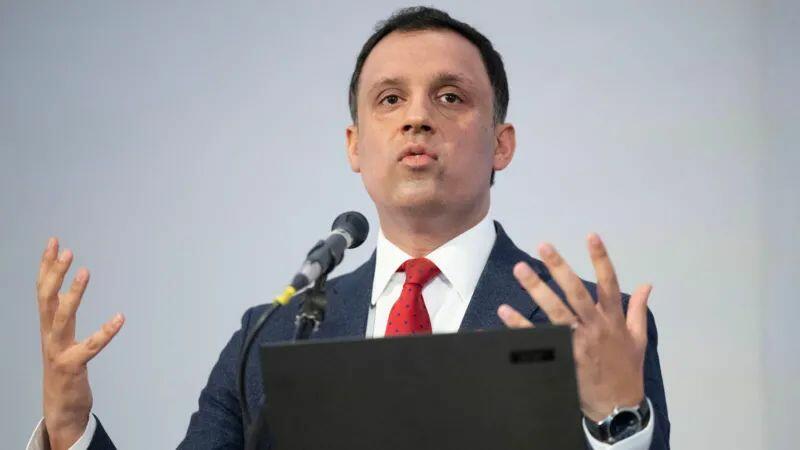
Pressure on Starmer showed no sign of abating. Anas Sarwar, leader of the Scottish Labour Party, was due to call for the prime minister’s resignation at a press conference later on Monday, according to British media. Critics within Labour said Starmer’s handling of the Mandelson affair and the resulting political damage had eroded confidence in his leadership.
Scottish Labour leader Anas Sarwar
Opinion polls show Labour’s support in Scotland falling, with the party trailing both the Scottish National Party and the populist Reform UK in some surveys – a poor showing ahead of May’s elections to the Scottish Parliament.
Opposition Conservative Party leader Kemi Badenoch accused Starmer of being unable to run his government effectively and called for change at the top of the UK government.
“He’s like a plastic bag blowing in the wind. We need him to get a grip and if he can’t do it then someone else in the Labour Party needs to do that, or they should have an election,” Badenoch told Sky News.
“It’s painful,” one Labour lawmaker told Reuters. “It’s like watching a fatal car crash in slow motion.“
Mandelson Scandal Deepens
The political storm stems from Starmer’s 2024 decision to nominate Mandelson as the UK ambassador to Washington, despite longstanding public scrutiny of Mandelson’s relationship with the late U.S. financier Jeffrey Epstein. Files released by the U.S. Justice Department last month detailed communications that raised questions about Mandelson’s conduct and his ties to Epstein, prompting an ongoing police investigation into alleged misconduct in public office.
Mandelson, a veteran Labour figure, was dismissed from the ambassadorship in September and has stepped back from frontline public roles. He has not publicly addressed the specifics of the allegations or the investigation.
Starmer has publicly said he regretted the appointment and accused Mandelson of misleading officials about his ties to Epstein during vetting, though he has defended his broader record in office and said he would release documents related to the decision.
UK’s Energy Secretary Ed Miliband took to X to express support, saying “Keir has earned the right to deliver the change he has promised and do what he cares about – which is to serve the country.
“This is not the time for the government to turn inwards on itself. We must focus on delivering the change we promised the country.”
… so business as usual:
This isn’t serving the country 👇 https://t.co/itq80r8Kml
— AM/PM (@Product_Mgr_) February 9, 2026
Political and Market Reaction
The controversy has rippled into political markets. UK government borrowing costs have risen, reflecting investor concerns about political uncertainty and questions about Labour’s fiscal direction amid turmoil.
Starmer is scheduled to meet with Labour lawmakers later on Monday in an effort to shore up support and quell dissent within his party.
Tyler Durden
Mon, 02/09/2026 – 10:20

Tracing The Crypto Market Selloff: Hong Kong Hedge Funds, Or TradFi Cross-Asset Whales?
Tracing The Crypto Market Selloff: Hong Kong Hedge Funds, Or TradFi Cross-Asset Whales?
Market Turmoil Sparks Rumors
In early February 2026, the crypto market saw a sharp correction, with Bitcoin briefly falling to around $60,000, its lowest level since November 2024. The selloff closely coincided with cross-asset deleveraging across traditional financial markets: equities declined markedly, while precious metals also suffered steep losses — silver posted one of its largest single-day declines on record, while gold saw its largest one-day drop since the early 1980s. Analysts broadly attributed the crypto downturn to rising macro uncertainty (such as reports of a more hawkish candidate for Federal Reserve chair) and large ETF outflows.
Against this backdrop, a narrative began circulating on crypto social media suggesting that the violent selloff was not driven purely by macro factors, but instead originated from the blow-up of a large fund forced to liquidate its Bitcoin positions. One line of speculation pointed to a Hong Kong hedge fund active in Bitcoin options trading. Multiple industry participants subsequently joined the discussion, offering both clues and strong skepticism.
Parker’s Hypothesis: Early Bitcoin Long-Term Holders, IBIT, and a Volatility Squeeze
Crypto commentator Parker (@TheOtherParker_) proposed an explanation linking the downturn to changes in how large, long-term Bitcoin holders manage their assets.
He noted that on July 29, 2025, U.S. regulators formally approved in-kind creation and redemption for Bitcoin ETFs, allowing investors to exchange real BTC directly for ETF shares and vice versa. This enabled large holders to move Bitcoin into ETFs (such as iShares Bitcoin Trust, commonly referred to as IBIT) under potentially tax-efficient, near-zero-slippage conditions, thereby gaining access to regulated options markets.
According to Parker, IBIT’s options market rapidly developed into one of the most liquid Bitcoin options venues globally, second only to SPY, QQQ, and SPX index options. This attracted substantial whale activity deploying covered call strategies and volatility-selling on ETF holdings. Throughout the summer of 2025, observers saw large-scale migration by early Bitcoin long-term holders, while realized volatility, implied volatility, and overall trading volume in Bitcoin compressed significantly. In Parker’s view, widespread options writing effectively suppressed market volatility.
This apparent calm was shattered during the October 10, 2025 selloff (“10/10”). Parker speculates that at least one, and possibly multiple, funds selling volatility on IBIT were severely hit when volatility suddenly spiked.
In his scenario, a fund backed by early Bitcoin holders may have been running income strategies on massive IBIT positions. This model had worked until October 10, when the short-volatility exposure was decisively breached, resulting in heavy losses. That initial blow-up may have triggered a chain reaction, especially if the affected funds then spent subsequent months quietly attempting to repair their balance sheets. Parker emphasizes that this remains a hypothesis based on fragmented clues, and that direct evidence is still lacking.
Dovey Wan: No Signs of Hong Kong Funds Blowing Up
Primitive Ventures founding partner Dovey Wan pushed back firmly against the “Hong Kong hedge fund quietly blew up” narrative, offering several key observations from her position inside the Hong Kong fund ecosystem.
First, Hong Kong imposes no capital gains tax, meaning any “tax-loss harvesting” logic driving ETF redemptions or selling is fundamentally U.S.-centric and does not apply locally. Hong Kong funds have no incentive to sell for tax reasons.
Second, she disclosed that her team is currently conducting due diligence on one of Hong Kong’s largest Bitcoin options funds, and based on both recent performance and direct conversations, “there has been nothing abnormal since October 11.” Hong Kong’s crypto investment circle is extremely small and information travels quickly; if a major fund had blown up, it would be nearly impossible to conceal for long. She cited the previous episode involving the Hong Kong market maker Taipingshan linked to 3AC, where the industry knew almost by the second day. As of early February, she had heard no credible information supporting the claim of a Hong Kong fund collapse.
She further noted that many Asian Bitcoin OGs had already moved BTC into structures like IBIT via Galaxy Digital and similar channels well before in-kind redemption was approved. Their motivations were primarily safer custody, lower operational and counterparty risk, easier collateral mobility within TradFi, and cleaner liquidity for rotation into other assets. As such, Asian whales’ use of IBIT is not a recent phenomenon and does not inherently imply financial stress.
Wan also observed that since the second half of 2025, Bitcoin liquidity has increasingly concentrated during U.S. trading hours, especially around the New York open. Recent spot selling has likewise clustered in those windows, which she views as more consistent with ETF redemption flows than a single fund collapse.
Finally, she argued that standard options writing alone is unlikely to cause catastrophic losses for a Bitcoin fund unless it involves naked options or highly leveraged basis trades. Conventional covered strategies are relatively conservative; true blow-ups typically imply excessive leverage or cross-asset margin structures. Therefore, if someone did fail via options, she leans toward it being a TradFi multi-strategy fund with cross-asset margining, rather than a purely crypto-native institution.
Franklin Bi: A Hidden Asian Macro Trader?
Pantera Capital partner Franklin Bi offered another perspective. He speculated that the real distressed party might not be crypto-native at all, but rather a large traditional trading firm based in Asia with some exposure to crypto.
Because such institutions often have few crypto-native counterparties, even severe losses might not immediately surface within crypto circles. He outlined a possible sequence of events: the institution had previously been market-making on platforms such as Binance while maintaining leverage funded by cheap capital (potentially via the JPY carry trade); the rapid appreciation of the yen combined with the October 10 Bitcoin liquidity shock materially damaged its balance sheet, triggering margin stress; the firm may then have received an approximate 90-day reprieve to stabilize; during that period it attempted to recover losses through gold and silver trades, but the recent ~20% single-day collapse in silver alongside gold’s decline worsened its position; ultimately, in early February 2026, it was forced to liquidate remaining crypto holdings, precipitating the concentrated Bitcoin selloff.
Franklin acknowledged this is speculative, but described it as “a reasonable sequence of events.” This framework also explains why the crypto community did not detect it early — the player would not belong to traditional crypto fund networks. Parker additionally pointed out that certain 13F filings show funds with nearly 100% allocation to IBIT, potentially designed to isolate single-trade risk. If one such single-asset fund collapsed, it would fit this profile.
Hard evidence remains absent. Parker noted that the decisive proof would be a Q1 2026 13F filing showing a large fund’s IBIT position dropping to zero, though such disclosures will not be available until mid-May.
Industry Skepticism: The View from Wintermute’s CEO
Wintermute CEO Evgeny Gaevoy expressed strong skepticism toward claims that “someone blew up.” He noted that when large institutions fail, informal industry channels usually surface warnings quickly — as happened with 3AC and FTX, where internal alerts emerged within days. This time, he sees no similar signals, and current rumors originate almost entirely from anonymous accounts.
He also emphasized that unlike the previous cycle, where hidden leverage accumulated via uncollateralized lenders such as Genesis and Celsius, today’s crypto leverage is largely concentrated in exchange perpetual markets, which are more transparent and orderly. Exchanges now employ automatic deleveraging and stricter margin controls, making large collapses harder to conceal.
Gaevoy likewise doubts the existence of FTX-style exchange-level issues, arguing that no institution would replicate that model post-FTX. Moreover, if an entity were in fact insolvent yet publicly denying it, it could face serious legal consequences in the U.S., U.K., EU, or Singapore — significantly reducing the feasibility of prolonged concealment.
In his view, the episode more likely reflects macro pressure combined with the liquidation of highly leveraged traders: “Maybe someone blew up, but there simply aren’t systemic spillover effects worth worrying about.”
Conclusion: The Truth Has Yet to Emerge
The true cause of Bitcoin’s early-February 2026 plunge remains unresolved. Macro factors clearly played a major role, but the persistence of the decline and certain anomalous trading volumes continue to prompt the market to search for more specific triggers.
Two main explanatory paths currently exist.
One centers on early Bitcoin long-term holders selling volatility via ETF structures, suffering outsized losses during the October 10 selloff and being forced into final deleveraging recently.
The other points to TradFi cross-asset strategies failing — spreading from yen carry trades into crypto and precious metals — triggering cascading margin pressure that ultimately manifested as concentrated Bitcoin selling.
As of now, no public filings, official disclosures, or confirmed loss figures substantiate either narrative. Multiple industry participants urge caution, noting that if structural issues truly exist, their impact will eventually surface through internal information channels or upcoming 13F disclosures.
Regardless of the ultimate answer, this episode once again highlights how deeply crypto markets are now intertwined with traditional finance. Shocks need not originate from crypto-native players; macro leverage and cross-asset risk can exert equally material impact on digital assets. Until facts are clarified, speculation remains highly susceptible to amplification.
As many industry voices have repeatedly emphasized, low liquidity combined with high leverage is often a powerful amplifier of market volatility.
That lesson is once again being reinforced by the markets of 2026.
Tyler Durden
Mon, 02/09/2026 – 10:05