Category: News

Joe Rogan Reveals Details Of His Invite To Epstein Island
Joe Rogan Reveals Details Of His Invite To Epstein Island
Authored by Steve Watson via modernity.news,
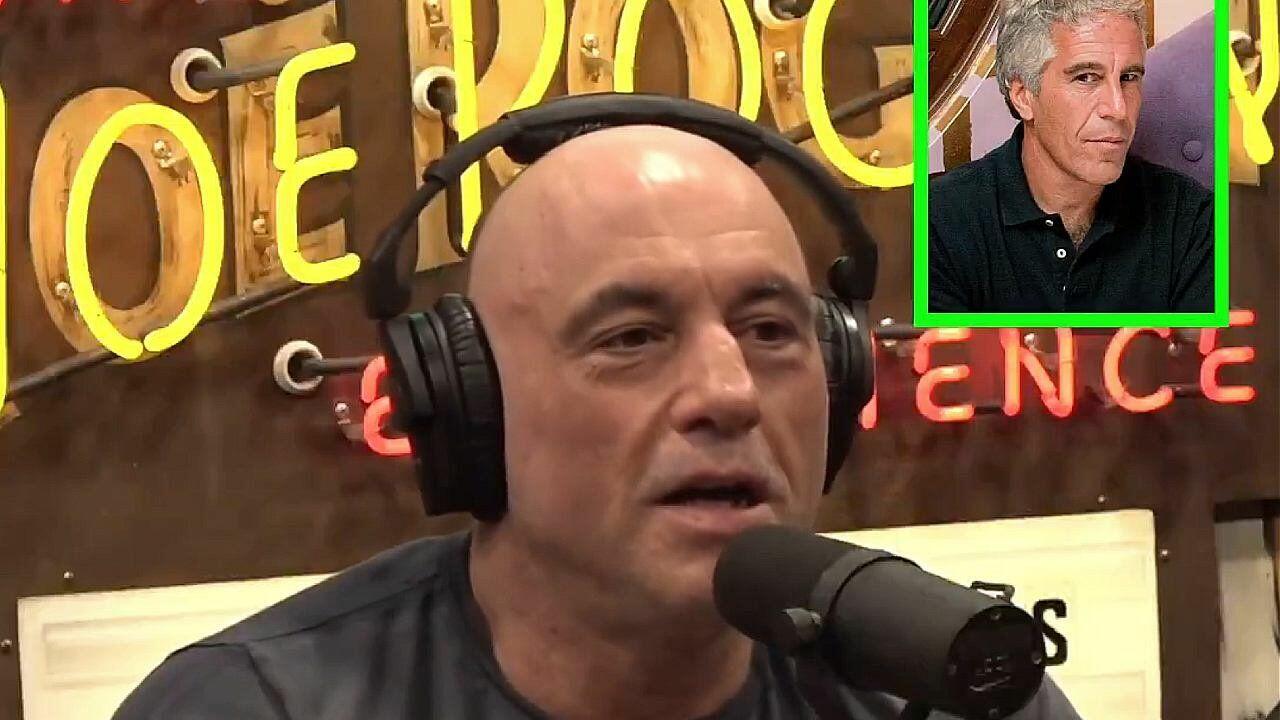
Joe Rogan has come forward to explain his appearance in the latest Jeffrey Epstein file dump, emphasizing that he’s mentioned solely because he refused to meet the convicted sex offender.
Rogan’s rejection stands in stark contrast to the ongoing associations maintained by powerful figures like Reid Hoffman and Bill Gates, fueling demands for accountability amid congressional scrutiny.
The Department of Justice released over three million pages of Epstein-related documents on January 30, more than a month after a congressionally mandated December 2025 deadline. This massive dump stems from bipartisan pressure in Congress to uncover the full extent of Epstein’s elite network, including potential blackmail and influence operations.
Central to this is the House Oversight Committee’s investigation, led by Chairman James Comer. The probe aims to question high-profile individuals tied to Epstein, with depositions and potential public testimonies designed to expose any wrongdoing or cover-ups.
Comer has already secured agreements from Bill and Hillary Clinton to testify, and signaled that Gates is likely next, amid allegations of affairs, STDs, and deeper entanglements detailed in the files.
Epstein emailed Krauss: “I saw you did the Joe Rogan show, can you introduce me, I think he’s funny.”
Krauss responded: “I will reach out to Rogan. I think I have his email, or at least his producer’s email. He lives and works in L.A.”
But Rogan, after Googling Epstein, rejected the idea outright.
On his podcast, Rogan recounted: “I’m in the [Epstein] files for not going. One of my guests was trying to get me to meet him. I was like, ‘B*tch, are you high?!’”
He added that upon the approach, his response was: “What the f*ck are you talking about?”
Krauss then apologized to Epstein in an email: “Sorry about Rogan so far. He seems MORE TIMID than I would have thought.”
Rogan’s decision came years after Epstein’s 2008 plea deal for sex crimes, but before his 2019 arrest. A basic search revealed the red flags that apparently escaped—or were ignored by—many in Silicon Valley and beyond.
This integrity contrasts sharply with Reid Hoffman, the LinkedIn co-founder and major Democrat donor. As we previously reported in our coverage of David Sacks’ exposé, Hoffman is mentioned over 2,600 times in the Epstein files.
The records show a multiyear relationship, with Hoffman visiting Epstein’s infamous island, New York townhouse, and New Mexico ranch. They conducted deals together and referred to each other as “very good friends.”
Sacks slammed The New York Times for downplaying Hoffman’s ties while targeting right-leaning tech figures like Elon Musk and Peter Thiel.
Similarly, Bill Gates faces mounting pressure. Comer confirmed Gates will likely be subpoenaed for questioning under oath, following revelations of emails alleging an affair and STD contracted via Epstein’s network. Gates’ spokesperson denies the claims, but the probe presses on.
Rogan’s story highlights how everyday diligence could have derailed Epstein’s web, yet partisan protections seemingly shielded left-leaning elites.
As the Oversight Committee’s work continues, these disclosures chip away at institutional rot, demanding equal justice regardless of political allegiance.
Your support is crucial in helping us defeat mass censorship. Please consider donating via Locals or check out our unique merch. Follow us on X @ModernityNews.
Tyler Durden
Tue, 02/10/2026 – 16:20
https://www.zerohedge.com/political/joe-rogan-reveals-details-his-invite-epstein-island

James ‘Boz’ O’Brien, owner of the Reilly’s Daughter tavern in Oak Lawn, dies at 75
If ever a man seemed born to run a tavern, that man was James “Boz” O’Brien, and he ran one of the finest this city has ever known.
A native of the Mount Greenwood neighborhood, he was only in his mid-20s when he opened a small tavern in a strip mall at 111th Street and Pulaski Road in Oak Lawn. He called his place Reilly’s Daughter and over the next decades, as it grew in size from 1,400 square feet to more than 5,000, it became not only an oasis of food and drink but a place of frequent parties, celebrations, music and events large and small, the sort of gatherings that help define and knit a community together.
O’Brien died on Jan. 28 at age 75. His death was confirmed by his son, Brendan O’Brien.
A wake took place at the Curley Funeral Home in Chicago Ridge, a funeral mass at St. Cajetan Catholic Church and burial at Holy Sepulchre Cemetery. The crowds were multi-generational and memories plentiful.
“It was something to see,” Brendan O’Brien said. “It showed how many lives my dad touched.”
A good tavern is more than a place to get a drink or seek shelter from the bumps and troubles of the world. A good tavern levels life’s playing field, becoming a space where an alderman can talk to a cab driver. It is a place where you can reassure or comfort yourself in conversations about matters large and small. It is a place where good fellowship is not on the menu but in the air. Such was Reilly’s Daughter, which was named for an old folk song popularized by the Clancy Brothers that begins: “As I was sitting by the fire, eating spuds and drinking porter, suddenly a thought came into my mind, I’d like to marry old Reilly’s daughter.”
“Boz held that place together. He was a larger-than-life character, Irish to his core and personality,” said his longtime friend and customer Mike Houlihan.
The bard of the South Side as writer, actor, newspaper columnist and filmmaker, Houlihan shared a personal example, saying, “I had moved home to Chicago after a dozen years in New York City, that was fun, but with a wife and twin sons I needed steady work, which I was lucky enough to find in Chicago through the old South Side Irish network. A steady paycheck was a glorious thing, but I was starting to feel that old itch to get back on stage.”
He talked to O’Brien and was encouraged to write a play about his youth and he “helped put some dough together to produce it.” The result was “Goin’ East on Ashland,” which opened at the Beverly Arts Center in the early 1990s. “It was an instant hit with critical raves and sell-out crowds and ran for over six years all over Chicagoland,” says Houlihan. “I never would have taken that leap of faith if Boz hadn’t believed in me.”
Others have stories too. Boz was an ebullient and energetic storyteller and conversationalist. He was also a great and talented connector of people. With friends from all areas of work and life (and seemingly all ages), he was artful at finding jobs for people, arranging events and running the liveliest of taverns.
O’Brien was born Feb. 15, 1950, to parents Lawrence and Margaret O’Brien, and attended Queen of Martyrs Elementary School and Brother Rice High School. He opened Reilly’s Daughter in 1976.
His was a family-friendly place and you could walk in on any night and run into pals and politicians, neighbors and labor leaders, or, for a time, members of the 1986 Super Bowl Bears. You might see Notre Dame coach Lou Holtz hosting a live TV show. There were frequent charity events, and music, music, music from Irish bands and with regularity from Lightning & Thunder, the Milwaukee-based Neil Diamond tribute band dramatized in the new movie “Song Sung Blue.”
The celebrity judges for the 32nd running of the Irish Soda Bread Contest were, from left, Alderman Matt O’Shea, Cook County Sheriff Tom Dart, Reilly’s Daughter owner Boz O’Brien and State Sen. Bill Cunningham. (Jeff Vorva/for the Daily Southtown)
Reilly’s Daughter held live turkey raffles for Thanksgiving, and wildly competitive soda bread and Irish coffee competitions. Santa Claus arrived by helicopter for some Christmases and the San Diego Chicken was hired to appear and strut along the bar. And on and on, because O’Brien was a master of creative stunts. And was the easiest of soft touches, but one who never tooted his own horn.
It can be an exhausting life too, and, having opened a small oasis inside Midway airport in 2002, O’Brien sold the original spot the next year and tried to take it easy, moving his two sons into managerial duties.
The space operated for a time with new names and new owners before O’Brien and his sons, Brendan and Danny, took it over in 2015, and a new generation of customers has come calling.
“Dad was always around,” said Brendan O’Brien. “He really did love people. And my brother Danny and I grew up in this world. Whether it was here or he was coaching our teams, he was a hands-on father, very involved in our lives. He was always around, always doing stuff for us and other people. But it wasn’t just about having fun. My father was one of the hardest workers I have ever known or seen. And that has really shaped us and the way we live, and work.”
Things could often get pretty noisy inside Reilly’s Daughter. But Boz never worried about that, saying, ever with a smile, “Our next-door neighbor is St. Casimir cemetery, so there’s never been a noise complaint.”
Survivors include sons Brendan and Dan O’Brien; and siblings Sheila McNulty, Paula Litman, Kevin O’Brien, Larry O’Brien and Caron Hayes; as well as a grandchild and nieces and nephews. Services have been held.
rkogan@chicagotribune.com
https://www.chicagotribune.com/2026/02/10/boz-obrien-reillys-daughter-obituary/

Estonia abre carretera de hielo que conecta con dos islas en el mar
Por KOSTYA MANENKOV
HIIUMAA, Estonia (AP) — Las temperaturas en el norte de Europa han sido tan bajas que los ciudadanos de Estonia ahora pueden conducir a través de un tramo de 20 kilómetros (12,5 millas) de mar congelado que conecta las dos principales islas del país.
El llamado “camino de hielo” que conecta las islas de Saaremaa y Hiiumaa, ubicadas en el oeste de Estonia entre el mar Báltico y el golfo de Riga, se abrió oficialmente el domingo con una fila de autos que esperaban para usarlo esa tarde.
Las autoridades decidieron abrir el camino de hielo después de que los lugareños comenzaran espontáneamente a conducir a través del mar congelado, exponiéndose a graves riesgos. Los transbordadores habían tenido dificultades para mantener un servicio regular en el mar congelado tras semanas de temperaturas que descendieron debajo de los -10 grados Celsius (14 grados Fahrenheit).
Las personas que viven en la isla más pequeña de Hiiumaa, con una población de 9.000 habitantes, viajan a Saaremaa, con una población de 31.000, para ir de compras, tomar un café o dejar a los niños en la escuela. Llegar a la isla más grande también asegura la conexión con la Estonia continental.
Aunque la apertura del camino de hielo surgió por necesidad, Hergo Tasuja, el alcalde de Hiiumaa, dice que también es “parte de nuestra cultura”.
“Durante generaciones y generaciones, las personas locales que viven aquí, especialmente aquellas que viven cerca del mar, nadan y usan botes en verano”, dijo Tasuja a The Associated Press. “Y en invierno, está en su sangre ir al mar” y pisar el hielo, expresó.
El camino es básicamente un corredor marcado en el mar congelado donde los especialistas han determinado que el hielo es lo suficientemente grueso como para soportar el peso de los autos.
Sin embargo, preparar el camino no es fácil, indicó Marek Koppel, supervisor de mantenimiento de carreteras en Verston Eesti, la empresa de construcción estonia encargada de construir y gestionar el camino de hielo. Los trabajadores tienen que medir el grosor del hielo cada 100 metros (328 pies) para determinar las áreas con más de 24 centímetros (9,5 pulgadas) de hielo, el mínimo requerido para la seguridad. También alisan el hielo donde hay crestas y grietas. Las condiciones climáticas y la solidez del hielo se monitorean las 24 horas y la ruta se modifica según sea necesario.
Un vehículo no puede pesar más de 2,5 toneladas (5.500 libras) y debe conducir a menos de 20 km/h (12,4 mph), o a entre 40 y 70 km/h (25 y 43 mph); cualquier cosa intermedia puede crear una vibración que dañe el hielo. No se permite que los autos se detengan y deben mantener una distancia segura entre sí. Los pasajeros no pueden usar cinturones de seguridad y las puertas deben ser fáciles de abrir, para permitir una salida rápida en caso de accidente.
“La carretera estaba bastante bien, era fácil de recorrer”, dijo Alexei Ulyvanov, quien vive en la cercana Tallin y viajó a las islas para mostrar a sus hijos “que es posible conducir un auto sobre el mar”.
Según Tasuja, la última vez que se habilitó un camino de hielo para conectar las islas hace unos ocho años. Desde entonces, los inviernos han sido demasiado cálidos.
Verston, la empresa de construcción, dijo que las autoridades los contrataron para abrir dos rutas de hielo más esta semana, esta vez conectando la Estonia continental con dos islas más pequeñas. ___
Esta historia fue traducida del inglés por un editor de AP con la ayuda de una herramienta de inteligencia artificial generativa.

Aurora planning nearly $1.9 million renovation of water tower
The city of Aurora is planning a nearly $1.9 million renovation of the water tower near the corner of Church Road and Bilter Road.
The project would mark the second rehabilitation this water tower has seen since it was first built in 1976. A contract with Era-Valdivia Contractors, Inc., for $1.86 million was recommended for approval by a committee of the Aurora City Council on Monday, so now it heads to another committee before coming before the City Council for final approval.
“This is a major infrastructure maintenance project for the water production division,” Aurora Superintendent of Water Production Bob Leible told the City Council Infrastructure and Technology Committee on Monday.
An inspection of the tank in 2020 found that certain work would be needed at around this time, according to Leible. He said the previous renovation project on this water tank was in 2001, about 25 years after it was put into service — and so after another 25 years, the tank is “hitting that window again.”
Specifically, the 2020 inspection recommended a full recoating and ancillary repairs, according to a city staff report from last year about the engineering contract for this project. The report also notes that the tank, located at 2680 Church Road, is of a welded steel, fluted column tank design and can store up to 1.5 million gallons of water.
Design of this planned renovation project was done by Engineering Enterprises, Inc., of Sugar Grove, which estimated the cost of construction at about $2.8 million, Leible said on Monday. So, the bid by Era-Valdivia Contractors is “significantly under budget,” he said.
Ald. Keith Larson, at-large, called it “good news.”
But Ald. Ted Mesiacos, 3rd Ward, had concerns about the cost estimate being nearly $1 million higher than the lowest bid. Especially when the city is trying to budget, that kind of difference can skew things, he said.
“That’s a big swing,” Mesiacos said of the difference between the estimate and the actual bid for construction. “There’s a lot of things that can be put into work with a million dollars.”
While Leible said he was not the engineer that did the cost prediction, he thinks they rely on the costs of similar past projects to make those estimates. The city staff report from last year says that Engineering Enterprises has a “substantial resume of experience in water tank recoating and rehabilitation projects” for the city.
Plus, the highest bid for construction on the project was closer to the estimate at around $2.5 million, according to Leible.
Additional water tank renovation projects are planned to be completed next year, he said, which are for two ground storage tanks located across from the water treatment plant at 1111 Aurora Ave.
rsmith@chicagotribune.com

Indian fusion restaurant/banquet hall proposed for old Golden Corral in Elgin
The owner of the now-vacant Golden Corral restaurant in Elgin is seeking city permission to transform it into an Indian fusion restaurant and banquet hall.
Golden Corral at 601 S. Randall Road never recovered after the COVID-19 pandemic, New Future company spokesperson Silpa Yadla told the Elgin Planning and Zoning Commission at its Feb. 2 meeting. Their goal is to rebrand the restaurant for a new use, a plan that the commission is recommending the Elgin City Council approve.
The new business will be called Tulsi, which, in addition to being a restaurant, will include two banquet rooms for parties, special events and corporate gatherings, Yadla said. One room will accommodate 200 people and the other 44; both will be available for use Friday through Sunday.
The banquet halls will be professionally managed with on-site staff, Yadla said. Meanwhile, restaurant hours will be 11 a.m. to 10 p.m. daily.
“Our proposed restaurant and banquet hall have been intentionally designed to operate within the existing constraints of the site and zoning framework,” Yadla told commissioners at their meeting.
New Future’s plan is to “activate an underutilized commercial space with a well-run, high-quality establishment that contributes positively to the area while being a responsible neighbor,” Yadla said.
The company operated Golden Corral until its closure in fall 2025 after an 18-year run. Early on, the restaurant was often at capacity, she said.
Tulsi needs city approval because an event venue is not listed as a permitted conditional use under the existing zoning.
Interior and exterior changes will be made to the 11,462-square-foot, one-story building. The exterior will have a modern facade with new dormers and stucco siding, according to plans submitted to the city.
While it is required to have 197 parking spaces under city ordinances, the property only has 166 available. However,because it’s located within a larger shopping center, it has access to more spaces, which they’re seeking permission to use from neighboring businesses.
That should allow them to meet the criteria, Elgin City Planner Damir Latinovic told the commission. A parking agreement will need to be finalized prior to the opening, he said.
“I appreciate your willingness and thoughtfulness to repurpose the existing business,” Commissioner Karin Jones told Yadla.
City documents cited the fact that an adaptive reuse avoids “50 to 75 percent of the embodied carbon emissions that an identical new building would generate because renovations typically reuse the most carbon-intensive parts of the building, the foundation, structure, and building envelope,” according to the American Institute for Architects and the National Trust for Historic Preservation.
“I just want to thank you for investing in Elgin,” Commissioner Debra Vruble said.
Gloria Casas is a freelance reporter for The Courier-News.
https://www.chicagotribune.com/2026/02/10/golden-corral-elgin-indian-banquet-hall-restaurant/

Portage proposes Chicago Bears stadium on city land
The city of Portage is throwing a hail Mary pass at a privately-funded Chicago Bears stadium built on city-owned land, city officials said Tuesday.
Portage Mayor Austin Bonta said the city has proposed to build a stadium on 300 acres of city-owned land on the north side of the city. City officials are calling the proposal “Halas Harbor,” a nod to the Bears’ Halas Hall headquarters in Lake Forest, Illinois.
Long-beleaguered Gary is serious about the Bears. Are the Bears serious about Gary?
The site would be located on the former SportsResort site north of I-94 with nearby train and boat access, Bonta said. The area, which is in a transit redevelopment district, is located along the Burns Waterway, where U.S. Steel’s Midwest plant in Portage spilled 300 pounds of hexavalent chromium in 2017.
In January, the city’s redevelopment commission approved a contract with Abonmarche Development for alternative development options for that parcel, known as the Hillcrest area on the city’s northwest side. That 300 to 400 acres would be for multiuse venues, Redevelopment Director Dan Botich said during that meeting.
It’s also where city officials have previously hinted is the approximate area where the Chicago Bears would be able to locate a new stadium if they move the team to Portage.
To fund the proposal, Bonta told the Post-Tribune the city has “a partner on the finance side to finance the stadium privately.”
“We have a proposal for a privately funded stadium on city-owned land,” Bonta said. He declined to give more details, noting the city will be holding a news conference Wednesday to announce the proposal and its funding.
Bonta said officials with the Bears and the state of Indiana are aware of the proposal and its funding.
The Bears have a broad fan base, Bonta said, as fans live throughout the Chicagoland area, which includes Northwest Indiana. Portage has been excited about the possibility of a Bears stadium since the team announced in December it would expand its stadium search into the region, he said.
“We have the same roar on a different shore,” Bonta said.
Gary officials announced in January that the city has three locations for a Chicago Bears stadium: Gary West End Entertainment District near Hard Rock Casino, Buffington Harbor and Miller Beach.
While Indiana officials play up their efforts to lure the Chicago Bears across the border for a new stadium, Illinois Gov. JB Pritzker said Monday that he and his staff have made “progress” to incentivize the team to stay in Illinois, the Chicago Tribune reported.
Records show Pritzker had scheduled conversations with NFL Commissioner Roger Goodell while Goodell was in Chicago for the Bears-Packers playoff game on Jan. 10. Before the game, Goodell joined Bears President and CEO Kevin Warren and Chair George McCaskey on a tour of the Arlington Heights site the team owns, and sites in Northwest Indiana, including one near Wolf Lake in Hammond, the Chicago Tribune reported.
The key sticking points in Illinois have been over how the state would legislatively or financially aid the team in its desire to build a stadium in Chicago’s northwest suburbs. In particular, topics have evolved around assistance for infrastructure around a proposed Arlington Heights stadium, property tax certainty for the team, and payment of debt for the Soldier Field renovations done more than 20 years ago at the team’s behest.
Sources familiar with the discussions between the Bears and state of Illinois officials said both sides have been meeting regularly since early December to hammer out legislation for this spring’s legislative session in Springfield. The talks have been in line with public infrastructure improvements for or around the Bears stadium site in Arlington Heights and so-called megaprojects legislation that would make it easier for the Bears to negotiate with local governments over property taxes, sources told the Chicago Tribune.
In Indiana, the legislature has been advancing Senate Bill 27 to establish a state authority to “acquire, construct, equip, own, lease and finance” a sports stadium.
The bill would require a National Football League team to enter into a lease for the stadium for at least 35 years. After the term of the lease, the lessee would have the option to purchase the capital improvement for $1 if certain conditions are met.
In response to the new legislation, the Bears said the legislation represented “a significant milestone in our discussions around a potential stadium development in Chicagoland’s Northwest Indiana region. We appreciate the leadership and responsiveness of Governor (Mike) Braun and Indiana lawmakers in advancing a framework that allows these conversations to move forward productively.”
During his state of the state address last month, Gov. Mike Braun said with Indiana’s strong business environment, “it’s not surprising” that the Chicago Bears have looked to northwest Indiana to build a stadium.
“We are working hard to bring the Chicago Bears to the Hoosier state so they can really see what a great place is to have a business. We’ll work hard to do it. Let’s get it across the finish line,” Braun said.
Freelance reporter Doug Ross contributed.
https://www.chicagotribune.com/2026/02/10/portage-proposes-chicago-bears-stadium-on-city-land/

Column: New Black empowerment group in Aurora calling for action over reaction
No doubt over the years you’ve seen these names in this newspaper many times.
Theodia Gillespie, Curtis Wilson, Sherman Jenkins, Clayton Muhammad, Richard Irvin, Cynthia Latimer, Cynthia Miller, Peggy Hicks and Pastors Julian Spencer and John Thompson are just some of Aurora’s Black leaders who are concerned about what they see as the steady erosion of their community’s influence in Aurora.
In response, more than 100 of these African American advocates gathered at Kathryn’s Place restaurant in Aurora on Thursday for the launch of the Black Empowerment Coalition, which has been described not only as a “new organization” but as a “long overdue” one.
“We can no longer afford to just sit around” while “our culture is being pushed aside and not recognized as being relevant,” said Theodia Gillespie, president and CEO of Quad County Urban League, noting how many positions of Black leadership have been lost in the past year alone in Aurora, including mayor, police chief and East Aurora School District 131 superintendent.
“It’s time to get our hands dirty and be that advocate to not only create unity but develop new leaders,” continued Gillespie.
Interestingly, this already-planned gathering during National Black History Month took place amid renewed national outrage about racism after President Donald Trump shared a social media post portraying former President Barack Obama and wife Michelle as primates in a jungle – an incident that underscored for many in the room why unity felt increasingly urgent.
A press release by the Black Empowerment Coalition also noted the exclusion of Maryland’s Wes Moore, the country’s only Black governor, from a White House dinner tied to the National Governors Association, where he serves as vice president.
“It’s hard when you see micro-aggressions coming at you day to day,” noted Aurora African American Heritage Advisory Board Chair Curtis Wilson, who is the Black Empowerment Coalition co-chair with Gillespie. “We need to look at how we can protect one another, not in an insular way, not as a separate society but use our common power when things go off the rails.”
While the timing of this Black coalition seems less coincidental than consequential, the seeds were planted last year when the city of Aurora, under newly-elected Mayor John Laesch, decided not to hold a city-sponsored Juneteenth flag-raising celebration this year, with a flag-raising eventually held the evening before the holiday.
The frustration and anger within the Black community only grew when past interview remarks made by an East Aurora School Board member that went public seemed to place the needs of Hispanic students above their Black peers. These African American leaders, also upset over other ways they felt their students and staff were being treated by the district, confronted school officials about the many grievances.
At that time this group did not have an official name. But now it does.
And the Black Empowerment Coalition also has a mission: To serve as an umbrella organization for African-American businesses, churches, nonprofits and other groups in three critical areas: civic engagement, economic/business development and education. That includes everything from supporting Black-owned businesses to mobilizing Black voters to ensuring the educational and emotional needs of the city’s Black students.
A similar effort to organize had been attempted by Scheketa Hart-Burns in 2020. And although the late Aurora City Council member was successful in helping start several church and anti-crime initiatives, the unification effort failed to launch. Thanks to a more efficient way of communicating – and no doubt current headlines – the tide has changed, these advocates tell me.
In her 40 years working in Aurora, Gillespie said she’d never seen so many Black leaders in one room. While many showed up not sure of what the meeting was about, by the time it was over, she continued, participants were excited and committed to taking the energy and ideas back to their own boards.
It all comes down to action, rather than reaction, they insist.
“We can’t look to other groups to solve our issues. It was time for us to come together as a community and work together,” said Gillespie. “We are celebrating 100 years of Black History Month this year but we need to continue to create these stories going forward for the children.”
Wilson agrees, noting that the Civil Rights Movement did not succeed by “retreating into a shell” but by “linking with others in a common cause.”
Part of being a good neighbor is “understanding what is happening not only on your own block,” he insisted, “but what’s going on in the world around you.”
dcrosby@tribpub.com

US Consumer Debt Delinquencies Soar To Highest Since 2017 While Office Delinquencies Hit Record High
US Consumer Debt Delinquencies Soar To Highest Since 2017 While Office Delinquencies Hit Record High
It will come as a surprise to exactly nobody that the Fed’s latest quarterly Household Debt and Credit report (for Q4 2025) reported total household debt balances increased by $191 billion in the fourth quarter of 2025, a 1% rise from 2025 Q3, to a new all-time high. Balances now stand at $18.8 trillion and have increased by $4.6 trillion since the end of 2019, just before the pandemic recession.
This is how various debt balances changed through the quarter:
Mortgage balances shown on consumer credit reports grew by $98 billion during the fourth quarter of 2025 and totaled $13.17 trillion at the end of December.
Balances on home equity lines of credit (HELOC) rose by $12 billion, the 15th consecutive quarterly increase.There is now $433 billion in outstanding HELOC balances, $116 billion above the low reached in 2022Q1. In total, non-housing balances increased by $81 billion, a 1.6% increase from 2025Q3.
Credit card balances rose by $44 billion during the fourth quarter and now total $1.28 trillion outstanding, up 5.5% since last year.
Student loan balances increased by $11 billion and now stand at $1.66 trillion.
Auto loan balances edged up by $12 billion to $1.66 trillion.
Other balances, which include retail cards and consumer finance loans, rose by $14 billion and now total $564 billion.
New debt originations were also solid in the quarter:
The volume of mortgage originations, which includes both refinance and purchase originations, increased with $524 billion newly originated in 2025 Q4, an uptick from the $512 billion seen in the previous quarter. It was the highest since 2022 when rates were far lower.
There were $181 billion in new auto loans and leases appearing on credit reports during the fourth quarter, a small dip from the $184 billion observed in 2025 Q3.
Aggregate limits on credit cards continued to rise, with a $95 billion (1.6%) uptick in the fourth quarter.
Home equity lines of credit (HELOC) limits rose by $25 billion (2.5%), continuing an expansion in HELOC limits that began in 2022.
Credit quality of newly originated mortgages held steady, while auto loans loosened slightly. The median credit score for new mortgage originations was 775 in 2025Q4, unchanged from 2025 Q3 while the tenth percentile declined from 660 to 650. For auto loans, the median credit score edged down, from 724 to 716.
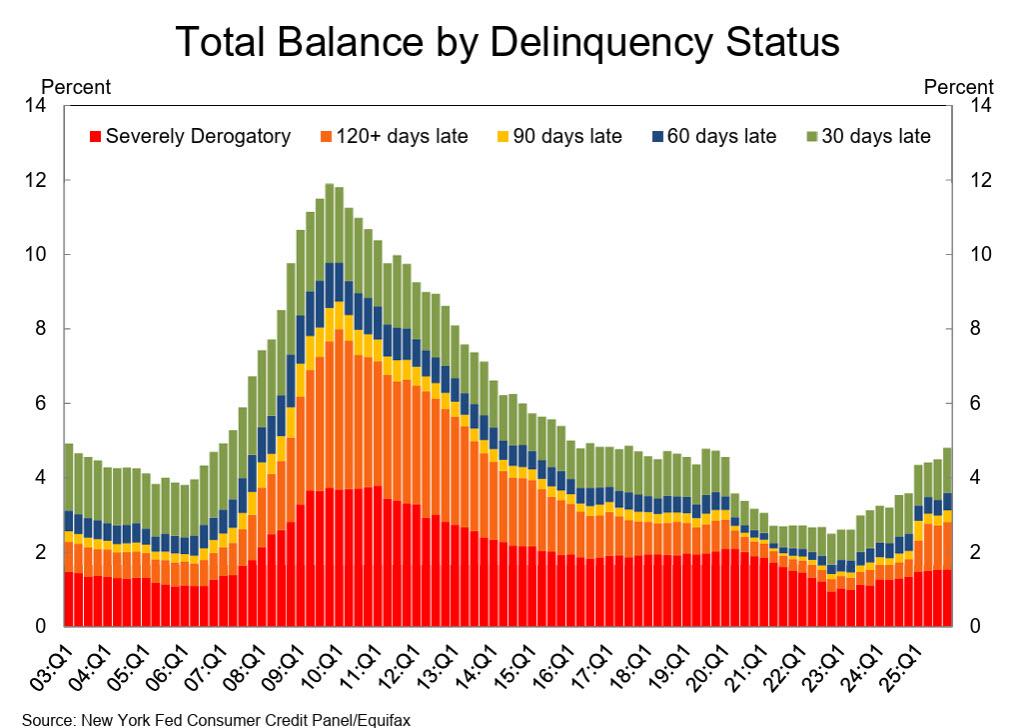
Taking a closer look at some of the negative changes below the surface, delinquency rates on loans ranging from mortgages to credit cards rose to 4.8% of all outstanding US household debt in the fourth quarter, up 0.3% sine Q3 2025 and the highest level since 2017, driven by higher defaults among low-income and young borrowers.
As Bloomberg notes, while the overall share of loans in some stage of default is near pre-pandemic averages, the rise in delinquencies among the lowest earners adds to evidence of an increasingly K-shaped economy, and nowhere was it more obvious than in the case of student loans – where with the Biden repayment moratorium has been over for the past year – we have seen a tsunami of both early delinquencies, with 16.3% of student-loan debt became delinquent in Q4 the biggest increase on record in data going back to 2004…
… and serious delinquencies (effectively defaults)…
… led by 50+ year-old “students” (almost certainly of the liberal major, blue-haired anti-ICE, variety).
The rise in defaults was also driven by delinquencies in mortgage payments, and New York Fed researchers found that they were particularly high in lower income zip codes.
“As household debt levels grow modestly, mortgage delinquencies continue to increase,” said Wilbert van der Klaauw, an economic research advisor at the New York Fed, said in a press release accompanying the figures. “Delinquency rates for mortgages are near historically normal levels, but the deterioration is concentrated in lower-income areas and in areas with declining home prices.”
The increased struggle in low-income and young borrowers’ ability to pay their loans is consistent with elevated unemployment rates among some parts of the population, the NY Fed researchers added. The jobless rate for workers 16 to 24 years old stood at 10.4% in December, near the highest levels since the depths of the pandemic in 2021, and largely the result of AI disruption.
But if the Fed is concerned about the soaring debt delinquencies now, just wait a few years until a third of all jobs are replaced by hallucinating chat bots, and the overall unemployment rate is 15%, something we discussed earlier. At that point the question will not be whether Kevin Warsh will shrink the balance sheet – he never will – but whether the coming Universal Basic Income money printing will be measured in the trillions or quadrillions.
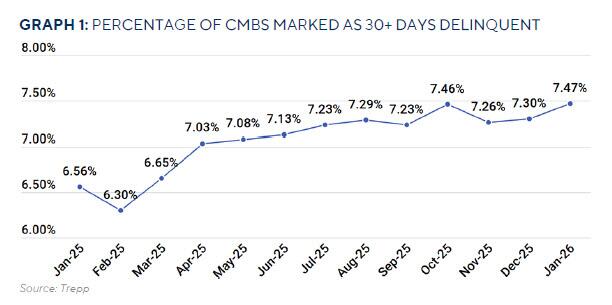
But wait, there’s more: because chatbot algos do not need an office – and the workers they displace no longer need an office – the spiked in post-covid office defaults is back, and according to commercial real estate specialist Trepp, the CMBS delinquency rate increased again in
January 2026, climbing 17 basis points to a record 7.47%.
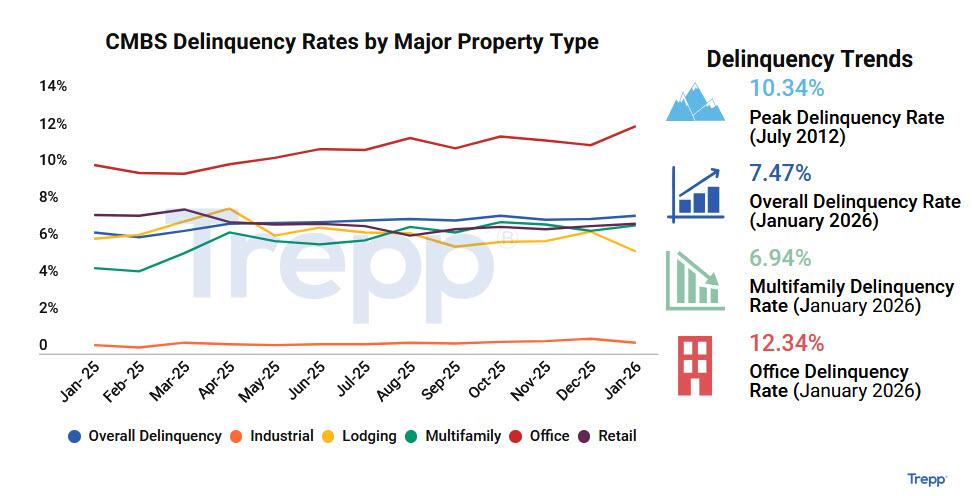
The increase was driven by a net increase in delinquent loans of almost $1.6 billion, primarily driven by the office sector. For the second straight month, three of the five major property types saw increases to their delinquency rates, while two pulled back, although the mix was different in January.
The largest rate increase was in office, which rose 103 basis points to an all-time high of 12.34%. The previous high was 11.76% back in October last year. The second largest rate increase was multifamily’s, which seesawed back up by 30 basis points in January to 6.94%, following a decrease of similar magnitude of 34 basis points the month prior.
January’s balance of newly delinquent loans totaled just under $5.4 billion, while over $2.6 billion of delinquent loans cured over the same period, and $1.1 billion of delinquent loans paid off, resulting in a net delinquency increase of about $1.6 billion.
The office sector was the largest net contributor to the increase in the delinquency rate, while a large lodging loan that cured in January helped to offset some of the increase in the headline delinquency rate.
It gets worse: if we were to include loans that are beyond their maturity date but current on interest (delinquency status of performing matured balloon), the delinquency rate would be 9.14%, up 39 basis points from December. That is also 167 basis points higher than the headline rate of 7.47%, highlighting ongoing maturity-related stress.
Bottom line: at some point the AI revolution may well lead to a productivity revolution, but to get there the US will first go through a mass layoff wave, resulting in tens if not hundreds of millions of layoffs (a 15% unemployment rate to go with the 15% growth rate), coupled with a historic debt crisis and a collapse in virtually every commercial real estate sector while Blackstone buys up all the residential real estate it has had its eyes on for the past decade.
Tyler Durden
Tue, 02/10/2026 – 15:45

Cold temps welcome thousands to Long Grove’s Cocoa Crawl: ‘Events like this bring everyone together’
Cold temperatures contributed to the atmosphere as more than 3,000 people attended the ninth-annual Cocoa Crawl Saturday in historic downtown Long Grove.
“Cocoa Crawl brings the community together — families, volunteers, local organizations lending a hand, and visitors enjoying the charm and character of Long Grove,” village events manager Nikki Faul said.
“It’s a fun way for everyone to enjoy the day, and for local merchants to connect with our community and welcome visitors,” she said.
The event was presented by the Historic Downtown Long Grove Business Association in partnership with the Long Grove Lions Club.
Association President Ryan Messner said the event serves as the first event of Long Grove’s 2026 festival calendar.
“This starts the season,” he said. “This is the kickoff of the year.
Trying free hot chocolate is Shosuke Tanaka, 7, of Buffalo Grove during the Cocoa Crawl in downtown Long Grove on Feb. 8, 2025. (Karie Angell Luc/Lake County News-Sun)
The village, he said, is “family-friendly and we’re open for business.”
At Cocoa Crawl, six hot cocoa stations were offering free hot chocolate, including new flavors blueberry and Dreamsicle. The Long Grove Confectionery offered its own hot cocoa strawberry flavor, along with complimentary cookies.
Jennifer Soto, barista at the confectionery’s coffee shop, said customer traffic was good.
“We love it,” she said of the event.
From left to right, having a hot chocolate experience are Nancy Meiller of Baraboo, Wisconsin, Laurie Gelhar of Green Lake, Wisconsin, Kathy Wilsnack of Green Lake, Wisconsin and Deb Bello of Kildeer during the Cocoa Crawl in downtown Long Grove on Feb. 8, 2025. (Karie Angell Luc/Lake County News-Sun)
Mike Dvorak returned to play the accordion and strolled the event premises while singing about the Cocoa Crawl. His signature song included the lyrics, “Do the Cocoa Crawl.”
“I’ve been retired for 10 years now, and I feel it’s important to get involved with the community,” he said.
Jeff and Sara DeFrancesca of Kildeer shared hot cocoa with their children Vienna, 4, and Vada, 6.
“We always like coming here for all of the events,” Sara DeFrancesca said. “They do such a nice job. It’s a cute little community. Good shopping.”
Accordionist and event volunteer Mike Dvorak of Long Grove leads music and discussion on the horse-drawn carriage ride during the Cocoa Crawl in downtown Long Grove on Feb. 8, 2025. (Karie Angell Luc/Lake County News-Sun)
Briana Voss of Long Grove sipped hot chocolate with son Bennett, 11.
In talking about the village, she said, “All the school districts are great, there’s a lot of land and conservation is big for Long Grove, so having deer in our backyard is really nice.”
The horse-drawn carriage co-driven by Mike Todd was popular again this year, and was busy with future riders waiting in line for their turn.
Taking a ride around town in the carriage were Paul and Aarn Kossof of Lake Zurich, the parents of Aaron, 6, and James, 5.
The horse-drawn carriage co-managed by Mike Todd of Barrington takes people for a ride at the ninth annual Cocoa Crawl in downtown Long Grove on Feb. 7, 2026. (Karie Angell Luc/Lake County News-Sun)
“It’s just a wonderful memory,” Paul Kossof said about the Cocoa Crawl. “We love living here. We’ve been here since 2020, and it’s just the most amazing place to live, and events like this bring everyone together.”
Vada DeFrancesca of Kildeer, 6, a first-grader has fun with her family at the ninth annual Cocoa Crawl in downtown Long Grove on Feb. 7, 2026. (Karie Angell Luc/Lake County News-Sun)
https://www.chicagotribune.com/2026/02/10/long-grove-cocoa-crawl/

Spring Brook Elementary teacher channels personal loss into heart-healthy mission
Rich Vine has hardly missed a day of running.
The physical education teacher at Naperville’s Spring Brook Elementary School has seen first hand the effects of poor lifestyle and health choices. When Vine was a 19-year-old college freshman, his father had a heart attack. Two years later, when Vine was studying cardiac rehabilitation, he suspected his father had heart failure.
“With that heart attack, I’m sitting there looking at all of his paperwork and everything like that, looking at his EKGs … I go, ‘Dad, you have heart failure,’” Vine said. “And my father’s like, ‘No, I don’t. … That’s not what my doctors have told me.’”
Vine’s father was 55 years old when he suffered his first heart attack, but it was not until he was 65 that he would be properly diagnosed with heart failure. About two years after that diagnosis, his father died.
Now, Vine leads Spring Brook’s Kids Heart Challenge, a program introduced by the American Heart Association. Every year, the school participates in the fundraising effort and educational program, which provides the tools and lessons to teach kids and their families about physical and mental well-being, particularly as it pertains to heart health.
For Vine, the opportunity to discuss and teach heart health to students “hits home.”
Rich Vine, center, in 2016 when he represented the Indian Prairie Educational Foundation’s Team IPEF for Longwood Elementary School for a marathon in Naperville. Vine is currently a physical education teacher at Spring Brook Elementary where he leads the school’s participating in the American Heart Association Kids Heart Challenge. (File photo)
The challenge originated 48 years ago as the American Heart Association’s Jump Rope for Heart challenge, a fundraiser that taught kids the importance of heart health through jump roping. In 2018, Jump Rope for Heart rebranded as Kids Heart Challenge to include other components such as mental health and wellness.
Now, the heart association partners with 15,000 schools nationwide on the event, according to Jen Rogers, AHA region vice president of development, school engagement.
When it comes to fundraising and engaging students, Spring Brook stands out as one of the top schools. Last year, it raised $26,319 — No. 10 in the state, Rogers said. It’s already surpassed that number, raising more than $27,000 so far. The total amount will be known after this weekend.
Since the school began participating in 1997, the school has raised more than $748,725 for the American Heart Association.
“It’s definitely not the average,” Rogers said. “That is a considerable amount of money for one school, but you can tell with that amount of money they’ve raised in their lifetime it is a true tradition and it’s meaningful to the school.”
Physical Education Teacher Rich Vine at Spring Brook Elementary School on Tuesday, Feb. 10, 2026. Vine said his family history with heart failure motivates him to teach his students the importance of good heart health. (Natalie Hoyle Ross)
While a different physical education teacher introduced Spring Brook Elementary to the challenge, Vine was happy to continue the tradition, he said.
The challenge usually kicks off in mid-January, about a week after the students come back from winter break. They spend four week teaching kids about heart health and fundraising before it wraps up with a student celebration featuring a DJ and activity stations.
While Vine is not as involved in the fundraising aspect of Kids Heart Challenge, he said he loves incorporating the educational component into his lessons.
“Two of the things that (American Heart Association) talks heavily about is hands-only CPR, and then recognizing the signs and symptoms of the stroke, and I take that to the kids and talk about adding that to their toolbox inside of their brain,” he said, emphasizing to students how learning these skills may be useful at an unexpected moment later in life.
Some aspects of the challenge can be difficult to teach, Vine said. As part of it, he puts up a display for students to read about children who have suffered heart complications.
“(The students are) more in shock over what these kids have gone through, because they can’t imagine what they’ve never experienced,” he said. “It talks about how a kid had open heart surgery at age three. … Many of these kids, the most they’ve ever experienced is a broken bone.”
Another component of the challenge is the variety of activities to teach kids how to elevate their heart rates. One of Vine’s favorites is the Jump Rope Ninja challenge, where students can earn different “belts” depending on how much they can consistently jump rope.
“The biggest thing is seeing the kids when they’re being able to continuously learn how to jump rope,” Vine said. “That, right there, is magical for some of these kids.”
Some of the students start off in kindergarten having never jumped rope, but as they get older and better, he’s watched those same students reach “black belt status,” which is given to kids who can jump rope continuously 250 times.
But Vine encourages his students not to stop there. Rather, he pushes them to reach G.O.A.T. – Greatest Of All Time – status, which requires students to continuously jump 500 times in a row.
It brings him joy to see “the smiles on their faces” when the students hit that 500 number, he said.
“They oftentimes (think) that that’s impossible. ‘Mr. Vine, I can’t do that.’ And then, ‘Oh, wait a second, you just did it,’” Vine said.
It is that dedication that makes Spring Brook such a dedicated school in the challenge year after year, Rogers said.
“(Vine’s) impact proves what is possible when educators lead with heart,” she said. “He’s passionate about the American Heart Association’s mission, and he brings that to his students, which is why they do an amazing job every single year. So he isn’t just teaching P.E., he’s shaping their healthy futures and hopefully creating leaders in heart health in the future.”
cstein@chicagotribune.com
https://www.chicagotribune.com/2026/02/10/spring-brook-elementary-naperville-vine-heart/