Category: News

With eyes on the NCAA Tournament, Mekhi Doby helps Aurora University to 17th straight win. ‘Really special.’
Junior guard Mekhi Doby was in it for the long haul from the start when Aurora University coach Steve Christiansen convinced him this was the school for him.
Three years in, the Rockford Guilford graduate is certain he made the right choice. And he’s playing an integral role for a program that has definitely turned the corner.
“He didn’t tell me I was gonna come in and be the man,” Doby said of Christiansen, who was completing his first season at the school when he recruited Doby. “He wasn’t promising me the world. He was straight with me, telling me I’d get a chance and had to work for it.
“What made me stay was our relationship that developed. He was hard on me some days when I needed it.”
This season, there has been many more good than bad.
Doby came through with another good one Wednesday, picking up 10 points, six rebounds and three assists as the Spartans cruised past visiting Rockford for a 84-70 Northern Athletics Collegiate Conference win in an afternoon matinee.
Aurora University’s Mekhi Doby (11) pulls up for a midrange jumper against Rockford during a Northern Athletics Collegiate Conference game in Aurora on Wednesday, Feb. 11, 2026. (Jeremy Toney / The Beacon-News)
The 6-foot-3 Doby entered the game as his team’s second-leading scorer with a 15.3-point average for AU (19-3, 14-1), which posted its 17th straight win.
“I’m a little surprised at the streak,” said Doby, who had endured back-to-back 11-15 records his first two seasons. “I knew we could go pretty high once we got going, but that’s a lot.”
Devon Richardson, a 6-8 junior center who transferred in this season from Joliet Junior College, delivered a dominant performance with 34 points and 18 rebounds to lead AU.
Junior Juan Madrigal, a 6-4 forward who transferred in from NCAA Division II Christian Brothers and averages a team-high 15.5 points, added 12 points for the Spartans.
Aurora University’s Mekhi Doby (11) shoots a free throw against Rockford during a Northern Athletics Collegiate Conference game in Aurora on Wednesday, Feb. 11, 2026. (Jeremy Toney / The Beacon-News)
Richardson and Madrigal are joined by a third transfer in the lineup — 6-1 junior point guard Cullen Rauls. They have helped key AU’s surge along with Doby and 6-4 junior guard Jeffery Hillmer, the fifth starter who came in the same recruiting class with Doby.
Rauls, who transferred from Madison, is third on the team in scoring at 14.9. Hillmer, a native of Sycamore who graduated from Wheaton Academy, averages 11.7 points.
“It was tough,” Christiansen said of his transition to AU.
A Hinckley native who played for Bob Barnett at Hinckley-Big Rock and then at North Central College, Christiansen took the job in spring 2022. He had coached 17 seasons at Triton, winning a national title in 2018 and assisted one year at Northern Illinois before making the move.
Aurora University’s Mekhi Doby (11) brings the ball up the court against Rockford during a Northern Athletics Collegiate Conference game in Aurora on Wednesday, Feb. 11, 2026. (Jeremy Toney / The Beacon-News)
“The way I coached at Triton was a different game,” Christiansen said. “I had to adjust my style and decide how do we play and be effective based on who we can get when I came here.
“It’s easier when you have (athletic) scholarships like we had at Triton. We got better each year, but the record didn’t reflect it.”
Dolby and Hillman have progressed as Christansen planned, but another recruit from their class — who was the NACC’s freshman of the year — transferred out.
“At the start of this year, we had no idea how these guys would coalesce and work together,” Christiansen said. “But the group has been amazing.”
Aurora University’s Mekhi Doby (11) goes up for a layup against against Rockford during a Northern Athletics Collegiate Conference game in Aurora on Wednesday, Feb. 11, 2026. (Jeremy Toney / The Beacon-News)
Three games remain in the regular season, with AU entering Saturday’s 3:15 p.m. home game with conference co-leader St. Norbert, followed by a home game next Wednesday against Benedictine, the only conference team to beat the Spartans this season, and a Feb. 21 finale at Milwaukee School of Engineering, which is one game behind.
AU hasn’t made the NCAA Tournament since back-to-back appearances in 2018 and 2019. Getting the top seed for the conference tournament could go a long way in reaching that goal.
Doby saw the progress coming in preseason.
“I knew it was gonna be a different team,” he said. “Everybody was doing things for each other. Even preseason runs, we weren’t just running to run. We were running to get something out of it.
“It was really special.”
https://www.chicagotribune.com/2026/02/11/mekhi-doby-aurora-university-mens-basketball/

FTC Probing Pediatrician Group, Non-Profit Over Gender Dysphoria Treatments For Kids
FTC Probing Pediatrician Group, Non-Profit Over Gender Dysphoria Treatments For Kids
Authored by Zachary Stieber via The Epoch Times,
The Federal Trade Commission (FTC) is examining statements from several organizations that have promoted drugs and surgeries for minors who believe they are a different gender, according to documents made public on Feb. 10.
FTC officials sent civil demands for documents to the American Academy of Pediatrics and World Professional Association of Transgender Health, documents posted online by the FTC show.
In the demands, dated Jan. 15, the FTC said officials are probing whether groups have “made, or assisted others in making, false or unsubstantiated representations or engaged in unfair practices in connection with the marketing and advertising of Pediatric Gender Dysphoria Treatment” in violation of federal law that bars people from engaging in deceptive practices affecting commerce and disseminating false advertisements.
Officials asked for each type of pediatric gender dysphoria treatment that the organizations advertised or promoted and information on financial relationships between the organizations and pharmaceutical companies, hospitals, or doctors involved in treating gender dysphoria.
They also want to know about the process for how the American Academy of Pediatrics developed its 2018 statement outlining its position on care for youth labeled as “transgender,” and how the World Professional Association of Transgender Health came up with its Standards of Care Version 8, which contains guidance for doctors contemplating giving children puberty blockers or cross-sex hormones, or performing surgeries on children questioning their gender.
FTC Chairman Andrew Ferguson said in 2025 the agency would investigate whether the gender transition procedures were being offered under unfair or false claims.
The inquiry is looking into whether people, particularly children, were harmed by false or unsubstantiated claims about “gender-affirming care.”
The American Academy of Pediatrics said in a response to the civil demand, filed with the FTC, that the FTC was going beyond its scope in the probe and that the demand should be quashed.
Story continues below advertisement
The World Professional Association of Transgender Health issued a similar response in a petition to revoke the demand directed to it.
The FTC and the two groups did not respond to requests for comment by publication time. If the petitions are turned down, the groups could turn to the courts.
Several other organizations sued the FTC over a separate probe.
A federal judge said in 2025 that the FTC’s civil demands in that investigation likely violated the constitutional rights of the organizations.
The new developments came after two medical groups, the American Society of Plastic Surgeons and the American Medical Association, said that there is uncertainty regarding treatments for gender dysphoria and that doctors should largely steer clear of surgeries on children.
They also followed a jury in New York finding two doctors liable for the breast removal surgery they supported and performed on a 16-year-old girl.
Tyler Durden
Wed, 02/11/2026 – 22:35

Miles huyen de “centros de ciberestafas” en Camboya y hallan cada vez menos ayuda
Por HUIZHONG WU
BANGKOK (AP) — Una noche reciente, Youga agradeció cuando por fin durmió en una cama, aunque no tenía almohada ni manta.
Durante dos días, narró el hombre africano, durmió en la calle tras llegar a Nom Pen, la capital de Camboya, luego de que escapó de un centro de ciberestafas en la localidad de O’Smach, fronteriza con Tailandia en el norte. Sólo le quedaban 100 dólares y quería ahorrar ese dinero. Así que el refugio de Cáritas lo acogió.
El albergue, el único de su tipo que ayuda a las víctimas que escapan de los centros de ciberestafas, anteriormente estaba financiado por Estados Unidos. Hoy está al límite de su capacidad, trabaja con un tercio del personal y una fracción del presupuesto que solía tener, en un momento en que el país enfrenta una oleada sin precedentes de trabajadores que abandonan los complejos de estafas cibernéticas.
Ahora, desbordado, el refugio ha tenido que rechazar a más de 300 personas necesitadas. Mark Taylor, quien trabaja en temas de trata de personas en Camboya, dijo: “Se ha convertido en un proceso de triaje”.
Hasta la semana pasada, el albergue tenía unas 150 personas. Muchos de los recién llegados dormían en una sala común y sólo tenían lo que llevaban puesto. Además, carecía de almohadas y mantas suficientes, refirió Youga, quien habló a condición de que sólo se publicara su nombre de pila por temor a sus antiguos jefes.
Una oleada de personas abandona los complejos de ciberestafas
Camboya se enfrenta a una oleada sin precedentes de trabajadores que abandonan los centros de ciberestafas. Esto ocurre semanas después de que el país extraditara a China en enero a un presunto capo del negocio de las estafas cibernéticas, quien desempeñó un papel destacado en la sociedad camboyana.
En los últimos años, las estafas en línea se han vuelto endémicas en la región, en Camboya, Myanmar y Laos. Dentro de los edificios, los estafadores han construido operaciones sofisticadas, que utilizan cabinas telefónicas insonorizadas con espuma, guiones en varios idiomas, e incluso cabinas de policía falsas de países que van desde Brasil hasta China. En Camboya, la Oficina del Alto Comisionado de las Naciones Unidas para los Derechos Humanos estimó que había hasta 100.000 trabajadores en ellas tan sólo en 2023.
Tras la creciente presión internacional en los últimos meses de países como Corea del Sur, Estados Unidos y China, Hun Manet, el primer ministro camboyano, anunció el mes pasado que “combatir la delincuencia es una prioridad política deliberada”, y mencionó específicamente a las ciberestafas. El gobierno camboyano informó haber deportado en enero a 1.620 extranjeros de 21 países vinculados a operaciones de estafas cibernéticas.
Los complejos han realizado despidos masivos en los últimos días, según 15 videos e imágenes en redes sociales verificados por Amnistía Internacional. La organización también entrevistó a 35 víctimas, quienes describieron una situación “caótica y peligrosa” al intentar irse, aunque muchos hicieron notar la falta de intervención de las autoridades camboyanas en el éxodo masivo.
Las salidas de los complejos de ciberestafas han creado una crisis humanitaria en las calles que es ignorada por el gobierno camboyano, reportan activistas. “En medio de escenas de caos y sufrimiento, miles de sobrevivientes traumatizados se ven abandonados a su suerte sin ningún apoyo del Estado”, declaró Montse Ferrer, directora regional de investigación de Amnistía Internacional, en un comunicado.
“El Gobierno Real de Camboya rechaza las acusaciones de que le falla a las víctimas de trata o tolera los abusos relacionados con los complejos de ciberestafas”, declaró Neth Pheaktra, ministro de Información del país, en respuesta a las acusaciones. “Todos los individuos son examinados para separar a las víctimas de los agresores, y las víctimas reciben protección, refugio, atención médica y asistencia para un retorno seguro”.
Li Ling, una rescatista, dijo que tenía una lista de 223 personas, en su mayoría de Uganda y Kenia, que habían salido de complejos en Camboya y pedían ayuda para regresar a casa. Ella y su pareja habían gastado al menos 1.000 dólares de su propio bolsillo para albergar a algunos de los casos más desesperados, pero no pueden mantener esa situación otra semana más.
La semana pasada, algunos regresaron a trabajar en los complejos, agregó. Era eso o enfrentarse a dormir en la calle.
“Cuando las organizaciones internacionales con sede en Camboya les siguen diciendo a las víctimas que acudan a sus embajadas, pero las embajadas nos dicen con franqueza que no tienen un camino ni un proceso claros, unos y otros eluden la responsabilidad y se crea un círculo vicioso sin salida”, refirió. “Esto no es un fracaso aislado, sino una descomposición sistémica”.
En Nom Pen, esas víctimas esperaron durante horas afuera de la oficina de la Organización Internacional para las Migraciones, una agencia de la ONU, dijo, pero les informaron que el albergue de Cáritas, con el que trabaja la OIM, está lleno.
Youga, originario de la República Democrática del Congo, contó que lo golpeaban con frecuencia dentro de un complejo porque se negaba a trabajar. Estaba decidido a irse y escapó por su cuenta cuando comenzaron las liberaciones masivas.
The Associated Press no pudo verificar de forma independiente la totalidad de su trayectoria, pero vio mensajes de sus peticiones de ayuda a la OIM. La agencia indicó que no podía comentar sobre casos individuales.
Vivir al día
Si bien el albergue aún opera, la principal preocupación inmediata en las próximas semanas es el presupuesto para alimentos, manifestó Taylor. “Es vivir al día”, agregó.
El albergue de Cáritas recibió apoyo financiero de Winrock International, socio de la Agencia de Estados Unidos para el Desarrollo Internacional (USAID, por sus siglas en inglés) en Camboya, según Taylor, quien supervisó la financiación. Iba a recibir 1,4 millones de dólares de USAID desde septiembre de 2023 hasta la primera mitad de 2026. Esa fuente de financiación desapareció tras la suspensión de la asistencia exterior estadounidense y el desmantelamiento de USAID en 2025.
Asimismo, el albergue contaba con financiación parcial de la OIM, que a su vez recibía en buena parte subvención de Estados Unidos, y también ha visto recortada su financiación.
Aunque en Camboya hay muchas organizaciones registradas contra la trata de personas, el albergue de Cáritas es el único que acoge a víctimas de complejos de fraudes cibernéticos en un entorno cada vez más represivo. Ante la presión gubernamental, los medios de comunicación independientes han cerrado, y un destacado periodista —famoso por informar sobre centros de ciberfraudes— fue arrestado y detenido durante un mes.
“Dado el profundo entorno represivo en Camboya, derivado del papel de la industria de la estafa como fuente dominante en la búsqueda de rentas por parte de la élite del partido gobernante, hay una cantidad muy pequeña de organizaciones formales dispuestas a responder al problema en el terreno”, observó Jacob Daniel Sims, investigador visitante del Centro de Asia de la Universidad de Harvard, quien ha trabajado en la lucha contra la trata de personas en Camboya.
Los rescatistas reportan que muchos de los que no llegan al refugio pueden terminar en centros de detención migratoria, varados y sometidos a presiones para que paguen sobornos a las autoridades. Otros reservan habitaciones de hotel en grupo si es que cuentan con dinero. Quienes tienen embajadas en el país pueden obtener ayuda, tales como los indonesios o los filipinos.
Youga no puede regresar a casa. Pertenece al grupo étnico banyamulenge, que ha sido blanco de ataques de grupos armados. Tampoco tiene una embajada en la región que pueda ayudarlo.
En noviembre fue atraído a un centro de ciberestafas en Camboya después de que su familia lo enviara al vecino Burundi. Refirió que no buscaba trabajo, pero alguien a quien no conocía le envió un mensaje por teléfono y luego un correo electrónico sobre un trabajo con todos los gastos pagados. Dijo que no, pero el reclutador persistió.
Youga manifestó que era estudiante universitario y quería continuar con sus estudios. Por ahora sólo espera encontrar un lugar seguro. “Quiero”, dijo, “reconstruir mi vida con dignidad”.

America’s Top Restaurant Winner Slaps Diners With Mandatory Tip And Woke Lecture On Receipt
America’s Top Restaurant Winner Slaps Diners With Mandatory Tip And Woke Lecture On Receipt
The top-rated restaurant in America (at least according to Food & Wine’s 2025 pick) is now buried under a pile of one-star reviews after deciding to lecture diners on receipts about the supposedly “racist” history of tipping, while auto-adding a non-negotiable 20% service charge to every bill, SFGate reports.
The fury began with a now-deleted Reddit post of the woke note tacked onto receipts at Burdell, the Oakland soul-food spot that’s become a progressive darling with Michelin nods and critical acclaim.
“Tipping in the US has an ugly past, allowing the continuation of underpaid labor,” the receipt lectured. “We don’t like that history. Included on your check is a 20% Service Charge which we use to pay hourly staff a consistent and livable wage, not dependent on archaic tipping customs or chance. No need to add anything else. Thank you!”
Predictably, the internet did what it does best by review-bombing the place on Yelp with complaints about everything from terrible food to claims of hidden fees, despite the restaurant insisting the charge is disclosed on menus and its website. Some diners felt ambushed by the mandatory add-on and the moralizing footnote.
Chef-owner Geoff Davis has since scrambled to find an excuse for all the hate, landing on claiming that mainly non-locals are simply jumping on a culture-war bandwagon.
“Most of the people who left reviews are from outside our region and community,” Davis told SFGate. “They’re using this as a crusade against Oakland, DEI, and the moment that we’re in. People are upset about a lot of things in America right now.”
“It blows my mind that there are so many restaurants that employ this model, and we’ve been doing it for so long with no surprise for the most part,” he added.
Davis previously faced backlash over his sky-high prices, saying that it’s an “uphill fight” to operate a soul-food restaurant because of America’s past, according to SFGate.
“It is what it is, and as Americans, we have to understand that racism is part of our core identity as a country. All we can do is do the best work that we can,” Davis told the news outlet.
Tyler Durden
Wed, 02/11/2026 – 22:10

Sam Merrill anota 32 y Cavaliers vencen 138-113 a Wizards en debut de Harden en casa
CLEVELAND (AP) — Sam Merrill estableció un récord en su carrera con 32 puntos, Donovan Mitchell añadió 30 y los Cavaliers de Cleveland derrotaron con facilidad 138-113 a los Wizards de Washington en el primer partido en casa de James Harden vistiendo los colores vino y oro.
Harden terminó con 13 unidades y 11 asistencias en 28 minutos para su segundo doble-doble en tres partidos desde que fue traspasado por los Clippers de Los Ángeles a los Cavaliers el 4 de febrero. Solo encestó 1 de 4 tiros de campo, pero acertó 10 de 12 desde la línea de tiros libres.
Cleveland ganó cinco juegos en fila y 10 de sus últimos 11. Fue la quinta vez esta temporada que los Cavaliers no estuvieron en desventaja en un partido.
Mitchell, quinto en la liga en puntos con 29,0 en promedio por partido, logró su 28vo juego de 30 unidades. Jarrett Allen aportó 21 tantos y nueve rebotes.
Kyshawn George anotó 17 puntos y Jamir Watkins 16 por Washington, que perdió por tercera vez seguida y por cuarta ocasión en cinco encuentros.
Los Cavs han ganado 15 partidos consecutivos contra los Wizards desde 2022, la segunda racha más larga ante un equipo en la historia de la franquicia.
Merrill sumó 26 puntos en la primera mitad, al encestar sus nueve tiros de campo, incluidos siete triples. Fue la tercera vez en la historia de la franquicia que un jugador estuvo perfecto al intentar nueve o más tiros en la primera mitad.
___
Deportes en español AP: https://apnews.com/hub/deportes

Brandon Miller anota 31 puntos; Hornets aguantan y vencen a Hawks por 110-107
CHARLOTTE, Carolina del Norte, EE.UU. (AP) — Brandon Miller anotó 31 puntos y capturó nueve rebotes, LaMelo Ball encestó siete triples en una noche de miércoles en la que sumó 24 puntos, y Charlotte resistió apenas para superar 110-107 a los Hawks de Atlanta, unas horas después de que la NBA suspendió a dos titulares de los Hornets por una trifulca.
Kon Knueppel agregó 18 puntos con cuatro triples, y Miller metió cinco triples por los Hornets, que atinaron 19 de 51 disparos desde más allá del arco para su décima victoria en 11 partidos.
Dyson Daniels anotó 21 puntos por Atlanta. Jalen Johnson aportó 19 unidades, 13 rebotes y nueve asistencias.
La NBA suspendió cuatro partidos a los aleros de los Hornets Miles Bridges y Moussa Diabaté por su papel en una pelea el lunes por la noche contra los Pistons de Detroit.
Los Hornets, mermados, no obtuvieron mucho aporte de los reemplazos Ryan Kalkbrenner y Grant Williams, pero PJ Hall, convocado desde la G League, totalizó 11 puntos y 10 rebotes. Y Charlotte recibió aportes de sus líderes anotadores Miller, Ball y Knueppel, quienes se combinaron para 10 triples en la primera mitad, cuando los Hornets abrieron una ventaja de 17 puntos.
Charlotte ganaba por 19 en la segunda mitad antes de que los Hawks reaccionaran con fuerza para recortar la diferencia a un tanto con 1:05 minutos por jugar, gracias a un tiro en suspensión de Johnson. Los Hawks tuvieron la oportunidad de tomar la delantera, pero Onyeka Okungwu perdió el balón en un contraataque.
_____
Deportes AP: https://apnews.com/hub/deportes

Chicago Bulls limp into All-Star break with 6th straight loss as Nikola Vučević scores 19 vs. former team
BOSTON — Payton Pritchard scored 26 points and the Boston Celtics rolled past the Chicago Bulls 124-105 on Wednesday night in the final game for both teams before the All-Star break.
Jaylen Brown added 24 points. Former Bull Nikola Vučević finished with 19 points and 11 rebounds for the Celtics, who have won six of their last seven games.
The Celtics carried a 28-point into halftime, taking advantage of a Bulls team that was missing several top contributors. The Celtics’ lead grew to as high as 33 in the second half.
Rob Dillingham had 16 points and seven assists to pace the Bulls (24-31), who have lost six straight and nine of 10. Matas Buzelis added 15 points and eight rebounds.
Vučević and the Bulls’ Anfernee Simons played against their former teams for the first time since being swapped in a trade-deadline deal last week.
It was Vučević’s second double-double in three games with the Celtics. Simons finished with seven points. It marked his first time being under 15 in his four starts for the Bulls.
The Bulls played without Isaac Okoro (knee), who joined what was already a lengthy injury list. Josh Giddey has been out since Jan. 28 when he aggravated a hamstring injury. Tre Jones also has been dealing with a hamstring issue that has kept him sidelined since Jan. 22.
Up next
Bulls: vs. Toronto Raptors on Feb. 19.
Celtics: At Golden State Warriors on Feb. 19.

Caring For Mom Is An Education In Scams And Fraud
Caring For Mom Is An Education In Scams And Fraud
Authored by Nancy Rommelmann via RealClearInvestigations,
It was summer 2021, and my mother’s desk was a mess, including a torn envelope from the IRS shoved in the back of a drawer.
“Mom?” I asked. “Did you pay your taxes?”
My mother, increasingly forgetful at 84, said she wasn’t sure. She told me to call her accountant of 30 years, who said the taxes hadn’t been paid but that he would take care of it.
That’s not all he took care of.
Within the year, a family member had my mother sign a blank check, which the accountant (or someone in his office) filled out for $25,000 to supposedly take over paying my mother’s bills – a task I was already doing. Instead of using the money for bills, the accountant paid himself the lion’s share of the funds. He then sent me an invoice for work I’d previously paid him for, at which point I told him never to contact my mother or me again.
The accountant does not work in some grubby backroom but for a white-shoe firm in a Manhattan office tower. I don’t know if this firm does legitimate business. I do know that the moment he had the opportunity to take advantage of a decades-long trust, he took it.
He’s not the only one. In the six years since I’ve taken my mother’s finances in hand, I’ve dealt with dozens of schemes meant to bilk the elderly, including phone scammers who promised my mother she had won a Mercedes, home health aides who inflated their hours, people forging my mother’s signature, and a relative who had her sign over her car.
“I don’t know why we had to go to the DMV,” my befuddled mother told her caregiver, after the relative had dropped her off and then driven away.
As hard as I tried to protect my mother from con artists, there is no way I could have predicted all the schemes, both clever and dumb, that industries and individuals constantly perpetrate on the elderly. Some will be strangers; others will be trusted confidantes and family members. Did I mention the beloved attorney who convinced my mother to sign away farm equipment worth nearly $200,000?
Rich Target
Predators targeting the elderly are on the rise because there have never been as many to prey upon. An estimated 67 million baby boomers live in the U.S., with a combined wealth of $85 trillion, according to Federal Reserve data, a veritable banquet for thieves, made all the easier by online trickery.
“It’s absolutely through the roof,” said Heidi W. Isenhart, a Florida attorney specializing in cyber-scamming of the elderly. “They’re called numerous times, they’re harassed; they give a little money and then the people come back. They’ll even say, ‘We’ll send a car for you to take you to the bank.’”
It seems everyone has a story of an elder who has been taken for a ride. My friend’s failing father fell for numerous scams, including agreeing to pay $26,000 for security for his computer. “This is for a desktop that cost $500,” my friend said. “I was able to claw back about half the money, then the guy disappeared.”
In 2024, the FBI received 836,000 reports of cyber fraud, with people on average losing $20,000. That’s a 33% increase in cyber fraud incidents since the year before, and the actual numbers are certainly much higher, as many who are victimized often don’t have the awareness to realize it or are too embarrassed to admit it. One growing scam uses AI’s ability to clone voices to fool victims into thinking loved ones have been arrested or abducted and need cash immediately.
Several measures now before Congress aim to combat scams and fraud targeting people 60 and older. The Scam Compound Accountability and Mobilization (SCAM) Act passed the Senate in December 2025 and now moves to the House. The STOP Scams Against Seniors Act was introduced that same month, but has yet to be passed into law. While the first bill targets international fraud and the second aims to coordinate federal, state, and local efforts to protect seniors from scams, the cognitive struggles of older adults will undoubtedly make it difficult for law enforcement to gather evidence and catch wrongdoers.
Which means their loved ones must step in and play the role of cop, which I discovered when an Eastern European kept leaving messages on my mother’s answering machine, asking for her banking information. I told my mother that under no circumstances was she to speak with him.
“But he sounds so nice,” she said. I told her that sounding nice was the scammers’ stock in trade.
It did not compute. My mother was living by herself, lonely for a voice on the phone, making her an easy mark. Scammers know how to ingratiate themselves; how to make the person feel lucky (a Mercedes!) or frightened, as with the phone threat my mother received telling her the police were on their way to arrest her. A frightened person is more likely to believe the anonymous voice on the phone telling her he can make the trouble go away, all she needs to do is provide her social security number.
I called the Eastern European scammer back.
“Why are you calling my mother?” I asked, along with a few choicer words, whereupon he launched a volley of expletives, which I let my mother hear on speaker.
My mother looked chagrinned. Yet despite my taping signs on her walls that read “ALL THE CALLERS ARE LYING TO YOU,” she fell for a similar con the following week.
Family Fraud
A sad fact that makes sense when you think about it: The people your parents love most will likely be the ones using them as an ATM machine. According to the National Council on Aging, abuse and neglect incidents are perpetrated 60% of the time by a family member.
“I do see some of that manipulation by children, by grandchildren,” said Isenhart. “But what I see more is one child saying to the parent, ‘My brother hates you, and he hasn’t been in contact with you, and I’ve done everything and I need everything.’ That’s just classic exploitation. And then they move in with them, and possession is nine-tenths of the law. And then they are in full control of everything. It is supreme gaslighting.”
In my mother’s case, something akin to this happened when an unscrupulous lawyer, at the behest of a relative who’d set his sights on my mother’s savings, tried to gain access to her bank accounts by badgering the bank’s call center in the Philippines in the middle of the night. The gambit was unsuccessful due to the lawyer’s incompetence (and the call center’s savvy). While red flags were added to the account, they were insufficient to catch the check on which the same relative forged my mother’s signature, to hand off to this same attorney. My raising the roof about this went nowhere. Same for the bank manager’s suggestion that my mother file a suspicious activity report.
“I don’t want him to go to jail,” my mother said, looking crestfallen and confused. It’s almost certainly the case that the relative and the lawyer did not fear legal action from a frail, forgetful 85-year-old wanting to keep the people she still remembered as close to her as she could.
“If we were to take all the cases of financial exploitation we know and try to summarize them in a single word, that word is loneliness,” said Liora Bar-Tur, a psychologist and gerontologist, in a recent talk, “What Is the Story Behind Financial Exploitation?” “Perhaps the money or property taken from them through deceit or malice nevertheless provides them, despite their vulnerability, with a sense of power, control, and love.”
My mother did love this relative, and yet there was no way I was going to let her wind up in that position again. Shortly after the forged check, I took her for neurological testing. It went about as expected: Mom could only name two U.S. presidents – Biden and Nixon – and was at sea with almost every memory question. When the relative and lawyer learned my mother had been assessed as no longer legally able to make financial decisions or sign documents, they screamed that this was a lie, that my mother was fine. But she was not, and there would be no more checks, forged or otherwise. The lawyer soon quit.
Stranger Danger
Next to kin, caregivers for hire present a more predictable set of issues. One is, do you need one at all? (If you think you do, you do.) Another: Your father says he’s fine, he doesn’t want a stranger in his home. Then you find him on the floor of his bedroom, with no idea how long he’s been there, and the only thing he can tell you is that he’s very thirsty.
There were many signs that my mother needed full-time care: leaving the stove on until the boiling eggs exploded and hit the ceiling; mistaking 11 p.m. for 11 a.m. and wandering around her Brooklyn neighborhood, wondering why it was dark out; finding $5,000 in cash in her wallet that she had no recollection of withdrawing.
I am sorry to tell you that if I had a nickel for every person who’s told a story of a caregiver leaving her parent alone, or stealing her jewelry, or whipping out a document the recently deceased grandparent has “signed” leaving the caregiver everything, I’d have about a buck-twenty.
I am not besmirching the profession. My mother, who is now 88, has had nine caregivers over the past five years, and, with the exception of one, they have been hard-working and reliable, doing a job many of us cannot or do not want to do.
“You haven’t lived until you’ve cleaned [excrement] off your dad’s balls,” said a high school girlfriend, who did not have the funds to hire full-time care.
Not many do, the costs of caregiving being exorbitant. While Medicare, under some circumstances, will provide skilled nursing, this will not cover bathing, feeding, and other custodial care. Which means you are either going to do these things yourself or hire aides for an average of $25/hour, which, at 24/7 care, comes to $18,000 a month or $216,000 a year.
That doesn’t include the cost of getting ripped off, as I was by a woman who billed herself as the head of an agency, which turned out to be a lie, through which she would pay two of my mother’s caregivers, which turned out to be a partial lie, in that she would pad their hours and pocket the difference. By the time I discovered this, my mother was in the midst of myriad health crises, making pursuing the few thousand dollars I was out not worth my time, which you can be sure the scammers know.
Start Early
The most important piece of advice I have for those with failing parents is this: Get a handle on their finances five years earlier than you think you need to. This, because they are not going to tell you that things are going downhill, or they won’t have noticed, or they’re embarrassed to ask for help.
Such was the case with my late father, who had been a numbers savant and successful stockbroker. When he asked me to calculate the tip after a pizza lunch, I thought I had better take a look at his bills, and found credit card charges of $52,000, racked up by someone he had entrusted the card to, to buy groceries.
“I guess I stuck my head in the sand,” my father said.
My dad agreed to let me pay off the card and cancel it. But getting involved in your parents’ finances, which can mean putting your name on their banking and investment accounts so you can monitor and steer inflows and outflows, only goes so far. At some point, you may need to take full control.
Psychologist Liora Bar-Tur tells a story of the 85-year-old patient who shared with her children that she was having a secret relationship with the actor Richard Gere. The relationship took place by text and led to the patient sending “Gere” more than $20,000. Trying to convince their mother that she was not, in fact, having a relationship with the actor, that it was all a scam, engendered only anger in the patient: Did her children not want her to be happy and in love? Why didn’t they just butt out of it?
“The only way the children were able to stop the transfer of funds was by activating the power of attorney they held,” said Bar-Tur. “This led to intense anger, crying, profound misery, and threats that she would change her will. After the funds were blocked, she attempted to sell her jewelry” in order to procure more funds to send to her movie star lover.
My last horror story is also the first. It was January 2013, and my mother’s third husband had just passed away. She’d inherited some property and some cash, as well as half the equipment at a tractor dealership he owned. There was an issue with the dealership, my mother said, and asked if I would accompany her to see her late husband’s lawyer.
“He loves me,” she said of the lawyer.
The lawyer’s office was in a small home in upstate New York. Neither he nor the accountant standing alongside him appeared pleased I’d accompanied my mother. As she eased into pleasantries, I could see the impatience of the men. They had a document they wanted her to sign; there would be time for chitchat after.
I asked to see the document, which had my mother signing away her ownership of the farm equipment to a third party. When I asked why she would sign this, the accountant flashed a look at the lawyer, who took back the paper. It wasn’t important, he said. A week later, when I was not around, he called my mother back into the office, where she signed the paper, forfeiting the equipment to her late husband’s former partner, who I later found out was a friend of the lawyer’s.
When I asked my mother why she had signed, she said it was because she had thought of the lawyer as caring; that when her husband was dying of leukemia, he had married them in the hospital room.
I did not, at the time, know the lawyer was playing a rigged game. I wish I had. And I wish I had realized that the characteristics that had heretofore given my mother a splendid and comfortable life – a trusting nature, independent to a fault, a belief that the people she loved would always look out for her – were the very things that would be used against her and open her up to so much danger.
I’m sorry, Mom; I wish I could have given myself the advice then that I’ve only just learned now.
Tyler Durden
Wed, 02/11/2026 – 21:45
https://www.zerohedge.com/personal-finance/caring-mom-education-scams-and-fraud

Naperville Police Arrests for Feb. 6-7
The following items were taken from Naperville police reports and press releases. An arrest does not constitute a finding of guilt:
A 48-year-old man from Naperville was arrested on charges of leaving the scene of an accident and driving under the influence of alcohol at 5:12 p.m. Feb. 6 in the 800 block of South Washington Street.
A 31-year-old man from Joliet was arrested on charges of trespass to a building and retail theft not exceeding $300 at 5:52 p.m. Feb. 6 at the police station, 1350 Aurora Ave.
A 29-year-old man from Joliet was arrested on a charges of trespass to a building and retail theft not exceeding $300 at 5:52 p.m. Feb. 6 at the police station, 1350 Aurora Ave.
A 56-year-old man from Aurora was arrested on two counts retail theft not exceeding $300 at 6:02 p.m. Feb. 6 in the 2700 block of West 75th Street.
A 48-year-old man from Naperville was arrested on a warrant and on a charge of battery at 6:58 p.m. Feb. 6 in the 600 block of Cottage Avenue.
A 48-year-old woman from Sandwich was arrested on a charge of obstructing identification at 12:22 a.m. Feb. 7 at North Route 59 and West Diehl Road.
A 20-year-old man from Cicero was arrested on a charge of possession of a controlled substance at 4:07 a.m. Feb. 7 at North Route 59 and West Diehl Road.
A 65-year-old woman from Naperville was arrested on charges of improper lane usage, driving on a revoked license and driving without insurance at 10:01 a.m. Feb. 7 at East Ogden Avenue and North Columbia Street.
A 45-year-old man from Aurora was arrested on a warrant at 10:31 a.m. Feb. 7 at 75th Street and Palomino Drive.
A 36-year-old woman from Romeoville was arrested on charges of criminal trespassing and resisting or obstructing a peace officer at 12;41 a.m. Feb. 8 in the 800 block of South Washington Street.
https://www.chicagotribune.com/2026/02/11/naperville-police-arrests-blotter-february-2/

“Modern Money Only Works By Cheating”: If You’re Long Bitcoin (Or Not Long Bitcoin), Read This…
“Modern Money Only Works By Cheating”: If You’re Long Bitcoin (Or Not Long Bitcoin), Read This…
For the OG ZeroHedgers, Hugh Hendry’s name will be well known and well respected.
For others, the infamous Scot made his bones being the ultimate contrarian to the world’s order and making a killing through the great financial crisis for himself and his hedge fund partners.
Google is your friend to find the many times we posted on Hendry’s musings in the late 2000s, early 2010s.
On the nature of panics and capital destruction (from Eclectica Fund commentary, August 2007): “Panics do not destroy capital; they merely reveal the extent to which it has been previously destroyed by its betrayal into unproductive works.”
On speculation ending (August 2008 interview, amid the crisis escalation): “There is no role for speculation or speculators today. This is kaput. If we were Second World War generals, we’ve exposed our flanks and the enemy is advancing.”
Hendry frequently emphasized contrarianism, asymmetry in bets (e.g., tail-risk protection with high upside in disasters), and skepticism of consensus. He drew inspiration from existentialist ideas, once saying principles like “God is dead, life is absurd, and there are no rules” guided his investing – fitting for someone willing to bet aggressively against the crowd pre-crisis.
His was the best performing macro hedge fund in 2010.
During Trump 1.0 he warned about the decline of Europe: “In Europe we anticipate further duress in the political commitment to the European project as the success of Trump’s economic stimulus plan keeps US growth humming along leaving the continent badly exposed as a politically fractured economy without the resolve to implement successful growth strategies.”
This was him in 2020 before the inflation crisis: “Chaos is coming… The mood of the nation is what unleashes the inflationary genie…it is not a monetary phenomenon.”
A few years after apparently retiring to St.Barts, the former Eclectica asset management co-founder is living his best life and sharing his thoughts via substack.
Hendry recently opined on “Bitcoin & The Human Problem”, explaining why certainty breaks us before price does.
bitcoin is down more than fifty percent from its high, and that fact alone is not even the bad news. historically, it usually gets worse. seventy percent drawdowns. eighty percent. this is not an anomaly, it is the pattern. the real question however is not why bitcoin does this, but why we keep pretending that this time will be different for us.
every cycle, people search for external explanations. leverage. regulation. china. quantum computing. the excuse does not matter. what matters is that the moment price falls hard enough, belief collapses. not because the thesis changed, but because the human brain cannot tolerate certainty paired with delayed reward under stress. when the future is clear but distant, and the present is painful, we choose relief now over reward later. always.
this is where monetary ideology dies and psychology takes over. under threat, we rewrite reality to avoid pain. we call it cognitive dissonance if we want to sound clever, but it is really just survival instinct. beliefs are luxuries. when belief becomes dangerous, it is abandoned instantly. peter denies jesus the moment belief threatens his safety. bitcoin does the same thing to its disciples. the king of hard money is worshipped right up until holding him becomes intolerable.
bitcoin’s fatal flaw, if it has one, is not technological. it is revelatory. it shows you the future too early and too clearly. a million dollars per coin is not a vague hope, it is a vivid image. our brains are not designed to hold that vision steady through violent volatility. we are not wired to lose money while knowing, with unbearable clarity, that patience would eventually make us rich. that contradiction fries the nervous system.
so the price falls, the new money panics, and belief evaporates on contact with stress. bitcoin is not failing. we are. gullible, imaginative, hysterical creatures who can glimpse the future but cannot emotionally survive the path to get there. the asset does not break. the holder does.
this is also why we will be replaced by machines. not because they are smarter, though they are, but because they can tolerate certainty without emotion. they do not flinch at drawdowns. they do not seek relief. they simply execute.
the bitter punchline is that nothing has changed. the future remains intact. the path remains unbearable. accumulation only becomes possible when holding becomes intolerable. below fifty thousand. really below forty. that is the ritual. that is the prayer. bitcoin does not need faith. humans do, and we keep losing it at precisely the wrong moment.
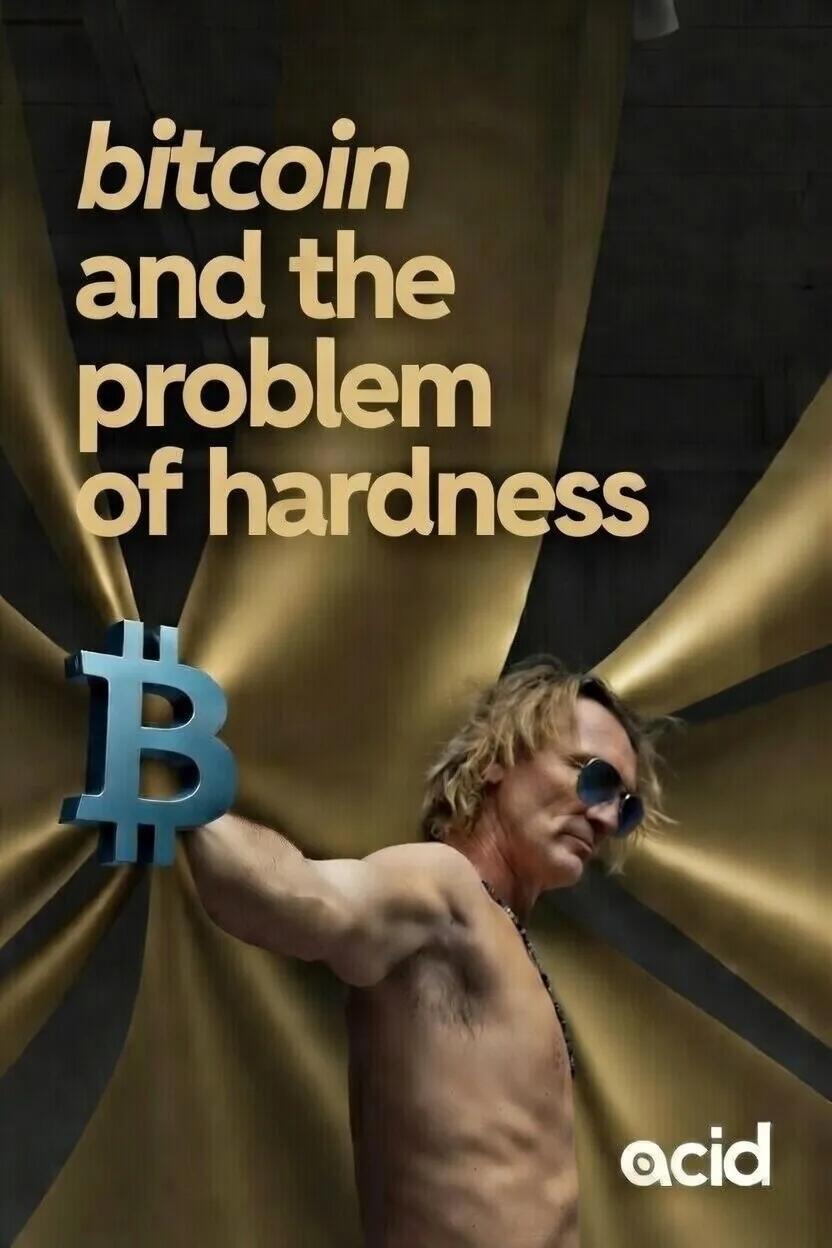
But, his latest note “Bitcoin & The Problem Of Hardness” is a masterpiece in seeing the big picture as he wends his way from the old world to the present day, explaining why mathematics, trauma, and human temperament matter more than ideology in modern money…
[ZH: Hendry writes in a unique style, without using capitals, we have chosen to preserve that style, though we have bolded a few sections of particular interest.]
For years, i treated bitcoin as something i understood well enough to have an opinion on, but not well enough to take apart properly.
that wasn’t laziness. it wasn’t lack of curiosity. it was the quiet assumption that whatever bitcoin was trying to solve, modern finance had already found a workaround.
this fourth, violent drawdown forced me to reconsider that assumption.
not as a trade, not as a belief system, but as a monetary object with consequences. at this point in its life, repeated collapses are no longer a curiosity. they are a feature that demands explanation.
this piece is my attempt to finally map the terrain i’d been circling for years: bitcoin’s hardness, its fragility, its human governance, and its uneasy relationship with a world that increasingly runs on elastic money and digital abundance. it’s not a defence. it’s not an indictment. it’s an audit.
writing it surprised me. i came away less certain about price, more certain about structure, and far more interested in the question of whether bitcoin’s biggest risk has ever been the mathematics at all.
if you’ve felt confident dismissing bitcoin, or confident believing in it, this is written for you. it left me sharper. i hope it does the same for you.
hugh.
a hard object in an elastic world.
bitcoin is not here to save the world. its here because the world learned the hard way that modern money only works by cheating. cheating time. cheating pain. cheating death. we built systems that survive by bending, by socialising loss, by pretending tomorrow can always carry what today can’t. and it mostly worked. worked well enough that america never failed, markets never cleared, and catastrophe was deferred again and again.
but in doing so, we quietly erased something that used to matter. the idea that there should exist at least one asset that doesn’t bend. one thing that refuses discretion. one thing that doesn’t care who’s in power, who’s desperate, or who’s about to break. bitcoin is not an improvement on the system. it is a provocation aimed at it.
a hard object thrown into an elastic world to see what happens.
that provocation only makes sense once you recognise what elastic money left behind. as societies embraced fiat, the global pool of savings did not become defenceless. inflation arrived, but it was hedgeable. equities, property, credit, productive ownership. capital learned how to run. what didn’t reappear was another asset that hedged inflation without introducing credit risk.
gold has of course played that role for centuries. scarce, apolitical, jurisdictionless, created without leverage, owing nothing to anyone. an inflation hedge that was simultaneously riskless. when gold was demoted as a monetary standard, that role was tolerated, not replaced when gold was ransacked between the long years of 1980 and 2011. curious minds looked for an alternative.
bitcoin emerged inside that gap. not as a rejection of fiat, and not as a tool for managing economic cycles, but as an attempt to recreate gold’s most elusive property in digital form. not merely scarcity, but scarcity without issuer risk. not just protection against dilution, but insulation from discretion. this is why bitcoin’s design is so severe. if the objective were simply to hedge inflation, the world already has dozens of ways to do that. the harder ambition is to build an asset that can sit beneath the monetary system as collateral rather than inside it.
that ambition now collides with modern finance. credit expands not on trust, but on what can be pledged. this is why stablecoins matter. they fuse the credit-risklessness of us treasuries with hard constraints elsewhere in the system. they are the clearest signal yet that the future of fiat will be built on better collateral, not moral restraint. bitcoin has a seat at that table only if it can scale into a recognised, liquid, riskless anchor. and that requires market value. not sentiment. not belief. but a market value deep enough to support global credit creation without fragility.
this is why the comparison with gold is unavoidable. gold is roughly forty-five trillion dollars. bitcoin remains under one. the gap is not philosophical. it is functional. geology has already earned its role. mathematics is still auditioning.
the question is not whether bitcoin is scarce enough, portable enough, or clever enough.
the question is whether an asset enforced by code and human coordination can ever be trusted, at scale, in the way an asteroid once was.
this is what this paper is about.
not whether bitcoin replaces fiat. it will not.
not whether elasticity is immoral. it is not.
fiat in an age of abundance.
the defining monetary lesson of the twentieth century was not ideological. it was traumatic. it emerged not from debates about socialism versus capitalism, or keynes versus hayek, but from the lived experience of what happens when economic systems impose rigidity on societies already under extreme stress.
after the first world war, germany was not a failed society. it was bruised, diminished, politically unstable, and deeply resentful, but it remained functional. industry existed. labour existed. institutions existed. the system was strained, not yet broken. the collapse came later, and it was not inevitable.
versailles changed that.
the treaty was not merely punitive. it was vindictive and economically illiterate. reparations were demanded in hard terms, payable in gold, at precisely the moment germany’s productive capacity was being constrained. forgiveness was absent. flexibility was absent. economic reality was ignored.
when germany struggled to meet those obligations, the response was not renegotiation but enforcement. in 1923, french and belgian forces occupied the ruhr valley, seizing control of germany’s industrial heartland, its coal, its steel, its metal production, while still demanding gold payments to the allied victors. output was taken. gold was still required. rigidity was imposed from both ends.
this was the breaking point.
what followed was not ideological radicalisation in the abstract, but economic paralysis in practice. unemployment surged. production collapsed. a growing share of the adult population became economically useless. not inefficient. not underpaid. useless. idle. watching. waiting. that condition does not produce reflection or moderation. it produces rage. and hyper-inflation.
hard money did not cause the collapse of weimar germany. but it failed catastrophically to absorb the trauma. and when institutions fracture under mass unemployment, money fractures with them. hyperinflation wasn’t softness. it was panic. it was the monetary expression of legitimacy evaporating in real time.
that sequence mattered. and it was remembered.
a decade later, the world faced another shock that threatened to replay the same pattern at a far larger scale. the crash of 1929 produced mass unemployment, collapsing demand, and the genuine possibility that the american system would follow germany down the same path. the ingredients were familiar: idle men, shuttered factories, political stress, and a rigid monetary framework that transmitted pressure rather than absorbing it.
this time, the response changed.
gold was abandoned as the governing constraint, not because it was immoral or discredited, but because it was brittle. too rigid to cope with systemic trauma. under gold, pressure concentrates until something snaps. under fiat, pressure disperses. elasticity replaced purity. monetary doctrine abandoned to keep the system intact.
the response was ugly. it was unfair. it produced deserved anger. but it worked.
the united states survived intact. unemployment was brutal, but the political centre held. extremism remained marginal. fiat didn’t heal the trauma, but it prevented it from metastasising. that became the lesson: in moments of economic shock, hardness accelerates entropy, while monetary elasticity buys time. and time, in stressed societies, is the difference between repair and collapse.
this was not an argument against scarcity. it was an argument against rigidity in the wrong place, at the wrong time. fiat emerged not as an ideological triumph, but as an adaptive response to the catastrophic failure of hard constraints under conditions of mass unemployment.
that distinction matters, because bitcoin did not arrive to overturn this lesson. it arrived long after, in its aftermath.
fiat’s ugly success.
over the subsequent century, that logic has been tested repeatedly, and each time it has been reaffirmed under pressure.
the global financial crisis of 2008 was not a scare or a stress test. it was a system-wide cardiac arrest. the banking system was insolvent in any meaningful sense. the only open question was whether circulation could be restarted before institutional damage became permanent. the response was not elegant. rules were bent. balance sheets were expanded. losses were socialised. hard constraints were suspended to keep the system alive. it was ugly, unfair, and morally nauseating to me and many others. it also worked.
the same pattern repeated during the pandemic. supply chains froze. borders closed. hospitals filled. the phrase “human extinction” escaped the laboratory and entered the bloodstream of culture. belief alone was enough to threaten collapse. once again, fiat leaned in. too much some say. money expanded. credit expanded. time was frozen. people were paid to stay home while the system was held upright. once again, rigidity was rejected in favour of elasticity. once again, the worst tail events were avoided.
this is what fiat does well.
it absorbs shocks that hard systems transmit. it disperses pressure instead of concentrating it. it allows societies to survive periods of mass dislocation without forcing immediate liquidation of people, institutions, or legitimacy. in a world repeatedly exposed to financial crises, pandemics, and geopolitical shocks, this has proven to be a feature, not a bug.
elasticity, however, is not free.
the cost shows up as inflation. not as a temporary inconvenience, but as a ratchet. prices spike, settle, and then remain elevated. grocery bills do not return to their old levels. this is the mechanical consequence of pushing risk forward in time. fiat smooths the present by borrowing from the future.
this matters most for those without assets. for the disenfranchised, inflation is not a macroeconomic abstraction or a debate about models. it is a daily budgetary pressure. rent before wages. food before leisure. energy before dignity. when prices ratchet higher, there is no portfolio adjustment, no rebalancing, no clever hedge. there is only less room to breathe.
modern financial systems are exceptionally effective at protecting those who already participate in them. the franchise holders. equities rise with nominal growth. property absorbs inflation and then some. credit, leverage, index-linked instruments, real assets, productive ownership. the menu is broad, liquid, and proven. elasticity doesn’t destroy capital for insiders. it often enriches them. asset prices inflate faster than wages precisely because the system is designed to keep capital mobile and solvent.
the burden falls elsewhere.
what inflation punishes is not thrift in some moral sense, but exclusion. money left idle because it must be. capital that cannot move because it does not exist. patience without agency. this is not a judgment about behaviour. it is a structural outcome. fiat rewards participation and mobility, not fairness. and over long periods of sustained monetary elasticity, that distinction compounds into something corrosive. something unfair.
this is where bitcoin enters the story, not as a solution to inequality, and not as a replacement for fiat, but as a strange and uncomfortable experiment. a mathematical object offered to the world without permission, leverage, or jurisdiction. a bearer asset in digital form. one that could, in principle, be owned by anyone with access to a phone and an internet connection. no bank account required. no credit history. no gatekeeper.
for the disenfranchised, that possibility mattered. not because bitcoin guaranteed protection, but because it offered asymmetry. if the experiment failed, little was lost. if it succeeded, if a provably scarce, apolitical, non-discretionary asset could be recognised at scale, the upside was transformative. not charity. social escape velocity. that truth remains.
but the promise remains unresolved. and it brings us back to the central tension of this paper. bitcoin’s relevance, credibility, and ultimate utility depend not on ideology, but on scale. to function as an anchor inside a fiat system. to serve as collateral, to support credit, to matter. the market capitalisation of bitcoin must approach that of gold. anything smaller remains a speculation. anything larger becomes infrastructure.
this is why the question is no longer academic. after fifteen years, bitcoin is no longer a curiosity. it is a lab rat running in real time, being tested as to whether mathematical scarcity can earn the trust, liquidity, and legitimacy that geological scarcity acquired over centuries. and whether doing so can widen access to riskless inflation protection, rather than merely creating a new priesthood.
this distinction sharpens as economies approach a shock larger than weimar or 1929: the displacement of labour by machines. automation and artificial intelligence are not just productivity stories. they are redundancy events. entire categories of work will vanish faster than societies can reassign income, purpose, or dignity. in that world, the fragile variable is not capital. it is employment.
fiat will almost certainly be called upon again. not as ideology, but as necessity. universal credit, fiscal transfers, monetary elasticity. these are the tools required to cushion employment shock and prevent social fracture when labour is displaced at scale. this is not conjecture. it is the only mechanism modern states possess to manage such transitions.
and importantly, this world does not lack inflation hedges. what is missing is something narrower and more structural: non-discretionary scarcity at industrial scale. assets that can sit at the base of the monetary system as collateral, not because they promise growth, but because they promise constraint.
gold once played that role. perhaps it will again. bitcoin is an attempt to recreate it digitally. not as salvation, and not as an alternative to elasticity, but as a potential anchor beneath it. the unresolved question is whether bitcoin can grow large enough, liquid enough, and trusted enough to serve that role when the singularity arrives.
how gold actually works.
gold has long been understood as money that sits outside politics. it is trusted precisely because it is not governed by decree, not issued by states, and not altered by committees. its neutrality is earned through distance. it is dug from the ground, refined at cost, and accumulated slowly. for centuries, that physical constraint has made it a reliable anchor when confidence in human institutions has failed.
but gold’s scarcity is often misunderstood.
when gold traded at roughly three hundred dollars an ounce in the early 2000s, global proven and probable reserves were estimated at around forty-five to fifty thousand tonnes. exploration budgets were thin. lower-grade ore was uneconomic. entire jurisdictions were ignored. supply looked finite because, at that price, it effectively was.
that picture changes when price changes.
today, with gold trading around five thousand dollars an ounce, estimated proven and probable reserves are closer to sixty-five to seventy-two thousand tonnes, despite decades of continuous mining. higher prices reclassify rock into ore. tailings into assets. deposits once dismissed as marginal suddenly become viable. jurisdictions previously considered uneconomic re-enter the map.
this is not debasement. it is response.
gold does not dilute itself politically. it expands itself industrially. when price rises, supply responds. not instantly. not recklessly. but structurally. historically, global gold supply has grown at roughly three percent per year. that rate is slow enough to preserve trust, but persistent enough to matter over long horizons.
by the end of this century, if history is any guide, the total stock of gold mined plus proven and probable reserves will have roughly doubled. no votes will be taken. no rules will be changed. physics will simply do what physics allows.
this is both gold’s strength and its limitation.
gold’s hardness is governed by geology. it obeys natural law, not human coordination. that makes it politically neutral and socially legible. but it also means that gold cannot refuse incentives. when the reward is high enough, more effort is applied. more technology is deployed. more supply eventually emerges.
gold responds to price.
that property does not make gold inferior. it makes it comprehensible. markets understand geological scarcity instinctively. they know how it behaves under stress. they know how it leaks. slowly. predictably. impersonally.
this is the benchmark against which bitcoin is inevitably measured. not because bitcoin is trying to replace gold, but because gold represents the oldest and most trusted expression of non-sovereign scarcity.
bitcoin enters this landscape not as a moral challenger to gold, but as a mechanical one. its claim is not that gold is weak, but that there exists another form of hardness, governed not by physics, but by time and rule.
that distinction is where the argument begins.
a different kind of hardness.
bitcoin’s claim is not philosophical. it is mechanical.
unlike gold, bitcoin does not respond to price. it does not expand when demand rises, and it does not contract when demand falls. its supply is governed entirely by time, according to a schedule fixed at inception and enforced by the network itself. that schedule does not care about recessions, wars, elections, panics, or the bitcoin price.
bitcoin was capped at birth. twenty-one million units. not an estimate. not a reserve calculation. not a probabilistic assessment signed off by a committee. a hard ceiling, defined in code and indifferent to circumstance. roughly ninety-four percent of that supply has already been issued. the remainder will be released slowly, on a predetermined path, with issuance effectively exhausted by around 2040. after that, the supply does not grow.
this is what makes bitcoin unusual. gold’s scarcity is governed by geology and incentives. bitcoin’s scarcity is governed by rules and time. when the gold price rises, supply eventually responds. when the bitcoin price rises, supply does not. instead, issuance tightens mechanically through the halving process, which reduces the flow of new coins roughly every four years regardless of demand.
this is not a moral hierarchy. it is a structural asymmetry.
gold is scarce because it is hard to extract. bitcoin is scarce because it is hard to change. gold’s constraint is physical. bitcoin’s constraint is social and procedural. one obeys physics. the other obeys consensus. both are forms of hardness, but they behave differently under stress.
by the end of this century the total stock of bitcoin will be unchanged. there will be no technological breakthrough that unlocks new bitcoin deposits. no reclassification of marginal code into viable supply. no price signal that induces expansion. scarcity is enforced by design, not discovered over time.
this is why bitcoin is often described as algorithmically scarce. not because it is digital, but because its supply dynamics are explicitly non-responsive. it is a system constructed to refuse incentives. where gold yields, bitcoin remains inert.
that inertness is the feature. it is also the source of discomfort.
markets are comfortable with scarcity that leaks slowly and impersonally. they are less comfortable with scarcity that depends on rule adherence and human coordination. geological systems do not argue back. social systems do. and the harder the rule, the more attention is paid to whether it can be broken.
bitcoin’s hardness, therefore, is not just a question of numbers. it is a question of credibility. not whether the rules are strict, but whether they can remain strict under pressure. not whether scarcity is defined, but whether it can survive stress without being renegotiated.
this is where bitcoin stops looking like a commodity and starts looking like a monetary regime. a red flag perhaps. its scarcity doesn’t rest on trust in institutions or authority, but it does rest on the collective willingness of participants to enforce rules that cannot be appealed, amended, or suspended for convenience.
that is a powerful design choice. it is also a demanding one. and its why bitcoin cannot be evaluated solely on the basis of its supply curve. the market is not just pricing scarcity. it is pricing the process required to maintain it.
that process is where the real uncertainty begins.
abundance and the exception.
what happens to scarcity in a world where almost everything else becomes abundant.
over the long arc of technological progress, the dominant trend is collapse in marginal cost. compute becomes cheaper. energy becomes more efficient. bandwidth expands. manufacturing scales. even intelligence and creativity, once thought irreducibly human, begin to look reproducible. the direction of travel is clear. more output, less input. more capability, less cost.
this abundance is not evenly distributed, but it is relentless.
the consequence is that scarcity erodes almost everywhere. goods that were once expensive become cheap. processes that once required labour become automated. advantages that once persisted collapse under replication. for capital, this creates opportunity. for labour, it creates displacement. entire categories of work can disappear faster than societies can reassign income, status, or purpose.
this is not a policy failure. it is a feature of technological speed.
but abundance sharpens the value of what does not scale. as more assets become reproducible, the appeal of assets that are deliberately constrained increases. not as replacements for fiat, and not as solutions to inequality, but as anchors. reference points. stores of value whose scarcity is not a function of demand, innovation, or political discretion.
gold has played this role for centuries. its scarcity leaks, but slowly enough to remain legible. bitcoin proposes a different anchor. one whose scarcity is not discovered over time, but enforced from the outset. in a world where almost everything responds to incentive, bitcoin is constructed to refuse it.
this is the context in which bitcoin should be understood. not as a bet against fiat, and not as a utopian alternative to modern states, but as an engineered exception in an environment of accelerating abundance. its relevance increases not because fiat is failing, but because fiat is succeeding in a world where the primary challenge is managing transition rather than enforcing discipline.
scarcity is collapsing across the economic landscape. where it persists, it does so either because physics enforces it, as with gold, or because rules do, as with bitcoin.
that distinction sets the stage for the central question the market is still wrestling with. not whether scarcity matters, but whether scarcity enforced by human process can command the same confidence as scarcity enforced by nature. the risk is not mathematical.
at the heart of this paper is not the price of bitcoin, not the narrative, but the thing that actually makes it scarce in practice. the lock.
bitcoin’s supply is only as hard as the mechanism that enforces ownership. that mechanism is encryption. not trust. not reputation. not authority. mathematics. ownership is defined by the ability to produce a valid cryptographic proof. if you can produce it, the network recognises you as the owner. if you can’t, the coins don’t move. there is no appeal, no administrator, no override, no discretion. the rule is absolute.
this is what gives bitcoin its hardness. not belief, but enforcement.
the lock itself is built on a key space so large that ordinary intuition fails. bitcoin’s current security rests on 256-bit cryptography. that number sounds abstract, but its meaning is concrete. it implies a universe of possible keys so vast that guessing the correct one is not merely unlikely, but physically meaningless. the standard analogy holds because it is accurate: it is equivalent to predicting the outcome of 256 perfectly fair coin tosses, correctly, in a single attempt. the number of possible outcomes dwarfs the number of atoms in the observable universe. not by a margin, but by orders of magnitude.
this is why bitcoin’s scarcity feels real. not asserted. not agreed upon. enforced by a wall that cannot be climbed with any conceivable amount of classical computing power. brute force does not fail slowly here. it fails categorically.
but no wall built from mathematics is eternal.
this is not heresy inside cryptography. it is orthodoxy. cryptographic systems are not laws of nature. they are assumptions about what is computationally infeasible given the machines we can build. quantum computing, if it matures to sufficient scale and reliability, does not gradually erode those assumptions. it invalidates them. in principle, certain mathematical problems that are intractable today become solvable. locks that once looked cosmological become penetrable.
this does not mean bitcoin is vulnerable today. it does mean that its hardness is not geological. it is conditional.
this is where discussion usually collapses into nonsense. critics speak as if bitcoin is on a ticking clock, moments from cryptographic collapse. advocates respond with hand-waving, invoking “bigger keys” or future upgrades as if the problem dissolves on contact. both positions miss the point.
the reality is more disciplined. cryptography is not out of tools. alternative ways of securing digital ownership already exist. increasing security parameters does not linearly increase difficulty; it explodes it. problem spaces expand faster than attackers can realistically pursue. even under aggressive assumptions about future machines, there are known constructions that push feasible attacks back beyond plausible horizons.
the constraint is not mathematics. it is coordination.
engineering disciplines do not harden systems today against threats that are distant, speculative, and underspecified. doing so imposes costs now for dangers that may arrive differently, or not at all. but good engineering does preserve optionality. it builds systems that can migrate. it avoids dead ends. it leaves room to move without tearing the structure apart.
conservative choices. minimal complexity. maximum headroom.
the lock wasn’t chosen because it was eternal, but because it was overwhelmingly strong relative to any foreseeable attack, while leaving open a path to adaptation if the world changes. the mathematics are formidable. probably sufficient for decades. perhaps longer. the real uncertainty does not live inside the encryption itself. it lives in whether a system that enforces absolute rules can coordinate calmly when those rules eventually need to change.
this distinction matters, because it reveals where the real risk lies.
coordination without a conductor.
bitcoin’s greatest vulnerability is not that mathematics will suddenly fail. it is that adaptation requires agreement.
cryptography can be upgraded. rules can be amended. but only through a slow, voluntary process that depends on human coordination.
software can change. can people?
the market understands this intuitively. it doesn’t price bitcoin as if its code were fragile. it prices bitcoin as if its governance were untested under existential pressure. not because the tools are missing, but because the process has never been forced to prove itself in extremis.
power in bitcoin is negative, not positive. the ability to say “no” matters more than the ability to say “yes.” control is distributed through indifference rather than command. participants who care deeply must persuade participants who often do not. that asymmetry is intentional. it makes capture difficult, but it also makes change slow.
there is an old joke, best told by monty python, about revolutionary movements. everyone agrees on the enemy. everyone agrees on the objective. and yet the room is full of factions who despise one another far more than they fear the empire they claim to oppose. the people’s front, the popular front, the other front that split off last year after a disagreement about principles. the comedy works because it is painfully familiar. shared goals are easy. shared coordination is not.
bitcoin’s existential risk looks uncomfortably similar.
the empire, in this case, is not a political power but a technological one: quantum computing. the objective is clear and universally agreed. protect the lock. preserve the scarcity. keep ownership unforgeable. nobody disputes that. and yet, beneath that agreement sits a familiar fragmentation. different camps, different thresholds, different definitions of danger. some insist the empire is decades away and not worth acknowledging. others want to mobilise immediately. some fear that any coordination is betrayal. others fear that delay is suicide.
bitcoin will not be tested by whether quantum computing arrives tomorrow or in thirty years. it will be tested by whether a system built to resist authority can still recognise an empire when it appears, and act together without collapsing into its own people’s front of judea. rome, in the sketch above, barely needs to intervene. the factions do the work themselves. bitcoin’s challenge is to prove that it can do the opposite. that a system built on voluntary consensus can still recognise a real threat, act deliberately, and preserve its core rules without fragmenting into rival truths.
that is the real hardness test. not whether the locks are strong enough, but whether the people guarding them can tell the difference between principle and paralysis when it finally matters.
quantum as a social stress test.
if quantum computing ever becomes relevant to bitcoin, it will not arrive as a cinematic rupture. there will be no single moment when the system is “broken.” instead, it would surface as a gradual erosion of a specific assumption: that only the holder of a key can authorise the movement of coins. the threat is not to the ledger itself, but to the exclusivity of ownership.
this distinction matters. bitcoin does not depend on secrecy in the abstract. it depends on the idea that control cannot be impersonated. if a new class of machines were ever able to reconstruct ownership credentials from publicly visible information, the system would not collapse overnight. but ownership would become contestable. and contestable ownership is where scarcity begins to blur.
such a threat would not arrive evenly. bitcoin ownership is not a single, uniform thing. some forms of ownership already expose more information than others, simply by how they were created or how they have been used. coins held in older address formats, coins that have reused addresses repeatedly, coins that have moved through transparent scripts, or coins sitting on exchanges necessarily reveal more public data about the conditions under which they can be spent.
other coins are quieter. coins held in newer formats, coins that have never moved, coins protected by more conservative spending conditions disclose far less information to the outside world. they would remain safer for longer, not because their owners are more virtuous, but because there is less surface area to attack.
the result is that pressure would build asymmetrically. some coins would become attractive targets earlier, while others would remain effectively untouched. the system would not fail all at once. it would experience localized stress, visible theft attempts, and contested ownership at the margins. that asymmetry matters. it is precisely what would force the system to confront change before catastrophe, rather than after it.
at that point, bitcoin’s challenge would no longer be mathematical. it would be procedural.
the first step would be agreement on the threat itself. not philosophically, but operationally. what does “quantum capable” mean in practice? how powerful would such machines need to be? how reliable? how accessible? how much warning time would exist between theoretical vulnerability and real-world exploitation? without consensus on the threat model, there can be no consensus on the response.
the second step would be the introduction of new ownership rules. a new kind of lock. bitcoin does not replace its rules abruptly. it adds them cautiously. new rules are typically introduced in ways that allow voluntary adoption before anything old is disabled. this bias toward gradualism is deliberate. it reduces the risk of fragmentation, but it also stretches timelines.
the third step, and the one that dominates everything else, would be migration.
bitcoin cannot move coins on behalf of their owners. there is no administrator. no emergency authority. no recovery desk. holders would need to upgrade wallets, generate new addresses, and move their coins deliberately. exchanges would need to adapt. custodians would need to adapt. hardware manufacturers would need to adapt. this would be a multi-year process under the best of circumstances.
and then comes the question bitcoin has spent most of its existence trying to avoid.
what to do about the old rules.
leaving old ownership rules valid forever preserves neutrality. it ensures that coins valid under the rules at the time remain valid indefinitely. but in a world where those rules are compromised, it also leaves a permanent attack surface. disabling old rules protects the system more aggressively, but it strands anyone who is slow, offline, confused, or dead.
there is no solution here that is clean.
this is where the existence of lost coins becomes unavoidable. it is widely believed that satoshi nakamoto mined roughly one million coins in bitcoin’s earliest days and never moved them. beyond that, several million more coins are thought to be lost owing to forgotten keys, destroyed hardware, or owners who have died. estimates vary, but something like fifteen to twenty percent of the total supply may already be permanently inaccessible.
those coins cannot migrate. they do not upgrade. they do not respond. they simply sit.
in purely economic terms, this creates a tempting argument. disabling old rules would freeze a large share of supply. the remaining coins would instantly become more valuable. incumbents would benefit. attentiveness would be rewarded. scarcity would tighten mechanically. from a price perspective, it looks clean.
but bitcoin is not priced like a system that optimises for incumbent profit. it is priced like a system that optimises for rule legitimacy.
retroactively invalidating ownership that was valid under the rules at the time crosses a line bitcoin has been extraordinarily careful to avoid. not because it is sentimental, but because once a system demonstrates a willingness to forgo legitimate ownership for convenience, every remaining holder must price the risk of being next. the question shifts from “how scarce is this” to “what future behaviour might disqualify me.”
that uncertainty does not announce itself as outrage. it shows up as a higher risk premium. as hesitation. as capital demanding optionality rather than commitment.
history offers guidance here, but only if the analogies are used carefully. the gold confiscation of 1933 is often cited in these debates. it is relevant, but frequently misunderstood. gold did not lose its status as a politically neutral store of value. globally and over time, it retained it. what changed was the monetary regime attempting to bind itself to gold, not gold itself.
the united states abandoned gold because the standard had become too rigid to absorb trauma. deflation was crushing the economy. unemployment was mass. legitimacy was failing. the choice was not between fairness and enrichment. it was between preserving individual claims and preserving the system itself. that was a regime change, not an opportunistic confiscation.
bitcoin’s quantum problem, if it ever becomes real, belongs in that category. not discretionary loss within a stable framework, but a question of whether the framework itself can survive without resetting its assumptions. that does not remove the legitimacy cost. it explains when such a cost might be tolerated.
the bar, however, is extremely high.
any decision to disable old rules would create visible losers. estates. early participants. long-term cold storage. institutions with slow governance. people who played by the rules as they understood them at the time. history shows that such losses can be judged necessary, but only under existential justification, never economic optimisation.
this is why bitcoin has been so resistant to discretionary change. it will tolerate loss. it will tolerate dead keys. it will tolerate entropy. what it resists, almost to the point of paralysis, is retroactive punishment by rule change.
this is the real stress test quantum computing represents. not whether new cryptographic tools exist. they do. not whether mathematics can scale. it can. the question is whether a system built on voluntary consensus can coordinate early enough, calmly enough, and at sufficient scale to protect its own scarcity without tearing its legitimacy apart.
that answer will not be found in code. it will be found in human behaviour.
and that, more than any algorithm, is what markets are still trying to price.
drawdowns and temperament.
bitcoin is down roughly fifty percent. this is not unprecedented. it has happened before, roughly four times, and in several instances the drawdown extended to seventy or even eighty percent. these episodes are often described as failures. they are better understood as stress tests of temperament.
when major assets halve in value, the correct response is not moralisation. it is allocation. this is true of equities, bonds, property, and commodities. when the s&p falls sixty percent, long-term investors do not debate its legitimacy. they buy it. when long-dated treasuries lose half their value, the instruction is the same. systemic assets occasionally experience violent repricing and then persist. bitcoin, if it is to be treated seriously, cannot be exempt from that logic.
this does not mean bitcoin is risk-free. it is not. it carries idiosyncratic risks that traditional assets do not. protocol risk. governance risk. technological risk. those risks are real, and they are reflected in price. they don’t nullify the asset. they explain its volatility.
the mistake is to confuse volatility with fragility.
bitcoin is not protected from pain. it is protected from dilution. supply does not respond to price. losses cannot be offset by issuance. drawdowns, therefore, must be absorbed entirely through repricing. that makes them feel extreme. but it also means that recovery, when it occurs, is not undermined by structural expansion.
this is where temperament replaces ideology. and what is unusual is the emotional intensity attached to these moves.
bitcoin doesn’t behave like an asset that allows gradual accommodation. it confronts holders with repeated tests of conviction. sharp losses followed by long stretches of waiting. certainty about the long-term supply combined with uncertainty about near-term price. that combination is psychologically demanding in a way most assets are not.
this is not a bug. it is the consequence of a system that refuses to smooth outcomes through discretion. volatility is the price of rule rigidity. markets understand this intellectually. individuals struggle with it emotionally.
this is the point at which ideology tends to collapse. narratives fail. communities fracture. people who articulated the thesis most clearly are often the first to abandon it under pressure. not because the thesis changed, but because holding it became economically intolerable.
bitcoin’s drawdowns, then, are not evidence that the system is broken. they are evidence that it is still being held by humans.
that distinction matters as the argument turns to psychology, belief, and the limits of human endurance in the face of certainty combined with delay.
believe, mispricing, and the human discount.
if bitcoin were only a mathematical object, its pricing would be straightforward. fixed supply. known issuance path. no discretion. no response to price. scarcity enforced mechanically rather than culturally. in that world, valuation would be an exercise in discounting time and adoption, not temperament.
but bitcoin is not held by mathematics. it is held by people.
this is the gap the market continues to price. not uncertainty about the code, but uncertainty about human behavior under stress. not whether the rules will hold, but whether holders will.
from inception, bitcoin was framed as revelation rather than instrument. the hardest money. the chosen alternative. the end state. this framing attracted capital, but it also attracted devotion. and devotion is not a stable pricing mechanism. it produces extremes. euphoric bids followed by violent repudiation. certainty on the way up, disgust on the way down.
markets are comfortable pricing scarcity created by geology. they have centuries of experience doing so. gold does not ask holders to believe anything. it does not demand patience under explicit stress. it does not confront its owners with countdowns, halvings, or visible issuance cliffs. its supply leaks quietly over centuries. impersonally. nobody has to watch it happen.
bitcoin is different. its scarcity is pristine, but it is also theatrical. the issuance schedule is known. the halving dates are calendared. the future is visible. and humans do not handle visible certainty well, especially when the reward is delayed and the price path is violent.
behavioral finance has names for this. temporal discounting. loss aversion. cognitive dissonance. but labels are beside the point. the practical outcome is simple. people sell not when the thesis breaks, but when holding becomes psychologically intolerable.
this is why drawdowns cluster around moments of structural clarity rather than structural failure. the halving does not damage bitcoin. it clarifies it. supply tightens. expectations rise. volatility follows. and under that pressure, the weakest element in the system is exposed.
the weakest element is not the cryptography.
it is not the supply rule.
it is not the network.
it is the holder.
this is not a moral judgment. it is a structural observation. bitcoin asks humans to do something they are historically bad at: tolerate long periods of stagnation and drawdown in exchange for a future that feels intellectually certain but emotionally distant.
gold went through this process over decades. from 1980 to 2011, it failed to make a real high. the thesis did not change. the environment did. but those who were right too early experienced thirty years of indistinguishable wrongness. many abandoned the asset not because it stopped being scarce, but because waiting became unbearable.
bitcoin is compressing that experience into years rather than decades. its adolescence has been marked by repeated, brutal repricing. each one framed as terminal. each one survivable. the speed intensifies the stress. the transparency magnifies it.
this is why the valuation gap between bitcoin and gold remains so wide. gold’s scarcity is enforced by physics and tolerated by human indifference. bitcoin’s scarcity is enforced by code and tested by human psychology. markets price that difference.
to say bitcoin may be mispriced is not to claim inevitability. it is to observe that the discount applied to it appears to be dominated less by doubts about mathematics and more by doubts about the human process required to endure it.
whether that discount narrows over time is not a question of code.
it is a question of who ends up holding the asset.
and for how long.
the transition from narrative-driven ownership to process-driven ownership is slow, but it is not hypothetical. it has happened before. equity markets in the early 20th century were dominated by individuals reacting emotionally to price. today they are shaped by institutions, mandates, and machines that do not care how a drawdown feels, only how it fits within a distribution.
bitcoin appears to be moving through a similar maturation, compressed in time and amplified in volatility. early ownership was ideological. then speculative. what comes next is procedural. assets that survive long enough tend to shed believers and acquire custodians.
this shift does not eliminate volatility. it changes its character. drawdowns become less about loss of faith and more about rebalancing flows. price discovery becomes less theatrical and more mechanical. the asset stops asking to be believed in and starts being held because it fits.
hardness, elasticity, and what the market is still pricing.
it is worth returning, briefly and soberly, to first principles.
this is not an argument against fiat. nor is it a plea for monetary purity. fiat is not a mistake. it was a response. it emerged from the wreckage of the twentieth century, shaped by mass death, political collapse, and the recognition that rigid systems amplify trauma rather than absorb it. elastic money was not designed to be virtuous. it was designed to prevent societies from tearing themselves apart under economic stress.
by that standard, it has largely succeeded. again and again, in 1929, the 1970s, in 2000, 2008 and in 2020, fiat absorbed shocks that would otherwise have produced mass unemployment, institutional collapse, and political extremism. the cost has been inflation, moral hazard, and periodic outrage. but the alternative was worse. history makes that clear.
bitcoin does not exist to replace this system. it exists alongside it, asking a narrower and more uncomfortable question.
how much hardness can a monetary asset sustain without breaking its holders.
gold answers that question geologically.
supply responds to price. scarcity leaks slowly. nobody has to endure explicit tests of faith.
bitcoin answers it mathematically.
supply is fixed. issuance is known. scarcity is absolute. and the burden of adjustment falls entirely on price and psychology.
this difference matters for valuation.
gold’s total market value is roughly forty five trillion dollars. bitcoin’s is under one. geology is not forty five times more convincing than mathematics. but geology is indifferent to belief, while bitcoin requires humans to live inside its rules. markets price that difference aggressively.
bitcoin’s challenge has never been proving its hardness. it has been surviving the consequences of it. repeated drawdowns are not evidence that the system is flawed. they are evidence that its constraints are real. scarcity enforced without discretion produces volatility. volatility tests holders. most fail. a few persist. over time, ownership concentrates in hands that can tolerate the process.
this is why the asset still looks mispriced to some observers including myself. not because the mathematics are uncertain, but because the market continues to apply a heavy discount to the human process required to hold it. that discount may persist for years. it may narrow slowly. it may never fully disappear. none of those outcomes invalidate the structure.
bitcoin was framed early as revelation rather than instrument. that framing attracted devotion, and devotion made the journey harder than it needed to be. gold’s history offers a cautionary parallel. being right too early feels exactly like being wrong. conviction held without relief curdles into capitulation.
what matters now is not belief, but endurance.
bitcoin does not promise comfort. it does not promise justice. it does not promise to save anyone. it offers one thing only: a set of rules that do not bend to price, politics, or persuasion. whether that is valuable depends entirely on who is holding it and why.
the mathematics will almost certainly hold long enough. the question has always been whether we will.
and that, more than code or cryptography, is what the market continues to price.
hugh.
Tl;dr:
Bitcoin exists not to replace fiat money but as a provocative “hard object” in an elastic monetary world. Modern fiat succeeds by cheating – deferring pain, socializing losses, and bending rules to absorb crises (Weimar rigidity led to hyperinflation; 1929 rigidity was abandoned for elasticity in the 1930s; 2008 and COVID responses bent rules to survive). Fiat buys time during trauma but creates ratcheting inflation that disproportionately burdens the asset-poor, while rewarding mobile capital.
Bitcoin recreates gold’s key elusive trait: non-discretionary, issuer-risk-free scarcity in digital form. Unlike gold (which responds to price via new supply), Bitcoin’s 21-million cap is mechanically enforced by code and time, refusing incentives. This makes it an potential anchor beneath fiat – collateral for credit expansion – if it scales to gold-like market value (~$45T vs. Bitcoin’s ~$1T).
Yet the real risk lies not in math (256-bit cryptography remains robust against classical attacks) but in human coordination: governance, quantum threats requiring consensus upgrades, and holder temperament during violent drawdowns. Markets price Bitcoin’s gap to gold not from doubts about scarcity, but from uncertainty about whether humans can endure its rigid, psychologically demanding process without capitulating. Bitcoin tests endurance more than code—its value hinges on who holds it, and for how long.
Read much more from Hugh at his ‘The ACID Capitalist’ substack here…
Tyler Durden
Wed, 02/11/2026 – 21:20