Category: News

El gobierno de Trump da importante paso para desmantelar las regulaciones climáticas
Por MATTHEW DALY
WASHINGTON (AP) — La administración Trump revocó el jueves una conclusión científica que durante mucho tiempo ha sido la base central de la acción de Estados Unidos para regular las emisiones de gases de efecto invernadero y combatir el cambio climático, la medida más agresiva del presidente Donald Trump para desmantelar las regulaciones climáticas.
La norma, finalizada por la Agencia de Protección Ambiental (EPA), anula una declaración gubernamental de 2009 conocida como la “conclusión de peligro” (endangerment finding), que determinó que el dióxido de carbono y otros gases de efecto invernadero ponen en riesgo la salud pública y el bienestar.
Esta norma, decretada durante el gobierno de Barack Obama, es el sustento legal de casi todas las regulaciones climáticas de la Ley de Aire Limpio para vehículos motorizados, plantas de energía y otras fuentes de contaminación que están calentando el planeta.
Expertos señalan que seguramente habrá impugnaciones legales contra una medida que deroga todas las normas de emisiones de gases de efecto invernadero para autos y camiones, y que podría desatar un desmantelamiento más amplio de las regulaciones climáticas sobre fuentes fijas, como las plantas de energía e instalaciones de petróleo y gas. Anular la conclusión “provocará más caos” que otras acciones del gobierno de Trump para revertir normas ambientales, afirmó Ann Carlson, profesora de derecho ambiental en la Facultad de Derecho de la Universidad de California en Los Ángeles (UCLA).
El administrador de la EPA, Lee Zeldin, quien ha reorientado la agencia hacia un enfoque favorable a las empresas y ha revertido varias regulaciones climáticas, sostuvo que la derogación de la conclusión de peligro “será la mayor acción desregulatoria en la historia de Estados Unidos”.
Grupos ambientalistas consideran que se trata del mayor ataque individual en la historia de Estados Unidos contra la autoridad federal para abordar el cambio climático.
Zeldin anunció el jueves la finalización de la norma junto al presidente Donald Trump. La EPA también indicó que propondrá un retraso de dos años a una norma de la era Biden que restringe las emisiones de gases de efecto invernadero de autos y camionetas ligeras.
Zeldin, excongresista republicano elegido el año pasado por Trump para dirigir la EPA, ha criticado a sus predecesores en gobiernos demócratas, al afirmar que, en nombre de enfrentar el cambio climático, estaban “dispuestos a llevar al país a la bancarrota”.
Retirar la conclusión de peligro “es el paso más importante que ha dado hasta ahora el gobierno de Trump para volver a la cordura energética y económica”, declaró Myron Ebell, un activista conservador que ha cuestionado la ciencia detrás del cambio climático. La decisión “hará que nuestra economía sea más productiva y beneficiará a los consumidores, de manera más inmediata al permitir que los fabricantes de automóviles produzcan los vehículos que la gente quiere comprar”, agregó.
La Corte Suprema respaldó la conclusión de peligro
La Corte Suprema de Estados Unidos dictaminó en un caso de 2007 que los gases de efecto invernadero que calientan el planeta, causados por la quema de petróleo y otros combustibles fósiles, son contaminantes del aire bajo la Ley de Aire Limpio.
Desde la decisión del máximo tribunal, en un caso conocido como Massachusetts vs. EPA, los tribunales han rechazado de manera uniforme las impugnaciones legales a la conclusión de peligro, incluida una decisión de 2023 del Tribunal Federal de Apelaciones de para el Circuito del Distrito de Columbia.
La conclusión de peligro es considerada ampliamente como la base legal de una serie de regulaciones destinadas a proteger contra amenazas que el cambio climático vuelve cada vez más graves. Eso incluye inundaciones mortales, olas de calor extremas, incendios forestales catastróficos y otros desastres naturales en Estados Unidos y en todo el mundo.
______
Esta historia fue traducida del inglés por un editor de AP con la ayuda de una herramienta de inteligencia artificial generativa.

Russia To Send Oil To Cuba Amid US-Imposed Blockade
Russia To Send Oil To Cuba Amid US-Imposed Blockade
Russia is preparing to rush urgently needed oil to Cuba under what officials describe as a “humanitarian” arrangement, according to a report Thursday by the pro-government newspaper Izvestia.
The Russian Embassy in Havana told Izvestia that “as far as we know, Russia is expected to supply oil and petroleum products to Cuba as humanitarian aid in the near future” – amid the island’s worst energy crunch in years.
After decades of already crippling sanctions, President Trump’s latest Executive Order “imposes a new tariff system that allows the United States to impose additional tariffs on imports from any country that directly or indirectly provides oil to Cuba.”
The most devastating move has been to block the ability of the post-Maduro Venezuelan government to send supplies to Cuba. Caracas was Cuba’s chief oil supplier.
Key airlines have stopped flights into Havana’s main international airport for lack of jet fuel. As we reported earlier, Russia is allowing its airlines to temporarily operate outbound flights only.
5,000 Russian tourists remain stranded in Cuba, amid an evacuation overseen by Moscow, according to AFP citing Russia’s Association of Tour Operators.
Earlier this month international reports said Cuba was merely days from running out of fuel, and widescale power outages across various districts of the country have only worsened.
“The last known delivery came via a tanker from Mexico in early January, but Mexico halted exports amid US pressure,” The Guardian notes. “At the same time, crude flows from Venezuela have dried up after a US operation in January that resulted in the capture of Nicolás Maduro, cutting off support from Cuba’s most trusted energy supplier.”
Havana’s lone primary international airport has seen drastic developments such as the following:
In recent hours, a video has gone viral on social media showing dozens of tourists disembarking from a plane on the tarmac in Moscow after their flight to Cuba was aborted just before takeoff.
The testimonies collected by the Russian outlet Mash on Telegram indicate that passengers on flight SU6849 had almost taken off when, “at the last moment, when the engines were already running, the pilot announced that there was no fuel in Havana,” forcing the flight to be canceled at the last minute.
Putin spokesman Dmitry Peskov said Monday that “the stranglehold imposed by the United States is already causing a lot of difficulties for Cuba” and this has resulted in the two allies discussing “possible ways to resolve these problems or at least provide all possible assistance.”
Tyler Durden
Thu, 02/12/2026 – 14:20
https://www.zerohedge.com/geopolitical/russia-send-oil-cuba-amid-us-imposed-blockade

Indian Prairie school board OKs almost $31 million in renovations at Waubonsie Valley High School in Aurora
Indian Prairie School District 204 buildings will again be seeing significant renovations this summer, as the district’s bond sale-funded facilities overhaul continues.
On Monday, the district’s school board approved more construction-related measures for the summer and beyond, including bids for almost $31 million in renovations at Waubonsie Valley High School in Aurora.
The district is currently undergoing a major facilities overhaul after the passage of a bond referendum question in 2024 meant to help pay for renovations across the district.
In 2024, voters approved a proposal from the district to sell up to $420 million in bonds to pay for facility improvements. The bonds are to be paid for using a continuation of an existing 37-cent property tax per $100 of equalized assessed value that would otherwise have expired at the end of 2026, meaning the tax rate for residents in terms of their contribution to capital projects will effectively remain flat as a result of the referendum question’s passage.
Since the referendum question was passed, the district has been proceeding with work on projects across district buildings that are set to extend through 2032. The work includes school-specific renovations at Waubonsie Valley High School, Neuqua Valley High School, Metea Valley High School, the Birkett Freshman Center and Gregory and Hill middle schools, along with district-wide safety and security upgrades, LED lighting installations and other infrastructure projects.
Included in Monday’s approvals were bids for significant work at Waubonsie Valley.
The work at Waubonsie is the largest project in the district in terms of referendum dollars — it’s slated to receive $130 million in bond sale funds over the course of its renovations.
This past year, the school got a major auditorium overhaul, and is slated to get a new turf field and a renovated cafeteria as part of the facilities work.
The nearly $31 million in construction bids approved by the board on Monday are for renovation work at Waubonsie that will start in the spring and continue during the 2026-27 school year through August 2027, per the district. Included in the cost of these contracts are things like selective demolition, roofing, masonry, plumbing and HVAC work. Additional bid packages are coming to complete the project.
On Monday, the school board also OK’d bid packages for furniture installation at Neuqua Valley and Waubonsie Valley high schools in the amount of $440,300, for classroom furniture for the Career Tech Labs at Neuqua and for new cafeteria tables and chairs for the renovated dining area at Waubonsie.
The board on Monday also approved flooring replacements at Clow, Graham, Longwood, Peterson, White Eagle and Young elementary schools, excluding their gyms. It also OK’d flooring replacements for the gyms, and in some cases the stage and multi-purpose rooms, at Brooks, Owen and Springbrook elementary schools.
The total cost for the flooring replacements is set to come to around $3.4 million, per a letter from architectural firm STR Partners included in Monday’s meeting agenda.
The board also approved architectural services from STR Partners to design additions for three elementary schools: May Watts, Steck and Young. Design would go on throughout 2026, with construction starting in spring 2027.
Per a letter from STR Partners, the additions are set to provide instructional classrooms, toilet facilities, intervention spaces and spaces for conferencing or offices.
Additionally, the board approved an application for building permits for the Regional Office of Education for the referendum-funded construction starting in the summer at a number of district schools.
mmorrow@chicagotribune.com
https://www.chicagotribune.com/2026/02/12/indian-prairie-facilities-overhaul-waubonsie-valley/

Real Madrid espera que cena de equipo pagada por Vinícius y Mbappé impulse en La Liga
Por TALES AZZONI
MADRID (AP) — El Real Madrid confía en que una cena de convivencia del equipo, que según se informó fue pagada por los dos grandes astros del plantel, impulse su búsqueda de los trofeos de La Liga y la Liga de Campeones en el tramo final de la temporada.
Vinícius Júnior y Kylian Mbappé pagaron la cuenta en el restaurante de Madrid el martes, según contó a los reporteros el mediocampista Dani Ceballos. La factura superó los 1.000 euros (1.100 dólares), de acuerdo con versiones de medios españoles.
Vinícius publicó una foto de toda la plantilla durante la llamada “cena de la conjura” cerca del centro de la ciudad, en un lugar elegante que incluye “Art Dining Club” (arte, gastronomía y club).
Aficionados esperaron afuera del restaurante para intentar hablar con los jugadores después de la cena, que se prolongó hasta pasada la medianoche.
El técnico Álvaro Arbeloa y sus asistentes no formaron parte de la cena, informaron medios españoles.
La muestra de unidad llegó una semana antes de que el Madrid enfrente a Benfica en el partido de ida de los repechajes de la Liga de Campeones. El equipo quedó fuera de los ocho primeros que se clasificaban automáticamente a los octavos de final tras una derrota 4-2 en la cancha del mismo Benfica en la última jornada de la fase de liga.
El defensor Raúl Asencio comentó a los medios después de la cena que el equipo estaba “muy unido”.
Los últimos meses en el Madrid han sido turbulentos. Según versiones de prensa, algunos jugadores no estaban en sintonía con el técnico Xabi Alonso, quien fue reemplazado por Arbeloa el mes pasado.
Con Arbeloa al mando, el Madrid fue eliminado por el Albacete de la segunda división en los octavos de final de la Copa del Rey, además de perder ante Benfica en la Champions.
En La Liga, Madrid ha ganado siete seguidos y está a un punto del líder Barcelona. Una victoria contra la Real Sociedad el sábado pondría a Madrid en el primer lugar antes del viaje de Barcelona para enfrentar a Girona el lunes.
La Real, octava en la tabla, viene de ganar 1-0 en la cancha de su rival vasco Athletic Bilbao, en el partido de ida de las semifinales de la Copa del Rey.
Enfrentamientos clave
Barcelona buscará su cuarta victoria consecutiva en la liga ante un Girona que se ubica en el 12º puesto y no ha ganado en sus últimos tres partidos.
Los azulgranas visitaban el jueves al Atlético de Madrid en la ida de la Copa del Rey, precedidos por 17 victorias en sus últimos 18 encuentros en todas las competiciones. El último tropiezo fue una derrota 2-1 en la cancha de la Real Sociedad en la liga el mes pasado.
El Atlético, tercero en la tabla, visitará el domingo al modesto Rayo Vallecano. El Villarreal, cuarto en la clasificación, enfrentará de visitante a un Getafe que marcha a media tabla.
Fuera de acción
Mbappé entrenó por separado del grupo el jueves por un problema en la rodilla y pasó a ser duda para el partido del sábado en el estadio Santiago Bernabéu. Ya el miércoles se había limitado a trabajo de gimnasio. El club no dio de inmediato detalles sobre su estado.
Vinícius estaba previsto que reaparezca tras perderse el partido anterior de liga por acumulación de amarillas, pero Jude Bellingham seguirá de baja por una lesión del isquiotibial.
Seguía sin estar claro si el delantero Raphinha se recuperaría por completo a tiempo de un problema muscular para el Barcelona-Girona. El atacante azulgrana Marcus Rashford era duda por un golpe en la rodilla.
Jugadores a seguir
Mbappé suma nueve goles en sus últimos nueve partidos. Totaliza 23 dianas en 22 encuentros de liga y comanda la tabla de cañoneros con comodidad, por encima de Vedat Muriqi, autor de 15 goles para Mallorca.
Fuera de la cancha
El partido del Rayo contra el Atlético podría terminar aplazándose por las malas condiciones del campo en el estadio de Vallecas.
El césped fue reemplazado la semana pasada, pero no estaba en condiciones adecuadas para el partido del fin de semana pasado contra el Oviedo, que tuvo que aplazarse con poca antelación.
Esta semana ha seguido lloviendo mucho en Madrid, lo que dificulta que el nuevo césped se asiente correctamente.
___
Deportes AP: https://apnews.com/hub/deportes

Trump’s EPA revokes scientific finding that underpinned US fight against climate change
WASHINGTON — The Trump administration on Thursday revoked a scientific finding that long has been the central basis for U.S. action to regulate greenhouse gas emissions and fight climate change, the most aggressive move by the president to roll back climate regulations.
The rule finalized by the Environmental Protection Agency rescinds a 2009 government declaration known as the endangerment finding that determined that carbon dioxide and other greenhouse gases endanger public health and welfare.
The endangerment finding by the Obama administration is the legal underpinning of nearly all climate regulations under the Clean Air Act for motor vehicles, power plants and other pollution sources that are heating the planet.
President Donald Trump called the move “the single largest deregulatory action in American history,” while EPA Administrator Lee Zeldin called the endangerment finding “the Holy Grail of federal regulatory overreach.”
Legal challenges are certain for an action that repeals all greenhouse gas emissions standards for cars and trucks, and could unleash a broader undoing of climate regulations on stationary sources such as power plants and oil and gas facilities, experts say. Overturning the finding will “raise more havoc” than other actions by the Trump administration to roll back environmental rules, said Ann Carlson, an environmental law professor at the UCLA School of Law.
Environmental groups described the move as the single biggest attack in U.S. history against federal authority to address climate change.
The EPA also said it will propose a two-year delay to a Biden-era rule restricting greenhouse gas emissions by cars and light trucks.
Zeldin, a former Republican congressman who was tapped by Trump to lead EPA last year, has criticized his predecessors in Democratic administrations, saying that in the name of tackling climate change, they were “willing to bankrupt the country.”
Withdrawing the endangerment finding “is the most important step taken by the Trump administration so far to return to energy and economic sanity,” said Myron Ebell, a conservative activist who has questioned the science behind climate change.
Supreme Court has upheld endangerment finding
The Supreme Court ruled in a 2007 case that planet-warming greenhouse gases, caused by burning of oil and other fossil fuels, are air pollutants under the Clean Air Act.
Since the high court’s decision, in a case known as Massachusetts v. EPA, courts have uniformly rejected legal challenges to the endangerment finding, including a 2023 decision by the U.S. Court of Appeals for the District of Columbia Circuit.
The endangerment finding is widely considered the legal foundation that underpins a series of regulations intended to protect against threats made increasingly severe by climate change. That includes deadly floods, extreme heat waves, catastrophic wildfires and other natural disasters in the United States and around the world.
Gina McCarthy, a former EPA administrator who served as White House climate adviser in the Biden administration, called the Trump administration’s actions reckless. “This EPA would rather spend its time in court working for the fossil fuel industry than protecting us from pollution and the escalating impacts of climate change,” she said.
EPA has a clear scientific and legal obligation to regulate greenhouse gases, McCarthy said, adding that evidence backing up the endangerment finding “has only grown stronger” as the health and environmental hazards of climate change have “become impossible to ignore.”
David Doniger, a climate expert at the Natural Resources Defense Council, said Trump and Zeldin are trying to use repeal of the finding as a “kill shot’’ that would allow the administration to make nearly all climate regulations invalid. The repeal could erase current limits on greenhouse gas pollution from cars, factories, power plants and other sources and could prevent future administrations from proposing rules to address global warming.
The EPA action follows an executive order from Trump that directed the agency to submit a report on “the legality and continuing applicability” of the endangerment finding. Conservatives and some congressional Republicans have long sought to undo what they consider overly restrictive and economically damaging rules to limit greenhouse gases that cause global warming.
Tailpipe emission limits targeted
Zeldin and Transportation Secretary Sean Duffy have moved to drastically scale back limits on tailpipe emissions from cars and trucks. Rules imposed under Democratic President Joe Biden were intended to encourage U.S. automakers to build and sell more electric vehicles. The transportation sector is the largest source of greenhouse gas emissions in the U.S.
The Trump administration announced a proposal in December to weaken vehicle mileage rules for the auto industry, loosening regulatory pressure on automakers to control pollution from gasoline-powered cars and trucks. The EPA said its two-year delay to a Biden-era rule on greenhouse gas emissions by cars and light trucks will give the agency time to develop a plan that better reflects the reality of slower EV sales, while promoting consumer choice and lowering prices.
The mileage plan would significantly reduce requirements that set rules on how far new vehicles need to travel on a gallon of gasoline. Trump said the rule change will lower the price of new cars and increase Americans’ access to the full range of gasoline vehicles they need and can afford.
Environmental groups said the plan would keep polluting, gas-burning cars and trucks on U.S. roads for years to come, threatening the health of millions of Americans, particularly children and the elderly.
Biden-era standards for clean cars and trucks are among the most important and effective protections to address climate pollution, advocates say.
https://www.chicagotribune.com/2026/02/12/trumps-epa-climate-change/

Microsoft AI CEO Warns Most White Collar Jobs Fully Automated “Within Next 12-18 Months”; Anthropic Fears Potential For ‘Heinous Crimes’
Microsoft AI CEO Warns Most White Collar Jobs Fully Automated “Within Next 12-18 Months”; Anthropic Fears Potential For ‘Heinous Crimes’
The man leading Microsoft’s AI sprawling efforts is sounding the alarm over imminent mass labor disruptions, warning that the overwhelming majority of white-collar professional work could vanish to automation far sooner than most business and policy leaders are willing to admit – something we’ve been concerned about since early 2023.
In an interview with the Financial Times, Microsoft AI CEO Mustafa Suleyman forecasted that within the next two years a vast swath of desk-bound tasks will be swallowed by AI.
“I think we’re going to have a human-level performance on most, if not all, professional tasks – so white collar where you’re sitting down at a computer, either being a lawyer, accountant, or project manager, or marketing person – most of the tasks will be fully automated by an AI within the next 12 to 18 months,” Suleyman said when asked about the time table for Artificial general intelligence, commonly known as AGI.
The specter of mass job displacement now haunts governments around the world, even as the true body count remains murky amid broader economic headwinds.
A recent Challenger report showed that AI was blamed for 7,624 job cuts in January, 7% of the month’s total, and linked to 54,836 announced layoffs across 2025. Since tracking started in 2023, AI has been cited in 79,449 planned cuts, roughly 3% of the overall tally.
“It’s difficult to say how big an impact AI is having on layoffs specifically. We know leaders are talking about AI, many companies want to implement it in operations, and the market appears to be rewarding companies that mention it,” said Challenger.
A stark illustration is unfolding at Bay Area startup Mercor, which has quietly hired tens of thousands of white-collar contractors, often highly credentialed specialists in medicine, law, finance, engineering, writing, and the arts, to train the very AI systems destined to replace them. Paid $45 to $250 per hour for weeks or months of reviewing and refining model outputs for giants like OpenAI and Anthropic, these workers are, in effect, being paid to hand over the keys to their own obsolescence, the Wall Street Journal reports.
However, some jobs still remain immune from AI – for now. High on the list are occupations that hinge on physical presence and skills such as healthcare professionals and tradesmen such as plumbers and welders. Those are just a sample of jobs that are safe until AI-powered Optimus robots are on the move. Want to know if your job is safe? Click here to see the list.
On the other side of the argument – Morgan Stanley analysts recently warned clients that “AI impacts may take longer to appear in economic data,” with the first undeniable waves likely hitting “later this decade and into the next.”
“While AI adoption may be faster than past technologies, we think it is still too early to see it in economic data, outside of business investment,” Stephen Byrd, the bank’s Global Head of Thematic Research and Sustainability Research, told clients.
Anthropic Warns Over ‘Heinous Crimes’
Meanwhile, Anthropic is warning that their latest Claude models could be used for “heinous crimes” such as developing chemical weapons.
“In newly-developed evaluations, both Claude Opus 4.5 and 4.6 showed elevated susceptibility to harmful misuse,” in certain computer use cases, the company said in a new sabotage report released late Tuesday.
Dario Amodei in Davos, Switzerland, last month. Photo: Krisztian Bocsi/Bloomberg via Getty Images
“This included instances of knowingly supporting — in small ways — efforts toward chemical weapon development and other heinous crimes.“
Anthropic also noted that in some test environments, when prompted to “single-mindedly optimize a narrow objective,” Claude Opus 4.6 appears “more willing to manipulate or deceive other participants, compared to prior models from both Anthropic and other developers.”
The company says that the risk is still low but not negligible, however the sudden departure of an Antrhropic AI safety researcher suggests otherwise.
“I continuously find myself reckoning with our situation. The world is in peril. And not just from AI, or bioweapons, but from a whole series of interconnected crises unfolding in this very moment. We appear to be approaching a threshold where our wisdom must grow in equal measure to our capacity to affect the world, lest we face the consequences,” said Mrinank Sharma, who led the company’s safeguards research team.
Today is my last day at Anthropic. I resigned.
Here is the letter I shared with my colleagues, explaining my decision. pic.twitter.com/Qe4QyAFmxL
— mrinank (@MrinankSharma) February 9, 2026
Last month Anthropic CEO Dario Amodei sounded the alarm on AI – warning of the following (via Axios):
Massive job loss: “I … simultaneously think that AI will disrupt 50% of entry-level white-collar jobs over 1–5 years, while also thinking we may have AI that is more capable than everyone in only 1–2 years.”
AI with nation-state power: “I think the best way to get a handle on the risks of AI is to ask the following question: suppose a literal ‘country of geniuses’ were to materialize somewhere in the world in ~2027. Imagine, say, 50 million people, all of whom are much more capable than any Nobel Prize winner, statesman, or technologist. … I think it should be clear that this is a dangerous situation — a report from a competent national security official to a head of state would probably contain words like ‘single most serious national security threat we’ve faced in a century, possibly ever.’ It seems like something the best minds of civilization should be focused on.”
Rising terror threat: “There is evidence that many terrorists are at least relatively well-educated … Biology is by far the area I’m most worried about, because of its very large potential for destruction and the difficulty of defending against … Most individual bad actors are disturbed individuals and so almost by definition their behavior is unpredictable and irrational — and it’s these bad actors, the unskilled ones, who might have stood to benefit the most from AI making it much easier to kill many people. … [A]s biology advances (increasingly driven by AI itself), it may … become possible to carry out more selective attacks (for example, targeted against people with specific ancestries), which adds yet another, very chilling, possible motive. I do not think biological attacks will necessarily be carried out the instant it becomes widely possible to do so — in fact, I would bet against that. But added up across millions of people and a few years of time, I think there is a serious risk of a major attack … with casualties potentially in the millions or more.”
Empowering authoritarians: Governments of all orders will possess this technology, including China, “second only to the United States in AI capabilities, and … the country with the greatest likelihood of surpassing the United States in those capabilities. Their government is currently autocratic and operates a high-tech surveillance state.” Amodei writes bluntly: “AI-enabled authoritarianism terrifies me.”
AI companies: “It is somewhat awkward to say this as the CEO of an AI company, but I think the next tier of risk is actually AI companies themselves,” Amodei warns after the passage about authoritarian governments. “AI companies control large datacenters, train frontier models, have the greatest expertise on how to use those models, and in some cases have daily contact with and the possibility of influence over tens or hundreds of millions of users. … [T]hey could, for example, use their AI products to brainwash their massive consumer user base, and the public should be alert to the risk this represents. I think the governance of AI companies deserves a lot of scrutiny.”
Seduce the powerful to silence: AI giants have so much power and money that leaders will be tempted to downplay risk, and hide red flags like the weird stuff Claude did in testing (blackmailing an executive about a supposed extramarital affair to avoid being shut down, which Anthropic disclosed). “There is so much money to be made with AI — literally trillions of dollars per year,” Amodei writes in his bleakest passage. “This is the trap: AI is so powerful, such a glittering prize, that it is very difficult for human civilization to impose any restraints on it at all.”
Call to action: “[W]ealthy individuals have an obligation to help solve this problem,” Amodei says. “It is sad to me that many wealthy individuals (especially in the tech industry) have recently adopted a cynical and nihilistic attitude that philanthropy is inevitably fraudulent or useless.”
Looks like all roads lead to…
Tyler Durden
Thu, 02/12/2026 – 14:00

Military-style tourniquet now available in Naperville for some emergency situations
The Naperville Fire Department has added a new emergency medical device to its toolbox — one used to treat injuries and save lives in military settings.
A SAM junctional tourniquet, which controls hemorrhages in places like the groin and armpit, is now available to emergency crews to stop severe bleeding and to act as a binder for fractures in the pelvic area.
Naperville is the first to incorporate the tourniquet into its services within the Edward Hospital EMS system, which also includes the Lisle, Woodridge, Darrien, Bolingbrook, Warrenville and Romeoville fire departments.
The tourniquet were introduced for us in military combat settings about a decade ago. A WIRED magazine article published in 2014 noted that it saved its first life a month after it became available.
“We’re an extremely progressive fire department,” said Bill Croft, division chief of health services. Naperville, for example, was the first in the area in 2019 to treat cardiac arrests by using mechanical CPR, impedance threshold devices and capnography, he said.
The results were immediate and remarkable, he said. The department saw its neurologically intact survival rate “double and triple at times during the year,” which Croft said is “unheard of nationally.” Typically, the survival rate is only about 9% nationally, but the Naperville Fire Department finds itself hovering “anywhere between 15 and 20%” thanks to its innovative techniques and devices, he said.
“We’re very proud of being progressive,” Croft said. “Finding the right tools to help serve our community, that is most important.”
Naperville Fire Department staff learn how to use the SAM junctional tourniquet during a training session on Jan. 13, 2026. Unlike other tourniquets, the SAM junctional tourniquet can be used to stabilize the pelvic area and is far more effective in stopping bleeding than the bedsheets they had been using, officials said. (Naperville Fire Department)
The department started looking into using the tourniquets about three months ago, he said.
“We have to have our ambulances inspected every year through (the Illinois Department of Public Health) and basically we were using a bed sheet to stabilize a pelvic fracture,” Croft said.
The use of sheets is a fairly common emergency technique in such situations, Croft said, but “I was like, ‘Oh, there’s got to be a better way of doing that.’ It just seems so antiquated to use a bed sheet and tie it around someone’s pelvis to secure the fracture.”
After doing some research, they learned about the SAM junctional tourniquet and decided it could be effective. They’ve trained nearly 200 Naperville firefighter paramedics on how to use them to stop bleeding so far, Croft said.
“How it works (is) it has an inflatable bladder that applies direct pressure over that vascular structure, the artery. You pump it up and it’s secured around the patient where a tourniquet wouldn’t work,” Croft said.
The device is meant to be rapidly deployed because “seconds count when you’re losing a lot of blood,” he said. It can be deployed in less than 25 seconds, according to the WIRED article.
Another benefit is its ability to stabilize pelvic fractures while reducing pain and not causing further damage to the pelvic area.
“It wraps around the pelvis, and it has a tightening strap, or latch, that helps secure that pelvis in place, so we can transport them to the hospital and (get the patient) surgical intervention or whatever they need, so it’s a great tool,” Croft said.
While the department has yet to use the device in an emergency, he’s happy to have it available to fill what he saw as a gap in the fire department’s medical emergency services, he said.
“That’s our job is to find ways to help people when they are in in dire need of help, and if we can constantly be looking at new technology, new equipment, new protocols, that’s what we’re going to continue to do,” Croft said.
cstein@chicagotribune.com
https://www.chicagotribune.com/2026/02/12/naperville-fire-military-tourniquet-pelvic-bleeding/
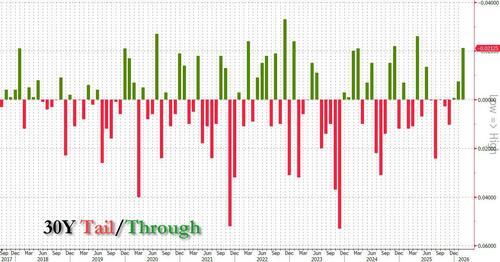
Stellar 30Y Auction Stops Through As Bid To Cover Soars, Dealers Plunge To Record Low
Stellar 30Y Auction Stops Through As Bid To Cover Soars, Dealers Plunge To Record Low
It was the polar opposite to yesterday’s slop.
After a mediocre 3Y, and a dismal 10Y auction yesterday, moments ago the Treasury concluded the sale of the week’s final refunding auction, when it unloaded $25BN in 30Y paper to seemingly endless demand.
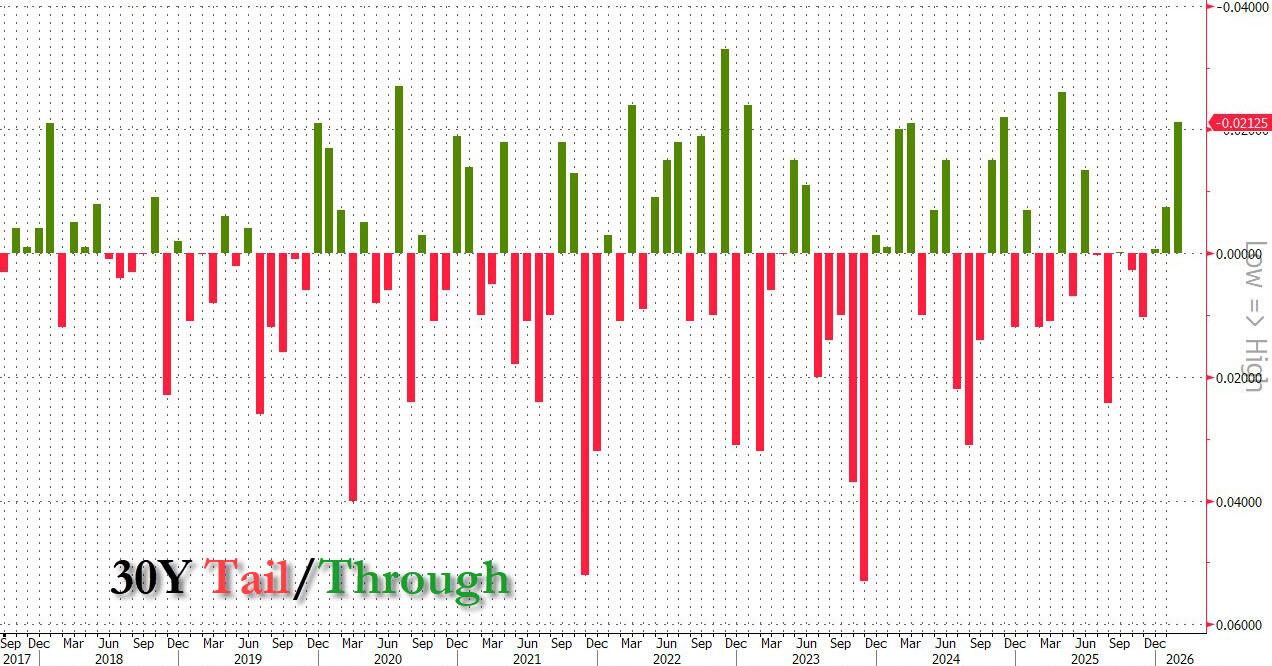
The auction stopped at a high yield of 4.750%, down from 4.825% in January, and the lowest since November. It also stopped through the 4.771% When Issued by 2.1bps, the biggest stop since LIberation Day in April 2025.
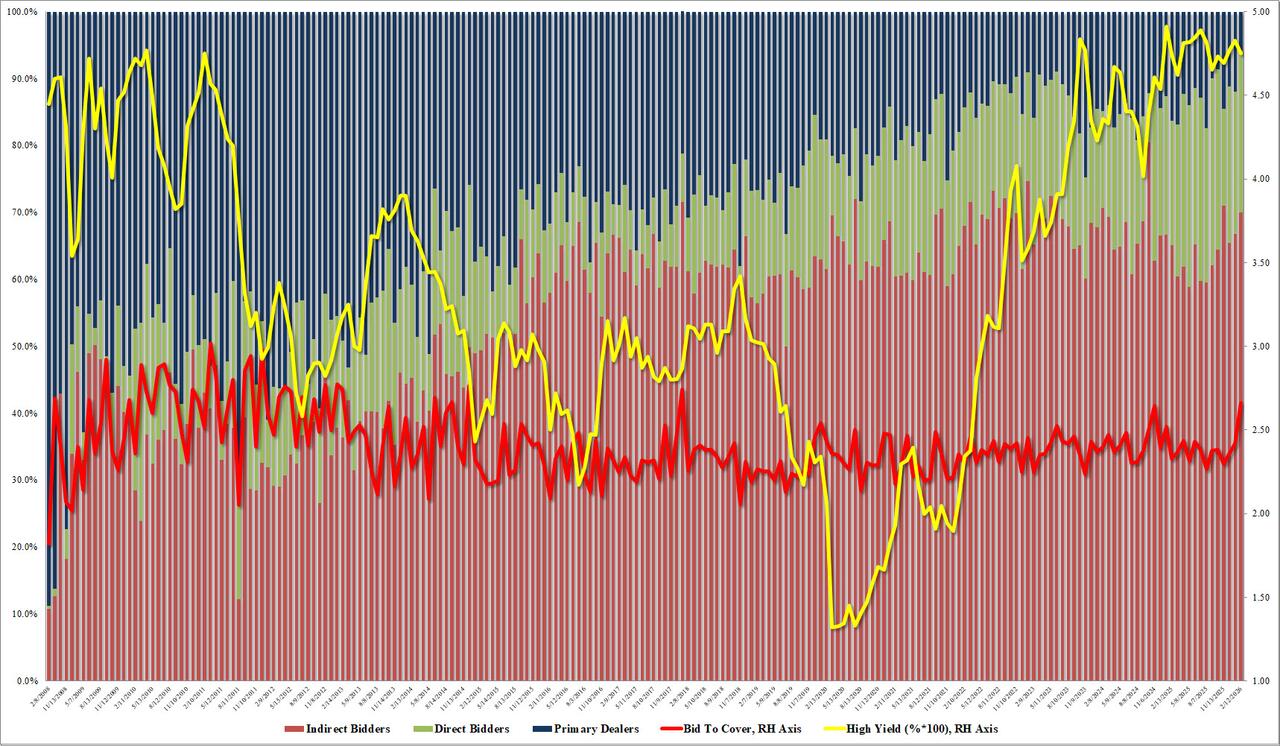
The bid to cover was 2.662, up sharply from 2.418 and the highest since January 2018! An oddity today is that the Fed’s SOMA tendered for, and accepted, a whopping $7.1 billion, a continuation of yesterday’s massive retention when the SOMA ended up with over $11BN of the 10Y.
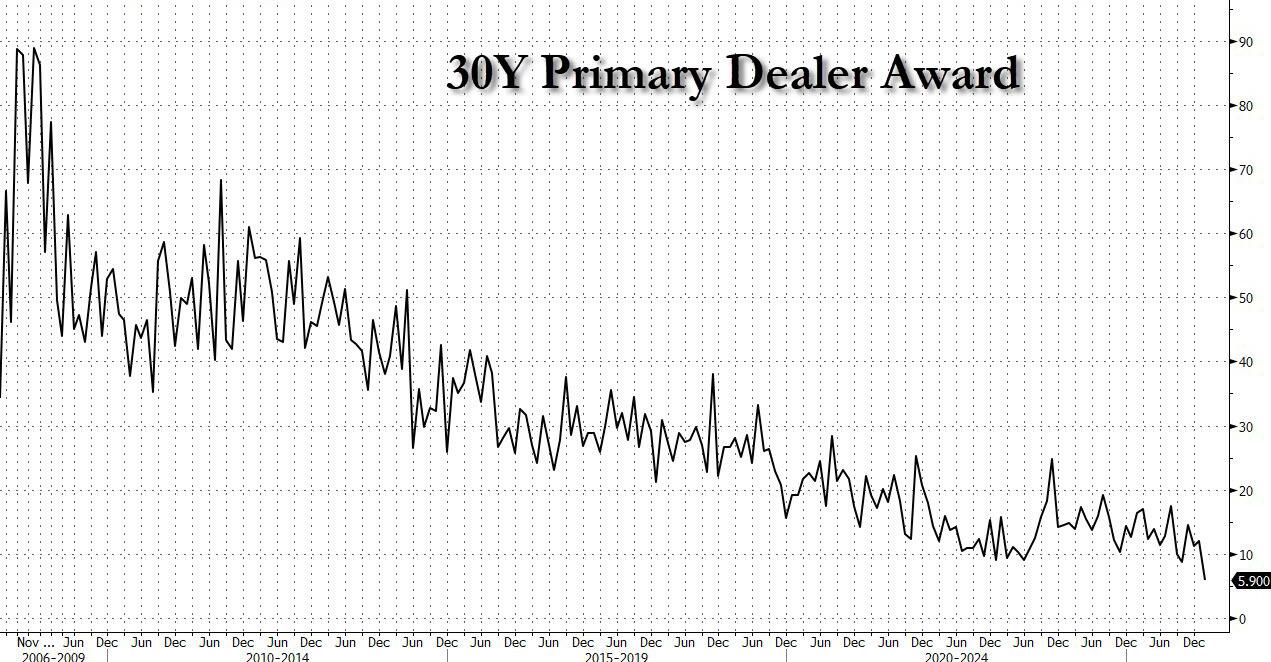
The internals were also stellar, with Indirects taking down 69.94%, up from 66.77% and the highest since November. And with Directs rising to 24.18% (if not a record high, unlike this week’s 3Y auction), Dealers were left with just 5.88%, down from 11.95% last month, and the lowest on record.
Overall, this was a stellar 30Y auction, one of the strongest on record, and clearly an indication that nobody is afraid that tomorrow’s delayed CPI may come in overly hot.
Tyler Durden
Thu, 02/12/2026 – 13:42

Investigan venta de edificios a Bélgica por parte de la Comisión Europea
BRUSELAS (AP) — Los fiscales han abierto una investigación sobre la venta por parte de la Comisión Europea de 23 de sus edificios a Bélgica, donde cuenta con decenas de inmuebles, informó el jueves el brazo ejecutivo de la Unión Europea.
El fondo soberano belga SFPIM compró los edificios por unos 900 millones de euros (1.000 millones de dólares) en 2024 para ayudar a transformar el barrio europeo de la capital, Bruselas, “en una zona moderna, atractiva y más verde”, según la Comisión Europea.
La comisión señaló en un comunicado que “la venta de los edificios siguió los procedimientos y protocolos establecidos, y confiamos en que el proceso se llevó a cabo de conformidad con las normas”. No ofreció detalles sobre la investigación.
La institución subrayó que “está comprometida con la transparencia y la rendición de cuentas”, y prometió cooperar plenamente con la Fiscalía Europea, o EPPO, que investiga delitos contra los intereses financieros de la Unión Europea.
La comisión, que propone leyes de la Unión Europea y supervisa la manera en que se aplican, prometió aportar “toda la información y la asistencia necesarias para garantizar una investigación exhaustiva e independiente sobre este asunto”, también en coordinación con las autoridades belgas.
La EPPO también declinó ofrecer detalles sobre la pesquisa para “no poner en peligro los procedimientos en curso y su resultado”. La portavoz Lidija Globokar se limitó a indicar que los fiscales estaban “realizando actividades de recopilación de pruebas en el marco de una investigación en curso”.
El Financial Times, que citó a “dos personas familiarizadas con la operación”, informó que la policía belga llevó a cabo registros en distintas dependencias de la comisión el jueves, incluido el departamento de presupuesto del brazo ejecutivo de la Unión Europea.
La comisión, que emplea a más de 30.000 personas, todavía posee alrededor de 60 edificios en Bruselas.
___________________________________
Esta historia fue traducida del inglés por un editor de AP con ayuda de una herramienta de inteligencia artificial generativa.
Supreme Court To Hear Roundup Maker’s Bid To Block Thousands Of Lawsuits In April
Supreme Court To Hear Roundup Maker’s Bid To Block Thousands Of Lawsuits In April
Authored by Matthew Vadum via The Epoch Times,
The U.S. Supreme Court scheduled oral argument in Monsanto’s appeal seeking to block thousands of lawsuits alleging the company failed to warn consumers that Roundup, its popular weedkiller, could cause cancer.
The court announced on Feb. 11 that it will hear Monsanto Co. v. Durnell on April 27.
The justices also scheduled arguments in two other high-profile cases.
Chatrie v. United States, which is about the constitutionality of search warrants that collect the location history of cellphone users near crime scenes, will also be heard on April 27.
The court will hear the consolidated cases of Federal Communications Commission (FCC) v. AT&T and Verizon Communications v. FCC together on April 21. The cases are about whether provisions in the federal Communications Act of 1934 allowing the FCC to use in-house adjudications to levy penalties are constitutional.
In the Monsanto case, a jury ruled for John Durnell, a Missouri man who allegedly developed non-Hodgkin lymphoma after exposure to Roundup. The jury found Monsanto liable for failing to warn Durnell of the danger posed by the ingredient glyphosate and awarded him $1.25 million in damages. Glyphosate is an herbicide that kills weeds and grasses.
A state appeals court upheld the jury’s finding of liability, and the Missouri Supreme Court declined to take up the matter. Many other lawsuits have been filed across the United States alleging that Roundup caused medical problems.
Missouri has not issued an official health warning about Roundup, and Monsanto has been unsuccessful in lobbying the Missouri Legislature to shield it from state-level failure-to-warn lawsuits. In 2015, an agency within the World Health Organization (WHO) classified glyphosate as “probably carcinogenic to humans.” The U.S. Environmental Protection Agency (EPA) rejected that conclusion, but in 2017, California accepted the WHO agency’s finding and categorized glyphosate as a chemical that causes cancer.
Monsanto, which was purchased in 2018 by biotechnology and pharmaceutical giant Bayer, argues that a federal law governing the labeling of pesticides preempts—or overrides—any state lawsuits.
U.S. Solicitor General D. John Sauer sided with Monsanto in a brief, writing that leaving the Missouri court’s ruling in place means “a jury may second-guess the [EPA’s] science-based judgments.”
In a brief, Durnell’s attorneys alleged that Monsanto “has known for decades” that Roundup can cause cancer, but has neither made its product safer, nor told consumers they should be cautious when using it.
“Instead, Monsanto has marketed Roundup as safe to spray in a t-shirt and shorts,” they said.
Geofencing Challenge
In the Chatrie case, the Supreme Court will consider whether the Fourth Amendment bars the collection of cellphone users’ location history around crime scenes.
If cellphone users want to access certain services, their phones must be set to continuously transmit their exact locations to wireless service providers. A so-called geofence warrant, which is growing in popularity with law enforcement agencies, allows police to seek location data on every person who was present at a specific location over a certain period of time.
Geofence warrants were used to investigate the Jan. 6, 2021, security breach at the U.S. Capitol. The location data led to charges against some of those involved. Some judges allowed the warrants, while others ruled that they violated the Fourth Amendment’s guarantee against unreasonable search and seizure.
Petitioner Okello Chatrie was convicted of armed robbery based on data obtained under a geofence warrant, and sentenced to nearly 12 years of incarceration.
Law enforcement had obtained a geofence warrant from a state court for anonymized location data for every device that was within 150 meters (about 500 feet) of a 2019 bank robbery within one hour of the robbery, and served it on Google. Anonymized data do not contain information that could be used to identify specific cellphone users.
Google complied with the warrant and provided a list, and then, without seeking a fresh warrant, law enforcement expanded its data search, and Google handed over the additional information sought.
Chatrie’s attorneys had argued the warrant violated his privacy because it allowed investigators to gather the location history of people who were near the financial institution that was robbed, even though there was no evidence of any connection to the robbery. Prosecutors countered that Chatrie had no expectation of privacy because he voluntarily opted into Google’s location history services.
A divided federal appeals panel found that because the petitioner allowed location tracking on his cellphone, the Fourth Amendment did not apply.
Sauer said in a brief that because Chatrie voluntarily provided Google with his location history, he relinquished any privacy right he might have had in that information.
SEC Cases
In the SEC cases, the Supreme Court will consider whether the FCC’s power to levy large fines violated Verizon and AT&T’s constitutional right to a jury trial.
The FCC fined the two telecommunications companies for sharing customer location data with third parties without consent. The fines were issued before the companies had their day in court.
The dispute is the latest legal case to test whether the in-house enforcement system used by a federal agency violates the Seventh Amendment.
The case arose after the FCC levied almost $200 million in fines against wireless carriers. T-Mobile was ordered to pay $80 million, while Sprint, which T-Mobile purchased in 2020, had to pay $12 million. AT&T was required to pay $57 million, while Verizon was ordered to pay almost $47 million.
The U.S. Court of Appeals for the Second Circuit affirmed Verizon’s penalty, finding the Constitution allows the FCC to carry out an initial penalty assessment, provided that an accused party is permitted to dispute the government’s collection efforts in court.
The Fifth Circuit, on the other hand, found that the initial assessment and fine the FCC imposed on AT&T violated the company’s right to have a jury trial.
The cases come after the Supreme Court limited the Securities and Exchange Commission’s use of in-house administrative tribunals, finding that defendants facing civil penalties are entitled under the Seventh Amendment to a jury trial.
“A defendant facing a fraud suit has the right to be tried by a jury of his peers before a neutral adjudicator,” Chief Justice John Roberts wrote in SEC v. Jarkesy.
Verizon said in its Supreme Court petition that “the FCC scheme at issue here mirrors the SEC scheme rejected in Jarkesy in every material respect.”
The FCC said in a brief that the Second Circuit was correct to rule that the fine complies with the Seventh Amendment.
However, the commission said it agreed with Verizon that the issues raised by the company deserved to be reviewed by the Supreme Court.
Decisions in the three cases are expected to be issued by the end of June.
Tyler Durden
Thu, 02/12/2026 – 13:40