Category: News

Victor Hanson On Our Super Bowl Satyricon
Victor Hanson On Our Super Bowl Satyricon
Authored by Victor Davis Hanson via American Greatness,
In recent years, Americans have known what to expect from our Neronian Super Bowl halftime shows: mediocre music veneered over with gaudy, flashily lit, but ultimately empty and meaningless sets.
As seen again this year, the usual array of supporting dancers twerk and simulate intercourse, in sync with the main singer, mindlessly grabbing his/her genitals—apparently to highlight the explicit sexual allusions of mostly nonsensical lyrics.
For some strange reason, this Roman orgiastic ritual is supposedly designed by the NFL each year to appeal to American families of all ages as they gather together around the living room TV on their festive cultural holiday.
But the script has now grown predictable and trite. This year’s mess jumped the shark and had a force-multiplying boring effect on one of the most tedious Super Bowl games in history.
The decision to have Bad Bunny as the main attraction to sing solely in Spanish—only 14 percent of the U.S. population is fluent in Spanish, while 90 percent is proficient in English—was apparently designed to grow the NFL’s global audience, particularly in the Western Hemisphere, or perhaps to shock America to get accustomed to its new official multilingual identity.
Yet of the anticipated 60 million Americans who likely watched this flat show, more than 50 million of them could neither read nor comprehend Spanish.
And they had previously been insulted by Bunny to hurry up and learn Spanish before the game—or else?
How odd that America provides translations of every conceivable language in its courts, hospitals, and schools for minorities of non-English-speaking residents. And yet at its annual signature sporting event, the marquee and main-event non-English speaker would not even provide translations for the vast majority of the viewing population.
Part of the hype of Bunny’s appearance was his supposedly edgy decision to perform entirely in Spanish. But was that really so avant-garde?
What would have been far more against-the-grain and bold for Bad Bunny would have been to find some way to reconnect with the millions of disenchanted families who simply wish a hiatus from the monotonously gross and politicized Super Bowl bacchanalias.
Most in the stadium had no idea what Bad Bunny was singing about, if we can call his nonstop talking and mumbling true music.
Fortunately for Bunny, that language barrier turned out to be about the only good thing about the entire Sunday disaster.
Most of Bunny’s lyrics were raunchy and demented, and likely out-Epsteined the imagination of the late Jeffrey Epstein.
In his vile, obscene “Safaera,” to avoid being censored, Bunny omitted a few of the song’s lyrics about his celebration of exploitative sodomy, fellatio, and anilingus—with misogynistic trashing of his compliant female sexual partners as “hoes.”
(Do woke intersectional feminists weigh in on the side of Bunny’s DEI credentials and sexual fluidity, or do they bristle at Bunny’s “objectification” of women, as he reduces them to mere mindless receptacles of violent and toxic masculinity?).
If Bunny’s purpose was to shock America, then he should have sung his full lyrics of “Safaera” in English, ensuring that his first-time listeners were forced to hear and react to his sick adolescent riffs on breasts, bottoms, phalluses, and vaginas.
Bunny had been previously instructed not to repeat his prior performance-art trashing of ICE and to keep his politicking subtle and coded.
Translated, that meant the NFL had greenlighted some of his obscene references as long as they were relegated to a Spanish-speaking audience only and toned down a bit. But he was not overtly to alienate over half of the NFL’s viewership, who not long ago had voted to stop illegal immigration and millions crashing the border.
Bunny mostly complied, albeit with empty platitudes about hate and love, and reducing the American flag to a status similar to that of the other South and Central American states.
Ricky Martin chimed in with his own incoherent Spanish-language harangue about the American rape of paradise in Hawaii (“They want to take my river and my beach too/They want my neighborhood and grandma to leave”).
If Martin’s point was the arrival of too many newcomers, then he might have first reflected on the 10-million uninvited illegal aliens who, during the Biden tenure, stormed America’s southern border.
A writer for the now-defunct sports section of the Washington Post had earlier and ludicrously boasted that the mostly forgotten Colin Kaepernick—the Dylan Mulvaney of the NFL—would be the most relevant figure at the 2026 Super Bowl.
Perhaps he was—if the writer meant by “relevant” the narcissistic Kaepernick’s past popularizing of taking-the-knee during the National Anthem.
That antic likely reduced NFL viewership by 25 percent in 2016-2017, and turned Sunday afternoons into racial psychodramas with two race-coded National Anthems.
In sum, last Sunday was the same old, same old Super Bowl Satyricon.
Tyler Durden
Thu, 02/12/2026 – 17:00
https://www.zerohedge.com/political/victor-hanson-our-super-bowl-satyricon

Cook County Treasurer Maria Pappas held stock in company that has county technology deal
Cook County Treasurer Maria Pappas held stock for years in a company with a major contract working in her office, a potential violation of the county’s conflict-of-interest rules.
Pappas has been one of the most vociferous critics of Tyler Technologies, the company that has been in charge of the rocky upgrade of the county’s property tax system, for more than a decade. Tyler has been embedded in the treasurer’s office, which calculates and mails out property tax bills, for years.
The problematic rollout of Tyler’s tax system revamp within county offices led to late property tax bills last year and problems distributing property tax revenues in recent months to local agencies like schools and libraries.
But while she was hammering Tyler, Pappas owned stock in the company. Pappas’ office shared statements from her broker that show ten Tyler shares were purchased in 2020, and four more in 2022. Together, they cost $4,562. Tyler first received the county contract in 2015.
Pappas said she was not aware of the investment, which was made by a former broker, and sold them in March of 2024. And following a Tribune inquiry, she also sold stock for other companies doing business with the county, including the bank providing lockbox and collection services for the treasurer, her office said.
Those investments were some of the 30 to 40 assets, including individual stocks and exchange-traded funds, that Pappas disclosed in annual statements of economic interest between 2021 and 2024. Under state law, officials are required to disclose those worth more than $10,000.
Even though the holdings were less than $10,000, Pappas’ office said she reported them anyway “in the interest of transparency,” but suggested she did not review them closely.
“When she realized they were in her portfolio, she instructed her new broker to sell the shares immediately,” spokesman Michael Puccinelli said of the Tyler stock in an emailed statement. She submitted her economic interest statements without noticing Tyler on the list, he said, and when she did, she asked her new broker to sell.
After the Tribune asked this week about the Tyler stock or other holdings that potentially represented a conflict, Pappas sold stakes in Microsoft, CDW, and JP Morgan, according to her office. JP Morgan has a contract with the Treasurer’s office to allow taxpayers to pay property taxes at Chase Bank locations, process fees and fines, and make online payments and remote deposits.
CDW provides IT infrastructure equipment countywide, and the county broadly uses Microsoft for its operating system.
People conduct business at the counters in the Cook County Treasurer’s office on Jan. 10, 2024. (Brian Cassella/Chicago Tribune)
Puccinelli said Pappas didn’t realize she held the stock from the other county contractors until the Tribune asked about additional potential conflicts. All the stocks Pappas held bought were for amounts below the $10,000 disclosure threshold, but she disclosed them anyway, according to Puccinelli.
“It was a mistake and a learning experience. She should’ve been aware of this and wasn’t,” the statement from Pappas’ office says.
The county’s ethics ordinance states no county official can use their position “to influence any County governmental decision or action” if that person “knows, has reason to know, or should know” that they or a relative has “any economic interest in such action or decision.”
Pappas didn’t have direct hiring or firing power over Tyler. The project was overseen by the Bureau of Technology under Cook County Board President Toni Preckwinkle’s office. But Pappas and other county officials whose offices dealt directly with the property tax system were consulted on contract extensions, and were in charge of executing Tyler changes in their offices.
The threshold for what “interest” means in the county’s ethics ordinance “is confusingly written,” Alisa Kaplan of the watchdog group Reform for Illinois said in an email. The ordinance seems to use financial and economic interest interchangeably. While “economic interest” includes anything of value in monetary terms, financial interest is more specific, including something in which the owner “currently received or is entitled to receive in the future more than $1,200 per year” or “with a cost or present value of $5,000 or more.”
The Tyler sale yielded $5,865 for a net profit of $1,303.
“It appears that Pappas would only be violating the law if she were making official decisions about Tyler while her interest in the company was worth $5,000 or more. It’s not clear that that ever happened. If it did — if the value of her Tyler stock rose to over $5,000 at some point while she was participating in decision making about the company — we’re talking about a pretty small number above the threshold here,” Kaplan wrote, suggesting the ordinance needed clarifying.
Juliet Sorensen, a former member of the county’s Board of Ethics and the director of the Rule of Law Institute at Loyola University, said even if her broker managed her investments day-to-day, Pappas reasonably should have known what she held, given her position and the annual requirement to report holdings.
The $5,000 and $10,000 discrepancy could have been a source of confusion, Sorensen said, but she could have asked the ethics board for advice, including about whether she was required to disclose those potential conflicts to them.
“What is the treasurer’s office in the business of?” Sorensen said. “Should she know the county does business with JP Morgan? I think so.”
A spokesperson for Tyler said they were not aware of Pappas’ holdings and “do not have access to ownership held by individuals.”
At the time of the first purchase in March of 2020, Tyler had just hit a major milestone: $1 billion in revenue. The stock price was about $277.
By that time, Pappas had been railing against the company for months, saying in a November 2019 letter it had blown deadlines, cycled through project managers and driven up ancillary costs. She concluded “it is long past time to cancel the contract with Tyler Technologies, possibly the worst technology contract with a vendor that Cook County has ever written.”
Just before the second stock purchase in January 2022, Pappas had written to Tyler’s CEO to chastise the company for being “four years late” on its work in her office and express her skepticism that any of its future timeline goals would be met. By then, the stock price was up to $470.
Just after the third stock purchase in May of 2022 – a single share for $376 – the county extended Tyler’s contract with new guardrails tying payment to goals being met. Pappas had written to Preckwinkle opposing its passage, saying it “would be throwing good money after bad and should be rejected.”
Top Tyler leaders haven’t been thrilled with Pappas either, replying to her letters by defending their work and characterizing her correspondence as counterproductive and at times, misleading or hyperbolic.
Pappas is running for re-election as county treasurer, a post she’s held since 1998. She has no challengers in the March 17 Democratic primary, and has floated running for mayor in the 2027 election.

Photos: The best images from Day 6 of the 2026 Winter Olympics
The helmet of Vladyslav Heraskevych, a Ukrainian skeleton athlete who was disqualified from his events at the 2026 Milan Cortina Winter Olympics, shown during a press conference at the Ukrainian General Consulate in Milan, Feb. 12, 2026. The IOC’s decision to disqualify Heraskevych over his helmet honoring countrymen killed in the war with Russia touched off the biggest crisis of the Games in Italy. (Vincent Alban/The New York Times)
Jens van ‘t Wout of the Netherlands wins gold as silver medalist Sun Long of China falls at the finish line during the short track speedskating men’s 1,000-meter final at the 2026 Winter Olympics, in Milan, Italy, Feb. 12, 2026. (Natacha Pisarenko/AP)
Silver medalist Chloe Kim of the United States celebrates during the medal ceremony for the women’s snowboard halfpipe at the Olympics at Livigno Snow Park on Feb. 12, 2026 in Livigno, Italy. (Patrick Smith/Getty)
United States’ Chloe Kim competes during the women’s snowboarding halfpipe finals at the 2026 Winter Olympics, in Livigno, Italy, Feb. 12, 2026. (Abbie Parr/AP)
Kristen Santos-Griswold of the United States competes during the short track speedskating women’s 500-meter at the 2026 Winter Olympics, in Milan, Italy, Feb. 12, 2026. (Natacha Pisarenko/AP)
Dutch fans cheer during the women’s 5,000 meters speedskating race at the 2026 Winter Olympics, in Milan, Italy, Feb. 12, 2026. (Luca Bruno/AP)
Jessie Diggins, of the United States, competes in the cross country skiing women’s 10km interval start free at the 2026 Winter Olympics, in Tesero, Italy, Feb. 12, 2026. The Afton native placed third to win her fourth Olympic medal. (Matthias Schrader/AP)
Gold medalist Francesca Lollobrigida of Italy, center, Merel Conijn of the Netherlands, left, and Ragne Wiklund of Norway, celebrate on the podium after the women’s 5,000 meters speedskating race at the 2026 Winter Olympics, in Milan, Italy, Feb. 12, 2026. (Ben Curtis/AP)
Jessie Diggins, of the United States, celebrates after winning the bronze medal in front of gold medalist Frida Karlsson, of Sweden, on the podium of the cross country skiing women’s 10km interval start free at the 2026 Winter Olympics, in Tesero, Italy, Feb. 12, 2026. (Matthias Schrader/AP)
Nadezhda Morozova, of Kazakhstan, warms up prior to competing in the women’s 5,000 meters speedskating race at the 2026 Winter Olympics, in Milan, Italy, Feb. 12, 2026. (Ben Curtis/AP)
Italy’s Federica Brignone, center, gold medalist in an alpine ski, women’s super-G race, celebrates with silver medalist France’s Romane Miradoli, left, and bronze medalist Austria’s Cornelia Huetter at the 2026 Winter Olympics, in Cortina d’Ampezzo, Italy, Feb. 12, 2026. (Jacquelyn Martin/AP)
Italy’s Federica Brignone speeds down the course during an alpine ski women’s super-G race at the 2026 Winter Olympics in Cortina d’Ampezzo, Italy, Feb. 12, 2026. (Marco Trovati/AP)
The Italian Frecce Tricolori acrobatic squad flies above during the medal ceremony of an alpine ski, women’s super-G race, at the 2026 Winter Olympics, in Cortina d’Ampezzo, Italy, Feb. 12, 2026.(Robert F. Bukaty/AP)
United States’ Nathan Pare (13), France’s Jonas Chollet (4) and France’s Loan Bozzolo (5) compete during the men’s snowboard cross finals at the 2026 Winter Olympics, in Livigno, Italy, Feb. 12, 2026. (Lindsey Wasson/AP)
France’s Floran Douay, right, checks Switzerland’s Dean Kukan during a preliminary round match of men’s ice hockey at the 2026 Winter Olympics, in Milan, Italy, Feb. 12, 2026. (Carolyn Kaster/AP)
Trinidad And Tobago’s Axel Brown, front, starts for a two-man bobsled training session at the 2026 Winter Olympics, in Cortina d’Ampezzo, Italy, Feb. 12, 2026. (Aijaz Rahi/AP)
United States’ Landon Wendler competes during the men’s freestyle skiing moguls qualifications at the 2026 Winter Olympics, in Livigno, Italy, Feb. 12, 2026. (Abbie Parr/AP)

3 Illinois GOP rivals for US Senate sidestep criticizing President Donald Trump in debate but note differences
Three Republicans seeking the party’s March 17 nomination for the U.S. Senate did what they could to avoid airing disagreements with President Donald Trump’s policies while still acknowledging some differences they have with the GOP’s national leader.
Don Tracy, Jeannie Evans and Casey Chlebek appeared Wednesday night at an hour-long debate hosted by ABC-Ch. 7, Univision Chicago and the League of Women Voters of Illinois and Chicago, with each of the candidates making some missteps as they contended a Republican could win the race for retiring Democratic U.S. Sen. Dick Durbin’s seat in deep blue Illinois.
Tracy, a former state GOP chairman, joined the other two in opposing an increase to the $ 7.25-per-hour federal minimum wage. He noted Illinois had increased its minimum wage for developmentally disabled workers and said, “Some of these people cannot produce anywhere near the value of the minimum wage.”
Chlebek, who has unsuccessfully sought the GOP U.S. Senate nomination in 2020 and 2022, answered the minimum wage question by instead talking about immigration. During the debate, he had difficulty understanding questions and frequently asked moderators to repeat them. He also said “abolishing property taxes” was a key campaign plank, though the federal government has no role in levying local real estate taxes.
Evans, an attorney billing herself as a “fresh face of the Republican Party of Illinois,” said she was unaware that her campaign website party lacked any mention of her political party affiliation. She tried to shy away from questions about whether she agreed with Trump’s decision to pardon Jan. 6 rioters who were involved in the deadly 2021 insurrection attempt to overturn Joe Biden’s election, saying, “It’s 2026. I’m moving forward.”
After the debate, Evans told reporters, “I was not involved in those decisions. I didn’t see all the decisions” involving the presidential pardon. She also tried to avoid answering a question about whether she agrees with Trump’s unfounded belief that the 2020 election was stolen, first repeating that she’s “ready to move forward” before acknowledging, “I have not seen the evidence of the election being stolen, so I’m just ready to move on to other topics.”
All three found various points to praise Trump.
“I’d like to focus on the things that I agree with,” Evans said. “I think this administration is doing a tremendous job in various areas,” such as securing the border and pushing to reduce business regulations.
“We have a very energetic president,” Tracy said, adding that asking him for any areas of disagreement with Trump was “a very broad question because there’s so many different policies, so many different things the president is trying to do.”
Chlebek said he was “totally on board with President Trump regarding” deregulation, adding “the extra protections that we have by all these over-regulated industries is actually a killer for many, many businesses.”
But all three said they did not support Trump’s call to nationalize elections, although Chlebek said voting should be limited to one day nationally and made the baseless claim that voting by mail is “prone to actually, fraud.”
The three also expressed concerns with Trump’s tariff policies, with Evans noting that she is a “free market economist,” while Tracy contended “we’ve been subsidizing the world, including China and Europe,” for way too long. Chlebek said tariffs should not be used in an “arbitrary fashion” and should be used only to retaliate against countries that dump goods into the United States.
Evans and Tracy blamed the state’s sanctuary policies for encouraging illegal immigration. Evans said she would “work to build cooperation between local, state and federal law enforcement.” Tracy said Trump’s aggressive immigration enforcement policies have “worked around the country. In sanctuary cities, due to massive resistance, it’s not working as well as it should.”
But Chlebek, who emigrated legally from Poland to Chicago with his family as a youth, criticized immigration enforcement agents for using “arbitrary rules” and said he opposed “a blanket way of just removing people from the streets.”
“If somebody is here five, ten years, we should apply a little bit different approach to them because maybe their positions are justified and maybe, as being good citizens and paying taxes, we should be giving them a way to citizenship,” he said.
Tracy, who lost a 2002 bid for a state Senate seat when he ran as a Democrat and in 2010 was an unsuccessful GOP lieutenant governor candidate, took a jab at Evans by saying the U.S. Senate was “certainly no job for a political novice.”
“Now that the U.S. Senate seat is going to be open, it’s a terrific opportunity for an Illinois Republican to win statewide again in Illinois. But winning that seat will not be easy. It will be an uphill dogfight,” said Tracy, a lawyer from Springfield who, with his siblings own Dot Foods, the world’s largest foodservice company. “I have worked with diverse coalitions, which is like herding cats sometimes. I know how to deal with adversaries. I am the most qualified candidate to win that particular seat.”
But Evans noted “the two others on this stage have run before on multiple occasions.”
“It’s time for a fresh face of the Republican Party in Illinois. I am ready to work hard to motivate people with conservative values across our entire state to come out to vote in November. My message will resonate,” she said.
Chlebek asked voters “to give me a chance to bring accountability and true leadership to Washington. I think we can do better.”
https://www.chicagotribune.com/2026/02/12/illinois-gop-senate/

Dollar Detente? Kremlin Memo Explores Rejoining US-Led Financial System
Dollar Detente? Kremlin Memo Explores Rejoining US-Led Financial System
The Kremlin apparently has a highly ambitious proposal for finally mending relations with the United States and wooing the Trump administration to its side regarding resolution to the Ukraine war.
It centers on Russia weighing a return to the dollar-based settlement system as part of a broader economic reset with the White House, according to an internal Kremlin memo reviewed by Bloomberg.
The high-level document drafted this year lays out seven sectors where Russian and US economic interests could converge in the aftermath of a Ukraine war settlement.
One central item is the call for pivoting back to fossil fuels over green energy, expanding joint ventures in natural gas and offshore oil, while partnering on critical minerals – with significant upside for American firms.
The partnership would include, per the Bloomberg report:
1. US and Russia working together on fossil fuels
2. Joint investments in natural gas
3. Offshore oil and critical raw material partnerships
4. Windfalls for US companies
5. Russia’s return to the USD settlement system
The memo was reportedly circulated among senior Russian officials and would mark a dramatic and sharp reversal from the Kremlin’s de-dollarization push, with obvious major implications for global financial flows.
It’s as yet unclear if the proposals have been formally presented to the US side – it seems unlikely at this stage – given Ukraine-focused talks have really gone nowhere of late.
All of the above seems a pipe dream if the basic issues at play stoking the Ukraine conflict can’t be resolved. Chief among them remains territorial concessions, Ukraine’s NATO and EU ambitions, and the fate of Russia’s frozen sovereign assets in Europe.
President Putin has repeatedly slammed the US for weaponizing the dollar as a tool to pressure other countries, through sanctions and other methods of economic isolation. But he also point out this ‘strategic mistake’ is backfiring while in reality slowly weakening the dollar and eroding global confidence.
Kremlin spokesman Peskov has yet to comment. In Moscow, is the discussion that BRICS de-dollarization us now a dead game?
Tyler Durden
Thu, 02/12/2026 – 16:40

Ex-CPD detective invokes 5th Amendment dozens of times in wrongful conviction trial
Disgraced former Chicago police detective Reynaldo Guevara invoked his 5th Amendment rights against self-incrimination more than 80 times Thursday in an ongoing federal wrongful conviction trial where he is accused of beating witnesses and coercing a confession in a 1989 gang-related slaying in Humboldt Park.
Guevara’s testimony, which was given remotely from San Antonio, Texas, where he now lives, came just days after city attorneys recommended aldermen spend $29.2 million to settle four separate lawsuits tied to the notorious ex-detective.
How the jury weighs Guevara’s refusal to answer questions could factor heavily into how much the city will eventually pay out in the more than two dozen other lawsuits that are still pending against him — or whether the Law Department decides to roll the dice and take some of them to trial.
Unlike in criminal proceedings, attorneys are allowed to argue in a civil case that a defendant invoking the 5th Amendment is doing so to shield himself from potential criminal liability.
About midway through Guevara’s testimony Thursday, U.S. District Judge Jeremy Daniel instructed the jury that they can, “but are not required to,” assume Guevara’s answers to the questions “may have been unfavorable to him.”
Former Chicago police detective Reynaldo Guevara testifies remotely from Texas on Feb. 12, 2026, in a wrongful conviction trial where he is accused of framing Jaime Rios for a June 27, 1989, gang-related murder in Humboldt Park. (L.D. Chukman)
Guevara, 82, who retired in 2005 and is still pulling a $91,000 annual city pension, has testified multiple times in post-conviction proceedings and lawsuits over the years, but it’s become much more rare since he first began invoking the 5th Amendment some 13 years ago.
His testimony Thursday marked his first appearance in a federal courtroom since he took the witness stand in 2018 in a lawsuit brought by Jacques Rivera, who accused the longtime gang crimes detective of framing him for the 1988 slaying of 16-year-old Felix Valentin.
In that trial, Guevara asserted his rights against self-incrimination more than 200 times, refusing to answer a barrage of questions about his policing practices, including whether he ever coerced witnesses into making identifications, falsified police reports or pinned bogus charges on suspects.
That jury found in favor of Rivera and awarded him $17.5 million for the 20 years he spent in prison before he was exonerated in 2011.
Since that verdict, the city has not gone to trial on any Guevara-related case, choosing to settle suits for often-staggering sums, despite shelling out tens of millions of dollars to outside lawyers to litigate the cases.
The current trial involves allegations by Jaime Rios, an admitted former Latin Kings gang member convicted in the June 27, 1989 shooting death of rival Spanish Cobras gang member Luis Morales on North Western Avenue.
Rios’ attorneys contend that the case had gone cold when Guevara, who at the time was a gang crimes specialist, not a homicide detective, inserted himself into the investigation by claiming two confidential informants had fingered Rios as the gunman.
Guevara and two colleagues, then-detectives Michael Mason and Ernest Halvorson, then orchestrated a frame-up by coercing one witness to identify Rios by beating him with a phone book and flashlight, and another by threatening to charge him with obstruction, according to the plaintiffs’ allegations.
Rios, meanwhile, gave a court-reported confession to the murder after detectives slammed his head into a table and threatened to take away his kids, according to the allegations.
“You will see Reynaldo Guevara was not an honest cop,” plaintiff’s attorney Stephen Richards told the jury in opening statements last week. “He was not just seeking to do good things…he was perceived as a thug, a corrupt officer. Not an officer who was out to seek the truth.”
But defense attorneys called Rios’ claims a fabrication, noting he had no visible injuries despite being allegedly roughed up in his interrogation and wound up confessing to the crime on three separate occasions, including in a typed court-reported statement before a Cook County state’s attorney.
Rios spent 17 years in prison before being paroled in 2007, yet waited more than 15 years to file his petition for a new trial, the defense noted.
In his opening statement to the jury, Guevara’s attorney, Timothy Scahill, blamed then-State’s Attorney Kim Foxx for Rios’ eventual exoneration in 2022, saying her own prosecutors thought the conviction was solid and that they should fight the effort for a new trial in court.
Instead, Scahill said, Foxx ordered them to stop fighting the litigation, including Rios’ pursuit of a certificate of innocence, which was granted without investigation after a hearing that lasted “about a minute and a half,” Scahill said.
“Kim Foxx made a decision based on nothing, case closed,” Scahill said. “We are here because the state’s attorney’s office didn’t do what they are supposed to do.”
Scahill also urged the jury to not read into Guevara’s reasons for taking the 5th, which was not his recommendation but the strategy of another Guevara attorney.
“The 5th Amendment protects innocent people. It protects people from government overreach (and) overzealous prosecutors,” Scahill said in his opening remarks. “Are there reasons why an 82-year-old retired man might be fearful he might be subjected to an unjust prosecution? I would submit to you there are a lot of reasons, and none of them have to do with him being guilty of anything.”
Guevara appeared in court Friday on a video screen that had been wheeled in front of the witness stand in Daniels’ 14th Floor courtroom. Dressed in a dark suit and blue shirt, with his beard now completely gray, Guevara seemed stiff as he fielded the first question from Richards: In 1989, were you a gang specialist?
“Yes,” Guevara said.
Guevara was then asked when he first heard of Morales’ murder in June 1989.
“On the advice of my attorney, I invoke my Constitutional rights under the 5th amendment,” Guevara answered.
Over the next half hour, Guevara would go on to invoke his rights against self-incrimination 81 more times, declining to answer questions about whether he falsely arrested Rios, searched his apartment without a warrant, or beat witnesses with a phone book and flashlight.
Under questioning from Scahill, Guevara told the jury he and his wife of 40 years are retired and living off of his police pension and Social Security in the suburbs of San Antonio. He said his health is okay but his “mind is not that bright like it used to be.”
Is that a concern to your wife? Scahill asked.
“Yeah it concerns both of us,” Guevara said with a short laugh.
Overall, the city has faced over 40 lawsuits alleging Guevara falsified evidence, extracted confessions through torture and lied to wrongfully put dozens of Chicagoans behind bars.
The litigation has already cost the city nearly $100 million in jury verdicts and settlements, with the remaining cases — some of them more than eight years old — representing hundreds of millions of dollars more in potential liability.
jmeisner@chicagotribune.com
https://www.chicagotribune.com/2026/02/12/detective-invokes-5th-amendment-guevara/
Homeland Security shutdown seems certain as funding talks between White House and Democrats stall
WASHINGTON — A shutdown for the Department of Homeland Security appeared certain Thursday as lawmakers in the House and Senate were set to leave Washington for a 10-day break and negotiations with the White House over Democrats’ demands for new restrictions had stalled.
Democrats and the White House have traded offers in recent days as the Democrats have said they want curbs on President Donald Trump’s broad campaign of immigration enforcement. They have demanded better identification for U.S. Immigration and Customs Enforcement and other federal law enforcement officers, a new code of conduct for those agencies and more use of judicial warrants, among other requests.
The White House sent its latest proposal late Wednesday, but Trump told reporters on Thursday that some of the Democratic demands would be “very, very hard to approve.”
Democrats said the White House offer, which was not made public, did not include sufficient curbs on ICE after two protesters were fatally shot last month.
Americans want accountability and “an end to the chaos,” Senate Democratic Leader Chuck Schumer of New York said Thursday, just before the Senate rejected a bill to fund the department. “The White House and congressional Republicans must listen and deliver.”
Lawmakers in both chambers were on notice to return to Washington if the two sides struck a deal to end the expected shutdown. Sen. Patty Murray, the top Democrat on the Senate Appropriations Committee, told reporters that Democrats would send the White House a counterproposal over the weekend.
“They haven’t taken it seriously yet,” she said of Republicans.
Impact of a shutdown
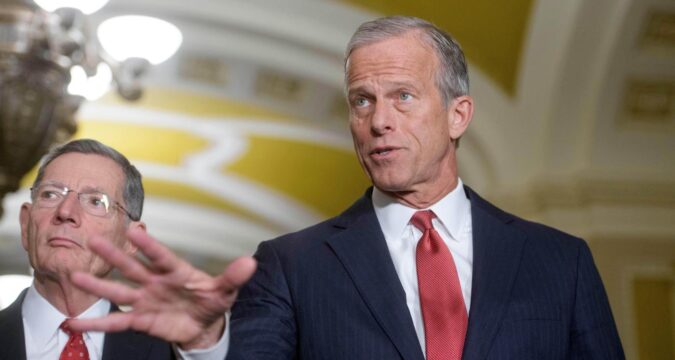
Senate Majority Leader John Thune, R-S.D., said after the vote that a shutdown appeared likely.
“The people who pay the price are the people of the agencies who are not going to be getting paychecks,” Thune said.
The impact of a DHS shutdown is likely to be minimal at first. It would not likely block any of the immigration enforcement operations, as Trump’s tax and spending cut bill passed last year gave ICE about $75 billion to expand detention capacity and bolster enforcement operations.
But the other agencies in the department — including the Transportation Security Administration, the Federal Emergency Management Agency, the Secret Service and the Coast Guard — could take a bigger hit over time.
Gregg Phillips, an associate administrator at FEMA, said at a hearing this week that its disaster relief fund has sufficient balances to continue emergency response activities during a shutdown, but would become seriously strained in the event of a catastrophic disaster.
Phillips said that while the agency continues to respond to threats like flooding and winter storms, long-term planning and coordination with state and local partners will be “irrevocably impacted.”
Trump defends officer masking
Trump, who has remained largely silent during the bipartisan talks, noted Thursday that a recent court ruling rejected a ban on masks for federal law enforcement officers.
“We have to protect our law enforcement,” Trump told reporters.
Democrats made the demands for new restrictions on ICE and other federal law enforcement after ICU nurse Alex Pretti was shot and killed by a U.S. Border Patrol officer in Minneapolis on Jan. 24. Renee Good was shot by ICE agents on Jan. 7.
Trump agreed to a Democratic request that the Homeland Security bill be separated from a larger spending measure that became law last week. That package extended Homeland Security funding at current levels only through Friday.
Schumer and House Democratic leader Hakeem Jeffries of New York have said they want immigration officers to remove their masks, to show identification and to better coordinate with local authorities. They have also demanded a stricter use-of-force policy for the federal officers, legal safeguards at detention centers and a prohibition on tracking protesters with body-worn cameras.
Democrats also say Congress should end indiscriminate arrests and require that before a person can be detained, authorities have verified that the person is not a U.S. citizen.
Republicans have been largely opposed to most of the items on the Democrats’ list.
Sen. Eric Schmitt, R-Mo., said that Republicans who have pushed for stronger immigration enforcement would benefit politically from the Democratic demands.
“So if they want to have that debate, we’ll have that debate all they want,” said Schmitt.
Judicial warrants a sticking point
Thune, who has urged Democrats and the White House to work together, indicated that another sticking point is judicial warrants.
“The issue of warrants is going to be very hard for the White House or for Republicans,” Thune said of the White House’s most recent offer. “But I think there are a lot of other areas where there has been give, and progress.”
Schumer and Jeffries have said DHS officers should not be able to enter private property without a judicial warrant and that warrant procedures and standards should be improved. They have said they want an end to “roving patrols” of agents who are targeting people in the streets and in their homes.
Most immigration arrests are carried out under administrative warrants. Those are internal documents issued by immigration authorities that authorize the arrest of a specific person but do not permit officers to forcibly enter private homes or other nonpublic spaces without consent. Traditionally, only warrants signed by judges carry that authority.
But an internal ICE memo obtained by The Associated Press last month authorizes ICE officers to use force to enter a residence based solely on a more narrow administrative warrant to arrest someone with a final order of removal, a move that advocates say collides with Fourth Amendment protections.
Far from agreement
Thune, R-S.D., said were “concessions” in the White House offer. He would not say what those concessions were, though, and he acknowledged the sides were “a long ways toward a solution.”
Schumer said it was not enough that the administration had announced an end to the immigration crackdown in Minnesota that led to thousands of arrests and the fatal shootings of two protesters.
“We need legislation to rein in ICE and end the violence,” Schumer said, or the actions of the administration “could be reversed tomorrow on a whim.”
Simmering partisan tensions played out on the Senate floor immediately after the vote, as Alabama Sen. Katie Britt, the chairwoman of the Senate Appropriations subcommittee that oversees Homeland Security funding, tried to pass a two-week extension of Homeland Security funding and Democrats objected.
Britt said Democrats were “posturing” and that federal employees would suffer for it. “I’m over it!” she yelled.
Connecticut Sen. Chris Murphy, the top Democrat on the Homeland spending subcommittee, responded that Democrats “want to fund the Department of Homeland Security, but only a department that is obeying the law.”
“This is an exceptional moment in this country’s history,” Murphy said.
Associated Press writers Lisa Mascaro, Joey Cappelletti, Stephen Groves and Rebecca Santana contributed to this report.
https://www.chicagotribune.com/2026/02/12/congress-homeland-security-shutdown/

We Have Now Reached “Gunperson”-Level Absurdity
We Have Now Reached “Gunperson”-Level Absurdity
Authored by Jenna McCarthy via ‘Jenna’s Side Rocks’ substack,
By now you’ve surely heard about Tuesday’s horrific school shooting in Tumbler Ridge—a tiny, remote Canadian town where the biggest excitement is probably a moose spotting on Nextdoor—that left nine people dead and more than two dozen injured. Monstrous would be an insult to monsters everywhere.
It’s the deadliest mass shooting Canada has seen in more than thirty years. The details are unimaginable, the community is destroyed, survivors are traumatized for life, and none of it is even remotely funny. The news coverage, however, could easily be nominated for a Primetime Emmy in the Outstanding Comedy Writing category.
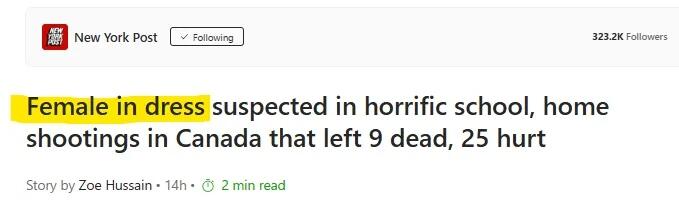
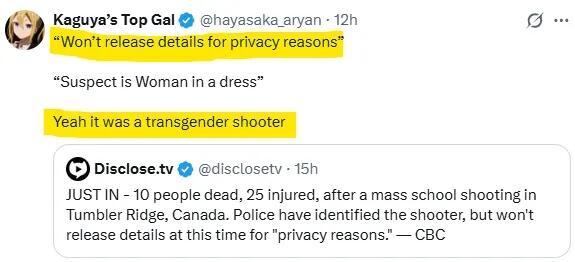
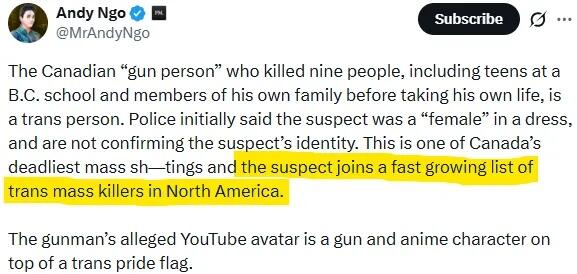
Within minutes of the rampage, alerts went out describing the suspect as a “female in a dress.”
The minute I saw that, I knew.
I mean, have you ever—even once—seen an alleged perpetrator described as a “male in pants” or a “female wearing shoes?” Of course not! It’s “armed female” or “adult male” or, if the subject is still on the loose, maybe “a white male in a neon green hoodie and purple parachute pants.” But never-not-ever is it “a human in human clothing.” They only threw the dress part in there to avoid stating a politically inconvenient fact, upsetting advertisers, or toppling their own carefully constructed narrative.
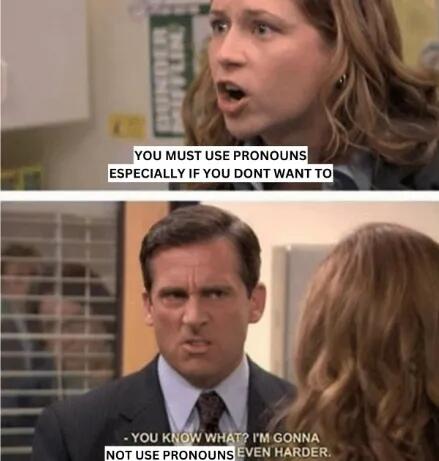
By the time officials reached the podium to deliver a press briefing, the description had morphed into “a gunperson.” A gunperson. As if the word “shooter” was insufficiently inclusive or somehow accidentally implied gender? The press spent more time agonizing over culturally sanitized euphemisms than reporting the actual details of the crime.
By early afternoon, every major outlet was doing verbal Pilates to avoid saying the one thing the adults in the room had already figured out: the “female in a dress” was a biological male transvestite.
Reporters tiptoed around the truth like it was a sleeping dragon. A lot of “quotes” were used.
You could practically hear the gears grinding: “If we get the pronouns wrong, we’ll be accused of hate; if we get the biology right, we’ll be called bigots. So let’s say nothing and hope nobody screenshots this.”
NOTE: I will not be mentioning the shooter’s name, showing his face, or referring to him as her or them. Linguistic autonomy. My stack, my choice.
Social media, as always, was on it. Online sleuths quickly dug up the shooter’s past, online posts, behavioral history, and hobbies—some dark, some disturbing, some tragically predictable for a young person spiraling into violence. They discovered that he was into guns, liked to wear lipstick, and described himself online as MtF, trans slang for someone making the switch from male to female. (I could probably stop there.) They found old Facebook posts written by his mother—who was allegedly one of the victims, along with one of her three other children—asking a private parenting group for advice on dealing with a child who “is angry, mean, and territorial,” “hurts his siblings” and “covers things up and lies.” They unearthed evidence that the mom was also seeking help for his ADHD diagnosis and that the killer was in fact, taking psychiatric drugs. They pointed out, time and again, that Canada has some of the strictest gun laws on the planet, a detail that somehow didn’t stop a deranged lunatic from getting his hands on a weapon and opening deadly fire. Go figure.
The actual press, it seemed, was too concerned with identity etiquette to touch any of those piddling particulars. And even long after the gunperson had been positively identified as someone who was born with XY chromosomes, they still couldn’t do it. They couldn’t bring themselves to have the journalistic decency to make it clear that the suspect was a mentally ill male who at the very, most generous best could be considered a transgender woman.
Nope, it was just woman.
What makes me mental is the media’s absolute allergy to stating the obvious. They refuse to report basic facts because those specifics implicate the very experiment they’ve helped unleash on America’s kids: destabilizing their identities, medicating their emotions, indulging their self-delusion, and then ignoring any possible connection when the result is deadly violence.
🚨”He is a MAN. He is a boy. It is a MALE crime. But you wouldn’t know that from watching the BBC, ITV or Sky News.”
Julia Hartley-Brewer’s scathing message to media outlets for telling the public “lies” about the sex of the suspect of the Canadian school shooter. @JuliaHB1 pic.twitter.com/uHzdzIaQ9O
— Talk (@TalkTV) February 11, 2026
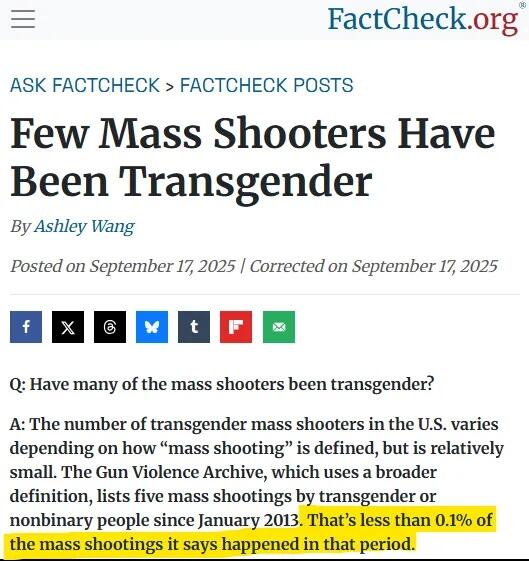
The media has a line they will repeat until the sun burns out: “Trans people are far less likely than cis men to commit mass shootings.”
You’ll see it on every network, on every chyron, and in every sanctimonious “actually” thread on X.
And technically, it’s true—but only because they cheat.
The stats they cite routinely fold every gun catastrophe in America into one giant pile: gang shootings, drug-turf shootouts, domestic murders, felonies gone bad, suicides, robberies, drive-bys, and the occasional drunk uncle with a Glock. If you use the standard media definition of “mass shooting”—four or more people shot in a single incident—then yes, trans-identifying shooters make up a tiny slice. So do dentists, redheads, and people named Gary.
But that’s not the category anyone conjures when they hear the phrase mass shooter.
We’re talking about public, ideological, spectacle violence—school shootings, mall massacres, club attacks, manifesto-fueled rampages, the “society broke me and now I’m returning the favor” genre. And when you look at those, the ones that shock the nation and lead to “serious national conversations,” a different pattern emerges—one the media pretends not to see.
Out of roughly 150–185 public mass shooters since the 1960s (depending on the database), at least five have been trans, “gender-nonconforming,” or nonbinary. That’s around 3%—and doesn’t include this week’s carnage—in a population where trans-identified people comprise about one percent. In other words: the trans community represents triple the baseline. And if you zoom in on the last decade, when the gender ideology movement hit full throttle, the number jumps to 7%.
It gets worse. If you narrow the subset further to school shooters only—using the standard definition to include non-gang, non-accidental, multiple targeted victims—and suddenly 10% of the perpetrators in the last decade (two out of twenty) have identified as transgender. And if you look at just the past five years, when five of ten shooters were trans—this time, I’m including this week’s horror—that number skyrockets to fifty percent. But nothing to see here, folks. Trust us.
Of course, this doesn’t prove causation. But what it absolutely disproves is the media’s favorite bedtime story: that it’s “baseless” or “bigoted” to notice a recurring theme. It isn’t. The pattern is real, documented, and growing. Yet the folks whose entire job it is to inform us will continue to chant their mantra that “trans people are far less violent than toxic cisgender men”—because they’d rather gargle broken glass than admit the monster under the bed is one they had a hand in feeding.
And I shouldn’t have to say it, but I will: facts matter. Trends matter. Truth matters. Because institutions can’t solve a problem they refuse to see, and you can’t have a public reckoning when half the country is duct-taping their mouths shut to protect an ideological narrative.
Change my mind.
Tyler Durden
Thu, 02/12/2026 – 16:20
https://www.zerohedge.com/political/we-have-now-reached-gunperson-level-absurdity

Venezuela aplaza aprobación de ley de amnistía para la liberación de presos por motivos políticos
Associated Press
CARACAS (AP) — La Asamblea Nacional de Venezuela aplazó el jueves la segunda discusión de la Ley de Amnistía propuesta por la presidenta encargada Delcy Rodríguez para la liberación masiva de presos por motivos políticos, para revisar la redacción de uno de sus 13 artículos luego de diferencias entre los legisladores oficialistas y de la oposición.
El debate fue suspendido en momentos en que se discutía un artículo cuya redacción podría afectar a muchos venezolanos que abandonaron el país y que tendrían que presentarse ante un tribunal local.
El debate de la norma —que fue presentada semanas después del ataque militar estadounidense en la capital venezolana que depuso y capturó al entonces presidente Nicolás Maduro— continuará la próxima semana.
De aprobarse, la llamada Ley de Amnistía para la Convivencia Democrática se aplicaría a dirigentes opositores, sindicalistas, activistas de derechos humanos, estudiantes, académicos y periodistas, entre otros. Entrará en vigor luego de que sea aprobada por la Asamblea unicameral, promulgada por la presidenta encargada y publicada en la Gaceta Oficial.
Rodríguez, quien fue juramentada como mandataria encargada el 5 de enero —dos días después del traslado de Maduro y su esposa a Nueva York para enfrentar cargos federales de tráfico de drogas— ha expresado su esperanza de que la ley sirva para reparar las heridas que ha dejado la larga confrontación política en el país sudamericano desde la llegada al poder del fallecido presidente socialista Hugo Chávez en 1999.
La ley es una de las principales exigencias de la oposición y de organizaciones de derechos humanos y cuenta con el respaldo de Estados Unidos. La demanda de una amnistía se profundizó especialmente luego de la captura de Maduro.
Familiares de presos y activistas han recibido con cautela la iniciativa y exigido al gobierno que la amnistía no sea restringida ni selectiva, sino que abarque a una amplia gama de hechos considerados punibles. La ley de amnistía excluirá a los condenados por homicidio, tráfico de drogas y violaciones graves de los derechos humanos.

Opus sends letter denying Merrillville ICE facility deal
Merrillville officials hope a letter denying the existence of a Department of Homeland Security contract on a warehouse in town will calm residents’ nerves about a theoretical immigrant detention center.
Councilman Shawn Pettit, D-6, read into the record during Tuesday night’s Town Council meeting a letter from Minnetonka, Minnesota-based Opus Group Vice President and General Counsel Shanna L. Strowbridge. The letter was a reply to a letter Town Attorney Joe Sventanoff wrote to the company last month at the council’s behest about rumors DHS was setting up a processing center at a 278,000-square-foot warehouse at 8719 Mississippi St.
“Opus, its board, and its leadership team earnestly value the relationship our company has with the municipalities and communities we serve. Maintaining those deep connections and our reputation as a world class, responsible real estate developer is one of our highest priorities,” Strowbridge said. “We also understand the reason for your inquiry in the position of the Town Council of the town of Merrillville. As an experienced attorney, we know you will appreciate that there are circumstances in which obligations of confidentiality limit parties in their ability to make public statements.
“While we would very much like to be helpful in our response to your request, any disclosure must comply with our ongoing legal obligation. Nonetheless, we can confirm that we are not under contract, nor are we in active negotiations concerning the sale or lease of our facility at 8719 Mississippi Street, Merrillville … with or involving any federal government agency.”
“Hopefully, this puts this issue to bed,” Svetanoff said. “We can post (the letter) on the website and at this time, again, hopefully we can move on.”
The letter reiterates the position a spokeswoman for Opus gave the Post-Tribune in recent weeks. The spokeswoman, Patty Gibbs, told the Post-Tribune via email that the building is still for lease.
“We can confirm that our Merrillville Industrial building is not under contract, does not have a transaction pending and remains available for sale or lease,” Gibbs said. “Consistent with historical business practices, Opus does not disclose details regarding prospective transactions.”
Additionally, the Town at its January 27 meeting approved a resolution denouncing any sort of detention or processing center. Sventanoff, however, previously told the Post-Tribune that if DHS decides Merrillville is its spot, there’s likely little it can do to stop it.
“I don’t think any municipality wants one of these in their town,” Town Council President Rick Bella, D-5, told the Post-Tribune. “We’ve reached out to DHS and let them know our feelings, and we have zoning for these warehouses that isn’t conducive to what they want, but we are concerned that federal law will overrule anything we have.”
A December 24 Washington Post article said the Trump administration “is seeking contractors to help it overhaul the United States’ immigrant detention system in a plan that includes renovating industrial warehouses to hold more than 80,000 immigrant detainees at a time.” Its plan, based on an unfinalized document the paper obtained, is to “speed up deportations by establishing a deliberate feeder system,” the Post-Tribune previously reported.
“Newly arrested detainees would be booked into processing sites for a few weeks before being funneled into one of seven large-scale warehouses holding 5,000 to 10,000 people each, where they would be staged for deportation,” the Washington Post article said. “The large warehouses would be located close to major logistics hubs in Virginia, Texas, Louisiana, Arizona, Georgia and Missouri. Sixteen smaller warehouses would hold up to 1,500 people each.
“The new facilities will ‘maximize efficiency, minimize costs, shorten processing times, limit lengths of stay, accelerate the removal process and promote the safety, dignity and respect for all in ICE custody,’ the solicitation said. ICE plans to share it with private detention companies this week to gauge interest and refine the plan, according to an internal email reviewed by The Post.”
The revelation, however, came as a complete shock, town officials said, as it also did for downstate officials. But that doesn’t mean the state will fight against it, Svetanoff said.
“With this administration (downstate), they won’t have a problem with it,” he said. “And that will include if a third-party vendor is chosen to operate it.”
Michelle L. Quinn is a freelance reporter for the Post-Tribune.
https://www.chicagotribune.com/2026/02/12/opus-sends-letter-denying-merrillville-ice-facility-deal/