Category: News
Justicia restituye a condenada expresidenta Fernández pensión por viudez que le había quitado Milei
Associated Press
BUENOS AIRES (AP) — Una corte de apelaciones de Argentina ordenó el jueves al gobierno del ultraliberal Javier Milei que le restituya a la expresidenta de centro-izquierda Cristina Fernández (2007-2015) la pensión por viudez del exmandatario Néstor Kirchner (2003-2007) que se le había dado de baja tras ser condenada a seis años de prisión por corrupción.
En paralelo, fiscales solicitaron el decomiso del apartamento en el que la exmandataria cumple prisión domiciliaria, entre otras propiedades, por resistirse a pagar un millonario depósito que se le impuso por desfalco al Estado.
Milei, a través de la Administración Nacional de la Seguridad Social (ANSES), dio de baja a fines de 2024 las asignaciones que recibía Fernández en su condición de exmandataria y viuda del expresidente Kirchner, fallecido en 2010, justo después que una corte penal le confirmó la condena de cárcel y la inhabilitación perpetua para ejercer cargos públicos por corrupción en la obra pública durante su gestión.
El gobierno adujo que Fernández no cumplía con los requisitos que la hacían merecedora de dichos beneficios previsionales que “se otorgan con carácter excepcional y extraordinario como contraprestación al honor, el mérito y el buen desempeño en el cargo”. Remarcó que la administración pública se ahorraba así el equivalente a 15.600 dólares mensuales.
La expresidenta reclamó ante la justicia la restitución del beneficio porque fue “conferido a un presidente que nunca fue condenado”, en referencia a Kirchner, y alegó “la imposibilidad de subsistencia sin la percepción de la asignación”.
Para la Cámara Federal de Seguridad Social, la decisión del gobierno no exhibe “nexo causal claro y suficiente entre los motivos invocados y la baja del beneficio de pensión”, según el fallo. En consecuencia, dispuso la restitución provisoria de la pensión por viudez a Fernández hasta tanto se dicte sentencia definitiva.
La medida judicial no incluye la jubilación que percibía Fernández como expresidenta y exvicepresidenta (2019-2023), también dada de baja.
ANSES apelará el fallo.
Fiscales piden acelerar decomiso de bienes
La exmandataria y líder del peronismo opositor recibió una sentencia de seis años de cárcel a fines de 2022 por administración fraudulenta que comenzó a cumplir en junio del año pasado en su domicilio de Buenos Aires luego de que la condena quedara firme.
Los mismos jueces que condenaron a Fernández, a exfuncionarios y a un empresario de la construcción les ordenaron pagar unos 535 millones de dólares —cifra que se calcula fue el desfalco al Estado y que fue definida por peritos de la Corte Suprema de Argentina—. El tribunal dejó a criterio de los condenados definir el porcentaje que le correspondía a cada uno.
Según la fiscalía, los condenados “todavía no han depositado ni un solo peso a pesar de que venció hace meses el plazo para hacerlo”.
Por esa razón, solicitaron al tribunal el decomiso de más de un centenar de inmuebles, entre ellos el apartamento donde Fernández cumple prisión domiciliaria, vehículos y depósitos bancarios de los condenados.

Column: Like other Chicago White Sox unforced errors, GM Chris Getz’s ‘switch hitter’ blunder will pass
Big crisis down at Camelback Ranch:
New Chicago White Sox player Luisangel Acuña is not a switch hitter, despite being advertised as one by general manager Chris Getz.
What this means for the rest of the 2026 season is unclear. But for Getz, beginning his fourth season on the job, it was an unforced error that fueled outrage from Sox fans on social media — not that that’s hard.
When Getz acquired Acuña from the New York Mets last month in the Luis Robert Jr. deal, he said Sox scouts were high on the versatile 23-year-old.
The Mets’ Luisangel Acuña slides safely home on a sacrifice fly against the Yankees on May 17, 2025, in New York. (Noah K. Murray/AP)
“We’ve been tracking him for a long time,” Getz said. “When you’re assessing a player, obviously you go through your scouting process, your analytic process, and you come to a decision. But to be able to bring in a young, exciting player that plays all over the diamond, a strong defender, an elite defender, elite baserunner (who) can make contact … very strong instincts for the game.
“I know over in New York, talking to individuals over there, they did not want to get rid of him. I know that. That’s because of how valuable he can be with a team.”
Getz didn’t mention that Acuña is a right-handed hitter, though it was in the press release he presumably read. But he later said in an interview with David Kaplan that Acuña is a switch hitter, then repeated it at SoxFest. I was at SoxFest but couldn’t hear what Getz was saying on stage because so many fans were ignoring him and conversing among themselves.
Apparently no one corrected him. Getz has a habit of repeating his talking points, so when he got to spring training this week at Camelback Ranch in Glendale, Ariz., he told reporters Acuña is “a strong defender, baserunner, switch hitter …”
At this point the mistake was all over social media. A blogger put together a video of Getz saying it four times. It got 2 million views and became rich fodder for sports-talk radio. Getz was put through the shredder, and by Thursday enough people had discussed the error that he was forced to respond.
He had left camp and was back in Chicago, so he sent out a statement through the Sox that read: “So I probably have been carried away describing his versatility. He can play every position on the field. Why does it have to stop there? I called Luisangel and told him that even though he’s just right-handed, we still love him.”
I’m not sure if Getz wrote that himself or if the Sox brainstormed lines during an emergency crisis management session in Bridgeport. But the attempt at humor didn’t satisfy some angry fans who believe Mets President David Stearns swindled Getz in a trade that essentially was a salary dump.
Getz made 26 errors over his seven-year big-league playing career, but this one threatens to be remembered more than any of the rest. It will go down in Sox annals with other unforced errors, such as the upper deck of new Comiskey Park, extending Terry Bevington’s contract and Disco Demolition Night.
Getz has company now with his adviser, former manager Tony La Russa, who didn’t know the COVID-19-related extra-innings rules in 2021 and left reliever Liam Hendriks on second base as the ghost runner to start the 10th inning. Hendriks had entered in the ninth in a double switch.
When reporter James Fegan asked La Russa about the decision afterward, La Russa admitted he was unaware he could’ve used a position player in the lineup, José Abreu, instead of his closer: “I’m guessing you know the rules better. Now I know.”
It was a relatively small mistake on a new rule that few fans or media members knew. But the coaches and manager should’ve known, and La Russa was forced to live with it for a while. When the Sox won the division, it was all but forgotten. No harm, no foul.
Getz’s error wasn’t nearly as embarrassing as one former GM Ken Williams made during his rookie season at the helm of the Sox in 2001.
Before the trade deadline, Williams dealt starter James Baldwin to the Los Angeles Dodgers for cash and three prospects, including Triple-A outfielder Jeff Barry. When he met with the four Chicago beat writers to discuss the trade, Williams said there was some “miscommunication” with Dodgers GM Dan Evans, a former assistant GM with the Sox, over a pitching prospect the Sox wanted named Jon Berry.
“And there was a little bit of a mix-up as far as how that was communicated to me and to where Danny Evans was,” Williams said. “We got on the same page, whereas Danny didn’t want to give up the Berry that we were after. So we agreed on another player.”
“So you wanted a pitcher named Berry and he wanted to give you the outfielder named Barry?” I asked Williams.
“I don’t know how far I can go with that discussion,” he said. “Because now, talking about another player is falling along the lines of tampering. So you figure it out.”
We were all puzzled.
Related Articles
Pitching prospects Noah Schultz and Hagen Smith are focused on the present at Chicago White Sox camp
Column: Spring training renews optimism for the Cubs and White Sox — no matter where you’re watching
Erick Fedde, back with the Chicago White Sox, aims to return ‘brick by brick’ to his 2024 form
Chicago White Sox starter Shane Smith looks to build on All-Star rookie season as spring training gets underway
Catching, starting pitching and center field are 3 spots to watch as Chicago White Sox spring training begins
“You have the player who is an outfielder?” another reporter asked.
“No,” Williams replied. “We substituted a different name. You’ve got to see the press release. Did they not get you the press release?”
A Sox employee pointed out that the press release said it was an outfielder named Jeff Barry.
“Obviously there has been another miscommunication,” an exasperated Williams said.
Williams was getting hot and the conversation was turning into a “Who’s on first?” routine.
“So you are getting the pitcher named Berry?” one reporter asked.
“No Berrys?” another reporter asked.
“Halle Berry?” a third reporter cracked.
“You’ve got to be (bleeping) me,” Williams said, grabbing his cellphone and leaving. “You never know.”
In the end the Sox honored the miscommunicated trade and wound up with the outfielder named Barry. I later wrote, “it’s no secret baseball has not been Barry-Berry good to Williams in 2001,” a line I still haven’t lived down.
Barry played 13 games for Triple-A Charlotte that summer and ended his career in 2002 in the Mexican League. The pitcher named Berry never made it above Class A. Much ado about nothing.
Four years after the trade, Williams won a World Series with the Sox, and the Barry-Berry saga became a minor footnote in his career, mentioned only whenever the Sox beat writers gather together to trade stories about the olden days.
So there’s still hope for Getz. Nobody is perfect.
La Russa is still a Hall of Famer. Williams still has his ring. Life goes on.
Now Getz just has to hope Acuña can hit, no matter what side of the plate it’s from.
https://www.chicagotribune.com/2026/02/12/chicago-white-sox-chris-getz-luisangel-acuna/

US stocks drop sharply as investors hunt for losers that will be hurt by AI
NEW YORK — U.S. stocks fell sharply Thursday as the market punished companies seen as potential losers from artificial-intelligence technology.
The S&P 500 sank 1.6% for its second-worst day since Thanksgiving, though it’s still near its all-time high set late last month. The Dow Jones Industrial Average dropped 669 points, or 1.3%, and the Nasdaq composite fell 2%.
AppLovin lost nearly a fifth of its value and tumbled 19.7%, even though it reported a stronger profit for the latest quarter than analysts expected. Like other software companies, it’s come under pressure from worries that AI may undercut its business while fundamentally changing how people use the internet.
AppLovin CEO Adam Foroughi pushed back on the concerns, saying in a conference call with analysts that indicators show his company is doing well. “There’s a real disconnect between market sentiment and the reality of our business,” he said.
Its stock nevertheless widened its loss for the young year so far, which came into the day at 32.2%.
Cisco Systems dropped 12.3% despite likewise topping analysts’ expectations for profit and revenue last quarter. The tech giant indicated that it may make less profit off each $1 of revenue during the current quarter than it did in the past quarter.
Analysts said that could be an indicator of higher prices for computer memory that everyone is having to pay amid the rush driven by AI.
More broadly, questions are rising about whether businesses that are spending heavily on AI will end up seeing high-enough profits and productivity to make the investments worth it.
The AI worries have hit software stocks particularly hard, but they’re spreading to other industries and other markets. For bonds, for example, “AI disruption risk” looks set to knock down prices, even if the threat still looks hazy, according to strategists at UBS.
“The timing of AI disruption remains indeterminate, and the fog of uncertainty is unlikely to dissipate quickly,” the strategists led by Matthew Mish wrote in a report.
They expect the AI risk to lead to an increase in defaults in the junk-bond and other low-rated markets. That could hurt even strong, financially stable companies by making it more expensive for them to borrow, including the Big Tech businesses that have been borrowing heavily to pay for their AI investments. That spending has been a major reason the AI frenzy has gotten as big as it has.
In a less likely but very damaging scenario, such knock-on effects “could be significant, potentially undercutting capital spending, investment plans, and ultimately the AI boom itself,” according to the UBS strategists.
In the meantime, some of the companies serving customers with huge AI budgets are benefiting.
Equinix, for example, jumped 10.4% even though the digital infrastructure company’s results for the latest quarter fell short of analysts’ expectations. It gave financial forecasts for 2026 that topped analysts’ expectations, and CEO Adaire Fox-Martin said that “demand for our solutions has never been higher.”
The company’s data centers are helping to power the world’s move into AI.
Outside of tech, McDonald’s rose 2.7% after reporting a stronger profit for the latest quarter than analysts expected. The restaurant chain credited moves to improve its value and affordability, including cutting prices on some U.S. combo meals in September.
Walmart’s rally of 3.8%, meanwhile, was the strongest single force pushing upward on the S&P 500. It erased losses from earlier in the week after a report said spending at U.S. retailers overall stalled in December.
All told, the S&P 500 fell 108.71 points to 6,832.76. The Dow Jones Industrial Average dropped 669.42 to 49,451.98, and the Nasdaq composite sank 469.32 to 22,597.15.
In the bond market, Treasury yields fell as investors looked for safer places to park their cash. A report also said slightly more U.S. workers filed for unemployment benefits last week than economists expected.
Still, the number was lower than the prior week’s, which is a signal that the pace of layoffs may be improving. It also followed a surprisingly strong report on the job market from Wednesday, which said the nation’s unemployment rate improved last month.
A strengthening job market could push the Federal Reserve to hold interest rates steady and keep its cuts on pause, even if President Donald Trump keeps loudly and aggressively calling for lower rates. While lower rates can give the economy a boost, they can also worsen inflation.
It all raises the stakes for Friday’s upcoming report on inflation at the U.S. consumer level. Economists expect it to show inflation slowed to 2.5% last month from 2.7% in December.
A separate report on Thursday said that sales of previously occupied homes slumped last month by more than economists expected, which also weighed on yields.
The yield on the 10-year Treasury fell to 4.10% from 4.18% late Wednesday.
In stock markets abroad, South Korea’s Kospi rushed 3.1% higher thanks to gains for Samsung Electronics, SK Hynix and other tech stocks.
The moves were more modest in other Asian markets and in Europe. Hong Kong’s Hang Seng fell 0.9%, and France’s CAC 40 rose 0.3%.
AP Business Writers Chan Ho-him and Matt Ott contributed.
https://www.chicagotribune.com/2026/02/12/us-stock-market-thursday-close/

Candidato presidencial colombiano Abelardo De la Espriella denuncia presuntas amenazas del ELN
Por ASTRID SUÁREZ
BOGOTÁ (AP) — El candidato presidencial colombiano Abelardo De la Espriella, opositor al gobierno, denunció el jueves que recibió una amenaza anónima en la que lo alertaban que fue presuntamente declarado “objetivo militar” por la guerrilla Ejército de Liberación Nacional.
En la denuncia remitida a la policía y publicada por la campaña detallan que las amenazas fueron recibidas por el jefe de seguridad personal del candidato, desde un número privado que alertó que “el ELN tiene planeado un accionar terrorista debido a los bombardeos, por lo que le dieron la orden a los diferentes frentes urbanos atentar contra uno de los objetivos ‘el tigre’ y sus diferentes sedes de campaña”.
El ELN, alzado en armas desde 1964, no ha aceptado públicamente haber amenazado al candidato.
El candidato solicitó, en un comunicado, un refuerzo de su esquema de protección y la “intervención urgente de los organismos de inteligencia” estatales para establecer la “credibilidad, alcance y origen de la amenaza”.
El Ministerio del Interior dijo a The Associated Press a través de su oficina de prensa que, tras las amenazas denunciadas por el candidato, están evaluando la situación con la policía en el comité presidencial para garantizar seguridad a candidatos en riesgo.
El ultraderechista De la Espriella es uno de los punteros en las encuestas, junto al senador de izquierda Iván Cepeda, candidato por movimiento político del presidente Gustavo Petro, primero de tendencia izquierdista en el país.
Al menos dos decenas de candidatos presidenciales aspiran a suceder a Petro y se alistan a competir en las elecciones del 31 de mayo, en la primera vuelta presidencial.
La actual campaña electoral tuvo su punto de violencia más alto en junio del año pasado con el atentado a tiros contra el precandidato presidencial opositor Miguel Uribe Turbay, quien falleció a causa de las heridas dos meses después.
A finales del año pasado, otros dos candidatos denunciaron amenazas. Mauricio Lizcano, exministro del gobierno de Petro, recibió en su sede de campaña una corona fúnebre con el nombre de su padre; mientras que la candidata opositora Paloma Valencia fue alertada de un supuesto plan para atentar contra su vida.
El gobierno de Petro suspendió los diálogos de paz con el ELN desde hace un año como reproche por una incursión armada contra un bando enemigo en la frontera con Venezuela que terminó por afectar a los civiles.
El ejército responsabilizó al ELN el jueves de atacar con drones cargados con explosivos un cantón militar ubicado en Arauca, fronterizo con Venezuela, causando heridas leves a dos oficiales de la Fuerza Aeroespacial Colombiana.
Vintage Chicago Tribune: Black Panther heritage sites in the Chicago area
Those savvy in the city’s Black history might know where Jean Baptiste Point DuSable, Chicago’s first non-native resident, established his homestead. Or, where the Rev. Martin Luther King Jr. lived during his yearlong stay amid the civil rights movement.
Other landmarks, however, may be lost to time — especially since many of the original buildings have been demolished. That’s why former members of the Illinois Chapter of the Black Panthers spent years researching where the group’s significant events took place and they have since been added to the National Register of Historic Places. There are 13 sites that form a heritage trail — with commemorative plaques — that stretches from Chicago to Peoria. Click here to view the inaugural list of Black Panther heritage trail sites.
Black Panther Party’s Illinois history recognized with heritage trail
A recent search of the Tribune’s archives found the significance of five of these sites — including the West Side apartment where Panthers leaders Fred Hampton and Mark Clark were killed during an early-morning shootout with police on Dec. 4, 1969.
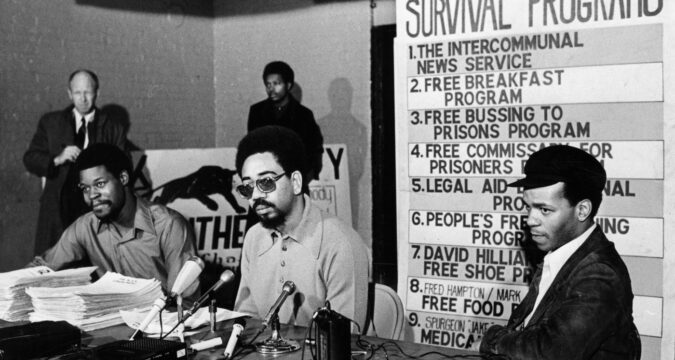
Yet members of the Historical Preservation Society of the Illinois Chapter of the Black Panther Society want people to also remember the group for its social services — including free food and medical care — that was often overshadowed by the Panthers’ militant ways.
Chicago locations
925 W. Diversey Parkway
Fred Hampton, left, chairman of the Black Panthers, speaks during a press conference with the Young Lords (a Puerto Rican civil and human rights group) on Oct. 10, 1969, at Holy Covenant United Methodist Church. With Hampton are, seated from left, Pablo “Yoruba” Guzman, a Young Lord from New York, Jose “Cha-Cha” Jimenez, founder of the Young Lords of Chicago, and Mike Klonsky, a Students for a Democratic Society spokesman. (Dave Nystrom/Chicago Tribune)
Holy Covenant United Methodist Church was founded on Jan. 30, 1894. According to the church’s website, widow Helena Bergman sold her plot of land to build what was then known as Diversey Parkway Evangelical Church. It was dedicated on July 22, 1894.
Social justice has long been a significant part of the Lincoln Park church’s mission.
The National Guard has been activated to Chicago 18 times from 1877-2021. Here’s a breakdown.
The church and others in the city and Evanston provided refuge for the Students for a Democratic Society, the Black Panthers, the Weather Underground, the Young Lords and the Rainbow Coalition during the Days of Rage, which were protests that followed the 1968 Democratic National Convention.
It was the site of an Oct. 10, 1969, news conference in which Black Panthers leader Fred Hampton and others criticized the violence and vandalism used by the Weatherman (the early name for the Weather Underground) during the demonstrations.
2350 W. Madison St.
Firefighters are present at the Black Panthers organization’s headquarters at Madison Street and Western Avenue in Chicago after a shootout there on July 31, 1969. (Ray Foster/Chicago Tribune)
The 27th Ward building, which has been demolished, was home to a registration station for the selective service in 1942, and the Chicago School of Custom Tailoring in the late 1940s before it became headquarters for the Illinois Chapter of the Black Panthers in November 1968.
Raids were common at the Near West Side site.
About 40 FBI agents surrounded the building on June 4, 1969, and eight Panthers inside were persuaded to walk out without the need to deploy tear gas.
An estimated 50 police officers descended on the organization’s headquarters early on July 31, 1969, when a passing patrol car reported it was under fire from the Panther’s second-floor office. A 30-minute gun battle was followed by a fire on the building’s roof, the Tribune reported.
Willie Calvin, spokesperson for the Panthers, said police instigated the incident and started the fire. Five police officers and three people inside the building were injured.
Though three Panthers were charged with attempted murder, the organization’s deputy minister of defense, Bobby Rush, said police started the fire and stole cash from the group’s office.
Police stop a car in front of the Black Panther headquarters at 2350 W. Madison St., following a gun battle on July 31, 1969, in Chicago. (Ray Foster/Chicago Tribune)
A similar skirmish between police and Panthers happened again at the location early on Oct. 4, 1969.
A federal agent later testified the FBI had wiretapped the Panthers’ headquarters in order to monitor phone conversations there from spring 1969 through at least June 1970.
A Walgreens is now at the site, which is a half mile west of the United Center.
2337 W. Monroe St.
Police gather at an apartment building at 2337 W. Monroe St. following a bloody and controversial raid on Dec. 4, 1969, where Black Panthers Fred Hampton and Mark Clark were shot and killed. (Ed Smith/Chicago Tribune)
“For a generation of Chicagoans, their opinion of what happened in 1969 when Chicago police raided the West Side apartment of Black Panther Party members depended greatly on what neighborhood they called home,” the Tribune’s Will Lee wrote in 2019.
“For the public at large, it was as police officials described: a dramatic gunfight launched against police by violent Black nationalists that left two dead and four wounded.
“But for others, particularly socially conscious African Americans, the Dec. 4, 1969, raid on the two-flat at 2337 W. Monroe St. was a cold-blooded execution of Black Panthers leaders Fred Hampton and Mark Clark, ordered by federal authorities eager to snuff out burgeoning Black leadership.”
Clark was killed in early-morning gunfire, but survivors Harold Bell and Hampton’s fiancee, Akua Njeri, then known as Debra Johnson, testified at the 1972 criminal trial against the state’s attorney and officers in the raid that Hampton was pulled alive from his bed and shot dead after the group had surrendered. Later, an FBI whistleblower said the agency coaxed local law enforcement across the country, including Chicago police, into deadly clashes with heavily armed Black Panthers.
A federal grand jury reporter said only one shot could be proved to have been fired from the apartment, compared with 82 to 99 shots fired by police.
A photo of the north wall in the front bedroom, with the other side of the wall being the living room, at the Black Panther headquarters on Dec. 12, 1969. Bullet holes show the extent of the shooting that left Fred Hampton and Mark Clark dead on Dec. 4, 1969. The hall door is on the left. (James O’Leary/Chicago Tribune)
In 1983, a federal judge approved a settlement that awarded $1.85 million to survivors of the raid and families of the two men who were killed, to be paid by the federal government, the city of Chicago and Cook County. It was believed to be one of the largest civil rights settlements in federal court history.
Another residential building now occupies the same location.
1512 S. Pulaski Road
People teach and learn math at the Better Boys Foundation at 1512 S. Pulaski Road in Chicago on June 14, 1973. The Black Panthers worked out of the Better Boys Foundation in Chicago. (Hardy Wieting/Chicago Tribune)
The Better Boys Foundation was founded in 1961 by boxing promoter Joe Kellman to benefit underprivileged boys, specifically.
On April 1, 1969, the group’s three-story building in North Lawndale was where the Panthers launched their first local Free Breakfast for Children Program. But by September 1969, the Tribune was critical of the effort — and said “political orientation” classes were also held at the city’s growing number of breakfast program sites operated by the Panthers.
“Altho Fred Hampton, the party’s Illinois chairman, claims that 3,000 to 3,500 children are being fed at three locations each week, it was found that on some days the centers were never opened and on others only a handful of children showed up,” Tribune reporter Ronald Koziol wrote.
Koziol said records showed some of the donations for the food program were used by Panther officials for their own personal use. By January 1970, Koziol wrote the breakfast program was “barely operating in Chicago.”
Children and adults enter and leave St. Andrews Episcopal Church at 48 N. Hoyne Ave., in Chicago where the Black Panthers were serving breakfast on Jan. 12, 1970. (James O’Leary/Chicago Tribune)
Yet the idea inspired the U.S. Department of Agriculture’s School Breakfast Program, which launched in 1975. About 65 billion meals have been served to schoolchildren since then. Other social services the Panthers provided to the community were free food pantries, child care facilities and medical centers.
BBF (Building Brighter Futures) Center for the Arts continues Kellman’s mission at the same location.
4233 S. Indiana Ave.
A playlot run by the Black Panthers is next to their headquarters at 4233 S. Indiana Ave. in Chicago on July 28, 1972. The group ran a free breakfast for local children at the building. (Quentin Dodt/Chicago Tribune)
During the 1940s-1960s, Friendship House was a community center in Grand Boulevard operated by Roman Catholic laymen who promoted racial understanding and communication in the pre-civil rights era.
The Panthers began to use the building as a South Side headquarters in the late 1960s. It’s where the group requested, in August 1971, the state reinvestigate the raid that killed Clark and Hampton and for the immediate resignation of Cook County State’s Attorney Edward Hanrahan (whose officers led the raid).
The now-closed Black Panther Party headquarters at 4322 S. Indiana Ave. has the words “All Power To The People” on the door on Sept. 16, 1974. (Ernie Cox Jr./Chicago Tribune)
The address was later used as a “temple” for the El Rukn street gang, according to Tribune archives.
An apartment building has since been constructed on the site.
Want more vintage Chicago?
Become a Tribune subscriber: It’s just $1 for a 1-year digital subscription.
Thanks for reading!
Subscribe to the free Vintage Chicago Tribune newsletter, join our Chicagoland history Facebook group, stay current with Today in Chicago History and follow us on Instagram for more from Chicago’s past.
Have an idea for Vintage Chicago Tribune? Share it with Kori Rumore at krumore@chicagotribune.com.
https://www.chicagotribune.com/2026/02/12/vintage-chicago-tribune-black-panther-sites/

US Forces Pull Out Of Syria’s Tanf Base, Hand Over To Jolani Regime
US Forces Pull Out Of Syria’s Tanf Base, Hand Over To Jolani Regime
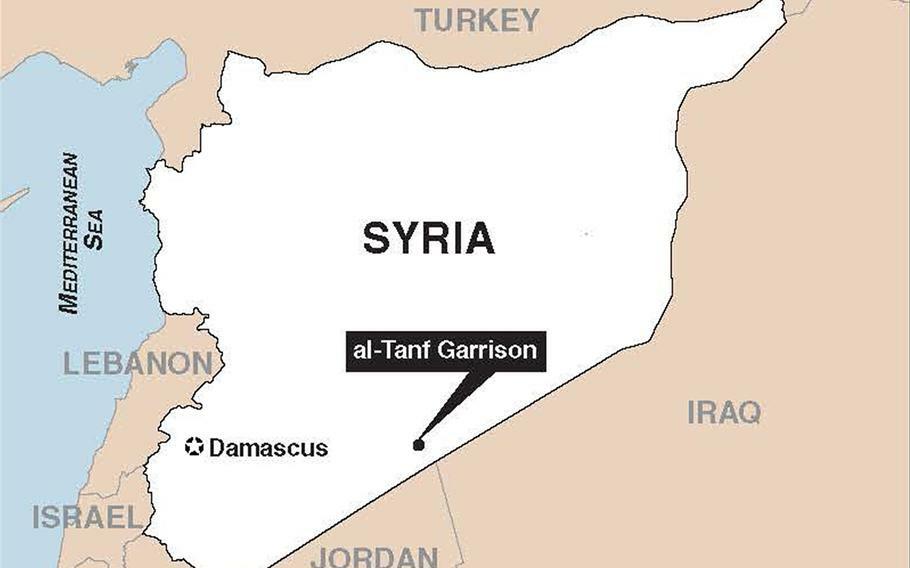
After many years of being there, American forces have withdrawn from the Al-Tanf Garrison, a base in southern Syria near the borders of Iraq and Jordan, according to fresh reporting in AFP.
US troops had long operated out of Tanf to pressure the Assad government as part of the long-running US-backed regime change project. The US primarily trained the Syrian Free Army (FSA) in that remote desert area – which was an umbrella group of various factions, likely among them jihadists, armed and funded by Washington.
A Syrian military source told AFP and other international outlets Wednesday that the “American forces withdrew entirely from Al-Tanf base today” and relocated to a Jordan base.
The report said that Syrian military personnel replaced the US forces – but that the Pentagon will “continue to coordinate with the base in Al-Tanf from Jordan.”
So after over a decade-long proxy war, the bearded ‘ISIS-lite’ jihadists of Jolani/Sharaa’s army were just handed an American base overnight. Perhaps that was the plan all along. Al Jazeera provides further confirmation:
Syrian forces have taken control of the strategic al-Tanf military base near the border with Iraq and Jordan, the Syrian defense ministry has said, amid the withdrawal of a longstanding United States troop presence at the base.
The ministry said in a statement on Thursday that Syrian Arab Army units had taken control of al-Tanf, securing the base and its surroundings, “through coordination between the Syrian and American sides”.
Army units had “begun deploying along the Syrian-Iraqi-Jordanian” border nearby, the ministry said, while border guards would be deployed in the coming days.
It was only in December that an insider attack took place in the central town of Palmyra, resulting two US soldiers and a civilian killed. Washington tried to pass it off as a “lone ISIS gunman” but the Syrian government itself admitted the attacker belonged to their security forces.
US officials have admitted to The Wall Street Journal that post-Assad Syrian Army is “riddled with jihadist sympathizers, including soldiers with ties to al-Qaeda and ISIS and others who have been involved in alleged war crimes against the Kurds and Druze.”
In northeastern Syria, a place where most US troops are based, there have been signs of large-scale withdrawal into Iraq over the last several weeks.
This has been extremely controversial as the US-backed Kurds and SDF forces have been attacked as Damascus forces move in. The Kurds are once again being thrown under the bus, with no support, after having been armed and trained by Washington for much of the last decade. Abandonment of the stateless Kurds has been a clear pattern over time.
Tyler Durden
Thu, 02/12/2026 – 17:20
https://www.zerohedge.com/geopolitical/us-forces-pull-out-tanf-base-hand-over-jolani-regime

Police: Unidentified woman pulled from river on Lower West Side
Police are investigating after a woman’s body was pulled from the water Thursday afternoon on the city’s Lower West Side near the South Ashland Avenue Bridge over the Chicago River.
The Chicago Fire Department’s Marine unit recovered the body in the 2700 block of South Ashland Avenue just before 1:20 p.m., according to Chicago police. The woman was pronounced dead on the scene.
Police did not immediately release any further details, but said Wentworth Area detectives were conducting a death investigation, pending an autopsy scheduled for Saturday.
https://www.chicagotribune.com/2026/02/12/chicago-police-bridge-death-lower-west-side/

El Atlético destroza 4-0 al Barcelona tras garrafal error del arquero Joan García
Por TALES AZZONI
MADRID (AP) — El Barcelona no se pudo reponer de un garrafal error del arquero Joan García en los albores del encuentro y un nefasto primer tiempo al sucumbir el jueves 4-0 ante el Atlético de Madrid en el partido de ida de su semifinal de la Copa del Rey.
Los azulgranas le obsequiaron al Atlético un inesperado regalo cuando García dejó que el balón se le escurriera por debajo del pie tras un pase retrasado del defensor Eric García en el séptimo minuto del duelo en el Estadio Metropolitano.
El Atlético no perdonó, marchándose al descanso con una ventaja de cuatro goles.
Antoine Griezmann, Ademola Lookman y el argentino Julián Alvarez también estamparon goles para el equipo dirigido por Diego Simeone.
La aciaga noche azulgrana empeoró con la expulsión de Eric García a los 85 minutos, con roja directa, al cortar un contragolpe.
El Barcelona, líder de La Liga española, vio anulado un gol de Pau Cubarsí al comienzo de la segunda parte por fuera de juego.
La victoria deja al Atlético cerca de volver a una final de la Copa del Rey por primera vez desde que ganó la competición en la temporada 2012-13, consiguiendo su décimo título.
El Barça, dueño del récord con 32 títulos del torneo de copa, se consagró en la edición del año pasado al vencer al Real Madrid en la final.
La paliza empezó a dibujarse cuando Joan García intentó controlar un pase de apariencia inofensiva de Eric Garcóa pero el balón se le fue por debajo del pie fuera del área chica.
El arquero corrió y se lanzó para intentar evitar que el balón cruzara la línea, pero no llegó a tiempo. Lo manoteó para devolverlo al campo —y Lookman lo envió después a la red—, pero el balón ya había cruzado la línea previamente.
Griezmann amplió la ventaja del Atlético a los 14, Lookman añadió el tercero en el 33 con asistencia de Álvarez y luego el delantero argentino anotó el cuarto en el tiempo añadido del primer tiempo.
El Atlético dispuso de varias ocasiones para abultar el marcador en la segunda mitad.
En la otra semifinal, la Real Sociedad venció el miércoles 1-0 al Athletic Bilbao de visita al estadio de San Mamés.
Los partidos de vuelta se jugarán en marzo. La final será en Sevilla en abril.
___
Deportes AP: https://apnews.com/hub/deportes
Lake Bluff native Rylie Mills sacks uncertainty and the quarterback to help Seattle Seahawks win Super Bowl LX
In December 2024, Rylie Mills faced an uncertain football future after suffering serious injuries at Notre Dame that left his professional prospects in doubt.
What a difference 14 months makes.
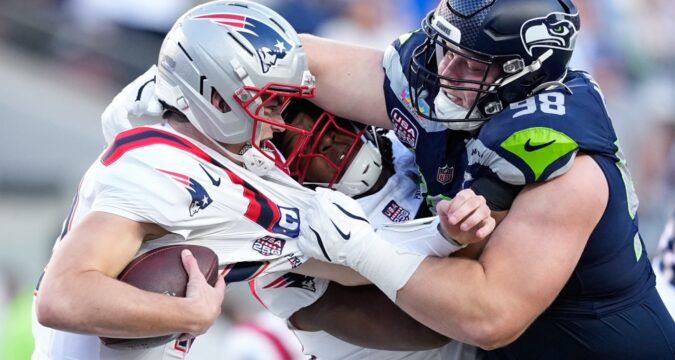
Seattle Seahawks defensive end Rylie Mills (98) celebrates after sacking New England Patriots quarterback Drake Maye during the first half of the NFL Super Bowl 60 football game, Sunday, Feb. 8, 2026, in Santa Clara, Calif. (AP Photo/Sue Ogrocki)
Mills, a Lake Bluff native, saw his determination rewarded in the second quarter of Super Bowl LX when he recorded a 10-yard sack, overpowering New England lineman Jared Wilson and driving him into Patriots quarterback Drake Maye. Mills raised his leg and screamed in celebration — one of the iconic moments in Seattle’s 29-13 victory as its defense smothered the Patriots.
Mills said he went into the game planning to go as hard as he could at Maye, knowing his bull-rush technique was one of his strengths.
“That was something I wanted to put on display and use,” he said. “Once I was able to get my hand extended, I knew it was over.”
The defensive lineman said his first thought was disbelief, followed quickly by the realization that the play showed he was truly back from his injuries.
“That was always my celebration in college, and I think once I got the sack that was six to 12 months of pent-up frustration and anxiousness and just feelings about my injury and getting through it,” Mills said in an interview. “I just let it all out right there, so it felt great.”
The sack marked another step in the football journey for the Lake Forest High School graduate, who was the 2019 Pioneer Press All-Area Football Defensive Player of the Year. From there, he went to Notre Dame, where he played five seasons due to eligibility changes during the COVID-19 pandemic and amassed 131 tackles and 17 sacks.
While an NFL career seemed like the natural next step, that changed during a 2024 College Football Playoff game against Indiana, when Mills tore several ligaments in his right knee while recording a sack that turned out to be his final college play. He also played most of his senior season with a torn labrum in his left shoulder.
He underwent surgeries to correct both injuries, creating uncertainty heading into the NFL Draft, when the Seahawks selected him in the fifth round, 142nd overall.
Mills acknowledged the frustration of the timing — during the college playoffs and so close to the draft — but credited Notre Dame coach Marcus Freeman for his guidance and support through the disappointment.
“I feel like everything happens for a reason. I’m a big believer in that,” Mills added. “I had to get hurt to reclimb the mountain again, and we had to end up in Seattle, and we had to win the Super Bowl to get this opportunity. I feel like I’m in the best place possible. It was obviously frustrating at times, but it changed me as a person and helped me grow as a player.”
He continued his rehab, was activated for the final four regular-season games, and then appeared in two playoff victories as the Seahawks captured the NFC championship.
Among those watching the Super Bowl was Chuck Spagnoli, Mills’ high school head coach, who said his phone started going crazy after the sack.
Spagnoli recalled Mills’ ability on the football field.
“We coached him as hard as we did anybody else, but he was always the guy who did extra work, always the guy who wanted to get better, and everything he receives at this point is earned,” he said.
Rylie Mills was so effective on the defensive line for Lake Forest that opposing offenses almost never tried to move the ball in his direction.
(Final score Lake Forest 28-Stevenson 27)
Related Articles
Column: Seattle Seahawks’ emphatic Super Bowl victory highlights some offseason priorities for Chicago Bears
Yes, that was Chicago conductor Giancarlo Guerrero performing with Bad Bunny
Super Bowl halftime show: Bad Bunny nets 135M viewers to Kid Rock’s 6M
La Grange area residents feel the (Julian) Love at American Legion Super Bowl party
Super Bowl commercials 2026: The good, the bad and the good-stupid
The longtime LFHS head coach also praised his demeanor off the field.
“I don’t think Rylie has ever met or talked with anybody who doesn’t like him,” Spagnoli said. “He’s a great kid with a great personality and an unselfish guy who really cares about those around him.”
After the game, Mills celebrated on the field with his girlfriend and family and later watched Bad Bunny’s halftime show — fittingly, he is a big fan of the artist. On Feb. 11, he participated in the Seahawks’ victory rally in Seattle, soaking in a championship moment that took time to fully register after falling short of titles in both high school and college.
While his parents no longer live in Lake Bluff, he said he would be interested in visiting his alma mater and speaking to the next generation of Scouts, adding that he remains grateful for the life lessons he learned at LFHS.
“You have to know yourself and be willing to learn,” he said. “Lake Forest taught me what kind of person and leader I want to be, and that carried over to Notre Dame and kept evolving. That set me down the right track for the fundamentals and principles I have today.”
For now, Mills plans to take a vacation with his girlfriend before beginning preparations for the 2026 season in March.
“It’ll be great to have a full offseason where I’m healthy and able to do everything,” he said. “Winning the Super Bowl sets your perspective on the work it takes to get there. Now I have a clear idea of what it takes and what it’s supposed to look like. Hopefully, we can build on this and keep it going next year.”
Daniel I. Dorfman is a freelance reporter for Pioneer Press.
https://www.chicagotribune.com/2026/02/12/lake-bluff-rylie-mills-superbowl-champion/
Waukegan library’s Maker Space offers a variety of options
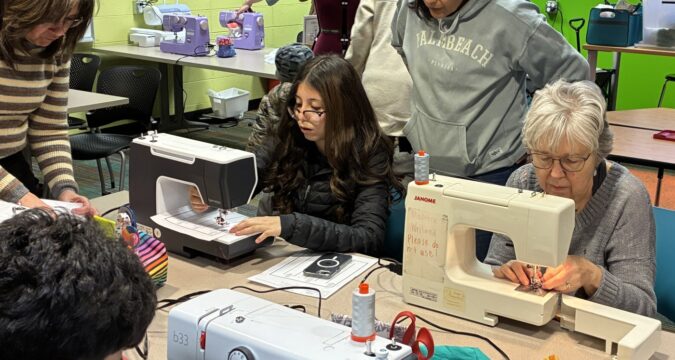
Zoey Gratys of Waukegan, a junior at Regina Dominican High School in Wilmette, first learned to sew six years ago. She is now taking a sewing class at the Waukegan Public Library’s Maker Space to enhance her skills.
“I just made some bibs and a burping cloth for my new cousin,” Gratys said Tuesday.
Yazmin Ramirez brought her three children, who are in elementary or middle school, with no sewing experience to the class. She wants them to develop practical skills that can last a lifetime.
“They need to learn adult activities,” Ramirez said.
Fiona Tranter, the president of locally based Loopy Connections, teaches the class with several assistants from the not-for-profit organization, helping to provide personal attention to students. She called it a “life skill.”
The Waukegan Public Library Maker Space now has select open hours and regularly scheduled classes, with individual tutoring starting April 1, as a part of what it offers to patrons nearly a year after opening on a limited basis.
A mother holds her child while getting sewing instruction during a class in the Waukegan Public Library’s Maker Space on Tuesday. (Steve Sadin/For the Lake County News-Sun)
Jeremy Donaldson, an adult services librarian, is one of two people regularly working in the Maker Space. He said the Maker Space now has open hours between 4 and 7 p.m. each Tuesday. A librarian will be available to help patrons with projects or needs.
Donaldson said individual one-on-one sessions will be available starting April 1. Patrons can make an appointment either by email or phone. In addition to sewing, classes are available on 3D printing or customizing on the sublimation machine.
Along with two 3D printers, the sublimation machine and a sewing machine, there is a lamination machine, a laser engraver, an audio recording station, an embroidery machine and a Cricut machine.
Tranter said the sewing class is in its second week. Since the library only has one sewing machine, Loopy Connections provides one for any student who needs it. People are also welcome to bring their own machine. Fabric is also furnished.
Zoey Gratys, left, and her mother, Victoria Gratys, middle, work on a maze during a sewing class in the Waukegan Public Library’s Maker Space on Tuesday. (Steve Sadin/For the Lake County News-Sun)
“We are a not-for-profit organization which brings fabric art to people who do not have the opportunity to make their own,” Tranter said. “There are people in Waukegan who are not able to (have) this. We bring it to them.”
With both experienced and beginner students, Tranter said the class is geared to all skill levels. The main object of the class is that somebody leaves with something they made, which can include a pillow, a hot pad or something else. Several people from Loopy Connections are there to help.
“We meet them where they are,” Tranter said of the mixed levels of students. “It’s not a very regimented class. Some of the students have never sewn before. We spread out and help anyone who needs it. We can help someone make a quilt.”
Victoria Gratys, Zoey’s mother, said the class is primarily an opportunity to “get out of the house and socialize.” Initially, she was not planning on participating as she sat with her daughter. Then things changed.
Jeremy Donaldson, an adult services librarian at the Waukegan Public Library, works on the recording studio in the library’s Maker Space on Tuesday. (Steve Sadin/For the Lake County News-Sun)
As each participant started getting comfortable with the machine sewing a maze on paper, going around dotted lines, both mother and daughter got into the flow.
“I’m very competitive,” Victoria Gratys said. “I saw it and needed to do well.”
“It really helps warming up for the sewing,” added Zoey Gratys.
Ramirez’s son Jonay Cortez, a seventh grader at John Lewis Middle School in Waukegan, said he had a practical reason for taking the class. For him, part of the purpose is obtaining a life skill.
Jonay Cortez, left, works with his sister during a sewing class at the Waukegan Public Library’s Maker Space on Tuesday. (Steve Sadin/For the Lake County News-Sun)
“I want to learn to fix my clothes,” he said.
Donaldson said he has helped people use the recording studio. With earphones, it can be done without disturbing others in the Maker Space. A person can “fully compose a song,” he said.
“It offers a lot of flexibility,” Donaldson said.
https://www.chicagotribune.com/2026/02/12/waukegan-public-library-maker/