Those savvy in the city’s Black history might know where Jean Baptiste Point DuSable, Chicago’s first non-native resident, established his homestead. Or, where the Rev. Martin Luther King Jr. lived during his yearlong stay amid the civil rights movement.
Other landmarks, however, may be lost to time — especially since many of the original buildings have been demolished. That’s why former members of the Illinois Chapter of the Black Panthers spent years researching where the group’s significant events took place and they have since been added to the National Register of Historic Places. There are 13 sites that form a heritage trail — with commemorative plaques — that stretches from Chicago to Peoria. Click here to view the inaugural list of Black Panther heritage trail sites.
Black Panther Party’s Illinois history recognized with heritage trail
A recent search of the Tribune’s archives found the significance of five of these sites — including the West Side apartment where Panthers leaders Fred Hampton and Mark Clark were killed during an early-morning shootout with police on Dec. 4, 1969.
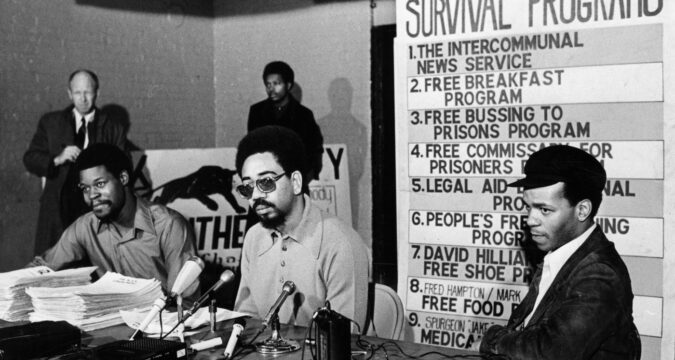
Yet members of the Historical Preservation Society of the Illinois Chapter of the Black Panther Society want people to also remember the group for its social services — including free food and medical care — that was often overshadowed by the Panthers’ militant ways.
Chicago locations
925 W. Diversey Parkway
Fred Hampton, left, chairman of the Black Panthers, speaks during a press conference with the Young Lords (a Puerto Rican civil and human rights group) on Oct. 10, 1969, at Holy Covenant United Methodist Church. With Hampton are, seated from left, Pablo “Yoruba” Guzman, a Young Lord from New York, Jose “Cha-Cha” Jimenez, founder of the Young Lords of Chicago, and Mike Klonsky, a Students for a Democratic Society spokesman. (Dave Nystrom/Chicago Tribune)
Holy Covenant United Methodist Church was founded on Jan. 30, 1894. According to the church’s website, widow Helena Bergman sold her plot of land to build what was then known as Diversey Parkway Evangelical Church. It was dedicated on July 22, 1894.
Social justice has long been a significant part of the Lincoln Park church’s mission.
The National Guard has been activated to Chicago 18 times from 1877-2021. Here’s a breakdown.
The church and others in the city and Evanston provided refuge for the Students for a Democratic Society, the Black Panthers, the Weather Underground, the Young Lords and the Rainbow Coalition during the Days of Rage, which were protests that followed the 1968 Democratic National Convention.
It was the site of an Oct. 10, 1969, news conference in which Black Panthers leader Fred Hampton and others criticized the violence and vandalism used by the Weatherman (the early name for the Weather Underground) during the demonstrations.
2350 W. Madison St.
Firefighters are present at the Black Panthers organization’s headquarters at Madison Street and Western Avenue in Chicago after a shootout there on July 31, 1969. (Ray Foster/Chicago Tribune)
The 27th Ward building, which has been demolished, was home to a registration station for the selective service in 1942, and the Chicago School of Custom Tailoring in the late 1940s before it became headquarters for the Illinois Chapter of the Black Panthers in November 1968.
Raids were common at the Near West Side site.
About 40 FBI agents surrounded the building on June 4, 1969, and eight Panthers inside were persuaded to walk out without the need to deploy tear gas.
An estimated 50 police officers descended on the organization’s headquarters early on July 31, 1969, when a passing patrol car reported it was under fire from the Panther’s second-floor office. A 30-minute gun battle was followed by a fire on the building’s roof, the Tribune reported.
Willie Calvin, spokesperson for the Panthers, said police instigated the incident and started the fire. Five police officers and three people inside the building were injured.
Though three Panthers were charged with attempted murder, the organization’s deputy minister of defense, Bobby Rush, said police started the fire and stole cash from the group’s office.
Police stop a car in front of the Black Panther headquarters at 2350 W. Madison St., following a gun battle on July 31, 1969, in Chicago. (Ray Foster/Chicago Tribune)
A similar skirmish between police and Panthers happened again at the location early on Oct. 4, 1969.
A federal agent later testified the FBI had wiretapped the Panthers’ headquarters in order to monitor phone conversations there from spring 1969 through at least June 1970.
A Walgreens is now at the site, which is a half mile west of the United Center.
2337 W. Monroe St.
Police gather at an apartment building at 2337 W. Monroe St. following a bloody and controversial raid on Dec. 4, 1969, where Black Panthers Fred Hampton and Mark Clark were shot and killed. (Ed Smith/Chicago Tribune)
“For a generation of Chicagoans, their opinion of what happened in 1969 when Chicago police raided the West Side apartment of Black Panther Party members depended greatly on what neighborhood they called home,” the Tribune’s Will Lee wrote in 2019.
“For the public at large, it was as police officials described: a dramatic gunfight launched against police by violent Black nationalists that left two dead and four wounded.
“But for others, particularly socially conscious African Americans, the Dec. 4, 1969, raid on the two-flat at 2337 W. Monroe St. was a cold-blooded execution of Black Panthers leaders Fred Hampton and Mark Clark, ordered by federal authorities eager to snuff out burgeoning Black leadership.”
Clark was killed in early-morning gunfire, but survivors Harold Bell and Hampton’s fiancee, Akua Njeri, then known as Debra Johnson, testified at the 1972 criminal trial against the state’s attorney and officers in the raid that Hampton was pulled alive from his bed and shot dead after the group had surrendered. Later, an FBI whistleblower said the agency coaxed local law enforcement across the country, including Chicago police, into deadly clashes with heavily armed Black Panthers.
A federal grand jury reporter said only one shot could be proved to have been fired from the apartment, compared with 82 to 99 shots fired by police.
A photo of the north wall in the front bedroom, with the other side of the wall being the living room, at the Black Panther headquarters on Dec. 12, 1969. Bullet holes show the extent of the shooting that left Fred Hampton and Mark Clark dead on Dec. 4, 1969. The hall door is on the left. (James O’Leary/Chicago Tribune)
In 1983, a federal judge approved a settlement that awarded $1.85 million to survivors of the raid and families of the two men who were killed, to be paid by the federal government, the city of Chicago and Cook County. It was believed to be one of the largest civil rights settlements in federal court history.
Another residential building now occupies the same location.
1512 S. Pulaski Road
People teach and learn math at the Better Boys Foundation at 1512 S. Pulaski Road in Chicago on June 14, 1973. The Black Panthers worked out of the Better Boys Foundation in Chicago. (Hardy Wieting/Chicago Tribune)
The Better Boys Foundation was founded in 1961 by boxing promoter Joe Kellman to benefit underprivileged boys, specifically.
On April 1, 1969, the group’s three-story building in North Lawndale was where the Panthers launched their first local Free Breakfast for Children Program. But by September 1969, the Tribune was critical of the effort — and said “political orientation” classes were also held at the city’s growing number of breakfast program sites operated by the Panthers.
“Altho Fred Hampton, the party’s Illinois chairman, claims that 3,000 to 3,500 children are being fed at three locations each week, it was found that on some days the centers were never opened and on others only a handful of children showed up,” Tribune reporter Ronald Koziol wrote.
Koziol said records showed some of the donations for the food program were used by Panther officials for their own personal use. By January 1970, Koziol wrote the breakfast program was “barely operating in Chicago.”
Children and adults enter and leave St. Andrews Episcopal Church at 48 N. Hoyne Ave., in Chicago where the Black Panthers were serving breakfast on Jan. 12, 1970. (James O’Leary/Chicago Tribune)
Yet the idea inspired the U.S. Department of Agriculture’s School Breakfast Program, which launched in 1975. About 65 billion meals have been served to schoolchildren since then. Other social services the Panthers provided to the community were free food pantries, child care facilities and medical centers.
BBF (Building Brighter Futures) Center for the Arts continues Kellman’s mission at the same location.
4233 S. Indiana Ave.
A playlot run by the Black Panthers is next to their headquarters at 4233 S. Indiana Ave. in Chicago on July 28, 1972. The group ran a free breakfast for local children at the building. (Quentin Dodt/Chicago Tribune)
During the 1940s-1960s, Friendship House was a community center in Grand Boulevard operated by Roman Catholic laymen who promoted racial understanding and communication in the pre-civil rights era.
The Panthers began to use the building as a South Side headquarters in the late 1960s. It’s where the group requested, in August 1971, the state reinvestigate the raid that killed Clark and Hampton and for the immediate resignation of Cook County State’s Attorney Edward Hanrahan (whose officers led the raid).
The now-closed Black Panther Party headquarters at 4322 S. Indiana Ave. has the words “All Power To The People” on the door on Sept. 16, 1974. (Ernie Cox Jr./Chicago Tribune)
The address was later used as a “temple” for the El Rukn street gang, according to Tribune archives.
An apartment building has since been constructed on the site.
Want more vintage Chicago?
Become a Tribune subscriber: It’s just $1 for a 1-year digital subscription.
Thanks for reading!
Subscribe to the free Vintage Chicago Tribune newsletter, join our Chicagoland history Facebook group, stay current with Today in Chicago History and follow us on Instagram for more from Chicago’s past.
Have an idea for Vintage Chicago Tribune? Share it with Kori Rumore at krumore@chicagotribune.com.
https://www.chicagotribune.com/2026/02/12/vintage-chicago-tribune-black-panther-sites/


