Category: News

Portage school officials preparing for moving day
The former Portage Township Schools Administration building will be the first to be demolished this spring when workers begin preparing to build the new Aylesworth Middle School.
The building, which most recently housed the information technology team, is scheduled to be razed in April, Superintendent Amanda Alaniz said.
The construction site includes two existing schools as well, Aylesworth Elementary School and Willowcreek Middle School.
This is the last school year for the elementary school, which will be demolished when it’s emptied out. Willowcreek Middle School will remain until its replacement is ready for use, then demolished to make way for the rest of the project.
All told, the district is planning a $99.85 million construction project, not all of which is at that site, at the corner of Willowcreek Road and Central Avenue, Alaniz said. Construction bids came in low enough that other projects on the district’s to-do list are being accelerated, including HVAC work at other schools and moving a career and technical education program from Willowcreek to Portage High School.
Alaniz is meeting with architects Fanning Howey to get a list of projects ready for the School Board’s review and approval.
“We’ve got a couple of things that are Priority 1, but all of Priority 1 can’t happen until the first domino goes,” she said.
At Portage High School, the south cafeteria is a challenge for food service personnel because of the tight space. That’s one of the areas the architect is looking at. “The equipment alone, as you can imagine, is extremely pricey,” Alaniz said, to the tune of about $2 million.
As the project gets closer to actual construction, the district is looking at what equipment can and can’t be salvaged from the elementary school.
Newer equipment that still works well at Aylesworth could replace older equipment at other schools.
Board member Jeff Smith said he hoped the playground equipment could be salvaged, but that’s a no-go. It has aged, Alaniz said, and likely wouldn’t be structurally sound if it’s moved. “It’s too much of a risk,” she said.
“We’re making sure not to be wasteful in any way,” Alaniz said.
As part of the project, grades are being realigned to turn Fegely Middle School into an intermediate school. New cafeteria furniture will be needed because of the increased number of students there. The school will also see four lunch periods instead of three.
Storage there will need to be increased, too.
“It’s exciting, but it’s kind of scary at the same time,” School Board President Andy Maletta said.
“Fegely’s going to be a little bit tight at first,” Alaniz said, but she anticipated that.
Some teachers might use carts for a year or two instead of having their own classroom, but the district’s demographic study shows enrollment will continue to decrease, so that problem will go away.
As the city adds subdivisions, what if the study is wrong, Maletta asked her.
Even with razing Aylesworth and having one less elementary school, it still would be cheaper to operate an addition to another school rather than an entire school building, Alaniz said.
“We asked those kinds of things with architectural when we worked with Skillman Corp.,” the district’s contractor for the construction project.
On Monday, the board approved conducting a traffic study for the site of the new school. Instead of an entrance on Willowcreek Road, traffic will be directed to Central Avenue.
Requiring a traffic study is common for any construction project of this size, Maletta said.
As the end of school approaches, Alaniz and her team are preparing faculty and staff for the start of construction.
“When that last day of school happens, it’s going to be very quick before they mobilize to go into that building,” Alaniz said, so teachers are being encouraged now to make final decisions on what to move to their new classrooms elsewhere.
Teachers will get help moving their stuff out, Maletta said.
This school year has an additional faculty workday to help with the big move.
Personal items, the teachers can move, perhaps ahead of the end of the school year. Furniture and other items that are property of the district will be moved without requiring the teacher’s help.
The district is likely to hire movers to help with the project.
Get rid of trash now, Alaniz urged, to reduce the amount that needs to be moved later.
Alaniz is communicating with faculty about what they can do now to make the final move easier. “They are all grateful for the chunks of digestible information,” she said.
Doug Ross is a freelance reporter for the Post-Tribune.
https://www.chicagotribune.com/2026/02/13/portage-school-officials-prepare-for-move/

Review: Another prodigy has taken the classical world, and the CSO, by storm. Is that a good thing?
Precocious artists are all over the Chicago Symphony’s program this weekend.
Mozart’s child-prodigy past needs no introduction. More recently, composer Joel Thompson wrote “Seven Last Words of the Unarmed,” one of the essential choral works of the 21st century, when he was 26. And this week’s soloist, the Japanese violinist Himari, is, at just 14, enough of a sensation to get a one-name billing like Beyoncé or Madonna.
Himari has already performed with the Berlin Philharmonic, widely considered the world’s best, and the CSO, at Ravinia last July. She’ll make her Carnegie Hall debut with the Boston Symphony next year. Her conquest of the biggest stages in classical music, in just a few years, hasn’t been seen since the 1990s prodigy boom that produced CSO artist-in-residence Hilary Hahn, Chicago violinist Rachel Barton Pine and fellow mononymic violinist Midori, now teaching at Ravinia’s Steans Institute.
In comparison, we’re less swarmed by prodigies today — not because musicians are any less talented than they once were, but because there seems to have been a cultural reset about the ethics of placing young artists into our industry’s most glaring spotlights. Himari’s ascension feels like a relic from a time we’ve moved on from.
On Thursday, the violinist’s performance of Max Bruch’s concerto in G minor indeed betrayed some youthful quirks: tapping her foot along with the music, always sweeping her bow off the strings with a smiling flourish. But Himari’s musicality is the real deal. Her solo prelude was uncommonly expansive, as though she had all the bow in the world to spin out that first, endless phrase. She clearly conceives of the music as a complete lyrical statement — look no further than the middle section of the Adagio, which grew from introspective to impassioned.
She also used her brief soloist-only moments to play with time slightly in the finale, which is easily tossed off as a bravura showcase. But of course, her performance scratched that itch, too, her tone ringing and fingers mind-blowingly agile.
That said, as in her Ravinia debut, Himari’s partnership with the orchestra felt like a work in progress. Absent in both her playing and van Zweden’s leadership was that ethos of chamber playing — of sensitive listening, subtle spontaneity and give-and-take — that makes a compelling concerto performance. The CSO seemed to operate as nothing more than an orchestral mise en scène. If the orchestra got Himari’s attention, it usually wasn’t for good reasons: a rushing oboe, an overassertive horn line.
Plus, youth is a trap, as CSO music director designate Klaus Mäkelä’s most vitriolic critics prove — and he was at least a legal adult when he started racking up orchestral appearances in the late 2010s. Himari is now on the same stages as the world’s top soloists, and asking to be assessed alongside them. By the same token, she lacks their freedoms. If she were to do anything outside the realm of the expected in a repertoire piece, it would be misunderstood as naïveté, youthful overeagerness, a technical failing. Daring requires trust — but the public doesn’t know her well enough yet.
That leaves technical prowess. Himari has heaps of that. But honestly, I can’t say I would have rather heard her play Bruch over most other violinists on the CSO calendar, except for the obvious spectacle of seeing a child play like Paganini.
I don’t think it’s a coincidence that both Thursday’s performance and Himari’s Ravinia debut shone brightest during her encores, when the orchestra dropped away and she played, alone. Her approach to Fritz Kreisler’s “Recitativo and Scherzo-Caprice” was contemplative, soulful, piercingly candid and — best of all — free. It’s what’s ringing in my ears now, despite the dazzle of the Bruch. Hopefully, solo and recital repertoire remains dear in whatever career she builds.
On the same day as Himari’s Ravinia debut last summer, young artists with the festival’s Steans Institute premiered Thompson’s first string quartet. The Jamaican American composer — a member of the “Blacknificent 7” collective that includes Chicago composers Jessie Montgomery, Shawn Okpebholo and Damien Geter — happens to be at the same venue as the violinist again, with his orchestral work “To See the Sky” opening the concert on Thursday night.
According to a confessional program note, Thompson had been reluctant to compose orchestral music that “relies on the rhythms of (his) youth.” “Because then,” he writes, “the question of genre arises. Dvořák could bring Bohemian tunes into his music, but then, if a Black person brings in African American music, does it become jazz?”
Seeing Terence Blanchard’s breakthrough opera “Fire Shut Up in My Bones,” which came to Lyric in 2022, gave Thompson the confidence boost he needed.
“To See the Sky” is tightly crafted, with a general three-note, up-down-up melodic contour that recurs in different guises over all three movements. In the first movement, it builds an uneasy chord; in the second, it becomes a flowing melody, with wistful interludes from English horn and muted trumpet; in the third, it strides.
The orchestration has an almost Bernsteinian gusto — perhaps a nod to its commissioner, the New York Philharmonic, which premiered the piece in 2024. (I attended that performance.) The questions Thompson was grappling with get teased in the first movement via a drum-kit backbeat, and a brief, bluesy clarinet solo.
But the final movement is the work’s pièce de résistance. The melody gives way to a percussion-only interlude: hand claps, djembe and agogô, a West African double bell. When the melody returns, it’s gauzy, gentle — sharing space with the percussion, rather than wheeling off in its own world. With sensitive CSO corps playing and a ripened interpretation from Van Zweden, what was stirring in New York became profoundly moving in Chicago.
The concert closed out with Mozart’s final symphony: his 41st, “Jupiter.” This gracefully shaped performance carried van Zweden’s quintessential clarity and verve: first and third movements that seemed to dance across the stage, and a fourth movement both zippy and crisply precise.
That forward momentum bled into the second movement, which, while beautifully colored, never eased into its own sentimentality — another van Zweden signature. But the headlong energy van Zweden inspires in the CSO thrilled during the symphony’s final coda, the five melodies of the famous fugue intertwining with blazing clarity.
This moment still staggers, almost 250 years later — the last symphonic statement from someone who, after a precocious start, freed himself from the yoke of others’ expectations and came, unapologetically, into his own. Great artists always do.
Continuing through Saturday in Orchestra Hall at Symphony Center, 220 S. Michigan Ave.; cso.org
Hannah Edgar is a freelance critic.

Lindsey Vonn hopes to go home after another surgery following crash in Olympic downhill
CORTINA D’AMPEZZO, Italy — Lindsey Vonn will have another surgery on her broken left leg Saturday at the Italian hospital treating her, “and then I can potentially leave and go back home.”
Vonn posted a video message on Instagram on Friday after her horrific crash in the Olympic downhill race at the Milan Cortina Games.
“Hey guys, I just wanted to give you a little update and say thank you so much to everyone that has been sending me flowers and letters,” Vonn said, adding that she also has received stuffed animals, including a shark pillow that she was resting her head on in the video. “It’s just been so amazing and really helped me a lot.
“It has been quite a hard few days in the hospital here. I’m finally feeling more like myself. I have a long, long way to go. Tomorrow I’ll have another surgery and hopefully that goes well and then I can potentially leave and go back home, at which point I will need another surgery. Still don’t know exactly what that entails yet until I get some better imaging, but it’s kind of where I am right now.”
Vonn is being treated at a hospital in Treviso.
“And yup, that’s a bruise under my eye,” Vonn added in a written message in her post. “Almost gone though!”
The 41-year-old Vonn crashed 13 seconds into her run during Sunday’s race and was airlifted off the course by helicopter. The American skiing standout said late Monday she had suffered a “complex tibia fracture that is currently stable but will require multiple surgeries to fix properly.”
She said on Wednesday that she had a “successful” third surgery.
Nine days before Sunday’s crash, Vonn ruptured the ACL in her left knee in another crash. Even before then, all eyes had been on her as the feel-good story heading into the Olympics for her comeback after nearly six years of retirement.
In her latest post, Vonn said she is “very much immobile but I have a lot of friends and family that have been coming to visit.”
“I feel very lucky and fortunate to have so many people around me that have really helped me get through this so I just wanted to say thank you and go Team USA,” Vonn said. “It’s so great to watch and really lifted my spirits. Good job, team, and keep crushing it. I’ll check in with you guys when I can.”
https://www.chicagotribune.com/2026/02/13/olympics-lindsey-vonn-another-surgery/

Financial uncertainty prompts Waukegan D60 to review staffing: ‘To ensure resources are aligned with student needs’
A review of primarily central office jobs at Waukegan Community Unit School District 60 is underway in light of potentially declining revenue and rising costs in the midst of budget discussions for the 2026-2027 school year.
Gwen Polk, the district’s assistant superintendent for business and financial services, said there is a lot of uncertainty about several revenue streams. Salaries and benefits account for 75% to 80% of all spending. As a result, she said, taking a closer look at what employees do is necessary.
“This year, in particular, the district is going to take a closer look at administrative staffing levels through a comprehensive review process to ensure resources are aligned with student needs and district priorities,” Polk said.
The District 60 Board of Education got a close look at the review process and other financial issues during a meeting of the Operational Services Committee on Tuesday at the Education Service Center in Waukegan, ahead of making decisions later this month.
Department heads are already looking at the roles of each job they supervise and, in the process, are making suggestions. Polk said the recommendations will go to the appropriate deputy superintendent for further consideration.
LeBaron Moten, District 60’s deputy superintendent for operational supports and programs, or Eduardo Cesario, the deputy superintendent for academic supports and programs, will soon give their recommendations to Superintendent Theresa Plascencia for final consideration.
Plascencia will make a final decision before a review by the human resources and legal departments. Polk said the board will consider any changes at a special meeting in late February. Impacted employees, if any, will be notified in early March.
“Before we spread panic, we’re looking at administrative division positions right now,” Plascencia said. “We’re looking at central office positions. My stance has been, we will not cut direct services to students.”
Among direct services to students, she said things like student initiatives, athletics, art programs or “anything that directly touches students” will remain. She wants to make sure there is no duplication of services in any of the descriptions. Some changes are already taking place.
“We’ve already started to scale back this school year, and we will continue to scale back,” Plascencia said. “What we don’t want is a direct impact where it shocks the system.”
Board member Anita Hanna said that before the district starts cutting staff, she wants to see a reduction in expenses. There are areas where she sees waste.
“Before we get to staff reductions, what kind of spending reductions are we doing?” Hanna said. “There are things we could do without, (like) using other venues when we have a school building we could use. We need to get rid of consulting contracts before we start reducing staff.”
Plascencia said programs and their expenses are often connected. One is needed to ensure the other will work. For special events, outside vendors can be less expensive than the contracted food service provided for school meals.
“You don’t look at these two things in isolation,” Plascencia said. “They have to work together. We are looking at it all simultaneously. It’s not the cart before the horse, or the horse before the cart. One can’t come before another. This is a process, and it’s going to be a process.”
Board member Carolina Fabian said certain positions are mandated. She wants to make sure they remain in place. She also thinks consultants provide a fresh set of eyes with an outside perspective.
“You don’t want the person who works in the district to be writing their own job description, or the job description of their colleagues, or the person above them,” Fabian said. “There are moments in time when we need consultants because they are neutral. “
Among the financial uncertainties confronting Polk are less state funding because of declining enrollment. There is uncertainty because the federal government is considering the elimination of the U.S. Department of Education. Executive orders from Washington can make a difference.
“We don’t know what the impact of that is going to be,” Polk said. “We’ve heard that there are going to be some reductions in Medicaid, and we have to look at that because we’re providing services to our special education students and we’re getting reimbursed for some of those costs.”
https://www.chicagotribune.com/2026/02/13/waukegan-school-board-job-review/

Two Philadelphia Men Admit To AI-Assisted $3.5M Housing Aid Scam In Minnesota
Two Philadelphia Men Admit To AI-Assisted $3.5M Housing Aid Scam In Minnesota
This will be the first of many AI scams of its kind, we predict…
Two men from Pennsylvania admitted to repeatedly flying from Philadelphia to Minneapolis to exploit Minnesota’s Housing Stabilization Services (HSS) program, stealing about $3.5 million, according to prosecutors. Authorities say they used artificial intelligence to forge records and falsely bill for services, according to Fox News.
Anthony Waddell Jefferson, 37, and Lester Brown, 53, registered businesses as HSS providers, claiming they offered housing support and transition services. In reality, officials say much of the work never happened.
Launched in 2020, HSS helps people with disabilities, seniors, and those struggling with mental health or addiction secure housing. The Justice Department has noted the program had “low barriers to entry and minimal records requirements.”
Attorney General Pam Bondi said, “Criminal fraud not only robs taxpayers — it shatters trust in our institutions… Our prosecutors will work tirelessly to unravel criminal fraud schemes.”
Fox News writes that prosecutors allege the pair billed Medicaid for services supposedly provided to about 230 clients. Both men pleaded guilty to wire fraud and face up to 20 years in prison.
Deputy Attorney General Todd Blanche stated, “Minnesota will no longer be a haven for fraud under our watch,” adding that dozens of convictions have already been secured in the state.
Investigators say Jefferson and Brown promoted themselves as “The Housing Guys” at shelters and Section 8 housing sites to recruit clients. Jefferson allegedly hired relatives and associates to produce fake service notes, sometimes using invented employee names. Brown reportedly failed to keep required records. Authorities also say the men fabricated emails and used ChatGPT to generate false documentation.
Assistant Attorney General A. Tysen Duva said, “They traveled across the country for one purpose: to prey upon and steal millions in taxpayer dollars,” emphasizing that such schemes threaten federally funded programs nationwide.
Tyler Durden
Fri, 02/13/2026 – 13:20
https://www.zerohedge.com/markets/philly-pair-admit-35m-ai-housing-aid-scam-minnesota

Kane County Board OKs raises for Health Department employees
Kane County Health Department employees will be getting raises, after the county board recently approved a new collective bargaining agreement for the department that extends through 2027.
The Health Department’s most recent collective bargaining agreement expired on Nov. 30, 2024, per the measure authorizing the new contract that was approved on Tuesday. That means the new contract will extend retroactively from Dec. 1, 2024, through Nov. 30, 2027.
The new agreement also includes retroactive raises for Kane County Health Department employees.
Effective Dec. 1, 2024, employees who were on the payroll as of the day the collective bargaining agreement was ratified are to receive a retroactive increase in their base pay. That will amount to either a 3% across-the-board increase, or an upward adjustment to the department’s new revised minimum hourly amounts — $17 per hour for administrative assistants, $27.50 for public health nurses, $25 for environmental health positions, $25 for employees working in communicable diseases and $33 for epidemiologists.
From there, effective Dec. 1, 2025, each employee who was on the payroll as of that date will get a 3% raise, per documents included in Tuesday’s meeting agenda. Health Department employees will get another 3% raise starting on Dec. 1, 2026.
At a Kane County Board Finance Committee meeting in January, Kane County Finance Director Kathleen Hopkinson said the impact of the raises was around $120,000 for the first year, and around $70,000 for the two years following.
Michael Isaacson, executive director of the Kane County Health Department, noted that, since the contract extends retroactively, department employees who didn’t receive a raise at the time will receive backpay.
The measure was approved by the full board Tuesday as part of the meeting’s consent agenda.
mmorrow@chicagotribune.com
Italia, en cumbre con África, promete mayor cooperación
Por SAMUEL GETACHEW y EVELYNE MUSAMBI
ADIS ABEBA, Etiopía (AP) — Italia se comprometió a profundizar la cooperación con países africanos el viernes durante su segunda cumbre con África, la primera en suelo africano, con el objetivo de revisar proyectos iniciados en sectores críticos como la energía y la infraestructura.
Los proyectos integran el llamado Plan Mattei para África, lanzado en el 2024 y que busca promover una cooperación impulsada por la inversión en lugar de la ayuda tradicional.
La primera ministra italiana Giorgia Meloni se dirigió a decenas de jefes de Estado y de gobierno africanos en la capital de Etiopía, Adis Abeba, y reiteró que una asociación exitosa dependería de la “capacidad de Italia de nutrirse de la sabiduría africana” y de garantizar que se aprendan las lecciones.
“Queremos construir cosas juntos”, les manifestó a los jefes de Estado africanos. “Queremos ser más coherentes con las necesidades de los países involucrados”.
El primer ministro etíope Abiy Ahmed afirmó que Italia proporciona a África una puerta de entrada a Europa a través de estas alianzas.
“Este es un momento para pasar del diálogo a la acción”, expresó. “Al combinar la población enérgica y creativa de África con la experiencia, la tecnología y el capital de Europa, podemos construir soluciones que aporten prosperidad a nuestros continentes y más allá”.
Después de que la cumbre Italia-África concluya el viernes, los líderes africanos permanecerán en Adis Abeba para la cumbre anual de la Unión Africana, que comienza el sábado.
La escritora y analista política keniana Nanjala Nyabola señaló que los resultados tangibles de este tipo de cumbres dependen de los preparativos que hagan los países.
Los gobiernos africanos a menudo se centran en “la imagen en lugar de convertir realmente las cumbres en un compromiso significativo”, sostuvo.
En lugar de esperar a recibir una lista de exigencias, los países deberían “presentar las conclusiones de un periodo prolongado de análisis de las necesidades nacionales” y entablar un diálogo para ver cómo pueden satisfacerse esas necesidades.
Desde que se lanzó hace dos años, el Plan Mattei ha involucrado directamente a 14 naciones africanas y ha puesto en marcha o impulsado alrededor de 100 proyectos en sectores cruciales, entre ellos la energía y la transición climática, la agricultura y la seguridad alimentaria, la infraestructura física y digital, la atención de la salud, el agua, la cultura y la educación, la capacitación y el desarrollo de la inteligencia artificial, según el gobierno italiano.
___________________________________
Musambi reportó desde Nairobi, Kenia.
___________________________________
Esta historia fue traducida del inglés por un editor de AP con ayuda de una herramienta de inteligencia artificial generativa.
https://www.chicagotribune.com/2026/02/13/italia-en-cumbre-con-frica-promete-mayor-cooperacin/

Financial Nihilism & The Trap Young Investors Are Walking Into
Financial Nihilism & The Trap Young Investors Are Walking Into
Authored by Lance Roberts via RealInvestmentAdvice.com,
The article from the Wall Street Journal titled “Why My Generation Is Turning to Financial Nihilism” by Kyla Scanlon argues that Gen Z is embracing high-risk financial behavior out of despair and detachment. Of course, it is essential to recognize that Kyla, although well-intentioned, is a young twenty-something influencer with limited real-life experience, and sees things for “her generation” through a very narrow lens of “recency bias.”
Let’s start with understanding that “Financial Nihilism” is a term used to describe an attitude where people believe financial decisions are meaningless because the system is rigged, the future is hopeless, or traditional paths to wealth are broken. The term “Financial Nihilism” was first coined in 2020 by Demetri Kofinas, a podcaster, who used it to describe his belief that speculative assets lack intrinsic value, driven by a loss of faith in traditional economic systems.
However, while this phrase has gained popularity in recent years, particularly following the GameStop short squeeze, crypto mania, and the rise of meme trading, it disappeared when all of that collapsed in 2022. However, after three years of unprecedented market gains in every asset class, from stocks to cryptocurrencies to precious metals, “Financial Nihilism” has resurfaced to rationalize “speculative excess” and justify abandoning long-term investment strategies that have withstood the “sands of time.”
While Kyla produced a bombastic article to gain social media exposure by suggesting that Gen Z and Millennials no longer believe in saving, investing, or following traditional financial paths, the data shows something very different.
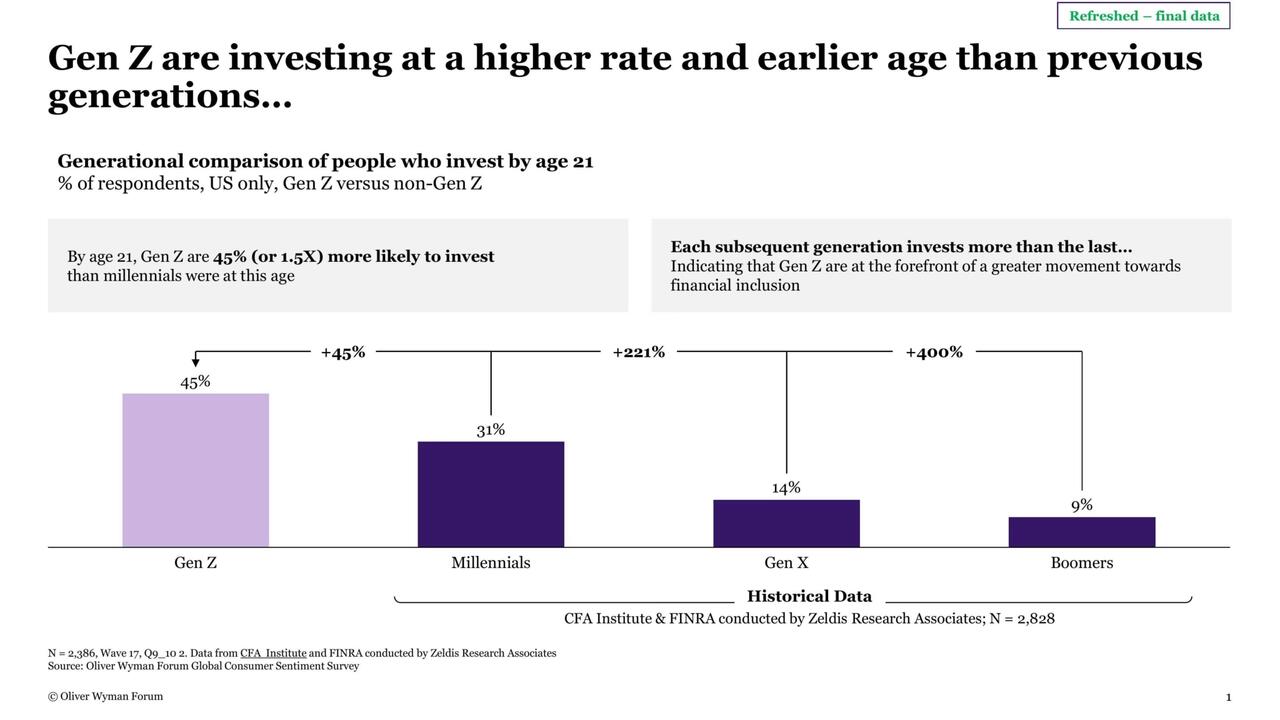
Over half of Gen Z holds investments in traditional financial products, according to FINRA and the CFA Institute.
A 2023 Vanguard report showed Gen Z participants in retirement plans were increasing contributions, not fleeing traditional investing.
Charles Schwab’s Modern Investor Study found Gen Z prefers low-cost ETFs and index funds, strategies built around long-term returns.
Pew Research data shows that Gen Z and Millennials are investing at earlier ages than previous generations.
None of these behaviors is nihilistic. They are practical and reflect economic constraints, not philosophical despair.
Yes, there is undoubtedly a pool of young investors throwing “caution to the wind” and aggressively investing in speculative assets to “get rich quick.” But even my children, at the ripe old age of 22, think they are unique and different and that no one understands their challenges. We parents, of course, have “no idea” about their situation. Of course, this is the problem with our youth who have no real-world experience or a sense of history. We, the “old people,” were the ones speculating on Dot.com investments in the late 90s, just before it all went bust. As I wrote in“Retail Investors Flood The Market,”
“Is it 1999 or 2007? Retail investors flood the market as speculation grows rampant with a palpable exuberance and belief of no downside risk. What could go wrong?
Do you remember this commercial?
That commercial aired just 2 months shy of the beginning of the “Dot.com” bust. We “youngsters” at the time thought Warren Buffett was an idiot for avoiding technology stocks because “he didn’t get it.”
Turns out he was right.
But that wasn’t the first time that we youngsters had to learn the risks of chasing “hot investments,” and why “this time is NEVER different.” The following E*Trade commercial aired during Super Bowl XLI in 2007. The following year, the financial crisis set in, markets plunged, and once again, investors lost 50% or more of their wealth by refusing to listen to the warnings.
Why this trip down memory lane? (Other than the fact that the commercials are hilarious to watch.) Because what is happening today is NOT “Financial Nihilism,” it is the typical outcome of exuberance seen during strongly trending bull market cycles.
While young people, like Kyla, may think that “this time is different,” they lack the historical experience to support such a conclusion. Ask anyone who has lived through two “real” bear markets, and the imagery of people trying to “daytrade” their way to riches is all too familiar. The recent surge in speculative excess, leverage, and greed is not a new phenomenon.
With that said, let’s examine the issues with Kyla’s article and why “Financial Nihilism” is a myth.
“Meme Stocks and Crypto Aren’t Jokes Anymore. They’re Cries for Help.”
I loved this line from her diatribe as it suggests that Gen Z uses risky financial products as an emotional outlet. She implies that young people are not seeking returns but rather relief from feelings of hopelessness. While that framing sells well, it doesn’t hold up under scrutiny. While speculative assets like cryptocurrency and meme stocks attract younger buyers, that’s not proof of despair. Instead, it reflects broader exposure to digital markets, higher risk tolerance, easy access to trading (via platforms like Robinhood), leverage, and the rise of a gambling mentality.
But this is a newer development.
“Historically, access to capital markets was highly mediated, available only to institutions or individuals who had the time, money and resources to manage their assets with the help of brokers and financial advisors. Today, market data is readily accessible online and new technologies have significantly reduced the cost of trading and other barriers to entry. This means that more people can trade, at any time, from anywhere.” – World Economic Forum
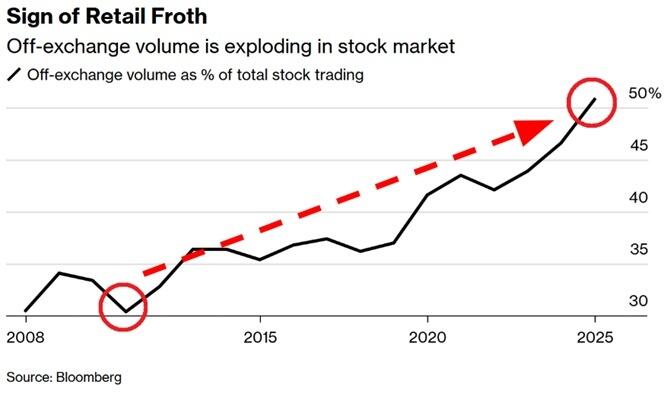
Since 2016, the volume recorded at platforms that match orders from brokerages, a proxy for retail activity, has posted its third consecutive annual increase, rising by 15%. Meanwhile, the average daily volume of US-listed stocks has been ~12.0 billion shares since 2019, which is ~75% above the levels seen over the prior six years. Most notably, just over the last 12 months, daily volume has averaged a massive 16.7 billion shares.
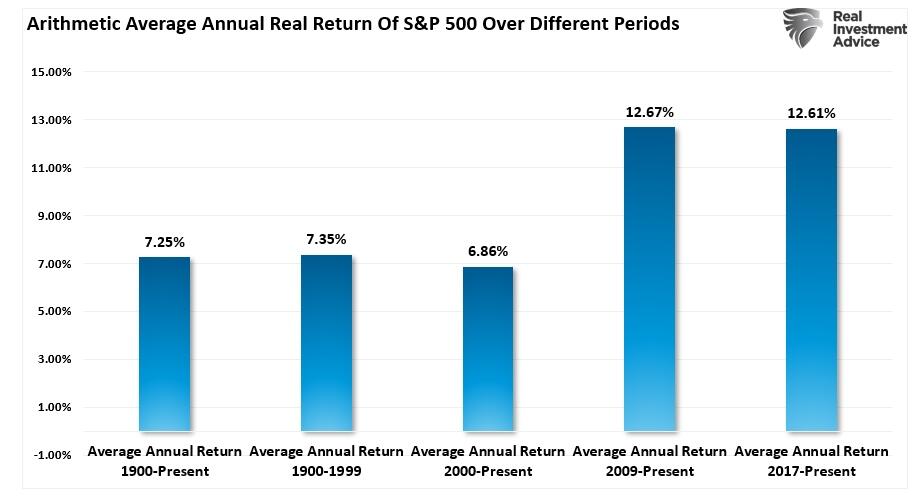
Yes, retail investors are piling into the market. But why wouldn’t they after watching 15 years of market returns that are 50% above historical norms, and seeming “no risk” for speculative activities?
However, there is a difference between risk appetite and recklessness. As noted above, the data indicate that Gen Z is starting to engage with investing at a younger age than previous generations, and many hold investments for the long term while utilizing digital tools to experiment with their investments. That may include crypto or options, but it’s not a binary between discipline and nihilism.
Emotional narratives about “cries for help” obfuscate the data. Investors in their 20s often take more risk because they have longer time horizons. But where they are going wrong is through the amount of speculative risk and gambling behaviors they have adopted without financial guidance and education.
As noted above, “youngsters” gambling with investments is not new. Every generation throughout history has speculated on risk assets through every bull market cycle. But, unfortunately, regardless of age, speculative bubbles all ended the same way.
Gen Z didn’t “reinvent” the market; they are just entering a market that incentivizes risk-taking. Until it doesn’t.
“People My Age Don’t Think the System Works, So Why Follow Its Rules?”
Scanlon asserts that Gen Z has lost faith in traditional finance and institutions, and assumes systemic distrust is translating into a rejection of personal responsibility.
That isn’t an argument. It’s an excuse for “victimization.”In other words, my personal financial situation is not a result of my personal behaviors, spending habits, work ethic, or savings process, but it’s the “system’s fault.” Yet there is vast data to the contrary, showing that successful young individuals who follow the tried-and-true process of financial pathways succeed. Do they have as much wealth as their parents? Of course, they don’t, because they haven’t had the time to accumulate it. However, they are early on the path to success, which will likely outpace their peers.
Furthermore, this argument falsely equates skepticism with nihilism. Many young investors distrust centralized finance due to real-world events, including the 2008 crash, rising debt burdens, and stagnant wages. But rejecting blind trust in institutions is not the same as rejecting financial logic. Despite disillusionment, Gen Z invests at higher rates than Millennials did at the same age, according to Pew and the WEF. They also save a larger share of their income, using digital apps and platforms to automate their financial behavior.
Yes, Gen Z tends to distrust the government and financial media, but do you blame them, given the garbage that is produced daily on social media and YouTube by people with an agenda to promote? While skepticism fuels caution, it is not chaos. Gen Z is more likely to question fees, demand transparency, and seek passive investment tools, and that’s a smart move. Traditional rules of finance, such as saving consistently, spending less than you earn, and investing for the long term, are still followed; they just don’t generate “media-grabbing headlines.”
Calling this behavior “Financial Nihilism” misses the point. Gen Z is engaging with markets on its own terms, and while not all methods are necessarily healthy, it represents adaptation, not rejection.
“If the Future Feels Doomed, Why Not YOLO Trade Into It?”
Lastly, Kyla suggests that existential dread leads young people to treat the market like a casino. The idea is that if nothing matters, risk doesn’t either. This is the article’s weakest argument. While social and economic pressures are real, they are not driving widespread self-destruction. They are driving innovation in how people build and manage their wealth.
The idea behind this line is that young people, facing what feels like a bleak financial future, are throwing caution to the wind to gamble on crypto, options, and meme stocks to build wealth fast, rather than creating “lasting wealth.” This is where the term “YOLO trading” comes in, making aggressive bets with the mindset that there’s nothing to lose. However, as noted above, there is certain logic to that mindset, given that over the last 15 years, every market downturn has been met by either fiscal or monetary interventions. Repeated bailouts of bad investment decisions have created a “moral hazard” in the marketplace.
There’s truth here, but only part of it.
Yes, a subset of young investors is engaging in reckless speculation. They take on excessive risk, invest in volatile assets, and often trade on hype rather than fundamentals. Many borrow money to do it. This group exists, and their outcomes won’t be good. Some will lose money, and likely most will wipe themselves out entirely. The market is unforgiving when paired with leverage, inexperience, and emotional trading.
Here is a great example of the “YOLO” trading fallacy. Since the end of the “Meme Stock” craze in 2021, retail investors on Robinhood have made no money, even after accounting for the $4-5 billion wipeout in the January rout. That’s 5 years of their investing time horizon gone, whereas just investing in the S&P 500 index would have produced far superior results.
But this behavior doesn’t define the generation. It represents the tail end of the distribution—the loudest, not the largest.
What’s left out of Kyla’s article is what happens after the eventual realization that “trading” is a losing exercise over the long term. Early losses are the price of financial education, and, hopefully, if they survive financially, they will change their approach and revert to more traditional principles that have endured over the decades. In other words, they grow up and learn from the experience just as every great investor in history has.
The future is not doomed. But it is fragile for those who ignore risk. Financial outcomes depend on staying in the game long enough to benefit from compounding. If you blow yourself up in your 20s, you lose that opportunity.
The lesson is simple. Speculation is fun while you are winning, but that is not “Financial Nihilism.” It is simply greed masquerading as investing. However, the people who win in the long term are not gamblers. They’re grinders. They keep costs low, automate savings, and make decisions that allow them to survive market cycles. That’s not as flashy as YOLO trading, but that is how wealth is built.
What Gen Z Should Do: Build Survivability, Not Sensation
Despite the bad headlines, most young people are serious about their money. But seriousness alone doesn’t build wealth. The key is survivability, the ability to stay in the game long enough to benefit from compounding returns.
Do yourself and your financial future a favor: turn off bombastic, emotionally charged headlines and focus on what matters for building long-term wealth. Crucially, whether you agree with the current financial and economic system or not, learn to take advantage of it.
The only thing YOU can change is YOUR future. So stop worrying about things you can not control.
To get there, start here.
Turn off the social media, influencers, and other financial goblins and focus on your goals and behaviors.
Keep fixed expenses low
Build cash reserves that cover 6 months of spending
Use retirement accounts like Roth IRAs early
Allocate most of their portfolio to index funds or ETFs
Limit risky bets to no more than 5% of their total assets
Learn through action, not theory, and track everything
Avoid the leverage period.
The goal is not to outperform every year or get rich quickly. The goal is to stay solvent long enough for your savings to generate a return.
Financial nihilism is a myth. What’s real is volatility, income pressure, and distrust. The response shouldn’t be disengagement, but rather financial discipline. Long-run wealth isn’t about hope; it’s about repeatable behaviors that work consistently through market cycles.
The biggest problem for most young investors is the lack of research on the stocks they buy. They are only buying them “because they were going up.”
However, when the “season does change,” the “fundamentals” will matter, and they matter a lot.
Such is something most won’t learn from “social media” influencers.
As Ray Dalio once quipped:
“The biggest mistake investors make is to believe that what happened in the recent past is likely to persist. They assume that something that was a good investment in the recent past is still a good investment. Typically, high past returns simply imply that an asset has become more expensive and is a poorer, not better, investment.”
Investing is a game of “risk.”
It is often stated that the more “risk” you take, the more money you can make. However, the actual definition of risk is “how much you will lose when something goes wrong.”
Following the “Dot.com crash,” many individuals learned the perils of “risk” and “leverage.”
Unfortunately, for Gen-Z’ers, such is a lesson that is still waiting to be learned.
Tyler Durden
Fri, 02/13/2026 – 13:00
https://www.zerohedge.com/markets/financial-nihilism-trap-young-investors-are-walking

Que empiece la fiesta: Alcalde de Río entrega la llave al rey Momo al iniciar el Carnaval
Por ELÉONORE HUGHES
RIO DE JANEIRO (AP) — El alcalde de Río de Janeiro le entregó la llave de la ciudad brasileña al Rey Momo el viernes, dando inicio al simbólico reinado de cinco días del monarca del Carnaval sobre las festividades.
Hasta el miércoles, Momo tiene la tarea de presidir el jolgorio, participar en los desfiles y promover la alegría de los fiesteros. Su gobierno sobre la metrópolis del país sudamericano simboliza que la sociedad se pone patas arriba durante el Carnaval.
El Momo de este año es Danilo Vieira, de 30 años, oriundo de Río, quien estará al frente de las celebraciones.
“Las reglas siguen aplicando, por supuesto. Tenemos que seguir las reglas de nuestra ciudad, de nuestro país, pero el Carnaval lo dirijo yo”, dijo Vieira a The Associated Press antes de su coronación simbólica.
El alcalde de Río de Janeiro, Eduardo Paes, emitió un decreto en 2024 que convirtió la ceremonia de entrega de la llave en un acto oficial anual, obligando a sus sucesores a participar.
El Ayuntamiento de Río espera que unos 6 millones de juerguistas participen en las estruendosas fiestas callejeras, donde grupos integrados por músicos, percusionistas y artistas sobre zancos atraen a miles de fiesteros, muchos con poca ropa y cubiertos de brillantina.
Muchos se dirigirán al famoso Sambódromo de Río, donde las escuelas de samba exhibirán sus desfiles —preparados con esmero durante meses—, con carrozas gigantescas y elaborados disfraces, ante jueces que repartirán puntos y, finalmente, anunciarán a un ganador.
Los desfiles de este año celebran temas diversos, entre ellos las trabajadoras sexuales, la fallecida cantante y compositora Rita Lee y las comunidades negras en la Amazonía.
Aunque el Carnaval de Río es el más conocido, la festividad es un fenómeno nacional. Las escuelas de samba en la selva tropical más grande del mundo también están preparando desfiles, y las celebraciones en la colorida ciudad colonial de Olinda comenzaron el jueves.
En Río, una reciente ola de robos cometidos por jóvenes que actúan en grupos ha incrementado las preocupaciones de seguridad, y algunos han pedido al alcalde y al gobernador Cláudio Castro que hagan más para garantizar la seguridad de los juerguistas.
“El Carnaval está supuesto a ser un tiempo de alegría, pero lo que hemos estado viendo en las fiestas callejeras de Río, más allá de la diversión, es miedo”, expresó la exconcejala Luciana Boiteux en Instagram a principios de este mes. Pidió mejor iluminación y labores preventivas de policía comunitaria.
La secretaría de orden público del Ayuntamiento de Río y la guardia municipal señalaron que han puesto en marcha un operativo especial que involucra a alrededor de 1.100 agentes para patrullajes. Los equipos vigilarán las fiestas callejeras de principio a fin, cuando el riesgo de robos suele intensificarse.
También habrá equipos especializados en violencia contra las mujeres en puntos clave para ofrecer apoyo y orientación, informó el Ayuntamiento.
En la ceremonia del viernes, Vieira afirmó que el Carnaval también trata de la inclusión.
“Carnaval es amor, el Carnaval cura”, expresó. “Ocurre una especie de magia, que lleva alegría a cada corazón, a todas las razas, a todos”.
___________________________________
Esta historia fue traducida del inglés por un editor de AP con ayuda de una herramienta de inteligencia artificial generativa.

NFLPA’s ‘team report cards’ are banned after league wins grievance against players union
An arbitrator determined the NFL Players Association violated the collective bargaining agreement with the NFL by distributing annual “team report cards” and ordered the union to stop making public any future reports.
The NFL informed teams of the decision Friday.
“We are pleased with the decision from the arbitrator, upholding the parties’ collective bargaining agreement and prohibiting the NFLPA from disparaging our clubs and individuals through ‘report cards’ allegedly based on data and methodologies that it has steadfastly refused to disclose,” NFL spokesman Brian McCarthy said in a statement.CT Sports
“We remain committed to working in partnership with the NFLPA and an independent survey company to develop and administer a scientifically valid survey to solicit accurate and reliable player feedback as the parties agreed in the CBA.”
In a memo sent to the 32 teams, NFL attorneys said the NFLPA’s witness and counsel at a hearing characterized the report cards as “union speech” and admitted the following: that the union “cherry-picked” topics and player responses to include or not in the report cards; players had no role in drafting the commentary; the union selected which anonymous player quotes to include or exclude; and the union determined the weight to give each topic and the resulting impact on the alphabetical grades.
“The arbitrator did not find that the union’s independent survey necessarily conflicts with its obligation to conduct a joint specific survey of players’ opinions regarding the adequacy of medical care under the CBA,” the league said in its memo to teams. “Therefore, the Management Council will continue to work with the NFLPA to design and conduct such a survey in the coming seasons.”
https://www.chicagotribune.com/2026/02/13/nfl-nflpa-team-report-cards/