Category: News

Mayor Brandon Johnson vetoes ordinance restricting Chicago hemp sales
Mayor Brandon Johnson has vetoed an ordinance passed by aldermen earlier this year outlawing unlicensed businesses in Chicago from selling most hemp products.
That means unless aldermen can override it, sales of CBD and hemp-derived THC products will continue and stakeholders will have to return to the negotiating table to try to hammer out a new deal.
The ordinance outlawed unlicensed businesses from selling all but a handful of hemp products starting April 1. It passed in a 32-16 vote in January despite concerns from critics that it would hurt small businesses — producers and convenience stores alike — and foster a black market for products. It would take 34 votes to override Johnson.
“I continue to have significant concerns around the current proposal and the potential negative impacts this prohibition-style ban could have on our city,” Johnson said in a veto letter sent to council members Friday afternoon.
“I want to be clear: I share the concerns raised about intoxicating hemp products, especially when it comes to packaging that may appeal to children or sales practices that lack proper safeguards. We must have strict age verification, responsible labeling, and clear enforcement standards,” his letter said. “There must be zero tolerance for businesses that market or sell these products to minors.”
Ald. Marty Quinn, 13th, led the charge for the ban and said his priority was to keep children “protected and safe” from the products, which are sometimes packaged to look like popular candy.
Cannabis companies also supported a crackdown, complaining it undercut their sales. While marijuana products are tightly regulated, they argued, hemp-derived products were not despite the fact they often contain THC that gets users high.
Under the ban, topicals and animal products could still be sold, along with hemp drinks sold at bars, restaurants and liquor stores.
Both entrepreneurs who make hemp products and small stores that sell the goods have been opposed to the ban. Johnson’s administration previously estimated wholesale prohibition would affect 10,000 jobs and ding sales tax collections, also warning that the city could not adequately enforce it.
It was premature for the city to act, Johnson argued Friday, given a looming federal ban on many hemp-derived topicals, gummies and drinks this coming November.
“The most responsible path forward for the City’s hemp regulation is to align with the forthcoming federal guidance, rather than acting prematurely in a rapidly shifting regulatory landscape,” Johnson’s official veto notification to Clerk Anna Valencia’s office read in part. “With preliminary federal rules forthcoming, it is essential that the City position itself to respond coherently once national standards are clarified.”
Johnson also said equity concerns were part of his decision, as many minority entrepreneurs were shut out of the state’s lucrative cannabis industry.
“The ordinance protects some establishments at the expense of many of our small businesses who have been following the law and deserve to have a seat at the table. Many of these businesses are Black- and brown-owned,” Johnson’s letter to council members said. “We cannot claim to support equitable economic development while advancing policies that concentrate the market in the hands of a few large entities.”
His veto will be recorded at the next City Council meeting on Wednesday.

Journalist Don Lemon pleads not guilty to civil rights charges in Minnesota church protest
ST. PAUL, Minn. — Former CNN host turned independent journalist Don Lemon pleaded not guilty to federal civil rights charges Friday, following a protest at a Minnesota church where an Immigration and Customs Enforcement official is a pastor. Four others also pleaded not guilty in the case.
Lemon insists he was at the Cities Church in St. Paul to chronicle the Jan. 18 protest but was not a participant. The veteran journalist vowed to fight what he called “baseless charges” and protect his free speech rights.
“For more than 30 years, I’ve been a journalist, and the power and protection of the First Amendment has been the underpinning of my work. The First Amendment, the freedom of the press, are the bedrock of our democracy,” Lemon said outside the courthouse after his arraignment. “And like all of you here in Minnesota, the great people of Minnesota, I will not be intimidated, I will not back down.”
Dozens of supporters gathered outside the courthouse, chanting “Pam Bondi has got to go” and “Protect the press.”
‘We the people have to stand for our rights’
Civil rights attorney Nekima Levy Armstrong was among the other defendants who pleaded not guilty Friday. The prominent local activist was the subject of a doctored photo posted on official White House social media that falsely showed her crying during her arrest. The picture is part of a deluge of AI-altered imagery that has circulated since the fatal shootings of Renee Good and Alex Pretti by federal officers in Minneapolis amid the Trump administration’s immigration crackdown.
Levy Armstrong echoed Lemon’s defiant words after the hearing.
“We the people have to stand for our rights. We have to stand for the Constitution. We have to stand for our First Amendment rights to freedom of the speech, some freedom of assembly, and freedom of the press,” she said.
“Today we have the federal government trying to weaponize the Department of Justice in order to silence us, in order to prevent us from speaking the truth,” Levy Armstrong said. “They are trying to prevent us from calling out a manifest injustice.”
All of the defendants have been charged under the FACE Act
Protesters interrupted a service at the Southern Baptist church last month, chanting “ICE out” and “Justice for Renee Good,” referring to the 37-year-old mother of three who was fatally shot by an ICE officer in Minneapolis.
In total, nine people have been charged under the 1994 Freedom of Access to Clinic Entrances Act in relation to the church protest. The FACE Act prohibits interference or intimidation of “any person by force, threat of force, or physical obstruction exercising or seeking to exercise the First Amendment right of religious freedom at a place of religious worship.”
Two more defendants accused in the protest are scheduled for arraignment next week, including another independent journalist, Georgia Fort.
Penalties can range up to a year in prison and up to a $10,000 fine.
Protest provoked conservative religious backlash
Renee Carlson, an attorney with True North Legal, which is representing Cities Church, said in a statement that by pleading not guilty Lemon and others are “doubling down on their claim that the press can do whatever they want under the auspices of journalism.”
“The First Amendment does not protect premeditated schemes to violate the sanctity of a sanctuary, disrupt worship services, or intimidate children,” Carlson said. “There is no ‘press pass’ to trespass on church property or conspire to invade religious worship.”
The church protest drew sharp complaints from conservative religious and political leaders. White House press secretary Karoline Leavitt warned in a social media post at the time: “President Trump will not tolerate the intimidation and harassment of Christians in their sacred places of worship.” Even clergy who oppose the administration’s immigration enforcement tactics expressed discomfort.
Former federal prosecutor is part of Lemon’s legal team
Another of Lemon’s attorneys who was in court Friday is Joe Thompson, one of several former prosecutors who have left the Minnesota U.S. Attorney’s Office in recent weeks citing frustration with the Trump administration’s immigration enforcement crackdown in the state and the Justice Department’s response to the killing of Good and Pretti.
Thompson had led the sprawling investigation of major public program fraud cases for the prosecutors office until he resigned last month. The Trump administration has cited the fraud cases, in which most defendants have come from the state’s large Somali community, as justification for its immigration crackdown.
Associated Press journalists Mark Vancleave in Minneapolis and Rebecca Boone in Boise, Idaho, contributed.
https://www.chicagotribune.com/2026/02/13/don-lemon-pleads-not-guilty-minnesota-church-protest/

You Can Buy Love… (But It’s Never Been More Expensive)
You Can Buy Love… (But It’s Never Been More Expensive)
U.S. adults will spend a record $29.1 billion on Valentine’s Day this year, according to estimates published by the National Retail Federation.
You will find more infographics at Statista“>As Statista’s (ironically named) Valentine Fourreau reports, this is up from last year’s $27.5 billion, with U.S. shoppers planning to spend $200 on average per person, up from $189 in 2025.
You will find more infographics at Statista
According to the NRF, Valentine’s Day was one of the annual events that shoppers tended to splash out the most on last year.
Where the average per person expected spend for the date was $188.81, it was slightly higher for Easter ($189.26), and lower for graduation ($119.54), Halloween ($114.45), Independence Day ($92.44), the Super Bowl ($91.58) and St. Patrick’s Day ($43.64).
A lot of Americans are expected to celebrate the day.
This year, 55 percent of U.S. adults are forecast to mark Valentine’s Day. This is based on a survey of 7,800 U.S. adults conducted between January 2 and January 8, 2026.
The most common gifts consumers plan to give this year are candy (cited by 56 percent of respondents), followed by greeting cards and flowers (both 41 percent).
Outside of significant others, 58 percent of respondents plan on purchasing gifts for other family members such as kids, parents or siblings this year, while 35 percent will be buying gifts for their pets.
Tyler Durden
Fri, 02/13/2026 – 16:40
https://www.zerohedge.com/personal-finance/you-can-buy-love-its-never-been-more-expensive
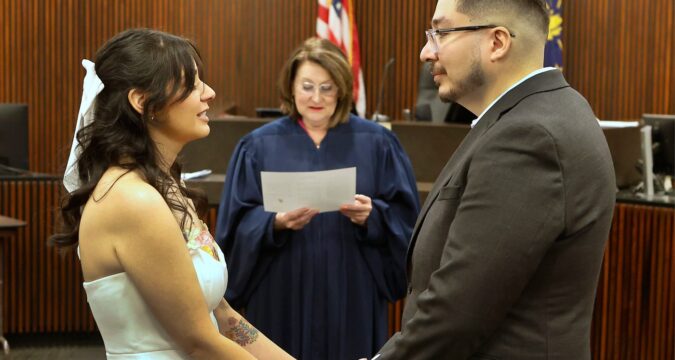
Hearts afire: Couples line up to marry ahead of Valentine’s Day
Mayra Hernandez and Armando Lopez have known that when they get married, they want the moment for themselves.
“It’s our choice,” Hernandez said. “It’s very special, and it’s very intimate. We’ll celebrate with our family and friends afterwards.”
A marriage license and a single rose lies on a Lake County courtroom table on February 13, 2026. (John Smierciak/for the Post-Tribune)
On Friday, the couple, who have been together for about four years, joined others at the Lake County Clerk’s Office for a courthouse wedding. The day is popular for weddings because it was Friday the 13th and the last day for a courthouse wedding before Valentine’s Day.
“Part of the reason why we picked today is because (13) is her lucky number,” Lopez said. “And it’s the day before Valentine’s Day, so why not?”
Hernandez and Lopez have wanted to get married since the beginning of the year, and they also decided to on Friday because they didn’t think it’d be busy.
“And we thought, ‘Nobody wants to get married on Friday the 13th,’ but here we are waiting in line,” Hernandez said.
With marriage license in hand, Armando Lopez and Mayra Hernandez leave the Lake County Courthouse after getting married on February 13, 2026. (John Smierciak/for the Post-Tribune)
Hernandez and Lopez said the clerk’s office was “very welcoming.”
The clerk’s office also had a giveaway for couples who were married on Friday, with prizes including dinner packages, roses and concert tickets. Following their short ceremony with a judge, couples enter the giveaway.
Before the COVID-19 pandemic, hotels were also part of the giveaway, Clerk Mike Brown said, and he’s hoping that starts again.
“Couples will get married today, and they’ll have a chance to celebrate and say, ‘Look what we did,’” Brown said. “Hopefully, that marriage will stay together because that’s what the ceremony is all about: two people coming together for a lifetime.”
Armando Lopez and his fiancee Mayra Hernandez check in with Judge Natalie Bokota’s office manager Patricia Hutton on February 13, 2026. (John Smierciak/for the Post-Tribune)
Brown said the clerk’s office expected to see between 10 and 20 couples get married on Friday. Couples don’t have to register ahead of time, so the office wouldn’t know the exact number.
Seeing the couples who got married was “a great feeling,” Brown said, and it’s meaningful for his staff to be part of the ceremonies.
“Love is the greatest healer,” he said. “Seeing two people unite in love is beautiful. No matter what their backgrounds are or how they came together, just the fact that they chose to be together and unite, that means a lot to our staff.”
Layla Lazaroff and Ted Trulley were another couple who wed at the Lake County Government Center on Friday. The pair, who have been together for about a year, both were married before in traditional weddings.
Ted Trulley and Layla Lazaroff leave the courtroom of Judge Natalie Bokota after getting married on February 13, 2026. (John Smierciak/for the Post-Tribune)
“This is for us, and this is just about us,” Lazaroff said. “It’s intimate, and we’ll do something later with our close family. … It was beautiful. There were no distractions, and it was just about us today.”
Trulley is a numbers guy, he said, so that’s why they picked Friday as the day to wed. The couple didn’t know about the clerk’s office giveaway.
“Two times 13 is 26, so I thought that was kind of cool,” Trulley said. “Honestly, I just wanted to come in and get married today.”

“An Astonishing Sign Of Cultural Decay…”
“An Astonishing Sign Of Cultural Decay…”
Authored by James Howard Kunstler,
Sure, Take That Time-Out
“Crisis is when brittleness meets shock. “
– Yuri Bezmenov’s Ghost on X
By shutting down the government for a minimum of ten days supposedly over funding for the Department of Homeland Security (DHS), the Wile E. Coyote Democratic Party is about to blow up another Acme bomb in its mangy muzzle.
I will tell you why.
First, this DHS business is just a stupid prank to bamboozle the public.
It will not shut down ICE operations, as Chuck Schumer pretends. ICE was already funded with $75-billion in last year’s Big Beautiful Bill. The shutdown will only defund the Coast Guard and airport security. (Does that sound smart?)
Second, senators will be leaving the DC swamp and going home to their states where, it turns out, polls show that voters of both parties combined overwhelmingly favor election reform by 84-percent.
The House has passed the SAVE Act onto the Senate for action, up or down. For at least ten days of the shutdown, the senators will have to explain why proving that you are a citizen to vote is a bad idea — or conversely, why allowing non-citizens to vote is a good idea. So, thanks, Democrats, for sending the senators home to face their voters.
Eventually, senators will have to return to the US Capitol and take up the SAVE Act.
The act will require proof of citizenship to register, photo ID to vote in person and for requesting an absentee ballot. The bill would prohibit universal mail-in voting, require absentee ballots be received by election day, impose a five-year prison sentence for helping anyone to register without correct documents, and provisions to clean up the states’ voter rolls.
Additional legislation still in the House, introduced by Rep. Bryan Steil (R-WI), would provide for Election Day only in-person voting by paper ballots, and yet other bills awaiting action would eliminate electronic vote-tallying machines. All the provisions above are common in most other civilized nations (and even a few that are not, such as Afghanistan). The Democratic Party is against all of it because they can only win national elections by deceit and chicanery.
When Senators return to DC, they will have to overcome the filibuster in its current mode, which is the silent or so-called “zombie” filibuster. You see, in the old days, before 1972, if senators wanted to filibuster, they had to actually hold the Senate floor and keep talking — bringing all Senate business to a complete halt until either they gave up or the majority could gather enough votes for cloture (ending debate). It was physically very hard on the senators, an ordeal, and to get through the hours of mindless blather, they would read the phone book, or the World Almanac, or a Sunday newspaper from page one to the obituaries, which subjected them to ridicule.
After 1972, the Senate introduced what they called “the two-track” system, which allowed the body to move on to other business under a filibuster, without requiring a member to stand and speak. All that was needed was for a senator to inform the leadership that he intended to block a vote, with the backing of 40 other senators. This led to a dramatic increase in the use of filibusters — transforming them from a rare, physically demanding gambit into a routine procedural threat.
Now, the catch is that this change in procedure was never formally voted on. Going from “talking” filibusters to “silent” filibusters didn’t happen through a deliberate decision by the full Senate to change the rules — it emerged in 1972 from a procedural workaround that then Majority Leader Mike Mansfield introduced.
It’s just a custom masquerading as a rule, and one that now Majority Leader John Thune (R-SD) could declare null and void.
Doing so would bring back the old talking filibuster. Opponents of a given bill, such as the SAVE Act, would have to step into the well of Senate and offer arguments against election reform, or they could read through the Chicago phone book.
In either case, they’d expose themselves to ridicule. Perhaps those ten days at home during the present government shutdown will lead to an attitude change.
If that doesn’t do it, consider that sometime in the weeks and months ahead, you will be seeing some results from the seizure of the Fulton County, GA, 2020 voting records that took place in January. Since the FBI went in there on a warrant — meaning a judge saw probable cause of voter fraud — the country will likely be exposed to real evidence, for the first time, that one crucial swing state ran a corrupt election operation, and it will no longer be possible for the Democrats to yell that such claims are “baseless” or “debunked.”
It’s an astonishing sign of cultural decay that we are even arguing over election reform at this point.
The measures introduced during the dastardly COVID-19 trip – unlimited mail-in balloting, organized “ballot harvesting,” counting ballots for weeks after Election Day, doing so with Dominion / Smartmatic machines connectable to the Internet, and ignoring chain-of-custody requirements – were patently and obviously dishonest.
That’s what got you four years of “Joe Biden,” a walking-talking lie.
Is there anything that the Democratic Party doesn’t lie about? I’ll wait for your answer.
Tyler Durden
Fri, 02/13/2026 – 16:20
https://www.zerohedge.com/political/astonishing-sign-cultural-decay

Playing more minutes, Ansley Ruh comes through when it matters most for Kaneland. ‘Always take advantage.’
Sophomore guard Ansley Ruh could see the writing on the wall for Kaneland.
The Knights entered the season with only two seniors, meaning there would be plenty of opportunities for playing time. Ruh took notice right away and was ready for the challenge.
And as her minutes have steadily increased?
“Every opportunity I get in and out of the game, I always take advantage of,” she said. “There’s a lot of good competition on our team. Everybody was kind of fighting for a spot.
“It was like working hard to get your spot, always making sure you’re working hard.”
Ruh worked hard Thursday night to fuel Kaneland’s comeback, scoring all five of her points at crucial moments for the host Knights in a 42-36 nonconference victory over Oswego.
Kaneland’s Ansley Ruh (22) gets in position for an inbounds pass against Oswego during a nonconference game in Maple Park on Thursday, Feb. 12, 2026. (Jeremy Toney / The Beacon-News)
After trailing by as many as 13, Kaneland (19-12) cut the deficit to 31-30 on Ruh’s 3-pointer early in the fourth quarter. With 4:18 left, her layup off a steal gave the Knights a 35-33 lead.
Kyra Lilly led all scorers with 13 points for the Knights. Amani Meeks added 11 points, seven rebounds, five assists and three steals, while Grace Brunscheen scored eight points off the bench.
Kendall Grant and Peyton Johnson picked up nine points apiece to pace Oswego (13-17).
The trust in Ruh from Kaneland coach Brian Claesson has grown all season. She didn’t start Thursday but was on the court for the entire fourth quarter as the Knights completed the rally.
Kaneland’s Ansley Ruh (22) scores the go-ahead basket against Oswego during a nonconference game in Maple Park on Thursday, Feb. 12, 2026. (Jeremy Toney / The Beacon-News)
“The first half, the shots just weren’t falling,” Claesson said. “It was just one of those things where we went into halftime and said, ‘Hey, we’re good. The next shot’s falling.’
“She had that mentality and hit that shot.”
For her part, Ruh pointed out that she and her teammates were just sticking together.
“We were all just trying to do whatever we can, really focusing on offense at that point of the game and trying to make game-winning plays,” Ruh said. “I really think that (Claesson) has helped me, building my confidence and my team too. They’ve definitely helped a lot.”
Kaneland’s Ansley Ruh (22) high-fives teammate Kyra Lilly (21) after drawing a late foul against Oswego during a nonconference game in Maple Park on Thursday, Feb. 12, 2026. (Jeremy Toney / The Beacon-News)
Kaneland, which snapped a three-game losing streak, fell behind 23-10 at halftime. The Knights shot only 2 of 20 from the floor and 3 of 10 from the free-throw line in the first half.
They gave up just 15 points in the second half, though, allowing them to creep back into the game.
“We had plenty of opportunities, missed way too many shots,” Oswego coach Venita Parsons said. “Turnovers at key points in the game, that’s what it comes down to.
“I think what they need to understand is that you have to finish. You can’t play only half a basketball game.”
Ruh’s emergence this season has been steady. With the rash of injuries Kaneland has suffered in the last month, that emergence was accelerated.
“She’s been building on it,” Claesson said of Ruh. “It’s been rough on us the past three weeks. We’re just trying to find people to step up. (Thursday) she did step up.”
Kaneland’s Ansley Ruh (22) looks on as a teammate shoots a free throw against Oswego during a nonconference game in Maple Park on Thursday, Feb. 12, 2026. (Jeremy Toney / The Beacon-News)
Having a largely new team after heavy graduation losses, Claesson knew this could be an unpredictable season. He’s happy with how everything turned out, however.
“Only having two seniors, there are a lot of different roles that are happening this year and people are stepping up,” Claesson said. “Hopefully, this is the right momentum going into the playoffs.”
Battling injuries, the Knights had lost seven of eight games going into Thursday. But they rallied for a big win and will carry that momentum into Monday’s playoff opener against Geneva.
“We’re feeling a lot better,” Ruh said. “We’ve been suffering with losses from injuries, but now everybody is getting back and it’s really nice.”
Paul Johnson is a freelance reporter for The Beacon-News.
https://www.chicagotribune.com/2026/02/13/ansley-ruh-kaneland-osewgo-girls-basketball/

Bad Bunny se ofreció a pagar el seguro del Clásico al astro boricua Carlos Correa
WEST PALM BEACH, Florida, EE.UU. (AP) — Bad Bunny realmente quería ver a Carlos Correa jugar con Puerto Rico en casa en el Clásico Mundial de béisbol.
Correa, el jugador de cuadro de los Astros de Houston que fue apartado del roster del Clásico por la cobertura del seguro, comentó el viernes que la superestrella de la música y también puertorriqueño se había ofrecido a pagar una póliza.
“Significa mucho que esté tan involucrado. Trató de hacer todo lo posible. Yo quería jugar y asegurarme de que iba a salir ahí a jugar por el equipo de Puerto Rico en Puerto Rico”, dijo Correa a la prensa en el complejo de entrenamiento de primavera de los Astros. “El hecho de que hiciera eso dice mucho de cuánto le importa el país, cuánto le importan los fanáticos en casa. Estoy profundamente agradecido de que lo intentara con tanta determinación”.
Correa, quien tiene un contrato de 200 millones de dólares hasta 2028, se sometió a una cirugía en 2014 para reparar una fractura de la tibia derecha, y tanto los Gigantes de San Francisco como los Mets de Nueva York no aprobaron sus exámenes médicos para un contrato durante la temporada baja 2022-23.
Sin dar el nombre del proveedor que propuso Bad Bunny, Correa indicó que se trataba de uno que las Grandes Ligas, los Astros y el agente de Correa, Scott Boras, no aprobaron. El jugador de cuadro señaló que todos le dijeron que era una mala idea.
“No podía firmar algo así, poniendo mi vida en manos de eso, cuando tres personas en las que confío me están diciendo que no lo haga”, señaló Correa.
Puerto Rico será sede de un grupo de la primera ronda del Clásico el próximo mes.
Bad Bunny, nacido Benito Antonio Martínez Ocasio, es uno de los artistas con más reproducciones en streaming del planeta. Fue el artista principal del espectáculo de medio tiempo del Super Bowl el domingo pasado, una semana después de ganar el premio al álbum del año en los Grammy de 2026 por “Debí Tirar Más Fotos”, la primera vez que un álbum íntegramente en español se llevó el máximo galardón.
La firma de representación deportiva de Bad Bunny, Rimas Sports, y la Asociación de Jugadores de las Grandes Ligas llegaron a un acuerdo en una demanda el año pasado, después de que el sindicato sancionara a la agencia por violaciones a su reglamento de agentes.
Revocó la certificación de agente de William Arroyo, de Rimas, y negó las certificaciones de los ejecutivos Noah Assad y Jonathan Miranda, al citar un préstamo sin intereses de 200.000 dólares y un regalo de 19.500 dólares. El sindicato impuso una multa de 400.000 dólares por mala conducta. La árbitra Ruth M. Moscovitch ratificó las suspensiones de cinco años del sindicato para Assad y Miranda y redujo la suspensión de Arroyo a tres años.
___
Deportes AP: https://apnews.com/hub/deportes

Un saludable Shohei Ohtani apunta al gran premio que le falta: el Cy Young
Por DAVID BRANDT
GLENDALE, Arizona, EE.UU. (AP) — Shohei Ohtani es cinco veces All-Star, cuatro veces Jugador Más Valioso, dos veces campeón de la Serie Mundial y monarca del Clásico Mundial de Béisbol, lo que le da un currículum brillante que ningún jugador actual puede igualar.
¿El único gran reconocimiento que no ha ganado? Un premio Cy Young.
Dado su historial, no sería una sorpresa ver a la estrella japonesa de doble función sumar ese trofeo a su colección en 2026.
“Creo que es justo decir que él espera estar en la conversación del Cy Young. Solo queremos que esté sano, que haga aperturas, y todos los números y las estadísticas se acomodarán por sí solos.
“Pero, hombre, este tipo es un trabajador tan disciplinado y exige lo máximo de sí mismo”, comentó el viernes el manager de los Dodgers, Dave Roberts.
Los lanzadores y receptores del equipo, incluidos Ohtani, Yoshinobu Yamamoto y el resto, realizaron su primer entrenamiento de primavera en Camelback Ranch el viernes, apenas 105 días después de que los Dodgers se convirtieran en los primeros campeones consecutivos de las mayores en un cuarto de siglo —al vencer a los Azulejos de Toronto en un emocionante séptimo juego—.
Ohtani espera ser un jugador de doble función a tiempo completo por primera vez desde 2023. Una lesión en el codo lo mantuvo fuera del montículo durante la temporada 2024 y regresó a lanzar a mitad del año pasado, con marca de 3-0 y efectividad de 4,43 en la postemporada para ayudar a los Dodgers a conquistar su segundo título consecutivo de la Serie Mundial.
Roberts señaló que una temporada baja sin lesiones —en la que pudo concentrarse en el descanso, la recuperación y la fuerza— debería hacerlo aún más temible en el montículo esta temporada.
“Se ve fuerte, pero sin demasiada masa”, afirmó Roberts. “Al verlo lanzar, al verlo correr, su cuerpo se mueve bien. Creo que está en un punto ideal”.
Ohtani, de 31 años, desayunó y se rió con sus compañeros en el clubhouse antes de su sesión de bullpen, completamente cómodo en lo que ahora son alrededores familiares. Entra en su tercera temporada con la franquicia que lo ha ayudado a convertirse en el mayor fenómeno del béisbol en décadas.
“Por fin pude tener una temporada baja normal”, expresó Ohtani. “Aunque la temporada baja fue bastante corta, pensé que fue algo bueno”.
Ohtani contó que llegó a Camelback Ranch a principios de mes y que el bullpen del viernes —que, según dijo, salió bien— fue su tercero de la primavera. El objetivo es lanzar práctica de bateo en vivo la próxima semana antes de irse para unirse al Equipo Japón en Tokio, donde jugará el Clásico Mundial de Béisbol.
No lanzará para Japón en el CMB, ya que se enfocará únicamente en su trabajo en el plato.
Roberts explicó que mantener a Ohtani fuera del montículo en el CMB fue una decisión conjunta centrada en su salud a largo plazo.
“Por más que la gente piense que no es humano, sigue siendo un ser humano que se ha sometido a dos cirugías importantes”, manifestó Roberts. “Tiene una larga carrera por delante”.
El calendario y el itinerario del CMB —el Equipo Japón podría jugar del 6 al 17 de marzo en dos continentes distintos— convierten en un reto la preparación de Ohtani para el juego inaugural de los Dodgers contra los Diamondbacks de Arizona el 26 de marzo. Ni Roberts ni Ohtani estaban seguros de cómo sería su programa de lanzamientos en Japón.
Roberts indicó que está seguro de que Ohtani querrá estar listo para lanzar al inicio de la temporada, pero que el equipo será flexible.
___
Deportes en español AP: https://apnews.com/hub/deportes

School board members: Chicago should wait for a fully elected board before hiring a permanent CPS CEO
In April, the Chicago Board of Education unanimously agreed on a clear and transparent process to select the district’s next CEO. We identified a local, minority-and-woman-owned firm — Alma Advisory Group — with extensive experience working with the district. Alma did outstanding work. With Alma’s support, we engaged in the most robust community engagement process in the district’s history, hosting 10 community engagement sessions across the city and dozens of other stakeholder meetings with students, staff, parents and myriad other partners. Together, we designed a competency-based process that was rigorous, thoughtful and thorough.
Alma recruited a pool of more than 100 candidates, including exceptionally qualified leaders of major American school systems who understand the complex work of executive leadership. These were leaders who know what it takes to deliver results for students — especially those furthest from opportunity.
The process was working well — until November. That is when the mayor and his allies on the board started running political interference. Instead of moving forward to a conclusion, they have repeatedly tampered with the agreed-upon process. Whatever the intention, the result has been extended uncertainty for our district and the public.
The news this week that the board is terminating its contract with its search firm to identify a permanent CEO and parting ways with the Alma Advisory Group is not a “reset,” nor is it a decision based on merit. It is a calculated political maneuver designed to clear the path for a candidate who will serve City Hall, not our students.
And let us be clear. The majority of the elected members of this board — members representing diverse constituencies from all across Chicago — absolutely did not want to see this happen.
Leadership transitions are always consequential. In a district as large and complex as Chicago Public Schools, they are even more so. Enrollment shifts, budget pressures and federal policy changes demand steady, trustworthy leadership. Prolonged instability at the top makes every other challenge harder to solve.
We now face a practical question: How do we restore stability, rebuild trust, and keep our focus on students and schools?
There is only one responsible path forward: Retain Macquline King as CEO through the 2027 school year and until the board is fully elected.
King is the only stability we have left. She has done laudable work under impossible circumstances. Under her leadership, CPS solved a $734 million budget deficit and delivered a balanced budget that kept cuts out of the classroom and kept our credit rating intact.
Chicago Public Schools interim CEO Macquline King attends a community engagement session on the CPS budget at Dyett High School on July 14, 2025. (Armando L. Sanchez/Chicago Tribune)
She reopened schools successfully this fall and has led the district with stability and confidence even as our communities have been targeted by federal agents. As a Black woman who is also a CPS alumna, teacher, principal and proud parent of a CPS graduate, she understands this system as an executive and from lived experience.
We’ve heard from principals in our communities, including leadership from the Chicago Principals & Administrators Association. We have heard from parents, teachers and community advocates, including representatives from the NAACP. The message has been clear and consistent: King’s leadership has brought stability during a turbulent period, and stability matters right now.
For that reason, we believe the responsible path forward is to offer King a contract through June 2027. By keeping King, we stop the chaos. We allow the fully elected board, which arrives in January 2027, to design a new search process free from the turbulence that has marked this one. It would also honor the voices of school leaders and families who have asked for consistency at the top.
This moment should not be about personalities or political alignments. It should be about institutional integrity and student learning. Chicago’s students deserve stability. Educators deserve clarity. Families deserve confidence that governance decisions are made with students’ futures at the fore.
Extending King’s leadership through 2027 would ensure that, in a time of uncertainty, our schools remain focused on what matters most: delivering consistent, high-quality education to every child in every neighborhood.
Jessica Biggs represents District 6 on the Chicago School Board. Che “Rhymefest” Smith represents District 10. They are elected members of the board’s executive search and transition team.
Submit a letter, of no more than 400 words, to the editor here or email letters@chicagotribune.com.
https://www.chicagotribune.com/2026/02/13/opinion-chicago-public-schools-macquline-king-ceo-search/

Review: Gwendolyn Whiteside is superb in ‘Come Back, Little Sheba’ at American Blues
Gwendolyn Whiteside, the star of “Come Back Little Sheba” at American Blues Theater, is one of the great Chicago actors.
You might not know that because over the last 15 years or so, Whiteside has moved into directing and administrative roles, including building a new theater for American Blues in a former drugstore on Lincoln Avenue. But I’ve been around long enough to remember her on-stage work from 20 years ago. It was exceptional then, and it is yet more remarkable now as she returns to the American Blues stage.
Whiteside is playing one of the mid-century canon’s trickiest roles in Lola, the woman at the center of William Inge’s “Come Back, Little Sheba,” a piece of domestic realism that once was so frequently produced as to be a virtual cliché, its raw honesty mistaken for sentimentality, but now has fallen into relative obscurity.
Played on film in 1952 by Shirley Booth (who was reprising her Broadway role), Lola is a frumpy, middle-aged housewife with the misfortune to be married to Doc Delaney, a recovering alcoholic played in director Elyse Dolan’s black-box production by Philip Earl Johnson. Their marriage was seeded in bitterness: Doc was a promising medical student but Lola became pregnant with his child and was thrown out on her ear by her father. Doc did the right thing, as they used to say at the time, but also dropped out of college. Worse, their child then died, and others became impossible, a situation that arrived long before the play begins. The Sheba of the title is a missing dog, but its symbolic referent is obvious.
Inge, a Midwestern writer who specialized in depicting ordinary lives of quiet desperation, throws into the mix a young college student named Marie, who has rented a room from this sad couple. Marie, played by Maya Lou Hlava, has an active sex life with both Turk (Ethan Serpan) and Bruce (Justin Banks) and Lola and Doc struggle with how to react to her, juggling genuine affection and worry for her well-being with the envy and bitterness that flows from the punitive reaction to their own situation and its long-term consequences for their lives.
Dolan’s production is staged in American Blues’ smaller studio with the audience arranged around the periphery of the space, allowing the actors to range freely as Lola begins to lose control of her world. Designer Shayna Patel has built one of those Chicago-style sets that didn’t cost a fortune but still evoke the fragility of these characters without symbolic pretension; it’s a fine environment for this particular play.
Ethan Serpan and Maya Lou Hlava, with Philip Earl Johnson and Gwendolyn Whiteside, in “Come Back, Little Sheba” by American Blues Theater. (Michael Brosilow)
Not everything about the production works. I think the play works better with an intermission, as it was written, rather than going straight through, and although Johnson is excellent later in the play, his sober version of Doc is so low energy in the early scenes as to slow the pace of the writing; the show has to move a little more than it does here at times. And this symphony of sexual desire doesn’t always smolder as it can.
But this is Lola’s play, and Whiteside’s deeply moving performance is so multi-layered and, frankly, courageous as to more than compensate. I’d certainly stack its vulnerability, and also its optimism, against any other Inge interpretation I’ve seen over the years and it will linger long after you head back out onto Lincoln Avenue.
Chris Jones is a Tribune critic
cjones5@chicagotribune.com
Review: “Come Back, Little Sheba” (3.5 stars)
When: Through March 22
Where: American Blues Theater, 5627 N. Lincoln Ave.
Running time: 1 hour, 35 minutes
Tickets: $34.50-64.50 at 773-654-3103 and americanbluestheater.com
https://www.chicagotribune.com/2026/02/13/review-come-back-little-sheba/