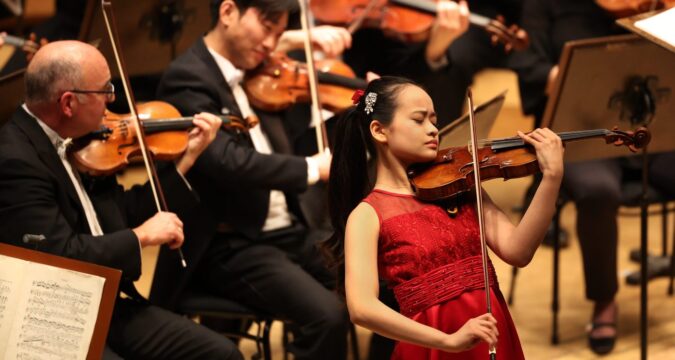
Precocious artists are all over the Chicago Symphony’s program this weekend.
Mozart’s child-prodigy past needs no introduction. More recently, composer Joel Thompson wrote “Seven Last Words of the Unarmed,” one of the essential choral works of the 21st century, when he was 26. And this week’s soloist, the Japanese violinist Himari, is, at just 14, enough of a sensation to get a one-name billing like Beyoncé or Madonna.
Himari has already performed with the Berlin Philharmonic, widely considered the world’s best, and the CSO, at Ravinia last July. She’ll make her Carnegie Hall debut with the Boston Symphony next year. Her conquest of the biggest stages in classical music, in just a few years, hasn’t been seen since the 1990s prodigy boom that produced CSO artist-in-residence Hilary Hahn, Chicago violinist Rachel Barton Pine and fellow mononymic violinist Midori, now teaching at Ravinia’s Steans Institute.
In comparison, we’re less swarmed by prodigies today — not because musicians are any less talented than they once were, but because there seems to have been a cultural reset about the ethics of placing young artists into our industry’s most glaring spotlights. Himari’s ascension feels like a relic from a time we’ve moved on from.
On Thursday, the violinist’s performance of Max Bruch’s concerto in G minor indeed betrayed some youthful quirks: tapping her foot along with the music, always sweeping her bow off the strings with a smiling flourish. But Himari’s musicality is the real deal. Her solo prelude was uncommonly expansive, as though she had all the bow in the world to spin out that first, endless phrase. She clearly conceives of the music as a complete lyrical statement — look no further than the middle section of the Adagio, which grew from introspective to impassioned.
She also used her brief soloist-only moments to play with time slightly in the finale, which is easily tossed off as a bravura showcase. But of course, her performance scratched that itch, too, her tone ringing and fingers mind-blowingly agile.
That said, as in her Ravinia debut, Himari’s partnership with the orchestra felt like a work in progress. Absent in both her playing and van Zweden’s leadership was that ethos of chamber playing — of sensitive listening, subtle spontaneity and give-and-take — that makes a compelling concerto performance. The CSO seemed to operate as nothing more than an orchestral mise en scène. If the orchestra got Himari’s attention, it usually wasn’t for good reasons: a rushing oboe, an overassertive horn line.
Plus, youth is a trap, as CSO music director designate Klaus Mäkelä’s most vitriolic critics prove — and he was at least a legal adult when he started racking up orchestral appearances in the late 2010s. Himari is now on the same stages as the world’s top soloists, and asking to be assessed alongside them. By the same token, she lacks their freedoms. If she were to do anything outside the realm of the expected in a repertoire piece, it would be misunderstood as naïveté, youthful overeagerness, a technical failing. Daring requires trust — but the public doesn’t know her well enough yet.
That leaves technical prowess. Himari has heaps of that. But honestly, I can’t say I would have rather heard her play Bruch over most other violinists on the CSO calendar, except for the obvious spectacle of seeing a child play like Paganini.
I don’t think it’s a coincidence that both Thursday’s performance and Himari’s Ravinia debut shone brightest during her encores, when the orchestra dropped away and she played, alone. Her approach to Fritz Kreisler’s “Recitativo and Scherzo-Caprice” was contemplative, soulful, piercingly candid and — best of all — free. It’s what’s ringing in my ears now, despite the dazzle of the Bruch. Hopefully, solo and recital repertoire remains dear in whatever career she builds.
On the same day as Himari’s Ravinia debut last summer, young artists with the festival’s Steans Institute premiered Thompson’s first string quartet. The Jamaican American composer — a member of the “Blacknificent 7” collective that includes Chicago composers Jessie Montgomery, Shawn Okpebholo and Damien Geter — happens to be at the same venue as the violinist again, with his orchestral work “To See the Sky” opening the concert on Thursday night.
According to a confessional program note, Thompson had been reluctant to compose orchestral music that “relies on the rhythms of (his) youth.” “Because then,” he writes, “the question of genre arises. Dvořák could bring Bohemian tunes into his music, but then, if a Black person brings in African American music, does it become jazz?”
Seeing Terence Blanchard’s breakthrough opera “Fire Shut Up in My Bones,” which came to Lyric in 2022, gave Thompson the confidence boost he needed.
“To See the Sky” is tightly crafted, with a general three-note, up-down-up melodic contour that recurs in different guises over all three movements. In the first movement, it builds an uneasy chord; in the second, it becomes a flowing melody, with wistful interludes from English horn and muted trumpet; in the third, it strides.
The orchestration has an almost Bernsteinian gusto — perhaps a nod to its commissioner, the New York Philharmonic, which premiered the piece in 2024. (I attended that performance.) The questions Thompson was grappling with get teased in the first movement via a drum-kit backbeat, and a brief, bluesy clarinet solo.
But the final movement is the work’s pièce de résistance. The melody gives way to a percussion-only interlude: hand claps, djembe and agogô, a West African double bell. When the melody returns, it’s gauzy, gentle — sharing space with the percussion, rather than wheeling off in its own world. With sensitive CSO corps playing and a ripened interpretation from Van Zweden, what was stirring in New York became profoundly moving in Chicago.
The concert closed out with Mozart’s final symphony: his 41st, “Jupiter.” This gracefully shaped performance carried van Zweden’s quintessential clarity and verve: first and third movements that seemed to dance across the stage, and a fourth movement both zippy and crisply precise.
That forward momentum bled into the second movement, which, while beautifully colored, never eased into its own sentimentality — another van Zweden signature. But the headlong energy van Zweden inspires in the CSO thrilled during the symphony’s final coda, the five melodies of the famous fugue intertwining with blazing clarity.
This moment still staggers, almost 250 years later — the last symphonic statement from someone who, after a precocious start, freed himself from the yoke of others’ expectations and came, unapologetically, into his own. Great artists always do.
Continuing through Saturday in Orchestra Hall at Symphony Center, 220 S. Michigan Ave.; cso.org
Hannah Edgar is a freelance critic.


