Category: News
Just When You Thought Obama’s Tower Of Doom Couldn’t Get Any More Ugly…
Just When You Thought Obama’s Tower Of Doom Couldn’t Get Any More Ugly…
Authored by Steve Watson via Modernity.news,
Barack Obama’s infamous Presidential Center in Chicago, already slammed as a dystopian “prison-like” monstrosity, has just received a bizarre new update that’s ignited widespread mockery online.
The addition of disjointed words from one of Obama’s speeches has been dubbed “headache-inducing,” amplifying the backlash against this $830 million behemoth that’s overrun budgets, displaced locals, and turned a public park into a narcissistic shrine.
As construction drags on toward a June 2026 opening, the former president’s ego-driven tweaks have only fueled the fire, with X users unleashing savage roasts and memes comparing the structure to everything from a Soviet-era bunker to a “concrete porta potty.”
The latest fiasco stems from Obama’s decision to etch excerpts from his 2015 Selma speech onto the building’s facade. But instead of inspiring awe, the disjointed lettering has sparked hilarity and disgust.
They somehow managed to make the Obama presidential library even uglier.
My gosh. ? pic.twitter.com/lmZnyJ4FSs
— johnny maga (@johnnymaga) February 17, 2026
One X user highlighted how the words appear chopped and unreadable, calling it a “headache-inducing” mess that perfectly encapsulates the project’s overall failure.
I’s indistinguishable from L’s and T’s. E’s indistinguishable from F’s. Multiple words get disjointed–not just on one plane but two.
Truly, one of the most headache-inducing reading experiences I’ve ever had. pic.twitter.com/hohr6Whusy
— Jacob Shell (@JacobAShell) February 17, 2026
what don’t you understand about
YOU ARE AMERICA
ED BY HABILAND
UNENCUMBERED
ADY TO SEIZE WE https://t.co/kmHawlABHO
— Logan Dobson (@LoganDobson) February 16, 2026
Fixed it for Obama. pic.twitter.com/BJU5eA6vIx
— Steve Guest (@SteveGuest) February 18, 2026
This is what the text should read… pic.twitter.com/YaZ2iSJQuY
— The OverboostedOne (@OverboostedOne) February 18, 2026
— FoundAgainAfter (@CheatCodeTruth) February 18, 2026
As we previously reported, the Obama Presidential Center has ballooned to nearly $1 billion in costs, resembling a “Tower of Doom” that’s sucking the life out of Chicago’s South Side. Locals have decried it as a “totalitarian command center dropped straight out of 1984,” with property values skyrocketing and forcing out longtime residents.
Alderwoman Jeanette Taylor warned that such developments “displace the very people they say they want to improve it for,” as rents for two-bedroom apartments jumped from $800 to over $1,800 per month. The project’s DEI-focused hiring of diverse contractors has backfired spectacularly, leading to lawsuits over “racial discrimination” and claims of poor performance, proving once again that woke policies lead to broke outcomes.
President Trump didn’t hold back when mocking the stalled eyesore. “He needs help,” Trump quipped, noting how the library-museum hybrid is “not too pretty” and has “run out of money” despite Obama’s insistence on DEI builders.
Trump contrasted this with his own push for classical architecture, like the grand Arch near Arlington Memorial Bridge, symbolizing a return to American greatness.
The center’s foundation is now scrambling with only $116 million in reserves against $230 million in remaining costs, not including staff salaries. Scheduled tours have started, but critics question who’d visit this overpriced ode to Obama’s ego amid Chicago’s economic woes.
Obama’s defenders claim it’ll be an “economic catalyst” for the black community, but the reality is displacement and fiscal chaos. This project exemplifies the hypocrisy of elite liberals: preaching equity while building vast ego towers that burden the working class.
In the end, as Trump restores beauty and dignity to American landmarks, Obama’s legacy crumbles under the weight of its own pretension— a fitting monument to an era of division and decline.
Your support is crucial in helping us defeat mass censorship. Please consider donating via Locals or check out our unique merch. Follow us on X @ModernityNews.
Tyler Durden
Thu, 02/19/2026 – 15:40

After chef-owner of Warlord restaurant in Avondale arrested, new Humboldt Park project faces backlash
One month after being charged with sharing sexually explicit images of a woman without her consent, chef and co-owner of Chicago restaurant Warlord says he is still attached to the business. The allegations have brought scrutiny to plans for a second restaurant and highlighted long-running issues in how the restaurant industry addresses problematic behavior.
Trevor Fleming, 41, spoke to the Tribune after a routine status hearing Wednesday morning outside the domestic violence courthouse. He said that “as of right now,” he is still part of the operations at Warlord.
A Cook County judge on Jan. 29 allowed Fleming to be released from electronic monitoring starting Jan. 31 until his Monday return from Japan for “business travel” related to his work as a chef, according to court documents. On Wednesday, Fleming showed Judge Sabra Lynne Ebersole that his bracelet was reapplied in compliance with court orders.
After the proceeding, Fleming declined to comment on the case beyond saying the “serious allegations” against him are false, telling the Tribune that “he’s on a trial of public opinion.”
While Fleming goes through legal procedures, the Avondale restaurant has continued service four nights a week with co-owners Emily Kraszyk and John Lupton at the helm. Despite Fleming’s claim, Kraszyk and Lupton said they have removed him from Warlord.
“Trevor broke our trust,” the pair said in a statement Thursday morning. “Clearly our attempts to address this issue fell short, which is why we ultimately made the decision to take decisive action and remove him from the partnership as soon as we were legally able to under our operating agreement.”
Chicago police arrested Fleming on Jan. 17, after he was accused of distributing private sexual images of a woman without her consent, Cook County court records show. The images Fleming is accused of sharing in September 2023 “clearly show” the woman’s face and private areas during a sexual act, according to court records. The woman had been in a romantic relationship with Fleming.
Fleming was released later that day on electronic monitoring with orders to avoid the woman’s home and workplace. His lawyer said the charge did not allege violence and that the order was issued over Fleming’s objection.
As Fleming faces a public fallout, some in the industry, including former Warlord employees, have spoken of the chef’s alleged history of verbal and emotional abuse.
“Trevor was outrageous towards the kitchen staff, especially the younger kitchen staff who were there to learn,” said Sidney Rakowiecki, a former lead server at Warlord.
Rakowiecki, who now works at Void in Avondale, was employed at Warlord for less than two years, starting in 2023 when the restaurant first opened. She said the pay was decent, which is why so many employees stuck around for as long as they did.
The misconduct at Warlord was something talked about only within “secret circles” of Chicago’s restaurant-worker scene, or in forums on Reddit, where employees could anonymously share their experiences, Rakowiecki said. When the Jan. 17 allegations came to light, it was long overdue, she said.
“He’s been a predator for younger women for a really long time,” Rakowiecki said, noting that she once took steps to address Fleming’s behavior to Warlord co-owner Kraszyk, but no action was taken.
Kraszyk declined to comment on that conversation.
“Emily and John were very approachable people and were more receptive and easy to work with, so it’s been very frustrating to see them take an approach of ‘oh we had no idea,’ — you knew exactly what was going on,” Rakowiecki said.
In one instance, a Warlord co-worker told her that Fleming had shown them a photo of a woman with a discernible tattoo. The co-worker wanted to find the woman and tell her that “Trevor was sharing her private images,” Rakowiecki recalled.
The last straw for Rakowiecki was in 2024, when Fleming was suspended from work for “behavioral issues” but returned “unscathed” and unchanged after about two weeks. Rakowiecki said she quit shortly after his return.
“Emily and John had a brief meeting with us pre-shift, saying that they don’t align with his values and that Trevor would be gone for as long as it’s needed. He was welcomed back a couple weeks later,” she said.
Also in 2024, the Chicago Hospitality Accountable Actions Database Project, a local organization that advocates for restaurant workers and educates them on workplace rights, started fielding reports of “ongoing traumatic experiences” from employees at Warlord.
According to Raeghn Draper, executive director of CHAAD Project, a dozen employees, both men and women, reached out to the organization that year about Fleming and the toxic work environment at the restaurant. Complaints also pointed at Kraszyk and Lupton allowing Fleming’s behavior to continue, Draper said.
Kraszyk and Lupton declined to comment on Fleming’s conduct and their alleged complicity.
In their statement, Kraszyk and Lupton said they will learn from this experience and “rebuild our relationship with a community that has been so generous and important to us.”
In January, the Warlord team announced plans to open a new concept called Lords in Humboldt Park. The Warlord owners had procured the building at 2803 W. Chicago Ave. last summer after Feed owner Nelson Sumba had to close the beloved neighborhood chicken shack because of a personal injury.
Graffiti covers windows of a vacant property at 2803 W. Chicago Ave., Feb. 12, 2026, in Chicago. The site previously housed the restaurant Feed, which closed in 2025. (John J. Kim/Chicago Tribune)
The news of Lords was met with heavy criticism from the CHAAD Project and some in the Humboldt Park community, who said allowing the owners to open a business in a neighborhood that’s home to a lot of diverse industry people, despite the allegations against Fleming, puts them at risk.
Ald. Gilbert Villegas, 36th, whose ward includes the possible Lords location, said he is aware of “troubling allegations of abuse” about Fleming. In a statement, he said his office is in communication with the Department of Business Affairs and Consumer Protection about next steps.
“The neighborhood is getting more gentrified, but Puerto Ricans really want to hold on to what we have here,” said Alejandro Gonzalez, a Boricuan chef who owns Moncho Moncheo, a Humboldt Park-based catering company, with Quique Ortiz. “And obviously the Young Lords have a lot of history here and a restaurant named Lords is absolutely rubbing salt in the wound. Imagine, the place that (Puerto Ricans) got displaced to has a restaurant called Lords that barely anyone in the neighborhood will be able to afford.”
In the 1960s, the Young Lords, under José “Cha-Cha” Jiménez, transformed from a Chicago street gang into a major Puerto Rican human rights organization that fought against displacement and police brutality, and aided in community services. The Young Lords defied rapid, city-led gentrification that was displacing thousands of working-class Latino residents from Lincoln Park and pushing them west to areas like Humboldt Park.
Gonzalez, 28, moved to Chicago after Hurricane Maria struck Puerto Rico in 2017. He worked his way through Chicago kitchens before Moncho Moncheo pop-ups took off. He’s also seen Humboldt Park shift. Gonzalez said it’s even more frustrating that the building slated for Lords formerly housed Feed, an offbeat diner where families could buy a quarter chicken, sides and a soda for $13.
“It’s wildly offensive,” Gonzalez said. “Even non-Puerto Ricans are saying it’s ridiculous. It’s just stupid, especially in an era where you would think everyone is trying to be more self-aware.”
After news of the allegations against Fleming spread in January, any record of Lords was wiped from Warlord’s already scant social media posts. But an Instagram account for Lords is still live with two posts from December.
On Thursday, Kraszyk and Lupton said Lords is Fleming’s project, and they would not be working with him in any capacity moving forward.
It’s not clear whether Fleming will proceed with opening Lords, or something else, at 2803 W. Chicago Ave. But after Wednesday’s court hearing, when asked if he was attached to a new restaurant named Lords, Fleming offered one quip.
“Think we’re going to name the restaurant Allegedlys now,” he told the Tribune.
Nathan Cooper, operations manager for Segnatore in Humboldt Park, said he hopes local efforts hinder Warlord’s expansion. Having been in the restaurant industry for more than 15 years, Cooper said the energy of Warlord is enough of a red flag.
“It’s the reputation (Fleming) had, of why Warlord is a heavy metal, loud, hot, uncomfortable space… that space is him personified,” Cooper said. “It might not be what was included in write-ups from food publications, but within the industry, it was well-known that Trevor was difficult, that he had had very questionable behavior towards staff and towards guests. It is a huge city, but the restaurant industry is very small.”
Cooper said Fleming’s case also highlights the industry’s tendency to protect “untouchable” chefs.
In 2019, a slew of anonymous allegations posted on Instagram alleged former Chicago chef Ian Davis mistreated women and that the owners of the Michelin-rated brewpub, Band of Bohemia, failed to prevent a toxic work environment. Following the misconduct claims, Davis resigned instead of joining another top restaurant, Entente.
In June 2020, Fat Rice, the award-winning restaurant that helped make the Logan Square neighborhood a dining destination in Chicago, closed after employees accused ownership of racism and creating a hostile work environment. In 2021, owners Abe Conlon and Adrienne Lo reopened as NoodleBird with a menu emphasizing hand-made rice noodles and charcoal-grilled chicken.
And last year, Jacob Bickelhaupt, a renowned Michelin-star chef based in South Florida with ties to Chicago, was charged with a brutal assault that left a woman in critical condition, following a history of domestic violence. Bickelhaupt had pleaded guilty in 2017 to attacking his ex-wife and business partner in Chicago, leading to widespread public backlash and the closure of his Michelin-starred restaurant 42 Grams. But his career bounced back after his move to South Florida, where he earned another Michelin star for his restaurant Konro, which closed in 2025.
“I think service and hospitality award companies have a responsibility to improve their vetting systems, because it’s obvious the current system has allowed for predators to be platformed, and they benefit from that recognition, and it buffers them from accountability,” Cooper said.
Premier culinary authorities like Michelin should reconsider the inclusion of certain chefs and restaurants in the Michelin Guide, he added. Warlord, for example, was added to the Chicago Michelin Guide in 2024. The Michelin Guide could not be reached for comment.
“It stems back to this issue within the restaurant industry where chefs become untouchable if your food is great enough,” Cooper said. “If you keep getting the accolades and if your investors are happy, it is relatively impossible to oust a chef for sour behavior, especially if that behavior is towards staff.”
Fleming is also subject to an earlier order of protection against another woman, which court records show is in effect until March 2027. The woman, who is listed as a current or former girlfriend of Fleming’s, first petitioned for a court order against him in January 2025, alleging that Fleming had grabbed her by her scarf and used it to choke her, and threatened her for spreading rumors about him.
The order shows that Fleming was ordered to avoid the two North Side bars where the woman worked and to pay for damaging her apartment window in August 2024. He was also ordered to complete a domestic violence partner abuse program and a mental health evaluation, records show.
Shakespeare District (14th) police previously arrested Fleming in June 2025 for alleged drug possession and driving without valid auto registration or insurance, court records show. He agreed to participate in a deferred prosecution program, records show, and the case was dismissed after he completed that program in September 2025. Fleming’s lawyer said the 2025 drug charge was an unproven allegation.
Fleming will be back in court on March 6.
https://www.chicagotribune.com/2026/02/19/warlord-trevor-fleming-response/

Jueza federal acusa al gobierno de Trump de “aterrorizar” a inmigrantes
Por SUDHIN THANAWALA
Una jueza federal acusó al gobierno del presidente Donald Trump de aterrorizar a los inmigrantes y de violar la ley de manera temeraria en sus esfuerzos por deportar a millones de personas que viven en Estados Unidos ilegalmente.
Al citar las muertes de Renee Good y Alex Pretti en Minnesota, la jueza sostuvo que la Casa Blanca también había “extendido su violencia a sus propios ciudadanos”.
“Las amenazas planteadas por el poder ejecutivo no pueden considerarse de forma aislada”, afirmó la jueza de distrito Sunshine Sykes, de Riverside, California, en su dura decisión emitida a última hora del miércoles.
Sykes dijo que el gobierno había violado su fallo emitido en diciembre, en el que determinó que era ilegal negar a muchos inmigrantes detenidos la oportunidad de ser liberados. Le ordenó al Departamento de Seguridad Nacional que les diera aviso de que podrían ser elegibles para ser liberados bajo fianza y que les diera acceso a un teléfono para llamar a un abogado en el lapso de una hora.
También desechó en septiembre una decisión de un tribunal de inmigración que el gobierno había citado para continuar con su política de detención obligatoria.
El jueves, la Casa Blanca remitió los comentarios al Departamento de Seguridad Nacional. La agencia dijo en un comunicado que la Corte Suprema había “fallado repetidamente en contra” de los tribunales inferiores en el tema de la detención obligatoria.
“El ICE tiene a la ley y los hechos de su parte, y se adhiere a todas las decisiones de la corte hasta que, al final, logra que sean invalidadas por el más alto tribunal de la tierra”, se lee en el comunicado.
En gobiernos anteriores, las personas sin antecedentes penales por lo general podían solicitar una audiencia de fianza ante un juez de inmigración mientras sus casos avanzaban por el tribunal correspondiente, a menos que hubieran sido detenidas en la frontera. La Casa Blanca de Trump revirtió esa política a favor de la detención obligatoria.
Sin acceso a una audiencia de fianza, miles de inmigrantes presentaron peticiones separadas en tribunales federales para solicitar su liberación. Se han presentado más de 20.000 casos de hábeas corpus desde la investidura de Trump, según registros de tribunales federales analizados por la AP.
Los jueces han accedido a muchas de esas peticiones, pero más tarde encontraron que el gobierno violaba sus órdenes de liberar a las personas o proporcionarles algún otro alivio.
Un juez federal de Minnesota dio el miércoles el inusual paso de declarar en desacato a un abogado del gobierno de Trump debido al incumplimiento por parte de la administración de una orden de devolver documentos de identificación a un inmigrante cuya liberación había sido ordenado el juez.
Esta semana, un juez federal de Nueva Jersey ordenó al gobierno que explicara los procedimientos que existen para garantizar que las órdenes del tribunal en su distrito se siguen de manera constante y a tiempo. El juez federal de distrito Michael Farbiarz dijo el martes que los funcionarios de Trump no habían cumplido los plazos establecidos por el tribunal para conceder audiencias de fianza en 12 de los aproximadamente 550 casos desde el 5 de diciembre.
“Las órdenes judiciales nunca deben violarse”, escribió.
___
Esta historia fue traducida del inglés por un editor de AP con la ayuda de una herramienta de inteligencia artificial generativa.
Jueza federal acusa al gobierno de Trump de “aterrorizar” a inmigrantes
Por SUDHIN THANAWALA
Una jueza federal acusó al gobierno del presidente Donald Trump de aterrorizar a los inmigrantes y de violar la ley de manera temeraria en sus esfuerzos por deportar a millones de personas que viven en Estados Unidos ilegalmente.
Al citar las muertes de Renee Good y Alex Pretti en Minnesota, la jueza sostuvo que la Casa Blanca también había “extendido su violencia a sus propios ciudadanos”.
“Las amenazas planteadas por el poder ejecutivo no pueden considerarse de forma aislada”, afirmó la jueza de distrito Sunshine Sykes, de Riverside, California, en su dura decisión emitida a última hora del miércoles.
Sykes dijo que el gobierno había violado su fallo emitido en diciembre, en el que determinó que era ilegal negar a muchos inmigrantes detenidos la oportunidad de ser liberados. Le ordenó al Departamento de Seguridad Nacional que les diera aviso de que podrían ser elegibles para ser liberados bajo fianza y que les diera acceso a un teléfono para llamar a un abogado en el lapso de una hora.
También desechó en septiembre una decisión de un tribunal de inmigración que el gobierno había citado para continuar con su política de detención obligatoria.
El jueves, la Casa Blanca remitió los comentarios al Departamento de Seguridad Nacional. La agencia dijo en un comunicado que la Corte Suprema había “fallado repetidamente en contra” de los tribunales inferiores en el tema de la detención obligatoria.
“El ICE tiene a la ley y los hechos de su parte, y se adhiere a todas las decisiones de la corte hasta que, al final, logra que sean invalidadas por el más alto tribunal de la tierra”, se lee en el comunicado.
En gobiernos anteriores, las personas sin antecedentes penales por lo general podían solicitar una audiencia de fianza ante un juez de inmigración mientras sus casos avanzaban por el tribunal correspondiente, a menos que hubieran sido detenidas en la frontera. La Casa Blanca de Trump revirtió esa política a favor de la detención obligatoria.
Sin acceso a una audiencia de fianza, miles de inmigrantes presentaron peticiones separadas en tribunales federales para solicitar su liberación. Se han presentado más de 20.000 casos de hábeas corpus desde la investidura de Trump, según registros de tribunales federales analizados por la AP.
Los jueces han accedido a muchas de esas peticiones, pero más tarde encontraron que el gobierno violaba sus órdenes de liberar a las personas o proporcionarles algún otro alivio.
Un juez federal de Minnesota dio el miércoles el inusual paso de declarar en desacato a un abogado del gobierno de Trump debido al incumplimiento por parte de la administración de una orden de devolver documentos de identificación a un inmigrante cuya liberación había sido ordenado el juez.
Esta semana, un juez federal de Nueva Jersey ordenó al gobierno que explicara los procedimientos que existen para garantizar que las órdenes del tribunal en su distrito se siguen de manera constante y a tiempo. El juez federal de distrito Michael Farbiarz dijo el martes que los funcionarios de Trump no habían cumplido los plazos establecidos por el tribunal para conceder audiencias de fianza en 12 de los aproximadamente 550 casos desde el 5 de diciembre.
“Las órdenes judiciales nunca deben violarse”, escribió.
___
Esta historia fue traducida del inglés por un editor de AP con la ayuda de una herramienta de inteligencia artificial generativa.
Vintage Chicago Tribune: Five phases of Rev. Jesse Jackson’s legendary life
The Rev. Jesse L. Jackson died Tuesday — “peacefully” and “surrounded by his family” — at 84. He battled Parkinson’s disease since 2017, and in April 2025, he was diagnosed with progressive supranuclear palsy, a neurological disorder.
The Chicago-based Baptist minister was a mainstay in the Civil Rights Movement and founder of the Rainbow/PUSH Coalition. Yet there are some aspects of the outspoken orator’s life that might have been forgotten. Here’s a look back at five phases of Jackson’s legendary life.
Athlete
The Rev. Jesse Jackson plays basketball with residents during a visit to the Ida B. Wells housing project on April 3, 1989, in Chicago. (Charles Osgood/Chicago Tribune)
Jackson, a three-sport athlete at Sterling High School in Greenville, South Carolina, was quarterback for the Tigers when the team posted a 7-2-1 record during the 1958 season.
Jackson told the Tribune’s Fred Mitchell in October 2005 the San Francisco Giants and the Chicago White Sox were interested in signing him after their 1959 Go-Go White Sox season.
“It was a choice for me between football and baseball. I loved both sports, but felt more secure with football. At that time, the (baseball) bonuses that they were offering were $10,000 to $50,000, which was all the money in the world. But I could just not take that risk. There were a lot of kids who never got past Triple A. I thought with football I had more options and I felt more secure.”
Jackson attended the University of Illinois Urbana-Champaign his freshman year of college intending to play football. David Condon’s “In the Wake of the News” column from Dec. 19, 1959, touted Jackson as a “195-pound halfback, shifted from quarter” who could be a “speedster of the Buddy Young, Bobby Mitchell type.” Yet Jackson’s name doesn’t appear on an Illinois team roster from 1959 or 1960.
David Condon’s “In the Wake of the News” column from Dec. 19, 1959, described Jesse Jackson, one of several freshmen “outstanding backs” for the 1960 season. (Chicago Tribune)
Jackson transferred to North Carolina Agricultural and Technical State University for his sophomore year. He told the Tribune in 1984 that he chose to return to the South after Black fraternities and sororities were not allowed to attend an all-Greek dance on campus where Duke Ellington’s band played.
“I left the region of apartheid in our nation and came north to the Land of Lincoln with high expectations. Many of my ideological expectations were torn asunder right here. I looked at new realities, I looked at new names and old games of rejection and of oppression,” Jackson told reporter George E. Curry. “We were not permitted to go to that dance on campus. We had our affair at the VFW, out in the city. It was that contrast that kept disturbing me, and it was the new realities that helped stimulate my desire to fight and go and change things.”
MLK’s protege
The Rev. Martin Luther King Jr. walks along East Huron Street after a morning summit meeting at the St. James Episcopal Cathedral parish house at 666 N. Rush St. in Chicago on Aug. 17, 1966. The meeting was to discuss the city’s racial problems. Jesse Jackson is at his side. (Al Phillips/Chicago Tribune)
After considering law school, Jackson instead moved to Chicago in 1964 to pursue a master’s degree at Chicago Theological Seminary. Though he was ordained a Baptist minister in 1968, he didn’t receive his degree until 2000. His interest in the civil rights movement meant studies had to wait. He took a leave of absence from school.
While in the school’s cafeteria Jackson was inspired to join the Rev. Martin Luther King Jr.’s 1965 march from Selma to Montgomery, which became known as “Bloody Sunday.”
“I got up on one of those tables and said, ‘We have to go, we have to go,’” Jackson recalled in 2000. “It was an exciting breakfast.”
When King traveled to Chicago to lead “the first significant freedom movement in the North,” Jackson was by his side. King told Jackson he would “learn more with me in six months than in six years at the seminary,” Jackson said.
“I was a 24-year-old graduate student at Chicago Theological Seminary and (a Southern Christian Leadership Conference) staffer, appointed by Dr. King to head Operation Breadbasket, the economic arm of the movement. Dr. King chose Chicago over New York for his northern crusade because Chicago had a growing independent political movement and a broad-based civil rights coalition, the Coordinating Council of Community Organizations headed by Al Raby,” Jackson wrote in a Tribune op-ed in 2016. “Some historians say Dr. King got bested by the Democratic Machine and that the Freedom Movement failed. I take exception to that shortsighted view. The struggle for power and justice is a long-term commitment. We sowed seeds in 1966 that have been producing progress for 50 years.”
The Rev. Martin Luther King Jr. stands with other civil rights leaders on the balcony of the Lorraine Motel in Memphis on April 3, 1968, a day before he was assassinated at approximately the same place. From left are Hosea Williams, Jesse Jackson, King and Ralph Abernathy. (Charles Kelly/AP)
Jackson was also with King when he was assassinated at the Lorraine Motel in Memphis on April 4, 1968. Jackson claimed he cradled King in his arms. Others who were at the scene, however, had different recollections. When he returned to the site in April 1984, Jackson stood by his previous statement.
“I held him,” Jackson said. “I was down, and Rev. (Samuel ‘Billy’) Kyles handed me a sheet from that room to catch the blood. By that time, four or five of us were there. I walked away at that time and went into Room 305 (the room next to Rev. King’s) to call Mrs. King to indicate Dr. King had been shot.”
Presidential candidate
The Rev. Jesse Jackson holds his daughter, Jackie Lavinia, after making a speech to a crowd at the Holiday Inn on Ohio Street in Chicago on March 20, 1984. Jackson was running for president at the time. (Ernie Cox Jr./Chicago Tribune)
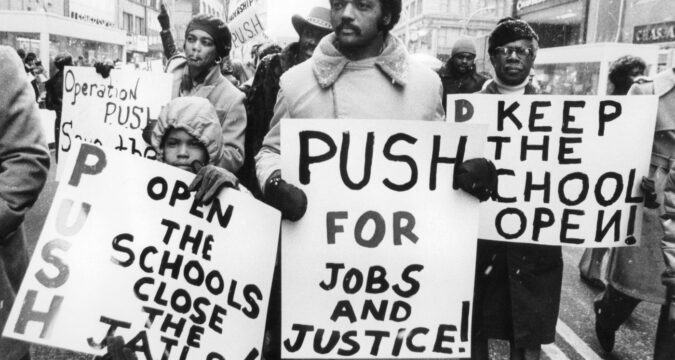
Jackson, the founder of Operation PUSH (People United to Save Humanity, later changed to “Serve” Humanity) was the first Black person to lead a serious campaign for the White House during both the 1984 and 1988 presidential elections.
He announced his first candidacy on Nov. 3, 1983, at the Washington, D.C., Convention Center — followed by a live band, gospel and secular singers and 16 other speakers.
“I seek the presidency to serve the nation at a level where I can help restore a moral tone, a redemptive spirit and a sensitivity to the poor and dispossessed of this nation,” he told the crowd. “We can do without the Democratic Party or the Republican Party. They can not do without us.”
A comment to Washington Post reporter Milton Coleman, however, strained Jackson’s relationship with the Jewish community. Coleman reported he heard Jackson refer to Jews as “Hymie” and New York as “Hymietown.” Jackson said he had “no recollection” of using those terms, but the remarks caused dissent within the Democratic party.
Walter Mondale received the Democratic nomination at the party’s convention in San Francisco on July 18, 1984, with 2,191 votes. Jackson had just 465 ½ votes. Mondale lost to incumbent Ronald Reagan.
A quiet moment for Democratic presidential candidate the Rev. Jesse Jackson as he sits on the press bus after arriving at Chicago’s Midway Airport from Houston on March 9, 1988. After a grueling day of campaigning on Super Tuesday, and a late night at a campaign rally, Jackson was up early for interviews and an early morning press conference in Houston before he traveled to Chicago. (Paul Gero/Chicago Tribune)
Jackson received an endorsement from Chicago Mayor Harold Washington — the city’s first Black mayor — during the 1988 race. Michael Dukakis (who lost the election to George H.W. Bush) earned the party’s nomination on July 20, 1988, at the convention in Atlanta with more than 2,700 delegate votes. Jackson had about 1,100 — more than any other Black candidate before him.
Hostage negotiator
The Rev. Jesse Jackson and U.S. Rep Rod Blagojevich, behind Jackson to the right, arrive at O’Hare International Airport on May 7, 1999, following their successful trip to Belgrade where they secured the release of three captive American soldiers. More than 300 people were on hand to greet them. (Phil Greer/Chicago Tribune)
Jackson’s work as an intermediary helped secure the release of dozens of people held against their will around the world.
Jackson traveled to Syria in January 1984 to meet with President Hafez Assad regarding U.S. Navy pilot Lt. Robert Goodman, who was imprisoned after his plane was shot down in the Middle East. Though Jackson’s negotiations were successful, some called it a publicity stunt for his election campaign.
Jackson also secured from Cuban President Fidel Castro the release of 26 Cuban political prisoners and 22 Americans in Cuba and brought them back to the United States in June 1984.
U.S. Presidential candidate the Rev. Jesse Jackson gestures to the crowd at Havana’s Jose Marti Airport on June 29, 1984. Shortly afterward, Cuban President Fidel Castro, left, released Cuban and American prisoners to Jackson. (J. Scott Applewhite/AP)
He met with Iraqi leader Saddam Hussein in September 1990 to make sure women and children of foreign nationals were sent home from Kuwait — as Hussein promised — during the Gulf War.
Yugoslavian President Slobodan Milosevic released three American prisoners of war as a “humanitarian gesture” after he met with Jackson and then-Illinois Congressman Rod Blagojevich in May 1999.
Advocate for pardon of Blagojevich — and his own son
Illinois Gov. Rod Blagojevich acknowledges the crowd before his State of the State address at the Capitol’s House of Representatives on Feb. 3, 2005. The Rev. Jesse Jackson, front row on the right, and Rep. Jesse Jackson Jr., D-Ill., second from right, were in attendance. (Abel Uribe/Chicago Tribune)
Jackson and his son, former U.S. Rep. Jesse Jackson Jr., himself a convicted felon, wrote a letter to President Donald Trump in July 2019 seeking a release and full pardon for Blagojevich.
“We stand with his family as they seek a full pardon for a father and husband that has served most of a sentence that was far longer than the offense deserved,” they wrote.
Vintage Chicago Tribune: Pardon me — Chicagoans who received clemency from a US president
At his second trial in 2011, the former Illinois governor was found guilty on widespread corruption charges, including attempting to sell the U.S. Senate seat once held by President Barack Obama. Blagojevich was sentenced to 14 years in federal prison — the second-longest term ever delivered in federal court in Chicago for a public corruption case.
Trump, convicted of felonies himself, commuted the former Illinois governor’s 14-year sentence to about eight years served on Feb. 18, 2020.
After President Joe Biden pardoned his own son, Hunter Biden, Jackson requested in December 2024 a pardon for his son saying he had “taken full responsibility for his actions.” Biden, however, did not grant Jackson’s request.
Want more vintage Chicago?
Become a Tribune subscriber: It’s just $1 for a 1-year digital subscription.
Thanks for reading!
Subscribe to the free Vintage Chicago Tribune newsletter, join our Chicagoland history Facebook group, stay current with Today in Chicago History and follow us on Instagram for more from Chicago’s past.
Have an idea for Vintage Chicago Tribune? Share it with Kori Rumore at krumore@chicagotribune.com.
Vintage Chicago Tribune: Five phases of Rev. Jesse Jackson’s legendary life
The Rev. Jesse L. Jackson died Tuesday — “peacefully” and “surrounded by his family” — at 84. He battled Parkinson’s disease since 2017, and in April 2025, he was diagnosed with progressive supranuclear palsy, a neurological disorder.
The Chicago-based Baptist minister was a mainstay in the Civil Rights Movement and founder of the Rainbow/PUSH Coalition. Yet there are some aspects of the outspoken orator’s life that might have been forgotten. Here’s a look back at five phases of Jackson’s legendary life.
Athlete
The Rev. Jesse Jackson plays basketball with residents during a visit to the Ida B. Wells housing project on April 3, 1989, in Chicago. (Charles Osgood/Chicago Tribune)
Jackson, a three-sport athlete at Sterling High School in Greenville, South Carolina, was quarterback for the Tigers when the team posted a 7-2-1 record during the 1958 season.
Jackson told the Tribune’s Fred Mitchell in October 2005 the San Francisco Giants and the Chicago White Sox were interested in signing him after their 1959 Go-Go White Sox season.
“It was a choice for me between football and baseball. I loved both sports, but felt more secure with football. At that time, the (baseball) bonuses that they were offering were $10,000 to $50,000, which was all the money in the world. But I could just not take that risk. There were a lot of kids who never got past Triple A. I thought with football I had more options and I felt more secure.”
Jackson attended the University of Illinois Urbana-Champaign his freshman year of college intending to play football. David Condon’s “In the Wake of the News” column from Dec. 19, 1959, touted Jackson as a “195-pound halfback, shifted from quarter” who could be a “speedster of the Buddy Young, Bobby Mitchell type.” Yet Jackson’s name doesn’t appear on an Illinois team roster from 1959 or 1960.
David Condon’s “In the Wake of the News” column from Dec. 19, 1959, described Jesse Jackson, one of several freshmen “outstanding backs” for the 1960 season. (Chicago Tribune)
Jackson transferred to North Carolina Agricultural and Technical State University for his sophomore year. He told the Tribune in 1984 that he chose to return to the South after Black fraternities and sororities were not allowed to attend an all-Greek dance on campus where Duke Ellington’s band played.
“I left the region of apartheid in our nation and came north to the Land of Lincoln with high expectations. Many of my ideological expectations were torn asunder right here. I looked at new realities, I looked at new names and old games of rejection and of oppression,” Jackson told reporter George E. Curry. “We were not permitted to go to that dance on campus. We had our affair at the VFW, out in the city. It was that contrast that kept disturbing me, and it was the new realities that helped stimulate my desire to fight and go and change things.”
MLK’s protege
The Rev. Martin Luther King Jr. walks along East Huron Street after a morning summit meeting at the St. James Episcopal Cathedral parish house at 666 N. Rush St. in Chicago on Aug. 17, 1966. The meeting was to discuss the city’s racial problems. Jesse Jackson is at his side. (Al Phillips/Chicago Tribune)
After considering law school, Jackson instead moved to Chicago in 1964 to pursue a master’s degree at Chicago Theological Seminary. Though he was ordained a Baptist minister in 1968, he didn’t receive his degree until 2000. His interest in the civil rights movement meant studies had to wait. He took a leave of absence from school.
While in the school’s cafeteria Jackson was inspired to join the Rev. Martin Luther King Jr.’s 1965 march from Selma to Montgomery, which became known as “Bloody Sunday.”
“I got up on one of those tables and said, ‘We have to go, we have to go,’” Jackson recalled in 2000. “It was an exciting breakfast.”
When King traveled to Chicago to lead “the first significant freedom movement in the North,” Jackson was by his side. King told Jackson he would “learn more with me in six months than in six years at the seminary,” Jackson said.
“I was a 24-year-old graduate student at Chicago Theological Seminary and (a Southern Christian Leadership Conference) staffer, appointed by Dr. King to head Operation Breadbasket, the economic arm of the movement. Dr. King chose Chicago over New York for his northern crusade because Chicago had a growing independent political movement and a broad-based civil rights coalition, the Coordinating Council of Community Organizations headed by Al Raby,” Jackson wrote in a Tribune op-ed in 2016. “Some historians say Dr. King got bested by the Democratic Machine and that the Freedom Movement failed. I take exception to that shortsighted view. The struggle for power and justice is a long-term commitment. We sowed seeds in 1966 that have been producing progress for 50 years.”
The Rev. Martin Luther King Jr. stands with other civil rights leaders on the balcony of the Lorraine Motel in Memphis on April 3, 1968, a day before he was assassinated at approximately the same place. From left are Hosea Williams, Jesse Jackson, King and Ralph Abernathy. (Charles Kelly/AP)
Jackson was also with King when he was assassinated at the Lorraine Motel in Memphis on April 4, 1968. Jackson claimed he cradled King in his arms. Others who were at the scene, however, had different recollections. When he returned to the site in April 1984, Jackson stood by his previous statement.
“I held him,” Jackson said. “I was down, and Rev. (Samuel ‘Billy’) Kyles handed me a sheet from that room to catch the blood. By that time, four or five of us were there. I walked away at that time and went into Room 305 (the room next to Rev. King’s) to call Mrs. King to indicate Dr. King had been shot.”
Presidential candidate
The Rev. Jesse Jackson holds his daughter, Jackie Lavinia, after making a speech to a crowd at the Holiday Inn on Ohio Street in Chicago on March 20, 1984. Jackson was running for president at the time. (Ernie Cox Jr./Chicago Tribune)
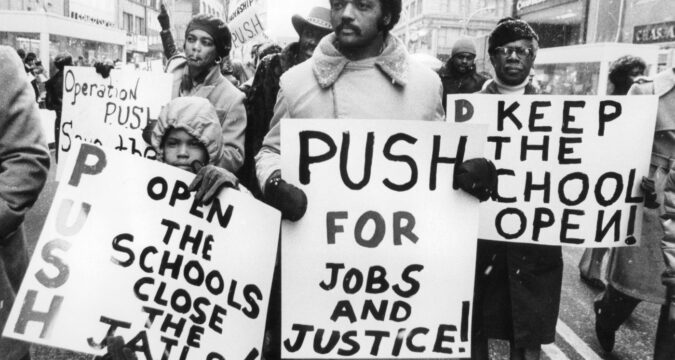
Jackson, the founder of Operation PUSH (People United to Save Humanity, later changed to “Serve” Humanity) was the first Black person to lead a serious campaign for the White House during both the 1984 and 1988 presidential elections.
He announced his first candidacy on Nov. 3, 1983, at the Washington, D.C., Convention Center — followed by a live band, gospel and secular singers and 16 other speakers.
“I seek the presidency to serve the nation at a level where I can help restore a moral tone, a redemptive spirit and a sensitivity to the poor and dispossessed of this nation,” he told the crowd. “We can do without the Democratic Party or the Republican Party. They can not do without us.”
A comment to Washington Post reporter Milton Coleman, however, strained Jackson’s relationship with the Jewish community. Coleman reported he heard Jackson refer to Jews as “Hymie” and New York as “Hymietown.” Jackson said he had “no recollection” of using those terms, but the remarks caused dissent within the Democratic party.
Walter Mondale received the Democratic nomination at the party’s convention in San Francisco on July 18, 1984, with 2,191 votes. Jackson had just 465 ½ votes. Mondale lost to incumbent Ronald Reagan.
A quiet moment for Democratic presidential candidate the Rev. Jesse Jackson as he sits on the press bus after arriving at Chicago’s Midway Airport from Houston on March 9, 1988. After a grueling day of campaigning on Super Tuesday, and a late night at a campaign rally, Jackson was up early for interviews and an early morning press conference in Houston before he traveled to Chicago. (Paul Gero/Chicago Tribune)
Jackson received an endorsement from Chicago Mayor Harold Washington — the city’s first Black mayor — during the 1988 race. Michael Dukakis (who lost the election to George H.W. Bush) earned the party’s nomination on July 20, 1988, at the convention in Atlanta with more than 2,700 delegate votes. Jackson had about 1,100 — more than any other Black candidate before him.
Hostage negotiator
The Rev. Jesse Jackson and U.S. Rep Rod Blagojevich, behind Jackson to the right, arrive at O’Hare International Airport on May 7, 1999, following their successful trip to Belgrade where they secured the release of three captive American soldiers. More than 300 people were on hand to greet them. (Phil Greer/Chicago Tribune)
Jackson’s work as an intermediary helped secure the release of dozens of people held against their will around the world.
Jackson traveled to Syria in January 1984 to meet with President Hafez Assad regarding U.S. Navy pilot Lt. Robert Goodman, who was imprisoned after his plane was shot down in the Middle East. Though Jackson’s negotiations were successful, some called it a publicity stunt for his election campaign.
Jackson also secured from Cuban President Fidel Castro the release of 26 Cuban political prisoners and 22 Americans in Cuba and brought them back to the United States in June 1984.
U.S. Presidential candidate the Rev. Jesse Jackson gestures to the crowd at Havana’s Jose Marti Airport on June 29, 1984. Shortly afterward, Cuban President Fidel Castro, left, released Cuban and American prisoners to Jackson. (J. Scott Applewhite/AP)
He met with Iraqi leader Saddam Hussein in September 1990 to make sure women and children of foreign nationals were sent home from Kuwait — as Hussein promised — during the Gulf War.
Yugoslavian President Slobodan Milosevic released three American prisoners of war as a “humanitarian gesture” after he met with Jackson and then-Illinois Congressman Rod Blagojevich in May 1999.
Advocate for pardon of Blagojevich — and his own son
Illinois Gov. Rod Blagojevich acknowledges the crowd before his State of the State address at the Capitol’s House of Representatives on Feb. 3, 2005. The Rev. Jesse Jackson, front row on the right, and Rep. Jesse Jackson Jr., D-Ill., second from right, were in attendance. (Abel Uribe/Chicago Tribune)
Jackson and his son, former U.S. Rep. Jesse Jackson Jr., himself a convicted felon, wrote a letter to President Donald Trump in July 2019 seeking a release and full pardon for Blagojevich.
“We stand with his family as they seek a full pardon for a father and husband that has served most of a sentence that was far longer than the offense deserved,” they wrote.
Vintage Chicago Tribune: Pardon me — Chicagoans who received clemency from a US president
At his second trial in 2011, the former Illinois governor was found guilty on widespread corruption charges, including attempting to sell the U.S. Senate seat once held by President Barack Obama. Blagojevich was sentenced to 14 years in federal prison — the second-longest term ever delivered in federal court in Chicago for a public corruption case.
Trump, convicted of felonies himself, commuted the former Illinois governor’s 14-year sentence to about eight years served on Feb. 18, 2020.
After President Joe Biden pardoned his own son, Hunter Biden, Jackson requested in December 2024 a pardon for his son saying he had “taken full responsibility for his actions.” Biden, however, did not grant Jackson’s request.
Want more vintage Chicago?
Become a Tribune subscriber: It’s just $1 for a 1-year digital subscription.
Thanks for reading!
Subscribe to the free Vintage Chicago Tribune newsletter, join our Chicagoland history Facebook group, stay current with Today in Chicago History and follow us on Instagram for more from Chicago’s past.
Have an idea for Vintage Chicago Tribune? Share it with Kori Rumore at krumore@chicagotribune.com.

Canada Announces Plan To Recruit Foreign Soldiers For Fast Track Immigration
Canada Announces Plan To Recruit Foreign Soldiers For Fast Track Immigration
It’s a common theme throughout history – When governments go authoritarian, they often hire foreign soldiers in order to better control their respective populations or wage war on their neighbors. The strategy is being implemented across Europe currently; with many nations taking in millions of third world migrants from Muslim nations and using targeted marketing to recruit them as police and military.
Not all mass immigration is about rigging elections in favor of socialists. It’s sometimes about subjugation using people who have no loyalty to the native population.
Canada appears to be the latest progressive regime to introduce the integration of foreign military professionals into their ranks. The decision is part of the the country’s new “Express Entry” program for migrants with skills that the government has deemed essential to the economy and to Canada’s security.
Globalist Prime Minister Mark Carney asserts that Canada will “tighten” the open immigration policies of the Trudeau Administration but it will also increase opportunities for foreign professionals to easily obtain entry and citizenship. Canada’s housing market has been crushed by inflation and a supply drought caused by a flood of 3 million immigrants (legal and illegal) over the past five years alone.
In country with a population similar to the state of California and with less housing, the migrant influx has been a disaster. Around 23% of Canada is foreign born. Around 15% are migrants from third world countries. The majority of these new citizens are low-skill and act as a drain on the nation’s social welfare apparatus.
The announcement of tighter controls on immigration will probably come as a welcome surprise to most of the Canadian citizenry (if it actually happens), but the introduction of foreign assets into the Canadian military is a worrying sign.
Under Canada’s new 2026 Express Entry category-based selection, announced by Immigration Minister Lena Metlege Diab on February 18, 2026, a dedicated category exists for skilled military recruits (also referred to as highly skilled foreign military applicants or Foreign Skilled Military Applicants). This targets highly skilled foreign military personnel specifically recruited by the Canadian Armed Forces (CAF) for key roles (Start video at 13:30).
The purported focus of this recruitment is doctors, nurses and pilots. However, the categories for qualified personnel are rather broad, including leadership roles and:
Commissioned officers of the Canadian Armed Forces (NOC 40042)
Specialized members of the Canadian Armed Forces (NOC 42102)
Operations members (NOC 43204)
The parameters do not explicitly call for combat troops, but there is a loophole. There is no dedicated NOC for Canadian special operations forces (e.g., JTF2 or CSOR), which are typically drawn from combat arms backgrounds and involve advanced training rather than a distinct occupational code. Special operators often perform overlapping duties, such as operating weapons for defense, configuring surveillance systems, or using engineering for various tasks – elements already listed in 43204’s main duties.
In other words, foreign personnel could be brought into Canada through the Express program under the guise of being “support specialists” while acting as combat troops. This is only if the government decides it wants to hide the importation of combat soldiers into the country. Carney could also simply change the open policy whenever he likes without public input.
Most nations seek to avoid recruitment of foreign troops to prevent intelligence breaches and loss of unit cohesion. The US launched a similar foreign military recruitment program under Barack Obama in 2009, but this was shut down by the Trump Administration in 2017.
Canadian officials cite growing tensions with the US as one of the reasons for the decision. Canada is being forced to finally meet its NATO requirements, while the EU and Canada have expressed hostility towards US efforts to save the west from the mass immigration schemes of leftist politicians.
Carney, seeking to reduce reliance on the United States, announced a new defense strategy that aims to lift government investment in defense-related research and development by 85%, boost defense industry revenues by more than 240%, increase defense exports by 50% and create up to 125,000 new jobs (which will likely go to foreigners). Like other NATO members, Canada has pledged to raise defense spending to 5% of gross domestic product by 2035.
The Canadian Armed Forces (CAF) is experiencing a severe, long-term recruitment crisis, operating roughly 14,000 personnel short of its goals in 2025–2026. Critics suggest that Canada, like the EU, may be preparing for a war with Russia that could easily be avoided by staying out of Ukraine. Another problem to consider is the rise of draconian speech laws and gun confiscation programs.
Canada may be preparing to oppress the native conservative citizenry (around 40% of the population) as they expand progressive controls. This would require considerable outside resources (foreign troops) to reinforce their small contingent of 65,000 active duty members, many of whom would likely be opposed to martial law.
Tyler Durden
Thu, 02/19/2026 – 15:05

Afternoon Briefing: South Shore dancers killed in freeway crash
Good afternoon, Chicago.
Indiana lawmakers took another step toward potentially luring the Chicago Bears to the state today, as a key committee approved a plan to create an agency that would build a new stadium for the team. The Indiana House of Representatives Ways and Means Committee, which oversees state spending, voted 24-0 to establish a northwest Indiana stadium authority empowered to issue bonds to finance, construct and lease a stadium for the Bears near Wolf Lake in Hammond.
The move comes as Republican Gov. Mike Braun and GOP lawmakers in Indianapolis have acted quickly to encourage the Bears across the border, a development that would be a significant economic advantage for “The Region,” as northwest Indiana is called, as well as a political victory against Democratic-dominated Illinois. Republican House Speaker Todd Huston sponsored the measure, having called it “an incredible economic opportunity.”
Here’s what else is happening today. And remember, for the latest breaking news in Chicago, visit chicagotribune.com/latest-headlines and sign up to get our alerts on all your devices.
Subscribe to more newsletters | Asking Eric | Horoscopes | Puzzles & Games | Today in History
Boaz Flemister, 17, was killed on Feb. 19, 2026, in a vehicle crash on the Bishop Ford Freeway. Flemister was a member of the Empiire Dance Company. (Angela Hongo)
2 dancers killed, 3 injured in Bishop Ford Freeway crash: ‘Baby of the family’
Two people killed in a single-vehicle rollover crash on the Bishop Ford Freeway around 1:15 a.m. today, Illinois State Police said. Three others were transported to a local hospital with injuries. Read more here.
More top news stories:
Cook County assessor candidates spar over ‘garbage’ data, property tax shifts
Religious leaders allowed into Broadview ICE facility for Ash Wednesday after judge orders DHS to grant access
Ex-ComEd executive who went undercover for FBI in Madigan bribery probe gets probation
Construction on the permanent Place Casino is scheduled to start early next year in Waukegan.
Waukegan temporary casino marks third anniversary
Entering its third year of operation, American Place’s temporary casino in Waukegan is already outperforming a number of Illinois’ permanent gaming establishments and is virtually even with Bally’s temporary Chicago enterprise. Read more here.
More top business stories:
Loop 4-bedroom home with terrace, built-in wet bar: $6M
Average US long-term mortgage rate dips to 6.01%, lowest level in more than 3 years
Kevin Alcántara throws a ball during fielding drills at spring training at Sloan Park on Feb. 18, 2026, in Mesa, Arizona. (Armando L. Sanchez/Chicago Tribune)
Chicago Cubs notes from camp: Kevin Alcántara puts injury behind him — and a lockout ‘all but guaranteed’
Offseason surgery for a sports hernia has Kevin Alcántara fully healthy as he battles for a spot on the opening day roster as a backup outfielder. Read more here.
More top sports stories:
Mundelein’s Ryan Borucki, a Chicago White Sox fan since childhood, is ‘firmly in the mix’ for a roster spot
Chicago Bears promote Jeff King, a member of the front office since 2015, to assistant GM on his birthday
Twenty-four returning players are abandoned on the islands of Fiji with the chance to win $1 million for “Survivor’s” 50th season. (Robert Voets/CBS)
‘Survivor’ offering an idol hunt for viewers ahead of its Season 50 premiere
Ahead of the upcoming season of “Survivor” on Feb. 25, CBS has added an interactive element for viewers with a nationwide hunt for an immunity idol, one hidden in each of the 50 states. Read more here.
More top Eat. Watch. Do. stories:
Garth Brooks, Ed Sheeran, Post Malone will headline Summerfest 2026 in Milwaukee
Review: ‘How to Make a Killing’ wavers between satire and cautionary tale
A sign for the Department of Housing and Urban Development outside the agency’s headquarters in Washington, D.C., on Jan. 16, 2026. (Mark Schiefelbein/AP)
HUD proposes rule that would force noncitizens from public housing
The measure would effectively bar mixed-status families — where some household members are eligible for help — from housing and is part of the government’s immigration crackdown. Read more here.
More top stories from around the world:
Slavery exhibit removed by Trump administration is returning to Independence Mall in Philadelphia
FCC chairman says the agency is investigating ABC’s ‘The View’ over equal time rule

Afternoon Briefing: South Shore dancers killed in freeway crash
Good afternoon, Chicago.
Indiana lawmakers took another step toward potentially luring the Chicago Bears to the state today, as a key committee approved a plan to create an agency that would build a new stadium for the team. The Indiana House of Representatives Ways and Means Committee, which oversees state spending, voted 24-0 to establish a northwest Indiana stadium authority empowered to issue bonds to finance, construct and lease a stadium for the Bears near Wolf Lake in Hammond.
The move comes as Republican Gov. Mike Braun and GOP lawmakers in Indianapolis have acted quickly to encourage the Bears across the border, a development that would be a significant economic advantage for “The Region,” as northwest Indiana is called, as well as a political victory against Democratic-dominated Illinois. Republican House Speaker Todd Huston sponsored the measure, having called it “an incredible economic opportunity.”
Here’s what else is happening today. And remember, for the latest breaking news in Chicago, visit chicagotribune.com/latest-headlines and sign up to get our alerts on all your devices.
Subscribe to more newsletters | Asking Eric | Horoscopes | Puzzles & Games | Today in History
Boaz Flemister, 17, was killed on Feb. 19, 2026, in a vehicle crash on the Bishop Ford Freeway. Flemister was a member of the Empiire Dance Company. (Angela Hongo)
2 dancers killed, 3 injured in Bishop Ford Freeway crash: ‘Baby of the family’
Two people killed in a single-vehicle rollover crash on the Bishop Ford Freeway around 1:15 a.m. today, Illinois State Police said. Three others were transported to a local hospital with injuries. Read more here.
More top news stories:
Cook County assessor candidates spar over ‘garbage’ data, property tax shifts
Religious leaders allowed into Broadview ICE facility for Ash Wednesday after judge orders DHS to grant access
Ex-ComEd executive who went undercover for FBI in Madigan bribery probe gets probation
Construction on the permanent Place Casino is scheduled to start early next year in Waukegan.
Waukegan temporary casino marks third anniversary
Entering its third year of operation, American Place’s temporary casino in Waukegan is already outperforming a number of Illinois’ permanent gaming establishments and is virtually even with Bally’s temporary Chicago enterprise. Read more here.
More top business stories:
Loop 4-bedroom home with terrace, built-in wet bar: $6M
Average US long-term mortgage rate dips to 6.01%, lowest level in more than 3 years
Kevin Alcántara throws a ball during fielding drills at spring training at Sloan Park on Feb. 18, 2026, in Mesa, Arizona. (Armando L. Sanchez/Chicago Tribune)
Chicago Cubs notes from camp: Kevin Alcántara puts injury behind him — and a lockout ‘all but guaranteed’
Offseason surgery for a sports hernia has Kevin Alcántara fully healthy as he battles for a spot on the opening day roster as a backup outfielder. Read more here.
More top sports stories:
Mundelein’s Ryan Borucki, a Chicago White Sox fan since childhood, is ‘firmly in the mix’ for a roster spot
Chicago Bears promote Jeff King, a member of the front office since 2015, to assistant GM on his birthday
Twenty-four returning players are abandoned on the islands of Fiji with the chance to win $1 million for “Survivor’s” 50th season. (Robert Voets/CBS)
‘Survivor’ offering an idol hunt for viewers ahead of its Season 50 premiere
Ahead of the upcoming season of “Survivor” on Feb. 25, CBS has added an interactive element for viewers with a nationwide hunt for an immunity idol, one hidden in each of the 50 states. Read more here.
More top Eat. Watch. Do. stories:
Garth Brooks, Ed Sheeran, Post Malone will headline Summerfest 2026 in Milwaukee
Review: ‘How to Make a Killing’ wavers between satire and cautionary tale
A sign for the Department of Housing and Urban Development outside the agency’s headquarters in Washington, D.C., on Jan. 16, 2026. (Mark Schiefelbein/AP)
HUD proposes rule that would force noncitizens from public housing
The measure would effectively bar mixed-status families — where some household members are eligible for help — from housing and is part of the government’s immigration crackdown. Read more here.
More top stories from around the world:
Slavery exhibit removed by Trump administration is returning to Independence Mall in Philadelphia
FCC chairman says the agency is investigating ABC’s ‘The View’ over equal time rule

Batavia City Council mulling new rules for e-bikes and e-scooters
Responding to safety concerns around e-bikes and e-scooters as the devices’ popularity rises, Batavia is considering implementing regulations as to how e-bikes and other motorized devices can and can’t be used in the city.
Many other suburban municipalities have recently taken up legislation in response to concerns about these devices’ safety — from nearby St. Charles to Highland Park and Park Ridge.
On Monday at its Committee of the Whole meeting, the Batavia City Council heard a presentation from Batavia Police Chief Eric Blowers about “e-mobility” devices and what kind of regulations the city may choose to impose.
At Monday’s meeting, Blowers noted the benefits of the devices, as well as their potential safety issues — like individuals operating the equipment in an unsafe manner, riding too close to pedestrians or in congested areas on sidewalks and disregarding traffic control devices. In particular, he noted concerns with child riders, including a lack of proper safety gear, unfamiliarity with the rules of the road and a lack of parental oversight.
So, the police department, along with the Batavia Active Transportation Advisory Committee, is looking to develop some regulations for the city for e-bikes and similar devices.
“This is not a … goal to discourage or limit the opportunity for people to utilize e-mobility devices, but rather to ensure that they’re doing so in a safe and responsible way,” Blowers said.
But, one difficulty that’s arisen when it comes to regulations is that different municipalities have different rules, and that’s on top of some state regulations governing these devices’ use.
“There is some rider and public confusion,” Blowers said. “So, we want to enact (a) local regulation that’s …easy to understand … (and) easy to enforce and that closely aligns with the existing state laws, because we don’t want to have something completely outside the box.”
Under Illinois law, e-bikes, which are sometimes referred to as low-speed electric bicycles, are different from an electric motorcycle. An e-bike must have an electric motor of less than 750 watts, and is split into three classes.
Class 1 e-bikes have motors that only provide assistance when the rider is pedaling, whereas Class 2 e-bikes have an electric motor that cuts out when the brake is applied. Class 3 e-bikes, like Class 1, have a motor that stops when its rider stops pedaling. Riders must be 16 years old or older to use Class 3 e-bikes, according to state law.
State law also indicates that a rider can operate a low-speed electric bicycle on any roadway a traditional bike can use, including in bike lanes. E-bikes can’t be operated on sidewalks, however.
According to the 2025 Illinois Rules of the Road from the Secretary of State’s Office, low-speed electric and gas bicycles may not exceed 20 mph.
But the state’s rules also allow local governments to prohibit some or all classes of e-bikes on bike paths, which has created a patchwork of different laws across Chicago’s suburbs.
On Monday, Blowers noted particular concern with “e-motos,” or electric motorcycles, being used on shared paths, sidewalks and roadways. An e-moto, according to Blowers, can often exceed 20 mph without its rider pedaling, and sometimes lacks pedals entirely. He said they’re not currently regulated under state law, but municipalities often regulate them as they do motor vehicles.
Low-speed electric scooters, on the other hand, are regulated by the state, which requires riders to be 18 years old or older. There are no state definitions for faster e-scooters, Blowers said. He noted that the city, as it considers local rules for these devices, may be able to create another classification for these scooters, and recommended that they maintain at least the minimum restrictions in place by the state for the lower speed version.
As far as the specifics of a future ordinance, Blowers pointed to some of the major issues other municipalities have regulations on, like requiring helmets for riders under 16, prohibiting cellphone use while riding, requiring parental oversight or parental responsibility for a minor’s actions and instituting yield requirements for riders when they’re approaching pedestrians. He also noted things like speed limit recommendations on shared paths, mandatory dismount zones in downtown areas, prohibiting the use of e-mobility devices on sidewalks and lighting requirements for the devices.
Blowers said the city’s goal when crafting an ordinance would be to largely mirror state statute when it comes to regulations for e-bikes, but e-motos are the “primary concern” in that they are unregulated currently.
“Those are the devices that I think likely need a higher level of scrutiny,” Blowers said of e-motos.
As far as enforcement, Blowers emphasized that the city would likely rely on local prosecution, rather than criminal court, for violations of any future e-bike policy, as it enables more flexibility and often lighter penalties. He also suggested the possibility of a graduated enforcement, in which first-time violations warrant a lower fine and fines increase with repeated violations.
Blowers’ presentation also emphasized the importance of a public education campaign before enforcement was to begin in the city, including partnerships with entities like local schools, bike shops and community groups.
At Monday’s meeting, City Council members weighed in on varying aspects of the possible local legislation, from the specific requirements the city wants to impose to how it’s enforced.
Ald. Alan Wolff, for example, suggested making violators of the policy do community service rather than imposing fines, and emphasized the need for education on any regulations that are passed, including partnership with the school district or park district.
“That, to me, will be the biggest way we can make this better and make it safer,” Wolff said. “I don’t want us to wait to change stuff for this (until) somebody gets killed.”
Ald. Kevin Malone emphasized the importance of lights so the bikes aren’t “disappearing in the dark” as being part of any future regulations.
Asked about helmet requirements by the council, Blowers said at the meeting that he had not seen other municipalities adding helmet requirements for adults, only for those 16 and under and a general recommendation that adults wear them.
Ald. Jim Fahrenbach asked about the possibility of an adult helmet requirement in Batavia, to which Blowers explained that the city likely could, but noted that differing rules across municipalities could present challenges.
Ald. Dustin Pieper said he is a regular e-bike rider and that he often has to use the sidewalk to activate the crosswalk button, so he suggested that to be considered in terms of enforcing any bans on sidewalk use.
In response, Blowers said that’s an example where “an officer’s discretion comes into play” and that the concern with enforcement is more so when riders are riding quickly down sidewalks.
Malone also asked about the parental responsibility requirement, and Blowers explained that, in the case of a violation, parents are “going to kind of be on the hook for” fines incurred by their children.
Ald. Jennifer Baerren said she’s supportive of gradual penalties and parental responsibility for violations, but said she thinks the money from penalties issued could be “an opportunity to invest into more education” on the issue.
And Ald. Leah Leman asked how enforceable any local legislation would be, particularly given the proliferation of e-bikes.
“Are we just going to have a police officer sitting down at Shumway and Wilson just handing out tickets … every five minutes to kids who come through?,” Leman asked.
Wolff said that the city needs to prioritize education and compliance, so that people “know what’s expected of their kids when they’re on these, what’s expected of the adults when they’re on these.”
Leman also pointed out the challenges with riding bicycles on roadways in Batavia, and said that the city isn’t currently enforcing the prohibition of riding bicycles on sidewalks.
“Even if we make an ordinance, I don’t see us enforcing things like helmets or people being on sidewalks,” Leman said. “I am really asking, are we just putting an ordinance in place just so we can say we have it, but it’s not really going to do anything?”
Malone responded that what he’s looking for in local legislation is guidance for parents or commuters for what kinds of e-mobility devices they can purchase and then use in the city, as well as providing guidance to sellers about what kinds of devices are allowed and enabling the police to penalize “egregious” violations.
Ald. Tim Lanci also emphasized that enforcement of the use of these devices “starts at home” since the majority of users are kids who don’t have access to cars. He said education “goes a long way,” and that the ordinance provides “some teeth” for enforcement.
Fahrenbach referred to this as “step one,” and said that legislation on these devices is just beginning. And Wolff suggested they don’t implement fines at first, and emphasized education efforts as a priority.
Blowers said, based on the council’s direction, that an ordinance would begin to be drafted with a helmet requirement for youth and a possible parental responsibility component, as well as creating a higher speed classification for scooters.
But, he noted, with state regulations expected down the line, any rules the city creates could be subject to change.
“We might be back here in a few months asking to change things,” Blowers said. “But I think at this point, with what we’ve seen and with how slow … things can move at the state level sometimes, it’s probably prudent to just advance a local ordinance at this time and then if we need to amend it down the road, we do so.”
mmorrow@chicagotribune.com
https://www.chicagotribune.com/2026/02/19/batavia-mulling-e-bike-rules/