Category: News

OF prospect Braden Montgomery ironing out details of his game as he works through Chicago White Sox system
GLENDALE, Ariz. — Braden Montgomery experienced just how relentless baseball can be during his first professional season last year with the Chicago White Sox organization.
“You have a bad game, you have a good game, it doesn’t matter,” the outfielder told the Tribune on Sunday at Camelback Ranch. “The next 18 hours, you are preparing for your next game.
“It’s very much a process in which you’ve got to have your routines and your habits ironed out because it’s relentless. You’re not going to be able to sit back and wait for the next day because it’s coming, so you’ve got to prepare for it.”
Photos: An inside look at Chicago White Sox spring training
Preparation for 2026 is underway for the prospect, who is in Sox camp as a nonroster invitee.
“(He’s) just a guy that seems really mature the way he goes about his business,” Sox manager Will Venable said Tuesday. “He has a very thoughtful plan. Everything he does is with a purpose. Not surprising that after a healthy offseason he’s able to turn his body into even more of a weapon than it was before. He’s an extremely physical guy that has put on good weight and looks great out there.
“He’s a very driven guy. I think those types of guys want feedback and want to do everything they can to continue to get better, and Braden is just a guy who is really hungry to get better. It’s one of those guys you really like to coach.”
MLB.com recently ranked Montgomery as the No. 36 prospect in baseball. He’s part of the next group of Sox prospects in line to possibly contribute at some point this season.
This is the second consecutive year Montgomery has received a camp invite.
“It’s definitely different now, kind of understanding what goes into it,” Montgomery said. “Having a better feel for the staff, a better idea of how I want to go into things and start of these bonds with the new clubhouse guys. It’s a lot of turnover. We’ve got a lot of new faces and so it’s exciting. It’s kind of starting over from phase zero. We’re all kind of jumping into the fire together and now in the foxhole. It’s exciting stuff.”
He joined the organization as part of the December 2024 trade that sent pitcher Garrett Crochet to the Boston Red Sox. The 2024 first-round pick’s professional career was delayed by a broken right ankle suffered in the NCAA Super Regional with Texas A&M.
White Sox outfield prospect Braden Montgomery takes live batting practice during spring training at Camelback Ranch on Tuesday, Feb. 17, 2026, in Glendale, Ariz. (Eileen T. Meslar/Chicago Tribune)
Montgomery, 22, made up for the missed time, compiling a combined .270/.360/.444 slash line with 34 doubles, 12 home runs and 68 RBIs in 121 games during 2025 for Class A Kannapolis, High A Winston-Salem and Double-A Birmingham.
“It’s a hard game,” he said. “The lead-up to the game is almost more important than what you do in the game, because your preparation is what’s going to come out once the lights come on you’ve got to put up or shut up.”
Montgomery’s season was cut short because of a small fracture in his right foot. But he did all he could to support his teammates as Birmingham won the Southern League title.
“I’ve always thoroughly enjoyed winning,” Montgomery said. “Throughout high school and college, I’ve been blessed enough to be a part of really great teams. Winning is now a part of me, it’s one of my biggest goals and one of the things I’m trying to do the most whenever we step on the field. That’s always going to be the main thing.”
Related Articles
Bruce Meyer elevated to MLBPA interim executive director after Tony Clark’s forced resignation
Photos: An inside look at Chicago White Sox spring training
Mundelein’s Ryan Borucki, a Chicago White Sox fan since childhood, is ‘firmly in the mix’ for a roster spot
After demotions in 2025, Jonathan Cannon and Sean Burke adjust mindset in bids for Chicago White Sox rotation
Cubs and White Sox players tout unity after MLBPA leader Tony Clark’s abrupt resignation
Montgomery returned from the injury to play 12 games for the Glendale Desert Dogs in the Arizona Fall League, going 15-for-41 (.366) with one home run and 11 RBIs. Infielder Sam Antonacci and pitcher Hagen Smith were among the other Sox prospects on the team.
“I was super glad to be able to play some games after missing that last playoff run in Double A,” Montgomery said. “It was a really good group of guys, I enjoyed being back out here. And the White Sox guys represented really well.
“We had a great time. I thoroughly enjoyed it. The best part was the outside of baseball stuff and being able to create some more bonds throughout baseball and have some more friends across all the different organizations, so it was a really cool experience.”
This spring, Montgomery is continuing to iron out the details of his game as he works his way through the Sox system.
“Just like every hitter is different, every pitcher is going to attack those hitters a little differently because I’m not going to be the same hitter as (teammates) William Bergolla (Jr.) or that Sam Antonacci is, so I’m probably not going to see the exact same stuff,” Montgomery said. “So I want to do a better job of learning what that will mean for me, what that will mean for how guys are going to attack me 0-0 or 0-2 or after a pitch that I chase on or certain things like that.
“There’s always different details I can figure out and try to understand. I just want to continue taking steps forward in that.”
https://www.chicagotribune.com/2026/02/19/chicago-white-sox-braden-montgomery-camp/
Policía de Idaho busca a sospechoso que robó una ambulancia y la chocó contra edificio del DHS
Por AUDREY McAVOY y REBECCA BOONE
BOISE, Idaho, EE.UU. (AP) — Las autoridades de Idaho buscaban el jueves a un sospechoso que, según dijeron, robó una ambulancia afuera de un hospital, le roció una sustancia inflamable y la metió en un edificio cercano que alberga oficinas del Departamento de Seguridad Nacional (DHS, por sus siglas en inglés).
El jefe de policía de Meridian, Tracy Basterrechea, no identificó la sustancia vertida en el interior y el exterior de la ambulancia. “Parece que el sospechoso no pudo encender el acelerante antes de ser ahuyentado por las agencias que acudieron a la llamada”, afirmó en un comunicado.
La policía informó que el incidente ocurrió alrededor de las 11:10 de la tarde del miércoles en Meridian, un suburbio de Boise.
Basterrechea explicó que el sospechoso tomó la ambulancia del hospital St. Luke’s y la condujo hacia el norte a través de un estacionamiento. Luego, el sospechoso recogió bidones de gasolina de entre la vegetación cercana.
Imágenes transmitidas por televisión muestran puertas de vidrio destrozadas en la entrada de un edificio de oficinas.
El edificio es propiedad de St. Luke’s Health System y es uno de varios en un gran complejo empresarial conocido como The Portico, al lado del hospital. Otros inquilinos en Portico North son la aseguradora de salud SelectHealth Inc., St. Luke’s Home Health and Hospice y Quest Diagnostics.
El hospital ha enfrentado críticas por alquilar espacio al DHS mientras el gobierno del presidente Donald Trump lleva a cabo sus redadas migratorias.
“Ha habido mucha retórica” sobre el tema del arrendamiento, comentó Basterrechea, y añadió que “los comentarios en redes sociales de que ‘los daños a la propiedad no son violencia’ son absolutamente falsos”.
Calificó el incidente como “un acto delictivo grave”.
“Esto definitivamente fue un acto de violencia y, si el sospechoso no hubiera sido interrumpido, no hay duda de que este edificio habría sido incendiado, poniendo en riesgo la vida de los socorristas y de otras personas”, manifestó Basterrechea.
Indicó que su departamento encabezaba la investigación y que trabajaba con el FBI, el DHS y otras agencias.
___
McAvoy informó desde Honolulu.
___
Esta historia fue traducida del inglés por un editor de AP con la ayuda de una herramienta de inteligencia artificial generativa.
Done With Winter? Not So Fast As Weekend Snowstorm Risk Rises For US East
Done With Winter? Not So Fast As Weekend Snowstorm Risk Rises For US East
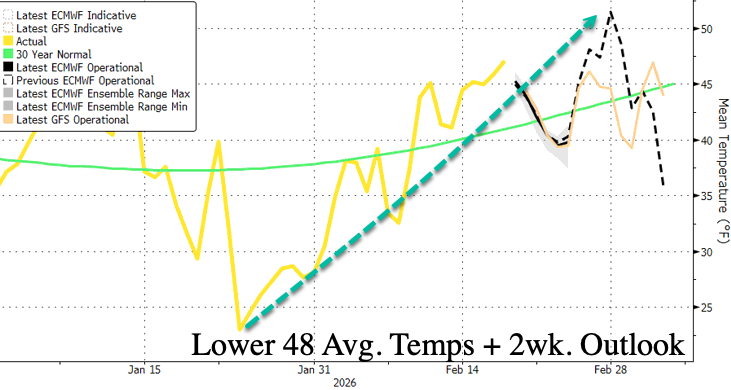
Meteorologists on X are posting new weather models showing a setup for a potentially serious winter storm threat that could blanket parts of the Mid-Atlantic and Northeast with wintry precipitation from Sunday into Monday. The elevated risk of a major snow threat is notable because the peak of Northern Hemisphere winter in the Lower 48 has already passed and temperatures have been trending higher.
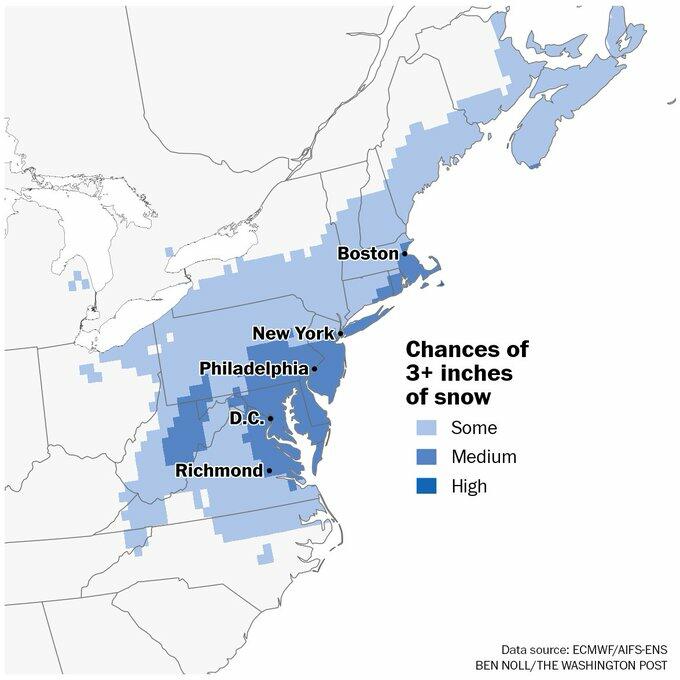
A major storm threat from Sunday into Monday could bring significant winter precipitation from Washington, DC, to Philadelphia, to New York City, and to Boston.
Meteorologist Ben Noll wrote on X, “Just a few hundred miles could make the difference between heavy snow in the Mid-Atlantic and Northeast on Sunday and Monday — or none at all.”
“As the forecast comes into focus, the latest probabilities show a medium chance for 3+ inches in a stretch from D.C. to Boston,” Noll said.
An excerpt from meteorologist Ryan Maue’s weather note outlined the increasing chances that a nor’easter/coastal storm will develop and impact the Mid-Atlantic and Northeast by late weekend.
Maue wrote:
East Coast Storm System — Mid-Atlantic + Nor’easter Watch
Updated ECMWF 06z shows the low-pressure center waiting to rapidly intensify or “bomb out” until late Sunday into Monday, missing the opportunity for the backside of the circulation to dump snowfall on the coast. The northeast track keeps the low-pressure center away from New England as well.
Ensembles: The ECMWF EPS at 06z (median) still NOT interested in the coastal storm having major impacts to the Mid-Atlantic or the Northeast.
Ensemble Probability of 3 inches of snow: about a coin flip from Washington, D.C., to Philly and New York City
The question is whether cold air will be in place as the storm arrives in the Mid-Atlantic region by late weekend. If so, plan accordingly for any travel disruptions.
Tyler Durden
Thu, 02/19/2026 – 18:00
https://www.zerohedge.com/weather/done-winter-not-so-fast-weekend-snowstorm-risk-rises-us-east

Alysa Liu da su primer oro olímpico s en patinaje artístico femenino en 24 años a Estados Unidos
Por DAVE SKRETTA
MILÁN (AP) — Estados Unidos ganó su primera medalla de oro olímpica en patinaje artístico femenino en 24 años gracias a la ejecución casi impecable de Alysa Liu en el programa libre del jueves. Vistiendo un reluciente vestido dorado se impuso a las rivales japonesas Kaori Sakamoto y Ami Nakai en los Juegos de Milán-Cortina.
La joven de 20 años que se había alejado del deporte tras los Juegos de Beijing hace cuatro años solo para protagonizar un notable regreso, terminó con 226,79 puntos, la mejor marca de su carrera. Nakai y Sakamoto, que patinaron justo detrás de ella, cometieron cada una un error en una secuencia de combinación, y eso marcó la diferencia en las medallas.
Sakamoto sumó 224,90 puntos para llevarse la plata, que se añade al bronce que ganó en Beijing. Nakai terminó tercera con 219,16 puntos.
En el momento en que se anunció la puntuación de Nakai tras el último programa de la noche, su compañera Amber Glenn saltó al estrado del “kiss-and-cry” y levantó la mano de Liu en señal de triunfo. Liu, con timidez, se giró y aplaudió a Nakai, de 17 años, quien corrió hacia ella y la abrazó.
Es la primera medalla de oro para una estadounidense desde 2002, cuando Sarah Hughes se subió a lo más alto del podio en Salt Lake City.
Glenn terminó quinta, por detrás de la japonesa Mone Chiba, en un impresionante repunte tras un desastroso programa corto la noche del martes. Su mejor programa libre de la temporada le dio una puntuación de 214,91 puntos, y por poco también la colocó en el podio.
Adeliia Petrosian, la rusa de 18 años que compite como atleta neutral en los Juegos de Milán-Cortina, intentó el único salto cuádruple durante la competencia femenina, pero se cayó en el cuádruple toe loop. El resto del recorrido lo hizo limpio, pero los puntos que Petrosian perdió por esa caída terminaron dejándola a menos de medio punto de la líder.
Fue Chiba —la novena patinadora en salir después de Glenn— quien finalmente se adueñó del primer lugar.
Eso no duró mucho, con Liu como la siguiente en salir al hielo.
___
Deportes AP: https://apnews.com/hub/deportes

Asamblea de Venezuela reanuda debate de Ley de Amnistía tras diferencias sobre exiliados
Associated Press
CARACAS (AP) — La Asamblea Nacional de Venezuela reanudó el jueves el debate de la Ley de Amnistía propuesta por la presidenta encargada Delcy Rodríguez para la liberación masiva de presos por motivos políticos.
La norma —que llegó al debate legislativo después del ataque militar estadounidense en Caracas que depuso y capturó el 3 de enero al entonces presidente Nicolás Maduro— se aplicaría a dirigentes opositores, sindicalistas, activistas de derechos humanos, estudiantes, académicos y periodistas, entre otros, detenidos durante meses o incluso años por motivos políticos.
La ley entraría en vigor luego de que sea promulgada por la presidenta encargada y publicada en la Gaceta Oficial.
Uno de los puntos conflictivos del proyecto —que obligó a diferir la semana pasada el debate— radica en si se puede conceder la amnistía a las personas que abandonaron el país para evitar un arresto. La iniciativa establece que los exiliados deberán “ponerse a derecho” ante un tribunal antes de acogerse a la amnistía.
Rodríguez, quien fue juramentada como mandataria encargada el 5 de enero —dos días después del traslado de Maduro y su esposa a Nueva York para enfrentar cargos federales por tráfico de drogas— ha expresado su esperanza de que la ley sirva para reparar las heridas que ha dejado la larga confrontación política en el país sudamericano desde la llegada al poder del fallecido presidente socialista Hugo Chávez en 1999.
La mandataria en funciones y sus aliados han dicho que aspiran a que la ley se convierta en una herramienta para potenciar el diálogo con los sectores políticos, económicos y sociales del país.
La Ley de Amnistía es una de las principales exigencias de la oposición y de organizaciones de derechos humanos y cuenta con el respaldo de Estados Unidos. La demanda de una amnistía se profundizó especialmente luego de que Maduro fue capturado.
Skokie OKs plan to refund $750 to homeowners who replaced their lead service lines
Skokie trustees on Tuesday unanimously approved a limited rebate program aimed at reimbursing homeowners who replaced their own lead service lines — which bring water from water mains into homes —after a 2022 state mandate required municipalities to eliminate the lead pipes.
Under the newly approved plan, residential property owners who replaced their private-side lead or galvanized service lines out-of-pocket between January 2022 and now will be eligible for either a $750 cash rebate or a $1,250 credit on their utility bill.
Skokie village staff estimate the total cost of the program will range from $172,500 to $287,500. The village estimates roughly 230 properties completed their own lead service line replacements after the mandate was introduced, so the cost to the village depends on how many of them decide to apply.
Trustees said at the Board meeting that the rebate is intended to address the equity gap for homeowners who were not initially covered by the village replacement program when it was first introduced back in 2022. Due to financial constraints and mandate uncertainty, only a limited number of households were eligible.
“The village is really stepping up to meet the moment,” said Skokie Mayor Ann Tennes at the Board meeting. “This is a way of providing some measure, a small measure, but a measure of equity to [homeowners].”
According to the village’s website, participation in the original program was reduced to “instances of an emergent situation,” such as a leak needing immediate repair, or as part of a larger water main replacement initiative.
A worker removes a lead service line as a crew replaces it with a copper pipe for a homeowner in the 10100 block of south Green Street in Chicago, May 2, 2024. (Antonio Perez/Chicago Tribune)
The original program capped a property owner’s costs at $3,090, with costs adjusted annually as fees rose. The program also allowed homeowners to finance the cost of the replacement over a period of 15 years at a low-interest rate paid through their water bill.
In December 2025, the lead service line replacement program was expanded to include “self-selecting” households beginning May 1, up to the program’s current limit of 688 replacements per year.
This comes in the wake of a growth in public awareness in recent years over the risks associated with drinking lead-contaminated water.
The United States Environmental Protection Agency (EPA) classifies lead as a toxic metal that can cause serious problems even at low levels of exposure, particularly for infants and young children who have still-developing brains and nervous systems.
According to the EPA, low levels of exposure to lead in children has been linked to “damage to the central and peripheral nervous system, learning disabilities, shorter stature, impaired hearing and impaired formation and function of blood cells.” Children ages six years old or younger are the most susceptible to lead poisoning.
Adults and children are exposed to lead primarily through the corrosion of aging water service lines. These lines are responsible for bringing tap water from a public distribution system to a home or business office. Prior to 1986, water service lines were primarily constructed of lead, according to the village’s website, whereas copper is now the standard accepted material.
The federal government and many states have since issued their own mandates for water service line replacements over the next decade. The Illinois Lead Service Line Replacement and Notification Act, introduced in January 2022, mandates that all lead service lines across the state be replaced, with full compliance stretching up to 50 years, or by 2077.
In accordance with the act, Illinois no longer allows a partial replacement of water service lines. If emergency services are needed to make a repair, the full lead service line must be replaced within 30 days, or 120 days if weather delays the replacement process.
“We understand that the costs [of replacement] are much higher than $750.This is an attempt to bring some parity and a courtesy. Thank you to those residents that took it upon themselves to do this,” said Julian Prendi, finance director for the village, during the Board meeting. “[Homeowners] got removed from the inventory, essentially, so they did the village a favor, but the budgetary constraints are what they are.”
Funding for the rebates are provided through the village’s FY26 budget of lead service line replacements via the Capital Improvements Program. Given scheduling constraints and crew and equipment limitations, the lead service line program may not be able to accommodate every self-selecting property this fiscal year.
Prendi said the cash rebate total is generated from cash out of the village’s water fund, whereas the water bill credit is a cost that the village will “eventually recognize much slower, perhaps over multiple years, because the credit is only applicable if you have a bill.”
A recognized small surplus in this year’s fiscal budget “drove the rebate amount” total, Prendi added.
As village staff noted in the memorandum, “Offering a rebate program would give some incentive and benefit to property owners to pursue the replacement through a contract on their own; this would also benefit the village by reducing the number of services replaced by village crews and reaching the total replacement sooner than the mandated deadline.”
Property owners hoping to take advantage of the rebate will need to apply with the village’s finance department, through an online portal, by mail or in-person.
Village staff will begin accepting rebate applications on March 1 and will work with the village communications team to notify residents and homeowners of the upcoming changes.
https://www.chicagotribune.com/2026/02/19/skokie-lead-service-line-rebate-750/

Small Businesses Compete… Why Can’t Credit Card Companies?
Small Businesses Compete… Why Can’t Credit Card Companies?
Authored by Adam Temple via RealClearPolitics,
Families aren’t the only ones who’ve been struggling with affordability for years. So have the small businesses that power the American economy and create the majority of new jobs. There’s no shortage of commonsense ideas to give job creators relief, but President Trump just highlighted one of the most important: Stop credit-card companies from ripping off Main Street.
This month, the president announced his support for the Credit Card Competition Act. At its core, this bipartisan bill would give small businesses the right to choose between multiple credit card processing networks. That’s a huge difference from the status quo, because right now, Main Street is stuck with networks that charge huge swipe fees. This leaves small businesses with a real dilemma: Stop accepting credit cards or pass the costs on to consumers. That’s an impossible choice in today’s economy.
This crisis can be laid at the feet of Visa, Mastercard, and the big banks that create the unfair and uncompetitive payment systems. The two powerful credit card companies and their banking partners decide what swipe fees every small business in America pays. They charge 2%-4% on each transaction, which adds up quickly. In 2024, the swipe fees totaled a record $187.2 billion, and they were most merchants’ highest operating cost after labor. And as credit card companies have raised their swipe fees in recent years, many small business margins have come to the breaking point.
Visa and Mastercard fees disproportionately impact small businesses more than larger competitors. But there’s no good reason for small merchants to pay higher rates. The transaction process and equipment costs are the same for everyone. Visa and Mastercard’s higher prices for smaller merchants seem designed to maximize their own Wall Street profits while punishing Main Street.
Every American suffers from this broken system. When small businesses lose money, they can’t hire more employees or invest in higher wages and better benefits. They also struggle to keep prices low, which matters at a time when consumers are cutting back and looking for deals. In the direst cases, swipe fees threaten the ability of small businesses to remain open at all.
As long as this anti-competitive, rate-setting regime remains in place, small businesses and their communities will suffer. That’s why Main Street is counting on Congress to pass the Credit Card Competition Act.
Authored by Sens. Marshall and Durbin and Reps. Gooden and Lofgren, the bill would end the current broken system by requiring banks to let small businesses choose more than one credit card network. Instead of being forced to go with only Visa and Mastercard, small businesses could simultaneously use well-established, secure, and independent networks like Star, NYCE, Pulse, and Shazam.
Under this bill, there would be no more take-it-or-leave-it, no more one-size-fits-all fee structure. Instead, there would be real competition among credit card networks. And as every small business can attest, competition lowers costs. Credit card networks would cut their fees to keep their customers, and small businesses would pass the savings on to families. Small businesses already have to compete every day. Why shouldn’t credit card companies?
Main Street is desperate to see reform. Ninety-two percent of NFIB’s small and independent business owner members?¯believe they should be able to pick the credit card networks that process their transactions. Now it’s time for our leaders in Washington, D.C., to pass the Credit Card Competition Act. President Trump is on board. So are lawmakers on both sides of the aisle. They need to give small business relief fast – for the sake of Main Street and all the families who depend on it.
Adam Temple is senior vice president for advocacy at the National Federation of Independent Business (NFIB).
Tyler Durden
Thu, 02/19/2026 – 17:40
https://www.zerohedge.com/markets/small-businesses-compete-why-cant-credit-card-companies

Trump’s War Room Assesses The Midterms: It’s The Economy, Stupid
Trump’s War Room Assesses The Midterms: It’s The Economy, Stupid
The 2026 midterms are (as always) shaping up to be the most consequential off-year election in a generation, and the people closest to Donald Trump know it.
If Republicans lose the House or Senate, Trump’s second-term agenda will be stopped dead in its tracks. That reality brought Trump administration officials, pollsters, and House Republicans together Tuesday night on Capitol Hill for a closed-door strategy session with one goal: don’t blow it. Journalist Mark Halperin posted the details on X, and what emerged from the briefing was a picture of a party that knows exactly what’s at stake.
Whether they understand how to win is another question entirely.
Political czar James Blair opened with historical data, making the case that midterm losses for the president’s party aren’t just common, they’re nearly inevitable. Decades of precedent suggest the party in power will lose seats. The lone exemption over the past 25 years was the 2002 midterms, when Republicans gained seats in the House and Senate, while George W. Bush was still president. But that was no ordinary election; it was the first midterm election after the 9/11 terror attacks.
Blair walked through the numbers on how rare it is for a sitting president’s party to avoid significant seat losses, framing the whole operation as a race against historical precedent.
Pollster and strategist Tony Fabrizio followed with roughly 25 slides of voter data, including demographics, issue rankings, and which messages cut through the noise. His bottom line was blunt: “The economy will be THE issue in the election.” But even that comes with some caveats.
“Trying to argue about wages being up will not help,” Blair warned. “Voters have to feel it.”
One only needs to look at Joe Biden for proof of this. He infamously tried to sell the idea that “Bidenomics” had delivered an economic recovery even as inflation reached historic highs. The messaging backfired big time.
Fabrizio found that the messages that actually resonate with persuadable voters include banning stock trading for members of Congress, transparency on health insurance pricing and claims reimbursement, lowering prescription drug costs, and Trump’s tax cuts. Housing affordability is also a huge issue, particularly for younger voters. Meanwhile, taking credit for closing the border, one of Trump’s strongest issues, “does not resonate much.”
According to Sophia Cai of Politico, Fabrizio told the audience “that the biggest takeaway is to focus on Trump’s efforts to lower prescription drug pricing.”
Trump pollster Tony Fabrizio is telling the audience that the biggest takeaway is to focus on Trump’s efforts to lower prescription drug pricing, per person in the room.
— Sophia Cai (@SophiaCai99) February 17, 2026
Democrats, in contrast, are running on “We hate Trump” and little else. That might energize a base, but it’s historically weak as a closing argument for voters who are deciding whether their lives are better.
Men, moderates, true independents, and Hispanic voters are the true persuadable voters, according to Fabrizio.
Then came the most candid moment of the briefing. Blair acknowledged outright that regardless of what came out of the meeting, “Donald Trump will do what he wants to do, say what he wants to say, not be data driven.”
He added, “Everyone else has to stay on message and be driven by the data. In effect, two separate but related campaigns.“
In short, Republicans must run a disciplined, data-driven operation as the president runs his own show. The goal is to make those two tracks complement each other rather than collide.
Perhaps the good news for the GOP is that most voters don’t begin paying serious attention until after Labor Day, which will give plenty of time for Trump’s economic policies to show results that voters feel.
Tyler Durden
Thu, 02/19/2026 – 17:20
https://www.zerohedge.com/political/trumps-war-room-assesses-midterms-its-economy-stupid

Judge denies challenge to Amazon data site as revitalization area
A Lake Superior Court Civil Division judge has denied a request from four Hobart homeowners challenging the city of Hobart’s designation of 725 acres as an Economic Revitalization Area (ERA) with property tax abatements.
The property, presently farmland, is located at 61st Avenue and Colorado Street, and the designations are connected to the proposed Amazon data center development.
Judge Kristina Kantar, in her ruling made on Wednesday, said “the actions of the Hobart City Council in designating an ERA and approving a tax abatement, by means of written resolutions approved at public meetings, is hereby confirmed.”
“This is a final appealable order and no cause for delay exists,” Kantar said in her written decision.
Hobart City Attorney Heather McCarthy issued the following statement in regard to the decision made by Kantar:
“The city of Hobart is pleased to announce that the Lake Superior Court has ruled in its favor, confirming that all statutory provisions were followed, including procedural requirements and due process. The court further ruled that the record reflects the Hobart City Council made its decision in an appropriate manner, supported by substantial evidence. This ruling validates the city’s position and affirms the council’s commitment to acting lawfully and responsibly on behalf of its residents. Mayor Josh Huddlestun remains steadfastly committed to advancing initiatives that benefit the city and its residents, a priority that continues to guide every decision of his administration.”
Kantar on Tuesday took all evidence under advisement following a Gary court hearing that lasted more than two hours.
The four homeowners, including Angelita Soriano, Albina Venegas-Roman, Barbara Koteles and Joseph Conn, were seeking to vacate two city council resolutions awarding real property tax abatements and a council resolution approving an enterprise information technology exemption for entities that have said they intend to develop data centers on property within the ERA.
The plaintiffs, in their complaint, said the Hobart City Council’s grant of a personal property tax exemption to Amazon Data Services was “arbitrary, capricious, not in accordance with law and not supported by substantial evidence because the council did not validly declare the subject property an ERA.”
The plaintiffs were seeking a declaratory judgment that the tax exemptions granted to Amazon Data Services be declared null and void and that the resolutions passed by the Hobart City Council be declared null and void.
Soriano, a spokesperson for the Hobart homeowners, said on the No Data Center group’s Facebook site: “The court’s verdict unfortunately did not go in our favor for the Feb. 17 ERA hearing, but let’s not get discouraged.”
“The scope of this hearing was extremely limited. We were only allowed to argue if this land was blighted or not. The first argument determined if we had legal standing to make this argument and the judge determined that we did have legal standing,” Soriano said.
“However, throughout the proceedings, the other attorneys repeatedly argued the burden was on the residents (appellees) to prove the land was not an Economic Revitalization Area. While we strongly disagree with that premise and believe that the city council should have been required to demonstrate and prove to its residents as to why this land qualified as an ERA in the first place, it basically became a Catch 22,” Soriano said.
“Unfortunately, under current Indiana law, the statute does not require the city council to carry that burden the same way it did for us when we were appealing it. Apparently per a more recent 2022 General Assembly language amendment, vacant farmland qualifies for an ERA. Thus the law is structured to give enormous discretion to the city, even when the public raises serious concerns,” Soriano said.
Several people testified at the hearing held in Gary on Tuesday including Hobart Realtor Sophia Mason; Hobart City Councilman Matt Claussen; and Brandy Schaeffer, an economic land development principal for Amazon.
The four Hobart residents were represented by attorney David E. Dearing of Dearing Law Firm.
Deborah Laverty is a freelance reporter for the Post-Tribune.
https://www.chicagotribune.com/2026/02/19/judge-denies-challenge-to-data-site/

Walgreens laying off 469 Illinois employees, following sale to private equity firm
Walgreens is laying off 469 employees in Illinois, just months after being bought by a private equity firm.
The employees work at the company’s offices in Deerfield, at the Old Post Office downtown and in Danville, according to a letter the company sent to the Illinois Department of Commerce and Economic Activity.
Walgreens said in the letter, which was sent earlier this month, that it would give affected employees 60 days notice of their termination, starting Feb. 10 and in the days following.
“… Walgreens is reorganizing several areas of the business to best position the Company for growth and deliver results where they matter most: in our stores and with our customers and patients,” wrote Kimberly Metrick, a Walgreens vice president in the letter.
The letter said that all affected employees would remain employed and receive their full compensation and benefits for 60 days after being notified of their terminations or until they resigned.
“We’re focused on becoming America’s best retail pharmacy, beginning with improving the in‑store experience for our customers and patients,” a Walgreens spokesperson said in a statement Thursday. “To do this, we’ve made the difficult decision to simplify our organization in both the support center and with our field leadership to speed decision making and improve the service that millions of customers rely on every day.”
The layoffs follow private equity firm Sycamore Partners’ acquisition of Walgreens Boots Alliance in August for about $10 billion – a deal that took Walgreens private.
As part of that transition, Sycamore said that Walgreens, The Boots Group, Shields Health Solutions, CareCentrix and VillageMD would operate as separate, standalone companies moving forward. A new CEO was appointed to lead Walgreens. Shortly after the sale, Walgreens said it planned to exit its space at Chicago’s Old Post Office, with its headquarters remaining in Deerfield.
The deal came after years of challenges for the retail pharmacy giant, which has faced issues related to medication reimbursements and competition from online retailers. Walgreens also struggled after pursuing an ill-fated attempt to become more of a health care destination by investing billions of dollars into primary care provider VillageMD.
Some industry-watchers noted, at the time of the deal, that the acquisition by a private equity firm would give the company space and time for a turnaround, while others worried that it would lead to layoffs and more store closures.
Bloomberg first reported news of the layoffs Thursday.
https://www.chicagotribune.com/2026/02/19/walgreens-layoffs-private-equity/