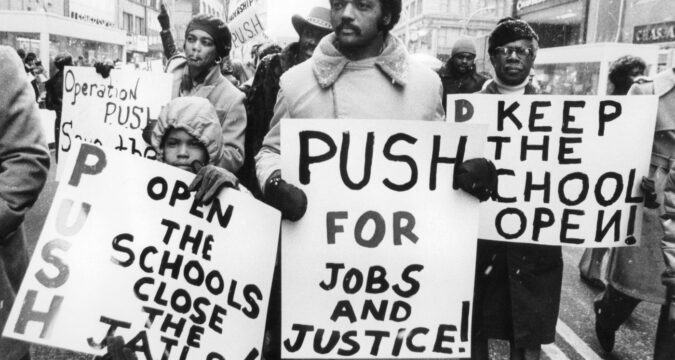
The Rev. Jesse L. Jackson died Tuesday — “peacefully” and “surrounded by his family” — at 84. He battled Parkinson’s disease since 2017, and in April 2025, he was diagnosed with progressive supranuclear palsy, a neurological disorder.
The Chicago-based Baptist minister was a mainstay in the Civil Rights Movement and founder of the Rainbow/PUSH Coalition. Yet there are some aspects of the outspoken orator’s life that might have been forgotten. Here’s a look back at five phases of Jackson’s legendary life.
Athlete
The Rev. Jesse Jackson plays basketball with residents during a visit to the Ida B. Wells housing project on April 3, 1989, in Chicago. (Charles Osgood/Chicago Tribune)
Jackson, a three-sport athlete at Sterling High School in Greenville, South Carolina, was quarterback for the Tigers when the team posted a 7-2-1 record during the 1958 season.
Jackson told the Tribune’s Fred Mitchell in October 2005 the San Francisco Giants and the Chicago White Sox were interested in signing him after their 1959 Go-Go White Sox season.
“It was a choice for me between football and baseball. I loved both sports, but felt more secure with football. At that time, the (baseball) bonuses that they were offering were $10,000 to $50,000, which was all the money in the world. But I could just not take that risk. There were a lot of kids who never got past Triple A. I thought with football I had more options and I felt more secure.”
Jackson attended the University of Illinois Urbana-Champaign his freshman year of college intending to play football. David Condon’s “In the Wake of the News” column from Dec. 19, 1959, touted Jackson as a “195-pound halfback, shifted from quarter” who could be a “speedster of the Buddy Young, Bobby Mitchell type.” Yet Jackson’s name doesn’t appear on an Illinois team roster from 1959 or 1960.
David Condon’s “In the Wake of the News” column from Dec. 19, 1959, described Jesse Jackson, one of several freshmen “outstanding backs” for the 1960 season. (Chicago Tribune)
Jackson transferred to North Carolina Agricultural and Technical State University for his sophomore year. He told the Tribune in 1984 that he chose to return to the South after Black fraternities and sororities were not allowed to attend an all-Greek dance on campus where Duke Ellington’s band played.
“I left the region of apartheid in our nation and came north to the Land of Lincoln with high expectations. Many of my ideological expectations were torn asunder right here. I looked at new realities, I looked at new names and old games of rejection and of oppression,” Jackson told reporter George E. Curry. “We were not permitted to go to that dance on campus. We had our affair at the VFW, out in the city. It was that contrast that kept disturbing me, and it was the new realities that helped stimulate my desire to fight and go and change things.”
MLK’s protege
The Rev. Martin Luther King Jr. walks along East Huron Street after a morning summit meeting at the St. James Episcopal Cathedral parish house at 666 N. Rush St. in Chicago on Aug. 17, 1966. The meeting was to discuss the city’s racial problems. Jesse Jackson is at his side. (Al Phillips/Chicago Tribune)
After considering law school, Jackson instead moved to Chicago in 1964 to pursue a master’s degree at Chicago Theological Seminary. Though he was ordained a Baptist minister in 1968, he didn’t receive his degree until 2000. His interest in the civil rights movement meant studies had to wait. He took a leave of absence from school.
While in the school’s cafeteria Jackson was inspired to join the Rev. Martin Luther King Jr.’s 1965 march from Selma to Montgomery, which became known as “Bloody Sunday.”
“I got up on one of those tables and said, ‘We have to go, we have to go,’” Jackson recalled in 2000. “It was an exciting breakfast.”
When King traveled to Chicago to lead “the first significant freedom movement in the North,” Jackson was by his side. King told Jackson he would “learn more with me in six months than in six years at the seminary,” Jackson said.
“I was a 24-year-old graduate student at Chicago Theological Seminary and (a Southern Christian Leadership Conference) staffer, appointed by Dr. King to head Operation Breadbasket, the economic arm of the movement. Dr. King chose Chicago over New York for his northern crusade because Chicago had a growing independent political movement and a broad-based civil rights coalition, the Coordinating Council of Community Organizations headed by Al Raby,” Jackson wrote in a Tribune op-ed in 2016. “Some historians say Dr. King got bested by the Democratic Machine and that the Freedom Movement failed. I take exception to that shortsighted view. The struggle for power and justice is a long-term commitment. We sowed seeds in 1966 that have been producing progress for 50 years.”
The Rev. Martin Luther King Jr. stands with other civil rights leaders on the balcony of the Lorraine Motel in Memphis on April 3, 1968, a day before he was assassinated at approximately the same place. From left are Hosea Williams, Jesse Jackson, King and Ralph Abernathy. (Charles Kelly/AP)
Jackson was also with King when he was assassinated at the Lorraine Motel in Memphis on April 4, 1968. Jackson claimed he cradled King in his arms. Others who were at the scene, however, had different recollections. When he returned to the site in April 1984, Jackson stood by his previous statement.
“I held him,” Jackson said. “I was down, and Rev. (Samuel ‘Billy’) Kyles handed me a sheet from that room to catch the blood. By that time, four or five of us were there. I walked away at that time and went into Room 305 (the room next to Rev. King’s) to call Mrs. King to indicate Dr. King had been shot.”
Presidential candidate
The Rev. Jesse Jackson holds his daughter, Jackie Lavinia, after making a speech to a crowd at the Holiday Inn on Ohio Street in Chicago on March 20, 1984. Jackson was running for president at the time. (Ernie Cox Jr./Chicago Tribune)
Jackson, the founder of Operation PUSH (People United to Save Humanity, later changed to “Serve” Humanity) was the first Black person to lead a serious campaign for the White House during both the 1984 and 1988 presidential elections.
He announced his first candidacy on Nov. 3, 1983, at the Washington, D.C., Convention Center — followed by a live band, gospel and secular singers and 16 other speakers.
“I seek the presidency to serve the nation at a level where I can help restore a moral tone, a redemptive spirit and a sensitivity to the poor and dispossessed of this nation,” he told the crowd. “We can do without the Democratic Party or the Republican Party. They can not do without us.”
A comment to Washington Post reporter Milton Coleman, however, strained Jackson’s relationship with the Jewish community. Coleman reported he heard Jackson refer to Jews as “Hymie” and New York as “Hymietown.” Jackson said he had “no recollection” of using those terms, but the remarks caused dissent within the Democratic party.
Walter Mondale received the Democratic nomination at the party’s convention in San Francisco on July 18, 1984, with 2,191 votes. Jackson had just 465 ½ votes. Mondale lost to incumbent Ronald Reagan.
A quiet moment for Democratic presidential candidate the Rev. Jesse Jackson as he sits on the press bus after arriving at Chicago’s Midway Airport from Houston on March 9, 1988. After a grueling day of campaigning on Super Tuesday, and a late night at a campaign rally, Jackson was up early for interviews and an early morning press conference in Houston before he traveled to Chicago. (Paul Gero/Chicago Tribune)
Jackson received an endorsement from Chicago Mayor Harold Washington — the city’s first Black mayor — during the 1988 race. Michael Dukakis (who lost the election to George H.W. Bush) earned the party’s nomination on July 20, 1988, at the convention in Atlanta with more than 2,700 delegate votes. Jackson had about 1,100 — more than any other Black candidate before him.
Hostage negotiator
The Rev. Jesse Jackson and U.S. Rep Rod Blagojevich, behind Jackson to the right, arrive at O’Hare International Airport on May 7, 1999, following their successful trip to Belgrade where they secured the release of three captive American soldiers. More than 300 people were on hand to greet them. (Phil Greer/Chicago Tribune)
Jackson’s work as an intermediary helped secure the release of dozens of people held against their will around the world.
Jackson traveled to Syria in January 1984 to meet with President Hafez Assad regarding U.S. Navy pilot Lt. Robert Goodman, who was imprisoned after his plane was shot down in the Middle East. Though Jackson’s negotiations were successful, some called it a publicity stunt for his election campaign.
Jackson also secured from Cuban President Fidel Castro the release of 26 Cuban political prisoners and 22 Americans in Cuba and brought them back to the United States in June 1984.
U.S. Presidential candidate the Rev. Jesse Jackson gestures to the crowd at Havana’s Jose Marti Airport on June 29, 1984. Shortly afterward, Cuban President Fidel Castro, left, released Cuban and American prisoners to Jackson. (J. Scott Applewhite/AP)
He met with Iraqi leader Saddam Hussein in September 1990 to make sure women and children of foreign nationals were sent home from Kuwait — as Hussein promised — during the Gulf War.
Yugoslavian President Slobodan Milosevic released three American prisoners of war as a “humanitarian gesture” after he met with Jackson and then-Illinois Congressman Rod Blagojevich in May 1999.
Advocate for pardon of Blagojevich — and his own son
Illinois Gov. Rod Blagojevich acknowledges the crowd before his State of the State address at the Capitol’s House of Representatives on Feb. 3, 2005. The Rev. Jesse Jackson, front row on the right, and Rep. Jesse Jackson Jr., D-Ill., second from right, were in attendance. (Abel Uribe/Chicago Tribune)
Jackson and his son, former U.S. Rep. Jesse Jackson Jr., himself a convicted felon, wrote a letter to President Donald Trump in July 2019 seeking a release and full pardon for Blagojevich.
“We stand with his family as they seek a full pardon for a father and husband that has served most of a sentence that was far longer than the offense deserved,” they wrote.
Vintage Chicago Tribune: Pardon me — Chicagoans who received clemency from a US president
At his second trial in 2011, the former Illinois governor was found guilty on widespread corruption charges, including attempting to sell the U.S. Senate seat once held by President Barack Obama. Blagojevich was sentenced to 14 years in federal prison — the second-longest term ever delivered in federal court in Chicago for a public corruption case.
Trump, convicted of felonies himself, commuted the former Illinois governor’s 14-year sentence to about eight years served on Feb. 18, 2020.
After President Joe Biden pardoned his own son, Hunter Biden, Jackson requested in December 2024 a pardon for his son saying he had “taken full responsibility for his actions.” Biden, however, did not grant Jackson’s request.
Want more vintage Chicago?
Become a Tribune subscriber: It’s just $1 for a 1-year digital subscription.
Thanks for reading!
Subscribe to the free Vintage Chicago Tribune newsletter, join our Chicagoland history Facebook group, stay current with Today in Chicago History and follow us on Instagram for more from Chicago’s past.
Have an idea for Vintage Chicago Tribune? Share it with Kori Rumore at krumore@chicagotribune.com.


