Category: News

Amendment guts gratuity bill inspired by former Portage Mayor
An Indiana state bill addressing gratuities that was drafted in response to the bribery case against former Portage Mayor James Snyder was amended and approved in the Senate to remove all language pertaining to gratuities.
The bill’s author — State Rep. Hal Slager, R-Schererville — said he will work in the final days of session to undo the amendment.
As filed, House Bill 1065 would have made it a Class A misdemeanor for a person to offer a payment to a public servant as a reward for an official act taken by the public servant or a public servant to solicit or accept a payment as a reward for performing an official act.
The bill also initially increased the penalty to a Level 6 felony if the fair market value of the reward is at least $750. The bill exempts a good or service that is subject to a reporting requirement or otherwise allowed under an applicable rule or code of ethics. It further exempts plaques, trophies, framed photos, lawful political contributions and wages.
Slager previously said he filed the bill to prevent the acceptance of a gratuity after Snyder was indicted and convicted of accepting a bribe.
“It’s not a good idea, under any circumstances, for a public official to accept a gratuity for doing their job,” Slager previously told the Post-Tribune. “We want to put an end to that … because we didn’t have that in our code.”
The House Courts and Criminal Code Committee amended the bill to include language from House Bill 1141, which would make commingling of a committee with personal funds up to $50,000 a class A misdemeanor.
When the bill was heard on second reading in the Senate on Monday, State Sen. Aaron Freeman, R-Indianapolis, proposed an amendment to remove all portions of the bill that pertain to gratuity, which means the bill only contains the language about commingling of a committee with personal funds.
A spokesman for Freeman did not respond to requests about why the bill was amended.
The bill passed the Senate on Tuesday, 47-1, with State Sen. Jean Leising, R-Oldenburg, voting against the bill. A spokesman for Leising said she voted against the bill “because someone had told her the bill was not legally well put together.”
Slager said Wednesday he filed a dissent motion against the way the bill was amended. But, Slager expressed surprise that Freeman, the chair of the Senate committee that the bill passed out of unanimously, removed the gratuity language.
“I’ve not had a chance to talk with him, but reports suggest some misunderstanding,” Slager said.
The bill passed the House in a 85-0 vote Feb. 2. The bill will be returned to the House for consideration because it was amended in the Senate.
A jury in U.S. District Court in Hammond found Snyder not guilty on the bribery charge involving a towing contract, and convicted him in two separate trials on a garbage truck bribery charge, a case that made its way to the U.S. Supreme Court. In June 2024, the justices ruled that the $13,000 payment Snyder received over a garbage truck contract was a gratuity, not a bribe, because the payment came after the contract and not before. The case was remanded to the lower courts.
Snyder’s conviction on the tax charge, which involved his personal business and not his duties as mayor at the time, remains unchallenged, and Snyder is scheduled to be sentenced on March 10 in Hammond’s U.S. District Courthouse, nearly a decade after he was originally indicted.
Snyder’s case was heard by the U.S. Supreme Court, which ruled that Indiana didn’t have a law against gratuity, so the court ruled in Snyder’s favor, Slager said.
“Everything pointed to the fact that, in fact, the giving of the gratuity was done so after the official act, not before, and that there was no evidence to suggest there was any arrangement in advance to participate that way,” Slager previously said.

Of Notoriety: Kevin Matthews, ‘Bernadette,’ World Banquet and more
In a Feb. 3, 1989 edition of The Torch, the weekly campus newspaper at Valparaiso University, freshman class “cub reporter” Phil Potempa (that’s me) had a byline story interview with “shock jock” Kevin Matthews.
Matthews was age 33 at the time and the top radio personality on WLUP-AM “The LOOP” broadcasting from downtown Chicago while also dabbling in stand-up comedy, touring on nights and weekends. For Feb. 10, 1989, he was booked to perform his comedy act on stage at the VU Student Union with tickets priced at $5 for the community and $3 for students.
As described in my story from nearly four decades ago, at the time, Matthews was billed and branded as “outrageous,” and my interview details: “He is known for his impersonations of everyone from Pee Wee Herman, Led Zeppelin and Barney Fife to his own creations such as Jim Shorts and Mr. Stupid.”
He reminded me during our phone chat that before his time at WLUP (where he started in March 1987 and eventually stayed for 12 years), that station had originally been under the “call letters” of WCFL-AM and programmed as a religious music station. “Kev” christened his devoted followers, fans and groupies as “Kev-Heads.” My story noted that proceeds from his show would benefit Lutheran Family Services of Northwest Indiana.
Fast forward 37 years.
Matthews, who turns 70 in a couple weeks on March 12, seems like a new man.
He has stepped away from radio broadcasting the past few years to devote his time as an executive producer to star in his own documentary focusing on his faith journey titled “Broken Mary: The Kevin Matthews Story.” He released the film to limited distribution in theaters around the country last year on Oct. 7, 2025. A month early, a 112-page companion print paperback ($14.99) with the same title was authored by Aeliana Veyra and included Matthews’ life pivot after being diagnosed with multiple sclerosis in December 2008.
Chicago radio personality Kevin Matthews is shown on the cover of the January 1996 issue of Illinois Entertainment Magazine, which he shared on social media, adding his commentary: “National DJ? Whatever! We were professional (expletive). This photo I recently found causes one to vomit.” (Image courtesy of Kevin Matthews/Illinois Entertainment Magazine Archive)
The catalyst Matthews credits for his life and career transition (the latter aimed now with focus as a popular booked speaker on the lecture circuit) is from his 2010 encounter with a “broken” statue of the Virgin Mary that he noticed discarded in a city alley. He retrieved the statue and began to repair it while embracing it as a symbol that it was also time for him to repair his own life and faith connections.
Earlier this month, on Feb. 11, Pope Leo XIV met with Matthews at The Vatican and blessed the “Broken Mary” statue, which, when not traveling with Matthews, resides at Matthews’ hometown parish, St. Anthony of Padua Catholic Church in Grand Rapids, Michigan.
Mark your calendars for Matthews to be in Northwest Indiana this summer with the statue, his presentation and a documentary screening on June 13 at St. Stanislaus Kostka Catholic Church, 1506 Washington St. in Michigan City, with details at https://ststanschurch.com/ or call 219-879-9281.
POPE ‘NO AI’
The day after Ash Wednesday mass at the Basilica of Santa Sabina, Pope Leo XIV held a closed-door meeting Feb. 19 with top clergy from the Diocese of Rome and beyond to give the dictate “urging priests to not to use artificial intelligence (AI) to write their homilies or to seek ‘likes’ on social media platforms, specifically mentioning TikTok,” according to a report published on Feb. 21 by The National Catholic Reporter.
The Pope said priests should resist “the temptation to prepare homilies with artificial intelligence.”
“Like all the muscles in the body, if we do not use them, if we do not move them, they die,” he said, as also quoted by The Vatican News on Feb. 20.
“The brain needs to be used, so our intelligence must also be exercised a little so as not to lose this capacity. To give a true homily is to share faith, and artificial intelligence will never be able to share faith.”
DINNER INVITATIONS
When I had Chef Gabe Rosado of Hartsfield Village on my weekly Of Notoriety radio show on WJOB 1230 AM earlier this week, he announced the good news that tickets for this year’s 25th Annual Meals on Wheels NWI Dine with the Chefs on Sunday, March 1, have sold out at a record capacity of 450 guests. Last year’s event generated more than $178,000 for the nonprofit organization.
But there’s still time for the Valparaiso University International Students’ Association’s 46th annual World Banquet Sunday. The event is hosted in the Harre Union Ballrooms from 6 to 8:30 p.m. and this year is themed “enchanted forest.” In addition to a sampling of international cuisine favorites, the night includes a variety of performances and cultural activities. Tickets for the general public are $15 and must be purchased in advance, available at the Harre Union Welcome Desk or by calling 219-464-5333 or https://vivenu.com/event/visa-world-banquet-2026-lq24jv.
‘BERNADETTE’ BUS
The Militia of the Immaculata of the Carmelite Shrine in Munster is hosting a Lenten excursion to Chicago next month to see “Bernadette, The Musical” for the matinee performance Saturday, March 14. The two motorcoaches will depart at noon from the Carmelite Fathers Monastery, 1628 Ridge Road in Munster, for the 2 p.m. performance at Chicago’s Athenaeum Center and will return at approximately 5:30 p.m. Suitable for all ages, the musical stars French actress Eyma in the title role, and the show is co-produced by actor Kelsey Grammer. Billed as “a powerful and deeply-moving theatrical production,” it brings to the stage the extraordinary story of Bernadette Soubirous, the young girl whose Marian apparitions she encountered in Lourdes in 1858, which “forever changed the spiritual landscape of the world.” The cost is $65 per person and includes transportation and one balcony ticket. For more information or to make reservations, call Joe Cascone at 708-560-7767 or email him at casconejoe@outlook.com.
Philip Potempa is a journalist, published author and radio show host on WJOB 1230 AM. He can be reached at PhilPotempa@gmail.com.

Proposed legislation would slash $40M in ‘hidden expenses’ from Illinois utility bills
With utility rates rising across Illinois, consumer groups are backing proposed legislation to wring $40 million per year in hidden expenses out of customer bills.
The Utility Transparency Act, sponsored by state Sen. Suzy Glowiak Hilton and Rep. Theresa Mah, is seeking to prohibit investor-owned utilities such as ComEd and Peoples Gas from charging customers for everything from trade association memberships and shareholder insurance protection to advertising.
Illinois utilities are even able to charge customers for outside legal services and expert witnesses used to push for rate hikes at the Illinois Commerce Commission.
Consumer groups Citizens Utility Board, 350 Chicago and AARP Illinois held a news conference Wednesday morning in Springfield to bring attention to the proposed legislation and the hidden expenses adding to already high monthly utility bills.
“I’ve talked to some of my constituents, and they’re saying that their bills haven’t just ticked up, that they’ve doubled,” Glowiak Hilton, a Democrat from Western Springs, said during the news conference. “What we should be doing is delivering energy to homes and businesses, not asking people to pay for extra things that don’t do that.”
Under current Illinois law, utilities are able to pass along certain costs that consumer groups have long argued do not directly benefit customers. The proposed legislation would shift those costs, which are buried in delivery charges on monthly customer bills, to company shareholders.
A Citizens Utility Board analysis of documents filed in rate cases before the ICC from 2023 to 2025 found that the proposed legislation could save Illinois ratepayers about $40 million per year. Similar legislation has passed in Connecticut, Colorado and Maine.
Chicago-area customers have been hit by a one-two punch of higher delivery rates charged by utility companies and spiking energy costs, which are passed through to suppliers. Some ComEd customers saw a triple-digit increase in their total June electricity bills due to a supply rate increase and high demand during a summer heat wave.
Last month, ComEd filed a $15.3 billion, four-year grid plan with the ICC to meet projected increased electricity demand among its 4.1 million customers across northern Illinois. While ComEd will not file a rate request reflecting the grid plan until next year, it is projected to increase residential customer bills by about $3 per month starting in 2028, the utility said.
Meanwhile, both Peoples Gas and Nicor Gas are seeking rate increases as supply costs continue to rise.
Nicor, which serves 2.3 million customers in suburban Chicago and northern Illinois, filed a $221 million rate increase request last month with the ICC to replace and repair aging pipelines and equipment. If approved, it would raise average residential customer delivery charges by about $6 per month beginning in 2027, the utility said.
Residential gas bills include both supply and distribution charges. While the utilities don’t make any money on the supply end — the natural gas itself — they are responsible for procuring it as efficiently as possible, to hold down the cost paid by customers.
Nicor Gas supply prices are at 53 cents per therm in February, up 66% over the same month last year, according to published ICC data.
Peoples Gas filed for a $202 million rate hike last month with the ICC to recover projected costs for its accelerated pipeline replacement program.
If approved, the rate increase request would raise average residential customer delivery charges by $10 to $11 per month beginning in 2027, the utility said.
Ordered by the ICC to retire more than 1,000 miles of old cast iron pipe by the end of 2034, Peoples Gas began work this week, excavating streets, sidewalks and parkways to install new plastic pipes across 10 Chicago neighborhoods from Budlong Woods to Rosemoor to Schorsch Village, the utility said.
https://www.chicagotribune.com/2026/02/25/hidden-expenses-utilities-illinois/

Partnering with West Aurora School District, Aurora food pantry moves drive-up service to Saturdays
Saturday mornings are likely to look a lot different at the Aurora Area Interfaith Food Pantry starting this weekend, as the pantry is moving its drive-up service to the weekend in the hopes of serving more people in the community.
Beginning Feb. 28, residents looking to pick up food from the pantry can stop by its location at 1110 Jericho Road in Aurora on Saturday mornings from 8 to 10 a.m. — replacing its popular Friday drive-thru service, according to an update from the pantry.
Aurora-area food pantries have in recent months seen rising demand for food amid a monthslong surge of immigration law enforcement in Chicago and its surrounding suburbs and uncertainty surrounding the future of SNAP benefits.
For Aurora Area Interfaith, that increase has been noticeable for its delivery and drive-up services, the pantry has said previously.
Aurora Area Interfaith began offering a drive-up service last year, and started to promote it to the community as an option as these concerns mounted. Marie Wilkinson Food Pantry in Aurora also offers a drive-thru distribution option.
Part of the reason for Aurora Area Interfaith switching its drive-thru offering from Friday to Saturday, the update from the pantry said, is to reach more families from West Aurora School District 129, which is partnering with the pantry on the new drive-up service.
Citing reluctance from community members to come in and shop inside at the food pantry, the school district and the pantry began working together to come up with a plan that would “show the fact that (they) are community partners,” and help people get food without having to leave their cars, West Aurora School District Associate Superintendent of Operations Angie Smith told The Beacon-News on Wednesday.
They initially considered operating a service our of one of the district’s schools, Smith said, a model that is comparable to one implemented by nearby East Aurora School District 131, which distributes food to high school students in partnership with Marie Wilkinson Food Pantry. But West Aurora was unable to land on a location that had sufficient storage space to make a similar set-up work.
So, the district and food pantry instead landed on working together to promote the new weekly Saturday offering to West Aurora families.
“Making sure that we can kind of really use all of our resources,” Smith said, “through our building newsletters, through our social media, to really let West Aurora families … know, ‘Hey, we’re here to help. We’re partners together.’”
West Aurora already has a few options for students and families to get food. The VNA Health Center at the Jeff Craig Family Resource Center serves West Aurora families and, in partnership with Marie Wilkinson Food Pantry, provides medical care and nutrition support. And Jefferson Middle School already has a “micro pantry” in partnership with Aurora Area Interfaith, which provides food for students to eat and take home.
The latter offering was part of what inspired the pantry’s partnership with the district for the drive-up service, Katie Arko, the pantry’s executive director, said.
Arko said that the success of the initiative at Jefferson led to the pantry getting requests from other schools to offer something similar.
That’s still an option the pantry is considering, Arko said, but, in the meantime, it has decided to work with the district on modifying and promoting its drive-thru service to district families.
As for the rationale for the change, Arko said that demand at the drive-thru distribution on Fridays has been steady since it began, but noted that it may preclude some people who work from using the services.
“We’re just hoping to reach a new … group of people that are struggling, that have not taken advantage of the different resources in the community,” Arko said of the pantry’s moving its drive-thru service to Saturdays.
Drive-thru services are also more convenient, she pointed out, and allow the pantry to serve more residents in a shorter period of time than, say, traditional shopping inside the food pantry.
While the change is geared at reaching more West Aurora families, anyone in the community can use the Saturday drive-up service, not just those in the school district, both Smith and Arko emphasized.
Individuals can register in advance or at the drive-thru, and only have to register the first time they go to the pantry, Arko said, describing the registration requirements as only requiring “very basic information.” The pantry distributes food to people living in Kane, DuPage, Kendall, Will and DeKalb counties.
As far as reaching families in West Aurora District 129, however, Arko described how partnering with the school district might make families feel more comfortable seeking out the services. She also noted, for example, that having to get out of one’s car and come in and out of the pantry could spark concern from individuals in light of fear around the presence of federal immigration agents.
“I think by partnering with the district, it … gives that familiarity that hopefully will prompt families to come and grab food,” Arko said of the new partnership.
Smith pointed out that the district provides students with breakfast and lunch, and sometimes snacks, but that doesn’t happen on the weekends, when students aren’t in school, a gap this new offering aims to fill.
And the drive-up service would be distinct from other food resources the district currently provides in that it allows a family to get significantly more food.
According to Arko, the average packaged box that will go into a car’s trunk as part of the drive-thru will be between 100 and 120 pounds of food — far more than a student could carry home from the micro pantry at Jefferson, for example.
“If you think about it, kind of like when you go to Walmart or Target and can pull up and have your groceries put into your car, that’s more what this is,” Smith said.
Smith said the district has been seeing increased numbers of families coming to the district with concerns about food and housing security as this new partnership comes to fruition.
“As the economy takes a turn and as prices continue to go up, more and more families are struggling paycheck to paycheck, and (we) wanted to make sure that this is yet another resource that they know about, that they have information on and that’s accessible to them,” she said.
She said the district makes providing resources to families “as confidential as possible,” and that it works to encourage community members not to let “pride … get in the way of (them) using these (resources).”
And she thinks the nature of the drive-thru service will help with that.
“I can’t help people who don’t tell me that they need help,” Smith said. “But what we have to do is make people comfortable with being that vulnerable and saying, ‘I need help,’ and I think take some of the stigma away from that.”
And she referred to the need to make families feel like there’s no stigma attached with receiving these services.
“It’s actually a strength to know, ‘Where can I get help?’” Smith said. “It’s actually a strength to know, ‘How do I leverage my dollars in a different way?’ So that I can use the food pantry to help here so that I can focus on my rising utility bill or paying my rent.”
The district is also looking to promote the program within the district in hopes of recruiting more volunteer or financial support for the pantry, Smith noted.
“If we’ve got families in the district that are very fortunate to not have food insecurity, but want to help volunteer, want to help donate cash or things like that, the more that we can get in front of people the fact that there are great nonprofits out there doing great work, and … here’s (one) that you can support that are benefiting your neighbors and your friends here in West Aurora,” Smith said.
And she spoke appreciatively of the community offerings in the district and greater Aurora area.
“Aurora’s a really big little town in some respects, and people want to help, they want to help their neighbor,” Smith said. “I think this is a great example of that.”
mmorrow@chicagotribune.com

‘The Mirage’ Of Manufactured Calm And The Disconnect Between Markets And Reality
‘The Mirage’ Of Manufactured Calm And The Disconnect Between Markets And Reality
The newest form of subliminal messaging — and how we play into it every single day
Turn on the news any morning — any morning — and within sixty seconds you will be told that somewhere, something is the most extreme version of itself that has ever existed. The drought is the driest on record. The rainfall is the wettest in a century. The storm is historic. The heat is unprecedented. The cold snap is generational. Tomorrow, a different city will be the hottest, the snowiest, the most flooded. The language never changes because the game never changes: make the ordinary feel extraordinary, make the expected feel shocking, and above all, make the audience feel that without this information they would have been dangerously unprepared.
Weather is just the warm-up act. Sports runs the same playbook every day. You open your phone, pull up the injury report, scan the line movement, and read the breakdown from three different analysts — and somehow each one tells a completely different story using the exact same set of facts. One paints a team as invincible. Another frames the same record as a house of cards. A third pulls a five-game sample that makes a .500 team look like a dynasty. The numbers didn’t change. The narrative did. And nine times out of ten, you don’t just consume it — you believe it.
By the time you scroll past weather and sports and land on money, the conditioning is complete. You are told, on the same front page, that markets are at record highs, that the economy is generating record jobs, and that “national wealth” has never been greater — while in the next tab, you quietly check your bank app and find record credit-card balances, record insurance renewals, and a savings buffer that rounds to zero. Record stock market valuations sit beside record credit card delinquency rates. Record low unemployment sits beside record time-to-hire and job-search fatigue. Record corporate profits stack on top of record household interest-to-income ratios. Record “national wealth” coexists with record subjective financial anxiety. The drought is the driest, the flood is the worst, the market is the richest — and somehow, your ATM is still flashing “insufficient funds.”
That is not a sports problem, and it is not a weather problem. It is the oldest trick in the modern information economy: data, packaged with precision, weaponized as belief. Financial markets in 2026 are running the longest, most sophisticated version of this game in recorded economic history, and most of the world is playing along — including the institutions paid to be skeptical.
This is the story of that mirage. It is the story of a financial system that has become extraordinarily skilled not at pricing risk, but at deferring it — and of the tools, the legislation, and the language engineered to make sure you never notice the difference. The record drought and the historic flood were just the rehearsal. The main event has been running on Wall Street all along.
The Scoreboard Has Been Severed from the Field
As of February 24, 2026, two numbers exist simultaneously in the same global economy, and they describe two entirely different worlds.
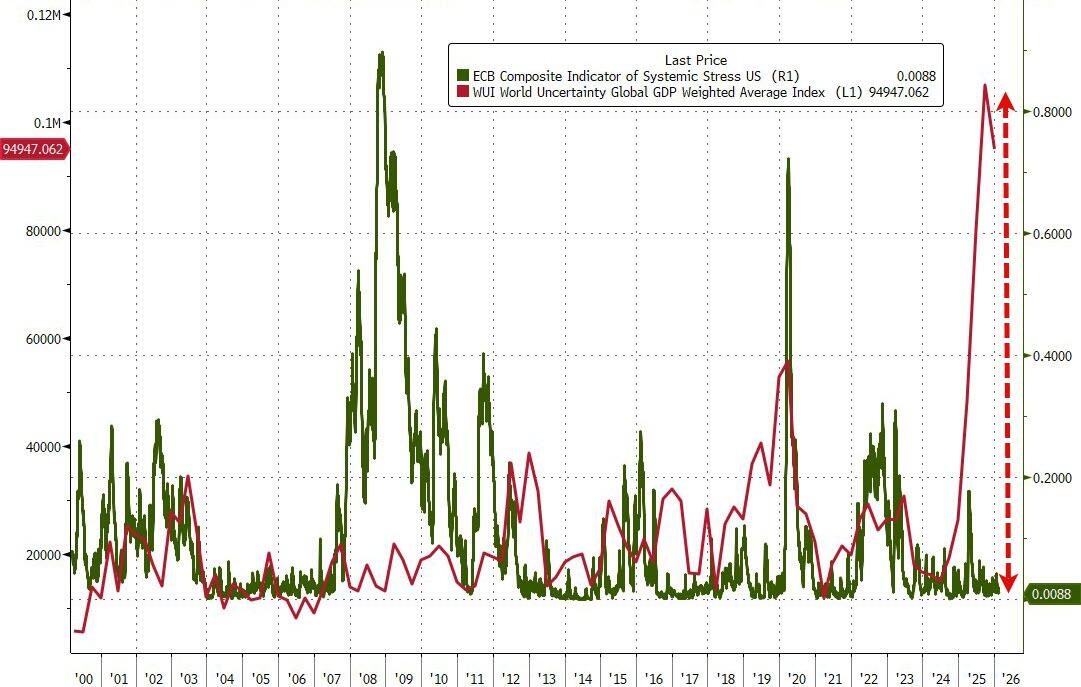
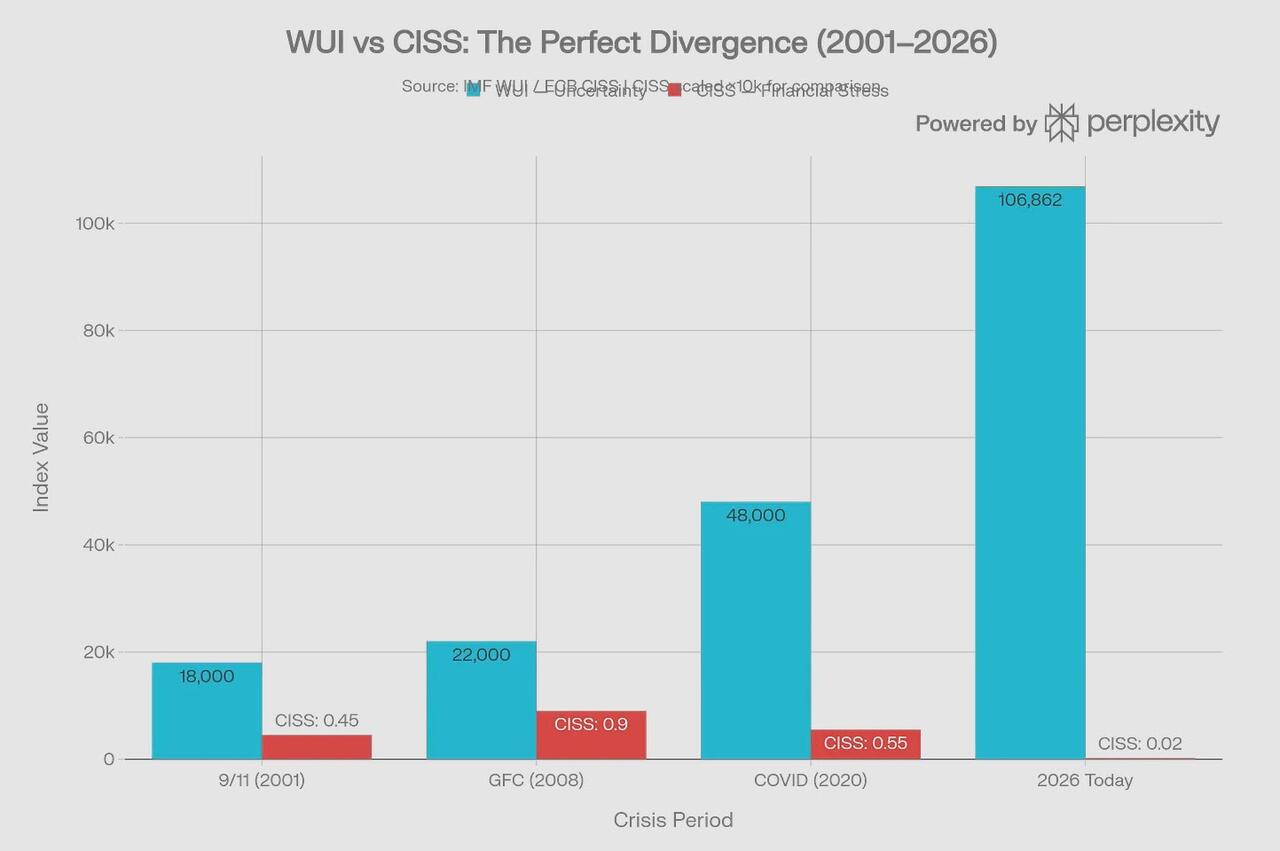
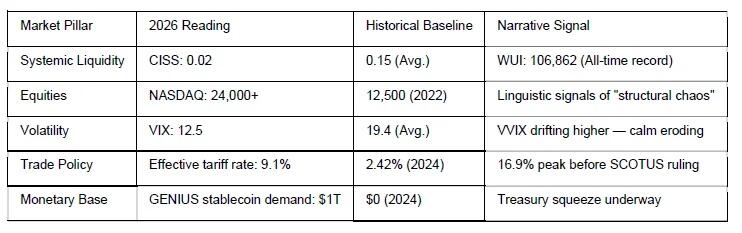
The first number is 0.02. That is the current reading of the Composite Indicator of Systemic Stress — the CISS — a real-time diagnostic developed by the European Central Bank to measure the health of the financial system’s plumbing. It aggregates fifteen individual stress indicators across five market segments: banks, money markets, equities, bonds, and foreign exchange. A reading of 0.02 is about as low as the instrument goes. It says, in effect, that the pipes are flowing with perfect, frictionless liquidity. Nothing in the financial system, according to this gauge, is under stress.
The second number is 106,862. That is the current reading of the World Uncertainty Index — the WUI — which scours Economist Intelligence Unit country reports from 143 nations, counts how often the word “uncertainty” appears, normalizes it, and rescales the result. A reading of 106,862 is not just high. It exceeds the peak readings of COVID-19, the 2008 Global Financial Crisis, and the September 11 attacks — combined. It says that the narrative fabric of the global economy is more frayed than at any point in sixty years of recorded data.
These two numbers describe two incompatible realities sitting on top of each other. And the reason most people have heard of one and not the other is itself the story.
Think of it this way: imagine a gambler in a 2026 sportsbook. The digital board shows the home team — Wall Street — winning by an insurmountable margin. The odds of a soft landing, of diplomatic success, of smooth sailing through the rest of the year are priced at near-certainty. But if the gambler looks out the window, they can see the stadium is on fire. The players are leaving the field. The referees are arguing. The fans are beginning to panic.
In a functional market, that gambler bets on the chaos. In the Mirage, the subliminal messaging of government policy tells the gambler that the scoreboard is the only reality that matters — and that regardless of what is happening on the field, as long as the scoreboard says the team is winning, the payout will come.
That messaging didn’t happen by accident. It was built.
The Architecture of the Mirage
There is a third signal that sophisticated market participants watch but rarely discuss publicly: the VVIX, the “Volatility of Volatility.” While the VIX — Wall Street’s headline fear gauge — sits suppressed at 12.5, a level associated with extreme complacency, the VVIX has begun a quiet, ominous upward drift.
That specific combination — low VIX, rising VVIX — is the mathematical signature of an eroding calm. It says current prices are stable, but the predictability of that stability is breaking down underneath. Sophisticated players are quietly buying insurance on the idea that when the VIX finally moves, it will not be a trend. It will be a vertical jump.
Three instruments. Three stories. One of them makes the headline. Welcome to the new subliminal messaging.
Treasury squeeze underway
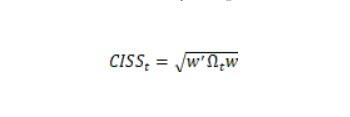
The mathematics behind the CISS formula clarifies why this disconnect is possible. The index only spikes when multiple market segments are stressed simultaneously, expressed as:
Where is the vector of weights across five market segments and is their time-varying correlation matrix. When that correlation matrix is engineered to reflect an absence of co-dependence — when the market segments are operating as isolated silos rather than an interconnected system — the Dam appears impenetrable regardless of what is happening outside it. That engineering is precisely what the legislation of 2025 accomplished.
The Two Laws That Built the Rebar
The 2026 divergence is not a market accident. It is the product of two pieces of legislation, signed in the summer of 2025, that have effectively lobotomized the mechanisms that allow markets to price risk honestly.
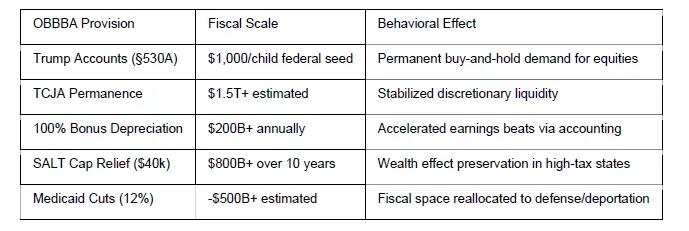
The first is the One Big Beautiful Bill Act, signed into law on July 4, 2025 — a $6 trillion fiscal package functioning as a permanent liquidity floor under both corporate earnings and household risk appetite. Its most behaviorally sophisticated provision is the creation of the “Trump Account” (Internal Revenue Code Section 530A): a tax-advantaged savings vehicle seeded with a $1,000 federal contribution for every American child born between 2025 and 2028, immediately invested in S&P 500 index funds. Parents, employers, and relatives can contribute up to $5,000 annually. The Council of Economic Advisers projects that a $1,000 birth deposit could grow to $500,000 by retirement — or $1 million by age 28 with maximum contributions.
Read that again. The federal government has created a mechanism that locks millions of American families into the permanent maintenance of current index levels — not as investors making a judgment about value, but as structural, generational, policy-mandated buyers of the market. The bid for equities is now baked into the birth certificate.
The OBBBA also made the TCJA tax cuts permanent and reinstated 100% bonus depreciation for qualified production property — allowing corporations to manufacture “earnings beats” through accounting timing rather than genuine productivity growth. While “Liberation Day” tariffs initially averaging 16.9% (reduced to 9.1% after a February 2026 Supreme Court ruling) quietly decimated actual trade volumes with key partners, record corporate buybacks mechanically held earnings per share elevated. To a price-based stress index like the CISS, this looks like resilience. To an honest observer, it is rebar made of debt.
The second pillar is the GENIUS Act — the Guiding and Establishing National Innovation for U.S. Stablecoins Act, enacted July 18, 2025. If the OBBBA is the floor under equities, the GENIUS Act is the wall around the U.S. Treasury market. By requiring all dollar-backed stablecoins to be backed 1:1 with U.S. Treasuries, it converts an entire and growing slice of digital finance into a structural, captive buyer of short-term government paper.
By February 2026, stablecoin supply has stabilized near $300 billion, with Standard Chartered projecting it reaches $2 trillion by 2028 — generating $800 billion to $1 trillion in fresh T-bill demand as issuers accumulate reserve assets. That captive demand artificially suppresses interest rates at the front end of the curve, allowing the Treasury to potentially suspend 30-year bond auctions for up to three years. Simultaneously, the GENIUS Act greenlights a new payments rail dominated by U.S.-listed tech platforms — justifying NASDAQ valuations north of 24,000, even as 30–40% of the global semiconductor supply chain sits fragmented behind tariff walls and export controls.
Together, OBBBA and GENIUS are the Synthetic Rebar of 2026: fiscal policy and regulatory design transformed into volatility suppressants. The calm is not organic. It has been manufactured, at scale, by statute.
History Always Tells You the Ending
The pattern embedded in the 2026 Divergence Matrix is not new. History has run this exact script before — and it has always resolved the same way: not gradually, not gracefully, but through what physicists call a phase transition and what markets call a crash.
In 1929, new technologies — the automobile, the telephone — were proliferating with the same boundless optimism that now surrounds AI and stablecoins. Brokerage houses allowed ordinary people to buy stocks on 10% margin, creating a Liquidation Machine with a hair trigger. Financial stress, by every price-based measure, was negligible. The Fed had been publicly warning about speculative excess since 1928. Trade tensions simmered. The WUI equivalent of the day, had it existed, would have been screaming. When the first serious break hit on Black Tuesday, October 29, 1929, 16 million shares traded and $30 billion in market value evaporated in sessions the ticker machines couldn’t keep pace with. The scoreboard and the field re-coupled in days.
In 1973, markets rested on the belief that U.S. oil spare capacity — managed by the Texas Railroad Commission since the 1930s — would cap any global energy shock. Price-based stress was low. Equities were priced for perfection. In reality, the buffer had been exhausted in March 1971, when the Commission permitted 100% production capacity for the first time, with the chairman lamenting that the “old warrior” of Texas oil could no longer rise. When OAPEC imposed its embargo, the market realized the cushion was zero. Oil prices quadrupled. The S&P 500 entered a 45% collapse. The Mirage of energy independence shattered into stagflation.
In 2007, the VIX hovered in the low teens. The CISS sat near 0.05. Regulators used the word “contained” to describe subprime mortgage turmoil — the single most consequential wrong word in modern financial history. A retrospective text analysis of that era would have shown an explosive surge in mentions of “counterparty risk,” “insolvency,” and “bank runs” — the linguistic early-warning system that price-based models were structurally blind to. When the dam broke in 2008, stress did not trend higher. It jumped — interbank lending froze entirely, Libor-OIS spreads blew out, and institutions simply stopped trusting one another.
Each episode followed the same script: long divergence between low measured stress and high creeping uncertainty, resolved in a short, violent re-coupling. Nothing about 2026 suggests a different ending.
The Household Version of the Same Story
The CISS/WUI split does not live only on trading floors. It lives at the kitchen table.
The macro-level Mirage has a household-level echo: the affordability disconnect. The same machinery that manufactures a story of stability out of price-based indexes manufactures a story of “doing fine” out of aggregates like GDP and headline unemployment — even as the lived balance sheet says the opposite.
While official inflation gauges may show cooling price pressures, the entry ticket to stability — a starter home, a decent lease in a safe zip code — remains at record highs. A whole cohort has become trapped renters: they earn enough to qualify for a lease, but every rent check resets the clock on ever accumulating a down payment. Home and auto insurance premiums, medical coverage, co-pays, and deductibles function as stealth taxes — they rarely move in lockstep with headline CPI baskets, but they climb relentlessly in the background, consuming the line that used to be called “savings.” High-end electronics may deflate in price, lending cover to “inflation is under control” narratives, but groceries, utilities, and fuel remain structurally elevated — turning daily life into a slow bleed, a financial death by a thousand cuts.
Perhaps most telling is the emergence of what can only be called the “New Poor” with high incomes: households earning two or three times the median income who still feel precarious, because the cost of maintaining a basic middle-class baseline — housing, healthcare, childcare, any path toward education — has outpaced even high-tier wage growth. On paper, comfortable. One medical event from the edge.
This is the Statistical Gaslighting Effect in action. Curated aggregates — GDP, unemployment, top-line CPI — function as a macro-shroud. When the official data says “expansion” but the kitchen-table budget says “contraction,” it creates a Knightian Gap in trust: citizens no longer believe the map reflects the terrain. Uncertainty is no longer just about the future economy. It is about whether the scoreboard is honest.
The OBBBA and GENIUS Act, which have locked fiscal and monetary interventions into protecting asset prices, have also built an affordability wall. Those who already own assets are subsidized. Those on the outside face permanently raised entry prices. A household can be technically solvent — income exceeds expenses, bills paid on time — and still be psychologically insolvent, because the margin of safety has been consumed entirely by the rising cost of survival. It is the personal-finance version of a market with CISS at 0.02 and WUI at 106,862: a story of calm floating on top of a reality of constant, grinding stress.
When the Official Story and the Kitchen Table Story diverge far enough, the system begins to lose the consent of the governed around economic policy. People stop debating the model and start rejecting the legitimacy of the scoreboard. The household-level divergence becomes a precursor to political volatility — and political volatility, as history shows, has a way of finding the structural fault lines in the financial architecture above it.
The Knightian Gap, at that point, is no longer a number on a Bloomberg terminal. It is the distance between the Truth of the Spreadsheet and the Truth of the ATM.
The Geneva Trigger
The economist Frank Knight, writing in 1921, drew a distinction that has never mattered more than it does today. Risk, Knight argued, is a situation where the probability of future outcomes can be estimated from historical data. Uncertainty — what is now called Knightian Uncertainty — is categorically different: a state where there is no scientific basis whatsoever to form a calculable probability.
The 2026 Mirage is not a crisis of high risk. It is a crisis of model failure. Standard financial models — Value-at-Risk, the CISS itself — are built on the assumption that the future will resemble the past, or at minimum that the distribution of outcomes is knowable. The Synthetic Rebar of 2026 has introduced a set of Unknown Unknowns those models were never designed to process. How does one model the probability of a Strait of Hormuz closure against the backdrop of a $6 trillion liquidity floor? What happens when the mandated S&P 500 investments inside Trump Accounts collide with an 8% inflation spike? There is no formula for that interaction — because the interaction itself has no historical precedent.
This problem is compounded by the fact that AI-driven agents now account for more than 70% of global trading volume, turning the market into a Black Box that absorbs uncertainty while simultaneously multiplying it. The Mirage is no longer only a human psychological condition. It is a feature of the algorithms themselves.
As of today, February 24, 2026, the Mirage is focused on a single near-term pressure point: the U.S.-Iran nuclear talks in Geneva, scheduled for February 26. Markets are priced for a muddle-through — no war, no blockade of the Strait of Hormuz, no escalation that forces hard policy choices on OBBBA or GENIUS. Senior U.S. officials have warned this may be the final diplomatic window before potential military action against Iranian nuclear sites. The United States has assembled its greatest military firepower in decades across the Middle East.
The Knightian threat lives one layer below what the market is pricing:
A failed Geneva outcome pushes oil toward $150 to $200 per barrel — roughly 20% of the world’s oil supply flows through the Strait of Hormuz — driving U.S. headline inflation toward the high single digits. The OBBBA’s “Trump Accounts” and debt-fueled buybacks stop feeling like free money when real wages are being crushed by energy costs. The projected $303,800 balance for a child born in 2026 becomes a nominal mirage if the purchasing power of that dollar has been halved.
Simultaneously, if global markets begin to doubt the stability of the U.S. dollar — facing fiscal dominance and inflation together — the structural bid for Treasuries from stablecoin issuers could reverse. A run on a major stablecoin, echoing the 2022 TerraUSD collapse, could force the liquidation of hundreds of billions in T-bills at the exact moment the Treasury needs to issue more debt to fund OBBBA obligations.
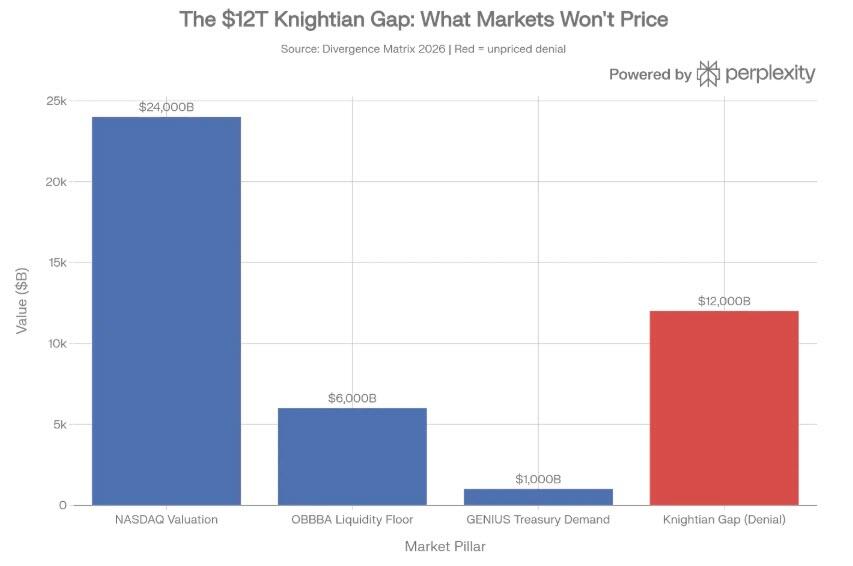
At that point, the correlation matrix snaps to 1.0. The CISS does not creep from 0.02 to 0.10 to 0.30. It jumps — from 0.02 to 0.90 — as vol-sellers become forced buyers of protection and cross-market contagion, the very thing the OBBBA was designed to conceal, lights up every board simultaneously. The $12 trillion gap between where uncertainty-based indicators say we are and where asset prices trade is not amortized over a decade. It is closed in a single week of trading.
The $12 Trillion Knightian Gap: the unpriced vacuum of denial sitting between manufactured market calm and real-world uncertainty. When the Synthetic Rebar snaps, this gap doesn’t close gradually — it closes in a single week of trading.
The Signal of the Century
The 106,862 WUI reading is the most important number in the world today.
It is, in context, the signal of the century — evidence that the narrative fabric binding 143 economies together is more frayed than at any point in sixty years of data collection. That this signal coexists with a near-zero CISS and a tranquil VIX tells us nothing about the genuine strength of the system, and everything about the success of our policy-driven delusions.
We have constructed a financial architecture of Synthetic Rebar — the OBBBA’s $6 trillion liquidity floor and the GENIUS Act’s weaponized stablecoin demand — that has stripped the market of its ability to price risk honestly. We have deployed the same editorial operating system that governs the weather desk and the sports breakdown: find the number that sounds most reassuring, lead with it, and let the audience fill in the rest. The CISS reading of 0.02 makes the front page. The WUI reading of 106,862 does not. The earnings beat is the headline. The hollowed-out trade volume is paragraph seven.
The system has not gotten better at understanding risk. It has gotten better at deferring it — via legislative engineering, regulatory design, and the relentless curation of which data point gets promoted to “the story.”
When the dam finally fails to hold back the ocean, history shows the resolution is not gradual. It is a phase transition — violent, rapid, and absolute. Whether the trigger is Geneva, a stablecoin run, a collapse in the semiconductor supply chain, or the structural failure of OBBBA and GENIUS themselves, the result will be the same: the Mirage shatters, the $12 trillion gap closes, and the Matrix is forced to see the world the way the uncertainty indices — and the household ATM — have been describing it all along.
We are standing in the gap.
The only real unknown is which specific failure will finally snap the rebar.
Tyler Durden
Wed, 02/25/2026 – 17:10

IURC launches affordability inquiry into utilities including NIPSCO
After months of resident complaints and legislative action, the Indiana Utility Regulatory Commission announced on Wednesday that it’s conducting an investigative inquiry into the state’s energy affordability.
Northern Indiana Public Service Company, LLC — or NIPSCO — will be one of the five utilities included in that inquiry, which is scheduled for March 24 in Indianapolis. The other utilities included are AES Indiana, CenterPoint Energy, Duke Energy and Indiana Michigan Power Company, according to an IURC news release.
Northern Indiana Public Service Company displays different metering technologies during a community customer care center event at the Porter County Expo Center in Valparaiso on Tuesday, Feb. 24, 2026. (Michael Gard/for the Post-Tribune)
“Indiana, like every state, is facing a real challenge when it comes to energy affordability,” IURC Chairman Andy Zay said in a news release. “Costs are increasing across the board, and rising utility bills are placing added pressure on budgets that, for many, are already strained. We’ve heard the concerns about the burden utility bills have on families and businesses across the state, and we are committed to evaluating short- and long-term solutions related to affordability.”
Zay was appointed to the IURC post in December by Gov. Mike Braun. He resigned his position as a Republican State Senator for Huntington on Jan. 8.
As part of the investigative inquiry, the five utilities will present on various topics, including how usage and rates lead to bills, the impact of growth on affordability, and short term steps that can increase bill transparency and rising energy costs, according to the IURC. The inquiry will be from 8:45 a.m. to 3 p.m. at the PNC Center in Indianapolis, and it will be streamed on the IURC’s website.
A NIPSCO spokesperson responded to the inquiry in a Wednesday statement, saying that the utility is committed to cooperating with the commission. The utility also does not set or raise utility prices on its own, the statement said, and the company files rates with the IURC.
Protesters gather in front of the NIPSCO Hammond District Office to voice displeasure with rising utility rates Sunday, Feb. 1. (Kyle Telechan/for the Post-Tribune)
Rates go through a “transparent regulatory process,” the statement said, including with the Office of the Utility Consumer Counselor and external community groups to protect customers. NIPSCO’s latest rate cases have been resolved through settlement agreements with all or almost all stakeholders, and they’ve been approved by the IURC.
In June, NIPSCO also received Indiana Utility Regulatory Commission to increase electric rates by 16.75%, according to the utility’s website, and residential customers could expect an increase of about $23 per month. The rate changes began in July, and the utility company previously said that rate changes would be phased in “to help ease the impact.”
State Rep. Ed Soliday, R-Valparaiso, is chair of the House Utilities, Energy and Telecommunications Committee. Soliday, along with other representatives, requested an investigation into electric rates, he said.
“Let me make something very clear, the legislature does not set rates, and you don’t want us to,” Soliday said. “The IURC is a court of law. When you don’t like what they decide, you appeal to the state appellate court. … With all the noise out there, specifically with the mayor of Portage, why don’t you file your complaint with the appellate court?”
Last summer, Soliday sent a text to Portage Mayor Austin Bonta threatening to block any request from Portage for state funding because of Bonta’s support for a Portage City Council resolution against NIPSCO’s electrical rate increase.
“I promise I will work hard to make certain your city never gets any revenue increases!!!” Soliday text concluded.
Since complaints weren’t filed with the court, Soliday and other representatives sent a formal letter to the IURC requesting an investigation of NIPSCO rates. The investment interview that the IURC scheduled is not what he requested, Soliday said.
“They will, and they have promised me … that this is just the first step,” he added. “They will proceed with a formal investigation. A formal investigation, they’re saying, could take 60 days to six months.”
Soliday claims that Indiana’s rates are the lowest in the Great Lakes region, and every state is struggling with high energy rates, he said.
According to the U.S. Energy Information Administration, in December 2025, Indiana had the lowest price of electricity compared with other east north central states, including Illinois, Michigan, Ohio and Wisconsin.
The Citizens Action Coalition has found that electric utility bills have increased more than $28 per month statewide, or 17.5%, according to a July report from the organization. NIPSCO residential customers were hit hardest, with about a $50 per month, or 26.7% increase, in one year.
“What we’re asking (the IURC) is to look at the facts,” Soliday said. “If you find something that is wrong, fix it. But let’s stop with all the emotional outbursts. … What’s particularly frustrating is that we have extremely cold months, and you pay for what you use, but we’re having them compare it with November bills and say it’s a rate increase. It isn’t — it’s a use increase.”
This legislative session, Republicans and Democrats have both said electricity affordability was one of their focuses, and both the House and Senate passed House Bill 1002 to tackle that issue.
State Rep. Alaina Shonkwiler, R-Noblesville, authored House Bill 1002, which would allow residential ratepayers to be placed on budget billing plans on July 1, and utilities will be prohibited from disconnecting low-income customers’ services during periods with extreme heat warnings. The legislation also ties utility profits to performance metrics, including affordability and service restoration, and utilities will use a three-year rate plan.
State Rep. Alex Burton, D-Evansville, who is a member of the House Utilities, Energy and Telecommunications Committee, called the inquiry a culmination of months of concerns raised about high energy bills.
“Rising energy costs are putting real pressure on families, which in turn is driving action in the legislature and at the IURC,” Burton said in a Wednesday statement. “This is one of the several efforts with bipartisan support, and it is encouraging to see what alignment focused on addressing energy costs. … There is more work ahead, but meaningful steps are underway to address Hoosiers’ concerns about rising energy costs.”
On Tuesday, state Rep. Randy Novak, D-Michigan City, said in a statement that he joined a group of state legislators that asked for a review of NIPSCO’s residential utility rates.
“Families across our communities have been sounding the alarm on their utility bills for some time,” Novak said. “When monthly costs spike like this, it demands a serious, independent review. … Hoosiers deserve to understand exactly what they are paying for and to trust the system is working fairly.”
In Northwest Indiana, residents have protested rising NIPSCO rates at both the utility’s Hammond office and Merrilllville headquarters.
Bonta said in a Wednesday text message that the investigative inquiry is a “major change in direction,” and it’s because Indiana residents have called out “dramatic and confounding” rises in electric and gas rates.
“This scheduled inquiry in itself is not a guarantee that the IURC will ultimately fix the current crisis in Indiana, but it does show that when enough people call for a reform, they are being heard,” Bonta said in his text to the Post-Tribune. “It’s now important that Hoosiers continue to raise this issue. Keep writing to the IURC about what you are experiencing and urge them to investigate and fix this statewide problem.”
Bonta is preparing a resolution to present to the Portage council in March to be sent to the IURC before the scheduled inquiry. He hopes they will vote for it, and the city’s voice will be added to the calls to fix the issue.
“Thank you again to all the Hoosiers across our state who have kept this cause up,” Bonta said. “This moment is just the beginning, but it’s a beginning that you have created. Keep being the ‘public noise boxes’ Indiana needs.”
Kerwin Olson, executive director of the Citizens Action Coalition, said in a Wednesday statement that the IURC’s decision is unprecedented. The organization supports the action, but Olson believes the IURC is “moving into new territory, behaving more like elected officials than appointees.”
“It is a shame that it had to get to this point before they took action. It is long overdue,” Olson said. “CAC has been sounding the alarm for years, issuing multiple requests for a utility affordability task force. Ratepayers from Evansville to Gary have been organizing over outrageously high bills. Finally, someone is listening. The State of Indiana has been placing monopoly profits over the financial well-being of consumers for far too long. It’s time to balance the scales and bring fairness to the regulatory process. Hoosier ratepayers deserve nothing less.”
After the investigative inquiry, the IURC will determine appropriate next steps, according to the news release. Any formal action taken by the IURC will be taken at one of the commission’s weekly meetings.
“As utility regulators, we are required to review all the evidence and balance factors like reliability and affordability when making decisions, but careful attention must be paid to the impact these increases can have when combined with inflation, fuel costs, and other forces outside of a utility’s control,” Zay said in a statement. “Our focus with this investigative inquiry is to examine some of those cost drivers and identify meaningful steps that can be taken to address issues like bill transparency and affordability without sacrificing reliability.”

Phil Collins, Lauryn Hill, INXS, Iron Maiden, Luther Vandross and Shakira get Rock Hall nominations
NEW YORK — Phil Collins, Mariah Carey, Lauryn Hill, INXS, Iron Maiden, Luther Vandross and Shakira are some the 2026 nominees for induction into the Rock & Roll Hall of Fame, a wide net that includes rap, metal, R&B, hip-hop, Britpop, blues rock and pop.
The hall revealed the list of 17 performer nominees Wednesday, a list that also includes Melissa Etheridge, Jeff Buckley, Pink, New Edition, Sade and the Wu-Tang Clan.
Billy Idol, Joy Division/New Order return to the nominations after missing induction last year. The list this time also repeats two sets of musical brothers who have had public feuds and recent reunions — The Black Crowes and Oasis.
Collins, who already is in the Hall as a member of Genesis and had such solo hits as “In the Air Tonight” and “One More Night,” has earned eight Grammys, including album of the year in 1985 for “No Jacket Required.” Hill’s “The Miseducation of Lauryn Hill” made history as the first hip-hop album to win the Grammy for album of the year in 1999.
Carey, nominated in 2024 and 2025, has had 19 No. 1 hits on the Billboard Hot 100, while soul-jazz vocalist Sade, also nominated in 2024, had such soft rock hits as “Smooth Operator” and “The Sweetest Taboo.” The Wu-Tang Clan have been hailed as rap innovators since their game-changing 1993 debut album “Enter the Wu-Tang.”
INXS ruled the late 1980s charts with hits like “Need You Tonight,” “Devil Inside” and “New Sensation.” Two-time Grammy winner Etheridge is best known for her songs “Come to My Window” and “I’m the Only One.” Iron Maiden helped power the new wave of British heavy metal with iconic albums like “The Number of the Beast.”
New Edition had the hits “Cool It Now” and “Candy Girl,” while Shakira has been lauded for her ability to bridge Latin music with rock and pop. Pink has had four No. 1 songs and three No. 1 albums, including “The Truth About Love.”
Ten of the 17 nominees are on the ballot for the first time: Buckley, Collins, Etheridge, Hill, INXS, New Edition, Pink, Shakira, Vandross and Wu-Tang Clan.
Vandross, who sold more than 25 million albums and had the hits “Here and Now” and “Any Love,” died in 2005. Buckley, whose 1994 debut album “Grace” is widely acclaimed, died in 1997.
“This diverse list of talented nominees recognizes the ever-evolving faces and sounds of Rock & Roll and its continued impact on youth culture,” John Sykes, chairman of the Rock & Roll Hall of Fame Foundation, said in a statement.
The 2026 inductees will be revealed in April, along with inductees entering the hall under three special committee categories: Musical influence, musical excellence and the Ahmet Ertegun Non-Performer Award.
Artists must have released their first commercial recording at least 25 years before they’re eligible for induction. Nominees will be voted on by more than 1,200 artists, historians and music industry professionals.
Last year, Cyndi Lauper, Outkast, Bad Company, Chubby Checker, Soundgarden, Joe Cocker, Salt-N-Pepa, The White Stripes, Carol Kaye, Nicky Hopkins, Lenny Waronker, Thom Bell and Warren Zevon all were inducted.
https://www.chicagotribune.com/2026/02/25/rock-hall-of-fame-nominations/

‘Instant offense’: Chicago White Sox looking for best ways to utilize IF Lenyn Sosa after 22-home run season
GLENDALE, Ariz. — Lenyn Sosa led the Chicago White Sox with 22 home runs in 2025 while mostly playing second and first base.
As this year’s infield comes into shape, how the Sox will utilize Sosa remains to be seen.
“My goal, my mindset every year, is to get better,” Sosa said through an interpreter last week at Camelback Ranch. “To improve my game all around, trying to find ways to help this team win games. And that’s my focus.
“I don’t really pay attention to what my role is. It’s just trying to get better every day and do the best for me every day.”
Sosa appeared in 99 games last season at second base, making 85 starts. He played 42 games at first base, starting 35 games at the position. He also saw time at designated hitter (11 games, 10 starts) and third base (three games, two starts).
But Wednesday’s Cactus League game lineup against the Cincinnati Reds featured what could be the starting infield. Offseason addition Munetaka Murakami is expected to spend most of his time at first base, with Miguel Vargas at third base. Up the middle, the Sox have a double-play combination of Colson Montgomery at shortstop and Chase Meidroth at second.
Chicago White Sox’s Lenyn Sosa hits during the fourth inning against the Milwaukee Brewers in a Cactus League game at Camelback Ranch on Sunday, Feb. 22, 2026, in Glendale, Ariz. (Armando L. Sanchez/Chicago Tribune)
Additionally, designated hitter options include Andrew Benintendi when he’s not in left field, and either Kyle Teel or Edgar Quero when the other is catching.
Manager Will Venable said it’s going to be “huge” for the Sox to find ways to keep Sosa’s bat in the lineup.
“He was one of our best hitters last year, somebody that you kind of think of him as instant offense,” Venable said before Wednesday’s game. “He can do a lot of things at the plate and help you win ballgames in different ways. So, he’s going to be a guy that we’ve got to find at-bats for.”
Sosa started at third base in Tuesday’s 12-10 victory against the Seattle Mariners in Peoria, Ariz.
“It’s good, I felt very good yesterday at third base,” Sosa told the Tribune through an interpreter on Wednesday morning. “It’s a position I’m used to. It’s just a matter of getting the reps and more game action to really feel 100 percent there, too.”
Over parts of four big-league seasons, Sosa has 54 starts at third base. Second base is the only position where he’s made more starts in the majors (172).
“(He’s) another guy where we will try to find how it all fits together and see what it looks like,” Venable said. “He didn’t touch third base a ton last year, but has in the past. So, we want to make sure he’s able to do that as well as second and first, too.”
Sosa set career highs in numerous offensive categories last season. In addition to leading the Sox in home runs, he also had the most hits (137) and RBIs (75) on the club.
Related Articles
Column: New bidets might help the Chicago White Sox flush away the past
Photos: Chicago White Sox on photo day at spring training
Column: The selling of Munetaka Murakami and other observations from Chicago White Sox camp
Chicago White Sox rotation is far from set — and versatile Mike Vasil is eyeing the opportunity
Cactus League report: Springfield native makes White Sox impression — and Moisés Ballesteros lands at Cubs camp
“I truly enjoyed the results because the process wasn’t easy,” Sosa said last week. “You go through ups and downs, but you have to stay true to yourself and I was able to do that. I enjoyed every part, just knowing the hard work, the dedication and your routine is going to get you to the point where you want to be and I was able to prove that.”
Sosa is focused on making defensive strides. His 10 errors at second base last season ranked tied for second in the American League. That was an area of concentration in winter ball.
“The focus was on my defense, I worked on my defense to improve my range,” Sosa said of the winter league experience in his native Venezuela, where he played first, second and third base. “I worked a lot on my first step (defensively) being faster. And in order to do that, I do different drills to be more agile. It helped me.”
That work has continued this spring.
“Offensively, (I’m working on) just getting my timing and obviously getting comfortable with it,” Sosa told the Tribune on Wednesday. “Defensively, just being ready to play third, second and first, because those are the positions I’m going to be playing at. Just getting those reps and feeling comfortable at those positions.”
Sosa wants to be more consistent in his overall game and make improvements.
“There’s room for that, I know I can do it,” he said on Wednesday. “And also improve my defense just to become that complete player that I know I can be and that I want to be.”
https://www.chicagotribune.com/2026/02/25/chicago-white-sox-lenyn-sosa-role/

Naperville Police Arrests for Feb. 19-21
The following items were taken from Naperville police reports and press releases. An arrest does not constitute a finding of guilt:
A 29-year-old woman from Oswego was arrested on charges of failure to report an accident to police, driving under the influence of alcohol and transportation or possession of open alcohol by a driver at 1:50 a.m. Feb. 19 at North Route 59 and McDowell Road.
A 48-year-old woman from Oswego was arrested on charges of assault and disorderly conduct/breach of peace at 8:35 a.m. Feb. 19 in the 1700 block of Windward Avenue.
A 28-year-old man from Downers Grove was arrested on charges of driving on a suspended license, driving without insurance, driving with a canceled, suspended or revoked registration and transportation or possession of open alcohol by a driver at 10:58 a.m. Feb. 19 at South Washington Street and Edgewater Drive.
A 30-year-old man from Naperville was arrested on a charge of public indecency at 9:22 p.m. Feb. 19 in the 100 block of Water Street.
A 43-year-old man from Oswego was arrested on charges of failure to signal when required, speeding and driving under the influence of alcohol at 1:55 a.m. Feb. 20 at Audrey Avenue and Fort Hill Drive.
A 49-year-old man from Westmont was arrested on a warrant and on a charge of obstructing an officer at 2:17 a.m. Feb. 20 at Audrey Avenue and Fort Hill Drive.
A 31-year-old man from Elgin was arrested on charges of driving under the influence of alcohol, transportation or possession of open alcohol by a driver and possession of cannabis paraphernalia at 9:50 p.m. Feb. 20 in the 2700 block of West 75th Street.
A 51-year-old man from Elgin was arrested on a charge of resisting an officer at 11:28 p.m. Feb. 20 in the 1500 block of North Route 59.
A 32-year-old man from Moline was arrested on charges of aggravated unlawful use of a weapon, unlawful possession of cannabis by a driver, transportation or possession of open alcohol by a driver and not having a license plate at 10:45 p.m. Feb. 21 at McDowell Road and North Route 59.
https://www.chicagotribune.com/2026/02/25/naperville-police-arrests-blotter-february-7/
Nvidia Smashes Estimates With Record Revenue And Blowout Guidance; Stock Jumps
Nvidia Smashes Estimates With Record Revenue And Blowout Guidance; Stock Jumps
Heading into NVDA’s earnings, we said that all else equal, the bare minimum for the stock – which has underperformed peers rather dramatically in recent months – to outperform, was to (solidly) beat expectations of another 2+2 quarter, i.e., beat the guide by $2BN and beat Street expectations for the April quarter guide by $2BN.
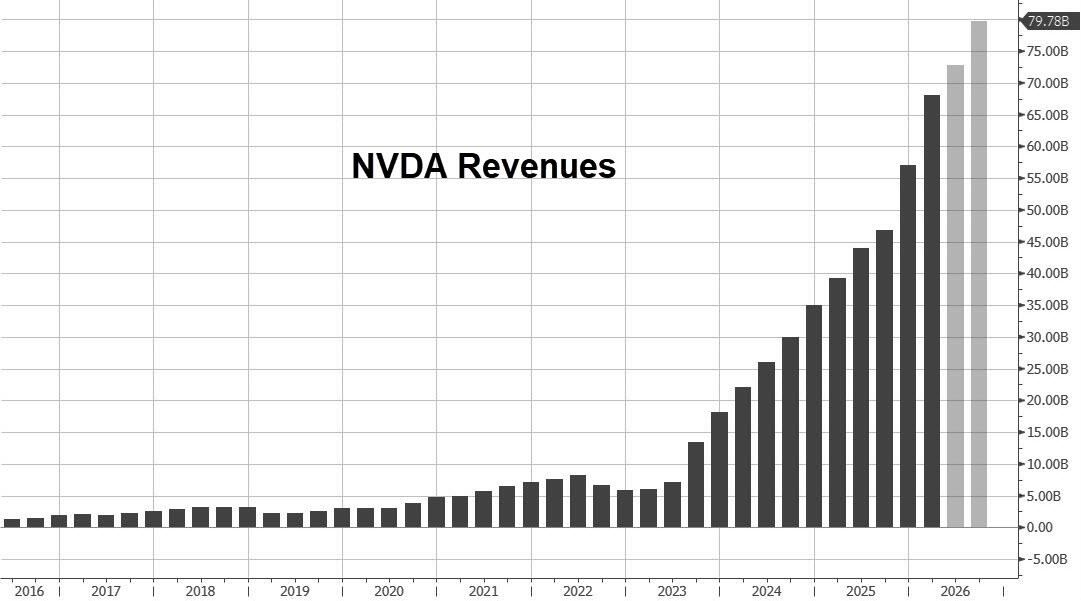
What they got was a blowout 2.2+5: Q4 revenues beating by $2.2BN and guidance beating the midpoint by about $5BN
Here are the details from the just completed Q4:
Adjusted EPS $1.62, beating estimate $1.53
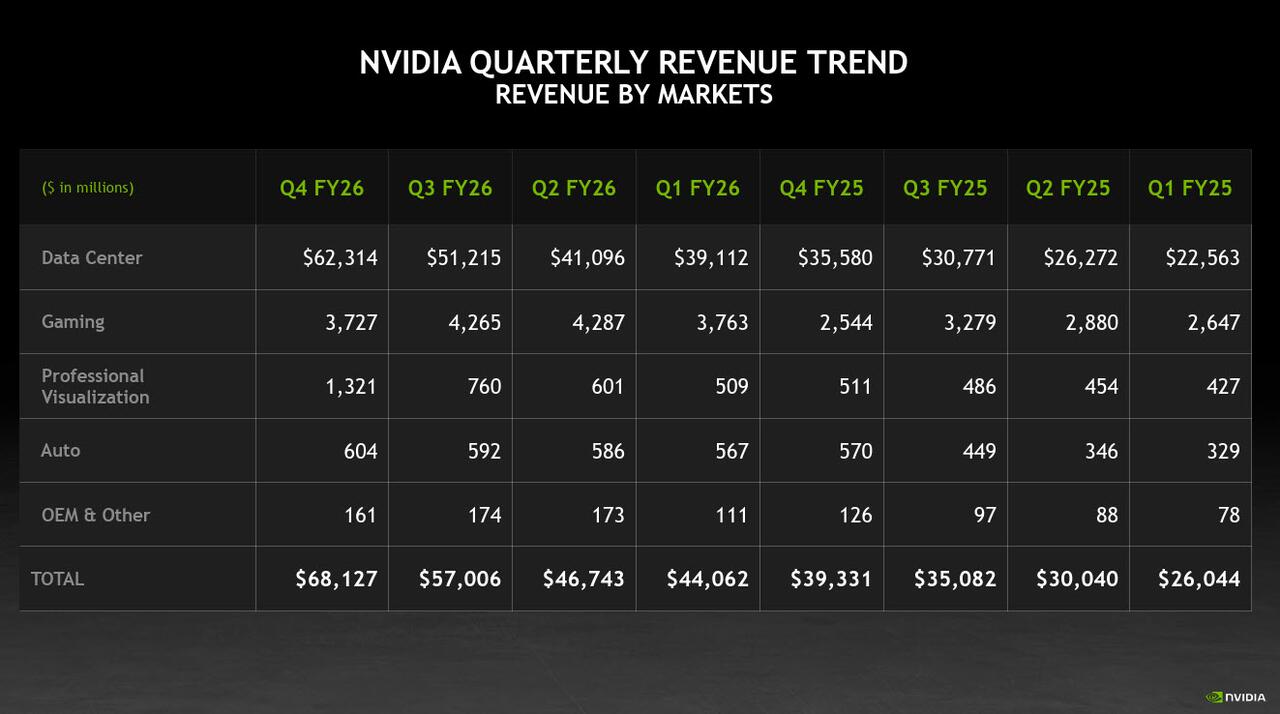
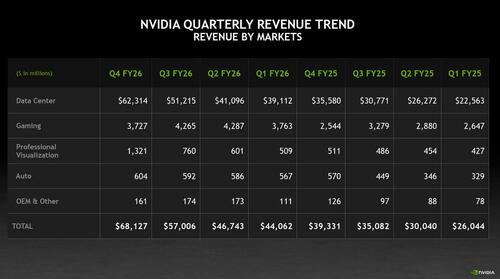
Record revenue $68.13 billion, +73% y/y, blowing away estimates of $65.91 billion by $2.2BN
Data center revenue $62.31 billion, +75% y/y, smashing estimate $60.36 billion
Compute revenue $51.33 billion, +58% y/y, missing estimate $51.61 billion
Networking revenue $10.98 billion vs. $3.02 billion y/y, beating estimate $9.02 billion
Gaming revenue $3.73 billion, +49% y/y, missing estimate $4.01 billion
Professional Visualization revenue $1.3 billion vs. $511 million y/y, beating estimate $770.7 million
Automotive revenue $604 million, +6% y/y, missing estimate $643.2 million
OEM & other revenue $161 million, +28% y/y, missing estimate $179.4 million
According to the company, Data Center revenue was driven by accelerated computing and AI:
Overall revenue has been a relentless juggernaut.
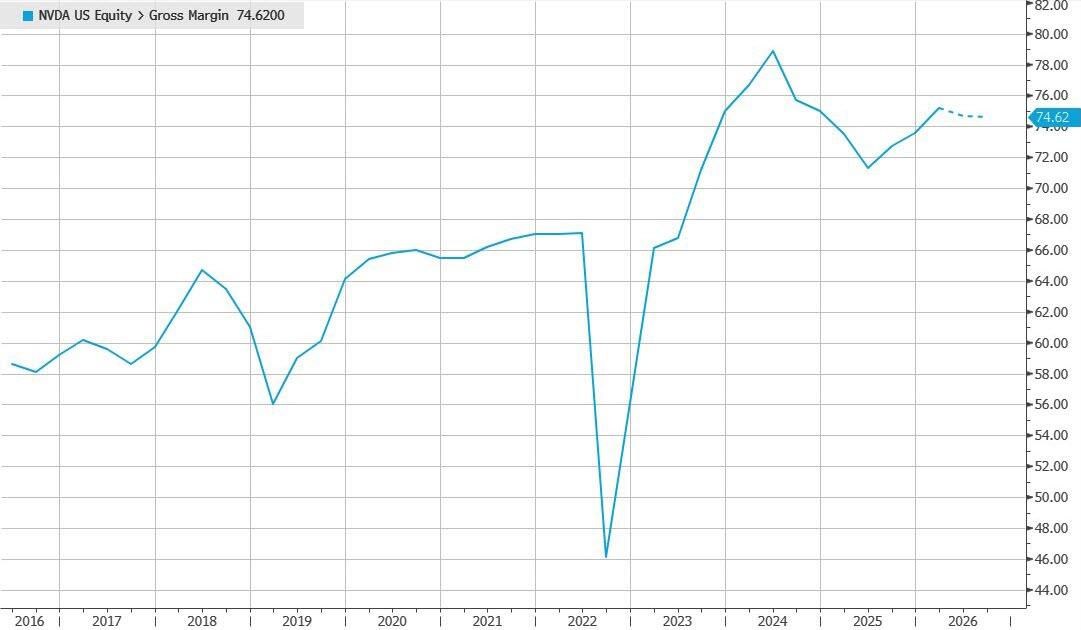
Adjusted gross margin 75.2%, above the 75.0% bogey and beating estimates of 74.7%
Adjusted operating expenses $5.10 billion, +51% y/y, below estimate $4.96 billion
Adjusted operating income $46.11 billion, +81% y/y, above estimate $44.56 billion
R&D expenses $5.51 billion, +48% y/y, above estimate $5.38 billion
And free cash flow was a remarkable $34.90 billion, more than double the $15.52 billion YoY
While historical were great, the guidance was stellar:
Sees revenue $76.44 billion to $79.56 billion, the midpoint of $78BN more than $5BN above the estimate $72.78 billion, and comfortably above the buyside bogey of $74-75BN
Sees adjusted gross margin 74.5% to 75.5%, in line with the 75% buyside bogey and above the sellside consensus estimate 74.7%
Sees adjusted operating expenses about $7.5 billion, estimate $5.33 billion
For the full year fiscal 2027, GAAP and non-GAAP tax rates are expected to be between 17.0% and 19.0%, excluding any discrete items and material changes to NVIDIA’s tax environment.
To go with the guidance, Nvidia said it’s got enough supply on hand to meet demand: “We have strategically secured inventory and capacity to meet demand beyond the next several quarters.”
Notably, NVDA’s guidance does not assume any China data center compute revenue.
If there were any lingering concerns that Nvidia is investing too much money in others in an attempt to boost the overall market for AI, the company is quashing these: cash and equivalents was $62.6 billion at the end of the quarter – up nearly $20 billion for the same point a year earlier.
Here are some of the comments from Jensen Huang:
Computing Demand Is Growing Exponentially
Customers Are Racing to Invest in AI Compute
Enterprise Adoption of Agents Is Skyrocketing”
Grace Blackwell With Nvlink Is the King of Inference
“Enterprise adoption of agents is skyrocketing,” is Jensen’s way of trying to assert that it’s not just hyperscalers buying Nvidia’s products, the use of AI is spreading into corporations. If that’s happening at a meaningful scale, there’s no bubble. Yet.
Nvidia said that big cloud companies spent more and made up just over half of data center sales. But most of the growth actually came from other customers. They don’t name them or give specifics but Nvidia is arguing they’re not relying as heavily on just the big players.
And some additional details from the filing:
In February 2026, the USG granted a license that would allow us to ship small amounts of H200 products to specific China-based customers. To date, we have not generated any revenue under the H200 licensing program, and do not yet know whether any imports will be allowed into China. The license requires that the H200s go through an inspection process in the United States prior to any shipment to the customer. As a result, any H200 shipped under the new licensing program will be subject to a 25% tariff upon importation into the United States.
As a reminder, the company does not account for any of these in its guidance.
As Bloomberg summarizes, this was a solid quarter by any measure and shares are responding accordingly. “Fourth-quarter revenue beat by more than $2 billion while the forward guide midpoint lands at $78 billion, way above the $72.78 billion Wall Street was anticipating. So in other words, Nvidia delivered on even some of the highest expectations out there, which should go a long way to reviving confidence in the tech sector.”
According to Bloomberg Intel’s Kunjan Sobhani, “this beat — and more impressively the raised 1Q outlook — point to a stronger ramp-up of its GB300 chip. Networking drove most of data-center upside, suggesting a higher NVLink and Spectrum attach rate. Key to sentiment is upside to the $500 billion pipeline through fiscal 2027, and resuming China shipments — or the lack thereof.”
Emarketer analyst Jacob Bourne was also delighted: “Nvidia once again exceeded expectations and with billions more in capex planned by the hyperscalers this year, demand for Nvidia’s chips remains robust. But the competitive picture is also shifting as companies like Meta diversify toward AMD and the big cloud players invest more in custom silicon. This puts a focus on Nvidia’s guidance for what the future holds in terms of maintaining its dominance as the AI buildout matures and questions around enterprise ROI intensify.”
So, with the earnings call about the begin, most of the big questions have answers, or partial answers.
Results and guidance once again beat estimates… massively.
Demand is good and revenue is pushing the limits of Wall Street expectations.
The company says it has enough supply for several quarters.
Getting access to that supply is not crimping margins.
And China’s still an open question. Yes, they have some licenses from the US but we have no idea whether Beijing will give its companies the go-ahead to import Nvidia chips.
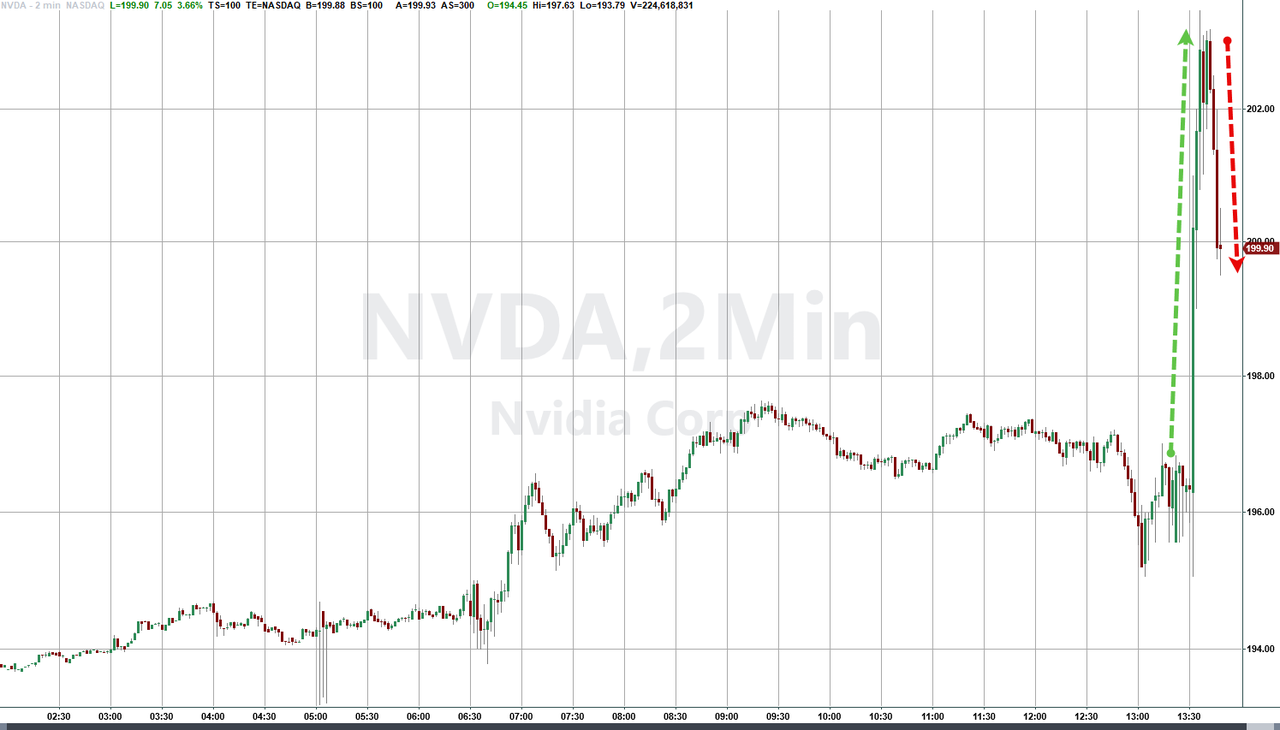
Needless to say, how investors now react to Nvidia’s results will be important for the entire market, given the stock’s nearly 8% weight in the S&P 500. Nvidia shares gained 1.4% in Wednesday’s session to close at the highest level since Nov. 10. Shares have been stuck in a narrow range over the last few months as investor enthusiasm around artificial intelligence has waned. Options were pricing in a 4.4% move ahead of the report, which means we are about to see a lot of options expire worthless. That’s because while the stock jumped about 5%, it has since faded gains a bit. Still, it is trading at the highest level since November.
The question is will that be enough to get the Nasdaq out of its recent funk? For now the signs are good, with Nasdaq futures rising and shares of Broadcom, TSMC and Micron are all higher after hours.
Here is the company’s Q4 investor presentation.
Tyler Durden
Wed, 02/25/2026 – 16:54