Category: News

Connor Bedard ready to play ‘normal hockey’ again as Chicago Blackhawks return to action after Olympic break
NASHVILLE, Tenn. — The Chicago Blackhawks held their morning skate Thursday at Bridgestone Arena before facing the Nashville Predators in their first game in three weeks. Practice is essential, but even coach Jeff Blashill admitted he was looking forward to returning to the swing of things.
“(I’m) definitely ready to get going,” Blashill said. “It’s going to be a sprint here to the end of the season.”
Hawks players agreed with their coach. They want nothing more than for game action to resume and for things to get back to normal after the long Winter Olympics layoff.
“I wouldn’t say (the break) was needed, but I say (it was) a beneficial time to refresh physically and mentally,” center Connor Bedard said. “Practicing is fun but we do this so we can play. That’s what we love to do.
“(We’ve been working on) special teams and a lot of D-zone coverage. Those two have been big.”
It’s been an interesting season for the 20-year-old star. He was putting together a Hart Trophy-caliber start to the campaign and broke Hawks franchise records in the process.
Then it all came to a halt Dec. 12 in St. Louis when he suffered a right shoulder injury in the final second of a loss to the Blues. He missed 12 games, and the Hawks went 5-6-1 in his absence.
That injury could have plagued his chances at an NHL season award and very well may have kept him off the Team Canada roster for the Milan Cortina Olympics. He watched as his home country fell short against the United States in the gold-medal game.
Bedard entered Thursday with 53 points — 23 goals, 30 assists — in 43 games this season, and he has more points — 181 and counting in his third season — before turning 21 than any player in franchise history.
No point in dwelling on the past, though. The Hawks (22-26-9, 53 points) entered Thursday with 25 games left to increase their playoff chances, which sit at 0.9%.
Blackhawks center Connor Bedard takes a shot during against the Sharks on Feb. 2, 2026, at the United Center. (Armando L. Sanchez/Chicago Tribune)
Blashill said Bedard will be taking faceoffs again and going back to a “true center role” — in other words, normal hockey for the Canadian standout.
“It’s nice to play your full position, I’m looking forward to that,” Bedard said. “I think (my shoulder’s) fine, we got smart people so I trust them, (so) you just go out there and play, but I feel good.”
It hasn’t happened frequently, but Bedard spent some time as a wing when he returned from his injury. Centers Ryan Greene, Oliver Moore and others have spent a good chunk of games skating as wingers to Bedard, Frank Nazar and Jason Dickinson.
Bedard also has seen plenty of wingmates this season: Nazar, Greene, André Burakovsky, Tyler Bertuzzi and Ilya Mikheyev, among others.
Bedard prefers his natural position but sees the importance in dabbling elsewhere at times.
“You can flip the lines if you need or whatnot,” Bedard said. “I’m a center, and I feel like I’m a center, so that’s where I want to be.”
Goalie depth
The Hawks signed goaltender Olivier Rodrigue to a one-year, two-way contract through the 2025-26 season. The deal has a $775,000 salary-cap hit.
The move gives the Rockford IceHogs a backup in goal after Stanislav Berezhnoy was hit with a lengthy suspension Tuesday. He was suspended for 20 games for violating the terms of the AHL/PHPA Performance Enhancing Substance Program and won’t be eligible to play until April 11.
Rodrigue, 25, was selected in the second round (No. 62) in the 2018 draft by the Edmonton Oilers. He played 131 games with their AHL affiliate Bakersfield Condors, compiling a 61-52-17 record, 2.92 goals-against-average, .905 save percentage and two shutouts. He started two games for the Oilers in 2024-25.
https://www.chicagotribune.com/2026/02/26/chicago-blackhawks-connor-bedard-olympic-break/

Dorsey’s Block Fires Nearly Half Of The Company In ‘Massive’ AI Bet, Sending Shares Soaring
Dorsey’s Block Fires Nearly Half Of The Company In ‘Massive’ AI Bet, Sending Shares Soaring
One week after WIRED reported that things were pretty dismal over at Jack Dorsey’s payment processing company Block (formerly Square), the company announced that they are cutting 4,000 employees – nearly half of their headcount – in order to invest ‘heavily’ in artificial intelligence tools to run more efficiently, including its own called Goose, Bloomberg reports.
The news sent shares up over 30% in after hours trade.
“We are taking bold and decisive action here, but we’re doing it from a position of strength,” CFO Amrita Ahuja told Bloomberg, adding “We’re doing it in a way that we believe positions us to move even faster for our customers.”
The reduction in force, which was announced in a shareholder letter on Thursday, comes after rolling job eliminations that have often been tied to annual performance reviews.
…
In the shareholder letter, the company highlighted strong financial performance over 2025 including that gross profit growth more than doubled from the first quarter to the fourth quarter. Dorsey, the company’s co-founder, touted how the company has reignited growth of users of its peer-to-peer payments app Cash App, scaled its lending products and accelerated Square gross payment volume. Block reported gross profit of $10.36 billion in 2025, up 17% year-over-year. -Bloomberg
“Intelligence tools have changed what it means to build and run a company,” wrote Dorsey, adding that “we’re already seeing it internally. A significantly smaller team, using the tools we’re building, can do more and do it better.”
As noted, according to a report last week in WIRED, things are bad over at Block…
“Morale is probably the worst I’ve felt in four years,” reads one employee complaint submitted to Dorsey in a recent all-hands meeting (AI workers will notably not be submitting complaints anytime soon). “The overarching culture at Block is crumbling.“
“We don’t yet know if our livelihoods will be affected, and this makes it incredibly hard to make major life choices without knowing if we still have a job next week,” another employee said in a complaint.
Is this the first domino in the AI-driven layoff dystopia that we have been feamongered about, bringing fictional predictions into factual problems, as companies look upon Block’s big gains and stroke their Dorsey-like beards at just how many of the proletariate can be replaced by an agent or two?
Tyler Durden
Thu, 02/26/2026 – 16:40

FedEx devolverá a clientes los reembolsos que reciba por revocación de aranceles de Trump
Por MAE ANDERSON
NUEVA YORK (AP) — La empresa de mensajería FedEx dijo el jueves en un comunicado que devolverá a los remitentes y a los clientes cualquier reembolso arancelario que pudiera recibir y que ellos hayan pagado.
El comunicado se emitió después de que FedEx presentara una demanda ante el Tribunal de Comercio Internacional de Estados Unidos para solicitar un reembolso de lo que pagó por los aranceles establecidos por el presidente Donald Trump en virtud de la Ley de Poderes Económicos de Emergencia Internacional (IEEPA, por sus siglas en inglés). El viernes, la Corte Suprema dictaminó que los aranceles impuestos según la IEEPA son ilegales.
Más de 1.000 empresas han presentado demandas ante el Tribunal de Comercio Internacional de Estados Unidos en un intento por recuperar costos derivados de los aranceles, entre ellas, grandes corporaciones estadounidenses como Costco y Revlon.
“Si se emiten reembolsos a FedEx, emitiremos reembolsos a los remitentes y consumidores que originalmente asumieron esos cargos”, afirmó FedEx el jueves en un comunicado. “Cuándo ocurrirá eso y cuál será el proceso exacto para solicitar y emitir reembolsos dependerá, en parte, de futuras orientaciones del gobierno y del tribunal”.
En el fallo de la Corte Suprema no se abordó la implementación de ningún sistema mediante el cual las empresas y personas que pagaron esos aranceles pudieran recibir reembolsos.
Es probable que establecer un sistema de reembolsos será un proceso largo. El Liberty Justice Center, de tendencia libertaria, indicó el martes que, junto con el abogado coasesor Neal Katyal, presentó mociones coordinadas ante el Tribunal de Apelaciones de Estados Unidos para el Circuito Federal, así como ante el Tribunal de Comercio Internacional de Estados Unidos, para ayudar a poner en marcha un proceso de reembolsos. El gobierno debe presentar una respuesta el viernes.
“Estamos comprometidos con la transparencia y nos comunicaremos con claridad a medida que haya instrucciones adicionales disponibles por parte del gobierno de Estados Unidos y del tribunal”, señaló FedEx en el comunicado.
___
Esta historia fue traducida del inglés por un editor de AP con la ayuda de una herramienta de inteligencia artificial generativa.

The Great Reversal: Trump’s Real Progress In Tackling Legal Immigration
The Great Reversal: Trump’s Real Progress In Tackling Legal Immigration
Via White Papers Policy Institute,
Sixty-plus years of unchecked mass immigration have eroded the fabric of American society to the point where Americans are beginning to wonder if the country can survive. The focus of the media, left and right, when it comes to immigration, has been on the Minneapolis riots over the arrest and detention of illegal aliens.
What goes unnoticed however, is the seismic shift in immigration policy, particularly legal immigration policy, that arrived with the latest Trump administration.
The fantastic truth is that the floodgates that allow more than 1-1.2 million legal immigrants in the United States every year since 1990 are closing. The tide is in fact going out—net emigration of immigrants is becoming the new reality. Under President Trump’s renewed mandate, legal immigration has plummeted. Millions are already departing voluntarily, and millions more who would have come to America have been deterred from doing so. Moreover, projections from within Trump’s administration signal an even sharper decline in legal immigration for 2026 and beyond.
What the executive branch has managed to do, with little help from Congressional leadership, is affect a necessary reset of the legal immigration system that will finally bring an end to the decades of mass immigration that Americans have consistently voted against. While there must be legislation passed by the (as of now) GOP controlled Congress to ensure these immigration changes are enshrined into law, we should take a moment to recognize and celebrate the accomplishments of this administration.
The Sharp Drop in Legal Arrivals
In fiscal year 2025, U.S. Citizenship and Immigration Services (USCIS) processed 2.7 million immigration cases in its third quarter. This marked a 16% plunge from the same point 2024. In other words, fewer people are applying for visas, and the government has taken measures to increase processing times. USCIS and DHS are also simply not approving as many visas. According to a great report by the Niskanen Center, approvals cratered by 21%, while work authorization applications halved in October 2025 compared to the previous year. Consulates issued 20% fewer immigrant visas and 16% fewer nonimmigrant visas in May 2025 compared to 2024, with family-based categories hit hardest. For example, there were 6,128 fewer FX1, FX2, and FX3 visas for immediate relatives requesting to relocate to the United States. International student numbers dropped by 17,457 overall, and overseas visitors fell by over 828,000 in the first 11 months of 2025. This isn’t happenstance. It’s the fruit of aggressive enforcement and bureaucratic action that makes potential immigrants think very seriously about their move to America. Potential fraudsters understand they won’t make the cut under more serious scrutiny.
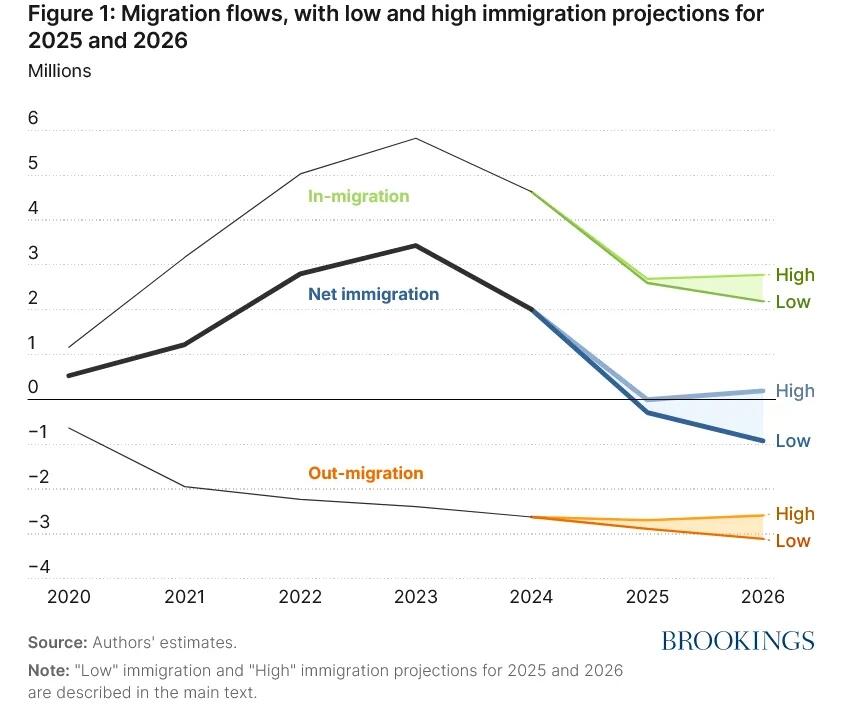
Most importantly, overall net international migration turned negative (net emigration?) in 2025 for the first time in half a century. According to a January 2026 report by Brookings, anywhere between 10,000 and 295,000 more people left the United States than entered the country in fiscal year 2025.
This is a major turnaround from a period when net migration (including legal immigration, 1-1.2 million annually, and illegal immigration together) into the United States has run into the multiple millions since the 1990s. Green cards issued abroad dipped to 560,000-575,000—down more than 100,000 from 670,000 in 2024. Refugee admissions plummeted to 7,600-12,000 from 105,000. And virtually all new refugees are Afrikaners and other White South Africans fleeing the persecution of their post-apartheid ‘rainbow’ government.
The immigrant population shrank from 53.3 million in January 2025 to 51.9 million by June. This is a 2.6% drop, the first decline since the 1960s.
Overall population growth slowed to 0.5%, adding just 1.8 million to the overall American population which sits somewhere between 345 and 355 million. Every state except two experienced reduced growth rates. These declines stem from the administration’s unyielding stance: travel bans, public charge restrictions, and/or visa restrictions on 93 countries, suspension of refugee programs, and restrictions on family sponsorships. This is on top of the new fees, paperwork, and bureaucratic barriers the administration has been steadily putting into place to reduce legal immigration.
Miller’s Projections
The administration appears to be far from done, and the change in public charge rules looks promising in terms of slashing legal immigration even further. Stephen Miller, currently Deputy White House Chief of Staff, expects that the new rules coming into force in 2026 will cut legal immigration by 33% to 50% over four years, denying 1.5 to 2.4 million green cards. Based on FY2023’s 1.17 million legal immigrants, this means 4.7 million over a term without restrictions. We can expect only half that number under the new regime. The new policies are already affecting immigrant’s immediate relatives, who constitute 48% of legal inflows and are already facing more denials under the expanded public charge criteria. The new rules for 2026 and beyond stand to prevent a further 941,000 to 1.65 million family-based immigrants.
We do, of course, wish that Congress and the administration would restrict immigration even further. The H-1B program needs to be abolished, the Optional Practical Training Program needs to be scrapped, and Chip Roy’s PAUSE Act to institute an immigration moratorium is the single most important piece of legislation sitting in Congress right now. Still, we are grateful for the progress in slowing or reversing our replacement.
For 2026, net migration is projected to land somewhere between -925,000 to +185,000 and given the increasing restrictions, it will likely remain on the lower rather than the higher end of that prediction by the Brookings Institution. Green cards could fall to 490,000-575,000, temporary visas to 1.65-1.99 million, refugees are expected to remain stable at roughly 7,500 and overwhelmingly from South Africa. It is important to note, though, that the projections vary and the Congressional Budget Office (CBO) forecasts net immigration at 410,000 in 2025 and 570,000 in 2026. Though this is a major downward revision from earlier projections due to administrative crackdowns.
As a result of all these fantastic immigration changes by the administration, it is expected that by 2028-2035 the workforce could shrink by 6.8-15.7 million. Progressives and market fundamentalist conservatives would like you to panic about this, but the reality is that there are more than 7 million prime age working males (ages 25-54) currently out of the job market in the United States. Putting these men back to work is far more important than continuing to import immigrants at a large scale who undercut the American job market. These 7 million young men are not included in the further 10.4% of Americans aged 16-24 who are unemployed (and are looking for work) and the 6.1% of recent tech grads who report unemployment. Millions more Americans are “underemployed” and working in part-time or poverty level wage jobs. According to Bloomberg. more than 8% of American workers could now be classified as “underemployed.” Further reporting by The Hill shows that underemployment rates for recent STEM grads now averages 20%. America does not need more immigrants. It needs to fewer so that our own young people can be directed by a healthier market into more productive, well-paying employment.
A Word on Illegals
In 2025, nearly 3 million illegal aliens left according to figures provided by DHS. The department claims that it has facilitated the deportation of 675,000 illegals while 2.2 million more have opted for self-deportation. While there is some disagreement about these numbers, few institutions disagree that interior enforcement, and therefore illegal departures, have risen rapidly. Brookings pegs illegal immigrant outflows at 520,000-720,000, with 210,000-405,000 more voluntary self-deportations than in a normal fiscal year. This is unsurprising seeing as ICE arrests quadrupled, detention doubled to 70,000 daily, and the government continues to build more facilities and hire more agents.
Public charge rules also amplify these departures. The proposed rescission of 2022 regulations expands scrutiny to all benefits, chilling enrollment. At 10-30% disenrollment rates, 1.3 million to 4 million immigrants (both legal and illegal) could forego Medicaid/CHIP benefits. DHS estimates 460,000 disenrollments, but reporting by the KFF shows even broad disenrollment in welfare programs by non-citizens. 11% of immigrant adults avoided programs since January 2025. This “chilling effect” spurs departures, as immigrants weigh benefits against status risks. Past rules caused 18% drops in child participation. Now, with CMS sharing data to ICE, the exodus intensifies.
Toward a Moratorium
Yet projections warn of incomplete victory. Without a full moratorium as proposed by Texas representative Chip Roy and an entirely new immigration system, which we believe should resemble the 1924 Immigration Act proposed here, residual inflows could rebound. If the Congressional GOP does not get its act together and legislate more restrictions into law, a future Democratic president could undue all the Trump administration’s executive actions with executive actions of his or her own. Millions upon millions more legal and illegal immigrants would come pouring into the United States and replacement migration would begin again.
Views expressed in this article are opinions of the author and do not necessarily reflect the views of ZeroHedge.
Tyler Durden
Thu, 02/26/2026 – 16:20
https://www.zerohedge.com/political/great-reversal-trumps-real-progress-tackling-legal-immigration

Elgin’s ban on single-use plastic bags goes into effect in June 2027
Single-use plastic bags will be banned at large retail stores in Elgin starting in June 2027 under an ordinance approved Wednesday night by the Elgin City Council.
The new rule, recommended by the city’s Sustainability Commission, will affect 42 businesses in Elgin, including Jewel, Hobby Lobby, Target, Walmart, Meijer, Menards, Blain’s Farm and Fleet, and Burlington.
Businesses with 12 or less locations or 250 or less full-time employees are exempt as are restaurants, gas station convenience stores and small retail mercantile establishments. It also does not apply to people receiving government assistance through progams like the Supplemental Nutrition Assistance Program (SNAP).
Stores affected by the change can offer shoppers the option of buying paper bags for 10 cents each if they do not bring a reusable bag for their purchases, the ordinance says.
“I’m in favor of moving forward on this. We’ve been discussing this for a long time,” Councilwoman Tish Powell said at the meeting. While not a perfect ordinance because it only affects larger stores, she said, “I look at this as a starting point.”
The vote was not unanimous; council members Rose Martinez and Steve Thoren voted against it. It will not be a done deal until the council votes on the final measure at its next meeting.
Not all residents were in favor of the change. Of the 2,185 people who responded to a city survey on the issue, 57% opposed the ordinance, 38% supported it and 5% wanted information.
Business owners said they were worried about the paper bag cost hurting customers already facing rising prices, the potential loss of customers to stores where there is no bag ban, and increased costs related to buying paper bags.
Roy Coombes, manager of the Walmart store on South Randall Road, said he worked in a California town that passed a single-use bag ban 15 years ago. There were customers who would rather drive to another community to shop than deal with the bag situation at his store.
Even when more communities passed a ban, those customers never came back, Coombes said.
“It changed their shopping habits completely,” he said.
A statewide ban would be better because then retailers would be on a level playing field, Coombes said. By the state taking action, “it’s not a choice for the consumer,” he said.
Blain’s Farm & Fleet Store Manager Keith Rochford said the company is a family-owned business that’s been around for 70 years. His concern is the ban will be confusing to customers because they won’t be able to get a plastic bag at the store but will get one if they order items online.
Rochford said he understands the damage plastic bags can cause to the environment, but the city’s ban affects only certain businesses rather than all.
“It doesn’t matter whether it’s a plastic bag from a big box store or a small restaurant or a gas station. It’s still a plastic bag,” he said. “If we are going to have this, we need to have a level playing field and get rid of it completely, not just single out box stores.”
Wednesday’s meeting also brought out supporters of a ban.
“This is a single-use plastic bag,” said Vivienne Bailey, holding up a white plastic bag. “Everybody recognizes these, right? This weighs from five to eight grams, which is approximately one quarter of an ounce. It costs one cent to manufacture. It costs 17 cents to recycle.”
“This bag lives from 20 to 1,000 years. Please pass the single-use plastic bag ordinance,” Bailey said.
Gary Swick, who helps coordinate cleanups along the Fox River, says plastic bags are among the trash they haul out of the water and on the river banks.
“Plastics are a complicated, multilevel environmental problem. Plastics were developed and used because they are valuable properties, but we must weigh the benefits with the risks,” Swick said.
“Plastics in various forms are now legacy contamination in our Fox River and in your bloodstream. Doing what we can do to reduce plastics when practical is essential action. You have the opportunity to make a statement about our local culture.”
Martinez said her negative vote was because 57% of people who took the survey opposed the idea.
That also played a role in Thoren’s decision.
“I know many of my co-council valued the input by the surveys and have said in the past that’s how they want to get answers, but in this case, I guess it doesn’t matter to them,” he said. “I know there is an environmental issue here, but I feel the impact is so minimal in our town. I’m just not in favor of it.”
Among the supporters was Councilman John Steffen.
“I’ve been pushing this for a long time. It’s a first step. I think it’s a good one,” he said.
Nationally, more than 330 communities and 12 states have adopted similar policies. Locally, Batavia and Northbrook passed ordinances within the last three years. A study of 33 stores in New Jersey subject to a bag law found a 96% reduction in bags distributed or sold per store per week, equating to more than 90 million fewer bags over an eight-month period, according to city documents.
While Illinois has a ban under consideration, the legislation hasn’t moved out of committee.
Mayor Dave Kaptain supported the ordinance, in part because he has no confidence the state will pass a ban. Elgin has been a leader in taking action on important issues, like police body cameras and banning vaping and cannabis derivatives, he said.
“I think the changes should begin here and should start with consumers in the city of Elgin,” Kaptain said.
Gloria Casas is a freelance reporter for The Courier-News.
https://www.chicagotribune.com/2026/02/26/elgin-plastic-bags-ban-paper-2027/

Burger King prueba auriculares con IA que detectan si empleados dicen “bienvenido” o “gracias”
Por DEE-ANN DURBIN
Burger King ha iniciado el proceso de prueba de auriculares impulsados por inteligencia artificial que pueden dictar recetas, alertar a los gerentes cuando los inventarios están bajos e incluso rastrear cuán amables son los empleados con los clientes.
Restaurant Brands International —la empresa con sede en Miami que es dueña de Burger King, Popeyes y otras marcas— informó el jueves que actualmente prueba los auriculares impulsados por OpenAI en 500 restaurantes de Estados Unidos.
El sistema recopila datos sobre las operaciones del restaurante y los comparte a través de “Patty”, una voz que les habla a los empleados a través de sus auriculares. Si a la máquina de bebidas le queda poca Diet Coke, Patty se lo dirá al gerente de la tienda. Si un cliente usa un código QR para reportar un baño sucio, se alertará al gerente.
Los empleados pueden preguntarle a Patty cómo preparar diversos productos del menú o pedirle que elimine artículos de los menús digitales si se quedaron sin ingredientes.
Burger King señaló que también explora el uso de Patty como una forma de mejorar el servicio al cliente. El sistema puede registrar cuándo los empleados dicen palabras clave como “bienvenido”, “por favor” y “gracias”, y compartir esa información con los gerentes.
Al ser consultada el jueves por The Associated Press sobre esa capacidad, Burger King indicó que la intención es usar a Patty como una herramienta de capacitación, no como un rastreador de cada empleado.
“No se trata de calificar a las personas ni de imponer guiones. Se trata de reforzar una gran hospitalidad y darles a los gerentes información útil, en tiempo real, para que puedan reconocer a sus equipos de manera más efectiva”, afirmó la empresa en un comunicado.
Burger King añadió que las palabras clave son “una de muchas señales que ayudarán a los gerentes a entender los patrones de servicio”.
“Creemos que la hospitalidad es fundamentalmente humana. El papel de esta tecnología es apoyar a nuestros equipos para que puedan mantenerse presentes con los clientes”, señaló.
Patty forma parte de una plataforma más amplia, BK Assistant, basada en una aplicación, que estará disponible para todos los restaurantes de Estados Unidos en los próximos meses.
Burger King es una de las varias cadenas de comida rápida que experimentan con inteligencia artificial. Yum Brands informó la primavera pasada que estableció una asociación con Nvidia para desarrollar tecnologías de IA para sus marcas, que incluyen KFC, Taco Bell y Pizza Hut.
McDonald’s puso fin en 2024 a una asociación con IBM en la que probaba pedidos automatizados en sus autoservicios. La empresa ahora trabaja con Google en sistemas de IA.
___
Esta historia fue traducida del inglés por un editor de AP con la ayuda de una herramienta de inteligencia artificial generativa.

Jorie Butler Kent, daughter of the founder of Oak Brook, dies at 95
Jorie Butler Kent, the businesswoman, polo expert, photographer and philanthropist whose father, Paul Butler, incorporated the west suburban village of Oak Brook in 1958, died on Jan. 16 of natural causes at a hospital in Palm Beach, Florida. She was 95.
An expert equestrian, Jorie Butler Kent oversaw operations in the 1960s and ’70s at the Oak Brook Polo Club, which had been formed by her father, Village of Oak Brook founder Paul Butler.(Reute Butler)
Kent, a Palm Beach resident, formerly lived in Oak Brook for many years.
Kent’s daughter, Reute Butler, was with her mother when she died. “She had a strong sense of responsibility and a desire to give back,” Butler wrote in Kent’s 2023 memoir, “Jorie: The Extraordinary Life of Jorie Butler Kent: Visionary and Philanthropist.” The two had coauthored the memoir.
Kent spent many years managing Oak Brook’s Bath and Tennis Club, and from 1963 until 1979, she oversaw the legendary, now-shuttered Oak Brook Polo Club, which her grandfather and father had established in 1922. She was later the co-owner of a luxury safari company and founded Friends of Conservation, a group aimed at helping people in Kenya preserve their local ecology and further sustainable tourism.
Born Marjorie Butler in Chicago in 1930, Kent was part of a storied family whose fortune had been built by the Butler Paper Company that her ancestors had formed after coming to the U.S. from Yorkshire in the 1700s. In 1945, her father founded Butler Aviation, a firm providing service facilities for private aircraft at major airports in the East and Midwest, and he also began buying large swaths of family farms and cow pastures in eastern DuPage County, north of Hinsdale.
Kent attended the Latin School in the Gold Coast and graduated from Choate Rosemary Hall in Connecticut. She then earned a degree in commercial art from the now-closed Finch College in New York.
In the 1950s, Kent worked closely with her brother, Frank O. Butler II (who died in 2014), in running Butler Aviation at the Palm Beach International Airport.
“We had a wonderful time together,” she told the Tribune in 2014. “Frank was the general manager and I was the controller.”
In a 1975 interview with the Tribune, Kent said she learned polo not in Oak Brook but during her student days in a Colorado ranch school, noting that “we’d play a boys’ team from a neighboring school, and often we’d win — because we were bigger than boys our own age at that point.” As a teen, Kent competed at the Oak Brook Polo Club, regularly winning awards and ribbons.
After incorporating Oak Brook in 1958, Paul Butler continued building out recreational facilities to go along with the Oak Brook Polo Club, including Butler National Golf Club, which opened in 1972. In total, some 1,600 acres were designated as the Oak Brook Sports Core, including the Oak Brook Bath & Tennis Club, and Kent, a vice president in her father’s Butler Company, took over leadership of the Sports Core in the 1960s. That included overseeing both the Oak Brook Bath & Tennis Club and the Oak Brook Polo Club — a role she took on, she told the Tribune in 1972, after her older brother, Michael, “went off to do this thing,” which included producing the Broadway performance of the rock musical “Hair.”
Kent also oversaw the operations of Sun Ranch, her father’s cattle spread in Montana. And in the mid-1980s, she, along with her brothers, teamed up with a unit of Carson Pirie Scott to build the Oak Brook Hills hotel project at the corner of 35th Street and Cass Avenue in Oak Brook.
Kent’s many years as an equestrian made her a natural to run the Oak Brook Polo Club. The Tribune’s Margaret Carroll in 1975 called Kent an “impresario of the summer Sunday polo matches,” adding that the work entailed complicated arrangements for polo players and ponies to be on the right field at the right time.
“Every year the polo clubs in the United States Polo Association request the tournaments they would like to have played on their fields,” Kent told the Tribune in 1975. “But the planning is a year-round project.”
Kent’s efforts with polo extended beyond Oak Brook. She nurtured the establishment and growth of the Museum of Polo in Lake Worth, Florida, and she helped guide the launch of new polo operations in Palm Beach, Florida, Greenwich, Connecticut and in Vero Beach, Florida.
In stages from 1970 until 1973, Kent’s father laid out the four-lane roadway Jorie Boulevard — which he named for her — on the north and west sides of the Oak Brook Sports Core.
Kent and a future husband, polo-playing former British Dragoon Guard Geoffrey Kent, met in the early 1970s and by 1972 had gone into business together, leading the safari company that had been founded by his parents, Col. John and Valerie Kent. The company, Abercrombie & Kent, provided photographic safaris by Land Rover, in tented luxury. It eventually expanded to South Africa and Zimbabwe in 1980, Egypt in 1981 and then India, and today has offices in 55 countries.
A professional photographer, Kent shot most of the photographs for Abercrombie & Kent along with her daughter — also a professional photographer — and Kent led the design and decor of the company’s properties, including sustainably responsible designs. She wound up co-owning Abercrombie & Kent for more than four decades.
“My father was a super photographer. That’s where my interest came from,” Kent told the Tribune in 1987. “I had a darkroom in my house and developed all black-and-white pictures. My interest goes toward the wildlife, the outdoors and more exotic places because that’s where my husband and I travel.”
In an effort to help prevent poaching in Kenya, Kent in 1982 founded Friends of Conservation, a group supporting wildlife conservation and education projects in East Africa. One of her friends, England’s now-King Charles III, knew Kent through polo and became an avid supporter of Friends of Conservation.
Kent and her brother, Michael, invited Charles in 1986 to bring an English team to play an international match at the Oak Brook Polo Club, and she later hosted Charles at the Windsor Polo Club in Vero Beach.
Friends of Conservation partnered with the Maasai people of Kenya, and Kent worked closely with her daughter, who later became the group’s president and international director. The organization wound up establishing dozens of schools in the Masai Mara Reserve in Kenya, created a scout program to fight poaching and increased the population of black rhinos there.
“She truly was a visionary,” said Norma Cooke, a close friend and longtime colleague who is executive director of Friends of Conservation. “No one worked any harder than Jorie did. She was gracious, elegant and a lady in every sense of the word.”
Outside of work and philanthropy, one of Kent’s pastimes was painting and firing china plates, using a kiln at her home.
“Anyone can learn, all it takes is time,” she told the Tribune in 1971. “It’s easy to get colors, but hard to work with them and fire them.”
After Paul Butler’s death in 1981, disagreements over the division of their father’s estate, estimated at $100 million, ended up in court, with Kent and brothers Michael and Frank waging a five-year legal battle. The case was settled in 1986, with the terms of the resolution kept private.
In 2025, the Museum of Polo inducted Kent into the Museum of Polo Hall of Fame.
Four marriages ended in divorce, but Kent maintained friendships with all her former husbands, Cooke said. Kent is survived by her daughter, Reute; her daughter’s wife, Manuela Hung; and a half-sister, Wendy Mathias Dunaway.
A celebration of life service will take place on Feb. 28 in Palm Beach.
Bob Goldsborough is a freelance reporter.
https://www.chicagotribune.com/2026/02/26/jorie-butler-kent-oak-brook-obituary/

Tech Bosses To Meet At White House, Pledge Their Data Centers Won’t Boost Electricity Bills
Tech Bosses To Meet At White House, Pledge Their Data Centers Won’t Boost Electricity Bills
Authored by Jacki Thrapp via The Epoch Times (emphasis ours),
Leaders in big tech are expected to meet with President Donald Trump at the White House next week to pledge that their data centers will not increase the energy bills of Americans living near the facilities.
“Major tech companies will join President Trump at the White House next week to formally sign the Rate Payer Protection Pledge that he announced during his historic State of the Union address,” a White House official told The Epoch Times on Feb. 25.
The March 4 event will include representatives from Amazon, Google, Meta, Microsoft, xAI, Oracle and OpenAI.
The initiative will require massive companies to build, bring, or buy their own power supply for new artificial intelligence data centers in order to avoid causing Americans’ electricity bills to skyrocket.
“President Trump is committed to ensuring American AI dominance while simultaneously lowering costs for working families,” the White House official added on Wednesday.
Trump first revealed the plans during his wide-ranging and record-breaking State of the Union address at the Capitol on Feb. 24.
“We’re telling the major tech companies that they have the obligation to provide for their own power needs,” Trump said on Tuesday night. “They can build their own power plants as part of their factory, so that no one’s prices will go up and, in many cases, prices of electricity will go down for the community, and very substantially down.”
In July 2025, Trump issued an executive order aimed at streamlining data center projects in America.
“These plans include artificial intelligence (AI) data centers and infrastructure that powers them, including high‑voltage transmission lines and other equipment,” the executive order said. “It will be a priority of my administration to facilitate the rapid and efficient buildout of this infrastructure by easing federal regulatory burdens.”
Any data center project must have more than “100 megawatts (MW) of new load dedicated to AI inference, training, simulation, or synthetic data generation,” the order stated.
Surging electricity bills caused by data center development was one of the key issues in the November gubernatorial elections in New Jersey and Virginia.
Customers in New Jersey paid an average of 19 percent more for energy in 2025 compared with 2024.
Virginia customers who already experienced 30 percent hikes from 2020 to 2023 will likely see rate increases up to 21 percent by 2027.
Big tech is planning a series of data center projects, including a 400 megawatt natural gas plant by Meta in New Albany, Ohio, while Energy Northwest and Amazon plan to build a Cascade Advanced Energy Facility near Richland, Washington.
Tyler Durden
Thu, 02/26/2026 – 15:45

Lake County school superintendents mulling sales tax referendum: ‘Doing it would make schools less dependent on property taxes’
School superintendents across Lake County are discussing a possible referendum to establish a countywide 1% sales tax that would generate more than $122 million in revenue, with $14 million going to Waukegan Community Unit School District 60.
Adding the tax would require the approval of a majority of Lake County voters after school districts representing 50% of the county’s public school students take the steps necessary to place it before the voters.
District 60 Superintendent Theresa Plascencia said the superintendents around the county are having discussions about asking voters to approve a 1% sales tax to support education. The educators like the idea, she said.
The District 60 Board of Education learned about the idea of possibly receiving revenue from sales taxes during a briefing from Plascencia and a financial consultant on Tuesday at the Education Service Center in Waukegan, so they can begin to evaluate the proposition.
“I do want the board to know this is the initial conversation,” she said. “This is the initial conversation to let you know what we’re thinking, and make you aware of what we’re considering, because 52% of the (sales) taxpayers are out of Lake County.”
Elizabeth Hennessy, a managing director with Raymond James, the district’s financial advisor for bonds, said state law allows counties other than Cook County to implement a sales tax of no more than 1% for certain educational expenses a school district incurs.
If school districts representing more than 50% of public school students in the county pass a resolution favoring the tax, Hennessy said Regional Superintendent of Schools for Lake County Michael Karner is required to take the steps necessary to place the question before voters.
Karner said Thursday, Illinois law has allowed up to a 1% sales tax for schools for approximately 17 years. His role is to take steps to put the referendum on the ballot once he receives resolutions from districts representing 50% plus one of the public school population.
“Doing it would make schools less dependent on property taxes,” he said. “I have no resolutions yet. It takes care of aging buildings, school resource officers and mental health. Those are areas of big concern to the districts.”
Of Illinois’ 102 counties, 55 use a sales tax to help fund their schools. Hennessy said many of those counties needed to put a referendum before the voters more than once before it passed.
Hennessy said based on available information from a recent study, a 1% sales tax would generate nearly $123 million in revenue for Lake County’s schools. Karner’s office collects the money and distributes it to school districts based on enrollment.
“That’s a lot of sales tax,” Hennessy said at the meeting. “Importantly, Waukegan has 13,640 students representing 11.7% of that tax. So, on an annual basis, that would mean $14 million to Waukegan public schools.”
District 60’s $323 million budget for the current school year projects property tax revenue of slightly more than $57.3 million. Assistant Superintendent for Business and Financial Services Gwen Polk said in September that balancing the budget will require $39 million from cash reserves.
Other revenue comes from state and federal funding as well as grants. Should the sales tax become a reality, it would increase the district’s share of tax revenue 19.6% without causing a bump in real estate taxes.
“It is $1 for a $100 purchase at Walmart, excluding groceries,” Hennessy said. “It would take Waukegan from an 8.5% sales tax to 9.5%.
Board member Carolina Fabian expressed concern over a 9.5% sales tax in Waukegan. Since the sales tax can be levied in quarter-percent increments —.25%, .5% or .75% — she suggested a smaller amount.
“Our taxes are high in Waukegan (and) median income is lower,” Fabian said. “Have we looked at what it would be if we did .5%? I don’t want to burden our families and add more onto their plates.”
Sales tax revenue cannot be used for all expenses. Salaries and benefits — the largest budget item at nearly 57% of all expenditures — are not included. New buildings, renovations to existing structures, technology infrastructure, security, safety, parking lots, fire prevention and life safety, energy efficiency and roofing are among the permitted expenses.
Exceptions to the salary provision are school resource police officers and mental health professionals if they are specifically mentioned on the ballot. Karner said mental health expenses include both employees and outside counselors.
Should District 60 choose to finance long-term projects by selling bonds, Hennessy said $14,000 a year will retire a $130 million bond issue in 20 years, negating the need for a referendum. If a recession causes people to spend less, sales tax revenue will dip.
Board member Christine Lensing said she is concerned about a potential slide in the economy and will weigh that against the benefits if a resolution for a sales tax referendum is presented to the board for a vote.
“Maybe I have a paranoid brain, but for me, I feel we’re on the brink of a recession,” Lensing said. “As we start to look at this, I think we need to be more informed as to the worst-case scenario if we’re heading that way and time this appropriately.”
Hennessy said the earliest a referendum can appear on the ballot is the Nov. 3 election. The board must pass a resolution by Aug. 17. It needs to be certified to Lake County Clerk Anthony Vega by Aug. 26.
https://www.chicagotribune.com/2026/02/26/waukegan-school-board-sales-tax/

Elgin News Digest: Polar Plunges planned for Special Olympics; ECC holding discussion on human trafficking
POLAR PLUNGES PLANNED FOR SPECIAL OLYMPICS
Members of the Elgin Police Department will take part in a Polar Plunge for Special Olympics at noon Sunday, March 1, at Crystal Lake Main Beach and South Elgin and St. Charles police will do the same at 10 a.m. Sunday, March 8, at Ferson Creek Park in St. Charles.
Money raised by the events help support Special Olympics athletes in Illinois and the annual sporting events in which they compete, according to a social media post from the Elgin Police Department.
Money in support Elgin’s effort can be pledged at support.soill.org/fundraiser/6870136. For South Elgin, go to support.soill.org/team/800755 and for St. Charles, go to support.soill.org/team/793385.
REP. NESS HOLDING VIRTUAL TOWN HALL TUESDAY
State Rep. Suzanne Ness, D-Carpentersville, will hold a virtual town hall via Zoom from 6 to 7 p.m. Tuesday, March 3, to discuss legislative priorities and Gov. J.B. Pritzker’s annual budget proposal.
“It’s clear that there is much work ahead to combat the affordability crisis that’s impacting families across Illinois,” Ness said in a new release. “Coming fresh off the governor’s annual budget address, now is not the time to be investing in new ventures. It’s time we meticulously go line by line to see what works for our families, what doesn’t, and how we can reinvest our savings to build a future we can all afford.”
Ness said the spending plan needs to be closely examined because of the cuts being made to services and funding by the federal government so state legislators can prioritize spending to help provide the services on which families rely.
To register to attend the town hall, email info@repsnessil66.com or sign up at us06web.zoom.us/meeting/register/Y9y5KhVlTlW0oLREJLl99w?_x_zm_rtaid=MLd2qEEjTyOFu6KrU3Kfgg.1771357610539.fc86bb8933f31233aba13f271578d2f1&_x_zm_rhtaid=509#/registration.
ECC HOLDING DISCUSSION ON HUMAN TRAFFICKING
Elgin Community College will host a Criminal Justice Conversation, “The Reality of Human Trafficking,” from 6 to 8 p.m. Wednesday, March 4, at The Alumni Room in Building B on the school’s 1700 Spartan Drive campus.
Free and open to the public, the event will feature staff from the Kane County state’s attorney’s office’s Human Exploitation Unit offering information on human trafficking and labor trafficking, sharing regional case examples and providing prevention strategies and victim resources.
“In many cases, human trafficking goes unnoticed because people don’t recognize the signs,” Todd Ramljak, ECC criminal justice instructional coordinator and associate professor of criminal justice, said in a news release. “Community discussions help individuals identify red flags, such as signs of coercion, abuse or exploitation, which can lead to earlier intervention,”
Registration is recommended. Go to elgin.edu/calendar/criminal-justice-conversations-the-reality-of-human-trafficking.php.
ELGIN STUDENT ON SIU’S WINNING FANTAXTIC TEAM
Elgin resident Ryan Ruthenberg was part of a five-person team from Southern Illinois University Carbondale that placed third in the national Deloitte’s 2026 FanTAXtic case study competition.
Ruthenberg, an SIU sophomore accounting major, and his team had two hours in the first round and three hours in the final round to analyze complex tax issues, conduct research, prepare a professional presentation and present it to judges, according to a news release from the school.
The national finals were held Feb. 6-8 at Deloitte University in Westlake, Texas. This year’s case challenged teams to provide recommendations on whether a fictional company should operate as an LLC taxed as a partnership or as an S corporation and compute tax implications under each structure.
A team from UCLA won the 24th annual competition, followed by a team from The Ohio State University in second place. This was SIU’s third trip to the nationals in the four years.
https://www.chicagotribune.com/2026/02/26/elgin-police-plunges-ecc-trafficking-ness/