Category: News

Los Falcons van a Madrid para el segundo juego de temporada regular de la NFL en España
Por TALES AZZONI
MADRID (AP) — Los Falcons de Atlanta jugarán este año en el segundo partido de temporada regular de la NFL que se escenifica en Madrid.
El rival de los Falcons se confirmará cuando se publique más adelante en el año el calendario completo de la temporada. Se espera que los Falcons sean el equipo local en el estadio Santiago Bernabéu del Real Madrid.
La cita en Madrid forma parte de un récord de nueve encuentros internacionales en 2026, incluidos nuevos anfitriones en Francia, Australia y Brasil.
Los Commanders de Washington se enfrentaron a los Dolphins de Miami en el partido inaugural en la capital española el año pasado en el Bernabéu. Los Dolphins ganaron 16-13 en tiempo extra ante una multitud de 78.610 aficionados.
Este verano, la selección nacional de fútbol de España disputará dos partidos del Mundial en el estadio Mercedes-Benz de los Falcons.
“Estamos increíblemente orgullosos de formar parte de un partido de temporada regular de la NFL en Madrid, en el icónico Bernabéu”, dijo el presidente y director ejecutivo de los Falcons, Greg Beadles, en el comunicado difundido el martes por la liga. “Atlanta y Madrid encajan a la perfección, ya que recibiremos dos partidos de la fase de grupos de España en el próximo Mundial en el Mercedes-Benz”.
Será el quinto viaje de los Falcons a Europa y el cuarto en seis temporadas. Atlanta jugó en Toronto en 2013, en Londres en 2014, 2021 y 2023, y en Berlín en 2025.
La NFL anunció en febrero que alcanzó un acuerdo plurianual para seguir disputando partidos de temporada regular en el Bernabéu. La liga señaló que España era “un mercado importante a nivel global”, con 11 millones de aficionados. También indicó que se centrará en desarrollar en todo el país las iniciativas de flag football de la liga.
Los Dolphins, los Chiefs de Kansas City y los Bears de Chicago tienen derechos de marketing en España como parte del programa de mercados globales de la liga, que otorga a los equipos de la NFL derechos en zonas fuera de Estados Unidos para “impulsar el reconocimiento de marca y la afición mediante la participación de los seguidores, eventos y oportunidades comerciales”.
La NFL ha dicho que planea aumentar el número de partidos internacionales hasta un punto en el que cada equipo pueda jugar un encuentro en el extranjero cada año.
Se han disputado 62 partidos de temporada regular fuera de Estados Unidos, con Londres, Berlín, Múnich, Fráncfort, Madrid, Dublín, Sao Paulo, Ciudad de México y Toronto como sedes.
La liga tendrá su primer partido en Río de Janeiro, uno que se realizará en el mítico estadio Maracanã, además de regresar a la Ciudad de México al estadio Banorte, el nuevo nombre del estadio Azteca.
___
Deportes AP: https://apnews.com/hub/deportes

More Bark Than Bite: Kaine’s War Powers Resolution Is An ‘Imminent’ Failure
More Bark Than Bite: Kaine’s War Powers Resolution Is An ‘Imminent’ Failure
We now have a glimpse of the War Powers Resolution promised by Sen. Tim Kaine (D., Va.), which is reportedly scheduled for a vote in the Senate today or Wednesday. The resolution purportedly ends all combat operations against Iran … until you reach the very end where there is a hole that you could drive a combat task force through.
I respect members asserting their inherent constitutional authority. I have long criticized the lack of declarations of war as demanded by the Framers. We have not had a formal declaration of war since World War II. However, courts and Congress have long deferred to presidents in the conduct of such operations.
I represented congressional members challenging the Libyan war operation launched by President Barack Obama. Most Democratic members were entirely silent when Obama (and President Joe Biden) exercised such authority against different countries. Notably, the Libyan operation clearly sought regime change without an imminent threat to the United States. Some of those members are now the loudest condemning President Donald Trump in this operation.
This resolution shows how presidents can easily box in Congress once combat operations begin.
The resolution boldly declares “Congress hereby directs the President to terminate the use of United States Armed Forces for hostilities against the Islamic Republic of Iran or any part of its government or military.”
However, at the very end, the resolution has this line: “Nothing in this section shall be construed to prevent the United States from defending itself from imminent attack.”
As I wrote this week, the problem with such resolutions is that they are effectively meaningless in the context of full combat operations against a nation: “Kaine and others insist that hostilities were not imminent when we attacked. Even if that were true, they are now.”
In these circumstances, it would be nearly impossible to limit the war powers of the President without putting American personnel or allies at risk. After decapitating the leadership in Iran, Iranian assets are clearly operating under prior orders in a decentralized structure. The United States is now seeking to neutralize any assets that it can find in preemptive attacks while trying further to degrade the command structure and military capacity of the Iranian government.
As I wrote earlier:
“The choice now for Democrats is either a senseless or suicidal resolution. It can either resolve to end hostilities as soon as practically possible (an objective already stated by the Administration) or it can actually seek to limit the Administration’s options amid full-fledged war.”
This is the senseless option. All threats from Iran are now “imminent,” and all attacks are arguably preemptive. So what does this actually do?
Here is the resolution: Iran War Powers Resolution
Tyler Durden
Tue, 03/03/2026 – 11:10
https://www.zerohedge.com/political/more-bark-bite-kaines-war-powers-resolution-imminent-failure
OpenAI Rewrites ‘Sloppy’ Pentagon AI Deal After Backlash Over Surveillance Risks
OpenAI Rewrites ‘Sloppy’ Pentagon AI Deal After Backlash Over Surveillance Risks
OpenAI – which millions of users trust with everything from legal documents to tax returns – is revising its newly signed contract with the US Department of War, just days after it was announced that they would replace Anthropic for use in government systems because the rushed rollout “looked opportunistic and sloppy.”
Hours after negotiations collapsed between the Pentagon and rival startup Anthropic on Friday, the San Francisco-based company agreed to supply its AI models for use in classified military operations. The breakdown followed talks with Defense Secretary Pete Hegseth over how the government could deploy advanced AI tools.
OpenAI initially described its agreement as containing “more guardrails than any previous agreement for classified AI deployments, including Anthropic’s.” But on Monday, CEO Sam Altman said the company was working with the department to add explicit contractual language barring the intentional use of its systems for domestic surveillance of U.S. persons or nationals.
“The AI system shall not be intentionally used for domestic surveillance of US persons and nationals,” Altman said the revised terms would state, adding that intelligence agencies such as the National Security Agency would be excluded from the deal for now.
So – while OpenAI has likely bought some legal cover with these changes, there’s always the possibility of unintentional use.
From a Monday update to OpenAI’s statement on the deal:
Throughout our discussions, the Department made clear it shares our commitment to ensuring our tools will not be used for domestic surveillance. To make our principles as clear as possible, we worked together to add additional language to our agreement.
This language makes explicit that our tools will not be used to conduct domestic surveillance of U.S. persons, including through the procurement or use of commercially acquired personal or identifiable information. The Department also affirmed that our services will not be used by Department of War intelligence agencies like the NSA. Any services to those agencies would require a new agreement.
The new language reads:
Consistent with applicable laws, including the Fourth Amendment to the United States Constitution, National Security Act of 1947, FISA Act of 1978, the AI system shall not be intentionally used for domestic surveillance of U.S. persons and nationals.
For the avoidance of doubt, the Department understands this limitation to prohibit deliberate tracking, surveillance, or monitoring of U.S. persons or nationals, including through the procurement or use of commercially acquired personal or identifiable information.
The Department of War plans to convene a working group made up of leaders from the frontier AI labs, cloud providers, and the Department’s policy and operational communities. OpenAI will participate and expect this will be an important forum for ongoing dialogue on emerging AI capabilities, privacy, and national security challenges going forward.
These updates build on the framework we announced last week and we hope will help create a pathway for other labs to work with the Department going forward.
* * *
Guardrails, Technical Controls and Legal Debate
OpenAI says it can uphold its own red lines through a mix of contractual provisions and technical controls. The company says it will deploy models via cloud access rather than installing them directly onto military hardware and will keep its personnel involved in the loop. It has reiterated that its technology cannot be used to direct autonomous weapons systems.
Altman suggested the company was comfortable relying in part on existing law. “Anthropic seemed more focused on specific prohibitions in the contract, rather than citing applicable laws, which we felt comfortable with,” he said Saturday.
But by Monday, he acknowledged concerns about how AI systems could enable large-scale data gathering.
“We shouldn’t have rushed to get this out on Friday. The issues are super complex, and demand clear communication,” Altman wrote in a message to employees reposted on X. “We were genuinely trying to de-escalate things and avoid a much worse outcome, but I think it just looked opportunistic and sloppy.”
The updated language would “prohibit deliberate tracking, surveillance or monitoring of US persons or nationals, including through the procurement or use of commercially acquired personal or identifiable information,” according to the company.
Fallout From Anthropic’s Collapse
The Pentagon’s pivot to OpenAI came after Anthropic’s negotiations unraveled over two core red lines articulated by its CEO, Dario Amodei: no domestic mass surveillance and no use of AI in lethal autonomous weapons systems – and would require the Pentagon to seek approval to use it in the heat of battle.
According to the Financial Times, Hegseth sought language permitting the models for “all lawful use.” Anthropic executives argued existing U.S. law could allow mass AI-enabled data collection and pressed for tighter contractual safeguards until new legislation was enacted. Discussions reportedly stalled over terms governing the mass collection of publicly available data.
The Pentagon had signaled openness to revising phrasing that Anthropic viewed as overly broad, and senior figures at the company believed a deal was close. But negotiations ultimately fell apart.
Since then, the Trump administration has moved aggressively against Anthropic. President Donald Trump has directed agencies to phase out the company’s tools. The Treasury Department, the Federal Housing Finance Agency, and government-backed mortgage giants Fannie Mae and Freddie Mac all announced they would end Anthropic contracts – with full dis-integration to occur within six months. The Pentagon also designated the company a supply chain risk.
Employee Dissent and Public Protest
The deal has triggered unrest inside OpenAI and across the broader tech sector. Employees have voiced concerns internally and on social media, according to people familiar with the matter. Nearly 900 workers at OpenAI and Google signed an open letter urging leadership to refuse government demands for domestic mass surveillance or autonomous killing capabilities.
Over the weekend, chalk graffiti appeared outside OpenAI’s San Francisco office reading “NO TO MASS SURVEILLANCE” and urging staff to “Do the right thing!”
The controversy has also spilled into the consumer market. Anthropic’s chatbot, Claude, briefly climbed above ChatGPT in Apple’s App Store rankings, according to Sensor Tower data, amid calls online for users to delete ChatGPT.
Miles Brundage, OpenAI’s former head of policy research, publicly criticized the company’s handling of the negotiations, writing that employees’ “default assumption” should be that OpenAI “caved + framed it as not caving,” though he acknowledged the organization is complex and that some staff worked toward what they considered a fair outcome.
Tyler Durden
Tue, 03/03/2026 – 10:50

OpenAI Rewrites ‘Sloppy’ Pentagon AI Deal After Backlash Over Surveillance Risks
OpenAI Rewrites ‘Sloppy’ Pentagon AI Deal After Backlash Over Surveillance Risks
OpenAI – which millions of users trust with everything from legal documents to tax returns – is revising its newly signed contract with the US Department of War, just days after it was announced that they would replace Anthropic for use in government systems because the rushed rollout “looked opportunistic and sloppy.”
Hours after negotiations collapsed between the Pentagon and rival startup Anthropic on Friday, the San Francisco-based company agreed to supply its AI models for use in classified military operations. The breakdown followed talks with Defense Secretary Pete Hegseth over how the government could deploy advanced AI tools.
OpenAI initially described its agreement as containing “more guardrails than any previous agreement for classified AI deployments, including Anthropic’s.” But on Monday, CEO Sam Altman said the company was working with the department to add explicit contractual language barring the intentional use of its systems for domestic surveillance of U.S. persons or nationals.
“The AI system shall not be intentionally used for domestic surveillance of US persons and nationals,” Altman said the revised terms would state, adding that intelligence agencies such as the National Security Agency would be excluded from the deal for now.
So – while OpenAI has likely bought some legal cover with these changes, there’s always the possibility of unintentional use.
From a Monday update to OpenAI’s statement on the deal:
Throughout our discussions, the Department made clear it shares our commitment to ensuring our tools will not be used for domestic surveillance. To make our principles as clear as possible, we worked together to add additional language to our agreement.
This language makes explicit that our tools will not be used to conduct domestic surveillance of U.S. persons, including through the procurement or use of commercially acquired personal or identifiable information. The Department also affirmed that our services will not be used by Department of War intelligence agencies like the NSA. Any services to those agencies would require a new agreement.
The new language reads:
Consistent with applicable laws, including the Fourth Amendment to the United States Constitution, National Security Act of 1947, FISA Act of 1978, the AI system shall not be intentionally used for domestic surveillance of U.S. persons and nationals.
For the avoidance of doubt, the Department understands this limitation to prohibit deliberate tracking, surveillance, or monitoring of U.S. persons or nationals, including through the procurement or use of commercially acquired personal or identifiable information.
The Department of War plans to convene a working group made up of leaders from the frontier AI labs, cloud providers, and the Department’s policy and operational communities. OpenAI will participate and expect this will be an important forum for ongoing dialogue on emerging AI capabilities, privacy, and national security challenges going forward.
These updates build on the framework we announced last week and we hope will help create a pathway for other labs to work with the Department going forward.
* * *
Guardrails, Technical Controls and Legal Debate
OpenAI says it can uphold its own red lines through a mix of contractual provisions and technical controls. The company says it will deploy models via cloud access rather than installing them directly onto military hardware and will keep its personnel involved in the loop. It has reiterated that its technology cannot be used to direct autonomous weapons systems.
Altman suggested the company was comfortable relying in part on existing law. “Anthropic seemed more focused on specific prohibitions in the contract, rather than citing applicable laws, which we felt comfortable with,” he said Saturday.
But by Monday, he acknowledged concerns about how AI systems could enable large-scale data gathering.
“We shouldn’t have rushed to get this out on Friday. The issues are super complex, and demand clear communication,” Altman wrote in a message to employees reposted on X. “We were genuinely trying to de-escalate things and avoid a much worse outcome, but I think it just looked opportunistic and sloppy.”
The updated language would “prohibit deliberate tracking, surveillance or monitoring of US persons or nationals, including through the procurement or use of commercially acquired personal or identifiable information,” according to the company.
Fallout From Anthropic’s Collapse
The Pentagon’s pivot to OpenAI came after Anthropic’s negotiations unraveled over two core red lines articulated by its CEO, Dario Amodei: no domestic mass surveillance and no use of AI in lethal autonomous weapons systems – and would require the Pentagon to seek approval to use it in the heat of battle.
According to the Financial Times, Hegseth sought language permitting the models for “all lawful use.” Anthropic executives argued existing U.S. law could allow mass AI-enabled data collection and pressed for tighter contractual safeguards until new legislation was enacted. Discussions reportedly stalled over terms governing the mass collection of publicly available data.
The Pentagon had signaled openness to revising phrasing that Anthropic viewed as overly broad, and senior figures at the company believed a deal was close. But negotiations ultimately fell apart.
Since then, the Trump administration has moved aggressively against Anthropic. President Donald Trump has directed agencies to phase out the company’s tools. The Treasury Department, the Federal Housing Finance Agency, and government-backed mortgage giants Fannie Mae and Freddie Mac all announced they would end Anthropic contracts – with full dis-integration to occur within six months. The Pentagon also designated the company a supply chain risk.
Employee Dissent and Public Protest
The deal has triggered unrest inside OpenAI and across the broader tech sector. Employees have voiced concerns internally and on social media, according to people familiar with the matter. Nearly 900 workers at OpenAI and Google signed an open letter urging leadership to refuse government demands for domestic mass surveillance or autonomous killing capabilities.
Over the weekend, chalk graffiti appeared outside OpenAI’s San Francisco office reading “NO TO MASS SURVEILLANCE” and urging staff to “Do the right thing!”
The controversy has also spilled into the consumer market. Anthropic’s chatbot, Claude, briefly climbed above ChatGPT in Apple’s App Store rankings, according to Sensor Tower data, amid calls online for users to delete ChatGPT.
Miles Brundage, OpenAI’s former head of policy research, publicly criticized the company’s handling of the negotiations, writing that employees’ “default assumption” should be that OpenAI “caved + framed it as not caving,” though he acknowledged the organization is complex and that some staff worked toward what they considered a fair outcome.
Tyler Durden
Tue, 03/03/2026 – 10:50

Trial opens for Dolton man charged in Hammond apartment double slaying
A trial opened Monday for a man charged in connection with a shooting that left two men dead at a Hammond apartment.
Marvin “Geno” Clark, 33, of Dolton, Illinois, is charged with four counts of murder and three counts of burglary. Two of those murder counts are while committing a burglary.
The victims — Gary Shanklin, 23, of East Chicago, and Montelle “Monty” Lang, 29, of Chicago — were found shot to death at the bottom of a stairwell. Hammond Police were called around 3:30 a.m. May 18 to the Renaissance Towers on the 500 block of Michigan Street.
A woman alleged Anthoney “Mainski” Smothers — one of Clark’s co-defendants and her former boyfriend — was heavily drunk and arguing elsewhere with her when she heard gunshots.
Police learned Smothers was on the phone with the woman when Lang, her new boyfriend, had choked her a week earlier in front of at least one of their kids.
On the night of the murders, Smothers called the woman, appearing drunk, saying he would come over. He showed up with Clark and co-defendant Daniel “Danny” Harmon.
Shanklin was friends with Lang — they stopped over after a party.
When Smothers’ ex-girlfriend didn’t let them in, the men took off a screen and they climbed through a living room window. Lang and Shanklin started arguing with them.
The woman told the victims to go out her front door while she talked with Smothers. He followed the woman outside her unit as they argued by the building’s east side. The woman heard shots. The two men with him, then Smothers fled.
“He’s dead,” Harmon said while leaving.
In opening statements Monday, Deputy Prosecutor Brad Carter argued the trio — Smothers, Clark and Harmon — had a plan to make sure the other men didn’t escape.
Their deaths were a “cold-hearted” and a “deliberate execution,” he said.
That night, Smothers called his ex-girlfriend several times, looking to get into a confrontation with Lang, Carter said. Clark was there in the same clothes from the bar, now in a ski mask.
When they arrived, the men split up.
Carter acknowledged there was no direct camera footage of the shooting.
A video camera outside the apartments captured a license plate as the vehicle arrived. Cell phone location data and license plate readers also put the men at the scene, he said.
The victims were hit by a “barrage of bullets,” with Lang shot twice in the head and abdomen, while Shanklin was shot nine times. Ballistics tests showed two guns were used, indicating two potential shooters.
Defense lawyer John Cantrell argued his client, Clark, wasn’t there.
That night, Smothers took the other two men from a bar to his ex-girlfriend’s apartment and they fought, which was typical for their volatile relationship, he told jurors.
Clark didn’t “have a dog in the fight” and left before the shooting.
He argued the men didn’t climb through the window, because no DNA was found or “pry marks.”
Instead, the men knocked on the apartment door and the woman stepped outside in the hallway, closing the door behind her. When the former couple got into a physical fight, Clark left, the lawyer said.
He had “no idea” who shot the men.
Deputy Prosecutor Milana Petersen played a couple of 911 calls.
Hammond Police Officer Elias Guido testified that four young children were huddled together in the woman’s apartment bedroom about seven feet from the two bodies in the hallway. Carter previously said three were the woman’s children.
“I’m scared,” one child said, on bodycam footage, “…of the mouse.”
“Don’t worry,” the officer said. “We’re gonna take care of the mouse for you.”
Investigators tagged a silver Chevrolet SUV in the parking lot right before the shooting. They traced it to Harmon’s relative.
He told police the three were drinking at a Burnham, Illinois, bar, the Brown Jug, that evening. They went to the ex-girlfriend’s apartment. Harmon claimed he wasn’t driving, didn’t know what was going to happen and was outside when the shooting happened.
Investigators doubted his story.
The night of the murders, Smothers pulled a gun and pointed it at the woman. The two men with Smothers stopped Shanklin and Lang from leaving.
Smothers handed the gun to Harmon so he could freely attack the woman. She led Smothers outside the apartment trying to “defuse” the confrontation just before the shooting.
Shanklin was acquitted in January 2025 of the Oct. 13, 2021, deaths of Nalisha D. Martin, 43, of Hammond, and Christopher Burks, 52, of Chicago. The case was unrelated to his death.
Clark’s two co-defendants’ cases are pending. Harmon’s next hearing is Wednesday, while Smothers’ next hearing is March 12.
Post-Tribune archives contributed.

Wilmette asking Evanston to nix 17 Chicago Stars games at Northwestern’s Ryan Field
Wilmette officials are objecting to a proposal that would permit the Chicago Stars soccer team to play home matches at the new Ryan Field following the expected stadium opening later this year.
The Chicago Stars, a member of the National Women’s Soccer League, have filed an application with Evanston seeking permission to play 15 to 17 home matches annually at Ryan Field over a five-year period, with an option to extend after the third year, according to city documents. The matches would be played between March and November.
Because the stadium at 1501 Central Street sits along the Evanston-Wilmette border, Wilmette officials say the additional events could negatively affect village residents.
Village President Senta Plunkett read a letter she sent to Evanston officials at Wilmette’s Feb. 24 village board meeting protesting what she described as 17 additional 10,000-person events annually at the athletic campus.
“This increase to the already controversial and impactful use requires the village be steadfast in its opposition to the increasing number of permitted events at the athletic campus, particularly before the new stadium is even operating,” Plunkett wrote.
“Northwestern has asked a lot from its neighbors in Wilmette and Evanston, and to ask for more while the extent of the adverse impacts of the already approved events remains unknown is unfortunate timing.”
In addition to Northwestern University football games, the stadium is expected to host six outdoor concerts annually with a capacity of 28,500, along with other athletic and community events.
Plunkett’s letter also referenced Wilmette’s objections in 2023 before the Evanston City Council voted to permit construction of the new stadium on the site of the previous Ryan Field.
Workers continue their construction of Northwestern’s Ryan Field, Nov. 21, 2025, in Evanston. (Dominic Di Palermo/Chicago Tribune)
She noted that when Evanston approved construction of the new stadium in 2023 — including the 28,500-seat outdoor concert venue — residents in both communities expressed concern that additional events would follow.
“Before Ryan Field has even opened its doors, this proposal clearly validated that concern,” she wrote. “To now add more uncertainty and potential impact to the already impacted area is imprudent at best, and unneighborly at worst.”
In February 2024, Evanston and Wilmette entered into an intergovernmental agreement governing concerts and other non-football events at the stadium.
For now, Wilmette is asking Evanston to deny the Stars’ application or amend its zoning code to reduce the number of permitted events.
Evanston spokeswoman Cynthia Vargas declined to comment.
The Stars played last season at SeatGeek Stadium in Bridgeview. The team is scheduled to play its 2026 season at Northwestern Medicine Field at Martin Stadium, the lakefront facility where Northwestern played during construction of the new stadium. The long-term plan is to move into Ryan Field in 2027 if the city approves the request.
Stars spokesman Luis Leyva said the team averaged 5,574 fans per match in 2025, with the one match played at Martin Stadium drawing 10,127.
“We recognize there are differing perspectives, and we firmly believe our presence in Evanston will be additive — driving positive economic impact and delivering meaningful social benefit to the community,” Leyva wrote.
Northwestern spokesman Jon Yates said the matter is being handled between the team and the city.
“Northwestern is supportive of organizations exploring opportunities at Ryan Field and would be glad to work with the Stars if the city ultimately approves their request,” Yates said.
The first event scheduled at the new Ryan Field is an Oct. 2 football game between Northwestern and Penn State.
https://www.chicagotribune.com/2026/03/03/chicago-stars-northwestern-wilmette/

Comienza juicio a exmandos de la Armada argentina por el hundimiento de un submarino en 2017
Associated Press
BUENOS AIRES (AP) — Más de ocho años después de una de las mayores tragedias de la historia de la Armada argentina, cuatro exjefes de la fuerza comparecían el martes ante un tribunal para ser juzgados por su presunta responsabilidad en el hundimiento del submarino ARA San Juan que causó la muerte de sus 44 tripulantes.
El tribunal de Santa Cruz, en el sur de Argentina, lleva adelante el proceso en el que los acusados enfrentan los cargos de incumplimiento de los deberes de funcionario público, omisión de deberes del oficio y estrago culposo agravado, que contemplan penas de cárcel. Ningún antiguo funcionario político ha sido procesado por el hecho ocurrido en noviembre de 2017.
Los imputados son Claudio Villamide, exjefe comandante de la Fuerza de Submarinos; Héctor Alonso, extitular del Estado Mayor del Comando de la Fuerza de Submarinos; Luis Enrique López Mazzeo, exjefe del Comando de Adiestramiento, y Hugo Correa, exdirector operativo de Comunicaciones. Todos defienden su inocencia.
El submarino de fabricación alemana desapareció el 15 de noviembre en aguas del Atlántico sur con sus 44 tripulantes a bordo cuando navegaba desde Ushuaia, en el extremo austral de Argentina, hacia a su base en Mar del Plata, 400 kilómetros al sur de Buenos Aires, luego de participar de un ejercicio de adiestramiento.
El submarino informó el 15 de noviembre que había sufrido una avería a raíz de la entrada de agua a las baterías a través del snorkel, pero que el incidente había sido resuelto. Horas después se registró una explosión en la zona donde se había perdido contacto con la nave.
La investigación judicial determinó que el sumergible tenía deficiencias operativas antes de zarpar el 25 de octubre de 2017 desde Mar del Plata.
Según la presentación realizada el martes por la fiscalía ante el tribunal, desde la finalización de su reparación de media vida en el año 2015 “presentó numerosos desperfectos técnicos que fueron documentados por los distintos capitanes que se sucedieron a lo largo de los años”.
“Si bien muchos de ellos se fueron solucionando, los de mayor envergadura subsistían al momento de que el submarino emprendiese su última navegación. Durante el transcurso de 2017 el capitán Pedro Martín Fernández informó a su superior jerárquico, Claudio Javier Villamide, acerca de estas novedades”, indicó la acusación.
Entre los pedidos, estaba el “ingreso a dique seco” del sumergible para su revisión.
Según la reconstrucción de la justicia, el agua que ingresó a través de conductos de ventilación llegó hasta un tanque de batería ocasionando un cortocircuito seguido por un principio de incendio. Ocurrió entonces un descenso descontrolado del submarino que desencadenó su implosión debido a que su estructura no podía soportar la presión a más de 600 metros de profundidad.
La empresa estadounidense Ocean Infinity lo encontró un año después de su desaparición a 600 kilómetros al este del puerto de Comodoro Rivadavia.
Familiares de los fallecidos agrupados en la querella representada por Luis Tagliapietra, padre de uno de los tripulantes que pereció, sostienen que este juicio es insuficiente para hacer justicia.
“La jueza a cargo (de la investigación inicial) Martha Isabel Yañez no ha realizado las pericias necesarias ni ha investigado a los responsables políticos”, dijeron en un comunicado difundido recientemente, en alusión a los expresidentes Mauricio Macri (2015-2019) y Alberto Fernández (2019-2023).
Regime Change Will Not Be Easy: Tehran’s Goal Is To Survive By Any Means Necessary
Regime Change Will Not Be Easy: Tehran’s Goal Is To Survive By Any Means Necessary
By Molly Schwartz, cross-asset macro strategist at Rabobank
My Circus! My Monkeys!
Europe was hit with the first strike to its energy supply chain after the Russian invasion of Ukraine and had to start diversifying its inflows from elsewhere. Now that Middle Eastern LNG is losing reliability, Europe might have to get involved just to keep the lights on.
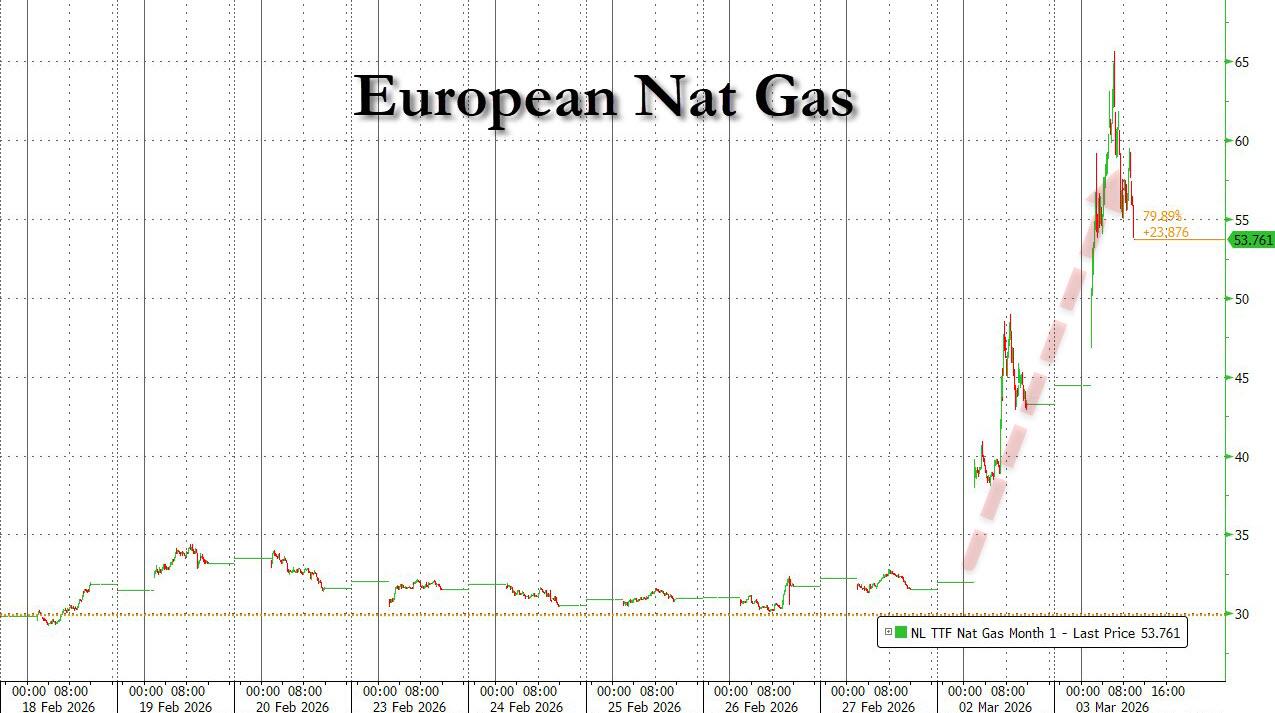
While the EU and UK would probably be more than happy to spectate from the proverbial “monitoring chair,” they may not have a choice. TTF prices reached highs of – €48.95/MWh yesterday—the highest since February of 2025- and are up more than 20% today.
QatarEnergy announced that it has ceased production of LNG and associated products due to the recent escalation. Our Energy Strategists, Florence Schmit and Joe DeLaura, note that we could see prices return to 2022 levels should Qatar be taken out of the LNG equation entirely (easily back to €100/MWh). Read more here.
This puts the entire European energy complex at risk and might be just the incentive needed for Europe to get out of the monitoring chair and into the ring.
France24 reports that “France, Germany, UK ready to take ‘defensive action’ against Iran.” As the EU touts commitments to increase defense spending and build up its military capabilities, Rabobank Global Strategist Michael Every has mused, “why have all these war planes sitting on the tarmac not doing anything?”
A little farther south, the Gulf Cooperation Council (GCC) is considering its own involvement. Omani foreign minister Badr Albusaidi said on X that “neither the interests of the United States nor the cause of global peace are well served by this. I urge the United States not to get sucked in further. This is not your war.” But the GCC has made it clear that they don’t want it to be their war either. Threats to the economies of the Gulf are not just about energy—this also impacts their budding tourism and hospitality industries as few want to vacation in an active warzone. The UAE and Qatar have reportedly been lobbying allies to end this war as soon as possible.
Meanwhile, in a statement, the Saudi Ministry of Foreign Affairs affirmed “its full solidarity with and unwavering support for the brotherly countries, and its readiness to place all its capabilities at their disposal in support of any measures they may undertake. It also warns of the grave consequence resulting from the continued violation of states’ sovereignty and the principles of international law.” As much as the GCC may want to stay out of it (or, at least as far out of it as they can when their territory is being striked by Iranian drones), the Saudis, at least, are prepared to escalate further.
Trump and Hegseth have not shown any signs of backing down just yet. Early yesterday morning, Hegseth affirmed that “Iran is not a regime change war, but the regime did change,” and that the war will be finished “on America-first conditions.” What those conditions are is still TBD. And the ambiguity of those conditions still leaves us with the question of what constitutes a win.
Hegseth and Rubio would tell you that the aim is the same as last time—to set back Iran’s nuclear proliferation program. But as we saw recently, it doesn’t take Iran very long before they can start to rebuild capacity. The best way to cut off nuclear proliferation is to cut off the head, and that necessitates regime change.
However, as noted in yesterday’s installment, regime change will not be easy. The goal of Tehran is to survive by any means necessary. Even if the regime is rendered a shell of what it once was, but manages to hang on by a thread, then the US has failed. While Trump has announced that this military operation could take weeks and Hegseth rejected the idea that this would be another endless war to echo Iraq and Afghanistan, this may still be a much longer ride than expected.
Yesterday’s stellar performance of USD also exemplified how calls of “Sell America” in recent months were shortsighted. While USD has not been behaving as a safe-haven traditionally would, given the dramatic USD sell-off in H1 2025, we have long argued that this was more about positioning—a repricing of EUR/USD in the aftermath of European announcement of defense spending, and rising USD hedge ratios from foreign investors—than it was a loss of USD’s safe haven status. Indeed, recent price action makes it clear that when the going gets rough, investors still flee to the warm embrace of greenback liquidity.
Still, other US assets have not felt the love. The inflationary risks posed by an extensive war with Iran are at front of mind for investors, especially as analysts keep a watchful eye on the strait of Hormuz. Even though the Fed prefers to look at core inflation, which strips out direct energy costs, energy is an input into everything, including core goods and services. While inflation is already above the 2% target, and the lagged effects of tariffs are starting to put pressure on core goods, the additional price increases posed by turning the major oil exporter of the world into a warzone may put the Fed in a tricky position. US 2 year and 10 year Treasury yields moved in parallel, closing the day up 11bp, which is the greatest single day move since the US-Iranian skirmish last June.
Tyler Durden
Tue, 03/03/2026 – 10:30

El Dow Jones cae más de 900 puntos y sube el petróleo por la guerra
Por STAN CHOE
NUEVA YORK (AP) — Una ola de ventas de acciones está golpeando a Wall Street tras propagarse desde Europa y Asia, mientras los precios del petróleo subían aún más ante el temor de que la guerra con Irán se esté ampliando y pueda causar un daño más sostenido a la economía de lo que se temía.
El S&P 500 caía 1,8% a las 9:35 a.m., hora local. El promedio industrial Dow Jones se hundía 907 puntos (1,9%) y el compuesto Nasdaq perdía 2,1%.
Los precios del crudo saltaron más de 8% después de que Irán atacó la embajada de Estados Unidos en Arabia Saudí, como parte de una ampliación de objetivos que también incluye zonas críticas para la producción mundial de petróleo y gas natural.
El lunes, el S&P 500 llegó a caer hasta 1,2% pero terminó con una ganancia de menos de 0,1%. El Dow Jones bajó 0,1% y el Nasdaq subió 0,4%.
______
Esta historia fue traducida del inglés por un editor de AP con la ayuda de una herramienta de inteligencia artificial generativa.
Capturan en Colombia 121 personas en operativo contra el secuestro y la extorsión
Associated Press
BOGOTÁ (AP) — La policía colombiana informó el martes la captura de 121 personas por los delitos de secuestro y extorsión en una operación simultánea en más de una decena de departamentos.
La llamada “Operación Jade” impactó al Clan del Golfo, el cártel activo más grande del país; la guerrilla Ejército de Liberación Nacional (ELN); la banda transnacional Tren de Aragua; disidencias de la extinta guerrilla Fuerzas Armadas Revolucionarias de Colombia (FARC) que no se acogieron al acuerdo de paz firmado hace una década y bandas como “Los Mexicanos”, “Los Costeños” y “La Terraza”.
El Grupo de Acción Unificada por la Libertad Personal (Gaula) señaló que las operaciones simultáneas se realizaron entre el 23 de febrero y el 1 de marzo e incluyeron ciudades capitales como Bogotá, Medellín, Cartagena, Barranquilla, Cúcuta y Quibdó.
La policía resaltó la captura de alias “Pavito”, cabecilla de la banda “Los Mexicanos” que opera en Quibdó, en el noroeste del país, dedicada a extorsionar a comerciantes. Detalló que la banda llegaba a los establecimientos y con disparos buscaba presionar los pagos de las extorsiones.
En los operativos fueron incautados “297 elementos utilizados para la comisión de estos delitos” como armas, granadas, motocicletas y celulares, los cuales eran utilizados para hacer extorsiones telefónicas.
El secuestro, uno de los crímenes más repudiados en Colombia por el conflicto armado interno, se incrementó en 2025 un 108% con respecto al año anterior, pasando de 313 víctimas a 651. Mientras que la extorsión continúa siendo una preocupación para las autoridades, aunque ha menguado. En 2025 se registraron 12.180 casos, mientras que en 2024 fueron 13.802 —la cifra más alta en una década—, según datos públicos del Ministerio de Defensa.
El gobierno de El Salvador reclamó a Colombia en enero por estafas telefónicas desde prisiones colombianas que afectaron a sus ciudadanos, por lo cual el gobierno colombiano decidió bloquear las señales celulares en tres cárceles que identificó como prioritarias por la comisión de extorsiones.