Category: News
Jacob Lane: Grover Cleveland and the lost art of saying no
In high school, I put useless trivia knowledge to work on the quiz bowl team. I wasn’t the fastest on the buzzer, but I learned quickly which names and facts came up repeatedly.
Grover Cleveland was one of those names.
He was the only president to serve nonconsecutive terms. Of course, this was before Donald Trump’s return to office.
Cleveland was always good for a point or two. Beyond that, I did not think much about him.
He was another name to memorize, somewhere between Presidents Millard Fillmore and Chester Arthur. If anything, I remembered Cleveland more for his thick, signature mustache more than his presidency.
Portrait of Grover Cleveland, president of the United States. (New York Daily News archive)
That is probably true for most Americans. Cleveland lives in the margins of history books, remembered more for the fact that he served two nonconsecutive terms than for how he governed. He was not a wartime hero, nor did he leave behind a sweeping program that bore his name.
But the more you learn about him, the harder it is to ignore how unusual he was.
Cleveland believed government should do less, spend less and stay within its limits. That was not just campaign rhetoric. It was how he approached the office.
To Cleveland, saying no was not a weakness. It was often the point.
You can see that clearly in 1887.
Congress passed a bill to send federal seed to drought-stricken farmers in Texas during a severe economic slump. Lawmakers stepped in to help. Cleveland vetoed the legislation.
His explanation was blunt: “I can find no warrant for such an appropriation in the Constitution.”
He did not question that farmers were struggling. He simply believed the Constitution did not authorize federal involvement. To him, good intentions did not erase constitutional limits. That mindset defined his presidency.
Cleveland rose from mayor of Buffalo to governor of New York to the White House in just a few years. But what set him apart was not the speed of his ascent. It was how he governed once he arrived.
He treated public office as a public trust, not a steppingstone or a reward system.
At a time when political machines dominated state and city politics, Cleveland challenged patronage and favoritism. Taking on Tammany Hall was risky, but he pushed back. Even his friends were not immune.
He denied his former law partner and supporter, Wilson Bissell, a Cabinet post and a consulship. Personal loyalty did not come before public duty.
That kind of independence is hard to imagine in modern Washington. Politics still run on loyalty and access. The names and parties change, but the instincts remain.
Cleveland’s most lasting mark came from his use of the veto pen. By the end of his two terms, he had vetoed more than 500 bills, more than double the total issued by all the presidents before him combined. Many were spending measures he believed exceeded constitutional authority.
In his view, wasting public money was not merely bad policy; it was a “crime against the citizen.”
He did not see the presidency as a vehicle for constant action. He saw it as a guardrail.
His job was not to hand out federal help whenever pressure mounted. It was to protect the Constitution and the taxpayer, even when doing so was unpopular.
Cleveland won the popular vote three times and, for more than a century, was the only president to serve nonconsecutive terms. Still, he rarely receives the recognition given to more celebrated leaders.
There are no towering monuments to him. No HBO miniseries or films with A-list actors. Restraint, it turns out, does not make for dramatic storytelling.
March 18 would have marked Cleveland’s 189th birthday. It will likely pass with little fanfare, as it usually does. Little notice beyond a few historians. Just another date on the calendar.
For years, Cleveland was just a trivia answer to me. A name, a fact and a president with a killer mustache.
Now I see something else: restraint. Discipline. The willingness to say no when it would have been easier to go along.
Washington could use a few more Grover Clevelands.
Jacob Lane is a Republican strategist based in Illinois.
Submit a letter, of no more than 400 words, to the editor here or email letters@chicagotribune.com.
https://www.chicagotribune.com/2026/03/06/opinion-grover-cleveland-federal-government-spending/

The US Leads The World In The Weight-Loss Injection Boom
The US Leads The World In The Weight-Loss Injection Boom
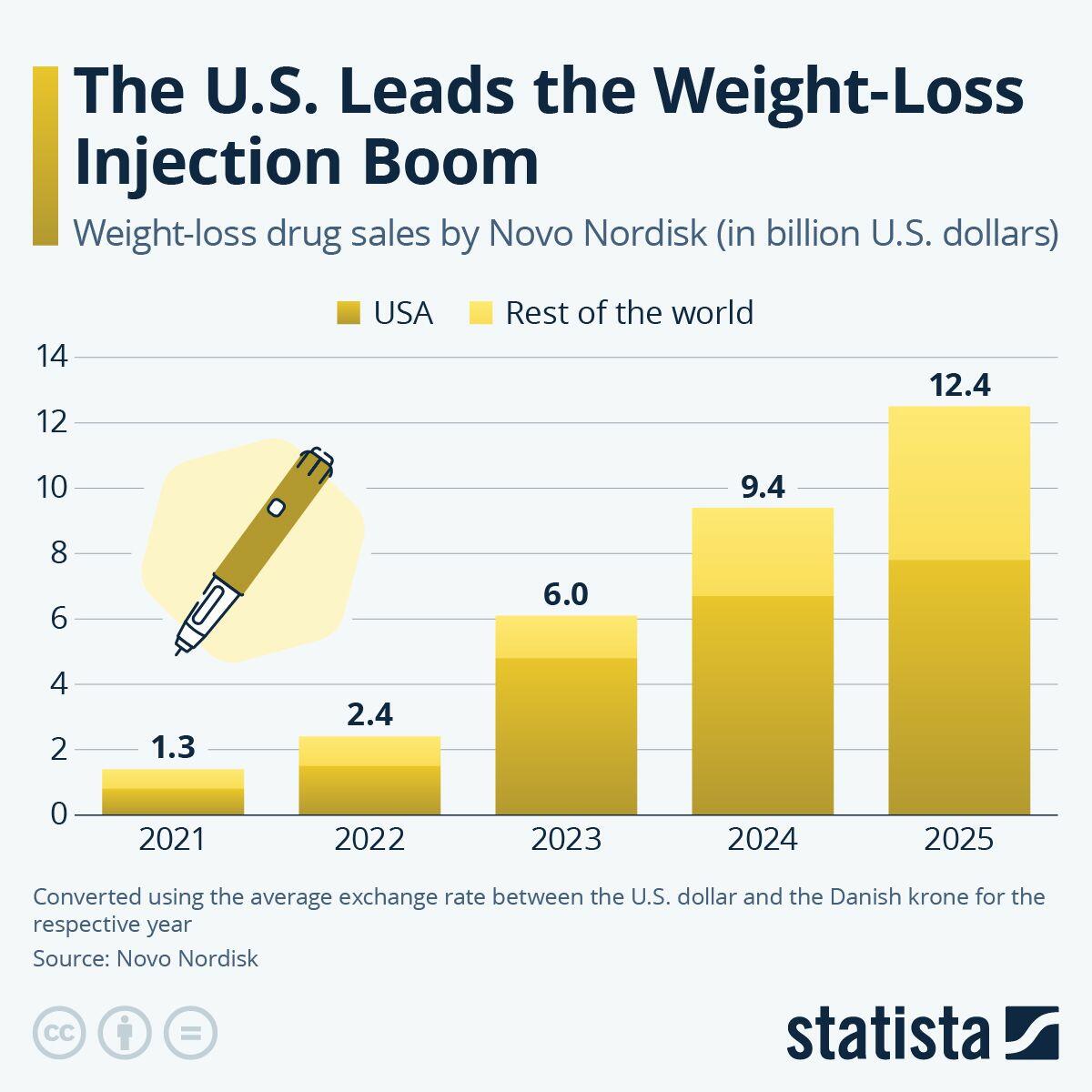
Novo Nordisk’s obesity-drug franchise has surged at a remarkable pace. In just four years, revenue from its weight-management treatments ballooned roughly tenfold – from about $1.3 billion in 2021 to approximately $12.4 billion in 2025. The growth has been fueled largely by Wegovy, the company’s blockbuster weight-loss drug built around the active ingredient semaglutide and marketed as a once-weekly injection.
Semaglutide itself was originally developed to treat type 2 diabetes and continues to be sold under the brand name Ozempic for that purpose. The primary difference between the two products lies in dosage. As Statista notes, Wegovy is formulated at higher semaglutide levels for weight management, while Ozempic is designed for blood-sugar control in diabetic patients. In practice, however, Ozempic has frequently been prescribed off-label for weight loss – a practice that is restricted or prohibited in several European Union countries.
Regardless of branding, the United States has emerged as Novo Nordisk’s most important market. According to the company’s 2025 annual report, the U.S. accounts for the overwhelming share of sales for both Ozempic and Wegovy. For drugs marketed specifically for weight loss, more than 60% of global revenue comes from the American market – a reflection of both the country’s large pharmaceutical sector and its high obesity rates, which have helped make the U.S. the epicenter of the global GLP-1 boom.
Tyler Durden
Fri, 03/06/2026 – 05:45
https://www.zerohedge.com/medical/us-leads-world-weight-loss-injection-boom

Today in History: Oreo cookies introduced
Today is Thursday, March 6, the 65th day of 2025. There are 300 days left in the year.
Today in history:
On March 6, 1912, Oreo cookies were first introduced by the National Biscuit Company (later known as Nabisco).
Also on this date:
In 1820, President James Monroe signed the Missouri Compromise, which allowed Missouri to join the Union as a slave state and Maine to join as a free state, while banning slavery in the northern portion of the Louisiana Territory.
In 1836, the Alamo in San Antonio, Texas, fell as Mexican forces led by General Antonio Lopez de Santa Anna stormed the fortress after a 13-day siege; the battle claimed the lives of all the Texian defenders, including William Travis, James Bowie and Davy Crockett.
In 1857, the U.S. Supreme Court, in the Dred Scott v. Sandford decision, ruled 7-2 that Scott, an enslaved person, was not an American citizen and therefore could not sue for his freedom in Federal court; it also ruled that slavery could not be banned from any Federal territory. The decision deepened the national divide over slavery in the years leading up to the Civil War.
In 1869, chemist Dmitri Mendeleev introduced his concept of a periodic table of elements at a meeting of the Russian Chemical Society in St. Petersburg.
In 1951, the trial of Julius and Ethel Rosenberg on federal espionage charges began in New York.
In 1964, heavyweight boxing champion Cassius Clay took a new name given to him by Nation of Islam leader Elijah Muhammed: Muhammad Ali.
In 1970, a bomb being built inside a Greenwich Village townhouse in New York by members of the Weather Underground militant leftist group accidentally exploded, destroying the house and killing three group members.
Related Articles
Vintage Chicago Tribune: History of Hawthorne Race Course, the oldest horse-racing venue in Illinois
Today in Chicago History: John Belushi’s death in LA shocks his hometown
Today in History: Martha Stewart convicted
Today in History: President Abraham Lincoln inaugurated for a second term
Today in Chicago History: Billy Goat Tavern — of ‘Cheezborger, cheezborger’ fame — opens on Michigan Avenue
In 1981, Walter Cronkite signed off for the last time after nearly two decades as the anchor of “The CBS Evening News.”
Today’s birthdays: Former FBI and CIA director William Webster is 101. Former Federal Reserve Chairman Alan Greenspan is 99. Former Soviet cosmonaut Valentina Tereshkova is 88. Opera singer Kiri Te Kanawa is 81. Rock musician David Gilmour (Pink Floyd) is 79. Filmmaker-actor Rob Reiner is 78. Actor-comedian Tom Arnold is 66. Actor-comedian D.L. Hughley is 62. Actor Connie Britton is 58. Basketball Hall of Famer Shaquille O’Neal is 53. Rapper-producer Tyler, the Creator is 34. Actor Millicent Simmonds is 22.
https://www.chicagotribune.com/2026/03/06/today-in-history-oreo-cookies/

Today in Chicago History: Chance the Rapper cuts CPS a $1 million check as ‘call to action’
Here’s a look back at what happened in the Chicago area on March 6, according to the Tribune’s archives.
Is an important event missing from this date? Email us.
Front page flashback: March 7, 1857
A “full and elaborate statement” of the U.S. Supreme Court’s Dred Scott decision was published on the Tribune’s front page on March 7, 1857. (Chicago Tribune)
1857: The U.S. Supreme Court issued its infamous Dred Scott decision, which legitimized the institution of slavery.
“The Scott family didn’t find the freedom they sought through the legal challenge,” according to the National Park Service. “But their courage and determination in filing this case helped bring about the Civil War and freedom from enslavement for all Americans.”
Weather records (from the National Weather Service, Chicago)
High temperature: 70 degrees (2000)
Low temperature: 0 degrees (2015)
Precipitation: 0.92 inches (1894)
Snowfall: 4 inches (1943)
A crowd of 50,000 attends the burial services for Mayor Anton J. Cermak on March 10, 1933, at Bohemian National Cemetery in Chicago. (Chicago Tribune archive)
1933: Chicago Mayor Anton Cermak died 20 days after he was struck by an assassin’s bullet presumably intended for President-elect Franklin D. Roosevelt in Miami.
Once at the hospital, Cermak reportedly uttered the line that is engraved on his tomb. Speaking to FDR, Cermak allegedly said: “I’m glad it was me instead of you.” The Tribune reported the quote without attributing it to a witness, and most scholars doubt it was ever said.
Nation of Islam leader Elijah Muhammad addresses Black Muslims in Chicago in 1967 as world heavyweight champion Muhammad Ali listens intently at left. (AP)
1964: Elijah Muhammad, head of the Chicago-based Nation of Islam, bestowed the name Muhammad Ali on new follower Cassius Clay.
“I am honored,” the heavyweight champion said when notified in Louisville, Kentucky.
Runner Tom O’Hara of Loyola pours it on in the home stretch, crossing the finish line in 3:56.4 to break his indoor mile record on March 7, 1964. Most of the crowd misses his finish — their eyes are on the timer. (Chicago Tribune historical photo)
Also in 1964: Loyola University sprinter Tom O’Hara set the indoor mile record of 3:56.4 in the Bankers Mile at Chicago Stadium in the 1964 Chicago Daily News Relays.
Chance the Rapper holds a press conference at Westcott Elementary School in Chicago’s Chatham neighborhood on Monday, March 6, 2017.
Chance the Rapper met with Gov. Bruce Rauner last week and promised to come up with a plan for the cash-strapped Chicago Public Schools.
(Zbigniew Bzdak/Chicago Tribune).
2017: Hours after Gov. Bruce Rauner offered two options to provide $215 million to Chicago Public Schools, Chance the Rapper cut the district a $1 million check that the Grammy-winning musician described as a “call to action” for the city’s business and philanthropic community.
Chance was critical of the Republican governor’s efforts to fix the city’s schools during a news conference in West Chatham on the South Side, not far from the musician’s old neighborhood.
“Gov. Rauner still won’t commit to give Chicago’s kids a chance without caveats or ultimatums,” Chance told students and reporters at Westcott Elementary School. “Gov. Rauner, do your job.”
Want more vintage Chicago?
Subscribe to the free Vintage Chicago Tribune newsletter, join our Chicagoland history Facebook group, stay current with Today in Chicago History and follow us on Instagram for more from Chicago’s past.
Have an idea for Vintage Chicago Tribune? Share it with Kori Rumore and Marianne Mather at krumore@chicagotribune.com and mmather@chicagotribune.com
https://www.chicagotribune.com/2026/03/06/march-6-chicago-history/
‘Mr. Gold’ Warns Of ‘System Reset’ As Silver Lights Fuse Of Derivatives Time-Bomb
‘Mr. Gold’ Warns Of ‘System Reset’ As Silver Lights Fuse Of Derivatives Time-Bomb
Authored by Greg Hunter via usawatchdog.com,
Financial writer and precious metals expert Bill Holter (aka Mr. Gold) predicted that by March, silver would likely suffer a failure to deliver physical metal at COMEX. In other words, demand for physical silver will swamp the existing supply. The math is scary and simple, and Holter breaks it down, “The registered inventory at COMEX in silver is 86 million ounces. On the second day of March, there are already 52 million ounces of silver standing for delivery. That leaves 30 million to 35 million ounces unspoken for. . .. This looks dicey. If they have 52 million ounces standing for delivery now, where is it going to be at the end of the month? If silver fails to deliver, then what you are going to have in the gold market is buyers stepping up that normally would not even buy and ask for delivery. . .. The bottom line is if silver fails to deliver, gold will fail to deliver in 24 hours. Once that happens, then confidence breaks. . .. You are looking at two quadrillion dollars in derivatives in a global economy with $350 trillion in debt with an underlying $100 trillion annual GDP. The math does not work. I think silver, and I have said this for many years, silver will be the spark or the fuse that lights off gold, which then lights off the derivatives time bomb. Warren Buffett calls derivatives weapons of mass financial destruction.”
Mr. Gold thinks, “When the system resets, governments will start a money print fest that will touch off global hyperinflation. . .. The pure math of debt outstanding is that it cannot be repaid in current terms. It will be hyperinflation of the things we need and hyper-deflation of the things we already have. . .. How is somebody going to buy your house if the capital is not there? If the capital is not there, then the price is going to have to come down. . .. It is highly likely that silver will kick off the demise of the financial system.”
Mr. Gold thinks this kind of global debt will go bad fast. Holter warns, “When this thing cascades and collapses, you are either in place, or you are out of place. If you are out of place, you will not be able to repair your mistake. It will be a lifetime mistake to have not gotten ready. Let me just say there is a difference in being early and being wrong. In 2000 to 2005, if you were buying gold or you were buying silver, you were an idiot, a complete idiot, and people thought you walked around with a tin foil hat on. . .. Now, we are at the point where the best place to have invested your money since January 2000 would be in gold or silver. When Noah was running around building his ark, he looked wrong. He was not wrong–he was just early.”
Watch:
Tyler Durden
Fri, 03/06/2026 – 05:00
Qué saber sobre los kurdos y su posible participación en la guerra de Irán
Por SAM McNEIL
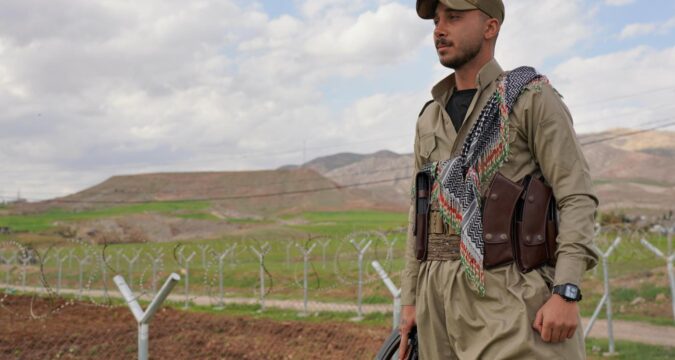
BUSELAS (AP) — Miles de kurdos curtidos en batalla en el norte de Irak se están preparando para una posible operación militar transfronteriza en Irán con respaldo de Estados Unidos, según dijeron a The Associated Press funcionarios kurdos.
Los tres funcionarios indicaron que el presidente de Estados Unidos, Donald Trump, y los líderes de los dos principales partidos kurdos de Irak discutieron la situación el domingo. Los tres hablaron bajo condición de anonimato porque no estaban autorizados a hacer declaraciones públicas.
La incorporación de kurdos armados ahora, mientras Israel y Estados Unidos siguen atacando a Irán, supondría un importante desafío para las defensas iraníes, pero también podría arrastraer aún más a Irak —donde algunos de los grupos kurdos iraníes tienen bases— al conflicto.
A continuación, un vistazo a los kurdos y sus relaciones en Oriente Medio:
¿Quiénes son los kurdos?
Los kurdos son uno de los grupos étnicos apátridas más grandes del mundo, con aproximadamente 30 millones de personas que viven como minorías en Turquía, Irak, Irán y Siria. Hablan su propio idioma, con varios dialectos, y la mayoría son musulmanes suníes.
Aunque nunca han tenido su propio Estado, gobiernan una zona semiautónoma en el norte de Irak y durante años controlaron de facto gran parte del noreste de Siria. Muchos han librado campañas insurgentes con el objetivo de establecer su propia nación, Kurdistán.
Los nueve millones de kurdos de Irán viven principalmente en una zona a lo largo de la frontera occidental del país con Irak y Turquía. Tienen una larga historia de agravios y rebeliones tanto contra la actual República Islámica como contra la monarquía que la precedió.
Antes de la guerra, Amnistía Internacional afirmó que los kurdos enfrentan “discriminación sistémica” en Irán y que en el pasado “las fuerzas de seguridad mataron o hirieron a muchos mensajeros kurdos desarmados que cruzaban la frontera (kulbars) con impunidad”.
¿Qué es la oposición kurda en Irán?
A lo largo de los años, varios grupos opositores kurdos han tomado las armas contra las autoridades iraníes.
Algunos han establecido bases en el vecino Irak, lo que fue un motivo de confrontación entre Teherán y el gobierno central iraquí en Bagdad hasta 2023, cuando alcanzaron un acuerdo para desarmar a los grupos kurdos iraníes.
En la antesala de la guerra actual, cinco grupos kurdos iraníes formaron una coalición dedicada a derrocar a la República Islámica y a establecer el derecho del pueblo kurdo a la autodeterminación. El jueves se les unió un sexto grupo.
“Por primera vez, todos los principales partidos kurdos se han unido como uno solo en una nueva coalición —un paso histórico hacia la construcción de un nuevo futuro para los kurdos y un Irán democrático”, dijo Abdullah Mohtadi, secretario general del Partido Komala del Kurdistán iraní.
Pero unirse a los otros grupos de la oposición iraní para apartar del poder a las autoridades en Teherán podría resultar difícil.
¿Cuál es la historia de los kurdos con Estados Unidos?
Los kurdos rara vez han salido ganando en sus interacciones con presidentes de Estados Unidos.
En 1975, el presidente Gerald Ford no logró protegerlos de una derrota a manos de las fuerzas iraquíes.
En 1988, Ronald Reagan no impidió que las fuerzas iraquíes usaran armas químicas contra los kurdos.
En 1990, George Bush los animó a levantarse contra Saddam Hussein después de que este invadiera Kuwait, pero se hizo a un lado mientras las fuerzas iraquíes aplastaban la rebelión con brutalidad.
Y en enero, Trump permitió que fuerzas sirias se apoderaran del territorio ganado por los kurdos durante la guerra civil en Siria y en sangrientas batallas contra el grupo extremista Estado Islámico.
¿Cuál es la postura de Turquía?
Es poco probable que Turquía, un miembro clave de la OTAN y posible receptor de refugiados de guerra, acepte envíos de armas occidentales a guerrilleros kurdos, incluso si sus objetivos se encuentran en Irán.
Turquía libra desde 1984 una brutal campaña militar contra una insurgencia kurda armada que se ha cobrado decenas de miles de vidas y se ha extendido al vecino Irak y a Siria.
El jueves, Turquía manifestó su oposición a la posible participación de grupos disidentes kurdos iraníes en el conflicto en Irán, advirtiendo de una mayor inestabilidad en la región.
Turquía considera que el principal grupo disidente kurdo, el PJAK, es una organización terrorista vinculada a los separatistas que luchan contra Ankara. El Ministerio de Defensa turco indicó el jueves que las actividades del PJAK “afectan negativamente no solo la seguridad de Irán, sino también la paz y la estabilidad generales de la región”.
¿Cuál es la situación en Irak?
La violencia ya ha estallado en los territorios kurdos que se extienden a ambos lados de la frontera entre Irán e Irak.
Mientras Israel y Estados Unidos atacaban objetivos en todo Irán, las fuerzas iraníes y sus aliados en Irak lanzaron misiles y drones contra bases militares que albergan a estadounidenses y el consulado de Estados Unidos en Irbil, así como contra las bases de los grupos kurdos iraníes.
Khalil Nadiri, un funcionario del Partido por la Libertad del Kurdistán, con base en la región semiautónoma kurda del norte de Irak, dijo el miércoles que algunas de sus fuerzas se habían desplazado a zonas cercanas a la frontera iraní en la provincia de Sulaymaniyah y estaban en alerta.
En enero, el grupo anunció que había llevado a cabo incursiones en territorio iraní durante la represión masiva de las protestas. La prensa estatal los calificó entonces de “terroristas”, sin ofrecer ninguna prueba que respaldara la afirmación, un delito que la República Islámica castiga con la muerte.
Por su parte, funcionarios del gobierno regional kurdo de Irak y de partidos políticos kurdos iraquíes indicaron que no quieren que se lancen ataques a Irán desde su territorio por temor a represalias.
Peshawa Hawramani, vocero del gobierno regional del Kurdistán, señaló en un comunicado que “las acusaciones que afirman que formamos parte de un plan para armar y enviar a partidos de oposición kurdos al territorio iraní carecen por completo de fundamento” y que los partidos kurdos iraquíes no quieren “ampliar la guerra y las tensiones en la región”.
___
Los periodistas de The Associated Press Suzan Fraser en Estambul, Qassim Abdul-Zahra en Bagdad, y Stella Martany y Rashid Yahya en Irbil, Irak, contribuyeron a este despacho.
___
Esta historia fue traducida del inglés por un editor de AP con la ayuda de una herramienta de inteligencia artificial generativa.

Ask Anna: My boyfriend keeps prioritizing other women
Dear Anna,
Related Articles
Ex-etiquette: Daughter asked her mother not to tell father about starting her period
Terry Savage: Last chance to file the FAFSA for your college student
Asking Eric: They are rude and condescending toward me
The Kid Whisperer: How to make sure you are not raising a manipulative jerk
Answer Angel: Olympics style question
I’m 32 and my boyfriend of three years constantly prioritizes other women over me in small but consistent ways, and it’s driving me crazy. He’s a generally nice guy — the kind who prides himself on being helpful and chivalrous — but somehow I’m never the one receiving that treatment. A few recent examples: We were at the airport and he immediately helped another woman grab her huge luggage off the carousel. He did not do the same for me when my luggage came around. At a concert last month, the MC asked people to cheer if it was their first show. He turned to his friend’s girlfriend standing next to him and pointed at her instead of me — even though we were both first-timers. When we’re walking in a group on the street, he always positions himself closest to the road, in case a car swerved too close or something — not next to me. I’ve brought this up at least four or five times over the years, explaining how hurt and overlooked it makes me feel. He always apologizes and says he didn’t realize he was doing it, but nothing changes. I’m tired of being treated like an afterthought. How do I get through to him that this isn’t about jealousy, it’s about basic consideration? — Invisible Girlfriend
Dear IG,
I’m going to be honest with you — but gently.
On their own, none of these examples seem as damning as they probably feel when you’re living them. The luggage thing: Did you actually need help, or did it sting because he rushed to help someone else and didn’t think to check in with you? The concert moment: Awkward, yes, but also very plausibly a split-second reflex toward the person closest to him. The walking-by-the-street thing? I’ve seen plenty of men (and even a few masc women!) do this automatically, without any conscious calculation about who “deserves” protection. It’s less chessboard, more muscle memory.
Not to make excuses for anyone, but if we zoom way out, I don’t see a man who is actively prioritizing other women over you in some nefarious or even particularly meaningful way.
But — and this is the important part — I do see a woman who feels unseen in her own relationship. And when that’s the emotional baseline, small moments don’t land as small.
This is where I think the real issue lives. So let’s unpack that a bit.
If you’ve been cataloging these moments over three years, and you’ve brought them up four or five times, the pain probably isn’t about airport luggage or concert pointing. It’s about a broader feeling of being taken for granted. These moments aren’t the crime; they’re the evidence your brain is collecting to explain a deeper discomfort.
Let’s separate two questions:
1. Are these specific behaviors objectively harmful?
2. Or are they symptoms of a larger pattern where you don’t feel prioritized, cherished, or actively chosen?
Because if the relationship is otherwise warm, attentive, affectionate and supportive — if he shows up for you emotionally, makes time for you, listens, invests, plans and shows care in meaningful ways — then yes, it’s possible you’re zooming in too tightly on moments of thoughtlessness.
But if you don’t feel appreciated or centered in his life, then the problem isn’t that he’s helping another woman with her suitcase. It’s that he’s not reliably showing you that you matter.
And here’s the part that’s valid regardless: If you’ve raised a concern multiple times and nothing changes, that’s frustrating even if the concern itself seems “minor” on paper. It’s not about chivalry. It’s about responsiveness.
So instead of continuing to litigate individual incidents (“Remember the airport?”), I’d suggest one bigger, calmer conversation about the pattern. Something like:
“I’ve realized that in group settings, I sometimes feel overlooked by you. I don’t think you mean to do it, but it affects me. I want to feel like we’re choosing each other when we’re out in the world together.”
Then — and this matters a lot — give him concrete ways to show up. Not vague chivalry, but modern equivalents: checking in with you in social settings, small touches, verbal affirmation, prioritizing you in group conversations, making sure you feel connected. People who are genuinely oblivious often need specifics. (And if the luggage thing really gets your goat, then ask specifically for him to grab yours from the carousel next time.)
Finally, do some honest self-reflection. Outside of these moments, do you feel loved? Do you feel like a priority in his decisions, his time, his future planning, his emotional life? Do you feel chosen when it counts?
If yes, these moments may be irritants worth contextualizing, not deal-breakers. If no, then this isn’t about other women at all — it’s about whether this relationship is giving you the kind of attention and consideration you need to feel secure.
Not every oversight is a red flag. But a persistent feeling of invisibility is always worth taking seriously — especially after three years.
The goal here isn’t to make him perfect. Because nobody is. It’s to find out whether he’s capable of seeing you in the way you need to be seen.
___
(Anna Pulley is a syndicated Tribune Content Agency columnist answering reader questions about love, sex and dating. Send your questions via email (anonymity guaranteed) to redeyedating@gmail.com, sign up for her infrequent (yet amazing) newsletter or check out her books!)
https://www.chicagotribune.com/2026/03/06/ask-anna-other-women/

Ex-etiquette: Daughter asked her mother not to tell father about starting her period
Q. My 11-year-old daughter started her period and asked her mother not to tell me. So, she didn’t. I found out almost two months later. Isn’t this something my ex should have told me, even if our daughter asked her not to? What’s good ex-etiquette?
Related Articles
Ex-etiquette: 10-year-old tells the gory details of our divorce
Ex-etiquette: Alienating our son?
Ex-etiquette: Getting to the truth
Ex-etiquette: Sad at Valentine’s Day
Ex-etiquette: A valentine for my ex?
A. This is a tender situation, and it sits right at the intersection of a child’s growing need for privacy and a parent’s responsibility to co-parent transparently. To be direct, yes, your ex should have told you. Not sharing this information establishes a quiet “you can trust me more” dynamic, and that is not good ex-etiquette.
Let’s start with what matters most. Your daughter has reached a significant developmental milestone. Puberty isn’t just a physical change; it’s an emotional one. For many children, especially at age 11, asking for privacy isn’t about secrecy or exclusion. It’s about trying to regain a sense of control over a body that suddenly feels unpredictable and exposed. And yes, part of this is simply that you are Dad, and a guy, and she likely felt embarrassed having that conversation with you. That isn’t personal. What made it personal was that Mom chose not to tell you.
To be fair, your ex was placed in a difficult position. She may have believed that honoring your daughter’s request was the same as protecting her confidence. But this is where good ex-etiquette asks parents to distinguish between honoring a child’s feelings and withholding important information from the other parent. Remember this, because it will come up again:
A child can ask for privacy.
A child cannot set the terms of adult co-parenting.
Menstruation is not a private diary entry. It is a health and developmental event that affects medical care, emotional support and day-to-day parenting. Withholding that information, even with good intentions, undermines the co-parenting alliance and unintentionally places the child in the middle. It also gives an 11-year-old control over the flow of parental information, which is not a role children should ever have to manage.
Here’s the difference in approach now that you’re divorced. If you were still together, your daughter would likely have confided in her mother, and Mom might have said to you in passing, “By the way, Lily started her period, but she’s a little embarrassed to talk with you about it right now.” Most dads would understand, respect the moment, and not make a fuss, because they are included.
After divorce, however, that same moment can shift. What once felt like sharing an intimate parenting responsibility can turn into a feeling of superiority. When parents are together, shared information protects a child’s privacy. When parents are apart, withholding it can unintentionally turn that information into currency –“I know more about our child than you do” — and the purpose of protecting the child is lost.
Here’s the nuance. Your ex didn’t need to share details, commentary or your daughter’s emotional processing. A simple, neutral heads-up would have honored both roles:
“I wanted you to know that our daughter has started her period. She’s adjusting and asked for privacy, so I’m keeping details minimal, but I felt it was important that you be aware.”
As for how you handle this now, resist the urge to confront your daughter or express hurt to her. That would ask her to manage adult emotions, something good ex-etiquette cautions against. instead, focus on restoring safety and openness. You might say:
“I know your body is changing, and that can feel private. You don’t have to tell me everything, but I want you to know I’m here to support you, and I’m not uncomfortable talking about these things if you ever want to.”
Separately, address this with your ex, calmly attach it to co-parenting, not blame:
“I understand why you wanted to respect her wishes. Going forward, I need to be informed about major health and developmental changes so I can support her appropriately.”
That’s not an accusation.
It’s a boundary.
Good ex-etiquette isn’t about forcing children to share more than they’re ready for. It’s about adults sharing enough with each other so children don’t have to manage the divide. When parents handle milestones collaboratively, children feel protected, not exposed. And that’s exactly what this stage of development requires. That’s good ex-etiquette.
____
(Dr. Jann Blackstone is a child custody mediator and the author of “The Bonus Family Handbook: The Definitive Guide to Co-parenting and Creating Stronger Families. She can be reached at www.bonusfamilies.com or jann@bonusfamilies.com.)
https://www.chicagotribune.com/2026/03/06/ex-etiquette-period-daughter/

Stop The War… Because ‘Global Warming’!!!
Stop The War… Because ‘Global Warming’!!!
Via notalotofpeopleknowthat blog,
Apparently our climate propagandists are not bothered about the Mad Mullahs!
War makes climate change worse in many ways, and vice versa.
The US-Israel attacks on Iran that began over the weekend have killed hundreds of civilians and sent oil prices soaring, but this war also promises to unleash massive amounts of planet-warming gases at a time when civilization is already hurtling toward irreversible climate breakdown.
Not every story about the Iran war needs to make the climate connection, but climate change is essential context if the public and policymakers are to understand the full dimensions of this conflict.
Join Covering Climate Now and a panel of experts for a discussion about the geopolitical and climate implications of the war on Iran, which has one of the world’s largest oil reserves.
Their only concern is that a war might put a bit more carbon dioxide into the atmosphere!
They would no doubt be much happier with a nuclear winter!
At least it will lower global warming.
Tyler Durden
Fri, 03/06/2026 – 04:15
https://www.zerohedge.com/geopolitical/stop-war-because-global-warming
Indonesia prohibirá las redes sociales a menores de 16 años, dice ministra de Comunicación
Associated Press
YAKARTA, Indonesia (AP) — Indonesia prohibirá las redes sociales para los menores de 16 años, anunció el viernes la ministra de Comunicación y Asuntos Digitales, Meutya Hafid.
Hafid explicó en un comunicado que acababa de firmar un reglamento gubernamental que supone que los menores de 16 años ya no podrán tener cuentas en plataformas digitales de alto riesgo, entre ellas YouTube, TikTok, Facebook, Instagram, Threads, X, Bigo Live y Roblox.
___
Esta historia fue traducida del inglés por un editor de AP con la ayuda de una herramienta de inteligencia artificial generativa.