
Category: News

Two low-funded Republicans battle to run against Illinois Secretary of State Alexi Giannoulias in the fall
SPRINGFIELD — The March 17 election includes primary races for Illinois’ secretary of state, attorney general and treasurer — and while all those positions are held by incumbent Democrats who are running for new terms with no primary challengers, Republicans are duking it out in one of the contests.
For the GOP nomination for secretary of state, Joliet resident Diane M. Harris is going up against Chicagoan Walter Adamczyk for the right to compete against first-term incumbent, Democrat Alexi Giannoulias, in November’s general election.
The office has arguably the most interaction with the public of any at the state level, providing a host of services that include driver’s licenses and testing and other state IDs, registrations for vehicles, lobbyists, businesses and other services.
A precinct committeewoman for more than a decade, Harris is a retired Commonwealth Edison employee, having spent more than 30 years working for the utility giant. She’s also run unsuccessfully for several other offices over the years, including for state senator and Joliet mayor.
As she takes her chances in the secretary of state’s race, Harris wants to push for reduced fees for state stickers, titles and other vehicle service fees, especially for seniors and veterans. According to the secretary of state website, a vehicle title can cost as much as $165 and standard renewal stickers can cost $151 each.
Harris also has heard complaints about how the office’s appointment process can be inconvenient, and with many of its services available online, she notes, “some individuals will not and still won’t go online to do their services.”
Former Illinois Republican Party Chair Don Tracy, right, expresses his pleasure that Diane Harris is a secretary of state candidate during a joint meeting between the Illinois Republican Party State Central Committee and the Republican County Chair’s Association on Aug. 14, 2025, in Springfield. (Dominic Di Palermo/Chicago Tribune)
“There’s a select group of individuals who will always go online. I mean, I’m 70 years old. I enjoy the online, and I only enjoy it because I have someone that can help me,” she said. “At my age, we have a lot (of people who will) not go online because it’s too frustrating.”
Like other Republicans running in primaries for statewide office, Harris, a conservative Republican, will face significant challenges in blue Illinois. In the 2022 general election, Giannoulias won his race with 54% of the vote over his challenger, Republican Dan Brady of Bloomington.
Funding-wise, Giannoulias, who has been floated as a potential 2027 Chicago mayoral contender, had more than $6 million in his campaign coffers at the end of 2025, according to the Illinois State Board of Elections. Harris had just $9.75 in her campaign account through last year.
She said, “It’s totally difficult to get funding,” though it won’t prevent her from continuing to run her race.
Adamczyk said on his campaign website that he wants to improve customer service for veterans, pushing for all honorably discharged vets to receive free driver’s licenses or state IDs upon presenting proof of service.
On his website, Adamczyk, who is listed on the Cook County Republican Party website as the GOP committeeman for Chicago’s 29th Ward, also emphasized walk-in services and creating dedicated express lanes for veterans at secretary of state facilities.
“Veterans should not be forced to navigate appointment backlogs or long waits,” his campaign website says. “A veteran should be able to walk in, be served promptly, and be treated with appreciation — no appointment required.”
In an interview, Adamczyk explained that while he isn’t a military veteran, he has friends who are.
“I go (to) all these VFW (Veterans of Foreign Wars) halls, you know, they’re helping homeless vets, give them jackets, give them this, give them that. How come we don’t help them get their IDs?” he said. “Then we can bring them to the VA (U.S. Department of Veterans Affairs) and then they can get their benefits.”
Walter Adamczyk, right, hands out boxes of masks to Little Village residents at the corner of 32nd Street and Harding Avenue just blocks from the defunct Crawford power plant on April 16, 2020. The smokestack chimney of the former coal plant had recently imploded. (Chris Sweda/Chicago Tribune)
Board of Elections records show that through 2025, his campaign raised no money.
In the attorney general’s race, former Chicago Ald. Bob Fioretti is the only Republican seeking the nomination, almost assuredly earning him the chance to take on Democratic incumbent Kwame Raoul in November. Raoul, who is seeking a third term, also has no primary opponent.
The office has myriad functions, ranging from handling consumer protection issues and prosecuting some crimes to defending state laws in court. Since Republican President Donald Trump took office last year, the office under Raoul has often partnered with other states’ attorneys general in filing more than 50 lawsuits, including over federal immigration enforcement agent tactics used during deportation missions and the Trump administration’s attempt to deploy Illinois National Guard troops against Democratic Gov. JB Pritzker’s wishes.
Fioretti is a civil rights attorney who has run for and lost several public offices, including as a Democrat, since leaving the Chicago City Council more than a decade ago. In 2024, he ran as a Republican in the Cook County state’s attorney race, losing to Democrat Eileen O’Neill Burke.
“Several years ago, I switched to the Republican Party because to me, like (many) others across America, the Democratic Party left me,” Fioretti said in an interview. “They left family values, fiscal responsibility and freedom behind.”
Former Chicago Ald. Bob Fioretti sings the national anthem during Republican Day at the Illinois State Fair on Aug. 14, 2025, at the Illinois State Fairgrounds in Springfield. (Dominic Di Palermo/Chicago Tribune)
In a statement later, when asked if he’d continue with Raoul’s lawsuits, Fioretti’s campaign said it hadn’t reviewed every Trump-related lawsuit but said that if any “of Raoul’s lawsuits that seek to impede law enforcement officials from doing their sworn duty, interfere in cleaning up the corruption in Illinois elections, target the rights of law-abiding gun owners, or substitute Kwame Raoul’s judgment for parental decision making regarding the education, health care and general welfare of their children, we will withdraw from those lawsuits as quickly as possible.”
In the interview, Fioretti said he’d use the attorney general’s office to “stand up for crime victims instead of violent criminals” and look at the statewide use of grand juries to ramp up on how the office prosecutes public corruption and violent crime.
Like many other Republicans, he also wants to push to overturn or tweak the state’s sweeping criminal justice overhaul from 2021, the Safety, Accountability, Fairness and Equity-Today law, also known as the SAFE-T Act, which includes a controversial provision that eliminated cash bail.
Specifically, Fioretti wants to revisit the law’s electronic-monitoring and judicial-discretion guidelines, which he believes are too lenient.
Attorney General Kwame Raoul speaks during a press conference at the State of Illinois building on Jan. 20, 2026. (Eileen T. Meslar/Chicago Tribune)
Despite warnings a few years ago from Republicans that the elimination of cash bail would lead to upticks in crime in Chicago, the opposite has happened. Last year, Chicago recorded 416 killings — the lowest homicide total the city has seen in more than a decade — while shootings, defined as incidents in which at least one person was killed or wounded, fell by about one-third compared with 2019, Chicago Police Department data show. Also last year, the city saw drops in other crime categories.
Fioretti noted that crime is down across the country, not just in Chicago, and the SAFE-T Act can’t take credit for that. But, he said, “I know” a lot of people aren’t reporting crimes.
“I’ve told people to go to the police station when they were attacked on the street, or something, and they just say, ‘Well, nothing’s going to happen,’” Fioretti said.
In 2022, Raoul won the general election with 54% of the vote against Republican attorney Thomas DeVore of Sorento, Raoul’s main challenger in the race.
Board of Elections figures show Raoul had more than $1.5 million in his campaign account at the end of last year. Fioretti, meanwhile, had only a little over $23,700 through 2025.
For state treasurer, Democratic incumbent Michael Frerichs is currently running unopposed in his bid for a fourth term, including by any Republicans, marking the first time in at least 90 years that a major political party did not have any candidate file to run in a primary election for statewide office, Frerichs’ campaign has said.
https://www.chicagotribune.com/2026/03/07/illinois-gop-primary-secretary-state-other-statewides/

Biblioracle: ‘Haven’ is Ani Katz’s taut, propulsive new novel
There were times while reading Ani Katz’s taut, propulsive new novel, “Haven,” that I thought I was losing my mind.
My mental and emotional state was not as unsettled as that of Caroline, the novel’s protagonist. She is a first-time mother whose baby Gabriel has gone missing from the vacation house on an exclusive island she’s been inhabiting with her husband’s co-workers. The husband, Adam, has previously returned to the mainland, summoned by the mysterious, seemingly all-powerful tech company he works for, Corridor.
Corridor had seemed to be the answer to Caroline and Adam’s problems. Following the failure of Adam’s startup under unsavory conditions, they’ve racked up debt, and Adam seems paralyzed by uncertainty. But then Corridor comes calling. At first, Adam is reluctant to give himself over to the corporate hegemon, but soon enough, he and Caroline are heading to Haven, the exclusive private island with a heavy Corridor presence, mixed with the town’s natives, who both depend on and resent Corridor’s involvement.
“Haven” is set in a quasi-dystopian near future where climate change has made less of the planet habitable and the habitable parts of the planet less pleasant. “Big Tech” is the most powerful entity in the country, and one’s security and well-being means yoking oneself to a company like Corridor.
But even in a semi-collapsed state, people want family and children and vacations, and so Caroline somewhat reluctantly joins Adam and a cohort of others on Haven. Adam is summoned back, leaving Caroline alone with these strangers in this very strange place.
On the island, we’re quickly immersed in a kind of uncanny space of wanton consumption, drink, food and drugs seemingly everywhere. Strange rituals conducted by children unfold on the beach; dance parties at the big club devolve into fever dream bacchanals; cryptic, threatening symbols appear near the rental house. A trio of teenage girls appears obsessed with Gabriel, volunteering to babysit.
Gabriel going missing proves to be deranging to Caroline, and the novel becomes increasingly deranged with her. It’s not clear if she is delusional or being gaslit or some combination of the two. Maybe there is something supernatural going on. Maybe Corridor is behind all of it.
Caroline’s anguish and her ineffectuality at making progress in finding Gabriel make for some frustrating moments as a reader. There’s a dream logic (or illogic) to the events. You’re begging her to get her stuff together, but there appears to be no authorities in charge and Gabriel himself is meaningful beyond the fact that he is Caroline’s child.
This sense of frustration must clearly be intentional, and for sure, it kept me turning the pages as I became as confused and disoriented as Caroline herself. I was possibly expecting a more standard thriller about a missing child, but “Haven” is an exploration of power dynamics, surveillance, colonialism, toxic masculinity, and other big concepts. We seem to be getting clues from the island’s inhabitants, but maybe they just enjoy messing with the outsiders who have invaded their territory.
I was desperate to learn Gabriel’s fate, but could not put together how the things we were being shown were drawing us closer to a conclusion. The novel’s scope seemed to expand just as I was expecting it to narrow.
No spoilers here, but the resolution is not easy or straightforward. Some of what’s been hidden is revealed, but much remains mysterious, at least to me.
To me, it felt both true to the project and, to a degree, unsatisfying, but this seems to be the point. We can’t expect tidy resolutions.
I’d been unsettled, which is what Katz set out to do.
Book recommendations from the Biblioracle
John Warner tells you what to read based on the last five books you’ve read.
1. “Clementine Crane Prefers Not To” by Kristin Bair
2. “Sky Daddy” by Kate Folk
3. “That’s Not How It Happened” by Craig Thomas
4. “The Correspondent” by Virginia Evans
5. “Best Offer Wins” by Marisa Kashino
— Kimberly L., Lombard
Something is telling me that Kent Haruf’s “Plainsong” is the right choice for Kimberly. Truthfully, it’s a book most people will take to.
1. “Only the Beautiful” by Susan Meissner
2. “How to Read a Book” by Monica Wood
3. Maybe You Should Talk to Someone: A Therapist, Her Therapist, and Our Lives Revealed” by Lori Gottlieb
4. “The Book Thief” by Markus Zusak
5. “Theo of Golden” by Allen Levi
— Ruth Y., Arlington Heights
Here’s a book that I haven’t recommended in a while, but should bring the right kind of drama and comfort to Ruth, “The Lager Queen of Minnesota” by J. Ryan Stradal.
1. “The River of Doubt: Theodore Roosevelt’s Darkest Journey” by Candice Millard
2. “Lightning Down” by Tom Clavin
3. “The Revenant” by Michael Punke
4. “81 Days Below Zero: The Incredible Survival Story of a World War II Pilot in Alaska’s Frozen Wilderness” by Brian Murphy with Toula Vlahou
5. “Endurance: Shackleton’s Incredible Voyage” by Daniel Bryce
— Daniel L., Genoa City, Wisconsin
In his email, Daniel said he always goes looking for survival stories, which is apparent from his list, so I’m going to stick with that. I can’t choose between two contenders, so I’m recommending both, and both are from some time back, so maybe they’ll be new to Daniel. First, “Abandon Ship: The Saga of the U.S.S. Indianapolis, the Navy’s Greatest Sea Disaster” by Richard F. Newcomb. Second, “Alive: The Story of the Andes Survivors” by Piers Paul Read.
Get a reading from the Biblioracle
Send a list of the last five books you’ve read and your hometown to biblioracle@gmail.com.
John Warner is the author of books including “More Than Words: How to Think About Writing in the Age of AI.” You can find him at biblioracle.com.
https://www.chicagotribune.com/2026/03/07/biblioracle-ani-katz-haven/

The Tribune’s Quotes of the Week quiz for March 7
Brighter evenings are ahead, Chicago. Tonight we spring forward an hour for daylight saving time, one of the first signs the seasons are changing.
But time isn’t the only thing shifting this week. In a sudden Cabinet shakeup, President Donald Trump announced Thursday he’s firing embattled Homeland Security Secretary Kristi Noem and will nominate Oklahoma Sen. Markwayne Mullin to lead the department. The news was met with celebration by many local activists and Illinois public officials.
Earlier this week, Noem appeared before the Senate Judiciary Committee to answer questions about immigration agents’ use of excessive force and the department spending billions of congressional dollars. During the hearing, Noem declined to address the shooting of Marimar Martinez by an immigration agent in Chicago, saying she was not “familiar with the details” of the case. Meanwhile, DHS remains shut down after another unsuccessful effort by the Senate to pass a funding bill.
After the U.S. and Israel launched a series of attacks against Iran that killed Supreme Leader Ayatollah Ali Khamenei, the president on Friday ruled out attempting to negotiate with Iran unless the nation surrenders and suggested that he wants to pick its next leader. Travelers in the Middle East had difficultly leaving the region — including one group of Chicagoans in Dubai — with airspaces restricted as the U.S., Israel and Iran continued retaliatory airstrikes throughout the week. Congress, in an effort to limit Trump’s war against the Islamic Republic, considered a pair of war powers resolutions. The Senate voted down the legislation Wednesday, and on Thursday, the House defeated a similar measure.
In other world news, the State Department said Thursday the United States and Venezuela have agreed to reestablish diplomatic relations, marking a major shift just two months after former President Nicolás Maduro’s ouster. Locally, Illinois joined some two dozen states in suing over Trump’s new global tariffs, plans for the state’s largest data center are moving forward, and the race is on in Illinois’ 2nd Congressional District.
Services continued this week for the late Rev. Jesse Jackson, who died on Feb. 17 at the age of 84. The civil rights icon was honored in his native South Carolina on Monday, lying in repose inside the state capitol. Back in Chicago, former presidents, religious leaders, sports figures and everyday Chicagoans converged on the South Side for a public celebration of life ceremony.
In fallout from last week’s deposition, Gov. JB Pritzker had to set the record straight about his ties to Jeffrey Epstein after former President Bill Clinton testified before Congress that he thought he remembered traveling with the Illinois politician on Epstein’s plane. The governor also commented this week on when Springfield could act on proposals to ensure the Bears stay in Illinois, but not in Chicago. The mayor, however, said he believes there is still hope for the team to stay in the city.
Chicago’s football team was also busy this week — though unrelated to their stadium prospects. Bears linebacker Tremaine Edmunds was released from his contract, wide receiver DJ Moore was traded to the Buffalo Bills, and Pro Bowl center Drew Dalman informed the team that he’s retiring at the age of 27, leaving the team scrambling to replace a big hole on the offensive line. The Blackhawks saw a similar reshuffling. The NHL trade deadline was Friday afternoon, and general manager Kyle Davidson traded away four Hawks players, including veteran captain Nick Foligno.
At the same time, the Cubs and White Sox are hard at work in Arizona preparing for the start of their seasons and considering opening day rosters. But more than a dozen Chicago players and prospects departed camp this week to participate in the World Baseball Classic. Plus, former White Sox play-by-play announcer Jason Benetti, who left the booth in 2024 for a job with the Detroit Tigers, was selected Wednesday as the new voice of NBC’s “Sunday Night Baseball.”
And the Actor Awards (formerly known as the SAG Awards) were Sunday. In perhaps the biggest upset of the night, Michael B. Jordan won the award for best male actor for his dual performance as the Smokestack twins in “Sinners,” beating out category favorite Timothée Chalamet. Director Ryan Coogler’s Jim Crow-era vampire thriller also took home the night’s top prize: best ensemble. The wins set up an interesting best picture race heading into the Oscars next Sunday.
Which, speaking of, if you haven’t seen all the nominated films yet, there’s still time to do so! A handful of Chicago-area theaters are screening the best picture nominees ahead of the awards ceremony on March 15.
Without further ado, here’s the Tribune’s Quotes of the Week quiz, from March 1 to 7. Missed last week? You can find it here or check out our past editions of Quotes of the Week.
https://www.chicagotribune.com/2026/03/07/quotes-quiz-march-7/
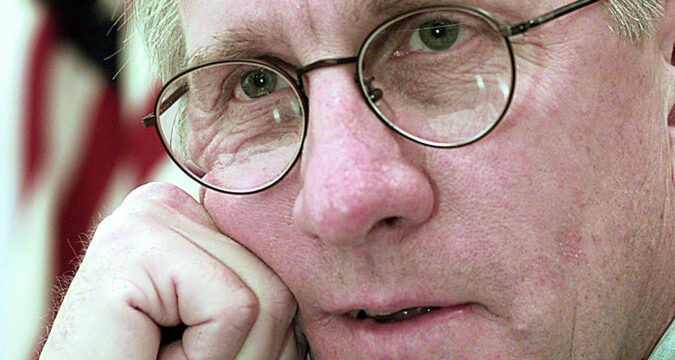
Gayle Franzen, longtime Illinois and DuPage County public servant who helped build I-355, dies at 81
Across nearly three decades of public service, Gayle Franzen led the Illinois Department of Corrections and the Illinois State Toll Highway Authority before he served one term as the DuPage County Board chairman.
While at the toll authority, Franzen worked with legislators to create a deal that paved the way for the funding and construction of Interstate Highway 355, the Veterans Memorial Tollway. As DuPage County Board chairman, Franzen worked to end long-standing rancor on the board while also reducing county residents’ property taxes.
“He enjoyed and understood the importance of public service, and really had the right perspective on things,” said former DuPage County Board Chairman Dan Cronin. “He always said how fortunate we were to be in a position to solve problems and help people and make the world a better place. He said what he meant, and he meant what he said. You could count on his word.”
Franzen, 81, died Tuesday at Lake Forest Hospital in Lake Forest after suffering a fall at his home and a resulting brain bleed, said his son Tim.
A Lake Forest resident since 2021, Franzen previously had lived in Chicago, Wheaton and Springfield.
Gayle Menke Franzen was born in Rantoul, Illinois, where he grew up on his parents’ farm and graduated from Rantoul High School. He spent two years at a junior college in Florida, where he played baseball, before transferring to Michigan State University.
At MSU, he got a degree in criminal justice and was the starting shortstop alongside a third baseman named Steve Garvey, who would go on to star as a first baseman for the Los Angeles Dodgers before going into politics himself.
After college, Franzen was hired as an investigator by the U.S. Attorney’s Office for the Northern District of Illinois, where he got to know then-U.S. attorney and future Illinois Gov. James R. Thompson. Franzen then took a job overseeing the correctional system in Pierce County, Washington.
In 1977, Thompson, by then elected governor, lured Franzen back to Illinois as a special adviser. Late in 1978, Thompson named Franzen the head of the beleaguered Illinois Department of Corrections. That agency had been under fire after a riot at Pontiac Correctional Center and because of inmate misconduct, inefficiencies and suspected collusion between inmates and guards at Stateville Correctional Center.
As state corrections director, Franzen ordered a shakedown at Stateville and fired two wardens at the facility in an effort to root out corruption. He also oversaw the construction of new prison facilities.
In early 1981, after a little more than two years into the job — a tenure that was generally well regarded, the Tribune wrote in 1986 — Franzen left the state Department of Corrections to become the Illinois State Toll Highway Authority’s executive director.
In that role, he championed legislation to authorize construction of I-355, the first new toll road built in more than a decade. In fact, within weeks of taking the job, Franzen informally proposed building a tollway instead of a freeway that had been on the drawing board for 20 years.
From there, Franzen worked to win the support of then-state Sen. James “Pate” Philip, the Republican chairman of DuPage County, and then-DuPage County Board Chairman Jack Knuepfer on the idea of the project as a tollway. Another powerful DuPage Republican, House Minority Leader Lee A. Daniels, also eventually agreed.
Even so, Franzen told the Tribune, there still were “a lot of naysayers, including in the governor’s office.”
“I got laughed at,” he recalled in 1986.
Ultimately, the project won approval amid a complicated compromise in which DuPage legislators offered help to the Chicago bloc in passing World’s Fair and McCormick Place bills in exchange for approval of the tollway, which opened in 1989.
DuPage County Board Chairman Gayle Franzen in 1998. (John Kringas/Chicago Tribune)
Franzen resigned from the toll authority in late 1984 to take a job in the private sector. He went into municipal bond finance as senior vice president of the firm L.F. Rothschild, Unterberg, Towbin, where he negotiated various municipal bond issues. He left Rothschild in 1987 and immediately joined the firm Donaldson, Lufkin & Jenrette in the same capacity.
Franzen’s private-sector work also included being one of seven investors in the first casino in Illinois, the Empress Riverboat Casino in Joliet.
While in the private sector, Franzen was named to the board of the Illinois Sports Facilities Authority — the public agency created to fund a new ballpark for the Chicago White Sox after the team’s threats to relocate to Florida. Ultimately, the agency funded a new Comiskey Park — now Rate Field — and Franzen left that board in 1990.
In 1989, Thompson named Franzen the part-time chairman of the Regional Transportation Authority. While with the RTA, Franzen lobbied for legislative approval in 1989 for a $1 billion capital investment program aimed at improving bridges, stations and rails.
Disappointed with the DuPage County Board’s direction, Franzen resigned as RTA chairman in 1993 to run for County Board chairman as a Republican in his first bid for elected office. He tapped lawyer and then-Wheaton City Councilwoman Linda Davenport, now a justice on Illinois’ 3rd District Appellate Court, to be his campaign’s treasurer, even though Davenport was and remains a Democrat.
“What you saw was absolute him — there was no pretense,” Davenport said. “He taught me so much about grace and not being afraid and to learn that in every situation, someone, somewhere, is going to teach you something. He also taught me to be fearless and to go for it. For someone like Gayle Franzen to be proud of you, that lifted me up and gave me courage.”
Franzen was elected County Board chairman in 1994, comfortably defeating then-County Board member Gwen Henry, former County Board member Judith Crane Ross and board member Robert Schroeder in the GOP primary. Then, with about 74% of the vote, he trounced Naperville Democrat Richard Owens in November.
As chairman, he drew praise for reducing friction among board members, promoting a longtime employee to be a county administrator who handled most of the day-to-day business, and cutting taxes four times in three years.
Franzen also lobbied for legislation in Springfield that separated DuPage’s forest preserve district from the County Board, starting in 2002. Before then, County Board members also had sat as forest preserve commissioners.
“Gayle was one of those people when you talked to him and he had an opinion, you could take it to the bank, because he knew what he was talking about,” said former DuPage County Board Chairman Robert Schillerstrom, whom Franzen appointed to the DuPage Water Commission’s board and who succeeded Franzen. “He had substantial experience on the state level and also the local level, and he also was a very skilled guy. He was like a walking resume.”
In October 1997, Franzen announced that he would not run for reelection as County Board chairman.
“I knew what I promised to do four years ago when I started running, and I had accomplished just about everything I had promised to do,” Franzen told reporters. “I guess in some respects, that’s been my history: to go into an agency — go into a unit of government — and turn it around and then look for something new to do.”
Two weeks after his announcement to not seek reelection as board chairman, Franzen announced a bid for the GOP nod for Illinois secretary of state in 1998. He changed his mind just one week later, telling reporters that he lacked the passion to run for higher office.
“I’ve had the power. I’ve done that. I don’t need the secretary of state to satisfy some ego,” Franzen told reporters at a news conference at a Lisle hotel. “I have always relished a fight. I like the competition. I like the battle. I knew when I got into the race that I would get a lot of heat. It wasn’t about that. It just wasn’t what I wanted to do. I didn’t have the passion.”
Later, the public learned the reason why: Franzen revealed in 1999 to then-WBBM-Ch. 2 reporter Carol Marin that he had been battling clinical depression for the past five years. By that point under a doctor’s care, Franzen said that there were days where all he had wanted to do was to lie on a couch. The purpose of his on-camera interview with Marin was to get the word out.
“I stayed private (about depression) and I shouldn’t have, because the right time to have done it was when I was in office,” he told her. “Then, it would have had a much greater impact, and would have been a much more honest approach than (not saying anything).”
With about eight months to go in his term, Franzen resigned as County Board chairman in April 1998 to become CEO of the West Chicago-based Harry W. Kuhn road-building firm.
He left that firm a year later and began focusing on commercial real estate development with his two sons. The trio worked together on a variety of projects in the western suburbs, including successfully building the Front Street Center project in downtown Wheaton.
Franzen retired from development work in 1994. He and his wife moved from Wheaton to Chicago around 2011.
Former Gov. George Ryan appointed Franzen to head the now-defunct Illinois Clean Energy Community Foundation, a six-member political panel created to oversee the distribution of hundreds of millions of dollars in utility-supplied environmental funds. Franzen left that panel in 2000.
Outside of work, Franzen enjoyed golfing, and was a member of the Chicago Golf Club in Wheaton from 1985 until 2010.
In addition to his son, Franzen is survived by his wife of 56 years, Peggy; another son, Craig; two grandchildren; two brothers, Gary and Todd; and a sister, Kathleen Swanson.
A visitation will take place from noon to 3 p.m. Thursday at Wenban Funeral Home, 320 Vine Ave., Lake Forest. A funeral mass will be held at 10:30 a.m. Friday at St. Patrick Catholic Church, 991 S. Waukegan Road, Lake Forest.
Bob Goldsborough is a freelance reporter.
https://www.chicagotribune.com/2026/03/07/gayle-franzen-obituary-dupage/

Now is the perfect time to prune your garden
I just purchased a new home and many of the shrubs in the backyard are overgrown. Is this a good time of year to cut them back?
— Glen Peltier, Oak Park
Pruning is my favorite gardening task by far. I prune plants that have gotten overgrown very aggressively, and I suspect that will be the best approach for you, too. Most gardeners are hesitant to prune hard enough to get good results. Overgrown plants have little value in your garden, so if they do not respond well to pruning, you will have an opportunity to add new plants to replace them. The dormant season is the best time of year to do this work, as healthy plants will respond with lots of new growth. I generally start this rejuvenation pruning in the middle of February and finish it before the shrubs start to grow in the spring. This date varies from year to year depending on the weather.
First, identify the shrubs in your garden to better understand how they might respond. Here are some general guidelines that should work for most shrubs. Start by removing large stems at ground level, especially if they have formed mature bark. A small folding hand saw is best for this task, and it will minimize damage to any remaining young stems. It is best to prune at ground level to avoid leaving stubs (which I often see in pruned shrubs). The remaining young stems will need to be cut back if they are spindly and flopping over. It is difficult to give exact height recommendations without seeing a picture of your shrubs, but you will probably end up cutting the remaining stems back to a height of 2 to 3 feet. Make the cuts at an angle 1/4 inch above a bud or side branch when possible. The goal is to encourage growth from the base of the plant, so err on the side of cutting the shrubs back lower than you think they should be. If you do not cut them back hard enough, you will end up with spindly growth rather than with a shrub that is densely branched from the base. This type of pruning is dramatic.
If your shrubs do not have young stems to work with, cut back the thick old stems to about 2 feet, just above the point where there is a young stem. This results in an ugly shrub, but there will be new growth from the old stems and base in most situations. There have been very few occurrences in which I did not get good results from this pruning approach. Since the goal is to remove most of the old stems, prune back thick remaining stems to new canes that develop lower on the stem over the next couple of years. Cut back to shorten any young stems that remain. Once you get these thick old stems to a couple of inches from the ground, you should be able to stop cutting them back, providing you have developed a good-looking shrub.
It’s OK to be much less aggressive when pruning most evergreen shrubs, trying not to cut beyond green foliage. Spreading yews respond to drastic pruning that goes into woody stems with no leaves, but they can be very slow to fill back in. The more aggressive the pruning, the longer it will take for yews to look good again. Plan on at least two to three years for yews to recover. Replacing severely overgrown yews may be the best strategy. Arborvitaes do not respond well to aggressive pruning.
Monitor these shrubs in spring and cut out any dead portions of stems. It is likely that you will have some follow-up pruning to do. Cut back any new growth that is shooting around the other stems to encourage the shrub to develop more densely. Spring-flowering shrubs like lilacs and viburnums that formed flower beds the previous year will not flower until next year. It may also be beneficial to fertilize your shrubs in spring and provide extra water during dry spells throughout the growing season.
For more plant advice, contact the Plant Information Service at the Chicago Botanic Garden at plantinfo@chicagobotanic.org. Tim Johnson is senior director of horticulture at the Chicago Botanic Garden.
https://www.chicagotribune.com/2026/03/07/garden-prune-winter-shrubs/

Letters: Mexico is fully prepared to host World Cup matches
I read the editorial “Mayor, call FIFA to snag World Cup if Guadalajara cartel problems prove insurmountable” (Feb. 24), which raises the possibility of relocating four FIFA World Cup 2026 matches currently scheduled to be held in Guadalajara, citing security concerns. I love that Chicagoans are embracing soccer, and I respect how much sports are an essential part of the city’s essence; however, in this case I have to say, not so fast, my friends!
On Feb. 22, Mexican Armed Forces carried out a successful operation in Jalisco that hit at the core one of the region’s most dangerous criminal organizations. In the immediate aftermath, isolated acts of violence followed the death of a high‑ranking criminal leader and the arrest of more than 70 members of this criminal group. Since then, the situation has stabilized, airports are fully operating and daily life has resumed across the affected areas.
The decisive action of the Mexican government is positive for families on both sides of the border who suffer the devastating consequences of the activities of these transnational criminals. This encouraging result is a testament to the heroism of Mexican forces, particularly of those who lost their lives in the line of duty, and reaffirms the effectiveness of ongoing cooperation between Mexico and the United States, including the intelligence‑sharing that supported the operation. This is exactly what works when combating an international violent threat to our communities: collaboration.
Mexico is fully prepared to host an exceptional tournament, one that will allow fans from around the world to celebrate the unifying power of soccer, as FIFA President Gianni Infantino recently stated. As always, Mexicans will rise to the occasion with efficiency, creativity and fun, to make sure all attendees feel safe and successfully enjoy every match of the 2026 World Cup.
The ties between Chicago and Mexico run deep culturally, economically and, of course, through a shared passion for soccer. Today, more than ever, this trilateral World Cup offers an opportunity not only to celebrate sports, but also to recognize the strength of friendship and collaboration between our two nations.
— Reyna Torres Mendivil, consul general of Mexico, Chicago, and dean, Chicago Consular Corps
Conversation with cabbie
I applaud Andy Shaw’s recent opinion piece (“Mexico, like Chicago, is more than just its worst headlines,” Feb. 28). My family visits Mexico yearly. We love the people, the culture and the beaches. We enjoy seeing the sights. One time while taking a taxi ride to Zihuatanejo, Mexico, the friendly cabdriver asked me where I was from.
“Chicago,” I replied. “Beautiful city,” he said. “Have you ever been there?” I asked. He turned his head and responded, “No, too dangerous.”
— Jim Wunderlich, Libertyville
Mexico a friendly place
I entirely agree with Andy Shaw’s piece about Mexico. My wife, dog and I flew into Puerto Vallarta recently on our way to our home in Sayulita. We had a smooth trip through the airport and on the highway to Sayulita and are enjoying Sayulita where there has been no violence.
Shaw is correct that the cartels are an issue in Mexico, but this latest outbreak was not directed at civilians or tourists. It rarely is. I have not seen a report of a tourist being injured related to it.
My wife and I founded a tuition-free preschool in Sayulita and live here more than half of the year. We also have traveled throughout Mexico. We have never experienced or witnessed any violence. People walk freely in Sayulita all hours of the night and day.
Mexico is a beautiful country with warm, wonderful people; fabulous culture; and delicious food.
Isn’t it time that the U.S. stop bullying a country we attacked and whose land we stole (in the Mexican-American War) and whose cartels get guns from us, cartels that sell the majority of their drugs to us?
We have traveled extensively around the world. Mexico is one of the friendliest countries on the globe.
— Lawrence Casazza, Glen Ellyn
Regulate robotaxis
The rise of robotaxis promises to reshape our streets, our safety and our communities. But if there’s one lesson we should have learned from the last transportation revolution, it’s this: When we let tech companies set the rules, the public pays the price.
Uber didn’t just change how we travel. It flooded streets with drivers, bypassed taxi regulations, undercut public transit and reshaped traffic patterns with limited oversight. The result: congestion, regulatory confusion, and many drivers and passengers left vulnerable.
We cannot afford to make the same mistake with robotaxis.
Autonomous vehicles are being deployed in cities across the country, and they’re being tested in Chicago. And while Silicon Valley tech giants promise convenience and innovation, they rarely talk about who bears the cost when something goes wrong. And make no mistake — things will go wrong.
Robotaxis still struggle with complex real-world situations: navigating unpredictable pedestrians, interpreting construction zones and reacting to erratic human drivers. Cities need proactive safety standards before these cars hit the streets. This means mandatory testing, transparent reporting of crashes and “near misses,” and substantial penalties for noncompliance.
When an autonomous vehicle causes a crash, who pays? Current ride-share insurance minimums already leave many victims undercompensated and confused. With robotaxis, the uncertainty only increases — liability could be shifted between the software company, the vehicle manufacturer or some other corporate entity, leaving injured people caught in the middle.
If these crashes are treated as product liability cases, victims will face longer, more expensive battles against well-funded corporations just to recover basic medical expenses. Lawmakers should act now to require strong insurance minimums and clearly assign responsibility, treating autonomous vehicle crashes as standard motor vehicle claims handled through ordinary auto insurance — not complex product litigation.
We can’t sit idly by and let tech companies dictate the terms. The decisions made today will determine whether autonomous vehicles improve public safety — or undermine it.
Public officials, regulators and community advocates must demand that these companies come into our cities on our terms, not theirs. Because once robotaxis take over the roadways, we won’t get a second chance to set the rules.
— Bryant Greening, attorney and co-founder, LegalRideshare LLC
Submit a letter, of no more than 400 words, to the editor here or email letters@chicagotribune.com.
https://www.chicagotribune.com/2026/03/07/letters-030726-mexico-fifa/
What ever happened to the 7 buildings on Preservation Chicago’s 1st Endangered Buildings list?
Preservation Chicago has highlighted historical places or objects — including churches, schools, warehouse districts and even wooden double-hung windows — since 2002 that could be lost to demolition if action is not taken to restore them.
There are more than 100 locations considered endangered by the architectural conservation group. Some have been highlighted multiple times during the past two decades.
Here’s a look back at the seven sites initially highlighted by the organization as threatened — and their most recent status.
Chicago Mercantile Exchange
Preservation groups expressed outrage in March 2002 that the former Chicago Mercantile Exchange Building at the northwest corner of Franklin and Washington streets in the Loop could be razed. (Bill Hogan/Chicago Tribune)
300 N. Franklin St.
Preservation Chicago staged a half-dozen anti-demolition protests at the 1927 Beaux-Arts style, 17-story building in 2002, so it was no surprise when it topped the group’s inaugural list. Dubbed the “Butter and Egg building” when it opened, the structure featured bronze elevator doors decorated with scenes from agricultural life — milking, churning butter, feeding chickens — that reflect its role as the place where farmers’ products were steered to the nation’s consumers.
The former Chicago Mercantile Exchange building at Franklin and Washington streets was designed by Alfred S. Alschuler. (Bill Hogan/Chicago Tribune)
The Crown family bought the building in the late 1940s, and in 1972, the Merc moved operations to 444 W. Jackson Blvd. It moved again in 1982, to 30 S. Wacker Drive.
A demolition permit was issued in February 2002 for the Merc, which was designed by Chicago architect Alfred S. Alschuler. His London Guarantee Building, 360 N. Michigan Ave. — which has been home to the LondonHouse Chicago hotel since 2016 — was designated a city landmark in 1996.
Demonstrators each hold a letter spelling out, “SAVE THE MERCANTILE EXCHANGE BUILDING,” as they wrap around the corner at Franklin and Washington streets on July 5, 2002. (Chuck Berman/Chicago Tribune)
Current status: The building was torn down in 2003, but Preservation Chicago still considered its efforts to protect the building a win. An ordinance was passed the same year requiring a 90-day warning before a demolition permit could be issued for buildings rated orange or red, the two highest categories on a local historic survey.
“You can characterize the Merc as the martyr child for preservation reform in the city of Chicago. … It died so that others could live,” group President Jonathan Fine told the Tribune in early 2003. “It hammered home … how grossly overdue landmark reform was.”
The site is now an empty lot.
Cook County Hospital
Exterior of the old Cook County Hospital on March 12, 2003. (Terrence Antonio James/Chicago Tribune)
1825 W. Harrison St.
Cook County Hospital was designed in the Classic Revival style by Paul Gerhardt, a German American architect who also planned Lane Tech College Prep. The migrants and the poor were treated inside the two-block-long structure nicknamed Chicago’s Ellis Island, which also was the site of the first blood bank in the United States, founded by immigrant Hungarian doctor Bernard Fantus.
The building’s facade and interior was the inspiration for the TV show “ER” and used in 1993’s movie “The Fugitive” starring Harrison Ford.
The operation theater, neglected for many years, awaits renovation at the former Cook County Hospital. (Antonio Perez/Chicago Tribune)
Once among the largest hospitals in the country, the building was slated for demolition in 1994 by the Illinois Medical District. The then-88-year-old building was shuttered in December 2002 when the gleaming $623 million, 464-bed John Stroger Hospital replaced it.
“It seemed like Chicago would repeat the civic barbarity it committed in the early 1970s when it allowed the destruction of Dankmar Adler and Louis Sullivan’s Chicago Stock Exchange Building,” Tribune critic Blair Kamin wrote.
The exterior of the former Cook County Hospital on May 20, 2020. (Antonio Perez/Chicago Tribune)
Current status: After sitting vacant for more than a decade, county officials selected the Civic Health Development Group to remake the hospital and surrounding land in the Illinois Medical District.
“Their combined work has the building’s exterior, made of granite, brick, limestone and terra cotta, looking sharper and cleaner than it has in decades,” Kamin wrote. “More than 4,500 pieces of terra cotta have been replaced — roughly 2,800 more than anticipated. (The developers had enough in their contingency fund to pay for the extras.) Naturalistic details, including sculpted versions of grapes, emerge as if we’ve never seen them before.”
The lobby at the former Cook County Hospital on May 20, 2020. (Antonio Perez/Chicago Tribune)
The multiphase $1 billion redevelopment — that included two hotels, a food hall, day care center and medical offices — reopened in 2020.
Lower River North Historic District
A view down Illinois Street at Wabash Avenue on Oct. 29, 2009. (Nancy Stone/Chicago Tribune)
Area bounded roughly by Carroll Avenue to the south, Grand Avenue to the north, Franklin Street to the west and Wabash Avenue to the east.
Though this grouping of Victorian buildings was not in immediate danger, Preservation Chicago sought to protect them due to the possibility of the commercial area’s structures being torn down for redevelopment. This defined area of structures built between the 1870s and the 1930s was already surrounded by high-rises.
“Many of Chicago’s cherished architects are represented within this district,” according to a release from the group. “Lower River North illustrates the crucial development of Chicago commerce and industry during its significant stages of growth, as reflected by its various building types, styles and sizes.
“In no other part of Chicago can one examine the growth of medium-sized commercial architecture during the critical periods immediately following the (Great Chicago Fire).”
Current status: Though Ald. Brendan Reilly, 42nd, explored creating a landmark district in 2007, no action has been taken.
Metropolitan (Apostolic) Community Church
Metropolitan Community Church, at 41st Street and South King Drive, was built in the late 1880s by John T. Long. The church was scheduled for demolition in 2003, but was granted landmark designation in late 2006. (Milbert O. Brown/Chicago Tribune)
4100 S. King Drive
Not just a house of worship, this church also played an important role in African American history. Metropolitan Church has served as the organizational home to civil rights demonstrators and Black labor unions, most notably the Brotherhood of Sleeping Car Porters founded by A. Philip Randolph. Its membership rolls are a who’s who of the Black community, including journalist Ida B. Wells, Chicago Defender founder Robert Sengstacke Abbott and Gwendolyn Brooks, Illinois poet laureate and the first Black person to win a Pulitzer Prize.
First lady Eleanor Roosevelt spoke from the church’s pulpit on March 29, 1943, telling those gathered that the right of all people to be considered equal must be preserved in the country’s post-World War II efforts.
“It’s so senseless,” Johnnie Richardson, a parishioner of Metropolitan Community Church since 1930, said on Oct. 29, 2002. The historic building located on the southwest corner of 41st Street and King Drive in Chicago was suggested for demolition in 2002, but named a landmark by the city in 2006. (Scott Strazzante/Chicago Tribune)
Yet in early 2003, a minister from another congregation wanted to buy the building and tear it down. Preservation Chicago and the Landmarks Preservation Council of Illinois both listed the Romanesque house of worship with distinctive variegated reddish-brown stonework on their endangered lists.
Current status: The church was granted landmark status by the city’s Commission on Chicago Landmarks in December 2006, and officially designated a landmark on July 19, 2007.
New York Life Building
The exterior of the New York Life Building, 37-43 S. LaSalle St. Chicago, on Oct. 24, 2002. (Chuck Berman/Chicago Tribune)
Entrances at 122 W. Monroe St. and 39 S. LaSalle St.
The 14-story Classical Revival-style building made Preservation Chicago’s list in 2003 and 2006, and the Landmarks Preservation Council of Illinois’ list in 2004. It was designed in the late 1890s and built in stages by prominent architect William LeBaron Jenney, who also gave the city its first skyscraper — the Home Insurance Building. That building was torn down in 1931, but the New York Life Building still represented one of the city’s early high-rises a block away.
Law journals are shelved at the Volume 39 bar in The Gray Hotel at 39 S. LaSalle St., Chicago. (John J. Kim/Chicago Tribune)
Current status: The building faced becoming partially or fulled torn down in June 2006 — despite being granted preliminary landmark status — but ultimately became the fifth adaptive reuse project by Kimpton Hotel & Restaurants in Chicago.
The Gray Hotel opened in 2016 after a $106 million transformation.
Architectural detail in the lobby leading up the twin grand stairs to the Kimpton Gray Hotel in Chicago on Jan. 12, 2017. (Antonio Perez/Chicago Tribune)
“Interior highlights include the palatial LaSalle Street lobby, a showcase of gray marble (another source of inspiration for the building’s name),” Kamin wrote after a tour of the new hotel. “Twin grand stairs, a coffered ceiling and elegant archways reflect the influence of the ‘White City,’ the neoclassical World’s Columbian Exposition in 1893, a year before the New Life Building opened.”
St. Boniface Church and related buildings
St. Boniface Church, 1358 W. Chestnut St., Chicago, on July 27, 2016. (José M. Osorio/Chicago Tribune)
1358 W. Chestnut St.
The Catholic sanctuary in West Town was among almost 40 churches cited for closure in January 1990 as part of Cardinal Joseph Bernardin’s financial plan to reverse an operating deficit. Tribune reporter Michael Hirsley called the effort “one of the most drastic shakeups ever in the nation’s second-largest archdiocese.” Debt and low attendance were the reasons given for why the churches were targeted.
Detail of St. Boniface Church, 1358 W. Chestnut St., Chicago, on July 27, 2016. (José M. Osorio/Chicago Tribune)
The congregation was originally organized in 1864 and housed in a wood-frame structure. It survived the Great Chicago Fire and provided refuge for people displaced by the blaze.
The brick Romanesque Revival edifice was designed by architect Henry J. Schlacks, who also built other churches around Chicago. Motorists might recognize its four bell towers, which are visible near the Kennedy Expressway.
Long vacant, St. Boniface was highlighted by Preservation Chicago in 2003, 2004 and 2009.
The bell tower deck looks out to the Chicago skyline on Oct. 3, 2025, in a penthouse in The Residences at St. Boniface in Chicago’s West Town neighborhood. (Dominic Di Palermo/Chicago Tribune)
Current status: Several attempts to demolish the church were halted. Chicago developer ZSD transformed the church and surrounding property into 42 housing units, which opened in June 2025.
A Bocci glass sculpture with 37 glass spheres hangs above the living room in a penthouse on Oct. 3, 2025, at The Residences at St. Boniface in Chicago’s West Town neighborhood. (Dominic Di Palermo/Chicago Tribune)
The first phase focused on transforming the church into 18 housing units. The second phase added eight units in an adjacent building, and a third phase added 17 additional condos in a new structure next door.
With more than 30 church properties listed for sale by the Archdiocese of Chicago alone, more conversions to housing are likely.
Zepf’s Hall
Members of Preservation Chicago, from left, Ron Ernst, William Buster and Dia Cirillo, make a presentation on Oct. 24, 2002, on preserving seven places in Chicago they say are threatened. (Chuck Berman/Chicago Tribune)
630 W. Lake St.
Though built in 1882, the architect for this Italianate structure is unknown. Yet it remains the only building still standing from the May 4, 1886, labor demonstration at Haymarket Square.
Current status: Japanese American cocktail bar Kumiko — which won Outstanding Bar at the 2025 James Beard Restaurant and Chef Awards — is at the Near West Side address.
Subscribe to the free Vintage Chicago Tribune newsletter, join our Chicagoland history Facebook group, stay current with Today in Chicago History and follow us on Instagram for more from Chicago’s past.
Have an idea for Vintage Chicago Tribune? Share it with Kori Rumore and Marianne Mather at krumore@chicagotribune.com and mmather@chicagotribune.com
https://www.chicagotribune.com/2026/03/07/preservation-chicago-endangered-buildings-list/
Residentes cerca de edificio de ICE en Portland logran orden que limita uso de gas lacrimógeno
Por CLAIRE RUSH
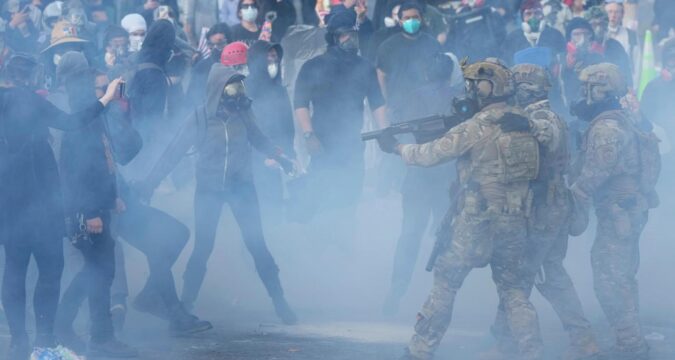
PORTLAND, Oregon, EE.UU. (AP) — Una jueza federal en Oregon limitó el viernes el uso de gas lacrimógeno por parte de agentes federales durante protestas en un edificio federal de inmigración en Portland, como parte de una demanda presentada por un complejo de viviendas asequibles contiguo tras meses de exposición repetida.
La jueza de distrito Amy Baggio dictó la orden judicial preliminar tras una audiencia celebrada el mes pasado en la que residentes del complejo describieron síntomas físicos y psicológicos que iban desde dificultad para respirar, tos, ardor en los ojos y urticaria, hasta ansiedad y ataques de pánico. Algunos declararon que usaban máscaras antigás en sus propias casas.
El caso coincide con la creciente preocupación por el uso de tácticas agresivas de control de multitudes por parte de agentes federales, mientras en ciudades de todo el país se convocaron manifestaciones contra la campaña migratoria impulsada por el gobierno del presidente Donald Trump.
En su opinión, Baggio señaló que el caso no trataba sobre los derechos de los manifestantes, sino sobre las denuncias de los residentes en el edificio de apartamentos Gray’s Landing de que el uso de municiones químicas por parte de agentes federales durante las protestas “ha sido tan excesivo, tan envolvente, que viola los derechos de los demandantes”.
“La Corte reconoce que una orden judicial preliminar es un remedio extraordinario, pero este es un caso extraordinario”, escribió.
Su orden prohíbe a los agentes el uso de municiones químicas en cantidades que probablemente alcancen Gray’s Landing, que está en la esquina opuesta a las instalaciones del Servicio de Inmigración y Control de Aduanas de Estados Unidos (ICE, por sus siglas en inglés), a menos que sea necesario para responder a una amenaza inminente contra la vida.
En otra demanda presentada por ACLU Oregon en nombre de manifestantes y periodistas independientes, un juez emitió una orden de restricción temporal que limita el uso de gas lacrimógeno por parte de los agentes durante las protestas en el edificio. El magistrado está valorando si concede una orden judicial preliminar en ese caso.
El administrador del edificio residencial y varios de los inquilinos denunciaron al gobierno federal en diciembre alegando que el uso de municiones químicas viola el derecho de los residentes a la vida, la libertad y la propiedad al enfermarlos, contaminar sus apartamentos y confinarlos en el interior.
“Esta decisión protege la salud y la seguridad básicas y el derecho a vivir en el propio hogar sin temor a que el gobierno use armas químicas”, señaló Skye Perryman, presidenta y directora ejecutiva de Democracy Forward, una organización legal sin fines de lucro que representa a los demandantes, en un comunicado el viernes. “Los residentes no deberían resultar perjudicados simplemente porque viven junto a un lugar de protesta pública”.
Los demandados, que incluyen a ICE y al Departamento de Seguridad Nacional y a sus respectivos jefes, sostienen que los agentes han desplegado dispositivos de control de multitudes en respuesta a protestas violentas en las instalaciones de la agencia en Portland, que ha sido escenario de manifestaciones durante meses.
Ni ICE ni el Departamento de Seguridad Nacional no respondieron a solicitudes de comentarios sobre el fallo.
Los demandantes presentaron una solicitud actualizada para medidas cautelares a finales de enero, después de que los agentes lanzaran gases contra una multitud que incluía a menores y que las autoridades locales describieron como pacífica.
De los 237 residentes del complejo de viviendas asequibles, casi un tercio tiene 63 años o más, según documentos judiciales. El 20% de los departamentos están reservados para veteranos con ingresos bajos y el 16% de los inquilinos se identifican como personas con discapacidad.
El gobierno indicó en documentos judiciales que, en ocasiones, los agentes federales despliegan dispositivos de control de multitudes en respuesta a grupos “violentos, obstructivos o que invaden propiedades” o que no cumplen con las órdenes de dispersión.
También rechazó las afirmaciones de que se hayan violado los derechos constitucionales de los inquilinos señalando que, según ese argumento, “los agentes federales y estatales del orden violarían la Constitución cada vez que desplieguen dispositivos aerotransportados de control de multitudes que, de manera inadvertida, se desplacen hacia la casa o el negocio de alguien, incluso si el uso de tales dispositivos es, por lo demás, completamente legal”.
La orden judicial preliminar estará en vigor mientras avanza la demanda.
___
Esta historia fue traducida del inglés por un editor de AP con la ayuda de una herramienta de inteligencia artificial generativa.
Today in Chicago History: Mayor Harold Washington halts cooperation with federal immigration authorities
Here’s a look back at what happened in the Chicago area on March 7, according to the Tribune’s archives.
Is an important event missing from this date? Email us.
Chicagoland front page flashback: March 8, 2019
Former Ald. Edward Vrdolyak, center left, leaves the Dirksen U.S. Courthouse on March 7, 2019, after pleading guilty to a federal tax evasion charge. (José M. Osorio/Chicago Tribune)
2019: Former Chicago Ald. Edward Vrdolyak pleaded guilty to a federal tax evasion charge stemming from millions of dollars in payments he received from the state’s massive settlement with tobacco companies in the 1990s.
The Dishonor Roll: Meet the public officials who helped build Illinois’ culture of corruption
Weather records (from the National Weather Service, Chicago)
High temperature: 78 degrees (2000)
Low temperature: Minus 2 degrees (1943)
Precipitation: 1.15 inches (1872)
Snowfall: 10.9 inches (1931)
The State of Illinois seal in the new First Appearance Court, formerly called Bond Court, at the DuPage County Courthouse in Wheaton on Dec. 27, 2022. (Mark Black / for the Chicago Tribune)
1867: The state seal of Illinois was authorized by the General Assembly, but not used until Oct. 26, 1868. It was designed by Illinois Secretary of State Sharon Tyndale and that office remains the keeper of the seal.
Tyndale sought to change the state motto from “State Sovereignty, National Union” to “National Union, State Sovereignty” after the Civil War. He was rebuffed by the Republican-dominated Illinois Senate. Tyndale, however, got the last laugh when he later illegally redesigned the current Great Seal of Illinois, putting the word “Sovereignty” upside down and positioning more prominently the words “National Union.”
The state seal has changed several times since 1868, but Tyndale’s design has not. Tyndale was shot and killed in April 1871 while walking to the train station in Springfield. The Tribune called it, “One of the most shocking events that has ever occurred in this State.”
1896: An X-ray room was established at Mercy Hospital to take “shadowgraphs” of injuries and fractured bones.
Flashback: Mercy Hospital’s major milestones
“Experimenters in the city have received hundreds of applications from persons who wish foreign substances in their bodies located,” the Tribune reported.
Just when Chicago believed snow was finished for the season, the city was walloped with about 16 inches of snow in early March 1931. Tribune cartoonist Carey Orr summarized locals’ reaction to the unexpected snowstorm in two frames, which published on the front page of the March 9, 1931, edition of the Tribune. (Chicago Tribune)
1931: For the third consecutive year, the Chicago area experienced a historic snow event.
Chicago’s 10 largest snowfalls since 1886 — and how the Tribune covered them
Unlike the previous two years, however, the city was prepared for it. Overall 16.2 inches of snow — the seventh largest storm in the city’s recorded history — blanketed Chicago.
Cameras escorted Lena Phillips, 31, as she marked her first day as a “motorwoman” for the Chicago Transit Authority on March 7, 1975. (Chicago Tribune)
1975: Lena Phillips became the CTA’s first “motorwoman.”
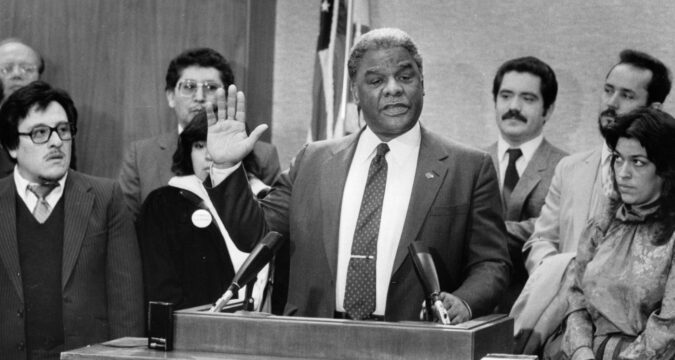
In signing an executive order on March 7, 1985, that ended the city’s practice of asking applicants about their citizenship status, Mayor Harold Washington told reporters, “The city government has and will work closely with those agencies to ensure that the public good is protected pursuant to law. We draw the line, however, in the actions of any agency that impinges on people’s fundamental human rights.” (Chicago Tribune)
1985: Chicago Mayor Harold Washington signed an executive order ending the city’s practice of asking job and license applicants about their U.S. citizenship and halting cooperation by city agencies with federal immigration authorities.
Want more vintage Chicago?
Subscribe to the free Vintage Chicago Tribune newsletter, join our Chicagoland history Facebook group, stay current with Today in Chicago History and follow us on Instagram for more from Chicago’s past.
Have an idea for Vintage Chicago Tribune? Share it with Kori Rumore and Marianne Mather at krumore@chicagotribune.com and mmather@chicagotribune.com
https://www.chicagotribune.com/2026/03/07/march-7-chicago-history/
Today in History: ‘Bloody Sunday’ in Selma for civil rights movement
Today is Friday, March 7, the 66th day of 2025. There are 299 days left in the year.
Today in history:
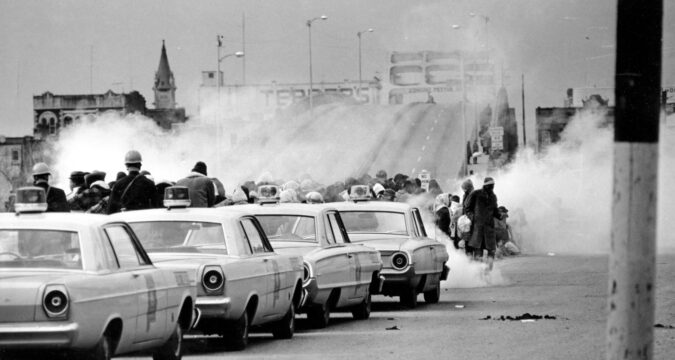
On March 7, 1965, a march by over 500 civil rights demonstrators was violently broken up at the Edmund Pettus Bridge in Selma, Alabama; state troopers and a sheriff’s posse fired tear gas and beat marchers with batons in what became known as “Bloody Sunday.”
Also on this date:
In 1876, Alexander Graham Bell received a U.S. patent for his telephone.
In 1936, Adolf Hitler ordered his troops to march into the Rhineland, thereby breaking the Treaty of Versailles and the Locarno Treaties.
In 1975, the U.S. Senate revised its filibuster rule, allowing 60 senators to limit debate in most cases, instead of the previously required two-thirds of senators present.
In 1994, the U.S. Supreme Court unanimously ruled that a parody that pokes fun at an original work can be considered “fair use.” (The ruling concerned a parody of the Roy Orbison song “Oh, Pretty Woman” by the rap group 2 Live Crew.)
In 2010, filmmaker Kathryn Bigelow became the first woman to win the Academy Award for Best Director, taking the prize for directing the film “The Hurt Locker.”
Related Articles
Package dated 1935 found in tusk of Aurora’s mastodon bones
Today in History: Oreo cookies introduced
Today in Chicago History: Chance the Rapper cuts CPS a $1 million check as ‘call to action’
Vintage Chicago Tribune: History of Hawthorne Race Course, the oldest horse-racing venue in Illinois
Today in Chicago History: John Belushi’s death in LA shocks his hometown
In 2024, armorer Hannah Gutierrez-Reed was found guilty of involuntary manslaughter in connection with the shooting incident on the set of the film “Rust” in 2021, which killed cinematographer Halyna Hutchins. (Gutierrez-Reed was later sentenced to 18 months in prison.)
Today’s birthdays: Hall of Fame auto racer Janet Guthrie is 87. Actor Daniel J. Travanti is 85. Entertainment executive Michael Eisner is 83. Football Hall of Famer Lynn Swann is 73. R&B musician Ernie Isley (The Isley Brothers) is 73. Actor Bryan Cranston is 69. Tennis Hall of Famer Ivan Lendl is 65. Singer Taylor Dayne is 63. Author E.L. James is 62. Author Bret Easton Ellis is 61. Comedian Wanda Sykes is 61. Actor Rachel Weisz is 55. Actor Peter Sarsgaard is 54. Actor Jenna Fischer is 51. Actor Tobias Menzies is 51. Actor Laura Prepon is 45. Poet Amanda Gorman is 27.
https://www.chicagotribune.com/2026/03/07/today-in-history-bloody-sunday/


