Category: News

Column: Ballot features unusual number of open federal seats
There’s nothing like an open Senate or congressional seat to bring out the candidates. Accompanying those crowded fields are loads of negative advertising.
Across Chicagoland, we’re seeing that happen as hopefuls vie for political plums. Most of that action is on the Democratic side and the sniping is getting downright churlish as we near the March 17 primary elections.
As journalist and author Allen Drury once observed, “Few people can hate one another with more cordial enthusiasm than a bunch of Democrats.” In the early days of the runup to voting on St. Patrick’s Day, there was sort of a collegial tone to debates and appearances among candidates seeking to move up the Illinois political ladder.
Prior to this month, they had a common enemy: President Donald Trump and his policies, which are anathema in this strongly blue state. That lasted for a while, and now they are turning on each other in several high-stakes primary contests.
Going at it hammer and tongs are 10 candidates who want to replace a pair of retiring octogenarian Democrats, U.S. Sen. Dick Durbin and 9th Congressional District Rep. Jan Schakowsky of Evanston.
In the Senate race, charges and counter-charges have escalated between U.S. Reps. Raja Krishnamoorthi of Schaumburg and Robin Kelly of South Suburban Lynwood, and Lt. Gov. Juliana Stratton over who does or doesn’t want to disband the U.S. Immigration and Customs Enforcement agency, and who has or hasn’t taken funds from Super PACs. They’ve also accused fellow candidates in a slew of expensive television campaign ads of accepting money from MAGA donors and not standing up to the Trump administration.
It’s only going to get muddier before the primary. Seldom do this many federal seats become available in an election year.
Indeed, it is historic to have this many political openings in the state at the federal level. Which is why the races are brimming with candidates.
Four congressional districts — the 8th, 2nd, 7th, and 9th — have open races without incumbents on the Democratic primary ballot. The 8th was held by Krishnamoorthi, the 2nd represented by Kelly and the 7th by long-time Congressman Danny Davis of Chicago, who decided to retire this election cycle.
The 8th has eight candidates, the 2nd has 10 candidates, and in the 7th, there are 13. In the 9th, 15 Democrats and four Republicans are seeking to replace Schakowsky.
The Chicago-centric district, like the 5th Congressional District, seeps into Lake County through a snake-like gerrymandered remap. In the county, the district includes the communities of Buffalo Grove, Barrington Hills, Hawthorn Woods, Island Lake, Lake Barrington, Long Grove, Port Barrington and Wauconda.
The seat has been solid Democratic since 1949, unparalleled in the state for one-party rule in a congressional district. That means whoever makes it out of the GOP primary — Rocio Cleveland of Island Lake, John Elleson of Arlington Heights, Paul Friedman of Chicago or Dongbo Mark Su of Chicago — has little hope of victory.
The last year the seat was open was in 1998 when incumbent Sidney Yates stepped down and Schakowsky won the primary and general election. One of her defeated primary opponents was JB Pritzker, now Illinois governor, who this year is seeking a third term as the state’s chief executive.
The 15 Democrats in the 9th District include some familiar names to voters, especially those in the Cook County portions of the district. Those include state Sen. Laura Fine of Glenview, Evanston Mayor Daniel Biss, state Sen. Mike Simmons of Chicago and state Rep. Hoan Huyh of Chicago. Others in the crowded field are making their first try for public office.
The primary also includes the rare opening for a statewide office, Illinois comptroller, where four Democrats, including Lake County Treasurer Holly Kim of Mundelein, want to replace incumbent Susana Mendoza, who decided not to seek re-election. Mendoza last week endorsed Kim for the job over state Reps. Margaret Croke of Chicago and Stephanie Kifowit of Oswego, and state Sen. Karina Villa of West Chicago.
These primary contests aren’t for the faint-hearted, as a flurry of last-minute attack ads soon will become prevalent on our TV screens. Negative campaigning, many will advise, works. In most cases.
After all, “politics ain’t beanbag” is the prevailing tenor in the rough-and-tumble political arena of Illinois elections.
Charles Selle is a former News-Sun reporter, political editor and editor. sellenews@gmail.com. X @sellenews.
https://www.chicagotribune.com/2026/03/09/charles-selle-column-primaries/

Fred Hoiberg agrees to a 3-year extension with Nebraska amid a record-setting season
LINCOLN, Neb. — Nebraska and men’s basketball coach Fred Hoiberg have agreed to a three-year contract extension after he guided the Cornhuskers to a school-record 15 Big Ten wins.
The school announced the deal Monday, a day before the conference tournament begins at the United Center with Nebraska as the No. 2 seed. Hoiberg is now under contract through the 2031-32 season. He previously signed a two-year extension in 2024.
“Fred has built this program step by step, and his leadership has Nebraska positioned to continue to compete at a high level in the Big Ten Conference and nationally,” athletic director Troy Dannen said in a statement. “Fred is one of the most respected coaches in the country by his peers, and his success has been recognized throughout the college basketball world.”
The Huskers, who have won 20-plus games in three consecutive seasons for the first time in school history, enter the Big Ten Tournament with a 26-5 record. They reached a program-best No. 5 national ranking in January.
“We have a long family history with the University of Nebraska, and the support we have received over the last seven years is truly remarkable,” Hoiberg said. “We are blessed with world-class facilities, but the people are what make Nebraska special. Our goal is to continue building a program that our fans can embrace and have pride in because it represents the values of Nebraska.”
https://www.chicagotribune.com/2026/03/09/nebraska-fred-hoiberg-extension/

Anthropic demanda al gobierno de Trump para anular designación
Por MATT O’BRIEN
Anthropic demandó al gobierno de Trump, pidiendo a los tribunales federales que anulen la decisión del Pentágono de designar a la empresa de inteligencia artificial como un “riesgo para la cadena de suministro” por su negativa a permitir un uso militar sin restricciones de su tecnología.
Anthropic presentó dos demandas separadas el lunes: una ante un tribunal federal en California y otra ante el tribunal federal de apelaciones en Washington, D.C.; cada una impugna distintos aspectos de las acciones del Pentágono contra la empresa.
El Pentágono designó formalmente la semana pasada a la empresa tecnológica de San Francisco como un riesgo para la cadena de suministro tras una disputa inusualmente pública sobre cómo podría utilizarse en la guerra su chatbot de IA, Claude.
“Estas acciones no tienen precedentes y son ilegales”, dice la demanda de Anthropic. “La Constitución no permite que el gobierno ejerza su enorme poder para castigar a una empresa por su expresión protegida. Ninguna ley federal autoriza las acciones tomadas aquí. Anthropic recurre al poder judicial como último recurso para reivindicar sus derechos y detener la campaña ilegal de represalias del Ejecutivo”.
El Departamento de Defensa declinó hacer comentarios el lunes.
Anthropic declaró que buscó restringir que su tecnología se utilizara para dos usos de alto nivel: la vigilancia masiva de estadounidenses y las armas totalmente autónomas. El secretario de Defensa, Pete Hegseth, y otros funcionarios insistieron en que la empresa debe aceptar “todos los usos legales” de Claude y amenazaron con castigos si la empresa no cumplía.
Designar a la empresa como un riesgo para la cadena de suministro impide el uso del trabajo de defensa de Anthropic, utilizando una autoridad que fue diseñada para evitar que adversarios extranjeros perjudiquen los sistemas de seguridad nacional. Es la primera vez que se sabe que el gobierno federal ha utilizado tal designación contra una empresa estadounidense.
El presidente Donald Trump también dijo que ordenaría a las agencias federales dejar de usar Claude, aunque le dio al Pentágono seis meses para eliminar gradualmente un producto que está profundamente integrado en sistemas militares clasificados, incluidos los utilizados en la guerra de Irán.
Incluso mientras combate las acciones del Pentágono, Anthropic ha buscado convencer a empresas y a otras agencias gubernamentales de que la sanción del gobierno de Trump es limitada y que solo afecta a los contratistas militares cuando están usando Claude en trabajos para el Departamento de Defensa.
Dejar clara esa distinción es crucial para la empresa porque la mayor parte de sus ingresos proyectados de 14.000 millones de dólares este año proviene de empresas y agencias gubernamentales que están usando Claude para programación informática y otras tareas. Más de 500 clientes están pagando a Anthropic al menos 1 millón de dólares al año por Claude, según una inversión que había valorado a la empresa en 380.000 millones de dólares.
___________________________________
Esta historia fue traducida del inglés por un editor de AP con ayuda de una herramienta de inteligencia artificial generativa.
El técnico de Irak pide a FIFA aplazar el repechaje por la guerra de Irán
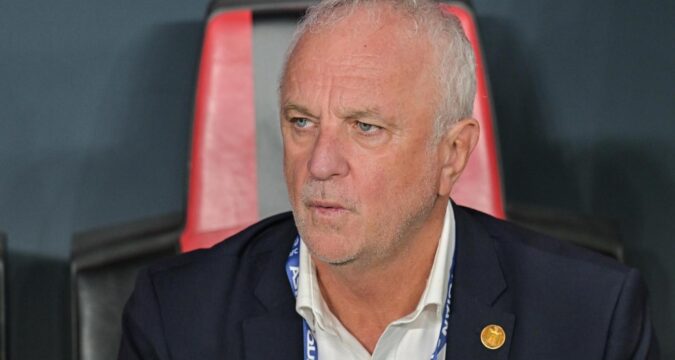
BAGDAD (AP) — El seleccionador de Irak, Graham Arnold, lanzó un llamado urgente a la FIFA para que posponga el repechaje intercontinental de su equipo para el Mundial debido a las interrupciones provocadas por la escalada de la guerra con Irán.
El plantel iraquí enfrenta importantes problemas logísticos antes de un repechaje a todo o nada contra Surinam o Bolivia, programado para el 31 de marzo en Monterrey, México.
Con el espacio aéreo iraquí cerrado hasta el 1 de abril debido a la intensificación del conflicto, el equipo de Arnold —integrado en su mayoría por jugadores de la liga local— no puede reunirse por completo.
Los jugadores no han conseguido visas para el torneo de repechaje en México debido al cierre de embajadas extranjeras, y Arnold está varado en los Emiratos Árabes Unidos a causa del conflicto.
“Por favor, ayúdennos con este partido porque ahora mismo estamos teniendo dificultades para sacar a nuestros jugadores del país, Irak”, dijo Arnold, exentrenador de la selección de Australia, a la agencia noticiosa Australian Associated Press.
La agitación ya obligó a posponer un campamento de entrenamiento previsto en Houston. Arnold señaló que alinear un equipo compuesto únicamente por jugadores que actúan en el extranjero no es una opción viable.
“No sería nuestro mejor equipo y necesitamos tener disponible a nuestro mejor equipo para el partido más importante del país en 40 años”, manifestó.
Arnold ha propuesto un aplazamiento estratégico del calendario del repechaje, al sugerir que la FIFA permita que Surinam y Bolivia disputen su partido preliminar este mes, pero que posponga el repechaje final hasta una semana antes de que comience el Mundial.
“En mi opinión, si la FIFA retrasara el partido, nos da tiempo para prepararnos adecuadamente”, comentó Arnold. “En mi opinión, también le da a la FIFA más tiempo para decidir qué va a hacer Irán”.
“Si Irán se retira, entramos al Mundial, y le da a Emiratos Árabes Unidos, a quien vencimos en la clasificación, la oportunidad de prepararse para enfrentar a Bolivia o a Surinam”, agregó. “El presidente de nuestra federación, Adnan Dirjal, está trabajando día y noche tratando de planificar y prepararse para hacer realidad el sueño de todos en Irak, así que necesitamos que esta decisión se tome rápidamente”.
___
Deportes AP: https://apnews.com/hub/deportes

New York’s Medicaid Program Under Federal Investigation For Alleged Fraud
New York’s Medicaid Program Under Federal Investigation For Alleged Fraud
Authored by Sylvia Xu via The Epoch Times (emphasis ours),
Dr. Mehmet Oz launched a federal investigation into New York’s Medicaid program on March 3, citing the unusual spending trend in the state.
“Heart surgeons are trained to look at the numbers. When something doesn’t add up, you don’t ignore it; you investigate,” Oz, administrator of the Centers for Medicare and Medicaid Services and a former heart surgeon, said in a video posted on X.
“Right now, the numbers coming out of New York’s Medicaid program don’t add up,” he said.
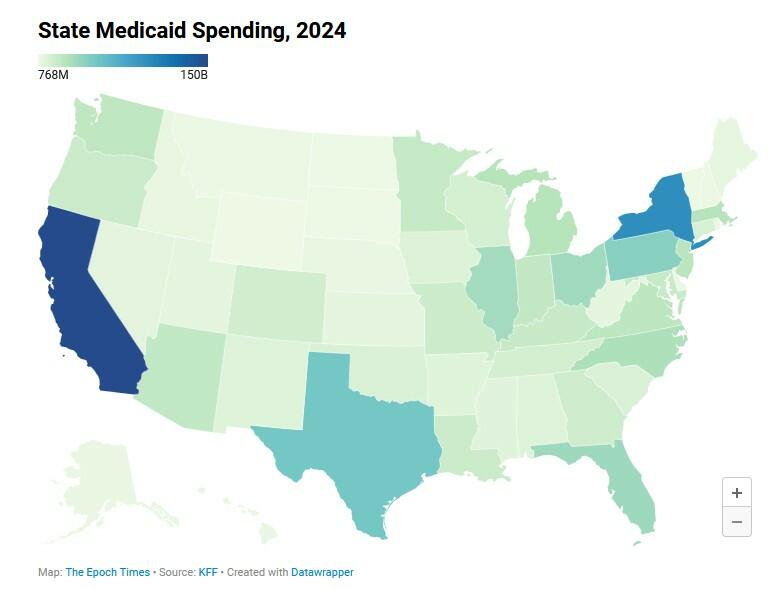
New York far outspends other states on its Medicaid program, both on a statewide and per beneficiary basis, according to Oz’s letter to New York Gov. Kathy Hochul.
Numbers
New York’s Medicaid program spends more than $90 billion a year, the second-highest total in the nation, Oz said. That’s roughly 10 percent of the nation’s $900 billion in Medicaid spending for 2024.
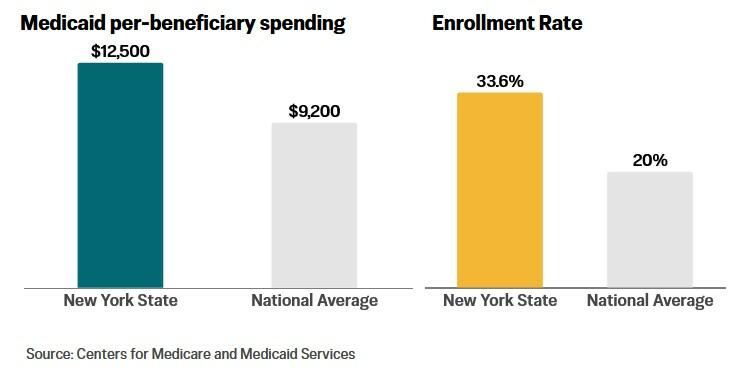
New York’s average spending on each beneficiary is more than $12,500, which is 36 percent higher than the national average. The state’s per-resident spending is the highest in the country, nearly 80 percent higher than the national average.
As of January, about one-third of New Yorkers—6.7 million individuals—have enrolled in Medicaid.
That is nearly 14 percentage points higher than the national average of 20 percent Medicaid enrollment, according to November data from the federal government.
“That alone demands scrutiny, but it gets worse,” Oz said in the video.
In addition to New York’s Medicaid enrollment size, Oz cited the workforce delivering long-term care, particularly home-based personal care services, as another driver of New York’s high Medicaid spending.
Between 2023 and 2024, 38 percent of job growth in New York was from the home health and personal care aide category.
“Now, New York has turned this [Medicaid] program to help our most vulnerable into a massive jobs program reimbursed by federal taxpayers,” Oz said.
Personal care services include daily living assistance such as eating, bathing, and dressing. Patients need such services due to aging, chronic illness, or disability.
From 2023 through mid-2025, New York state provided personal care services for nearly 75 percent of its Medicaid enrollees at a cost of $45 billion.
In fiscal year 2024, the state’s Medicaid spending on personal care services was $18.5 billion, nearly 70 percent more than other states’ combined spending on this item, according to The Epoch Times’ analysis of open data from the U.S. Department of Health and Human Services.
“That level of utilization is unheard of,” said Oz.
New York state allowed problems such as being “easily distracted” to qualify for a personal care system, making personal care services the number one occupation in the state, Oz said.
Demand for Documentation
He said officials must send documents on how they handle fraud, waste, and abuse, or their federal payments will be put on hold.
“We ask hard questions; we expect an honest answer,” Oz said.
On March 4, Gov. Hochul said the Trump administration was targeting New York for political reasons. She added that she would “show them the facts” to prove them wrong and promised to help fight any actual fraud, according to The Associated Press.
The federal government temporarily deferred $259 million in Medicaid payments to Minnesota over alleged fraud on Feb. 25.
Oz said the money would be released after Minnesota proposes and acts on a “comprehensive corrective action plan to solve the problem.”
Minnesota sued the federal government on March 2 to stop it from withholding funding. The state warned that freezing these funds could force cuts to medical care for low-income residents.
Tyler Durden
Mon, 03/09/2026 – 11:25

Man accused of brandishing knife and charging at police officers in St. Charles charged with attempted murder
A man has been charged with attempted murder after allegedly brandishing a knife and charging at police officers in St. Charles, police officials said.
At approximately 11:34 p.m. on Friday, officers from the St. Charles Police Department were dispatched to the area of East Main Street and Hunt Club Drive in St. Charles after a man was reported to be running in and out of the roadway toward vehicles, according to a press release from the department.
Arriving officers were immediately met by Licurgo Diazsandi, 23, homeless, the release stated. Officers initially attempted to speak with Diazsandi, however, police said he quickly brandished a knife and charged at the responding officers, according to the release.
One of the officers deployed a less-than-lethal Taser device on Diazsandi and struck him, while another fired his service weapon, but did not hit him, the release said.
Diazsandi was subsequently subdued and taken into custody by the officers, police said. Diazsandi was taken to Northwestern Medicine Delnor Hospital in Geneva, and later released into police custody, according to officials. One of the involved officers was also taken to another nearby hospital, per protocol, the release said.
The Kane County State’s Attorney’s Office approved several charges against Diazsandi, including attempted murder, armed violence, attempt to disarm a peace officer, aggravated assault to a peace officer with a weapon, criminal damage to government property and resisting a police officer, according to the release.
Diazsandi was transported to the Kane County Jail for a conditions/detention hearing, where he is currently being held, the release on Saturday said.
Anyone who might have information regarding the incident is asked to contact the St. Charles Police Department at 630-377-4435.
“Let Them Keep Playing Games”: Iran Warns Of $200 Crude Oil
“Let Them Keep Playing Games”: Iran Warns Of $200 Crude Oil
G-7 finance ministers are holding an emergency meeting on Monday morning to discuss options to cap skyrocketing energy prices, with Brent and WTI trading in triple-digit territory as the Middle East conflict threatens to unleash a global energy shock. As the U.S.-Iran conflict intensifies heading into the new week, the Islamic Revolutionary Guard Corps has warned of $200-a-barrel oil.
IRGC spokesman Ebrahim Zolfighari said on Monday that the U.S. has begun a new chapter in the conflict by targeting Iran’s energy infrastructure.
“If they can afford the price of oil at $200 per barrel, let them keep playing this game,” Zolfighari said in a video message posted by Al Jazeera on X.
“If they can afford the price of oil at $200 per barrel, let them keep playing this game.”
The spokesman for a wing of the IRGC, Ebrahim Zolfighari, says the US has opened a new chapter in the war by bombing Iran’s energy infrastructure. pic.twitter.com/UNy21beiAj
— Al Jazeera English (@AJEnglish) March 9, 2026
Over the weekend, Israeli strikes on major oil facilities around Tehran, combined with production shut-ins by major Gulf producers and IRGC retaliatory attacks on energy facilities across the Middle East, sparked panic in energy markets worldwide, with Brent crude briefly topping $119 per barrel in Asian trading.
On Friday, Goldman analyst Daan Struyven wrote four reasons why oil prices are moving higher:
Shipping has stopped. We estimate that shipments passing through the Strait of Hormuz are down 90% from normal, curtailing 18 mbpd from the global market (~18% of global oil).
Pipeline pressures. We estimate only about 25% of the theoretical redirection of oil in the Middle East through pipelines is currently being achieved, partly due to physical disruptions. We estimate only ~0.9 mbpd are incrementally coming to market through Middle East pipeline initiatives.
No quick shipping solutions. Our conversations highlight that most shippers are in a wait-and-see mode while physical risks in the SoH are high.
Demand destruction may be necessary. With no supply relief in sight, oil prices may need to go to demand-destruction levels even more quickly than history and simple models focusing on Persian Gulf exports alone suggest.
Goldman’s Rich Privorotsky commented on the speculation of SPR dumps, indicating:
Such a release would buy time. If the disruption proves temporary, a coordinated SPR release makes sense. If the disruption persists for months, those reserves might arguably be more valuable at higher prices or in a more acute shortage.
Additionally, energy economist Anas Alhajji warned UBS analysts last week about SPR limitations:
“The impact of the U.S. SPR is limited. Saudi Arabia is completely out of the picture. All of that spare capacity in OPEC is out of the picture. So what do we do? We are then left relying on demand destruction to curb”
Related:
JPMorgan’s New Hormuz Closure Math: Just 3 Days Until Commodity Chaos
What’s evident is that Operation Epic Fury, which initially focused on military, nuclear, missile, and IRGC sites, is now targeting economic high-value assets, with Iran’s Kharg Island now in focus (read).
Tyler Durden
Mon, 03/09/2026 – 11:05
https://www.zerohedge.com/energy/let-them-keep-playing-games-iran-warns-200-crude-oil

NFL free agency: Dallas Cowboys get edge rusher Rashan Gary in trade with Green Bay Packers
The Dallas Cowboys are acquiring edge rusher Rashan Gary from the Green Bay Packers in a trade just as NFL free agency opens, a person with knowledge of the deal told The Associated Press on Monday.
Dallas will send a 2027 late-round pick to the Packers, the person said.
The person spoke on condition of anonymity because the deal was still being finalized.
The Cowboys and Packers reached the deal just as free agents were being allowed to talk to teams and reach agreements on contracts that can’t be signed until the league year begins Wednesday.
The Miami Dolphins announced they are releasing Tua Tagovailoa, adding another big name at quarterback to a list of free agents that will include Kyler Murray, who is being let go by Arizona.
The Dophins made another move by agreeing to trade safety Minkah Fitzpatrick to the New York Jets for a seventh-round pick, according to a person familiar with the negotiations.
The Cowboys and Green Bay have agreed on a trade involving an edge rusher for the second year in a row.
A week before the season started last year, the Cowboys traded young star Micah Parsons, who immediately signed a $188 million, four-year contract with $136 million guaranteed. It was the richest contract for a non-QB in league history. The Cowboys also got defensive tackle Kenny Clark from Green Bay in the Parsons trade.
Gary was the No. 12 overall pick in 2019, two years before Parsons went to the Cowboys in the same draft spot. Gary had 7 1/2 sacks last season, but none in the final 10 games of an up-and-down year when the Packers were hoping the addition of Parsons would be a boost for Gary.
Parsons missed the final three games and a wild-card loss to the Chicago Bears after tearing the ACL in his left knee.
The 28-year-old Gary spent his first seven seasons with the Packers and had at least 7 1/2 sacks in four of the past five years. Gary, T.J. Watt and Myles Garrett are the only NFL players with at least 40 sacks, 100 quarterback hits, five forced fumbles and five fumble recoveries since 2020.
This trade caps an eventful few days for Gary. He had posted a farewell to Green Bay on Instagram in Friday — an indication the Packers were about to move on from him — but he deleted the post later that day.
The New York Giants are re-signing veteran tight end Chris Manhertz, keeping him and running back Devin Singletary among the offensive holdovers under new coach John Harbaugh.
The team last week also re-signed receiver/returner Gunner Olszewski, and 25-year-old Wan’Dale Robinson may depart in free agency after becoming just the third player since the 1970 AFL-NFL merger 5-foot-8 or shorter to eclipse 1,000 yards receiving in a season.
The Vikings kept one of their unrestricted free agents off the market by agreeing to terms on a new contract with 10th-year veteran linebacker Eric Wilson, a three-year deal valued at $22.5 million with $12.5 million guaranteed, according to the NFL Network.
Wilson, who returned to his original team last season, had career highs in tackles for loss (17), sacks (6 1/2), quarterback hits (10) and forced fumbles (four).

Madrid-Man City y PSG-Chelsea lideran octavos de Champions. Bodø/Glimt debuta
Por GRAHAM DUNBAR
Los octavos de final de la Liga de Campeones comienzan el martes con revanchas de alto voltaje, equipos que ponen fin a largas ausencias en esta fase y la historia inspiradora del debutante Bodø/Glimt.
El Paris Saint-Germain recibe el miércoles a un Chelsea que el pasado julio impidió que el campeón de la Liga de Campeones coronase la temporada con el título del Mundial de Clubes.
Por su parte, el Real Madrid recibe al Manchester City por segunda vez esta campaña y por quinto año consecutivo en las rondas de eliminación directa. En tres de esos años, el ganador terminó levantando el trofeo.
El Madrid-Man City también es uno de los tres cruces de octavos de final cuyos equipos ya se enfrentaron hace unos meses en la fase de liga inaugural.
En septiembre, Galatasaray venció a Liverpool en Estambul y Barcelona se fue de Newcastle con los tres puntos.
Galatasaray y Newcastle disputan partidos de la Liga de Campeones en marzo por primera vez en, respectivamente, 12 y 23 años. Atalanta recibe a Bayern Múnich cinco años después de haber alcanzado por última vez los octavos de final.
Bodø/Glimt puso fin a la espera de 29 años de Noruega por tener representación en una ronda tan avanzada del torneo desde que Rosenborg avanzó a los cuartos de final desde una fase de grupos más pequeña, de 16 equipos.
El conjunto noruego enfrentará Sporting de Lisboa en su campo de césped artificial dentro del Círculo Polar Ártico, donde tanto Man City como el Inter de Milán sucumbieron 3-1 en meses recientes.
La temperatura prevista al saque inicial es de 3 grados Celsius (37 Fahrenheit) en la localidad pesquera del mar de Noruega.
¿Mbappé vs. Haaland?
El equipo de Pep Guardiola ya ganó en el estadio Santiago Bernabéu en diciembre. Un penal de Erling Haaland antes del descanso sentenció una victoria 2-1. El astro merengue Kylian Mbappé se quedó en el banquillo.
Mbappé vuelve a ser duda para el miércoles por una distensión en la rodilla izquierda.
“Cada día va mejor… es un proceso en el que vamos a ir viendo sus sensaciones día a día”, dijo el técnico merengue Álvaro Arbeloa la semana pasada.
Hay seis días entre el partido de ida y el de vuelta en Manchester, aunque Mbappé y Haaland tienen otra oportunidad de enfrentarse esta temporada.
En el Mundial, Francia se las verá contra Noruega en la última jornada del Grupo I el 26 de junio en el estadio de los Patriots de Nueva Inglaterra, cerca de Boston.
Duelo de campeones
El PSG-Chelsea tiene el aire de una auténtica rivalidad de la Liga de Campeones, aunque han pasado 10 años desde que se enfrentaron en la competición.
También fue en octavos de final, cuando los entrenadores en 2016 eran Laurent Blanc y Guus Hiddink, respectivamente. Un PSG con Zlatan Ibrahimović ganó en casa y fuera en lo que fue el tercer año consecutivo en que los clubes se cruzaron en la fase de eliminación directa.
Su enfrentamiento más reciente, hace ocho meses, fue la sorpresiva victoria 3-0 de Chelsea —entonces dirigido por Enzo Maresca— en el estadio MetLife, cerca de Nueva York, impulsada por Cole Palmer.
El entrenador de Chelsea ahora es Liam Rosenior, quien comenzó la temporada como rival de PSG en la liga francesa al frente de Estrasburgo.
Historia de finales europeas
Solo uno de los ocho cruces de esta semana es una revancha de alguna final de la UEFA desde que la Copa de Europa comenzó en 1955. Pocos la recordarán.
La final de la Recopa de Europa de 1963 fue la victoria 5-1 de Tottenham sobre Atlético de Madrid, disputada en Róterdam. También es la única vez que se enfrentaron anteriormente.
Hay cierta familiaridad para Tottenham porque el estadio Metropolitano del Atlético es donde el club del norte de Londres perdió la final de la Liga de Campeones de 2019 contra Liverpool.
El Atlético ganó apenas uno de sus últimos 10 partidos en competiciones de la UEFA contra rivales ingleses, aunque el martes recibe al equipo que marcha 16to en la Premier League, en una temporada caótica.
Igor Tudor, el técnico interino de Tottenham, es el 12do estratega distinto contratado por el club, ya sea a tiempo completo o parcial, desde que el Atlético incorporó a Diego Simeone hace más de 14 años.
¿Un primer puesto desafortunado?
Terminar primero en la clasificación de 36 equipos no le salió bien hace un año a Liverpool, que fue eliminado en octavos de final por el PSG.
Arsenal lideró esta vez como el primer preclasificado y quedó emparejado en el cuadro con el Bayer Leverkusen, el 16to preclasificado que será local en la ida el miércoles. Bodø/Glimt es el equipo con la preclasificación más baja en esta ocasión después de colarse por poco en los playoffs de eliminación directa como 23ro.
___
Deportes AP: https://apnews.com/hub/deportes
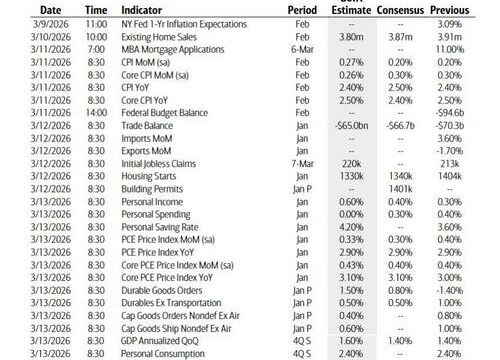
Key Events This Week: CPI, PCE, ADP, Durable Goods And More
Key Events This Week: CPI, PCE, ADP, Durable Goods And More
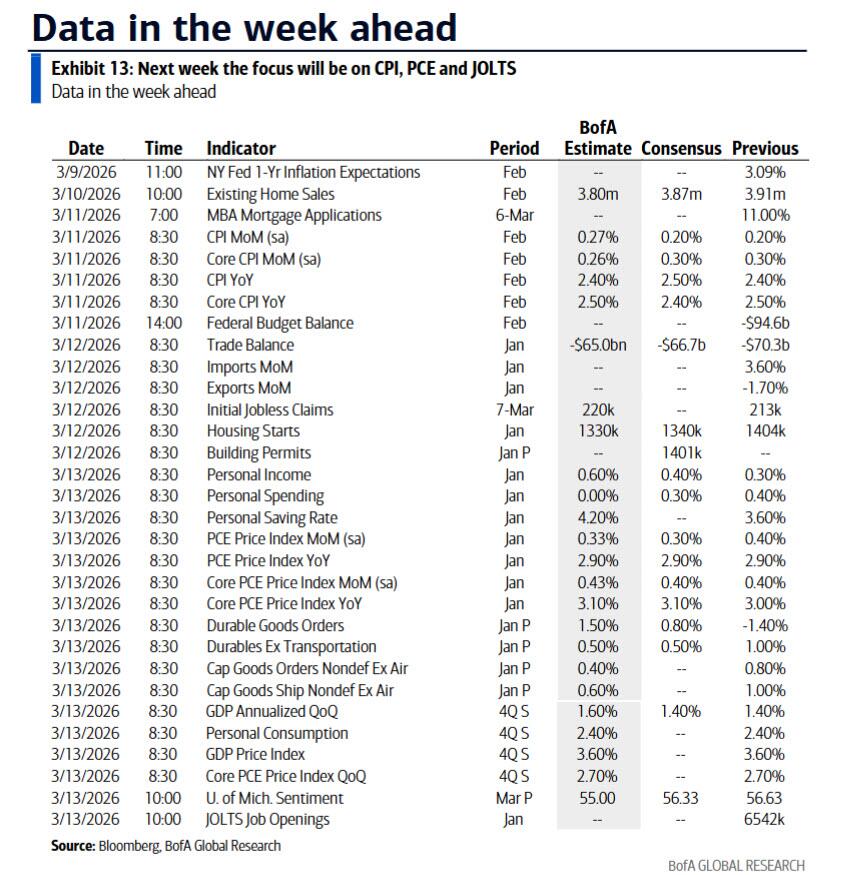
With the Fed in their self-imposed blackout period, the economic data will get a chance to do the talking ahead of the March 18th FOMC meeting. Of particular note will be the inflation data, namely Wednesday’s CPI report for February and Friday’s core PCE reading for January, but there will also be some scattered labor market data to help put context around last Friday’s disappointing February employment report. Of course, all of that assumes that traders can be dragged away from the latest Iran war headlines fro more than 5 minutes.
Turning to this week’s main event, the February CPI report will get top billing. DB’s expectations are for a 1.0% increase in energy prices to boost headline CPI (+0.27% forecast vs. +0.17% previous) relative to core (+0.24% vs. +0.30%). This translates to a year-over-year rate of 2.40% (vs. 2.39% previous), while the latter would tick down by 4bps to 2.46%. Within the CPI basket, DB looks for tariff-related strength in core goods, particularly apparel. In addition, recent gains in wholesale used car prices have the potential to begin adding to price pressures over the next couple of months. On the services side, expect more rental disinflation, though recent upward revisions to the repeat-rent indices suggest caution around the speed at which that can occur. Also look for payback from January’s particularly large increase in airfare prices, though recent moves in energy prices could add to airfares going forward.
Also of note on the inflation front this week will be Friday’s personal income (+0.4% forecast vs. +0.3% previous) and consumption (+0.1% vs. +0.4%) report for January, which will contain that month’s reading on core PCE, the Fed’s preferred inflation measure. Based on the January CPI and PPI data, DB is expecting a 0.42% increase (vs. +0.36%), which would take the year-over-year rate up a tenth to 3.1%. The Fed will have to wait until the morning of their March 18th meeting for the PPI data to get a more complete read on February’s core PCE. Based on our component-level CPI forecasts, our prior expectation is for a 0.18% February gain, which would have the year-over-year rate decline to 2.8%.
In terms of the labor market data, ADP’s weekly data on Tuesday covering the week of February 21st will provide an initial view on net hiring trends beyond February’s survey week. Similarly, Thursday’s jobless claims and Friday’s January JOLTs release will give additional context on gross labor market flows.
The remainder of the data this week will help forecasters sharpen their views on current quarter growth. Growth data will also feature. Revisions to the second estimate of fourth quarter GDP (Friday) will update the baseline from which to judge early 2026 momentum. Tuesday’s existing home sales (3.81mn vs. 3.91mn) for February and Thursday’s housing starts (1.325mn vs. 1.404mn) and permits (1.450 vs. 1.455mn) for January will provide an update on the residential sector. We will also get a preliminary look into the health of the factory sector with January’s durable goods orders (+0.4% vs. -1.4% headline / +0.4% vs. +0.8% core) on Friday as well.
Friday will also see the preliminary release of the University of Michigan survey for March. While DB expects a decline in sentiment (55.0 vs. 56.6), due to the recent hostilities in the Middle East, also important for the Fed will be consumers’ inflation expectations.
Over in Europe, the focus will be on the monthly GDP for January in the UK (Friday), German January factory orders and industrial production (today) and the trade balance (tomorrow), and February CPIs in Norway and Denmark (both tomorrow).
Rounding out with earnings, there will be reports from Oracle and Adobe in the US as well as Inditex, Rheinmetall, Volkswagen and BMW in Europe. Finally, the focus will be on the Saudi Aramco earnings tomorrow amidst the big rise in oil prices last week.
Fed reaction
The emergence of shale production in the US has helped to limit the impact of oil price spikes on the economy. Indeed, within the Fed’s FRB/US model, a $20/bbl increase in oil prices only increases unemployment by about 2bps and has almost no impact on core PCE inflation. However, with downside risks to the labor market while inflation has run above target for almost five years in a row, the response for the Fed to such a supply shock is not clear. Indeed, looking at the Fed’s prior responses to energy shocks does not yield a regular pattern (see “What does history tell us about the Fed’s response to oil price shocks?”). Sometimes, the Fed emphasized the threat to the inflation side of their dual mandate while other times, it sought to protect against any deterioration in the labor market.
In the current episode, with inflation expected to be on a downward trajectory, the market could give the Fed some leeway to “look through” another supply-side shock. That said, inflation has been too high for too long, and the latest data calls into question how much disinflation can reasonably be expected, especially if there are increases in measures of inflation expectations (e.g., Friday’s Michigan data). On the flipside, growth looks strong but there are concerns on a forward-looking basis, for example, due to the potential for AI to disrupt the labor market.
In summary, the February jobs report, as well as January’s, makes it clear that one month’s data should never be taken in isolation. San Francisco Fed President Daly made this point in the wake of last Friday’s release, noting that while February’s data gives her some concern, all the moving parts like the strike and the change in population controls make it harder to interpret.
While the more dovish members will likely point to the February employment report as justification for more policy support, the Committee, as a whole, will likely need more data to ascertain the underlying state of the labor market. We continue to expect the Fed to cut rates only once this year, should disinflationary pressures become clear in the second half of 2026. However, if February’s weakness is confirmed in subsequent months (not our base case), that could open a path to an earlier reduction
Courtesy of DB, here is a day-by-day calendar of events:
Monday March 9
Data: US February NY Fed 1-yr inflation expectations, China February CPI, PPI, Japan February Economy Watchers survey, bank lending, January labor cash earnings, BoP current account, trade balance, leading index, coincident index, Germany January factory orders, industrial production
Central banks: ECB’s Elderson speaks
Earnings: CATL, Constellation Software, HPE
Tuesday March 10
Data: US February NFIB small business optimism, existing home sales, China February trade balance, Japan February PPI, machine tool orders, M2, M3, January household spending, Germany January trade balance, France January trade balance, current account balance, Italy January PPI, Sweden January GDP indicator, Norway February CPI, Denmark February CPI
Central banks: ECB’s Simkus and Muller speak
Earnings: Saudi Arabian Oil, Oracle, Volkswagen, Partners Group
Auctions: US 3-yr Notes ($58bn)
Wednesday March 11
Data: US February CPI, federal budget balance
Central banks: Fed’s Bowman speaks, ECB’s Guindos and Schnabel speak
Earnings: Inditex, Rheinmetall, Telecom Italia
Auctions: US 10-yr Notes (reopening, $39bn)
Thursday March 12
Data: US January trade balance, housing starts, building permits, Q4 household change in net worth, initial jobless claims, UK February RICS house price balance, Canada January international merchandise trade, building permits
Central banks: Fed’s Bowman speaks, ECB’s Villeroy speaks
Earnings: Adobe, Generali, BMW, RWE, Dollar General
Auctions: US 30-yr Bond (reopening, $22bn)
Friday March 13
Data: US January PCE, personal income, personal spending, durable goods orders, JOLTS report, March University of Michigan survey, UK January monthly GDP, Germany February wholesale price index, January current account balance, Italy January industrial production, Canada January manufacturing sales, February labour force survey
Central banks: BoE inflation attitudes survey
Focusing on just the US, Goldman writes that the key economic data releases this week are the CPI report on Wednesday and the durable goods and core PCE reports on Friday. Fed officials are not expected to comment on monetary policy this week, reflecting the blackout period ahead of the March FOMC meeting.
Monday, March 9
No major economic data releases scheduled.
Tuesday, March 10
10:00 AM Existing home sales, February (GS +0.5%, consensus -0.8%, last -8.4%)
Wednesday, March 11
08:30 AM CPI (MoM), February (GS +0.18%, consensus +0.3%, last +0.2%); Core CPI (MoM), February (GS +0.17%, consensus +0.2%, last +0.3%); CPI (YoY), February (GS +2.34%, consensus +2.4%, last +2.4%); Core CPI (YoY), February (GS +2.42%, consensus +2.5%, last +2.5%): We estimate a 0.17% increase in February core CPI (month-over-month SA), which would lower the year-over-year rate by 0.1pp to 2.4% on a rounded basis. We expect softer autos inflation, reflecting a 0.5% decline in used car prices, a slight increase in new car prices (+0.2%), and a decline in the car insurance category (-0.3%). We expect a smaller contribution from travel services inflation (airfares: flat vs. +6.5% in January; hotels: +0.5% vs. -0.5% in January), reflecting signals from alternative price data. We forecast a benign increase in the shelter categories (rent: +0.22%, OER: +0.22%), reflecting a continued slowdown in their underlying trend. We expect unchanged medical services prices, reflecting a continued decline in medical insurance prices (-1.0%). We expect upward pressure from tariffs on categories that are particularly exposed (such as recreation) worth +0.05pp. We estimate a 0.18% rise in headline CPI, reflecting higher food (+0.1%) and energy (+0.5%) prices.
Thursday, March 12
08:30 AM Trade balance, January (GS -$63.0bn, consensus -$66.0bn, last -$70.3bn)
08:30 AM Initial jobless claims, week ended March 7 (GS 215k, consensus 215k, last 213k); Continuing jobless claims, week ended February 28 (consensus 1,850k, last 1,868k)
08:30 AM Housing starts, January (GS -2.0%, consensus -4.6%, last +6.2%)
Friday, March 13
08:30 AM Personal income, January (GS +0.6%, consensus +0.5%, last +0.3%); Personal spending, January (GS +0.3%, consensus +0.3%, last +0.4%); Core PCE price index, January (GS +0.39%, consensus +0.4%, last +0.4%); Core PCE price index (YoY), January (GS +3.07%, consensus +3.1%, last +3.0%); PCE price index, January (GS +0.30%, consensus +0.3%, last +0.4%); PCE price index (YoY), January (GS +2.85%, consensus +2.9%, last +2.9%): We estimate that personal income and spending increased by 0.6% and 0.3%, respectively, in January. We estimate that the core PCE price index rose 0.39% in January, corresponding to a year-over-year rate of +3.07%. Additionally, we expect that the headline PCE price index increased 0.30% in January, or increased 2.85% from a year earlier.
08:30 AM Durable goods orders, January preliminary (GS +1.0%, consensus +1.1%, last -1.4%); Durable goods orders ex-transportation, January preliminary (GS +0.5%, consensus +0.5%, last +1.0%); Core capital goods orders, January preliminary (GS +0.5%, consensus +0.5%, last +0.8%); Core capital goods shipments, January preliminary (GS +0.6%, consensus +0.5%, last +1.0%): We estimate that durable goods orders increased by 1% in the preliminary January report (month-over-month, seasonally adjusted), reflecting an increase in commercial aircraft orders. We forecast a 0.5% increase in core capital goods orders and a 0.6% increase in core capital goods shipments—the latter reflecting the increase in orders in the prior month.
08:30 AM GDP, Q4 second release (GS +1.6%, consensus +1.4%, last +1.4%); Personal consumption, Q4 second release (GS +2.4%, consensus +2.4%, last +2.4%): We estimate a 0.2pp upward revision to Q4 GDP growth to +1.6% (quarter-over-quarter annualized). Our forecast reflects a downward revision to business fixed investment growth based on softer software spending details in the quarterly services survey (QSS) that is more than offset by upward revisions to residential fixed investment and inventory accumulation. We estimate a modest upward revision to consumer spending that leaves the rounded Q4 growth rate unchanged at 2.4%.
10:00 AM University of Michigan consumer sentiment, March preliminary (GS 54.5, consensus 55.3, last 56.6): University of Michigan 5-10-year inflation expectations, March preliminary (GS 3.5%, last 3.3%)
10:00 AM JOLTS job openings, January (GS 7,000k, consensus 6,750k, last 6,542k)
Source: DB, Goldman
Tyler Durden
Mon, 03/09/2026 – 10:55
https://www.zerohedge.com/markets/key-events-week-cpi-pce-adp-durable-goods-and-more