Category: News
NY Fed: Inflation Expectations Dropped To 1 Year Low Ahead Of Iran War Amid Improving Household Finances
NY Fed: Inflation Expectations Dropped To 1 Year Low Ahead Of Iran War Amid Improving Household Finances
While the latest NY Fed consumer expectations report shows sentiment from February, and does not account for the surge in oil prices as a result of the Iran war, the trend continues to be supportive which would be good news for the US economy if the current energy price spikes proves to be transitory.
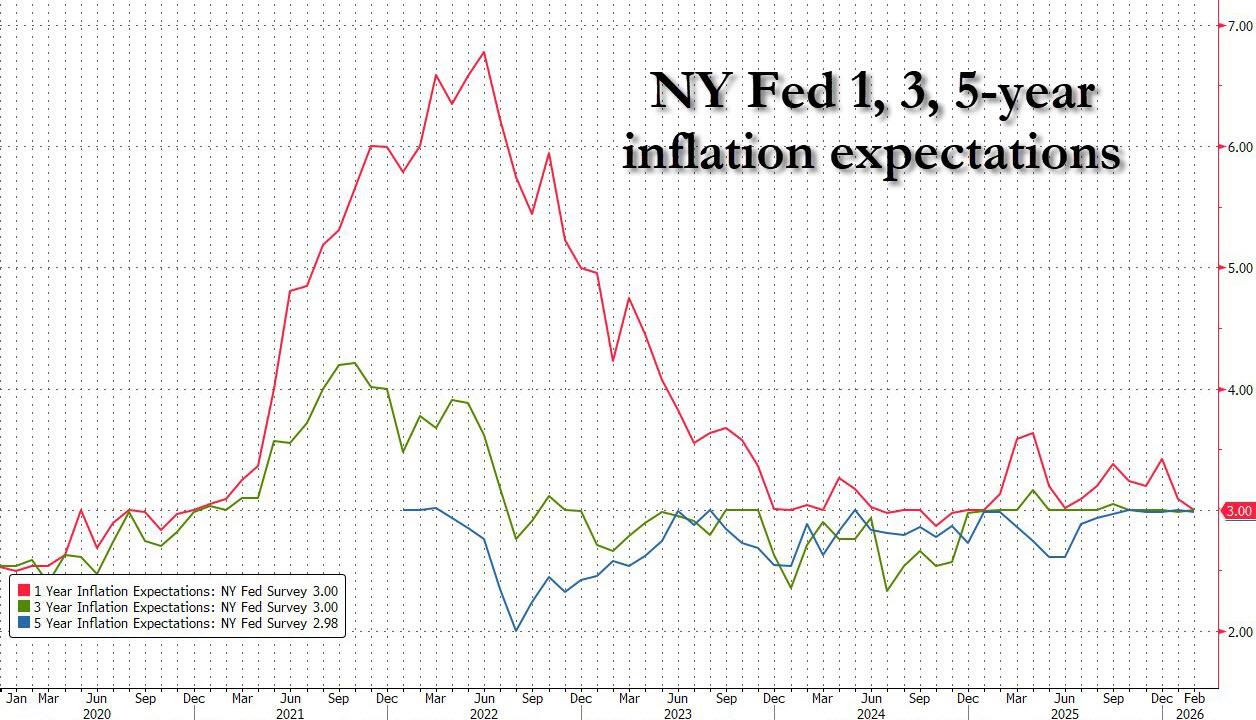
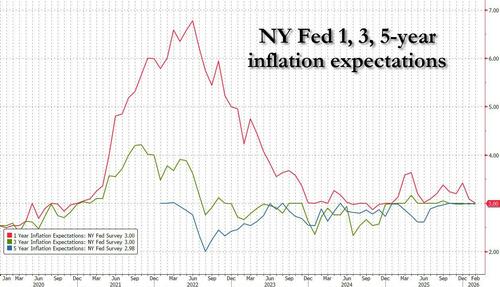
In what was the calm before the Persian Gulf storm, Americans’ inflation expectations eased further back in February amid mixed views on the state of the job market and current and future finances. Specifically, the expected level of inflation a year from now dropped to 3% from 3.1% in January, and the lowest since the start of 2025 while the projected level of inflation three and five years from now held steady at 3%.
The New York Fed survey, released Monday, was conducted between February 2-28. As such, it does not capture the public’s reaction to surging oil prices that are the result of the Iran war, which has massively disrupted global energy supplies and sent crude over $100.
Huge increases seen thus far in energy prices are almost certain to drive up already high levels of overall inflation and stand a good chance of pushing the public toward a less benign view on the outlook for price pressures over coming years, assuming the price increase sticks and there is no prompt resolution to the war.
That would present a challenging environment for the Fed, which has been contending with high levels of inflation for years, the result of its post-covid policy error which has pushed inflation above the Fed’s 2% target for 60 moinths. Officials agree that where price pressures are expected to go exerts a strong influence on where they stand now, so if the oil shock creates expectations of higher price pressures, that could complicate efforts to get inflation back to target. Then again, the Fed has traditionally ignored one-time shocks which suggests that the Iran shock will only matter if it lasts a longer period of time. Earlier today, we pointed out that according to the Fed’s FRB/US model, a $20/bbl increase in oil prices only increases unemployment by about 2bps and has almost no impact on core PCE inflation
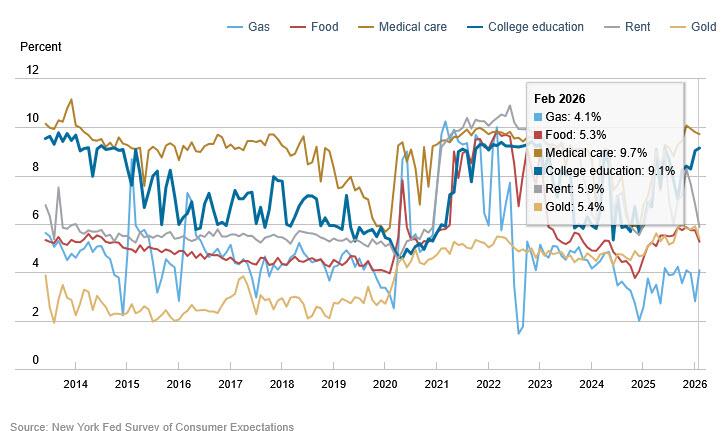
Turning to specific items, over the next year consumers expect gasoline prices to rise 4.09%; food prices to rise 5.27%; medical costs to rise 9.72%; the price of a college education to rise 9.14%; rent prices to rise 5.88%
The New York Fed survey also found relative calm on the hiring front during February: amid generally lackluster job reports, survey respondents said last month they project a lower future unemployment rate and a lower prospect of losing a job relative to January.
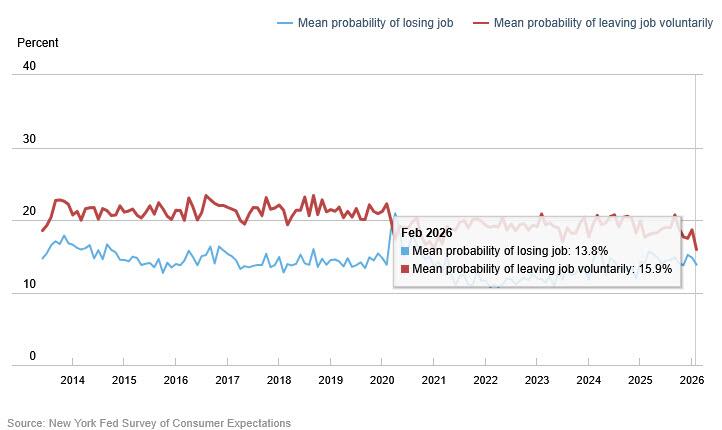
Specifically, the mean perceived probability of losing one’s job in the next 12 months decreased by 1.0 percentage point to 13.8%, falling slightly below the trailing 12-month average of 14.6%. The mean probability of leaving one’s job voluntarily, or the expected quit rate, in the next 12 months decreased by 2.8 percentage points to 15.9%, a new series low.
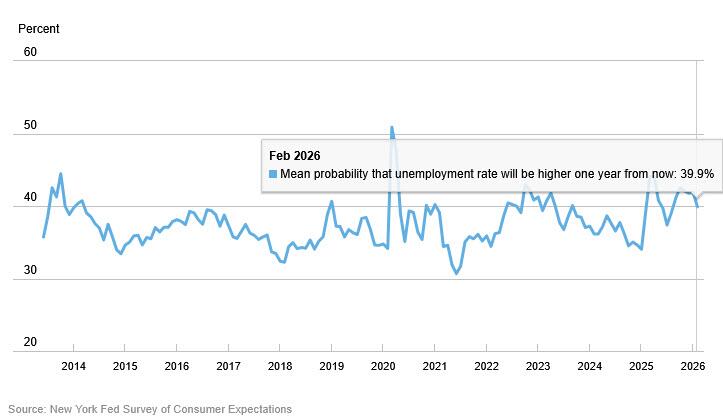
In more good news for the labor market, the mean unemployment expectations -or the mean probability that the U.S. unemployment rate will be higher one year from now -decreased by 2.0 percentage points to 39.9%.
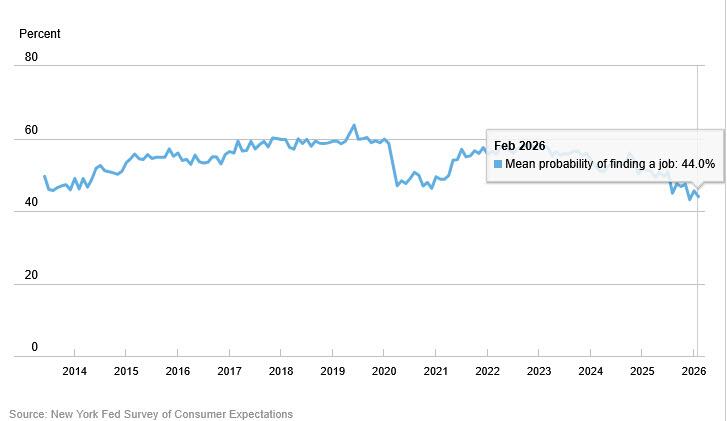
But respondents also said last month finding new work would be harder than what they thought at the start of the year: the mean perceived probability of finding a job in the next three months if one’s current job was lost decreased by 1.6 percentage points to 44.0%, just slightly above the series low reached in December 2025
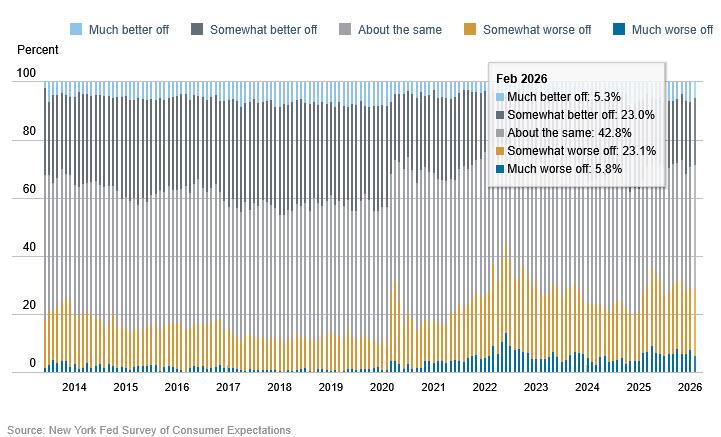
There was more good news on the household finance side: perceptions about households’ current financial situations compared to a year ago improved, with a smaller share of respondents reporting that their households were worse off compared to a year ago, and a larger share reporting they were better off. Expectations about year-ahead financial situations remained steady, with the net share of households reporting expecting a worse versus better situation a year from now remaining relatively unchanged.
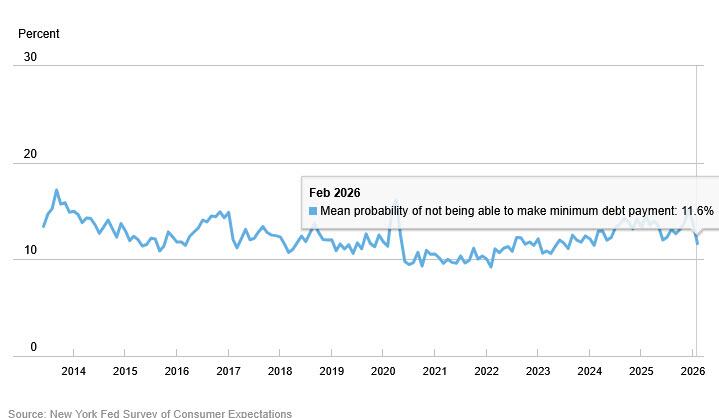
In more good news, the average perceived probability of missing a minimum debt payment over the next three months decreased by 2.1% points to 11.6%, its lowest level since February 2024.
And while respondents found that credit was harder to get in February compared to January, they believe it would be easier to get in the future. They were more upbeat about current finances in February versus the prior month, while holding steady views about the future state of their finances.
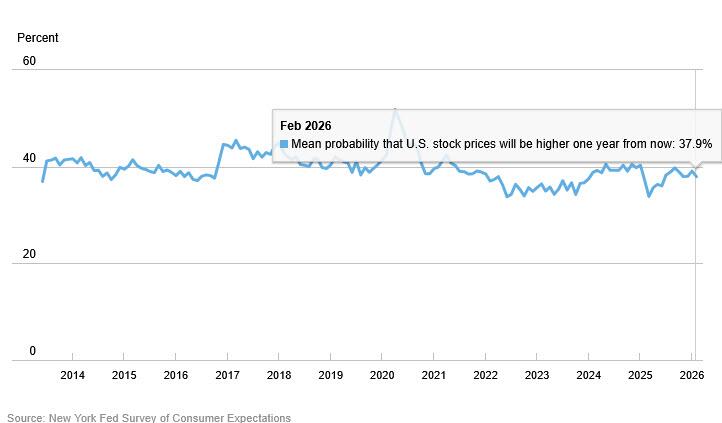
What was rather notable is that 37.9% of respondents expect stocks to be higher one year from now, a number that has barely budged in recent years.
On Friday, the University of Michigan will release its latest report on consumer sentiment and that report may offer the most up to date view on how the public is pricing the energy surge into its outlook for inflation.
Deutsche Bank economists said in a note Monday that U.S. oil production can blunt the impact of global price surges. But they added, “inflation has been too high for too long, and the latest data calls into question how much disinflation can reasonably be expected, especially if there are increases in measures of inflation expectations.”
Tyler Durden
Mon, 03/09/2026 – 13:45
NY Fed: Inflation Expectations Dropped To 1 Year Low Ahead Of Iran War Amid Improving Household Finances
NY Fed: Inflation Expectations Dropped To 1 Year Low Ahead Of Iran War Amid Improving Household Finances
While the latest NY Fed consumer expectations report shows sentiment from February, and does not account for the surge in oil prices as a result of the Iran war, the trend continues to be supportive which would be good news for the US economy if the current energy price spikes proves to be transitory.
In what was the calm before the Persian Gulf storm, Americans’ inflation expectations eased further back in February amid mixed views on the state of the job market and current and future finances. Specifically, the expected level of inflation a year from now dropped to 3% from 3.1% in January, and the lowest since the start of 2025 while the projected level of inflation three and five years from now held steady at 3%.
The New York Fed survey, released Monday, was conducted between February 2-28. As such, it does not capture the public’s reaction to surging oil prices that are the result of the Iran war, which has massively disrupted global energy supplies and sent crude over $100.
Huge increases seen thus far in energy prices are almost certain to drive up already high levels of overall inflation and stand a good chance of pushing the public toward a less benign view on the outlook for price pressures over coming years, assuming the price increase sticks and there is no prompt resolution to the war.
That would present a challenging environment for the Fed, which has been contending with high levels of inflation for years, the result of its post-covid policy error which has pushed inflation above the Fed’s 2% target for 60 moinths. Officials agree that where price pressures are expected to go exerts a strong influence on where they stand now, so if the oil shock creates expectations of higher price pressures, that could complicate efforts to get inflation back to target. Then again, the Fed has traditionally ignored one-time shocks which suggests that the Iran shock will only matter if it lasts a longer period of time. Earlier today, we pointed out that according to the Fed’s FRB/US model, a $20/bbl increase in oil prices only increases unemployment by about 2bps and has almost no impact on core PCE inflation
Turning to specific items, over the next year consumers expect gasoline prices to rise 4.09%; food prices to rise 5.27%; medical costs to rise 9.72%; the price of a college education to rise 9.14%; rent prices to rise 5.88%
The New York Fed survey also found relative calm on the hiring front during February: amid generally lackluster job reports, survey respondents said last month they project a lower future unemployment rate and a lower prospect of losing a job relative to January.
Specifically, the mean perceived probability of losing one’s job in the next 12 months decreased by 1.0 percentage point to 13.8%, falling slightly below the trailing 12-month average of 14.6%. The mean probability of leaving one’s job voluntarily, or the expected quit rate, in the next 12 months decreased by 2.8 percentage points to 15.9%, a new series low.
In more good news for the labor market, the mean unemployment expectations -or the mean probability that the U.S. unemployment rate will be higher one year from now -decreased by 2.0 percentage points to 39.9%.
But respondents also said last month finding new work would be harder than what they thought at the start of the year: the mean perceived probability of finding a job in the next three months if one’s current job was lost decreased by 1.6 percentage points to 44.0%, just slightly above the series low reached in December 2025
There was more good news on the household finance side: perceptions about households’ current financial situations compared to a year ago improved, with a smaller share of respondents reporting that their households were worse off compared to a year ago, and a larger share reporting they were better off. Expectations about year-ahead financial situations remained steady, with the net share of households reporting expecting a worse versus better situation a year from now remaining relatively unchanged.
In more good news, the average perceived probability of missing a minimum debt payment over the next three months decreased by 2.1% points to 11.6%, its lowest level since February 2024.
And while respondents found that credit was harder to get in February compared to January, they believe it would be easier to get in the future. They were more upbeat about current finances in February versus the prior month, while holding steady views about the future state of their finances.
What was rather notable is that 37.9% of respondents expect stocks to be higher one year from now, a number that has barely budged in recent years.
On Friday, the University of Michigan will release its latest report on consumer sentiment and that report may offer the most up to date view on how the public is pricing the energy surge into its outlook for inflation.
Deutsche Bank economists said in a note Monday that U.S. oil production can blunt the impact of global price surges. But they added, “inflation has been too high for too long, and the latest data calls into question how much disinflation can reasonably be expected, especially if there are increases in measures of inflation expectations.”
Tyler Durden
Mon, 03/09/2026 – 13:45
Under Federal Pressure, More Gender Clinics Halt Procedures On Minors
Under Federal Pressure, More Gender Clinics Halt Procedures On Minors
Authored by Janice Hisle via The Epoch Times,
Mounting political, financial, and legal pressures are poised to put more youth gender clinics out of business – or could force them to scale back services.
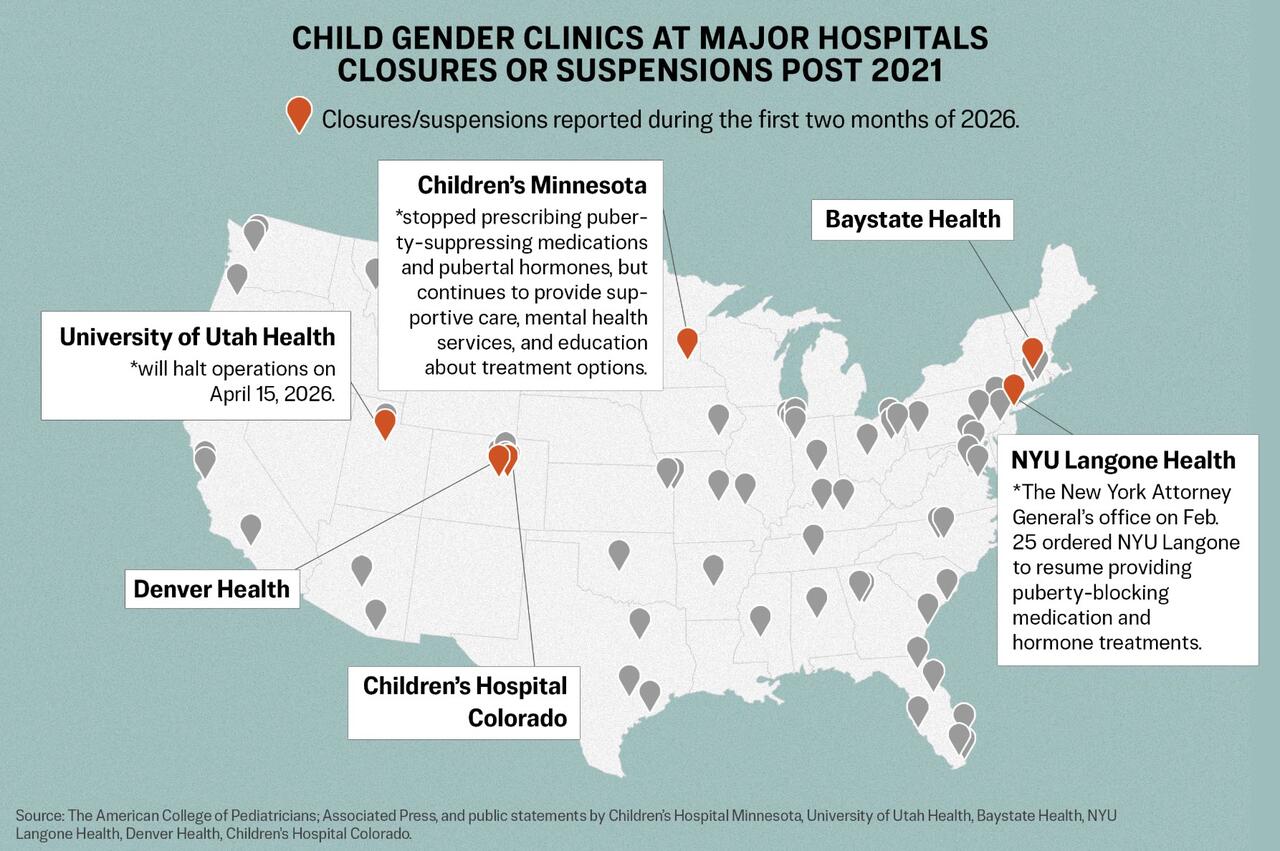
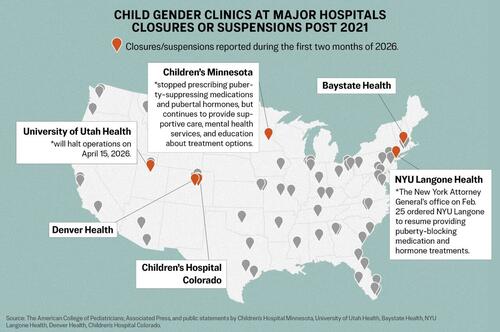
During the first two months of 2026, about a half-dozen U.S. gender clinics announced they would pause or discontinue some treatment programs for minors, according to hospital announcements and news reports reviewed by The Epoch Times.
The curtailment trend, which began in 2021 when states began passing laws to ban medical interventions on minors, picked up steam last year when President Donald Trump issued a wide-ranging executive order to guard against what he calls “surgical and chemical mutilation” of children—procedures that advocates refer to as “gender-affirming care.”
A wave of clinic closures and increased restrictions followed, buoyed by a mid-2025 Supreme Court ruling that upheld Tennessee’s statewide ban on medical transitions for minors. And this year, in a landmark verdict, a New York jury awarded a woman $2 million in a gender-transition medical malpractice case; many similar cases are pending.
Within days of the Jan. 30 decision, two major medical organizations—the American Society of Plastic Surgeons and the American Medical Association—recommended delaying transition procedures until adulthood.
Several clinics that ended some gender treatments last month emphasized that mental health services would remain unaffected.
University of Utah Health confirmed that it will “discontinue hormonal transgender treatment for all patients under the age of 18, effective April 15, 2026,” an emailed statement said.
NYU Langone Health released a statement last month in which it cited a hospital leadership change and “the current regulatory environment” as reasons for stopping its Transgender Youth Health Program.
New York state Sen. Kristen Gonzalez said she considers those treatments “essential healthcare” for minors, according to a statement released Feb. 18, following NYU Langone’s closure decision.
Gonzalez headed a group of more than 70 New York state lawmakers who signed a letter two days later urging the hospital to reverse its decision.
The New York Attorney General’s office on Feb. 25 ordered NYU Langone to resume gender services within 14 days.
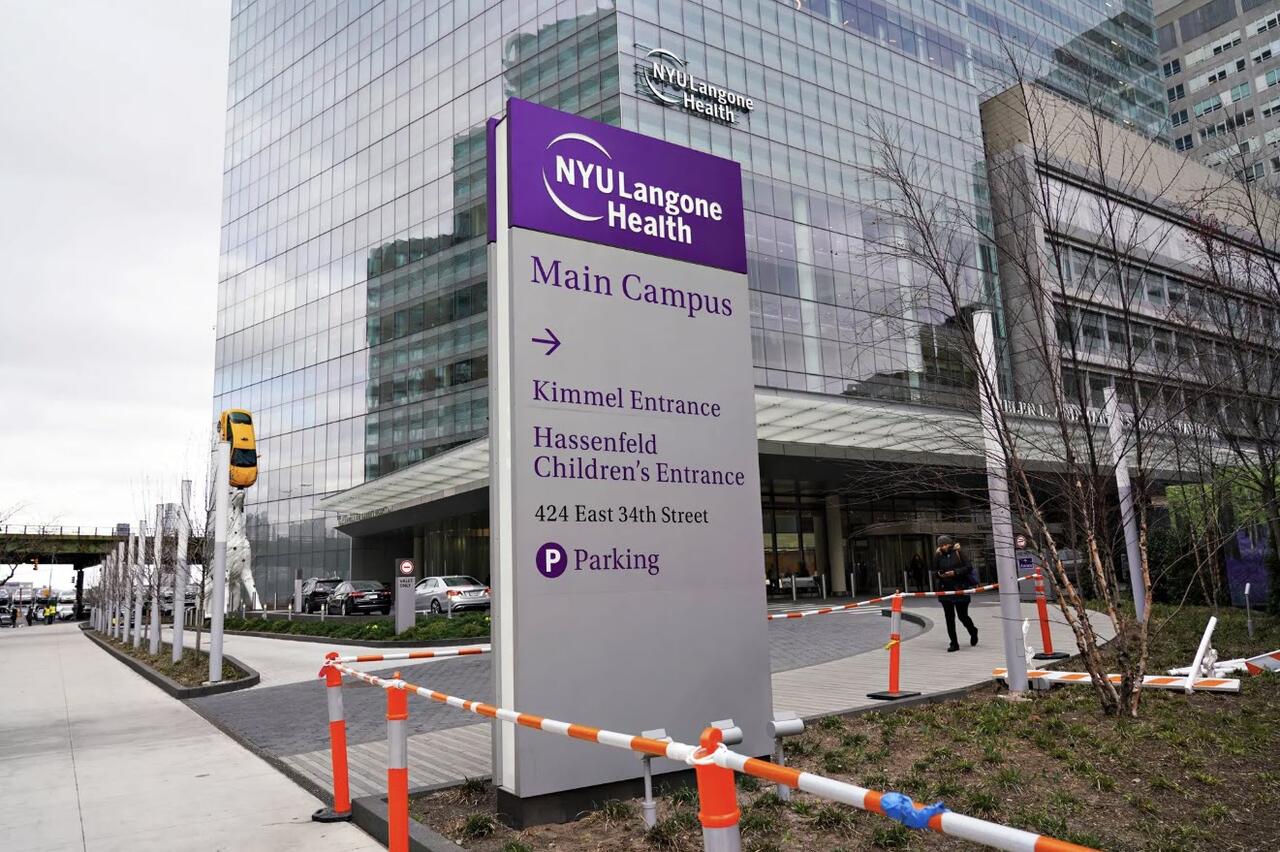
NYU Langone Health in New York City on March 16, 2020. Cindy Ord/Getty Images
In the neighboring state of Massachusetts, Baystate Health announced it would no longer prescribe hormones and puberty blockers to minors, but said it would transfer patients’ care to other providers.
Baystate emphasized, “Our Gender Health program is not closed. We continue to provide supportive care, mental health services and education regarding medical and non-medical treatment options.”
And in the Midwest, Children’s Minnesota announced in early February that the hospital would “temporarily pause” prescriptions of “puberty-suppressing medications,” along with hormones for patients under age 18 in its Gender Health program. The change, posted on the hospital’s website, took effect Feb. 27.
It happened because of “an increase in federal actions” against hospitals providing gender-transitioning procedures, Children’s Minnesota said.
Further, the hospital said it “remains committed to advocating for the patients and families and stands firmly behind the fact that gender affirming care is evidence-based and lifesaving for transgender and gender diverse youth.”
Children’s Hospital Colorado and Denver Health both suspended the treatments, the Colorado Sun reported Jan. 2.
The Epoch Times was unable to independently verify reports that additional clinics had also restricted or ended youth gender transition programs earlier this year.
Battle Far From Over
Despite these increasing restrictions, the medicalized gender-transitioning of minors is not screeching to a standstill in America.
Dr. Eithan Haim, a general surgeon who nearly went to prison for exposing youth gender-transitioning at a Texas hospital, doubts the clinics are genuinely backing away from gender ideology.
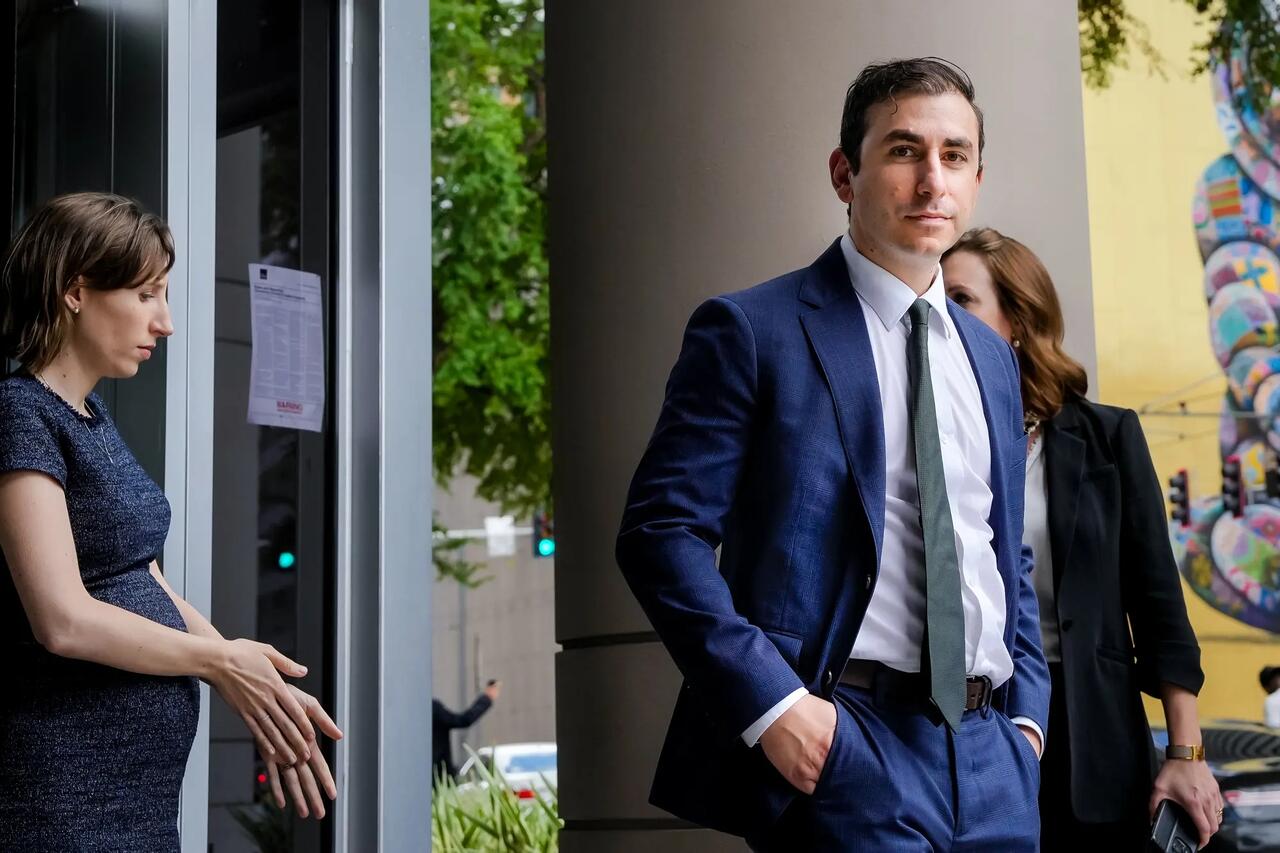
Dr. Eithan Haim (R) leaves the Bob Casey United States Courthouse after an arraignment hearing in Houston on June 17, 2024. Haim, a Texas surgeon, exposed alleged illegal gender transition surgeries in 2023. Yi-Chin Lee/File/Houston Chronicle via AP
He believes their public announcements are intended to appease federal officials enough to keep federal dollars flowing. Without that money, most hospitals would be “insolvent,” he said.
“These hospitals aren’t, you know, having a ‘come-to-Jesus’ moment—that they realize this thing is wrong,” he said.
Scott Newgent, a female who regrets undergoing masculinizing procedures as an adult, has spent at least seven years fighting against medical transitioning of minors. Newgent says attacking that issue is like playing “Whac-A-Mole;” when one problem is beaten down, another pops up.
Newgent and Haim say factors seem to be lining up to discourage gender-transitioning of minors. But the two crusaders suspect that advocates of gender transitioning will find ways to keep the procedures going, regardless of how the current battles turn out.
Mental Health
Proponents of so-called gender-affirming ideology counter that treatments such as puberty blockers, hormones, and surgeries are “essential,” “medically necessary,” and even “life-saving.”
The Disability Rights Education and Defense Fund has accused federal officials of advancing “a cruel and unlawful anti-trans agenda” by seeking to restrict or eliminate the procedures for minors.
And in a Facebook post last month, Human Rights Campaign said, “Gender-affirming care SAVES LIVES. The Trump administration is attacking medically necessary care for trans and non-binary youth, recklessly putting their lives in danger.”
Advocates make such claims based on assertions that transgender youth may commit suicide if they are denied the treatments.
But in May 2025, a Health and Human Services report found insufficient evidence to support contentions that the procedures improve mental health.
The report concluded the procedures carry risks that seem to outweigh possible benefits—findings that advocates such as The Trevor Project, an LGBT suicide-prevention organization, dispute.
In December 2025, Health Secretary Robert F. Kennedy Jr. cited his agency’s findings and said that “sex-rejecting procedures for children and adolescents are neither safe nor effective” to treat gender-related disorders in minors.
Kennedy’s declaration is important because it could lead to providers being excluded from federal programs—and therefore cut off from funding.
In response, 19 states and the District of Columbia sued over Kennedy’s declaration.
Meanwhile, more than a dozen facilities are facing extra federal scrutiny based on Kennedy’s declaration.
Mike Stuart, Health and Human Services general counsel, referred those clinics and hospitals for further investigation. He alleged “failure to meet recognized standards of health care” for minors’ gender-related treatments.
Advocates Push Back
Despite mounting obstacles, transgender advocates are continuing to push back against federal actions, including proposed rules that would block use of Medicaid or Medicare dollars for children’s “sex-rejecting procedures.”
That term conveys “the unnatural and disruptive nature” of puberty blockers, wrong-sex hormones, and surgeries, according to the Ethics and Public Policy Center.
The American Academy of Pediatrics opposes the federal rules, denouncing them as a “baseless intrusion into the physician-patient relationship.” The academy also continues to call the procedures “gender-affirming care.”
People walk past a sign for an American Academy of Pediatrics (AAP) conference in Anaheim, Calif., on Oct. 8, 2022. John Fredricks/The Epoch Times
And in February, the academy sued the Federal Trade Commission over its probe of alleged “deceptive” practices related to youth gender treatments.
From 2016 to 2020, about 3,700 adolescents aged 12 to 18 underwent surgeries for gender dysphoria, Kennedy’s statement noted. Gender dysphoria is a disconnect between a person’s biological sex and gender self-perception.
During a five-year span ending in 2021, more than 120,000 children, ages 6 to 17, were diagnosed with gender dysphoria; more than 17,000 of them were treated with puberty-blocking drugs and/or hormones, he said.
Kennedy also said that, as of early 2023, an estimated 271 youth gender clinics existed in the United States; about 70 of them went “inactive” because of state legislation.
In August 2025, a smaller medical society, the American College of Pediatricians, estimated that only about one-third of the nation’s estimated 100 “major” youth gender clinics were still open.
It was unclear how many of the clinics have closed since then. The Epoch Times found multiple reports of clinics quietly discontinuing services by sending letters to patients’ families; some, however, did issue public statements.
As the warring factions continue to spar over how to treat gender-dysphoric youths, Newgent, the transition-regretter, and Haim, the whistleblower doctor, both gave warnings.
Newgent said people who are desperate to continue treatments may resort to online providers or buy medications on the black market.
Haim said unscrupulous providers could use fraudulent diagnosis codes to get insurers to cover procedures that otherwise would be excluded from coverage.
The fight over transgender medicine reform is fierce, he said, with opponents “throwing up roadblocks” at every step.
Still, Haim said he is optimistic that permanent changes in youth treatment can take hold.
At the same time, he cautioned, “The only reason things are changing now is because of pressure from the Trump administration. If that changes in 2028 with the new administration, everything is going to go back to what it was.”
Tyler Durden
Mon, 03/09/2026 – 13:25
https://www.zerohedge.com/medical/under-federal-pressure-more-gender-clinics-halt-procedures-minors
Under Federal Pressure, More Gender Clinics Halt Procedures On Minors
Under Federal Pressure, More Gender Clinics Halt Procedures On Minors
Authored by Janice Hisle via The Epoch Times,
Mounting political, financial, and legal pressures are poised to put more youth gender clinics out of business – or could force them to scale back services.
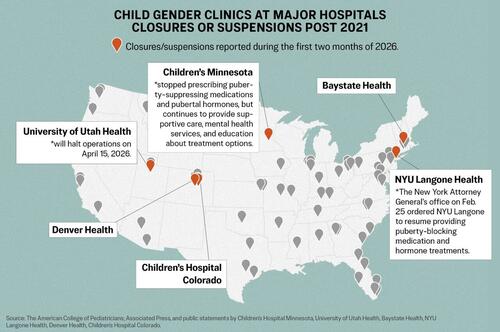
During the first two months of 2026, about a half-dozen U.S. gender clinics announced they would pause or discontinue some treatment programs for minors, according to hospital announcements and news reports reviewed by The Epoch Times.
The curtailment trend, which began in 2021 when states began passing laws to ban medical interventions on minors, picked up steam last year when President Donald Trump issued a wide-ranging executive order to guard against what he calls “surgical and chemical mutilation” of children—procedures that advocates refer to as “gender-affirming care.”
A wave of clinic closures and increased restrictions followed, buoyed by a mid-2025 Supreme Court ruling that upheld Tennessee’s statewide ban on medical transitions for minors. And this year, in a landmark verdict, a New York jury awarded a woman $2 million in a gender-transition medical malpractice case; many similar cases are pending.
Within days of the Jan. 30 decision, two major medical organizations—the American Society of Plastic Surgeons and the American Medical Association—recommended delaying transition procedures until adulthood.
Several clinics that ended some gender treatments last month emphasized that mental health services would remain unaffected.
University of Utah Health confirmed that it will “discontinue hormonal transgender treatment for all patients under the age of 18, effective April 15, 2026,” an emailed statement said.
NYU Langone Health released a statement last month in which it cited a hospital leadership change and “the current regulatory environment” as reasons for stopping its Transgender Youth Health Program.
New York state Sen. Kristen Gonzalez said she considers those treatments “essential healthcare” for minors, according to a statement released Feb. 18, following NYU Langone’s closure decision.
Gonzalez headed a group of more than 70 New York state lawmakers who signed a letter two days later urging the hospital to reverse its decision.
The New York Attorney General’s office on Feb. 25 ordered NYU Langone to resume gender services within 14 days.
NYU Langone Health in New York City on March 16, 2020. Cindy Ord/Getty Images
In the neighboring state of Massachusetts, Baystate Health announced it would no longer prescribe hormones and puberty blockers to minors, but said it would transfer patients’ care to other providers.
Baystate emphasized, “Our Gender Health program is not closed. We continue to provide supportive care, mental health services and education regarding medical and non-medical treatment options.”
And in the Midwest, Children’s Minnesota announced in early February that the hospital would “temporarily pause” prescriptions of “puberty-suppressing medications,” along with hormones for patients under age 18 in its Gender Health program. The change, posted on the hospital’s website, took effect Feb. 27.
It happened because of “an increase in federal actions” against hospitals providing gender-transitioning procedures, Children’s Minnesota said.
Further, the hospital said it “remains committed to advocating for the patients and families and stands firmly behind the fact that gender affirming care is evidence-based and lifesaving for transgender and gender diverse youth.”
Children’s Hospital Colorado and Denver Health both suspended the treatments, the Colorado Sun reported Jan. 2.
The Epoch Times was unable to independently verify reports that additional clinics had also restricted or ended youth gender transition programs earlier this year.
Battle Far From Over
Despite these increasing restrictions, the medicalized gender-transitioning of minors is not screeching to a standstill in America.
Dr. Eithan Haim, a general surgeon who nearly went to prison for exposing youth gender-transitioning at a Texas hospital, doubts the clinics are genuinely backing away from gender ideology.
Dr. Eithan Haim (R) leaves the Bob Casey United States Courthouse after an arraignment hearing in Houston on June 17, 2024. Haim, a Texas surgeon, exposed alleged illegal gender transition surgeries in 2023. Yi-Chin Lee/File/Houston Chronicle via AP
He believes their public announcements are intended to appease federal officials enough to keep federal dollars flowing. Without that money, most hospitals would be “insolvent,” he said.
“These hospitals aren’t, you know, having a ‘come-to-Jesus’ moment—that they realize this thing is wrong,” he said.
Scott Newgent, a female who regrets undergoing masculinizing procedures as an adult, has spent at least seven years fighting against medical transitioning of minors. Newgent says attacking that issue is like playing “Whac-A-Mole;” when one problem is beaten down, another pops up.
Newgent and Haim say factors seem to be lining up to discourage gender-transitioning of minors. But the two crusaders suspect that advocates of gender transitioning will find ways to keep the procedures going, regardless of how the current battles turn out.
Mental Health
Proponents of so-called gender-affirming ideology counter that treatments such as puberty blockers, hormones, and surgeries are “essential,” “medically necessary,” and even “life-saving.”
The Disability Rights Education and Defense Fund has accused federal officials of advancing “a cruel and unlawful anti-trans agenda” by seeking to restrict or eliminate the procedures for minors.
And in a Facebook post last month, Human Rights Campaign said, “Gender-affirming care SAVES LIVES. The Trump administration is attacking medically necessary care for trans and non-binary youth, recklessly putting their lives in danger.”
Advocates make such claims based on assertions that transgender youth may commit suicide if they are denied the treatments.
But in May 2025, a Health and Human Services report found insufficient evidence to support contentions that the procedures improve mental health.
The report concluded the procedures carry risks that seem to outweigh possible benefits—findings that advocates such as The Trevor Project, an LGBT suicide-prevention organization, dispute.
In December 2025, Health Secretary Robert F. Kennedy Jr. cited his agency’s findings and said that “sex-rejecting procedures for children and adolescents are neither safe nor effective” to treat gender-related disorders in minors.
Kennedy’s declaration is important because it could lead to providers being excluded from federal programs—and therefore cut off from funding.
In response, 19 states and the District of Columbia sued over Kennedy’s declaration.
Meanwhile, more than a dozen facilities are facing extra federal scrutiny based on Kennedy’s declaration.
Mike Stuart, Health and Human Services general counsel, referred those clinics and hospitals for further investigation. He alleged “failure to meet recognized standards of health care” for minors’ gender-related treatments.
Advocates Push Back
Despite mounting obstacles, transgender advocates are continuing to push back against federal actions, including proposed rules that would block use of Medicaid or Medicare dollars for children’s “sex-rejecting procedures.”
That term conveys “the unnatural and disruptive nature” of puberty blockers, wrong-sex hormones, and surgeries, according to the Ethics and Public Policy Center.
The American Academy of Pediatrics opposes the federal rules, denouncing them as a “baseless intrusion into the physician-patient relationship.” The academy also continues to call the procedures “gender-affirming care.”
People walk past a sign for an American Academy of Pediatrics (AAP) conference in Anaheim, Calif., on Oct. 8, 2022. John Fredricks/The Epoch Times
And in February, the academy sued the Federal Trade Commission over its probe of alleged “deceptive” practices related to youth gender treatments.
From 2016 to 2020, about 3,700 adolescents aged 12 to 18 underwent surgeries for gender dysphoria, Kennedy’s statement noted. Gender dysphoria is a disconnect between a person’s biological sex and gender self-perception.
During a five-year span ending in 2021, more than 120,000 children, ages 6 to 17, were diagnosed with gender dysphoria; more than 17,000 of them were treated with puberty-blocking drugs and/or hormones, he said.
Kennedy also said that, as of early 2023, an estimated 271 youth gender clinics existed in the United States; about 70 of them went “inactive” because of state legislation.
In August 2025, a smaller medical society, the American College of Pediatricians, estimated that only about one-third of the nation’s estimated 100 “major” youth gender clinics were still open.
It was unclear how many of the clinics have closed since then. The Epoch Times found multiple reports of clinics quietly discontinuing services by sending letters to patients’ families; some, however, did issue public statements.
As the warring factions continue to spar over how to treat gender-dysphoric youths, Newgent, the transition-regretter, and Haim, the whistleblower doctor, both gave warnings.
Newgent said people who are desperate to continue treatments may resort to online providers or buy medications on the black market.
Haim said unscrupulous providers could use fraudulent diagnosis codes to get insurers to cover procedures that otherwise would be excluded from coverage.
The fight over transgender medicine reform is fierce, he said, with opponents “throwing up roadblocks” at every step.
Still, Haim said he is optimistic that permanent changes in youth treatment can take hold.
At the same time, he cautioned, “The only reason things are changing now is because of pressure from the Trump administration. If that changes in 2028 with the new administration, everything is going to go back to what it was.”
Tyler Durden
Mon, 03/09/2026 – 13:25
https://www.zerohedge.com/medical/under-federal-pressure-more-gender-clinics-halt-procedures-minors

Naperville Police Arrests for March 4-5
The following items were taken from Naperville police reports and press releases. An arrest does not constitute a finding of guilt:
A 26-year-old man from Naperville was arrested on a charge of driving on a suspended license at 9:58 a.m. March 4 at East Diehl Road and North Washington Street.
A 23-year-old woman from Willowbrook was arrested on a warrant at 11:16 a.m. March 4 at the police station, 1350 Aurora Ave.
A 31-year-old man from Chicago was arrested on two warrants and on a charge of obstructing identification at 1:41 p.m. March 4 in the 100 block of 4th Avenue.
A 20-year-old man from Aurora was arrested on a charge of driving on a suspended license at 3:54 p.m. March 4 at East Ogden Avenue and Sherman Avenue.
A 30-year-old woman from Aurora was arrested on charges of attempted theft not exceeding $300, endangering the life or health of a child and filing a false police report at 6:30 p.m. March 4 in the 2800 block of 95th Street.
A 34-year-old man from Sheridan was arrested on a charge of possession of a controlled substance at 11:06 p.m. March 4 in the 1500 block of Naperville Wheaton Road.
A 31-year-old man from Streamwood was arrested on charges of failure to signal when required, driving on a suspended license, driving without insurance, driving on suspended registration for non-insurance and unlawful use of cannabis by a driver at 12:39 a.m. March 5 at North Mill Street and Commons Road.
A 39-year-old man from Aurora was arrested on a charge of battery at 4:35 a.m. March 5 in the 1100 block of East Ogden Avenue.
A 24-year-old man from Aurora was arrested on a warrant at 4:34 p.m. March 5 at the police station, 1350 Aurora Ave.
https://www.chicagotribune.com/2026/03/09/naperville-police-arrests-blotter-march/

Flossmoor home owned by first Black partner at Skidmore, Owings & Merrill to go on market in April
A four-bedroom, contemporary-style house in Flossmoor that was once the home of the late architect Robert Wesley, who was the first Black partner of architectural firm Skidmore, Owings & Merrill, will come back on the market in April for $749,000, its owners said.
Built in the mid-1970s, the house was designed by Wesley, who became Skidmore’s first Black partner in 1984.
Wesley, who died in January at age 88, worked on a host of important local and regional projects, including Orchestra Hall, Elmhurst University’s performing arts center, the Toledo Museum of Art in Ohio and projects for Northwestern University, the University of Chicago, a State Street renovation and the Lakefront Millennium Project.
Set on a 0.75-acre lot, the house has four bedrooms, 3½ bathrooms, two fireplaces, a living room with a two-story wall of glass, a fireplace, an art studio, a screened porch, a wraparound deck and two primary suites.
Current owners Cynthia Ramsey Nolan and her husband, Tom, bought the home in 2002 from Wesley and his wife, Wilma.
“What drew us to this house, No. 1, was that it was designed by a regionally significant architect. We had lived in a house in Dallas designed by a regionally significant architect, and my wife got transferred up here — otherwise, we’d still be in Dallas,” Tom Nolan told Elite Street.
“We were looking to replicate the home in Dallas and while you obviously can’t do that, this was the next best thing,” he said. “We shopped the North Shore and couldn’t find anything noteworthy that wasn’t $3 million or $4 million, and we finally found this house and liked the aspect of being able to bring it back and kind of modernize it. Plus, it has a really nice lot.”
Cynthia Ramsey Nolan added that she and her husband liked the diversity of Flossmoor, plus the fact that, although the house is located in a neighborhood, it feels private.
“Because there are so many oversized windows, I like that the outside comes into the interior,” she said. “We did lots of entertaining, and this is a terrific house for entertaining purposes.”
Laurie Mead of @properties will have the listing.
The couple first listed the house last year for $799,000 and later reduced their asking price to $749,000 and then to $724,000 before taking it off the market in January. They said they want to sell the house because they are considering moving downtown.
The house had a $7,865 property tax bill in the 2024 tax year.
Bob Goldsborough is a freelance reporter.
https://www.chicagotribune.com/2026/03/09/flossmoor-elite-street-wesley/
Suspects Linked to IED At Gracie Mansion Made Pro-ISIS Statements In Custody
Suspects Linked to IED At Gracie Mansion Made Pro-ISIS Statements In Custody
When “suspicious devices” turned up outside Gracie Mansion on Saturday during dueling protests, the media quickly sought to gaslight the public about what really happened.
“Two people in custody after ‘suspicious devices’ ignited outside NYC mayor’s official residence,” NBC New York reported.
FAKE NBC NEWS NY PUSH FALSE NARRATIVE OF NYC MAYOR ZO AND WIFE UNDER ATTACK FOR MUSLIM BELIEFShttps://t.co/RHYJofBmBx
(*Witnesses say the attackers shouted “allahu akbar” as they threw the bombs at the protestors.) pic.twitter.com/TH5ZsE1Vao
— Politics On 𝕏 (@PoliticsOnX) March 9, 2026
However, despite the narrative that was initially pushed by the media, the suspect who allegedly lit and threw the two improvised explosive devices near Mayor Zohran Mamdani’s official residence was actually a Muslim counter-protester.
And by Monday morning, federal authorities were calling it ISIS-inspired terrorism.
NYPD Commissioner Jessica Tisch stood at a press conference alongside Mamdani and confirmed that suspects Amir Balat, 18, and Ibrahim Kayumi, 19, were arrested on Saturday and remained in custody. Both men were being prosecuted in federal court in Manhattan. Kayumi is a rich kid whose family came from Afghanistan.
Both reportedly made pro-ISIS statements while in custody. Federal agents have already executed search warrants in Bucks County, Pennsylvania, where the two men lived, and at a related address in New Jersey.
Investigators are also reviewing the suspects’ travel history, including trips to Turkey and locations described as potential terror training grounds.
“The NYPD Bomb Squad has conducted a preliminary analysis of a device that was ignited and deployed at a protest yesterday and has determined that it is not a hoax device or a smoke bomb. It is, in fact, an improvised explosive device that could have caused serious injury or death,” Tisch said in a post following the incident. NYPD sources added that the devices were packed with nuts, bolts, and screws, stuffed inside taped canisters fitted with fuses and filled with a chemical substance. The FBI’s Joint Terrorism Task Force responded alongside local authorities.
The NYPD Bomb Squad has conducted a preliminary analysis of a device that was ignited and deployed at a protest yesterday and has determined that it is not a hoax device or a smoke bomb. It is, in fact, an improvised explosive device that could have caused serious injury or…
— Jessica S. Tisch (@NYPDPC) March 8, 2026
According to The New York Times, Police Commissioner Jessica Tisch said the explosive device contained TATP—short for triacetone triperoxide—a white, crystalline explosive that can be made from commonly available precursor materials. The compound has been linked to ISIS in past terrorist plots, including the November 2015 Paris attacks.
This is by FAR the clearest footage we have seen of the man who lit the bomb, dropped it at an officer’s feet and fled.
It happens so fast it’s hard to see, so I’ve slowed the footage and added arrows so you can see it.
He literally drops it RIGHT AT the feet of an officer. pic.twitter.com/y5nMNh7ibK
— Matt Van Swol (@mattvanswol) March 9, 2026
Mamdani issued a statement Saturday that carefully avoided naming the actual suspects or their apparent motivation. He opened his statement by condemning the rally organized by conservative activist Jake Lang, describing it as “rooted in bigotry and racism,” then pivoted directly to the explosive devices without making it clear that neither Lang or his group was not responsible for the IED. “What followed was even more disturbing. Violence at a protest is never acceptable. The attempt to use an explosive device and hurt others is not only criminal, it is reprehensible and the antithesis of who we are,” his statement read.
Yesterday, white supremacist Jake Lang organized a protest outside Gracie Mansion rooted in bigotry and racism. Such hate has no place in New York City. It is an affront to our city’s values and the unity that defines who we are.
What followed was even more disturbing. Violence…
— Mayor Zohran Kwame Mamdani (@NYCMayor) March 8, 2026
The sequencing was deliberate. Lang’s name was mentioned, then the devices were mentioned immediately after. He said nothing about ISIS. HE said nothing about how the devices were used against Lang and his group. It said nothing about the counter-protesters. The statement weaponized implication in a way that no careful reader could miss, and the press coverage that followed largely amplified it. The initial reporting on “suspicious devices found at an anti-Islam rally” told readers almost nothing useful about what had actually occurred. Once again, when the facts are inconvenient, the narrative retreats into technically true but misleading territory and waits for the news cycle to move on.
The investigation remains active. Federal charges had not yet been formally filed as of Monday, and Tisch declined to detail the specific allegations pending prosecution.
Tyler Durden
Mon, 03/09/2026 – 13:05

A Hinsdale street, part of which hasn’t be resurfaced since 1891, gets $1 million boost for reconstruction
Hinsdale officials have secured more than $1 million in grant funds as planning continues for a Sixth Street Reconstruction and Utility Project that is expected to cost $6.5 million.
The work will cover Sixth Street between Garfield Street and County Line Road and will separate the combined sewer system in accordance with the village’s Stormwater Master Plan. Village President Greg Hart said the work should improve drainage and reduce localized flooding.
“It will also replace the more than 80-year-old water main and sanitary sewer infrastructure and fully reconstruct the roadway pavement,” he said, adding that the project addresses infrastructure that is “well beyond its useful life.”
Hart said the village secured a $1.092 million federal Community Project Funding grant, with the help of Congressman Jesus “Chuy” Garcia, to help offset costs related to the underground utility portion of the project.
“That funding supports separation of the combined sewer system, installation of new storm sewers, and replacement and upgrading of aging water main and sanitary sewer infrastructure, in accordance with our Stormwater Master Plan,” he said.
The section of Sixth Street to be improved currently is constructed in brick. Whether that remains when the project is completed remains to be determined.
“We are working with residents on Sixth Street to determine project details, including the materials that will ultimately be used,” Hart said. “More information will be shared once we have final grant requirements and have completed further dialogue with Sixth Street residents.”
The project is anticipated to be bid in fall 2026, with construction taking place in 2027, with the timing being dependent on the distribution of federal grant funds,
“The last major utility work on this corridor dates back more than 80 years,” Hart said. “While routine maintenance has been performed over time to maintain drivability, there has not been a full reconstruction of this magnitude in modern history. Portions of the street surface date back as far as 1891.”
Hart said the village will work to maintain access for local traffic and driveways as much as possible, while work is being done.
“However, given the scale of the project, temporary street closures and construction staging impacts should be expected during active construction,” he said. “Specific traffic control plans will be finalized closer to the start of work.”
Chuck Fieldman is a freelance reporter for Pioneer Press.
https://www.chicagotribune.com/2026/03/09/hinsdale-street-work-grant/

Cowboys adquieren al defensivo Rashan Gary en canje con Packers, según fuente AP
Por SCHUYLER DIXON
Los Cowboys de Dallas al defensivo Rashan Gary, procedente de los Packers de Green Bay, mediante un canje al abrirse la agencia libre de la NFL, informó a The Associated Press una persona con conocimiento del acuerdo el lunes.
Dallas enviará a los Packers una selección de ronda tardía del draft de 2027, indicó la fuente. La persona habló bajo condición de anonimato porque el acuerdo aún se estaba finalizando.
Los Cowboys y los Packers cerraron el trato por el cazamariscales justo cuando a los agentes libres se les permitía hablar con los equipos y alcanzar acuerdos sobre contratos que no pueden firmarse hasta que el año de la liga comience el miércoles.
Miami anunció que dejó en libertad a Tua Tagovailoa, sumando otro gran nombre en la posición de quarterback a una lista de agentes libres que incluirá a Kyler Murray, descartado por Arizona. Los Dolphins realizaron otro movimiento al traspasar al safety Minkah Fitzpatrick a los Jets de Nueva York por una selección de séptima ronda, según una persona familiarizada con las negociaciones.
Los Cowboys y Green Bay han acordado un canje que involucra a un cazamariscales por segundo año consecutivo.
Una semana antes de que comenzara la temporada el año pasado, los Cowboys canjearon a la joven estrella Micah Parsons, quien de inmediato firmó un contrato de cuatro años por 188 millones de dólares, con 136 millones garantizados. Fue el contrato más lucrativo para un jugador que no es quarterback en la historia de la liga. Los Cowboys también obtuvieron al tackle defensivo Kenny Clark de Green Bay en el canje por Parsons.
Gary fue la selección número 12 global en 2019, dos años antes de que Parsons llegara a los Cowboys en el mismo puesto del draft. Gary sumó 7 capturas y media la temporada pasada, pero ninguna en los últimos 10 partidos de un año irregular, cuando los Packers esperaban que la incorporación de Parsons fuera un impulso para Gary.
Parsons se perdió los últimos tres partidos y una derrota en la ronda de comodines ante los Bears de Chicago tras romperse el ligamento cruzado anterior de la rodilla izquierda.
Gary, de 28 años, pasó sus primeras siete temporadas con los Packers y registró al menos 7 capturas y media en cuatro de los últimos cinco años. Gary, T.J. Watt y Myles Garrett son los únicos jugadores de la NFL con al menos 40 capturas, 100 golpes al quarterback, cinco balones sueltos forzados y cinco recuperaciones de balón suelto desde 2020.
Este canje culmina unos días movidos para Gary. Había publicado una despedida de Green Bay en Instagram el viernes —una señal de que los Packers estaban a punto de seguir adelante sin él—, pero borró la publicación más tarde ese mismo día.
Los Giants de Nueva York renovaron el contrato del veterano tight end Chris Manhertz, manteniéndolo a él y al corredor Devin Singletary entre los jugadores ofensivos que permanecen bajo el nuevo entrenador John Harbaugh.
Por su parte, los Vikings mantuvieron a uno de sus agentes libres sin restricciones fuera del mercado al llegar a un acuerdo para un nuevo contrato con Eric Wilson, un linebacker con una década de experiencia en la liga, ofreciéndole un pacto de tres años valorado en 22,5 millones de dólares con 12,5 millones garantizados, según NFL Network.
Wilson, quien regresó a su equipo original la temporada pasada, estableció máximos de su carrera en tacleadas para pérdida (17), capturas (6 1/2), golpes al quarterback (10) y balones sueltos forzados (cuatro).
___
Deportes AP: https://apnews.com/hub/deportes

Anthropic sues Trump administration seeking to undo ‘supply chain risk’ designation
Anthropic is suing the Trump administration, asking federal courts to reverse the Pentagon’s decision designating the artificial intelligence company a “ supply chain risk ” over its refusal to allow unrestricted military use of its technology.
Anthropic filed two separate lawsuits Monday, one in California federal court and another in the federal appeals court in Washington, D.C., each challenging different aspects of the Pentagon’s actions against the company.
The Pentagon last week formally designated the San Francisco tech company a supply chain risk after an unusually public dispute over how its AI chatbot Claude could be used in warfare.
Elizabeth Shackelford: The Pentagon’s fight with Anthropic is about unchecked power
“These actions are unprecedented and unlawful,” Anthropic’s lawsuit says. “The Constitution does not allow the government to wield its enormous power to punish a company for its protected speech. No federal statute authorizes the actions taken here. Anthropic turns to the judiciary as a last resort to vindicate its rights and halt the Executive’s unlawful campaign of retaliation.”
The Defense Department declined to comment Monday, citing a policy of not commenting on matters in litigation.
Anthropic said it sought to restrict its technology from being used for two high-level usages: mass surveillance of Americans and fully autonomous weapons. Defense Secretary Pete Hegseth and other officials publicly insisted the company must accept “all lawful uses” of Claude and threatened punishment if Anthropic did not comply.
Designating the company a supply chain risk cuts off Anthropic’s defense work using an authority that was designed to prevent foreign adversaries from harming national security systems. It was the first time the federal government is known to have used the designation against a U.S. company.
President Donald Trump also said he would order federal agencies to stop using Claude, though he gave the Pentagon six months to phase out a product that’s deeply embedded in classified military systems, including those used in the Iran war.
Anthropic’s lawsuit also names other federal agencies, including the departments of Treasury and State, after officials ordered employees to stop using Anthropic’s services.
Even as it fights the Pentagon’s actions, Anthropic has sought to convince businesses and other government agencies that the Trump administration’s penalty is a narrow one that only affects military contractors when they are using Claude in work for the Department of Defense.
Making that distinction clear is crucial for the privately held Anthropic because most of its projected $14 billion in revenue this year comes from businesses and government agencies that are using Claude for computer coding and other tasks. More than 500 customers are paying Anthropic at least $1 million annually for Claude, according to a recent investment announcement valued the company at $380 billion.
Anthropic said in a statement Monday that “seeking judicial review does not change our longstanding commitment to harnessing AI to protect our national security, but this is a necessary step to protect our business, our customers, and our partners.”