Category: News
U.S. To Begin 86-Million-Barrel SPR Dump Next Week Via Exchange Program
U.S. To Begin 86-Million-Barrel SPR Dump Next Week Via Exchange Program
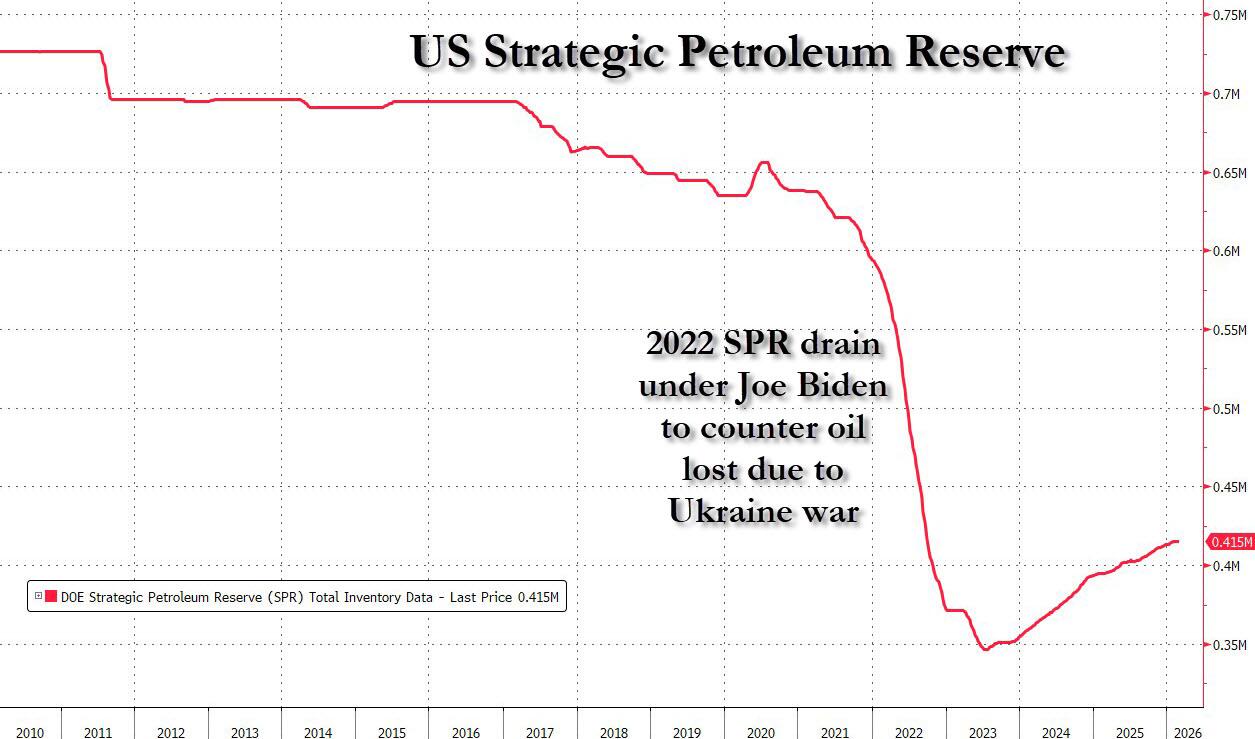
The speed of the energy shock rippling out from the U.S.-Iran conflict in the Middle East and the near-paralysis of the Strait of Hormuz forced the 32-member IEA last week to approve a 400-million-barrel release from Strategic Petroleum Reserves to help cushion the blow to the global economy. The bulk of that supply will come from the U.S., with the Trump administration preparing a request to exchange 86 million barrels of crude oil as soon as next Wednesday.
The planned U.S. SPR release of 86 million barrels of crude, part of a broader 172 million-barrel U.S. release and part of the IEA’s “historic” 400-million-barrel emergency release action plan across 32 nations to shield economies from the worst energy shock ever to hit the world, has been altered by the end of the week.
Under an exchange program, the Department of Energy will allow companies to borrow crude now and return it later with additional barrels as a premium.
Bloomberg Opinion and commodities columnist Javier Blas added more color on the altered SPR plan by the DoE on X, saying:
The U.S. government seems to have changed its mind about the terms of the use of the Strategic Petroleum Reserve:
Earlier this week, it announced a SPR release (an outright sale, and the method used in the emergency actions of 1991, 2005, 2011, and 2022). But now, the DOE has published details for something different: a SPR exchange (effectively, an oil loan, with the barrels returned later with interest).
The US gov seems to have changed its mind about the terms of the use of the Strategic Petroleum Reserve:
Earlier this week, it announced a **SPR release** (an outright sale, and the method used in the emergency actions of 1991, 2005, 2011 and 2022)
But now, the DOE has… pic.twitter.com/KIo8SiFOUX
— Javier Blas (@JavierBlas) March 14, 2026
Secretary of Energy Chris Wright released a statement saying this SPR release will begin next week and “take approximately 120 days to deliver based on planned discharge rates.”
“President Trump promised to protect America’s energy security by managing the Strategic Petroleum Reserve responsibly, and this action demonstrates his commitment to that promise,” Wright said.
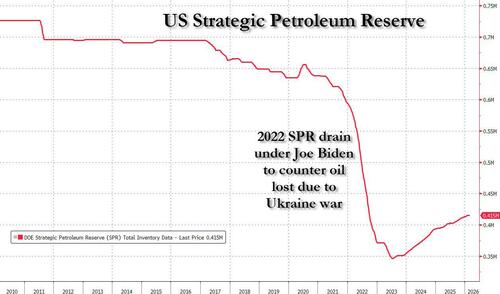
He continued, “Unlike the previous administration, which left America’s oil reserves drained and damaged, the United States has arranged to more than replace these strategic reserves with approximately 200 million barrels within the next year, 20% more barrels than will be drawn down, and at no cost to the taxpayer.”
The current U.S. SPR holds about 415 million barrels, up from roughly 395 million barrels one year ago.
As JPMorgan noted last week, no matter how large the SPR release is, it would not be able to offset the biggest issue facing global energy markets: the sudden elimination of 16 million barrels currently stuck in the Gulf due to the Strait of Hormuz blockade. That’s because it’s not a stockpile problem, but rather a flow problem.
Beyond the incoming SPR dump, the Trump administration has taken several steps to combat triple-digit Brent and WTI prices by waiving a century-old law that requires U.S. ships to transport goods between U.S. ports, allowing domestic supplies to be shifted around more quickly. The administration then allowed Russian seaborne crude already at sea to be sold.
… and now, with a major U.S. attack on Iran’s Kharg Island in the overnight hours, this will only raise more fears of tightening global supplies.
Tyler Durden
Sat, 03/14/2026 – 11:05
https://www.zerohedge.com/energy/us-begin-86-million-barrel-spr-dump-next-week-exchange-program
The Most Expensive Science Lesson in European History
The Most Expensive Science Lesson in European History
Authored by James Hickman via SchiffSovereign.com,
On March 11, 2011, a magnitude 9.0 earthquake struck off the coast of Japan and triggered a massive tsunami that slammed into the Fukushima Daiichi nuclear power plant. Three of the plant’s six reactors melted down, and it became the worst nuclear disaster since Chernobyl.
On the other side of the world, German Chancellor Angela Merkel panicked.
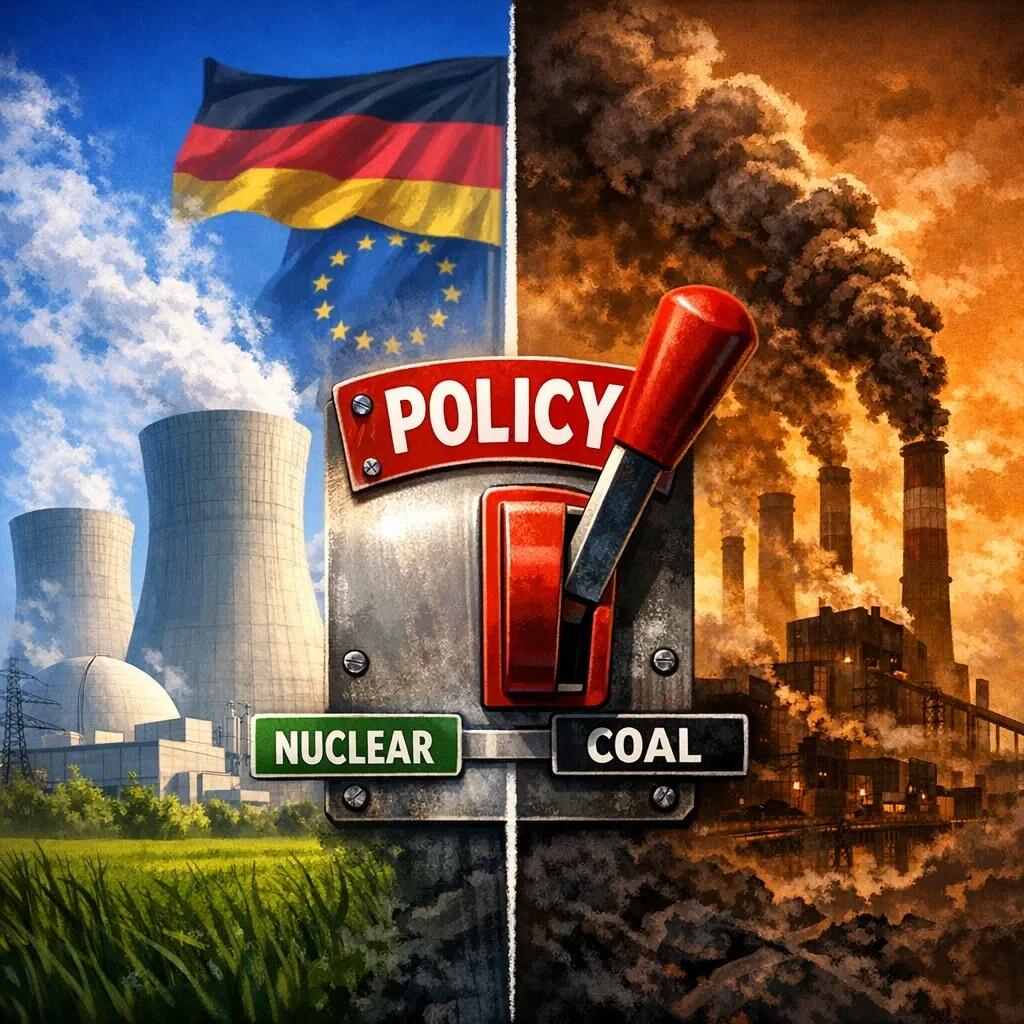
Her government had extended the operating lives of Germany’s 17 nuclear reactors just five months earlier. But, because of the earthquake in Japan, Merkel reversed course overnight and mothballed eight German reactors.
But Merkel’s decision wasn’t really about natural disasters. It was political.
Merkel was terrified of Germany’s Green Party— which was literally founded on anti-nuclear activism in 1980 and had been gaining ground. A critical regional election was just two weeks away, and Merkel was hoping that she might pull out a victory if she killed the reactors.
Her gambit didn’t work, and the Greens won anyway.
But at that point the fate of nuclear had already been set in motion. Within three months, the German government decided to phase out EVERY nuclear reactor in the country.
Bear in mind that Germany’s 17 reactors were generating over a third of the country’s electricity… with zero carbon emissions. That’s a pretty good thing for a country obsessed with climate change.
Yet Germany’s Green party had inexplicably spent decades campaigning to close them, i.e. to shutter the cleanest, most carbon-free source of baseload energy known to man.
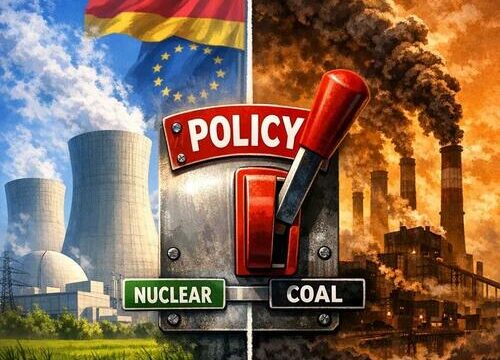
Germany committed to replacing its nuclear plants with solar panels. Naturally this meant that, in a country where the sun barely shines, Germany became increasingly dependent on natural gas— most of which is piped in from Russia.
The true extent of this idiocy didn’t reveal itself until February 2022 when Russia invaded Ukraine: Germany joined Western sanctions against Russia. Russia retaliated by throttling gas supplies. And Germany had no fallback.
So Germany— the country that had lectured the entire world on carbon emissions— frantically restarted more than 20 coal-fired power plants. Then they imported 42 million metric tons of coal, including a surge from southern Africa. They even bulldozed the village of Lützerath to expand a lignite mine, dragging away protesters.
Germany also became a net electricity importer, buying power from France’s nuclear grid.
And gee what a surprise: German electricity prices are now the highest in the European Union. One obvious consequence is that Germany is no longer industrially competitive due to energy costs.
And that brings us to March 6, 2026.
Manuel Hagel, a 37-year-old political candidate from ex-Chancellor Merkel’s party, visited an elementary school.
National television cameras were rolling as Hagel attempted to explain the greenhouse effect to the children:
“Between the earth and the sun is the atmosphere. And as this gets increasingly thin, the sun gets hotter and hotter. And the reason for this is CO2 emissions and and and. And that is the greenhouse effect.”
Unfortunately his explanation is completely wrong. The greenhouse effect works because CO2 and other gases trap heat within the atmosphere; it has nothing to do with the atmosphere thinning or the sun getting hotter.
This is a guy who takes away stoves and gasoline powered vehicles in the name of reducing carbon emissions. Yet he doesn’t even understand the basics of his own ‘science’.
Zee German leadership humiliated themselves even more when, on March 10, European Commission President Ursula von der Leyen stood at the Nuclear Energy Summit in Paris and declared that Europe’s retreat from nuclear power had been “a strategic mistake.”
“In 1990 one-third of Europe’s electricity came from nuclear, today it is only close to 15%. This reduction in the share of nuclear was a choice, I believe that it was a strategic mistake for Europe to turn its back on a reliable, affordable source of low-emissions power.”
She’s right, of course. It was a mistake. An extraordinarily costly one.
This is hilariously ironic since Von der Leyen is German. She served in Merkel’s cabinet. She personally voted to phase out nuclear, and her own policies at the Commission have been to quietly phase out nuclear power.
Also this week, Germany’s current Chancellor (Friedrich Merz) weighed in on this nuclear blunder when he called the reactor phase-out “a mistake” and said, “I regret this.”
Great. Then fix it!
But they’re not going to do that. Unfortunately for Germany, said the Chancellor, “it is the way it is, and we are now concentrating on the energy policy we have.”
Unbelievable. So, in summary:
Germany (initially by Angela Merkel, then later by subsequent governments) destroyed their clean, cheap nuclear plants
They did this for idiotic political reasons
This led to a major energy crisis, which triggered an economic crisis
Nearly everyone in power now acknowledges this was a huge mistake
But they aren’t going to even bother trying to fix it
As we’ve written before, abundant cheap energy is one of the few forces that can reliably keep inflation in check. It fuels stronger growth, lowers prices, and makes life better for everyone.
The US, at least, is heading in the right direction for now, thanks to recent executive orders to reform nuclear licensing, fast-track small modular reactor designs, and create the first real momentum the US nuclear industry has seen in decades.
But the risk is obvious: one election, one change in administration, and a new set of politicians could gut all of that progress overnight — just like Merkel did in 2011.
Germany is a fifteen-year case study in how terrible policies can weaken a country.
And that’s exactly why it makes sense to have a Plan B.
Tyler Durden
Sat, 03/14/2026 – 10:30
https://www.zerohedge.com/political/most-expensive-science-lesson-european-history

Media Says ‘Gambling’ Trump Got Lucky On The Economy
Media Says ‘Gambling’ Trump Got Lucky On The Economy
Democrats have been predicting doom and gloom ever since Trump returned to office, yet the economic calamity they assured us would come has yet to materialize. But rather than give Trump credit, the narrative being pushed now is that his wins are just dumb luck.
(Washington Post staff illustration; photo by Jabin Botsford/The Washington Post, iStock)
That’s certainly the message of a Politico piece headlined “Trump Keeps Gambling With the Economy — And Getting Away With It.”
“President Donald Trump has spent his second term turning risky economic gambles into a way of life,” the article kicks off. “He has implemented sweeping global tariffs that have dramatically increased the cost of doing business across the world. He has sharply decreased the number of people immigrating to the U.S. He has pushed for the Federal Reserve to lower interest rates under any circumstance, even though inflation has not entirely cooled. And now, he’s launched an attack on Iran, a scenario that has long been the clearest and most direct threat to one of Trump’s favored political barometers: gas prices.”
The implicit verdict is clear: these were all reckless moves, and Trump has no business still standing. Except the economy is still standing. Quite well, actually.
So-called experts warned repeatedly that Trump’s tariff regime would send prices spiraling. That didn’t happen. Inflation went down. Democrats entered 2025 predicting that aggressive immigration enforcement would “deliver a catastrophic blow to the U.S. Economy.” That blow never landed. What about the prediction that Trump’s mass deportations would devastate the economy? Not only did that not happen (albeit there was TACO’ing over the scale of deportations), it reversed the trend of rising housing costs, making them more affordable. At some point, a pattern of failed predictions stops being an argument about Trump’s recklessness and starts being an argument about the quality of the predictions.
The article quickly pivots to gas prices, which are up following the attack on Iran – though Energy Secretary Chris Wright called this a ‘fear premium‘ that will fall in ‘weeks, not months’ [though we generally place little stock in bureaucrat promises].
“And now, he’s launched an attack on Iran, a scenario that has long been the clearest and most direct threat to one of Trump’s favored political barometers: gas prices,” the article warns. “The conflict has led to a jump in oil prices, though not quite to worst-case levels, and markets have been jittery about the prospect of more expensive energy and higher U.S. federal debt, stemming from the cost of the U.S.-Israel war with Iran.”
Politico is unwilling to credit the Trump administration for successfully managing the economy after the Biden administration went full leeroy jenkins on inflationary stimmies and red tape; instead, we’re supposed to be convinced that Trump is just lucky that disaster hasn’t struck, or as Politico put it, “getting away with it.”
In fact, Politico suggests that the economy is doing well in spite of Trump…
“In so many ways, that is the story of Trump’s economic stewardship up to this point. His disruptive policies have left some dents, including serious damage to his approval rating, but by the biggest readings of its health, the U.S. economy – measured by overall growth, the job market, the stock market, even inflation – largely keeps absorbing what he throws at it.“
…
But mostly, the U.S. economy is just a consumer-driven powerhouse that seems hard to crush.
The closest they came to crediting Trump for anything was this painful concession:
The president himself is part of the reason for the resilience: GOP tax cuts are expected to provide a huge power-up to economic expansion this year by boosting refunds for individuals and offering immediate deductions for businesses making certain investments. And the administration’s deregulatory efforts have repeatedly driven stocks to new highs, which has helped increase the wealth of households invested in the market.
…
Trump’s own effect, too, is hard to disentangle. He has demonstrated a willingness to be responsive to the desires of corporate America and to the anxieties of financial markets, but he’s also flouted both of those things far more than he did in his first term.
But all of that is just a gamble that paid off, as opposed to signs that Trump’s policies are working. The cognitive dissonance here is astounding, yet unsurprising.
Tyler Durden
Sat, 03/14/2026 – 09:55
https://www.zerohedge.com/political/media-says-gambling-trump-got-lucky-economy
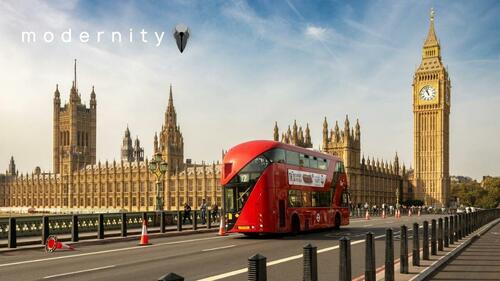
London Buses Must Now Be Equipped With Stab-Kits
London Buses Must Now Be Equipped With Stab-Kits
Authored by Steve Watson via Modernity.news,
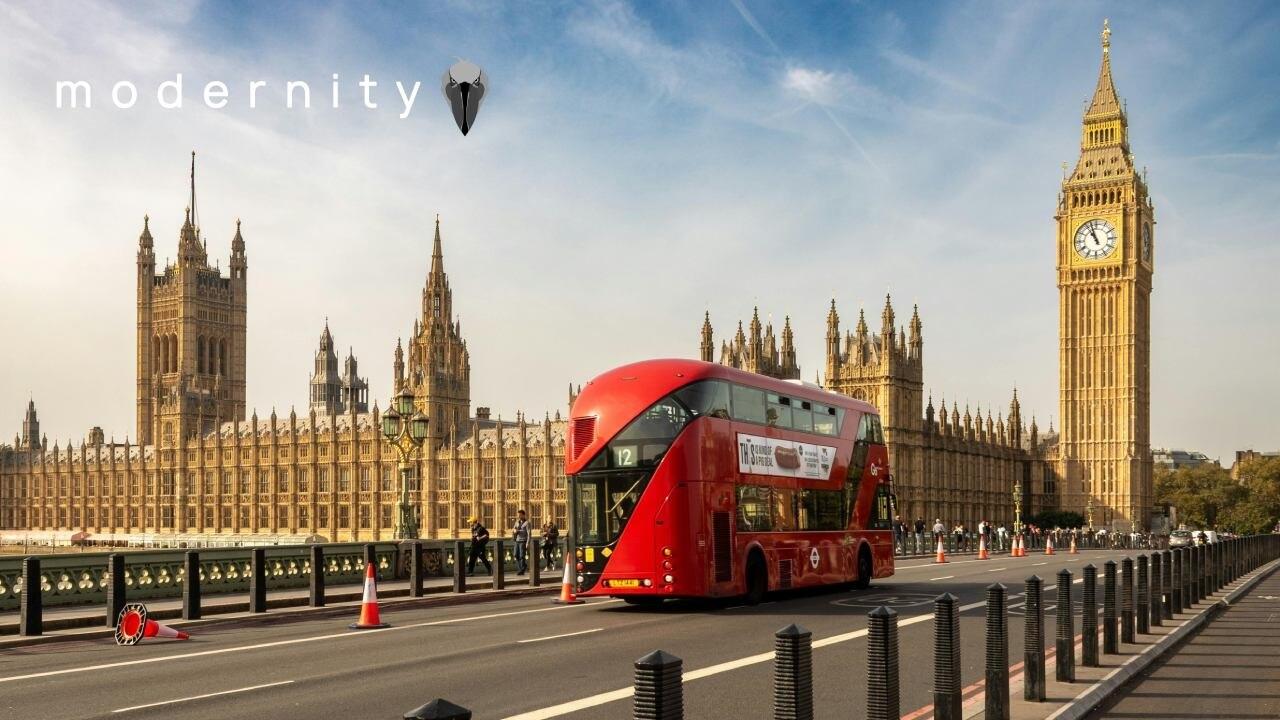
Calls for “bleed kits” to be rolled out across London’s bus network have gained traction, with the London Assembly unanimously backing a motion to install them in major bus stations and trial them on high-risk routes.
These kits, designed to stem severe bleeding from deep wounds, are pitched as a lifesaver in emergencies—yet their sudden necessity speaks volumes about the city’s descent into chaos under unchecked policies.
The push comes from the London Youth Assembly, highlighting how young people feel increasingly unsafe on public transport.
BBC says “deep wound” stab kits are now recommended on London buses for some strange, unstated reasonhttps://t.co/9y3cgbLSj4
— Not the Bee (@Not_the_Bee) March 11, 2026
As Hugo Maxwell, chair of the London Youth Assembly, put it: “These kits are already in lots of Underground stations but buses are the mode of transport most used by young people and therefore it’s essential that we start the rollout there.”
Labour’s transport spokesperson Elly Baker added: “I’ve heard too often from young people that they don’t always feel as safe as they should do travelling… Passing this motion will show that we are listening to young people and backing the investigation of a potentially valuable method of saving lives.”
BBC reports frame this as a proactive safety measure, but online reactions cut through the evasion.
One X user quipped: “The English will be wearing mail armor again. Return to feudal times.”
Another noted: “Their police are too busy arresting people for memes.”
A commenter added: “Self Defense should be available to everyone.”
And one simply stated: “Ready for my commute to work in London,” alongside an image of protective gear.
This rollout underscores a low-trust society where stabbings are dismissed as background noise, a grim reality fueled by open borders and soft-on-crime approaches.
Instead of tackling the root of this horrific reality, it is just being accepted that commuters are somewhat likely to be attacked and killed, as if it’s an accepted part of everyday life in London.
Practically every week we see barbaric attacks, such as this recent one by an Afghan illegal migrant who butchered innocent dog walker Wayne Broadhurst in broad daylight.
Whenever this happens, police urge against sharing the footage, claiming they are attempting to curb “misinformation.”
People are in fear for their lives every day.
iframe sandbox=”allow-scripts” security=”restricted” src=”https://modernity.news/2025/10/29/watch-petrified-woman-details-brutal-…” width=”600″ height=”400″ title=”“Watch: “Petrified” Woman Details Brutal Reality Of Lawless, Borderless Britain” — modernity” data-secret=”dQfpdhgsnz” frameborder=”0″ marginwidth=”0″ marginheight=”0″ scrolling=”no” class=”wp-embedded-content”>
Ironically, when a London bus driver recently stood up to a criminal, he was fired from his job.
What kind of hell are we now living in where buses are doubling as trauma centers?
Ready for my commute to work in London. pic.twitter.com/C8oF9zMVw3
— 𝐌𝐚𝐭𝐭 𝐂𝐚𝐬𝐞𝐲 (@MCasey0311) March 11, 2026
Paging Ricky Gervais…
Your support is crucial in helping us defeat mass censorship. Please consider donating via Locals or check out our unique merch. Follow us on X @ModernityNews.
Tyler Durden
Sat, 03/14/2026 – 09:20
https://www.zerohedge.com/political/london-buses-must-now-be-equipped-stab-kits
The AI Boom Is Creating A Global Memory Chip Shortage
The AI Boom Is Creating A Global Memory Chip Shortage
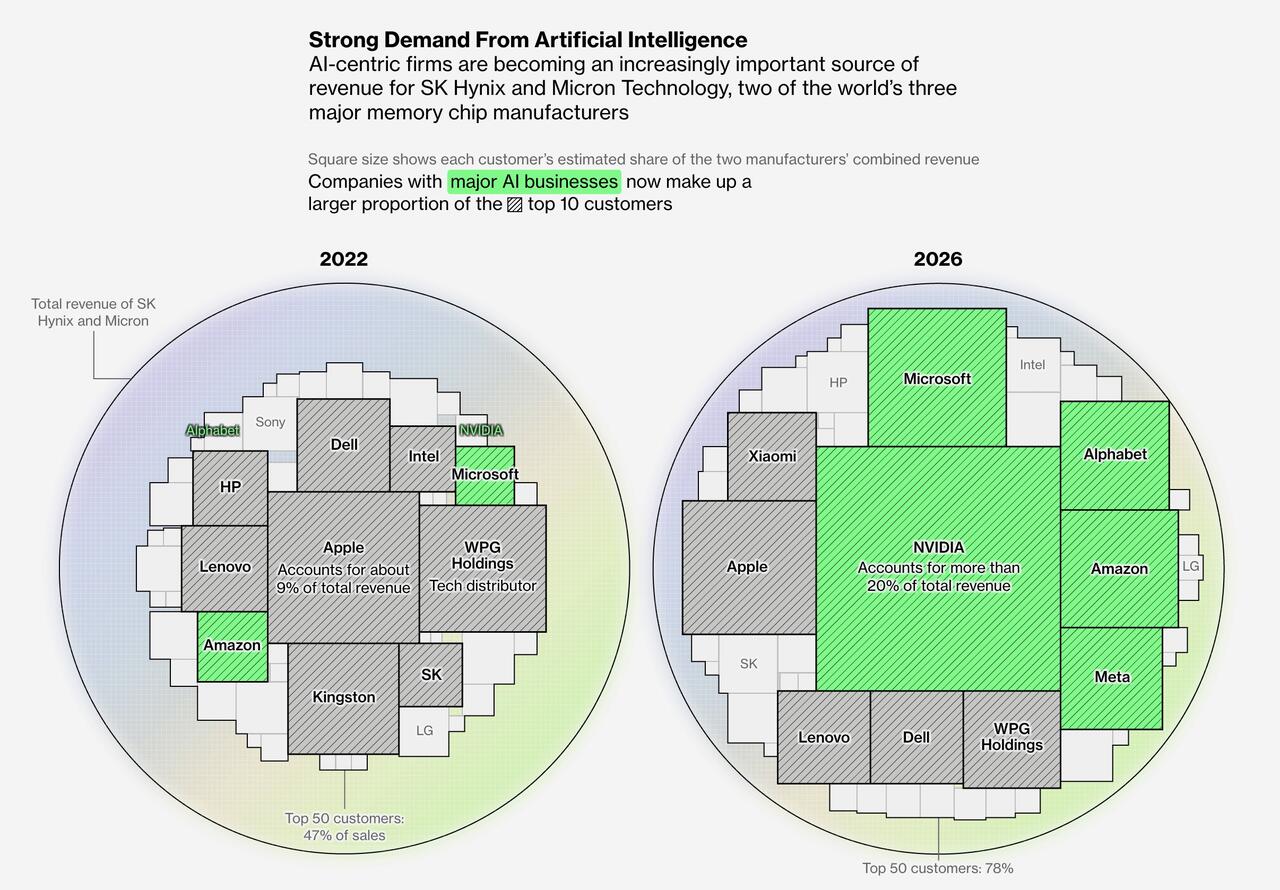
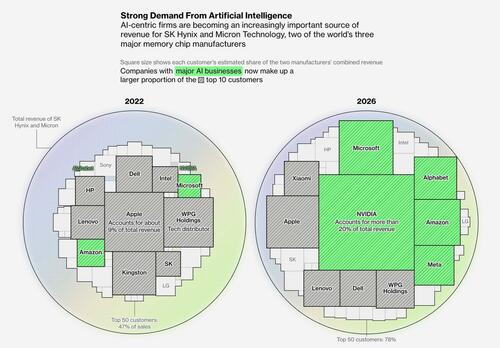
A global shortage of memory chips is emerging as demand for artificial intelligence infrastructure surges, according to a new report from Bloomberg.
Large technology companies are locking in supply by signing long-term agreements and paying higher prices to guarantee access to chips years in advance. Because these deals are more profitable, chip manufacturers are increasingly directing production toward AI customers. This shift has reduced the number of chips available for other products such as laptops, smartphones, gaming consoles, and cars, pushing prices sharply upward.
Memory chips play a critical role in modern computing because they store and deliver data to processors, which carry out calculations. Without sufficient memory, devices would struggle to run applications, load programs, or process data efficiently. Two types dominate the industry. DRAM functions as short-term working memory that computers and servers use to quickly access active data. NAND flash memory serves as long-term storage, holding files, photos, and software even when devices are powered off.
Bloomberg writes that Artificial intelligence systems require enormous amounts of memory, especially a newer design known as high-bandwidth memory (HBM). This technology stacks multiple layers of memory vertically and places them close to processors, allowing data to move much faster than with traditional designs. The speed is essential for AI models that must constantly move and process huge volumes of information.
The rapid expansion of AI data centers has dramatically increased demand for memory chips. Major technology firms are investing hundreds of billions of dollars to expand computing capacity, and AI servers require far more memory than traditional systems. As a result, data centers now account for a much larger share of global DRAM usage than they did just a few years ago, and that share is expected to keep growing.
With supply unable to keep pace, memory prices have climbed steeply. In some cases, DRAM spot prices have risen several hundred percent within a year, while NAND storage costs are also increasing. The impact is spreading across the electronics industry. Companies that build computers, phones, and gaming systems are facing higher manufacturing costs and tighter component supply. Some manufacturers have already raised prices or reduced the amount of memory included in certain devices to manage expenses.
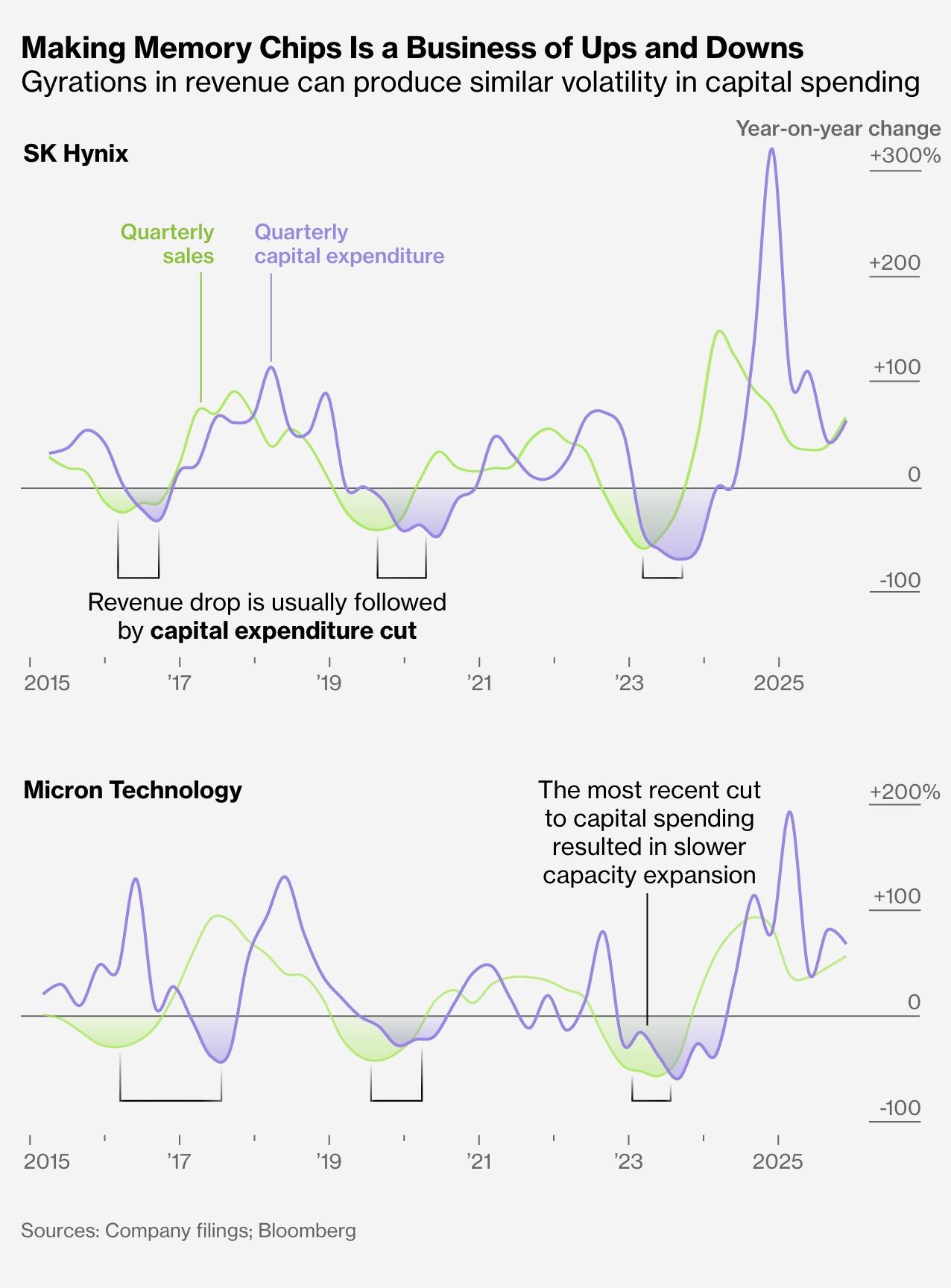
Expanding production is not a quick solution. The memory chip industry is highly concentrated, with most output coming from companies such as Samsung Electronics, SK Hynix, and Micron Technology. Building new fabrication plants requires enormous investment and several years before meaningful output begins. Producing advanced chips like HBM is even more challenging because they involve stacking extremely thin layers of silicon with microscopic connections; even a small defect can ruin an entire unit.
Manufacturers are expanding cautiously because the memory business has historically been volatile, swinging between shortages and oversupply. Companies want to benefit from the AI boom without repeating past cycles that led to large financial losses when demand suddenly weakened. For the moment, firms building AI infrastructure are securing the components they need, while consumer electronics makers may have to cope with higher costs and limited supply until production eventually catches up with demand.
Tyler Durden
Sat, 03/14/2026 – 08:45
https://www.zerohedge.com/markets/ai-boom-creating-global-memory-chip-shortage
British Tourist Faces Prison Sentence In UAE For Filming Iranian Missiles
British Tourist Faces Prison Sentence In UAE For Filming Iranian Missiles
Authored by Dave DeCamp via AntiWar.com,
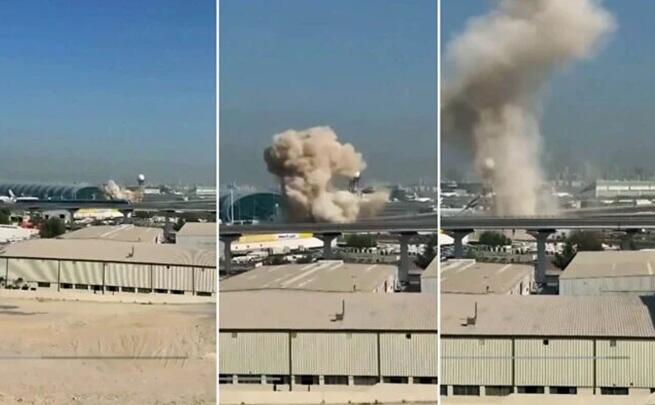
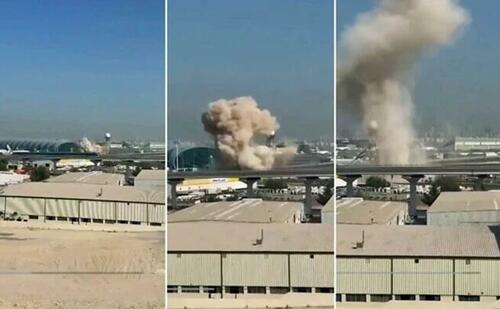
A British tourist is among about 20 people who are facing charges in the UAE for filming Iranian attacks on Dubai, as America’s Gulf Arab allies are taking steps to censor the impact of the war.
According to The Guardian, the 60-year-old man is being charged with a law that prohibits sharing material that can endanger public security. The report said that he is still facing charges despite deleting the video immediately when he was asked to.
The charge carries a penalty of up to two years in prison, and many could face similar charges for simply sharing videos of missile attacks that have already been published online.
“The charges sound extremely vague but serious on paper. In reality, the alleged conduct could be something as simple as sharing or commenting on a video that is already circulating online,” said Radha Stirling, the head of Detained in Dubai.
“Under UAE cybercrime laws, the person who originally posts content can be charged, but so can anyone who reshapes, reposts, or comments on it,” Striling added.
In the immediate aftermath of the US and Israel launching the war with Iran on February 28, videos of counterattacks in Gulf countries were widespread on social media, but they became scarce once the Arab governments began cracking down.
In Bahrain, which has a Shia majority ruled by a Sunni monarch, authorities began arresting people for “misusing” social media and pursued people who appeared to be celebrating the attacks.
Israel has also imposed tight restrictions on the dissemination of information about Iranian missile strikes, as it did during the 12-Day War in June 2025.
Tyler Durden
Sat, 03/14/2026 – 08:10

Sweden Seizes Another Suspected Russian ‘Dark Fleet’ Tanker, Despite US Easing Sanctions
Sweden Seizes Another Suspected Russian ‘Dark Fleet’ Tanker, Despite US Easing Sanctions
Washington has eased sanctions on countries buying Russian oil in connection with the Iran war and Strait of Hormuz crisis, an easing welcomed by the Kremlin, but which has caused angst and anger among pro-Ukraine campaigners.
The US waiver is active for a month, and applies to crude which has has been floating at sea and thus was unable to be sold. However, this hasn’t stopped some European countries from moving against tankers without proper registration and flags.
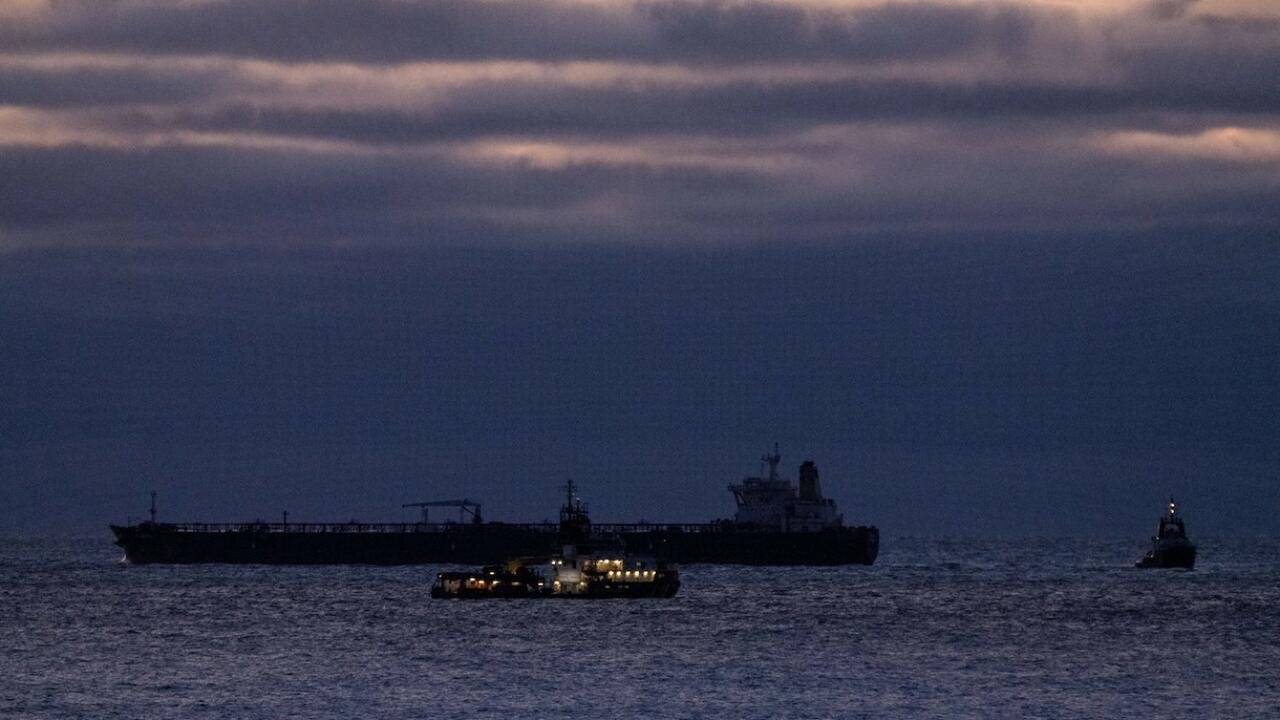
Sweden, for example, on Thursday seized a suspected Russia “shadow fleet” tanker sailing under “false flag” – following similar interdicts going back months.
Ship-tracking data shows the 228-meter tanker Sea Owl I had been headed from Santos, Brazil toward Tallinn before Swedish police boarded it off the southern town of Trelleborg.
Swedish authorities said they believe the vessel’s actual destination was Primorsk, near Saint Petersburg. A statement said:
“The tanker Sea Owl I flies the Comorian flag. The coast guard suspects that it is not included in their ship register, that it is sailing under a false flag and that there is therefore no flag state that can guarantee the safety on board,” Sweden’s coast guard said.
“A preliminary investigation into suspected violations of the maritime act regarding lack of seaworthiness has been initiated,” the coast guard added.
Authorities also noted the vessel is on a European Union sanctions list and has previously transported oil products between Brazil and Russia. Below is some more recent background on prior interdictions:
On 6 March, Sweden stopped and detained the vessel Caffa in the Baltic Sea over suspicions of sailing under a false flag and violating maritime law and security regulations. The Russian captain of the ship was subsequently arrested.
On the night of 28 February-1 March, Belgium, with the help of French military helicopters, detained the oil tanker Ethera in the North Sea, another vessel linked to Russia’s shadow fleet.
As for the US letting off the gas pedal when comes to pressuring Russian oil exports, the move has been seen as another U-turn, and comes months after President Trump slapped tariffs on Indian goods in a bid to pressure Prime Minister Narendra Modi’s government to abandon energy purchases from Russia, which India never did.
“To enable oil to keep flowing into the global market, the Treasury Department is issuing a temporary 30-day waiver to allow Indian refiners to purchase Russian oil,” US Treasury Secretary Scott Bessent said last week in a post on X. “This deliberately short-term measure will not provide significant financial benefit to the Russian government as it only authorizes transactions involving oil already stranded at sea.”
Tyler Durden
Sat, 03/14/2026 – 07:35

UK Councils Warn Schools: Children’s Drawings Could Be Blasphemous Under Islamic Law
UK Councils Warn Schools: Children’s Drawings Could Be Blasphemous Under Islamic Law
Authored by Steve Watson via Modernity.news,
In yet another assault on free expression in British classrooms, schools are being instructed by Labour councils to treat kids’ innocent drawings as potential offenses under Islamic interpretations.
Guidelines warn that depicting humans or prophets could spark blasphemy complaints, forcing teachers to tiptoe around religious sensitivities at the expense of creativity and open education.
The push comes amid a broader Labour government drive to monitor and suppress any perceived slights against Muslims, turning schools into surveillance outposts rather than places of learning.
Pupils’ drawings could be blasphemous under Islamic law, Labour councils tell schools – while music and dance classes may go against the teachings of Islam https://t.co/fB8uWaSvx8
— Daily Mail (@DailyMail) March 11, 2026
The guidance, titled “Sharing the Journey,” originates from northern Labour councils like Leeds, Calderdale, Oldham, and Wakefield, and has been adopted by others including Sefton and Tameside. It explicitly states that “for some Muslim parents, sensitivities may exist in connection with the teaching of aspects of art, dance, drama, music, physical education, religious education and RSHE”.
Teachers are advised: “It is very important that the school understands this and is also careful not to ask its students to reproduce images of Jesus, the Prophet Mohammed or other figures considered to be prophets in Islam. Some Muslim pupils may not wish to draw the human figure.” This stems from hadith interpretations prohibiting images of living beings, viewed as idolatrous by some sects.
The restrictions don’t stop at art. On music, the document notes: “in Islam, music is traditionally limited to the human voice and non-tuneable percussion instruments as in the days of the Prophet, when they were only used in marriage ceremonies and on the battlefield”. It adds that “schools should listen to any concerns, discuss the place of music in the curriculum and ensure that students are not asked to join in songs that conflict with their religious beliefs”.
Dance lessons face similar scrutiny, with warnings that they could cause parental concerns over “physical contact between males and females”. The overall aim, per the introduction, is to play a part in “building harmony and understanding” and fostering “cohesion” in local communities.
This guidance ties directly into Labour’s escalating surveillance in schools. As we previously reported, Communities Secretary Steve Reed announced: “Today, we are adopting a non-statutory definition of anti-Muslim hostility. This gives a clear explanation of unacceptable prejudice, discrimination and hatred targeting Muslims, so we can take action to stop it.”
Critics like Richard Holmes from the Free Speech Union countered: “It risks hindering free speech under the law and legitimate criticism of Islamism.”
‘We do not need a government supplied definition of Islamophobia!’
GB News contributor Connie Shaw explains why the free speech union has claimed the new Islamophobia definition could stifle legitimate criticism of faith and freedom of speech. pic.twitter.com/mk5kYyNzIb
— GB News (@GBNEWS) March 11, 2026
Such monitoring creates a “chilling effect” on debate. It’s no surprise, given the regime’s pattern of stifling dissent.
While all this is going on, the authorities are pushing propaganda depicting teenage white boys as terror threats.
The indoctrination is reaching into schools.
We have also highlighted earlier indoctrination efforts, including teaching children how to “spot extremist content and misinformation”.
You can guess what constitutes that from the government’s perspective.
Education Secretary Bridget Phillipson announced she was “launching a review of the curriculum in primary and secondary schools to embed critical thinking across multiple subjects,” which really meant training kids to dismiss anything the state labels as “putrid conspiracy theories.”
What started as spotting ‘fake news’ in English and maths has now morphed into policing playground sketches for blasphemy, all under the same veil of ‘critical thinking’ that stifles genuine inquiry and enforces ideological conformity.
The overreach also extends to online freedoms, with the government once again threatening to shut down X over Grok being recently prompted to produce ‘insults’ and ‘offensive language’.
Even national symbols aren’t safe from this all out assault on British culture. The leaked ‘Social Cohesion’ Strategy draft absurdly claims that “Flying a Union Jack flag is a ‘tool of hate’.
These interconnected policies reveal a clear agenda: under the guise of “cohesion,” the government is dismantling free speech and cultural expression. From classrooms to online platforms, the surveillance state expands, criminalizing everything from kids’ sketches to national flags.
The Batley Grammar School incident in 2021, where a teacher remains in hiding after showing a prophet image, underscores the real dangers of such accommodations. Yet instead of defending educators, authorities double down on restrictions.
This isn’t about harmony—it’s about control. As free-speech advocates warn, these measures inhibit legitimate criticism and debate, all while ignoring actual threats from unchecked migration and extremism.
Britain’s freedoms hang by a thread. Resisting this creeping authoritarianism means championing open discourse and national pride, rejecting a playbook that sacrifices liberty for appeasement.
Your support is crucial in helping us defeat mass censorship. Please consider donating via Locals or check out our unique merch. Follow us on X @ModernityNews.
Tyler Durden
Sat, 03/14/2026 – 07:00
Trump Crosses Iran’s ‘Red Line’ By Heavy Bombing Of Kharg Island, Endangering Energy Assets Across Region
Trump Crosses Iran’s ‘Red Line’ By Heavy Bombing Of Kharg Island, Endangering Energy Assets Across Region
In what could prove to be a major step up the escalation ladder in the two-week-old US-Israeli war on Iran, President Trump on Friday evening (notably after US market closure) announced that US Central Command had carried out a major bombing raid on Kharg Island, which handles upwards of 90% of Iran’s crude oil exports. Importantly, Iran has previously warned that an attack on the island would cross a red line, and precipitate Iranian attacks on energy infrastructure up and down the Persian Gulf.
Perhaps with that previous Iran warning in mind — and to allay the fears of US allies in the region who don’t want to see their energy facilities go up in smoke — Trump emphasized that the attack was focused on military assets:
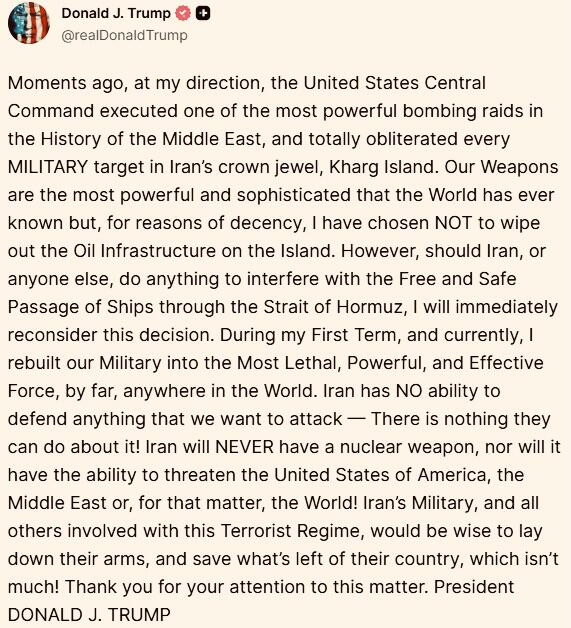
“Moments ago, at my direction, the United States Central Command executed one of the most powerful bombing raids in the History of the Middle East, and totally obliterated every MILITARY target in Iran’s crown jewel, Kharg Island.
Our Weapons are the most powerful and sophisticated that the World has ever known but, for reasons of decency, I have chosen NOT to wipe out the Oil Infrastructure on the Island. However, should Iran, or anyone else, do anything to interfere with the Free and Safe Passage of Ships through the Strait of Hormuz, I will immediately reconsider this decision.”
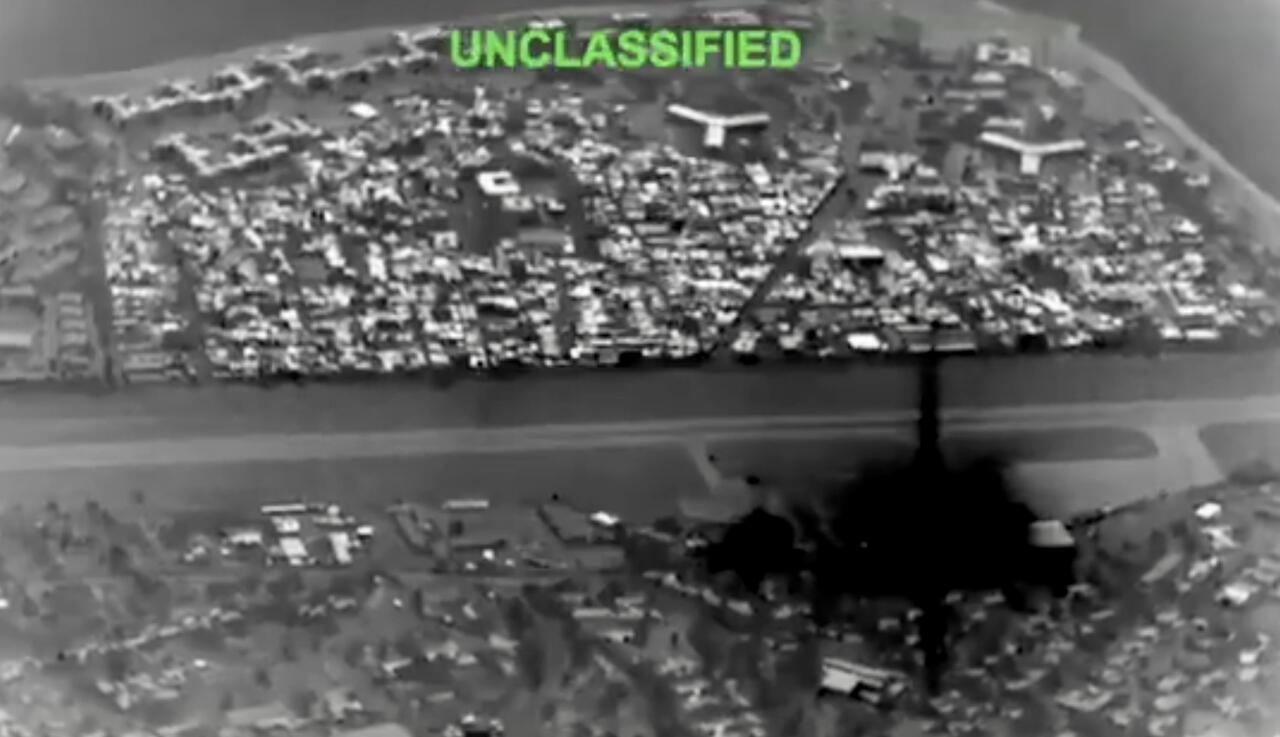
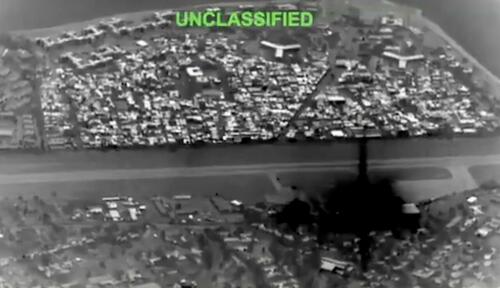
Iran’s FARS news agency confirmed the attack, saying at least 15 explosions were heard as it unfolded. FARS reports that targets included air defense assets, a naval base, an airport control tower and a helicopter hangar associated with Iranian Offshore Oil Company. The Trump administration released video highlights from the bombing raid:
Footage has now been published by President Donald J. Trump showing today’s strikes against Iranian military targets on Kharg Island in the Northern Persian Gulf, which acts as a port hub for the export of up to 90% of oil products leaving Iran. In the footage, strikes can be… pic.twitter.com/WH3iWw74sE
— OSINTdefender (@sentdefender) March 14, 2026
Trump’s threat to “reconsider” the decision not to damage the energy infrastructure on the island if Iran continues to shut down the Strait of Hormuz will surely cause deep concern among Gulf allies and everyone else who’s wary of the looming global economic catastrophe that will unfold if the Persian Gulf energy shutdown persists.
With Iran apparently bent on imposing a devastating cost for the US-Israeli war — one that will deter future attacks — there’s little reason to think Tehran is going signal “all clear” on the strait anytime soon.
Five miles long and situated 15 to 20 miles off the mainland-Iranian coast, Kharg Island is essential to Iran’s export of petroleum. Facilities there have continued to operate throughout the war, with at least 10 tankers hauling off nearly 19 million barrels since the US-Israeli surprise attack on Feb 28. Iran has, however, sought to add a small measure of export-facility diversification, by reopening energy exports at the Jask terminal, which is southeast of the Straight of Hormuz, in the Gulf of Oman.
Earlier on Friday, Trump said the US Navy would shortly begin escorting oil tankers through the Strait of Hormuz, telling reporters, “It will happen soon, very soon.” A few hours after his Kharg Island announcement, Trump reiterated his latest war-justification that centers on Iran’s supposed schemes for regional conquest, posting that “Iran had plans of taking over the entire Middle East, and completely obliterating Israel. JUST LIKE IRAN ITSELF, THOSE PLANS ARE NOW DEAD!”
The administration has reportedly contemplated seizing Kharg Island. Given its close proximity to the Iranian mainland — which is teeming with drones, cruise missiles and weapon-bearing speedboats — landing a strike force on the island and then occupying it could come at a high casualty rate.
On Friday, Defense Secretary Pete Hegseth approved a CENTCOM request for a Marine expeditionary unit to be deployed to the theater of operations. This would typically comprise some 5,000 Marines and sailors on several ships.
Iranian armed forces statement in response to Trump’s threat to attack oil infrastructure on Kharg Island (published by Iranian state media) pic.twitter.com/8J40dzIE7C
— Steve Lookner (@lookner) March 14, 2026
Some speculation on Trump White House’s thinking regarding this ultra-risky thinking (or what might eventually prove a point of no return) via Jim Bianco:
Recognizing that this could freak out oil markets, they announced it on Friday evening to give markets 48 hours to digest the news. Trump also made it explicit that oil infrastructure would be next if Iran did not allow ships to pass freely through the Strait of Hormuz.
In football terms, they’re throwing a Hail Mary pass now, hoping it works. They don’t have any more time on the clock. Oil markets and the world economy cannot wait weeks or months for the military to open the Strait. Further, I could envision political advisors suggesting that if oil prices are destined to hit $200 without this action, it might as well happen next week, giving six months to bring them down before the midterm elections.
For now, though, all eyes are on Iran, and whether its leaders view a Kharg Island attack that was confined to military targets as within the red-line boundary — or if energy assets across the region will soon be beset by drone swarms and ballistic-missile barrages, sending oil and gas prices rocketing higher.
Tyler Durden
Sat, 03/14/2026 – 00:01
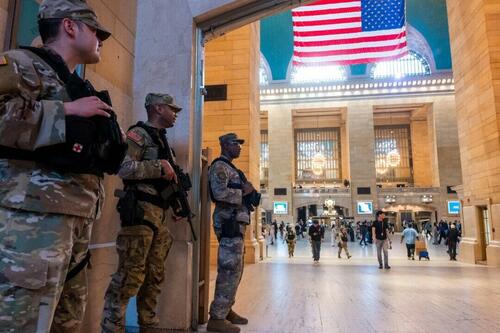
War Abroad Should Not Mean Less Freedom At Home
War Abroad Should Not Mean Less Freedom At Home
Authored by Mollie Engelhart via The Epoch Times,
As an American, a mother, and a rancher, I have been reflecting on what it means when our country enters another war—and what history tells us often follows at home.
There will be endless debate about who is right and who is wrong. Some will praise our leaders, others will criticize them, and neighbors will disagree about how we got here and how events will unfold in the future. Those conversations are natural in a free society.
But there is another conversation that deserves just as much attention, one that history quietly asks every time the United States goes to war: What freedoms will Americans lose this time?
History suggests that wartime often reshapes the relationship between citizens and government.
The United States remains one of the last English-speaking countries where speech and thought are still broadly protected. That did not happen by accident. It is the inheritance of a constitutional republic built on the understanding that rights do not come from government; they come from God. The Constitution did not grant Americans their freedoms. It recognized them and placed limits on what government may do.
Yet when we look honestly at the past century, a pattern becomes difficult to ignore. Nearly every major war America has entered has been followed by some erosion of liberty at home.
During World War I, Congress passed the Espionage Act of 1917, followed by the Sedition Act of 1918. Under these laws, Americans could be arrested and imprisoned simply for criticizing the war or discouraging military enlistment. Speech that would normally fall under the protection of the First Amendment suddenly became criminal. One of the most famous cases involved Eugene V. Debs, a political leader who received a 10-year prison sentence for delivering a speech opposing the war and the draft.
The war eventually ended, but the Espionage Act remains on the books more than a century later.
World War II produced an even more direct violation of civil liberties. After the attack on Pearl Harbor, the federal government issued Executive Order 9066, authorizing the forced relocation of Japanese Americans living on the West Coast. More than 120,000 people, mostly American citizens, were removed from their homes and placed in internment camps. Families lost farms, businesses, and property, and people were detained without criminal charges or trials. The Supreme Court upheld the policy at the time, though it is now widely regarded as one of the most troubling civil liberties failures in modern American history.
The war ended and the camps were eventually closed, but the lesson remained clear: in times of fear and national emergency, the rights of citizens can be pushed aside.
The Cold War era introduced another form of government intrusion into American life. Fear of communist infiltration led to sweeping investigations into the political beliefs of citizens. The House Un-American Activities Committee summoned Americans to testify about their associations and views, while the Smith Act allowed prosecutions for advocating certain political ideas. Teachers, actors, writers, and government employees were blacklisted or pressured into oaths of loyalty. Careers were destroyed not because someone had committed a crime, but because they held—or were suspected of holding—the wrong political beliefs.
The Vietnam War era expanded another category of government power: domestic surveillance. During this period, the FBI operated a secret program known as COINTELPRO, which monitored activists, journalists, and political organizations across the country. Civil rights groups, anti-war movements, student organizations, and political activists found themselves under federal surveillance. What began as intelligence gathering against perceived threats grew into widespread monitoring of American citizens engaged in political activism.
The pattern continued into the modern era. In response to the terrorist attacks of Sept. 11, 2001, the United States launched what became known as the War on Terror, a series of conflicts that included military operations in Afghanistan, Iraq, Libya, and later involvement in the war in Syria.
At home, these wars were accompanied by some of the most significant expansions of federal surveillance authority in modern American history. Congress passed the Patriot Act, granting intelligence agencies broader powers to monitor communications, access financial records, and collect data connected to national security investigations. The federal government also created the Department of Homeland Security, dramatically expanding the domestic security infrastructure of the United States.
Airport travel changed almost overnight with the creation of the Transportation Security Administration, bringing new searches, body scanners, and security databases that monitor millions of travelers. Years later, whistleblower Edward Snowden revealed that intelligence agencies had been collecting vast amounts of digital information through programs designed to monitor global communications networks. Phone metadata, internet traffic, and other digital communications were gathered on a scale few Americans had previously imagined.
The technology had changed, but the pattern had not. Once again, a national crisis and the wars that followed led to an expansion of government authority over the lives and communications of ordinary citizens.
None of this history is meant to pass judgment on any particular war or moment in time. Every generation faces dangers that require difficult decisions, and national security is not an abstract concern. But history does reveal a pattern. War has often expanded the power of government while gradually narrowing the freedoms of citizens. Perhaps our generation can be the one that finally recognizes that pattern and refuses to let the erosion continue.
It is easy to succumb to the emotions of the moment.
War brings grief, anger, fear, and uncertainty. Families pray for sons and daughters in uniform, and communities mourn the innocent lives lost in conflicts far from our shores. Those responses are deeply human.
But between the praying and the grieving, there must also be vigilance. Americans must stand shoulder to shoulder and guard the freedoms that define this country.
Foreign policy decisions are often far beyond the control of ordinary citizens. Individuals living in small towns and rural counties do not set global strategy, but we do have a voice when it comes to the preservation of liberty at home. Whether someone supports this war or opposes it should not matter when it comes to defending constitutional freedoms. Americans across the political spectrum should be able to agree that freedom of speech, privacy, and due process matter. Our disagreements about policy cannot become an excuse to surrender the principles that allow us to disagree in the first place.
History shows that government often expand their reach during wartime through censorship, surveillance, or emergency authority that remains long after the emergency has passed. Americans should make one thing clear: war must never become an excuse to erode the freedoms of citizens at home.
Do not use technological capabilities, border crises, or fears of instability to justify mass surveillance of the American people. Military intelligence tools and artificial intelligence designed for battlefield awareness do not belong in the daily lives of citizens. The American people are not subjects of the state. We are sovereign citizens, and sovereignty means something simple but powerful: government authority ultimately flows from the consent of the governed.
Many forces in the world are beyond the control of ordinary people. Wars between nations are often among them. But the preservation of liberty inside our own country has always depended on the vigilance of citizens, and that responsibility does not disappear in wartime. In fact, wartime is when it matters most.
If the past century teaches us anything, it is that freedom rarely disappears all at once. It erodes slowly, piece by piece, often justified by fear and the promise that restrictions will only be temporary.
Americans have heard that promise before.
This time we should respond that we will pray for peace, we will pray for our troops, and we will mourn innocent lives lost in war. But we will also stand together in sending a clear message:
Our freedoms are not negotiable.
Not this time. Not ever.
Views expressed in this article are opinions of the author and do not necessarily reflect the views of The Epoch Times or ZeroHedge.
Ty
Fri, 03/13/2026 – 23:05
https://www.zerohedge.com/political/war-abroad-should-not-mean-less-freedom-home