Category: News
49ers anulan más de 26 millones del contrato de Brandon Aiyuk, según fuente de AP
Por JOSH DUBOW
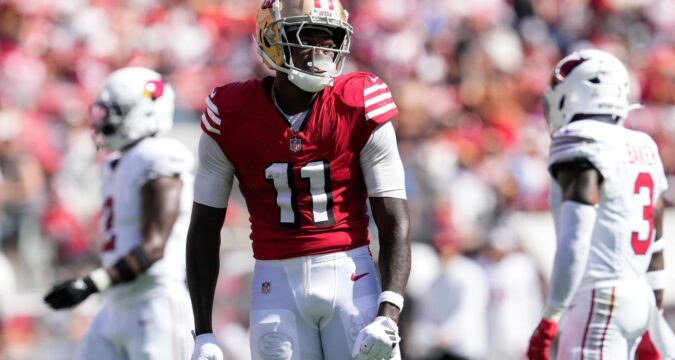
SANTA CLARA, California, EE.UU. (AP) — El receptor de los 49ers de San Francisco Brandon Aiyuk, ha perdido el dinero garantizado en su contrato para la próxima temporada tras no participar en reuniones y otras actividades del equipo.
Una persona familiarizada con la decisión confirmó que el equipo anuló a principios de este año los más de 26 millones de dólares que se suponía que Aiyuk tendría garantizados en 2026 bajo la extensión de cuatro temporadas y 120 millones de dólares que firmó el año pasado. La persona habló con The Associated Press bajo condición de anonimato porque el equipo no hizo ningún anuncio.
The Athletic fue el primer medio en informar sobre la decisión.
Aiyuk ha estado fuera toda la temporada, mientras se recupera de una cirugía de rodilla a la que se sometió el año pasado, y no hay un cronograma para su regreso. El entrenador Kyle Shanahan dijo durante el verano que Aiyuk podría volver al campo de práctica a principios de noviembre, pero ha permanecido en la lista de físicamente incapaces de desempeñarse.
La decisión de anular el dinero garantizado permitiría a los Niners deshacerse de Aiyuk el próximo año y solo cargar con aproximadamente 29,5 millones de dólares en dinero muerto en el tope salarial por bonos ya pagados. Podrían dividir eso en dos años.
Aiyuk firmó la lucrativa extensión el verano pasado tras una prolongada discrepancia contractual que lo mantuvo fuera del campo de entrenamiento. Venía de una temporada 2023 en la que aportó 75 recepciones para 1.342 yardas y siete touchdowns
Fue elegido al segundo equipo All-Pro.
Aiyuk realizó apenas 25 recepciones para 374 yardas en siete duelos la temporada pasada antes de lesionarse.
El jugador de 27 años, tiene 294 recepciones en su carrera para 4.305 yardas y 25 touchdowns desde que fue seleccionado en la primera ronda del draft de 2020.
_____
Deportes AP: https://apnews.com/hub/deportes

Heat domina 143-107 a Bulls, liderados por 20 puntos y 14 rebotes de Kel’el Ware
CHICAGO (AP) — Kel’el Ware anotó 20 puntos y 14 rebotes, Norman Powell sumó 19 unidades y el Heat de Miami superó 143-107 a los Bulls de Chicago el viernes por la noche.
Bam Adebayo anotó 18 puntos, mientras que Pelle Larsson y Davion Mitchell anotaron 16 cada uno para Miami, que superó la marca de 140 puntos por cuarta vez esta temporada, igualando su total de tales juegos de las últimas siete temporadas combinadas.
Miami, que terminó el juego con un promedio de 124,8 puntos por partido, el mejor de la NBA esta temporada, lideró por 41 en los minutos finales. Esa fue la segunda mayor ventaja del Heat en la temporada y el mayor déficit de los Bulls (el anterior fue de 25 contra Nueva York el 2 de noviembre).
Ayo Dosunmu anotó 23 puntos para Chicago, que obtuvo 19 puntos, 11 rebotes y nueve asistencias de Josh Giddey. Jalen Smith anotó 14 para los Bulls.
El Heat se puso 2-1 en los juegos de la Copa NBA, medio juego detrás de Milwaukee (2-0) por el liderato del Grupo C del Este. Chicago (1-2 en juegos de la Copa) cayó al cuarto lugar en el sector, medio juego detrás de Nueva York y medio juego por delante de Charlotte.
Chicago abrió el juego con una racha de 18-11 en los primeros cinco minutos y medio, pero Miami controló el resto del camino. Una ráfaga de 53-21 del Heat le dio a Miami una ventaja de 25 puntos al final de la primera mitad, y el margen nunca fue menor de 14 nuevamente.
Los Bulls perdieron a Kevin Huerter en el tercer cuarto después de que agitara el balón con frustración tras una falta. El balón rebotó en la pierna trasera del árbitro Che Flores, y Huerter fue expulsado.
Chicago también vio a Matas Buzelis (tobillo derecho) y Dalen Terry (pantorrilla izquierda) salir con lesiones.
___
Deportes en español AP: https://apnews.com/hub/deportes
How Trump’s Own Appointees Aided Russiagate Plot Against Him
How Trump’s Own Appointees Aided Russiagate Plot Against Him
Authored by Paul Sperry via RealClearInvestigations,
When Obama administration officials manufactured U.S. intelligence tying Donald Trump to Moscow following his stunning 2016 victory, they had no idea Trump’s own political appointees would help them undermine Trump’s presidency – and his chances of reelection in 2020.
RCI’s review of recently declassified documents and exclusive interviews with former Trump officials reveals for the first time how key members of Trump’s cabinet and other appointees during his first term shrouded the previous administration’s machinations and either deliberately or inadvertently misled the public into thinking the fake Russiagate intelligence was real.
Former Special Counsel John Durham, former National Security Adviser John Bolton, former Secretary of State Mike Pompeo, and former CIA Director Gina Haspel dismissed or buried evidence that cast doubt on a foundational document of the Russigate hoax – the Intelligence Community Assessment (ICA) prepared in the waning days of the Obama administration.
Durham, who was appointed by Attorney General William Barr, stopped the declassification and release of key exculpatory evidence debunking the ICA on the eve of the 2020 election, which has not been reported previously.
The ICA helped frame the false narrative, which led to multiple espionage investigations that dogged Trump throughout his first term: that Russian President Vladimir Putin had authorized dirty tricks to help Trump win the 2016 election. A 2018 government review of that document, which was chiefly prepared by Obama’s CIA Director John Brennan and his National Intelligence Director James Clapper, found that its most explosive claims were based on “one scant, unclear and unverifiable fragment of a sentence from one of the substandard [intelligence] reports,” according to a recently declassified report that Trump administration and, later, Biden administration officials had helped keep locked away in a CIA vault. It also cited as supporting intelligence debunked political dirt paid for by Hillary Clinton’s campaign.
While these Trump-appointed officials may not have initiated the weaponization of the CIA against Trump, they facilitated it by hiding evidence that exposed the claims that Russia tried to help Trump as a fraud. By obscuring Joe Biden’s own role in perpetrating the hoax, they may have helped Obama’s vice president win the close race for the presidency in 2020.
“The Russiagate betrayal continued in plain sight,” said former Trump national security adviser J.D. Gordon, with some in Trump’s own cabinet letting him twist in the wind instead of daylighting secreted material that would have cleared the clouds of suspicion hanging over his head before the 2020 election.
John Bolton
The suppression can be traced back at least until mid-2018. That’s when Fred Fleitz, who was National Security Adviser John Bolton’s chief of staff, heard that investigators at his former employer, the House Intelligence Committee, were probing the raw intelligence in the ICA supporting the assessment’s key judgments.
A one-time CIA analyst himself, Fleitz was curious to learn what they had found during the previous year, interviewing CIA analysts and reviewing secret documents at Langley. So, he traveled to the other end of Pennsylvania Avenue and read a draft of the highly classified report in a secure room of the U.S. Capitol.
Fleitz told RealClearInvestigations that he was startled to learn that the investigators discovered numerous intelligence documents showing the ICA’s key conclusion – that Russia “developed a clear preference” for Trump and “aspired to help” him win the election – was based on shoddy and fabricated intelligence. House investigators found those assessments were supported in part by the Steele dossier, a series of Clinton campaign-funded reports containing baseless accusations linking Trump to the Kremlin compiled by former British intelligence officer Christopher Steele.
“The ICA misrepresented both the significance and credibility of the dossier reports,” which were “either proven false or unsubstantiated,” the top-secret congressional analysis noted. “The ICA referred to the dossier as ‘Russian plans and intentions,’ falsely implying that the dossier had intelligence value for understanding Moscow’s influence operations.”
Fleitz thought Bolton should be briefed on the unpublished House report, which undermined the prevailing narrative that Trump and Moscow had colluded during the 2016 election campaign. When he returned to his West Wing office, Fleitz sat down at his classified computer and wrote a synopsis of the review and gave it to his boss.
But Bolton did not, in turn, brief the president. “He didn’t do anything with it. He never told Trump, and I never heard anything about it again,” Fleitz told RCI.
If Trump had known about the shocking revelations from the classified report, Fleitz said, he could have used them to remove the cloud of suspicion hanging over his presidency concerning Russia.
Bolton – who is facing unrelated criminal charges for mishandling other classified documents – and his lawyer did not respond to requests for comment.
Mike Pompeo
What Fleitz did not know at the time was that the CIA was also hindering the House probe of the ICA. As Trump’s first CIA chief, Mike Pompeo was skeptical that his predecessor Brennan had gotten the Russia intelligence assessment as wrong as he was hearing from the autopsy conducted by the House Intelligence Committee. “We showed him a draft but he didn’t believe it. He said we have to be wrong on a lot of this stuff,” said Derek Harvey, who worked as a senior analysis adviser with the House Intelligence Committee from 2017 to 2022.
As a result, he said, “We didn’t get a lot of cooperation from Pompeo.”
Multiple attempts to reach Pompeo by email and phone at his new jobs as senior executive director of the Center for Law & Government at Liberty University in Virginia and adviser to Ukraine’s top defense contractor Fire Point in Kyiv were unsuccessful.
Gina Haspel
Pompeo’s deputy at the time was Gina Haspel, who appears to have played a much more active role in drawing a veil over the information. A veteran CIA official whom Pompeo had put in charge of most of the day-to-day operations of the agency, she apparently didn’t appreciate congressional staffers investigating the agency’s spycraft that went into the highly classified and restricted version of the ICA.
Sources told RCI she made sure the investigators’ on-site examination, which spanned from 2017 to 2020, was closely monitored and tightly controlled. The House investigators had to be cleared into a “read room” at Langley each day to examine the records the CIA used to support the ICA. And they were forced to lock up their laptops and materials there when they left at night.
“Haspel didn’t allow them to take even their notes out of their workspace there,” Harvey said. “They couldn’t take anything out of the building.”
Another House Intelligence Committee source familiar with the operation said the investigators suspected the CIA “was spying on [committee] computers” back on Capitol Hill. They reported back to then-committee chairman Devin Nunes that the CIA had tampered with the computers the agency forced them to use to draft their report inside headquarters – and this was only after they were denied access to any computers in the first four months of their oversight investigation.
“Deliberate technical modifications to the [CIA-issued] computers made the machines unstable and unreliable,” which slowed down investigators’ work, according to a committee report documenting the CIA’s efforts to “obstruct” their probe.
The report, which was obtained by RCI, added: “Peculiar machine glitches caused lines of text to appear fuzzy, forcing restarts to correct and sometimes resulting in lost text or footnotes.”
The investigators repeatedly requested “proper computers” to support the review, but were never provided with them. They were also denied software tools that would have allowed them to efficiently search large volumes of classified and unclassified reporting at the agency. Thousands of pages of intelligence reports relevant to the ICA were available only in paper form. The staffers had to comb through thick binders with broken rings and missing tab dividers, further hamstringing their audit.
Pompeo and Haspel also placed restrictions on their access to Brennan’s five hand-picked authors of the ICA, who initially were kept at arm’s length.
“It took nearly five months for committee staff to be allowed to interview the ICA authors,” the internal report said.
Committee spokeswoman Lesley Byers told RCI, “Just getting interviews with the ICA drafters was a massive battle with the CIA back then, which further makes the point of the extraordinary measures the CIA went through to obstruct the HPSCI [House Permanent Select Committee on Intelligence] staffers.” She added, “Why obstruct if there was nothing to hide?”
In May 2018, Trump appointed Pompeo as secretary of state and named Haspel as his replacement. Haspel came highly recommended to the job, with the support of many intelligence community veterans, including John Brennan, for whom she worked as London station chief and director of CIA operations. Before her 2018 confirmation hearing, Brennan signed a joint letter with 52 other former intelligence officials expressing his “strong support” for Haspel and arguing she was “an outstanding choice for that position.” He also assured senators she would produce “unbiased intelligence.”
After she took over the CIA, she locked up all drafts of the House Intelligence Committee report in a gun safe inside a vault in a highly secure room at CIA headquarters until she left office in January 2021. She also impounded all the examiners’ notes and other work materials.
“Gina Haspel buried the report,” Harvey said.
Knowledgeable sources say that before Haspel left, she demanded that both Barr and Durham keep the report classified and not release any part of it before the 2020 election.
“In 2020, Gina Haspel was running around with her hair on fire saying it should never see the light of day,” a former senior official at the Office of the Director of National Intelligence said. “I still cannot believe that she was President Trump’s CIA director. It’s totally insane.”
Fleitz described her efforts to block such exculpatory information from getting out as “insubordination to a U.S. president.”
Fluent in Russian, Haspel had long been an expert on the Kremlin and staked out hawkish positions that ran counter to many of Trump’s policies dealing with Moscow.
It’s not clear if Haspel contributed to the ICA, but in 2016, she was the CIA’s station chief in London, where she assisted Russiagate investigators, including Peter Strzok. She reportedly approved his travel to London to meet with Australian diplomat Alexander Downer, who claimed Trump campaign adviser George Papadopoulos told him the Russians had dirt on Hillary Clinton. Haspel was briefed on the matter, which became the basis for the FBI’s Crossfire Hurricane investigation targeting several Trump advisers, including Papadopoulos.
Haspel was also in London during the so-called “bump ops” the FBI ran on Papadopoulos and Trump’s national security adviser, Michael Flynn, where the bureau used longtime CIA asset Stef Halper to try to catch them having possible compromising contacts with Russians.
Multiple attempts to reach Haspel by email and phone at her new job as chair of the CIA Officers Memorial Foundation in Herndon, Va., were unsuccessful.
A source familiar with Haspel’s thinking said she objected to releasing the report debunking the ICA because it might reveal sensitive intelligence, though its recent release proved no national security interests were harmed, including sources and methods.
John Durham
Nevertheless, as Trump’s first term drew to a close, there was one more opportunity to expose the Obama administration’s machinations. Ironically, that was forestalled by the special counsel who had been appointed to investigate the origins of the Russiagate hoax, John Durham. It was Trump’s attorney general, Barr, who tapped Durham, an old DOJ colleague and friend.
While Durham’s final report, which was not issued until 2023, raised serious questions about the Russiagate probe, his most significant decision may have occurred in the final days of the 2020 election when he quashed efforts to expose the plot to weaponize U.S. intelligence. That October, then-National Intelligence Director John Ratcliffe sought to declassify and release a devastating 44-page report that refuted the Obama-ordered Intelligence Community Assessment’s explosive finding that Moscow tried to swing the election to Trump. When the ICA was finally declassified this summer, it set off a firestorm of controversy, leading to the investigation of Brennan and Clapper and the indictment of former FBI Director James Comey.
In 2020, however, Durham insisted the ICA review be kept under wraps. Durham argued he was using the secret report, drafted by two career House Intelligence Committee investigators, in his inquiry into whether the FBI and CIA had politicized and weaponized intel against Trump.
“Durham specifically asked for that report to not be declassified and released, along with other things, because he wanted to use it as part of his investigation and prosecutions – or so we presumed,” the former senior ODNI intelligence official familiar with Ratcliffe’s declassification effort said.
Ratcliffe, now CIA director, initially agreed to withhold the report, which remained buried for the next five years – until Trump’s new National Intelligence Director Tulsi Gabbard declassified and publicly released it virtually unredacted in July.
“After we gave Durham the report, along with over a thousand pages of other classified documents, he went ghost,” said the former senior intelligence official, who spoke on the condition of anonymity. “We didn’t hear from him, and he didn’t appear to do anything with the report.”
Although Gabbard’s release of documents makes clear that the ICA was a foundational document in the Russiagate hoax, Durham all but ignored it in his final report on the scandal. Outside of a footnote on page 7 citing the ICA – which states, “[S]ee also Intelligence Community Assessment, ‘Assessing Russian Activities and Intentions in Recent US. Elections’ (Jan. 6, 2017)” – there is no mention of the ICA elsewhere in his 316-page report. Nor does it appear in a recently declassified appendix to the report, even though Durham had interviewed the two Obama officials principally responsible for putting together the ICA – Brennan and Clapper.
“I have no clue why Durham left it out,” the former senior intelligence official said.
Attempts to reach Durham for comment were unsuccessful.
The declassified ICA is now being used as evidence in criminal probes of Obama-era figures, including Brennan, by the Justice Department. Prosecutors in the Southern District of Florida, who are reportedly trying to build a conspiracy of corruption case, recently issued a flurry of grand jury subpoenas targeting Brennan and Clapper, former FBI officials Peter Strzok and Lisa Page, and other Obama-era officials who were involved in the crafting of the ICA. They seek communications records and other documents covering the 2016-2017 period when classified versions of the assessment were drafted and an unclassified version was released to the public.
Durham’s decisions are still influencing the debate over Russiagate. Washington media are skeptical prosecutors will find anything incriminating, because they maintain that Durham already plowed that ground.
“John Durham, the special counsel appointed by the Trump administration, looked exhaustively at the Russian interference assessment and found no criminal wrongdoing,” MSNBC national security correspondent Ken Dilanian recently opined. “But here the Justice Department is trying to take another crack at this?”
However, former Trump officials have come to doubt that Durham conducted anything approaching a thorough investigation of the matter. J.D. Gordon, a national security adviser to Trump, says the now-retired prosecutor merely “went through the motions.”
“Since John Durham didn’t include relevant and incriminating information available to him about the criminal conspiracy against a duly elected president, history should remember his efforts as a dismal failure,” Gordon told RCI.
“He treated nearly all conspirators with kid gloves,” Gordon added. “His gentle approach was the polar opposite of the [Special Counsel Robert] Mueller investigation, which relentlessly pursued Trump associates for anything under the sun, even though they were all innocent victims of the Russia ‘collusion’ hoax.”
Gordon notes that Mueller and his prosecuting staff, who found no evidence of a Trump-Russia conspiracy, dispatched FBI agents to grill Gordon three times between 2017 and 2019. They also got a grand jury to subpoena his phone records. House Judiciary Committee Chairman Jerry Nadler demanded Gordon provide additional documents in 2019, and he complied. A retired Navy commander and former Pentagon spokesman under President George W. Bush, Gordon said he was forced to run up a five-figure legal bill defending himself against the fake scandal.
Rigged Intelligence
“The CIA engaged in a conspiracy to fabricate intelligence against Trump,” Harvey said. “They were effectively running an intelligence op targeting his campaign and presidency.”
The ICA was a key piece of the conspiracy, he noted, because it was strategically used as a pretext to pursue countless espionage investigations of Trump and his advisers that crippled his presidency.
A month after Trump defeated Clinton, President Obama ordered the CIA and other U.S. intelligence agencies to go back and review their prior assessments that found no evidence the Russian government tried to hack the election for Trump.
Within just three weeks, the CIA came up with new evidence to conclude that Russian President Vladimir Putin personally launched an influence operation to help swing the race to Trump. The publicly released ICA report, which helped Obama and Clinton explain her shocking defeat, hid the fact that the CIA relied in part on the Clinton-funded dossier to reach its new conclusion.
Career intelligence analysts objected to using the dossier, but Obama’s top spook, Brennan, overruled them. At least one senior intelligence analyst, now a whistleblower cooperating with the DOJ in its ongoing investigation of the Russiagate hoax, said he was “threatened” by superiors to change his pre-election assessment to conform with the new ICA.
The whistleblower, who worked under then-DNI Clapper, also said he reached out to Special Counsel Durham’s investigators to report suspicions of “manipulation” of raw intelligence that went into the ICA, but they never interviewed him, even though “I likely had information relevant to ongoing criminal investigations,” as RCI first reported.
“They tried to make it seem like Trump was Putin’s candidate, but there really was no evidence that Putin was trying to support Trump,” Harvey said. “If you read the [HPSCI] report [on the ICA] carefully, both Brennan and Clapper come across as the real malign operators, and it turns out that both of them knew Hillary had this whole Russia operation going against Trump from the start.”
Brennan and Clapper did not return requests for comment through their lawyers.
“They rigged and politicized the intelligence,” added Fleitz, “and that was obvious to anyone who read that dynamite report.” This included Barr, Durham, Bolton, Pompeo, Haspel, and other Trump appointees who, instead of exposing the scandal, suppressed it.
Tyler Durden
Fri, 11/21/2025 – 23:25
https://www.zerohedge.com/political/how-trumps-own-appointees-aided-russiagate-plot-against-him
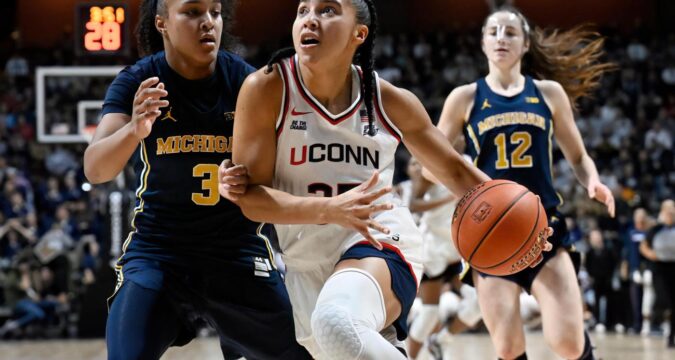
Azzi Fudd scores 31 points to help No. 1 UConn hold off No. 6 Michigan 72-69
UNCASVILLE, Conn. — Azzi Fudd scored 31 points and Sarah Strong added 16 points and 20 rebounds to lead No. 1 UConn to a 72-69 victory over No. 6 Michigan on Friday night in the Naismith Basketball Hall of Fame Women’s Showcase.
Huskies coach Geno Auriemma had said earlier in the week that Michigan might be the best team that his team would play this early in the season. He wasn’t wrong.
UConn (5-0) looked like it would run away with it, building a 17-point lead midway through the third quarter before the Wolverines (4-1) rallied. They used a 13-0 run to pull to 49-45 heading into the fourth.
Fudd ended a nearly eight-minute scoring drought for the Huskies, hitting a 3-pointer to start her own 9-0 run and restore a double-digit advantage for UConn.
Michigan wasn’t done, rallying to 68-66 in the final minute on a Syla Swords 3-pointer with 22.2 seconds left. The Wolverines fouled Fudd 5 seconds later, and the guard calmly hit two free throws to restore the two-possession lead.
Swords once again answered hitting a deep 3-pointer with about 12 seconds left, making it 70-69.
Fudd then hit two more free throws with just less than eight seconds left, and Michigan couldn’t get a final shot off to tie it.
Swords finished with 29 points and Olivia Olson added 18 for the Wolverines.
UConn jumped all over Michigan with Strong leading the way on both ends of the court. She had six points, nine rebounds and three blocks in the first 10 minutes as the Huskies led 22-5 after one quarter. Fudd took over in the second quarter, scoring 13 points as the Huskies led 45-27 at the half.
This was the third time in the last two seasons that Michigan has faced a No. 1 team. The Wolverines lost to South Carolina in the opener last year and then were beaten by Big Ten foe UCLA. Before those meetings, Michigan had faced a No. 1 team only once — a loss to Iowa in 1988.
Up next
UConn will play Utah and Michigan will face Syracuse on Sunday in the second set of games in this tournament.
https://www.chicagotribune.com/2025/11/21/uconn-michigan-womens-basketball/
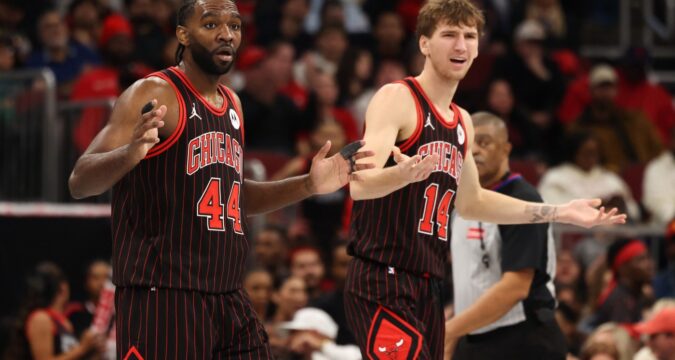
Photos: Miami Heat 143, Chicago Bulls 107 at the United Center
Photos from the Chicago Bulls’ 143-107 loss to the Miami Heat in an NBA Cup game Nov. 21, 2025, at the United Center.
Bulls guard Ayo Dosunmu (11) and teammates head toward the locker room after a 143-107 loss to the Heat in an NBA Cup game Nov. 21, 2025, at the United Center. (John J. Kim/Chicago Tribune)
Heat center Kel’el Ware dunks in the fourth quarter against the Bulls on Nov. 21, 2025, at the United Center. (John J. Kim/Chicago Tribune)
Bulls guard Josh Giddey pauses after getting hit in the face by Heat forward Keshad Johnson in the fourth quarter Nov. 21, 2025, at the United Center. (John J. Kim/Chicago Tribune)
Bulls guard Josh Giddey checks for blood after getting hit in the face by Heat forward Keshad Johnson in the fourth quarter Nov. 21, 2025, at the United Center. (John J. Kim/Chicago Tribune)
Heat forward Keshad Johnson releases a successful 3-pointer as Bulls forward Jalen Smith (25) and guard Ayo Dosunmu are late to defend in the fourth quarter Nov. 21, 2025, at the United Center. (John J. Kim/Chicago Tribune)
Bulls guard Ayo Dosunmu (11) is fouled by Heat guard Pelle Larsson in the fourth quarter Nov. 21, 2025, at the United Center. (John J. Kim/Chicago Tribune)
Heat forward Keshad Johnson dunks in the fourth quarter against the Bulls on Nov. 21, 2025, at the United Center. (John J. Kim/Chicago Tribune)
Heat coach Erik Spoelstra congratulates guard Dru Smith in the fourth quarter against the Bulls on Nov. 21, 2025, at the United Center. (John J. Kim/Chicago Tribune)
Bulls guard Ayo Dosunmu talks with officials during a timeout in the fourth quarter against the Heat on Nov. 21, 2025, at the United Center. (John J. Kim/Chicago Tribune)
Bulls guard Jevon Carter defends Heat guard Pelle Larsson in the fourth quarter Nov. 21, 2025, at the United Center. (John J. Kim/Chicago Tribune)
Bulls guard Jevon Carter releases a successful 3-pointer in the fourth quarter against the Heat on Nov. 21, 2025, at the United Center. (John J. Kim/Chicago Tribune)
Bulls guard Josh Giddey (3) watches the ball fly past on a rebound attempt in the fourth quarter against the Heat on Nov. 21, 2025, at the United Center. (John J. Kim/Chicago Tribune)
Bulls guard Coby White, center, is dressed in street clothes as he watches the second quarter against the Heat on Nov. 21, 2025, at the United Center. (John J. Kim/Chicago Tribune)
Heat forward Jaime Jaquez Jr. (11) moves through the Bulls defense for two points in the second quarter on Nov. 21, 2025, at the United Center. (John J. Kim/Chicago Tribune)
Bulls forward Jalen Smith dunks in the first quarter against the Heat on Nov. 21, 2025, at the United Center. (John J. Kim/Chicago Tribune)
Bulls guard Coby White warms up for a game against the Heat on Nov. 21, 2025, at the United Center. White did not play. (John J. Kim/Chicago Tribune)
Bulls forward Isaac Okoro signs autographs before a game against the Heat on Nov. 21, 2025, at the United Center. (John J. Kim/Chicago Tribune)
Two young fans wearing balloon horns take their seats for a Bulls-Heat game on Nov. 21, 2025, at the United Center. (John J. Kim/Chicago Tribune)
Bulls center Nikola Vučević, center, warms up for a game against the Heat on Nov. 21, 2025, at the United Center. (John J. Kim/Chicago Tribune)
The United Center court is decorated with an NBA Cup design for a Bulls-Heat game Nov. 21, 2025. (John J. Kim/Chicago Tribune)
Former Bulls player and executive John Paxson greets a colleague before a game against the Heat on Nov. 21, 2025, at the United Center. (John J. Kim/Chicago Tribune)

Gen Z Demands Cushy Jobs; The Economy Wants Grown-Ups…
Gen Z Demands Cushy Jobs; The Economy Wants Grown-Ups…
While the US labor market defied expectations in September – adding 119,000 jobs according to delayed numbers, the unemployment rate rose to 4.4%, the highest level in four years. Normally, this would be the time for most employees to make sure they’re the most valuable asset at a company – especially with layoffs surging and AI slowly replacing entry level jobs across various industries.
Yet, Gen Z workers don’t seem to be getting the message. Instead of putting in long hours, many young workers remain convinced that work-life balance is their nonnegotiable right – even as the ground shifts beneath their feet.
Across industries, entry-level employees say they’re not responding to emails after 5 p.m., staying out late on work nights or carving out weeknight pickleball time – behaviors that would have been unthinkable for young workers during earlier periods of economic softening. Managers say the detachment is coming at the exact moment younger employees most need to demonstrate grit, reliability and value, according to the Wall Street Journal.
Damaryan Benton, a 24-year-old at an advertising firm in Los Angeles, checks in with his supervisors before logging off and makes clear he won’t be working after hours. “After five if I’m not by my laptop, I’m not by it,” he said. “I don’t provide an explanation for it, either.”
Nia Joseph, who works at a Houston ophthalmology practice, said she recently stayed out until 2 a.m. on a Sunday – even though she had to be at work before 8. A few years ago, she says, she would have gone home early. “It reminded me that I used to enjoy things a bit more,” she said.
And Jessica Moran, a senior audit associate in New Jersey, said she made sure her manager understood that pickleball practice takes priority during certain weeknights.
“I was asking associates, senior associates and managers questions to gauge their work-life balance and what it truly looked like,” the 24-year-old Moran told the WSJ, adding “For me, that means there must be work-life balance here.”
The shared theme: Gen Z wants work to adapt to their lifestyle, not the other way around.
Older Workers See Red Flags. Gen Z Doesn’t.
Executives say the disconnect is widening just as the labor market shows unmistakable signs of cooling.
Companies are slowing hiring, eliminating positions and cautioning new employees that boundaries may be blurry. Historically, periods of economic uncertainty would prompt younger professionals to work harder to prove they could be counted on.
“Gen X, when times get tough…what do we do? We work harder, we dig in more, we push,” said Marcie Merriman, founder of Ethos Innovation. Younger workers, she says, expect to be judged solely on output – not effort or availability.
That attitude may have made sense during the pandemic-era hiring boom, when job seekers had leverage. Today, employers say, it risks looking like complacency.
Gen Z Says Loyalty Doesn’t Pay. Employers Say Discipline Still Matters.
Part of the generational divide stems from the pandemic and the rise of remote work. Younger workers entered the workforce during a time when many employers emphasized mental health, flexibility and boundaries. Many watched family members burn out in traditional jobs. Joseph said her parents’ careers “completely took over their life,” a pattern she refuses to repeat.
But managers argue the pendulum has swung too far. In a stable job market, detachment may look like confidence. In a weakening one, it can look like a lack of commitment.
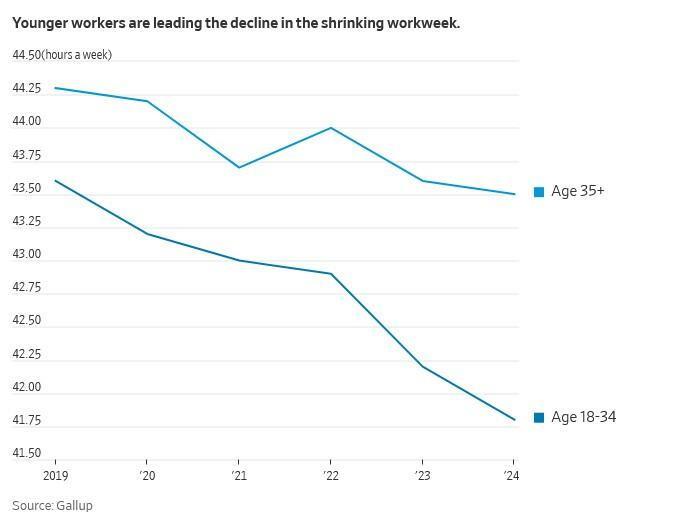
Gallup data shows younger workers are leading the drop in hours worked: nearly two hours fewer per week than before the pandemic. Older workers trimmed less than an hour.
The shifting priorities are showing up in shrinking work hours. Americans worked an average of 42.9 hours a week last year, down from 44.1 hours in 2019, according to a Gallup survey. Those younger than 35 led the decline, working an average of nearly two hours less a week, while older employees reduced their workweek by just under one hour.
Jim Harter, Gallup’s chief scientist for workplace management, said many younger employees “are still feeling disconnected from their employers” despite signs of a tougher market.
A Wake-Up Call Few Want to Hear
The stories of young workers reflect a belief that employers won’t – or can’t – penalize them for inflexibility. Yet the labor market is beginning to reward something Gen Z has been slower to embrace: resilience.
Benton recalls the pressure he once placed on himself as an intern, logging on at 7 a.m., working through illness and sometimes staying up past midnight. Now, he says he doesn’t go out of his way to take on extra work. When a deadline overwhelmed him during his internship, his manager encouraged him to take a break and extended the deadline. Today, he takes paid time off freely and doesn’t worry about after-hours requests.
Employees like Benton and Joseph see these boundaries as healthy. Executives see them as signals of a workforce unprepared for the demands of a more competitive job market.
The question looming over the next cycle is whether Gen Z will adjust—or whether employers will decide to prioritize workers who already have.
Tyler Durden
Fri, 11/21/2025 – 23:00
https://www.zerohedge.com/political/gen-z-demands-cushy-jobs-economy-wants-grown-ups
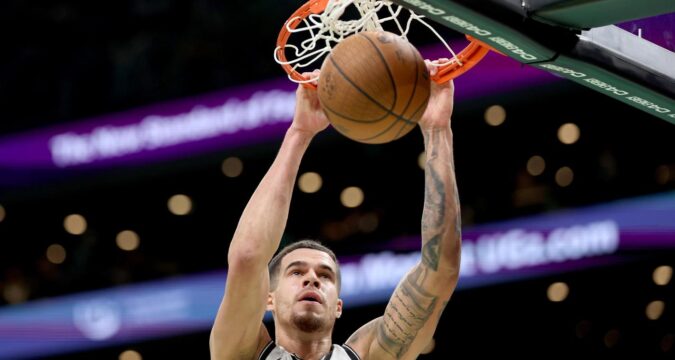
Nic Claxton logra su 1er triple-doble en la NBA y Nets vencen a Celtics
BOSTON (AP) — Nic Claxton totalizó 18 puntos, 11 rebotes y 12 asistencias para su primer triple-doble en la NBA, y los Nets de Brooklyn vencieron el viernes 113-105 a los Celtics de Boston para conseguir su primera victoria en la Copa NBA.
Michael Porter Jr. anotó 33 puntos, mientras que Noah Clowney aportó 19 para ayudar a que Brooklyn rompiera una racha de nueve derrotas consecutivas contra Boston. Los Nets mejoraron a 3-12 en general y a 1-2 en la Copa NBA.
Jaylen Brown lideró a los Celtics con 26 puntos, pero se limitó a jugar 32 minutos debido a problemas de faltas. Neemias Queta sumó 16 puntos y 12 rebotes pero Boston cayó a 8-8 en general y a 1-2 en la Copa.
El intento de remontada de los Celtics sufrió un duro golpe cuando Brown cometió su quinta falta con 5:52 minutos restantes en el tercer cuarto. El entrenador de Boston, Joe Mazzulla, desafió, la decisión, pero ésta se ratificó.
_____
Deportes AP: https://apnews.com/hub/deportes

New MAGA Weapon: ‘Fight Tanks’ For Rural America
New MAGA Weapon: ‘Fight Tanks’ For Rural America
Authored by Philip Wegmann via RealClearPolitics,
Another conservative satellite has joined the Trump constellation.
Jenn Pellegrino, formerly chief spokesperson for the America First Policy Institute, has launched twin think tanks in time for a brewing fight on Capitol Hill over health care and ahead of the coming midterms. The GOP is scrambling to build legislation from scratch to lower health care costs when Biden-era Obamacare subsidies expire on Dec. 31. Those same Republicans are hoping to keep their seats in the election next year.
Enter Defend Forgotten America (DFA). Enter also Defend Forgotten America Action (DFAA).
The names are pulled directly from President Trump’s first victory speech when he vowed in 2016 that “the forgotten men and women of our country will be forgotten no longer.” The goal is to bridge the divide between flyover country and the D.C. beltway, between what Pellegrino describes as rural and small urban communities and “unelected Washington bureaucrats.”
Though still in its infancy, the groups already have a window into the White House. Chris LaCivita, Trump’s 2024 campaign manager, serves as an advisor to the mission, RealClearPolitics is first to report.
DFA will focus specifically on health care policy. The DFAA policy portfolio will include everything from agriculture to housing policy. Internally, they call themselves “fight tanks.” The shared mission statement: “Championing forgotten communities and restoring power to the people who built America.”
The right-wing universe is already vast – and increasingly decentralized. Mammoth organizations, like the Heritage Foundation and the America First Policy Institute, anchor the landscape, but numerous small upstarts now dot the horizon. All of them orbit one man, President Trump, who has redefined conservativism for the last decade, much in the same way as he remade the GOP in his own image.
The Pellegrino operation will be distinct in its emphasis on the local. A key issue, one that some Republicans feel has become a blind spot, is affordability.
“President Trump has done a great job on inflation. Look at gas prices – they’re down. The cost of eggs is certainly way down from what it was several months ago. But there’s still work to be done,” she told RCP in a brief interview.
“Just like Secretary Scott Bessent was saying recently, we’re not going to speak like the Biden administration did and say that everything is great,” she added, referencing the head of the Treasury Department. “We understand and see that Americans are still feeling pain on so many issues from health care to housing. Especially in rural communities, like the blue-collar one I grew up in upstate New York, a lot of them are living paycheck to paycheck. We are focusing on their issues.”
And two recent humanitarian disasters provide a rubric for just exactly what the organizations plan to do: the train derailment in East Palestine, Ohio, and Hurricane Helene that ravaged North Carolina. A breakdown in communication, in both cases, slowed the response from the federal government.
In the face of future disasters, Pellegrino said the twin think tanks would get on the ground, not to write white papers, but to develop immediate policy proposals to guide the response. And then absent catastrophe, the organizations will seek to bring the concerns of rural Americans directly to D.C.
The Democratic brand has become radioactive in rural America. A former Newsmax host, Pellegrino is unabashedly conservative. The organization immediately makes clear its dissatisfaction with the left and liberal policy prescriptions. “They don’t understand us,” she says of Democratic politicians in a promo video, “because they have never lived like us.” Unsurprisingly, prominent Republicans have already welcomed the new group with open arms.
“We proved in 2024 that when you speak directly to working Americans in the communities the establishment ignores, you build an unstoppable coalition,” LaCivita said in a statement. “These organizations are built in that same spirit.”
New York Rep. Claudia Tenney heralded the new endeavor as “a strong advocate for the hardworking Americans who have been left behind for far too long.” Florida Rep. Anna Paulina Luna, meanwhile, described it as a bulwark against “corporations who have taken over via special interest efforts in Washington.”
Tyler Durden
Fri, 11/21/2025 – 22:35
https://www.zerohedge.com/political/new-maga-weapon-fight-tanks-rural-america
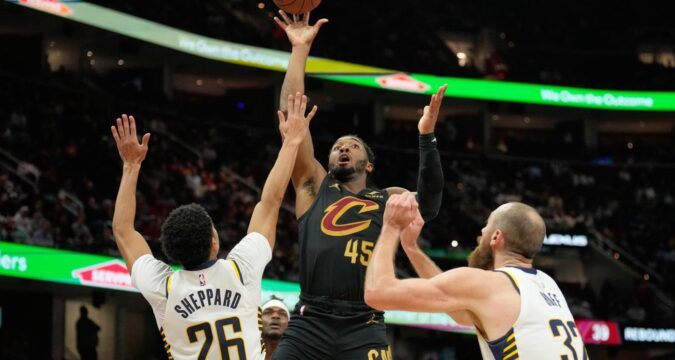
Mitchell anota 32, Garland suma 20 en su regreso y Cavaliers vencen 120-109 a Pacers en la Copa NBA
CLEVELAND (AP) — Donovan Mitchell anotó 32 puntos, Darius Garland sumó 20 en su regreso a la alineación de Cleveland y los Cavaliers se alejaron en la segunda mitad para lograr una victoria de 120-109 sobre los Pacers de Indiana en un partido de la Copa NBA el viernes por la noche.
Fue el primer encuentro entre los equipos desde que los Pacers eliminaron a los Cavaliers, que eran los primeros sembrados, en cinco juegos en las semifinales de la Conferencia Este de la temporada pasada.
Evan Mobley añadió 22 puntos y 12 rebotes para los Cavaliers, quienes mejoraron a 2-1 en el Grupo A del Este.
Andrew Nembhard logró un récord personal de 32 unidades para Indiana, plagada de lesiones, que cayó a 0-2 en el grupo. Pascal Siakham sumó 26 tantos y nueve rebotes, y Bennedict Mathurin anotó 21 puntos.
Los finalistas de la NBA del año pasado tienen un récord de 2-14 y les faltan seis jugadores. Indiana ha perdido nueve de sus últimos diez encuentros.
Garland se perdió cinco juegos debido a una contusión en el dedo gordo del pie izquierdo que fue reparada quirúrgicamente en junio.
El base, dos veces All-Star, jugó 26 minutos y anotó 18 puntos en la primera mitad. Terminó con cinco de 12 en tiros de campo, incluidos tres triples, y acertó los siete tiros libres que intentó.
Los Cavaliers lideraban 62-55 al medio tiempo antes de realizar una racha de 21-9 en un lapso de cuatro minutos en el tercer cuarto para tomar el control. Jalen Tyson anotó ocho de sus 14 puntos durante la racha, lo que aumentó su ventaja a 16 a mitad del período.
La mayor ventaja de Cleveland fue de 103-81 con un triple de Mitchell al inicio del último cuarto. Fue la novena vez en 15 juegos esta temporada que el base All-Star ha anotado al menos 30 puntos.
___
Deportes en español AP: https://apnews.com/hub/deportes
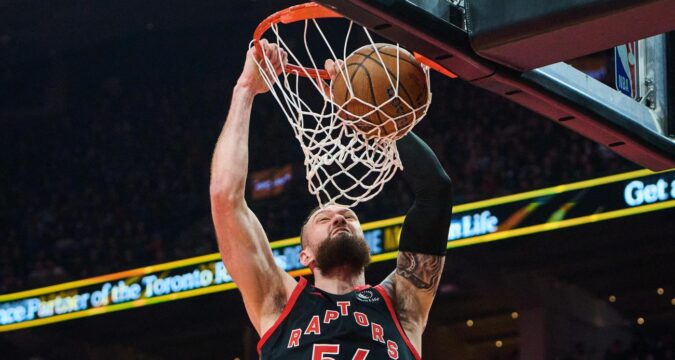
Brandon Ingram anota 24 puntos y Raptors aplastan a Wizards por 140-110 para avanzar en Copa NBA
TORONTO (AP) — Brandon Ingram y RJ Barrett anotaron 24 puntos cada uno, Scottie Barnes sumó 23 y los Raptors de Toronto se convirtieron en el primer equipo clasificado a los cuartos de final de la Copa NBA al aplastar el jueves a los Wizards de Washington por 140-110.
Toronto aseguró el primer lugar del Grupo A con la victoria y la derrota de Indiana en Cleveland.
Sandro Mamukelashvili anotó 23 puntos, su número máximo en la temporada, e Immanuel Quickley agregó 17 por Toronto, que mejoró a 3-0 en la Copa NBA y extendió su racha de triunfos en general a seis.
CJ McCollum anotó 20 puntos, Tre Johnson logró 14 y Cam Whitmore agregó 11 por los deplorables Wizards (1-14), que perdieron su decimotercer partido consecutivo y cayeron a 0-10 contra oponentes de la Conferencia Este.
Jamal Shead prodigó 10 asistencias, su mayor cifra de la temporada, por Toronto, que ha ganado diez de 11 compromisos desde una racha de cuatro derrotas que siguió a un triunfo en la apertura de la temporada en Atlanta.
_____
Deportes AP: https://apnews.com/hub/deportes