Category: News

Unidentified victim dead in double shooting Friday night in Loop
An unidentified man was pronounced dead Friday night in a shooting that left an 18-year-old man seriously wounded in the Loop neighborhood, Chicago police said.
Around 10:40 p.m., officers responded to a call of someone shot in the 100 block of South Dearborn Street and found two victims struck by gunfire. The first victim suffered multiple wounds to the body, and was taken to Northwestern Memorial Hospital where he was pronounced dead.
An 18-year-old man suffered a wound to a leg and was taken to the same hospital where he was listed in serious condition, police said.
No one was in custody and detectives were investigating.

Murieron 23 niños de desnutrición en un mes en Kordofán, región del centro de Sudán
Por SAMY MAGDY
EL CAIRO (AP) — Casi dos docenas de niños murieron por causas relacionadas con la desnutrición en un mes en el centro de Sudán, donde se ha centrado la feroz lucha entre el ejército del país y un grupo paramilitar, informó un grupo médico.
Las muertes de 23 niños en la región de Kordofán subrayan la deteriorada situación humanitaria en el país del noreste de África, donde la hambruna se está extendiendo después de más de 30 meses de una guerra devastadora.
Sudán se sumió en el caos en abril de 2023 cuando una lucha de poder entre el ejército y las poderosas Fuerzas de Apoyo Rápido (FAR) paramilitares estalló en enfrentamientos abiertos en la capital, Jartum, y en otras partes del país.
La devastadora guerra ha matado a más de 40.000 personas, según cifras de la ONU, pero los grupos de ayuda afirman que esa cifra es un subregistro y que el número real podría ser muchas veces mayor. Ha creado la mayor crisis humanitaria del mundo, con más de 14 millones de personas obligadas a huir de sus hogares, ha avivado brotes de enfermedades y ha llevado a partes del país a la hambruna.
Unas 370.000 personas habían sido llevadas a la hambruna en Kordofán y la región occidental de Darfur hasta septiembre, y a otras 3,6 millones de personas a un paso de la hambruna en las dos regiones, según expertos internacionales en hambre.
Muertes de niños se atribuyen a desnutrición severa y escasez de suministros
Las muertes de los niños se reportaron entre el 20 de octubre y el 20 de noviembre en la ciudad sitiada de Kadugli y la localidad de Dilling, indicó la Red de Médicos de Sudán, un grupo de profesionales que rastrea el conflicto.
El grupo subrayó el viernes por la noche que las muertes fueron un “resultado de desnutrición aguda severa y escasez de suministros esenciales” en las dos áreas, donde un bloqueo “impide la entrada de alimentos y medicinas y pone en riesgo la vida de miles de civiles”.
Kadugli, la capital de la provincia de Kordofán del Sur, es donde se declaró la hambruna a principios de este mes por la Clasificación Integrada de las Fases de la Seguridad Alimentaria (CIF). Las FAR han sitiado la ciudad de Kadugli durante meses, con decenas de miles de personas atrapadas al tiempo que el grupo intenta apoderarse de más territorio del ejército sudanés.
Dilling, también en Kordofán del Sur, ha experimentado supuestamente las mismas condiciones de hambre que Kadugli, pero la CIF no anunció hambruna allí debido a la falta de datos, explicó.
La lucha por el control de Kordofán se intensificó a principios de este año después que el ejército expulsara a las FAR de Jartum. Desde entonces, el grupo paramilitar ha centrado sus recursos en Kordofán y la ciudad de el-Fasher, que era el último bastión militar en la extensa región de Darfur.
Las FAR expulsaron al ejército de el-Fasher a principios de este mes y obligaron a decenas de miles a huir a campamentos superpoblados para escapar de las atrocidades reportadas por la fuerza paramilitar, según grupos de ayuda y funcionarios de la ONU.
Combatientes de las FAR irrumpieron en el Hospital Saudí en la ciudad, matando a más de 450 personas, de acuerdo con la Organización Mundial de la Salud (OMS). Los combatientes también fueron de casa en casa, matando a civiles y cometiendo agresiones sexuales, sostienen trabajadores de ayuda y residentes desplazados.
Continúa la desaparición de cadáveres en el-Fasher
Nuevas imágenes satelitales parecen mostrar esfuerzos continuos de las FAR para deshacerse de cadáveres en ubicaciones en el-Fasher, informó el viernes el Laboratorio de Investigación Humanitaria (HRL, por sus siglas en inglés) de la Facultad de Salud Pública de Yale.
El aparente intento de deshacerse de los cadáveres de las instalaciones del Hospital Saudí y en los alrededores de un complejo en el barrio de Daraja Oula se lleva a cabo en ubicaciones donde las FAR supuestamente cometieron asesinatos masivos cuando tomaron la ciudad a finales del mes pasado, declaró el HRL.
“La combinación del probable intento de deshacerse de los cuerpos mediante inmolación, la nula actividad de entierro tradicionales y la nula actividad en el mercado plantea preocupaciones serias sobre la presencia de civiles y la sostenibilidad de la vida para aquellos que permanecen en el-Fasher”, enfatizó el HRL.
El laboratorio agregó que es muy probable que la mayoría de los civiles que estaban en la ciudad antes del ataque de las FAR el 26 de octubre “hayan sido asesinados, hayan muerto, estén detenidos, se encuentren escondidos, hayan huido o de alguna otra manera no puedan moverse libremente”.
___
Esta historia fue traducida del inglés por un editor de AP con la ayuda de una herramienta de inteligencia artificial generativa.

NATO Countries Blame Russia As Mystery Drones Keep Buzzing Key European Military Installations
NATO Countries Blame Russia As Mystery Drones Keep Buzzing Key European Military Installations
A string of unexplained drone incursions over military, industrial and transportation hubs across Europe is raising fresh concerns about the vulnerability of NATO territory to covert surveillance and sabotage.
In the French border town of Mulhouse, authorities are probing a Nov. 11 incident in which a police officer reported a drone hovering above a police station courtyard shortly before midnight. Moments later, the aircraft maneuvered over a nearby rail depot and filmed a military convoy transporting Leclerc main battle tanks before disappearing. Investigators have yet to track down the device or its operator.
Local prosecutors said there is “no evidence to suggest whether this was a deliberate flight…or simply an accidental overflight.” But the episode followed closely on the heels of a far more targeted intrusion at the Eurenco plant in Bergerac, where defense officials say drones twice breached the airspace above one of Europe’s most sensitive ammunition and explosives facilities. The plant supplies propellants used in the artillery shells shipped to Ukraine.
French investigators called those flights “deliberate” and “clearly targeted,” intensifying fears that unmanned aircraft are scouting the continent’s military infrastructure and industrial supply lines, the Washington Times reports.
A Continent-Wide Pattern Emerges
The French incidents are part of a broader uptick in mysterious drone activity. German officials have logged repeated breaches over Ramstein Air Base, Rheinmetall arms factories and energy infrastructure. And of course, the chief suspect in all of this among Western sources is Russia – who western analysts warn may be waging a “hybrid” campaign.
Denmark faced its own wave of disruptions starting Sept. 22, when large drones forced Copenhagen’s airport to shut down for hours. Within days, similar UAVs appeared over other strategic points, including three regional airports and Skrydstrup air base, home to Denmark’s F-16 fleet and incoming F-35s. Media reports described drones circling the base for hours without interception, prompting political fallout over the failure to neutralize small off-the-shelf aircraft.
Prime Minister Mette Frederiksen said Denmark had “been the victim of hybrid attacks” and warned that such flights “could multiply.” The country’s Defense Intelligence Service later declared that “Russia is conducting hybrid warfare against Denmark and the broader West,” citing drone incursions and GPS jamming.
Norwegian authorities, meanwhile, have detained several Russian nationals at airports and border posts for flying drones or possessing drone footage, adding to suspicions that some activity is linked to Russian intelligence.
Germany has faced similar activity. In December, security services confirmed sightings of “mystery drones” over the U.S. Air Force’s Ramstein hub for Ukraine operations and over Rheinmetall facilities. Officials have not named suspects, but the flights add to concerns about Russian espionage and sabotage since the full-scale invasion of Ukraine. By October, Germany had recorded 172 drone-related air-traffic disruptions this year, prompting draft legislation to empower police to shoot down dangerous drones and establish a federal drone-defense center by mid-December.
Belgium’s Nuclear-Adjoining Base Exposed
Belgium has experienced some of the most alarming events. Over two weekends in late October and early November, multiple drones were spotted near Kleine Brogel air base, widely believed to store U.S. tactical nuclear weapons. Defense Minister Theo Francken labeled the pattern a “spying operation,” saying small drones appeared to probe security radio frequencies before larger systems attempted to “destabilize” the area while evading jamming systems.
“They come to spy, to see where the F-16s are, where the ammunition is, and other highly strategic information,” Francken said.
Around the same time, unidentified drones forced temporary closures at Brussels and Liege airports, disrupting dozens of flights and stranding passengers.
Belgium has since accelerated national air-security plans, established new surveillance measures and convened its National Security Council. With NATO and EU headquarters located in Brussels, the government considers the incidents a top-tier security concern.
Across the continent, the pattern is consistent: small, commercially available drones operating at night or in poor visibility, repeatedly probing the seams of NATO’s defenses around air bases, logistics corridors, energy infrastructure and even nuclear-adjacent sites.
For now, investigators in multiple countries are scrambling to match technology, tactics and flight signatures across borders. The growing consensus: Europe’s drone problem is no longer sporadic. It is systemic – and increasingly strategic.
Tyler Durden
Sat, 11/22/2025 – 08:45

1 dead, 1 fatally wounded Friday night at Roseland gas station
A 32-year-old woman was pronounced dead and another victim was wounded Friday night in a shooting at a Roseland neighborhood gas station, Chicago police said.
Shortly before 11:45 p.m., a 25-year-old man was driving through a gas station parking lot in the first block of West 115th Street when a silver SUV pulled up, and someone inside opened fire, police said. The SUV fled the scene.
The man, who suffered a wound to the eye, got himself to Roseland Community Hospital where he was listed in good condition. A woman, 32, who was standing near the gas station was wounded to an arm and was taken in critical condition to UChicago Medicine where she was later pronounced dead.
No one was in custody for the fatal shooting and detectives were investigating.
https://www.chicagotribune.com/2025/11/22/gun-violence-29846816/

Former New England Patriots star James White to be Benet’s football coach: ‘That is a great catch’
Benet athletic director Scott Lawler was in the advanced stages of his search for a new football coach to replace the retiring Pat New when he received two unsolicited messages.
“I had somebody that I know send me something and somebody that emailed me out of the blue, both on the same day, asking me if I would accept one more resume,” Lawler said.
The resume belonged to former NFL running back James White, who won three Super Bowls with the New England Patriots and is an assistant running backs coach at Illinois.
That got Lawler’s attention. White then earned Lawler’s respect during the ensuing interview and got the job.
“I was trying to figure out how serious he was, especially with his background,” Lawler said. “His family lives in the suburbs, and he’s been traveling to Champaign and even staying down there for days at a time.
“He’s always wanted to coach high school football, and it means a lot for him to raise his family. As a former college coach myself, I know what it’s like to try to raise a family at the college level. It’s hard because you’re on the road a lot.”
White, 33, played at Wisconsin for current Illinois coach Bret Bielema. During an eight-year career with the Patriots, he ran for 1,278 yards and 25 touchdowns and made 381 catches for 3,278 yards and 25 touchdowns in 95 regular-season games.
White began his coaching career at Northern Illinois in 2024 and then joined Illinois, where he will stay for the remainder of this season.
“I would like to say thank you to (Benet president) Bill Myers and Scott Lawler for giving me this opportunity,” White said in a statement. “This is a tremendous opportunity, and I will give you all my very best. I can’t wait to get started and build relationships within the Benet community.”
White came highly recommended from people close to Lawler and Benet, including former basketball star Frank Kaminsky, who attended Wisconsin with White. Kaminsky and White were inducted into Wisconsin’s Athletic Hall of Fame in September.
Bielema also extolled White.
“James is an impressive individual both on and off the football field,” Bielema said in a statement. “Benet Academy is getting a proven leader that will make a positive impact in the lives of their young men. I am excited to see the success he has as a high school coach in the state of Illinois.”
Such praise is not what got White across the goal line for the Benet job.
“James told me in our interview, ‘I feel a lot of people put a lot of time and effort into my career to help me achieve my goals, so it’s time for me to help other people achieve theirs,’” Lawler said. “When he said that, I said, ‘You’re my head coach.’”
The hiring of White has energized the school, according to Lawler.
“The excitement is through the roof,” Lawler said. “University of Illinois I thought was first class in writing an article about him and having it on their athletic site, and coach Bielema allowing the time for me and him to talk, but also celebrating him, was unbelievable.
“I said to James, ‘The way they wrote it, it sounded like you got the LSU job. You definitely didn’t get the LSU job.’”
White got the job previously held by New, who retired after a 16-year stint with a 92-67 record. The Redwings made the playoffs 10 times under New, including appearances in state semifinals in 2012, 2016 and 2017.
New, who will continue teaching social studies at Benet, does not know White but is enthusiastic about the hire.
“When I heard, I was like, ‘Wow, that is a great catch,’” New said. “It’s as big a name as we could have found, I think.
“It’s really exciting for our players. One of our guys is a die-hard Patriots fan, so when I saw him in the hallway, I said, ‘You’ve got to be loving this.’ He remembers him playing, so he’s really excited.”
Lawler’s brother Todd, who was Benet’s running backs coach this season, will serve as interim head coach until White finishes his duties at Illinois and will help in the transition.
Lawler said he is confident White will build upon New’s accomplishments.
“In a faithful way, I would say it was the Holy Spirit working,” Lawler said. “I say that because of the whole timing of things.
“We’re celebrating Pat New because I think he did an unbelievable job really resurrecting the program, and I think James is going to take us to a different level now.”
Matt Le Cren is a freelance reporter.
https://www.chicagotribune.com/2025/11/22/benet-football-coach-new-england-patriots-james-white/

From the Farm: A good reason to get ‘bogged down’ by Hoosier history of cranberries
Cranberry sauce, either jellied or crushed whole berry variation, is a favored garnish of Thanksgiving feasts and holiday dinners dating back centuries.
Early Native Americans referred to these tart, red berries as “imbi,” meaning “bitter berry,” while valuing them for their merits as a food garnish to balance strong-tasting game meat. They are a good source of vitamin C and favored for their healthy diuretic properties, as well as the bonus benefit of yesteryear that the red skin and juice can be used as a red dye.
The pilgrims found adding sugar to the crushed berries provided an even greater range of possibilities for baking, cooking and consuming.
The heavily wooded farm at the end of our family farm road in San Pierre is the address of my oldest brother Tom and his late wife Linda, who hosted many family holiday dinners at their home during the past three decades.
They purchased the 40-acre farm in November 1989 during the auction and estate sale of the late Mildred D. Evans, widow of Chicago attorney Donald L. Evans. Born Aug. 15, 1900, as Mildred James, the couple married in Chicago in June 1924. With their primary residence being in Chicago, Donald purchased the 40-acre farm in San Pierre as a “weekend getaway,” with the property consisting of a small cottage, underground root cellar, stable and several outlying buildings, the latter used for hunting and for Donald’s favorite hobby, inviting weekend guests to enjoy “skeet” or “shooting clay pigeons.”
By the time of Donald’s death in September 1973, the childless couple had sold their Chicago home and retired to their weekend farm property.
It was after a fall in her home that “Mrs. Evans” (as we always referred to her) was admitted to our small town’s Little Company of Mary Hospital and Care Facility in San Pierre. Shortly after, her home and property were liquidated and sold at auction in November 1989 by her estate’s bank conservator, our neighbor Betty Kalinke, the latter who died just a year ago at age 88, as I chronicled in a previous column.
Mrs. Evans, at age 91, died Aug. 31, 1991, and was buried near her husband at Mount Hope Cemetery in Chicago.
It was when my brother and his wife Linda were purchasing the Evans property that they were reminded by our neighbor Ed “Snuffy” Wolski that the back acreage of that property, where the pond is located, was a “cranberry bog” with a clear “built-up” dirt wall ridge still apparent as evidence that water collected to create ideal swampy growing terrain for cranberries.
Linda Potempa, the late sister-in-law of columnist Phil Potempa, photographed the pond and surrounding bog of her favorite walking trail on April 2, 2015. Linda Potempa died at age 69 on July 28, 2023. (Photo by Linda Potempa)
(The origin of the nickname for neighbor “Snuffy” was shared in my 2007 cookbook from a reprinted 2003 column, along with his fondness for chewing tobacco and a resemblance to a Sunday newspaper cartoon character of the same name.)
The name “cranberry” was originally the term “craneberry,” since sandhill cranes favored wading through the same swamps and bogs that are home to the long, floating cranberry vines.
The remnants of my brother’s century-old cranberry bog is even older than today’s cranberry claim-to-fame company Ocean Spray, now based in Plymouth County, Massachusetts. The company started in 1930 as a collaboration of farmers Marcus Urann, John Makepeace and Elizabeth Lee, who banded together to ensure better prices from the cannery manufacturers of commercially canned cranberry sauce, and later in 1933, the advent of bottled cranberry juice.
Within a decade, more farmers, including those in Oregon, Wisconsin and Washington, began joining the agriculture cooperative and, in 1957, the National Cranberry Association, established in 1946, rebranded as “Ocean Spray” after purchasing the name logo from an existing canned fish company in Washington. Today, more than 700 farmers are part of the Ocean Spray initiative.
Cranberries earned added consumer popularity in the 1920s and 1930s courtesy of Hoosier newspaper syndicate visionary Samuel McClure, who immigrated from Ireland to Indiana and graduated from “Valparaiso City Public Grade School” (now Valparaiso High School) in 1873. He went on to found McClure’s Magazine in 1893 and, before that, the McClure’s Newspaper Syndicate in 1884, the latter of which is credited as “the first U.S. newspaper syndicate.”
Among McClure’s favorite syndicated features was a distributed comic and story strip called “Uncle Wiggily Longears,” about a fancy rabbit lame from rheumatism (often depicted using a crutch or cane) who loved eating cranberries from a nearby bog, as written and created by author Howard R. Garis and illustrated by Chicago artist Lansing Campbell. Published in hundreds of newspapers, cranberries soon became a delicious “must-have” for menus around the time of the Great Depression.
In a November 1928 “Uncle Wiggily” installment I read in a newspaper clipping from The Indianapolis News archive, Uncle Wiggily tells his “muskrat lady housekeeper” he is going to find cranberries in preparation for Thanksgiving dinner:
“We will want some cranberries for pies, tarts, as well as some for sauce to eat with roast carrots,” Uncle Wiggily explains.
“The bog is a low, swampy place where rain collects, even where it is sandy. Cranberries grow best in bogs, you know, and in the winter, the bog must be covered with water so the bushes will not catch cold and freeze. Even when covered with a coating of ice, the cranberry bushes will live until summer sun comes again.”
The distinct taste of tart dried cranberries is balanced by brown sugar, butter and white chocolate for a delicious, easy blended flavor oatmeal cookie recipe developed by the test kitchens at Ocean Spray. (Photo courtesy of Ocean Spray)
Today’s recipe, courtesy of Ocean Spray, combines dried cranberries with oatmeal, brown sugar, flour and butter to create a scrumptious cookie dough that has a hint of chocolate chunks to balance the berry flavor.
Columnist Philip Potempa has published four cookbooks and is a radio host on WJOB 1230 AM. He can be reached at PhilPotempa@gmail.com or mail your questions: From the Farm, PO Box 68, San Pierre, Ind. 46374.
Cranberry Oatmeal Chocolate Cookies
Makes 24 cookies
2/3 cup softened butter or margarine
2/3 cup brown sugar
2 large eggs
1 1/2 cups old-fashioned oats
1 1/2 cups flour
1 teaspoon baking soda
1/2 teaspoon salt
6 ounces dried cranberries
2/3 cup white or semi-sweet chocolate chunks or chips
Directions:
Preheat oven to 375 degrees. Using an electric mixer, beat butter or margarine and sugar together in a medium mixing bowl until light and fluffy. Add eggs, mixing well.
Combine oats, flour, baking soda, and salt in a separate mixing bowl.
Add to butter mixture in several additions, mixing well after each addition. Stir in dried cranberries and chocolate chunks.
Drop by rounded teaspoonfuls onto ungreased cookie sheets. Bake for 10-12 minutes or until golden brown. Cool on wire rack.
EU-Digital Summit Exposes Europe’s Innovation Crisis
EU-Digital Summit Exposes Europe’s Innovation Crisis
Submitted by Thomas Kolbe
It was summit season again in Berlin. After crisis meetings with the automotive and steel industries, attention on Tuesday turned to the next trouble spot: the digital economy. So far, EU regulators have literally strangled it.
Grand reception at Berlin’s EUREF campus: Around 900 participants from politics, business, and science across Europe traveled to the capital for the Digital Summit. Among the prominent speakers: Chancellor Friedrich Merz and his French counterpart Emmanuel Macron, both currently facing stiff political headwinds at home.
EU Europe has now officially entered crisis mode on the political level as well. The sheer number of economic summits reflects this and bodes ill for the coming years. Looking at the digital economy, which has initiated the next major economic revolution, one must conclude: the panic mode in Brussels, Paris, and Berlin is justified.
The technological gap between the Eurozone economy and competitors in the U.S. and China appears, at present, unbridgeable. Revolution? Not in sight.
Lifeless Capital Market
A glance at the raw numbers provides a clear sense of the technological hiatus: In the U.S., over $340 billion is being invested in artificial intelligence this year, following $244 billion in 2024. In China, the private sector mobilizes roughly $100 billion to upgrade digital processes.
The EU, even when generously including the U.K., reaches barely €25 billion—a negligible share on a global scale.
Amazon alone invests roughly $118 billion, almost five times the capital of the entire EU economy, which can only muster its small contribution through roughly 50% public funding. Politically embarrassing, economically disastrous.
Spiritless Summit
The dilemma of European policy emerged clearly from the speeches in Berlin. From the start, the regulatory framework was far too tight, stifling innovation, leaving the digital economy dependent—primarily on American giants like Amazon, Google, or Microsoft. SAP software? Often comes from the U.S.!
A central demand of the summit was therefore to reduce this dependency on powerful overseas competitors.
The European Commission announced on summit day that over the next twelve months, it would review how stricter regulation could rein in allegedly anti-competitive practices by cloud providers like Microsoft Azure and Amazon Web Services. A tough struggle lies ahead to confront the U.S. government, which will undoubtedly push back forcefully.
Meanwhile, Chancellor Merz repeated his call for European digital sovereignty and warned against reliance on American software. It is about actively shaping the digital future, he reiterated—initiating a catch-up process to close the gap with the competition.
State Intervention
European politicians draw the familiar conclusion: public funding. It already accounts for roughly 40% of total AI volume in Europe and will increasingly target the training and retention of European IT talent.
It should also help build an independent digital infrastructure, particularly in cloud services and cybersecurity, another Achilles’ heel of the European economy.
The trade association Bitkom calls for a sweeping simplification of EU digital laws and a drastic reduction of reporting obligations. The GDPR has been a costly and senseless flop, like other elements of Brussels overregulation. AI Act and Data Act—everything must be reviewed, streamlined, or scrapped.
Digital Tax as Ultima Ratio?
In its current state, the EU digital economy is simply unable to scale or keep pace with international competitors. Another discussion point: a digital tax on ad revenues of global players, especially U.S. firms. Recently, Culture Minister Wolfram Weimar introduced the idea polemically.
But what would that actually change? In Europe, the state blocks innovation. Too much capital flows through public channels to allow a functioning venture capital market to emerge capable of funding these innovations.
Summit participants likely realized the EU faces a trade-off: maximum data protection hinders industry growth. The EU will need to liberalize and return data control to users. On Wednesday, this issue will be central in a Brussels parliamentary debate.
Energy and Innovation Culture
The economy of the future is data-driven, dependent on stable energy infrastructure and highly competitive startups surrounding technological hubs. None of this exists in Germany today. Result: international investors are largely uninterested in the location.
Considering the size of the European single market, remaining capital strength, and robust academic structure, it is a political feat to have strangled the digital economy so completely. Brussels built the regulatory framework long before a significant digital economy existed. When it comes to controlling and manipulating the free market, Brussels acts efficiently—and destructively.
Commission Retreat Needed
Breaking out of this regulatory trap and stimulating digital entrepreneurship would require a radical break from poor practices: ending rules like the AI Act or GDPR, halting ongoing interventions via the Digital Services Act (DSA) and Digital Markets Act (DMA), which regulate Europe’s digital market in minute detail.
Yet the summit showed little insight into the self-created problem. Brussels views growing criticism of the DSA and DMA as an attack on its power. Digital regulation, like climate policy, must be seen in the context of the ideological reshaping of the Euro-economy. Brussels is the command center of this fatal process. Pressure on the regulator grows with the deepening recession.
Market barriers must fall, entrepreneurship must be freer, fiscal burdens reduced, and the state must retreat from dominating the capital market. Cutting the Gordian knot of digital regulation through radical liberalization to allow autonomous European ecosystems to grow sounded, at the Berlin summit, like a fable.
Collision of Philosophies
Rarely have U.S. and European political philosophies and economic paradigms collided so violently as in the digital economy. Disputes over Brussels’ censorship, the DSA, and planned chat monitoring have caused real tensions, escalating since U.S. VP J.D. Vance criticized European censorship at the Munich Security Conference in February.
The fight for civil rights, freedom of speech, and property rights is clearly taking place in the digital space: freedom vs. surveillance, self-responsibility vs. nanny state—U.S. vs. EU? Broadly, one could interpret it that way. But the U.S. will also have to address the market power of its own digital oligopolies and whether new competitors can access the market freely—or whether lobbying, like in Brussels, shields Amazon & Co. from competition.
Digital Risk Space
For the European regulator, the digital space is above all a narrative risk: an unbounded, hard-to-discipline public space that fuels opposition rather than suppressing it.
Recent attacks by German politicians on U.S. platforms like X and Meta reflect growing awareness—and the loss of control in conflict areas critical to EU politics and ideology: climate policy, the Ukraine conflict, and the deepening economic crisis, largely underreported in state-affiliated media.
The risk of a critical opposition forming in opaque, decentralized, polemical, and highly visible ways remains ever-present.
Error and Control
In the debate on the digital future of the Eurozone economy, the specter of the digital euro—and the question of individual sovereignty in the digital space—looms.
Even attempting to integrate this technology as a form of centralized state dominance in money and capital markets shows that Brussels does not understand digital technology as a matter of decentralized competition, which thrives under minimal state regulation.
With the Genius Act and U.S. stablecoin integration into banking—a quasi-alternative money market—Washington pushes credit creation deeper into the private sector’s responsibility.
European Anachronism
Everything points to the synchronized merging of decentralized money creation and technological AI applications, which is why the EU’s attempt to centralize and tightly regulate these elements is doomed.
The Digital Summit confirmed fears: European policy is intellectually and bureaucratically trapped in a model where public funding, detailed regulation, labor norms, and heavily censored public discourse form the ideological blueprint.
This cannot and will not end well if technological progress pushes toward freedom.
* * *
About the author: Thomas Kolbe, born in 1978 in Neuss/ Germany, is a graduate economist. For over 25 years, he has worked as a journalist and media producer for clients from various industries and business associations. As a publicist, he focuses on economic processes and observes geopolitical events from the perspective of the capital markets. His publications follow a philosophy that focuses on the individual and their right to self-determination.
Tyler Durden
Sat, 11/22/2025 – 08:10
https://www.zerohedge.com/political/eu-digital-summit-exposes-europes-innovation-crisis

Amid redistricting fallout, Indiana GOP look at candidate options
Indiana’s mid-census redistricting debate seemingly has settled into two camps — with House Republican leadership supporting Gov. Mike Braun’s call to meet in December to pass new Congressional maps while Senate Republican leaders would back the GOP candidate in the First Congressional District in its current boundaries.
When Organization Day, the ceremonial start to a legislative session, ended Tuesday, House Speaker Todd Huston, R-Fishers, told the representatives to keep the first two weeks of December, as previously decided, open to address mid-census redistricting.
Indiana Republican House Speaker Todd Huston listens at the Statehouse, April 27, 2023, in Indianapolis. (Darron Cummings/AP)
The Senate held a rare vote to return on Jan. 5, 2026, which effectively ended any chance of passing new Congressional maps, which President Donald Trump and his administration have been pressuring Indiana to do since August.
After Organization Day, Senate President Pro Tem Rodric Bray, R-Martinsville, said the Senate would rather support a Republican candidate in the First Congressional District to “give President Trump another Republican in Congress” as opposed to mid-census redistricting.
“We don’t believe the choice to redistrict is a binary choice where we will either keep a 7-2 map or draw one that automatically becomes 9-0,” Bray said. “I’ve had the honor to speak with the President on this issue, and I have expressed to him that our caucus is supportive of him and wants to maintain Republican control of the House, which is why we believe pursuing Congressional District 1 is the best way forward.”
Indiana was last redistricted in 2021, which left Congressional Republicans with seven seats to the Democrats’ two seats. The Democratic seats are Northwest Indiana’s First District, held by U.S. Rep. Frank Mrvan of Highland, and the Seventh District, held by U.S. Rep. André Carson of Indianapolis, which encompasses most of Indianapolis and Marion County.
Indiana Gov. Mike Braun speaks at the Gary/Chicago International Airport, Oct. 30, 2025. He has called a special session to redraw the state’s House map. (Michael Gard/for the Post-Tribune)
Lake County Republican Chairman Randy Niemeyer, who ran against Mrvan in 2024, said he didn’t receive support from the state’s Republican Party leadership as a Congressional candidate.
“I think that’s a very hollow statement by Sen. Bray because we have been doing the work here,” Niemeyer said.
As a candidate, Niemeyer said he left Bray many voicemails and never received a call back. The state’s Republican Party needs to “be a part of the process” in supporting Republican candidates, he said.
Aaron Dusso, associate professor of political science at Indiana University Indianapolis, said when the Republican-led legislature oversaw the 2021 redistricting process they shifted the First Congressional District to be more competitive for Republicans.
Lake County councilman Randy Niemeyer sings the national anthem during an event to honor veterans at the Lake County Government Center in Crown Point, Nov. 7, 2024. (Kyle Telechan/for the Post-Tribune)
“They didn’t make it a Republican advantage district, but they made it closer so that if they had a good candidate and if the winds kept shifting … maybe they’d be able to capture that with a closer district,” Dusso said.
Election data shows the impacts of redistricting, Dusso said, as Mrvan won the 2024 election with 53.4% of the vote while former Democratic U.S. Rep. Peter Visclosky won the 2018 election with 65.1% of the vote.
Now, Dusso said the Senate has taken the position that Republican leadership should support Republican candidates in the First District as opposed to taking a risk with mid-census redistricting.
“That’s certainly within striking distance,” Dusso said of Republicans’ potential to win the First District.
Julia Vaughn, the executive director of Common Cause Indiana, said she doesn’t see a big shift toward Republican candidates in the First District. But, she’s pleased that Senate Republicans don’t support mid-census redistricting, Vaughn said.
Ultimately, voters in Northwest Indiana don’t support mid-census redistricting, so if the legislature moves forward with it, that would create an “uphill battle” for a Republican candidate in the First District.
“More than anything else, voters in Northwest Indiana want legislators who listen to them,” Vaughn said. “They don’t want a map maker to choose who will represent them.”
The current Congressional map is set up in such a way to secure seven Republican seats and, “if the wind moves their way a little bit,” an eighth seat in the First District, Dusso said.
If they really wanted to, Dusso said, Republicans could probably get away with redrawing the map to further increase the likelihood of a Republican winning in the First District. But, Trump’s request for all nine seats is the issue, he said.
Shifting the lines of all Congressional Districts could backfire on Republicans and create more competitive districts where Democrats could win, Dusso said.
“I understand the logic of the Republicans in the Senate saying, ‘Well, we have a really good map that makes it safe. We can count on those seven districts,’” Dusso said.
Had Trump asked for the maps to be redrawn to give Republicans eight seats instead of all nine, Dusso said that plan would’ve likely been easier for Senate Republicans to support.
“That’s a much easier and simpler thing for them to do. It’s the demand for all nine that doesn’t seem viable,” Dusso said. “It might be too late to even come to that because they’ve pushed so hard at this point.”
It’s likely Senators’ feelings have hardened on mid-census redistricting given the false calls to police or threats targeting at least seven Senate Republicans, Dusso said. The Indiana State Police and other agencies are investigating threats to State Senators Greg Goode, Dan Dernulc, Spencer Deery, Rick Niemeyer, Kyle Walker, Linda Rogers and Andy Zay as of Friday afternoon.
Braun, in a Friday statement condemning the swatting calls, said he and his family have been threatened as well.
If Huston calls the House back in December and is able to pass new maps, Dusso said that would be a pressure tactic on the Senate. That pressure would increase if, along with House-passed maps, Trump administration officials got involved in some way, he said.
But, if the House passes maps knowing the Senate opposes the measure, Dusso said that would publicly show the relationship between Republican leadership in the statehouse is fractured.
While the House could pass new maps in December, that wouldn’t mean that the Senate has to vote on the new maps, Vaughn said. If the House passed maps, that “would be a super aggressive move” on Huston’s part, she said.
Further, if the House passed maps in December, Vaughn said that Bray would likely assign the maps to the Senate Rules and Legislative Procedure Committee, which he chairs, and not move the maps forward.
“That would be a tremendous amount of drama,” Vaughn said.
Any piece of legislation, including new maps, would have to be approved by the House and the Senate before heading to the governor’s desk, Dusso said.
Braun and Trump both made comments about how they would ensure reluctant Republican senators would be primaried, which Dusso said could be the only threat to potentially shift some senators’ minds.
“That’s one thing that could actually be the thing that breaks members of the Senate, if they feel that it’s not just talk — they will actually fund a primary challenger that will actually force (members) to have to actually campaign during the primary” Dusso said.
If an incumbent Republican senator is primaried and loses, Dusso said it’s unlikely that the Democratic candidate would win in the general election given that the state legislative districts have been drawn to favor Republicans.
The public displays of opposing views on mid-census redistricting shows that Braun doesn’t have strong ties with Republican leadership in the statehouse, Dusso said.
“Good politicians are keeping all that kind of stuff behind closed doors, and they’re able to because they’ve been able to build these connections over years and decades,” Dusso said. “What’s happening right now suggests that Mike Braun doesn’t have those connections, doesn’t necessarily have the political pull.”
Without political pull, Dusso said Braun’s threat to primary those opposed redistricting rings hollow because it’s unlikely he’ll be able to find candidates. The lack of political persuasion could result in Braun finding “firebrand” candidates who might make some noise in a primary election, but better connected incumbents would still likely win, Dusso said.
“It’s easier said than done to say, ‘we’re just going to fund a challenger to you in a primary.’ Well, you still gotta find someone who could do it. It’s not just a money thing,” Dusso said.
As Thanksgiving approaches, Dusso said it’s likely the temperature around redistricting will decrease and “cooler heads prevail,” assuming no more pressure comes from the White House.
“Barring outside influence, I think the Thanksgiving time might allow for some emotions to dissipate, the heat to be turned down, and ultimately the House won’t meet in December and try to force the Senate’s hand,” Dusso said.

‘I Refuse To Be A Battered Wife’ – Marjorie Taylor Green Abandoning House Seat
‘I Refuse To Be A Battered Wife’ – Marjorie Taylor Green Abandoning House Seat
One week after President Trump withdrew his “support and endorsement” of Marjorie Taylor Greene, the establishment-bucking Georgia congresswoman stunned supporters and foes alike by announcing she will resign from Congress. The move also comes shortly after Greene helped push Trump into a major political reversal that saw him suddenly encouraging Congress to pass legislation requiring the release of Jeffrey Epstein investigation files.
Marjorie Taylor Greene and Thomas Massie, who’ve demanded the release of the Epstein files and opposed US support of Israel, have both been targeted for primary challenges by President Trump (Tom Williams / CQ Roll Call)
In a video shot in her Georgia living room and posted to X, Green said her last day in office will be Jan 5, and lamented that “no matter which way the political pendulum swings, Republican or Democrat, nothing ever gets better for the common American man or woman.” As examples, she cited the ongoing replacement of American jobs with foreign labor’; the use of tax collars to “fund foreign wars, foreign aid, and foreign interests”; mounting debt; and the erosion of the dollar.” She also complained that various bills she introduced to advance the MAGA agenda “just sit collecting dust” as House leadership ignores them.
Elsewhere in her 10-minute announcement (full transcript here), Greene said:
“Loyalty should be a two-way street and we should be able to vote our conscience and represent our district’s interest…
[My work] has brought years of nonstop never ending personal attacks, death threats, lawfare, ridiculous slander and lies…I have too much self-respect and dignity. I love my family way too much. And I do not want my sweet district to have to endure a hurtful and hateful primary against me by the president that we all fought for, only to fight and win my election while Republicans will likely lose the midterms. And in turn, be expected to defend the President against impeachment after he hatefully dumped tens of millions of dollars against me and tried to destroy me. It’s all so absurd and completely unserious. I refuse to be a ‘battered wife’ hoping it all goes away and gets better.”
If I am cast aside by MAGA Inc and replaced by Neocons, Big Pharma, Big Tech, Military Industrial War Complex, foreign leaders, and the elite donor class that can’t even relate to real Americans, then many common Americans have been cast aside and replaced as well. There is no ‘plan to save the world’ or insane 4D chess game being played.”
As part of a Friday night meltdown that also focused on Republican Rep. Thomas Massie, Trump last week dropped a nearly-300-word rant assailing “Wacky Marjorie,” and announcing he was withdrawing his “support and endorsement” of her. Trump said he stood ready to give the “right” Republican primary challenger his “Complete and Unyielding Support.” Following Greene’s resignation announcement, Trump told ABC News that her pending departure from the House is “great news for the country…I think it’s great. I think she should be happy.”
First elected in 2020 to represent northwest Georgia’s 14th Congressional District, Greene has been considered a central figure in the Make America Great Again movement — even after Trump’s attempt last week to excommunicate her, vilifying her as a “ranting lunatic” who’s “gone far left.”
Particularly over the past year, Greene has increasingly been a gadfly for the Republican establishment. In addition to being one of just four House Republicans to vote for the Massie-written discharge petition that ultimately compelled Trump’s reversal on the Epstein files, Greene has resisted Trump’s support for Ukraine and condemned GOP Congressional leadership for the expiration of Obamacare subsidies without offsetting initiatives to make health insurance more affordable.
Of particular note, Greene has become Congress’s most outspoken Republican critic of US support of Israel, repeatedly opposing additional aid to what she calls the “secular government of Israel,” accusing Israel of genocide in Gaza, and demanding that the American Israel Public Affairs Committee (AIPAC) register as a foreign agent. While not mentioning Israel by name in her resignation announcement, Greene appeared to take aim at those who put undue emphasis on Israel’s interests: “America First should mean America First and only America First, with no other foreign country ever being attached to America First in our halls of government.”
One antisemite down.
One to go.
— Congressman Randy Fine (@RepFine) November 22, 2025
Massie, who is himself the target of a Trump-led primary challenge financed by three Israel-supporting billionaires, expressed disappointment at the sudden news that he was losing an important ally, writing:
“I’m very sad for our country but so happy for my friend Marjorie. I’ll miss her tremendously. She embodies what a true Representative should be. Everyone should read her statement; there’s more honesty expressed in these four pages than most politicians will speak in a lifetime.”
My message to Georgia’s 14th district and America.
Thank you. pic.twitter.com/tSoHCeAjn1
— Marjorie Taylor Greene 🇺🇸 (@mtgreenee) November 22, 2025
Greene’s resignation will at least temporarily trim the GOP’s already-slim House majority — they currently have 219 seats to the Democrats’ 213, with three seats vacant. Under Georgia law, Governor Brian Kemp will have 10 days after Greene’s seat goes vacant in January to call a special election, and that special election must happen within 30 days of that gubernatorial directive. Greene’s district is reliably Republican — she was reelected last year by a 64% to 36% margin.
Early Saturday morning, President Trump weighed in on MTG’s resignation on Truth Social, writing in a post:
Marjorie “Traitor” Brown, because of PLUMMETING Poll Numbers, and not wanting to face a Primary Challenger with a strong Trump Endorsement (where she would have no chance of winning!), has decided to call it “quits.” Her relationship with the WORST Republican Congressman in decades, Tom Massie of Kentucky, also known as Rand Paul Jr. because he votes against the Republican Party (and really good legislation!), did not help her. For some reason, primarily that I refused to return her never ending barrage of phone calls, Marjorie went BAD. Nevertheless, I will always appreciate Marjorie, and thank her for her service to our Country! President DJT
“The House is not big enough for her ambitions or personality,” Steve Bannon, the Trump confidant and War Room podcast host, told the New York Times after Greene’s announcement. “She had her committee assignments pulled by Pelosi in her first term — and rose to be a national figure. We haven’t seen or heard the last of MTG.”
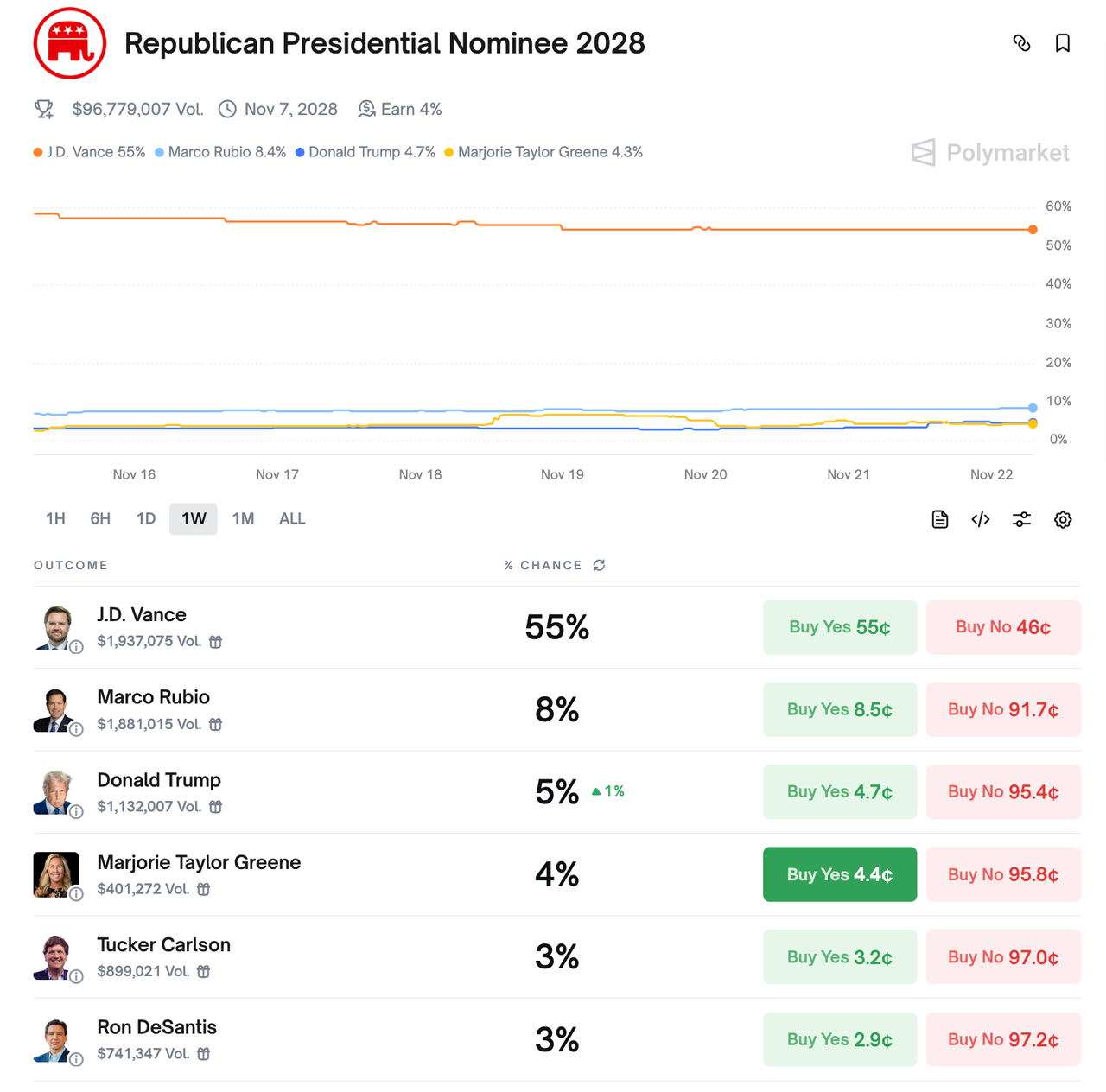
Given Bannon’s comments, we turn to Polymarket, where MTG currently sits at just 4% odds of becoming the Republican presidential nominee in 2028. J.D. Vance leads with 55%, followed by Marco Rubio at 8%. Interesting to note, Tucker Carlson has 3% odds.
Certainly a lot of posturing in the Republican Party ahead of midterms. Meanwhile, Democrats recently had to pull a $15 million loan just to stay afloat, as the rudderless party shows its true colors by embracing far-left toxic ideology.
Tyler Durden
Sat, 11/22/2025 – 07:35

Downtown Neighborhood Association of Elgin prepping streets for the upcoming holiday season
With its Holly Days promotion, the Downtown Neighborhood Association of Elgin is doing what it can to make sure city sidewalks are busy sidewalks throughout the holiday season.
“Feedback has shown that the holiday campaign has continued to grow and build interest over the years,” said DNA Executive Director Jennifer Fukala
This year, more than 40 businesses will be open on Small Business Saturday, Nov. 29, with 25 serving drinks for the Holiday Cheers Beverage crawl, Fukala said.
Along with seasonal fun, the Holly Days events are a way to draw people downtown to shop, eat, and drink.
“The impact of shopping local cannot be overstated,” Fukala said. “Increased sales during the holidays are pivotal for businesses to help balance out the slow times elsewhere in the calendar.”
As such, here’s a chronological list of downtown Holly Days events.
Saturday, Nov. 29
In conjunction with Small Business Saturday, a sleighful of activities will be taking place.
People can take photos with Santa from 10 to 11:30 a.m. at his house and workshop along DuPage Court.
More than 50 small businesses will set up shop from 10 a.m. to 4 p.m. during Holidays at The Highland Loft, 168 E. Highland Avenue.
More than 20 vendors will be selling their wares from 10 a.m. to 6 p.m.at the Merry & Made Holiday Pop-Up Market in the Highland Lofts, 164 E. Highland Avenue.
This is the cup patrons get when participating in the Nov. 29 holiday beverage crawl. (Courtesy of the Downtown Neighborhood Association of Elgin)
Those who have purchased their special Holiday Cheers insulated cups can visit more than 20 participating merchants from 10 a.m. to 6 p.m. to partake in a beverage crawl.
From 12 to 5 p.m., a free-to-ride trolley will take shoppers around the downtown.
Santa’s Workshop with craft projects for kids will be up and running from 1 to 3 p.m. on DuPage Court.
The Weave, another pop-up market, is set to take place from 1 to 5 p.m. at Side Street Studio Arts, 15 Ziegler Court.
There will be free photo ops with the Grinch from 2 to 4 p.m. at the Elgin Area Chamber of Commerce office, 31 S. Grove. Avenue.
There will be a holiday storytime session from 3 to 4 p.m. along DuPage Court.
Carolers will be singing from 3 to 5 p.m. along DuPage Court.
At 5 p.m., Mayor Dave Kaptain will oversee the city’s holiday tree lighting along DuPage Court.
Friday, Dec. 5
The Krampusnacht Bazaar will be selling macabre seasonal gifts from 6 to 10 p.m. at Elgin ArtSpace, 210 DuPage Street. For more information on Krampus events, email johnlafleur13@gmail.com.
Saturday, Dec. 6
M3 Dance will present “The Nutcracker” at noon and again at 5 p.m. at the Hemmens Cultural Center, 45 Symphony Way. Tickets are $32.50 to $43 and available at hemm.na.ticketsearch.com/sales/salesevent/19225.
The Krampusnacht Bazaar, featuring ghoulishly delightful artisan wares and eerie oddities, will open once more from 3 to 7 p.m. at ArtSpace.
The Downtown Neighborhood Association of Elgin’s “Holly Days” promotion kicks off on Small Business Saturday, Nov. 29, and includes a tree lighting ceremony along DuPage Court at 5 p.m. that night. (Photo courtesy Downtown Neighborhood Association of Elgin.)
Adult revelers are welcome to cosplay while taking part in a Krampus Crawl from 7 p.m. to midnight at participating downtown establishments. For more information on Krampus events, email johnlafleur13@gmail.com.
Nothing But Treble will celebrate the holiday season in song with a 7 p.m. concert at the First Congregational Church of Elgin, 256 E. Chicago Street. Admission is a suggested $20 donation. For more information, visit fcc-elgin.org/event/nothing-but-treble-concert/.
Sunday, Dec. 7
M3 Dance will present “The Nutcracker” at noon at The Hemmens, 45 Symphony Way.
Monday, Dec. 8
Axiom Brass will perform a holiday concert at 7 p.m. at First Congregational Church of Elgin, 256 E. Chicago Street. Tickets are $25, and $15 for students. For tickets and more information, visit www.chambermusiconthefox.org/concert/holiday-brass/.
Saturday, Dec. 13
The Downtown Neighborhood Association of Elgin will be hosting a Holly Days Holiday Pop-Up Market from 12 to 6 p.m. in the lobby of the Habitat for Humanity of Northern Fox Valley building, 56 S Grove Avenue.
The Elgin Symphony Orchestra will perform its annual Holiday Spectacular concerts at 2:30 and 7:30 p.m. at the Hemmens Cultural Center, 45 Symphony Way, Elgin. Tickets are $20 to $68, with discounts available for students. For tickets and more information, visit www.elginsymphony.org/en/home.
Sunday, Dec. 14
The Holly Days Holiday Pop-Up Market will run once more from 12 to 6 p.m. in the lobby of the Habitat for Humanity of Northern Fox Valley building, 56 S Grove Avenue.
The Elgin Symphony Orchestra will reprise its Holiday Spectacular at 2:30 p.m. at the Hemmens Cultural Center, 45 Symphony Way, Elgin.
For more information on Holly Days events, visit www.downtownelgin.com/hollydays/.
Mike Danahey is a freelance reporter for the Elgin Courier-News.
https://www.chicagotribune.com/2025/11/22/downtown-neighborhood-association-elgin-holly-days/