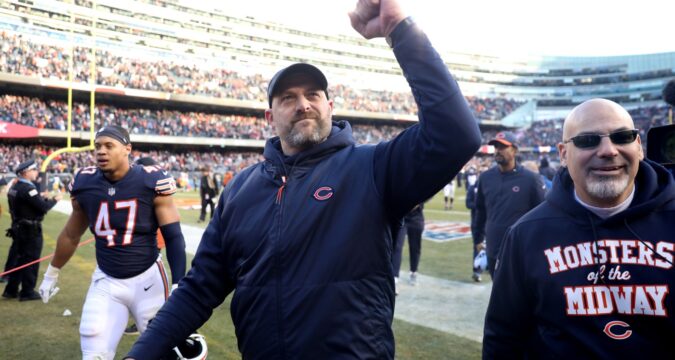
The first-place Chicago Bears — that might take some getting used to — will seek their eighth win in nine games Sunday when the Pittsburgh Steelers, with or without Aaron Rodgers, visit Soldier Field.
Is all this early success in coach Ben Johnson’s first season sustainable? Remember, the Bears won a division title seven years ago in another first-time head coach’s debut season. Brad Biggs’ weekly Bears mailbag begins there.
How is this season different than Matt Nagy’s fluky first season? Tell us fans this is different and why. — Dhana M., Peoria
I don’t know that the Bears’ success in 2018 was a fluke because that implies there was an element of luck or pure happenstance to it. That team had a dominant defense led by coordinator Vic Fangio. It was the best unit the Bears have fielded since the height of the Lovie Smith era.
Consider their rankings in key defensive metrics:
Scoring: 1st (17.7 ppg)
Total defense: 3rd (299.7 ypg)
Rushing defense: 1st (80.1 ypg)
Passing defense: 7th (219.7 ypg)
Opponent passer rating: 1st (72.9)
Third down: 4th (34.3%)
Red zone: T-5th (50%)
Takeaways: 1st (36)
The team’s success that season wasn’t fueled by luck. It was driven by a great defense that held 10 of 16 opponents to 17 or fewer points. Fangio departed to become the Denver Broncos head coach after the season ended with the “double doink” playoff loss to the Philadelphia Eagles.
The issue — and I think what you’re really getting at here — is how can the success the team is enjoying under Ben Johnson (7-3 and first place in the NFC North entering Week 12) be sustainable when the organization was unable to build on what the Bears did in 2018?
The Bears really thought they had something cooking when the 2019 season began. It was the 100th year of the franchise. There was talk of a Super Bowl run. The NFL put the Bears and Green Bay Packers in the Thursday prime-time slot to open the season, and Nagy’s offense, with quarterback Mitch Trubisky starting Year 3, fell flat in a 10-3 loss. It was a sign of offensive struggles to come.
Meanwhile, the defense didn’t maintain its lofty status with Fangio out of the picture. Nagy went 8-8 in Year 2 and followed that with another 8-8 season in which the Bears snagged a wild-card spot. It was all downhill from there.
What’s the difference this time around? Well, there are a lot of them. The Bears don’t have a singularly dominant unit. Quarterback Caleb Williams will be going into Year 3 in 2026 and has had a better start to his career than Trubisky. There’s better infrastructure around the position than there was when Nagy was getting started. It’s unlikely defensive coordinator Dennis Allen will be departing anytime soon, so Johnson shouldn’t have to handle that kind of staff turnover.
This is an interesting topic worth exploring down the road because people will want to know if the Bears are putting together the kind of season that can be a launching pad to further success. The 2010 Bears couldn’t build off their success after coming within one game of the Super Bowl, and the 2018 Bears missed a golden opportunity. The franchise last had consecutive winning seasons in 2005 and 2006.
A ton of football remains to be played — seven games. So we’ll have a much better idea of who the 2025 Bears are in two months, and that in theory will make it easier to project into the future. Johnson has put down a good foundation to this point, and the remainder of the season will be very interesting. Let’s see how it plays out before we start looking too far ahead.
Monday’s article referenced the Bears’ strength of victory and you mentioned that Ben Johnson didn’t select the schedule. Absolutely true. Please make sure you advocate that the Bears had the second-toughest schedule coming into the season. People don’t remember that. You play who is in front of you. I’m tired of hearing people ask who they beat. — Rob M.
You make a valid point. The Bears’ 2025 opponents had a .571 winning percentage in 2024, tied with the Detroit Lions and just behind the New York Giants (.574). As you know, the landscape can change pretty quickly in the NFL, and the slate of games the Bears have played to this point certainly doesn’t present as one of the more difficult schedules in the league. Strength of schedule based on the previous season can be used as a reference point during the offseason, but once things get rolling, that changes.
Entering Week 12, 19 teams have at least five wins. Of those 19, the Bears’ strength of victory (the winning percentage of the opponents they’ve defeated) is the lowest at .285. That’s because they count wins over the Las Vegas Raiders (2-8), New Orleans Saints (2-8), Cincinnati Bengals (3-7) and Giants (2-9), among others.
The next-lowest is the Kansas City Chiefs at .346. There are other teams with good records and low strengths of victory:
Broncos (9-2): .357
Patriots (9-2): .359
Colts (8-2): .361
Packers (6-3-1): .371
But as you can see, there’s a pretty good gap between those teams and the Bears. I’ve always said you can look at the list of quarterbacks a team has faced to get a decent handle on how challenging the schedule has been. That list hasn’t been overwhelming this season.
No one is taking anything away from the Bears’ 7-3 record and position atop the NFC North. They’ve handled adversity with some key injuries to their defense. They’ve adjusted quickly to new schemes on both sides of the ball and shown time and again they have the moxie to close out close games in the final minutes. You can only beat the teams on your schedule, and that’s what the Bears have done since an 0-2 start.
What is your assessment of Ben Johnson’s play calling from Sunday’s game against the Vikings? I found at least a handful of calls utterly confusing and detrimental. For example, end of the first half, third-and-1, and he didn’t run it. That failed conversion allowed Minnesota another possession and eliminated the opportunity to score before halftime. That’s just one example off the top of my head. I know we all praise Ben Johnson for his creativity — but sometimes I wonder if he misses the obvious and boring calls in an attempt to out-think the defensive coordinator. — Brian G.
Johnson is pretty transparent postgame and the day after games when he talks about calls he’d like to have back. This week was no different. I can’t imagine the play you’re referring to is one of them.
It was third-and-1 and the Bears were on their 29-yard line with 25 seconds remaining in the half. The offense needed a chunk play if it was going to have a chance for points before halftime. A deep pass to Rome Odunze didn’t connect, and the Bears punted. Minnesota took over on its 39 with 10 seconds remaining. Did the Vikings have a chance to score? Sure. But the odds were extremely low and their lateral play went nowhere.
The Bears are fourth in the league in total offense at 373.8 yards per game. They’re No. 2 in rushing. They’re eighth in scoring at 25.8 points per game and tied for second with only six turnovers. A ton is going right for this offense, and more times than not, Johnson is making a good call.
C.J. Gardner-Johnson’s impact vs. Kyler Gordon’s availability. Who gets more snaps? — @the1calledcj
Bears nickel back C.J. Gardner-Johnson (35) celebrates with safety Jaquan Brisker (9) after sacking Giants quarterback Jaxson Dart on Nov. 9, 2025, at Soldier Field. (Eileen T. Meslar/Chicago Tribune)
That’s something the Bears will have to sort through in the near future, provided Gordon returns healthy to the 53-man roster. It’s possible they could open the 21-day return-to-practice window for Gordon on Wednesday. Ben Johnson has said all along the team expected Gordon’s stay on injured reserve to be on the shorter side, and he now has missed the minimum four games.
For the sake of discussion, let’s say Gordon is back on the practice field this week. In that scenario, how much practice time is required before the team feels comfortable restoring him to the roster and using him in a game? He has missed an awful lot of time (eight of 10 games) dating back to the first week of August, when he was initially injured. My hunch is the team would want to see him ramped up for two weeks in practice before considering using him in a game, but every player and every injury situation is unique.
When Gordon is in the mix, then the question becomes appropriate: What does defensive coordinator Dennis Allen do? I would expect Gordon to be the starting nickel cornerback. The Bears made him the league’s highest-paid player at that position in the offseason. It’s not like Gardner-Johnson is going to Wally Pipp him.
There are a variety of ways Allen could incorporate Gardner-Johnson when Gordon is back. The first that comes to mind is the dime package. The Bears have used dime (six defensive backs) for 48 snaps this season, 8.2%. That ranks 19th in the league. Allen could expand on the dime package versus certain opponents. It’s also possible he gets creative and maybe uses Gardner-Johnson as a safety in certain situations. Just spitballing. Could he remove Jaquan Brisker in certain looks and use Gardner-Johnson?
“There’s probably a lot of things we could do,” secondary coach Al Harris said last week when I asked how things could shake out. “But that’s just a bridge we’ve got to cross when we get there.”
Assuming the Bears give Darnell Wright his fifth-year option or an extension, what do you see as the plan for their other players in that draft class and eligible for a second contract? — @greggisp
Based on how he’s playing, the likeliest scenario for Wright is the team exercising the fifth-year option in his contract and then looking to hammer out a multiyear extension that could be finalized in the spring or over the summer. There won’t be any rush to strike a new deal, but the team can save a little money by doing a deal before the season starts, and Wright can lock up security.
You’re probably looking at a big deal too. It’s premature to speculate on numbers with seven games remaining, but just know there are six right tackles with an average annual salary of $20 million or more.
Wright’s contract situation will be the biggest piece of business for general manager Ryan Poles. After that, I’m not sure there is another player the team will want to pay. The remainder of the season could drive a decision one way or the other with a couple of players.
Bears defensive tackle Gervon Dexter Sr. (99) celebrates after he and defensive end Montez Sweat (98) sacked Giants quarterback Jaxson Dart on Nov. 9, 2025, at Soldier Field. (Eileen T. Meslar/Chicago Tribune)
Defensive tackle Gervon Dexter Sr. has four sacks. I’m curious how the team views him. His playing time has dipped a little recently. In the last three games, he was on the field between 51.5% and 57.5% of the snaps. Through the first seven games, that figure was hovering around 66%, but the Bears have been using nose tackle Andrew Billings and working in Grady Jarrett more after he returned from his right knee injury.
Dexter is a big guy with a ton of talent. He’s sort of a tweener. He’s not an ideal three-technique and he’s not exactly what you’re seeking in a nose tackle. But he can play both and he’s strong. Suffice to say, Dexter has a lot to play for in the remaining seven games.
Cornerback Tyrique Stevenson has been better this season, but has his play risen to the level that the team would want to explore extension discussions? The Bears could bring back Stevenson next year and have him play in a contract season before making a decision.
Four picks from the 2022 draft will be coming out of contract: Safety Jaquan Brisker, left tackle Braxton Jones, defensive end Dominique Robinson and safety Elijah Hicks. Aside from Wright, five players from the 2023 draft will have one year remaining and be eligible for an extension: Dexter, Stevenson, running back Roschon Johnson, linebacker Noah Sewell and cornerback Terell Smith.
Given Brisker’s history of concussions, my guess is the Bears will look to rebuild at safety and consider re-signing Kevin Byard III, who leads the NFL with five interceptions. Maybe they like the idea of Robinson and/or Hicks returning on a modest one-year contract. As far as the other 2023 picks, they’ll probably be back in a position where they have to compete for a spot in 2026 in the final year of their contracts.
I don’t know what the numbers say and frankly don’t care about the rankings of the Bears special teams. I know they periodically make good plays like the Devin Duvernay return at Minnesota but mostly seem average at best. It seems like they return kickoffs to the 26- or 27-yard line and give up returns between the 35 and 40. The punt teams aren’t any better. Am I wrong? Is Richard Hightower doing a good job? Did Ben Johnson bring him back because he thinks he’s good or was there just no one out there that was better? — Dave K., Albuquerque, N.M.
The Bears had one disastrous game on special teams this season in Cincinnati, and they overcame a series of major errors — including a kickoff return for a touchdown and a blocked field goal — to win 47-42. They’ve also won two games largely because of special teams at the end: the Week 4 game in Las Vegas with Josh Blackwell’s blocked field goal and Sunday’s win in Minnesota when Duvernay’s 56-yard kickoff return set up Cairo Santos’ 48-yard field goal on the final play.
What you’re overlooking is that Hightower set up that final return by showing the Vikings one look — and Blackwell nearly broke a kickoff return all the way — and then giving a different look at the end with Duvernay. There’s nuanced strategy that goes into this.
The Bears are tied for ninth in the league with an average starting field position of the 30.9-yard line on kickoffs. They’re 23rd in opponents’ starting field position (31.3), a figure that would be much better if not for the touchdown by the Bengals.
Punt coverage hasn’t been great, and the Vikings hit the Bears for a big one Sunday. Kickoff coverage needs to be tightened up, but it was good this past week and Santos executed some really good kicks that resulted in an average starting point of the 23-yard line for the Vikings on five kickoffs.
We can find a play or two every week on special teams that needs to be better. That’s the nature of that phase. No different than offense and defense. But this unit has come up big in some big moments, and Hightower and his players have responded since Cincinnati.
Hightower gave Johnson one advantage when he retained him in that he was familiar with players on the roster. The group has evolved a little bit. If we’re going to discuss the shortcomings this season — and there have been some — we need to dive into what has gone right as well.
How would you assess the job Tory Taylor has done so far this season? — Mike F., Chicago
Bears holder Tory Taylor jumps to celebrate a game-winning field goal by kicker Jake Moody to defeat the Commanders on Oct. 13, 2025, at Northwest Stadium in Landover, Md. (Brian Cassella/Chicago Tribune)
We have a smaller sample size to work with this season, and that’s a very good thing, right? Taylor has been good — and he was really good as a holder, handling the switch to Jake Moody when Cairo Santos was sidelined and making that situation seamless. His gross average of 48.1 yards is 12th in the league, and the net average of 39.5 ranks 22nd.
The latter figure took a hit in the fourth quarter Sunday when Vikings rookie Myles Price had a 43-yard return, the longest the Bears have allowed this season. While Taylor has given up some return yardage in a few instances this season when he outkicked his coverage, that wasn’t the case on this play. So a punter’s net average is closely tied to the performance of the coverage team.
While Taylor has only 11 punts inside the 20-yard line, his 35 total punts rank near the bottom of the league, and Ben Johnson isn’t turning to special teams a whole lot when the offense is around midfield. I think Taylor is just scratching the surface too. He has a wealth of talent, a variety of kicks and the leg strength to absolutely crush the ball in the specific instances when special teams coordinator Richard Hightower wants that. If the Bears cover well the rest of the season, that net average should climb back above 40.
Looking ahead, can you compare the amount of say this coaching staff will have in free agency and the draft with how much of a say the previous coaching staff had? — @0ccamsrazorburn
Related Articles
Aaron Rodgers has a broken left wrist, but the Pittsburgh Steelers QB still might play vs. Chicago Bears
Are the Chicago Bears legitimate contenders to win the NFC North? 5 pressing questions after Week 11.
Jake Moody joins the Washington Commanders off the Chicago Bears’ practice squad
What we learned from the Chicago Bears, including why Ben Johnson isn’t talking about the playoffs
New York Jets bench struggling QB Justin Fields for Tyrod Taylor
Ben Johnson’s opinion carries a ton of weight in the building. He’s the top-paid person in the football operation, and he has justified his hiring with how the team has performed to this point. It’s fair to imagine he has more sway in personnel decisions than his predecessor, Matt Eberflus, did. Any major decision is going to run through him. But that’s natural. General manager Ryan Poles doesn’t want to saddle his coach — whether it’s Johnson, Eberflus or whoever — with a player he doesn’t deem as a fit.
The Bears don’t want to get into a situation, though, where the coaching staff is dictating every personnel move. There have been plenty of examples around the league in which coaches gained too much control in those situations (based on a lot of success) and eventually things unraveled.
Poles has a scouting staff that spends the entire year evaluating the college and pro sides. The best teams lean on their scouting departments to do their job before it reaches the point of making a decision. The scouts vet the makeup of players and do the exhaustive legwork required to give a complete picture. Johnson and his coaches simply don’t have the time to do that. They will get involved in that aspect of the process after the season ends. They will meet draft prospects and provide valuable input. But the scouting staff has to do its job first.
The short answer is, yes, I think Johnson has more say than Eberflus did and maybe more than Matt Nagy had before him. That’s probably a good thing because he has a unique way of viewing players, their strengths and how they fit the vision. But the Bears still have to lean into the work their scouts do.
https://www.chicagotribune.com/2025/11/19/chicago-bears-mailbag-ben-johnson-matt-nagy/


