Category: News
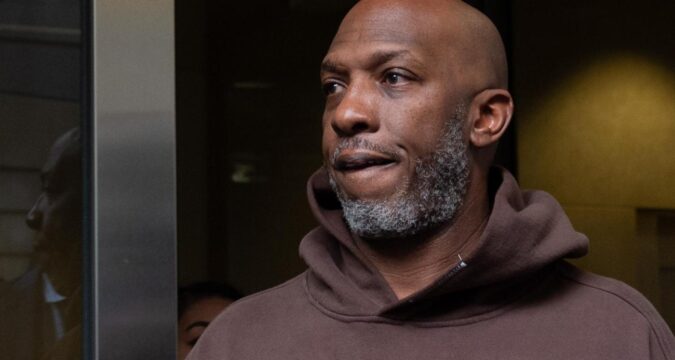
Portland Trail Blazers coach Chauncey Billups to be arraigned in rigged poker games case
NEW YORK — Portland Trail Blazers coach and basketball Hall of Famer Chauncey Billups is set to appear in a New York court to face charges he profited from rigged poker games involving several Mafia figures and at least one other former NBA player.
The five-time All Star, who won a championship with the Detroit Pistons, will be arraigned in Brooklyn federal court Monday on money laundering and wire fraud conspiracy charges.
Chris Heywood, his attorney, has said Billups is a “man of integrity” and denies the charges.
“To believe that Chauncey Billups did what the federal government is accusing him of is to believe that he would risk his Hall of Fame legacy, his reputation and his freedom. He would not jeopardize those things for anything, let alone a card game,” Heywood said after Billups appeared in federal court in Portland, Oregon, when prosecutors first announced the indictment on Oct. 23.
Billups was arguably the most prominent name among more than 30 charged in last month’s sprawling federal takedown of illegal gambling operations linked to professional sports. The other defendants are also expected to appear in court for Monday’s proceedings, in which the judge, prosecutors and defense lawyers will likely discuss next steps in the case.
Prosecutors say the 49-year-old Denver native, who was inducted into the Naismith Memorial Hall of Fame last year, was involved in a scheme to rig Mafia-backed illegal poker games in Manhattan, Las Vegas, Miami and the Hamptons.
Former NBA player and assistant coach Damon Jones was also nabbed in that alleged scheme, which prosecutors say utilized a range of sophisticated technology that allowed the gambling to be rigged, such as altered card-shuffling machines, hidden cameras in poker chip trays, special sunglasses and even X-ray equipment built into the table to read cards.
Jones was also charged along with Miami Heat guard Terry Rozier in a separate scheme at the same time that allowed gamblers to exploit insider information about players to win bets on NBA games.
Prosecutors say the poker scheme Billups was involved in defrauded victims of an estimated $7 million starting in at least 2019.
They say he served as a celebrity “face card” that could draw wealthy, unsuspecting players to the games. Prosecutors said during one game, the scheme’s organizers exchanged messages saying one of the victims “acted like he wanted Chauncey to have his money” because he was “star struck.”
Prosecutors say Billups, who earned about $106 million from his playing days, received a portion of the ill-gotten gains. After one rigged game in October 2020, for example, they say he was directly wired $50,000.
The scheme organizers also had to share a portion of their proceeds with the Gambino, Genovese and Bonanno mob families for operating within the illegal poker games run by the New York criminal enterprises, prosecutors said.
Mafia members, in turn, helped commit violent acts, including assault, extortion and robbery, to ensure repayment of debts and the continued success of the operation, they said.
Billups was selected as the third overall pick in the 1997 draft by the Boston Celtics after starring in college for the Colorado Buffaloes. He played 17 years in the NBA, with stints with the Toronto Raptors, Denver Nuggets, Minnesota Timberwolves, New York Knicks and Los Angeles Clippers.
But he is perhaps most beloved in the Motor City, where he earned the nickname “Mr. Big Shot” for his knack of making clutch shots.
Billups was named the NBA Finals MVP during the Pistons’ title run in 2004 and had his No. 1 jersey retired by the team.
After retiring in 2014, Billups embarked on a career as a TV analyst before pivoting to coaching.
He was hired as Portland’s coach in 2021 and signed a multi-year extension with the Trail Blazers earlier this year after the team missed out on the playoffs for the fourth straight season in 2024. Billups previously served as an assistant coach on the Los Angeles Clippers.
After his arrest, he was placed on unpaid leave and assistant coach and former NBA player Tiago Splitter was named the Trail Blazers interim coach.
https://www.chicagotribune.com/2025/11/24/chauncey-billups-arraigned-rigger-poker-games/

Novo Nordisk Plunges After Ozempic Pill Fails Alzheimer’s Trials – Shares Suffer Worst Year Ever
Novo Nordisk Plunges After Ozempic Pill Fails Alzheimer’s Trials – Shares Suffer Worst Year Ever
Shares of Novo Nordisk in Copenhagen plunged the most in nearly four months after top-line results from a two-year analysis of the evoke and evoke+ Phase 3 trials, a pill version of Ozempic, showed the treatment failed to slow progression in early-stage symptomatic Alzheimer’s disease.
The studies, which enrolled 3,808 adults over two years, found improvements in Alzheimer’s-related biomarkers but no meaningful impact on cognitive decline, as measured by the Clinical Dementia Rating (CDR-SB) score.
“While treatment with semaglutide resulted in improvement of Alzheimer’s disease-related biomarkers in both trials, this did not translate into a delay of disease progression,” Novo wrote in a press release.
Novo chief scientific officer Martin Holst Lange commented on the results:
“Based on the significant unmet need in Alzheimer’s disease as well as a number of indicative data points, we felt we had a responsibility to explore semaglutide’s potential, despite a low likelihood of success. We are proud to have conducted two well-controlled phase 3 trials in Alzheimer’s disease that meet the highest standards of research and rigorous methodology.
“We sincerely thank all participants and their caregivers for their meaningful contributions. While semaglutide did not demonstrate efficacy in slowing the progression of Alzheimer’s disease, the extensive body of evidence supporting semaglutide continues to provide benefits for individuals with type 2 diabetes, obesity, and related comorbidities.”
Goldman analyst James Quigley, arguably one of Novo’s biggest super bulls, offered a first take on today’s results:
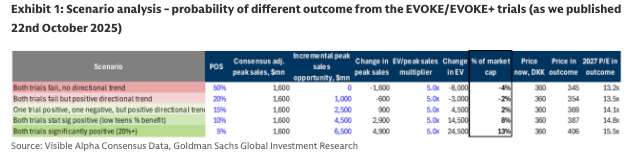
This morning (November 24th), Novo announced that the EVOKE/EVOKE+ trials of semaglutide in Alzheimer’s disease did not hit the primary endpoint, as no efficacy difference was seen between the treatment and placebo arms, leading to the 1-year extension study to be discontinued. Topline results will be presented at the CTAD conference on December 3rd, and Novo noted that semaglutide behaved as expected on all other known characteristics (safety, tolerability etc). Our expectations into the trial were low, as we forecast 5% probability of c.$4bn in peak sales for semaglutide in Alzheimer’s disease and while the DCF impact on our model is limited (<1% decline on taking EVOKE out of the model), our scenario analysis suggested c.4% downside to the shares in this scenario. Our investor conversations suggested that downside risk could be >4%, given potential concerns over 2026 growth. However, we note that these concerns should largely be included in the stock given the recent step down on commentary around FY26 headwinds, and while the stock is trading down c.8% at the time of writing we believe the stock could underperform by LSD-MSD based on the trial failure.
EVOKE/ EVOKE+ misses on lack of efficacy. Oral semaglutide treatment for patients with Alzheimer’s disease did not show superiority in reducing disease progression vs placebo in the EVOKE/EVOKE+ trials. In the press release, Novo confirmed that the final year of the trials will be suspended given the efficacy shown by semaglutide during the trials.
Sensitivity analysis suggests c.4% downside in the event of a trial failure and no directional benefit (Exhibit 1). As we had previously highlighted, while the impact on our DCF is negligible, our scenario analysis (based on consensus estimates) implies a c.4% downside risk in this scenario. Investor feedback following our original note suggested that there could be additional downside risk, beyond just removing Alzheimer’s, particularly given concerns over the 2026 growth outlook; however, we would argue that consensus has already started to move down (Visible Alpha now estimates c.2% CER growth vs. 6/7% previously.
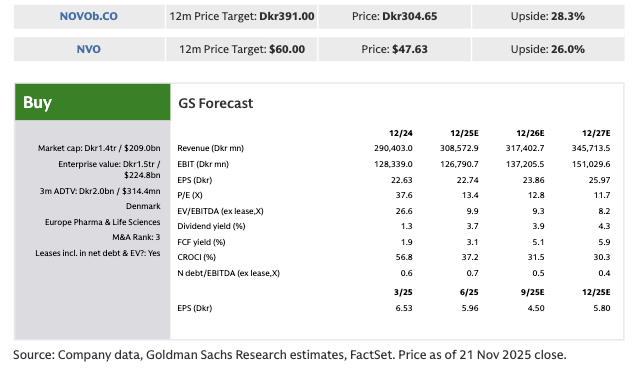
Quigley remains buy-rated on Novo with a 12-month price target of DKK 393 per share.
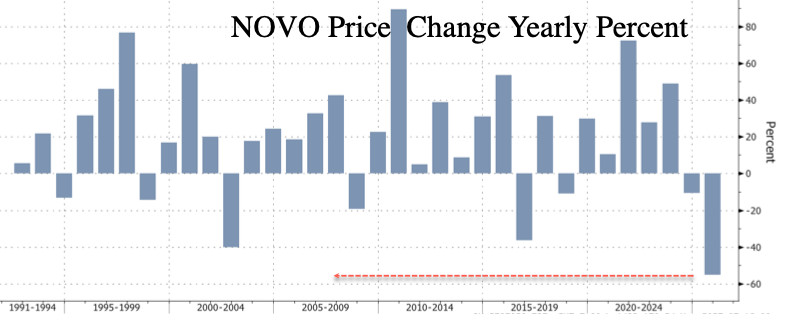
The dismal results sent Novo shares tumbling nearly 10% in Copenhagen by afternoon trading, the steepest intraday drop since the 23% crash on July 29. The stock is now down 55% year-to-date, hitting levels last seen in mid-2021. Novo ADR shares are down 9%.
Worst year on record.
Related:
Novo Undercuts Lilly’s Obesity Drug Price, Now Cheaper Than Car Payment
Goldman Maps Out Next Wave Of Obesity-Drug Catalysts
“It was a lottery ticket that could have had great value,” said Per Hansen, investment economist at Nordnet AB, who Bloomberg quoted. “Investors hadn’t assigned it any real value. Still, the hope was there.”
Tyler Durden
Mon, 11/24/2025 – 07:45

Daywatch: ‘You’re going to wish that doesn’t happen to you’
Good morning, Chicago.
As Gary Ellis lay dying in August 2023, no one at the facility caring for him called his son.
Instead, staffers called Ellis’ court-appointed state guardian, who had recently taken charge of all decisions related to the 69-year-old man’s care. Not until it was too late did Gary Brown learn his father had been at death’s door, Brown told the Tribune.
“When I went there the nurse was like, ‘We’ve been trying to call someone all night but nobody answered the phone,’” Brown said. “All I got was ‘I’m sorry.’ ‘I’m sorry’ didn’t do nothing to help me or my dad.”
The scenario was exactly what Brown feared when he learned, to his surprise, that Northwestern Memorial Hospital had moved to appoint a guardian for his father. The family said Northwestern had been treating the retired CTA bus driver for months, except for a brief stint at a rehabilitation facility, after he suffered a fall in April 2023.
Putting someone under guardianship has profound consequences, often stripping the individual of the right to make personal, medical and financial decisions for the rest of their lives. Courts, government officials and advocates for adults with disabilities say it should be an option of last resort, used only when people cannot make their own decisions and no less restrictive solution is available.
Yet Chicago-area hospitals recently initiated hundreds of guardianship petitions in just 18 months, a Tribune investigation has found, sometimes to the dismay of family members or friends who did not want people they loved to be placed under someone else’s control.
Read the full investigation from the Tribune’s Emily Hoerner, Christy Gutowski and Lisa Schencker.
Here are the top stories you need to know to start your day, including what Chicago activists shared with community organizers in other cities for resisting Border Patrol, the latest after a 14-year-old was killed in a downtown shooting during a “teen takeover” and when Siskel met Ebert.
Today’s eNewspaper edition | Subscribe to more newsletters | Asking Eric | Horoscopes | Puzzles & Games | Today in History
April Verrett, president of Service Employees International Union, speaks at a large rally at Chicago’s Daley Plaza at a “Hands Off” protest and march on April 5, 2025. (Audrey Richardson/Chicago Tribune)
‘Fracture’ in Chicago’s labor world complicates Mayor Brandon Johnson’s third budget fight
As Mayor Brandon Johnson has shaken hands in church pews and given booming speeches in school auditoriums while selling his 2026 budget plan directly to Chicagoans, one color has been notably muted among his supporters: purple. That’s the signature hue of the Service Employees International Union, whose local affiliates were Johnson’s second-biggest labor backer in his 2023 election.
Instead, the self-styled “most pro-worker mayor” in Chicago’s history has only seen one union vociferously cheer his $16.6 billion proposal, despite his hard line against layoffs: the red-shirted Chicago Teachers Union. It’s a sign of the times after a “fissure” between the once-close SEIU and CTU has grown into a full-blown “fracture,” said Ald. Desmon Yancy, a freshman progressive who previously served in SEIU leadership.
Veronica Castro, deputy director at the Illinois Coalition for Immigrant and Refugee Rights, speaks outside City Hall, Oct. 31, 2024. (Brian Cassella/Chicago Tribune)
Chicago activists share blueprint for resisting Border Patrol: ‘Chicago clearly is front and center’
As President Donald Trump’s ramped-up Border Patrol action hits city after city, Chicago’s immigration-focused community organizers are following. They aim to pass on what they learned to foster pushback in Operation Midway Blitz.
Her dad was taken by immigration agents. Now a 12-year-old girl fears she’s lost her only living parent.
Illinois National Guard housed at state site as questions about Trump deployment costs grow
Police officers are posted in the 100 block of North Michigan Avenue Saturday, Nov. 22, 2025, in Chicago. Nine teens were shot the previous night in two incidents a few blocks away, in the 100 block of North State Street and 100 block of South Dearborn Street. (John J. Kim/Chicago Tribune)
14-year-old killed in downtown shooting during Friday ‘teen takeover’ identified, his death ruled a homicide
A 14-year-old boy who was killed in downtown Chicago during one of two Friday night shootings that also injured eight others has been identified, and his death ruled a homicide.
Armani Floyd died from multiple gunshot wounds, according to the Cook County medical examiner’s office. He was pronounced dead at Northwestern Memorial Hospital at 10:59 p.m. Friday.
Two killed, one wounded in shooting at Two Brothers Roundhouse in Aurora
Former Illinois House Speaker Michael Madigan leaves Dirksen U.S. Courthouse after being sentenced to 7 1/2 years in prison and fined $2.5 million during his post-trial sentencing hearing, June 13, 2025, in Chicago. (Terrence Antonio James/Chicago Tribune)
Imprisoned ex-Speaker Michael Madigan formally disbarred after nearly 60 years as a lawyer
Nearly 60 years after earning his law degree, imprisoned former House Speaker Michael Madigan was formally disbarred this week in a one-paragraph notice buried in a monthly list of attorney discipline from around the state.
DePaul University graduate students attend a social gathering for international students at the school’s downtown campus on Jan. 26, 2024. International enrollment dropped at nearly two dozen Illinois universities this fall, including DePaul. (Chris Sweda/Chicago Tribune)
International student enrollment declines at nearly two dozen Illinois universities
A Tribune analysis of 27 of the state’s largest universities found that foreign enrollment dipped at all but four institutions, including the University of Chicago and a handful of liberal arts colleges.
The condo building, center, at 9 W. Walton St. in Chicago’s Near North Side neighborhood, is seen on Nov. 25, 2024. (Antonio Perez/Chicago Tribune)
Former Chicago Bulls player Zach LaVine sells Chicago condo for $6.4M
Former Chicago Bulls guard Zach LaVine, who played for the team for parts of eight seasons, took a loss on his three-bedroom, 4,500-square-foot condominium on the 28th floor of the building at 9 W. Walton St., selling it for $6.4 million.
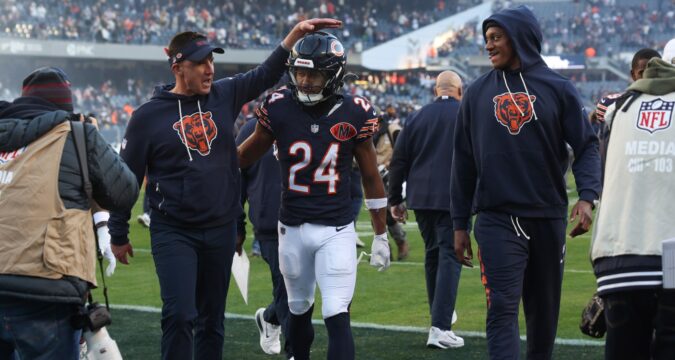
Bears defensive coordinator Dennis Allen congratulates cornerback Nick McCloud (24) as injured linebacker Tremaine Edmunds, right, watches after a 31-28 win over the Steelers on Nov. 23, 2025, at Soldier Field. (John J. Kim/Chicago Tribune)
Unlikely heroes keep arising for 1st-place Chicago Bears: Brad Biggs’ 10 thoughts on the Week 12 win
A Bears defense missing five starters Sunday at Soldier Field was too good for a Pittsburgh Steelers team missing future Hall of Fame quarterback Aaron Rodgers. In a season in which unlikely heroes are arising on an almost weekly basis, it was some of the most recently promoted who delivered big plays in a 31-28 victory.
Week 12 recap: Bears hang on for their 8th win in 9 games, beating Steelers 31-28
Backup LBs D’Marco Jackson and Amen Ogbongbemiga help Bears defense keep rolling with the punches
St. Rita’s Damon Sutton Jr. (20) breaks a tackle attempt by Batavia’s Luke Gardner on his way to a touchdown during a Class 7A semifinal, Nov. 22, 2025, in Chicago. (Troy Stolt/for the Daily Southtown)
IHSA state football playoffs: Complete championship pairings from Class 8A to 1A
The finals of the IHSA state football playoffs are set. The original field of 256 teams across eight classes is down to 16 after Saturday’s action.
Championship games will be held Thanksgiving weekend at Hancock Stadium in Normal, with Classes 1A-4A on Friday and Classes 5A-8A on Saturday.
Naperville Central’s Trinity Jones (10) shoots over Kenwood’s Janiah Daniel (11) during a Tip-Off Tournament game on Nov. 21, 2025, in Naperville. (Jon Cunningham/for the Naperville Sun)
Trinity Jones breaks Candace Parker’s single-game scoring record as Naperville Central stuns Kenwood
Just minutes after celebrating Naperville Central’s most memorable win in recent history, senior guard Trinity Jones got some unexpected news.
Film critics Roger Ebert, left, and Gene Siskel pose on the set of their TV show, relaunched as “Sneak Previews,” in 1976. The set used forced perspective to create the illusion that they were watching film clips from a theater’s balcony. (WTTW)
When Siskel met Ebert: Competing critics made TV history with show about the movies
People who turned to the television listings in the Nov. 26, 1975, edition of the Tribune bore witness to history being made. Among the evening programs, competing with the second half-hour of “Tony Orlando and Dawn” and a repeat of “Ironside,” appeared a new show airing on WTTW, Chicago’s public television station.
Those who went a step further and turned the dial at 7:30 p.m. to Channel 11 caught the opening of this new show with a long title, “Opening Soon … At a Theater Near You.” Billy Joel’s “Root Beer Rag” played under a series of stills from Hollywood classics, including “The Jazz Singer” and “Ben-Hur.”
Evan C. Dolan, Jessie J. Potter, Alex Syiek, Sophie Grimm and cast in “White Christmas” at Paramount Theatre in Aurora. (Boris Martin)
Review: ‘White Christmas’ gets an extra special holiday production at Paramount Theatre
The whole “White Christmas” experience is just better in a historic venue like the Paramount with the room and the budget (for now, anyway) for a full-sized, 15-piece orchestra, writes Chris Jones.
https://www.chicagotribune.com/2025/11/24/daywatch-youre-going-to-wish-that-doesnt-happen-to-you/
Unlikely heroes keep arising for 1st-place Chicago Bears: Brad Biggs’ 10 thoughts on the Week 12 win
Dennis Allen hasn’t blinked when asked about various fill-ins the Chicago Bears have called upon on defense this season. In turn, it’s hard to find an example of a reserve who has blinked when pressed into action.
A Bears defense missing five starters Sunday at Soldier Field was too good for a Pittsburgh Steelers team missing future Hall of Fame quarterback Aaron Rodgers. In a season in which unlikely heroes are arising on an almost weekly basis, it was some of the most recently promoted who delivered big plays in a 31-28 victory.
It marks the second four-game winning streak this season for a team that began the year with consecutive losses. The Bears (8-3) have won eight of their last nine, remain atop the NFC North and need one more victory in their final six games to finish with a winning record for the first time since 2018. Of course, they are hunting plenty more this season than finally being on the right side of .500.
10 thoughts after another narrow win for the Bears, who are 6-1 in games decided by five points or fewer.
1. This was an important game when you zoom out for a look at the big picture.
Safety Jonathan Owens celebrates after the Bears defeated the Steelers 31-28 at Soldier Field on Nov. 23, 2025. (Eileen T. Meslar/Chicago Tribune)
The Steelers (6-5) are the first opponent with a winning record the Bears have defeated. The win came before a short week of preparation and a trip to Philadelphia on Friday. It’s not that the Bears needed wiggle room in what could become a tight NFC playoff race, but it doesn’t hurt — especially before they have to tangle with the defending Super Bowl champion Eagles.
The win also helps validate what coach Ben Johnson and his staff have been working to instill. The Bears figured it would be a classic game in the trenches, the kind of physical battle you have to win outside when it’s cold in the second half of the season. The Bears were the more physical team and they certainly enjoyed better quarterback play as Caleb Williams was 19 of 35 for 239 yards and three touchdowns, two of them to DJ Moore.
It’s how the Bears held off the Steelers, though, that’s notable, with the top three linebackers — Tremaine Edmunds, T.J. Edwards and Noah Sewell — sitting out.
D’Marco Jackson, in his first NFL start, made 15 tackles. Amen Ogbongbemiga, a core special teams player pressed into action when rookie Ruben Hyppolite II left with a shoulder injury late in the first quarter, added 14 tackles.
Cornerback Nick McCloud, filling in for Tyrique Stevenson, who exited with a hip injury, made seven tackles. Opposite him, Nahshon Wright, who has started nearly all season with Jaylon Johnson injured, picked off Mason Rudolph’s first pass and broke up another rare deep shot by the Steelers backup quarterback, who rarely looked downfield.
Want the latest Bears news? Subscribe to the Chicago Tribune to read it all — and sign up for our free Bears Insider newsletter.
On offense, rookie Ozzy Trapilo made his first start at left tackle with Theo Benedet sidelined, and rookie Luke Newman wound up spelling Jonah Jackson at right guard for two scoring drives in the second quarter while the veteran had an eye injury looked at in the locker room.
“We were decimated in certain areas,” Johnson said. “The easy thing is to say, ‘Woe is me,’ and our guys didn’t do that. They just stepped up and kept battling through. It happens to most teams each season, too, where your depth gets tested. It just so happens it was this week for us.”
Backup quarterback Tyson Bagent, in an unrelated conversation last week about running the scout team during practice, made an observation that applies here.
“This is definitely by far the best staff at keeping the backups ready,” Bagent said. “In past years, you get too wrapped up into the season or whatever, but this staff does a really good job of making sure the guys that are backups are prepared to play.”
It’s almost as if Bagent had a premonition of what would be needed Sunday. Maybe a healthy Aaron Rodgers would have taken advantage of inexperienced linebackers and issues on the outside. If the Steelers hoped they could win those matchups with Rudolph, that changed immediately after the second offensive snap. Wright picked off an underthrown 50-50 ball to DK Metcalf for his fifth interception of the season.
“We knew what kind of game this was going to be,” free safety Kevin Byard III said. “It was, ‘Mason, let’s not have our offense mess it up.’ They wanted to let their defense eat and keep the game close toward the end. It was a lot of screen game and dink and dunks and just running the ball.
“Once we kind of figured that out, we were just loading the box. We knew they were going to run the ball. We still could have been a lot better. We just knew he wasn’t going to take too many shots, and the few times he did, it was on the outside. They were not going to throw the ball across the middle.”
Bears safety Kevin Byard III (31), cornerback Nick McCloud (24) and safety Jaquan Brisker (9) wrap up Steelers tight end Pat Freiermuth during the fourth quarter on Nov. 23, 2025, at Soldier Field. (Eileen T. Meslar/Chicago Tribune)
The Steelers totaled 186 rushing yards, with Kenneth Gainwell carrying 10 times for 92 yards, including a 55-yard romp on fourth-and-1 when the Bears were expecting something up the middle. Jaylen Warren added 68 yards.
While Rudolph completed 24 of 31 passes, he got just 171 yards through the air with a net of 4.8 yards per drop-back. The rare times he looked comfortable, he was throwing the ball immediately.
How does the staff, especially on defense where the injuries have been concentrated, have the backups ready? Defensive coordinator Dennis Allen isn’t Mr. Original when he uses the phrase “next man up.” Maybe he has a unique approach to living that.
“For starters, it’s just the expectation that you know,” said special teamer Daniel Hardy, who gets time at defensive end and as an off-ball linebacker. “It’s not, ‘Well, you’ll play if somebody gets hurt.’ It’s, ‘You’re going to play, so you better be ready.’ There is an expectation that everybody in the room is ready to play at all times.”
Along those lines, Allen hits the players with pop quizzes every week, with questions that get to the smallest details. He’ll call on the highest-paid players on the roster to the most recent practice-squad additions. Talk about a situation with peer pressure to be on top of your stuff.
“You’ve got to know this because we’re a shoestring and whatever else away from you going in,” cornerback Josh Blackwell said of the spot players are in when called upon to deliver an answer. “That’s the reality of the NFL, right? It’s not that (Allen) has tried to embarrass anyone. But if you don’t know it, you could be the guy in that situation and we need you to make the play.”
McCloud, who had stops with four other teams before this season, said practices have the most competitive edge he has experienced in the NFL. That’s probably easier to create when a team is in the thick of the race and not playing out the string, but it’s an important distinction when you talk about working to improve on a weekly basis.
Bears defensive coordinator Dennis Allen congratulates cornerback Nick McCloud (24) as injured linebacker Tremaine Edmunds, right, watches after a 31-28 win over the Steelers on Sunday, Nov. 23, 2025, at Soldier Field. (John J. Kim/Chicago Tribune)
“By this point in the season last year, we were only doing practices in shells,” Hardy said. “We weren’t in pads. We still do it. Ben is getting every bit of preparation that he can out of us. The staff does a phenomenal job of keeping us ready. The narrative is be ready to play because you’re going to at some point.”
Edmunds was placed on injured reserve Saturday, and the team hopes he’s back before the regular season ends. Cornerbacks Jaylon Johnson and Kyler Gordon could be green-lighted in time to face the Eagles. Edwards probably isn’t far off, so the Bears should look closer to whole soon.
“We’ll get some of the reinforcements back at some point,” Ben Johnson said. “But until then, we’ve got to hold down the fort. I can’t say enough good things about the guys that stepped up today to help us win that ballgame.”
Bagent’s take on how reserves are kept ready was interesting, and certainly the results support the premise.
“This coaching staff is really good at coaching, period,” said Elijah Hicks, the dime back of late. “A lot of it has to do with that and being very detailed, and then a lot of it is on the individual too. Because guys like (Jackson) and Amen and guys who have either been inactive or just been on special teams, it’s on them to stay locked in and be watching film and knowing the different adjustments that are going on.
“It’s great coaching, but a lot of it has to do with the players. You don’t ever want to have to change your routine because your opportunity has come.”
2. D’Marco Jackson and Amen Ogbongbemiga joined exclusive company when they combined for 29 tackles on Sunday.
Bears linebackers D’Marco Jackson (48) and Amen Ogbongbemiga (45) tackle Steelers running back Kenneth Gainwell in the fourth quarter on Nov. 23, 2025, at Soldier Field. (John J. Kim/Chicago Tribune)
Jackson was credited with five solos and 10 assists for 15 total tackles and Ogbongbemiga had two solos and 12 assists to give him 14. Only once prior to 1994, which is as far back as the tackle statistics go in Pro Football Reference, have the Bears had a pair of linebackers with 14 or more tackles in a game.
It happened on Oct. 16, 2006, in Glendale, Ariz., in what some call the “Monday Night Miracle.” Brian Urlacher had 19 tackles by the official press box total (coaches’ review of film later credited him with 25) and Lance Briggs had 15 that night. The wild rally for a victory over the Cardinals was one of the signature performances of Urlacher’s Hall of Fame career.
This is really the only way Jackson and Ogbongbemiga should be compared to Urlacher and Briggs, but, remarkably, it’s something that hasn’t happened any other time — and the fill-in linebackers were a big part of the victory.
Ben Johnson presented Jackson with one of two game balls in the locker room. He was the player who ran the defensive huddle with the green dot on his helmet and his relationship with defensive coordinator Dennis Allen from New Orleans paid off. Jackson was a core special teams player with the Saints the last two seasons and when he was waived in roster cutdowns, the Bears claimed him.
“When I got here, we talked,” Jackson said. “(Allen) just told me the expectations and things like that. He said he knew that he could count on me.”
With Tremaine Edmunds, T.J. Edwards and Noah Sewell all out, it was Jackson’s turn and he ran with it.
“It’s a great feeling,” Jackson said. “Really humbling. A roller coaster.”
Even though Jackson played only 73 snaps on defense the last two years in New Orleans, Allen felt like he had the aptitude to be a back-end player and his work on special teams was well documented. The experience — being waived and then claimed — was eye-opening for a guy who was a fifth-round draft pick in 2022 after being named the Sun Belt Conference defensive player of the year as a senior at Appalachian State.
Jackson expected bigger opportunities to come his way sooner in his career. But a hamstring injury forced him to spend his entire rookie season on injured reserve and the Saints had some veterans they liked in front of him. So, he bided his time on special teams.
Bears guards Jonah Jackson (73) and Jordan McFadden (74) smile as they walk off the field after defeating the Steelers 31-28 on Nov. 23, 2025, at Soldier Field. (Eileen T. Meslar/Chicago Tribune)
He’d been through disappointment before. Named a finalist for South Carolina’s Mr. Football award as a senior at Broome High School in Spartanburg in 2016, Jackson suffered a torn ACL a little more than midway through the season. He had a scholarship offer from South Carolina but that disappeared after the injury when other schools were scared off, too.
“The bigger schools, the major programs got out,” Jackson said. “Appalachian State stuck with me. I thought South Carolina was the spot for me.”
As challenging as the rehabilitation process was and having to readjust his sights on a school, none of that compared to being cut in New Orleans.
Related Articles
DJ Moore scores 2 TDs and Caleb Williams overcomes miscues in Chicago Bears’ win: ‘Winning in every fashion’
Backup LBs D’Marco Jackson and Amen Ogbongbemiga help Chicago Bears defense keep rolling with the punches
Week 12 recap: Chicago Bears hang on for their 8th win in 9 games, beating Pittsburgh Steelers 31-28
Chicago Bears place LB Tremaine Edmunds on injured reserve amid a flurry of moves ahead of Sunday’s game
Jaylon Johnson a full participant in Chicago Bears practice, plus 3 more things we learned Thursday
Related Articles
DJ Moore scores 2 TDs and Caleb Williams overcomes miscues in Chicago Bears’ win: ‘Winning in every fashion’
Backup LBs D’Marco Jackson and Amen Ogbongbemiga help Chicago Bears defense keep rolling with the punches
Week 12 recap: Chicago Bears hang on for their 8th win in 9 games, beating Pittsburgh Steelers 31-28
Chicago Bears place LB Tremaine Edmunds on injured reserve amid a flurry of moves ahead of Sunday’s game
Jaylon Johnson a full participant in Chicago Bears practice, plus 3 more things we learned Thursday
“Because that is reality setting in,” he said. “It’s a humbling moment. You get cut and you realize like, ‘Wow.’ But I got to the NFL as a small-school guy with the chip on my shoulder. You get into the league and you wait for your opportunity to come. Obviously, it didn’t happen in New Orleans the way I thought it might. I was grateful to be able to go out there and help my team win today.”
Ogbongbemiga’s turn came when rookie Ruben Hyppolite II left with a shoulder injury. It’s been a trying season for the special teams ace. He missed the first eight games on injured reserve with a knee issue.
“I’ve had a lot of injuries that I’ve never dealt with before,” Ogbongbemiga said. “I’ve never really missed games in my career (just four in his first four seasons). I missed the whole spring, got knocked out early in the preseason, missed a whole bunch of games there, and that was hard on me. I didn’t get reps going into this week.
“I’m a competitor, so I was expecting to play. And when I was told I wasn’t going to be with the first group, especially with all the guys that were hurt, I stayed down, stayed with my process, and just kept going.”
It wasn’t perfect. The Steelers’ Jaylen Warren and Kenneth Gainwell had numbers on too many running plays and if that happens next week, the Bears will be in trouble. The Steelers’ game flow, no doubt, played into the tackle production for the linebackers. That’s what Steelers offensive coordinator Arthur Smith is. The run game foundation is the beginning of his playbook and he was playing with a backup quarterback who tried to major in a horizontal passing game.
The Bears saw a lot of misdirection and a lot of movements designed to deceive the interior players. The fake tush push was a perfect example. They didn’t have any linebackers flowing to the edge. There was no one home. Warren’s 1-yard touchdown run was a crack block inside on Jackson by wide receiver Ben Skowronek. Cornerback Nick McCloud didn’t replace him, so it was a walk-in score. Smith did a few things to expose the linebackers at times.
But the pair of Jackson and Ogbongbemiga did enough and they certainly didn’t get picked on in the passing game by Rudolph. It was a huge moment for two role players who proved to be ready when their time arrived.
“It feels good just because of all the adversity I faced this year,” Ogbongbemiga said.
3. A conversation about how far the Bears have come so far this season — a mighty long way — and where the year could ultimately head has to include a discussion of the quarterbacks they’ve been facing.
Steelers quarterback Mason Rudolph runs the ball during the fourth quarter against the Bears at Soldier Field on Nov. 23, 2025. (Eileen T. Meslar/Chicago Tribune)
Five of the last six quarterbacks the Bears have gone against do not have 20 career starts, and Mason Rudolph is the second-most experienced on the list. Sunday’s game was the 19th start of his seven-year career.
Oct. 19: Spencer Rattler, New Orleans Saints, 13th career start
Oct. 26: Tyler Huntley, Baltimore Ravens, 15th career start
Nov. 2: Joe Flacco, Cincinnati Bengals, 198th career start
Nov. 9: Jaxson Dart, New York Giants, seventh career start
Nov. 16: J.J. McCarthy, Minnesota Vikings, fifth career start
Nov. 23: Mason Rudolph, Pittsburgh Steelers, 19th career start
Dart is a rookie and McCarthy and Rattler are in their second seasons. Huntley started the season as the No. 3 in Baltimore and Flacco, of course, was playing in place of Joe Burrow.
The Bears are 5-1 in this collection of games and they’ve done what good teams do — they’ve found a way to win close games in every instance but the Saints game, which was 26-14 and probably should have had a wider margin at the end. The QB ratings for the six quarterbacks ranged from 47.7 on the low end for McCarthy to 116.9 on the high end for Huntley, the one loss in the span. The Bears dominated McCarthy and Rattler (three interceptions) and they prevented Rudolph from hitting them for many explosive plays.
It was surprising the Steelers didn’t challenge the Bears more downfield, especially after cornerback Tyrique Stevenson went out with a hip injury on the second Pittsburgh possession. Rudolph drew a 27-yard pass interference call on Stevenson’s replacement, Nick McCloud, and Nahshon Wright got flagged for pass interference that cost 11 yards. But Rudolph wasn’t comfortable in the pocket and his eyes rarely went to the second and third levels.
The hope here is that the Bears, who didn’t choose the schedule, have picked up some good habits along the way, learning how to win close games, like this one was. Stuff happens, but off the top of my head, I can’t remember a stretch like this where the team has encountered so many backups and very inexperienced quarterbacks in such an extended stretch of games. I can remember the Bears starting lousy backup quarterbacks on occasion over the years against other teams, but this is a bit of a quarterbacking mirage the Bears have been facing.
Those who thought the Bears might be better off facing Aaron Rodgers than Rudolph — and there were some who wondered about that this past week — were delusional. Rodgers is far from the guy he was in his prime in Green Bay, who made a sport of defeating the Bears twice per season. But he’s still Rodgers and you better believe he would have exposed more holes on the second and third levels of the defense.
The schedule will now provide an opportunity to assess where the defense is and how it will perform against better quarterbacks. There’s a game on Friday at Philadelphia. Jalen Hurts played better against a lousy Dallas Cowboys defense on Sunday and he’s a former Super Bowl MVP. There are two games against Jordan Love, one against Brock Purdy and a rematch with Jared Goff in Week 18.
So, barring even more injuries to quarterbacks on the Bears’ schedule, there are plenty of tests looming against quarterbacks who have played in big-time games. There will be many more data points for a well-rounded discussion in January.
4. Caleb Williams had some passes that were way off the mark — one was a gimme interception right to Steelers safety Kyle Dugger that he dropped.
Bears quarterback Caleb Williams throws in the third quarter against the Steelers at Soldier Field on Nov. 23, 2025. (John J. Kim/Chicago Tribune)
But one thing that stood out was that the quarterback is getting more comfortable throwing the ball in the middle of the field.
Williams finished 19 of 35 for 239 yards with three touchdowns and no interceptions. His biggest mistake was retreating into the end zone at the start of the second quarter when T.J. Watt beat right tackle Darnell Wright off the line. The play began at the 10-yard line and Watt wound up popping the ball loose for Nick Herbig to recover for a touchdown. Ben Johnson won’t need a long conversation with Williams about that play. He simply can’t try to be the hero in that situation. He’s got to get rid of the ball or take a sack in the field of play.
Williams’ completion percentage dipped to 59.2 and that’s something that has to remain a focus, but it’s encouraging to see him attempt and complete more throws in the middle of the field where there’s traffic.
“I’ve got to go look at that tape, but 31 points on offense, that’s always a good thing when you get over 30,” Johnson said. “From my perspective, we probably had a couple that we let get away from us but I don’t know many quarterbacks that do play a perfect game.”
Since the Cincinnati Bengals game at the beginning of the month, Williams has shown more desire to get the ball to tight ends and, of course, those throws are often in the middle third of the field. The Bears are looking at Colston Loveland as a wide receiver in the red zone. He’s going to win the vast majority of his matchups there against a safety and he’s got excellent foot quickness. That allows him to beat press coverage and then he can widen the safety and use that quickness to get inside and then create leverage to the football where he’s shielding the play with his frame. That can be a weapon as a backside X or a power guy in the slot.
Loveland was matched up on Dugger on third-and-5 from the 12-yard line and he easily got inside of the safety. The throw was on the money, and just like that Loveland had his third touchdown of the season.
The 25-yard touchdown pass to DJ Moore running the seam was an excellent play design. The Steelers are a single high post defense a lot of the time and they will play three-deep zones. The Bears had a 3×1 formation and ran four verticals. Williams focused on the front side and it’s a layup touchdown if the defense doesn’t carry Moore, which it failed to do. No. 3 Rome Odunze ran directly at the post safety to freeze him. No. 1 Luther Burden released outside and that left a huge space for Moore.
Williams is showing he is more willing to cut it loose and put the ball in more crowded spaces on the field. Some guys will not do that. Justin Fields refused to with the Bears and it crippled the passing game. Mitch Trubisky had a tough time in the middle of the field.
Bears quarterback Caleb Williams celebrates a 31-28 win over the Steelers on Nov. 23, 2025, at Soldier Field. (John J. Kim/Chicago Tribune)
Fundamentally, there’s still a lot to work on. Williams has a tendency to get stuck on his back foot at times, waiting for his primary read to uncover. That will lead to questions like why isn’t he getting the ball to two or three in the progression and why aren’t two or three open? Well, the timing is off for the secondary reads if he’s stuck on No. 1 for too long.
“Today, just in the beginning, it didn’t feel like I got into a good rhythm,” Williams said. “I was missing passes and it was kind of weird. I wasn’t too frustrated like a couple weeks ago where I was just missing and I got supremely frustrated and things like that. I understood and I wrote on my notes for myself to stay positive for myself and also the guys.
“I think I did a solid job with that this week. You know, just was missing, like I said, on passes and routes that I’ve been hitting the past couple weeks and been pretty good with. We’ll figure it out. We’ll go back and watch and figure out why.”
5. Montez Sweat is taking off and he’s putting up the kind of numbers he did when he was acquired in 2023 — stats in bunches.
Bears defensive end Montez Sweat celebrates after a sack and fumble recovery in the third quarter against the Steelers at Soldier Field on Nov. 23, 2025. (John J. Kim/Chicago Tribune)
Sweat has two sacks, including a strip/sack of Mason Rudolph in the third quarter, and three quarterback hits. In the last six games — since the Oct. 19 game against the New Orleans Saints — he has 6 1/2 sacks and nine quarterback hits.
What was a legitimate concern at the start of the season is no longer. Entering the Washington game on Oct. 13 (Sweat was credited with a forced fumble in that game), he had really been struggling to create splash plays. From the start of the 2024 season to that point, he’d produced 6 1/2 sacks and 15 QB hits. In that span, 68 players had more sacks and 69 had more QB hits.
Since then, he’s been playing like the player the Bears are paying him to be and that’s got to be reassuring for everyone from the coaching staff to the front office. The strip/sack was pivotal as it set up a possession the Bears turned into a touchdown on a 2-yard run by Kyle Monangai to go ahead 31-21 with 14:14 remaining.
“I think it was a play action,” Sweat said. “I saw the tight end, gave him a move, came around and sacked the quarterback. I saw the ball was out, saw a couple of people try to pick it up, saw the ball on the ground and I just covered it up.”
Defensive tackle Gervon Dexter Sr. tried to scoop the ball and take off and missed. He’s fortunate Sweat was there to cover it. Later in the game, Sweat had a chance for a third sack but Rudolph spun out.
“He’s been heating up since the bye week,” Ben Johnson said. “You just feel it each week. He seems to impact the game a little more each week. It’s good to see that come on. I feel him. I feel (DT) Grady (Jarrett), (DE Austin Booker), I feel all those guys. Whenever we get that two-score lead there, that’s when it certainly starts to play in our favor a little bit more as well.”
Sweat didn’t feel he was playing poorly at the start of the season.
“I think I am just taking advantage of my opportunities,” he said. “Early in the season I felt like I was playing good ball, but the stats are starting to come through for me. It’s a blessing. We still have a lot left on the table to get cleaned up.”
Bears defensive end Montez Sweat celebrates the win over the Steelers at Soldier Field on Nov. 23, 2025. (Eileen T. Meslar/Chicago Tribune)
Defensive line coach Jeremy Garrett offered an interesting perspective, pointing out that it probably took a little time, even for a veteran, to feel at home in the new scheme. That wasn’t something I necessarily expected because a lot of times edge rusher is viewed as one of the easiest positions to plug a player in and watch him go: See quarterback, hit quarterback.
“I think he’s more comfortable with the scheme and I think he’s worked at it, to his credit,” Garrett said. “Little bit more studying. Practicing harder. Not that he wasn’t practicing hard but these are his goals for himself, ‘Hey, I want to do this better. I want to study better. I want to practice harder. I want to do the walk-through better.’ You’re seeing the results on the field of a guy who has worked to improve himself.”
Garrett said there’s some truth to the idea that pass rushers should be pretty impactful quickly in a new scheme. At the same time, there’s nuance to it.
“There are some things that slow you down when you have a new scheme,” Garrett said. “Maybe you’re in a situation where in a split-second you have to say, ‘Can I make this move right here because where is the pressure coming from? Where does this guy fit?’ There is a feel for when to take your shot and when to not within the scheme. That’s part of it.”
Sweat is having a lot more success shooting his shot now. That’s for certain.
6. The Bears have to feel good about second-round draft pick Ozzy Trapilo’s first start at left tackle against a defense that entered the game third in the NFL in sacks.
Bears offensive tackle Ozzy Trapilo (75) works to protect quarterback Caleb Williams in the second quarter against the Steelers on Nov. 23, 2025, at Soldier Field. (John J. Kim/Chicago Tribune)
The Steelers were credited with only one quarterback hit — that came on the T.J. Watt strip/sack on the opposite side — and for Trapilo to come out of his first start without having glaring plays that changed the course of possessions, that’s a positive.
It will be interesting to see how offensive line coach Dan Roushar evaluates the effort. He’s got a critical eye for what his linemen do. Reality is that going from an undrafted player in Theo Benedet, who was out with a quad injury, to a second-round pick isn’t the worst predicament to be in.
The Bears have a good line around Trapilo and he’s playing next to one of the best left guards in the last 20 years in Joe Thuney. Ben Johnson is mindful of his linemen when he calls games. He designs things to help them with chips and, of course, Caleb Williams is as slippery a quarterback in the NFL as there is when it comes to avoiding pressure. All of that made for a smoother debut for Trapilo.
It’s helped that Trapilo has been practicing on the left and right sides since Braxton Jones went on injured reserve five weeks ago. And his involvement in the jumbo package as an eligible lineman helped.
“Especially moving around, motioning, things like that,” Trapilo said. “I think it helps a lot, being right-handed, left-handed stance, sometimes it’s pass, sometimes it’s run. It helped me acclimate in a way.
“I think it’s helped me sort of become well-rounded and able to do both. Wherever they need me. I think I can go and perform.”
There will be a lot of stuff Trapilo and Roushar want to be better. No question about that. But when Johnson goes through a news conference and doesn’t get a single question about a left tackle making his first start, that’s a good sign.
7. How good is the NFC right now? If the playoffs were based on Monday morning’s standings, the Detroit Lions (7-4) would not be in the postseason.
Bears fans cheer during the fourth quarter in the game against the Steelers at Soldier Field on Nov. 23, 2025. (Eileen T. Meslar/Chicago Tribune)
How big is Friday’s game at the Philadelphia Eagles (8-3)? A Bears’ win would vault them into second place in the NFC, a half-game behind the Los Angeles Rams (9-2), who thumped the Tampa Bay Buccaneers on Sunday.
A glance at the conference standings right now:
1. Rams (9-2)
2. Eagles (8-3)
3. Bears (8-3)
4. Buccaneers (6-5) (tops in NFC South)
5. Seahawks (8-3)
6. Packers (7-3-1)
7. 49ers (7-4)
———
8. Lions (7-4)
9. Panthers (6-5)
10. Cowboys (5-5-1)
Only the top seed in the conference earns a first-round bye. The No. 2 seed, of course, earns the right to play at home unless it reaches the NFC Championship Game and the top seed is still alive. So, there’s a ton at stake with a LONG way to go.
The 49ers host the Panthers on Monday night in a pivotal game. The victory over the Steelers was big for the Bears because with six games remaining, they probably only need two more wins to reach the playoffs. That’s not a lock, though. The Seahawks stayed home at 10-7 last year.
NFC North roundup: Detroit Lions win in OT while Green Bay Packers pound Minnesota Vikings 23-6
“For (fans), if they want to think (about the playoffs), that’s fine,” Caleb Williams said when asked if it was premature to start wondering about the postseason. “But for us, it’s just the next game. If we go 1-0 in each week, we’ll be exactly where we want to be, and they’ll be here supporting us, cheering us on like they always do.”
8. Owners have pushed back against the NFLPA player report cards that have been released for the last three years.
Bears general manager Ryan Poles walks around the field before the game against the Bengals at Paycor Stadium in Cincinnati on Nov. 2, 2025. (Eileen T. Meslar/Chicago Tribune)
Some of the feedback that has been produced has resulted in improvements for the Bears.
ESPN reported earlier this month that the league has filed a grievance over the union’s practice of releasing the results of polls it conducts with players. The owners believe it is a violation of the collective bargaining agreement because the public release of the results can make some teams and owners look bad.
You bet it was a bad look for the Bidwills in 2023 when the initial NFLPA report cards were released and it was revealed the Arizona Cardinals deducted money from players’ checks if they grabbed dinner from the team facility or tried to get a meal during offseason workouts.
“That was crazy,” said Bears tight end Cole Kmet, a player representative to the NFLPA. “That would be good to know if I was a free agent at that time. If you are serious about winning, the main source of fuel for your players and making sure they are healthy is what they are eating and diet.”
The Cardinals no longer charge players for food and that’s one example of how these report cards have been good for the league in general.
In 2023, the Bears earned a C-minus grade for how the organization treats player families on game days and a D-plus for nutrition. The organization has gotten significantly better in those areas and now offers child care for players’ families that require it during home games. That’s a very small thing in the grand scheme of things, but it matters to some players and the club responded.
The Bears ranked 14th overall in the 2025 report card. A lot of those grades — training room, locker room, food/dining, ownership willingness to invest, etc. — were closely grouped together. The Bears got dinged last year because players banged coach Matt Eberflus. Guess what? Any coach who piles up losses like Eberflus did is probably going to get an F.
“We’re going ahead and doing them still for this year,” said Kmet, who is aware of the grievance owners have filed. “They will still be coming out. I think you hear from guys across the league and it’s positive. I give credit to the organization here. (The Bears) took it and said, ‘What can we do better?’ It was constructive. The game day experience for families has been better.
“Things like food, there has been a huge upgrade since they started the report cards here. They’ve really stepped up and they keep putting money into our resources which the players have really noticed.”
Linebacker Jalen Reeves-Maybin, signed to the Bears practice squad last week, has been the NFLPA president since 2024. He believes that, as transparent as everything in the NFL is, public report cards are beneficial for the union and fair for everyone.
“I think it’s a way for players to communicate with each other and kind of voice what we experience,” he said. “We’re a union so we’re all one. Everyone knows the standards and what they can expect in each place.
“We’re in an industry where everything is in glass. People come ask us questions every day. Guys play the game. And the score for how they rate against every other player is on full blast. If you’re 200 out of 200, it’s on national television for everyone to see to observe and make judgments on.
“I think it’s a little contradictory for that same high standard to not be held across the league (for owners). It’s not to say everyone is bad. There are places where guys are really taken care of and that’s reflected. The ones that care get to their players and ask them, ‘What’s your experience? What could be better?’ They take advantage of that and become better. There are some places that just think they are the world and they hold everything to a high standard and that’s not always the case. This is an industry that is based on being the best all of the time and that should be reflected.”
9. I think it’s fair to say that special teams coordinator Richard Hightower enjoyed a game in relative anonymity on Sunday.
Bears place kicker Cairo Santos kicks a successful field goal in the second quarter against the Steelers at Soldier Field on Nov. 23, 2025. (John J. Kim/Chicago Tribune)
I say that because a veteran personnel man who has been doing it a long time said something that resonated with me when we chatted last week. I told him there’d been a lot of discussion about the Bears and special teams this season and there have been some big plays late in games and big kicks — and there have been some breakdowns. It’s a layered conversation when you’re talking about the Bears and special teams.
He replied that his team has been going through a roller coaster on special teams this season and offered this up.
“If no one notices you, it’s a good day,” the personnel man said. “You can only (screw) it up. Unless you block a punt or have a return touchdown and you’re the hero, your goal is just to not be noticed.”
I think there are some things that were notable from the game. First, Cairo Santos’ “dirty ball” kickoff — a low liner designed to hit the ground at the front of the landing zone — pinned Pittsburgh on its own 5-yard line after the Bears’ first touchdown. Later in the first half, Santos struck a low line drive kick to the left side that bounced into the end zone for a touchback to the 20. The Steelers’ average starting field position on five kickoffs was their own 21-yard line. That’s hidden yardage that added up in a big way for the Bears.
In the third quarter, a holding penalty on Ben Skowronek negated a Pittsburgh punt that would have had the Bears starting on their own 10-yard line. The Bears elected to have the Steelers re-kick and Corliss Waitman, who was with the Bears in the offseason last year, had a terrible kick that set the Bears up on their own 40, a difference of 30 yards. That’s where they began the drive that ended on DJ Moore’s 25-yard touchdown catch.
10. Caleb Williams was sacked once.
Steelers linebacker T.J. Watt sacks Bears quarterback Caleb Williams to cause a fumble resulting in a touchdown for the Steelers during the second quarter at Soldier Field on Nov. 23, 2025. (Eileen T. Meslar/Chicago Tribune)
The Bears have surrendered 17 so far, putting them on pace for only 26 this season. That’s remarkable considering the team had allowed 44 sacks through the first 11 games in 2024. The Bears entered the week with a sack percentage of 4.61%, the fourth-best in the NFL.
Here are the times since 1995 the Bears have allowed 30 or fewer sacks in a season.
2016: 28
2013: 30
2008: 29
2006: 25
2001: 17
1995: 15 (franchise record and 2.79% sack percentage)
10a. It was interesting to see Ben Johnson choose to punt on two fourth-down situations in the second half.
The first occurred in the third quarter when he sent Tory Taylor on the field with a fourth-and-1 on the Bears’ 36-yard line. They led 24-21 at the time.
The second instance was in the fourth quarter with the Bears ahead 31-28 when facing a fourth-and-2 on their own 40 with 4:46 remaining. Taylor hit a good ball 49 yards that was downed at the Steelers’ 11.
Bears coach Ben Johnson communicates with coaches in the fourth quarter against the Steelers at Soldier Field on Nov. 23, 2025. (John J. Kim/Chicago Tribune)
Johnson has been go-for-broke at other times this season. The Bears have gone for it five times on fourth-and-1. They’ve gone for it twice on fourth-and-2 and three times each when it’s been fourth down and they’ve needed three or four yards.
This was the first time they’ve punted on fourth-and-1 and there were three previous punts on fourth-and-2 in instances where the offense was on its own 18-, 17- and 26-yard line.
I think game situation and knowing the Steelers were having a difficult time generating any explosive plays probably played into Johnson’s thinking. Plus, he was confident Taylor could flip the field.
10b. I noted that CBS analyst J.J. Watt was closely inspecting the Soldier Field sod before the game. He was walking the field and really taking a look at the surface.
Watt replied to the post I made on social media and it’s an encouraging sign for the work the team and park district do to keep the field in good shape in the second half of the season.
“Shorter and faster grass than I ever remember here. It’s clearly new sod, freshly laid, with some sand over the top of it. Can definitely see the defined lines between the pieces. But for mid-November in Chicago, no snow, no rain, it’s about as good as you can hope for,” Watt posted.
10c. Amazon Prime Video will broadcast Friday’s game against the Eagles at Lincoln Financial Field. Al Michaels, Kirk Herbstreit and Kaylee Hartung will be on the call. The game kicks off at 2 p.m.
10d. The Eagles opened as a 7-point favorite over the Bears at Westgate SuperBook in Las Vegas.
https://www.chicagotribune.com/2025/11/24/chicago-bears-brad-biggs-10-thoughts-week-12-steelers/

AI Bubble Fears Could Weaken US Chip Restricitons
AI Bubble Fears Could Weaken US Chip Restricitons
By John Liu, Bloomberg markets live reporter and strategist
Three things we learned last week:
1. As concerns over an artificial intelligence bubble intensify in US stock markets, the Trump administration is considering options to ease restrictions on chip exports to China.
US officials are said to have early discussions on whether to let Nvidia Corp. sell its H200 AI chips to China. The potential move would constitute a victory for the world’s most valuable company.
Nvidia has been lobbying against the strict US chip export controls on China, arguing that such curbs would hand China’s massive AI market over to local competitors like Huawei Technologies Co.
Enthusiasm for AI is fading among American investors. Nvidia’s stock price has fallen 13.6% from its October high, despite reporting stronger-than-expected revenue forecasts last week.
Allowing China to buy the more powerful H200 will bolster both Nvidia’s industry domination and the AI ambitions of China’s tech giants. Such a move will likely be hailed by investors on both sides of the Pacific.
The discussions will face opposition from China hawks in Washington. Federal prosecutors just charged two Chinese nationals and two US citizens with a scheme to smuggle advanced Nvidia chips to China.
* * *
2. China is considering additional fiscal stimulus to support the real estate market, a move that serves as both crisis management and economic rebalancing.
Policymakers are said to consider a slew of options, such as providing new homebuyers mortgage subsidies, raising income tax rebates for mortgage borrowers, and lowering home transaction costs.
China’s struggling property sector remains among its most pressing economic issues. The slump in home sales and prices has worsened in recent months, with some indicators approaching the levels seen last year when China rolled out a package of rescue measures in September 2024.
A pivot of fiscal policy in favor of greater support to the housing market is timely. The room to cut borrowing costs further is limited as banks’ asset quality are under pressure. After all, combating deflation requires boosting household income, not investment.
* * *
3. China’s euro bond sale drew record demand last week in the latest sign of growing investor appetite for the country’s debt.
China’s Ministry of Finance has raised a combined $8.6 billion by tapping both the dollar and euro bond markets in recent weeks, with bids for the two bonds reaching a record total of at least $234 billion.
Investors’ robust appetite allowed China to borrow dollars at essentially the same cost as the US. Its euro-denominated bond was also sold at yields slightly above the benchmarks.
Global investors’ appetite for yuan-dominated sovereign notes is also rebounding. Offshore institutions increased holdings of China’s onshore government bonds in October, ending a four-month selling streak.
Tyler Durden
Mon, 11/24/2025 – 07:20
https://www.zerohedge.com/markets/ai-bubble-fears-could-weaken-us-chip-restricitons

Wisconsin woman in 2014 Slender Man stabbing is found a day after walking away from group home
MADISON, Wis. — A Wisconsin woman who admitted to nearly stabbing a classmate to death at age 12 to please the online horror character Slender Man has been found in Illinois after she cut off an electronic monitoring device and left a group home, authorities said.
Madison police issued an alert Sunday for Morgan Geyser, now 23, saying she was last seen around 8 p.m. Saturday with an adult acquaintance.
The department issued an update late Sunday that Geyser was taken into custody in Illinois.
She was found at a truck stop in Posen, Illinois, the Posen Police Department confirmed early Monday. Posen is about 25 miles (40 kilometers) south of Chicago. The community is about 170 miles (274 kilometers) south of Madison.
Geyser was found with a 42-year-old man who was charged with criminal trespassing and obstructing identification, Posen police confirmed. He has since been released from custody.
Geyser was placed in a group home this year after being granted conditional release from the Winnebago Mental Health Institute. She was sent to the psychiatric institute in 2018 after pleading guilty to attempted first-degree intentional homicide in a deal with prosecutors to avoid prison. The stabbing happened in 2014.
Geyser’s attorney, Tony Cotton, said Sunday that he did not know what happened with his client and urged Geyser to turn herself in.
The Madison Police Department said Sunday that it was not made aware that Geyser was missing until nearly 12 hours after she left the group home. The state Department of Corrections received an alert Saturday night that Geyser’s ankle monitor had malfunctioned. The department contacted the group home where she lived about two hours later and was told she was not there and had removed the bracelet, Madison police said.
The Department of Corrections issued an apprehension request just after midnight. The Madison Police Department said it did not learn Geyser was missing until someone from the group home called the next morning. The corrections department did not immediately respond to an email seeking comment.
Authorities say Geyser and her friend, Anissa Weier, also 12, lured their classmate, Payton Leutner, to a suburban Milwaukee park after a sleepover. Geyser stabbed Leutner more than a dozen times while Weier egged her on. Leutner barely survived.
The girls later told investigators that they attacked Leutner to earn the right to be Slender Man’s servants and they feared he’d harm their families if they didn’t follow through.
Slender Man was created online by Eric Knudson in 2009 as a mysterious figure photo-edited into everyday images of children at play. He grew into a popular boogeyman, appearing in video games, online stories and a 2018 movie.
Weier pleaded guilty to attempted second-degree intentional homicide. She was also sent to the psychiatric center and granted release in 2021.
https://www.chicagotribune.com/2025/11/24/wisconsin-woman-2014-slender-man-stabbing-found/

Record number turn out to take part in Tom-A-Hawk Turkey Trot 5K in Aurora
For years, communities in the Fox Valley have held family-friendly races around the Thanksgiving holiday to create some camaraderie among relatives and friends as well as burn a few calories before the seasonal splurge begins.
Jay Colon, 14, of Aurora, was one of the hundreds doing just that on Saturday morning during the fifth annual Tom-A-Hawk Turkey Trot 5K in Aurora.
“I go to West Aurora High School and I’m a runner and wanted to be out here with my friends,” Jay said as he got ready for the race which began at 8 a.m. at Wilder Park. “I just like to run. It makes me feel free and happy.”
Relatively mild weather greeted a record number of runners and walkers at this year’s event, which was once again a fundraiser for the Aurora East Educational Foundation and the A+ Foundation for West Aurora Schools.
East Aurora High School English teacher Shane Gillespie, who also serves as the school’s cross-country and track coach, organized the annual event half a decade ago and said it has continued to gain traction every year.
“This race sold out. Last year we had just over 1,100 registrants and this year we capped it at 1,200 and we sold out almost two weeks before the race,” he said. “This was the fastest sell-out ever. Hopefully, we can work to accommodate even more people next year. There’s clearly a demand.”
Gillespie said he believes the increase in participation is due to “people having a great experience.”
“We’ve got a ton of returning runners every year and then they bring a friend or a family member and we just continue to grow,” he said. “I’d guess about 70% at least are repeaters.”
Due to the increase in the number of participants, start times were altered this year with the fastest heat going off at 8 a.m. “to ease the traffic on the path,” organizers said, with a second and third wave of slower runners leaving at 20-minute intervals afterward and the Turkey Walk group setting off at 9 a.m.
Gillespie said with entrance fees and sponsorships, the race should raise “somewhere in the $45,000 to $50,000 range this year as compared to just over $40,000 last year.”
An awards ceremony was held after the race at Two Brothers Roundhouse in Aurora.
Runners packed Wilder Park well before race time to warm up while listening to a DJ ramp up the crowd.
Many teachers were on hand including Obed Mendoza, who teaches in the East Aurora School District and also coaches soccer.
“I’ve been here for all of these,” said Mendoza.
Lisa Samp of North Aurora, left, and Lauren Rios of Montgomery, both teachers at Waldo Middle School in Aurora, take part in the fifth annual Tom-A-Hawk Turkey Trot 5K race that kicked off at Wilder Park in Aurora at 8 a.m. Saturday, Nov. 22, 2025. (David Sharos/For The Beacon-News)
Lisa Samp of North Aurora, who teaches at Waldo Middle School in East Aurora School District, was likewise running and said she wanted to run “because it’s something fun that brings the two districts together.”
“My kids go to school at West Aurora and I teach on the East Side so it’s a great get-together for Aurora,” she said. “I am a runner but on the slow side. This is just to get out and support both sides. I’ve done it every year.”
Uriel Ochoa of Aurora said this was his second time running in the race.
“Last time it was two years ago and I think I finished 30th,” he said. “I am running this with my godbrother. It’s his first time. We’ve been training for about a month and a half and I’m excited to run it with him. It’s his first year. The loser buys breakfast.”
David Sharos is a freelance reporter for The Beacon-News.

BHP Scraps Anglo Takeover Attempt (Again) – UBS Raises Question: What’s Next?
BHP Scraps Anglo Takeover Attempt (Again) – UBS Raises Question: What’s Next?
The world’s largest global diversified miner, BHP Group, has abandoned a renewed takeover approach for Anglo American, ending a brief effort to disrupt Anglo’s planned $60-billion merger with Canada’s Teck Resources.
BHP confirmed earlier that it had held preliminary discussions with Anglo, but said it was now “no longer considering a combination of the two companies” and would focus on its existing portfolio, according to a Bloomberg report.
On Sunday, the outlet reported:
The regulatory statement followed a Bloomberg News report on Sunday that BHP — which had already failed in a bid for Anglo last year — made a new overture in recent days. Anglo rejected that new approach, according to people familiar with the situation, having reviewed the proposal and decided that it was not superior to the combination with Teck. The people asked not to be named as the discussions were private.
BHP’s renewed interest in Anglo highlights mining-sector activity centered on copper, where supply is tightening and demand is set to surge amid global electrification and artificial intelligence trends.
The timing is notable: the takeover approach occurred just weeks before Anglo and Teck shareholders are set to vote on their $60-billion copper merger.
UBS Analyst Myles Allsop told clients earlier that BHP had exhibited discipline by walking away from Anglo for the second time after a cash and stock approach was rejected, even though “it would create significant value for all stakeholders.”
“BHP now can’t re-bid for 6 months, by which point the Anglo-Teck merger will likely be done,” UBS analyst Dominic Ellis noted, adding that “UBS Research still sees compelling upside for Anglo-Teck, and thinks it could trade at £33-49 per share on a copper price of $5-6/lb and an EV/EBITDAQ multiple of 8-9.5x, in line with copper pure plays.”
Ellis asked: “The key question from here will be whether BHP is now firmly focused on the organic opportunity, or whether it will be looking at Anglo alternatives.”
Tyler Durden
Mon, 11/24/2025 – 06:55

From TikTok to PBS: Kiki Rough’s ‘Recession Recipes’ are filling a need
In Lidia Bastianich’s PBS special “Lidia Celebrates America: A Nation of Neighbors,” one of the people featured is Kiki Rough, who has gained a following on TikTok and other social media platforms for her “Recession Recipes” series of videos. A self-taught cook, she is helping people learn — or more accurately re-learn — how to make a dollar stretch in the kitchen, resurfacing ideas from earlier eras.
“I think a lot of people facing food insecurity right now feel very alone and isolated,” she tells in the special, which airs Tuesday on Chicago’s WTTW, “and what I’m trying to do is make sure that they have the skills to feel normal and feel empowered, even though everything else feels like it’s on fire.”
It’s an especially timely subject with the recent uncertainty around SNAP benefits.
Rough, 29, wears heart-shaped glasses. She was born in Hoffman Estates and moved around often as a child. Now she’s based in Porter County, Indiana. She started the “Recession Recipes” series less than a year ago, in February.
She was already on TikTok, with about 60,000 followers that she had picked up after posting videos of her and her husband “doing weird stuff, like he rigged a stove to heat our pool and we could bake cookies while our pool was being heated. Just funny stuff like that. I was just posting stuff randomly and didn’t have a strategy.”
In January, she lost her job working at software technology company, “so I took a step back and said, what am I good at? I bought a nice camera and I was going to start doing software product demonstrations, because the industry I was working in was so niche that I figured I could find some of these companies in this ecosystem to buy software demonstrations from me.”
But instead of pursuing that, “Recession Recipes” came about — and by accident. “The biggest luxury to me was getting to a place where I could go to the grocery store and put whatever I wanted in my cart, and all of a sudden that wasn’t true again. So for fun, I decided to make a video making a common meal I used to make when I had no money. And I woke up after I posted that and I had 150,000 followers. And I was like, oh! So from there, I realized this is impacting people hard.”
Now she posts a new video three to four times a week, while juggling a new job that she landed in March. “I don’t make enough from this series to do it full-time, so I work about 30-40 hours a week at this software technology firm and then I get off and work about 20 hours a week on these videos.”
Reached at her home, she talked about the origins of the series and whether this is something she can eventually turn her attention to full-time.
Q: What’s your backstory as a cook?
A: I don’t have any formal culinary experience. The knowledge that I have is from life experience, and being totally kicked on my butt and having to make do with whatever I could get access to. I had to drop out of college for a while and all of a sudden I was working three minimum-wage jobs. I was on food stamps, but I only got about $40 a month. And then I got a 10 cent raise at one of my jobs and I lost my food stamps. So I was playing Tetris with my budget.
Kiki Rough films a video for her TikTok series “Recession Recipes.” (E. Jason Wambsgans/Chicago Tribune)
Q: Fast-forward to February and your thought process after posting that first video.
A: I was really excited at the response and I thought maybe this is when I start showing people the basic skills that I had to teach myself. We weren’t really a cooking household growing up; I love my mother, but she is not the best cook. Something that really excited my audience is what can actually be made in the kitchen, because we have a knowledge gap.
Q: When influencers start making money — sometimes big money — one criticism they have to contend with is that they’re not relatable anymore. Looking ahead longer term, how do you think about navigating that?
A: I’m very mindful about that. I have a tip jar, but I don’t want my followers to ever have to purchase my content. I want it to be free.
Right now, the way that I live would be considered lower middle class. I’m strictly shopping at Dollar General and Aldi right now. I would love to get to middle class. I’ve taken on about $5,000 in debt to create the series, so the money that I make not only goes to pay down that debt, but yesterday I just got a better camera that will allow me to show more intricate shots of what I’m doing. So I’m constantly making sure that I’m pouring money back into the series.
And I don’t advertise this, but sometimes I’ll send some of my followers grocery money. Or this one woman was like, “I’d love to make this but I don’t have spoons or bowls right now,” so I sent her a gift card to get spoons and bowls. I live very modestly and I hardly shop for myself, so I do not intend on turning this into something where I all of a sudden detach from the reality that my followers are living in. I don’t want this to be a get-rich cash funnel.
Q: In the PBS special, you talk about finding ideas in old recipe books from the early 1900s, the Depression and wartime eras.
A: We’ve already gone through this history and lived it as a society, so I can just pull from the pros. One thing that doesn’t necessarily translate is that back then, nearly everyone had access to eggs, and that’s just not the case anymore (with egg prices increasing). Or everybody used dairy, which isn’t the case now. My family has very severe food allergies — and a lot of them — so how can I take these recipes and do the math and make it not only modern, but adaptable for people who have food allergies?
What I’m mindful of is that people have limited ingredients and I don’t want to give them a recipe that requires a certain level of skill that they might not be at. But also, even if they make a couple of mistakes, it’ll still end up being good, because very few people can afford to waste their food. There is no room for experimentation in lower-income kitchens right now, so I have to make sure everything I’m putting out is an entry-level skill set, but also that whatever substitutions you use are going to work. You have to be able to eat that meal after you make it.
Q: Where are you finding these books?
A: Oh, it’s so fun, it’s like a treasure hunt! There is an antique book reseller near me that has my number on file and he’ll be like, “Hey, I just got one from the 1920s, do you want to come in?” But also I go to estate sales, there are a lot of hidden gems in there. And also, I was really touched by this, someone was clearing out their deceased parents’ house and found their cookbooks and sent them to me. I can’t tell you how much that moved me. The books are everywhere; you just need to know where to look.
Something I notice in the books is, all of a sudden there will be pigeon as an ingredient. They tried to use everything. Sometimes it will call for leftover grease from another recipe. You can tell everyone was trying to use every last drop. Also, they got a little too excited with Jell-O, I’ll say that.
Q: Are there recipes that you come across and think: No one is going to eat this, I really can’t consider it for an upcoming video.
A: Oh, 100%! Some of the ingredients are like: Are you willing to shoot rodents? There was this one cookbook I didn’t buy that was focused on recipes made with squirrel and rabbit.
Q: What recipe got a big response that surprised you?
A: Bagels and cream cheese. That blew some people’s minds, because they were like, “I’m not a bakery but I can make bagels?” That’s my favorite one. The bagels and the cream cheese are from scratch.
Q: Coming up with new ideas and then shooting and editing your videos is a full-time job in terms of time and effort. Do you want it to become your full-time job for real?
A: Well, right now I don’t have kids. So that’s a big time-freer. I have an acting degree and this series has allowed me to reconnect to that love of performance, but also that love of being myself. Because when you’re acting, you’re being someone else and tapping into someone else’s vision, and this has given me such a good creative outlet as myself.
It’s also the way that I can help right now. And I am so invested in the people that I’m helping, that I will continue to juggle this if I have to and don’t end up monetizing it enough to make it my full-time job.
It’s tough because my inbox is full of people who are so scared and they really express those fears to me. I’m just one woman, but with the SNAP uncertainty, I feel even more motivated. But the concern for everyone swallows me sometimes.
Q: What is it like becoming the face of a business venture?
A: It’s really humbling. I was bullied growing up, because I was a weird girl, because I make noise when I want, and I say funny things that may not land. So, becoming a personality that people gravitate to and trust, I’ve never felt more appreciated and supported in my life. It’s not like they’re loving this curated personality; they’re appreciating me.
I kind of had to have an ego death in order to put this together because I didn’t have an hour to do hair and makeup between my day job and the filming. I had to let that go and just show up how I am for the day and then slap that on the internet. And it’s made me let go of that vanity because the impact is there whether or not I have lipstick on. I know that the people at home care way less about how I look and care more about how I’m talking to them and the knowledge that I’m giving them.
Kiki Rough adds ingredients to her dish, on camera, in a video for her TikTok series “Recession Recipes.” (E. Jason Wambsgans/Chicago Tribune)
Q: Have you been contacted by book agents or TV producers?
A: I have been contacted by a few book agents and what I will say right now is that I need to make sure that if I take a book deal that it heavily aligns with my values. And right now I’m not there yet.
I haven’t been reached out to by a producer yet, but having a show would be a dream. And I don’t think people understand how far I could take this. How bright I could make this.
I’m an adult, I don’t have kids, but I watch “Bluey” because it gives me this feel-good feeling. It’s wholesome and it calms me down after watching the news. And I think now is the time to step back and create that kind of positive content that people can lean into. That’s part of the appeal of Mr. Rogers or Bob Ross. They are neurologically calming!
So I would love to have a show where I meet new people, cook new things and get new perspectives on life from different walks of life. My brain is a constant creative machine and I know if I had the resources, there is so much cheer I could bring to households.
https://www.chicagotribune.com/2025/11/24/kiki-rough-recession-recipes/

‘They Threw A Grenade – Now Feign Outrage’ – No Sympathy For TikTok Traitors
‘They Threw A Grenade – Now Feign Outrage’ – No Sympathy For TikTok Traitors
Authored by Steve Watson via Modernity.news,
Rep. Byron Donalds (R-FL) lit into Democrats Friday on Capitol Hill, blasting their viral video urging military mutiny against President Trump as a cynical “grenade” lobbed for clicks and clout—then dismissing their crocodile tears over Trump’s jail threats as “BS” with zero moral high ground.
Speaking to reporters amid the seditious uproar that saw Trump vow prison for the “traitors”, Donalds refused to entertain their victim act.
“I’m not going to give them any standing about ‘how do they feel?’ That’s BS! They KNEW what they were doing […] They created a political STUNT to get a response and they didn’t like the response!” Donalds urged.
Cutting off a reporter mid-question on presidential restraint, he roared:
“Stop. No, no. And this is where I’m gonna push back. What they are doing is trying to throw literally a grenade into the room, it goes off. And then they’re going to claim outrage? They have no moral standing to claim outrage!”
Donalds skewered the hypocrisy, noting “Now they’re gonna feign outrage because Donald Trump responded to their words that do yield to insurrection. Please! They decided that they were going to be cute and put out a TikTok video, trying to get likes, trying to demonstrate that they’re tough enough to stand up to president Trump.”
“Donald Trump is the commander in chief, not Mr. Crow, not Senator Slotkin. They are not the commander in chief! And like I said before, they would not tolerate any Republican launching any video like that!” Donalds further stressed.
The Florida firebrand wrapped with a gut-punch, noting “Now they want to feign outrage and have everybody come and ask them how they feel? Man, STOP. We’re tired of the games and the charade. The American people are looking for real answers on energy, on immigration, on affordability, but they want to be cute!”
Watch:
🚨 HOLY CRAP! Rep. Byron Donalds goes NUCLEAR on the fake news after Democrats called for sedition against President Trump 🔥🔥
“I’m not going to give them any standing about ‘how do they feel?’ That’s BS! They KNEW what they were doing […] They created a political STUNT to… pic.twitter.com/IRJPZRGRin
— Eric Daugherty (@EricLDaugh) November 23, 2025
Your support is crucial in helping us defeat mass censorship. Please consider donating via Locals or check out our unique merch. Follow us on X @ModernityNews.
Tyler Durden
Mon, 11/24/2025 – 06:30
https://www.zerohedge.com/political/they-threw-grenade-now-feign-outrage-no-sympathy-tiktok-traitors