Category: News

Calumet City aldermen lower limit of Mayor Thaddeus Jones’ credit card, citing excessive travel spending
Calumet City aldermen are raising concerns about Mayor Thaddeus Jones’ municipal credit card after receiving a statement that shows the mayor, who was reelected in April, spent more than $44,000 in one month.
The spending, much of which took place during the Congressional Black Caucus’ 54th annual legislative conference in Washington, led the City Council to lower Jones’ credit card limit from $50,000 to $5,000 and consider asking the mayor, who is also a state representative, to reimburse the city for an undetermined portion of the costs.
Second Ward Ald. Monet Wilson said she raised concerns about Jones’ spending after receiving a list of bills for approval Oct. 23, which included unauthorized charges to a Hooters restaurant in Lansing, steakhouses in Chicago and Washington and private tours of Washington.
“The spending reflected in this bill list reveals a pattern of wasteful, unauthorized and excessive use of public funds that cannot, in good conscience, be ignored,” Wilson wrote in an email sent to Jones and other aldermen Oct. 23, the day of the City Council meeting. “I had hoped that some of these line items would raise questions from members of this council — because raised eyebrows should lead to raised phone receivers. Instead, silence seems to have replaced oversight.”
In response, Jones wrote that her email was “full of lies and misinformation.”
“I expect you to vote ‘yes’ tonight as the funds were reimbursed and approved already,” Jones said.
The council voted unanimously to remove 25 separate charges from the approved bill list. Restaurant charges removed include $480 spent on two occasions at the Lansing Hooters, $510 spent at Chicago Cut Steakhouse, $120 spent at Chicago Pita, $1,100 spent at Rosemont restaurant Carmine’s, $310 spent at Washington restaurant Ocean Prime and $2,700 spent at STK, a Washington steakhouse.
Other spending removed from the bill list included payments totaling $1,900 to Amazon, four payments of $4,500 to KSM Logistics, $6,300 in payments made to three separate vendors via Paypal, four payments to Southwest Airlines totaling $980, two payments of $820 to Private D.C. Tours, $690 in Uber rides and $530 to Uber Eats, according to the Oct. 23 meeting minutes.
At a Nov. 4 special Finance Committee meeting, Jones said he gave a $25,000 check to the city treasurer to cover the charges removed from the previous bill list, according to meeting minutes.
Further inquiry into spending via the municipal credit card during the Sept. 22-29 Washington trip uncovered tens of thousands of dollars in transactions recorded, some of which were not included in the October bill list but are visible on Jones’ credit card statements.
Calumet City 2nd Ward Ald. Monet S. Wilson participates in a City Council meeting Nov. 9, 2023. (Terrence Antonio James/Chicago Tribune)
The City Council considered canceling Jones’ credit card entirely during a Nov. 4 Finance Committee meeting. Alds. Wilson, DeAndre Tillman and DeJuan Gardner voted in favor of canceling the credit card, while Alds. Shalisa Harvey, Ramonde Williams, Melissa Phillips and Miacole Nelson voted against.
“It wouldn’t put the council at risk of having to comb through various potential items of expenditures that are questionable,” Gardner said.
All seven aldermen did vote to reduce Jones’ card limit from $50,000 to $5,000.
“I would hope that this policy is followed now that the amount has been reduced significantly,” Gardner said.
Phillips said she was unavailable for comment while Tillman, Harvey, Williams and Nelson did not immediately respond to requests for comment.
According to the credit card statement that closed Oct. 2, more than $44,000 was spent via Jones’ municipal credit card in September. The city budgeted $5,000 for Jones to spend during the Washington conference, and the council approved $4,800 on Sept. 11 for his lodging at a Marriott Marquis hotel.
Wilson and Tillman were also approved to attend the conference and provided $3,500 each for travel expenses, meeting minutes show. According to the Sept. 11 meeting minutes, city employees Juel Stanley, Jericho Thomas and Scott Nnamah and Ald. Harvey were also approved, though the amount allocated for each official to spend was not specified.
Calumet City Mayor Thaddeus Jones talks to area residents about property tax increases in the south suburbs on July 22, 2024, at Thornton Fractional North High School in Calumet City. (Terrence Antonio James/Chicago Tribune)
Jones declined to be interviewed, but in a statement said “I stand firm in the decision to have staff as well as our elected officials travel to Washington D.C. to take part in all of the impactful workshops and seminars in which the Congressional Black Caucus offered to local governments, not-for-profits, and business leaders throughout the nation.”
During the trip, Jones said, he and others met with representatives for Illinois’s two U.S. senators and congressional leaders, and made a request for $20 million. He said one of the Hooters charges “was for employees from public works and city staff (both men and women) who were working overtime at a previous event. THEY CHOSE HOOTERS. I treated them to lunch.”
Jones is under federal investigation for tax issues involving his campaign funds, the Tribune has reported, with the mayor and state representative paying tens of thousands of dollars in the first quarter of this year to a law firm that specializes in criminal defense.
Among the records that emerged with a 2022 subpoena were previously undisclosed details of a 2017 hearing on a complaint filed by two Calumet City aldermen with the State Board of Elections that alleged Jones spent political funds for personal use.
The complaint cited a series of expenditures by Jones’ campaigns, including for outings to Chicago White Sox and Chicago Cubs games, and nearly $7,000 spent between 2014 and 2016 at Hooters. The complaint also claimed payments to the Jones Foundation, a charity Jones founded that is headed by his wife, were illegally reported.
Following a hearing, the elections board ruled there was insufficient evidence to support most of the allegations and Jones was not fined.
Former Calumet City Ald. James Patton, who filed the complaint along with Tillman, this year mounted an unsuccessful challenge to Jones for mayor, losing in the Democratic primary.
Jones also came under fire last year after charges from Hooters, a Gordon Ramsey restaurant, a hotel in New Orleans and a Cadillac lease appeared on his municipal credit card statements. Jones promised to repay the city for some of the $13,000 in scrutinized expenses, though some of the disputed charges were ultimately approved by the council.
ostevens@chicagotribune.com
https://www.chicagotribune.com/2025/11/24/calumet-city-aldermen-limit-mayors-credit/
Condenan a un surcoreano a cadena perpetua por red de chantaje y abuso sexual a cientos de víctimas
Por KIM TONG-HYUNG
SEÚL, Corea del Sur (AP) — Un hombre surcoreano de 33 años fue condenado a cadena perpetua el lunes por dirigir una red de chantaje en línea que explotó o abusó sexualmente de 261 víctimas, incluidas más de una docena de menores a quienes violó o agredió, durante un período de cuatro años antes de su arresto en enero.
El Tribunal del Distrito Central de Seúl afirmó que la gravedad de los crímenes de Kim Nok-wan justifica su “aislamiento permanente de la sociedad”. Sentenció a 10 cómplices a penas de prisión que van de dos a cuatro años en lo que las autoridades policiales describen como el mayor caso de ciberdelito sexual del país hasta la fecha.
A partir de agosto de 2020, Kim tomó como objetivo a mujeres que publicaban contenido de carácter sexual en redes sociales y a hombres que intentaban unirse a salas de chat secretas en Telegram para compartir imágenes sexuales manipuladas digitalmente de conocidas. Amenazó con exponerlos y los coaccionó para reclutar nuevas víctimas, formando una red de chantaje en forma de pirámide en la aplicación que producía y compartía imágenes sexuales manipuladas de sus objetivos, la mayoría de las cuales eran menores, según los detalles de los crímenes revelados en el tribunal.
Kim violó o agredió a 16 víctimas, incluidas 14 menores, y grabó videos de sus crímenes en 13 de esos casos. Creó aproximadamente 1.700 imágenes o videos de explotación sexual dirigidos a unas 70 víctimas, difundiendo alrededor de 260 de ellos en internet para amenazar a quienes se negaban a cooperar, e intentó también chantajear a algunos de los familiares y compañeros de trabajo de las víctimas, dijo el tribunal.
Los otros acusados, incluidas cinco menores, sabían que las víctimas que reclutaban a través de amenazas con videos e imágenes enfrentarían la misma explotación sexual que ellas habían sufrido, pero llevaron a cabo los actos de todos modos para evitar que sus propias imágenes fueran difundidas, dijo el tribunal.
“La mayoría de las víctimas eran niñas o adolescentes, y parece que habrían sufrido un dolor físico y psicológico extremo como resultado de los crímenes”, dijo el tribunal en un comunicado.
“Los delitos sexuales digitales pueden amplificar rápidamente los daños a las víctimas a un nivel irreparable en el espacio digital, y una vez que los materiales de explotación sexual son distribuidos, es físicamente muy difícil eliminarlos por completo, haciendo que la recuperación del daño sea prácticamente imposible”.
La revelación de los crímenes de Kim tras su arresto en enero provocó conmoción pública y preocupación por el creciente riesgo de violencia sexual facilitada por las tecnologías digitales. El fallo del lunes se produjo casi cinco años después de que el mismo tribunal emitiera una condena de 40 años de prisión para Cho Ju-bin por cargos de chantajear a docenas de mujeres, incluidas menores, para que filmaran videos sexualmente explícitos y los vendieran a otros.
___
Esta historia fue traducida del inglés por un editor de AP con la ayuda de una herramienta de inteligencia artificial generativa.

Thanksgiving weather: After mild and overcast start to the week, holiday will turn cold and blustery
The holiday week will start overcast for Chicago-area residents before turning sharply colder for a blustery travel day Wednesday and a breezy Thanksgiving Thursday.
Monday morning will break with fog, and the day is expected to close with spotty showers, mostly west of I-55. Scattered rains are forecast to continue Tuesday with 50-degree temperatures, followed by a drop on Wednesday to highs in the upper 30s and lows in the 20s.
“But the main story is Tuesday night and Wednesday, a strong cold front will be rolling through the area,” said Lee Carlaw, a meteorologist at the National Weather Service office in Chicago. “It’ll kind of shift the winds out of the west and northwest.”
On Wednesday, wind gusts could reach up to 40 miles per hour, he said. Temperatures will remain in the mid- to upper 30s before sunset, making the day not “a particularly pleasant one.”
Windy conditions are forecast to persist into Thursday, with gusts of 25 to 35 mph and even colder temps. Highs will hover in the low to mid-30s during the day and might get as low as 16 degrees, making for a cozy night in. Both days, meteorologists expect conditions to be mildest in and around Chicago and near the lakefront.
The week could still end on a magical holiday note. Though uncertainty is still pretty high, Carlaw said there is some potential for white snow accumulations over the weekend.
https://www.chicagotribune.com/2025/11/24/thanksgiving-weather-cold-windy/

Editorial: The bond vigilantes are coming for the city of Chicago. Is the mayor paying heed?
With recent attention focused on the budget drama in Chicago, you’re forgiven if you missed what could end up being a yet-bigger story with perilous long-term consequences for this city.
The city floated $454 million in bonds on Nov. 19, and $75 million of those went unsold.
More precisely, Goldman Sachs, which underwrote the deal, was left holding the $75 million after the bank couldn’t find buyers for that amount, according to Bloomberg News. And, making matters worse, the bonds that were sold moved only after Goldman boosted interest rates beyond what the city forecast in order to entice the buyers.
These bonds weren’t issued to finance new spending. Instead, these securities refinanced bonds already on the city’s books, some of which were backed by sales tax revenues and so were about as safe an investment in the city of Chicago as an investor can make these days.
Which begs the question: How will investors respond when they’re next asked to bankroll hundreds of millions in new spending?
If the markets already perceive Chicago as such a fiscal basket case that there’s tepid-at-best appetite for the most risk-free debt the city has to offer, it’s not a stretch to worry that the city will struggle to finance future needs.
Mayor Brandon Johnson’s administration surely isn’t helping to reassure investors by proposing the City Council approve a record-setting $3.8 billion bond authorization.
Johnson’s finance team wants $2 billion of that amount for refinancing, which it thinks can save the city money on debt-service payments. As for the remaining $1.8 billion, $1.3 billion would go for future infrastructure spending. Another $451 million in bond authority would be earmarked to cover $166 million in back pay due Chicago firefighters after the city struck a collective bargaining agreement following years of negotiation, with the remaining $285 million earmarked for current and future legal settlements tied mainly to past police misconduct.
That’s a lot of cash, needless to say. And thus far the council has been reluctant to give its approval.
The trepidation is appropriate, since S&P Global downgraded Chicago’s credit early this year and recently slapped a negative outlook on the city’s rating.
In this ocean of new debt authority Team Johnson is seeking, there’s an important point many have overlooked until now. At least in terms of new infrastructure spending authority, the city has a total of $2.4 billion at its disposal from past capital bond authorizations.
You read that right: It already has, but has not yet used, $2.4 billion.
That includes $754 million from the $830 million the council narrowly approved in February. But it came as a surprise to us that the city has another $1.4 billion of bond authority left from a $1.85 billion ordinance passed in 2022 and a separate $235 million from an ordinance first passed in 2020.
In other words, why in the world is the city asking the City Council to endorse another $1.3 billion for future capital projects right now when there’s so much authority left untapped and markets are jittery about Chicago’s debt load as it stands?
A Johnson spokesperson told us this has been routine practice and that much of the bond money authorized now wouldn’t be issued for years to come.
We spoke last week with Ald. Bill Conway, 34th, vice chair of the council’s powerful Finance Committee, a potential mayoral candidate and a frequent critic of the administration’s financial management. He made the point that the city seems to have no need for more infrastructure bonding authority right now. He supports providing authority only for refinancing, which makes sense to do because it saves on debt service costs (if done right).
We wholeheartedly agree. This is no time for business as usual, which seems obvious to everyone other than the pollyannas on the fifth floor.
Left unaddressed by this approach, though, is how to cover the $166 million in firefighter back pay that the mayor is proposing to handle via borrowing. Likewise, there’s another $90 million in settlements tied to multiple misconduct cases involving former Chicago police Sgt. Ronald Watts that as of now is included in the mayor’s proposal to borrow another $285 million for settlements.
We’ve written before how Johnson’s plan to borrow to pay for operational costs is a terrible fiscal practice, one in which the city used to engage routinely and wisely stopped years ago. Investors feel the same way, as do credit ratings agencies like S&P.
Consider then how the bonds to cover such costs, if the council agrees to authorize them, will be greeted if and when the city attempts to sell them.
As of now, the city estimates the interest payments on the proposed $285 million, five-year debt for the legal settlements would total $42 million. For the three-year debt proposed to cover the firefighters deal, the estimated total interest is another $16 million.
Given the investor reaction to the city’s refinancing deals last week, it would seem the interest estimates on the bonds for operations will run significantly higher than the current estimates.
All of this is to say that, with all the understandable focus on the mayor’s egregious taxes, his exorbitant debt plans haven’t gotten the attention they’ve deserved. But as it trims the budget sails, the council also needs to scale those debt allowances way back, ideally to permit only money-saving refinancings.
And if aldermen don’t want to listen to us on that score, they still should heed the blunt message the market delivered to Chicago last week.
Submit a letter, of no more than 400 words, to the editor here or email letters@chicagotribune.com.

Aurora to pilot new on-street parking schedule this winter
The city of Aurora is set to pilot a new on-street parking schedule to aid snow plowing that would allow parking on one side of the road or the other, depending on the day.
The plan, as presented to the Aurora City Council’s Committee of the Whole on Nov. 18, would test the new parking schedule on certain roads that have seen the most parking tickets or that the city streets division has seen the most issues with. Currently, city code bans parking on streets when there are two or more inches of snow on the ground, but during and after a snowfall cars may be parked in a driveway over a sidewalk or in a house’s front lawn.
“We’re starting to realize that there’s some communities that just don’t have enough room within their driveways to do this,” Adrian Perez, city superintendent of streets, said of the current parking restrictions.
The pilot parking plan was designed to help these communities have a place to park where their vehicles won’t be ticketed or towed, Perez said at the Nov. 18 meeting.
Signs are set to go up on roads included within the pilot program to mark which side of the road can be parked on during even-numbered calendar days and which side can be parked on during odd-numbered calendar days. An example of a sign shown during the meeting restricted parking on one side of the road from 2 a.m. to 3 p.m. on all even-numbered days.
The streets city staff are looking at doing the pilot parking schedule on are Sheridan Avenue, Forest Avenue, Mountain Street, Pierce Street, Zengele Avenue, Windsor Avenue, Farnum Avenue, Maple Avenue, Best Place, Monomoy Street and Liberty Street between Farnsworth Avenue and Beckwith Street, according to the presentation.
Currently, the streets division is having an issue where some cars aren’t being moved off the streets on snowy days, Perez said. His presentation showed this can create icy roads, drainage problems and longer response times, which means an increase to operational costs.
This parking schedule could be used year-round to help better clean streets with the street sweeper, Mayor John Laesch said at the meeting.
While no specific timeline was given on when the pilot program may begin, Perez said he was hoping it would be ready by Dec. 1. The presentation was given to the Aurora City Council for information only, and the pilot doesn’t need approval from the council to begin.
Some aldermen had concerns about the parking schedule, particularly around putting it in place in areas that already have parking issues.
Ald. Carl Franco, 5th Ward, said there are areas he represents where people are parking on both sides of the street with nowhere else to go, which is a problem all day, every day. While the pilot is a good idea, he isn’t sure it will work, he said.
Ald. Ted Mesiacos, 3rd Ward, said he was concerned about the messaging around the pilot plan because, in some areas, there will be “an uproar.” According to Laesch, the plan is to send community engagement staff out with flyers to every resident who would be impacted to explain the change in English or Spanish, in addition to other methods of outreach.
Elgin has a similar parking program, according to Perez. He said he spoke with officials there and learned that there was a “learning” and “adjustment” period.
rsmith@chicagotribune.com

‘Fracture’ in Chicago’s labor world complicates Mayor Brandon Johnson’s third budget fight
As Mayor Brandon Johnson has shaken hands in church pews and given booming speeches in school auditoriums while selling his 2026 budget plan directly to Chicagoans, one color has been notably muted among his supporters: purple.
That’s the signature hue of the Service Employees International Union, whose local affiliates were Johnson’s second-biggest labor backer in his 2023 election. Instead, the self-styled “most pro-worker mayor” in Chicago’s history has only seen one union vociferously cheer his $16.6 billion proposal, despite his hard line against layoffs: the red-shirted Chicago Teachers Union.
It’s a sign of the times after a “fissure” between the once-close SEIU and CTU has grown into a full-blown “fracture,” said Ald. Desmon Yancy, a freshman progressive who previously served in SEIU leadership.
And the labor fight has implications for the whole city. Billions of dollars in property taxes and other money from residents’ pockets are in play as Johnson tries to get aldermen to approve his spending plan. With some unions working against him or staying on the sidelines, he has less political firepower and could be forced to compromise his progressive vision in ways big and small in exchange for votes.
“It’s definitely an odd moment that they aren’t active,” Yancy said of the SEIU. “The reason why this mayor was elected was because of work that, frankly, progressive labor did over the last decade, (only) to have the — pardon the pun — fruit of that labor get us to this moment that we’re in right now, where there isn’t a cohesive progressive labor push around this key agenda item for the mayor.”
Yancy was talking about Johnson’s budget bid to revive the corporate head tax, which aldermen voted down last week in a remarkable revolt. Meanwhile, the Chicago Federation of Labor has not yet endorsed the mayor’s budget because it would halve the city’s advance payment to underfunded public worker pensions and balance the books by using a record amount of money from special tax districts that would otherwise fund construction projects around Chicago.
The trade unions are at the forefront of the latter concern, while another city labor group is protesting cuts to the libraries. SEIU, whose local chapters did not provide comment for this article, has neither publicly endorsed nor opposed the plan.
But CTU Vice President Jackson Potter predicted labor will indeed come to a consensus “on the question of, the wealthy and the corporations should pay before we see any reductions in staff.”
“Ultimately, this budget is a litmus test of which side are you on,” Potter said, a nod to the 1930s anthem of coal mine strikers.
Some of the labor world’s tension stems from Johnson’s $1 billion tax increment financing district sweep, needed to close $233 million of the city’s own budget gap and provide a lifeline to Chicago Public Schools. The district would be due to receive $572.6 million to stave off potential midyear cuts and reimburse the city for a $175 million pension payment.
To stress the need, the teachers union launched a website with a calculator it says shows CPS cuts without that TIF surplus, by ward. The topline message for the first council member of 50 reads: “Schools in Alder Daniel La Spata’s Ward (1) will stand to lose $13,565,069 and 191 positions. This will affect 7,137 students of which 81% are non-white. Take action! Tell your Alder to vote YES for TIF surplus!”
It is an implicit message to CPS parents that aldermen who oppose Johnson’s budget are supporting school cuts.
Critics argue the calculator is misleading because aldermen are unlikely to vote down the whole surplus, and any reduction would not necessarily translate into 1:1 cuts as laid out by the website. Potter countered, arguing even though those numbers represent “averages” that the shortfall is distributed equally, CPS schools would suffer across the city.
A coalition of building trades — unions that represent carpenters, plumbers, laborers, engineers, ironworkers, painters and electrical workers — is arguing such a large TIF surplus would kill both long- and short-term construction jobs. Sapping that money from ward projects in order to balance the city’s books would jeopardize building renovations, roadwork and other infrastructure projects that employ those unions in the public and private sector alike, they say.
They have been joined by big business interests and more wonkish aldermen who shared a broader concern that sweeping TIFs is a one-time fix that will do nothing to reduce next year’s budget strain.
“Once you eat it up, it’s gone,” said Marc Poulos of the Operating Engineers Local 150. It and other construction unions backed Johnson’s rival U.S. Rep. Jesus “Chuy” Garcia in the 2023 mayoral race but have since donated to Johnson’s political fund.
Asked to address that pushback, Johnson last week countered residents want to see that tax money going straight to parks and libraries. “I think we’re always going to be on the right side when we’re invested in people,” he said.
Meanwhile, the American Federation of State, County and Municipal Employees Local 1215 has protested Johnson’s plan to slash 89 vacant full- and part-time Chicago Public Library positions and halve the collections fund used to buy books. Those steep cuts would come despite the record proposed TIF surplus, and are on top of 74 similar vacancy cuts in the 2025 budget.
Federation of Labor President Bob Reiter said some degree of dissent is to be expected among such a diverse coalition.
“That’s just a day in the life of being a federation leader,” Reiter said. The lack of endorsement doesn’t mean they won’t reach consensus, he said. “In terms of labor, there’s been no greater partner than the city’s workers and the residents of our city who are members of the labor movement.”
Chicago Federation of Labor President Bob Reiter rallies members of the American Federation of Government Employees Local 704, which represents EPA employees across the Midwest, during a protest on Aug. 12, 2025, at Federal Plaza. (E. Jason Wambsgans/Chicago Tribune)
Meanwhile, a mayoral opponent recently aggravated union leaders when he called for more “shared sacrifice” from city workers. “I’m going to say something uncomfortable: Labor needs to be at the table,” Southwest Side Ald. Matt O’Shea said Wednesday during a City Club of Chicago panel.
Absent the layoffs the mayor has taken off the table, whittling down health care costs or enacting furloughs would require unions to voluntarily give up protections enshrined in their contracts, which labor is unlikely to do.
“Corporations need to come to the table first. And right now, we just haven’t seen that,” the mayor told reporters.
Johnson tried unsuccessfully to raise property taxes in his 2025 budget, but is now maintaining he will veto any spending plan that raises that levy next year. And he says obstinate aldermen are the ones refusing to collaborate on a solution because they have yet to present an alternate budget proposal.
Then-mayoral candidate Brandon Johnson accepts the endorsement of the Service Employees International Union on March 8, 2023. (Antonio Perez/ Chicago Tribune)
Though SEIU has stayed out of the spotlight, the group does benefit from parts of Johnson’s plan. The record TIF sweep means the city’s schools, libraries and parks where a large share of SEIU members work receive a big cut. Those employees are also part of the pension plan that would be covered by $175 million of CPS’ total $572.6 million chunk of the surplus.
And $7 million of the $100 million Johnson’s team projects from his head tax would go toward subsidizing child care pay. A coalition championing those workers that includes SEIU Healthcare Illinois has praised the payment, but demanded the amount be increased to $20 million.
The mayor’s office has also scaled back a proposed geographic expansion of the city’s congestion fee on Uber and Lyft rides, which affects drivers that SEIU Local 1 is attempting to organize statewide. But that could be as much a bone to aldermen worried about costs for residents in those boundaries as to labor worried about declining ridership.
SEIU also endorsed the People’s Unity Platform, a campaign that called for reinstating the head tax ahead of Johnson’s 2026 budget address. But that’s the extent of that left-leaning organization’s direct cheerleading. An earlier spat with CTU over who should represent CPS jobs has made the once-familiar sea of purple and red union shirts during pro-Johnson rallies a rarer sight.
The break between the unions may have its origins in policy disputes, but it has played out in a series of public spats and accusations of “bullying and dishonesty” that threaten the prospects of Chicago’s two bedrock progressive political powerhouses mending fences.
Close labor watchers and some aldermen have privately grumbled that CTU’s pressure campaign makes reaching consensus that much more difficult.
Ald. Desmon Yancy, 5th, watches a monitor during a Public Safety Committee meeting at City Hall on Sept. 9, 2024. (Eileen T. Meslar/Chicago Tribune)
Last week, Yancy leveled his own gripe with the teachers union for publicly blasting him after the Finance Committee shot down the mayor’s head tax. “The day after Black Chicagoans got hit with 100% property tax increases, council members like Desmon Yancy are putting millionaire-yacht owners ahead of the children,” a CTU statement that has since been deleted from its website said.
Yancy isn’t on the Finance Committee, so did not vote on the head tax. “CTU’s brand has been attack, attack, attack. This isn’t new, just, some of us are on a different side of it right now,” Yancy said. He said he’s separately received pressure from a fellow South Side alderman who suggested a no vote would mean pulled support from the union come election time. “That sort of stuff won’t move me at all. In fact, it’ll push me further away from supporting the mayor’s agenda.”
Poulos doesn’t fault CTU’s tactics, describing them as the same ones every other union uses to help reach their ends. “Whether constituents buy it” is an open question, he added.
Potter, for his part, noted Yancy brought the conversation public by criticizing the mayor’s budget in the media, but said “some of this is productive struggle around where people stand, who they stand with and who they stand for.”
“When you have strong allies, you can have legitimate differences and debate and struggle and still end at a similar place,” Potter said.
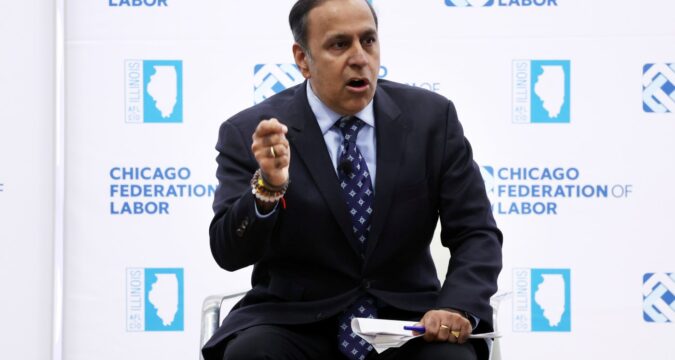
Rep. Raja Krishnamoorthi adds to labor backing with Teamsters joint council
Democratic U.S. Rep. Raja Krishnamoorthi continued to gain momentum on the labor front in his bid for the U.S. Senate nomination, gaining the endorsement of the politically influential Teamsters Joint Council 25.
The endorsement of the 100,000 member joint council representing 25 member unions, to be formally announced Monday, is one of the region’s largest labor organizations in the region. It is the 10th endorsement the five-term congressman from Schaumburg has gained from labor in his campaign.
“He’s stood with our members on picket lines, he’s gone after powerful corporations that shortchange workers, and he’s championed labor at every step,” Thomas Stiede, president of the Teamsters’ joint council, said of Krishnamoorthi in a statement.
“Raja has always been the kind of leader who listens first and fights hard, and that’s why workers across Illinois trust him,” Stiede said.
Krishnamoorthi is among three major candidates in a field of 14 who filed seeking the Democratic nomination to succeed retiring five-term U.S. Sen. Dick Durbin, along with Lt. Gov. Juliana Stratton and U.S. Rep. Robin Kelly of Lynwood. Eight Republicans have filed for the GOP nomination.
The Teamsters’ joint council nomination comes after more than 100 leaders of churches with predominantly Black congregations endorsed Krishnamoorthi last week. Krishnamoorthi’s inroads in the Black community are politically important since his two main rivals are Black women.
“We don’t need another politician; we need a public servant,” said Bishop Shirley Coleman of Spiritual Wholistic Ministries on Chicago’s South Side. “I stand here because Raja is such a strong advocate, not only for women’s rights, but for people’s rights.
Pastor Ira Acree of the Greater St. John Bible Church on the West Side, said in a statement that “my choice isn’t about identity — it’s about integrity and truth.”
“I’m supporting the candidate whose record meets the urgency of this moment — someone ready to confront extremism, defend democracy and stand up for justice,” he said. “We don’t need a placeholder. We need a truth-teller and a real fighter.”
https://www.chicagotribune.com/2025/11/24/raja-krishnamoorthi-teamsters-support/

International student enrollment declines at nearly two dozen Illinois universities
International enrollment dropped at nearly two dozen Illinois universities this fall, with some seeing dramatic declines after the Trump administration tightened student visa policies.
A Tribune analysis of 27 of the state’s largest universities found that foreign enrollment dipped at all but four institutions, including the University of Chicago and a handful of liberal arts colleges.
The data shows the sweeping scope of President Donald Trump’s efforts to reshape higher education: While the decline in international enrollment hit large, urban schools such as DePaul University, it also reached rural colleges downstate, enrolling just a few thousand students.
Many institutions are feeling the pinch. DePaul, which saw a 62% drop in new international graduate students, announced a string of budget cuts last month. Lewis University, which saw a 37% drop in foreign students, is cutting dozens of staff positions.
“We accept a large number of domestic students, as well as a large number of international students. One does not replace the other,” said Lewis Provost Christopher Sindt. “When we lose international (students), we essentially lose total enrollment for the institution.”
Experts have been warning of the downturn for months, as Trump pursued a string of policies curbing the flow of students from abroad. That includes a travel ban targeting 19 countries, a temporary pause on visa interviews and new social media screening. He even directly pressed some schools to cap international enrollment.
The decline threatens the bottom line for many universities, who rely on international recruitment for a revenue boost. It’s also a major hit to the U.S. economy. Foreign students’ economic contributions fell by $1.1 billion this fall, costing the country nearly 23,000 jobs, according to NAFSA: Association of International Educators.
For schools that pride themselves on being diverse, global institutions, the decline may jolt campus culture, experts say. A recent study from the Institute of International Education found that new international enrollments plummeted 17% this fall compared with the year prior.
“International students have been a huge, net positive gain for the nation,” said Mitchell Chang, a professor of education and former provost at the University of California Los Angeles. “We’re going to feel it, for sure.”
Illinois universities collectively lost thousands of international students, according to the Tribune’s analysis. Regional schools bore the brunt of the decline. Eastern Illinois and Western Illinois universities saw their foreign populations plummet 51% and 40%, respectively, the largest shares across the state.
Five schools bucked the trend. The University of Chicago saw the most notable growth, reporting a jump of 163 international students this fall. Wheaton College also saw an increase of about 14%.
It’s not a surprise to experts. Elite universities, with global prestige and large applicant pools, were expected to be more insulated from the decline. Liberal arts colleges, meanwhile, tend to be undergraduate focused, and most students from abroad are pursuing graduate degrees.
“I think overall, there was a sense that the larger, more well-recognized schools would be able to weather some of these choppy waters, more so than smaller, regional, perhaps less well-known schools,” said Rachel Banks, senior director for public policy and legislative strategy at NAFSA.
Some schools were able to bridge the gap. Chicago State University, for example, saw a 31% drop in international enrollment but welcomed its largest freshman class in a decade. As did Northern Illinois University, which lost 19% of its international students. The University of Illinois System set a fall enrollment record.
Chicago State University, shown on Aug. 8, 2025, saw a 31% drop in international enrollment but welcomed its largest freshman class in a decade. (E. Jason Wambsgans/Chicago Tribune)
For other schools, though, the trend has compounded a looming demographic cliff.
“If these are permanent shifts, that would pretty much be the end of international programs as we know it,” said Randy Glean, associate vice president at WIU’s Center for Global Studies.
At Augustana College, a small, liberal arts school in Rock Island, international enrollment held steady from the previous fall. It’s the payoff of years of overseas recruitment, which has increased foreign enrollment eightfold since 2012. International students now represent 20% of campus.
“I’ve got two full-time people who travel the globe to recruit international students, and this fall, they’ve been anywhere from Pakistan to Rwanda to Kenya to Mongolia,” said Kent Barnds, executive vice president for strategy and innovation.
But it’s not all smooth sailing. New international enrollment dipped slightly, even amid Augustana’s aggressive recruitment efforts. Many students aren’t sure if they’ll be able to obtain a visa, or if it’s still worth it to study in the U.S. That could jeopardize the school’s future enrollment prospects.
“We are certainly hearing from international students, as well as agents who represent us abroad, that there are reservations about studying in the U.S.,” Barnds said. “That does have us concerned.”
In restricting foreign students, Trump has cited national security issues and the need to reduce competition for admissions slots. In April, his administration abruptly revoked and later restored the visas of more than 1,000 international students across the country.
This fall, the president also announced a new $100,000 fee for H-1B visas, the primary employment pathway for foreign professionals. The move was an abrupt overhaul of a 30-year program that steadily built up the country’s research landscape. At Northwestern University, for example, the majority of post-doctoral researchers are from overseas.
“For decades, we’ve drawn the best and brightest all over the world to come to the U.S.,” said Chang. “On that level, it’s been a brain gain for the U.S.”
And the decline might get worse. The Institute of International Education found that the total number of students, nationwide, only dipped 1%. Many schools were able to offset their losses with their existing international enrollment. But as the pipeline of new students dries up, more universities and local economies could feel the strain.
“Even small businesses in a college community can be affected by that swing, with fewer people being attracted to the community,” Banks said. “It can really shake itself out in a day-to-day way.”
A spokesperson for Northwestern, which last year enrolled close to 5,000 international students, said specific data was not yet available. But last fall, foreign enrollment accounted for 13% of the student body, compared to 12% this year, according to the school’s website.
Illinois Institute of Technology, one of the nation’s universities most reliant on international students, did not respond to repeated requests for comment. Still, their website shows that foreign students represent 60% of graduate students — compared to 71% last fall.
https://www.chicagotribune.com/2025/11/24/international-student-enrollment-declines-illinois/
US Rep. Mike Quigley: It’s not too late for Chicago to pursue cost-saving measures
Chicago stands at a crossroads. The city is facing a $1.19 billion deficit that is largely structural and is being led by a mayor who is only proposing more tax increases and more debt. Federal pandemic money, unwisely used to fund operations, is gone, and as long as Donald Trump is president, it’s going to stay that way.
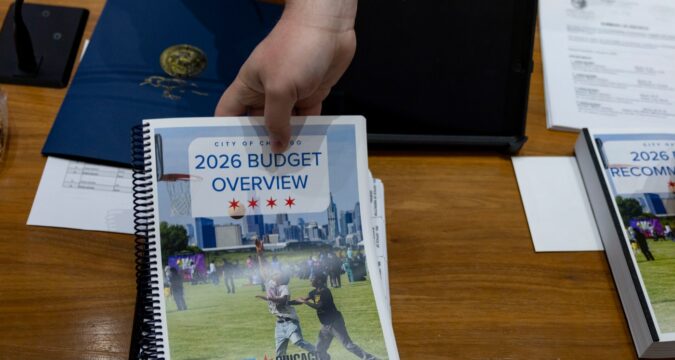
A recently released EY report — commissioned by the city for $3.2 million — identifies between $530 million and $1.3 billion in potential efficiencies that could reduce the need for new revenue. The mayor’s budget includes only a tiny portion of these ideas — about $75 million, according to the Civic Federation.
Before we ask Chicago taxpayers for one more dollar, we must show that we’ve done everything possible to deliver essential services efficiently and effectively. It’s not too late to adopt the remaining EY reforms or pursue other cost-saving measures and long-term reforms. Here are a few we should implement now:
Consolidate back-office functions (human resources, information technology, legal), reduce management layers (supervisors manage six to eight people rather than three), and eliminate noncritical positions from the over 4,000 roles that are currently vacant, saving $147 million to $257 million.
Centralize procurement. Currently, every department makes individual purchases, meaning we are not buying in bulk and getting economies of scale. Serious reform could save $55 million to $111 million, while the mayor suggests a mere $10 million.
Cost recovery for large events. Ensuring we are getting reimbursed for all the police, traffic enforcement and cleanup we provide to hundreds of events could generate $21 million.
Modernize our vehicle fleet of 15,000 vehicles over 36 departments by reducing duplicative purchases and maintenance, selling inactive vehicles and centralizing services.
Adopt a real estate strategy that assesses the city’s 500 facilities, 10,400 vacant land parcels, sells profitable land and property, consolidates office space and maximizes Riverwalk revenue.
Ensure employee benefits match peer city benefits. Our public servants deserve excellent benefits, but it’s hard to believe the mayor identified not one reform. We could offer credits for employees who go on a spouse’s plan, reduce health maintenance organization contributions by employees to incentivize movement from preferred provider organization to HMOs or negotiate better prescription drug plans.
Optimize public safety service delivery. Public safety professionals are essential to our city, which is why we must ensure their services are delivered efficiently and effectively. Civilianizing administrative roles currently performed by sworn officers, expanding telehealth diversion to handle noncritical 911 calls and reducing 311 hours from 24/7 could save millions.
Finally, the biggest challenge facing our budget — underfunded pensions — is excluded from this EY report. The tough but honest truth is: Unless Chicago tackles its pension debt, it will never escape its budget hole. Forty percent of the city’s budget already goes toward debt and pensions. This amount will only grow, further crowding out resources for more police, teachers and critical services and putting the benefits of current workers in jeopardy. We have to bring retirees, current employees and taxpayers to the table to talk about real solutions, together, and chart a path forward.
I’ve seen this movie before. As a Cook County commissioner, I wrote a similar report called “Reinventing Cook County.” I offered, and implemented, a number of reforms to consolidate overlapping agencies (e.g., clerk and recorder of deeds), reform procurement to reduce patronage and adopt technology (e.g., digitizing Cook County court records) to reduce costs and improve services.
Rather than slashing government services or taxing our citizens out of Chicago, I say we reinvent. If we were to start over today, providing critical services, who would do what, and where would they do it? We must reinvent government, not because we hate it, but because we love it and owe it to the taxpayers to show them it can work.
We paid for a road map for reform in the EY report. Now we need leadership with the courage to choose the road of reinvention.
U.S. Rep. Mike Quigley, D-Chicago, is a member of the U.S. House Committee on Appropriations and exploring a run for mayor of Chicago.
Submit a letter, of no more than 400 words, to the editor here or email letters@chicagotribune.com.
https://www.chicagotribune.com/2025/11/24/opinion-chiacgo-budget-property-tax-reforms/

Letters: The Tribune Editorial Board is wrong about the Galena resort project being ‘heaven-sent’
After reading the opening line of the editorial about how the Parker resort project is “heaven-sent” for Galena, Illinois, I questioned everything — including the credibility of the Tribune Editorial Board (“Deluxe, ‘Sonoma-style’ resort is back on track for Galena, surviving a NIMBY court battle,” Nov. 17). Whose opinion is this? Who is telling me that the town I grew up in needs another resort?
The Parker project represents a classic, money/greed versus community/wildlife scenario where an out-of-state developer with a small portfolio has somehow convinced a few aging, unpaid and paid small-town leaders that they will in some way be empowered by allowing a massive resort to create more traffic congestion, light pollution and noise pollution in an area previously zoned agricultural that is rich with forest cover and wildlife, adjacent to a few residents’ homes and the Galena River.
Hundreds, yes, hundreds, of locals have spoken out against it. That is significant in a town with a population of around 3,000. Putting a vineyard so close to a waterway would impact all the wildlife that call this precious Driftless Area home.
You know what would truly be heaven-sent for someone like me who has watched the landscape slowly be encroached upon my entire life? I would like to see the town of Galena recognize that there are still people who live here, that this land that we call “Driftless” is a unique and irreplaceable part of our state that is worth saving and worth fighting for.
— Jeannie Coates, Galena, Illinois
An ill-informed editorial
Way to go to the Tribune Editorial Board for its Nov. 17 oversimplification of a complex issue and for the name-calling of a responsible, intelligent, compassionate and respectful citizen. The editorial regarding the recent appellate court decision on the proposed Parker development in Galena is about as ill-informed, inaccurate and one-sided as it gets.
The city chose to appeal the initial court decision. Why didn’t it just start the approval process over at that point rather than spend time and money to appeal? What is really going on here?
Has the editorial board watched any of the public meeting footage? The editorial is worthy of a cheap tabloid sheet.
— Bronwyn Clark Skov, formerly of Galena, Miesville, Minnesota
Increase in property taxes
The property tax bill that I just received is $5,540 after homestead and senior exemptions for a 1,400-square-foot single-family home in a neighborhood that is considered working-class. And last year, after being reassessed, my tax went up $900.
After reading the front-page story about the tax increases on Chicago property owners (“Record property tax hikes slam Chicago homeowners,” Nov. 17), especially on the South and West sides, I would like to have one of those tax bills. Let’s talk about actual dollars and not percentages.
— Anton Iberle, Evergreen Park
Information from county
I got my property tax bill late. It had a lot of information but was missing previously included info on what percentage of taxing body pension funds was covered. I tried to find it online, and the county taxing body info finder couldn’t recognize MWRD. So I typed in Metropolitan Water Reclamation District. I got a listing of the Alsip Park District twice and the Barrington Park District twice (not even in Cook County) and so on, filling up first-page space.
Cook County Treasurer Maria Pappas, please bring back that revealing info.
— Stephen T. White, Buffalo Grove
Downtown property values
Increased property values in downtown Chicago would only benefit the city if the property owners paid their fair share of taxes — which most of them likely don’t. High-priced, well-connected lawyers can get them off every time.
My property values increasing means I have to pay more since I can’t afford to challenge.
— Muriel Balla, Chicago
Guaranteed income pilot
Cook County property owners have been complaining about their recent tax bills.
The county over two years starting in 2022 gave 3,250 residents $500 per month in a guaranteed income pilot. That came out to $39 million. This is just one example of unnecessary spending paid for with taxes.
People don’t complain about their credit card bill because it reflects what they spent. They shouldn’t complain about the high taxes without complaining about unnecessary spending.
— Larry E. Nazimek, Chicago
Bravo to these aldermen
A group of Chicago aldermen are preparing their own alternative budget? You mean, acting like a true legislative body? Kudos to them!
Would that our Congress took a lesson.
— Daniel Heenan, Palos Heights
Tribune’s factual reporting
The Tribune was recently criticized for reporting factual information about a man who was shot by immigration agents when he allegedly resisted arrest. The Tribune was not criticized for reporting misinformation or making an error — but for reporting truthful information, which may or may not be relevant to the allegations that the individual resisted arrest.
I do not believe news providers should withhold information because it may not fit into someone’s version of the truth or it might be offensive to some.
When the Fourth Estate is reprimanded for reporting facts, we are in trouble.
— Clare Connor, Chicago
Pretrial detention request
Regarding “A woman was set on fire on the Blue Line. Chicago can’t shrug this off” (Nov. 21): The most telling point in the editorial is: “The state’s attorney’s office told us they requested that Reed be held in detention over the alleged August assault. Incredibly, their request was denied.”
The standard in the SAFE-T Act for pretrial detention is that the arrested person is a danger to any specific person or people or to the community. And anyone with such a long criminal history is clearly a danger to the community.
I would like to read the details of that pretrial detention hearing. It sounds like a pretty serious failing on the part of the judge.
— Edward Gogol, Crystal Lake
National Guard at stations
Gov. JB Pritzker and Mayor Brandon Johnson should agree to deploy the National Guard to all 146 CTA “L” stations 24/7 to decrease violent crime, robberies and vagrancy. Deploying two members of the guard at the turnstiles and two on the platforms would require about 1,000 troops. This added security would deter turnstile jumpers and criminals from entering the system and loitering.
The guard could also clear the trains and platforms at the end of each line and occasionally ride the trains.
In a matter of hours, the whole system could be safe for residents, workers and tourists. Legitimate riders would return, CTA revenue would increase and Chicago taxpayers wouldn’t be paying the Chicago Police Department overtime for added security.
— Mike Carano, Chicago
Submit a letter, of no more than 400 words, to the editor here or email letters@chicagotribune.com.
https://www.chicagotribune.com/2025/11/24/letters-112425-galena-resort/


