Category: News

Daily Horoscope for November 27, 2025
General Daily Insight for November 27, 2025
Missing details could throw off our stride with little warning. We may feel restless as the emotional Moon squares unpredictable Uranus, making it tough to handle any unexpected detours. As the day unfolds, disciplined Saturn stations direct at 10:52 PM EST, asking us to rebuild dependable habits and recommit to boundaries we’ll actually respect. Saturn’s bluntness is softened by Luna’s drift into caring Pisces, so we can forgive small slips while still honoring our long-game structure. Remember — measure twice, cut once.
Aries
March 21 – April 19
Your heart is speaking more quietly than normal. Personal accountability calls you inward as karmic Saturn turns direct in your 12th House of Intuition. Allow your soul a chance to tidy its corners by getting some rest before you fulfill your duties. You may cancel a noisy plan to stay in with a calmer hobby, especially if you’ve felt extra tired as of late. If a friend pushes for a late chat, you can suggest reconnecting tomorrow morning — they should understand your needs.
Taurus
April 20 – May 20
Friends ought to feel like a team worth keeping. Your 11th House of Society steadies as structured Saturn begins moving forward. You’re being empowered to reshape group goals. If a committee chat wanders off topic, you can bring it back to pitches for your next steps. A friend may test boundaries about favors. If you want to indulge them, make it clear that you’re doing so on your own terms. You can show you care without taking on someone else’s job.
Gemini
May 21 – June 20
Intimidating goals could currently use more supportive structure. Ambitious Saturn steps ahead in your 10th House of Accomplishments, urging you to define responsibilities with a supervisor or ensure your talents are appreciated in other ways. In the workforce or not, you deserve to be seen for your skills — and to set up your flow in the way that works best for you. The results of a well-maintained schedule should speak for themselves! State limits kindly to protect and sustain your progress.
Cancer
June 21 – July 22
Faith requires patience at present. You can’t learn everything about a subject at once, even once lawful Saturn turns direct in your 9th House of Distance. Still, this is great encouragement for reaching out to take in as much knowledge as possible. A quick online search could lead to your next great adventure! If relatives or peers question your plan, you can explain your original inspiration and ideal timeline. Confidence in yourself can prove your capability. Move slowly, keeping your purpose in mind throughout.
Leo
July 23 – August 22
Honesty is currently the best way to nourish trust. Boundary-setting Saturn’s retrograde is ending in your resourceful 8th house. Its movements are a good reminder to keep an eye on your accounts, especially ones split with another person. If something isn’t right, talk to anyone else involved ASAP. Letting it lie risks inciting resentment or causing a worse financial situation. In any resulting discussions, make an effort to stay calm. There’s no need to point fingers when you’re meant to be on the same team.
Virgo
August 23 – September 22
Promises are serious business at the moment. Even something as small as “I promise I’ll do the dishes tonight” likely means a lot to the person you’re talking to. Responsible Saturn returns to its usual movements in your partnership quadrant, reinforcing your words with cosmic reliability. Consider setting up a weekly check-in for shared chores, because simple routines keep misunderstandings from nipping at trust. If exhaustion drags at your capacity, try to take one step that shows how hard you’re working to come through.
Libra
September 23 – October 22
Small habits can shape a good day into a great one. With dutiful Saturn stepping forward in your productive 6th house, you’ve got a chance to work on your to-do list. You may move a workout to a time you can keep or block out ten minutes to tidy your room or workspace before leaving. If peers ask for extra help, take a look at your schedule before accidentally promising them too much time. Protect the routines that keep you grounded and calm.
Scorpio
October 23 – November 21
Your inner muse could be craving a more stable routine. Lesson-bearing Saturn is turning direct in your 5th House of Flair, nudging you to commit to a project with vigor. That being said, your commitment style is unique — perhaps you’ll show up at odd hours or offer material contributions when you can’t be somewhere in person. As long as you’re consistent with your form of support, that’s all that ultimately matters. Slow and steady moves are the best way to build your future.
Sagittarius
November 22 – December 21
Comfort blooms best when given direction, much like a tree needs regular pruning. Your 4th House of Nurturing is grounded by Saturn spinning forward once more, steeling you to set rules with kindness. You can be authoritative without being authoritarian. Crafting steady structures could improve your home situation for everyone living there (including you, of course). If a relative reopens an old debate, look for ways to disengage rather than thinking up snappy retorts. Avoiding unnecessary fights should keep love close and protect your peace.
Capricorn
December 22 – January 19
Say it once, and say it clearly. Rule-focused Saturn stations direct in your 3rd House of Communication and Local Life, encouraging you to send succinct messages and respect your own office hours. If someone tries to drag you away from dinner or out of bed for anything that isn’t urgent, let them know that you’ll get back to them later. Siblings and neighbors, in particular, may need you to restate your boundaries. When possible, use fewer words to underline your point without wasting time.
Aquarius
January 20 – February 18
Today’s choices should match your inner truth. Money could be at the top of your mind with restrictive Saturn’s direct turn in your 2nd House of Values, nudging you to set a spending rule you can keep. You may pause before a flash sale and ask whether the purchase fits your financial goals. If pay talks are on the table, you can present your duties and recent wins, proving that you respect yourself and the process, regardless of its outcome. Prioritize your lasting values.
Pisces
February 19 – March 20
Own your path with calm, steady courage. Your identity comes into focus as authoritative Saturn turns direct in your sign, inviting you to define what you stand for and choose rhythms that protect your sensitive nature. You may be ready to reveal personal changes, even to people you aren’t sure will take it well. That’s their problem! When you define yourself, the people who care about you ought to respect that. Honor your pace, because self-trust sets up better paths ahead.
https://www.chicagotribune.com/2025/11/26/daily-horoscope-for-november-27-2025/

Public Schools Are Failing And Parents Are Bailing
Public Schools Are Failing And Parents Are Bailing
Authored by Larry Sand via American Greatness,
Students attending American public schools are struggling. Test scores from the 2024 National Assessment of Educational Progress (NAEP), released this year, indicate that 33% of 8th graders—a greater percentage than ever before—are reading at the “below basic” level.
Additionally, only 22% of high school seniors are proficient or above in math, down from 24% in 2019, and only 35% are proficient in reading—the lowest score since NAEP began in 1969—down from 37% in 2019. Also, a record-high percentage scored at “below basic” levels in both math and reading compared to all previous assessments.
Parents across the country, especially in big cities, have become aware of the problem and are removing their children.
In Chicago, public school enrollment has decreased significantly over the past 15 years, from nearly 403,000 students in 2010-11 to just over 316,000 in 2025-26, according to the Illinois Policy Institute. Most recently, the district reported a decline of 9,081 students between 2024-25 and 2025-26. IPI states that more than one in three desks in the district are empty.
For the 2025–26 school year, the New York City Department of Education discloses that 793,300 students are enrolled in K-12 grades. That’s a 2.3% decrease from the previous year and a nearly 10% drop since 2020. The data also show that 112 of the city’s public schools have fewer than 150 students, up from 80 schools just two years ago.
Twenty years ago, the Los Angeles Unified School District had 737,000 students, but that number has now fallen to approximately 408,000, reflecting a decline of over 40%.
Among students who haven’t withdrawn, many are chronically absent. Using data from 44 states and Washington, DC, Nat Malkus, the director of education policy at the American Enterprise Institute, writes that the alarming rate of chronic absenteeism—students missing more than 10% of school days annually—was 23.5% in 2024.
This problem, too, is especially serious in our large urban areas. In Los Angeles, over 32% of students were chronically absent in the 2023-2024 school year, 34 elementary schools have fewer than 200 students, and 29 use less than half of the building. Even worse, Chicago’s chronic absentee rate is 41%.
As government-run schools are shrinking, private schools are expanding substantially.
Participation in private school choice—when students use public funds for private school tuition—has risen 25%, from just over one million students in 2024 to 1.3 million this year, according to a new analysis by EdChoice, a school choice advocacy group.
This has been the largest year-to-year increase since EdChoice started tracking the data in 2000, said Robert Enlow, president and CEO of EdChoice. He noted that it took about 24 years for private school choice participation to reach one million students, and this year it hit 1.3 million.
Florida educates over 500,000 students through its universal voucher and scholarship programs. Utah’s Fits All Scholarship launched in 2024 with about 10,000 seats and was immediately oversubscribed. Iowa’s Students First Educational Savings Account program enrolled nearly 28,000 students in its second year, surpassing projections.
Additionally, many parents have chosen to homeschool. In fact, homeschooling has reached an all-time high.
Angela Watson of the Johns Hopkins University School of Education’s Homeschool Hub wrote earlier this month, “In the 2024-2025 school year, homeschooling continued to grow across the United States, increasing at an average rate of 5.4%. This is nearly three times the pre-pandemic homeschooling growth rate of around 2%. Notably, 36% of reporting states recorded their highest homeschool enrollment numbers ever—exceeding even the peaks reached during the pandemic.”
It’s not just parents who are dissatisfied with public schools; only 26% of teachers believe K-12 education is heading in the right direction nationwide, a 5-point drop from the spring, when 31% felt optimistic.
Of course, the public school monopolists, especially the teachers’ unions, are upset about the advancement of school choice, but their reasons are baseless. One argument they use is that choice increases segregation. American Federation of Teachers’ president Randi Weingarten nonsensically claims school choice was designed to keep schools segregated.
Wrong.
Researcher Greg Forster states that ten empirical studies have examined private school choice programs and their effect on segregation. Nine of these studies found that the programs reduced segregation, while one found no noticeable impact. None of the studies indicated that choice encourages racial discrimination.
No matter. The teachers’ unions, realizing they are losing in the court of public opinion, have resorted to litigation in various state courts. Wyoming, Missouri, Utah, South Carolina, and Montana have faced legal action from the unions, which are desperately afraid that parental choice will severely impact their bottom line.
So far, the unions’ efforts have been successful in two states.
In Wyoming, lawmakers launched the state’s first K-12 education savings account (ESA) program last year, beginning with the 2025-2026 school year. The $7,000 accounts can be used for private school tuition, tutors, homeschooling, or other education-related expenses. Nearly 4,000 students applied for them this fall.
However, the Wyoming Education Association, representing about 6,000 public school teachers, opposes using taxpayer dollars for a private option. In a lawsuit filed in June, the union and nine parents sued the state, arguing that the Steamboat Legacy Scholarship Act is unconstitutional because it violates a state regulation requiring a “complete and uniform system of public instruction.” The union was successful when a District Court judge issued a preliminary injunction against the voucher program in July.
In Utah, the state affiliate of the National Education Association successfully sued the state last year, arguing that the Utah Fits All Scholarship Program violates the state constitution by diverting tax revenue to private schools that aren’t free, accessible to all students, and supervised by the state board of education. The Utah Supreme Court is scheduled to review an appeal later this year.
In summary, we are engaged in a turf war. Parents, whose primary concern is their children’s education, are battling the establishment, particularly the teachers’ unions, whose aim is to protect their profits and maintain their toxic influence over K-12 education.
Tyler Durden
Wed, 11/26/2025 – 18:55
https://www.zerohedge.com/political/public-schools-are-failing-and-parents-are-bailing

Wisconsin seeks to block Slender Man attacker’s conditional release after escape from group home
Wisconsin authorities have asked a state court to revoke the conditional release of Morgan Geyser, the woman who in 2014 almost killed her sixth grade classmate in the name of horror villain Slender Man and escaped from a group home earlier this week.
A Waukesha County Circuit Court judge agreed on Wednesday to seal the petition filed by the Department of Corrections late Tuesday seeking to revoke Geyser’s conditional release. A Waukesha County judge earlier this year approved releasing Geyser from a state mental institution to live in a group home.
Geyser cut off her GPS monitoring bracelet on Saturday night and fled the group home in Madison, Wisconsin, with a 43-year-old companion, authorities said. Geyser was found by police outside a truck stop in Posen, Illinois, a village of 5,300 people about 25 miles south of Chicago, on Sunday night.
Geyser did not fight her extradition to Wisconsin in a Chicago court appearance Tuesday. Online records show she had been brought back to Wisconsin and was being held in the Waukesha County jail late Wednesday.
Slender Man attacker won’t fight extradition to Wisconsin after fleeing group home
Geyser’s attorney, Tony Cotton, did not respond to an email Wednesday seeking comment on the state’s request to revoke her release.
The judge set a motion hearing for Dec. 22.
If Geyser’s conditional release is revoked, she could be sent back to the mental institution where she spent most of the past eight years. She also could face new charges in connection with her escape.
Geyser’s companion has been charged with trespassing and obstruction, but The Associated Press isn’t naming the companion because the person hasn’t been charged with aiding Geyser’s escape. The AP’s attempts to contact that person have been unsuccessful.
The companion did call WKOW-TV on Monday, however, saying the two became friends at church and had seen each other daily for the past month. Geyser decided to flee because she was afraid her group home would no longer allow them to see each other, the person said.
“She ran because of me,” the friend told the television station.
Geyser and her companion took a bus overnight into Illinois, the friend said.
Geyser and her friend, Anissa Weier, lured one of their classmates, Payton Leutner, to a Waukesha park in 2014. Geyser stabbed Leutner 19 times, narrowly missing her heart, while Weier cheered her on. All three girls were 12 years old at the time. Leutner barely survived.
Geyser and Weier later told investigators they attacked Leutner in hopes of impressing Slender Man and becoming his servants. They said they were afraid Slender Man would hurt their families if they didn’t carry out the attack.
Slender Man was created online by Eric Knudson in 2009 as a mysterious figure photo-edited into everyday images of children at play. He grew into a popular boogeyman, appearing in video games, online stories and a 2018 movie.
Both Geyser and Weier were ultimately committed to a state mental institution — Geyser for 40 years and Weier for 25. Wisconsin law allows people committed to state institutions to petition for release. Weier earned conditional release in 2021. Geyser, now 23, won conditional release in September after four requests and was placed in the group home.
State health officials tried to block her release in March, telling the judge that Geyser didn’t volunteer to her therapy team that she had read “Rent Boy,” a novel about murder and selling organs on the black market. They also alleged that she has been communicating with a man who collects murder memorabilia, and has sent him her own sketch of a decapitated body and a postcard saying she wants to be intimate with him.
The judge concluded that Geyser wasn’t trying to hide anything and proceeded with her release, which was finalized in September.
https://www.chicagotribune.com/2025/11/26/morgan-geyser-release/

Trump-MbS Meeting Was Strained Behind Closed Doors: ‘Disappointment & Irritation’
Trump-MbS Meeting Was Strained Behind Closed Doors: ‘Disappointment & Irritation’
Axios reported some new details this week related to the recent meeting between US President Donald Trump and Saudi Crown Prince Mohammed bin Salman at the White House.
There were more tensions in the private dialogue between the two leaders than previously known, and some significant disagreements centered on policy toward Israel.
While the two leaders exchanged compliments in front of the cameras, aspects of the private discussion were strained, Axios noted. Officials described Trump as being frustrated by the resistance he encountered from the crown prince on joining the Abraham Accords.
Bin Salman presented his stance that a firm commitment toward a two-state solution involving the Palestinians must be made for Saudi Arabia to join the accords.
Behind closed doors the crown prince reportedly pushed back when Trump pressed him to formally join the Abraham Accords which establishes normalization with Israel.
MbS reportedly argued that he has to represent his people at a moment Saudi public sentiment has turned sharply against Israel in the aftermath the Gaza war.
But Trump had “pressed hard” on the issue in the November 18 meeting, Axios underscored. One unnamed admin official explained in the meeting’s aftermath, “The best way to say it is disappointment and irritation. The president really wants them to join the Abraham Accord. He tried very hard to talk him. It was an honest discussion. But MBS is a strong man. He stood his ground.”
The Saudis are insisting that Israel must agree to “an irreversible, credible and time-bound path” for a Palestinian state, but the Netanyahu government has firmly rejected this possibility, especially in the wake of the Oct.7, 2023 terror attack.
Another US official said, “MBS never said no to normalization. The door is open for doing it later. But the two-state solution is an issue.”
In relation to the Hamas Oct.7 attack, there’s long been speculation that the terror raids on southern Israel were launched precisely because the militant group was worried that as more and more regional countries join the Abraham Accords, the question of Palestinian statehood would be permanently abandoned.
According to this theory, the brazen and history-altering attack was meant once again to sow deep division among the ‘Arab world’ and Israel. To some degree, this may have succeeded as a broader geopolitical goal, given the Abraham Accords have indeed been stalled. But it also backfired, given Iran and Hezbollah are more weakened than ever, and the Syrian government was overthrown a year ago. These were all key, well-armed and historic resisters of Israeli expansion and Zionist hegemony.
Tyler Durden
Wed, 11/26/2025 – 18:30
Perú anuncia medidas para mejorar acceso y actividad turística en Machu Picchu
LIMA (AP) — El gobierno del Perú anunció el miércoles algunas medidas en un esfuerzo por mejorar la gestión del acceso y conservación de la ciudadela inca de Machu Picchu, considerada maravilla del mundo y mayor atractivo turístico del país, tras recientes advertencias de riesgo sobre su patrimonio y problemas en el transporte al sitio arqueológico.
Los ministerios de Cultura, Ambiente y Comercio Exterior y Turismo informaron que iniciaron “acciones coordinadas para abordar los principales retos de gestión, conservación y regulación” en Machu Picchu, que incluyen la venta anticipada de boletos, un convenio para hacer un nuevo estudio de capacidad de carga en el santuario histórico y la actualización de la regulación de actividades turísticas y de conservación.
Asimismo, buscarán en los próximos días una sesión con al Gobierno Regional del Cusco, donde se ubica la ciudadela inca, y autoridades locales sobre estas medidas.
La tensión creció estas semanas por dificultades para una licitación del servicio de buses para llegar a la llaqta (asentamiento incaico) y la amenaza del alcalde de la provincia de Urubamba, Ronald Vera, de cerrar temporalmente la ruta de acceso.
“Corremos el riesgo de paralizar un mes, dos meses”, dijo la semana pasda y cuestionó la operación de unidades no autorizadas. Gremios turísticos y de negocios rechazaron esa declaración.
En setiembre, la organización New7Wonders advirtió que Machu Picchu podría perder su título de “Nueva Maravilla del Mundo” si no se corrigen problemas como exceso de pasajeros, mala regulación del ingreso, deficiente transporte, denuncias sobre venta de boletos y falta de coordinación institucional.
El Ministerio de Cultura adujo que “la conservación y protección del (santuario) no está siendo vulnerada” y que la única entidad con competencia para evaluar la condición del patrimonio es la UNESCO.
El ministro de Cultura, Alfredo Luna, ha dicho que la preservación de Machu Picchu “es una prioridad” para el gobierno actual y que están haciendo ajustes en la planificación con miras a la temporada turística 2026.

Frank Ragnow ends retirement, returns to give the Detroit Lions a 4-time Pro Bowl center for stretch run
DETROIT — Frank Ragnow has ended his retirement from the NFL after nearly six months, giving the Detroit Lions a four-time Pro Bowl selection for the stretch run of the regular season and perhaps the playoffs.
The 29-year-old Ragnow was reinstated from the retirement list on Wednesday in a move welcomed by the Lions.
His replacement, Graham Glasgow, was ruled out with a knee injury for the game against the Green Bay Packers on Thanksgiving.
Ragnow stepped away from the game last June.
“I have given this team everything I have and I thought I had more to give, but the reality is I simply don’t,” Ragnow said last summer. “I have to listen to my body and this has been one of the hardest decisions of my life.”
While Ragnow was away from the game, he kept in contact with the Lions.
Detroit drafted Ragnow No. 20 overall in 2018 and he endured multiple injuries during his career. In 2021, following a season in which he played with a fractured throat, general manager Brad Holmes made him the league’s highest-paid center at the time with a $54 million, four-year extension.
Ragnow earned second-team All-Pro honors in 2020, 2023 and 2024. He was selected to his first Pro Bowl in 2020 under then-coach Matt Patricia, and then made three straight from 2022-24.
“He’s one of the best centers I’ve ever had the privilege to play against,” veteran defensive tackle Harrison Phillips said last summer. “I know that every time I had to play against him, I had to buckle my chinstrap extra tight and watch a lot of extra film.”
https://www.chicagotribune.com/2025/11/26/detroit-lions-frank-ragnow-ends-retirement/

República Dominicana autoriza 800 nuevos vuelos de turistas que cambiaron de destinos por huracán
Por MARTÍN ADAMES y DANICA COTO
SANTO DOMINGO (AP) — La República Dominicana ha autorizado la llegada de 800 nuevos vuelos para dar cabida al aumento de turistas que inicialmente tenían previsto pasar sus vacaciones en Jamaica, Cuba y Haití, pero que tuvieron que cambiar de destino tras la devastación causada por el huracán Melissa.
Los vuelos regulares y chárter fueron aprobados mientras el país caribeño se prepara para la temporada alta de turismo, informaron el miércoles responsables del sector.
“Esto tendrá un impacto positivo en la ocupación hotelera en la República Dominicana, y los hoteles dominicanos tienen capacidad para recibir esa afluencia”, afirmó Nairobi Santos, portavoz de la Asociación de Hoteles y Turismo del país.
El presidente de la Junta de Aviación Civil dominicana, Héctor Porcella, informó que el país ha autorizado “unos 800 vuelos de un tablazo (de una sola vez), porque (de) todo ese turismo que iba para Jamaica, se va a beneficiar la República Dominicana”.
Porcella lamentó el desastre que la tormenta de categoría 5 desató en el norte del Caribe, señalando que el impacto fue especialmente duro en Jamaica, las Bahamas, Cuba y Haití.
Explicó además que “esos vuelos son para un periodo de 8 meses” y que “los hoteles dominicanos tienen capacidad para recibir ese flujo”. Acotó que para la temporada alta de las fiestas de Navidad y fin de año se proyecta una ocupación superior al 95% promedio.
El turismo es uno de los principales sectores económicos de la nación caribeña. En 2024 le generó al país unos 10.972 millones de dólares.
El número de turistas que llegaron a República Dominicana por vía aérea en octubre fue de más de 672.000, en comparación con los más de 575.600 de septiembre. Las autoridades esperan que esa cifra se incremente este mes, aunque aún no se dispone de datos.
La República Dominicana ha recibido hasta ahora 8.030.334 visitantes entre enero y octubre.
La tasa de ocupación hotelera promedió aumentó a 63% en octubre, frente al 58,2% de septiembre, según las estadísticas del Banco Central Dominicano.
Mientras la República Dominicana se prepara para una afluencia de visitantes superior a la normal, Jamaica lucha por recuperarse del huracán Melissa, que tocó tierra en la parte occidental de la isla el 28 de octubre.
El ministro de Turismo, Edmund Bartlett, afirmó que se han producido varias cancelaciones de vuelos, y algunos de los principales hoteles han declarado que no prevén reabrir hasta mediados o finales de 2026.
Sin embargo, Bartlett dijo a principios de esta semana que espera que alrededor del 60% de las habitaciones de hoteles estén disponibles a partir de mediados de diciembre.
También señaló que los cruceros han visitado Jamaica desde la tormenta, trayendo hasta ahora unos 32.000 pasajeros, y se espera que esa cifra se duplique la próxima semana.
La tormenta causó la muerte de 45 personas y otras 16 siguen desaparecidas, según el director de la oficina de gestión de emergencias de la isla.
Otras once personas han fallecido en Jamaica por leptospirosis confirmada o sospechada, con un total de 91 casos sospechosos notificados, según el ministro de Salud, Christopher Tufton.
Melissa también causó la muerte de al menos 43 personas en la vecina Haití.

Christkindlmarket seeks to shorten lines, appeals to Chicago Mayor Brandon Johnson for increased capacity
Chicago’s festive Christkindlmarket may be in jeopardy after Mayor Brandon Johnson’s administration placed space requirements on the event this year, a move that organizers say has created long lines to enter and severely restricts the number of people who can visit the German-themed food and retail booths on Daley Plaza.
A holiday tradition for 29 years, the event was launched and organized by a subsidiary of the German American Chamber of Commerce of the Midwest Inc. to promote trade between Germany and the United States. The market, which opened last week, runs through Dec. 24, also including sites in Wrigleyville and Aurora.
But new space restrictions put in place by the city limiting the number of festivalgoers seeking their iconic mugs, a warm sip of glühwein, hot pretzels and pickle ornaments have organizers asking Johnson’s administration to grant a reprieve and warning that the event faces an uncertain economic future.
Organizers say the capacity limits are straining the ability of vendors to make a profit after paying rental fees and expenses. And they fear visitors seeing long entrance lines will give up and stop attending. They also note that other big-attendance events in the city, such as Lollapalooza, do not have similar space limits.
Event operators sent a letter to Johnson’s office and mayoral aides Wednesday asking them to reconsider the restrictions. The group also has scheduled a Daley Plaza news conference on Black Friday, typically one of the festival’s busiest attendance days, to warn of its future.
The mayor’s office did not immediately respond to requests for comment.
In its first few days operating under the restrictions, capacity has been limited to about 1,000 people at a time, down from a normal 5,000 visitors. The sharp reduction in festivalgoers also has been translating to reduced vendor sales, raising concerns that nearby Loop businesses, which get residual business from the event, also will see declines.
The inaugural marketplace was held at Pioneer Court in 1996, and then the event moved to Daley Plaza, its longtime home, the following year. In recent years, it expanded to satellite sites at RiverEdge Park in Aurora and Gallagher Way in Wrigleyville.
Organizers point to the economic impact for the city from the event on the festival’s website. Two years ago, the three markets combined reached a record of more than 2 million visitors, they said.
They also note the tourism impact of the event, which has repeatedly been cited as one of the world’s best Christmas markets.
https://www.chicagotribune.com/2025/11/26/christkindlmarket-chicago-lines/

Justin Fields was surprised by New York Jets benching but still believes he’s a starting quarterback in NFL
FLORHAM PARK, N.J. — Justin Fields was caught off guard when he was sent to the bench last week — for perhaps the rest of this season and maybe his tenure with the New York Jets.
The embattled quarterback said he “of course” believes he’ll be a starter again in the NFL, though, either here or elsewhere.
“I just know who I am as a person, as a football player, as a hard worker,” Fields said Wednesday while speaking to reporters for the first time since he was replaced by Tyrod Taylor. “I know I have the mindset and the skill to attain that. I just feel like I need to do it on a more consistent basis. That’s just what it is. I’m in this position now and all I can do is just keep on working, keep on getting better and focus on it.
“It’s just life, you know? It’s the ups and downs of life.”
His subpar play was a major reason the passing offense ranked last in the NFL in yards per game for much of the season. After Fields went 15 of 26 for 116 yards and a touchdown in a loss to the Patriots on Nov. 13, coach Aaron Glenn decided last week he was going to make a change at quarterback.
“Nah, I did not anticipate it, whatsoever,” Fields said.
For the season, Fields has passed for 1,259 yards — an average of just 140 yards per game — with seven touchdowns and one interception. Glenn said he needed to do what was best for the team by moving forward with Taylor.
“You know, you can call it what you want, but A.G. thought it was justified and he makes the decisions around here,” Fields said. “So, like I said, all I can do is focus on myself, focus on my team and get better each and every day.”
But he acknowledged it took some time for it to sink in that he was no longer the Jets’ starting quarterback.
“Of course, the first day it happens, it’s tough,” Fields said. “Probably took me a day and a half to fully accept my role. And then last Friday, I found myself in, like, kind of a ‘damn!’ moment to where it was like, yeah, it’s actually real.
“But you kind of just have to look at life from a positive perspective.”
Fields, who spent three seasons in Chicago before playing last year in Pittsburgh, signed a two-year, $40 million deal with the Jets in March that included $30 million in guaranteed money. He’s due to make $20 million next season, including $10 million guaranteed, and his salary cap charge will be $23 million.
The Jets, who are 2-9 and currently hold the No. 4 overall pick in next April’s draft, almost certainly will look to select a quarterback who could be the future of the franchise. They could also bring in a proven veteran through free agency. Either way, Fields’ status with New York is uncertain.
“I forgot what verse it was in the Bible, but we have too many troubles for tomorrow, so there’s no point in me worrying about tomorrow, nevertheless next year,” he said when asked if he’d want to remain with the Jets if he’s not a starter. “That’s a question for that day.”
Fields’ ability to make plays with his legs has always been an asset. He’s the team’s second-leading rusher behind Breece Hall with 383 yards and leads the Jets with four touchdown runs.
Fields said conversations have “popped up” that he could be used in some designed packages to utilize his athleticism, something the Steelers did with him last season. But the 26-year-old quarterback seemed hesitant about that possibility in New York, especially since he said his health isn’t totally where he’d like it to be.
“I have mixed feelings about it because I pride myself on being a team player, on being able to do anything I can to help the team,” he said. “But I also had soft tissue injuries, the most I’ve had in my career, last year.”
Fields insisted he’s happy and feels blessed and even “grateful” to be with the Jets, even through the ups and downs. He added that “of course” he would like his next chance to start to come with his current team.
“I’m not going to let past moments, let past things that happened, I’m not going to have that mindset to be like, ‘No, I don’t want to play here,’” Fields said. “I think that’s the wrong mindset to have. I think the mindset is, every time you step on the field is an opportunity. And it’s an opportunity that not many people get.
“So, of course, any time I can step on the field and play, play for my teammates and try to help win is an opportunity.”
https://www.chicagotribune.com/2025/11/26/new-york-jets-justin-fields-benching/
Why No COVID Commission In The US?
Why No COVID Commission In The US?
Authored by Jeffrey Tucker via The Epoch Times,
They were the hardest years of our lives, marked by the dissolution of rights, liberties, and hope. Sadness swept the land, as forced physical isolation and shattered civic life mutated toward mandates to wear masks and eventually to accept a new injection product.
The liturgy of life fundamentally disrupted, we lost track of the passage of time and saw our social and community networks decimated. Government spending and money printing exploded as never before. For many the whole period feels like a blur, one that resulted in a dramatic devaluation in the value of income and savings.
I speak of course of the COVID years, 2020–2023. Agencies at all levels cancelled religious holidays, closed small businesses and schools, imposed limits on house parties, and overturned traditional election protocols. It went on for three years. It was in the name of health but health collapsed during this period. It all feels like madness in retrospect.
People these days barely want to speak about the subject, because it is still somewhat divisive but mainly because it is deeply painful. It was this way following the Great War, a trauma on a similar scale. Most people just wanted it to go away, and to put it all in the rearview mirror.
That said, when people do open up about what happened, they share shocking stories of personal tragedy and loss. Only this past week, a man told me about his dream business he had started 10 years ago and then built into a growing wholesale machine with 200-plus employees and bright prospects ahead. With the lockdowns, all orders for his project stopped. The company collapsed in two weeks. All employees lost their jobs and he and his wife lost their dreams. They divorced soon after.
Today his idea and a version of his project is in most major stories, as manufactured by huge corporate enterprises. He changed professions and is still digging out from a financial hole.
It’s just one story but something replicated in some form millions of times over. Kids who experienced this will never forget it, and parents have few choices but to describe the whole thing as a time when adults lost their minds.
Remember that all of this happened not just in the United States but in 194 countries around the world. The policies were strikingly similar everywhere. It was a time in which human interaction was described as disease spreading and therefore to be avoided in the interest of “slowing the spread.”
Only a few nations resisted: Sweden, Tanzania, Nicaragua, and Belarus. Sweden in particular experienced far better outcomes even from the targeted pathogen, the best in Europe. The population in general avoided trauma.
After all this time, one might suppose that the world would be awash in apologies along with pledges never to do anything like this again. One possible path to making this happen might be a COVID Commission. The United States has never formed one. Early on, there was talk about such a thing but it never came to fruition. Even now, there are no plans for such a thing.
This is for a reason. An honest report, one informed and written by independent researchers, would implicate both political parties, most universities, many government agencies, the Big Tech and pharmaceutical sectors, churches and schools that went along, in addition to a massive swath of incumbent elites in foundations.
Sadly, that is just not going to happen. I wish it were otherwise. Any official commission report written as a coverup would be dead on arrival. Not even the establishment is that dumb.
I would like to live in a society in which mistakes are admitted, brutality is repudiated, institutions adapt in light of failure, and leadership is mature enough to seek forgiveness for wrongdoing. We hope for a narrative of history that is self-correcting in real time: error followed by pledges to improve and sin by repentance and propitiation.
Sadly none of that is to be.
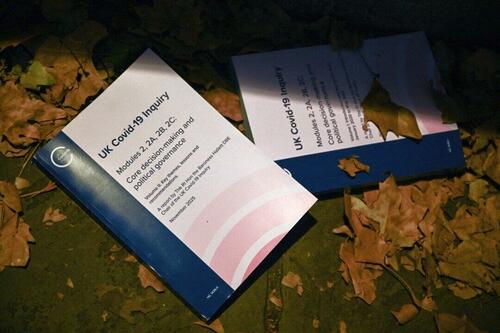
Somehow it came to be that the United Kingdom did put together an official commission.
It has spent upwards of 500 million pounds and taken years in testimony. The second part of the report just appeared. It features a helpful summary of its conclusions for those who do not want to slog through the entire thing. It is one that could have been predicted from the start. It comes down to four words:
“Too little, too late.”
Translation: The commission has decided that the UK waited too long to issue stay-at-home orders and shut businesses, churches, and schools. If it had acted in February rather than March 2020 and with greater ferocity, they have declared, somehow the outcomes would have been better. In short, there is no regret at all except for one point: it should have been more and sooner.
They know this because computer models tell them so.
Sure, the report admits, there were all sorts of mistakes in coordination, communication, and costing. This is bureaucratic speak for: we need more money next time. The report takes no issue with the disease modeling that gave rise to the lockdowns in the first place. The ineffective shot is not addressed in this particular report but we can anticipate what later reports will say: its only failure traces to slow uptake and vaccine resistance.
The huge lesson: “Governments must act swiftly and decisively to stand any chance of stopping the spread of a virus.”
In other words, they are going to do it again, more quickly and harder.
There is a feature of this report that simply breaks my heart. This is because I seriously doubt that anyone really believes in the truth of it. The claim is utterly unsustainable in light of any and all evidence. The Swedish experience is not discussed in any depth. It cannot because the Swedish experience disproves everything in this report.
I’ve been writing about this topic for five going on six years. My first piece was from January 2020, and it warned that if governments try to take on the microbial kingdom it will lose and utterly discredit themselves. I said this before we even knew of the thousand-fold differential in medically significant impact between the young and elderly and infirm. Even if the virus had been more serious, the result would have been the same.
Another reason that this report is demoralizing: tens and hundreds of thousands of actual experts the world over have debunked the pandemic response in countless numbers of papers, articles, and books. Have these protests made no difference at all? Are officials at all levels going to pretend forever as if these do not exist?
I don’t know the answer but this much I know: We cannot look to official statements of these sorts to codify truth. Instead, we can only count on them to be self-serving, a means of protecting the reputations and jobs of the very people who made such dreadful errors.
Just as no one should look to government to stop a fast-spreading and fast-mutating respiratory virus, we should not be looking to government commissions to admit error and pledge to do better next time. Just as the pandemic response discredited so many institutions, kicking off a new age of widespread distrust of everything and everyone, so too will more such reports entrench our culture of incredulity.
Given these conditions, the United States is better off with no commission at all. That said, it would be good for at least one legislative body to speak clearly and plainly about all that went wrong. My choice would be the U.S. Senate.
Maybe there is some chance of that with enough push from the grassroots. So long as there are no admissions of wrongdoing, there will be no healing from the anger and distrust that characterizes our times. This problem is not going away. As time has rolled on, the reality of what happened is ever more present in our lives.
Tyler Durden
Wed, 11/26/2025 – 18:05
https://www.zerohedge.com/covid-19/why-no-covid-commission-us