Category: News

Two East Aurora middle school students selected for national pre-college scholarship: ‘This is really incredible’
Two East Aurora School District 131 middle-schoolers were recently selected for a national pre-college scholarship that provides them with academic and college advising and financial support.
Yahir Ferreira, a student at Fred Rogers Magnet Academy, and Taleen Kandakji, a student at Cowherd Middle School, were named Jack Kent Cooke Young Scholars among applicants from across the country.
The scholarship is a selective, five-year pre-college program for “exceptionally promising” seventh-graders with financial need, according to the Jack Kent Cooke Foundation’s website. The organization also awards scholarships to high school and community college students.
As part of the program, students receive academic and college advising, along with financial support for academic and extracurricular opportunities, per the foundation’s website. Selected students may receive things like guidance in selecting and support in applying to high schools, the ability to participate in summer programs, resources for career exploration and mentoring and college counseling.
Students awarded the scholarship work with a designated educational advisor and receive an individualized learning plan. Part of the goal is to prepare them to be competitive applicants for the country’s top colleges and universities.
Ferreira is a high honor roll student and a member of the National Junior Honor Society, math team and band, said Jon Zaghloul, communications manager for the city of Aurora, during the City Council’s Committee of the Whole meeting on Nov. 18, at which the two students were recognized.
And Kandakji, who plays volleyball and is a member of the National Junior Honor Society, started school at Cowherd in seventh grade speaking Arabic, teaching herself English and Spanish in the meanwhile, Zaghloul said.
“This is really incredible for both of you,” Aurora Mayor John Laesch said at the meeting. “With less than 100 people being recognized around the entire United States, to have two from East Aurora is just really amazing.”
The number of students selected as Cooke Young Scholars varies from year to year, according to its website. In 2024, 55 students were awarded the scholarship.
The scholarship, awarded annually, extends through a student’s senior year of high school. Next year’s application opens in February, per the foundation’s website.
At the Nov. 18 meeting, Ferreira said he was “super, super grateful” for receiving the scholarship.
“When I was first applying, my counselor told me, ‘Oh, you should totally apply,’” Ferreira recalled. “And I was like, ‘OK.’ But I didn’t really feel like I would win the scholarship. I didn’t think, you know, I was smart enough for something like this.”
But he’s enthusiastic about what the future holds.
“I was so … excited for all these new doors that would open for me,” Ferreira said.
Kandakji, too, said she was “so proud to be here.”
One of Kandakji’s teachers, Mikayla Williams, also spoke at the meeting about her student’s achievements.
“Classes were hard because of the English, so she learned English,” Williams said. “And it was hard to make friends because they spoke Spanish, and so she learned Spanish.”
And she spoke to Kandakji’s adjustment to a new place and the challenges it brings.
“Middle school is hard for anybody, but when you add the new factors of a new country, a new culture and a new language … life is hard,” Williams said. “And I’ve just gotten to see her take one challenge at a time and just conquer them.”
In a statement provided to The Beacon-News, East Aurora School District Superintendent Bob Halverson pointed to Ferreira’s “commitment to taking on (the district’s) highest level coursework,” and Kandakji’s “determination in mastering two additional new languages while maintaining top academic performance.”
“East Aurora students continue to show extraordinary promise,” Halverson said, “and Yahir and Taleen are perfect examples.”
mmorrow@chicagotribune.com
https://www.chicagotribune.com/2025/12/01/two-east-aurora-middle-schoolers-get-national-scholarship/

Union Pacific says rail merger could unclog Chicago. Critics worry about costs and traffic tie-ups.
By merging with Norfolk Southern, Union Pacific wants to create a coast-to-coast railroad to carry nearly half of all U.S. rail freight.
Union Pacific says the $85 billion merger would serve the public interest and win federal approval by unclogging Chicago, the cradle of American railroading and still its biggest and most notorious bottleneck.
But the “increased monopolistic power” of the combined railroad will drive up shipping costs and could kneecap America’s global competitiveness, according to nine Republican attorneys general in a letter last month.
Shipping costs are already a pocketbook issue for everyday Chicagoans. Americans received 66 packages on average in 2024, a 78% increase over seven years, according to Capital One retail data. During this time, the average price per package dropped by just 4%.
Over time, Union Pacific’s promise of greater post-merger efficiency could mean less congestion and pollution on Chicago’s highways and on the northeast Illinois rail network that 1 in 4 U.S. freight trains now cross to get where they’re going.
The Chicago skyline can be seen behind freight train segments in the Norfolk Southern Ashland Yard on Nov. 25, 2025. (E. Jason Wambsgans/Chicago Tribune)
But neighborhoods located around tracks and terminals where the combined railroad may want to expand could get inundated with more traffic tie-ups, noise and environmental damage, according to Earl Wacker, a former CSX executive and now a transportation consultant with RINA North America in Chicago.
“The influx of freight trains through Chicago has the potential to cause substantial delays in local commuters’ schedules and inconvenience their daily lives,” Wacker wrote in Railway Age magazine.
As soon as this week, Union Pacific plans to file a merger application with the federal Surface Transportation Board that will run into the thousands of pages, according to spokesperson Kristen South.
The application will trigger not just an 18-month STB evaluation but also, potentially, negotiations between Union Pacific and affected communities and industries, including chemical and agricultural shippers.
Based on the outcome of those negotiations, the STB could place limits on route changes or price increases at the combined railroad. The board could also limit how many trains the combined railroad could run and how long each train would be.
North American railroads were already planning to boost by nearly 80% their rail capacity in the Chicago region by 2052, according to data from the Association of American Railroads last year. The area has more tracks than 40 U.S. states.
Starting in 1848, railroads raced to make Chicago the preeminent commercial and financial crossroads between booming factories on the East Coast and voracious markets and vast natural resources in the West.
But they always found it easier and cheaper to hand their freight off to each other in and around the city than to build transcontinental railroads that actually passed through Chicago. In some yards, including near McKinley Park 4 miles southwest of downtown, Union Pacific and Norfolk Southern exchange groups of railcars. Elsewhere, they hand off individual shipping containers to each other and to different railroads.
By running a single transcontinental railroad, Union Pacific says it can shave one or two days off the full week that 40-foot shipping containers now spend traveling from Los Angeles to Chicago and then on to, say, the western suburbs of New York City.
Instead of getting unloaded in Chicago, and then ferried across town by truck to a New Jersey-bound train operated by a different railroad, the containers would roll straight through Chicago without ever touching the ground.
Railroaders call their current crosstown container shipments rubber-tire moves, referring to the wheels of the trucks.
With a unified rail network, Union Pacific hopes to eliminate hundreds of rubber-tire container moves each day in and around Chicago, and hundreds more between Chicago and surrounding Midwest cities like Detroit; Columbus, Ohio; and Louisville, Kentucky.
Jim Vena, the Union Pacific CEO, told reporters this month he’s “99.999% sure” the STB will approve the merger. He’s essentially buying Norfolk Southern, and he says this is the only way for the railroads to recapture market share from trucks.
“A single coast-to-coast network will deliver faster, more competitive service by eliminating car touches and interchange delays, opening new routes, expanding intermodal services, and ensuring faster transit times,” Vena said in a July letter to his employees.
“We will take even more trucks off highways,” Vena promised in his letter.
Related Articles
Truck and rail backups are clogging roads, creating more pollution and raising health risks for Chicagoans near freight corridors
Trump rollbacks likely to increase health disparities in Chicago’s Black and brown neighborhoods
Belt Junction is a notorious bottleneck. Fixing it could increase rail capacity, but benefits to South Side residents could be mixed.
According to Larry Gross, an independent analyst in Denver, container trains captured just 10.9% of truck-size freight shipments longer than 500 miles in the U.S. in the third quarter, down from 12.5% in 2018. The rest went by diesel-powered trucks.
Vena also told Trains magazine in August that he expects Chicago to remain the nation’s premier rail crossroads. “I don’t see a wholesale change that we’re going to move everything out of Chicago and go straight to Kansas City,” he said.
But railroaders have been complaining about Chicago’s congestion and threatening to bypass the city for a century.
In fact, through the merger, Union Pacific would acquire a Norfolk Southern line that winds east from Kansas City through Springfield, Illinois, and then northeast to Fort Wayne, Indiana.
The line would be perfect for bypassing Chicago from southwest intermodal hubs like El Paso, Texas. But there’s one big problem, according to Bill Stephens, the Trains magazine editor. Union Pacific can’t run the line through Kansas City without using a short stretch of track owned by its main rival, BNSF Railway.
As executives jockey for position on a national rail infrastructure that Abraham Lincoln nurtured at its birth, big chunks of the Chicago economy hang in the balance.
Businesses that rely on frequent freight shipments, including manufacturing, construction, and retail and wholesale trading, account for a quarter of all jobs in the region, according to the Chicago Metropolitan Agency for Planning.
“If, over the next decade or so, the rail facilities in these other Midwest towns start growing at Chicago’s expense, then that could mean fewer warehouse jobs, fewer logistics jobs, fewer parts suppliers, and all the stuff around the railroad,” said Anthony Hatch, an independent railroad analyst based in New York. “And then the question is: Are those the kind of jobs you wish to retain anyway?”
For Larry Hopkins, the answer is an emphatic yes. For the last 15 years, he’s been crisscrossing the Midwest in vans to pick up and drop off crews at waiting trains.
Hallcon Corp vans that transport train crews pick up workers from a hotel near Midway Airport on Nov. 25, 2025. (E. Jason Wambsgans/Chicago Tribune)
A van transports a crew member as a Norfolk Southern, left, and two Union Pacific freight engines sit in the Norfolk Southern Ashland Yard on Nov. 25, 2025. (E. Jason Wambsgans/Chicago Tribune)
He works for Hallcon Corp., a Chicago-based company that operates shuttles for railroads, airlines, hospitals and universities across the country. Hallcon didn’t respond to emails requesting comment.
Hopkins, who is 59, lives near Midway Airport. But on any given day, he could drive anywhere from La Crosse, Wisconsin, to Mount Vernon, Illinois, to Toledo, Ohio, as trains start and stop not just at rail yards, but also in the middle of cornfields during federally mandated shift changes for the crews.
He earns $23.07 an hour, but it’s always been a precarious life. He’s on call five days a week, but he doesn’t get paid unless he’s assigned to a train. Of the long-distance Hallcon “road’” drivers who belong to United Electrical Workers Union Local 1177, of which he’s president, about a third routinely don’t get 40 hours of work each week, Hopkins said.
The Chicago-based local represents 625 Hallcon drivers in six Midwest states.
Hopkins said he’ll believe Union Pacific’s rosy growth projections when more of his members actually get assigned to trains. If the number of trains drops instead, and he loses his job, he could wind up doing what he was doing before, he said. That was driving nonemergency medical patients.
“I would do my best to keep the income level I have now,” Hopkins said. “But I would say at least a third of my income would be gone.”
Miya Bell, 45, is vice president of UE Local 1177. She started at Hallcon just under three years ago after her two kids grew up and left home. She’s a “yard” driver, meaning she’s not required to drive more than an hour away from Chicago. She operates under a different set of union work rules than Hopkins and the “road” drivers, typically working 60 hours a week and receiving $18.10 in hourly pay.
Miya Bell, Local 1177 vice president, who represents van drivers that transport train crews on Nov. 25, 2025. (E. Jason Wambsgans/Chicago Tribune)
“Everybody who works at Hallcon honestly loves their job. That’s why so many people have such long seniority,” Bell said.
“We feel like we’re a major part of the functioning of the railroad. And yet, in this whole process, we might still get treated like people who don’t matter,” she said, referring to the proposed merger.
The United Electrical Workers oppose the merger. Four rail unions representing engineers and conductors, boilermakers, firemen and carmen have endorsed it.
Under STB rules, Union Pacific will need to show that the merger will enhance competition and produce public benefits that can’t be achieved any other way.
This could be a tall order since one-off partnerships aimed at boosting growth and cutting costs are proliferating across a railroad industry where volume, market share and market capitalization have been stagnant for years.
In August, for example, BNSF and CSX announced a joint campaign to boost intermodal or container shipping from Los Angeles to Charlotte, North Carolina, and Jacksonville, Florida.
Intermodal trains account for about half the total volume at the big U.S. railroads. They also account for most of their growth potential since traditional businesses like hauling coal are continuing to decline.
The stakes are exceptionally high with the Union Pacific application because an STB approval, depending on how it’s structured, could force the other two big U.S. railroads, BNSF and CSX, to merge, according to Hatch.
These two mega U.S. railroads could in turn absorb their counterparts north of the border — Canadian National and Canadian Pacific Kansas City Ltd., he said.
“The board will be deciding some of the biggest issues in railroading history,” Hatch said. “And if you’re a public servant, man, isn’t that what you get into this for?”
The STB instituted tough guidelines in 2001 after a chaotic set of mergers, including Union Pacific’s takeover of the Southern Pacific railroad in 1996, which stalled rail traffic for months.
“There’s a feeling in the stock market that Union Pacific is trying to hustle this through and make it seem like it’s inevitable,” Hatch said. “It makes sense, you know, from their tactical point of view. But I don’t think so.”
As they try to grow again, Gross said, railroads could find big opportunities in the so-called watershed area that stretches from the headwaters of the Mississippi River south to the Gulf of Mexico.
The area is underserved by railroads because intermodal trains stuffed with Chinese imports often roll from the West Coast straight through to Chicago. Trucks then have to haul the containers back to river towns like Minneapolis, boosting transit times and costs, Gross said.
Railroads could exploit these watershed opportunities by clustering more Minneapolis-bound containers on the same train in Los Angeles, and then running the train there instead of into Chicago.
They could do so, Gross said, either through mergers or one-off partnerships like the one involving BNSF and CSX in North Carolina and Florida.
Vena says such partnerships typically don’t last long enough or go deep enough to generate the kind of systemic change he’s seeking with the merger.
Vena won’t reveal detailed plans until he files his formal merger application. In a preliminary disclosure, he projected $1 billion in annual cost savings for the combined railroad in three years, and $1.75 billion in additional revenue.
These projections could be way too optimistic, according to Rick Paterson, an independent railroad analyst in New York.
“At the end of the day, this is a ‘trust me‘ story, because they’re asking us to believe that these two companies, which have recorded zero volume growth over the last 10 years, will now grow by 10% within three years,” Paterson told the Railtrends industry conference this month, according to Trains magazine.
The merger is also attracting heavyweight critics. In July, the American Chemistry Council, which includes some of the country’s largest rail shippers, said it will fight the merger if it doesn’t enhance competition.
“Many rail customers are currently dealing with high rates and unreliable service,” the council said in a statement. “Further consolidation within the rail industry is likely to make these problems worse.”
BNSF, which is owned by Warren Buffett’s Berkshire Hathaway, said the merger will help railroad shareholders but not their customers.
BNSF also said it doesn’t want to get stampeded by Wall Street and Union Pacific, if the railroad’s Norfolk Southern merger is approved, into buying CSX. “BNSF is not looking to create a national duopoly,” the railroad said in a statement.
In 1960, three dozen so-called Class One or major railroads operated in the U.S. Today, the country has just four. Canada has two.
Vena is doing his best to mollify potential critics by, among other things, promising jobs for life for anyone working at Union Pacific and Norfolk Southern on the day the merger is approved.
But his application still raises many questions about how such tectonic economic and political decisions get made.
In September, Vena told investors that White House officials “understand the value of what we’re proposing,” according to Trains magazine. His statement came after he met directly with President Donald Trump in the Oval Office to discuss the merger and donate money for the White House ballroom.
Earlier this month, former STB Chair Marty Oberman, also a former Chicago alderman, wrote a blistering editorial for Trains magazine. In the editorial, Oberman defended both the board’s ability to make an independent decision and the necessity of doing so to protect the public interest.
“I worked closely with the three current STB members — two Republican appointees and one Democrat,” Oberman wrote. “I witnessed … their near fanatic devotion to examining the volumes of facts in the record and painstakingly basing their votes on that record, alone,” he wrote.
Trump, however, can’t resist sticking his oar in the water.
In August, he fired Robert Primus, a Democrat whom he appointed to the STB during his first term and who later emerged as a merger skeptic. And after meeting with Vena in the Oval Office in September, Trump told reporters the proposed merger “sounds good to me.”
Lippert is a freelancer.

Mohammad Hosseini and Kristi Holmes: After 3 years of ChatGPT, it’s clear Illinois needs more AI safeguards
Three years ago, ChatGPT entered our world and changed the way many of us interact with our phones, computers, work and life in general. What began as a fun novelty essentially kick-started an artificial intelligence boom. Today, numerous AI tools are embedded in research, classrooms, hospitals, law firms and other industries, promising efficiency and creativity. As we mark this anniversary, we must ask: At what cost and at whose expense do we realize this efficiency and creativity?
From a financial perspective, the rise of ChatGPT and other AI tools has fueled huge investments in technology and data centers. In fact, George Saravelos of Deutsche Bank recently wrote that without these investments, the U.S. economy “would be close to, or in, recession this year.” He added that since this level of investment is unsustainable, and companies that have invested in AI are not yet seeing the expected return on their investments, the current economic boon will likely be short-lived.
Even so, the owners and shareholders of companies that build AI tools and infrastructure have had big wins. Share prices have surged since the start of the AI boom: Microsoft, from $249.65 on Nov. 30, 2022, to about $485; Nvidia, from $16.91 to about $180; Meta, from $117.38 to about $635; and Amazon, from $96.54 to about $230, as of last week. Concurrently, a firm that tracks announcements of major layoffs has reported that AI was the second-most frequently cited cause of workforce reductions in October, resulting in 31,039 job cuts in the U.S. AI has created new jobs, but since the returns on AI investments do not seem as promising, the newly hired may lose their jobs sooner than expected.
As tech giants pour billions into building data centers to run AI models, AI’s environmental footprint is ballooning: Unprecedented volumes of electricity and water are being consumed, and tens of millions of tons of carbon dioxide are being released. AI companies rarely disclose detailed data about the energy, water and carbon costs of their operations, and much of the footprint is not directly measurable, meaning that even the staggering figures publicly discussed are almost certainly undercounts.
Either way, these costs are disproportionately borne by the communities near these facilities. Residents near major data centers report rising utility prices, stressed water supplies and land-use conflict. Further upstream are developing countries, where the necessary rare earth metals are extracted.
The negative impacts of AI on developing nations — unequal access, increased inequality and a digital divide — have been a concern for quite some time. AI is also hurting developed countries. For example, there is rising alarm over the negative impacts of generative AI on trust-based relationships, such as those between citizens and politicians or between patients and doctors. Research shows that AI tools risk undermining the patient-physician relationship by eroding empathy, shared decision-making and trust. Likewise, AI-generated deepfakes can undermine democracy by making it harder for citizens to distinguish truth from manipulation.
Another disturbing trend pertains to the mental health consequences of excessive AI use. Reports of AI-induced psychosis — an inability to distinguish reality from nonreality — and suicides linked to prolonged AI chatbot interactions are mounting. These cases often involve vulnerable individuals such as minors and individuals with preexisting mental health issues, who use AI chatbots such as ChatGPT excessively and establish parasocial relationships with them. After a while, these users start treating chatbots as trusted confidants or therapists.
Despite these risks, there is a lack of federal regulation to build more safeguards and sanction malicious users. Congress has debated AI governance but mostly opted for deregulation to limit impacts on innovation. In this vacuum, states such as California and Colorado have passed legislation to set a higher bar for transparency, bias audits and consumer rights.
Illinois too, has been active. In a progressive move, the General Assembly passed and Gov. JB Pritzker signed into law legislation to limit the use of AI in in therapy and psychotherapy services. Currently, four bills — H.B. 3506, S.B. 1929, S.B. 1792 and S.B. 2203 — are moving through committees in Springfield. H.B. 3506 would require AI developers to produce, implement and publicly post a safety and security protocol. It also would mandate that developers publish every 90 days a risk assessment report to outline emerging risks, mitigation steps and significant model changes. At least once a year, companies would need to hire an independent third-party auditor to verify compliance. H.B. 3506 also includes whistleblower protections, rules for redacting sensitive information and civil penalties for violations, though these penalties are capped at $1 million.
This penalty ceiling raises a critical question: What happens when AI systems cause harms that far exceed that amount? By limiting liability, the bill could end up offering disproportionate protection to the very firms whose technologies impose the greatest risks.
These bills are a good start but do not address overuse, disclosure or environmental costs. Future laws in Illinois could require AI providers not only to warn that outputs may be inaccurate (which some currently do), but also to display concise notices about the risks of excessive use and overreliance on AI and publish environmental labels that estimate energy use, water consumption and carbon dioxide per model and per user session. Warnings akin to those on addictive substances, perhaps: “Prolonged use of AI chatbots may affect mental health. This tool is not a substitute for professional care.”
Another missing piece is disclosure. Mandatory content-labeling laws are needed to require that all AI-generated text, images, audio, videos and virtual forms be explicitly marked in all contexts, including on social media. This transparency would help users distinguish human communication from synthetic content. It also potentially would help close a dangerous regulatory gap by ensuring that companies bear responsibility for identifying AI-generated content, enabling meaningful oversight, forensic auditing and legal accountability when AI is used to deceive or defraud.
Such measures could curb misuse without stifling innovation and communicate that there are social and planetary costs to AI.
Mohammad Hosseini, Ph.D., is an assistant professor in the Department of Preventive Medicine at Northwestern University’s Feinberg School of Medicine. Kristi Holmes, Ph.D., is a professor of preventive medicine and the director of Galter Health Sciences Library at Northwestern’s Feinberg School of Medicine.
Submit a letter, of no more than 400 words, to the editor here or email letters@chicagotribune.com.
https://www.chicagotribune.com/2025/12/01/opinion-chatgpt-ai-illinois-safeguards/
Anna Esaki-Smith: What do Illinois’ woes tell us about the future of higher education in America?
If what’s going on in Illinois is an indication of what’s ahead for American higher education overall, it doesn’t bode well.
The state’s universities and colleges are confronting a severe enrollment decline and mounting financial pressures, despite the state spending more per student than almost anywhere else in the country.
Illinois once symbolized access and innovation in learning. Now it is a bellwether for the financial and demographic headwinds reshaping U.S. colleges and universities. From Chicago’s creative institutions to its research powerhouses, Illinois is offering a preview of what’s likely coming for campuses across the country — fewer applicants as the pool of high school graduates shrinks, revenues decline, and doubts grow about the value and return on investment of a university degree.
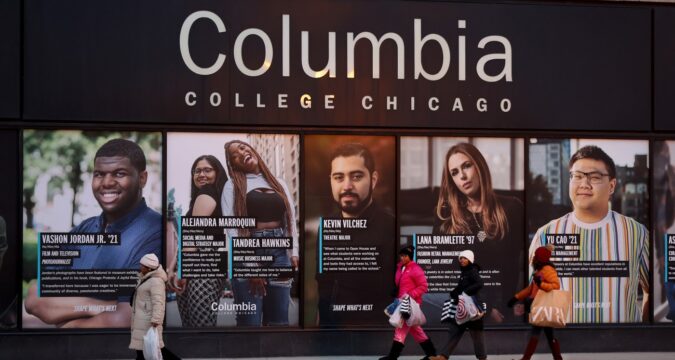
Let’s start with Columbia College Chicago, one of the state’s most prominent arts and media schools, established in 1890. This fall, enrollment dropped to 4,461 students from 5,571 — a startling loss of more than 1,000 students in a single year. In 2013-14, total full-time enrollment of undergraduate students at the school stood at 8,720, nearly double the current level, and 9,312 if graduate students were included.
The college has promised to “stabilize enrollment” and “strengthen philanthropic engagement,” but those words cannot obscure a larger trend. Columbia’s decline mirrors a national one: Families are questioning the price of a private education, especially one that does not readily lead to employment upon graduation.
High school graduates can choose faster and cheaper paths to the workforce, while the pool of traditional college-age students continues to contract as the U.S. enters a much-anticipated demographic decline. Add to that a drop in international student enrollments (down an estimated 17% nationally this year), and what’s going on at Columbia is not a blip — it’s a warning shot.
Even the University of Chicago, a crown jewel of intellectualism in U.S. higher education that has produced dozens of Nobel Prize-winning economists, is feeling financial strain.
In the 1990s, the university decided to recruit more undergraduate students by creating a more attractive campus culture. Low interest rates and increased competition for students from other universities fueled spending. The school built new labs, academic buildings and state-of-the-art dormitories. The strategy worked — the undergraduate body ballooned to its current 7,600 from 3,500 in the mid-1990s while an acceptance rate that was once 60% or more narrowed to an exclusive 4% in the process.
But at what cost?
After running budget deficits for 14 consecutive years, the university cut $100 million in expenses this summer. Government reductions in federal funding haven’t helped, but the University of Chicago’s woes were building long before President Donald Trump came back into office. To address budget shortfalls, the school has decided to slow tenure-tracking hiring, restrain new construction and halt admissions for multiple Ph.D. programs for a year.
Despite this streamlining, tuition at the university remains an eye-popping $71,325 per year, with an all-in cost just below $100,000.
For a school that epitomizes prestige and credibility, this kind of retrenchment underscores a sobering truth: No institution is too elite to feel the pressure.
The international side of things tells a similar story. Illinois universities are seeing declines in enrollments from overseas students after several months of volatile visa policies and unwelcoming rhetoric from the Trump administration. Data from DePaul University, the University of Illinois Chicago and the University of Illinois Urbana-Champaign show a drop in the number of international graduate students, the Sun-Times reported.
The loss in international students erodes university finances and translates into less research and innovation. But perhaps more importantly, the reputation of the state’s public universities as hubs of innovation and collaboration will decline if international students pass up the U.S. for other study destinations that are safer and more affordable.
Percolating crises are everywhere. The American college degree — once the engine of social mobility — is being reassessed, not out of cynicism but out of economic necessity.
Illinois shows where the pressures are heading: fewer students, tighter budgets and a public skeptical of the value of a degree. States that adapt readily to this reality will fare better. Those that don’t will face the same hard choices Illinois is contending with now.
But there is a glimmer of hope. Community colleges in Illinois are experiencing yearly growth in enrollments due to a broad range of certifications and degrees in high-demand fields. The state’s network, the third-largest in the country, is providing students with what they want — an education that won’t require taking on debt and could lead directly to a job. In other words, a good deal.
Perhaps that’s a solid playbook for the rest of the sector to use when planning for the future.
Anna Esaki-Smith is co-founder of research firm Education Rethink and author of “Make College Your Superpower,” a book about getting value from a university degree. Follow her on Instagram or TikTok.
Submit a letter, of no more than 400 words, to the editor here or email letters@chicagotribune.com.

Letters: We are primarily a country of good people and good values
Given the current leadership of the United States, it may not be popular these days to praise and give thanks to America. At times, our political leaders have given some of us reason to be resentful, cynical and even depressed.
Nevertheless, I am thankful for the U.S. No matter who leads us, we are primarily a country of good people, values and benevolence. America is by far the largest donor to global hunger and relief efforts, spending billions a year to provide international food assistance.
While we often take it for granted, the U.S. offers much to its people that other countries will not or cannot. Programs such as Social Security, Medicare, Medicaid, unemployment benefits, etc., are not offered in much of the world. While some services certainly have flaws, unlike many nations, the U.S. provides public education, law enforcement and care for its elderly.
This nation offers great landscapes and wildlife, diverse cultures and super-fast internet. While it does not always appear that way, America has a very good judicial system with a heavy emphasis on due process. This country also gives its people relatively easy access to the courts and voting booths.
Certainly, America faces challenges such as homelessness, income equality, immigration and access to quality medical care. Our leadership has caused much disenchantment, with some political policies appearing abusive. The American people must continue to push back against political leaders overstepping and threatening our civil rights.
Still, according to U.S. Citizenship and Immigration Services, since 2020, about 1 million foreigners each year applied for U.S. citizenship. Over the last decade, the U.S. has welcomed almost 8 million new citizens from foreign countries. Much of the world still wants what America has to offer.
We should be grateful for our country. God bless America.
— Terry Takash, Western Springs
Stand above the noise
Some days, the news makes it feel like the loudest, angriest voices are steering everything. The outrage, the division, the constant noise — it wears you down. It can make you forget that beneath all of that chaos, there’s something steadier at work. Something quieter. Something a lot of people still believe in, even if it doesn’t trend on social media.
Most of us still hold on to the same simple values. We believe in fairness. We believe everyone deserves a real chance to build a good life, regardless of where they started. We believe opportunity shouldn’t be reserved for a select few. And we believe freedom is more than a slogan — it’s the ability to shape your future without someone else tightening the limits around you.
These aren’t abstract ideas. They’ve always been the backbone of what this country promised to be. And even though they’re being tested — sometimes pushed right to the edge — people are still stepping up. From neighborhood volunteers to the people running in major national elections, there are countless individuals fighting to protect voting rights, defend personal freedom and insist that every one of us still matters in this democracy.
The answer to cynicism isn’t to shout over it. It’s to move with intention. It’s to stay engaged. It’s to remember that the strength we share doesn’t disappear just because the noise gets loud.
That’s why we keep going. That’s why we keep showing up.
We stand up. We speak up. Together.
— Laurel Jacobs, Gurnee
Unraveling of support
I never felt fortunate for having been raised in the prior millennium, but in hindsight, I am extremely thankful. I look around today and see the unraveling of support for education, medical care and other social services. Trusted sources of information have been replaced by dubious reports on social media or propaganda in the guise of news.
Time-honored institutions such as the Centers for Disease Control and Prevention are part of a kakistocracy in which unqualified appointees have agendas that are not necessarily in the nation’s best interest but are political or personal.
Historical records that remind us of how far we have come and need to go are disappearing, along with a national ethos in which people helped their neighbors despite political differences.
— Jerry Levy, Deerfield
Clarity about legality
The current discussion about obeying orders overlooks an essential point contained in the Uniform Code of Military Justice (UCMJ), which all members of the military are subject to. The UCMJ requires every service member to obey lawful orders. It makes clear that a soldier must refuse illegal orders. No one in the U.S. military is obligated to carry out an order that violates the law.
However, this protection imposes a very serious reality, which is that the soldier refusing an order must be absolutely right about the order being unlawful. If the order is later judged to have been lawful and the soldier refused it, that refusal becomes a violation of Article 92 of the UCMJ. The penalties for disobeying a lawful order can include a court-martial, loss of rank and pay, a dishonorable discharge and even confinement.
In short, while the UMCJ requires service members to reject illegal orders, it also imposes harsh consequences on anyone who incorrectly labels an order as unlawful.
It is a heavy but necessary responsibility placed on those who serve.
— Al Zvinakis, Lemont
Lessons of My Lai
When I, a proud veteran of the Army, consider the idea that American soldiers ought to disobey illegal orders, the following words come to mind: long understood, universally accepted, too obvious to merit expression.
The question of disobeying illegal orders came up at the Nuremberg trials in the wake of World War II. One defendant after another, even though clearly instrumental in Nazi atrocities, tried to exculpate themselves by claiming they were merely following orders.
One thing the Nuremberg trials decided was that military service does not absolve anyone of responsibility for his or her own actions. Even at the humblest level of service, soldiers have not just a right but a duty to disobey orders that shock the conscience.
This point came up again after the Vietnam War’s My Lai Massacre. In 1968, an Army unit in Vietnam engaged in Nazi-type behavior, shooting civilians at close range, burning homes, killing livestock and massacring hundreds of civilians. Later, the Army charged 26 soldiers with crimes, and, in 1971, the unit’s commander, Lt. William Calley Jr., was found guilty.
In so doing, the Army admitted that an order can be illegal and that soldiers should resist executing illegal orders. Why now, in 2025, has this question become controversial?
I cannot help but suspect one reason: Because the man in the White House would like an army that looks more like the Wehrmacht than the American army that defeated the Wehrmacht.
— Michael W. Drwiega, Wilmette
Path to citizenship
In letters to the editor, I often see comments from writers saying that people who want to immigrate to the U.S. should “just follow the rules.”
I know, however, that the legal process is not as simple as making a request to the correct person or agency, and I know that there are multiple barriers to completing the process — financial barriers, legal barriers, physical presence barriers, language barriers.
Could Tribune reporters gather some stories about people who have earnestly tried to “follow the rules” but found it impossible?
— Thelma Hoogland, Oak Forest
Editorial wrong-headed
Aside from the fact that the editorial detailing the Donald Trump-Zohran Mamdani meeting is bereft of intellectual rigor (“That bizarre day when the ‘fascist’ met the ‘communist’ and found common ground,” Nov. 25), the Tribune Editorial Board’s assessment that any reader who believes that we should never compromise with Trump is not making “the right call” is, well, wrong.
Destroying the checks and balances of our three branches of government, abuse of citizens and destruction of our economy for the president’s personal gain should never be supported. If the editorial board truly believes all of that is peachy, I suggest changing the name of the newspaper to the “Neville Chamberlain Evening Standard”; at least that way, the board’s capitulation will align with the newspaper’s masthead.
— C. F. Waterman, Chicago
Submit a letter, of no more than 400 words, to the editor here or email letters@chicagotribune.com.
https://www.chicagotribune.com/2025/12/01/letters-120125-united-states-values/

Kevin Jameson and Jeannine Forrest: How to help those living with dementia beyond awareness and education
A terrible irony of dementia — which can result in the inability to recognize people and places — is that the condition itself does not get the worldwide recognition it deserves.
Until now.
The United Nations recently announced a plan to address major neurological disorders, such as dementia. This is particularly significant because many countries do not always understand or treat the condition, which affects more than 57 million people worldwide. The U.N. action, though overdue, is welcome news for those of us working to raise awareness and improve the lives of people living with dementia and their care partners. Unfortunately, too many people and families are struggling with the condition and need more assistance.
As a condition, dementia is not a single disease. Instead, it is an umbrella term — a syndrome with a wide array of symptoms caused by one or more underlying pathologies affecting the brain. Just as the term “cancer” refers to numerous forms of the disease, dementia encompasses wide-ranging impacts to cognition, including memory loss, difficulty with language, muscle motor skill deterioration, behavioral changes, and impacts to decision-making and problem-solving.
The syndrome of dementia is one of the most critical health care challenges of our time. A recent study from the University of Southern California found that this year, there are 5.6 million people living with dementia in the United States, with 5 million of those ages 65 and older. The Centers for Disease Control and Prevention calculates that more than 11 million adults provide unpaid care for someone living with dementia. The annual cost of dementia in the U.S., inclusive of medical care and foregone earnings of care partners, is $781 billion. As our population ages, we can expect that the condition will become more prevalent and the emotional and economic burdens on families will grow.
While there are currently no cures or ways to reverse dementia permanently, there are three vital ways families and communities can plan for and work to address the syndrome that can make a real difference.
Increase awareness. Knowledge fights fear. Facilitating education about dementia by using nonmedical, jargon-free language helps families understand what they are facing and reduces the stigma that makes isolation worse. Organizations such as the Dementia Society offer crucial resources that help people navigate this journey and support their loved ones living with dementia.
Fund research. We need more research into what triggers cognitive decline and how to protect brain health. To advance cures, interventions and meaningful therapies, it is critical to support early-stage research aimed at better understanding of possible upstream triggers of cognitive impairment, as well as underappreciated approaches to enhance brain health.
Enrich life. Living with dementia does not mean that life stops — it means that life changes. Communities across America are pioneering compassionate approaches that preserve dignity and create moments of joy: memory cafes where people gather without judgment, music therapy programs that unlock memories through familiar melodies, art classes adapted for changing abilities, and dementia-friendly businesses training staff to offer patient, respectful service.
These efforts prove a fundamental truth: While we cannot yet cure dementia, we can radically improve how people live with it. When we invest in quality of life, we honor the humanity of every person facing cognitive decline.
The U.N.’s announcement matters because it elevates dementia from a private family burden to a global public health priority. Yet, the response to this crisis will be measured not in international resolutions but in local action.
For the 57 million people currently living with dementia, the syndrome is now our shared responsibility to work together to address.
Kevin Jameson is CEO of Dementia Society of America (DSA), a volunteer-driven nonprofit based in the Philadelphia area. Jeannine Forrest, Ph.D., directs the Dementia Horizons Academy, an educational program at the DSA, and lives in Chicago.
Submit a letter, of no more than 400 words, to the editor here or email letters@chicagotribune.com.
https://www.chicagotribune.com/2025/12/01/opinion-dementia-education-memory-loss/

Visualizing The $19 Trillion Global Cost Of Conflict
Visualizing The $19 Trillion Global Cost Of Conflict
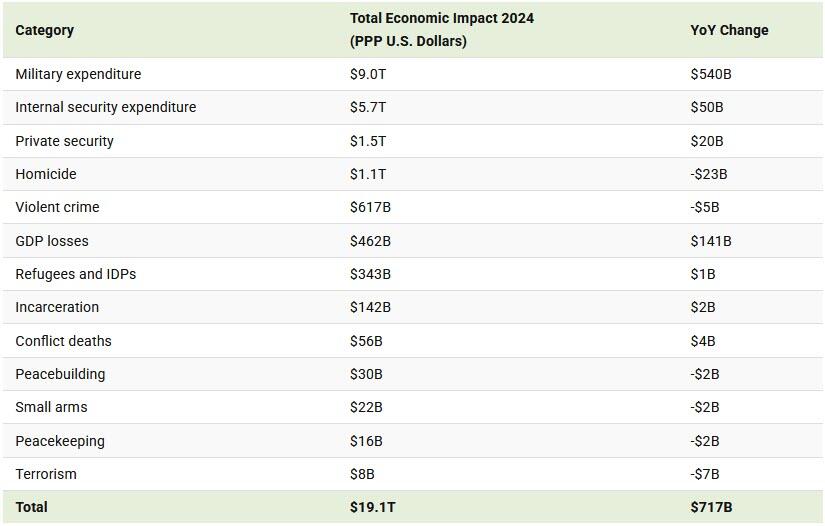
Last year, the economic impact of violence reached $19.1 trillion, or $717 billion higher than the previous year.
This came as conflict deaths hit 25-year highs, and wars continued in the Ukraine and Gaza. In response to heightened geopolitical tensions, European nations have injected billions into defense spending. Even Japan plans to double its defense spending to 2% of GDP.
This graphic, via Visual Capitalist’s Dorothy Neufeld, shows the global cost of conflict in 2024, based on analysis from the Institute for Economic and Peace.
Breaking Down the Cost of Conflict
Below, we show the economic impact of violence worldwide, with figures including direct and indirect costs:
In 2024, military spending grew by $540 billion to reach $9 trillion.
Overall, 84 countries increased spending on military as a share of GDP, with Norway, Denmark, and Bangladesh seeing the greatest jumps. U.S. military spending totaled $949 billion, while China followed at $450 billion, in international dollars.
As the second-highest cost, internal security expenditure hit $5.7 trillion. This includes costs associated with policing and the judicial system.
Meanwhile, GDP losses causes by conflict surged 44% in 2024 to reach $462 billion. Compared to 2008, GDP losses have more than quadrupled, while the cost of conflict deaths has followed a similar trend.
Adding to this, the cost of refugees and internally displaced persons (IDPs) had an economic toll of $343 billion. Today, 122 million people globally are forcibly displaced, more than doubling from 2008.
To learn more about this topic, check out this graphic on Europe’s biggest armies.
Tyler Durden
Mon, 12/01/2025 – 05:45
https://www.zerohedge.com/markets/visualizing-19-trillion-global-cost-conflict

Today in History: Ukrainians voted for independence
Today is Monday, Dec. 1, the 335th day of 2025. There are 30 days left in the year.
Today in history:
On Dec. 1, 1991, Ukrainians voted overwhelmingly for independence from the Soviet Union.
Also on this date:
In 1824, the presidential election was turned over to the U.S. House of Representatives after none of the candidates (John Quincy Adams, Andrew Jackson, William H. Crawford and Henry Clay) won more than 50% of the electoral vote. Despite Jackson winning the most electoral votes, Adams would ultimately win the presidency.
In 1955, Rosa Parks, a Black seamstress, was arrested after refusing to give up her seat to a white man on a segregated bus in Montgomery, Alabama. The incident sparked a yearlong boycott of the city’s buses and helped fuel the U.S. civil rights movement.
In 1965, the first “Freedom Flight” from Cuba to the United States landed in Miami. Over the ensuing eight years, the twice-daily flights allowed more than 250,000 Cuban refugees to migrate to the United States through a joint U.S.-Cuban agreement.
In 1969, the U.S. government held its first draft lottery for military service since World War II.
In 2009, President Barack Obama ordered 30,000 more U.S. troops into the war in Afghanistan but promised during a speech to cadets at the U.S. Military Academy at West Point to begin withdrawals in 18 months.
In 2017, retired Lt. Gen. Michael Flynn, who served in President Donald Trump’s first term as his initial national security adviser, pleaded guilty to lying to the FBI about reaching out to the Russians on Trump’s behalf. (Trump would later pardon Flynn.)
In 2020, a huge radio telescope in Arecibo, Puerto Rico, that played a key role in astronomical discoveries for more than half a century collapsed. The collapse stunned many scientists who long had relied on what was once the largest radio telescope in the world.
Related Articles
Long-lost Rubens painting depicting crucifixion sells for $2.7M
Chicago Bears’ 1985 Super Bowl run: Don Pierson’s game-by-game breakdown from the ‘most memorable season’
Today in Chicago History: Floyd Patterson becomes youngest heavyweight champ with KO at Chicago Stadium
Today in History: Ken Jennings ends his 74-game winning streak on ‘Jeopardy!’
Today in History: Natalie Wood dies
In 2023, Israel’s war with Hamas, which began in October, erupted anew minutes after a weeklong truce expired as Israeli airstrikes hit houses and buildings in the Gaza Strip.
Today’s Birthdays: World Golf Hall of Famer Lee Trevino is 86. Rock musician John Densmore (The Doors) is 81. Actor-singer Bette Midler is 80. Model-actor Carol Alt is 65. Actor Jeremy Northam is 64. Baseball Hall of Famer Larry Walker is 59. Actor Néstor Carbonell is 58. Actor-comedian Sarah Silverman is 55. Actor Riz Ahmed is 43. Singer-actor Janelle Monáe is 40. Actor Sarah Snook is 38. Actor Zoe Kravitz is 37.
https://www.chicagotribune.com/2025/12/01/today-in-history-ukrainians-voted-for-independence/
Today in Chicago History: Our Lady of the Angels school fire
Here’s a look back at what happened in the Chicago area on Dec. 1, according to the Tribune’s archives.
Is an important event missing from this date? Email us.
Chicago’s winter parking ban goes into effect Dec 1. Here’s what to know — snow or no snow.
Weather records (from the National Weather Service, Chicago)
High temperature: 68 degrees (1970)
Low temperature: Minus 6 degrees (1893)
Precipitation: 1.23 inches (2006)
Snowfall: 7.8 inches (1978)
Frank Rothing, center, senior vice president of the Midwest Stock Exchange (MSE), samples one of the 3.5 million hamburgers a day McDonald’s serves at its more than 1,200 outlets, in honor of the listing of the Chicago-based restaurant chain’s common stock on the MSE. With Rothing are Robert Wilson Jr., left, MSE specialist for the stock, and Ray Kroc, chairman and founder of McDonald’s. (Chicago Tribune archive)
1949: The Midwest Stock Exchange (now known as Chicago Stock Exchange), which merged the old Chicago Stock Exchange and the exchanges in St. Louis, Cleveland and Minneapolis-St. Paul, began trading.
Playboy magazine founder Hugh Hefner, a University of Illinois alum, turned a modest America on its ear with photographs of beautiful nude women mixed with provocative writing. Date on magazine is June 1963. (John Austad/Chicago Tribune)
1953: Hugh Hefner launched Playboy magazine in his Hyde Park apartment.
In an April 21, 2012, editorial in the Tribune, Hefner said he started the magazine with $8,000 raised through selling his furniture and borrowing from family and friends.
His debut issue, produced at his apartment’s kitchen table, featured a Marilyn Monroe photograph purchased from a suburban calendar company. It didn’t include a cover date since Hefner was unsure when or if he would be able to produce another. He described his enjoyment in watching people pick up the magazine from newsstands in December 1953.
By 1971, when Playboy Enterprises went public, the magazine was selling more than 7 million copies a month. In 2017, the magazine had about 800,000 subscribers.
Frank Hamilton, head instructor of the Old Town School of Folk Music, takes part in an informal hootenanny at Tribune writer Norma Lee Browning’s home in 1960. (Russell Ogg/Chicago Tribune)
1957: The Old Town School of Folk Music opened.
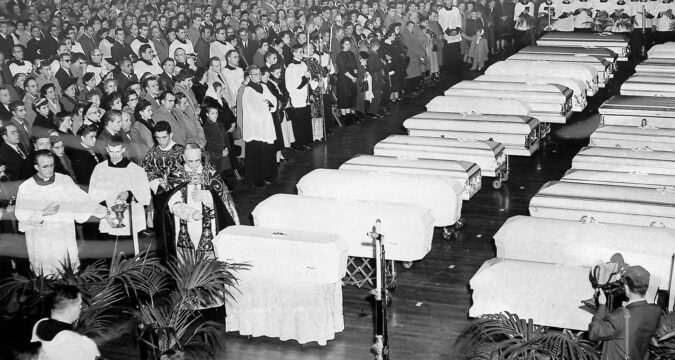
Dense smoke from Our Lady of the Angels school on Dec. 1, 1958, in Chicago. The fire on the city’s West Side took the lives of 92 children and three nuns. It remains one of the worst tragedies in Chicago history. (Chicago Tribune historical photo)
1958: Shortly before classes were to be dismissed, a fire broke out in the basement of Catholic school Our Lady of the Angels in the Humboldt Park neighborhood. The fire swept through the school of 1,600 students in a few hours.
Children jumped from windows, and neighbors and families ran to the school, at 909 N. Avers Ave., with ladders and blankets.
Our Lady of Angels school, site of devastating 1958 fire, has fire sprinkler system installed
It took firefighters only four minutes to arrive, but there was only so much they could do as 92 students and three nuns died.
The fire led to massive overhauls of fire codes and higher standards for building safety, such as brighter exit signs. The cause of the fire has never been officially determined.
Vintage Chicago Tribune: Tornadoes!!!
2018: At least 22 people were injured when 29 tornadoes hit central Illinois, centered around Taylorville, which was hit by an EF-3. It was the state’s largest tornado outbreak on record for December.
Want more vintage Chicago?
Subscribe to the free Vintage Chicago Tribune newsletter, join our Chicagoland history Facebook group, stay current with Today in Chicago History and follow us on Instagram for more from Chicago’s past.
Have an idea for Vintage Chicago Tribune? Share it with Kori Rumore and Marianne Mather at krumore@chicagotribune.com and mmather@chicagotribune.com
https://www.chicagotribune.com/2025/12/01/chicago-history-december-1/

‘Surgical Removal Of An Organ’: Ukrainian Recruiter Arrested For Allegedly Beating Conscript’s Genitals In Heinous Attack
‘Surgical Removal Of An Organ’: Ukrainian Recruiter Arrested For Allegedly Beating Conscript’s Genitals In Heinous Attack
After a forced conscript was beaten in his groin area to the point that he lost an “organ” following emergency surgery, Ukrainian authorities have moved to arrest the recruitment center head.
The staff of the Ukrainian State Bureau of Investigation (DBR) arrested the head of one of the district recruitment and military service preparation centers (TCK) in the Ivano-Frankivsk Oblast.
The recruiter is accused of brutally beating a conscripted man for refusing to perform a fluorographic examination during the medical aptitude test (VLK), reported by the General Prosecutor’s Office of Ukraine and the DBR, based on the announcements of Ukrainian news outlet Pravda.ua.
The DBR investigated complaints from citizens and parliamentarians that beatings, torture, and demands for money had taken place in a TCK operation in Transcarpathia. Notably, neighboring Hungary has alleged that recruits from the Transcarpathia region are targeted for recruitment at an especially high rate due to them being ethnic Hungarians.
“Investigators uncovered numerous abuses of power committed by a senior officer at the center,” the DBR communication was quoted by the source.
Based on the investigation, it was revealed that the man was sent to the hospital for a VLK examination together with other citizens.
When he refused the examination, the lieutenant colonel deliberately inflicted at least five blows against the victim, targeting the groin area.
As a result, the victim suffered serious physical injuries that required the “surgical removal of an organ.”
The officer was charged with abuse of power during martial law, with serious consequences. On the motion of the prosecutors, the court ordered an arrest without the possibility of bail. Based on the source, it was also revealed that the possible involvement of other persons, including police officers, in the case is currently being investigated.
This beating is likely just the tip of the iceberg, though. As already reported by Remix News, a Hungarian citizen and entrepreneur, József Sebestyén, died in July in the Beregsász hospital after Ukrainian recruiters severely beat him with iron bars in a forest, with the incident also caught on film.
Prime Minister Viktor Orbán has forcefully condemned forced conscription in Ukraine after the beating death. Speaking on Kossuth Radio, Orbán linked the tragic incident directly to the ongoing war, asserting that a country where such events occur due to forced conscription is unfit for European Union membership.
“A country where this could happen cannot be a member of the EU,” said Orbán.
“We are talking about a Hungarian-Ukrainian dual citizen. This entitles us to avoid using cautious language. They beat a Hungarian citizen to death, that’s the situation. And this is a case that we need to investigate, as this cannot happen,” Orbán stated, emphasizing the gravity of the situation.
He highlighted that while the front lines might seem distant to many Hungarians, “the war is taking place in our neighboring country. The threat is directly here.”
A video post on this topic from Remix News was immediately flagged by X and censored, meaning that EU censors may be jumping on this report due to its sensitive nature.
For years, videos of Ukrainian recruits being dragged off the streets and beaten have been circulating, making the arrest of one of these recruiters quite out of the ordinary.
Tyler Durden
Mon, 12/01/2025 – 05:00