Category: News
La Grange Area League of Women Voters forum: Affordable housing could help pump cash into economy
Affordable housing is important not only from a humanitarian standpoint, but it affects the larger economy as well, according to a speaker at a recent La Grange Area League of Women Voters forum on the subject.
“It strengthens our local economy because it brings more people,” said Tina Rounds, CEO of BEDS Plus, the La Grange-based nonprofit that has been working since 1988 to help people in suburban Cook County facing housing crisis. “People who work here can live here … and they can be lifelong community members, which we all strive to be.”
About 35 people gathered at the La Grange Public Library Nov. 19 to learn more about the subject.
Rounds said BEDS Plus distributed an average of $3,500 to clients for housing last year.
“I always think that of all of the things someone might spend $3,500 on, that keeps a family from becoming homeless in our community,” she said. “That kind of brings it into perspective.”
Rounds said affordable housing is often difficult to define. Many experts considered it affordable if persons could afford rental payments at 30% of their income. If rent was 50% of income, that person would be considered house/cost burdened; 80% would be considered extremely cost burdened.
Rounds said that of people living in the lowest levels of poverty, 70% are paying 80% or more for housing.
“Which leaves no room for crisis, it leaves no room for food and extra support that they might need for their children or family members for medical costs,” she said. “We might grumble about the price of eggs but this (housing costs) is directly affecting their ability to live.”
Rounds stressed the Chicago area was particularly troublesome for low-income people seeking affordable housing.
“It’s a tough place for us to live,” she said. “It’s expensive.”
Rounds noted that in La Grange, it would be difficult for a renter to find affordable housing, since the average rent in the village is $2,339, which would require an income of $95,000 to live affordably.
To illustrate the point further, Rounds pointed out that a minimum wage job would only be able to afford an apartment for $875 in La Grange; even someone with a white collar job making $70,000 could only comfortably afford to pay $1,750 for rent in the village.
According to figures from the state, La Grange’s share of affordable housing stands at 13.22%, with 399 affordable homes and 355 affordable rental units.
“So they’re meeting their minimum standard,” Rounds said, citing a 2003 Illinois state law setting goals for affordable housing.
Western Springs, which falls under the area served by BEDS Plus, is much worse, with only 2.8% affordable units of housing, leaving the village 298 units short of the state’s goal.
Rounds listed several reasons for the lack of affordable housing in recent years, including stagnant wages, what she described as the “financialization” of housing stock — where housing units are increasingly seen as investment opportunities for corporations — and barriers to greater production of housing. Those barriers include rising construction costs, regulatory burdens and local zoning control.
“It’s really complex, a multifaceted issue,” she said, stressing the supply of housing is not meeting demand. “The demand for housing is high, and there’s not enough housing being built.
“Construction costs are increasing. We’re trying to renovate a 55-room hotel and we’ve had to increase the costs three times just to keep up with current labor as well as other costs related to that building.”
As for solutions to the housing crisis, Rounds pointed to the BEDS Plus facility on Ogden and East avenues as an example of one way to meet demand, but said that there were several other options.
She referenced a newspaper article containing a quote from the mayor of Providence, Rhode Island.
”Our approach is robust and comprehensive. We are not just doing one thing. We’re making sure we don’t lose any existing units, promoting new construction and providing tenant protections for those who need it.”
Rounds mentioned an approach created by housing activists in the Netherlands that was another approach to affordable housing. “Social housing,” represents 29% of the housing stock in that country, begun by that country’s 284 housing associations.
“Many of them started with government investments, but now they’re sort of moved on from that,” she said. “And they’re asking a more benevolent investor than a corporate investor.”
To highlight the possibility that similar approaches could work in this country, Rounds noted that such approaches were taken in Highland Park and Winnetka.
Hank Beckman is a freelance reporter for Pioneer Press.

Crystal Fabergé egg crafted for Russian royalty shatters record and sells for $30.2 million
LONDON — A rare crystal and diamond Fabergé egg crafted for Russia’s ruling family before it was toppled by revolution shattered records Tuesday as it sold at auction for $30.2 million.
The Winter Egg, which was compared to the iconic Mona Lisa, was just one of seven of the opulent ovoids remaining in private hands, Christie’s London auction house said.
The 4-inch tall egg is made from finely carved rock crystal, covered in a delicate snowflake motif wrought in platinum and 4,500 tiny diamonds. It opens to reveal a removable tiny basket of bejewelled quartz flowers symbolizing spring.
The sale price, which included a buyer’s premium, topped the $18.5 million paid at a 2007 Christie’s auction for another Fabergé egg created for the Rothschild banking family.
Craftsman Peter Carl Fabergé and his company created more than 50 of the eggs for Russia’s imperial family between 1885 and 1917, each elaborately unique and containing a hidden surprise. Czar Alexander III started the tradition by presenting an egg to his wife each Easter. His successor, Nicholas II, extended the gift to his wife and mother.
Czar Nicholas II commissioned the egg for his mother, Dowager Empress Maria Feodorovna, as an Easter present in 1913. It was one of two eggs created by female designer Alma Pihl; her other egg is owned by Britain’s royal family.
The Romanov royal family ruled Russia for 300 years before the 1917 revolution ousted it. Nicholas and his family were executed in 1918.
Bought by a London dealer for 450 pounds when the cash-strapped Communist authorities sold off some of Russia’s artistic treasures in the 1920s, the egg changed hands several times. It was believed lost for two decades until it was auctioned by Christie’s in 1994 for more than 7 million Swiss francs ($5.6 million at the time). It sold again in 2002 for $9.6 million.
Each time the egg has sold, it has set a world record price for a Fabergé item, Christie’s said.
Margo Oganesian, the head of Christie’s Russian art department, called the egg “the ‘Mona Lisa’ for decorative arts,” a superb example of craft and design.
There are 43 surviving imperial Fabergé eggs, most in museums.
https://www.chicagotribune.com/2025/12/02/faberge-egg-russian-royalty-sale/
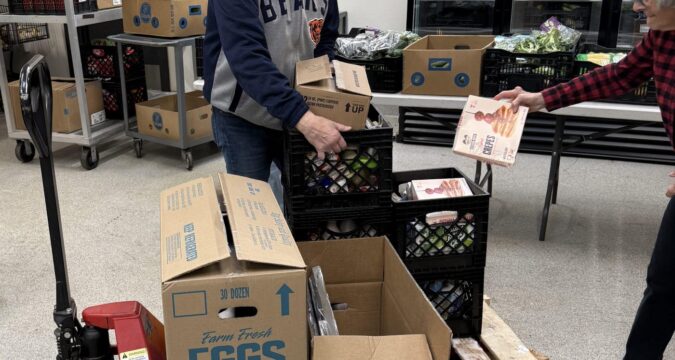
Column: Aurora responds when need is greatest at local food pantries
Although the disruption in SNAP benefits created plenty of outrage and angst during the government shutdown last month, there is one upside that came from all the upheaval.
It got more people thinking about food pantries.
And not just as that busy place they pass on the way to work. Or in another headline touting their importance as a lifeline to so many vulnerable people.
Suddenly lots more people began holding food drives.
And bringing in their own individual – and generous – bags of groceries.
And writing checks that can, as if by Christmas magic, turn into far bigger donations.
Cathedral of Grace St. John did just that at Thanksgiving with a $5,000 gift to the Marie Wilkinson Food Pantry in Aurora.
Because the pantry has a matching corporate donation through the holidays, this Aurora church’s check morphed into $10,000. And because pantries can purchase food cheaper through the Northern Illinois Food Bank, the $5,000 actually is worth $40,000 in meals, enough to feed 1,000 families for a week, according to some estimates.
What makes this particular donation also noteworthy is that this affiliate of the African Methodist Episcopal church is the oldest African American church west of Chicago, and Marie Wilkinson is the oldest pantry in the area.
In fact, the Rev. Jesse Hawkins, who has been pastor at Cathedral of Grace St. John for 43 years, worked alongside Marie Wilkinson, a social and civil rights activist who founded the Aurora pantry that bears her name 75 years ago.
There’s no question this gift comes at a time when need is greater than ever. With food insecurity dominating headlines, local pantries continue to be slammed, in part due to recent ICE raids in the community that have left many Hispanics fearful of leaving their homes.
Food distribution at East Aurora High School, Marie Wilkinson Food Pantry Executive Director Annette Johnson noted, has gone from about 80 kids every couple weeks last year to 600 students per week.
“We are also getting calls right and left” from East Aurora District 131 administrators for the pantry’s emergency food box program that is run through the elementary schools, said Johnson.
“Families are in real need,” she insisted.
And people are taking notice, including a man last week who told Johnson he’s driven past the Marie Wilkinson Food Pantry on his way to work for years, and even though he knew it was doing good things in the community, had never donated before to it.
“He took out the last $80 in his wallet,” Johnson told me, and handed it to her.
Katie Arko, executive director of Aurora Area Interfaith Food Pantry, is also overwhelmed with gratitude at the way people have rallied to the cause.
“Although demand has continued to rise,” she said, “the community’s response was immediate and inspiring,” with gifts flooding in online and through the mail.
“Donations, both monetary and food, poured in from businesses, service clubs, individuals, churches and neighborhood groups,” Arko noted.
“By the time the November food drive ended and totals were counted, the results were stunning,” she continued, noting more than “twice as much money” was donated this year compared to last.
Add to that, the generosity of longtime Interfaith supporter Karen Leonard, who recently contributed $25,000 in matching funds for Giving Tuesday, which in turn inspired others to donate, and which Arko predicts will break the pantry’s Giving Tuesday records.
“For decades Karen Leonard has been a remarkable force for good,” she continued, noting that every month this dedicated volunteer “scours sales, stacks coupons and purchases large quantities of food for pennies on the dollar,” then donates it all to the pantry.
“We never had a lot growing up,” Leonard recalled, “but my parents encouraged us to get involved and be charitable.”
As Arko pointed out, people like this make food pantries a “beacon of hope for families who need it most.”
And that often includes their four-legged loved ones, said Johnson, who tells me the Marie Wilkinson Food Pantry has deliberately stepped up its pet program.
Last month, she noted, four pallets of cat and dog food were handed out, all donated by those who realize how important pets are, especially during stressful times.
“Whether it’s cereal or diapers or personal care products, when we put out a request, people respond,” said Johnson. “We hear so much about the negative, but there really is so much goodwill in the community.”
dcrosby@tribpub.com

Trump administration says it will withhold SNAP from Democrat-led states if they don’t provide data
WASHINGTON — President Donald Trump’s administration said Tuesday that it will move to withhold SNAP food aid from recipients in most Democratic-controlled states starting next week unless those states provide information about those receiving the assistance.
Agriculture Secretary Brooke Rollins said at a Cabinet meeting Tuesday that the action is in the works because those states are refusing to provide data the department requested such as the names and immigration status of aid recipients. She said the cooperation is necessary in order to root out fraud in the program. Democratic states have sued to block the requirement.
Twenty-two states and the District of Columbia previously sued over the request for information, which was initially made in February. A San Francisco-based federal judge has barred the administration, at least for now, from collecting the information from those states.
The federal government last week sent the states a letter saying that it was time to comply, as other states have, but the parties all agreed to give the states until Dec. 8 to respond.
Administration says data is needed to spot fraud
About 42 million lower-income Americans, or 1 in 8, rely on SNAP to help buy groceries. The average monthly benefit is about $190 per person, or a little over $6 a day.
Rollins has cited information provided by the 28 other states — those with Republican governors plus North Carolina, saying it shows that 186,000 deceased people are receiving SNAP benefits and that 500,000 are getting benefits more than once.
“We asked for all the states for the first time to turn over their data to the federal government to let the USDA partner with them to root out this fraud, to make sure that those who really need food stamps are getting them,” Rollins said, “but also to ensure that the American taxpayer is protected.”
Her office has not released detailed data, including on how much in benefits obtained by error or fraud are being used.
Experts say that while there is certainly fraud in a $100 billion-a-year program, the bigger problem is perpetrated by organized crime, not beneficiaries.
U.S. Rep. Jahana Hayes, a Connecticut Democrat who is a co-sponsor of legislation to undo recent SNAP changes, said Rollins is trying to make changes without transparency — or without a role for Congress — and that she is mischaracterizing the program.
“Individuals who are just trying to buy food, those aren’t the ones who aren’t gaming the system in the way that the administration is trying to portray,” Hayes said in an interview on Tuesday before Rollins announced her intention.
Democratic officials question administration’s motives
Democratic officials responded to Rollins’ announcement by blasting the administration.
“The Governor wishes President Trump would be a president for all Americans rather than taking out his political vendettas on the people who need these benefits the most,” said Claire Lancaster, a spokesperson for Minnesota Gov. Tim Walz, a Democrat. “Whether it’s threatening highway funding or food assistance, the President is making malicious decisions that will raise prices and harm families.”
In response to Rollins’ comments, New York Gov. Kathy Hochul tweeted, “Genuine question: Why is the Trump Administration so hellbent on people going hungry?”
SNAP has been in the spotlight recently
The program is not normally in the political spotlight, but it has been this year.
As part of Trump’s big tax and policy bill earlier in the year, work requirements are expanding to include people between the ages of 55 and 64, homeless people and others.
And amid the recent federal government shutdown, the administration planned not to fund the benefits for November. There was a back-and-forth in the courts about whether they could do so, but then the government reopened and benefits resumed before the final word.
In the meantime, some states scrambled to fund benefits on their own and most increased or accelerated money for food banks.
Mulvihill reported from Cherry Hill, New Jersey. Reporters Michael Hill in Albany, New York; Steve Karnowski in Minneapolis; and Gary Robertson in Raleigh, North Carolina, contributed.
https://www.chicagotribune.com/2025/12/02/snap-withhold-democrat-led-states/

Interfaith service brings diverse worshippers together at Thanksgiving time, raises funds for Turning Point mental health center
A longstanding annual event in Niles Township brought together people from several religions just before Thanksgiving Day, continuing a tradition and offering a universal message of hope and gratitude.
A crowd of about 140 people had been anticipated to attend “An Interfaith Community Thanksgiving Service” Nov. 25 at Central United Methodist Church in Skokie, the Rev. Stuart Barnes Jamieson, co-chair of the Niles Township Clergy Forum, told Pioneer Press.
Rabbi Robert Jury, of Tikva Center for Jewish Recovery and Healing, speaks during the “Interfaith Community Thanksgiving” service Nov. 25, 2025 at Central United Methodist Church in Skokie. (Talia Sprague/for Pioneer Press)
Melissa Versch, of Skokie Health and Human Services, speaks during the “Interfaith Community Thanksgiving” service Nov. 25, 2025 at Central United Methodist Church in Skokie. (Talia Sprague/for Pioneer Press)
Ibrahim Khan speaks during the “Interfaith Community Thanksgiving” service Nov. 25, 2025 at Central United Methodist Church in Skokie. (Talia Sprague/for Pioneer Press)
“Clergy have been doing these services around Thanksgiving. It’s kind of a tradition and that’s when you have the ecumenical service,” said Jamieson, who is pastor of Carter-Westminster United Presbyterian Church in Skokie.
According to Jamieson, the special Thanksgiving service has taken place for more than 50 years, and this year’s location is where his Niles Township Clergy Forum co-chair, the Rev. Timothy Biel Jr., serves as pastor.
“Bringing people from different faiths together” was what Jamieson cited as the impetus for the annual interfaith service, which has drawn Christians, Muslims, Jews and members of the Baháʼí Faith into a house of worship together.
Cantor Rabbi Rob Jury, clinical director of Tikvah Center for Jewish Recovery and Healing in Northbrook, was keynote speaker for the service. The theme of the service was mental health and overcoming the stigma of it.
Donations made at An Interfaith Community Thanksgiving Service this year support the mental health services at Turning Point in Skokie, which Barnes Jamieson said has a “good reputation in the community.”
The service was presented by the Niles Township Clergy Forum.
The forum is “an opportunity for area religious leaders to get together and address topics of mutual interest and support causes in the Niles Township area,” said Barnes Jamieson.
Niles Township Supervisor Bonnie Kahn Ognisanti told Pioneer Press that the forum is not affiliated with township government, but the annual interfaith Thanksgiving service has helped support the township’s Respite Center, which is housed at St. Paul Lutheran Church in Skokie.
“Last year they actually raised money for our Respite Center and bought sleeping bags for people experiencing homelessness, so it was really nice for us and our clients,” said Ognisanti.
She said the township received $1,800 from donations to the service, and the money was used to purchase 20 sleeping bags.
Ognisanti called Turning Point “a really important resource for this community.”
Niles Township includes the villages of Skokie, Lincolnwood and Golf and portions of Morton Grove, Niles and Glenview.
Ognisanti pointed out the diversity of the township, including the more than 90 languages and dialects spoken by the student body of Niles Township High School District 219, which serves Skokie, Lincolnwood, Morton Grove and Niles.
“Niles Township is at its best celebrating those differences and really leaning into each other and knowing our neighbor,” she said. “The Clergy Forum Thanksgiving service is just a wonderful opportunity to live that value. It’s what social scientists call superdiverse.”
The township, along with other Chicagoland areas, faced challenges recently due to federal immigration enforcement activity by the U.S. Immigration and Customs Enforcement agency.
“We’ve been hit very hard by ICE. This community reacted to that by standing together … and really standing arm-in-arm with immigrant communities regardless of status,” Ognisanti said.
The township leader said the tumultuous time in the area with immigration enforcement activity has made Niles Township stronger. She said the faith community can also play a role in recovering from immigration enforcement efforts.
“I am in a government role so I don’t want to speak for anyone else, but I am assuming that people take a lot of solace through their house of worship and their faith community and can lean on each other and get support there,” said Ognisanti.
The Interfaith Community Thanksgiving Service included the Skokie Community Foundation providing refreshments from Will’s Place, an area coffee house that offers job opportunities for adults with disabilities.
The forum is “a really great opportunity to come together and give thanks regardless of your religious background and just to share those commonalities,” said Ognisanti.
Jessi Virtusio is a freelancer.
Gas Prices Hit Four-Year Low, Forcing Even CNN To Admit Affordability Squeeze Easing
Gas Prices Hit Four-Year Low, Forcing Even CNN To Admit Affordability Squeeze Easing
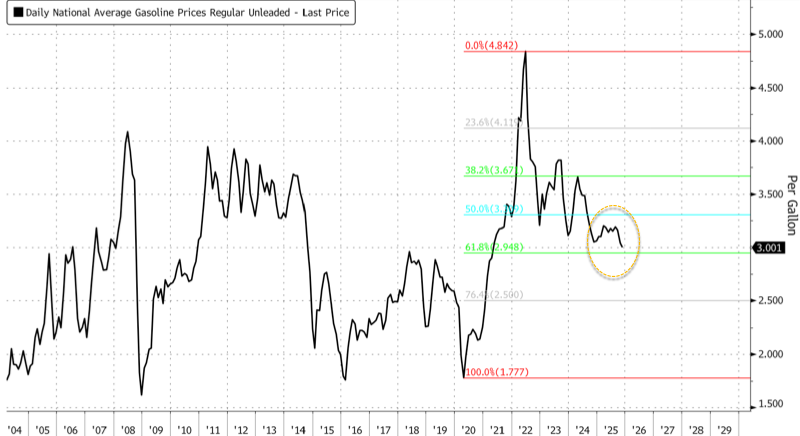
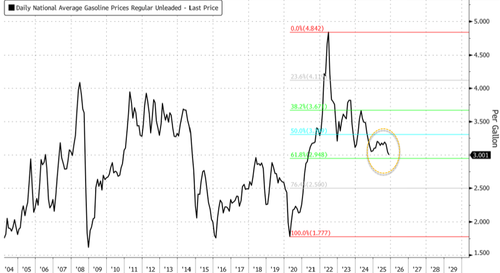
President Trump’s Operation Affordability has focused on lower energy costs for consumers this year. The administration’s aggressive “drill baby, drill” posture has translated into rising domestic supply, sending the national average for gasoline to the brink of the psychologically important $3 level.
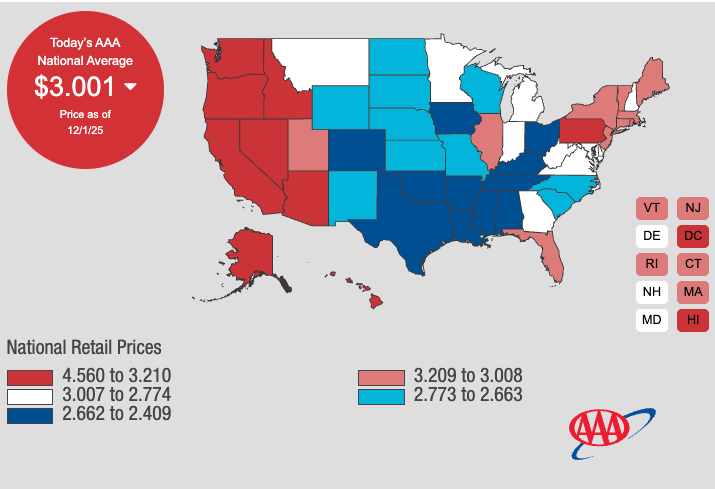
The latest data from the American Automobile Association shows the national average price for regular gasoline has fallen to a more than four-year low of $3.001 as of Monday.
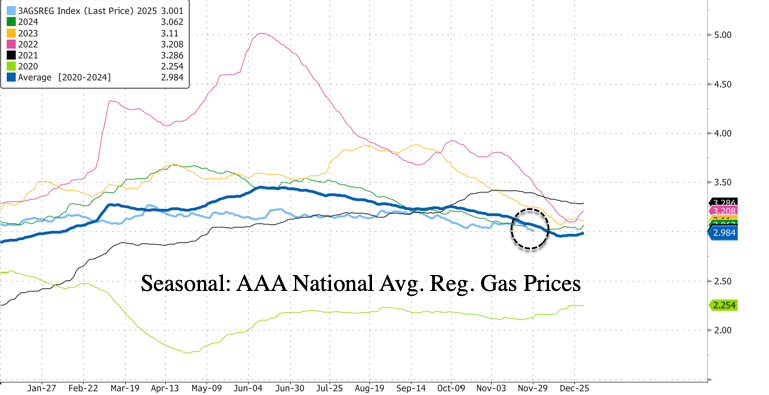
Seasonally, the national average for regular gasoline now sits below the five-year average. This marks a clear break for consumers from the Biden years, when prices were driven higher by green policies that prioritized unattainable climate goals while jeopardizing affordability for working-class households.
Gas prices are falling so sharply that even CNN has acknowledged President Trump’s energy policies are helping ease the affordability crisis that took root under the Biden-Harris years.
CNN: “For the first time in 4.5 years, gas prices are averaging $3/gallon nationally.”
“We’ve got TWENTY states across the country where the average is actually less than $2.75/gallon.” 🔥 pic.twitter.com/MzOvbMUfiG
— Rapid Response 47 (@RapidResponse47) December 1, 2025
In October, Trump told reporters at the White House that gasoline prices could reach $2.
President Trump predicts we will see $2 Gasoline very soon. 🙌
How much are you paying in Gasoline? Drop your state.
$2.84 in MDhttps://t.co/KbzRm3HYTc https://t.co/FS946iyHrR pic.twitter.com/N7u2AAQ1UK
— MJTruthUltra (@MJTruthUltra) October 22, 2025
More broadly, the Trump administration unveiled its Operation Affordability initiative last month, focusing on lowering food prices for working-class folks. This is a push that will hopefully translate into cheaper food items at the supermarket, including beef and coffee, ahead of the midterm election cycle. The administration had already worked its magic earlier this year by resolving the Biden-era egg price crisis.
Tyler Durden
Tue, 12/02/2025 – 16:40

America’s Feast-Or-Famine Reality… When $100,000 Feels Like Poverty
America’s Feast-Or-Famine Reality… When $100,000 Feels Like Poverty
Authored by Matt Smith via InternationalMan.com,
As an entrepreneur, my income has always been feast or famine. For years at the start of a new company, I would earn literally nothing. Now sure, employees had to be paid, and all the business had to move forward, but I took no compensation.
I survived on savings. Luckily I had some. Made from the years of feast. If there’s one thing that makes it hard for most people to be entrepreneurs, it’s this “feast or famine” income volatility. (Still worth it.)
During the COVID hysteria and seeing what’s coming, I decided to totally upend my life. For the first four years and up until fairly recently, I was in a period of personal income famine.
Encouraged by Doug, we launched a few new businesses, including our paid investment newsletter at CrisisInvesting.com. Things have improved. I wouldn’t call it a feast, but it’s enough to cover three hots and a cot.
What Is a Livable Income Today?
How much do you really need to make to live a reasonably prosperous life?
In our trips back to the U.S., I would often comment to my wife: “I don’t know how people can afford any of this.” Prices had gone up so much on virtually everything you can imagine, from food to housing, car insurance, health insurance. It’s insane. Insane enough that I started saying no to travel or new purchases I never would’ve given two seconds’ thought to before.
Admittedly, I’m in a position where these prices are much more of an irritant than a real impediment to my life. But I have eyes and a heart. I look around, I see what’s happening, and I’m worried. I’m worried not for myself, but for the fabric of society itself and all the individuals that are trapped. These individuals include not just random strangers, but friends and family, people I love. From my mom and dad who are retired and in poor health but who worked hard their whole lives. To my siblings whose careers are at risk of the shaky economy and who are being slowly subsumed by the steadily rising prices of all things.
Two years ago, while in the US, I thought, “how are people earning less than $100,000 a year making ends meet.”
A hundred grand is, or at least was, a lot of money. You were in a privileged status to have that kind of earnings power. And yet today, you can earn a hundred grand and be on the cusp of legitimate poverty.
Macro strategist Michael Green made this clear in his recent essay, “Part One: My Life as a Lie — How a Broken Benchmark Quietly Broke America.” I strongly encourage you to read it.
Michael wanted to know more about Americans’ poverty statistics. Perhaps he’d been asking himself many of the questions I had. How are people making it? What he discovered is shocking and disturbing, but totally believable.
According to Uncle Sam, if you’re a family of four earning $30,000 a year, you are living below the poverty line. If you’re above that line, theoretically, you’re doing okay. Not great, but you can survive. As Michael demonstrates, that simply is not true. In fact, it takes a lot more income to stay out of poverty in America today.
As a general rule, when you see a statistic, figure out how it’s calculated. That’s what Michael Green did here, and he learned that the official poverty line is calculated based upon a 1963 formula developed by Mollie Orshansky, an economist at the Social Security Administration.
The government estimated the cost of basic food diet for a family. In 1963 households spent 1/3 of their income on food. From there, the formula multiplied that amount by three to account for other living expenses.
The formula looks like this: (Food cost in 1963) * 3 + CPI = Poverty line.
For 2024 that number is $31,200.
As Michael says:
“For 1963, that floor made sense. Housing was relatively cheap. A family could rent a decent apartment or buy a home on a single income, as we’ve discussed. Healthcare was provided by employers and cost relatively little (Blue Cross coverage averaged $10/month). Childcare didn’t really exist as a market—mothers stayed home, family helped, or neighbors (who likely had someone home) watched each other’s kids. Cars were affordable, if prone to breakdowns. With few luxury frills, the neighborhood kids in vo-tech could fix most problems when they did. College tuition could be covered with a summer job. Retirement meant a pension income, not a pile of 401(k) assets you had to fund yourself. The food-times-three formula was crude, but as a crisis threshold—a measure of “too little”—it roughly corresponded to reality. A family spending one-third of its income on food would spend the other two-thirds on everything else, and those proportions more or less worked. Below that line, you were in genuine crisis. Above it, you had a fighting chance.
But everything changed between 1963 and 2024.”
So what’s changed? Housing is now incredibly expensive. Healthcare has become the largest household expense for many families. Childcare ballooned into a $70b industry and a huge expense for families with children. College went from affordable to where now the average of a four-year degree might cost you the net worth of the median American household.
But that’s not all, the requirement for a second income became mandatory in order to provide the standard of living that we were able to achieve before. But a second income means secondary costs. It means two cars become a requirement which means even more insurance. And who’s going to watch the children while both parents are at work? That’s where the $70 billion a year child care industrial complex comes in, consuming a huge portion of American family budgets.
All these new costs are like the price of admission to the American economy and have fundamentally changed the composition of household spending since 1963. The one upside, I guess, is that food costs are no longer a third of household spending. For most families, it’s just 5 to 7 percent. While housing is 35 to 50%, health care takes 20%, and child care can eat 20 to 40% of a family’s budget.
And so we get to the problem with that poverty line model created in 1963. Michael puts it this way:
“If you keep Orshansky’s logic—if you maintain her principle that poverty could be defined by the inverse of food’s budget share—but update the food share to reflect today’s reality, the multiplier is no longer three.
It becomes sixteen.
Which means if you measured income inadequacy today the way Orshansky measured it in 1963, the threshold for a family of four wouldn’t be $31,200.
It would be somewhere between $130,000 and $150,000.
And remember: Orshansky was only trying to define “too little.” She was identifying crisis, not sufficiency. If the crisis threshold—the floor below which families cannot function—is honestly updated to current spending patterns, it lands at $140,000.
What does that tell you about the $31,200 line we still use?
It tells you we are measuring starvation.”
Since the official poverty line for a family of four is $31,200 and the median income is roughly $80,000, we’re led to believe that a family that’s earning 80k a year is doing fine. Or at least surviving, as a stable middle class family.
But as Michael demonstrates above, a family of four living with $80,000 a year would in fact be living in deep poverty according to 1963 methodology.
Yesterday I talked to a friend whose family income was $160,000 a year. They’re living right on the financial edge. Have they made some bad financial decisions? Yes. Did they take on debt they shouldn’t have? Yes. But they are not living large. And there is always this feeling that they are on the brink of falling down.
Ask yourself, does it make more sense, based upon your personal experience, that $140,000 a year in America today is the actual poverty line and living below that line puts you at risk of poverty and destitution? Above that like you’re more likely to be reasonably secure.
Michael’s analysis didn’t stop with updating the 1963 methodology to today’s reality. He went further:
“I wanted to see what would happen if I ignored the official stats and simply calculated the cost of existing. I built a Basic Needs budget for a family of four (two earners, two kids). No vacations, no Netflix, no luxury. Just the ‘Participation Tickets’ required to hold a job and raise kids in 2024.
Using conservative, national-average data:
Childcare: $32,773
Housing: $23,267
Food: $14,717
Transportation: $14,828
Healthcare: $10,567
Other essentials: $21,857
Required net income: $118,009
Add federal, state, and FICA taxes of roughly $18,500, and you arrive at a required gross income of $136,500.
This is Orshansky’s ‘too little’ threshold, updated honestly. This is the floor.”
According to Michael, families are in a trap. To reach the median household income of $80,000, most families need two earners. But the moment you add a second earner to chase that income, you trigger the child care expense. And that child care expense is crushing. Roughly $32,000 a year.
In practice, the second earner is working to pay the stranger watching their children so they can go to work in some soul-crushing job merely to earn an extra $1,000 to $2,000 a month.
In two different models, updating the 1963 methodology for today’s household food-share percentages puts the poverty threshold at $130,000 to $150,000 a year. The second, a line item of reasonable expenses calculated by Michael gets us to $135,000 a year.
I found his analysis extremely convincing and spent a portion of our Crisis Investing VIP call last Monday discussing it with the group. I was looking for pushback from the dozens of people on the call. I got none. They all agreed. The real poverty line in America is $140,000 a year.
In his article, Michael Green goes on to explain some justification for numbers he uses to calculate the gross income needs and provides plenty of backup for his numbers. If anything, he’s being conservative.
The Cost of Participation
In addition, he makes the point that the cost to simply participate in the economy is far higher than is estimated.
He uses the example of the hedonic lie, why a phone costs $200, not $58. He says to function in a 1955 society, to have a job, call a doctor, and be a citizen, you needed a telephone line. That participation ticket cost $5 a month. Adjust it for standard inflation, that $5 should be $58 today. But he says you cannot run a household in 2024 on a landline. To function today, to two-factor authenticate your bank account, to answer work emails, to check your child’s school portal, which is now digital only, you need a smartphone plan and home broadband. So today, that cost of participation for a family of four is not $58, it’s at least $200 a month. Quite the “upgrade.”
He goes on to cover the skyrocketing health care costs, which in 1955 were $10 a month or $115 adjusted for inflation. But today, the average family’s premium is over $1,600 a month, which is four times the rate of inflation.
Up until very recently, I maintained health insurance for my family, even though we hadn’t been to the U.S. in well over a year and rarely used insurance at all. But that insurance cost me nearly $3,000 a month. I cancelled it and saved myself a bundle.
Insurance must be one of the biggest scams out there. $3,000 a month for health insurance I never used, and if I did, the deductibles would be at least $10,000. And car insurance, after decades and decades of paying at least $10,000 a year in auto insurance for all my vehicles. I never had a single claim. And yet, even this year, for my cars in storage in the U.S., my insurance went up.
Taxes, too, are a requirement of participation in the economy. In 1955, the Social Security tax was 2% on the first $4,200 of income. The maximum contribution was $84 a year. Adjusted for inflation, that’s about $960. But today, a family earning the median $80,000 pays over $6,100. That’s six times the rate of inflation.
Taxes, insurance, child care, the fact that the median car in America sells for over $50,000, car insurance, cell phones, and housing expenses consuming 35% to 50% of income—these are the costs of participation, the entrance fee you must pay simply to earn a living and maybe, just maybe, reach escape velocity someday.
For a median family, the “Cost of Participation” in the economy is roughly $50,000 a year.
The Broken Welfare System
Michael goes on to explain the sinister ways in which the welfare system locks people in to certain levels of income and makes it virtually impossible for them to escape.
“The family earning $65,000—the family that just lost their (childcare) subsidies and is paying $32,000 for daycare and $12,000 for healthcare deductibles—is hyper-aware of the family earning $30,000 and getting subsidized food, rent, childcare, and healthcare.
They see the neighbor at the grocery store using an EBT card while they put items back on the shelf. They see the immigrant family receiving emergency housing support while they face eviction.
They are not seeing ‘poverty.’ They are seeing people getting for free the exact things that they are working 60 hours a week to barely afford.”
Like it or not, we’re motivated by financial incentives. If you’re earning $30,000 a year and getting subsidized food, rent, child care, and health care, and you choose to put your nose to the grindstone and increase your income by 25% to, say, $40,000, the loss of benefits would actually end up costing you $200. A $10k raise equals a $200 loss.
And it gets worse from there. If through great effort you can push your income up from $30,000 to the $65,000 level, you lose the vast majority of benefits ending up worse off on a net basis.
So here you are at $65,000, well below the median and far, far below the real poverty line in America and taking home an income that would generate the same rewards as earning just $30,000/yr and collecting the benefits from Uncle Sam.
102,500,000 Americans Opted Out
As Michael points out, this should dispel your curiosity about why workforce participation rates are so shockingly low in America today. This is a measure of the working age population that is not employed and not actively looking for work. That’s 36% of the working-age population in America who are not employed and not even looking for a job. Over 100 million people.
It’s easy to scorn these people as freeloaders. But the fact is, maybe they’ve just done the math, and working harder just isn’t worth it. The bar they have to exceed is seen as too high, too out of reach. The $50,000 ticket to participate in the economy? Unachievable in their minds.
When will it become clear that the system is broken? This system which most of us are sending our kids into is setting them up to fail. Personally, I’m not sending my kids into this system. We’re following The Preparation.
The Real Poverty Line (And Why You Feel Poor)
Wrapping up with the great Michael Green again:
“The real poverty line—the threshold where a family can afford housing, healthcare, childcare, and transportation without relying on means-tested benefits—isn’t $31,200.
It’s ~$140,000.
Most of my readers will have cleared this threshold. My parents never really did, but I was born lucky — brains, beauty (in the eye of the beholder admittedly), height (it really does help), parents that encouraged and sacrificed for education (even as the stress of those sacrifices eventually drove my mother clinically insane), and an American citizenship. But most of my readers are now seeing this trap for their children.
And the system is designed to prevent them from escaping. Every dollar you earn climbing from $40,000 to $100,000 triggers benefit losses that exceed your income gains. You are literally poorer for working harder.
The economists will tell you this is fine because you’re building wealth. Your 401(k) is growing. Your home equity is rising. You’re richer than you feel.”
* * *
If Michael Green is right—and if your own experience tells you he is—then simply “working harder” inside this rigged system is not a plan, it’s a slow bleed. That’s why Doug Casey created Crisis Investing. It’s the research service built for times exactly like these—times when the mainstream narrative hides the real risks, and when the greatest opportunities appear precisely where most people aren’t looking. If you want guidance grounded in hard analysis, global perspective, and decades of success navigating turbulent cycles, this is where you’ll find it. If you feel the pressure building and want a clear path forward—one designed to help you not just endure the coming storms but potentially turn them to your advantage—you can subscribe to Crisis Investing right here.
Tyler Durden
Tue, 12/02/2025 – 16:20

‘We have fair maps’: Indiana redistricting bill passes out of committee despite criticism
After about three hours of public testimony against mid-census redistricting, the House Elections and Apportionment Committee approved a bill allowing for redistricting to move forward for consideration by the House in an 8-5 vote.
The lone Republican ‘no’ vote came from State Rep. Tim Yocum, R-Clinton, who voted with the four Democratic committee members against mid-census redistricting. Democrats proposed five amendments to the bill, including one that would require a study committee on when to hold redistricting, but they all failed 4-9.
Former Lt. Governor and Ivy Tech president Sue Ellspermann, pictured here in 2024, was one of many people who testified in opposition to the Republicans’ redistricting plans in a Tuesday, Dec. 2, 2025 hearing in Indianapolis. (Kyle Telechan/for the Post-Tribune)
Throughout the committee hearing, no Republican committee member — besides bill author State Rep. Ben Smaltz — addressed the bill.
The House convened its session shortly after the hearing, voting 63-24 to accept the committee report on House Bill 1032. After the session, State Rep. Earl Harris, D-East Chicago, said the House is scheduled to hear House Bill 1032 on second reading Thursday and third, and final, reading Friday.
Ahead of the committee vote, Committee Chairman Timothy Wesco, R-Osceola, said he supports mid-census redistricting because of actions former President Barack Obama and Illinois Gov. JB Pritzker, both Democrats, to encourage partisan drawing of Congressional maps. Obama filmed an advertisement supporting California’s redistricting ballot measure, which was created after Texas redrew its maps, and Pritzker has been supportive of redrawing maps in Illinois if Indiana’s redistricting efforts are successful.
House Bill 1032, authored by Smaltz, R-Auburn, would allow the legislature to amend congressional districts “at a time other than the first regular session of the general assembly convening immediately following the United States decennial census.”
The bill also establishes new Indiana Congressional district boundaries, and states that any challenges to the new maps will be heard by the state’s Supreme Court. The bill states that the current Congressional Districts won’t expire before Nov. 3, 2026.
Under the bill, the Secretary of State’s Election Division will assist counties with implementation of the new maps.
In the committee meeting, Smaltz said Indiana is taking up mid-census redistricting because of actions across the country, including Texas, California, Virginia and Missouri. The constitution allows for Congressional Districts to be drawn with political consideration in mind, he said.
“We have drawn these maps to create a Republican political advantage,” Smaltz said.
President Donald Trump and his administration has asked Republican-led states to undertake mid-census redistricting to maintain the Republican majority in the U.S. House of Representatives.
Redistricting typically occurs every 10 years after the release of census data. The Indiana constitution dictates that the legislature should take up redistricting every 10 years after census data is released.
In response to Trump’s request, Texas conducted mid-census redistricting to give Republicans five more seats, to which California responded with voter-approved mid-census redistricting to create five more seats.
In August, Vice President JD Vance met with Indiana Republicans to discuss redistricting in Indiana. Ultimately, after more meetings and discussions with federal officials, Gov. Mike Braun called for a special session to address redistricting.
Ahead of Organization Day, Nov. 18, Senate President Pro Tempore Rodric Bray, R-Martinsville, announced the Senate does not have the votes to pass new maps and canceled the Senate’s December session.
Officials with the Indiana House have maintained that they have the votes to pass new maps, and at the end of Organization Day House Speaker Todd Huston, R-Fishers, told his chamber to be prepared to come in December to address redistricting.
On Nov. 25, the special session became official as Huston announced the House would convene on Dec. 1 and Bray said the Senate would follow on Dec. 8.
A few hours before gaveling in Monday, the House released its proposed map that splits the current First District, held by U.S. Rep. Frank Mrvan, D-Highland, into two, which effectively puts the northern half of Porter County into the Second District. The new First District stretches from Lake County toward central Indiana.
The Seventh District, currently held by U.S. Rep. André Carson, D-Indianapolis, was divided into four sections, with the majority of Marion County split into the districts held by U.S. Rep. Jefferson Shreve, R-Indianapolis and U.S. Rep. Erin Houchin, R-Salem.
The new map was drawn by a group that works with the Republican NationalmCommittee, Smaltz said.
Under the new map, the state’s First, Second, Third, Seventh and Nineth Districts will have 753,948 Hoosiers and the state’s Fourth, Fifth and Sixth Districts will have 753,947 Hoosiers, Smaltz said.
The new map divides seven counties, while the current map divides eight counties, and the new map divides nine townships, while the current map divides 13 townships. Smaltz said.
Committee member State Rep. Matt Pierce, D-Bloomington, said the “whole point of this exercise” is to give Indiana Republicans all nine of the state’s congressional seats in the U.S. House of Representatives as opposed to the current makeup of seven Republicans and two Democrats.
Hoosiers have been discussing mid-census redistricting since August, Pierce said, and as of last week, it appeared that the issue wouldn’t be brought up. Pierce alluded to the change stemming from President Donald Trump threatening to support primary opponents of incumbent Republicans who oppose mid-census redistricting.
The new maps “don’t guarantee” a 9-0 Republican Congressional makeup for Indiana in the U.S. House of Representatives, but rather “an advantage,” Smaltz said. When it comes to political pressure, Smaltz said he hasn’t felt any pressure to pass new maps.
“I have had plenty of time, adequate time to consider,” Smaltz said. “I was not force, coerced, or otherwise arm twisted into doing this. I felt like the administration was very professional in allowing me to get there on my own.”
On Monday, Smaltz said he and his family were threatened for his support of mid-census redistricting. But, Smaltz said that political pressure “is part of politics.”
“It’s part of the process,” Smaltz said.
Committee member State Rep. Cherrish Pryor, D-Indianapolis, said threatening violence is not a normal part of the political process.
Pryor asked Smaltz what consideration was given to the racial makeup of each district. Smaltz said political advantage was considered when creating the districts.
Committee member State Rep. Carolyn Jackson, D-Hammond, asked Smaltz what has changed since 2021, when Indiana last conducted redistricting, to warrant new maps. Smaltz said it was the “movement across the country is becoming the new norm of redrawing maps.”
More than 60 people testified, only two in favor of mid-census redistricting, for more than three hours in committee Tuesday. Those who opposed the measure criticized the state’s Republican leadership for proposing a redistricting bill to appease Trump and urged them to vote no.
Former Lt. Gov. Sue Ellspermann addressed the committee, stating that Hoosiers “aren’t asking for” redistricting.
“We have fair maps, ones which have performed — some might say overperformed — for the Republican majority. The plea to redraw Indiana’s maps is coming out of Washington, D.C.,” Ellspermann said. “Some may argue that they have the right to ask and, in that case, we certainly have the right to answer no.”
Megan Robertson, the interim director of Indiana Conservation Voters, said she grew up in Porter County, or the First Congressional District, and lives in Indianapolis, or the Seventh Congressional District. She was shocked to see that the First District will be split into two while the Seventh District will be split into four.
The new map comes from a group in Washington, D.C., that doesn’t know Indiana, Robertson said. It’s upsetting that the committee is voting on the map the day after it was made public, she said, and that the legislature is poised to approve the maps in two weeks.
“We’ve got lots of issues we could be addressing. We’re here today because Washington, D.C. thinks they know better than we do. They think they know better than Hoosiers, and they think they know better than you all did when you voted to pass these bills in 2021,” Robertson said.
Before the vote, Pryor said she was disappointed that the maps were drawn in a way to dilute the votes of minority voters.
Ahead of the vote, Pierce said he was saddened by the action his Republican colleagues would take at the request of a sitting U.S. President.
“What’s happening here is not normal,” Pierce said.

‘I’m shocked’: Chicago appeals judge rips lower court’s ruling to release immigration arrestees
A federal appeals judge on Tuesday had blunt criticism for a lower court judge’s order to release hundreds of immigrants on bond whose arrests during “Operation Midway Blitz” are being challenged under a consent decree that limits so-called warrantless detention.
During arguments before a three-judge panel of the 7th Circuit U.S. Court of Appeals, Judge Thomas Kirsch II called out U.S. District Judge Jeffrey Cummings for failing to make a determination on who among the 450 or so detainees still locked up in the U.S. would qualify as a class member in the lawsuit.
“He just determined that they were a potential class member and released them,” said Hirsch, who was nominated to the 7th Circuit during the waning days of the first Trump administration. “And then he issued a 24-hour stay…I have no idea where that comes from in federal law do you?”
Hirsch also said he was “shocked” that Cumming’s ruling to extend the consent decree by four months treats the agreement “as if it’s a contract between two private parties — it’s not.”
At several points during the arguments, Hirsch also wondered if Cummings’ order was to stand, what would prevent any current presidential administration from going around the country near the end of its term and entering into consent decrees to “entrench its policies on the next administration.”
In response, Keren Zwick, an attorney for the plaintiffs, told Kirsch his analysis seemed off-point. Besides, she said, the consent decree at issue was largely negotiated by lawyers for the first Trump administration.
“The hypothetical parade of horribles that you are envisioning is not what is going on in this case,” she said.
The arguments came three weeks after Cummings ordered the release of hundreds of detainees — the vast majority arrested during Operation Midway Blitz — on a $1,500 bond and some form of monitoring, including electronic ankle monitors, pending the outcome of their immigration proceedings.
The Trump administration, meanwhile, immediately asked for a stay from the 7th Circuit, arguing Cummings made a “bevy of legal errors” that put public safety at risk and “cripple” immigration enforcement.
At issue is a 2022 consent decree known as the Castañon Nava agreement, which bars agents from making warrantless immigration arrests unless they have probable cause to believe someone is in the U.S. unlawfully and that the person is a flight risk.
It was originally supposed to sunset in March. Instead, after the new Trump administration began ramping up immigration enforcement efforts in January, lawyers for the National Immigrant Justice Center and ACLU alleged dozens of violations, mostly involving “collateral arrests,” or the detaining of individuals who are not targets.
In his Oct. 7 order extending the consent decree until February, Cummings said ICE had improperly told its field offices over the summer that the consent decree had been canceled. He also called into question the recent immigration raid on an apartment building in South Shore, where agents in military gear burst through doors and zip-tied residents regardless of citizenship.
Cummings also took particular issue with a practice by ICE agents of carrying blank I-200 warrant forms with them on missions and filling them out at the scene.
Department of Justice attorney Benjamin Hayes said the government was seeking a stay on both the extension of the consent decree as well as Cummings’ release order pending a full appeal.
The 7th Circuit panel that heard arguments Tuesday included Hirsch, who previously served as U.S. attorney in Hammond, Indiana, as well as a pair of Democrat-nominated judges: John Lee, an Obama nominee, and Doris Pryor, who was nominated by President Joe Biden in 2022.
Lee said he found the Castañon Nava case unique because the Trump administration seemed to be arguing the district court should not enforce a consent decree that “the government entered into eyes wide open.”
“The court is not kind of making things up on its own,” Lee said.
Lee cited a PowerPoint presentation disclosed during the litigation showing agents were being instructed to “go out with blank I-200 (warrants) to get around the requirements of the consent decree.”
Where is the line between operating in good faith and trying to duck a court order? Lee asked.
“It seems to me odd that the government — whoever has the White House at the time — can just say, ‘Oh well, I think this sheet of paper is good enough,’” Lee said.
Toward the end of the 45-minute session, Hirsch asked Zwick, the plaintiffs’ attorney with the National Immigrant Justice Center, whether issuing a stay of the consent decree extension would automatically trigger a stay on the release order as well.
“I think you’re probably right,” Zwick acknowledged.
The panel took the case under advisement and an opinion is expected to be fast-tracked.
jmeisner@chicagotribune.com
Orland Park settles former police sergeant lawsuit, annexes homes
The Orland Park Village Board voted Monday to annex properties over the objection of some residents and settled a lawsuit filed by former police Officer William Sanchez.
The board voted 5-2 to annex property east of Wolf Road between 171st and 175th streets, despite opposition by a group of residents who came out for the meeting.
“Annexation doesn’t really give much value in terms of immediate benefit to the neighborhood,” Fathi Mahmoud said. “Keep in mind that a lot of residents did move in based off of unincorporated terms of living.”
Mahmoud said those living in the area have “operated independently for decades,” paying for and maintaining their own water and septic systems without any issues.
“We’re not asking the village for any help,” Mahmoud said.
Orland Park Director of Development Services Steve Marciani said the village sought control over the unincorporated area after previously annexing land north of it. A major goal of the original annexation was to prevent a repossessed car lot from opening.
“It’s all or nothing,” Marciani said about acquiring the land, that includes more than a dozen homes along 110th Court. “For us to get control of the property so that we can properly maintain and control the quality of the development on Wolf Road, the properties on 110th Court have to come in with this.”
Several neighbors, including Thomas O’Neal, brought up concerns about increasing water and sewage costs after being incorporated.
Thomas O’Neal speaks out in opposition Monday about the Orland Park Village Board’s plan to annex territory between 171st Street and 175th Street on Wolf Road. (Olivia Stevens/Daily Southtown)
“There’s a lot of concerns in the community in regards to bringing this area into Orland,” O’Neal said. “We all enjoy that small country feel we get to enjoy every morning out there.”
Trustees Cynthia Katsenes and William Healy voted against the annexation. Mayor Jim Dodge directed Orland Park staff to work out an agreement with the residents of the land parcel “so that they see some benefits from coming into the village.”
Separately, the village voted to take control of the site of a former gas station at 9401 159th St. and the adjacent site of a former fast food restaurant at 9441 159th St.
Village Manager George Koczwara said the former gas station has been vacant since March 2020 and is an eyesore.
Orland Park Village Manager George Koczwaras answers board members’ questions during a meeting on Dec. 1, 2025. (Olivia Stevens/Daily Southtown)
“At this point, the only maintenance that’s been done to that property is being done by the village,” Koczwara said.
The village was unable to negotiate a deal with the property owners, leaving them to resort to eminent domain to encourage future development, Koczwara said.
Katsenes opposed the village taking control of the two properties, saying eminent domain “is having government coming in and taking property that isn’t theirs.”
Trustee Joanna Leafblad spoke in defense of the measure, saying the state of the corner where the former businesses lie “is something that’s harmful to the residents.”
“Property owners can’t come to Orland Park and just buy property and then make us take care of it for them while they just sit back and ignore it,” Leafblad said. “It’s not responsible property ownership.”
The board approved taking control of both properties, with Katsenes voting against both proposals and Trustees Healy and Michael Milani voting against acquiring the former fast food restaurant only.
Police officer settlement
The village also voted to settle a lawsuit filed by former police Sgt. William Sanchez, who alleged he was fired in early 2024 after complaining to supervisors and the village’s Human Resources Department that he was denied a promotion to lieutenant “because of his racial identity as a Hispanic Latino.”
The village agreed to reinstate Sanchez as sergeant and supervisor of the Police Department’s traffic safety division as of Tuesday, as well as pay him $524,000 in exchange for the lawsuit’s dismissal, according to the settlement agreement.
Sanchez was also given 200 hours of accrued vacation time to be used as of Sept. 13, 2026 and 128 hours of accumulated sick time. The village also agreed to take down from its website a news release with information regarding an investigation into Sanchez.
The agreement states the settlement was “based on a cost of defense economic decision of the village, and more importantly, its insurance carrier,” and not a reflection of the merits of the lawsuit.
Koczwara said the village spent about $460,000 litigating the matter before settling. The agreement was approved 5-2, with Healy and Katsenes voting against it.
Sanchez was one of two police officers who filed federal lawsuits against the village earlier this year.
An arbitrator ruled in January that Sanchez was not fired for just cause and ordered the village to reinstate him to his former position and “make him whole for all losses suffered.”
ostevens@chicagotribune.com