Category: News

Column: When a shirtless coach and a free hot dog rallied an entire city. Only in Chicago.
It’s been a rough month for Alinea and chef Grant Achatz.
Not only did Achatz’s iconic Chicago restaurant get demoted from three stars to two by the Michelin Guide, but it’s now in danger of falling behind The Wieners Circle as the place to see and be seen.
As The Wieners Circle’s foul-mouthed cashier Poochie might say: “Tough (bleeping) luck, you (bleeping bleeps).”
Everyone was there Tuesday for the big day at The Wieners Circle — the guy wearing 1985 Bears drip, people dressed like hot dogs and plastic mustard containers, various shirtless men, and, of course, a dog in a Caleb Williams jersey.
It was another free hot dog giveaway by the North Side hot dog stand, courtesy of owner Ari Levy and the “shirtless maniac” who made it all happen, Chicago Bears coach Ben Johnson.
An offer from The Wieners Circle to give away free dogs if Johnson removed his shirt during or after a game came to fruition last Friday when Johnson took it off following the Bears’ win over the Philadelphia Eagles, leading to Tuesday’s frenzied feast of free frankfurters.
Earl Johnson dresses as Bears coach Ben Johnson as fans line up for free hot dogs, Dec. 2, 2025, at The Wieners Circle in Chicago’s Lincoln Park neighborhood. (Brian Cassella/Chicago Tribune)
Though Johnson wasn’t on hand to witness the celebration resulting from his exhibitionism, there was, naturally, a Ben Johnson imitator who shed his shirt for the multitude of TV cameras and reporters.
“Ben is obviously the cultural icon of Chicago right now,” said Earl Johnson, a 43-year-old Wicker Park resident who is no relation to shirtless Ben. “He’s completely changed the city.”
The faux Johnson said the free hot dog was not the real draw. More important, he theorized, was showing the Bears “that we’re also on this ride with them” until the end.
“What if they hold a promotion like this and only four people show up?” he asked.
Like many others on hand, Earl Johnson also showed up back in late September when The Wieners Circle held their first giveaway after promising free dogs if Williams threw four touchdown passes against the Dallas Cowboys.
That successful giveaway prompted Levy to come up with his next great idea — more free dogs if Johnson showed off his six-pack. It took two months and eight more Bears wins for Johnson to answer the call to glory.
Tuesday’s giveaway was even bigger than the first. The video of the shirtless Johnson in the Bears locker room had gone viral and made national headlines. An internet meme showed a statue of a shirtless Johnson erected outside the South entrance of Soldier Field. Not since a shirtless father and son ran out on the field and attacked a coach at White Sox Park in 2002 had a bare-chested man garnered so much attention in this town.
It could only happen in Chicago.
Bob Keen lines up with Bears fans for free hot dogs Tuesday, Dec. 2, 2025, at The Wieners Circle in Chicago’s Lincoln Park neighborhood after coach Ben Johnson took his shirt off in a postgame celebration for a win over the Eagles. (Brian Cassella/Chicago Tribune)
With wind chills in the single digits, people lined Clark Street on a half-shoveled sidewalk that was filled with slush and very difficult to navigate. The line wrapped west around Drummond Place, but everyone polled seemed to agree it would be worth the wait.
Some killed time by chanting “Green Bay sucks,” which seemed to warm them up a bit. They passed by a trash can that, for some reason, was nicknamed “Aaron Rodgers.”
Almost everyone had their phones at the ready, waiting to get a photo of the marquee — “We got a new Mayor Johnson” — and perhaps to get a video of themselves getting insulted by the cashier.
The famous Poochie, the queen of profane insults, was not working Tuesday. But her partner in grime, the equally foul-mouthed Regan, was up to the task, swearing like a Streets & San worker on a St. Paddy’s Day binge:
“Bear down, mother (bleeps).”
“Put some money in the (tip) bucket, (bleep).”
“Good luck with your (bleeping) child support, you (bleep).”
“If you don’t move it, I’m going to be cracking your (bleeping) head like a (bleeping) coconut.”
Shannon Lahey-Petzold dresses for the occasion as Bears fans line up for free hot dogs, Dec. 2, 2025, at The Wieners Circle in Chicago’s Lincoln Park neighborhood after coach Ben Johnson took his shirt off in a postgame celebration for a win over the Eagles. (Brian Cassella/Chicago Tribune)
Those were the polite insults.
Regan also offered to put some things on the hot dogs that no one would put on a hot dog. The crowd ate it up, though not literally, thank goodness.
Where else but Chicago would someone be willing to freeze their tail off in a long line and have their manhood challenged for a free hot dog?
Some were on hand to get attention. Employees of the Chicago Dogs minor-league team handed out free Dogs caps and brought their mascot, a giant mustard bottle nicknamed “Squeeze,” who was called a “big yellow (bleep)” and ordered to get out of the way. A fire truck from Engine No. 78 in Wrigleyville parked in front and blasted “Bear Down, Chicago Bears” at a billion decibels. An alderman showed up to give his support, or perhaps to get on the 5 o’clock news.
It was the kind of Chicago sports celebration that reminded one of the days when a certain coach from a certain town had everyone under his magic spell.
Could Ben Johnson turn into the second coming of “Da Coach,” Mike Ditka?
Chicago Bears fans line up again for free Wieners Circle hot dogs, cheering ‘thank you, Ben Johnson’
“Oh yeah, I honestly think so,” said Bob Keen, a Logan Square resident wearing Bears-colored Zubaz and a Rozelle headband in honor of 1980s Bears quarterback Jim McMahon. “He’s got a long way to go because Ditka is a legend in this town, not just for winning, but for the character and the way he related to the city specifically.
“Ben Johnson has a different angle on it than Ditka, but he’s a man for his time. I can see him as a thinking man’s Ditka, if you will.”
Earl Johnson, the Ben Johnson imitator, was not yet willing to put the Da Shirtless Coach on the same pedestal as Da Coach himself.
“Probably not,” he said. “I mean, a Hall of Fame coach, the 1985 Bears, the (Super Bowl) shuffle? Win a Super Bowl, and then we’ll talk. But this is something different. We’re not there yet, but I like what’s happening.”
It’s too soon to refer to Ben Johnson as “Ditka-esque,” but he’s already making an impression. Johnson’s “good, better, best” mantra was repeatedly uttered by those in line on Tuesday, and someone even managed to give it a Wieners Circle twist.
“Good. Better. Best get your (bleeping bleep) out the (bleeping) way, you Green Bay (bleeps).”
It was enough to make a grown man cry.
https://www.chicagotribune.com/2025/12/02/chicago-bears-ben-johnson-weiners-circle-hot-dogs/
D65 school board impasse blocks path to any school closures
The Evanston/Skokie School District 65 Board of Education reached an impasse again on Monday, unable to make a decision on schools it will close on July 1, 2026. That complicates the district’s efforts to cut costs and balance its budget, outlined in its Structural Deficit Reduction Plan.
The board members voted in much the same way they did in November, when they reached an impasse over closing Kingsley Elementary School and Lincolnwood Elementary School, or just Kingsley, at the end of this school year.
The board now faces uncertainty about whether it will be able to close any schools at the end of the school year, aside from the Dr. Bessie Rhodes School of Global Studies, a decision the district’s administration says is necessary for the district’s long-term financial goals.
District 65 Board members Sergio Hernandez, Mya Wilkins and Andrew Wymer voted to close both Kingsley and Lincolnwood Schools, but faced opposition from board members Maria Opdycke, Patricia Anderson and Nichole Pinkard, who voted to only close Kingsley.
When a motion to only close Kingsley was on the table, Opdycke, Anderson and Pinkard voted to close it, with the objections of Hernandez, Wilkins and Wymer blocking the Board from committing to that scenario.
Part of the board’s inability to reach a deciding vote comes from the resignation of Board member Omar Salem, which came before the Board took a vote on school closures. With the vacant Board seat, there have been multiple 3-3 votes that have stymied any action on future school closures.
A previous Board of Education voted in 2024 to close Bessie Rhodes on June 30, 2025.
Evanston/Skokie School District 65 Board President Patricia Anderson listens to her colleagues on the Board of Education at a meeting on Dec. 1, 2025. At the meeting, the board deadlocked on two separate votes: one would have closed one school, the other two. (Richard Requena/Pioneer Press)
The board has a Dec. 16 Special Board of Education meeting to appoint a new member, who could potentially cast a tie-breaking vote on school closures.
A simple majority of the board would be needed to appoint the new member. If the board should deadlock again and not fill the vacancy within 60 days of Salem’s Nov. 4 resignation, the regional superintendent of schools is required to appoint a board member within 30 days thereafter.
At a previous board meeting on Nov. 20, Superintendent Angel Turner told the Board that its inability to make a decision on school closures before winter break will result in no school closures at the end of this school year.
Before the Board took its vote, each member spoke briefly to explain their vote.
“I’m fine with saying next year, at this time, that Lincolnwood School would be on conversation for closure, but I believe in this community, this Board, the educators and the community, that we can come up with a better solution that does not harm the marginalized population,” Pinkard said.
“I’m voting tonight for a two-school scenario because it is the only option for us that centers the long-term financial sustainability of our entire district,” Wymer said
“I cannot vote for a one-school closure, because I would have to violate my vote to act in the best interest of the whole district, not just one neighborhood,” he added.
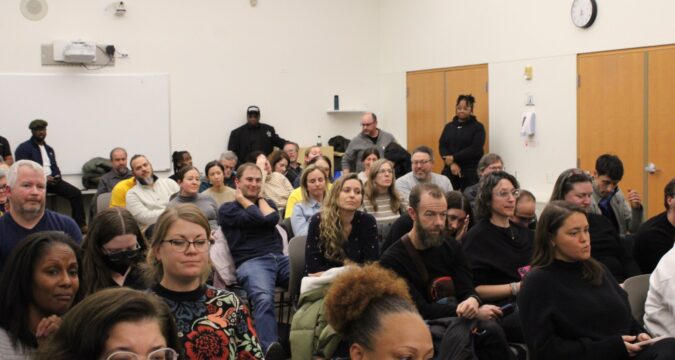
After the vote, a hush fell over the large audience at the Joseph E. Hill Early Childhood Center. In a turnabout of the mood in weeks passed, which varied from impassioned protests and public comment sessions where residents slammed the Board, applauded and heckled one another, attendees turned somber after the board failed to close a single school after four votes.
Esteban Quiñones, a member of the grassroots group The Legion of Data Nerds, a group of data experts who have been critical of the district’s school closure process, said while he wouldn’t have predicted the board’s vote, he wasn’t surprised by it either.
“It’s a little deflating… I think most of the community, whether they differ on the number, understand that we need to close at least one school…” he said.
“We were hopeful that there would at least be some compromise today, where if they can’t agree on two, then they would at least settle on one of the two,” Quiñones said.
Quiñones contested that the Board could not vote on the same measures after a new board member is appointed. The district’s administration did not respond to inquiries from Pioneer Press regarding whether the board could still vote in January, or later, to close a school at the end of this school year.
Oakton School parent Lindsey White, a frequent public commenter, said that the blame for the Board’s indecisiveness comes from the Board’s president, Anderson.
Before the start of the school year, the district’s administration floated a proposal to close up to four schools at the end of the school year.
“I think there’s going to be a large attempt to paint this as this all falls on the shoulders of the three board members who voted against closing one school only. But this is truly a failure of Board leadership, and an inability of that leadership to have effective conversations over this entire fall break,” White said.
White anticipated that when the Board has a chance to vote on school closures next year, the district’s financial problems will only be exacerbated, causing even more school closures to come down the pike.
The Evanston/Skokie School District 65 Board of Education convening on its Dec. 1, 2025 board meeting. (Richard Requena/Pioneer Press)
The district began its Structural Deficit Reduction Plan to cut millions of dollars in expenses in 2023, just months after Turner began her tenure at the district. A review of the district’s finances found that the district had a deficit greater than $10 million for two years prior under then-Superintendent Devon Horton.
Horton’s recently announced indictment from the federal government where he was accused of embezzlement during his tenure by hiring his friends to do little or no work for the district has further complicated trust with the district’s administration, the Board of Education and the public.

Sen. Dick Durbin demands answers from Homeland Security regarding U.S. citizens caught up in immigration raids
U.S. Homeland Security Secretary Kristi Noem recently claimed that no United States citizens have been caught up in Trump administration immigration raids.
But that is false, U.S. Sen. Dick Durbin said in a six-page letter to Noem that demands answers about the department’s detention of U.S. citizens and cites Chicago Tribune reporting.
“The disturbing reality is that many American citizens have been caught in the Trump Administration’s indiscriminate and violent immigration enforcement dragnet across the country,” Durbin wrote. “Masked, armed agents have aggressively arrested U.S. citizens; pushed them into unmarked vehicles; tazed, punched, and fired pepper balls at them; and, in some cases, wrongly detained them in immigration detention facilities for days, even weeks.”
A DHS spokesperson did not immediately respond to a request for comment.
Durbin’s letter cites a Tribune report on María Greeley, a Latina who had just finished working a double shift at the Beach Bar on Ohio Street in October when she said she was surrounded by three federal agents who grabbed her, forced her hands behind her back and zip-tied her.
María Greeley was detained by federal agents in October despite being a U.S. citizen. (Brian Cassella/Chicago Tribune)
Greeley, who was born at Advocate Illinois Masonic Medical Center and is adopted, carries a copy of her passport just in case she runs into federal agents.
During the encounter, Greeley said they told her she “doesn’t look like” a Greeley.
“They said this isn’t real, they kept telling me I’m lying, I’m a liar,” Greeley recalled. “I told them to look in the rest of my wallet, I have my credit cards, my insurance.”
Durbin’s letter also cites a Tribune report on Dayanne Figueroa, a woman who was on her way to get coffee before heading to work when she encountered heavily armed, masked federal agents making arrests on a residential street.
As Figueroa tried to drive through the 1600 block of West Hubbard Street in the West Town neighborhood on Oct. 10, an unmarked vehicle driven by federal agents collided with Figueroa’s car as it tried to speed away from a hostile crowd.
Dayanne Figueroa, a U.S. citizen, stands in her mother’s backyard in Northlake on Oct. 26, 2025. An unmarked vehicle driven by federal agents collided with Figueroa’s car as the agents tried to speed away from a hostile crowd, multiple videos reviewed by the Tribune show. (Eileen T. Meslar/Chicago Tribune)
Seconds after the crash, agents abruptly stopped their vehicle and got out with weapons in hand pointing at Figueroa, a U.S citizen. Agents then forcibly opened her door and pulled her out of the vehicle by her legs without identifying themselves, presenting a warrant or informing her that she was under arrest.
As bystanders yelled, “You hit her! We have it on video!” agents ignored the crowd and forced Figueroa into a red minivan and drove away.
Durbin disputed Noem’s contention about U.S. citizens citing press reports and his own office, which he said has documented “the reported detention of at least 40 U.S. citizens in Illinois alone between late August and early November 2025.”
He criticized the administration for its approach to immigration enforcement and for telling lies.
“Despite the fact that federal immigration agents are unlawfully sweeping up citizens in enforcement actions, and even though most Americans think President Trump’s immigration crackdown has gone ‘too far,’ the Trump Administration is doubling down on its made-for social media methods,” Durbin wrote. “In response to criticism, (DHS) representatives often have deflected, or issued defensive, misleading, or demonstrably false statements.”
Durbin closed his letter by requesting records showing the total number of U.S. citizens arrested during immigration enforcement activity since Jan. 20, related body-camera footage, complaints of wrongful arrests, and documents related to their training and records keeping practices, among other issues. He has requested a response by Dec. 16.

Democrat Mayor Asks For Federal Help After Mass Shooting At Child’s Birthday Party
Democrat Mayor Asks For Federal Help After Mass Shooting At Child’s Birthday Party
In a surprising act of political awareness, Democrat Mayor of Stockton, CA, Christina Fugazi, announced her intention this week to ask the federal government for manpower to stop rising crime after a horrific mass shooting at a child’s birthday party resulted in the deaths of 4 people and 11 wounded.
Though the investigation is ongoing, officials believe the attack was gang-related. Suspects remain at large.
“We’ve got approximately 5,000 gang members and 100 gangs in the city of Stockton,” Fugazi said. Stockton’s violent crime rate is currently 212% higher than the national average.
Heather Brent, a spokesperson for the San Joaquin County Sheriff’s Office, told reporters in a briefing that the shooting occurred around 6 p.m. Pacific Time at a banquet hall along the 1900 block of Lucile Avenue. On Sunday, Brent confirmed three children were among the four people killed. The victims were 8, 9, 14 and 21 years old.
“These animals walked in and shot children at a children’s birthday party,” San Joaquin County Sheriff Patrick Withrow said in a news conference Sunday. “None of us should stand for that.”
“And let us call this what it is,” Mayor Fugazi said in a Facebook post Sunday. “Gang violence exists in cities across the country, but this act was a pure act of terrorism. A complete, cowardly Terrorist Act!”
The Mayor admitted in press interviews that her city needed help, and that she was likely to ask for federal aid in the coming months.
The call for aid is a significant deviation for a blue city official. For the past year democrat mayors have acted with increasing hostility against the Trump Administration, proudly proclaiming their “resistance” to national law and order efforts including the deportation of illegal migrants.
The message being sent is impossible to misinterpret: Democrats would rather protect criminals than work with Trump to make cities safer. For if they accepted help, this would be an admission that progressive social policies don’t work. Mayor Fugazi seems desperate to make clear how bad the situation is, perhaps in fear of blowback from her own party.
“It’s babies we’re talking about, children,” Fugazi said. “We’re talking about a cake being cut as bullets are ringing out. The candles have been blown out, you’re cutting the cake, and then bullets are flying out, piercing, going through flesh and killing four people.”
She stopped short of calling for the deployment of the National Guard, but the Guard is not a fix-all solution, it’s essentially a barrier to protect other agencies from civil unrest and organized mobs. That said, Fugazi notes that she knows how significant her call for any aid from the Trump Administration is.
“We need more, we need more [federal manpower],” Fugazi said. “We want to be their pilot site for the United States of America. Come to Stockton, we’re here ready with our arms open for you to come into our city and let us lead them, the nation on how to do it right.”
“I am calling on the full power of the federal government not only to stop crime but also to give our community the tools to prevent crime before it starts…”
Is this the beginning of a sea change in how blue cities handle crime? Are they going to work with Trump for once instead of making life easier for criminals just to spite conservatives?
Tyler Durden
Tue, 12/02/2025 – 18:00

Dani Olmo anota pero se lesiona en victoria del Barcelona contra el Atlético de Madrid
Por TALES AZZONI
MADRID (AP) — El Barcelona incrementó su ventaja al frente de La Liga española al remontar y vencer el martes 3-1 al Atlético de Madrid, con Dani Olmo como autor del gol de la ventaja decisiva pero lesionándose el hombro en la acción.
Olmo se lesionó el hombro izquierdo en una caída despues de definir con un zurdazo a los 65 minutos para el segundo gol del Barça en el estadio Camp Nou. El Atlético había pegado primero con la diana de Álex Baena a los 19 minutos y Raphinha igualó para los locales a los 26.
Olmo mostró un dolor visible tras caer y no pudo celebrar el gol que dejó a los azulgranas cuatro puntos por delante del Real Madrid. El mediocampista ofensivo del Barça fue sustituido de inmediato y tuvo que ser asistido fuera del campo por el personal médico del club.
El partido de la 19ª jornada se adelantó porque los equipos jugarán en la Supercopa de España en enero. El Real Madrid y el Athletic Bilbao, que también jugarán en la Supercopa, se enfrentarán en Bilbao el miércoles.
“La confianza la vamos cogiendo partido a partido”, dijo Raphina. “Hoy sí, era clave. Pueden decidir una Liga puntos así”.
El Atlético, que ocupa el cuarto lugar, quedó a seis puntos del Barça después de 15 partidos. El equipo de Diego Simeone había ganado siete seguidos en todas las competiciones.
“El Barcelona hizo un gran partido. Tuvieron también ocasiones. Nosotros lo intentamos, pero infelizmente no fue posible”, comentó el arquero colchonero Jan Oblak.
“Cortamos una racha muy buena. A seguir adelante”, añadió.
El Barcelona sigue jugando en un Camp Nou que no puede llenarse a capacidad debido a la falta de permisos tras su vasta renovación.
Baena adelantó a los visitantes en un contragolpe tras recibir un pase en profundidad del argentino Nahuel Molina que sorprendió a la zaga azulgrana. El gol tuvo que ser confirmado después de una revisión de video por posible fuera de juego.
Raphinha igualó al capitalizar un buen pase filtrado de Pedri. El delantero brasileño superó a Oblak dentro del área antes de encontrar la red vacía.
El Barça pudo adelantarse a los 36 después de que Olmo fuera derribado por Pablo Barrios dentro del área, lo que provocó un penal, pero Robert Lewandowski envió su disparo desde el manchón muy por encima del travesaño en un inusual fallo para el veterano delantero polaco.
El argentino Thiago Almada rozó el empate para el Atlético a los 80 después de superar a un par de defensores rivales dentro del área. Ferran Torres, quien reemplazó a Olmo, selló la victoria del club catalán en el tiempo de descuento.
Ambos equipos perdieron jugadores debido a aparentes lesiones en la segunda mitad. El Barç vio salir a Pedri a los 74 y el Atlético sacó a Baena a los 63.
___
Deportes AP: https://apnews.com/hub/deportes

Huevo Fabergé de cristal hecho para la realeza rusa alcanza precio récord de $30,2 millones
LONDRES (AP) — Un raro huevo de cristal y diamante de Fabergé, elaborado para la familia gobernante de Rusia antes de ser derrocada por la revolución, rompió récords el martes al venderse en una subasta por 22,9 millones de libras (30,2 millones de dólares).
La Casa de Subastas Christie’s de Londres informó que el Huevo de Invierno, al que se ha comparado con la icónica Mona Lisa, es uno de los siete de estos opulentos ovoides que permanecen en manos privadas.
El huevo, de 10 centímetros (4 pulgadas) de altura, está hecho de cristal de roca finamente tallado, cubierto con un delicado motivo de copos de nieve elaborado en platino y 4.500 diminutos diamantes. Se abre para revelar una pequeña canasta removible de flores de cuarzo engastadas en joyas que simbolizan la primavera.
El precio de venta, que incluyó una prima del comprador, superó los 18,5 millones de dólares que se pagaron en una subasta de Christie’s en 2007 por otro huevo de Fabergé creado para la familia bancaria Rothschild.
El artesano Peter Carl Fabergé y su compañía crearon más de 50 de estos huevos para la familia imperial de Rusia entre 1885 y 1917, cada uno elaborado de manera única y con una sorpresa oculta en su interior. El zar Alejandro III inició la tradición al obsequiar un huevo a su esposa cada Pascua. Su sucesor, Nicolás II, extendió el regalo a su esposa y madre.
El zar Nicolás II encargó el huevo para su madre, la emperatriz viuda María Feodorovna, como regalo de Pascua en 1913. Fue uno de los dos huevos creados por la diseñadora Alma Pihl; el otro es propiedad de la familia real británica.
La familia real Romanov gobernó Rusia durante 300 años antes de ser derrocada durante la revolución de 1917. Nicolás y su familia fueron ejecutados en 1918.
Comprado por un comerciante de Londres por 450 libras cuando las autoridades comunistas, con problemas de liquidez, vendieron algunas de las joyas artísticas de Rusia en la década de 1920, el huevo cambió de manos varias veces. Se creyó perdido durante dos décadas hasta que fue subastado por Christie’s en 1994 por más de 7 millones de francos suizos (5,6 millones de dólares en ese momento). Se vendió nuevamente en 2002 por 9,6 millones de dólares.
Cada vez que el huevo se ha vendido, ha establecido un precio récord mundial para un artículo de Fabergé, dijo Christie’s.
Margo Oganesian, jefa del departamento de arte ruso de Christie’s, calificó el huevo como “la ‘Mona Lisa’ de las artes decorativas”, un magnífico ejemplo de artesanía y diseño.
Existen 43 huevos imperiales de Fabergé que han sobrevivido, la mayoría en museos.
___
Esta historia fue traducida del inglés por un editor de AP con la ayuda de una herramienta de inteligencia artificial generativa.

Editorial: City Council majority offers reasonable alternative to Mayor Brandon Johnson’s unacceptable budget
The calendar has turned to the final month, and, as was the case last year at this time, Chicago’s budget clock is ticking. Thanks to a pragmatic rump group of aldermen, though, there’s now reason for hope when it comes to the birthing of the 2026 budget.
As readers will recall, the budget chaos last year — which featured multiple rejections by aldermen of Mayor Brandon Johnson’s proposals for property tax hikes — led to the first downgrade of Chicago’s credit rating in a decade. It is an urgent priority, then, to forge a budget that preserves the city’s credit, now sitting just two uncomfortable notches above junk status.
The group of 26 aldermen (there could be more later) issued an alternative budget Tuesday to the mayor, and, with our pragmatic hats on, we liked most of what we read.
Last month, the City Council’s Finance Committee voted down the Johnson administration’s proposed revenue ordinance, the centerpiece of which is a return of the corporate head tax, a monthly per-job levy rightly derided as a disincentive to business hiring and investing in the city. The gang of 26, notably, are made up mostly of aldermen unaligned either with the most conservative council members or the most progressive, who usually are in the mayor’s camp.
We would call it an alternative budget, and no doubt others will, but the blueprint actually leaves much of what Team Johnson has proposed intact. Untouched is Johnson’s plan to boost the nation’s highest tax on cloud computing licensing payments — a major tax touching many Chicago businesses — by 27%. The aldermen’s plan even restores in full Johnson’s proposed tax on Uber and Lyft rides after the mayor’s team reduced its scope to win more support for its original budget plan.
But the justly loathed head tax at any level is gone — which, as we have said several times, is critical to signaling to the private sector that businesses are valued as job creators and substantial contributors to Chicago’s welfare, now and in the future. (Alas, the mayor on Tuesday continued to insist on the head tax despite staunch opposition from what appears to be a majority of the council.)
The aldermanic alternative scraps the mayor’s plan to borrow in order to finance $166 million in back pay owed to Chicago firefighters under a recent labor pact. Likewise, the plan rejects Johnson’s proposal to greatly reduce the advance payment to the city’s nearly insolvent pension plans; instead, the full $260 million contribution would be made.
Those wise provisions are aimed at staving off a future credit downgrade — a distinct possibility if the council were to approve the mayor’s budget. Standard & Poor’s Global Ratings, which downgraded the city earlier this year, cut its outlook on Chicago debt to negative in early November, shortly following Johnson’s budget release.
Scott Stantis provides his commentary in an editorial cartoon on the proposed alternative Chicago budget for 2026. (Scott Stantis)
Of course, all three of these major changes blow holes in Johnson’s budget, which had to plug a $1.2 billion 2026 deficit in the first place. So there has to be a combination of cost cuts and revenue increases to compensate.
Here, Team Compromise has settled on hiking the city’s monthly trash collection fee to $18 per household from $9.50 currently, with exemptions for senior citizens. That surely would be felt by lower-income homeowners, even if the fee still would lag behind what most other cities charge, but that seems a reasonable revenue measure in this moment of fiscal crisis, given the actual cost to the city of providing this service.
A revised sales tax on liquor sold other than at bars and restaurants would raise $24 million. Again, that seems reasonable, and crucially it protects bars and restaurants, which are struggling mightily at present.
As proposed by Ernst & Young in an audit of city government done earlier this year, the aldermen propose that city workers be asked to contribute by agreeing to very modest increases in what they pay for health care. They get some of the most generous health care benefits of any municipal workers in the entire country, so this is an extraordinarily reasonable demand to make of them in a spirit of shared sacrifice. Other cities run by Democratic mayors and lawmakers, as we’ve written before, have demanded far more sacrifice from their unionized workforces in solving their budget problems.
There’s more, of course. This proposal represents the broad outlines of a final agreement; it isn’t close to a finished product.
It’s not what we would do if we were in charge. There would be a far more substantial reorganization of city government, with the elimination of some departments and consolidation of others. Not to mention some careful trimming of clearly bloated management ranks.
But here’s the nature of eleventh-hour compromises. No one in any camp gets everything they want.
Much of Johnson’s budget would remain, most onerously the nosebleed 14% cloud-computing tax that, at $333 million in additional revenue, already puts most of the budget-balancing burden on businesses.
With this new alternative, a budget that was ideological in nature and correspondingly divisive can now at least return to the realm of reasonable negotiation. But that will require willing parties on the other side of the negotiating table, starting with the city’s chief executive.
We say to the mayor that this aldermen-revised budget does not call on him to significantly compromise his principles. On the contrary, it respects them.
Thus we call on the mayor and the rest of the council to leave ideological straitjackets (and the head tax) at the door and work to forge a balanced budget that spreads the sacrifice among all parties with a vested interest in Chicago’s future.
Submit a letter, of no more than 400 words, to the editor here or email letters@chicagotribune.com.

The AI Challenge: Palantir, The Pope, And Paul Kingsnorth
The AI Challenge: Palantir, The Pope, And Paul Kingsnorth
Authored by Peter Berkowitz via RealClearPolitics,
As artificial intelligence extends to every corner of contemporary life, it brings remarkable capabilities and opportunities – along with dangers that strike at the foundations of individual freedom, human dignity, and the common good.
Many incline to either extol AI’s blessings or condemn it as a curse. The savvy who learn from experience recognize that like all tools and contrivances, AI can be used for good and bad. Students of history grasp that as with numerous technological breakthroughs over the last 100 years – perhaps more so – AI promises unprecedented benefits while posing catastrophic peril to the future of human civilization.
What is artificial intelligence?
Three major artificial intelligence platforms – ChatGPT, Gemini, and Grok, all large-language models colloquially referred to as AI – to which I put the question agreed: AI consists in machines’ ability to perform tasks such as perceiving, learning, reasoning, problem-solving, and decision-making that normally require human intelligence. All three AI platforms stated that narrow or weak AI, the familiar and currently available form of artificial intelligence, executes one task well. The platforms added that computer scientists are pursuing general or strong AI (also known as artificial general intelligence or AGI) which, like a human being, would understand, learn, and apply knowledge across a wide range of tasks. Gemini and Grok noted – and ChatGPT concurred in response to my follow-up query – that researchers contemplate a third kind, superintelligent AI (also called artificial superintelligence or ASI), that would surpass human intelligence in virtually every aspect and in almost all ways.
To my initial inquiry, Grok volunteered observations on “common misconceptions.” AI can already accomplish wonderful things: write essays, computer code, music, legal briefs; pass bar exams, medical licensing tests, and Ph.D.-level science exams; generate photo-quality images and realistic videos; and hold conversations that feel human. But, reported Grok with seemingly sly modesty, “AI is not ‘alive’ or conscious (as far as we know in 2025).” Still, Grok acknowledged – as if describing a mental-health patient – AI hallucinates, errs, and lacks real-world grounding. And Grok helpfully summarized: “Artificial intelligence today is software that mimics cognitive abilities through massive statistical learning, not through human-like consciousness or general reasoning from first principles – yet it’s already transforming almost every industry.”
As it promises to sweep across and remake not only industries but also moral and political life, AI’s perils – some observable, some looming – come into focus.
AI provides a crippling crutch. Reliance on artificial intelligence, especially among the young, stunts creativity and judgment. Adults’ use of AI as a substitute for friends and therapists erodes empathy and human connection.
AI strains resources and damages the environment. The colossal data centers that handle artificial intelligence’s massive computational demands consume huge amounts of electricity and require immense quantities of potable water to prevent overheating.
AI diminishes human control and creates acute vulnerabilities. Artificial intelligence involves not one big machine but rather incorporates millions of interconnected devices distributed over vast geographical areas. As AI supports a growing number of crucial operations – government, national security, energy, telecommunications, transportation, health, finance, and more – the nation will increasingly depend on prodigious computer networks whose operations and output computer scientists can’t fully anticipate or account for.
AI displaces workers and diminishes human capabilities. Artificial intelligence will take over numerous jobs at which it outperforms the workers it has made unnecessary, while carrying out other activities more cheaply and efficiently but less responsibly than the professionals who will lose their livelihood. Skills and qualities essential to citizenship and human flourishing – not least reading, writing, and judiciousness – will atrophy.
AI blurs true and false. Able to present deepfakes as real and real images as deepfakes, artificial intelligence undermines the reliable information and shared reality on which free and democratic government depends.
AI facilitates the concentration of wealth and power. Government’s growing reliance on artificial intelligence entwines the public sector and the private sector, shifting influence and control from elected officials to giant corporations that write computer software, host clouds, and manage physical infrastructure.
And AI opens the door to doomsday scenarios once confined to science fiction. Artificial superintelligence incorporated into robots and weapons systems may conclude based on calculations that it conceals from the human beings who built it that wiping out this people, that nation, or these civilizations will yield the greatest good for the greatest number.
This brief parade of horribles – potential as well as actual – underscores the need for serious thinking about the AI challenge. Eminent figures from high-tech, religion, and the world of letters have taken notice and stepped up – to focus attention, frame the issues, and summon to action.
On Nov. 11, accepting the Hudson Institute’s Herman Kahn award, Palantir co-founder and CEO Alex Karp argued that AI was central to America’s national security. Turbulence lies ahead because technology “is going to change everything politically” and “there are dangers in AI,” warned Karp. To navigate the turbulence, he counseled, it is urgent to “understand and embrace the superiority of America and its culture.”
Echoing Abraham Lincoln, Karp stated that the United States is special because it was founded on the conviction that “the rights we have in this country are inalienable and they are given to us by God.” It follows, according to Karp, that no machine, however intelligent, can possess what God alone has the power to confer – an essential dignity expressed in the rights inherent in all persons.
The superiority of America’s moral and political principles, however, has never been enough to fend off the enemies of freedom. The United States preserves its superiority also thanks to prowess in “controlling the violence,” argued Karp. Americans earn the privilege of respecting the rule of law at home by prevailing on the battlefield abroad.
China, in Karp’s view, presents the primary threat to American freedom. Were the Chinese Communist Party to succeed in its quest for AI dominance, the CCP would decisively infuse international relations with authoritarian norms and comprehensively reshape world affairs to serve authoritarian interests. Consequently, argued the Palantir CEO, the United States must persevere – guided by the nation’s founding commitment to basic rights and fundamental freedoms – as the world’s “dominant technological culture in the world.” That requires excelling at AI.
A few days before Karp’s speech, an address by Pope Leo XIV was read aloud at the Builders Artificial Intelligence Forum held at the Pontifical Gregorian University. The pontiff praised the participants – organizers, researchers, entrepreneurs, and clergy – who had gathered in Rome “to ensure that emerging technologies remain oriented toward the dignity of the human person and the common good.” This called for examination of “not merely what AI can do, but who we are becoming through the technologies we build.”
The AI challenge represents, for the pope, the latest round in the age-old “dialogue between faith and reason.” Although a new technology, AI, “like all human invention, springs from the creative capacity that God has entrusted to us (cf. Antiqua et Nova, 37),” he stressed. “This means that technological innovation can be a form of participation in the divine act of creation.” Like all human invention, AI “carries an ethical and spiritual weight, for every design choice expresses a vision of humanity.” To foster wise choices, the pope summoned “all builders of AI to cultivate moral discernment as a fundamental part of their work – to develop systems that reflect justice, solidarity, and a genuine reverence for life.”
In contrast to high-tech titan Karp and the Bishop of Rome, both of whom want to harness AI to advance individual freedom, human dignity, and the common good, author Paul Kingsnorth maintains that artificial intelligence represents an all but unmitigated evil. His new book, “Against the Machine: On the Unmaking of Humanity,” has little to say directly about AI. But it offers rich psychological, neurological, cultural, autobiographical, ethical, political, and theological explorations of modernity’s internal dynamics, which, he believes, culminate in AI’s transformation of human beings into its servants. Kingsnorth’s explorations form an elaborate lamentation on what Nietzsche in the 19th century called “the death of God” and the German sociologist Max Weber in the 20th century described as “the disenchantment of the world.” They also recount Kingsnorth’s long, inspiring journey – intellectual, moral and political, religious – in search of a way amid modern technologies’ seductions and ructions to live in harmony with our essential humanity. His reflections are at once lyrical and erudite, illuminating and harrowing, compelling and overwrought.
By “the Machine,” Kingsnorth means not in the first place technological progress or politics dedicated to it, but rather a spiritual crisis born and bred in, and transmitted globally by, the West. The modern scientific spirit, he argues, manifests an instrumental orientation toward the natural world that relentlessly reduces human beings to natural objects, and therefore subject to control and manipulation no more and no less than any other particle or complex of particles. Left and right today, Kingsnorth maintains, serve the Machine’s degradation of human beings to mere things: Postmodern progressives work furiously to dissolve traditional constraints and abolish natural limits while pro-free-market conservatives spread the Machine’s ineluctable logic and dehumanizing imperatives around the world.
All is not lost, though, for Kingsnorth. Notwithstanding his darkest moments, he exhorts readers to “Remain human despite it all.”
Americans may even turn matters to the nation’s advantage by mustering the wherewithal to fashion an education that acquaints students with America’s roots and the West’s enduring heritage: inalienable rights and the forms of government that secure them, human dignity, and the common good. Such an education would greatly improve the nation’s chances of clarifying AI’s blessings and curses and putting today’s most astonishing and terrifying technology in the service of properly human purposes.
Tyler Durden
Tue, 12/02/2025 – 17:40
https://www.zerohedge.com/ai/ai-challenge-palantir-pope-and-paul-kingsnorth
Venezuela aprueba plan para derogar adhesión al Estatuto de Roma, base de Corte Penal Internacional
Associated Press
CARACAS (AP) — La Asamblea Nacional de Venezuela, de abrumadora mayoría oficialista, aprobó el martes en una primera discusión un proyecto para derogar la ley que ratificó la adhesión al Estatuto de Roma, el instrumento constitutivo de la Corte Penal Internacional (CPI), que apunta al retiro del país sudamericano de ese tribunal global.
La iniciativa, cuyo contenido se desconoce, entraría en vigor luego de ser revisada y aprobada en una segunda discusión legislativa —en una fecha aún por determinar— y ser promulgada por Maduro y publicada en la Gaceta Oficial.
“Hay una posición sesgada de parte de la Corte Penal Internacional y por eso estamos proponiendo ante esta Asamblea la derogatoria de este instrumento”, dijo el diputado oficialista Roy Daza al presentar el proyecto en el legislativo unicameral.
Venezuela ratificó el Estatuto de Roma en junio de 2000 durante el mandato del entonces presidente Hugo Chávez (1999-2013). La CPI ejerce jurisdicción sobre los crímenes cometidos en el territorio de Venezuela o por sus nacionales a partir del 1 de julio de 2002.
La CPI es un tribunal de última instancia que investiga crímenes de guerra, de lesa humanidad y otros delitos graves cuando las naciones no pueden o no quieren hacerlo, un sistema conocido como complementariedad.
El Estatuto de Roma establece también los pasos que un Estado miembro debe seguir si desea retirarse de la corte. El Estado parte debe informar al secretario general de las Naciones Unidas y el retiro entra en vigor un año después de la recepción de la notificación. Anunciar la retirada, sin embargo, no libera al país de sus deberes bajo el tratado.
La aprobación del proyecto legislativo se produjo un día después de que el gobierno de Maduro acusó a la Fiscalía de la CPI de “desentenderse” de sus deberes luego de que el fiscal adjunto de La Haya, Mame Mandiaye Niang, anunciara el cierre de su oficina en Caracas.
En 2023 el gobierno de Maduro y la Fiscalía de la CPI acordaron abrir una oficina en Venezuela con el propósito de facilitar la investigación de presuntos crímenes de lesa humanidad que pesa sobre la administración de Maduro por la actuación de la fuerza pública en las protestas de 2017.
El fiscal adjunto de la CPI indicó el lunes que se tomó la decisión de cerrar la oficina por una falta de “progreso real” en la “complementariedad” con el gobierno venezolano. Ese recinto permitía a la organización trabajar de manera más cercana con las autoridades del país, de modo que Venezuela pudiese “hacer más para cumplir sus obligaciones” en el marco del Estatuto de Roma.
La Fiscalía de la CPI resaltó que la investigación “permanece activa” y un equipo de esa instancia judicial seguirá trabajando desde La Haya.
El canciller venezolano Yván Gil, en un comunicado divulgado el lunes en su canal de Telegram, denunció que la Fiscalía de la CPI “no mostró el más mínimo compromiso ni espíritu de cooperación” y “nunca designó personal para ocupar dichos espacios”.
“Tampoco formuló sus aportes y recomendaciones a las diversas iniciativas de Venezuela, desentendiéndose irresponsablemente de las responsabilidades previamente asumidas. Su agenda en el país fue muy clara: desentenderse y no hacer nada para luego instrumentalizar la justicia con fines políticos”, agregó el escrito.
La CPI tiene una investigación abierta sobre la violencia que siguió a los comicios venezolanos de 2017, pero por ahora no ha emitido ninguna orden de detención.
Khan anunció a fines de 2021 que abriría una investigación tras una prolongada pesquisa preliminar y una solicitud de investigación formal presentada en 2018 por Argentina, Canadá, Colombia, Chile, Paraguay y Perú.

Firefighters respond to two house fires in Aurora
Aurora firefighters responded to two separate house fires last week, one of which left a single-family home uninhabitable, according to a news release from the Aurora Fire Department.
On Nov. 27 at around 7:34 p.m., firefighters responded to a reported structure fire in the 1500 block of Karen Court in Aurora, the news release said. Upon arrival, firefighters saw flames along the side of a two-story, single-family home and reported heavy smoke inside.
Crews deployed an initial hose line to control the exterior flames, while notifying additional units arriving of possible fire extension into the attic, the release said. The fire was upgraded to a full still alarm, bringing additional resources to the scene.
Additional crews then arrived and deployed a second hose line inside to address interior fire, the release said. Firefighters searched the structure and confirmed no occupants were inside, and then worked to ventilate and overhaul the affected areas, the release said.
The fire was brought under control, and utilities were secured by ComEd and Nicor, the release noted.
A total of four engine companies, two truck companies, three medic units and two chief officers, for a total of 26 personnel, responded to the scene, per the department.
No injuries were reported, the news release said, but the home was deemed uninhabitable due to fire and smoke damage. Victim Services assisted the displaced family, officials said.
Then, the next day, in the late evening, firefighters responded to a chimney fire in the 200 block of Lawndale Avenue in Aurora, per the release. Responding crews located a small fire in a chimney chase and contained it before it extended into the attic or surrounding structure, officials said.
The fire was extinguished, the home was ventilated, and there were no reported injuries, the department said.
In light of the two fires, Aurora Fire Department Deputy Chief Kevin Nickel, in the news release, noted that the winter months are a busy time for house fires as individuals use heating equipment — fireplaces in particular. He encouraged residents to have their fireplaces “professionally inspected and cleaned, and always make sure the flue is clear before lighting a fire.”
Both fires are still under investigation by fire department investigators, per the news release.
https://www.chicagotribune.com/2025/12/02/two-fires-aurora-thursday-friday/