Category: News

Holiday gifts from museum shops let you wrap a bow on Chicago culture
For Chicagoans who dread the frenzy of holiday shopping, there’s a calmer alternative. Instead of heading to mall, you can head to a museum.
The city’s cultural institutions offer festive shopping options that you may find inspiring, and you likely won’t find in big-box aisles. Museum gift shops brim with festive cards, clever stocking stuffers and unique items that carry real stories.
Plus, it’s a chance to support the organizations that make Chicago a cultural hub.
Admission is not required to visit these museum shops, but you may also enjoy browsing the galleries for things that aren’t for sale.
Art Institute of Chicago
The AIC’s two museum shops are filled with art‑inspired gifts that incorporate masterpieces into everyday life.
For kids, show a little love for sweet home Chicago with a Chicago flag plush ($28) or the colorful “Chicago ABCs” board book ($14.99). The plush green lions ($25), modeled after the museum’s Michigan Avenue guardians, can even be adorned with removable holiday wreaths.
For fashion and accessories, the Tiffany Hartwell Memorial Window silk scarf ($45) and Tiffany stained-glass earrings ($40) transform Art Institute icons into wearable works.
Desk décor lovers can protect their workspace with a bronze lion paperweight ($75).
Art fans can keep their feet cozy with playful socks featuring masterpieces such as Edward Hopper “Nighthawks” ($16), or hold their eyeglasses safe with the Claude Monet “Water Lilies” eyeglass case and cloth ($24).
Gift shops are located at the Michigan Avenue entrance and the Modern Wing entrance.
111 S. Michigan Ave.; shop.artic.edu
Museum of Contemporary Art
For the basketball fan who also loves art, the MCA X Bulls crew sweatshirt ($110) could be a slam dunk. Designed by Chicago artist Cody Hudson, this piece unites two city brands — the Bulls and the Museum of Contemporary Art.
Pop art lovers may gravitate toward the Haring Radiant Baby & Barking Dog hoodie ($120). Inspired by Keith Haring’s original Pop Shop designs, this heavyweight cotton blend hoodie features his playful artwork on both front and back, and has a kangaroo pouch.
For a unique accessory, try the Isabelle Gougenheim X MCA Good Vibes silk scarf ($240).
Design enthusiasts might appreciate the Lớp lamp ($195), created by French designer Thomas Vincent. Its layered acrylic planes and hovering sphere create an illusion of motion when lit.
And for the collector who values both art and activism, Yoko Ono’s limited‑edition “Add Color Where the World Needs Peace” print ($515) offers a chance to own a numbered work authenticated by the artist herself.
220 E. Chicago Ave.; mcachicagostore.org
Shedd Aquarium
Comfort seekers can cozy up this winter with beluga whale pajama pants ($45) or sea otter plush slippers ($37). Seal the deal with a cuddly plush moray eel ($23).
Great Lakes coasters ($10) celebrate regional ecosystems with artwork by Chicago’s own Bagman Studios.
And if you have a marine creature lover in your life, a Shedd Aquarium animal encounter offers a chance to go behind the scenes and get up close with animals such as penguins, belugas, sea lions and sea otters. Experiences start at $99.95 per person, depending on the animal.
1200 S. DuSable Lake Shore Drive; sheddaquarium.org
Glessner House
When you visit the Glessner House Museum in winter, the venue in the Near South Side’s Prairie District is dressed up in its Gilded Age holiday best. The in-museum shop has gifts that celebrate Chicago’s architectural heritage and design traditions.
Choose from coaster sets featuring tiles from the house’s fireplaces ($14.50) or inspired by carved wood furniture details ($14.50), both adding a touch of history to your coffee table.
A set of William Morris notecards ($18.95) emblazoned with eight of the designer’s iconic patterns used throughout the house are new for 2025.
Bookworms and Chicago history buffs may appreciate the book “Clarke House: Chicago’s Oldest Building” ($14.95), chronicling Chicago’s oldest surviving home as it approaches its 190th anniversary in 2026. And for architecture enthusiasts, the museum’s own publication “Louis Sullivan: An American Architect” ($39.95) offers fresh insight into the legendary designer’s work and legacy.
1800 S. Prairie Ave.; glessnerhouse.org
National Museum of Mexican Art
At Tienda Tzintzuntzan, or “place of the hummingbird”, the National Museum of Mexican Art’s gift shop retail manager, Raquel Juarez, curates treasures directly from artisans across Mexico.
Highlights include a paper‑mâché doll by Brittani Walker Morales of Guanajuato ($200) and a Capulineado vase from Michoacán ($100), decorated with intricate dotted patterns.
From Chiapas, handwoven Huichol dresses showcase traditional craftsmanship. The green dress ($65) and white huipil dress ($140) are both wearable works of art.
Everyday items get a cultural twist with a ceramic mug from The Found ($18.50) and leather bolsas, or bags, from Guerrero ($72).
Collectors may be drawn to the wooden alebrijes from Oaxaca — fantastical creatures carved and painted in vibrant colors, including owls ($420-$450), a coyote ($320) and a jaguar ($400).
1852 W. 19th St.; nationalmuseumofmexicanart.org
Griffin Museum of Science and Industry
Spark curiosity and wonder with science‑themed gifts, including a detailed U‑505 Submarine build-it-yourself model ($123), celebrating one of the museum’s most iconic exhibits, a type IXC submarine launched by the German Kriegsmarine on May 24, 1941.
Night Sky Playing Cards ($5.95) teach constellations while you play, and the Pocketscope ($35) is made for magnifying on the go.
The desktop Foucault Pendulum ($45) is a reminder that the Earth is indeed still spinning.
5700 S. Lake Shore Drive; griffinmsi.org
Chicago Architecture Center Design Store
The Chicago Architecture Center’s multicolored Kinetics Necklace ($168.95) has handmade paper designs by Takara Beatheagudell. (Emmelly Aldave, Chicago Architecture Center)
Design meets “The Bear” with the Franklin Barstool ($675), a custom piece from Navillus Woodworks’ Franklin Dining series, the same woodworkers that outfit the fictional Chicago restaurant aspiring for a Michelin star in the hit television series.
Chicago skyscraper playing cards ($24.95) showcase 56 buildings that illustrate our city’s architectural evolution from the 19th century to today.
When you buy the multicolored Kinetics Necklace ($168.95), with handmade paper designs by Takara Beatheagudell, you’ll also help support area women reentering the workforce.
Art created by locals is another option. The “JazOnVinyl” print ($275) by artist Jaz captures Chicago, movies, music and pop culture in a nostalgic 24-inch-by-36-inch illustration. And Nick Ulivieri’s “Surge” print ($400) of the same size, available exclusively at the CAC Design Store, offers a glimpse of the city through his lens.
111 E. Wacker Drive; architecture.org
Chicago skyscraper playing cards ($24.95) showcase 56 buildings. (Chicago Architecture Center)
American Writers Museum
For the bookworm in your life, the gift shop at the American Writers Museum offers literary‑inspired ideas.
Carry your passion for writing everywhere with a typewriter bag ($45), a nod to the bygone tool of authors past.
The “A book a day keeps reality away” mini cross stitch kit ($18.95) could serve as a stocking stuffer for crafty readers.
And for those who love quirky accessories, the Tiniest Book Club Earrings ($22.95) featuring the covers of iconic American novels are a way to wear your love of literature.
180 N. Michigan Ave.; americanwritersmuseum.org
Amy Bizzarri is a freelance writer.
https://www.chicagotribune.com/2025/12/04/chicago-museum-gift-shops/

America’s Great Build-A-Thon Comes With A Price Tag
America’s Great Build-A-Thon Comes With A Price Tag
Authored by David Parsons via BondVigilantes.com,
The United States is on the brink of an industrial transformation that could redefine its economic trajectory. Inward investment is surging, driven by a wave of new manufacturing plants, onshoring and reshoring initiatives, and a parallel boom in data centre and power generation construction. This is not incremental change; it is a structural shift that will demand vast amounts of labour, raw materials, and productive capacity. The question for investors and policymakers is whether this investment renaissance will reignite inflationary pressures which might lead to a newly reconstituted Federal Reserve signalling a willingness to run the economy “hot”.
The scale of manufacturing investment alone is extraordinary. Semiconductor fabrication plants, battery gigafactories, and advanced automotive plants are being announced at a pace unseen in decades. Industry estimates suggest that annual construction outlays for manufacturing could exceed an estimated $250 billion in both 2026 and 2027, as companies seek to localise and secure supply chains. These projects are not confined to the technology sector; they span electronics, pharmaceuticals, and heavy industry, creating a broad-based surge in demand for skilled labour and specialised materials. This manufacturing wave is additive to the already intense pressure from hyperscale data centre construction, which has become a defining feature of the digital economy. With AI and cloud computing hyperscalers expected to drive driving unprecedented demand for processing power, data centre investment is projected to account for half of the projected $1.2 trillion global data centre capital expenditure by 2029, while power generation projects will similarly scramble to keep pace with the energy requirements of this new infrastructure which are forecast to more than double over the next 10 years.
Source: DC Byte, Bloomberg NEF. Reported as of 15/04/2025. IT capacity is the amount of power a data centre needs for computing, network and storage
The implications for the labour market are huge. The construction sector already faces a shortfall of nearly half a million workers, and the competition for skilled trades, engineers, and project managers will only intensify as manufacturing and technology projects converge. Wage inflation is inevitable. In hotspots where multiple megaprojects collide, wage growth could easily outstrip national averages, creating ripple effects across the broader economy. Immigration constraints and demographic trends exacerbate the problem, and will leave employers with few options beyond aggressive pay increases and retention incentives. This is not a temporary squeeze; it is a structural challenge that will persist as long as the investment pipeline remains full.
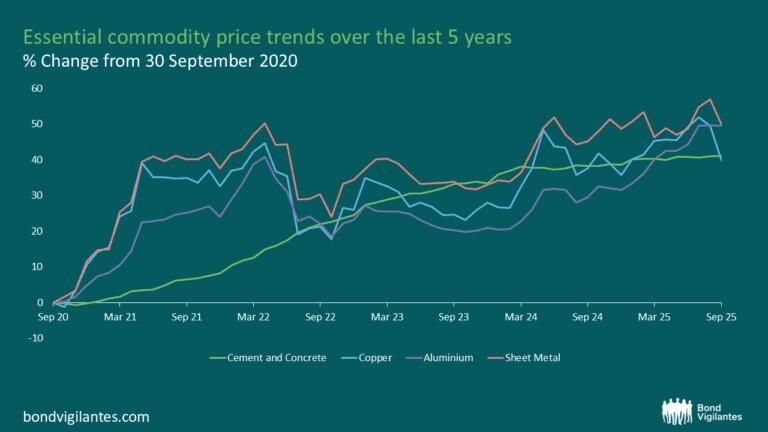
Raw materials tell a similar story. Steel, aluminium, copper, and cement are all set to experience sustained demand shocks as the buildout progresses. Tariffs and supply chain fragmentation have already pushed input costs higher, and the synchronised surge in construction activity will amplify these pressures. Equipment lead times are lengthening, and logistical bottlenecks remain unresolved. The result is a cost base that is not just rising but likely to sharply accelerate, with regional disparities adding complexity for project planners and investors alike.
Source: Bloomberg, Bureau of Labour Statistics
Overlay this with monetary policy, and the picture becomes even more concerning . The Federal Reserve has signalled a more accommodative stance for some time, tolerating inflation above its long-term target in the interest of sustaining growth and employment. This willingness to let the economy run hot serves a dual purpose: lower rates support the industrial build-out and, as a by-product, higher inflation erodes the real value of the US government’s $38 trillion debt mountain. For policymakers, this is a calculated risk; for bond investors, it is a warning shot. A period of elevated inflation may be politically palatable and even strategically desirable, but it comes at the expense of real returns and introduces volatility into rate expectations. If the Fed cuts too aggressively while fiscal incentives continue to flow, the combination of easy money and surging real-economy demand could create a perfect storm for inflation in 2026 and 2027.
The broader macroeconomic consequences are clear. A synchronised boom in manufacturing, data centres, and power generation will strain every aspect of productive capacity. Labour markets will tighten further, wages will rise, and material costs will climb. These sector-specific pressures will bleed into headline inflation, challenging the narrative of a smooth return to price stability. For investors, the message is simple: the risk premium for inflation is back, and positioning for real assets, pricing power, and inflation-linked instruments will be critical. For policymakers, the challenge is to harness the benefits of reindustrialisation without igniting an inflationary spiral that undermines financial stability.
America’s great build-out will test the limits of labour supply, material availability, and monetary policy flexibility. If the Fed remains tolerant and the economy runs hot, the debt mountain may shrink in real terms—but so too will the purchasing power of every dollar in circulation. For bond investors this industrial renaissance may be good for growth, but it could also be the spark that reignites inflationary fire.
Tyler Durden
Thu, 12/04/2025 – 06:30
https://www.zerohedge.com/economics/americas-great-build-thon-comes-price-tag
Review: The storytelling less than magical in ‘100 Nights of Hero’
“Are you ready? Then we shall begin.” This narration, over an image of three moons hanging in the sky, begins Julia Jackman’s “100 Nights of Hero,” which she adapted from Isabel Greenberg’s 2016 graphic novel, and directed. It signifies that we’re in for a level of heightened, self-reflective fantasy storytelling, and in fact, the revolutionary power of storytelling itself is the beating heart of this film.
Jackman takes her own stylistic approach to “100 Nights of Hero” without replicating Greenberg’s aesthetic. You can almost immediately tell this fantastical film has a feminine touch in its colorful, highly stylized, modernist look and sound; there’s a certain girlish wit in the vibrant pink hues and the centering of women’s narratives within the mannered compositions. The setting is an ancient, secluded, cult-like community (vaguely medieval England) that reveres its god, Birdman (Richard E. Grant, in essentially a cameo), and fashions a patriarchal society around the usual tenets: controlling women, producing heirs.
Young bride Cherry (Maika Monroe) is married to Jerome (Amir El-Masry), and though he claims they are trying to have a baby, he is not. Too bad she’s the one who will suffer the consequences of failing to get pregnant.
Soon, Jerome’s hunky man friend Manfred (Nicholas Galitzine) turns up and the two men engage in a cruel bet. Manfred has 100 nights alone in the castle to seduce Cherry while Jerome is away on business. If he fails, he has to find a baby for Jerome, who is uninterested in sex with women. If Manfred succeeds, he gets the castle. But if Cherry strays, she hangs. It’s a lose-lose situation for the wife, as expected.
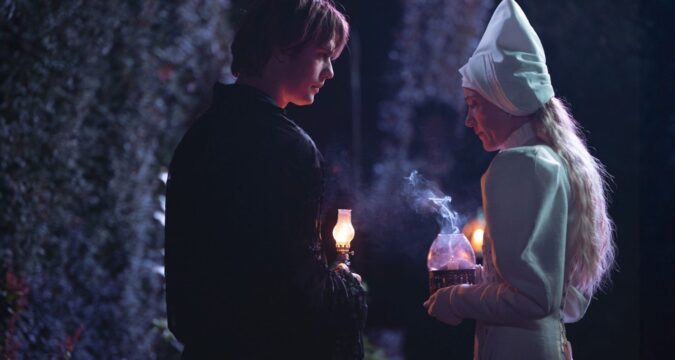
Cherry has one person on her side, Hero (Emma Corrin), her cunning maid, who distracts Manfred from his goal by telling the story of three sisters, who engage in the “sinful, wicked and absolutely forbidden” (for women) pleasure of reading and writing. One of the sisters, Rosa (Charli XCX), is married off to a merchant who soon discovers her “witchcraft.”
Every night, Hero tacks on a new chapter of the three sisters, their story interwoven with Cherry and Manfred’s, while we discover that Hero is a part of the League of Secret Storytellers, women who collect stories and weave them into tapestries, their women’s work hiding their true intention while the stories spread from ear to ear.
The issues here are basic and elemental: the trials and tribulations of sex, marriage, fidelity and procreation. Though brides are trapped in castles and men in bird masks want to burn the witches, this story is not so out of our time or place. The pressure to “produce an heir” lives on in current pro-natalist arguments and “trad wife” discourse, and the control of women’s bodies — and minds — is required to fulfill the goal of producing more and more babies. This tale doesn’t seem so ancient or fantastical at all.
However, there’s little nuance to the storytelling of “100 Nights of Hero” itself. It feels a bit like “feminism for ‘tweens,” a young-adult approach to explaining how the liberation of minds is necessary for the liberation of women’s bodies — it is blunt and obvious, which is to the film’s detriment. There are few gaps to fill, or threads we pull together on our own, and its quirky, opulent aesthetic can only sustain the exercise for so long.
As our interest wanes over the course of this 90-minute modernist fable, Manfred starts to slip away — natural for a folktale that seeks to decenter men. Unfortunately, Galitzine’s screen presence is just too powerful to ignore, and we notice his absence. Perhaps it’s that Manfred is so swaggeringly confident, Galitzine’s embodiment of fluid sensuality standing in stark contrast to Monroe’s stiff, anxious, breathy performance as Cherry.
The most powerful image of the film, which is made up of interesting images, is of Galitzine covered in blood as he hauls a freshly killed stag home for lunch. If the film is about women discovering their own pleasure and sensuality outside of men, they shouldn’t have made Manfred the most appealing and earthy character on screen.
While “100 Nights of Hero” sports compelling actors and beautiful visuals (often best seen in montage, animated by editing), its storytelling about the power of storytelling is unfortunately less than riveting. The urgency of the message remains, but the delivery leaves something to be desired.
Katie Walsh is a critic for Tribune News Service.
“100 Nights of Hero” — 2.5 stars (out of 4)
MPA rating: PG-13 (for sexual material, some bloody images and language)
Running time: 1:30
How to watch: In theaters Dec. 5
https://www.chicagotribune.com/2025/12/04/review-100-nights-hero/

Around the Southland: Holiday entertainment, events on tap throughout the area
Career Day at Moraine Valley draws emergency responder candidates
Fire Safety/First Responders Career Day drew more than 100 high school students from 10 local high schools to Moraine Valley Community College in Palos Hills, allowing them to learn about a public service career.
Students from Eisenhower, Reavis, Richards, Shepard, Oak Lawn Community, Stagg, Sandburg, Argo Community, Andrew and Evergreen Park Community high schools participated in the event, which was coordinated by Moraine Valley Fire Science Program coordinator and instructor Andrew Hufnagl and Moraine Area Career System assistant director Suzanne Kendryna.
Participants rotated through a series of stations that demonstrated techniques and operations, as well as a side-by-side sprinkler burn room. The college’s Fire Academy class led the sessions. MACS partners with the college to help local high school students explore career paths and make decisions about their future.
Metra hosts Toys for Tots drive Dec. 9
For the 14th year, Metra is teaming up with the U.S. Marine Corps Reserve Toys for Tots Foundation to collect monetary donations and new, unwrapped toys during the morning rush hour Dec. 9 at all five downtown Metra stations.
Metra employees and Marines will receive the donations at Millennium Station, Van Buren Station, Chicago Union Station and Ogilvie Transportation Center.
This year, Amtrak employees will join the toy drive. Last year’s event brought in nearly 2,900 toys and $9,500 to the campaign, allowing the Marines to donate more than 97,000 toys to more than 78,000 children in the Chicago area.
Master Chorale concert set in Homewood
The Chicago Cargoyle Brass Ensemble and organist Mark Sudeith will join the South Holland Master Chorale for a Holiday Joy & Fanfare concert at 4 p.m. Dec. 7 at St. John Neumann Parish, 17951 Dixie Highway in Homewood.
The 70-member chorale will perform a variety of holiday favorites, hymns and contemporary works. Audience members will be invited to sign several traditional Christmas carols, including “Silent Night,” which closes the concert. Admission is free but donations will be accepted. Details are at 708-210-2913 or southhollandmasterchorale.org.
Children with illnesses get boost from women’s organization
Team Nicholas recently received $15,000 from 100+ Women Who Care of Will County. On hand for the donation, from left, are Kelly Baltas, corporate giving and events coordinator, and Laura Valencik, director of guest and volunteer services, both at Silver Cross Hospital in New Lenox; Team Nicholas founder Joanna Veghts; and Maribeth Carlson, founder of 100+ Women Who Care of Will County. (100+ Women Who Care of Will County)
Members of 100+ Women Who Care of Will County recently chose Team Nicholas to receive $15,000, thanks to $10,000 collected from the group and a 50% matching donation from the Richard M. Schulze Family Foundation.
Team Nicholas brings joy, comfort and smiles to children with cancer and other critical illnesses in the Chicago area. The organization provides wish list items such as arts and crafts, toys, games and Legos. Silver Cross Hospital in New Lenox has been added to its coverage area.
At quarterly meetings, 100+ Women Who Care meet and choose three random charities. After brief presentations on each, members vote on a winning charity and write a $100 check to it that night. The group’s next meeting is 6 to 7 p.m. Feb. 10 at Coom’s Corner, 1225 E. Ninth St. in Lockport.
‘Christmas Story: The Musical’ hits stage in Chicago Heights
The Drama Group presents “Christmas Story: The Musical: at 7:30 p.m. Dec. 5, 6 and Dec. 11-13 and at 2 p.m. Dec. 7, 13 and 14 at 330 W. 202nd St. in Chicago Heights.
The show tells the story of the movie by the same name, featuring young Ralphie Parker, who just wants a Red Ryder BB gun for Christmas. Tickets cost $19 for students, $23 for seniors and military and $25 for adults; all tickets include a small service fee. They are sold at dg.booktix.com or by calling 708-755-3444.
Chamber plans Merry Magic Mixer
Business leaders, city officials and community partners are invited to gather for an afternoon of celebration at Merry Magic Mixer, set for 3 p.m. Dec. 11 at Wind Creek Chicago Southland, 17300 S. Halsted St. in East Hazel Crest.
During the annual holiday tradition, presented by the Chicago Southland Chamber of Commerce, attendees are encouraged to bring an unwrapped toy for the City of Harvey’s Christmas toy drive and a nonperishable food item for BEDS Plus. Raffles, music, hors d’oeuvres will be included. Sign up online at business.chicagosouthlandchamber.com/calendar or call 708-957-6950.
Enjoy tea by a Christmas tree at The Center
Tickets are being sold for Christmas Around the Tree teas Dec. 9 to 13 at The Center, 12700 Southwest Highway in Palos Park.
A holiday luncheon tea featuring a 20-foot Christmas tree takes place noon to 2 p.m. Dec. 9. Other teas are 2 to 4 p.m. Dec. 10-13. Entertainment, farm-grown tea, food and the chance to make holiday potpourri are included. Attendees are invited to bring their dolls to the tea.
Tickets cost $46 per person and can be bought by calling 708-361-3650 or online at www.thecenterpalos.org.
Second City touring show comes to Moraine Valley
The Second City Touring Company offers “Jack Frost Roasting on an Open Fire at 7:30 p.m. Dec. 13 in the Dorothy Menker Theater in the Fine and Performing Art Center at Moraine Valley Community Theater, 9000 W. College Parkway in Palos Hills.
Performers will roast everything from festive family gatherings to classic holiday movies in the show, which contains adult content. Tickets cost $37 for adults, $35 for seniors 55 and older and $32 for veterans, active military and people younger than 18. They are sold at 708-974-5500 or from 10 a.m. to 5 p.m. Tuesdays through Fridays in the box office in Building F.
Send news to communitynews@southtownstar.com.

Federal funding cuts threaten Chicago Harbor Lock, one of the nation’s busiest
The Linnea pulled off her dock on the north side of the Chicago River.
Sailing underneath burgundy bridges, the vessel glided east toward the lake. On that October afternoon, Trump Tower receded in the distance.
Ten minutes later, the Linnea — a commercial tour boat operated by Wendella Tours & Cruises — arrived at the Chicago Harbor Lock, the mechanism through which boats in Chicago must travel to sail between the river and Lake Michigan.
The harbor lock is one of the nation’s busiest for both commercial and recreational use; more than 900,000 passengers and 80,000 vessels traveled through it last year. But looming federal funding cuts have become a source of worry for boaters who rely on the lock.
The U.S. Army Corps of Engineers operates the harbor lock. It functions like a water elevator, allowing vessels to travel the different elevation levels between Lake Michigan and the Chicago River, the latter of which is typically kept several feet lower than the lake, a result of the feat of engineering that saw the flow of the Chicago River reversed in 1900.
The Army Corps requested $3.85 million for the operation and maintenance of the Chicago Harbor Lock and Dam next year, Corps spokesperson Emily Helton said. But in his proposed fiscal year 2026 budget, President Donald Trump allocated under $300,000 for the harbor, leaving a shortfall of more than $3.5 million, Helton said.
Water flows from Lake Michigan into the Chicago Harbor Lock as the gates open on Oct. 1, 2025. (E. Jason Wambsgans/Chicago Tribune)
In order to try to close the gap, Helton said, the Army Corps will use just over $1 million in leftover operating funds from this year. It will also reallocate some money it had previously planned to use for electrical rehabilitation work at the harbor.
“While not ideal, (the Army Corps) will have sufficient resources to cover the FY26 shortfall,” Helton wrote in an email to the Tribune.
But, she said, the reduction in funding “creates risks in future years.”
“Subsequent budgetary limits are based on an escalated five-year average of prior funding levels,” Helton said.
Mike McElroy, director of marine operations for Wendella, put it more bluntly.
“If they didn’t get it this year, odds are they’re not going to get it next year,” he said.
The harbor lock is 600 feet long, 80 feet wide and 22 feet deep. It is used by recreational boaters, commercial barges, government vessels and tour boats such as the Linnea. The lock made headlines in September when U.S. Customs and Border Protection agents docked their vessels near it after conducting a Chicago River cruise while armed with rifles.
The Army Corps staffs the lock 24/7. This year, it had an operating budget of $3.83 million, according to the Corps.
“If they didn’t get it this year, odds are they’re not going to get it next year,” said Mike McElroy, Wendella’s director of marine operations and the president of the Chicago Harbor Safety Committee, of the funding loss on Oct. 1, 2025. (E. Jason Wambsgans/Chicago Tribune)
McElroy, who in addition to his work at Wendella is president of the Chicago Harbor Safety Committee, said he’s concerned about the impact funding cuts could have down the line, even though there’s money to cover operations next year.
“The lock operates on-demand,” he said. “But if they do have enough funding cuts where they can’t cover it, they may have to restrict operations to certain times a day.”
McElroy is also concerned about the impact that delaying maintenance could have on the lock’s physical condition. “We’re concerned that they were going to push off maintenance that normally would be done proactively, and be more of a reactive stance,” he said.
Jerry Miarecki represents recreational boaters on the Harbor Safety Committee. He said any potential issues with the harbor lock would affect the ability of boaters to enjoy the Chicago River downtown.
“If the locks aren’t working, recreational boaters can’t get to and from the lake,” said Miarecki, a boater since 1970.
Funding for the harbor goes through the congressional appropriations process, and is part of the energy and water appropriations bill.
A boater holds onto a rope tethered to the wall of Chicago Harbor Lock operated by the U.S. Army Corps of Engineers as the boat waits to head out to Lake Michigan on Oct. 1, 2025. (E. Jason Wambsgans/Chicago Tribune)
That bill passed the U.S. House in September by a vote of 214-213, with congressional Republicans heralding it as legislation that would “(unleash) American energy dominance.”
There is still a chance the harbor will receive additional funding during the appropriations process. However, in a Senate version of the energy and water bill pitched by Republicans recently, operations funding for the harbor remains below $300,000.
In a statement before the Senate bill was released, a spokesperson for Democratic Sen. Dick Durbin of Illinois, who sits on the Senate Appropriations Committee, said he “supports full funding for the Chicago Harbor.”
The White House and its Office of Management and Budget did not respond on the record to the Tribune’s request for comment.
But the president’s 2026 budget proposal did give a reason for proposed cuts to the Harbor Maintenance Trust Fund, arguing that the program had “grown far beyond its original mission.” The budget proposal said that of $2.8 billion appropriated for the program in 2024, $1.4 billion had remained unobligated in the first quarter of 2025.
“There is no need to request more funding than necessary, which is why the Budget reduces funding for (harbor maintenance),” the proposal reads.
The Trump administration has repeatedly used federal funding as a political cudgel against blue cities and states, including in Chicago. Here, for instance, the administration froze nearly $2 billion in funding for the Chicago Transit Authority’s Red Line Extension over an investigation into racial preferences in contracting.
Tourists view the Chicago skyline from Lake Michigan during a Wendella boat tour on Oct. 1, 2025. (E. Jason Wambsgans/Chicago Tribune)
And during the government shutdown, Trump’s Office of Management and Budget head Russell Vought said the administration would be pausing more than $11 billion in funding for various Army Corps projects. When he announced the funding pause on X, Vought said it would include projects in four blue cities, including New York and San Francisco. Democrats blasted the announcement as political retaliation.
But it’s not clear the proposed Chicago Harbor operations funding cut is politically targeted, insiders said.
Faraz Khan, legislative director for the International Federation of Professional and Technical Engineers, a union representing 5,500 Army Corps workers around the country — including those who staff the Chicago Harbor Lock — said it wasn’t clear to the union whether the proposed cuts to the harbor funding were politically motivated.
“But it’s impossible for us not to see the pattern” in the Trump administration’s approach to federal funding, he said.
Regardless, Khan said, the union is “not surprised that the White House put forward a budget that’s fully underfunding critical infrastructure.”
The Army Corps itself said it had “no specific information” regarding the reason for the proposed cuts.
“While we are not aware of any political motivations, the funding decisions are part of the broader appropriations process, which includes numerous factors such as national priorities and budget constraints,” the Corps said.
A boat passes through Chicago Harbor Lock operated by the U.S. Army Corps of Engineers at the intersection of the Chicago River and Lake Michigan on Oct. 1, 2025. (E. Jason Wambsgans/Chicago Tribune)
Having traveled through the harbor lock — a process that involved docking along the lock’s side and waiting as hundreds of thousands of gallons of water flooded into the lock, raising its surface level toward that of the lake — the Linnea sailed onto Lake Michigan, where the breeze picked up.
From their seats atop her deck, boat tour-goers looked out at the jewels of downtown Chicago: Buckingham Fountain, the Adler Planetarium, Willis Tower.
When it was time to return to the river, the Linnea waited her turn to enter the lock. An Army Corps lockmaster directed its lakeside gates to open, and the Linnea docked once more inside the lock. The gates closed behind her.
Then the lock’s second set of gates opened, just by a sliver at first. Water poured from the lock into the mouth of the river, bringing the Linnea back down to level.
https://www.chicagotribune.com/2025/12/04/chicago-harbor-lock-federal-funding-cuts/

Editorial: Chicago Public Schools CEO search is on hold. Keep it that way until new elections.
While most eyes are on Chicago’s messy budget process, Chicago Public Schools has been laboring for months to find a new leader. And the process isn’t going well.
The 21-member hybrid Chicago school board, made up of elected members and those appointed by Mayor Brandon Johnson, launched a traditional search for a new CEO in the spring. The board hired a search firm and solicited applications to succeed Pedro Martinez, whom Johnson maneuvered out of the role after the two battled for the better part of a year over school budget issues.
All was going more or less as planned, with the board narrowing its choice to two finalists about a month ago. But then the chaotic politics of public education in Chicago reared its familiar head.
The identity of the two finalists — top school administrators in Denver and New York City — quickly was leaked. Denver Public Schools Superintendent Alex Marrero subsequently withdrew his name, leaving former New York schools Chancellor Meisha Porter as the only remaining choice.
Johnson, as well as his allies at the Chicago Teachers Union, criticized the process, saying the search should be broadened to allow for submittal of new applications. Now, the hunt for a new CEO appears to be on hold.
And that’s where it should remain,
Selection of the next permanent CEO of Chicago Public Schools, who will be asked to lead a district uncomfortably close to insolvency, should wait for a fully elected school board to take charge of CPS. Elections for a new board president (current President Sean Harden is a Johnson appointee) and the 20 other members are less than a year away.
In the meantime, CPS has an interim CEO, Macquline King, who took the reins in June with the approval of the mayor. He may well be less favorably disposed to her now following her resistance last summer to his demands that CPS cover a $175 million pension payment the district didn’t have the means to pay.
But nonetheless, the school year is well underway, and there have been few obvious operational problems so far under her leadership. King appears to be handling the caretaker role under awkward circumstances that included the board’s recent decision not to name her as a finalist for the full-time job.
We’ll allow it’s not ideal to keep an interim boss in place for well over a year, which would be the case if the search for a permanent CEO is delayed until 2027. Senior administrators already have departed following Martinez’s exit in June, making management of the nation’s fourth largest public schools system acutely challenging.
But the alternative is worse. On the ballot next year in the school board races will be nothing less than the future of CPS, which is burdened with dozens of half-empty schools (or worse), a massive debt load and a credit rating in the toilet.
Johnson and CTU continue to resist any and all suggestions of consolidation and have attempted without success to shame Springfield into providing a billion-dollar bailout it’s in no position to deliver. CTU was largely repudiated at the ballot box in the first-ever school board elections that took place last year; some of those elected board members have acknowledged, albeit ever so delicately, the likely need for future school closures.
How CPS’ unsustainable present course is addressed will be a focal point of next year’s campaign. Hiring a new CEO, who surely will insist on a multi-year employment contract, as these major questions remain unanswered would be folly. The new CPS boss should have a clear idea what their task is before they take the job.
As it is, under Johnson, the CEO’s job is somehow to balance deficit-plagued budgets year after year without being allowed to consider consolidation of schools — even facilities where teachers and other staff nearly outnumber the students. The Houdini act can’t go on much longer, so the next CEO’s job description is likely to be far different than it is under this mayor. It will probably entail making finite resources go as far as possible, whether that means lost CTU jobs or not.
What’s more, Johnson, who remains deeply unpopular in poll after poll, may well no longer be mayor beginning 18 months from now. Having played such an instrumental role in removing the CPS CEO he agreed to keep on when he first took office and being tied to the hip with a teachers union implacably opposed to addressing CPS’ fiscal issues realistically, there’s no good reason this mayor should get a say in who will run CPS for the next five years or longer.
Chicago is a scant year away from having a public school system in which the mayor — on paper, anyway — will have no control. It will be a new era, for better or for worse.
Whoever takes on the job of righting the ship at CPS must be in sync with the fully elected school board, not Brandon Johnson and CTU.
Submit a letter, of no more than 400 words, to the editor here or email letters@chicagotribune.com.

Paul Vallas: What can be done to restore faith in Chicago’s justice system?
Chicago and Cook County leaders have allowed the city to devolve into a refuge for those who repeatedly commit serious crimes and face virtually no consequences. Law-abiding citizens are paying the price in dwindling faith in our institutions as the broken justice system in Chicago is failing at its most essential job: holding violent offenders accountable.
Last year, the clearance rate for nonfatal shootings sat at around 6%, the Sun-Times reported in March. For those few arrested, the system’s common response is not decisive justice but a quick return to the streets via electronic monitoring or nominal court supervision.
Many people accused of violent felonies, who remain in the community, violate the terms of their release or skip court dates, often without repercussions. Crime watch website CWB Chicago reported in 2024 that almost 20% of felony arrests are individuals on pretrial release. The message: Chicago is a safe haven for repeat violent offenders, not their victims.
This revolving door of criminality isn’t only a moral crisis — it’s a financial disaster. Chicago has spent over a billion dollars on police-related settlements and judgments. Worse, new mandates from the SAFE-T Act and the federal consent decree create ever more lucrative paths for suing the city and police. Every million dollars spent on litigation is a million less invested in public safety, schools, mental health or economic opportunity.
This breakdown has both human and financial costs. Communities that most need consistent enforcement suffer the highest levels of violent crime committed by individuals who have multiple prior contacts with the system, while growing volumes of litigation divert scarce taxpayer resources from core public‑safety and neighborhood investments. What can be done about it?
Deterring crime begins with a visible police presence on every police beat, enough officers to respond to high‑priority 911 calls in real time and enough detectives to close cases with arrests. It requires community policing to be extended to every CTA station and on trains. It requires a police presence in public places such as schools and parks. Unfortunately, the administration recoils at more police being a part of any safety solution — except protecting the Democratic National Convention
This is less a revenue issue and more an issue of budgetary priorities. Reduced police strength has increased overtime to well over $150 million annually — enough to restore 1,200 officers. Money the CTA currently spends on private security combined with transit safety funding, available in the state’s transit rescue plan, could add 600 more officers to CTA public security.
The SAFE-T Act was framed as a tool for fairness but has instead undermined community security. If reform is to be meaningful, the system must be recalibrated. Serious and repeat offenders — including those victimizing police, witnesses or vulnerable populations — should be presumed ineligible for pretrial release. The state should also guarantee “truth in sentencing” so that habitual, violent criminals serve full sentences imposed by the courts. There also needs to be full transparency for SAFE-T Act data.
Chicago need not wait for state permission to act. As a home‑rule municipality, the city can and should enact its own ordinance — call it the Chicago Safety Act — granting the power to impose up to 364 days in jail and significant fines for those accused of offenses such as threatening police or witnesses or committing hate crimes, weapons violations, domestic violence and vehicle theft. Such cases can be prosecuted directly by the city’s Law Department, ensuring they are an immediate public safety priority.
Related Articles
Editorial: Blue Line horror brings a day of reckoning for the SAFE-T Act and hapless electronic monitoring in Cook County
Paul Vallas: State’s attorney’s office is once again an advocate for victims, not criminals
Moreover, the city must pass an enforceable public nuisance ordinance to provide real consequences for lower‑level but persistent public offenses that undermine safety and civility, such as the blocking of streets, damage to property, retail theft, harassment and more. Existing tools — impounding vehicles, confiscating property, levying major fines — must become the norm, not the exception. The City Council has the power to act.
This new safety act should include the creation within the Law Department of a division to rigorously defend against frivolous claims, to insist on full judicial scrutiny before settling, and to file lawsuits and countersuits seeking restitution on behalf of the city when appropriate. Where outside counsel add value, they should be retained — but only judiciously. Meanwhile, the city should press state and federal lawmakers to seek reasonable limits on civil settlements.
Long‑term safety depends on investments in education, mental health, drug treatment and economic revitalization — especially for communities ravaged by historic disinvestment. However, there’s no substitute for a justice system that keeps dangerous and habitual criminals off the streets and ensures real accountability for criminal behavior. Unfortunately, despite the progress made by Cook County State’s Attorney Eileen O’Neill Burke and Chicago police Superintendent Larry Snelling, that is still not the case.
Paul Vallas is an adviser for the Illinois Policy Institute. He ran against Brandon Johnson for Chicago mayor in 2023 and was previously budget director for the city and CEO of Chicago Public Schools.
Submit a letter, of no more than 400 words, to the editor here or email letters@chicagotribune.com.
https://www.chicagotribune.com/2025/12/04/opinion-chicago-crime-safety-reform-safe-t-act/

West Loop 5-bedroom duplex with private elevator: $4.1M
Address: 900 W. Washington Blvd., Unit PHW, Chicago
Price: $4,100,000
Listing agent: Laura England, Compass, 312-543-3178
This five-bedroom, five-bathroom, top-floor duplex offers skyline views from a wraparound terrace. A private elevator opens directly into the unit, which has radiant-heated concrete floors, designer lighting and floor-to-ceiling, sound-insulated windows. The kitchen has Scavolini cabinetry paired with Sub-Zero and Wolf appliances. All of the bedrooms have an en suite bathroom. The primary bedroom also has a custom walk-in closet. The unit is in a building that is LEED Gold-certified for environmental sustainability and has hospital-grade air filtration along with a 75% green roof. Two garage parking spaces are included.
This top-floor duplex at 900 W. Washington Blvd. in Chicago offers skyline views from a wraparound terrace. (Brent Borchardt)
This top-floor duplex at 900 W. Washington Blvd. in Chicago offers skyline views from a wraparound terrace. (Brent Borchardt)
This top-floor duplex at 900 W. Washington Blvd. in Chicago offers skyline views from a wraparound terrace. (Brent Borchardt)
This top-floor duplex at 900 W. Washington Blvd. in Chicago offers skyline views from a wraparound terrace. (Brent Borchardt)
This top-floor duplex at 900 W. Washington Blvd. in Chicago offers skyline views from a wraparound terrace. (Brent Borchardt)
This top-floor duplex at 900 W. Washington Blvd. in Chicago offers skyline views from a wraparound terrace. (Brent Borchardt)
This top-floor duplex at 900 W. Washington Blvd. in Chicago offers skyline views from a wraparound terrace. (Brent Borchardt)
This top-floor duplex at 900 W. Washington Blvd. in Chicago offers skyline views from a wraparound terrace. (Brent Borchardt)
Some listing photos are “virtually staged,” meaning they have been digitally altered to represent different furnishing or decorating options.
To feature your luxury listing of $1,000,000 or more in Chicago Tribune’s Dream Homes, send listing information and high-res photos to ctc-realestate@chicagotribune.com.
https://www.chicagotribune.com/2025/12/04/west-loop-dream-home/

What to do in Chicago: Big Jam, Jingle Ball, ‘Duke It Out! Nutcracker’ and holiday markets
Our picks for events in and around Chicago this weekend.
Jerrod Carmichael
The comedian and star of HBO’s “Jerrod Carmichael Reality Show” plays nearly a week’s worth of shows at the Den Theatre. His latest stand at Lincoln Center Theater promised “comedy in motion” — a working show blending stand-up and storytelling. If you’ve seen Carmichael, you know that even before he came out as gay in 2022, his work has always found its edge in making audiences uncomfortable.
7 p.m. Dec. 6-11 at the Den Theatre, 1331 N. Milwaukee Ave.; tickets from $28 (two-item minimum) at thedentheatre.com
“The Jinkx and DeLa Holiday Show”
Need a dose of true joy? For the eighth year, BenDeLaCreme and Jinkx Monsoon present their Christmas show, featuring over-the-top drag comedy centered around Dickensian ghosts and a rescue mission in Nutcracker’s “Land of Sweets.” The Los Angeles Times called it “a safe space for all traumatized by Christmas.” And what a space it is.
7 p.m. Dec. 7 at the Chicago Theatre, 175 N. State St.; tickets from $52.95 at jinkxanddela.com
Holiday Magic at Brookfield Zoo Chicago
The Brookfield Zoo Chicago lights up for the holidays, with a display that features a maze, tunnels and animal-themed lights. Also check out the animals: A new Holiday Dolphin Discovery Show will feature live demonstrations, and you may also see reindeer, llamas, gorillas and more. On select dates through Dec. 21, Santa will visit, too.
Through Jan. 4 at Brookfield Zoo Chicago, 31st Street and Golfview Avenue, Brookfield; tickets from $20.95, parking from $15.18 at brookfieldzoo.org
Music Box Christmas Sing-A-Long
For the 42nd year, the Music Box Theatre hosts a sing-a-long double feature of “White Christmas” (1954) and “It’s a Wonderful Life” (1946). Santa Claus leads a pre-show session of caroling, while organist Dennis Scott accompanies the audience in singing along with Irving Berlin classics during “White Christmas.” Lyrics are helpfully projected onto the screen. May your days be merry and bright.
Through Dec. 24 at Music Box Theatre, 3733 N. Southport Ave.; tickets from $10 at musicboxtheatre.com
Big Jam and Jingle Ball
Two radio stations — 107.5 WGCI-FM and 103.5 KISS-FM — will host their holiday concerts. First up, WGCI’s Big Jam lineup features GloRilla, Sexyy Red, Tink, BossMan Dlow, Big Boogie, BunnaB and Flippa T. Meanwhile, KISS-FM’s Jingle Ball rolls into town with Teddy Swims, Zara Larsson, Nelly, Jessie Murph, Reneé Rapp, a “K-Pop Demon Hunters” sing-along and more.
Big Jam is 7 p.m. Dec. 6 at United Center, 1901 W. Madison St.; tickets from $83.75 at unitedcenter.com; Jingle Ball is 7:30 p.m. Dec. 8 at Allstate Arena, 6920 N. Mannheim Road, Rosemont; tickets from $34.55 at rosemont.com
Brett Eldredge
The Illinois native returns to the Chicago Theatre with his latest “Glow” tour. While you may know him best for his “Baby, It’s Cold Outside” duet with Meghan Trainor, earlier this fall, Brett Eldredge released “Beautiful Lonely.” The EP features five songs that track with Eldredge’s nostalgic sound.
8 p.m. Dec. 5-6 at the Chicago Theatre, 175 N. State St.; tickets from $67.65 at msg.com
“Falstaff”
Honoring the 200th anniversary of the death of Antonio Salieri (yes, that Salieri, the one you might remember from the 1984 Mozart biopic “Amadeus”), the Chicago Opera Theater will perform “Falstaff, ossia Le tre Burle.” Translated as “Falstaff, or The Three Tricks,” the opera is a comedy inspired by Shakespeare’s “The Merry Wives of Windsor.” The show will feature two artists making their debuts: Robin Guarino as director and Christine Brandes as conductor.
3 p.m. Dec. 6-7 at Studebaker Theater in the Fine Arts Building, 410 S. Michigan Ave.; tickets from $58 at fineartsbuilding.com
The Chicago Tap Allstars (from left, Heather Latakas, Star Dixon, Liora Lahav, Amber Buchanan and Nico Rubio) present “Winter Wonderland” at Harold Washington Cultural Center this weekend. (Theon Reynolds)
“Winter Wonderland”
Find your rhythm this weekend with the Chicago Tap Allstars. The dance group, marking its fifth anniversary, will perform to festive holiday jazz. Bring the whole family for an afternoon celebration of dance.
Noon Dec. 6 at Harold Washington Cultural Center, 4701 S. Dr. Martin Luther King Jr. Drive; tickets from $25 at chicagotaptheatre.com
“Duke It Out! Nutcracker”
Quintet Attacca, members of the Braeburn Brass team and Dance Chicago collaborate to offer a fun take on “The Nutcracker.” The score alternates between Tchaikovsky’s original classical version and a jazz take by Duke Ellington and Billy Strayhorn. Clocking in at only an hour, it’s another good option for families seeking a little holiday entertainment on a cold day.
10 a.m. and 1 p.m. Dec. 6 at Nichols Concert Hall, Music Institute of Chicago, 1490 Chicago Ave., Evanston; tickets $21.40 at musicinst.org
Holiday markets
Shopping for something special for the holidays? Here are three of this weekend’s best options. The Mart hosts The One of a Kind Holiday Show, featuring 600 artists and makers. Explore handmade wares in 20 categories, including art, furniture and kids’ gifts. Lillstreet Art Center 50th Anniversary Holiday Party and Sale kicks off Dec. 5 in Ravenswood. The Art Center opens its doors to show off the wares of the more than 40 artists who work there as well as additional artists from across the country. This year, the Lillstreet Gallery will present “The Holiday Table,” an exhibition documenting table settings from various religious traditions. Julmarknad, in Andersonville’s Swedish American Museum, features traditional Scandinavian and modern crafts. Also sample treats, entertainment and visits from Tomten, a benevolent gnome-like character from Swedish folklore.
Lillstreet Art Center: Opening party 5-8 p.m. Dec. 5, with the sale continuing through Dec. 31 at Lillstreet Art Center, 4401 N. Ravenswood Ave.; details at lillstreet.com. The One of a Kind Holiday Show: 10 a.m.-7 p.m. Dec. 5-6 and 10 a.m.-5 p.m. Dec. 7 in The Mart, 7th floor, 222 Merchandise Mart Plaza; tickets $15 at oneofakindshowchicago.com. Julmarknad: 4-8 p.m. Dec. 5, 10 a.m.-5 p.m. Dec. 6 and 10 a.m.-4 p.m. Dec. 7 in the Swedish American Museum, 5211 N. Clark St.; details at swedishamericanmuseum.org
Have something to do around Chicago? Email events to day.chitribevents@gmail.com.
https://www.chicagotribune.com/2025/12/04/what-to-do-chicago-dec-6/

Some Aurora business, property owners meeting to launch new downtown nonprofit with city’s help
For Amy Jackson, owner of yoga studio The Perch on River Street, downtown Aurora has “so much potential.”
Unlike other cities’ downtowns, it isn’t “cookie cutter” with big chains and box stores, she said. It’s got “mom and pop shops” and small businesses, like hers.
But growing up in Aurora in the early 2000s, “you didn’t go downtown” because it wasn’t safe and there wasn’t anything there, Jackson said. Now that its safe and has “amazing shops,” she said downtown businesses are still battling that mindset.
So it feels to her like the time is right to get the word out. And that’s going to be one of the goals of a new organization currently being formed to support Aurora’s downtown.
Jackson is one of around 10 people representing downtown businesses and property owners that have been meeting recently to get the organization up and running. The effort is being supported by the city of Aurora after city officials proposed the creation of the new organization earlier this year based on feedback from the downtown area.
Despite its connection to the city, the new nonprofit is planned to be run by an independent board, although the exact details are still being worked out. The yet-to-be-launched organization is expected to support Aurora’s downtown through marketing, events, business support and more using funds generated by a special tax applied to property within the downtown area, or more specifically within Special Service Area Number One.
Harish Ananthapadmanabhan, who owns several pieces of property in downtown including the historic Hobbs Building, is also on the startup committee. He said that, whether it’s through streetscapes, business development strategies or whatever else, the goal of the new organization will be to make sure that downtown businesses are not just surviving, but are thriving.
“We just need to figure out as a group how we can make that happen, especially with different board members coming up with different ideas, and how can we all agree upon what is best for downtown Aurora as a whole,” he said.
The start-up group also needs to work to create a strategy, a structure and ways to be accountable so “we’re actually executing and not just talking about things,” according to Ananthapadmanabhan.
He said that, as a major contributor to Special Service Area One funds, he wanted to be a part of the decision-making group to “make sure we are all growing in the same direction.”
Nancy Martinez of Nide Jardin, a home decor and plant boutique in downtown Aurora, is another one of those meeting to launch the new organization.
She wanted to be a part of the effort because the previous Aurora Downtown organization did many good things, but also made some missteps, she said. In particular, she believes the previous nonprofit didn’t do enough to market or involve all in downtown, she said, and the beauty of Aurora is having diverse businesses.
One mission Martinez would like to see the new organization take on is small business retention. There are already “amazing” organizations doing that work, she said, and so she’d like to see the new nonprofit get involved with them.
Like Jackson, Martinez said she also wants the new organization to get more of the Aurora community to come downtown. Big names didn’t invest in other cities’ downtowns until they saw those cities’ own communities investing there, she said.
Another thing Jackson and Martinez have in common is that their businesses, although they are downtown, are not currently within Special Service Area One, the taxing district that will provide funding to the nonprofit. They spoke of hopefully expanding the area to include their businesses, which are both in the same building on South River Street.
Expanding the boundaries of Special Service Area One is one of the things the organization will likely consider, but first efforts are being centered around getting the nonprofit formally established. Early meetings of the start-up committee have led to the group selecting a law firm to help formally organize the nonprofit, draft bylaws and provide other legal assistance for the organization, according to city of Aurora Downtown Economic Development Manager Danielle Tufano, who’s helping the group organize.
In October, the Aurora City Council approved the use of $50,000 from Special Service Area One funds, as well as city staff time, to help the new organization get started. The organization likely won’t be up-and-running until the spring, city of Aurora Deputy Chief of Staff Nicholas Richard-Thompson told The Beacon-News in an interview last month.
Earlier in the year, the city sent a letter to downtown stakeholders proposing the new nonprofit, citing feedback received during downtown-specific town halls held in June. Aurora Mayor John Laesch previously said that, while different opinions were shared at those town halls, broadly people wanted a more democratic process over how downtown tax dollars are spent, more transparent, inclusive leadership and stronger cooperation with the city.
Jackson said she appreciates that transparency has been a key goal of the city in the process so far, and that this organization will truly be independent of the city.
Although the city has made recommendations about how the organization will work, ultimately those decisions are in the hands of the start-up committee, according to Tufano. Many of those recommendations were outlined in the letter sent to downtown stakeholders earlier this year.
For example, it proposed responsibilities that the organization would have, that the city would have and some they would share.
The city, the letter showed, would be responsible for overseeing the budget, managing databases, board logistics and the legal setup of the organization. The organization would be responsible for day-to-day operations and stakeholder communications as well as marketing and events.
Shared responsibilities would include financial transparency, reporting to stakeholders, strategic planning and support for the board, the letter proposed.
The letter also included a proposal for a board of directors with seven voting members, made up of four people who own property within Special Service Area Number One and three owners or managers of businesses located within the special service area.
Under the proposal, the board would also have three to five non-voting advisory member seats for city employees and four “ex officio” members, one each from the Aurora Civic Center Authority, Waubonsee Community College, the Aurora Area Convention and Visitors Bureau and the Aurora Area Economic Alliance.
The new nonprofit is planned to be similar to a previous one, known as Aurora Downtown, that joined with others to form the Aurora Regional Economic Alliance at around the beginning of the year. That former organization used to manage Special Service Area Number One funds to support downtown property owners and businesses, plus develop new businesses, through things like marketing, improvements, events and more.
Richard-Thompson previously said that this new organization would be similar to the previous one in function, but could be different in its governance and its level of transparency.
Although the city of Aurora is now supporting the start-up of this new nonprofit, last year it financially supported Aurora Downtown’s merger with the Aurora Regional Chamber of Commerce, Invest Aurora and the Quad County African American Chamber of Commerce, which collectively became the Aurora Regional Economic Alliance.
The idea, for which the Aurora City Council approved $3 million, was to bring these separate economic organizations under one umbrella to combine their efforts and cut out repeat functions.
Between the Aurora City Council approving the $3 million in seed money for the Aurora Regional Economic Alliance and the recent recommendation to reform a downtown organization, Laesch was elected and sworn in as the city’s new mayor. When he previously sat on the City Council as an alderman at-large, he voted against giving the $3 million to the Alliance.
When the proposal came before the Aurora City Council in October to support the creation of the new downtown organization, it sparked questions about the Alliance. A vote was delayed amid those questions and others about process, but the proposal was later unanimously approved.
That approval came after Alliance interim President and CEO Jenny Maltas wrote a letter to Aurora aldermen saying that, after meetings with Laesch, she felt there was a path forward for a partnership between the city and the Alliance. An earlier letter from the Alliance’s Executive Committee had outlined several instances of the city not communicating with the Alliance, despite the organization’s efforts.
The city of Aurora is also looking to take back economic development efforts that went to the Alliance through Invest Aurora when it was founded. Aurora’s proposed 2026 budget now includes $2 million the city is looking to get back from the Alliance because of the change.
rsmith@chicagotribune.com