Category: News

Panamá se debate entre enfrentar a rivales de peso o más accesibles pensando en segunda fase
CIUDAD DE PANAMÁ (AP) — En la víspera del sorteo del Mundial en Washington, Panamá se debate entre el deseo de enfrentar a las grandes potencias para sumar experiencia o a rivales más accesibles pensando en un inédito pase a segunda ronda.
La única selección de Centroamérica que disputará el Mundial del próximo año, entre las hasta ahora clasificadas por la CONCACAF (Estados Unidos, Canadá y México como países coanfitriones; Curazao y Haití), quedó instalada en el Bombo 3 junto a Noruega, Egipto, Argelia, Escocia, Paraguay, Túnez, Costa de Marfil, Uzbekistán, Qatar, Arabia Saudí y Sudáfrica.
El técnico de Panamá, el hispano-danés Thomas Christiansen, ya está en Washington para el sorteo del viernes.
“Hay dos versiones (o aspiraciones): jugar contra los mejores por la experiencia, lo que es vivir eso, o tener rivales no tan fuertes y tener alguna opción de poder pasar de grupo”, indicó Christiansen en entrevista con los canales televisivos panameños RPCTV y COS.
“De sedes, hemos visto unos cuantos, pero claro todo depende de los demás, los que están en el Bombo 1 o Bombo 2 , (que) tienen prioridad ante nosotros, pero tenemos algunos lugares que nos gustaría ir como base, pero hasta mañana (viernes) o pasado mañana (sábado)… sabremos”.
Panamá avanzó a su segundo Mundial al ganar su grupo en la pasada ronda final de las eliminatorias de la CONCACAF, en la que Curazao se clasificó por su llave a su primera cita mundialista y Haití a su segunda. Surinam y Jamaica avanzaron a un repechaje intercontinental a disputarse en marzo que otorgará otros dos pasajes.
Esta vez Panamá será el único representante centroamericano en el primer Mundial ampliado a 48 selecciones, mientras que la gran ausente será Costa Rica, que vio cortarse esta vez la racha que llevaba de tres mundiales al hilo.
En su primer viaje mundialista a Rusia 2018, Panamá quedó en el Grupo G junto a Bélgica, Inglaterra y Túnez. Perdió sus tres partidos.
___
Deportes AP: https://apnews.com/hub/deportes

Arab American activists to continue protest after Oak Lawn settlement of lawsuit accusing cop of beating teen
In light of Oak Lawn’s settlement of a lawsuit alleging police in 2022 struck a 17-year-old more than 10 times in the face and head as he was lying face down in the street during his arrest, Arab American activists say they will continue to demand accountability at public meetings.
“Remember when you all stood here and told us how we were liars and how we were wrong?” said Arab American Action Network lead organizer Muhammad Sankari, who led a protest of the Oak Lawn Police and Fire Commission meeting on Tuesday. “At the end of the day, the village just paid $825,000 of taxpayer money … because your officers beat a minor almost to death.”
The Village Board last week voted 6-0 in favor of settling the federal lawsuit brought by the former teenager who said police Officer Patrick O’Donnell beat him during his July 2022 arrest. The village said in a news release the board agreed to offer $825,000 in exchange for the lawsuit’s dismissal “not because of the merits of the case,” but as a result of pressure from the village’s insurance carrier.
“Although no member of the board wanted to settle, the reality is that we’re operating in a climate where certain elected officials are openly criticizing law enforcement and pursuing criminal charges against our officers,” Mayor Terry Vorderer said in the release. “We had to consider the broader consequences and act accordingly. This settlement puts the entire matter behind us and finds no fault in the actions of the police department.”
O’Donnell was indicted in February 2023 and pleaded not guilty to charges of aggravated battery and official misconduct during the arrest. The charges were dropped in December 2024, after Eileen O’Neill Burke took over as Cook County state’s attorney.
Sankari said members of the Arab American Action Network and other progressive organizations have showed up to every scheduled Police and Fire Commission meeting since the 2022 arrest, leading the village to escalate security measures before allowing meeting attendees to access the Village Hall.
A group of about 15 activists lined up Wednesday to enter the building before the meeting started, with police waving a security wand to check them on-by-one. Sankari was the first to interrupt the meeting’s proceedings, with others following as police worked to them from the building.
The group also expressed outrage over other instances they say show deep seated racism within the Police Department.
They include the death of Murod Kurdi, a 28-year-old Palestinian American who was hit by a car outside his Oak Lawn home in June 2023. The driver told police she had alcoholic drinks before getting behind the wheel and in December 2023 was found guilty of failing to reduce speed and fined $750.
Arab American Action Network member Rania Salem is escorted out of Thursday’s Oak Lawn Police and Fire Commission meeting. (Troy Stolt for Daily Southtown)
Kurdi’s family and many Arab American community members expressed outrage that the driver was never arrested or charged with a felony and instead only faced a traffic citation.
“What we want is a department that respects the civil rights of our community, and this department does not,” Sankari said.
Sankari and other activists, including Rania Salem of Orland Park, said community members will continue to show up at public meetings until Illinois Attorney General Kwame Raoul’s office launches an investigation into the department.
Arab American Action Network member Rania Salem leads a chant outside Oak Lawn Village Hall after group members were escorted out of the Police and Fire Commission meeting. (Troy Stolt for Daily Southtown)
“Justice isn’t just going to come,” Salem said. “It’s not going to be given to us — we have to fight for it, every single time. It’s not our fault that we face the misfortunes that we do or that we undergo racism or oppression, but it is our responsibility to fight against it.”
Salem said she continues to come to the Police and Fire Commission meetings, “because I firmly believe it’s our duty to do so, as a community.”
ostevens@chicagotribune.com
https://www.chicagotribune.com/2025/12/04/arab-american-activists-protest-oak-lawn/

Chicago Bears CB Jaylon Johnson says fasting and faith helped in recovery from season-threatening groin injury
During the nine weeks Chicago Bears cornerback Jaylon Johnson stayed off the field after reinjuring his groin in September and having core muscle surgery, he stayed mostly at home, away from Halas Hall.
“It was better for me that way, to be away from the game that way,” he said. “It can mess you up a little bit when you are in it and not in it.”
It was a coping mechanism “to protect myself mentally.”
Johnson needed more than physical rehabilitation to return to the game he has played since he was 7 years old when the Bears activated him for their Black Friday game against the Philadelphia Eagles.
When he went down during the Week 2 game against the Detroit Lions, there was talk that the injury would be season-ending. Johnson admitted those thoughts crept into his mind.
“I ruled myself out as well, coming back this season,” he told reporters Tuesday at Halas Hall. “But God had different plans and God pushed me and told me I’m on his time and not what anyone else says.
“For me, just really buying into that and then doing what I need to do, getting extra work, pushing myself to get back a lot sooner to get stronger a lot faster.”
Johnson watched on TV and saw his teammates work to get better, rattling off a four-game winning streak, then another four-game winning streak.
He said the hard part wasn’t watching from home or pushing through rehab.
“For me, it was more so spiritually,” Johnson said. “I went on a 10-day fruit and water fast, lost 15, 20 pounds. Really just stripped myself in that moment. I was already vulnerable physically, but I would say just also stripping myself spiritually and mentally and pushing myself to get closer to God and be uncomfortable, because throughout this whole process, that’s what I’ve been. …
“Realistically, this surgery is nothing. Just keeping my mind in the right spot, keeping my spirit in the right position, and trending toward God is the biggest thing for me.”
Bears cornerback Jaylon Johnson (1) tries to engage with Eagles wide receiver Jahan Dotson in the second quarter Nov. 28, 2025, at Lincoln Financial Field in Philadelphia. (Chris Sweda/Chicago Tribune)
Safety Kevin Byard III said he has had conversations with Johnson about fasting and their shared faith.
“I think it’s all about the mental and the physical in alignment,” he said. “This offseason, I actually did a 72-hour water fast. I fasted for three days. I just felt like my spirit called me.”
Added Johnson: “I think it’s a requirement when you have a relationship with God to starve your flesh to build up your spirits.”
Johnson’s journey would challenge most players’ mental fortitude.
He originally suffered the groin injury during offseason training and was placed on the nonfootball injury list July 19. He missed training camp, the preseason and the season opener against the Minnesota Vikings.
Bears cornerback Jaylon Johnson tumbles after covering Lions wide receiver Amon-Ra St. Brown in the second quarter Sunday, Sept. 14, 2025, at Ford Field in Detroit. (John J. Kim/Chicago Tribune)
Johnson was injured again during the second quarter against the Lions and didn’t return. The Bears placed him on injured reserve Sept. 20.
The Bears opened his 21-day practice window Nov. 14, giving him three weeks to get healthy enough to be activated or remain on IR.
Johnson got back in about two weeks when the team activated him and fellow defensive back Kyler Gordon on Thanksgiving, a day before the game in Philadelphia.
“Jaylon is a fighter,” Byard said. “Got a lot of respect, but I already had a lot of respect for him regardless.
“But to see what he’s been through, coming in training camp with an injury, fighting his way back to get back, coming out of the Detroit game, getting hurt again — you know, that takes a lot of mental fortitude to be able to fight through that injury, the rehab, working his way back and be able to play on Friday night. That was awesome to see.”
Chicago Bears cornerback Jaylon Johnson warms up to face the Philadelphia Eagles on Nov. 28, 2025, at Lincoln Financial Field in Philadelphia. (Brian Cassella/Chicago Tribune)
Added defensive coordinator Dennis Allen: “That’s challenging for any athlete: You have an injury, you push yourself to try to get back and then you suffer a setback and that’s tough both physically and mentally.
“But I think he did a really good job trying to push the rehab, trying to get back as quickly as he can, and it’s our job to make sure we’re smart in terms of what the volume is for him.”
Related Articles
NFL mandates playing surfaces for all stadiums meet new standards by 2028 to enhance player safety
Chicago Bears Q&A: Could Ben Johnson win Coach of the Year? When should fans panic about Caleb Williams?
Rarely have Chicago Bears and Green Bay Packers been this good in long rivalry. Here’s what the numbers say.
Are the 9-3 Chicago Bears the best team in the NFC? 5 pressing questions after Week 13.
Stats show troubling trend in Caleb Williams’ accuracy, but Ben Johnson says to ‘throw those out the window’
Against the Eagles, Johnson played 33 snaps — 61% of the defensive plays. He was targeted three times and allowed two receptions. He drew an offensive-pass-interference penalty against top Eagles wide receiver A.J. Brown in the second quarter.
“Overall I was pleased with what I saw,” Allen said. “Anytime you don’t really play a lot of football — basically it’s been about a year for both those guys (Johnson and Gordon) haven’t played a ton of football in the last year — there’s a little bit of rust that’s in there.
“But I think they’ll be improved this week.”
The Bears likely will need as many defensive backs as they can muster against the Green Bay Packers deep corps of receivers.
Despite missing all but about a game and a half, the two-time Pro Bower’s opponents passer rating this season, 84.0, is close to last season’s 84.5. His best season was in 2023, when opposing quarterbacks had a 47.8 rating against him.
“He’s got elite cover talent,” Allen said. “He is smart, he’s instinctive, he’s a good cover player. Just gives us another really good football player to put out there on the field.”
https://www.chicagotribune.com/2025/12/04/chicago-bears-jaylon-johnson-faith/

“Rage Bait” May Be The Word Of The Year, But Free Speech Remains The Target
“Rage Bait” May Be The Word Of The Year, But Free Speech Remains The Target
George Bernard Shaw famously observed that “England and America are two countries separated by the same language.” It appears, however, that this chasm has finally been overcome by the common dialect of rage. The new word of the year was announced this week by the Oxford University Press and it is tragically apt: “rage bait.”
First used in 2002, the new word is defined as “online content deliberately designed to elicit anger or outrage by being frustrating, provocative, or offensive, typically posted in order to increase traffic to or engagement with a particular web page or social media content.”
The choice is certainly apropos of what I called in my recent book, The Indispensable Right: Free Speech in an Age of Rage.” Rage is a curious emotion. It is the ultimate release. It allows you to do things and say things that you would not otherwise do or say. That is why it is addictive and contagious.
Rage, however, can also be a license not just to rave but to regulate.
The key to rage is that it is entirely subjective and relative. If you agree with a speaker, it is righteous. If you disagree, it is dangerous.
That relativism was evident in Oxford’s own press release on the selection of the word.
Casper Grathwohl, President of Oxford Languages, associated the term with “manipulation tactics we can be drawn into online.”
He slammed “internet culture” for “hijacking and influencing our emotions.”
Grathwohl warned that it is an extension of what is called “rage-farming… to manipulate reactions and to build anger and engagement over time by seeding content with rage bait, particularly in the form of deliberate misinformation of conspiracy theory-based material.”
If you listen carefully, you can almost hear the “here, here” grunts of the British censors.
Great Britain and other European countries have eviscerated free speech through criminalization and regulation for decades. The Internet is a particular obsession of the anti-free speech movement. The greatest single invention since the printing press, the Internet is a threat to countries and groups that want to control speech.
The new scourge is hidden “algorithms” that elevate certain postings. While liberals like Sen. Elizabeth Warren (D., Mass.) have called for social media companies to use algorithms to encourage people to choose better books, the left accuses these companies of fueling divisions but creating forums for views that it considers “disinformation, misinformation, and malinformation.”
The difficulty is distinguishing content-based bias in algorithms (which is rightfully condemned) from systems that simply elevate more popular posts. If social media is merely favoring more popular speech, the problem with critics is not with the bait but their own failure to attract nibbles from those surfing the web.
The fact is that these companies profit from traffic and favor posts that customers are most interested in reading. That drives activists to distraction because they believe their views are healthier and superior for citizens to discuss.
These are really calls for “enlightened algorithms” to favor truth, as defined by governments and supporting experts. That is not “hijacking” but liberating; it is not “rage bait” but reasoned debate. It is that easy.
Any disliked image or view can be deemed rage bait. The same week that Oxford was choosing rage bait, there was another story of how free speech is in a free fall in the United Kingdom.
Jon Richelieu-Booth told the Yorkshire Post that he was arrested for posting a picture on the networking site LinkedIn of himself holding a shotgun at a friend’s homestead in Florida. West Yorkshire Police allegedly warned him about the post and told him to be “careful” about what he says online and “how it makes people feel.” He was later arrested and spent months in the criminal justice system before the case was dropped.
It is an all-too-familiar story for those of us who have documented the decline of free speech in the UK.
The British police have arrested people for silently praying in public and a man was convicted for “toxic ideologies,” literal thought crimes.
The Times of London reported that police are making around 12,000 arrests per year over online posts.
Rage rhetoric has been with us since humans first learned to speak. The danger of rage rhetoric is rarely the rhetoric itself. It is the use of rage rhetoric by the government and others to silence citizens.
It is easy to say that certain postings are “bait” for rage. It is more difficult to agree on what rage is. While the left will denounce statements of Donald Trump as rage bait, they rarely object to such rhetoric from Hillary Clinton or Jasmine Crockett. The same is often true on the right. Each side views its own postings as reasoned debate and the other side’s as rage bait.
No one is being “hijacked” on the Internet. They are choosing their sources, and many create siloes or echo chambers. It is a common feature of “an age of rage.”
Oxford is clearly correct in the selection of a word that captures the age. However, it also captures the use of rage to rationalize censorship by treating viewpoints as harmful lures for the unsuspecting, unwashed masses. That desire to regulate speech is also often driven by rage, but it is embraced as reason.
Jonathan Turley is the Shapiro professor of public interest law at George Washington University and the author of the best-selling book “The Indispensable Right: Free Speech in an Age of Rage.”
Tyler Durden
Thu, 12/04/2025 – 16:20
https://www.zerohedge.com/political/rage-bait-may-be-word-year-free-speech-remains-target
Hobart’s data center opponents target Amazon project
Hobart residents Jennifer Williams and Sheri Valentine didn’t let the bitterly cold temperatures on Wednesday night deter them from protesting outside Hobart City Hall.
Both held no data centers signs and walked outside, on the sidewalk next to Main Street, while folks in passing cars honked in approval.
The no data centers group, of which both women belong, now has a known target for which to vent their opposition — Amazon.
Amazon’s proposed plans for part of its $15 billion in data centers to be built on 500 acres at 61st Avenue and Colorado Street were confirmed by Hobart Mayor Josh Huddlestun shortly before Thanksgiving.
Williams, who said she’d rather have a strip club built at the site than an Amazon data center, called it a bad choice.
“It’s just bad all the way around. It’s the worst time in history to fight something like this,” Williams said.
Hobart resident Sheri Valentine protested outside Hobart City Hall before the city council meeting Wednesday, Dec. 3, 2025. (Deborah Laverty/for Post-Tribune)
Her group has garnered the names of 4,000 residents on a no data centers petition and has hired two attorneys for representation.
Williams said if the proposed data center is built near her home, her two boys won’t be able to play outside because of the noise emitted and won’t be able to enjoy the wildlife and beauty now present in her area.
“That’s my piece of heaven when I get home. That data center will take it all away from me,” Williams said.
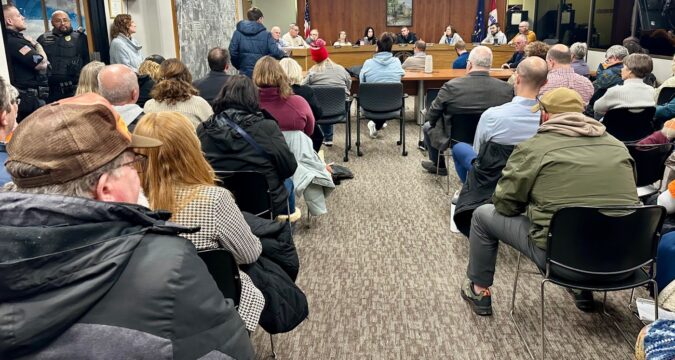
Valentine had to leave before the Hobart City Council meeting but Williams went inside to the heat-filled upper chambers, where she and fellow protesters vented their message to city officials for close to two hours.
Comments by some dozen residents, made during the public portion of the meeting, followed city council approval, in a 7-0 vote, of a resolution declaring a 725-acre parcel within Colorado Street and 61st Avenue as an Economic Revitalization Area.
Huddlestun said the resolution is the first step toward going forward with a development agreement with Amazon Web Services, which provides cloud computing services to businesses.
According to the terms of the resolution, the city “recognizes the need to stimulate growth and maintain a sound economy within the city and recognizes that it is in the best interest of the city to provide incentives to stimulate investment within the city.”
“This starts the process toward a potential tax abatement,” Huddlestun said.
A development agreement, along with a tax abatement agreement, will be presented at the Dec. 17 Hobart City Council meeting.
He confirmed that Amazon is the sole petitioner and will need to provide a statement of benefits, which would include a project description, number of jobs it will provide and community benefits.
Huddlestun said he is planning to hold a community meeting, at which Amazon would be there to present their proposal and answer questions, as requested by the no data centers group.
“We are planning to have a formal presentation to the residents; not sure how the timing will work out but before the site plan approval, which will probably be sometime next year,” he said.
“We’re trying to coordinate it,” he added.
He said the data center, once built, could bring in tens of millions of dollars each year to the city.
The financial impact for Hobart can’t be determined until the final numbers are crunched, but it’s going to be big money, he said.
Hobart has been buffeted by a series of financial hits, from the Southlake Mall property tax appeal to Senate Enrolled Act 1, which will offer property tax relief to taxpayers by reducing revenue local governments use to provide services to residents, he said.
“Hobart, residents are struggling,” Huddlestun said. “I want to actually give them relief.”
“We’re going to provide relief to our community,” he said, with money to solve flooding issues through the city as well as improving parks, police and fire protection and other services,” he said.
Residents who spoke during the public portion of the meeting, including Theresa DuBois, questioned the transparency of city officials and whether they had researched the effect the data center will have on the health, safety and welfare of residents.
“Right now we do not feel trust and confidence in our elected officials,” DuBois said.
Resident Suzanna Enslen spoke at the Hobart City Council meeting on Wednesday, Dec. 3, 2025. (Deborah Laverty/for Post-Tribune)
Resident Michael Weiss said the proposed data center will have a negative impact on the wildlife in that area.
“You’re just destroying all the land. Why don’t we try and preserve what we have….I don’t see the benefits long term,” Weiss said.
When some residents questioned the possible personal financial gain of city officials from the data center, City Councilman Matt Claussen, D-at-large, spoke in defense.
Claussen, a former Hobart police officer and long-time councilman, said he had never received any financial gain during his years of tenure.
“Don’t accuse me of being a thief,” Claussen said.
Colette Williams of Hebron said she came to the meeting because her parents still live in the area being proposed for the data center.
She grew up in Hobart and her great-grandfather was a blacksmith in the Ainsworth section many years ago.
“I have so many good memories. There’s a lot to lose here,” Williams said.
Deborah Laverty is a freelance reporter for the Post-Tribune; Post-Tribune freelance reporter Doug Ross contributed.
https://www.chicagotribune.com/2025/12/04/hobarts-data-center-opponents-target-amazon-project/

Immigration crackdown in New Orleans has a target of 5,000 arrests. Is that possible?
NEW ORLEANS — Trump administration officials overseeing the immigration crackdown launched this week in New Orleans are aiming to make 5,000 arrests with a focus on violent offenders, a target that some city leaders say is not realistic.
It’s an ambitious goal that would surpass the number of arrests during a two-month enforcement blitz this fall around Chicago, a region with a much bigger immigrant population than New Orleans.
In Los Angeles — the first major battleground in President Donald Trump’s aggressive immigration plan — roughly 5,000 people were arrested over the summer in an area where 10 million LA county residents are foreign-born.
“There is no rational basis that a sweep of New Orleans, or the surrounding parishes, would ever yield anywhere near 5,000 criminals, let alone ones that are considered ‘violent’ by any definition,” New Orleans City Council President J.P. Morrell said Thursday.
Census Bureau figures show the New Orleans metro area had a foreign-born population of almost 100,000 residents last year, and that just under 60% were not U.S. citizens.
“The amount of violent crime attributed to illegal immigrants is negligible,” Morrell said, pointing out that crime in New Orleans is at historic lows.
Violent crimes, including murders, rapes and robberies, have fallen by 12% through October compared to a year ago, from a total of 2,167 violent crimes to 1,897 this year, according to New Orleans police statistics.
A flood of messages about arrests
Federal agents in marked and unmarked vehicles began spreading out across New Orleans and its suburbs Wednesday, making arrests in home improvement store parking lots and patrolling neighborhoods with large immigrant populations.
Alejandra Vasquez, who runs a social media page in New Orleans that reports the whereabouts of federal agents, said she has received a flood of messages, photos and video since the operations began.
“My heart is so broken,” Vasquez said. “They came here to take criminals and they are taking our working people. They are not here doing what they are supposed to do. They are taking families.”
Several hundred agents from Customs and Border Protection and U.S. Immigration and Customs Enforcement are participating in the two-month operation dubbed “Catahoula Crunch.”
U.S. House Speaker Mike Johnson, who is from Louisiana, is among the state’s Republicans supporting the crackdown. “Democrats’ sanctuary city policies have failed — making our American communities dangerous. The people of our GREAT city deserve better, and help is now on the ground,” Johnson posted on social media.
Operation is being met with resistance
About two dozen protesters were removed from a New Orleans City Council meeting Thursday after chants of “Shame” broke out. Police officers ordered protesters to leave the building, with some pushed or physically carried out by officers.
Planning documents obtained last month by The Associated Press show the crackdown is intended to cover southeast Louisiana and into Mississippi.
Homeland Security Department spokesperson Tricia McLaughlin said agents are going after immigrants who were released after arrests for violent crimes.
“In just 24 hours on the ground, our law enforcement officers have arrested violent criminals with rap sheets that include homicide, kidnapping, child abuse, robbery, theft, and assault,” McLaughlin said Thursday in a statement. Border Patrol and immigration officials have not responded to requests for details, including how many have been arrested so far.
She told CNN on Wednesday that “we will continue whether that will be 5,000 arrests or beyond.”
Immigration arrests go beyond violent criminals
To come close to reaching their target numbers in New Orleans, immigrant rights group fear federal agents will set their sights on a much broader group.
New Orleans City councilmember Lesli Harris said “there are nowhere near 5,000 violent offenders in our region” whom Border Patrol could arrest.
“What we’re seeing instead are mothers, teenagers, and workers being detained during routine check-ins, from their homes and places of work,” Harris said. “Immigration violations are civil matters, not criminal offenses, and sweeping up thousands of residents who pose no threat will destabilize families, harm our economy.”
During the “Operation Midway Blitz” crackdown in Chicago that began in September, federal immigration agents arrested more than 4,000 people across the city and its many suburbs, dipping into Indiana.
Homeland Security officials heralded efforts to nab violent criminals, posting dozens of pictures on social media of people appearing to have criminal histories and lacking legal permission to be in the U.S. But public records tracking the first weeks of the Chicago push show most arrestees didn’t have a criminal record.
Of roughly 1,900 people arrested in the Chicago area from early September through the middle of October — the latest data available — nearly 300 or about 15% had criminal convictions on their records, according to ICE arrest data from the University of California Berkeley Deportation Data Project analyzed by The Associated Press.
The vast majority of those convictions were for traffic offenses, misdemeanors or nonviolent felonies, the data showed.
New Orleans, whose international flavor comes from its long history of French, Spanish, African and Native American cultures, has seen a new wave of immigrants from places in Central and South America and Asia.
Across all of Louisiana, there were more than 145,000 foreign-born noncitizens, according to the Census Bureau. While those numbers don’t break down how many residents of the state were in the country illegally, the Pew Research Center estimated the number at 110,000 people in 2023.
Seewer reported from Toledo, Ohio. Associated Press journalists Sara Cline in Baton Rouge, Louisiana; Sophia Tareen in Chicago; Aaron Kessler in Washington, D.C.; and Michael Schneider in Orlando, Florida, contributed.
https://www.chicagotribune.com/2025/12/04/new-orleans-immigration-crackdown-target/

Preliminary plans for 900-unit residential development get approval from Campton Hills Village Board
A proposed 900-unit residential development has gotten the next green light from the Campton Hills Village Board, after the village’s trustees unanimously approved preliminary plans for the project at a meeting on Tuesday.
The ordinance unanimously approved by the board Tuesday, which grants the project a preliminary Planned Unit Development, or PUD, zoning designation, essentially gives the developer — Geneva-based Shodeen Group — the ability to move forward with things like engineering review and negotiating infrastructure improvements, according to village attorney Carmen Forte.
The proposed development, called LaFox of Campton Hills, is set to be built on 962 acres generally bounded by Route 38 to the north, Keslinger Road to the south, Harley Road to the west and Brundige Road to the east. The area was previously unincorporated, but in September was annexed into Campton Hills in anticipation of the development.
The area has weathered numerous proposals for development over the years, none of which have come to fruition.
Proposals for developing the area have historically faced opposition by resident groups, but Shodeen’s pitch ultimately secured their support — through meetings with the local organizations and proposing a project with a lower density of homes and considerable open space.
The development is set to include 900 housing units, with more than half of the development remaining open space, according to plans.
The village board ultimately opted to annex the land into Campton Hills in September as Shodeen pursued the project. Annexation benefits property owners, Shodeen President David Patzelt said previously, because being part of a municipality means more staff and capabilities for managing the land. As for the village, annexing gives it a chance to shape what happens in the area and ensure the project is in line with its goal of low-density development and open space.
Suburbs on the fringes of the Chicago metropolitan area have seen considerable population growth in recent years, new estimates from the U.S. Census Bureau show. But expansion and development projects can be hamstrung by some of the elected officials and residents in those very communities, who say things like the prevalence of green space is what prompted them to move there in the first place.
However, as the suburbs see their populations grow, Campton Hills has been a vocal proponent of remaining a semi-rural community. Its mission statement, for example, highlights priorities like “agriculture traditions” and “honoring rural heritage,” a philosophy that’s in line with the local resident groups which opposed previous development proposals.
Now, with the backing of local groups and the village’s board, Shodeen is moving forward with its development project.
At the village’s Nov. 17 board meeting, Forte said that the villlage’s Planning and Zoning Commission had recommended approval of the PUD, with some conditions. The preliminary PUD was then brought to the village board on Dec. 2 for a vote.
Included in the materials for the preliminary approval were things like an initial landscape plan and a sample construction phasing plan. The approval was also contingent on some specific conditions, outlining requirements for things like roadway width and street lighting for the project.
Tuesday’s approval from the Campton Hills Village Board is only preliminary, however, and doesn’t give the green light for construction yet, as a final PUD — which has “a lot more meat on the bones,” according to Forte — must be approved first.
The developer has two years from the approval of a preliminary PUD, he noted, to submit an application for a final PUD. The project is expected to occur in phases.
But, though the plans ultimately got the green light from the village board, one question that was raised concerned affordable housing and what role this development might play in increasing affordable housing stock in Campton Hills.
At Tuesday’s meeting, Trustee Terese Hopfensperger asked what the dollar amount of housing that’s considered affordable in the village is.
Trustee Frank Binetti said the threshold is variable depending on how much debt a person has, but on average for a family of four, is about $266,000. But Trustee Nicolas Boatner noted that, as they drill down to Campton Hills, rather than the broader area, the affordable rate would be considerably higher.
Campton Hills has one of the lowest rates of affordable housing stock in the state, according to a 2023 statewide report from the Illinois Housing Development Authority on the Affordable Housing Planning and Appeal Act. Per the report, its share of affordable housing — defined as being within the means of homebuyers making 80% of the regional median household income or renters making 60% of the regional median household income — was just 2.4%.
According to IHDA’s 2024 guidelines, an affordable home in the Chicago metropolitan area — Kane County included — would equate to a purchase price of roughly $174,000 for a single person or just under $250,000 for a family of four, for example.
Hopfensperger said it’s been “impractical” for the village to have affordable housing when units use wells and a septic system. But, with this new subdivision coming where that won’t be a problem, she said she wanted to make sure they take that into consideration and “don’t create a scenario down the road that we didn’t address this housing issue.”
“If the townhomes (proposed for the project) are actually going to help with that statistic, then that’s …good news,” Hopfensperger said.
Forte clarified that municipalities that fall below the state’s threshold of 10% affordable housing must have a plan for how they intend to meet that threshold.
Trustee Janet Burson noted that individuals seeking more affordable housing are not just those moving into the community, but also include those currently living there — older residents who age out of their houses, those who are divorced or widowed, adult children seeking to remain living in the community. But she expressed the opinion that the issue was unrelated to the PUD approval.
“I don’t believe there’s been any representation that any of this is affordable housing,” said Burson at the meeting about the project.
This approval process is occurring simultaneously, Forte noted at the meeting, with the village’s evaluation of whether to create a tax increment financing, or TIF, district in the area.
A TIF district is a sort of economic development incentive in which the value of a property is essentially frozen, and the extra or “increment” taxes created by developing the property go into a special fund used to pay for costs related to improving the area. The annexation agreement, approved by the board in September, notes the possibility of a TIF district.
According to Forte, whether the village decides to create a TIF district is set to be decided before the final PUD plan is approved.
mmorrow@chicagotribune.com
https://www.chicagotribune.com/2025/12/04/campton-hills-residential-development-moving-forward/
Will County Board taps reserves to cover $2.77 million deficit
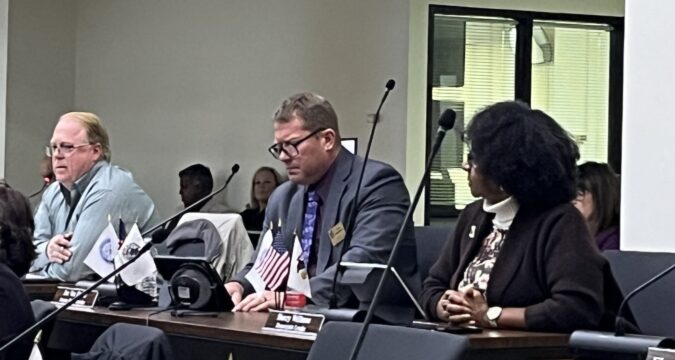
The Will County Board voted Thursday to use just over $2.77 million from its cash reserves to balance its budget for its 2026 fiscal year that started Monday.
The board voted 20-0 Thursday to reconcile its budget during a nearly two-hour special meeting after an unbalanced budget was approved two weeks ago.
While all board members present agreed to use cash reserves to close the gap, some members said they did so reluctantly because there was no other choice.
Last month, the board’s Republican Caucus along with Democrat Destinee Ortiz, of Romeoville, approved no tax levy increase in a 12-10 vote. However, the budget on the agenda included a 1.75% levy. The two conflicting votes created the shortfall of nearly $2.8 million.
The owner of a home valued at about $250,000 would have paid an extra $7 to the county with the 1.75% levy, according to the county’s supervisor of assessment’s office.
“The County Board shouldn’t be looting its cash reserves as a matter of practice to fill funding holes created by lazy and reckless financial planning,” Speaker Joe VanDuyne, a Wilmington Democrat said. “It’s bad accounting. It’s bad government. It’s bad business.”
VanDuyne said the budget that was passed allowed for spending based on the 1.75% increase in the tax levy, but when the board cut the levy to zero on the county board floor, it did so without considering the spending cuts necessary to balance the budget.
“The narrow majority that approved the budget did half the job and then walked away,” VanDuyne said.
Finance Committee Chair Sherry Newquist, a Steger Democrat, agreed.
“I don’t believe it’s proper practice,” she said. “I don’t believe it’s a good idea to use reserves to fill operational holes. However, we do need a balanced budget and I believe this is the only way forward for us at this point.
Newquist said she held special finance committees in the last few months where department heads presented their needs and board members could ask budget questions. She said they were “poorly attended.”
Several board members disagreed on whose responsibility it was to find cuts to the budget. Some members said the board does not know the day-to-day expenses required of each office while others said it is the board members’ duty to find cuts from the county executive’s draft budget proposal that is released each August.
Other board members said the cash reserves on hand were more than the policy requires, so using the reserves made sense.
The approved resolution noted the county has about $94.8 million in cash reserves, which is about a $22 million surplus.
“That’s tens of millions of dollars of taxpayer money that we’re holding onto,” board member Frankie Pretzel, a New Lenox Republican, said. “It would be super irresponsible for us to go back (to taxpayers) for more.”
Board member Dan Butler, a Frankfort Republican, said addressing the budget gap with cash reserves is one of the “most responsible actions this body can take.”
Karen Hennessy, the director of Will County’s finance department, answers questions on the county’s cash reserves during a special County Board meeting Thursday to address the budget shortfall. (Michelle Mullins/for the Daily Southtown)
Karen Hennessy, the director of the county’s finance department, said using cash reserves for an identifiable, planned one-time use is considered a good business practice, but it is not a good plan to cover operational expenses. She said the county is lucky to have an excess in reserves, so this action should not harm the county. But she cautioned it’s not a practice that should be done regularly.
The county built up its reserves largely due to $50 million in federal grant funds as part of an economic stimulus bill passed by Congress during the early days of the COVID-19 pandemic.
“That is the only reason we have excess,” Hennessy said. “We’ve been using it over the last few years. It’s not going to continue because we’re not going to have an influx like that again.”
The reserves act like a checking account and pays for employee payroll, vendors and other expenditures because revenue, such as property taxes, comes in only during certain times of the year.
“By choosing to tap into reserves to fill a deficit they created, the County Board is acknowledging the reality that there are no easy cuts to be found in this budget,” County Executive Jennifer Bertino-Tarrant said. “While this action will fill the shortfall, it would be reckless to rely on reserves to maintain county services in the future.”
Bertino-Tarrant said she was concerned that relying on reserves to fill budget holes will put the county’s bond rating at risk.
Jim Richmond, the board’s Republican Leader from Mokena, said the budget contains spending that will improve the county and its infrastructure that would be considered positive investments from a bond perspective.
Ortiz, whose microphone was once cut off after being warned she wasn’t speaking to the topic at hand, at one point shouted her remarks, saying the board wasn’t advised to follow proper procedures last month when approving the budget with a 1.75% tax levy, when it was clear the direction was to hold the line on tax increases.
She said a subsequent memo released by the executive’s office warning employees about a potential government shutdown and seeing if any would be willing to work without pay was designed to “manufacture panic.”
“This shortfall is tiny, is temporary and is easily covered with the reserves, but the real problem is the process,” Ortiz said.
Sherry Williams, the board’s Democratic Leader from Crest Hill, said the board can be better and more responsible.
The county’s portion of the tax bill is about 6%. Williams said the savings is not going to be noticed much on residents’ bills and said the board has a responsibility to both save taxpayer money and provide services.
“One other thing that the public expects us to do, they expect us to stop this clown show,” Williams said. “We are their representatives and they expect us to represent and to do it professionally. … We can do better.”
Michelle Mullins is a freelance reporter.
https://www.chicagotribune.com/2025/12/04/will-county-taps-reserves-cover-deficit/

Elgin News Digest: East Dundee’s Depot now a D300 Food Pantry drop-off point; Shop With a Cop Dundee Township seekimg donations
East Dundee’s Depot now a D300 Food Pantry drop-off point
The Depot Visitors Center in downtown East Dundee is now an official year-round drop-off location for the D300 Food Pantry.
Pantry officials say the most-needed items are cans of tuna, chicken, ravioli and beans; boxes of pasta, dried beans and macaroni and cheese; oatmeal, pancake mix and condiments; shampoo, soap and toilet paper; tea bags and coffee, according to a social media post.
The Depot is located at 319 N. River St., East Dundee. Hours of operation are 9 a.m. to 4 p.m. Thursday to Sunday. Because The Depot is staffed by volunteers, call 847-426-2255 to make sure it is open, officials said.
Shop With a Cop Dundee Township seekimg donations
The 22nd annual Shop With a Cop Dundee Township is seeking monetary donations by Saturday, Dec. 13, to provide gifts this season for children in need.
Fox Valley Baptist Church Pastor Phil Zilinski said Dec. 13 is the morning police officers from various local police departments will take about 120 children shopping at the Carpentersville Walmart. Some of them are children who were displaced by the Nov. 29 fire at the Meadowdale Apartments in Carpentersville, he said.
The day will begin at 9 a.m. with a breakfast for the children, their families and officers at Fox Valley Baptist in unincorporated East Dundee. At Walmart, each child will get to spend $150. They will also be given winter clothing, including snowsuits provided by the Boys & Girls Club, Zilinski said.
Zilinski said the nonprofit raises money all year for its December effort as well as for lunches held throughout the year and for helping families impacted by a catastrophic event. The program is intended to build relationships between officers and children.
For more information or to make a donation, go to www.shopwithacopdundeetownship.org/Donations.html.
Elgin Fire Department collecting winter wear for crisis center
The Elgin Fire Department is holding its annual winter clothing collection drive for the Community Crisis Center, now through Wednesday, Dec. 31.
Adult winter wear items for men and women are needed, including new and lightly used winter coats, boots and snow pants, according to a social media post.
New gloves, mittens, hats and scarves will be accepted. Used items need to be clean and should not have missing buttons or broken zippers.
Donations can be dropped off at any Elgin fire station location: Station 1, 550 Summit St.; Station 2, 650 Big Timber Road; Station 3, 2455 Royal Blvd.; Station 4, 599 S. McLean Blvd.; Station 5, 804 Villa St.; Station 6, 707 W. Chicago St.; and Station 7, 3270 Longcommon Parkway.
For more information, call 847-931-6175.
https://www.chicagotribune.com/2025/12/04/elgin-depot-dundee-pantry-winter-clothing/

Bolivia dice que trabaja para salir de la lista sobre blanqueo de capitales de la UE
Associated Press
LA PAZ, Bolivia (AP) — El gobierno boliviano anunció el jueves que trabaja para salir de la lista de países de alto riesgo por blanqueo de capitales y financiación del terrorismo, lo cual afirma complica los planes del país andino de acceder a financiamiento externo.
La Comisión Europea anunció la actualización de su lista e incluyó a Bolivia, lo que obliga a reforzar los controles en todas las transacciones en que intervengan personas o entidades bolivianas en la Unión Europea.
Esta decisión “dificulta más todavía los procesos de financiamiento, pero también la dinámica de comercio exterior y demás”, advirtió el jueves a los medios el ministro de Economía, José Gabriel Espinoza. “Nosotros ya estamos trabajando para poder salir de la lista… se requiere una serie de cambios por eso tenemos que trabajar”, afirmó, sin especificar de momento cuáles.
La autoridad culpó de esa situación a las anteriores administraciones de izquierda del expresidente Luis Arce (2020, 2025) y Evo Morales (2006,2019) que estuvieron casi 20 años en el poder.
El nuevo gobierno del presidente Rodrigo Paz ha dado un giro en las políticas y busca cambiar el modelo económico de sus antecesores cargado de medidas de subsidios, con mayor impacto en el sector de los combustibles, que ha mermado las reservas internacionales de la nación andina.
Bolivia atraviesa por la peor crisis en 40 años que comenzó hace dos, con la escasez de dólares debido a una caída en las exportaciones de gas natural, lo que a su vez provocó falta de combustibles que Bolivia importa para el consumo interno. El país subvenciona el combustible a más de la mitad de su precio.
En el llamado plan anticrisis de la nueva administración está la búsqueda de créditos ante organismos internacionales. El primero en llegar al país fueron los 550 millones de dólares como parte de un crédito global por 3.100 millones de la Corporación Andina de Fomento (CAF).
Espinoza dijo, además, que el gobierno está trabajando con organismos internacionales para “lograr un paquete de financiamiento que fácilmente va a superar los 9.000 millones de dólares” para los próximos tres años y que se concretaría en dos o tres meses.