Category: News
According To Democrats, Current Economic Conditions Have Never (Ever) Been Worse
According To Democrats, Current Economic Conditions Have Never (Ever) Been Worse
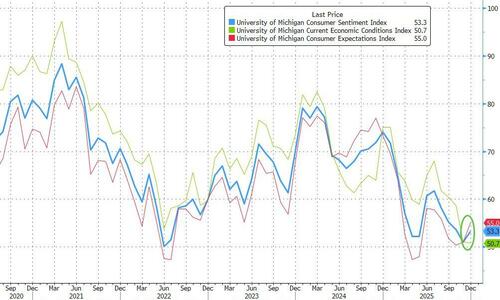
Consumer confidence data from the University of Michigan showed an impressive (and surprising) rebound in preliminary December data with the headline print rising from near record lows at 51.0 to 53.3 (well above the 52.0 exp)…
Source: Bloomberg
This month’s increase was concentrated primarily among younger consumers. Overall, while views of current conditions were little changed, expectations improved, led by a 13% rise in expected personal finances, with improvements visible across age, income, education, and political affiliation.
Labor market expectations improved – 63% of consumers expect unemployment to rise in the year ahead, still much higher than the 40% seen a year ago, according to Surveys of Consumers Director Joanne Hsu.
After UMich respondents proclaimed their fear of losing their jobs last month was as high as during the peak of COVID and the GFC, this month saw those fears collapse…
Source: Bloomberg
Most notably, reality is finally starting to hit for the Democrats who were fearmongered into believing inflation would explode under Trump.
Year-ahead inflation expectations decreased from 4.5% last month to 4.1% this month, the lowest reading since January 2025. This marks four consecutive months of declines. Additionally, long-run inflation expectations softened from 3.4% last month to 3.2% in December, matching the January 2025 reading
Source: Bloomberg
Independents saw long-term inflation expectations plunge…
Source: UMich
But it was the Democrats that really came to their senses…
Source: Bloomberg
Simply put, UMich’s Hsu is forced to admit that consumers have noted that the soaring inflation they feared in April and May 2025 at the height of tariff developments has not come to fruition at this time.
Hsu couldn’t help but play down the improvements with her concluding remarks:
“Consumers see modest improvements from November on a few dimensions, but the overall tenor of views is broadly somber, as consumers continue to cite the burden of high prices.”
Finally, according to UMich Democratic respondents, current conditions sentiment has never been worse…ever… and the gap between Republican and Democrat confidence has never been wider…
But, no bias, right?
Tyler Durden
Fri, 12/05/2025 – 10:30
Peace In Our Time? Don’t Count On It
Peace In Our Time? Don’t Count On It
By Benjamin Picton, Senior Market Strategist at Rabobank
US equities closed mixed on Thursday, despite solid leads from European markets where all of the major indices closed higher. Bond yields were mostly higher with US 10s pushing up 3.5bps to 4.09% and the 2-year yield lifting by almost 4bps to 3.52%. There was notable price action in the Aussie market where 2-year yields rose by 7.5bps to 3.98% after the Wall Street Journal reported that a number of local banks are considering updating their forecasts to project an RBA rate hike as early as February.
The rate hike chatter down under has been egged-on by a run of higher-than-expected inflation, strong household consumption figures and a lift in activity in Australia’s invincible housing market since the RBA began cutting interest rates back in February. A weaker-than-expected Q3 GDP result that showed growth of 0.4% in the quarter – compared to estimates of 0.7% – wasn’t enough to derail the push higher in yields as commentators pointed out that domestic final demand was strong and that the growth miss was largely attributable to a drawdown in inventories by mining companies.
We’re a little more circumspect on the prospect for hikes early next year in Aussie. The latest GDP figures confirmed that year-on-year productivity growth (as measured by GDP per hour worked) rose from 0.2% in Q2 to 0.8% in Q3, which raises the prospect that productivity growth might exceed the RBA’s 0.9% year-end forecast and thereby imply a higher potential growth rate for the economy. Similarly, the household savings ratio was upgraded substantially to levels that now exceed those observed in pre-Covid times and substantially exceed the RBA’s projections issued last month. That suggests that the intertemporal rate of substitution was more skewed towards saving (rather than spending) than the RBA thought, and implies that monetary policy may have been more restrictive than thought. That’s as growth gross national expenditure remains in-line with the RBA forecasts, the labour market continues to soften, Aussie equities underperform global peers and growth in rents continues to moderate.
If all of that isn’t reason enough to be skeptical of a February rate hike, the trade-weighted AUD already exceeds RBA forecasts even as the US Fed looks poised to cut rates next week, the JPY remains in a weakening trend and the PBOC begins fixing the CNY weaker than estimates. A February rate hike course reversal from one of the most notoriously staid central banks while all of that is going on? The 2-year yield might say yes, but don’t count on it.
While Australia navel-gazes over local issues, the economic picture elsewhere seems to be deteriorating. As noted yesterday, the US ADP employment survey for November was a miss, recording a loss of 32,000 jobs. Similarly, the Challenger job cuts figures released overnight show that in the year to November this year has seen more job losses than any non-recession year except 2002. The UK construction PMI printed at an abysmal 39.4 to follow Canada’s dreadful services PMI of 44.3 and a decent drop in US capacity utilization reported the day before that makes today’s PCE inflation release all the more interesting.
One bright spot seems to be US weekly jobless claims, where the number of new claimants fell to just 191,000 and the four-week average fell by approximately 10,000 to 215,000 – the lowest level since January. So, more job cuts but less claimants. Can we chalk that dynamic up to the activities of ICE? Axios today reports that daily arrests are surging, and the Wall Street Journal reports that the Trump administration is preparing to further tighten controls over the work rights of legal immigrants. Fewer jobless claims despite fewer jobs does seem to suggest a shrinking labor pool.
In geopolitical news the FT reports that French President Macron has warned of a risk of the “disintegration of the international order” following a meeting with Xi Jinping. Such revelations will not be news to regular readers of this missive – we have been warning of this since 2016 at least, but European politicians have been a little slow to catch on. President Xi, who has repeatedly criticized the international order as a US-led order that is too Western-centric and marginalizes the global South, encouraged Macron to “hold high the banner of multilateralism” as the two sides made all the right noises on mutual investment.
The kind of multilateralism that Xi has in mind is an important point to consider. Is Xi talking about an idealistic evolution of the United Nations where more power is given to the developing world but disputes are resolved via dialogue? Or is he talking about ending US hegemony to carve the world up into spheres of influence for regional great powers to preside over? Xi’s reluctance to get involved in brokering a peace deal in Ukraine and recent naval deployments in the wake of a diplomatic spat with Japan will make many nervous that it is the latter.
A spheres of influence paradigm is certainly favorable in the eyes of Vladimir Putin. He has reportedly rejected the latest peace overtures from US special envoy Witkoff and told India Today that Ukrainian troops will either leave the Donbas region or Russia will “liberate these territories by force”. Kremlin officials have reportedly told journalists that a peace deal remains a long way off. The Wall Street Journal editorial today says “maybe it is time to conclude that Mr. Putin doesn’t want peace” while arguing that Putin has no incentive to negotiate in good faith while he feels that he is winning.
So, peace in our time? Don’t count on it.
Tyler Durden
Fri, 12/05/2025 – 10:20
https://www.zerohedge.com/geopolitical/peace-our-time-dont-count-it

El ritmo de Lando Norris en prácticas lo posiciona como favorito en el desenlace de la F1
Por JAMES ELLINGWORTH
La lucha por el título de Fórmula 1 está en manos de Lando Norris, y no parece que vaya a perder.
El piloto británico fue el más rápido en ambas sesiones de práctica el viernes, marcando territorio antes del decisivo enfrentamiento a tres bandas por el título en el Gran Premio de Abu Dabi.
Norris superó a Max Verstappen, su rival por el título, por solo 0.008 segundos en la primera sesión y amplió esa diferencia sobre el piloto de Red Bull a 0.363 en la segunda, que fue más representativa de las condiciones de día-noche para la carrera del domingo.
La única forma en que Norris puede perder el título es si termina la carrera fuera de los tres primeros. Norris lidera a Verstappen por 12 puntos y a Oscar Piastri, su compañero en McLaren, por 16.
Norris y Piastri buscan ganar su primer título, mientras que Verstappen aspira a su quinto consecutivo.
“Por supuesto, soy el que más tiene que perder porque estoy en la cima”, afirmó Norris el jueves. “Haré lo mejor para quedarme allí hasta el final del año, unos días más. Al mismo tiempo, si no sale como espero, lo intentaré de nuevo el próximo año. Probablemente dolerá por un tiempo, pero así es la vida”.
Piastri se saltó la primera sesión y solo fue undécimo en la segunda, a 0.680 del tiempo de Norris, y el australiano aún no ha mostrado un ritmo competitivo significativo.
Norris ha negado que le pedirá a Piastri que ayude para al menos asegurar que un piloto de McLaren se convierta en campeón si parece que Verstappen se llevará el título.
El CEO de McLaren, Zak Brown, ha abierto la puerta a órdenes de equipo, pero si Norris tiene el tipo de ritmo que mostró el viernes, no serán necesarias.
Las posibilidades de Verstappen se reavivaron cuando McLaren se equivocó con la estrategia en Qatar, la carrera posterior a las descalificaciones de Norris y Piastri en Las Vegas.
‘Más extraordinario’ Verstappen
Verstappen, el único contendiente con experiencia previa en una carrera en la que se define todo, dijo que “simplemente está disfrutando de estar aquí” en una temporada en la que su defensa del título a menudo parecía imposible.
“Tengo cuatro de esos en casa, así que es agradable añadir un quinto”, comentó el jueves, mirando el trofeo a su lado.
“Ya he logrado todo lo que quería lograr en la F1 y todo es solo un bono. Sigo haciéndolo porque me encanta y lo disfruto, y así es como afronto este fin de semana. Pasarlo bien ahí fuera, intentar maximizar el resultado”, agregó.
Verstappen estaba a 104 puntos del líder en un momento, y descartó sus posibilidades nuevamente cuando no fue competitivo en la clasificación para el Gran Premio de Brasil, hace tres carreras.
“Probablemente sea justo decir que el mundo descubrió un Max aún más extraordinario esta temporada”, expresó el director del equipo, Laurent Mekies, el viernes. “Un poco por la magnitud de la remontada. Un poco porque ha estado tan relajado”.
Piastri se aferra
Piastri tenía una ventaja de 34 puntos en agosto y parecía encaminado a convertirse en el primer campeón australiano en 45 años. No ha ganado en ocho carreras desde entonces.
Mostró buen ritmo para ocupar el segundo lugar en Qatar la semana pasada, aunque quedó “sin palabras” después de una carrera dominada por la estrategia equivocada de McLaren.
“Obviamente, necesito que sucedan bastantes cosas este fin de semana para salir campeón”, comentó, “pero me aseguraré de estar en el lugar correcto en el momento adecuado y ver qué pasa”.
___
Deportes AP: https://apnews.com/hub/deportes
Inflación cae en Bolivia tras las asunción de Paz, pero la economía sigue en terapia
Associated Press
LA PAZ, Bolivia (AP) — La inflación en Bolivia registró una caída en noviembre, el primer mes del mandato del centroderechista Rodrigo Paz, pero la tasa acumulada en el año ronda el 20% mientras se esperan los ajustes que aplicará el mandatario para sacar el país de la peor crisis económica de las últimas cuatro décadas.
La inflación en noviembre fue de 0,40%, la más baja del año, debido a “disminución en el tipo de cambio del dólar” y la reducción de precios de algunos alimentos, dijo el Ministerio de Planificación del Desarrollo.
Mucha gente ha sacado los dólares que tenía ahorrados y los ha puesto en el mercado induciendo a una baja en la cotización, según el analista económico Gonzalo Chávez.
Paz eliminó algunos impuestos para atraer inversiones, anunció una reducción del 30% del gasto público y dijo que dará prioridad al pago de deudas, lo que sumado al giro político hacia la centroderecha ha derivado en una baja sostenida del dólar que había más que duplicado su precio en el mercado paralelo, según varios informes.
En sus primeros días en el gobierno Paz cuestionó la herencia económica de 20 años de gobiernos del Movimiento al Socialismo (MAS) y dijo que dejó una millonaria corrupción que alcanza a los 16.000 millones de dólares.
La situación del país es crítica por una combinación de la inflación con una caída de la economía de 2,40% en el primer semestre. El déficit fiscal está en torno del 10% del Producto Interno Bruto, según el presidente del Banco Central, David Espinoza.
El ministro de Economía, José Gabriel Espinoza, dijo que las medidas de fondo —como la eliminación del subsidio a los combustibles que consume más de 2.500 millones de dólares al año— se conocerán en el primer trimestre de 2026. Paz anticipó una reducción gradual.
El proceso de estabilización debe centrarse en reducir de manera drástica el déficit fiscal, normalizar el suministro de carburantes, cerrar la brecha cambiaria y estabilizar el mercado de divisas, asegurando el acceso del público a dólares, según un reciente informe sobre la economía de la privada Fundación Milenio.
Fed’s Favorite Inflation Indicator Continues To Show No Signs Of Runaway Tariff Costs
Fed’s Favorite Inflation Indicator Continues To Show No Signs Of Runaway Tariff Costs
First things first, this is September data… so horribly lagged/stale… but, it’s all we have, so let’s dive in.
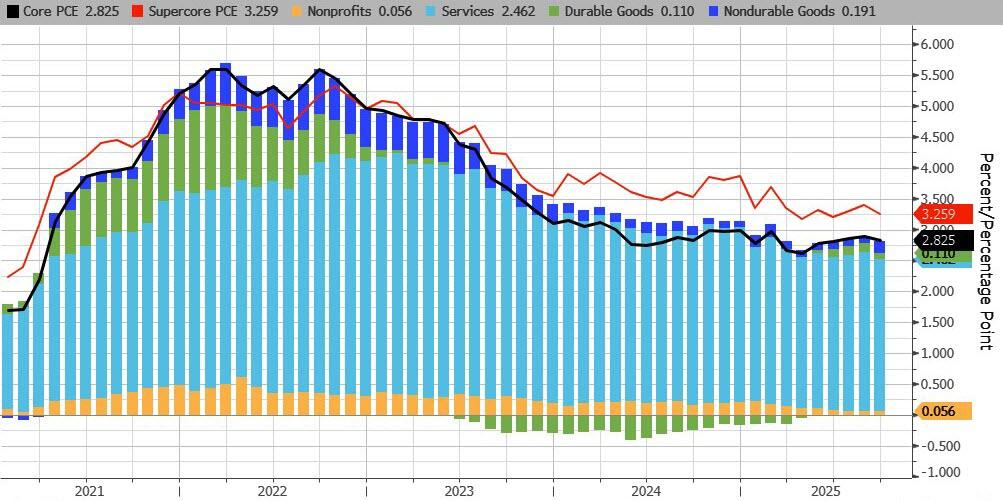
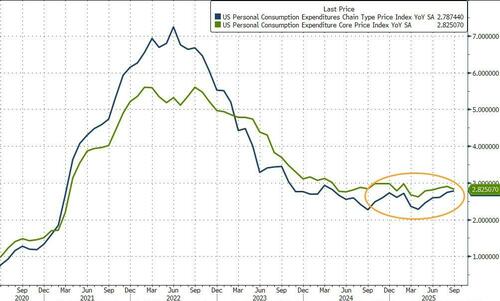
The Fed’s favorite inflation indicator – Core PCE – rose 0.2% MoM (as expected), which leave it up 2.8% YoY (as expected), slightly lower than August +2.9%…
Source: Bloomberg
On an annual basis, the headline PCE rose 2.8%, up modestly from 2.7% YoY in August (as expected). That is the highest since April 2024, but again remains in the range of the last two years…
Source: Bloomberg
…showing no signs at all of the runaway tariff-driven costs that so many establishment economists proclaimed was imminent.
Services costs (not tariff-related directly) attributed the most to the rising costs while Goods prices were barely positive…
Source: Bloomberg
The closely-watched SuperCore PCE slipped to +3.25% YoY…
Source: Bloomberg
Also trending lower overall, ruining the ‘Trump will kill us all with tariffs’ narrative.
Meanwhile, amid rising prices, income growth outpaced spending growth for a change…
Source: Bloomberg
Leaving the savings rate at 4.7%, unchanged from August and at lowest since Dec 2024…
So, while this data is admittedly stale, it shows no signs of 1) tariff-driven inflation or 2) a suffering consumer.
Tyler Durden
Fri, 12/05/2025 – 10:15
Incendio en fiesta de cumpleaños deja 10 muertos en restaurante de los Andes de Perú
Por FRANKLIN BRICEÑO
LIMA (AP) — Un incendio en un restaurante de una ciudad en los Andes del sur peruano, que no cuenta con una compañía de bomberos local y donde se celebraba el cumpleaños de un estudiante, dejó al menos 10 muertos y tres heridos, informaron el viernes las autoridades.
El siniestro empezó la víspera en el restaurante “Calma Tripas” de la ciudad de Huancané, ubicada muy cerca del lago Titicaca, que es compartido por Perú y Bolivia. El fuego se inició en el primer piso y luego llegó hasta la segunda planta donde estaban las víctimas que no pudieron bajar, indicó a la prensa local el funcionario municipal de Huancané, Yasmani Torres.
La ciudad no cuenta con una compañía de bomberos por lo que los vecinos, funcionarios municipales y la policía cargaron cubos de agua para intentar apagar el fuego. También llevaron un camión cisterna para distribuir agua, relató por teléfono a The Associated Press Francisco Villanueva, director del Instituto de Educación Superior Pedagógico Público de Huancané, donde estudiaban las víctimas.
Villanueva dijo que los estudiantes se reunieron para celebrar el cumpleaños de uno de ellos, quien cumplía 21 años. “Tenían la torta lista para cantar cuando empezó el incendio”, dijo Villanueva, quien supo este detalle porque conversó con una estudiante que sobrevivió al siniestro. El cumpleañero está en la lista de fallecidos, otorgada por las autoridades médicas del hospital Lucio Aldazábal Pauca de Huancané. Tres heridos por quemaduras se encuentran en el nosocomio.
El director relató que los estudiantes se encontraban atrapados en la segunda planta y no podían salir ni siquiera por las ventanas del balcón de madera porque estaban cerradas y selladas. “Pese a los intentos de un grupo de personas no se pudo abrirlas y mirar con impotencia cómo no puedes ayudar es algo indescriptible”, dijo. Los cuerpos de los estudiantes fueron hallados calcinados la madrugada del viernes, indicó.

La Casa Blanca crea un salón de la vergüenza para medios de comunicación
Por DAVID BAUDER
NUEVA YORK (AP) — La Casa Blanca del presidente Donald Trump está asumiendo el papel de crítico de los medios y pidiendo ayuda a los “estadounidenses comunes”.
El fin de semana de Acción de Gracias, la presidencia lanzó un portal web que, según dice, destacará el sesgo por parte de los medios de comunicación, señalando al Boston Globe, CBS News y The Independent como inauguradores de su sección “medio infractor de la semana”.
Es la novedad más reciente en la lucha contra lo que Trump etiquetó como “noticias falsas” desde su primer mandato. El presidente republicano ha llevado a medios como CBS News y The Wall Street Journal a los tribunales por su cobertura, está luchando contra The Associated Press en los tribunales por el acceso a los medios y ha tomado medidas para desmantelar medios administrados por el gobierno como Voice of America.
Trump también ha lanzado ataques personales. Apenas el último mes, le dijo “silencio, cerdita” a una reportera que le hacía preguntas a bordo del Air Force One; a un reportero de The New York Times le dijo que era “feo, tanto por dentro como por fuera” y a una periodista de ABC News le dijo en público que era “una reportera terrible”.
“Sinceramente es abrumador soportar todo esto y tener que defenderse constantemente de estas noticias falsas y estos ataques”, expresó Karoline Leavitt, secretaria de prensa, quien dijo que el nuevo portal web era un intento de responsabilizar a los periodistas.
Después del debut, la Casa Blanca pidió voluntarios para enviar sus propios ejemplos de sesgo mediático. “Los llamados ‘periodistas’ han hecho imposible identificar cada historia falsa o engañosa, por lo que la ayuda del pueblo estadounidense es esencial”, dijo la oficina de prensa de Trump.
Devorando los medios como papas fritas calientes
A pesar de los ataques, Axios escribió esta semana que los medios de comunicación dominantes están terminando el año “tan dominantes como siempre” en capturar la atención del presidente y establecer la agenda de Washington, citando como ejemplo la cobertura de The Washington Post sobre los ataques militares contra supuestos barcos de traficantes en aguas internacionales.
La ironía es que Trump interactúa con los reporteros a un nivel que no ha visto con ningún otro presidente en su vida, dijo Jim VandeHei, CEO de Axios y coautor del informe junto con Mike Allen.
“Siempre se ha quejado de los medios y la prensa”, dijo VandeHei a The Associated Press. “Devora estas cosas como papas fritas calientes de McDonald’s. Es un consumidor masivo de esto. Lo ve, llama a los reporteros, recibe llamadas de los reporteros… Esa siempre ha sido la contradicción con él”.
Los primeros “galardonados” de los medios fueron criticados por historias sobre la reacción de Trump a los legisladores demócratas que grabaron un video recordando a los miembros militares que no estaban obligados a seguir órdenes ilegales. Trump acusó a los legisladores de sedición “castigable con la muerte”.
La Casa Blanca dijo que era una tergiversación decir que Trump había pedido ejecutarlos. El portal también dijo que los medios de comunicación “insinuaron subversivamente” que el presidente había emitido órdenes ilegales. Los artículos de noticias que citaron no decían específicamente si Trump había o no ordenado actividades ilegales.
El nuevo portal también contiene un “Salón de la Vergüenza de Infractores” de artículos que considera injustos y un ranking de medios con la mayor cantidad de piezas a las que objetan. Veintiún medios están representados, liderados por las cinco historias de The Washington Post. CBS News y MS NOW, la cadena anteriormente conocida como MSNBC, tenían cuatro cada uno. Ningún medio que atrae a conservadores fue citado por sesgo.
“The Washington Post está orgulloso de su periodismo preciso y riguroso”, dijo al respecto una portavoz del Post.
Vigilante de medios da la bienvenida a la compañía
El vigilante de medios conservador Media Research Center, que ha acusado a los medios de tener un sesgo liberal desde 1987, dio la bienvenida a la compañía.
“Estamos complacidos”, dijo Tim Graham, director de análisis de medios de MRC. “Es un esfuerzo mayor del que han hecho los presidentes republicanos antes. Creo que todos los republicanos se dan cuenta hoy de que los medios están del otro lado y necesitan ser identificados como del otro lado”.
VandeHei dijo sobre el portal: “No puedo pensar en algo que me importe menos. Si quieren establecer un sitio y señalar el sesgo, genial. Se llama libertad de expresión. Háganlo. No creo que haga una maldita diferencia”.
Lo que es dañino es un constante tamborileo de afirmaciones de que lo que la gente lee en los medios es falso. “Hace que la gente desconfíe de la verdad y el país sufre cuando no operamos desde una semblanza de verdad común”, consideró VandeHei.
______
David Bauder escribe sobre los medios para la AP. Está en X como @dbauder y en Bluesky como @dbauder.bsky.socialv
___
Esta historia fue traducida del inglés por un editor de AP con la ayuda de una herramienta de inteligencia artificial generativa.

17-year-old MLS Next Pro player Chase Adams is ‘grateful’ as he returns to Naperville after U-17 World Cup
Chase Adams returned to Naperville Central three days before Thanksgiving, but he wasn’t there to attend classes.
Chase Adams, a 17-year-old who would be a senior this year, plays professionally for the Columbus Crew 2 in MLS Next Pro. He tries to make it back to campus as often as possible and was in town after playing forward for the U.S. team in the FIFA U-17 World Cup in Doha, Qatar.
“I’m not going to be able to make prom, sadly, but I was able to make homecoming (for the dance) and be able to be back and experience at least somewhat of a senior life,” he said. “Obviously, it’s different because I’m traveling over to Doha in the middle of it.
“But I try to maintain friends and have that life of a senior as much as I can, try to make friends and talk to people and just enjoy my life that I get when I’m here.”
Chase Adams is living the life many boys dream about but few realize. As a freshman, he teamed with his older brother, Carter, to lead the Redhawks to their first state championship. Two months later, he moved to Columbus, Ohio, and joined the Crew’s academy. He signed a professional contract in 2024.
Naperville Central senior Eli Jarrell, a former classmate and teammate, remains Chase Adams’ friend. The Redhawks, who lost to eventual Class 3A state champion Naperville North in the sectional final this past season, miss Chase Adams but understand why he left.
“I know he loves Central soccer very much,” Jarrell said. “We keep in touch. He comes back to Naperville. He said he kind of wishes he was out here, but obviously he’s off to bigger and better things, as we all know.”
Chase Adams played in two games at the U-17 World Cup. The U.S. went 3-0 in group play but lost 2-1 to Morocco on penalty kicks in the round of 32 on Nov. 14.
He missed the opener against Burkina Faso with a minor injury, but he started and played 80 minutes against Tajikistan. He entered the game against Morocco as a substitute in the 84th minute and converted a penalty kick in the shootout.
“I thought I played OK in the Tajikistan game,” Chase Adams said. “It took me a little bit to get into the game because it was my first game in a while. But I worked well, got a few chances. Goalkeeper made a few good saves.
“And then the Morocco game, I thought I made an impact with the penalty and kept my team in it, so that was good.”
He was impressed with the way the tournament was run.
“The environment was really sick,” Chase Adams said. “It was a professional setup. We had our own locker rooms. It was probably some of the best fields I’ve played on.”
The off-the-field experience was just as meaningful for him.
“I really enjoyed the time I got to spend with my teammates, and I became really close with a lot of them, so that was really nice,” Chase Adams said. “The soccer was amazing. That’s kind of what I expected it to be. But the ability to have so much time to spend with my teammates and actually become really good friends with them is what made it such a unique and nice experience.”
Naperville Central’s Chase Adams (10) celebrates after scoring a goal against Hinsdale Central during the Class 3A East Aurora Supersectional on Tuesday, Nov. 1, 2022. (Mike Mantucca / Naperville Sun)
Making it even better for Chase Adams was having Carter, a sophomore midfielder at John Carroll, and his parents, Troy and Jen, in attendance for the first three games.
Troy Adams, who coached both of his sons at Naperville Central, was thrilled, shaking off the jet lag caused by a 15-hour flight and the nine-hour time difference to soak in the atmosphere.
“You talk about a heartfelt moment to see something that to be honest you don’t even think about at all when you’re watching your kid play at age 6, 7, 8,” Troy Adams said. “Realistically, you’re just hoping they enjoy the game, they can make some friends.
“To see him warming up before the first game really was a special moment for myself, my wife and Carter, to see somebody that you care about so much has accomplished at least one of their goals.”
This was the second foreign trip Troy and Jen Adams have made to watch Chase play for the national team. They also went to Costa Rica in February for the U-17 World Cup qualifying tournament, where Chase Adams was the top scorer with 11 goals and scored the game-winner against Cuba.
“We’ve said with these different experiences Chase has had, every time could be the last time,” Troy Adams said. “Maybe he goes to the U-20, maybe he goes to the Olympics, maybe he plays for the senior team, but there’s no guarantee of that.”
Which is why Chase Adams was not satisfied with the U.S. team’s showing in Qatar.
“We expected to go to the semifinals, and our goal was to make it to the final,” he said. “I think we had the talent to make it that far and have that much success.
“Obviously, any time being there, you have to be grateful. But we all knew we could have done better. It hurts a lot.”
That disappointment will only fuel Chase Adams’ fire. He will return to Columbus on Jan. 4 to begin training for the 2026 season.
“Sometimes we see the athletes get where they are, and we don’t see the whole story of all the times that things went wrong,” Troy Adams said. “That’s what we’re most proud of as parents, to see how Chase has dealt with different adversity points.
“Sometimes it’s soccer. Sometimes it’s school. Sometimes it’s life. He’s really done a great job of working through them and kind of persevering.”
Matt Le Cren is a freelance reporter.
https://www.chicagotribune.com/2025/12/05/mls-next-pro-naperville-chase-adams-world-cup/
Why Netflix Buying Warner Bros Would Be A Disaster For America
Why Netflix Buying Warner Bros Would Be A Disaster For America
As we detailed earlier, Netflix and Warner Bros Discovery announced today a $72 billion merger, in a deal intended to consolidate Hollywood into the hands of a streaming giant.
“Our mission has always been to entertain the world,” said Ted Sarandos, co-chief executive of Netflix.
He added that the combination of the two entertainment giants together “can give audiences more of what they love and help define the next century of storytelling.”
Here’s a snapshot of the deal terms:
Each WBD share converts into $23.25 in cash plus $4.50 in Netflix stock
Boards of both companies unanimously approved the transaction
Closing in 12–18 months, pending regulatory review and WBD shareholder approval
Bankers for NFLX: Moelis, Skadden; additional financing by Wells Fargo, BNP, HSBC
Bankers for WBD: Allen & Co., J.P. Morgan, Evercore; legal counsel Wachtell and Debevoise
Netflix outbid other offers, including those from Paramount-Skydance and Comcast, earlier this year.
The former WBD CEO summed things up succinctly:
If I was tasked with doing so, I could not think of a more effective way to reduce competition in Hollywood than selling WBD to Netflix
— Jason Kilar (@jasonkilar) December 4, 2025
And as Matt Stoller details below via TheBIGNewsletter.com, this deal could be a disaster for America.
Already, filmmakers are coming out anonymously saying that the streaming giant, if the deal goes through, would “Hold a Noose Around the Theatrical Marketplace.” Just the fact that creative powerful storytellers are afraid of opposing this deal publicly should tell us something. The deal looks illegal and is likely to face a merger challenge, which I’m going to go into. It may ultimately even prompt a monopolization case against Netflix.
First, let’s talk about why this deal is happening and why it’s problematic.
Warner Bros Discovery is one of five remaining major film studios and the third biggest streamer via HBO Max (after Netflix and Amazon Prime). It has a lot of great assets, including “franchises like DC’s superheroes, Harry Potter, Lord of the Rings, Game of Thrones, Looney Tunes and Scooby-Doo. It is also the distributor of Legendary’s Dune franchise and Godzilla and King Kong films.” Warner Brothers has been sold multiple times in the last 30 years under the same premise that consolidation is necessary, and every single time the merger has been a failure. Nevertheless, they are still at it.
For the last eight months, there’s been an auction of Warner Bro. Discovery. The CEO of the company, David Zaslav, is a reviled executive who has done a poor job for shareholders and filmmakers, but will nonetheless get paid $500 million if the deal closes. But Zaslav is just the help, the real power here is cable billionaire John Malone.
There were multiple bidders in the process. Comcast/NBC and Paramount were the others, they owned traditional studios. Netflix, however, is different. It doesn’t release its content into theaters, and most people think that the goal of Sarandos is to kill the entire movie theater business in favor of streaming.
One very obvious problem with this deal is that movie theaters right now are in a precarious position, and Netflix will likely push them over the edge. A theater needs a certain number of new releases to be profitable, and are very close to that line right now. Previous mergers have actually cut the number of theatrical releases. Take the last big merger, when Disney bought Fox in 2019, cutting the number of major studios from six to five. The number of theatrical releases collapsed. Here’s a chart and commentary from investment bank TD Cowen making the point.
Before Disney acquired 20th Century Fox in 2019, those two studios combined for an average of 24 wide release (1000+ theaters) films annually. Over the last three years, the merged studios have only released an average of 14 films annually – a 44% decline. In contrast, total output for the rest of the industry is roughly flat, with a small decline in output from the other major studios (Warner, Universal, Sony, Paramount, Lionsgate, and Amazon/MGM) offset by increased output from smaller studios (such as A24, Angel, Neon Rated, and Roadside Attractions).
Netflix is the number one streamer, and would be buying the number three streamer. It would also be buying a large and important content library, which would presumably then be unavailable for potential rival streaming services. A Netflix-Warner merger is a recipe for monopolization, and would be a pretty straightforward challenge for an antitrust lawyer under the Clayton Act. Judges are always a crapshoot, but the story here is clear, and recent analogies work against this deal.
Yesterday, Biden antitrust chief Jonathan Kanter went on CNBC to discuss the situation, before the deal closed. He cast doubt on all the bidders, but pointed out that Netflx probably has the biggest legal risk among all the possible buyers. It would be a big streaming combination where prices to consumers are already going up, it would also mean that a big film and TV library currently being licensed by other streamers would be locked up by Netflix.
Kanter’s main point was that even attempting a deal is dangerous, since Warner Bros Discover would have to freeze its business for a year and half while it undergoes a review. If the merger fails, then its assets will have degraded in that time period. The risks of a deal are significant, and frankly, it is irresponsible of the Warner board to try to do this kind of sale.
Republican Senator Mike Lee also warned off Netflix, saying that the possible deal raises “serious competition questions – perhaps more so than any transaction I’ve seen in about a decade.”
If the deal is illegal, why would Netflix go ahead with it? Well, it’s probably bad legal advice. Sarandos hired antitrust lawyer Steve Sunshine of Skadden, and Sunshine is a bad lawyer. He is often over-optimistic in telling his clients to go ahead with deals.
Sunshine has advised on several high-profile mergers over the past decade that faced federal challenges. In multiple cases where he represented the acquiring company, the deals were blocked or later abandoned after intervention from the Department of Justice or the Federal Trade Commission. Those included Visa’s attempted purchase of Plaid, Adobe’s effort to buy Figma, and Sabre’s proposed acquisition of Farelogix.
It’s actually worse than it looks, because Sabre and Visa, as a result of their attempted mergers, eventually also drew monopolization charges. If Netflix wanted to set itself up for a monopolization case, an ill-fated attempt to buy Warner Bros Discovery would be a good way to get a bunch of internal documents over to enforcers.
One way to understand whether this deal is legal is to look at a very similar merger than happened a few years ago, since judges work through analogy. In 2022, Judge Florence Pan blocked the largest book publisher in America, Penguin, from buying its major rival, Simon & Schuster. At the time, the lawyers for the merger said the industry had to consolidate to compete with Amazon, technology required economies of scale, yada yada. The case against the merger was pretty simple; five book publishers combining into four meant fewer opportunities to publish interesting books and less money for writers.
The attempt to merge Warner Bros Discovery with a rival is a dynamic that is very similar to Penguin/Simon & Schuster. There were five major publishers trying to consolidate to crush the bargaining power of authors, in this case there are five major studios trying to consolidate to crush the bargaining power of writers, directors, and actors. There was a “tech” argument in the form of Amazon for books, for content that argument is in the form of streaming and YouTube. Additionally, we saw what happened when the number of major book publishers dropped from six to five in a previous merger, which was a decline in bidding intensity for books. We’ve seen the same thing after the Disney/Fox combination.
After Judge Pan blocked the Penguin/Simon & Schuster, private equity giant KKR bought Simon & Schuster. And while there was a lot of concern that KKR would be a problematic owner, I’m told that what happened was the opposite. The company invested more in new imprints and titles, and Simon & Schuster is now profitable and flourishing. Meanwhile, the CEO of Penguin was fired. We don’t hear a lot about this situation, because KKR keeps the financials private. But also, Wall Street dealmakers don’t like to tell a story about the virtues of a deal that didn’t happen, the value of competition. It’s always consolidation will happen, it’s inevitable. But it’s not.
We can also look at the flip side; when Microsoft bought Activision, and a judge did not block that deal, there were mass layoffs and prices went way up for gamers.
Something similar is likely here. All of the streamers have been raising their prices, led by Netflix. That trend will accelerate with consolidation.
And that brings me to the politics. This merger will overseen by the Justice Department, foreign enforcers, and a host of state attorneys general. It’ll be a long drawn out process. If Trump decides he doesn’t like the deal, then the Antitrust Division will challenge it. But even if he doesn’t, or settles a deal in ways that are problematic, other enforcers can oppose it.
The politics of antitrust in this environment are complex, but they initially line up against this acquisition deal. In the bidding process, Paramount tried to convince Warner’s board that their Netflix’s proposal was illegal. For instance, Paramount’s David Ellison hired former Trump Antitrust Division chief Makan Delrahim, and their pitch was that the Trump administration will let them do the merger, but won’t let anyone else. You can expect meaningful GOP opposition to this deal, unless Netflix chooses to curry favor with Trump with donations, promised changes to content, and so forth, or finds a way to get his Silicon Valley advisors to persuade him to accept it.
On the other side, there was strident opposition to the GOP-leaning Paramount getting control of Warner Bros Discovery because of fear that Trump would revamp CNN in a way that would make it more right-leaning. So with Netflix buying Warner Bros Discovery, there is some softening to this merger among certain Democrats. Here, for instance, is Biden official Neera Tanden.
And yet, it’s not like the Democrats as a whole are going to be favorable. Hollywood creatives dislike Netflix’s acquisition, and they are likely to determine how Democrats respond. More broadly, Democrats are coming to understand that consolidation is a problem. Yesterday, Jane Fonda put out a piece in The Ankler making that very point, noting “how this administration has used anticipated mergers as tools of political pressure and censorship.” She cited using antitrust hurdles to change news coverage, as well as the attempt to fire Jimmy Kimmel. And called up antitrust enforcers to protect free speech.
And we must demand that the Justice Department and state attorneys general evaluate every proposed entertainment merger for compliance with antitrust laws. These reviews cannot be treated as procedural formalities or political leverage; they are the last line of defense against media consolidation that threatens competition, creative freedom, and democratic discourse.
So those are the politics.
What’s odd about this situation is that the Warner board just doesn’t seem to consider running Warner Bros Discovery as a profitable company making good movies and TV shows, even though that’s a perfectly viable path. Hollywood worked for a hundred years with that model. And that’s what Simon & Schuster is doing now in book publishing.
So why this aggressive attempt to sell the corporation? A big reason is that Zazlav will be paid $500 million for closing the deal. But behind that payday is that the financiers who run Hollywood simply don’t believe the movie business can offer the kind of returns they see their monopolist peers in tech getting. And they lack any capacity for creativity or leadership.
That’s why antitrust laws exist, to prevent people like this from ruining important corporations. Ultimately, this story of consolidation in Hollywood has been longstanding, and it intersects with deregulation. The old Hollywood model was to make TV shows and movies, and to sell them through multiple channels; good content made good money. But starting 20 years ago, the price signals that used to communicate what consumers liked and didn’t like started breaking down, so making good content stopped translating into profits.
Why did they break down? Well, in 2019, I started tracing the collapse of the industry to the end of the regulations that prohibited vertical integration of TV and film. These were known as financial syndication rules in TV and the Paramount decrees in movies. In this framework, TV networks couldn’t make their own prime time shows, but had to buy them from others. Similarly movie theaters and studios had to be separated. These rules created an open market for content, and linked consumer preferences with quality content.
When these rules went away, Disney bought ABC/ESPN, then we had the Marvel universe dominating everything, then Peak TV as streamers tried to lock in market power. Today, dominant streaming giants and the end of open markets for content is destroying the industry. The lack of fair rules is why prices are going up, but also why quality is down, and why it’s harder for innovative content models to emerge.
The right way to fix this situation is, as Jon Voigt proposed, to restore the prohibitions against vertical integration, a streaming version of the financial syndication rules. But financiers like Sarandos, Malone and Zazlav hate that idea, and think the answer is consolidation. They figure that consumers will then have no choice but to pay more for streaming, regardless of quality. Netflix in particular seems to have a model of importing foreign content, which will ultimately end the American film industry entirely. That might get the return on capital they want, but probably not.
I still find this situation odd. There are many ways to make money, you can try to profit by making great movies, you can also try to profit by burning down studios and squeezing Americans with streaming price hikes. It’s bizarre that our financiers have convinced themselves the only way to do well is through arson. It’s especially weird they are doing it by trying to buy Warner, which Wall Street has sold many times to different companies. And it never works out.
The financiers who push the ‘consolidation is inevitable’ line are wrong. And it’s not just Simon & Schuster showing that. There are many examples of successful merger challenges leading to healthier market structures, such as ARM-Nvidia, Visa-Plaid, or Figma-Adobe. Nvidia is particularly interesting; instead of being tied up with consultants trying to merge a giant chip blueprint producer, it became the biggest company in the world.
Unfortunately, Warner Bros Discovery board members are trying to sell their company in an illegal deal. The ideal scenario now is a trial that puts the secrets of Hollywood executives and financiers on display, and crushes the financiers who think mergers are the only move in business. Then Hollywood can get back to the business of making good tv shows and movies.
Tyler Durden
Fri, 12/05/2025 – 09:45
https://www.zerohedge.com/markets/why-netflix-buying-warner-bros-would-be-disaster-america

Fox Valley Mall in Aurora featuring ‘Peanuts’ village with Santa
To celebrate the 75th anniversary of Charles M. Schulz’s “Peanuts” comic strip, Fox Valley Mall in Aurora is featuring a “Peanuts” holiday village, which is on display through Christmas Eve.
The “Peanuts Christmas Experience with Santa” features Snoopy’s doghouse, with screens showing classic “Peanuts” holiday moments, and a corridor of colorful trees, organizers said.
Children and families can visit with Santa at no cost. Professional photo packages are available to buy.
Children also can send letters to Santa in a special mailbox, take photos with life-sized “Peanuts” characters and dance with the Charlie Brown Band on a light-up dance floor with special effects. Every child receives a free holiday toy after their visit, organizers said.
Reservations are recommended but not required. For reservations and information about hours, go to tinyurl.com/PeanutsandSanta2025.
Winter wildlife programs set in Kane County
Participants can learn about local winter wildlife during a new nature program series offered by the Forest Preserve District of Kane County, district officials said.
The lineup of free programs is designed to showcase the creatures that stay active throughout Illinois’ colder months, such as chickadees, owls, eagles, woodchucks, beavers and more, according to a press release about the programs. District naturalists will lead the educational sessions during the series.
The Winter Wildlife Series includes Evening Owl Stroll to be offered from 4:30 to 6 p.m. on Thursday, Dec. 18, and Friday, Feb. 6, at Campton Forest Preserve, 4N379 Town Hall Road in St. Charles. The session will include a naturalist-led, twilight walk to learn about owl anatomy, cultural history and lore, the release said.
Another program about owls, called Search for Short-eared Owls, is set for 4 to 5 p.m. Monday, Jan. 5, at Brunner Family Forest Preserve, 18N681 Western Ave. in West Dundee, organizers said. Participants will learn about raptor behavior and search for short-eared owls.
The program Eagles along the Fox River will run from 10 to 11 a.m. Saturday, Jan. 10, at Jon J. Duerr Forest Preserve, 35W003 Route 31 in South Elgin. During the session, participants will learn about eagles while hiking along the Fox River in search of the majestic birds, district officials said.
Woodchuck Watch from 1 to 2 p.m. Friday, Jan. 30, at Hampshire Forest Preserve, 44W880 Allen Road in Hampshire, will offer a chance to learn more about woodchucks, according to the release.
Beaver Tales is set for 1 to 2 p.m. Sunday, Feb. 22, at Creek Bend Nature Center within LeRoy Oakes Forest Preserve, 37W700 Dean St. in St. Charles. Participants will learn how beavers build their dams and lodges, and then follow a naturalist down to a nearby creek to see signs of beaver handiwork, district officials said.
Advance registration is required for all Winter Wildlife Series programs, the release said. To register, go to www.kaneforest.com/register, call 630-444-3190 or email programs@kaneforest.com.
For more information on the Forest Preserve District of Kane County, go to www.kaneforest.com or follow the district on social media by searching @forestpreserve.