Category: News

Authorities: Man found fatally stabbed in West Loop condo
A man was found fatally stabbed inside a residence in the city’s West Loop, according to Chicago police.
The victim, 54, was found unresponsive with multiple stab wounds to his chest inside the home in the 700 block of West Jackson Boulevard just after 1 p.m., police said.
The man, Brant R. Dykehouse, of the Jackson Boulevard address, was pronounced dead at the scene, according to the Cook County medical examiner’s office.
The death was assigned to Belmont Area detectives, according to police. No arrests had been made as a homicide investigation was underway, police said. An autopsy is scheduled for Sunday.
https://www.chicagotribune.com/2025/12/06/authorities-man-found-fatally-stabbed-in-west-loop-condo/

Where Are America’s Dry Counties?
Where Are America’s Dry Counties?
While the U.S. ended federal Prohibition in 1933, local restrictions on alcohol still persist across the country to this day.
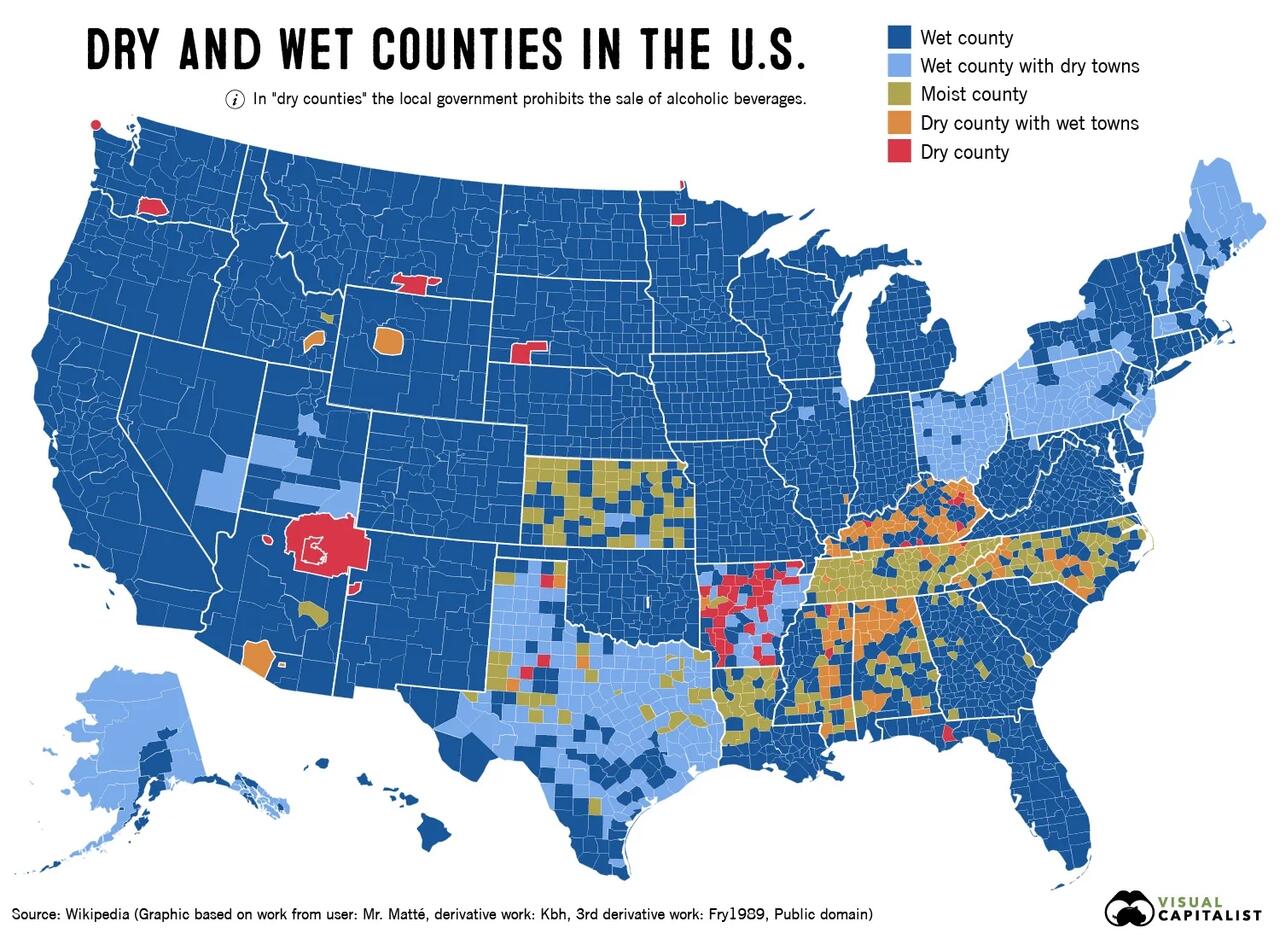
As Visual Capitalist shows in the map below, based on work by Wikipedia user Mr. Matté, many counties remain “dry,” banning the sale of alcohol entirely, or “moist,” allowing only limited sales.
Where Alcohol is Still Restricted
The data, crowdsourced from local government sites and media reports, reveals that alcohol restrictions are concentrated in the South, particularly in states like Arkansas, Kentucky, Mississippi, and Tennessee.
Arkansas stands out the most in the map above, with a patchwork of red and orange counties indicating either total bans or partial restrictions on alcohol sales. In fact, the state has long struggled with outdated liquor laws, where even grocery stores in “moist” counties may be prohibited from selling wine or spirits.
Alcohol Status: It’s Complicated
Here’s what the terminology means:
Dry county: No alcohol sales allowed by law
Moist county: Alcohol sales are partially restricted (e.g. allowed in restaurants but not in stores)
Wet county: Alcohol can be sold without county-level restriction
Even within “wet” counties, individual towns may choose to remain dry, and in “dry” counties, specific towns or establishments can apply for exemptions, creating a legal maze for consumers and businesses alike.
Declining Dryness Over Time
According to the National Alcohol Beverage Control Association, the number of dry counties has dropped significantly since the mid-20th century. In Texas, for example, only three dry counties remain.
Nonetheless, the persistence of these regulations reflects longstanding cultural attitudes and the influence of local referenda. While national consumption of spirits is rising, especially in certain states, the map shows that alcohol availability is still very much a local matter.
If you enjoyed today’s post, check out Americans are spending less on spirits…besides tequila on Voronoi, the new app from Visual Capitalist.
Tyler Durden
Sat, 12/06/2025 – 19:15
https://www.zerohedge.com/political/where-are-americas-dry-counties

On day of Kristi Noem visit to Chicago, federal immigration agents use tear gas on Elgin crowd
Federal immigration agents deployed tear gas and pepper spray Saturday on a crowd that gathered to protest a prolonged arrest in a northwest Chicago suburb, angering neighbors who said it was “uncalled for” and “tremendously disappointing.”
The standoff began around 10 a.m. Saturday when about 15 agents showed up to arrest an unidentified man at an apartment building on the 1600 block of Maple Lane in Elgin. Elgin police said there had been a traffic crash that morning involving a federal agent and the man, who then fled to the building.
The crowd, blowing whistles and shouting at agents to leave, grew throughout the morning, eventually swelling to at least 100 people by the afternoon.
Around 3:30 p.m., agents reportedly arrested the man while he was inside an apartment. Afterward, videos taken by a witness at the scene showed some people in the crowd throwing snowballs at the agents and their vehicles, while others yelled at them to stop.
While driving away, agents hurled pepper spray and flash-bang grenades into the crowd. One agent told the crowd, “Back up or gas will be deployed,” seconds before he threw a canister, a video shows.
U.S. Department of Homeland Security and Immigration and Customs Enforcement spokespeople didn’t immediately respond to a request for comment. Meanwhile, Secretary of Homeland Security Kristi Noem joined the U.S. Coast Guard for a Christmas tree event at Navy Pier on Saturday.
Audrey Luhmann, 40, of West Chicago, said the pepper spray and tear gas went “everywhere” into the crowd and that she could still smell it about an hour later on her clothes. Luhmann said neighbors asked the agents to see a warrant, which they refused.
“It’s almost as though they wanted things to escalate,” she said. “I don’t understand what goes through their mind to justify that kind of action. This could have been just a normal Saturday, and instead, this is what they have to do to our community.”
Federal agents faced mounting scrutiny from fearful residents and the courts alike over their use of chemical weapons during Operation Midway Blitz, which has tapered off since Border Patrol chief Gregory Bovino left Chicago with hundreds of his agents in November. Body cameras repeatedly captured agents’ apparent glee in deploying tear gas and other munitions on residential streets.
“It’s clear that Chicago and Illinois remain a target of the administration,” Brandon Lee, of the Illinois Coalition for Immigrant and Refugee Rights, told the Tribune this week after agents detained at least three people in the west suburbs.
According to Elgin Police, a federal agent reported that he was involved in the traffic crash while conducting enforcement activities, and that someone involved in the crash had fled to Maple Lane. The crash occurred around 9:15 a.m. in the 1600 block of West Highland Avenue, police said in a statement.
About 45 minutes later, a separate caller in the 1600 block of Maple Lane reported that “subjects in masks were on their property stating they had a warrant.”
The protest outside the building appeared to escalate around 12:30 p.m., however. A video taken by a witness at the scene shows at least two agents tackling a protester while other agents push the crowd back. Agents then threw tear gas and pepper balls into the crowd, according to witnesses and videos.
Tracy Howell, 58, said the agents tackled the man after he stepped closer to them off the sidewalk. At that point, agents shot the pepper balls, which Howell said “irritated” her nose and throat. She had arrived at the apartment building around noon, she said.
“(The agents) just kept saying, ‘Move back. Move back.’ And I kept asking, ‘Where do you want us to move back to?’” she said. “And the guy who was most aggressive … pushed me to the ground.”
Howell said neighbors were bringing pizzas, water and hand warmers so the group could stay out protesting longer. She said, “It causes me so much anxiety” to see the federal immigration activity in her community, especially the use of chemical weapons.
“That was just testosterone and anger and uncalled for. There was no reason for it. One little step and they’re triggered,” she said. “I never would have guessed that I would have been pepper shot at or pushed down by law enforcement.”
Elgin Police said they received reports that shots had been fired, but they determined this wasn’t true after arriving at the scene. They instead found that agents had “dispersed chemical irritants.” They treated and released seven people at the scene.
“The Elgin Police Department will continue to respond to any calls for service and determine the appropriate action within the parameters of the Illinois Trust Act which prohibits Elgin officers from assisting with federal immigration enforcement operations,” the department said.
By 2:30 p.m., the man the agents were attempting to arrest was still on the balcony. About 30 agents at the scene were trying to negotiate with him, while a crowd of about 200 people told the man not to talk to them.
https://www.chicagotribune.com/2025/12/06/immigration-agents-use-tear-gas-on-crowd-in-elgin/

Daily Horoscope for December 07, 2025
General Daily Insight for December 07, 2025
Steady thoughts bring calm choices and clarity. Early hours may bring misreads as fiery Mars forms a quincunx to expansive Jupiter, asking us to adjust big aims to match resources in daily life. With clever Mercury trining disciplined Saturn at 11:48 AM EST, our plans tighten gently, conversations become grounded, and commitments feel easier to honor. By evening, the emotional Moon warms confidence, so we speak up with heart and keep moves simple. Small, steady choices guide us toward reliable progress.
Aries
March 21 – April 19
Deep talks lead to practical steps now. Shared truth feels safe as cerebral Mercury harmonizes with responsible Saturn to activate your 8th House of Resources, helping you talk money that maps a goal. You may initiate a clear conversation with a trusted person, and private worries soften as karmic Saturn steadies your oceanic 12th house and brings perspective. If tempers rise, breathe, make a list, then propose one doable next step that works for now. Choose transparency — clarity is key for teamwork.
Taurus
April 20 – May 20
What will it take to strengthen your closest bonds? Your 7th House of Partnerships finds support as chatty Mercury works with structured Saturn, making agreements easier and helping you set expectations with someone important to you. You may calmly propose a timeline for something you share, then state what you need while responsible Saturn grounds your 11th House of Social Networks. If someone hesitates, offer a small promise — and make sure to keep it. Reliability repairs doubts. Trust in the power of patience.
Gemini
May 21 – June 20
When energies clash, small adjustments open better paths. Your 7th House of Partnerships stirs under ambitious Mars, while auspicious Jupiter highlights your 2nd House of Money, so you may tweak an agreement for real fairness. If someone wants more than you can give, ease the mood with a few options, then gently offer one workable compromise and ask for feedback. Quick humor helps, yet the aim is true balance, not winning. Edit contracts now — clear terms save time and protect your energy.
Cancer
June 21 – July 22
This morning favors heartfelt play and learning. Mischievous Mercury trines authoritative Saturn through your 5th House of Creativity and Romance, helping you plan fun activities and set boundaries that make play easier. You may pick one simple plan, then protect a window of time for devoted practice as authoritative Saturn brings focus to your curious 9th house. Let your tender side lead the conversation, and choose clear start and stop times. Structure creates safety, so joy can bloom brightly and linger.
Leo
July 23 – August 22
Leo, you naturally light up every room. The intuitive Moon brings focus to your identity and first impressions today, so you may refresh your look and lead with generous warmth that others quickly reflect. If nerves flicker before the spotlight, pause to breathe and choose a statement that sets the tone and shows your heart. Your charisma grows when you keep it real. Share credit freely, and let light playfulness guide introductions to new folks. If you lead with sincerity, connection follows with ease.
Virgo
August 23 – September 22
Quiet changes at home need your attention, Virgo. Harmony benefits from small edits as action-oriented Mars stirs your domestic 4th house and jovial Jupiter energizes your idealistic 11th house. Plans may need some minor tweaks. You could reorganize the house, then text your friends about your progress and extend a warm invitation to hang out. If expectations feel fuzzy, ask clear questions and wait patiently. Your eye for detail has a way of smoothing edges, as long as you keep relationships at the center.
Libra
September 23 – October 22
What truly supports your sense of self-worth? Intellectual Mercury harmonizes with boundary-setting Saturn today to focus your 2nd House of Money, which helps you price your work well and choose spending that matches your goals and values. You might calmly approach a client about a clearer contract or figure out your grocery budget, helped by structured Saturn in your 6th House of Habits. A graceful boundary with yourself keeps finances balanced and respectful of your deepest desires, regardless of your momentary wishes.
Scorpio
October 23 – November 21
Clear intentions reshape how others see you — for the better. Thoughtful messaging on your part earns respect as information-gathering Mercury harmonizes with discipline-minded Saturn today. State your needs in conversation, and invite honest feedback. Thanks to responsible Saturn in your 5th House of Creativity, receiving a warm compliment gives depth without drama and shows your willingness to connect. Drop the mystery, Scorpio! Clarity of desire will open the right door for you in a hurry. Speak plainly with the people you trust.
Sagittarius
November 22 – December 21
When ambitious drive conflicts with promises you’ve made, it’s time to adjust. Warrior Mars charges your 1st House of Initiative today while lucky Jupiter spotlights your 8th House of Intimacy, so your goal may need a tweak now to respect limits and previous commitments. You might see about changing a professional deadline so you can show up for existing plans with a close friend or family member. Your open optimism still shines when you play fair and keep your priorities straight.
Capricorn
December 22 – January 19
Today favors strategic outreach with friends. Your 11th House of Friends and Allies gains traction as mental Mercury harmonizes with authoritative Saturn, making it easier to advance a project that’s been sitting on the back burner. Draft a concise message, then confirm responsibilities and assignments while rules-focused Saturn in your informative 3rd house sets a confident tone. Make sure everyone knows the next step. Your professionalism lands well in situations like this — folks need someone to boss up and be a leader.
Aquarius
January 20 – February 18
Steady effort earns quiet (but meaningful) recognition. Your 10th House of Career and Status lights up as messenger Mercury trines ambitious Saturn, helping your ideas land with authority in any setting. You may polish a proposal and speak succinctly in a meeting while steady Saturn supports your grounded 2nd house and encourages realistic pricing and promises. Quiet confidence does more than extra words right now. Innovative touches still shine when the structure frames them clearly. Share your value plainly, and watch as doors start opening.
Pisces
February 19 – March 20
What’s the secret to balancing work and play? You’re figuring it out as passionate Mars activates your 10th House of Career and tussles with joyous Jupiter in your 5th House of Pleasure. Plans may clash between duty and freedom. You might propose a new deadline, then reserve an afternoon for creative time that lifts your heart. If guilt whispers, remember that real rest improves results later. Your infamous empathy helps everyone feel seen, lending extra strength to your example of self-care. Joy sustains your energy.
https://www.chicagotribune.com/2025/12/06/daily-horoscope-for-december-07-2025/

Lionel Messi and Inter Miami complete ‘incredible journey,’ winning MLS Cup for franchise’s 1st title
FORT LAUDERDALE, Fla. — Lionel Messi’s legacy was long secured when he came to Inter Miami and joined Major League Soccer. He’d won a World Cup, won dozens of trophies, was generally considered the greatest player in the sport’s history.
He didn’t need an MLS Cup.
But he wanted one — and got it.
Messi and Inter Miami have completed their ascent, beating the Vancouver Whitecaps 3-1 on Saturday in the MLS Cup final for the franchise’s first championship. It came 2½ years after the legend arrived in South Florida, a move that stunned plenty of onlookers at the time.
He led the team to a Leagues Cup trophy in 2023, the MLS Supporters’ Shield last year before a first-round playoff loss — and now, they grabbed the league’s biggest prize.
“Last year we went out early in the league and were eliminated in the first round,” Messi said in Spanish afterward. “This year, winning MLS was one of our main objectives. The team made a huge effort — it was a very long year, with many matches — and we were up to the task all season.”
Messi set up the title-clinching goal with a 72nd-minute assist to Rodrigo De Paul, a play in which Messi stole the ball and threaded a pass through a tiny gap in a wall of Vancouver defenders. De Paul got it in stride, pushed it into the far corner of the net — and Messi went airborne to hop into his arms a few seconds later, all smiles.
And as the final minutes ticked away, Inter Miami’s pink-clad fans — most wearing Messi’s No. 10 on their backs — stood and stomped and cheered. South Florida has seen NFL and NBA and Major League Baseball and NHL titles in the past.
It’s a soccer town now too. Messi made that happen. Tadeo Allende scored in the sixth minute of stoppage time — off another Messi assist, of course — to make it 3-1. And when Messi lifted the trophy surrounded by his teammates, confetti rained down and fireworks boomed.
“This was the dream,” Inter Miami managing owner Jorge Mas said. “A spectacular day.”
Inter Miami became the 16th franchise in the league’s 30-year history to win a title. And this extends a run of parity for MLS, which has seen five franchises win championships in the last five years and eight franchises in nine seasons — only Columbus has won twice in that span.
“They said soccer would never make it in America,” MLS Commissioner Don Garber said during the trophy ceremony. “Inter Miami fans, has soccer made it?”
It has, and the moment is also the culmination of a 12-year odyssey for David Beckham, part of Inter Miami’s ownership group.
He retired as a player in 2013, and his MLS contract said he could start a franchise at a discounted rate when his career ended. Beckham chose Miami and it took him years to finally make it happen; it wasn’t until January 2018 when the franchise was formally born, after he partnered with Miami businessmen Jorge Mas and Jose Mas, and even then the team didn’t have a stadium plan.
The team started play in 2020, and Messi arrived halfway through the 2023 season. Inter Miami was in last place in MLS at the time.
And then Messi arrived. The last-place team then now runs the league.
“It’s been an incredible journey,” Beckham said.
The trophy is Messi’s 47th for club and country, extending his global men’s soccer record, and some say it’s actually 48 because MLS awards a trophy for winning conference titles as well. He has won at least 21 titles in one-match-final situations, many of them with the core of this team — Sergio Busquets, Jordi Alba, Luis Suarez and Javier Mascherano, his longtime Barcelona teammates.
Busquets and Alba are retiring and got to go out as champions. Suarez’s future is uncertain. Mascherano is the coach now, one who changed Inter Miami’s lineup and tactics halfway through the season — his first one leading the club — with this moment in mind.
And the 38-year-old Messi, the 2024 MLS MVP who seems like a lock to win the award again this season, still is like none other in the biggest moments with a contract that could have him playing with Miami into his early 40s. When next season starts, the team will be playing in a new stadium near Miami International Airport with a back-to-back title in mind.
“He’s not just here to enjoy living in Miami,” Beckham said. “His wife and the kids love Miami, but he’s come here to win, and that’s really what Leo is all about. He wants to win. He’s got that dedication, the loyalty that he shows to his teammates, to the city, to the club. Leo is a winner. It’s simple as that.”
Inter Miami went up 1-0 on an own goal in the eighth minute before Vancouver tied it in the 60th on a score by Ali Ahmed. Another Whitecaps shot hit both posts about two minutes later but stayed out, a huge moment.
“It was very close and I think it could have been different,” Whitecaps coach Jesper Sorensen said. “But that is football.”
Said Mascherano: “Maybe that was the luck we needed to be champions.”
Not long after the final whistle, Messi went over to the Inter Miami supporters section and threw both his hands in the air. It was a moment 2½ years in the making. The team stayed on the field for more than an hour afterward, taking pictures with friends and family.
“This is the moment I had been waiting for, and that we, as a team, were waiting for,” Messi said. “It’s very beautiful for all of us. They deserved it.”
https://www.chicagotribune.com/2025/12/06/mls-cup-inter-miami-lionel-messi/
Filipinas acusa a China de lanzar bengalas a su avión patrulla en el mar de China Meridional
Por JIM GOMEZ
MANILA, Filipinas (AP) — Fuerzas chinas dispararon tres bengalas desde una isla hacia un avión filipino que realizaba un patrullaje de rutina el sábado en el disputado mar de China Meridional, pero el incidente no causó ningún problema y la aeronave continuó con su misión de vigilancia, informó la guardia costera de Filipinas.
Hasta el momento, se ignora a qué distancia del avión Cessna Grand Caravan de la oficina de pesca de Filipinas estaban las bengalas que, según autoridades filipinas, fueron disparadas desde el arrecife Subi, ocupado por China.
Hasta el momento, las autoridades chinas no han comentado sobre el incidente. Beijing ha reclamado prácticamente todo el mar de China Meridional, una ruta comercial global clave, y ha jurado defender firmemente su soberanía. Las fuerzas chinas han disparado bengalas desde sus islas ocupadas y desde sus aviones como advertencia para que los aviones extranjeros se alejen de lo que llaman su espacio aéreo en las aguas disputadas.
“La aeronave de la Oficina de Pesca y Recursos Acuáticos grabó imágenes de video de tres bengalas disparadas desde el arrecife hacia la aeronave durante su sobrevuelo legal”, afirmó la guardia costera de Filipinas, que realizó el vuelo de vigilancia del sábado con la agencia de pesca.
“Estos vuelos tienen como objetivo monitorear el entorno marino, evaluar el estado de los recursos pesqueros y garantizar la seguridad y el bienestar de los pescadores filipinos en el mar de Filipinas Occidental”, señaló la guardia costera, utilizando el nombre filipino para la extensión del mar de China Meridional que Manila reclama.
El avión de patrulla filipino avistó un barco hospital chino, dos barcos de la guardia costera china y 29 barcos presuntamente pertenecientes a milicias anclados en las aguas frente a Subi, informó la guardia costera de Filipinas.
Subi es uno de los siete arrecifes disputados y mayormente sumergidos que China convirtió hace más de una década en lo que ahora son bases insulares en las Spratlys, la región más disputada del mar de China Meridional. Las islas artificiales están protegidas por un sistema de misiles y tres de ellas tienen pistas de aterrizaje de grado militar, según funcionarios de seguridad de Estados Unidos y Filipinas.
Además de Subi, el avión de patrulla filipino voló cerca de otras seis islas, arrecifes y atolones disputados, entre ellos, Sabina, un bajío deshabitado en disputa, donde monitoreó un barco de la marina china. “Este buque emitió repetidamente desafíos por radio contra la aeronave de la Oficina de Pesca y Recursos Acuáticos mientras volaba dentro de los derechos soberanos de Filipinas”, dijo la guardia costera del país.
“Todo seguro y misión cumplida”, dijo Jay Tarriela, de la guardia costera de Filipinas, sobre el vuelo de vigilancia del sábado.
Estados Unidos no tiene reclamos territoriales en el paso marítimo, pero ha patrullado las aguas durante décadas y ha advertido repetidamente que está obligado a defender a Filipinas, su aliado más antiguo por tratado en Asia, si las fuerzas filipinas son atacadas, incluso en el mar de China Meridional.
Vietnam, Malasia, Brunéi y Taiwán también han participado en las prolongadas disputas por las aguas, ricas en recursos.
___
Esta historia fue traducida del inglés por un editor de AP con la ayuda de una herramienta de inteligencia artificial generativa.
General Flynn: Strategic Assessment Of Marxist-Style Color Revolution Targeting America
General Flynn: Strategic Assessment Of Marxist-Style Color Revolution Targeting America
Authored by Michael T. Flynn LTG USA (RET),
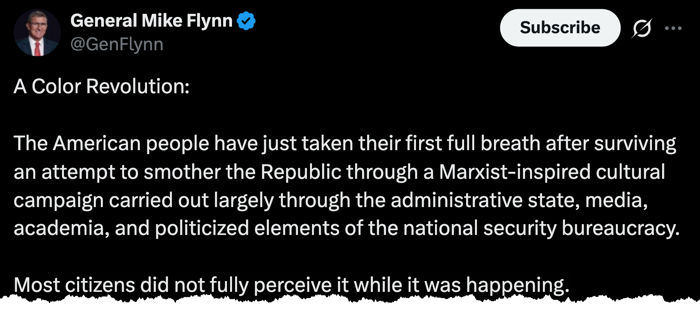
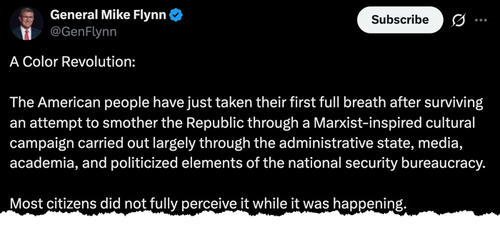
The American people have just taken their first full breath after surviving an attempt to smother the Republic through a Marxist-inspired cultural campaign carried out largely through the administrative state, media, academia, and politicized elements of the national security bureaucracy. Most citizens did not fully perceive it while it was happening. Many in the intelligence community either passively accepted it or actively furthered it. The architects of this project are not finished, but their effort has been damaged and delayed. It is only by the grace of God that the country has endured to this point.
The American version of the cultural revolution is distinct from the Maoist model that ravaged China in the twentieth century. It did not coalesce around a single charismatic revolutionary figure. Instead, it spread along the arteries of bureaucracy, higher education, corporate structures, and activist networks. The long march through the institutions, as described by Antonio Gramsci, became the operational template. Rather than Red Guards filling the streets under the orders of an identifiable supreme leader, the United States experienced a coordinated convergence of agencies, NGOs, foundations, media outlets, and activist fronts, all advancing the same ideological project under different labels.
Because federal agencies differ widely in size, mission, culture, and internal resistance, this revolution unfolded unevenly. It never achieved total dominance in a single decisive stroke. Instead, it advanced by fragmentary gains and suffered fragmentary defeats. Wherever the ideological project captured an HR department, a training pipeline, a public school system, or a central media platform, it encountered resistance in state governments, independent media, individual courts, and networks of citizens who refused to comply. This piecemeal quality of implementation slowed the collapse and gave the American people time to see what was happening and respond.
Even as these battles played out in public, darker currents moved beneath the surface. We now assess that thousands of religious and conservative federal employees were quietly identified and referred to a little-known federal entity, the Pre-Trial Services Agency. Accounts and initial documentation indicate that this agency may have been used to catalog individuals solely on the basis of ideology and religious conviction, under the pretext of January 6, and vaccine-related non-compliance. The intention appears to have been not only administrative removal but also potential criminalization. This matter demands immediate, transparent investigation by any future administration that claims to be serious about the rule of law.
To understand the broader context, it is necessary to define what we mean by the concept of the welfare state. We are not merely describing traditional social programs. We refer instead to a constellation of fully funded professional activist groups that present themselves as separate causes but in reality form a single revolutionary bloc. Over the last decade, organizations under the banners of antifascism, racial justice, radical feminism, abortion on demand, certain LGBTQ plus factions, environmental extremism, and gun control advocacy have shown remarkable cohesion. They share donors, staff, narrative frameworks, and street-level tactics. Their membership overlaps. Their messaging is synchronized. They rapidly support one another’s campaigns and protests.
These groups present themselves as grassroots movements. In reality, they function much more like a professionalized revolutionary caste. Their core is composed not of ordinary citizens but of trained activists who treat agitation as a full-time occupation. They are funded through a mix of private foundations, wealthy donors, and, in some cases, federal and state resources. They serve as the street and digital arm of a broader ideological project whose goal is not reform but transformation. They are bound together by a worldview that is explicitly revolutionary and implicitly Marxist, even if many of their foot soldiers do not use that language.
Within this structure, Diversity, Equity, and Inclusion plays a central role. DEI is not a harmless corporate fad. It is a cultural and psychological weapon system. In practice, DEI training and enforcement operate as a mechanism for behavioral conditioning, using guilt, struggle sessions, and the constant threat of social or professional punishment to bring individuals into line. The language of microaggressions, privilege, and systemic bias functions as a soft form of ideological policing. It compels people to monitor their speech, second-guess their instincts, and submit to an ever-expanding set of forbidden words and mandatory rituals.
This is not inclusion. It is coerced conformity disguised as virtue. The outcomes within institutions are fear, silence, and self-censorship. People learn quickly that specific questions cannot be asked, certain facts cannot be stated, and certain perspectives cannot be acknowledged without risking their careers. This is not an accidental side effect. It is the point. If you can compel people to lie about obvious realities in public, you own them. DEI is therefore best understood as a domestic application of political reeducation, aligned with Marxist and neo-Marxist approaches to cultural change.
Red washing is the term we use for the systematic erasure of material that exposes Marxism’s history, tactics, and consequences. When civics and traditional American history are removed from curricula and replaced with grievance narratives, the ground is prepared for a new ideology. When the record of socialist atrocities is buried or dismissed, whole generations lose the ability to recognize patterns that their grandparents would have seen immediately. This did not happen accidentally. Higher education, media, and entertainment became primary targets for this rewriting of memory.
By 2020, the United States had been subjected to decades of this cultural reshaping. The country entered that year already weakened and divided. The combined impact of a global pandemic, a Chinese Communist Party information campaign, and unprecedented civil unrest brought the country to a state of exhaustion. Law enforcement was undermanned and demoralized. The medical system was stretched to the limit. Schools at every level were shuttered or reduced to screens. The basic functions that distinguish a first-world nation were placed under siege.
These conditions were ideal for revolutionary actors who understood the Bolshevik concept of the spark. In Mao’s China, youth brigades became instruments of chaos once police authority had been stripped and traditional structures weakened. In the United States, policies calling for the defunding and delegitimizing of police, combined with political protection for rioters, produced something similar in spirit. The rolling riots of 2020 were not a spontaneous eruption. They were a conditioning phase, designed to hollow out public confidence, normalize political violence from the left, and set the emotional stage for a more targeted crisis.
That crisis came on January 6. Here, the doctrine of moderated violence is essential to understand. This tactic seeks to provoke an adversary into a desperate or unwise act that can then be weaponized to justify a crackdown. For a year, Americans watched their cities burn and were told it was mostly peaceful. Then, in a single day, a protest on Capitol grounds was framed as an insurrection, an existential threat to “democracy,” and the moral foundation for a years-long campaign of arrests, surveillance, and persecution. The left’s riots stopped instantly. The narrative flipped overnight. That abrupt shift reveals design, not coincidence.
January 6 was the planned inflection point that allowed the bureaucratic and activist alliance to declare open season on conservative and religious Americans. It became the lens through which all dissent could be labeled dangerous and disloyal. The people who entered the Capitol that day, many of them peaceful and bewildered, became the pretext for a broader project aimed at remaking the national security apparatus from within.
What came next moved beyond street-level activism or cultural capture. It entered the bloodstream of the national security state. The aftermath of January 6, the collapse of Afghanistan, and the federal vaccine mandates combined into an unprecedented attempt to remake the federal workforce through coercion, intimidation, and ideological purification. Inside the CIA and across the national security apparatus, the internal revolution reached its apex and then began to fracture under its own contradictions.
Societal collapse is never a singular event. It is a process.
* * *
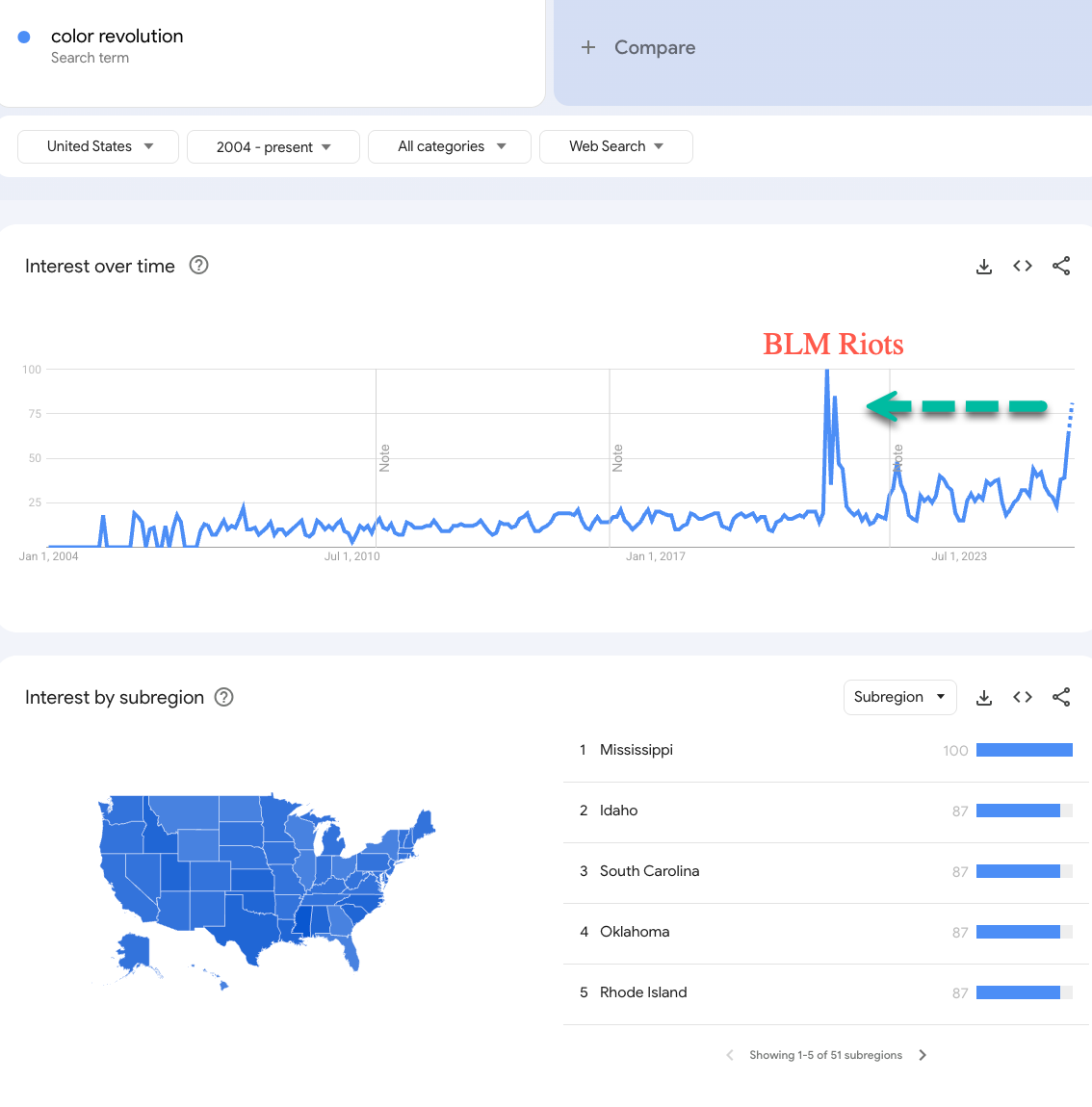
The search term “color revolution” has been catapulted into the mainstream. Google Search Trends shows the term has soared to the highest levels since the Marxist BLM rioters began burning city blocks across Democratic-run metro areas in 2020.
Last month, retired Lt. Gen. Michael Flynn told Alex Jones that the Trump administration must address the nation about what he called a sinister regime-change plot, one operating through billionaire-funded NGOs.
Breaking! General Flynn Calls On President Trump To Immediately Address The Nation Concerning The Color Revolution Being Fomented By The Seditious 6 And The CIA As He Lays Out The String Of Illegal Investigations And Law-fare That The Leftist Have Engaged In Since DJT’s Historic… pic.twitter.com/HYeXQwCNim
— Alex Jones (@RealAlexJones) November 26, 2025
“People need to understand that if this operation succeeds, things will move quickly – Trump would be removed from the scene almost immediately. Elite defection isn’t an early warning sign of an overthrow; it’s the final stage before one,” DataRepublican recently warned, adding, “This is why the ‘Seditious Six’ must face the most severe penalties the law allows.”
To sum up, for the first time, the American people are beginning to learn about the regime-change efforts that Democrats and their billionaire-funded NGO network have been pursuing over the past decade. It amounts to nothing but a color revolution. Time for reforms, especially across the nonprofit world.
Tyler Durden
Sat, 12/06/2025 – 18:40

Northwestern falls to 0-2 in Big Ten with 86-82 loss to Ohio State despite Nick Martinelli’s 32 points
Brandon Noel scored 29 points on 13-for-15 shooting and Ohio State won its Big Ten opener with an 86-82 victory over Northwestern on Saturday in Evanston.
Ohio State (7-1, 1-0) used a 18-7 surge in the second half to take a 64-61 lead with 8:41 left before Northwestern’s Arrinten Page tied it with a 3-pointer. Noel then scored the next four points on two free throws and a layup. The Buckeyes later pushed the advantage to 81-73 with 2:10 remaining.
The Wildcats pulled within 82-81 with 21 seconds to play before the Buckeyes sealed it from the free-throw line.
Bruce Thornton added 17 points and 10 assists for Ohio State, which shot 57% (35 of 61) from the floor. Amare Bynum chipped in with 11 points and Devin Royal scored 10.
Nick Martinelli had 32 points and eight rebounds to lead Northwestern (5-4, 0-2). Angelo Ciaravino added 14 points and Page had 13.
Martinelli scored 18 points and grabbed six rebounds in the first half to help the Wildcats build a 44-40 lead. Noel scored 10 points to pace the Buckeyes.
Up next
Northwestern plays at home against Jackson State on Saturday.
Ohio State hosts No. 14 Illinois State on Tuesday.
https://www.chicagotribune.com/2025/12/06/northwestern-ohio-state-mens-basketball/

Illinois State scores 2 late TDs to upset top-ranked North Dakota State 29-28 in FCS playoffs
FARGO, N.D. — Tommy Rittenhouse connected with Daniel Sobkowicz for two touchdown passes inside the final two minutes and overcame five interceptions to help No. 17 Illinois State upset top-ranked and previously unbeaten North Dakota State 29-28 on Saturday in the second round of the FCS playoffs.
Rittenhouse’s second 8-yard TD pass to Sobkowicz pulled Illinois State (10-4) within 28-21 with 2:44 left. On the ensuing possession, Jake Anderson strip-sacked Cole Payton, and the Redbirds had the ball back at the 23.
On fourth-and-goal with 51 seconds left, Rittenhouse threw a 6-yard touchdown pass to Sobkowicz, and the Redbirds converted a two-point conversion on a pass to Scotty Presson Jr.
The Bison (12-1) then drove near midfield, but Nathan Hayes threw an incomplete pass on fourth-and-7 to seal it for the Redbirds, who will move on to face the UC Davis-Rhode Island winner in a quarterfinal.
Payton threw a 73-yard touchdown pass to Bryce Lance on North Dakota State’s first play from scrimmage. About 10 minutes later, Jackson Williams scored on a 52-yard punt return for a 14-0 lead. Nathaniel Staehling added a 73-yard pick-six midway through the second quarter to give the Bison a 21-7 lead.
Rittenhouse threw three interceptions in the first half before throwing an 8-yard touchdown pass to Sobkowicz late in the second quarter to get the Redbirds within 21-14 at the break.
Rittenhouse completed 35 of 52 passes for 249 yards. Victor Dawson scored on a 69-yard touchdown run in the second quarter and finished with 137 yards rushing for Illinois State.
Payton and Hayes combined for 6-of-19 passing for 120 yards. Barika Kpeenu’s 4-yard touchdown run gave the Bison the lead at 28-14 with 12:38 left in the fourth quarter.
The Bison entered having won 14 straight in the series with a pair of playoff wins, including a 29-27 victory in the 2014 national championship game.
https://www.chicagotribune.com/2025/12/06/illinois-state-north-dakota-state-fcs-playoffs/

Secretario de Defensa de EEUU justifica ataques a embarcaciones de cárteles en foro de seguridad
Por DAVID KLEPPER
WASHINGTON (AP) — El secretario de Defensa de Estados Unidos, Pete Hegseth, defendió los ataques a presuntas embarcaciones de cárteles de drogas en un discurso pronunciado el sábado en la Biblioteca Presidencial Ronald Reagan, afirmando que el presidente Donald Trump tiene el poder de emprender acciones militares “como lo considere necesario” para defender la nación.
Hegseth desestimó las críticas a los ataques, en los que han muerto más de 80 personas, y ahora enfrentan un intenso escrutinio por preocupaciones de que violaron el derecho internacional. Al decir que los ataques están justificados para proteger a los estadounidenses, Hegseth comparó esa lucha con la guerra contra el terrorismo tras los ataques del 11 de septiembre de 2001.
“Si trabajas para una organización designada como terrorista y traes drogas a este país en un barco, te encontraremos y te hundiremos. Que no haya duda al respecto”, dijo Hegseth durante su discurso principal en el Foro Nacional de Defensa Reagan. “El presidente Trump puede y tomará acciones militares decisivas como lo considere necesario para defender los intereses de nuestra nación. Que ningún país en la tierra dude de eso ni por un momento”, añadió.
El ataque más reciente eleva el número de muertos de la campaña a al menos 87 personas. Los legisladores han buscado más respuestas sobre los ataques y su justificación legal, y si las fuerzas de Estados Unidos recibieron la orden de lanzar un ataque de seguimiento tras una ofensiva en septiembre, aun después de que el Pentágono supiera que había sobrevivientes.
Aunque Hegseth comparó a los presuntos traficantes de drogas con los terroristas de Al Qaeda, los expertos han señalado importantes diferencias entre los dos enemigos y los esfuerzos para combatirlos.
Las declaraciones del secretario se produjeron después de que el gobierno de Trump publicara su nueva estrategia de seguridad nacional, en la que pinta a los aliados europeos como débiles y busca reafirmar la dominancia de Estados Unidos en el hemisferio occidental.
En su discurso, Hegseth también habló de la necesidad de controlar el ascenso de China a través de la fuerza y no del conflicto. Repitió la promesa de Trump de reanudar las pruebas nucleares en igualdad de condiciones con China y Rusia, un objetivo que ha alarmado a muchos expertos en armas nucleares. China y Rusia no han realizado pruebas explosivas en décadas, aunque el Kremlin dijo que seguiría a Estados Unidos si Trump reiniciara las pruebas.
El discurso fue pronunciado en el Foro Nacional de Defensa Reagan en la Fundación e Instituto Presidencial Ronald Reagan en California, un evento que reúne a los principales expertos en seguridad nacional de todo el país. Hegseth aprovechó la visita para argumentar que Trump es el “verdadero y legítimo heredero” de Reagan en lo que respecta a una enérgica política exterior.
En contraste, el secretario de Defensa criticó a los líderes republicanos de los años posteriores a Reagan por apoyar guerras en el Oriente Medio y esfuerzos de construcción de democracia que no funcionaron. También censuró a quienes han argumentado que el cambio climático plantea serios desafíos a la preparación militar.
“El departamento de guerra no se distraerá con la construcción de democracia, el intervencionismo, las guerras indefinidas, el cambio de régimen, el cambio climático, la moralización “woke” y la construcción de naciones ineficaz”, afirmó.
___
Esta historia fue traducida del inglés por un editor de AP con la ayuda de una herramienta de inteligencia artificial generativa.