Category: News

Jim Nowlan: Illinois educators are applauding weak school achievement
More than 4 out of 5 Illinois public schools were rated “commendable” or “exemplary” in the recently released annual Illinois School Report Card. Wish it were so.
This recalls the observation by retired radio host Garrison Keillor that all the kids in the fictional town of Lake Wobegon were above average.
Many rural schools in my central Illinois region confines fall far below the state averages in math, yet they are somehow commendable. The official, bottom-scraping low bar for achieving “commendable” status is that a school graduate just 67% of its students and perform better than the lowest-performing 5% of schools.
Do readers think the school superintendent trumpets the fact that Johnny and his classmates are doing lousy in math, or back-pats herself at school board meetings about winning the official state imprimatur as a commendable school?
Unfortunately, with the hollowing out of community newspaper reporting staff, there is now rarely a gimlet-eyed journalist at the local school board meeting to cast a more sober tone on the school’s status. The community is the loser.
The Illinois report misleads parents and communities. “Isn’t it great that the state says our school is commendable?” says Mom to hubby. “Guess there is nothing we need to do to help Johnny succeed with his education.”
Overall, Illinois public schools are just above the middle of the pack against national averages for achievement. But the pack fares badly against international comparisons.
The Program for International Student Assessment reports that for 2022 15-year-old students in the U.S. scored on average 465 in math on a 1,000-point scale, below the developed nations’ average, while students from South Korea, Singapore, Taiwan and Japan scored from 527 to 575 points.
China participated only selectively in a 2018 Program for International Student assessment, and scored 591 points. This isn’t necessarily comparable, so let me give you a clue as to how well students there are likely doing.
In 2005, I was a visiting professor at Fudan University in Shanghai. On Saturday mornings, from my apartment window, I enjoyed seeing elementary youngsters in cute uniforms walking by — on their way to school! The students attend each Saturday until noon, and for one more hour of instruction each week day than in American schools. If Chinese parents were told their children could not attend school on Saturday, I imagine riots in the streets. If American parents were told their children had to attend school on Saturday, I also imagine riots in the streets.
Chinese leader Xi Jinping understands the importance of education in his quest to overtake the U.S. as the superior “Middle Kingdom” of the world, which China once was. Since Xi’s succession to power in 2012, four-year university enrollment in China has surpassed that of the U.S., and China is now the largest producer of peer-reviewed scientific articles in the world, according to a 2018 article in Nature magazine.
The Han Chinese majority are a very proud people. Xi has not forgotten how the advanced West humiliated backward China and its empress in the 19th century, forcing opium and serious addiction upon many Chinese, among other depredations. Now, according to my Chinese acquaintances, Xi wants to rub our noses in the muck of what he perceives to be America’s decadence.
It sounds alarmist, yet America should be on the equivalent of a war footing when it comes to education, the fount of economic success and military readiness in this digital century. China certainly is.
Education leaders must not lull parents into thinking that Illinois and the U.S. are doing well in educational achievement, when we’re not. Political leaders bear the responsibility for straight talk about education.
There is also opportunity at present to strengthen our teacher corps. Rare is the Ivy Leaguer who goes into teaching.
College students from up and down the achievement scale have deep concerns about job prospects in an AI world. Work is shifting from production of goods to the provision of services. What better pursuit than nurturing young minds via jobs that aren’t going away? Policymakers can work with educators to make teaching attractive and more highly respected, as it is in Finland and Japan.
All is not commendable in American education. Educators and school boards do not all deserve a prize. We should aspire to excellence rather than celebrate unwarranted self-congratulation.
Jim Nowlan is a former member of the Illinois House and a former state agency director. Nowlan worked for three unindicted Illinois governors and taught American politics at the University of Illinois at Urbana-Champaign. He is the lead author of “Fixing Illinois.”
Submit a letter, of no more than 400 words, to the editor here or email letters@chicagotribune.com.
https://www.chicagotribune.com/2025/12/09/opinion-illinois-students-achievement-china/

Cate Plys: How Mayor Brandon Johnson can help the budget and make the city’s trash fee more equitable
When I hear Mayor Brandon Johnson rail against the idea of raising Chicago’s paltry $9.50 garbage collection fee to help fill our gaping $1.2 billion budget gap, I remember a beautiful 12,000-square-foot mansion in Kenwood I walked through a few years back.
The four-story masterpiece features a ballroom on top, and turrets flanking the massive front porch. This place has every single room you’d need to play Clue. My daughter and I enjoy attending opulent open houses, so when this one got rehabbed and put on the market, we showed up early. The dining room should have featured a goalpost, since the double living room was the size of a football field.
In contrast, I live in a condo association of about a dozen six-flats. My unit is slightly under 2,000 square feet. Miss Scarlett could only kill Colonel Mustard in a sun porch, front room, bedroom, dining room or kitchen. No observatory. No secret passages.
Yet I pay $18 monthly for garbage and recycling pickup, while whoever waltzes around that private ballroom pays $9.50 — unless they’re over 65, in which case they pay just $4.75.
My friend’s condo association is a single six-flat. They pay $46 per month per unit.
But how can this be, you ask, when the mayor thunders that any garbage fee over $9.50 is an evil regressive tax?
Oh, I’ll tell you how.
First, the city’s garbage fee hasn’t increased since it was set in 2015. According to Johnson’s “Chicago Financial Future Task Force” report on this year’s budget, Chicago has the lowest garbage fee of almost any peer city. Los Angeles charges $55.95 per month. Chicago’s fee generates about $60 million annually, while the actual cost of garbage pickup is $320 million. That $9.50 covers just 18% of the service.
Plus, Chicago’s fee includes recycling. And they don’t charge extra for lawn refuse or “bulk waste.”
Second, only half of Chicago residences qualify for garbage service — single-family homes and buildings under four units. The other half, us schmucks living in six-flats, courtyards, mid-rises and high-rises? We pay full price for private trash and recycling services.
Then, we schmucks subsidize the 82% of garbage service we don’t even get that’s not covered by fees. Talk about regressive. We help pay the tab for every single-family home, from the smallest one-bedroom slab house in the poorest neighborhood to the Kenwood people who can play a real life game of Clue in their mansion.
The schmucks include Chicago’s poorest citizens, who don’t own houses. They rent apartments, mostly in buildings with over four units. So the poorest Chicagoans pay the full cost of their garbage pickup through their rent, and then they help pay for the Clue people’s garbage too.
Look, nobody wants to sock low-income homeowners with a garbage increase. That’s why I agree with Johnson’s task force report that qualified homeowners should get the same break on garbage as they do for other city utilities. Qualified owners use the Utility Billing Relief Program for a 50% rate cut on water and sewer fees with no late penalties or debt collection. Didn’t Johnson read his own report?
And here’s something the task force missed: Chicago can institute a graduated garbage fee by tying it to, say, a property’s assessed valuation. Finally, Johnson’s chance to soak the ultra-rich! The Clue people could pay the full cost of their garbage service, or more, without hurting less fortunate neighbors. They could even pay according to their volume of garbage. News flash: Big houses produce big garbage.
Johnson’s task force offered several garbage-fee increase plans to raise $20 million to $296.9 million. The alternative budget proposal put forth by 26 aldermen last week, including Johnson ally and Finance Committee Chairman Ald. Pat Dowell, suggests a fee structure raising $55 million. I think my idea could raise a lot more, but like the aldermen, I don’t have access to a budget staff to run the numbers. So we’ll stick with the aldermen’s figure.
That $55 million is over half the amount needed to jettison just one of Johnson’s terrible budget ideas — instituting a $21-per-employee corporate head tax, when Chicago’s downtown business district has a record-high 28% office vacancy rate.
Or we could put that $55 million toward protecting our credit rating, by dropping two other awful Johnson ideas — slashing in half the city’s $240 million extra payment to its perilously underfunded pensions, or borrowing $166 million to cover firefighter backpay. Those are both points that nudged Standard & Poor’s to change Chicago’s credit outlook to negative after Johnson unveiled his 2026 budget.
But no. A fair, equitable, graduated garbage fee increase won’t help close our budget gap this year.
Johnson, who called himself the “collaborator in chief” during last year’s budget process and has claimed for months that he wants to work with aldermen on this year’s budget, quickly batted down the entire aldermanic proposal, including the garbage fee increase.
According to a letter from Johnson’s financial team, any garbage increase would be “imposing another major cost escalation” and “create an immediate and disproportionate burden on households least able to absorb it.”
In fact, Johnson threatens to veto any budget that messes with the garbage fee.
My guess is that when Chicago sees its credit rating tank next year, the culprit will be Johnson, in City Hall, with a veto pen.
Cate Plys is a former Chicago reporter and columnist who now writes the Chicago history newsletter “Roseland, Chicago: 1972” on Substack. She is a regular panelist on WGN’s “Mincing Rascals” current events podcast, hosted by John Williams and airing Saturday nights at 8 p.m.
Submit a letter, of no more than 400 words, to the editor here or email letters@chicagotribune.com.
https://www.chicagotribune.com/2025/12/09/opinion-chicago-budget-brandon-johnson-garbage-fee/

Gonzalo Schwarz: America needs even more billionaires fueled by the American Dream, not fewer
As New York Mayor-elect Zohran Mamdani’s inauguration looms, the wealthiest Americans are being targeted as a rallying cry. In recent weeks, Mamdani’s criticism of millionaires and billionaires has been echoed by Sen. Bernie Sanders, megamillionaire singer Billie Eilish, and even an entity called “Patriotic Millionaires” which demands higher taxes on those wealthier than them.
Of course, philanthropy is patriotic. While the United States has the most billionaires and millionaires in the world, with 902 billionaires and almost 60 million millionaires, we are also the most philanthropic country across many financial and nonfinancial measures. And you certainly don’t have to be a high-net-worth individual to donate your money and time.
But calling billionaires policy failures is not about fairness. The rich pay much more than their “fair” share, with the top 5% paying 60% of all taxes collected in the U.S. It is a “luxury belief,” proclaiming an opinion to earn status. Debating exactly how much money people should or shouldn’t earn pushes a cultural narrative that frowns on success, disdains merit and the pursuit of meaning, promotes zero-sum thinking, and completely misunderstands the system that led to that wealth and its vast benefits for society.
Critics forget the quintessential American Dream stories that have made the U.S. the land of opportunity. Politicians like Mamdani ignore the myriad of risk-takers and innovators who created job opportunities for millions and improved standards of living for everyone (including his own family).
One of the best examples is Sam Walton, whose goal was to provide lower-cost items, so people had more disposable income. Walmart now employs 2.5 million people, and both the current and newly appointed Walmart CEOs started as store associates.
The world’s first self-made woman millionaire, Madame C. J. Walker, was a single mother, born to freed slaves. Was she too successful?
Other stories of people pursuing their purpose in life and becoming financially successful abound, such as FedEx founder Frederick W. Smith; Ameritrade founder Joe Ricketts; and my own favorite, Walt Disney, who was born to a poor family with five kids and built an entertainment empire. All of these benefit society.
Visitors line up to enter the birthplace home of Walt Disney at the corner of North Tripp Avenue and West Palmer Street in Hermosa on Oct. 15, 2023, during Open House Chicago. Disney was born on the second floor in 1901 and grew up there until his family moved to Missouri in 1906. (Brian Cassella/Chicago Tribune)
Financial success follows value creation. Less of it, either by disincentivizing or frowning upon that success, makes us all worse off. Creative entrepreneurial people leave countries that penalize success, such as the United Kingdom, France and more recently Norway. In countries that penalize success, inheritance matters more than effort. In the U.S., 73% of high-net-worth individuals are self-made, while in Norway and Sweden it’s only 47% and 42%, respectively.
Current discontent on affordability misleadingly attributed to billionaires has a clear root cause: lack of housing, “NIMBY” zoning, excessive fiscal spending, energy prices fueled by poor government policies, and even President Donald Trump’s tariffs. But two wrongs don’t make a right when it comes to affordability, and research has shown that there is an anti-profit bias narrative.
Let’s hope that New York’s experiment with democratic socialism is short-lived, and confined to the Big Apple alone. Let’s focus on upward mobility and less on the polarizing, zero-sum narrative of income inequality. Human flourishing comes from positive-sum narratives and from people pursuing their financial success.
Billionaires are the result of innovation, value creation and expanded opportunity that has enabled more paths to human flourishing for billions of people across the world. Dismissing the wealthy as policy failures might score political points, but it can destroy the foundation of a system that has done infinitely more good than harm.
As New York braces for Mamdani, all Americans should rally around the system that supports the American Dream for millionaires, billionaires and all of us who are empowered to flourish too.
Gonzalo Schwarz is president and CEO of the Archbridge Institute.
Submit a letter, of no more than 400 words, to the editor here or email letters@chicagotribune.com.
https://www.chicagotribune.com/2025/12/09/opinion-american-billionaires-taxes-fair-share/

Advocates hope newly passed bill will inspire more Illinois therapists to take private health insurance
Carey Carlock never imagined she’d have so much trouble finding a therapist for her teenage child.
She was a hospital CEO, on the board of a prominent local mental health organization and well connected. Yet the Oak Park mother couldn’t locate a therapist in her community who took her health insurance.
“I found that to just be completely unacceptable,” said Carlock, whose experience led her to change careers and open a new therapy practice in 2021 that now has six locations.
Now, she and others are hoping a recently passed bill will make it easier for people across Illinois to find therapists who take private insurance.
In recent years, many therapists have stopped taking insurance because of what they describe as low payment rates and administrative hoops that can make it difficult to treat patients — a situation that has left many patients either skipping behavioral health care or paying entirely out of pocket. The newly passed bill aims to address those issues by setting into law a formula outlining how much insurers must pay therapists for their services.
“This is an affordability bill,” said bill sponsor Rep. Lindsey LaPointe, D-Chicago. “It’s not affordable when you pay your monthly premium and then you have to pay $250 out of pocket for your monthly therapy.”
The bill also aims to cut red tape. It would bar insurers from requiring therapists to submit more documentation to get reimbursed for 60-minute sessions as compared with shorter sessions; require insurers to cover multiple behavioral health services for an individual patient in one day; and require them to cover services provided by therapists in training who are supervised by licensed professionals. The bill also aims to shorten the time it takes for therapists to join insurance plans’ networks.
The bill passed despite opposition from insurance industry representatives, who worry that it will mean higher costs for all members and who are against what they say is a precedent of reimbursement rates being set in statute.
Gov. JB Pritzker’s office also initially expressed concern about the bill earlier this year, but remained neutral after changes were made to the legislation. The governor’s office will review the final bill before the governor takes action, a spokesperson for the office said.
If Pritzker signs the bill into law, it would apply to about 2.5 million people in Illinois who have state-regulated health insurance plans, starting in January 2027, LaPointe said. Large companies typically have self-funded plans, which are regulated by the federal government, not the state. The bill also would not apply to people with HMOs.
The bill’s passage this fall came after several years of work by LaPointe and advocates for better access to behavioral health care. Thresholds, which serves people with serious mental health and substance use disorders in Illinois, brought the bill to LaPointe, said Heather O’Donnell, who was previously at Thresholds and now is DuPage County Health Department director of behavioral health strategy.
“I think this bill hit home with people,” O’Donnell said. “Elected officials hear from their constituents all the time about how hard it is to find a therapist, psychologist (or) social worker that takes their insurance. Many have their own personal experiences with the issue.”
Previous versions of the bill would have required insurers in Illinois to pay in-network therapists 141% of what Medicare pays for therapy and substance use disorder services. The formula in the version of the bill that passed this fall should get reimbursements to the “ballpark” of 141% of Medicare reimbursements, LaPointe said.
The bill was also changed, prior to passage, so that it would not apply to state employee health plans.
“The reason we carved out state employees is because the original version of the bill to include state employees would have allegedly raised costs for the state employee health plan,” LaPointe said. “We have always disputed that and the reason we’ve disputed that is because behavioral health care spending makes up a tiny percentage of overall health care spending.”
State Rep. Lindsey LaPoint, D-Chicago, at the Illinois Capitol in Springfield on Feb. 19, 2025. LaPointe sponsored a bill to make it easier for people across Illinois to find therapists who take private insurance. (Brian Cassella/Chicago Tribune)
Also, she said, better access to behavioral health care can save money on physical health care in the long run. LaPointe said compromises were necessary to pass the bill.
That carve-out, however, shows part of the problem with the bill, said Laura Minzer, president of the Illinois Life and Health Insurance Council, which opposed the bill. The bill could increase costs for everyone else on state-regulated, private plans, she said.
The council supported the other parts of the bill, but opposed the attempt to mandate reimbursement rates in law, Minzer said.
Insurance industry group AHIP also opposed the bill for similar reasons, and said in a statement it will continue to work with policymakers “to advance solutions that improve affordability and access to mental health and substance abuse care.”
Supporters of the bill, however, say it could make a real difference when it comes to access to therapists in Illinois.
Federal and state parity laws already require insurance companies to cover behavioral health and physical health care equitably — and though those laws were important, more work was needed, said Mark Ishaug, president and CEO of Thresholds.
Primary care doctors were paid about 24% more than behavioral health providers for similar services during office visits, by PPO insurance plans, in 2017, according to a 2019 report from consulting and actuarial firm Milliman commissioned by the Mental Health Treatment and Research Institute.
The newly passed bill could help address that inequity, advocates say.
“It is such a game changer for not only therapists but those seeking services and wanting to use their benefits that they pay into,” said Carlock, with Mosaic Counseling and Wellness. She said her practice already accepts insurance. But the practice accepts insurance in order to help as many patients as possible, not because it’s a good business decision, Carlock said.
Psychologist Monika Sharma decided to go into practice on her own and no longer accepts private insurance. Sharma is in her office in Lincoln Park on Dec. 4, 2025. (Eileen T. Meslar/Chicago Tribune)
Monika Sharma, a licensed clinical psychologist, owned a group practice for more than 10 years that took private insurance. Last year, under mounting costs and stagnant insurance reimbursements, she closed that practice.
“The payment and reimbursement we got just wasn’t cutting it anymore,” Sharma said. She said she also felt “buried” under the weight of administrative issues related to insurance.
She decided to go into practice on her own and no longer accepts private insurance.
“When I was running the group practice I felt like I got far away from why I entered this field,” Sharma said. “Now it was about playing according to their rules, which I never agreed to in the first place. It’s a system that felt … skewed to favor them and their profits and not favor clients or patients.”
If the newly passed bill becomes law, Sharma said she may consider taking insurance again so she can serve more patients.
https://www.chicagotribune.com/2025/12/09/therapists-health-insurance-bill/

These Are America’s Most-Murderous Cities
These Are America’s Most-Murderous Cities
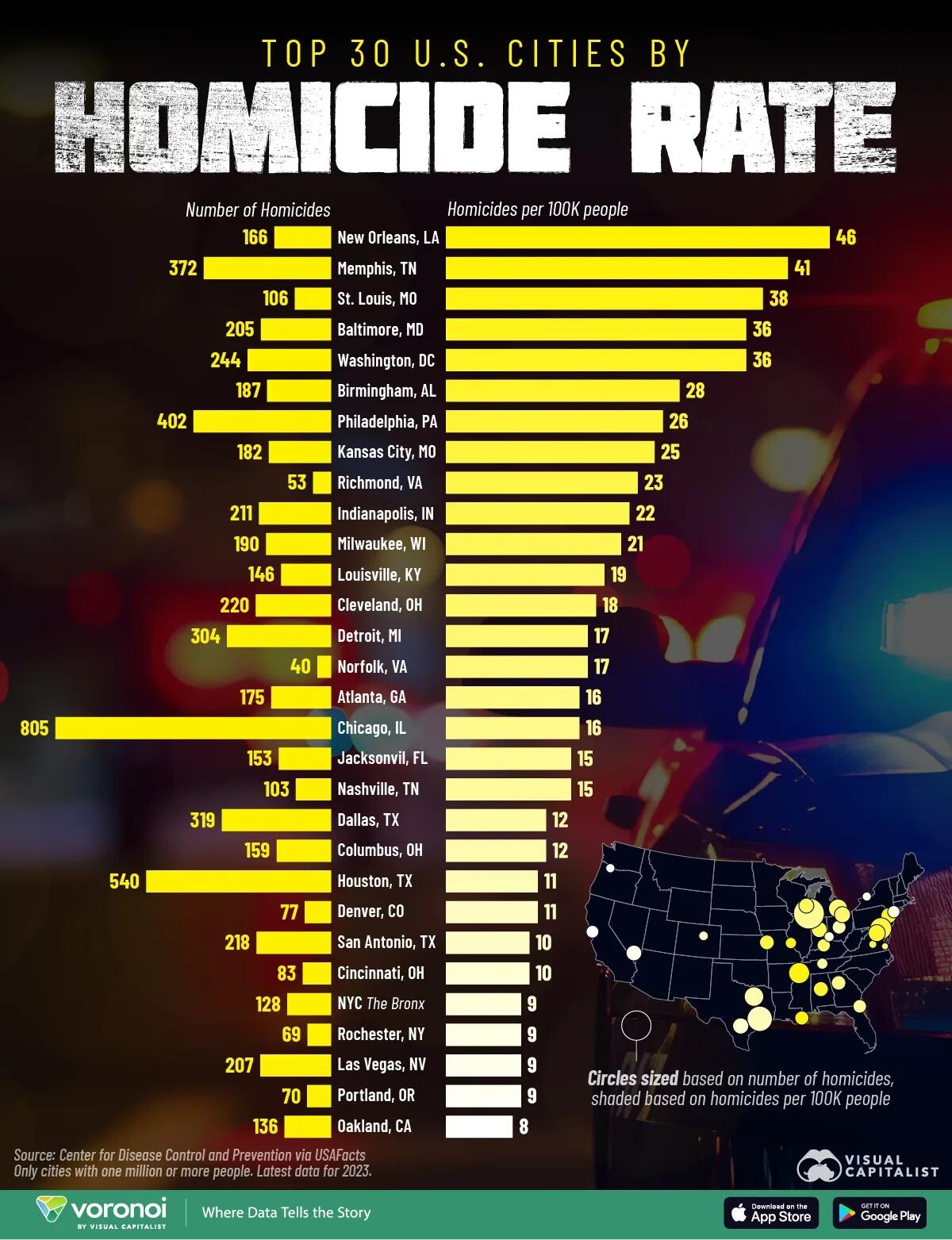
This visualization, via Visual Capitalist’s Niccolo Conte, highlights the top 30 U.S. cities with the highest homicide rates per 100,000 residents, offering a population-adjusted view that goes beyond raw totals.
The data for this visualization comes from the Centers for Disease Control and Prevention via USAFacts.
New Orleans and Memphis Lead the Nation
New Orleans tops the list with 46 homicides per 100,000 people, followed closely by Memphis at 41. Both cities consistently rank near the top due to long-term structural challenges, including poverty, strained social services, and persistent violent crime.
Rank
Major City
State
Homicides per 100K
Total Homicides
1
New Orleans
LA
46
166
2
Memphis
TN
41
372
3
St. Louis
MO
38
106
4
Baltimore
MD
36
205
5
Washington, DC
36
244
6
Birmingham
AL
28
187
7
Philadelphia
PA
26
402
8
Kansas City
MO
25
182
9
Richmond
VA
23
53
10
Indianapolis
IN
22
211
11
Milwaukee
WI
21
190
12
Louisville
KY
19
146
13
Cleveland
OH
18
220
14
Detroit
MI
17
304
15
Norfolk
VA
17
40
16
Atlanta
GA
16
175
17
Chicago
IL
16
805
18
Jacksonville
FL
15
153
19
Nashville
TN
15
103
20
Dallas
TX
12
319
21
Columbus
OH
12
159
22
Houston
TX
11
540
23
Denver
CO
11
77
24
San Antonio
TX
10
218
25
Cincinnati
OH
10
83
26
New York City (The Bronx)
NY
9
128
27
Rochester
NY
9
69
28
Las Vegas
NV
9
207
29
Portland
OR
9
70
30
Oakland
CA
8
136
31
Oklahoma City
OK
8
66
32
Phoenix
AZ
7
337
33
Pittsburgh
PA
8
98
34
Charlotte
NC
8
90
35
Orlando
FL
7
104
36
Minneapolis
MN
7
88
37
Los Angeles
CA
7
659
38
Miami
FL
7
176
39
Newark
NJ
7
56
40
Virginia Beach
VA
6
29
41
Seattle
WA
6
141
42
Saint Paul
MN
6
33
43
Fort Worth
TX
6
134
44
Buffalo
NY
6
57
45
Tampa
FL
6
90
46
Grand Rapids
MI
6
37
47
Sacramento
CA
5
86
48
Austin
TX
5
71
49
New York City (Brooklyn)
NY
5
130
50
San Francisco
CA
5
41
St. Louis and Baltimore also remain among the highest-rate cities. Together, these cities highlight the concentration of elevated homicide levels in portions of the South and Midwest.
Large Cities Show Lower Rates Despite High Total Homicides
Chicago, for example, recorded more than 800 homicides but ranks 16th with a rate of 16 per 100,000.
Houston, Los Angeles, and New York City boroughs show similar patterns. These cases demonstrate why total homicide numbers can be misleading when comparing risk across cities.
Mid-Sized Cities Also Experience Elevated Rates
Cities like Richmond, Indianapolis, and Milwaukee register rates between 20 and 23 per 100,000, placing them among the top 15 nationally. Although smaller in population, these mid-sized cities face similar drivers of violent crime found in larger metropolitan areas.
If you enjoyed today’s post, check out Mapped: U.S. Income Inequality by State on Voronoi, the new app from Visual Capitalist.
Tyler Durden
Tue, 12/09/2025 – 05:45
https://www.zerohedge.com/medical/these-are-americas-most-murderous-cities

Zelenskyy rechaza ceder territorio a Rusia mientras busca apoyo en Europa
Por PAOLO SANTALUCIA y ILLIA NOVIKOV
ROMA (AP) — El presidente ucraniano, Volodymyr Zelenskyy, se reunió el martes con el papa cerca de Roma mientras continuaba buscando apoyo europeo para Ucrania y resistiendo la presión de Estados Unidos para aceptar un compromiso doloroso con Rusia.
Respondiendo a las preguntas de los periodistas en un chat de WhatsApp, Zelenskyy reafirmó su firme negativa a ceder cualquier territorio, diciendo que “claramente no queremos renunciar a nada”, incluso cuando “los estadounidenses buscan un compromiso hoy, seré sincero”.
“Sin duda, Rusia insiste en que cedamos territorios”, dijo en el mensaje el lunes por la noche. “Según la ley, no tenemos tal derecho. Según la ley de Ucrania, nuestra Constitución, el derecho internacional, y para ser franco, tampoco tenemos un derecho moral”.
El presidente ucraniano se reunió temprano el martes con el papa León XIV en Castel Gandolfo, una residencia papal fuera de Roma, y tiene previsto entrevistarse más tarde con la primera ministra, Giorgia Meloni. Zelenskyy y el Vaticano no hicieron comentarios sobre el encuentro.
La Santa Sede ha intentado mantenerse neutral en la guerra mientras ofrece solidaridad y asistencia a lo que llama el pueblo “martirizado” de Ucrania. León se ha reunido ya tres veces con Zelenskyy y ha hablado por teléfono al menos una vez con el presidente ruso, Vladímir Putin. El papa estadounidense ha pedido un alto el fuego y ha instado a Rusia en particular a hacer gestos para promover la paz.
Zelenskyy sostuvo conversaciones el lunes en Londres con el primer ministro británico, Keir Starmer; el presidente francés, Emmanuel Macron, y el canciller alemán, Friedrich Merz para fortalecer la posición de Ucrania ante la creciente impaciencia del presidente estadounidense, Donald Trump.
Bajo presión de Trump
Negociadores estadounidenses y ucranianos completaron tres días de conversaciones el sábado con vistas a reducir las diferencias sobre la propuesta de paz del gobierno estadounidense.
Un punto importante de fricción en el plan es la sugerencia de que Kiev debe ceder el control de la región de Donbás en el este de Ucrania a Rusia, que ocupa ilegalmente la mayor parte, pero no todo, de ese territorio. Ucrania y sus aliados europeos se han resistido firmemente a la idea de entregar tierras.
En palabras a periodistas el domingo por la noche, Trump pareció frustrado con Zelenskyy, afirmando que el líder ucraniano “aún no ha leído” la propuesta.
Trump ha tenido una relación de altibajos con Zelenskyy desde que ganó un segundo mandato, insistiendo en que la guerra era un desperdicio del dinero de los contribuyentes estadounidenses. Trump también ha instado repetidamente a los ucranianos a ceder tierras a Rusia para poner fin al conflicto de casi cuatro años.
Zelenskyy dijo el lunes que Trump “ciertamente quiere terminar la guerra. (…) Seguramente, él tiene su propia visión. Nosotros vivimos aquí, desde dentro vemos detalles y matices, percibimos todo mucho más profundamente, porque esta es nuestra patria”.
El mandatario dijo que el actual plan de paz de Estados Unidos difiere de las versiones anteriores en que ahora tiene 20 puntos, en lugar de 28, después de que, según él, se eliminaron algunos “puntos obviamente antiucranianos”.
Europeos apoyan a Ucrania
Starmer, Macron y Merz apoyaron firmemente a Kiev. El líder británico dijo el lunes que el impulso por la paz estaba en una “etapa crítica”, y subrayó la necesidad de “un alto el fuego justo y duradero”.
Merz, por su parte, dijo que era “escéptico” sobre algunos detalles en los documentos publicados por Estados Unidos. “Tenemos que hablar sobre ello. Por eso estamos aquí”, dijo. “Los próximos días… podrían ser un momento decisivo para todos nosotros”.
Los líderes europeos trabajan para asegurar que cualquier alto el fuego esté respaldado por sólidas garantías de seguridad tanto de Europa como de Estados Unidos para disuadir a Rusia de atacar de nuevo. Trump no ha dado garantías explícitas en público.
Zelenskyy y sus aliados europeos han acusado repetidamente a Putin de ralentizar las conversaciones para avanzar con la invasión mientras sus fuerzas consiguen avances lentos pero constantes, y oleadas de misiles y drones golpean la infraestructura ucraniana.
Rusia y Ucrania intercambian ataques aéreos
La Fuerza Aérea de Ucrania dijo que Rusia disparó 110 drones de varios tipos en todo el país la noche pasada. Las defensas antiaéreas neutralizaron 84 drones y otros 24 alcanzaron sus objetivos, señaló.
Varias regiones de Ucrania enfrentaron apagones de emergencia el martes debido a los ataques previos de Rusia a la infraestructura energética, según el operador nacional de energía de Ucrania, Ukrenergo.
Ucrania, por su parte, continuó sus ataques con drones en Rusia.
Las defensas antiaéreas rusas destruyeron 121 drones ucranianos durante la noche sobre varias regiones rusas y la Crimea ocupada, dijo el Ministerio ruso de Defensa el martes. En Chuvashia, una región unos 900 kilómetros (aproximadamente 560 millas) al noreste de la frontera con Ucrania, el ataque dañó edificios residenciales e hirió a nueve personas, dijo el gobernador local Oleg Nikolayev en un comunicado en línea.
El Servicio de Seguridad de Ucrania llevó a cabo un ataque con drones en una terminal de gas licuado en el puerto de Temryuk en la región rusa de Krasnodar el 5 de diciembre, según un funcionario con conocimiento de la operación que habló con The Associated Press.
El funcionario, que habló bajo condición de anonimato porque no estaba autorizado para comentar públicamente, dijo que el ataque provocó un gran incendio en la instalación. Más de 20 tanques de almacenamiento de gas licuado de petróleo se incendiaron y ardieron durante más de tres días, dijo. El ataque también dañó vagones cisterna de ferrocarril, un tanque de reabastecimiento intermedio y una plataforma de carga y descarga.
___
Novikov informó desde Kiev, Ucrania.
___
Esta historia fue traducida del inglés por un editor de AP con la ayuda de una herramienta de inteligencia artificial generativa.

Today in Chicago History: ‘Empire’ actor Jussie Smollett found guilty for lying to police about purported attack
Here’s a look back at what happened in the Chicago area on Dec. 9, according to the Tribune’s archives.
Is an important event missing from this date? Email us.
Weather records (from the National Weather Service, Chicago)
High temperature: 62 degrees (1879)
Low temperature: Minus 14 degrees (1876)
Precipitation: 1.47 inches (2008)
Snowfall: 5.1 inches (1931)
1778: Illinois became a county of Virginia.
The Auditorium Building, circa 1889, with the entrance on Congress Street (now Ida B. Wells Drive) on the right, underneath the tower. (Chicago Tribune historical photo)
1889: The Auditorium Theatre was opened and dedicated by President Benjamin Harrison.
The New York Giants attempt to wrestle the Chicago Bears’ Bronko Nagurski, far right, to the ground during a football game at the Polo Grounds in New York on Dec. 9, 1934. New York won 30-23. (UPI)
1934: Students of early NFL history know that the New York Giants upset the Chicago Bears 30-13 at the Polo Grounds for the 1934 title because the Giants donned sneakers to help their footing on the icy field. But how many know that Abe Cohen was a hero in the so-called “Sneakers Game”?
In what became known as the “Sneakers Game,” the New York Giants beat the Chicago Bears 30-13 on Dec. 9, 1934, at the Polo Grounds in New York. The Giants swapped their cleats for rubber-soled shoes due to the field’s icy conditions. (Chicago Tribune)
Cohen was a tailor, a fan, and a sometimes-clubhouse attendant. Giants trainer Gus Mauch served a similar role at Manhattan College. When coach Steve Owen wondered where he could find enough gym shoes on a Sunday to outfit his club, Cohen was dispatched in a cab to Manhattan College. There, by hook or by crook, he entered the gym, opened lockers and returned with a cab full of rubber-soled shoes.
The Giants rallied from an early 10-3 deficit to score four unanswered touchdowns in the last 10 minutes and win. Lewis Burton in the New York American wrote: “To the heroes of antiquity, to the Greek who raced across Marathon Plain and to Paul Revere, add now the name of Abe Cohen.”
Scottie Pippen, left, with former coach Phil Jackson, center, and teammate Michael Jordan during the half-time ceremony where Pippen’s No. 33 jersey was retired on Dec. 9, 2005, at the United Center in Chicago. (Charles Cherney/Chicago Tribune)
2005: The Chicago Bulls retired Scottie Pippen’s No. 33 jersey during halftime of the Bulls’ loss to the Los Angeles Lakers at the United Center.
Pippen was a 6-7 forward from Central Arkansas when the Bulls selected him in the 1987 draft with the fifth pick, which they obtained in a trade with Seattle. Pippen helped the Bulls win six NBA titles in eight seasons. He went on to become an all-NBA player seven times and an all-defensive team player eight times, seven times on the first team.
The numbers for Chicago Bulls greats’ Jerry Sloan, Bob Love, Michael Jordan and Scottie Pippen hang above the United Center floor on Jan. 4, 2025. (Chris Sweda/Chicago Tribune)
Pippen finished his Bulls career with averages of 18 points, 6.8 rebounds and 5.3 assists, making him one of the most versatile front-court players in league history. He was named one of the 50 greatest players in NBA history in 1996.
The Bulls traded Pippen to the Houston Rockets in 1999.
Illinois Gov. Rod Blagojevich was arrested on Dec. 9, 2008, at his Northwest Side home on charges of conspiracy to commit fraud and solicitation of bribery. (Chicago Tribune)
2008: At 6:15 a.m.,Illinois Gov. Rod Blagojevich was roused from his Ravenswood Manor home, arrested, handcuffed and hauled before a federal magistrate on sweeping charges that he conspired to sell his office many times over — including putting a price on the U.S. Senate seat vacated by President-elect Barack Obama.
Rod Blagojevich saga: From arrest to Donald Trump’s pardon
“I intend to stay on the job, and I will fight this thing every step of the way. I will fight. I will fight. I will fight until I take my last breath. I have done nothing wrong,” Blagojevich said on Dec. 19, 2008, in his first news conference after his arrest.
During his second trial, Blagojevich was found guilty on 17 of 20 counts. In 2011, he was sentenced to 14 years in federal prison — the second-longest term ever delivered in federal court in Chicago for a public corruption case.
President Donald Trump, convicted of felonies himself, commuted Blagojevich’s 14-year sentence to about eight years served on Feb. 18, 2020.
The last resident of the last high-rise building, Annie Ricks, center, is swarmed by the media after she moved out of the Cabrini-Green public housing development on Dec. 9, 2010. (José M. Osorio/Chicago Tribune)
2010: Annie Ricks, the last resident of the Cabrini-Green public housing development’s last-standing housing tower, and her family left their home of 20 years — Apartment 1108 at 1230 N. Burling St., Chicago.
Mike Ditka speaks during a halftime ceremony to retire his No. 89 at a game between the Chicago Bears and the Dallas Cowboys at Soldier Field in Chicago on Dec. 9, 2013. (Chris Sweda/Chicago Tribune)
2013: The No. 89 jersey worn by Mike Ditka was retired by the Bears at Soldier Field during one of the coldest Bears home games ever at the venue. The temperature was 8 degrees at the 7:40 p.m. kickoff of the “Monday Night Football” game.
Former Chicago Cubs player Lee Smith, second from left, and former Chicago White Sox player Harold Baines, second from right, pose for photographs after both threw out ceremonial first pitches before the game between the two teams at Wrigley Field in Chicago on June 18, 2019. (Chris Sweda/Chicago Tribune)
2018: Former Chicago Cubs reliever Lee Smith and Harold Baines, former Chicago White Sox outfielder, were elected to the National Baseball Hall of Fame. Smith retired in 1997 after an 18-year career as the all-time leader with 478 saves. Baines collected 2,866 hits during a 22-year career, 14 with the Sox.
Chicago Blackhawks goalie Marc-Andre Fleury (29) stands with his family as he is honored for 500 career wins before an NHL hockey game against the Washington Capitals on Dec. 15, 2021, in Chicago. (Matt Marton/AP)
2021: Marc-Andre Fleury of the Chicago Blackhawks became the third NHL goaltender (Martin Brodeur and Patrick Roy were the others) to reach 500 career wins. The Blackhawks won 2-0 over Fleury’s hometown Montreal Canadiens at Centre Bell.
Jussie Smollett, third from left, leaves the Leighton Criminal Court Building on Dec. 9, 2021, after he was found guilty on five of six disorderly conduct charges for allegedly giving false information to Chicago police about an alleged racial and homophobic attack in January 2019. (E. Jason Wambsgans/Chicago Tribune)
Also in 2021: Actor Jussie Smollett was found guilty on five of six felony counts of disorderly conduct for lying to police about a purported attack in January 2019 in which the “Empire” actor claimed he was the victim. He had been charged with making the whole thing up.
Smollett was sentenced in March 2022 to 150 days in Cook County Jail. His convictions, however, were overturned in November 2024 by the Illinois Supreme Court, which found that a special prosecutor’s decision to retry him for allegedly staging a hate crime against himself violated his rights after the Cook County state’s attorney’s office previously dropped all charges.
Want more vintage Chicago?
Subscribe to the free Vintage Chicago Tribune newsletter, join our Chicagoland history Facebook group, stay current with Today in Chicago History and follow us on Instagram for more from Chicago’s past.
Have an idea for Vintage Chicago Tribune? Share it with Kori Rumore and Marianne Mather at krumore@chicagotribune.com and mmather@chicagotribune.com
https://www.chicagotribune.com/2025/12/09/chicago-history-december-9/

Today in History: ‘A Charlie Brown Christmas’ airs
Today is Tuesday, Dec. 9, the 343rd day of 2025. There are 22 days left in the year.
Today in history:
On Dec. 9, 1965, “A Charlie Brown Christmas,” the first animated TV special featuring characters from the “Peanuts” comic strip by Charles M. Schulz, premiered on CBS.
Also on this date:
In 1990, Solidarity founder Lech Wałęsa won Poland’s first free presidential election since 1926.
In 1979, scientists certified the global eradication of smallpox, a disease which killed an estimated 300 million people in the 20th century.
In 1992, the first U.S. Marines made a predawn beach landing in Somalia in support of Operation Restore Hope; they were met by hundreds of reporters awaiting their arrival.
In 2006, the space shuttle Discovery launched on a mission to add to and rewire the International Space Station.
In 2013, scientists revealed that NASA’s Curiosity rover had uncovered signs of an ancient freshwater lake on Mars.
In 2019, an island volcano off New Zealand’s coast called Whakaari, or White Island, erupted, killing 22 tourists and guides and seriously injuring several others. Most of the 47 people on the island were U.S. and Australian cruise ship passengers on a walking tour with the guides.
Related Articles
Today in Chicago History: ‘Empire’ actor Jussie Smollett found guilty for lying to police about purported attack
Chicago weather: How our 2025-26 seasonal snowfall compares with previous years
Today in Chicago History: United flight crashes into bungalows on approach to Midway, killing 45 people
Today in History: Brittney Griner freed in prisoner exchange
Soon no Pearl Harbor survivors will be alive. People turn to other ways to learn about the bombing.
In 2021, a cargo truck jammed with migrants crashed in southern Mexico, killing at least 53 people and injuring dozens more.
Today’s Birthdays: Actor Judi Dench is 91. Actor Beau Bridges is 84. World Golf Hall of Famer Tom Kite is 76. Actor John Malkovich is 72. Singer Donny Osmond is 68. Actor Felicity Huffman is 63. Empress Masako of Japan is 62. Democratic Sen. Kirsten Gillibrand of New York is 59. Rock singer-musician Jakob Dylan (Wallflowers) is 56. Actor Simon Helberg is 45. Olympic gymnastics gold medalist McKayla Maroney is 30. Actor Nico Parker is 21.
https://www.chicagotribune.com/2025/12/09/today-in-history-a-charlie-brown-christmas-airs/

Why Does The End Of The World Look So Profitable?
Why Does The End Of The World Look So Profitable?
Authored by Michael Kern via OilPrice.com,
Sovereignty is shifting from public institutions to private tech entities like Palantir and SpaceX, which secure massive government contracts and offer “governance as a service.”
The AI boom’s massive resource demands, particularly for energy and water, are being subsidized by the public, driving up costs while “efficiency” in the workplace leads to widespread job deletion and the flattening of the middle class.
To address this shift, a new social contract is required, including adopting a Sovereign Equity Model for government-funded ventures, implementing an automation tax to replace eroded payroll taxes, and moving toward Universal Basic Services.
The stock market is hitting record highs. GDP growth is in the green. Tech valuations are defying gravity… fueled by a promise that artificial intelligence is going to generate trillions of dollars in wealth.
And yet… everything feels kinda…terrible?
Jobs are disappearing, not in a crash, but in a slow fade. Prices for essentials remain stubbornly high. The divide between the digital economy and physical reality has never been wider.
We are told this is just a transition period. We are told that “efficiency” is messy… but necessary.
But the unease you feel isn’t irrational. The green arrows on the stock charts aren’t measuring the health of the everyday economy anymore. They are measuring the success of a takeover.
We are watching a fundamental shift in how the state operates. Sovereignty is shifting from public institutions to a network of private entities. And in many ways, we are holding the door open for them.
When Silicon Valley Bought the State
For years, we talked about the “revolving door” between business and government.
The idea was that regulators would leave office and take cushy jobs at the companies they used to police. It was a conflict of interest… but one we understood.
That metaphor doesn’t really fit anymore. This is more like a merger.
A specific network of billionaires and venture capitalists has moved beyond lobbying. They are now building the state infrastructure themselves.
They don’t want to influence the rules. They want to be the ones writing the code that executes the rules.
Look at the players involved…
Peter Thiel: The billionaire founder of Palantir, who has explicitly stated that he no longer believes “freedom and democracy are compatible.”
Elon Musk: Who uses his platforms to amplify “techno-populism” while securing massive government contracts.
Marc Andreessen: The venture capitalist whose “techno-optimist manifesto” calls for unlimited acceleration of technology, regardless of the social cost.
These aren’t just businessmen. They are state-builders.
And they’ve spent the last decade funding a pipeline of personnel to place into key government positions.
Thiel’s former chief of staff, Michael Kratsios, directed the White House Office of Science and Technology Policy.
An executive from Anduril, a defense contractor backed by Thiel’s Founders Fund, was nominated as Army under-secretary while still holding up to $1 million in company stock.
This pipeline has paid off. In late 2024 and 2025, we saw a massive consolidation of federal power into private hands.
SpaceX: The company secured a $1.8 billion classified contract with the National Reconnaissance Office (NRO) to build a vast spy satellite network.
1789 Capital: A venture firm joined by Donald Trump Jr. backed a company called Vulcan Elements… which immediately landed a $620 million Pentagon contract.
Palantir: By late 2024, 55% of their revenue—roughly $1.7 billion—came directly from government sales.
They have realized that the most profitable business model isn’t just selling products to consumers. It is offering “governance as a service.”
We look at this efficiency and applaud it. But it raises a difficult question: When a private company runs the software that powers the state, who is actually in charge?
Abundance for Them, Scarcity for You
This new system requires fuel. A lot of it.
The leaders of this shift love to talk about “abundance.” Listen to Sam Altman or other AI evangelists, and they will tell you we are on the verge of a “fusion utopia.” They promise that AI will eventually solve climate change and give us limitless, clean energy.
That is the sales pitch. And maybe, one day, it will be true. But the reality today is a story of immediate resource pressure.
To power the massive data centers required for their AI models, these companies are tapping into the American energy grid at an unprecedented scale.
According to the International Energy Agency (IEA), power consumption from data centers is projected to more than double… rising from 415 terawatt-hours in 2024 to 945 TWh by 2030.
To put that in perspective… that is roughly the equivalent of adding the entire electricity consumption of Japan to the global grid in just six years.
Where will this power come from?
Not from the magic fusion reactors of the future. It is coming from the grid you rely on today.
In the PJM electricity market, which covers 13 states from Illinois to New Jersey, the demand from data centers has already driven capacity prices up.
To meet this need, the government is pivoting.
The Department of Energy is increasingly financing coal and natural gas expansion to keep the servers humming.
It creates a difficult dynamic:
Tech giants lock down “clean” baseload power… like Microsoft’s deal to restart the Three Mile Island nuclear plant solely for their own use.
The public grid is pushed to rely more on the volatile “spot market,” often powered by gas.
Communities deal with the environmental cost… including the 6 billion gallons of water Google’s data centers consumed in 2024.
It isn’t necessarily malicious…It’s just math. But the math ends with the public paying higher bills to subsidize yet another part of the AI boom.
How “Efficiency” Is Deleting the Middle Class
This shift isn’t just happening on your electric bill. It is happening in the workplace.
The stock market is rallying on the promise of “efficiency.” And let’s be honest, technology does make things more efficient. But for the workforce, “efficiency” often looks like a closing door.
We often look at headline-grabbing layoff numbers. And they are significant. In the first few months of 2025 alone, over 126,000 tech workers lost their jobs, according to Crunchbase.
But the bigger story is what happens after the layoff.
It is a phenomenon called “silent firing.”
Companies aren’t just letting people go. They are simply… not hiring replacements. When a worker leaves, the role is dissolved, or the tasks are handed over to software.
According to a report by Zety and Allwork, 73% of workers reported experiencing “quiet firing” tactics in 2025… where support is withdrawn and roles are made redundant without a formal announcement.
The entry-level jobs are being automated first. If you are a junior analyst, a copywriter, or a coder fresh out of college… the job you would have taken five years ago is harder to find.
This flattens the middle class. It creates a gap where new careers should be. And the industry leaders know this is happening.
The Trap of Outsourcing Global Sovereignty
This isn’t just an American dynamic. This new model of “privatized sovereignty” is being exported globally.
Europe, for example, talks a lot about “Digital Sovereignty.”
They want to be independent. But building your own tech stack is expensive and slow.
A report by the Centre for European Policy Analysis (CEPA) estimates that achieving true digital independence would cost Europe €3.6 trillion.
Most nations aren’t willing…or able…to pay that bill. So, they sign contracts.
74% of publicly listed European companies now depend entirely on U.S. tech stacks.
Look at the United Kingdom.
The NHS signed a £330 million deal with Palantir to build its data platform. It’s efficient. It works. But it means a U.S. company now manages the health data of the British public.
Look at Ukraine. Their defense relies heavily on Starlink. It has saved countless lives. But it also means their military communications rely on the goodwill of a single American company.
It is a trade-off. These nations get the best technology in the world. But they become ‘client states’ in the process. You cannot have a truly independent foreign policy when your defense infrastructure is leased from a company in California.
And if a G7 nation can be reduced to a client state, the individual American worker doesn’t stand a chance.
The architects know this. That is why they have prepared a specific ‘safety net’ for the people they intend to make obsolete.
UBI Is a Trojan Horse
We need to talk about the “safety net” the architects are promising us.
Every tech billionaire has the same talking point: AI is going to take all the jobs, so we will need Universal Basic Income (UBI).
It sounds generous. It sounds inevitable. But if you look at their actions, it looks less like a safety net and more like a trap. While they preach UBI in the future, they are actively dismantling the machinery required to fund it in the present.
Elon Musk frequently claims that UBI will be “necessary” in an AI future. Yet, he lead the Department of Government Efficiency (DOGE), an initiative explicitly designed to slash federal spending by trillions.
You cannot have it both ways.
You cannot gut the federal budget, fire the administrators, dismantle the tax collection agency (IRS), and then claim you are going to distribute a monthly check to 330 million Americans.
And it’s not like he’s going to give away his own money, either.
He recently stated: “The biggest challenge I find with my foundation is trying to give money away in a way that is truly beneficial to people.”
He is literally telling us that he finds philanthropy “too difficult.” If he can’t figure out how to give away his own money, why should we trust him to build a system to give away the nation’s money?
Sam Altman, the CEO of OpenAI, advocates for a “Moore’s Law for Everything,” where we tax capital to fund a citizen’s dividend.
But his actual product, Worldcoin, reveals the true business model.
Worldcoin doesn’t give you a dividend as a right of citizenship; it gives you a crypto token in exchange for scanning your iris. It creates a proprietary database of human biometrics owned by a private company.
This is a customer acquisition strategy. He wants to build a user base, not a social safety net.
And for figures like Peter Thiel, UBI isn’t even meant to help the poor. They aim to delete the government.
UBI is the severance package for the “nanny state.” The deal is simple: cut every citizen a check, and in exchange, eliminate Social Security, Medicare, and public infrastructure.
It sounds like freedom, but it is a bad trade.
Even if the check is large, it cannot replace the leverage of the state.
The government negotiates wholesale prices for healthcare and runs transit at a loss for the public good.
If you replace those systems with cash, you force individuals to buy “retail” in a market that knows exactly how much money they just received.
You are trading a durable right to services for a volatile subscription to them. And as any Netflix user knows, the price of the subscription always goes up.
Auditing the Myth of the “Self-Made” Empire
Before we talk about solutions, we have to look at the receipts. We need to audit the myth of the “self-made” techno-oligarch.
The narrative they sell is one of libertarian genius…that they built these empires in a garage, fighting against the heavy hand of the state.
The reality is that the state was their angel investor.
We…were their angel investor.
Tesla survived its most critical moments thanks to a $465 million Department of Energy loan in 2010.
SpaceX exists because NASA awarded them huge contracts when the private market wouldn’t touch them.
Palantir was literally incubated by the CIA’s venture arm, In-Q-Tel.
OpenAI is currently lobbying for a $500 billion infrastructure investment, asking for taxpayer-funded power grids and tax credits to build data centers.
On top of the direct cash, the founders and CEOs have benefited from a tax code designed to let them hoard it.
The 2017 tax cuts slashed the corporate rate from 35% to 21%, and loopholes allow them to borrow against their stock holdings to live tax-free, while the average worker pays income tax on every paycheck.
Then there is the hidden subsidy: resource extraction.
When a data center drains a local aquifer to cool its servers, forcing the local town to upgrade its water treatment plant… the town pays for that upgrade. The company gets the cooling; the public pays the bill.
But it isn’t just water. It is the air itself.
Despite the ‘net-zero’ press releases, the dirty secret of the AI boom is diesel.
To guarantee 99.999% reliability, these facilities rely on banks of massive generators.
In some counties, data centers are permitted to burn enough fuel to rival a major airport, pumping exhaust into local lungs to ensure a chatbot in California never lags.
And it is the noise.
These things are massive, concrete fortresses emitting a constant, low-frequency roar—a mechanical drone that penetrates walls and disrupts sleep for miles. It is the sound of local quality of life being liquidated for uptime.
Then there is the infrastructure bill.
The enormous power draw requires billions in new transmission lines. But the tech companies often aren’t the ones paying for those upgrades…you are.
We have socialized the risks, the infrastructure costs, and the pollution, but privatized the profits, the intellectual property, and the control.
Demanding a Return on Our Investment
So… where do we go from here?
The old social contract was simple: Corporations make money, and in return, they provide jobs.
That contract is void.
They are building systems explicitly designed to remove the need for jobs.
The “Return on Investment” for the public is no longer employment. And it certainly isn’t UBI, which remains a distant fantasy while the tax base to pay for it is eroded.
If the public is going to put up the capital, and deal with the consequences of ballooning energy and resource use, the public should see a return.
We need a new model for ROI.
The Sovereign Equity Model
In the venture capital world, if an investor puts up the money to de-risk a technology, they get equity. They get a seat on the board. They get a share of the upside.
Yet, when the U.S. taxpayer does it, we call it a “subsidy.”
The CHIPS Act alone funneled $52 billion into semiconductor manufacturing…
While the taxpayers who funded this got nothing but the bill.
This is bad business.
We need to adopt a Sovereign Equity Model.
If a company wants a government loan, a tax credit, or a guaranteed energy contract, the government should take equity warrants in return. This isn’t radical socialism… It’s basic capitalism.
It is exactly what Warren Buffett did when he bailed out the banks in 2008. He didn’t give them free money…he bought warrants that eventually made Berkshire Hathaway billions.
We already have a successful blueprint for this in the Alaska Permanent Fund.
Since 1976, the state of Alaska has treated its oil reserves not as private bounty, but as a shared asset. When the oil flows, a portion of the revenue is deposited into a sovereign wealth fund, which then pays out an annual dividend to every resident.
We should treat our digital and energy infrastructure the same way.
The profits from these government-backed equity stakes shouldn’t disappear into the black hole of the general budget; they should flow into a ring-fenced National Wealth Fund that pays dividends directly to the citizenry.
If the American people are taking the risk, we should own the upside.
Tax the Robots to Save the Tax Base
The U.S. tax code is currently rigged to favor machines over people.
If you hire a human, you pay payroll taxes, social security, and healthcare. If you buy a GPU cluster to do the same job, you get a tax write-off for “depreciation.” We are effectively subsidizing our own replacement.
We need to rebalance the ledger with an automation adjustment.
This is not about punishing innovation… It’s about fiscal survival. Payroll taxes consistently account for roughly 30-35% of all federal revenue. If AI fulfills the promise of displacing millions of workers… that revenue stream collapses. The deficit explodes. The economy breaks.
Bill Gates, hardly a socialist, made this point explicitly: “Right now, the human worker who does $50,000 worth of work in a factory… that income is taxed… If a robot comes in to do the same thing, you’d think that we’d tax the robot at a similar level.”
If a company replaces a human workflow with an AI agent, the economic output remains, but the tax contribution vanishes. We need to attach a levy to that output.
Data Dividends
Data is the new oil. We have heard the cliché a thousand times. But we aren’t treating it like oil.
The AI models generating trillions in value were trained on the collective output of humanity. They scraped our journalism, our art, our open-source code, and our personal data. They harvested the “digital commons” for free… processed it… and are now selling it back to us at $20 a month.
In any other industry, this would be theft. If you drill for oil on someone else’s land, you pay royalties. If you use someone else’s timber, you pay for the lumber.
The generative AI market is projected to reach $1.3 trillion by 2032….
The raw material that fuels that market cannot be priced at zero. If our data is the raw material for their product, we are the suppliers. And suppliers get paid.
Universal Basic Services
If we give everyone a $5,000 UBI check, but the price of housing, energy, and internet doubles… we haven’t solved anything. We have just subsidized the landlords and the utility companies.
The smartest Return on Investment is to lower the “overhead” of being alive in America.
We should move toward Universal Basic Services (UBS). Use the proceeds from the equity stakes, the automation taxes, and the data dividends to fund the inputs of the modern economy:
Public Compute: Treat processing power like a public utility. Build state-owned clusters available to researchers and startups at cost, breaking the pricing power of the tech giants.
Green Public Transit: Make car ownership optional, removing a massive monthly debt anchor from the working class.
Digital Infrastructure: High-speed internet should be a right, not a subscription service dominated by regional monopolies.
We are hitting the physical limits of our energy grid. We are seeing the limits of the old labor model. We might have to accept that “infinite growth” isn’t compatible with a finite planet.
But “no growth” doesn’t have to mean poverty.
The vibes are off because deep down… we know the deal has changed. We are moving from a world of public institutions to a world of private platforms.
The “New Operating System” is being installed. And it is faster. It is more efficient. It is undeniably impressive.
But we have to decide if we want to be the owners of this new future… or just the users.
Tyler Durden
Tue, 12/09/2025 – 05:00
https://www.zerohedge.com/markets/why-does-end-world-look-so-profitable

La Corte Penal Internacional condena a líder de milicia sudanesa a 20 años por atrocidades en Darfur
Associated Press
LA HAYA (AP) — Los jueces de la Corte Penal Internacional sentenciaron el martes a un líder de la temida milicia Janjaweed de Sudán a 20 años de prisión el martes por crímenes de guerra y crímenes de lesa humanidad cometidos en el catastrófico conflicto en Darfur hace más de dos décadas.
En una audiencia el mes pasado, los fiscales pidieron una sentencia de cadena perpetua para Ali Muhammad Ali Abd-Al-Rahman, quien fue condenado en octubre por 27 cargos de crímenes de guerra y crímenes de lesa humanidad que incluyeron ordenar ejecuciones masivas y matar a dos prisioneros a golpes con un hacha en 2003-2004.
“Cometió estos crímenes a sabiendas, voluntariamente y, como muestran las pruebas, con entusiasmo y vigor” afirmó el fiscal Julian Nicholls afirmó en la audiencia de sentencia en noviembre.
Abd-Al-Rahman, de 76 años, se puso de pie y escuchó, pero no mostró reacción alguna cuando la jueza presidenta Joanna Korner dictó la sentencia.
___
Esta historia fue traducida del inglés por un editor de AP con la ayuda de una herramienta de inteligencia artificial generativa.