Category: News
Russia’s Oil Exports Face Delays As Tankers Take 70% Longer Route
Russia’s Oil Exports Face Delays As Tankers Take 70% Longer Route
By Charles Kennedy of OilPrice.com
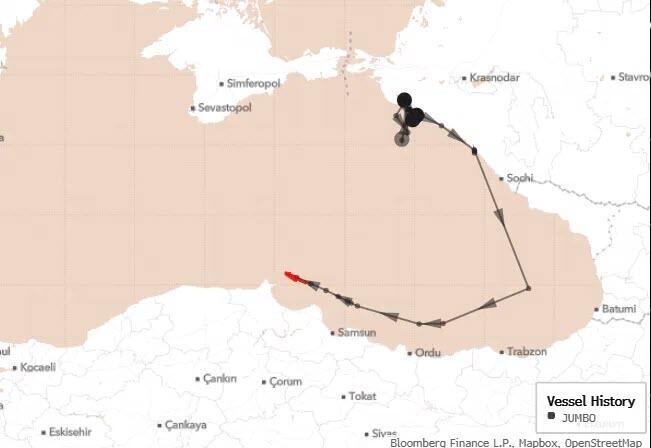
Oil tankers carrying Russian oil appear to be avoiding the fastest Black Sea route to the Turkish straits and travel along the Georgian and Turkish coasts to avoid drone attacks from Ukraine, according to ship-tracking data compiled by Bloomberg.
In recent weeks, several ships linked to Russia have been hit by Ukrainian drones in the Black Sea. All targeted vessels were empty at the time of the strikes.
At least two tankers that have loaded oil from Novorossiysk, the Russian port on the Black Sea, have recently traveled along the Georgian and Turkish coasts instead of taking the shortest route to the Bosphorus Strait, according to the data compiled by Bloomberg.
The detour along the Georgian and Turkish coasts would add about 350 miles, or 70%, to the journey of an oil tanker from the port of Novorossiysk to the Turkish straits.
Crude oil exports from the Russian terminals on the Black Sea were much lower in November than originally planned as bad weather and Ukrainian attacks on infrastructure have delayed loadings and departures.
Ukrainian attacks have also crippled Russia’s fuel exports from the Black Sea ports in recent weeks.
Ukrainian drone attacks on refineries in southern Russia and the Black Sea oil port of Tuapse crippled exports of fuels from the Black Sea export terminals in November.
The port of Tuapse suspended fuel exports for half of the month of November, due to the drone attack at the port infrastructure in early November.
An attack on another Black Sea port, Novorossiysk, also led to a slump in crude and fuel shipments.
Ukrainian forces have increasingly targeted Russian oil-refining, storage, and export infrastructure using drones and missiles. The campaign has gained intensity in recent months, with the Center for European Policy Analysis noting a shift in strategy “from smaller-scale strikes on storage tanks to targeting hard-to-replace refinery equipment, like cracking units, much of it western-made and subject to sanctions.”
Tyler Durden
Fri, 12/19/2025 – 15:00
https://www.zerohedge.com/markets/russias-oil-exports-face-delays-tankers-take-70-longer-route

Sospechoso del tiroteo en Brown y el asesinato de profesor del MIT fue estudiante de física
Por KIMBERLEE KRUESI y HEATHER HOLLINGSWORTH
PROVIDENCE, Rhode Island, EE.UU. (AP) — El sospechoso de perpetrar un tiroteo masivo en la Universidad Brown y de asesinar a un profesor del Instituto Tecnológico de Massachusetts estaba en el mismo programa académico que el catedrático en Portugal antes de asistir a Brown con una visa de estudiante.
En su momento, Claudio Neves Valente fue un prometedor estudiante de física en la escuela secundaria, pero en el año 2000 fue despedido del Instituto Superior Técnico, la principal escuela de ingeniería de Portugal, y se retiró de un programa de posgrado de la Universidad Brown tres años después sin obtener un título.
El jueves, Neves Valente, que emigró a Estados Unidos desde Portugal, fue encontrado muerto por una herida de bala autoinfligida en un almacén de Nueva Hampshire, dijo el coronel Oscar Pérez, jefe de policía de Providence.
Los investigadores creen que el hombre de 48 años es responsable de asesinar a tiros a dos estudiantes y herir a otras nueve personas en un aula de la Universidad Brown el 13 de diciembre, vistiendo el tipo de pantalones y zapatos que, según un testigo, son típicos de los trabajadores de restaurantes. Los investigadores creen que dos días después, mató a su excompañero de clase Nuno F.G. Loureiro en su casa en los suburbios de Boston, a unos 80 kilómetros (50 millas) de Providence.
Las autoridades no han mencionado un motivo, pero lo que está claro es que la vida no había transcurrido como Neves Valente había imaginado.
Neves Valente nació en Torres Novas, Portugal, a unos 121 kilómetros (75 millas) al norte de Lisboa. Cuando era estudiante de secundaria, participó en una competencia nacional de física en 1994, obteniendo el tercer lugar, según una revista portuguesa de física. Los cinco primeros clasificados pudieron competir en un certamen internacional al año siguiente en Australia.
De 1995 a 2000, estuvo en el mismo programa de física en Lisboa que Loureiro, dijo la fiscal federal Leah B. Foley. Loureiro se graduó del Instituto Superior Técnico en 2000, según la página del cuerpo docente del MIT. Un aviso de rescisión de contrato del entonces presidente de la universidad de Lisboa muestra que Neves Valente fue despedido de un puesto en el Instituto Superior Técnico ese mismo año.
Neves Valente llegó a Brown aquel otoño como alumno de posgrado con una visa de estudiante. La presidenta de la Universidad Brown, Christina Paxson, dijo que tomó una licencia en 2001 y se retiró formalmente con efecto al 31 de julio de 2003.
Durante su tiempo en Brown, se inscribió solo en clases de física. Paxson dijo que es probable que haya tomado cursos y pasado tiempo en el edificio donde tuvo lugar el tiroteo de este mes porque es donde se lleva a cabo la gran mayoría de los cursos de física. Sin embargo, los registros detallados que indican dónde se llevaron a cabo las clases no se extienden hasta 2001.
Paxson dijo que Brown no encontró indicios de ninguna interacción de seguridad pública u otras preocupaciones mientras Neves Valente era estudiante.
“Por el momento, no hemos identificado a ningún empleado que recuerde a Neves Valente ni hay ningún registro reciente de contacto entre este individuo y Brown”, afirmó.
Tras dejar Brown, obtuvo el estatus de residente permanente legal en septiembre de 2017, dijo Foley. Hasta el momento se ignora dónde estuvo entre el momento en que tomó una licencia de la escuela en 2001 y cuando obtuvo la visa en 2017.
Su última dirección conocida estaba a unos 16 kilómetros (10 millas) al norte de Miami. La casa amarilla con techo rojo está en un vecindario de clase trabajadora que cuenta con casas grandes, en su mayoría con patios traseros cercados y sótanos.
Algunos vecinos que hablaron con The Associated Press el viernes dijeron que nunca habían visto a Neves Valente. No se veían policías.
Edward Pol, un mecánico de autos de carrera que vive al otro lado de la calle, dijo que el propietario alquila algunas habitaciones a personas. Afirmó que nunca habló con Neves Valente, pero lo había visto varias veces, la más reciente hace dos o tres meses. Dijo que el portugués siempre estaba ocupado, parado afuera y en llamadas telefónicas. Se dio cuenta de que era el sospechoso cuando vio sus fotos en las noticias el viernes por la mañana.
Un hombre que respondió a la puerta a través de un intercomunicador en la casa dijo que era el propietario, pero se negó a identificarse o hacer algún comentario.
Mientras la vida de Neves Valente seguía siendo un misterio, Loureiro, el malogrado físico y científico de fusión del MIT, sobresalía. Loureiro se unió al MIT en 2016 y fue nombrado el año pasado para liderar el Centro de Ciencia y Fusión de Plasma de la escuela, uno de sus laboratorios más grandes. El científico de 47 años de Viseu, Portugal, había trabajado para explicar la física de fenómenos astronómicos como las erupciones solares.
El principal diplomático de Portugal dijo el viernes que el gobierno estaba sorprendido por las revelaciones de que un portugués fuera el principal sospechoso. La policía en Portugal dijo que fueron contactados por las autoridades estadounidenses el jueves.
Todavía hay “muchas incógnitas” en cuanto al motivo, dijo el fiscal general de Rhode Island, Peter Neronha. “No sabemos por qué ahora, por qué Brown, por qué estos estudiantes y por qué esta aula”, expresó.
___
Hollingsworth informó desde Mission, Kansas. Los periodistas de The Associated Press Barry Hatton y Helena Alves en Portugal, Mark Scolforo en Harrisburg, Pensilvania, Audrey McAvoy en Honolulu, Hallie Golden en Seattle y Matt O’Brien en Providence contribuyeron a este despacho.
___
Esta historia fue traducida del inglés por un editor de AP con la ayuda de una herramienta de inteligencia artificial generativa.

Worship news: Holiday to-go dinners and Lessons & Carols service
Chesterton
Liberty Bible Church: 824 North Calumet Ave. — Liberty Bible Church has Faithful Fitness for women on Mondays and Fridays. Faithful Fitness is an exercise class for women with two different classes offered — basic and modified. The cost is $2 per class. For more information, call 219-878-8700.
Crown Point
CrossPoint Church: 214 S. Court St — CrossPoint will have a candlelight Christmas Eve at 7 p.m. on Dec. 24. Family and friends are invited to attend. For more information, visit https://www.crosspoint.family/events/crosspoint-christmas-eve-candlelight-service.
Gary
Cathedral of the Holy Angels: 640 Tyler St. — Cathedral of the Holy Angels will have “Hope in the City” with a 7 a.m. Mass and a 6:45 p.m. Vespers on Jan. 2. The event happens on the first Friday of the month, and there will be adoration and confessions all day. For more information, call 219-882-6079. Join the Diocese of Gary in celebrating the Closing of The Year of Jubilee on Jan. 4. Mass begins at 11 a.m., with Eucharistic Adoration and Confessions from 12-5 p.m., and Solemn Vespers at 5 p.m.
Marquette Park United Methodist Church: 215 N. Grand Blvd. — All are welcome to worship at 11:15 a.m. Sundays at Marquette Park United Methodist Church. There will be refreshments afterward in the Fellowship Hall.
Griffith
Griffith First Christian Church: 202 W. Pine St. — Griffith First Christian Church will have a Christmas Eve celebration Dec. 24 at 5 p.m. and 6:30 p.m. The service will end with a candle lighting. To RSVP, visit https://shorturl.at/SSsmO.
Hammond
Faith United Church of Christ: 3030 175th St. — Faith United Church of Christ holds its worship service at 10 a.m. on Sundays, followed by fellowship and coffee.
Saint Joseph Catholic Church: 5304 Hohman Ave. — Saint Joseph Catholic Church will have “Donut Sunday” on the last Sunday of every month after the 9 a.m. Mass. Free coffee and donuts are provided at the church hall.
Highland
St. James Church: 9640 Kennedy Ave. — Need a break from the Holiday madness? The church is hosting a Day of Reflection on Dec. 20 A continental breakfast will be served at 8:30 a.m., followed by a presentation by Fr. Michael Surufka, OFM, from 9 a.m. to 12 p.m.
Merrillville
Our Lady of Czestochowa Shrine: 5755 Pennsylvania St. — The Our Lady of Czestochowa Shrine’s catering team is accepting orders for holiday “to-go” dinners until Dec. 22. Menu items, which are packaged warm and can be reheated at home, include Devolaj (a Polish version of the classic Chicken Kiev), pork loins stuffed with prunes, Beef Roulades, mashed potatoes, potato dumplings, sauerkraut, apple-beet salad, and broccoli-cauliflower salad. Order pick-up time will be from 10 a.m. until 2 p.m. on Dec. 25 in Millennium Hall. Cost is $20 per meal, with a minimum order of 10 required by Dec. 22nd; for more information, call Zosia at 708-267-5603 or Stasia at 708-205-8324.
Our Lady of Queen of Martyrs – South Campus: 8303 Taft St. — Join Bishop Robert J. McClory in celebrating Simbang Gabi at 4 p.m. on December 20. Simbang Gabi is a Filipino Christmas tradition of nine days of Masses during the Christmas season. A reception will follow the Mass.
Diocese of Gary Office: 9292 Broadway — The Diocese will be accepting donations hats, scarves and gloves for the Caps for Kids campaign at its Merrillville office through January. The Diocese is assisting the Society of St. Vincent de Paul, District Council of Gary, to collect new or handmade hats, scarves and gloves. Checks can also be mailed to “Caps for Kids,” c/o St. Vincent de Paul, 2714 169th St., Hammond, IN 46323. For more information, call (219) 769-9292, ext. 88251.
Munster
St. Thomas More Church: 8501 Calumet Ave. — The annual St. Thomas More Lessons and Carols program is set for 6-8 p.m. on Dec. 21. Nine lessons from Scripture are followed by carols to tell the human story of God’s love for humanity, from creation to the birth of Jesus Christ.
Schererville
St. George Greek Orthodox Church: 528 West 77th Ave. — St. George Greek Orthodox Church will have its annual St. George Ladies Philoptochos Holiday Gathering at noon on Jan. 11 for brunch at Toast & Jam in Schererville. The brunch is $30 for members and $40 for non-members, and includes scrambled eggs, bacon, sausage, hash browns, gourmet waffles, fried chicken, fresh veggies, dessert, coffee, hot and iced tea and soda. Attendees are asked to bring a wrapped or bagged $15 gift if they wish to participate in a white elephant gift exchange. RSVP to Georgia Karagan by January 5 at 219-743-4433 or pnkgk@sbcglobal.net.
Valparaiso
Liberty Bible Church: 1155 Sturdy Rd. — Liberty Bible Church will have “InterGen Sunday” from 9 a.m. to 10:45 a.m. Dec. 21. “InterGen” or Intergenerational Sundays allow parents and children to worship together. Children’s ministry for those in kindergarten through fifth grade will be suspended on InterGen Sundays, so kids are able to join their parents in worship. Childcare is provided for ages 0-5. For more information, visit https://www.findliberty.net/events-1/2025/intergen-sunday-nov30.
Living Hope Community Church: 1115 Calumet Ave. — Living Hope Community Church will have a Youth Group from 6:30 p.m. to 8 p.m. on Wednesday nights for fun, conversations and Bible study. Students from grades 6 to 12 are welcome to drop in anytime for the event led by youth director Romeo Marcinkowski.
To submit worship news, email cnance@post-trib.com.
Review: At the CSO, Mäkela and Lim make the 19th century new
Ironically, 2020 would have been a big year for new music.
The occasion of Beethoven’s birth, 250 years before, led to a surge of new orchestral commissions around the globe. The catch? Most had to reference Beethoven in some way — typically a stipulation of the commissioner.
At the time, I found this trend vexing. Not only did it play into orchestras’ worst inclinations — implying that living composers were best legitimized via deceased ones — but the fresh glut of Beethoven partner pieces cleared an easy pathway for those works to get programmed over and over again, often instead of worthier music.
As it happens, among Klaus Mäkelä’s many talents is converting cranky critics from their deeply held opinions. On Dec. 18, the Chicago Symphony’s music director designate led a riveting program that prefaced Beethoven’s Symphony No. 7 with two 21st-century bits of Beethoveniana: Unsuk Chin’s “subito con forza,” which Mäkelä premiered with Amsterdam’s Concertgebouw Orchestra in 2020, and Jörg Widmann’s “Con brio,” which, with its 2008 vintage, predates the latest Beethoven deluge.
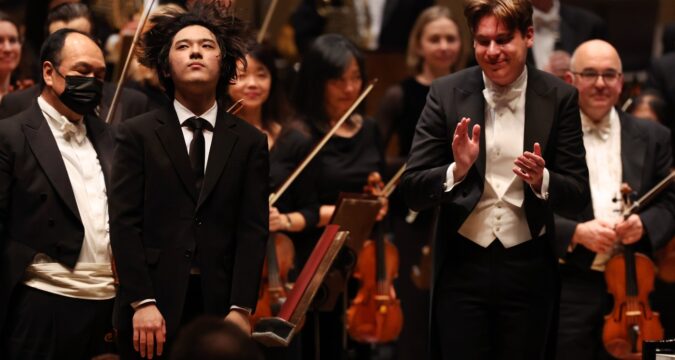
Nestled in the middle of all of it was Yunchan Lim, the mop-haired 21-year-old who made history three years ago as the Van Cliburn International Piano Competition’s youngest winner. A hall-filler on his own — his fall recital at Symphony Center handily sold out — he brought Robert Schumann’s Piano Concerto to this very van Beethoven program.
An outlier, then? Not the way Lim played it. Like all the other works on the program, the Schumann announces itself with declarative chords; Lim’s opening descent sprang from the orchestra’s downbeat like a diving block. But this might have been one of the few moments of youthful explosiveness. He committed to the concerto’s inner logic, rejecting the urge to play it as a thing of mere emotional tumult. When the theme of the first movement returned, near its end, it sounded world-wearier, as though it had lived a lifetime since.
Pianist Yunchan Lim performs with the Chicago Symphony Orchestra at Symphony Center on Dec. 18, 2025. (Chris Sweda/Chicago Tribune)
The second movement became untethered from time and pulse, a floating reverie before the pleasantly gamboling third movement. Here and before, Lim’s deep sense of rhythmic integrity gave the sense that he and the orchestra were one. All had a poetic sense of flow and care, as though Lim somehow drew upon, and sublimated, Schumann’s own literary persuasions. (Maybe not uncoincidentally, the young pianist’s longtime Instagram profile picture was not of himself but of a boyishly pouting Arthur Rimbaud.)
The program also had a certain musical logic. Lim brought the same wizened maturity to his encore, Chopin’s Waltz No. 3 in A minor — the same key as the Schumann, and a complement to the Beethoven’s A major. The waltz’s low, left-hand melody returns in many guises over its span; Lim took it at a pensive dirge on Thursday, stretching to around seven minutes. But each return of the melody was colored slightly differently — not through any loss of tempo, but through delicate changes in sensibility, a shift in tone saying more than words can express.
Already, the young pianist has established himself as a Chopin interpreter for the ages. This is why.
Frequent collaborators in recent seasons, Lim and Mäkelä were profoundly intertwined in the Schumann — leagues improved upon their last Midwest appearance together, during a 2024 tour stop in Ann Arbor, Michigan, with the Orchestre de Paris. Mäkelä’s gestures became a choreographic extension of Lim’s, and he emphasized the responsorial elements of the score, as he has before in other concertos.
The Schumann, ending the first half, came between “subito con forza” and “Con brio” — but without half the whiplash one would expect, in this program that spoke across the ages. Chin and Widmann are among today’s most programmed composers, though their popularity is anchored more in Europe than in the States. Even so, “subito con forza” and “Con brio” have become their most widely performed orchestral works — the Beethoven effect in action.
Different as Chin and Widmann’s aesthetics are, their works share key similarities. For one, they both rib Beethoven with affectionate irreverence, as one might tease a friend: flutter-tongue trumpet raspberries in the Chin, winds and brass clapping their bells in the Widmann. Neither account much for the soulful, introspective Beethoven. These Beethovens are all Sturm und Drang, all of the time.
Their key difference, besides their duration — Chin’s work, at five minutes, is about half as long as Widmann’s — is their philosophy. Brahms felt famously tortured by Beethoven’s stature, bemoaning the “giant marching behind” him. “Subito con forza” takes a sunnier view of Beethoven’s ubiquity, piggybacking on the giant as it stalks through the new millennium. The slashing opening chords of the “Coriolan” overture dissolve into a vibraphone jangle, then an all-orchestra aftershock. An Emperor Concerto-ish sweep up the piano becomes a passing pyrotechnic. The short-short-long motif of Beethoven’s Fifth also appears in diminution in the brass, here just an accompanimental figure.
“subito con forza” ends in a cluster chord, its notes dragged, as though against their will, into a C-minor conclusion — a portentous key for Beethoven. Thursday’s conclusion lost a bit of its oomph, with Mäkelä tying up things rather quickly. Still, the piece’s impact registered.
In contrast, Widmann, himself a clarinetist, evokes the experience of playing Beethoven, from a musician’s perspective. Wind players clack their keys and exhale, foregrounding the physical processes that fuel this sublime and uncanny music. According to the composer, Beethoven’s music is never actually quoted — unlike his recent Beethoven Studies for string quartet, which more pointedly put his oeuvre through a blender — but you’d swear it is, Widmann parroting the composer’s signature orchestrational timbres.
Pianist Yunchan Lim performs as Klaus Mäkelä conducts the Chicago Symphony Orchestra at Symphony Center on Dec. 18, 2025. (Chris Sweda/Chicago Tribune)
Both were exceedingly well-crafted performances of well-crafted pieces. But what sold Mäkelä’s programming was the Beethoven itself. Instead of treating “subito con forza” and “Con brio” as mere molds — one-way streets of inspiration — his Beethoven 7 thoroughly dialogued with both. A nattering open E string in the second violins in the first movement and teasing trills in the Presto seemed directly indebted to “subito con forza’s” sassy flourishes. Later, strings played the finale’s dotted engine super-secco, recalling the arid extended techniques in Widmann.
This might have been Mäkelä’s most compelling pacing of a repertoire work so far in Chicago. The last chord of the first movement had scarcely stopped sounding when he launched into its minor-key obverse in the Allegretto—a potent reminder of the key relationships at play all night. The finale was indeed very “con brio,” played with a bat-out-of-hell frenzy. But unlike October’s “Symphonie fantastique,” the wheels never came off the wagon.
This Beethoven 7 even donned some of Chin and Widmann’s winking humor. Mäkelä launched into the first repeat of the Presto, its boisterous timpani ever so slightly clipping the heels of the first section. But this movement also saw a less winsome flash of overexcitement: a pushing, and unclear, downbeat that sucked some levity out of the “Assai meno presto” secondary theme.
As has become a Mäkelä hallmark, this Beethoven 7 saw many stretches of hands-off leadership, an opening of the floor to group discussion. The music, in turn, flowered with open-hearted curiosity — a Beethoven 7 for the ages, most especially our own.
Where might we and Beethoven go next in this long 21st century?
Hannah Edgar is a freelance critic.
“Klaus Mäkelä & Yunchan Lim” continues through 7:30 p.m. Saturday at Symphony Center, 220 S. Michigan Ave., remaining tickets $225-$399, with limited $99 standby reservations at cso.org
https://www.chicagotribune.com/2025/12/19/review-cso-makela-lim/

Rubio responde preguntas sobre Rusia-Ucrania, Gaza y Venezuela en amplia rueda de prensa
Por MATTHEW LEE y DAVID KLEPPER
WASHINGTON (AP) — El secretario de Estado Marco Rubio opinó sobre los esfuerzos de paz entre Rusia-Ucrania e Israel-Hamás y defendió el aumento de la presión militar sobre Venezuela durante una rara conferencia de prensa de fin de año el viernes.
En una reunión relajada con periodistas que duró más de dos horas, Rubio también defendió la radical reforma de la asistencia exterior del presidente Donald Trump y detalló el trabajo de la administración para lograr un alto el fuego humanitario en Sudán a tiempo para el nuevo año.
La aparición de Rubio en la sala de prensa del Departamento de Estado se produce mientras se preparan reuniones clave sobre Gaza y Rusia-Ucrania que se llevarán a cabo en Miami el viernes y sábado, después de un año tumultuoso en la política exterior. Rubio ha asumido el papel adicional de asesor de seguridad nacional y ha emergido como un firme defensor de las prioridades de “Estados Unidos Primero” de Trump en temas que van desde las restricciones de visas hasta una reorganización de la burocracia del Departamento de Estado.
La conferencia de prensa se lleva a cabo apenas unas horas antes de que el enviado especial de Trump, Steve Witkoff, se reúna con altos funcionarios de Egipto, Turquía y Qatar para discutir la siguiente fase del plan de alto el fuego en Gaza del presidente republicano, cuyo progreso ha sido lento desde que se anunció en octubre.
Witkoff y otros funcionarios de Estados Unidos, incluido el yerno de Trump y asesor informal Jared Kushner, han estado presionando para implementar el plan de Gaza estableciendo una “Junta de Paz” que supervisará el territorio después de dos años de guerra y creará una fuerza internacional de estabilización que vigilaría el área.
El sábado, Witkoff, Kushner y Rubio, quien estará en su casa en Florida para las vacaciones, se reunirán con el asesor del presidente ruso Vladímir Putin, Kirill Dmitriev, en Miami para revisar la última versión del plan para poner fin a la guerra entre Rusia y Ucrania.
Rubio declaró que no habría un acuerdo de paz a menos que tanto Ucrania como Rusia puedan acordar los términos, lo que hace imposible que Estados Unidos imponga un acuerdo a alguien. En cambio, Estados Unidos está tratando de “averiguar si podemos empujar a ambas partes a un lugar común”.
“Entendemos que no vas a tener un acuerdo a menos que ambas partes tengan que ceder, y ambas partes tengan que obtener algo”, dijo Rubio. “Ambas partes tendrán que hacer concesiones si vas a tener un acuerdo. Puede que no tengas un acuerdo. Puede que no tengamos un acuerdo. Es desafortunado”.
La propuesta de Estados Unidos ha pasado por numerosas versiones con Trump oscilando entre ofrecer apoyo y aliento a Ucrania y luego aparentemente simpatizando con las posturas duras de Putin al presionar al presidente ucraniano Volodymyr Zelenskyy para que acepte concesiones territoriales. Kiev ha rechazado esa concesión a cambio de garantías de seguridad destinadas a proteger a Ucrania de futuras incursiones rusas.
En cuanto a Venezuela, Rubio ha sido un defensor destacado de las operaciones militares contra embarcaciones sospechosas de tráfico de drogas en el Mar Caribe y el Océano Pacífico oriental desde principios de septiembre. Las acciones de la administración Trump han aumentado la presión sobre el presidente venezolano Nicolás Maduro, quien ha sido acusado de narcoterrorismo en Estados Unidos.
En una entrevista con NBC News el viernes, Trump no descartó una guerra con Venezuela. Pero Rubio y el secretario de Defensa Pete Hegseth han mantenido públicamente que las operaciones actuales están dirigidas a “narcoterroristas” que intentan introducir drogas en Estados Unidos. Maduro ha insistido en que el verdadero propósito de las operaciones militares es derrocarlo.
Rubio evitó una pregunta directa sobre si Estados Unidos quiere un “cambio de régimen en 2026” en el país sudamericano.
“Tenemos un régimen que es ilegítimo, que coopera con Irán, que coopera con Hezbollah, que coopera con el narcotráfico y las organizaciones narcoterroristas”, indicó Rubio, “incluyendo no solo proteger sus envíos y permitirles operar con impunidad, sino también permitir que algunos de ellos controlen territorio”.
Rubio defendió las prerrogativas de Trump sobre Venezuela y dijo que la administración cree que “nada ha sucedido que requiera que notifiquemos al Congreso o que obtengamos la aprobación del Congreso o que crucemos el umbral hacia la guerra”. Añadió: “Tenemos opiniones legales muy sólidas”.
Trump ha hablado de querer ser recordado como un “pacificador”, pero las treguas que su administración ayudó a elaborar ya están en problemas debido a la renovada acción militar entre Camboya y Tailandia en Asia y Ruanda y la República Democrática del Congo en África. Sin embargo, Rubio señaló que esos acuerdos ayudaron a crear una lista de compromisos que ahora se pueden usar para llevar a ambas partes de vuelta a la paz.
“Esos compromisos hoy no se están cumpliendo”, admitió Rubio sobre el conflicto entre Tailandia y Camboya, que ahora amenaza con reavivarse tras los ataques aéreos tailandeses. “El trabajo ahora es llevarlos de vuelta a la mesa”.
La conferencia de prensa de Rubio se produce apenas dos días después de que la administración Trump anunciara un paquete de ventas de armas por 11.000 millones de dólares a Taiwán, un movimiento que enfureció a Beijing, que ha prometido retomar la isla por la fuerza si es necesario.
Trump ha oscilado entre mensajes conciliadores y agresivos hacia China desde que regresó a la Oficina Oval en enero, imponiendo aranceles a las importaciones chinas pero al mismo tiempo ofreciendo aliviar la presión comercial sobre Beijing en conversaciones con el presidente chino Xi Jinping. Sin embargo, la administración Trump ha denunciado consistentemente la postura de China hacia Taiwán y sus vecinos más pequeños en disputas sobre el Mar del Sur de China.
Desde que asumió el Departamento de Estado, Rubio se ha movido rápidamente para implementar la agenda de “Estados Unidos Primero” de Trump, ayudando a desmantelar la Agencia de los Estados Unidos para el Desarrollo Internacional y reduciendo el tamaño del cuerpo diplomático a través de una reorganización significativa. Administraciones anteriores han distribuido miles de millones de dólares en asistencia exterior durante las últimas cinco décadas a través de USAID.
Los críticos han dicho que la decisión de eliminar USAID y reducir el gasto en ayuda exterior ha costado vidas en el extranjero, aunque Rubio y otros lo han negado, señalando las operaciones de ayuda en desastres en Filipinas, el Caribe y otros lugares, junto con nuevos pactos de salud global que se están firmando con países que anteriormente tenían programas administrados por USAID.
“Tenemos una cantidad limitada de dinero que se puede dedicar a la ayuda exterior y la asistencia humanitaria”, sostuvo Rubio. “Y eso tiene que aplicarse de una manera que promueva nuestro interés nacional”.
___________________________________
El corresponsal Bill Barrow contribuyó para esta nota.
___________________________________
Esta historia fue traducida del inglés por un editor de AP con ayuda de una herramienta de inteligencia artificial generativa.
Centrus Energy Soars After Starting Commercial Uranium Enrichment Activity
Centrus Energy Soars After Starting Commercial Uranium Enrichment Activity
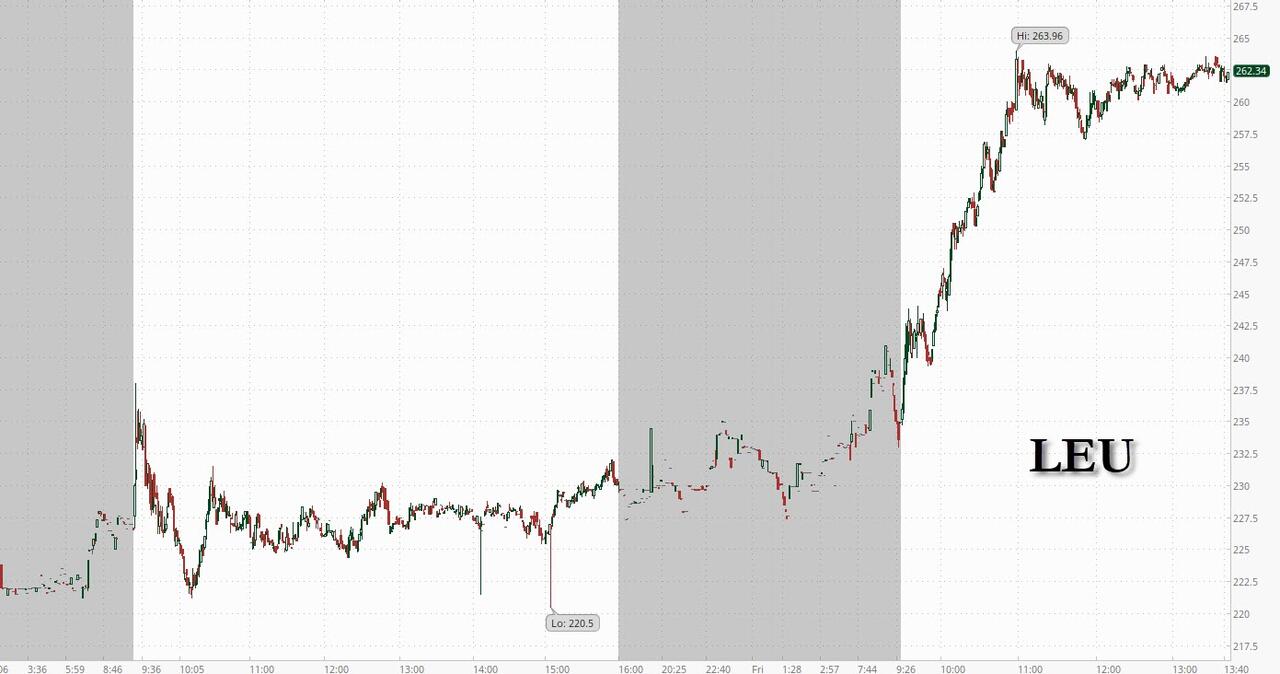
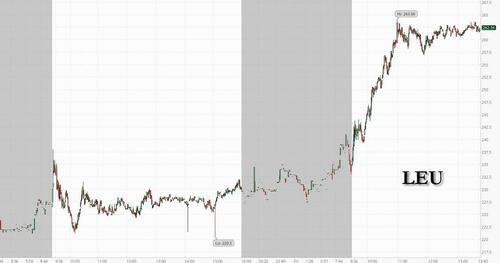
The long awaited buildout of Centrus Energy’s uranium enrichment facility is finally underway as the company announced this morning it has begun constructing new centrifuges to support commercial production of low-enriched uranium (LEU). LEU stock is surging as much as 14% on the news.
Why should anyone care though? We already have Urenco producing massive quantities of LEU in New Mexico. They’ve been producing millions of separative work units (SWU) worth of enriched uranium for use in the domestic commercial fleet of reactors in the US for years. They even export some of that enrichment to foreign reactor operators.
What makes the Centrus effort so special?
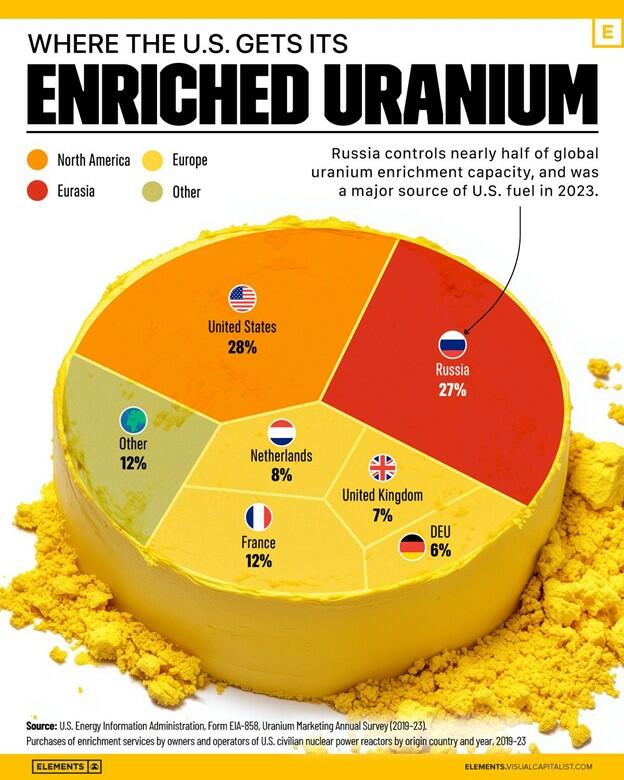
The difference is that under Trump, the US is done relying on others for its fuel. Not just gas or oil, but now uranium as well. Almost a quarter of US enriched uranium is imported from Russia, with the rest coming from companies like Urenco and Orano, all owned by foreign governments.
The US hasn’t produced its own uranium since the last plant closed in 2013, one of the major policy failures following the drop in approval for the use of nuclear energy following the Fukushima disaster in 2011.
Companies like Centrus Energy, BWXT, and General Matter, are both US owned and operated. The American ownership of the technology and the state-side location of operations enables the nuclear fuel to be labeled as unobligated.
Obligated fuel means in order to produce it, the use of foreign technology or equipment occurred at some point in the fuel chain, meaning the fuel cannot be used for US government purposes of any kind. All of the fuel that’s used in the US Navy’s submarine and carrier reactors, DoE research reactors, all the reactors under the Army’s Janus Program, as well as the multiple other programs that are ongoing with the US government, will not be able to use fuel that is obligated.
Only companies like General Matter, BWXT, and Centrus, can produce fuel that is allowed to be used by the US government for government purposes.
Centrus will rely on its domestic manufacturing chain to produce the AC100M enrichment centrifuge design, which is built on the AC100 design used in past enrichment cascades. With backing from the DoE’s LEU award program, international backing from South Korea, and recent significant capital raises and convertible notes offerings, Centrus has the capital on hand and the backlog stacked up to support the buildout of new enrichment capacity. They are already producing high-assay LEU (HALEU), which was developed with the DoE over the past few years.
The first production of LEU is expected in 2029.
Tyler Durden
Fri, 12/19/2025 – 14:20
https://www.zerohedge.com/energy/centrus-soars-after-starting-commercial-uranium-enrichment-activity

D203 board reduces summer school schedule instead of raising fees
The Naperville District 203 School Board has approved a revised summer school program that scales back the number of course offerings, days in session and locations instead of passing along a 20% tuition increase to families.
District officials recommended last month that fees be escalated across the board, noting they had not gone up since 2022 but costs for staff, transportation and materials have increased. The overall cost of summer learning this year was 5.6% more than the projected budget, district officials said.
Had the district increased tuition, elementary school summer courses would have gone up from $195 to $235 and junior high school courses would have increased from $195 to $235 for a 90-minute class and $390 to $470 for a three-hour class. Other fees, including those for science camp and summer music, also would have risen.
Board members rejected the proposal, saying they believed the increase could be a deterrent to families wanting to enroll their children in programs for enrichment, academic needs or as something to do over the summer months.
The board also looked at the district’s five-year financial forecast, which projects millions of dollars in deficits and did not want to have to absorb the additional costs in the budget.
In a new proposal approved Monday, the board opted for a revised summer program that does not come with higher fees.
The move changes summer school from two three-week sessions for elementary and junior high school students to one four-week session, reducing staffing costs. Elementary programs will be consolidated at Beebe Elementary School instead of at two locations and multilingual programming will be integrated into general education classes, according to the approved plan.
A $50 fee for field trips for junior high school students will be implemented.
The new plan reduces summer school costs without increasing tuition, prioritizes students with the greatest academic needs, helps with credit recovery so students can graduate on time and helps students at risk of academic regression, said Jayne Willard, assistant superintendent for curriculum and instruction.
Some courses have been eliminated from the initial plan proposed in November.
A junior high school course exploring Chicago and the suburbs through field trips, hands-on activities and outdoor exploration will not be offered.
Several exploratory classes for junior high students will remain options, including courses on airplanes and rockets, coding, graphics and gaming, culinary arts, robotics and engineering.
High school courses also will have a reduced number of selections, but a variety of English, math, biology, chemistry, civics, U.S. history and driver’s education classes will be maintained.
Additionally, online classes will continue due to low overhead costs, said Kevin Wojtkiewicz, director of summer learning.
Music and science camps also will run as scheduled.
Under the approved proposal, total expenses are to drop from $2.5 million to $1.8 million, with the district saving money on staff, supplies, food service, after-school care and transportation.
“These recommendations reflect a careful balance between fiscal responsibility and our commitment to students and families,” Wojtkiewicz said. “We believe this revised model preserves access for those with the greatest need, maintains valued enrichment opportunities and responds responsibly to the board’s financial direction.”
Board members Monday said they were grateful for the option to choose an updated, less-expensive plan.
“This is living within our means,” board member Holly Blastic said.
Board vice president Kristine Gericke said the reduced summer school plan is a precursor to the board dealing with the deficit projections.
“We have to focus on our needs first and if we can have more room for the wants, we will certainly do that,” Gericke said.
Melissa Kelley Black, who voted against the revised plan, said other organizations, such as Naperville Park District, College of DuPage and Naper Settlement can offer exploratory or enrichment camps for children for less than the district can.
“While I would love to be able to have those classes, I’m not sure it makes sense for us to provide classes (when) we live in an environment rich with these comparable classes and camps,” she said.
Board President Charles Cush said the district can always revisit the summer school program and may expand or cut summer school classes in future years.
Summer student registration opens March 3 for programs that run from June 2 to July 30.
Michelle Mullins is a freelance reporter for the Naperville Sun.
https://www.chicagotribune.com/2025/12/19/203-summer-school-naperville-fees-cuts/

Putin Identifies The Main Issue Which Will Settle Ukraine War In Year-End Q&A
Putin Identifies The Main Issue Which Will Settle Ukraine War In Year-End Q&A
Russian President Vladimir Putin made clear during his annual end of year question-and-answer session in Moscow that the matter of Ukraine ceding land which Russia now controls is the heart of the issue when it comes to peace talks. The issue of territory gained, lost, to be ceded or not, remains the prime topic that must be considered, but it’s the very thing that Ukraine’s Zelensky refuses to talk about or compromise on, Putin explained.
“We know from statements from Zelenskyy that he’s not prepared to discuss territory issues,” Putin told Q&A attendees in the capital’s Gostiny Dvor exhibition hall.
The Kremlin has pressed for Ukrainian troops to exit the Donbass, reduce the size of Kiev’s military, and for their to be international legal recognition that annexed eastern territories are part of the Russian Federation.
What’s more is that after the capture of the strategic Donetsk city of Pokrovsk in early December, Putin expects his forces will soon gobble up more territory.
Putin declared he’s “certain that before the year’s end we will witness new successes of our armed forces, our fighters.”
He named specific places were Russian forces remain ascendent, according to state media translation:
There is also intensive fighting for Krasny Liman and Dmitrov, as well as Gulyay Pole in Zaporozhye Region, the president added.
In the south, Russian forces have captured the city of Kupyansk and are pressuring the Ukrainian battlegroup that dug in at a large railway juncture nearby. Putin said some 3,500 Ukrainian troops there “have virtually no chances” to survive after being denied a request to retreat.
“The time will come when our guys finish their work destroying the encircled Ukrainian forces on the northern bank of the river and turn to the west. That will happen pretty soon,” Putin said.
Putin went on to explain that Zelensky’s efforts to hold territory “at any cost” will only result in more devastating losses for Ukraine, and that sooner or later he’ll be forced to concede at the future negotiating table, accepting defeat.
Speaking of prior efforts to solve the conflict, Putin said further of the Ukrainian side: “After the talks in Istanbul, they initially agreed… and then backed out, throwing all of those agreements into the trash. And now, in effect, they are refusing to bring this conflict to an end through peaceful means.”
“Still, we see, feel and know that there are certain signals, including those coming from the Kyiv regime, indicating that they are prepared to engage in some form of dialogue,” he added, expressing apparent hope for the Trump peace proposal.
❗️’No’: Putin Bluntly Answers Strange BBC Question About If There Will Be More Special Military Operations
“If you treat us with respect and respect our interests as we always do with yours. As long as you don’t play dirty tricks with us like about NATO expansion.” pic.twitter.com/rNWAX1tV2M
— RT_India (@RT_India_news) December 19, 2025
The annual Q&A event has stretched back to 2001, and draws literally millions of submitted questions from the Russian public via phone, text and online platforms. An artificial intelligence system from there analyzes the submitted questions to identify common themes, which are then asked of Putin in the televised event.
Tyler Durden
Fri, 12/19/2025 – 14:00

Despite the bitter cold temps, the ‘Christmas Stroll’ in Park Ridge brought the community out and raised money for area orgs
Despite the frigid temperatures that barely hovered at zero degrees, Saturday was a busy day in Park Ridge’s Uptown neighborhood where scores of people turned out for the second annual “Park Ridge Christmas Stroll.”
Families ventured to Hodges Park, Park Ridge Community Church, the public library and other local venues for activities that included seasonal contests, a children’s pageant and, of course, visits with Santa.
Children play the role of the Virgin Mary and Joseph and sit with baby Jesus in a nativity reenactment, left, during the Christmas pageant held Dec. 13, 2025 at Park Ridge Community Church in Park Ridge. The event was part of the activities of the “Park Ridge Christmas Stroll.” (Jesse Wright/for Pioneer Press)
Buddy the Elf emcees the ugly sweater contest Dec. 13, 2025 as part of activities during the “Park Ridge Christmas Stroll” event (Jesse Wright/for Pioneer Press)
Park Ridge Christmas Stroll celebrated the season as well as the community, and the money raised went to local charities.
“This is an event for families and kids and it benefits families and kids,” said Dolly McCarthy.
McCarthy is the publisher of “Stroll Park Ridge,” a monthly community magazine that celebrates all things Park Ridge, and she is the brains behind the Christmas Stroll.
“We wanted to do an event that was an opportunity to come together as a community and celebrate Christmas together,” she said.
Most of the event was free and the ones with a fee raised funds for various community charities. But mostly, it was free. Participants could walk from Santa’s Workshop to St. Paul of the Cross Church to the Park Ridge Community Church to the library. There was a choral performance, an ugly sweater contest, crafts, and more. Funds were raised through the bake sale and a cake walk activity.
Karl Ochsner was the big winner of the ugly sweater contest. His outfit featured some cutout paper figurines and a red banner that read “Santa stop here.” It was his second year taking the top “ugly” prize and he said he will be back again next year.
“You gotta get festive,” he said. “It’s a great Park Ridge event.”
McCarthy is also a member of the Kiwanis Club and much of the proceeds from the event went to support the club buying mental health care kits for area high school students.
The kits cost the club $8,500 a year and they get passed out to a variety of local high schools. Any high school that is interested can request the kits.
One of the new events this year was the Santa Stroll and Jingle Jog, which raised money for The Harbour, a nonprofit agency that provides shelter and support for homeless youth and young mothers experiencing homelessness
“We raised $6,000,” McCarthy said about the inaugural event, which featured a 5K run, one-mile walk and jog for kids.
McCarthy said the event seemed to draw more people last year but didn’t doubt that the cold temperatures put a freeze on attendance numbers. Nevertheless, parking lots around the Uptown area bustled and the churches were filled with people.
“One of the things I learned being the publisher of the community magazine is, this town comes out,” she said. “They open their hearts and wallets for each other.”
Jesse Wright is a freelancer.
https://www.chicagotribune.com/2025/12/19/park-ridge-santa-stroll-in-uptown/

Aldermen pass 2026 spending plan including debt sale over Mayor Brandon Johnson’s opposition
The budget counterproposal crafted by opponents of Mayor Brandon Johnson won a critical first vote before the full City Council on Friday, setting the mayor up to soon concede their remarkable weekslong fight — or issue Chicago’s first mayoral veto of a budget in decades.
Aldermen voted 29-19 to approve the revenue piece of an alternative 2026 spending plan that does not include Johnson’s corporate head tax. That’s shy of the 34-vote threshold needed to override a potential mayoral veto, however, leaving the door open for the City Hall standoff to escalate further still.
And with under two weeks until an end-of-year deadline to approve a budget, all factions agree Chicago is inching too close for comfort to a government shutdown.
When the moment came, aldermen debated for mere moments before quickly passing the plan.
“The city of Chicago’s financial position is at a critical juncture, and I think we have emerged today with the budget plan that protects programs which are vital to those,” said Ald. Pat Dowell, Johnson’s handpicked budget chair who played a critical role in the effort that out-muscled him.
The $16.6 billion aldermanic package contains a debt sale measure that Johnson called Thursday “morally bankrupt” and a “red line.” His budget team warned such a novel proposal should not be counted on to raise any money at all, on top of attacking other components of the alternative budget that they argue is unbalanced and would require midyear amendments next year.
Whether the plan requires a veto, in Johnson’s eyes, is the question of the hour.
“I don’t want people to take this as some sort of tool that is being taken lightly,” he told reporters on Thursday. “It needs to be used when necessary, and I will find that tool necessary if there is something that is presented in front of me that doesn’t hold to our values as a city.”
Johnson advisers said Friday the mayor had still not made up his mind on a veto. He will not reveal his decision until after the full budget package faces a vote likely to occur on Saturday.
The mayor introduced a revised budget plan of his own Friday that would replace the debt sale plan with his proposal to reinstate a corporate head tax. In the plan, the city would make a full advanced pension payment Johnson had earlier proposed halving, not legalize video gambling terminals and count on slot machines being placed at a Midway Airport lounge.
The historic rebuke of the freshman mayor will likely draw further condemnation from his leftist allies who have been admonishing aldermen for what they say is siding with rich corporations and billionaires over working-class Chicagoans. But even the progressives were not united with Johnson, who first introduced his own $16.6 billion package in October but failed to make the case that his pitch to reinstate the city’s head tax, among other new revenue measures, was Chicago’s best hope to stand up to President Donald Trump.
Check back for updates.