
Ironically, 2020 would have been a big year for new music.
The occasion of Beethoven’s birth, 250 years before, led to a surge of new orchestral commissions around the globe. The catch? Most had to reference Beethoven in some way — typically a stipulation of the commissioner.
At the time, I found this trend vexing. Not only did it play into orchestras’ worst inclinations — implying that living composers were best legitimized via deceased ones — but the fresh glut of Beethoven partner pieces cleared an easy pathway for those works to get programmed over and over again, often instead of worthier music.
As it happens, among Klaus Mäkelä’s many talents is converting cranky critics from their deeply held opinions. On Dec. 18, the Chicago Symphony’s music director designate led a riveting program that prefaced Beethoven’s Symphony No. 7 with two 21st-century bits of Beethoveniana: Unsuk Chin’s “subito con forza,” which Mäkelä premiered with Amsterdam’s Concertgebouw Orchestra in 2020, and Jörg Widmann’s “Con brio,” which, with its 2008 vintage, predates the latest Beethoven deluge.
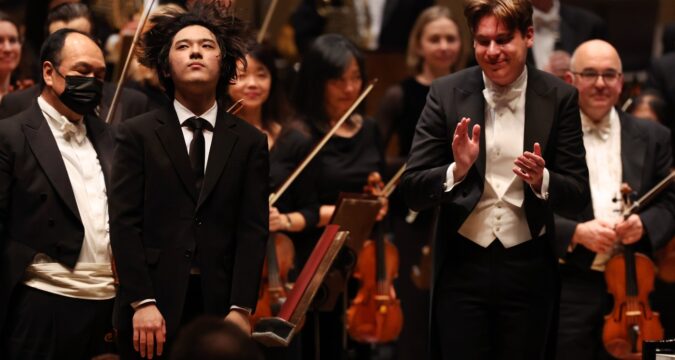
Nestled in the middle of all of it was Yunchan Lim, the mop-haired 21-year-old who made history three years ago as the Van Cliburn International Piano Competition’s youngest winner. A hall-filler on his own — his fall recital at Symphony Center handily sold out — he brought Robert Schumann’s Piano Concerto to this very van Beethoven program.
An outlier, then? Not the way Lim played it. Like all the other works on the program, the Schumann announces itself with declarative chords; Lim’s opening descent sprang from the orchestra’s downbeat like a diving block. But this might have been one of the few moments of youthful explosiveness. He committed to the concerto’s inner logic, rejecting the urge to play it as a thing of mere emotional tumult. When the theme of the first movement returned, near its end, it sounded world-wearier, as though it had lived a lifetime since.
Pianist Yunchan Lim performs with the Chicago Symphony Orchestra at Symphony Center on Dec. 18, 2025. (Chris Sweda/Chicago Tribune)
The second movement became untethered from time and pulse, a floating reverie before the pleasantly gamboling third movement. Here and before, Lim’s deep sense of rhythmic integrity gave the sense that he and the orchestra were one. All had a poetic sense of flow and care, as though Lim somehow drew upon, and sublimated, Schumann’s own literary persuasions. (Maybe not uncoincidentally, the young pianist’s longtime Instagram profile picture was not of himself but of a boyishly pouting Arthur Rimbaud.)
The program also had a certain musical logic. Lim brought the same wizened maturity to his encore, Chopin’s Waltz No. 3 in A minor — the same key as the Schumann, and a complement to the Beethoven’s A major. The waltz’s low, left-hand melody returns in many guises over its span; Lim took it at a pensive dirge on Thursday, stretching to around seven minutes. But each return of the melody was colored slightly differently — not through any loss of tempo, but through delicate changes in sensibility, a shift in tone saying more than words can express.
Already, the young pianist has established himself as a Chopin interpreter for the ages. This is why.
Frequent collaborators in recent seasons, Lim and Mäkelä were profoundly intertwined in the Schumann — leagues improved upon their last Midwest appearance together, during a 2024 tour stop in Ann Arbor, Michigan, with the Orchestre de Paris. Mäkelä’s gestures became a choreographic extension of Lim’s, and he emphasized the responsorial elements of the score, as he has before in other concertos.
The Schumann, ending the first half, came between “subito con forza” and “Con brio” — but without half the whiplash one would expect, in this program that spoke across the ages. Chin and Widmann are among today’s most programmed composers, though their popularity is anchored more in Europe than in the States. Even so, “subito con forza” and “Con brio” have become their most widely performed orchestral works — the Beethoven effect in action.
Different as Chin and Widmann’s aesthetics are, their works share key similarities. For one, they both rib Beethoven with affectionate irreverence, as one might tease a friend: flutter-tongue trumpet raspberries in the Chin, winds and brass clapping their bells in the Widmann. Neither account much for the soulful, introspective Beethoven. These Beethovens are all Sturm und Drang, all of the time.
Their key difference, besides their duration — Chin’s work, at five minutes, is about half as long as Widmann’s — is their philosophy. Brahms felt famously tortured by Beethoven’s stature, bemoaning the “giant marching behind” him. “Subito con forza” takes a sunnier view of Beethoven’s ubiquity, piggybacking on the giant as it stalks through the new millennium. The slashing opening chords of the “Coriolan” overture dissolve into a vibraphone jangle, then an all-orchestra aftershock. An Emperor Concerto-ish sweep up the piano becomes a passing pyrotechnic. The short-short-long motif of Beethoven’s Fifth also appears in diminution in the brass, here just an accompanimental figure.
“subito con forza” ends in a cluster chord, its notes dragged, as though against their will, into a C-minor conclusion — a portentous key for Beethoven. Thursday’s conclusion lost a bit of its oomph, with Mäkelä tying up things rather quickly. Still, the piece’s impact registered.
In contrast, Widmann, himself a clarinetist, evokes the experience of playing Beethoven, from a musician’s perspective. Wind players clack their keys and exhale, foregrounding the physical processes that fuel this sublime and uncanny music. According to the composer, Beethoven’s music is never actually quoted — unlike his recent Beethoven Studies for string quartet, which more pointedly put his oeuvre through a blender — but you’d swear it is, Widmann parroting the composer’s signature orchestrational timbres.
Pianist Yunchan Lim performs as Klaus Mäkelä conducts the Chicago Symphony Orchestra at Symphony Center on Dec. 18, 2025. (Chris Sweda/Chicago Tribune)
Both were exceedingly well-crafted performances of well-crafted pieces. But what sold Mäkelä’s programming was the Beethoven itself. Instead of treating “subito con forza” and “Con brio” as mere molds — one-way streets of inspiration — his Beethoven 7 thoroughly dialogued with both. A nattering open E string in the second violins in the first movement and teasing trills in the Presto seemed directly indebted to “subito con forza’s” sassy flourishes. Later, strings played the finale’s dotted engine super-secco, recalling the arid extended techniques in Widmann.
This might have been Mäkelä’s most compelling pacing of a repertoire work so far in Chicago. The last chord of the first movement had scarcely stopped sounding when he launched into its minor-key obverse in the Allegretto—a potent reminder of the key relationships at play all night. The finale was indeed very “con brio,” played with a bat-out-of-hell frenzy. But unlike October’s “Symphonie fantastique,” the wheels never came off the wagon.
This Beethoven 7 even donned some of Chin and Widmann’s winking humor. Mäkelä launched into the first repeat of the Presto, its boisterous timpani ever so slightly clipping the heels of the first section. But this movement also saw a less winsome flash of overexcitement: a pushing, and unclear, downbeat that sucked some levity out of the “Assai meno presto” secondary theme.
As has become a Mäkelä hallmark, this Beethoven 7 saw many stretches of hands-off leadership, an opening of the floor to group discussion. The music, in turn, flowered with open-hearted curiosity — a Beethoven 7 for the ages, most especially our own.
Where might we and Beethoven go next in this long 21st century?
Hannah Edgar is a freelance critic.
“Klaus Mäkelä & Yunchan Lim” continues through 7:30 p.m. Saturday at Symphony Center, 220 S. Michigan Ave., remaining tickets $225-$399, with limited $99 standby reservations at cso.org
https://www.chicagotribune.com/2025/12/19/review-cso-makela-lim/


