
Category: News
Dumber, Sicker, & Poorer
Dumber, Sicker, & Poorer
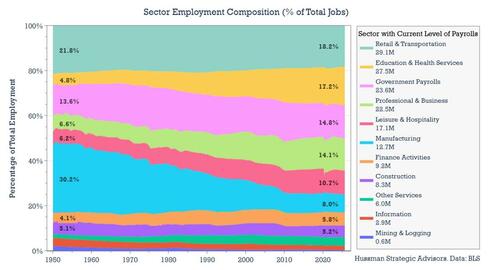
The chart below is a fascinating snapshot of the last 75 years in the demise of the American empire.
As The Burning Platform’s Jim Quinn explains in his no-nonsense manner, there are currently 164 million people employed in America. About 34 million of those are employed part-time.
When you understand the working age population is 275 million and your friendly number fudgers at the BLS declare 103 million of them NOT IN THE LABOR FORCE, and hysterically declaring only 7.8 million Americans are unemployed, you understand what a fraudulent economy we have.
The reported 4.6% unemployment rate is complete and utter bullshit. In reality, it is north of 20%.
Welcome to the golden age…
The percentage of total jobs in the Education and Health Services sector has grown from 4.8% in 1950 to 17.8% today. Wow!! We must be the smartest, healthiest nation on earth. Not quite. With 28 million teachers, doctors, nurses, and mostly administrators (aka overhead), our education system matriculates millions of barely functional idiots into society every year. Meanwhile, as a country, we are sickly, fat, lazy, dependent upon Big Pharma drugs, and spend more on healthcare than any country on earth. To quote the immortal Dean Wormer, “Fat, drunk, and stupid is no way to go through life, son.”
Proof we have become a non-productive, debt dependent, government dependent, shadow of our former industrial powerhouse is the decline in the percentage of manufacturing jobs from 30.2% in 1950 to 8.0% today. We borrow and consume, when we used to invest and build. Trump can threaten, tariff the world, and make bullshit announcements about manufacturing jobs coming back, but they are not coming back. Any new manufacturing plants will be operated by robotics.
Even though the percentage of government employees (aka parasites) has remained relatively steady since 1950, we are stuck with 24 million blood suckers who contribute nothing to the country’s productivity. The average working schmuck has to pay outrageously high taxes to pay the bloated salaries and pensions of these government freeloaders.
And now some bad news for the formerly well paid workers in the Professional & Business Services sector, which had grown from 6.6% of total jobs in 1950 to 14.1% today. ChatGPT and the avalanche of AI tools are eliminating jobs in these sectors at hyperbolic speed. These are the same assholes who used to tell blue collar workers to “learn to code”. Well, now the plumbers, electricians, and construction workers can recommend they learn to be fry cooks at McDonalds, but too late, robots are taking those jobs.
The relatively stable employment situation over the last few years has been the only thing keeping this ship of fools from sinking.
But, the increase in the fraudulent unemployment rate from 4.0% when Trump took office to 4.6% today shows the ship is taking on water and it won’t be long before millions are drowning under the waves of debt, delusion, and dumb decisions.
Tyler Durden
Fri, 12/19/2025 – 20:30
https://www.zerohedge.com/personal-finance/dumber-sicker-poorer

Tesla CEO Elon Musk recovers $55 billion pay package in Delaware court ruling
Elon Musk, already the world’s richest man, scored another huge windfall Friday when the Delaware Supreme Court reversed a decision that deprived him of a $55 billion pay package that Tesla doled out in 2018 as an incentive for its CEO to steer the automaker to new heights.
Besides padding Musk’s current fortune of $679 billion, the restoration of the 2018 pay package vindicates his long-held belief that the Delaware legal system had overstepped its bounds in January 2024 when Chancellor Kathaleen St. Jude McCormick rescinded the compensation in a case brought by a disgruntled Tesla shareholder.
Tesla didn’t immediately respond to a request for comment late Friday.
McCormick’s ruling so incensed Musk that it spurred him to spurn Delaware and reincorporate Tesla in Texas. That decision also caused Tesla’s board to scramble for ways to keep its CEO happy, including a successful effort to persuade the company’s shareholders to reaffirm the pay package, which was valued at $44.9 billion at the time of the second vote 18 months ago.
With Musk still signaling discontent, Tesla upped the ante again this year by crafting another pay package that could pay him $1 trillion if he can lead the automaker down a road during the next decade that lifts the company’s market value from its current $1.6 trillion to $8.5 trillion. Shareholders approved that pay package last month, to Musk’s delight.
That may sound like a difficult task, but it also appeared like a long shot for Musk to hit all the targets to qualify for the payout that was dangled in the 2018 package. At that time, Tesla was still struggling to expand its production of electric vehicles and burning through cash.
At the time the 2018 pay package was drawn up, Tesla’s market value was hovering in the $50 billion to $75 billion range. But then the company’s manufacturing problems eased, enabling it to start meeting hot demand for its vehicles, which in turn pumped up its sales and stock price to a level that qualified Musk for the big payout that had been promised him.
But based on evidence that included Musk’s testimony during a 2022 trial, McCormick ruled the pay package had been crafted by a board that was too cozy and beholden to the hard-charging Musk.
In its 49-page ruling, the Delaware Supreme Court cited a variety of errors in McCormick’s 2024 decision and declared the 2018 pay package should be restored. It also awarded Tesla $1 in nominal damages.
https://www.chicagotribune.com/2025/12/19/tesla-elon-musk-pay-package-2/

A brief encounter, two attacks and then a break in investigations into the Brown and MIT shootings
PROVIDENCE, R.I. — Just before Thanksgiving, Claudio Neves Valente checked into a Boston hotel and traveled to Brown University, where he had studied physics 25 years earlier.
The drive to Providence was short, and in the days that followed, the 48-year-old Portuguese national returned to the campus again and again. On most trips, he drifted around Brown and the surrounding neighborhoods in a gray Nissan rental car with Florida plates. A custodian noticed him inside an engineering building while most students were home on the holiday break and spotted him again three days later, according to authorities.
Investigators say that on Dec. 13, Neves Valente returned to Brown once more, this time with a 9 mm handgun, and he opened fire in a lecture hall in an attack that killed two students and injured nine others. He got away in the ensuing chaos, and two days later, showed up at the home of a Massachusetts professor who was a classmate of his in Portugal in the 1990s, and fatally shot him, too, investigators said.
In their frantic search for the Brown attacker, authorities released footage in the hopes that someone might recognize him. But his face was always hidden behind a mask, with a black beanie covering his head.
“I wish the video could speak, and then I’d have the answers I need,” a frustrated Providence police chief, Col. Oscar Perez, told reporters during one of the week’s news briefings.
Arriving in New England
Investigators are still trying to figure out much of what Neves Valente was doing in New England in the weeks before the shooting, but they know he repeatedly visited the Ivy League school’s Providence campus. He was spotted on surveillance footage at a Boston rental car agency as early as Nov. 17.
Neves Valente, who attended Brown as a graduate student during the 2000-01 school year, may have arrived in Boston from Miami, the site of his last known address. He stayed at a Boston hotel from Nov. 26 until Nov. 30 and was spotted by the custodian in the Brown building twice: first on Nov. 28 and again three days later, on Dec. 1, the day he rented the gray Nissan.
On at least one occasion, the custodian saw him enter from the same street entrance that authorities say the attacker used to get in and out on the day of the shooting.
Brown is attacked
Last Saturday, he roamed the streets near campus for hours, sometimes jogging and sometimes walking with what investigators described as a distinct gait. In surveillance footage, he first appeared just after 10:30 a.m. could be seen, off and on, casing the area over the next few hours.
At about 2 p.m., a man whose tip police have credited with breaking the case open — identified in an affidavit only as “John” — saw a man authorities later identified as Neves Valente inside the engineering building. He said their encounter was in a first-floor bathroom, that the man had a “weathered” and “cinnamon color complexion,” and that his clothes were “inappropriate and inadequate” for New England in December.
It’s unclear if John and the custodian are one and the same. A Brown spokesperson didn’t respond to an inquiry seeking clarification.
John said he followed the man outside, leading to a “game of cat and mouse.” He said he saw the man approach a silver Nissan with Florida plates, click the key fob causing the lights to flash, and then abruptly turn away and start walking in a different direction, according to the affidavit.
The interaction ended when the suspect confronted him and asked, “Why are you harassing me?”
At about 4 p.m., authorities believe Neves Valente entered the engineering building through the street-facing door, walked into the lecture hall and opened fire on students who were studying for a final before slipping away.
With few if any security cameras in the engineering building, investigators were left for days with little more than blurred images pulled from home security systems and passing vehicle cameras — moments in time that show where the gunman had been, but not who he was. As police flooded Providence and warned the public that the suspect remained at large, investigators acknowledged the challenging task ahead of them, given the limited evidence on hand at the time.
Early on Sunday, FBI Director Kash Patel announced on social media that investigators had effectively identified or detained a person of interest in the Brown shooting. But authorities released that man hours later after determining he didn’t do it.
The attack near Boston
On Monday night, shots rang out in a neighborhood in the Boston suburb of Brookline. Someone had shot Massachusetts Institute of Technology professor Nuno F.G. Loureiro in his home before fleeing.
Loureiro died at a hospital the next day — the same day that Neves Valente apparently shot himself in New Hampshire, according to initial autopsy results released Friday.
Loureiro, a 47-year-old physicist and fusion scientist who ran one of MIT’s biggest labs, grew up in Portugal and studied in the same university program as Neves Valente from 1995-2000. But it would be days before investigators would link the Brown shooting and professor’s killing, saying initially that they had no reason to think they were related.
While trying to find an image of the Brown attacker’s face in the days after the shooting, investigators were also interviewing the students who were in the room when he opened fire.
When one of the wounded students was shown an image of the man in the initial grainy videos that police circulated, she froze, shook, then began to cry, overcome with recognition, the affidavit states. She said she knew immediately that the man was the one who had hurt her and her classmates.
Another victim “took a deep breath, shut his eyes, changed his breathing pattern,” before confirming that the man in the video footage was the person who shot him, it says.
But no one — including any of the victims — could provide a name or even place ever seeing Valente before the shooting.
A break in the case
On Thursday, authorities said they suspected that the same person might have been responsible for both attacks.
The tip from the man identified as John about encountering a suspicious man with a Nissan with Florida plates enabled Providence police to tap into a network of more than 70 street cameras operated around the city by surveillance company Flock Safety. Those cameras track license plates and other vehicle details.
After leaving Rhode Island for Massachusetts, authorities say Neves Valente stuck a Maine license plate over his rental car’s plate to help conceal his identity.
Video footage showed Neves Valente entering an apartment building near Loureiro’s. About an hour later, he was seen entering the New Hampshire storage facility where he was later found dead, authorities said.
https://www.chicagotribune.com/2025/12/19/investigations-brown-mit-shootings/

Jets dejan fuera a su astro Garrett Wilson por lesión para los últimos 3 partidos de la temporada
Por DENNIS WASZAK Jr.
FLORHAM PARK, Nueva Jersey, EE.UU. (AP) — Garrett Wilson, receptor abierto de los Jets de Nueva York se perderá los últimos tres partidos de la temporada mientras continúa recuperándose de una lesión de rodilla.
El entrenador Aaron Glenn dijo el viernes que Wilson está progresando adecuadamente, pero el equipo no quiere correr riesgos innecesarios con el receptor estrella. Wilson ha estado fuera durante cinco partidos, después de lesionarse contra Cleveland el 9 de noviembre.
Los Jets (3-11) están fuera de la contienda por los playoffs mientras se preparan para enfrentar a los Saints (4-10) en Nueva Orleans el domingo.
“Está haciendo un muy, muy buen trabajo en cuanto a su rehabilitación”, afirmó Glenn. “Sólo queremos ser inteligentes con él porque es una pieza clave en lo que estamos haciendo aquí. Poder tenerlo de vuelta en el programa para la próxima campaña, completamente sano y listo para jugar, es la mejor decisión para todos nosotros”.
Glenn agregó que Wilson, de 25 años, estaba “de acuerdo” con la decisión después de hablar con los médicos y el equipo.
“Estará listo para comenzar cuando inicie el programa de la temporada próxima”, dijo Glenn. “Y estoy emocionado por eso”.
Wilson firmó una extensión de contrato de cuatro años y 130 millones de dólares en julio después de terminar con 1.000 yardas mediante recepción en cada una de sus primeras tres temporadas en la NFL desde que fue reclutado con la décima selección del draft de 2022, procedente de Ohio State. Fue galardonado por la AP como el Novato Ofensivo del Año en la NFL y se convirtió de inmediato en uno de los receptores abiertos más productivos de la liga.
Pero Wilson jugó solo siete partidos esta temporada después de reencontrarse con su exmariscal de campo de Ohio State, Justin Fields. Se perdió dos partidos por una lesión en la rodilla derecha antes de poder regresar en la Semana 10, pero sufrió una lesión diferente en la misma rodilla al final del partido contra los Browns, y esta vez le costó los últimos ocho partidos.
Wilson terminó con apenas 36 recepciones para 395 yardas, con lo que aún lidera al equipo, y cuatro touchdowns. Ya ocupa el décimo lugar en la lista histórica de los Jets con 315 recepciones en apenas 58 partidos y sus 3.644 yardas mediante recepción lo colocan en el 13er puesto de la lista de la franquicia.
_____
Deportes AP: https://apnews.com/hub/deportes

US military launches strikes in Syria targeting Islamic State fighters after American deaths
WASHINGTON — The Trump administration launched military strikes Friday in Syria to “eliminate” Islamic State group fighters and weapons sites in retaliation for an ambush attack that killed two U.S. troops and an American civilian interpreter almost a week ago.
A U.S. official described it as “a large-scale” strike that hit 70 targets in areas across central Syria that had IS infrastructure and weapons. Another U.S. official, who also spoke on condition of anonymity to discuss sensitive operations, said more strikes should be expected.
“This is not the beginning of a war — it is a declaration of vengeance. The United States of America, under President Trump’s leadership, will never hesitate and never relent to defend our people,” Defense Secretary Pete Hegseth said on social media.
The new military operation in Syria comes even as the Trump administration has said it’s looking to focus closer to home in the Western Hemisphere, building up an armada in the Caribbean Sea as it targets alleged drug-smuggling boats and vowing to keep seizing sanctioned oil tankers as part of a pressure campaign on Venezuela’s leader. The U.S. has shifted significant resources away from the Middle East to further those goals: Its most advanced aircraft carrier arrived in South American waters last month from the Mediterranean Sea.
Trump vowed retaliation
President Donald Trump pledged “very serious retaliation” after the shooting in the Syrian desert, for which he blamed IS. Those killed were among hundreds of U.S. troops deployed in eastern Syria as part of a coalition fighting the group.
Trump in a social media post said the strikes were targeting IS “strongholds.” He reiterated his backing for Syrian President Ahmad al-Sharaa, who Trump said was “fully in support” of the U.S. effort.
Trump also offered an all-caps threat, warning IS against attacking American personnel again.
“All terrorists who are evil enough to attack Americans are hereby warned — YOU WILL BE HIT HARDER THAN YOU HAVE EVER BEEN HIT BEFORE IF YOU, IN ANY WAY, ATTACK OR THREATEN THE U.S.A.,” the president added.
The attack was conducted using F-15 Eagle jets, A-10 Thunderbolt ground attack aircraft and AH-64 Apache helicopters, the U.S. officials said. F-16 fighter jets from Jordan and HIMARS rocket artillery also were used, one official added.
U.S. Central Command, which oversees the region, said in a social media post that American jets, helicopters and artillery employed more than 100 precision munitions on Syrian targets.
How Syria has responded
The attack was a major test for the warming ties between the United States and Syria since the ouster of autocratic leader Bashar Assad a year ago. Trump has stressed that Syria was fighting alongside U.S. troops and said al-Sharaa was “extremely angry and disturbed by this attack,” which came as the U.S. military is expanding its cooperation with Syrian security forces.
Syria’s foreign ministry in a statement on X following the launch of U.S. strikes said that last week’s attack “underscores the urgent necessity of strengthening international cooperation to combat terrorism in all its forms” and that Syria is committed “to fighting ISIS and ensuring that it has no safe havens on Syrian territory and will continue to intensify military operations against it wherever it poses a threat.”
Syrian state television reported that the U.S. strikes hit targets in rural areas of Deir ez-Zor and Raqqa provinces and in the Jabal al-Amour area near the historic city of Palmyra. It said they targeted “weapons storage sites and headquarters used by ISIS as launching points for its operations in the region.”
IS has not said it carried out the attack on the U.S. service members, but the group has claimed responsibility for two attacks on Syrian security forces since, one of which killed four Syrian soldiers in Idlib province. The group in its statements described al-Sharaa’s government and army as “apostates.” While al-Sharaa once led a group affiliated with al-Qaida, he has had a long-running enmity with IS.
The Americans who were killed
Trump this week met privately with the families of the slain Americans at Dover Air Force Base in Delaware before he joined top military officials and other dignitaries on the tarmac for the dignified transfer, a solemn and largely silent ritual honoring U.S. service members killed in action.
The guardsmen killed in Syria last Saturday were Sgt. Edgar Brian Torres-Tovar, 25, of Des Moines, and Sgt. William Nathaniel Howard, 29, of Marshalltown. Ayad Mansoor Sakat, of Macomb, Michigan, a U.S. civilian working as an interpreter, also was killed.
The shooting near Palmyra also wounded three other U.S. troops as well as members of Syria’s security forces, and the gunman was killed. The assailant had joined Syria’s internal security forces as a base security guard two months ago and recently was reassigned because of suspicions that he might be affiliated with IS, Interior Ministry spokesperson Nour al-Din al-Baba has said.
The man stormed a meeting between U.S. and Syrian security officials who were having lunch together and opened fire after clashing with Syrian guards.
Associated Press writer Abby Sewell in Beirut, Lebanon, contributed.
https://www.chicagotribune.com/2025/12/19/us-military-launches-syria/
California Expected To Defy Federal Pressure, And Reissue 17,000 Non-Domiciled CDLs
California Expected To Defy Federal Pressure, And Reissue 17,000 Non-Domiciled CDLs
By Rob Carpenter of FreightWaves
California is expected to begin reissuing approximately 17,000 non-domiciled commercial driver’s licenses that the state had planned to revoke following federal enforcement pressure. The decision comes despite ongoing corrective action requirements from FMCSA and raises fundamental questions about federal enforcement authority when a state openly defies compliance directives.
State transportation officials confirmed to sources that the Department of Motor Vehicles will begin restoring the contested licenses to immigrant drivers who received 60-day cancellation notices on November 6. The state has not clarified the specific process but points to the D.C. Circuit Court’s November 13 emergency stay of FMCSA’s interim final rule restricting non-domiciled CDL eligibility.
What California apparently misunderstands, or is choosing to ignore, is that the court stay addressed only the September 29 interim final rule. It did not address the separate compliance failures FMCSA documented during its 2025 Annual Program Review, which found that approximately 25% of California’s non-domiciled CDLs were improperly issued under regulations that existed before the emergency rule was ever published.
The federal government threatened to withhold more than $150 million in highway funding from California over these pre-existing violations. Those threats remain fully in effect regardless of the court’s stay of the new rule.
Two Separate Problems California Is Conflating
Understanding California’s legal exposure requires separating two distinct issues that the state appears to be deliberately merging.
Problem One: The Interim Final Rule. On September 29, 2025, FMCSA issued an emergency interim final rule titled “Restoring Integrity to the Issuance of Non-Domiciled Commercial Drivers’ Licenses.” This rule dramatically restricted the eligibility of non-domiciled CDL holders to H-2A, H-2B, and E-2 visas, excluding asylum seekers, refugees, and DACA recipients. The D.C. Circuit Court stayed this rule on November 13, finding petitioners were “likely to succeed” on claims that FMCSA violated federal law, acted arbitrarily, and failed to justify bypassing standard rulemaking procedures. With this rule stayed, states can theoretically continue issuing non-domiciled CDLs under pre-September 29 regulations, except for states under corrective action plans.
Problem Two: Pre-Existing Compliance Failures. FMCSA’s 2025 Annual Program Review found California had been violating federal regulations that existed long before the interim final rule. The agency documented systemic failures: CDLs issued with expiration dates extending years beyond drivers’ lawful presence authorization, licenses issued to Mexican nationals who are prohibited from holding non-domiciled CDLs (unless under DACA), and inadequate verification procedures. These violations triggered a preliminary determination of substantial noncompliance under 49 CFR 384.307, a process entirely separate from the stayed interim final rule.
California remains subject to a corrective action plan addressing these pre-existing violations. The court stay doesn’t change that. FMCSA’s November 13 guidance was explicit: states “subject to a corrective action plan” must maintain their pauses on non-domiciled CDL issuance until demonstrating compliance with pre-rule regulations.
The Nuclear Option: Decertification
Under 49 U.S.C. § 31312, FMCSA has authority to decertify a state’s entire CDL program if the state is found in “substantial noncompliance” with federal requirements. Decertification would prohibit California from issuing, renewing, transferring, or upgrading any commercial learner’s permits or commercial driver’s licenses, not just non-domiciled credentials, until FMCSA determines that the state has corrected its deficiencies.
The consequences would be immediate and severe. Every new driver in California’s CDL pipeline would freeze. CDL schools would halt operations. Testing would stop. Carriers would face weeks or months of disruption in recruiting new drivers. The ripple effects would devastate one of the nation’s most critical freight corridors.
FMCSA recently threatened Pennsylvania with decertification after an Uzbek terror suspect was found holding a Pennsylvania-issued CDL. The agency gave the state 30 days to respond and warned that failure to correct deficiencies could result in losing issuance authority entirely. California’s defiance appears far more egregious; the state is not merely failing to correct problems but actively moving to restore licenses that federal auditors determined were improperly issued.
Interstate Reciprocity and Federal Authority
Here’s where California’s gambit becomes particularly problematic. Commercial driver’s licenses aren’t purely state credentials; they’re federal credentials issued through a partnership with states. The Commercial Motor Vehicle Safety Act of 1986 established minimum standards that all states must meet. When a state issues a CDL, other states recognize that credential based on the assumption that it was issued in compliance with federal standards.
If California reissues non-domiciled CDLs that federal auditors have determined don’t comply with federal regulations, those credentials may not be valid for interstate operation. A driver holding a California CDL issued in violation of federal requirements could face enforcement action in any other state, and carriers who dispatch those drivers could face liability exposure.
Under 49 CFR 384.405, decertification prohibits a state from performing any CLP or CDL transactions. Even short of full decertification, FMCSA could issue guidance that CDLs issued by a noncompliant state during the noncompliance period are not valid for interstate commerce. Other states could refuse to recognize California’s credentials. The Commercial Driver’s License Information System (CDLIS), which enables interstate verification, could flag California licenses.
The question isn’t whether FMCSA has authority to act; 49 U.S.C. § 31312 is unambiguous. The question is whether the agency has the political will to exercise that authority against the nation’s most populous state.
California’s Position
California’s argument rests on several claims. The state contends that the 17,000 licenses with mismatched expiration dates represent “clerical errors” rather than substantive violations. State officials point out that the work authorizations underlying these licenses remain valid; the DMV simply failed to align CDL expiration dates with employment authorization document expiration dates.
With the court stay in effect, California argues it can now correct those date mismatches and reissue compliant credentials. The state maintains that drivers with valid work authorization who pass the knowledge, skills, and medical tests should be able to obtain properly dated CDLs under pre-September 29 regulations.
This argument sidesteps FMCSA’s core findings. The agency didn’t merely identify date mismatches; it documented systemic failures in California’s verification procedures, including the issuance of licenses to Mexican nationals who were prohibited from holding non-domiciled CDLs. California’s October 26 response to FMCSA acknowledged finding 20,000 non-domiciled CDLs with expiration dates exceeding drivers’ lawful presence. Still, it refused to revoke them, arguing the state hadn’t violated federal regulations as they existed before the interim final rule.
FMCSA’s November 13 response rejected this interpretation as “erroneous,” noting that “the regulatory universe of non-domiciled CLPs and CDLs is premised on the basic notion that a non-domiciled driver’s commercial motor vehicle driving privileges cannot extend beyond that driver’s lawful presence in the United States.”
Human Stakes
Behind the legal and regulatory frameworks are real people whose livelihoods hang in the balance. Many of the affected 17,000 drivers are Sikh men who fled persecution in India and sought asylum in the United States. The transportation and logistics industry has been a major employer for this community; approximately 150,000 Sikhs work in trucking nationwide, with California hosting the largest U.S. Sikh population.
Amarjit Singh, a 41-year-old truck owner-operator in Livermore, represents the personal dimension of this crisis. His work authorization extends through 2029. He invested $160,000 in his truck in 2022, faces $4,000 monthly payments, and supports two young children. When Singh heard California would reissue his license, he prayed in gratitude. His wife cried.
“It’s going to save my life, and it’s going to save my business,” Singh told KQED.
Singh’s relief may be premature. If FMCSA determines that California’s reissued licenses don’t comply with federal regulations, Singh and thousands of drivers like him could face the same uncertainty all over again, potentially worse, if other states refuse to recognize California credentials or if FMCSA moves toward decertification.
Political Collision
This confrontation unfolds against a backdrop of intense political conflict between California and the Trump administration. Governor Gavin Newsom has positioned himself as a leading Democratic opponent of federal immigration enforcement. Transportation Secretary Sean Duffy has made non-domiciled CDL enforcement a signature initiative, personally announcing enforcement actions against California and warning of consequences.
When a California asylum seeker named Jashanpreet Singh crashed his truck on I-10 on October 21, killing three people, Duffy issued a “bombshell report” directly blaming California for breaking federal law. “My prayers are with the families of the victims of this tragedy,” Duffy said. “It would have never happened if Gavin Newsom had followed our new rules. California broke the law and now three people are dead.”
California countered that the Jashanpreet Singh case involved the automatic removal of an age-based restriction, not a discretionary upgrade. The state argued it had complied with the then-existing regulations. FMCSA rejected this defense.
The political stakes guarantee that neither side will back down easily. For the Trump administration, allowing California to defy federal CDL requirements would undermine its entire enforcement framework. For California, capitulating would validate what advocates call a “contrived emergency” targeting immigrant workers.
What Happens Next
FMCSA faces a choice. The agency can accept California’s interpretation that the court stay permits license reissuance, effectively allowing the state to sidestep compliance requirements. Or it can enforce its position that California remains under corrective action and must demonstrate compliance with pre-rule regulations before resuming non-domiciled CDL issuance.
The enforcement tools are clear. FMCSA can withhold federal highway funding, up to $75.5 million in fiscal year 2027, with amounts doubling in subsequent years. The agency can issue a final determination of substantial noncompliance. And it can decertify California’s CDL program entirely, prohibiting the state from issuing any commercial driving credentials until deficiencies are corrected.
Given the current political dynamics, FMCSA moving toward decertification seems more likely than backing down. The agency has already threatened to decertify Pennsylvania for less egregious violations. Texas, Colorado, South Dakota, and Washington have all received compliance warnings. If California can openly defy federal requirements without consequence, the entire federal-state CDL partnership becomes meaningless.
For carriers operating in California or employing drivers with California non-domiciled CDLs, the uncertainty continues. The safest course is to monitor FMCSA guidance closely, document immigration status verification for all non-domiciled drivers, and prepare for the possibility that California credentials face additional scrutiny or rejection in other states.
The Big Question
Underlying this entire controversy is a question the D.C. Circuit Court’s stay didn’t resolve: Who ultimately controls commercial driver licensing standards in the United States?
The Commercial Motor Vehicle Safety Act of 1986 established federal minimum standards that states must meet. But states actually administer licensing programs. When a state believes federal standards are wrong, whether procedurally flawed, as the court found with the interim final rule, or substantively discriminatory, as advocates argue, what mechanisms exist to resolve the conflict?
The funding withholding and decertification provisions in 49 U.S.C. § § 31314 and 31312 provide federal enforcement tools. But using those tools against California would create massive disruptions to interstate commerce and potentially strand hundreds of thousands of drivers. The practical consequences may constrain federal enforcement regardless of legal authority.
Meanwhile, 17,000 drivers wait to learn whether the licenses California plans to reissue will actually let them work. Carriers wait to learn whether those credentials will be recognized outside California. And the rest of the trucking industry watches to see whether federal CDL standards mean anything at all when a state decides to ignore them.
Tyler Durden
Fri, 12/19/2025 – 20:05

Myles Garrett de Browns busca récord de capturas en una temporada ante Josh Allen de Bills
Por JOE REEDY
Josh Allen ha sido comparado con Brett Favre, miembro del Salón de la Fama del Fútbol Americano Profesional, debido a su fuerza de brazo y su capacidad para correr con el balón a pesar de los altos riesgos ocasionales.
Myles Garrett espera que Allen tenga otra similitud con Favre, quien al ser derribado hace casi un cuarto de siglo permitió que su captor estableciera un récord.
Garrett, All-Pro de los Browns de Cleveland llega al encuentro del domingo contra los Bills de Buffalo con 21 capturas y media. Necesita una y media más para superar a Michael Strahan, miembro del Salón de la Fama, y a T.J. Watt de Pittsburgh.
Ambos comparten el récord de más capturas en una temporada.
Garrett, quien ha registrado al menos una captura en ocho duelos consecutivos, dijo el viernes que sería especial si el récord se lograra contra el actual Jugador Más Valioso de la NFL.
“Absolutamente. Quiero decir, él es de esos tipos sobre quienes presumirías que venciste dentro de unos años”, dijo Garrett. “Creo que es una comparación un poco divertida porque esos tipos tienen estilos similares, y, ya sabes, Mike y yo hemos sido comparados antes, pero, sí, significaría mucho enfrentarlo. El tipo es increíble y lo que puede hacer en la posición de quarterback y con el balón, en general. No hay nadie como él, así que será un enfrentamiento divertido.”
Strahan superó la marca de 22 capturas establecida en 1984 por Mark Gastineau. El récord llegó al final del último cuarto de la temporada 2001 de los Giants contra Green Bay. Favre se dejó caer al suelo mientras Strahan se acercaba para establecer la marca.
Watt empató el récord durante el último encuentro de 2021 en Baltimore al derribar al quarterback de los Ravens, Tyler Huntley. Las capturas se convirtieron en una estadística oficial de la NFL en 1982.
Allen ya está en la lista como uno de los 51 jugadores a quienes Garrett ha capturado en su carrera de nueve años. Los dos se han enfrentado un par de veces —Garrett consiguió una captura durante un encuentro en 2022.
Allen dijo el miércoles que no había pensado en ser el quarterback que le daría a Garrett el récord.
“Me gustan los videos destacados, pero no me gusta ser parte de los videos destacados de otras personas”, añadió Allen. “Él puede vencerte con velocidad y poder. Quiero decir, es simplemente un jugador completo de fútbol americano.
Según Next Gen Stats, Garrett ha convertido el 33,6% de sus presiones en capturas, la segunda proporción más alta por parte de un defensor con al menos 50 presiones desde 2018. El índice de presión a captura de Watt fue del 34,6% en 2021, cuando empató la marca de Strahan.
Garrett está promediando una captura cada 17,3 presiones de pase. A un ritmo de una captura y media por partido podría terminar la temporada con 26, una más que el objetivo que estableció al comienzo de la temporada y que tiene escrito en la cinta de su muñeca derecha.
Garrett se ha alineado en el borde derecho en el 81,5% de sus jugadas, con 17 capturas y media en esa colocación. El tackle izquierdo de Buffalo, Dion Dawkins, ha permitido cuatro capturas esta temporada y su tasa de presión permitida del 7,7% es la décima más baja entre los tackles izquierdos.
Dawkins pareció preparado para el desafío cuando apareció en el podcast “Bussin’ With The Boys”, presentado por los exjugadores de la NFL Will Compton y Taylor Lewan.
“Partidos como éste muestran quién eres y qué tipo de jugador eres. Tenemos un esquema y un plan en marcha. Esperamos que el plan se ejecute al más alto nivel porque Myles viene por ese título de capturas y yo estoy aquí para detenerlo”, señaló Dawkins sobre el enfrentamiento.
___
Deportes en español AP: https://apnews.com/hub/deportes

Juez brasileño permite a Bolsonaro salir de prisión para una cirugía de hernia
Por MAURICIO SAVARESE
SAO PAULO (AP) — El expresidente de Brasil Jair Bolsonaro, quien desde noviembre ha estado cumpliendo una condena de 27 años en prisión por intento de golpe de Estado, recibió el viernes permiso para salir de prisión para someterse a una cirugía de hernia. La fecha de la cirugía no ha sido anunciada.
El juez del Supremo Tribunal de Brasil Alexandre de Moraes dio luz verde a Bolsonaro después de que los médicos de la policía federal confirmaran que necesita el procedimiento.
Los médicos dicen que la hernia de Bolsonaro afecta ambas ingles y le causa dolor. El expresidente, quien gobernó Brasil entre 2019 y 2022, ha pasado por varias otras cirugías desde que fue apuñalado en el abdomen durante un mitin de campaña en 2018.
De Moraes, quien supervisó el juicio a Bolsonaro y lo sentenció a prisión, negó la solicitud del expresidente de arresto domiciliario después de que salga del hospital.
Bolsonaro no tiene contacto con los pocos otros reclusos en la sede de la policía federal en Brasilia donde está detenido y donde su habitación de 12 metros cuadrados (130 pies cuadrados) tiene una cama, un baño privado, aire acondicionado, un televisor y un escritorio, según las autoridades. Tiene acceso libre a sus médicos y abogados, pero otros visitantes deben obtener la aprobación del Supremo Tribunal Federal.
El expresidente y varios de sus aliados fueron declarados culpables por un panel de jueces del STF por intentar derrocar la democracia de Brasil tras su derrota electoral en 2022.
El complot incluía planes para asesinar al presidente Luiz Inácio Lula da Silva, al vicepresidente Geraldo Alckmin y a De Moraes. También había un plan para fomentar una insurrección a principios de 2023.
El expresidente también fue declarado culpable de liderar una organización criminal armada e intentar la abolición violenta del Estado de derecho democrático.
Bolsonaro ha negado haber cometido delito alguno.
___
Esta historia fue traducida del inglés por un editor de AP con la ayuda de una herramienta de inteligencia artificial generativa.
Naperville’s final decision on IMEA contract could come early next year
The Naperville City Council may make a final decision on whether to extend or end its energy contract with the Illinois Municipal Electric Agency by early next year.
When that vote is held hinges on whether a controversial data center proposal will appear on the agenda for the Jan. 20 council meeting. The center, proposed for the former Alcatel-Lucent site at 1960 Lucent Lane, has won the city’s Planning and Zoning Commission’s endorsement but is being actively opposed by a group of Naperville residents, some of whom live near the site.
City staff are sorting through details of the data center proposal in preparation for the council review and vote. Naperville City Attorney Michael DiSanto said the IMEA contract in not expected to be on the January meeting agenda as of right now.
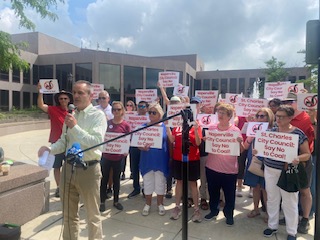
The future of Naperville’s energy supply has been one of the most polarizing topics in the city in recent memory, sparking anti-IMEA rallies and long city council meeting debates on whether the city should continue to purchase energy from IMEA, a joint action agency that offers an already assembled power supply to members at a wholesale price but relies heavily on coal as a power source.
Naperville’s contract with IMEA expires in 2035, but the organization wants to extend its contract with the city and other member municipalities until 2055.
In August, council members directed city staff to negotiate with IMEA on a number of key points for the city, including the ability for Naperville to exit the contract in 2045, an amendment that would give Naperville weighted IMEA voting rights and other provisions that would allow the city to lower its carbon footprint.
At the same time, Naperville has sought proposals from power providers on clean energy options to supplement a potential energy agreement between the city and IMEA.
Naperville’s current contract does not allow the city to procure electricity from other sources, but IMEA members who sign a new 20-year agreement with the nonprofit joint action agency can utilize a Member Directed Resource (MDR) allocation to procure a percentage of their energy needs from renewable or cleaner sources.
A pile of coal sits on the Prairie State Energy Campus near Marissa, Illinois. The city of Naperville obtains its electricity through the Illinois Municipal Electric Agency, which owns Prairie State. (Chicago Tribune)
A city request for proposals for non-fossil fuel energy options to supplement the electricity provided by IMEA was made in September.
Since then, the city has received responses from IMEA and clean energy vendors, officials said. Four of the clean energy vendor proposals are being evaluated, according to DiSanto, who declined to share more details. He also would not discuss what IMEA’s response has been because discussions remain ongoing, he said.
On Tuesday, council members discussed in closed session “confidential items related to MDR proposals,” Councilman Ian Holzhauer said.
“There’s been discussion about having further conversations in closed session, behind closed doors, about the future energy strategy,” said Holzhauer, noting that council members have been asked to provide their input by email regarding IMEA’s counterproposals.
Holzhauer said he believed it was time to start having more public discussions on the ongoing negotiations.
“I think there’s a transparency angle here too,” he said. “I think the public deserves to know where we stand on this.”
Multiple council members appeared to agree Tuesday with Holzhauer, with some being adamant that it was time to make a final decision.
“I would like the IMEA discussion to happen sooner than later. I’d rather the vote be right now,” said Councilman Josh McBroom, who emphasized that he wants more than just another conversation about the contract. “That would be very important to me that it wouldn’t just be a discussion and another discussion and another discussion, (but) that we would actually make a decision.”
Councilman Ashfaq Syed agreed.
“IMEA has been in discussion for (the) last two years. I am tired of this now. … It’s high time that we should make a decision and move forward,” he said.
cstein@chicagotribune.com
https://www.chicagotribune.com/2025/12/19/naperville-imea-electricity-contract-vote-council/
Justice Department Quietly Reverses Clinton-Era Rule On Immigrant Welfare Benefits
Justice Department Quietly Reverses Clinton-Era Rule On Immigrant Welfare Benefits
For almost 30 years, a key part of America’s 1996 welfare reform laws has existed mostly on paper after the Clinton DOJ effectively nullified it with a loophole. Now, the Trump DOJ says it’s time to enforce those laws as Congress originally wrote them.
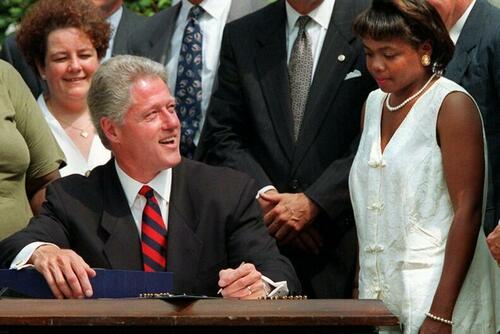
Clinton signing the Personal Responsibility and Work Opportunity Reconciliation Act of 1996.
Earlier this week, the Justice Department’s Office of Legal Counsel quietly reversed a Clinton-era legal opinion that had sharply limited when immigrants could be denied federal welfare benefits. The earlier interpretation narrowed the law so much, critics say, that it allowed many immigrants – including some who were not lawfully eligible – to continue receiving benefits Congress intended to restrict.
The new DOJ opinion restores a broader reading of the law, potentially expanding waiting periods for benefits, strengthening sponsor repayment requirements, and closing loopholes that have existed since the late 1990s.
What Congress Intended in 1996
In 1996, Congress passed the Personal Responsibility and Work Opportunity Reconciliation Act (PRWORA) along with major immigration reforms. The message was straightforward: immigrants should be self-sufficient, public benefits should not encourage immigration, and American taxpayers should not be responsible for supporting new arrivals.
To enforce those goals, Congress created several rules:
Most lawful permanent residents were barred from receiving “means-tested” federal benefits during their first five years in the U.S.
Family members who sponsored immigrants had to sign legally binding affidavits promising to support them.
If a sponsored immigrant received certain benefits, the government could seek reimbursement from the sponsor.
When agencies evaluated eligibility for benefits, they were required to count the sponsor’s income as part of the immigrant’s resources.
Congress defined “federal public benefit” broadly but never formally defined the term “federal means-tested public benefit.” That gap would become critical.
How the Clinton Administration Narrowed the Law
Early drafts of the 1996 legislation included definitions that covered any benefit based on income or financial need. But during Senate debate, those definitions were removed for procedural reasons tied to budget rules – not because Congress rejected them on policy grounds.
In 1997, the Clinton Justice Department issued a legal opinion arguing that because the definition had been removed, the law was ambiguous. The administration concluded that “means-tested” benefits should include only mandatory programs like Medicaid and cash welfare – and not discretionary programs funded annually by Congress.
As a result, for nearly three decades, most of the law’s enforcement tools applied to only a small number of programs. Many other benefits that also rely on income tests remained available.
Critics argue that this interpretation effectively gutted large portions of welfare reform and allowed immigrants – including some who were not legally eligible – to access benefits Congress sought to limit.
The Justice Department’s new opinion withdraws that 1997 interpretation.
The shift follows last year’s Supreme Court ruling ending the practice of courts deferring to agency interpretations simply because a law is ambiguous. Instead, agencies must now apply what they believe is the statute’s best reading.
Using that standard, the Justice Department concluded that “means-tested” plainly refers to any program where eligibility or benefit levels depend on income or financial need – regardless of how the program is funded.
Read the full opinion here: https://t.co/cs8aWICHho
— Eric W. (@EWess92) December 18, 2025
The new opinion also notes that the law specifically exempts certain discretionary programs. According to the Justice Department, those exemptions would make little sense if discretionary programs were never covered in the first place.
For a deeper dive that includes legal machinations underpinning the move, the DOJ effectively just implemented exactly what George Fishman from the Center for Immigration Studies recommended in this article from September, though Fishman recommended an executive order to redefine the term vs. an OLC opinion that requires follow-on agency action.
What This Means Going Forward
The decision does not immediately cut off benefits or change eligibility rules. Federal agencies will need to review their programs and decide how to apply the new interpretation.
But the implications are significant. The ruling could:
Expand the five-year waiting period for benefits
Strengthen enforcement of sponsor repayment obligations
Restore income-deeming rules that have rarely been used
Reduce taxpayer exposure to benefit costs Congress sought to avoid
Supporters say the move simply enforces the law as written and restores the original intent of welfare reform. Critics warn it could reduce assistance for vulnerable populations and lead to legal challenges.
What is clear is that a long-standing executive interpretation – one that shaped immigration and welfare policy for a generation – has now been undone. The Justice Department has reopened a debate that many assumed was settled, signaling a renewed emphasis on enforcing immigration and welfare laws as Congress designed them.
Tyler Durden
Fri, 12/19/2025 – 19:40





