Category: News
Dreaming of a gray Christmas? Thursday’s forecast — and what climate change means for the holidays
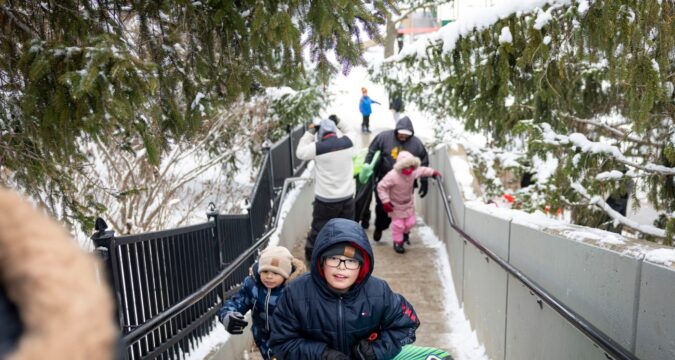
Monday evening at a packed Christkindlmarket in downtown Chicago, tourists and locals alike rushed to finish their holiday shopping — ears tucked under muffs and hats, necks and chins hidden behind large scarves and hands stashed away in puffy coats or holding hot drinks, all in an effort to stave off the freezing temps. But that’s about as festive as the weather will be this week in the city.
On Christmas Day, the only thing blanketing Chicago rooftops will likely be fog, and the only thing falling from the sky might be an intermittent drizzle. Meteorologists are forecasting no snow in the Chicago area on Christmas Eve or Christmas Day. Rather, temperatures will be unseasonably warm in the 40- to 50-degree range.
Typically, Chicago has a white Christmas about once every three to four years, but it has only experienced one in the past seven. That was 2022, and even then, it barely qualified with 1 inch of snow.
“Everybody’s always like, ‘We don’t get winters like we used to,’” said Judah Cohen, a research scientist at the Massachusetts Institute of Technology, whose research focuses on snow and winter climate. “You remember when it’s snowing, but you’re blocking out when it’s warm and foggy and drizzly, when it’s not the Christmas you want.”
As human activity, such as burning fossil fuels, releases heat-trapping gases into the atmosphere, global climate change is making U.S. winters overall warmer and shorter. Chicago has experienced it too, with average seasonal temperatures warming by an average of 4.5 degrees since 1970.
A few degrees difference might not seem like much, but it could mean the difference between dreary rain and magical snow around the holidays. The likeliest scenario for Thursday is dry, but the National Weather Service forecast “can’t completely rule out” a light rain, said Gino Izzi, senior meteorologist at the Chicago office.
While all three winter months are warming in Illinois, December is doing so at a faster rate, said Trent Ford, the state climatologist.
Fog in the Chicago area will tamp Thursday temperatures down a bit. Closer to St. Louis, however, the high will probably break into the 70s. The day is on track to be the warmest Christmas in Illinois since 2019, Ford said. According to data from the National Weather Service, the normal average temperature for the date is 28.2 degrees, and the normal snowpack is a meager third of an inch.
“Part of this is just weather variability,” Ford said. “When you track weather on one specific day, like Christmas Day or New Year’s Day, any given year, (it’s) just sort of random.”
Historically, the probability that the Chicago area has more than 1 inch of snowfall on Dec. 25 has been low for the date at around 35%. It mirrors national trends: According to data from the National Oceanic and Atmospheric Administration, snow blanketed just 36% of the contiguous U.S. on Christmas between 2003 and 2024. The last time Chicagoans woke up to more than 2 inches of snow was the morning of Dec. 25, 2017.
Almost two-thirds of over 2,000 locations across the country get less snow nowadays than they did in the early 1970s; another 36% have seen an increase in snowfall totals, according to an assessment last year by science education nonprofit Climate Central.
But white Christmases won’t necessarily become a thing of the past. Even in a changing climate, snowfall trends can be tricky to predict, and outlier local weather systems with heavy snow remain a possibility, defying seasonal and even daily forecasts. Cohen called these “regular oscillations” in weather.
Trucks dump snow into the Chicago River at Wacker Drive and Dearborn Street on Dec. 26, 1950. The trucks were privately owned trucks. City snow removal crews were to begin their work the night before. On Christmas Day in 1950, 5.1 inches blanketed the ground at Midway Airport. (Chicago Tribune archive)
For instance, the most snow Chicago has ever gotten on Christmas Day was 1950, when 5.1 inches blanketed the ground at Midway Airport, despite meteorologists forecasting light snow.
Bouts of bitter cold also don’t contradict global warming, Cohen said. “You have to try to separate (that) from the fact that the whole climate system is much warmer than it used to be.”
Despite early season record-breaking snowfall, the Chicago area is not on track for a white Christmas, a “great example,” he said, of the “Dr. Jekyll and Mr. Hyde” element — that is, the sometimes opposing impacts — of climate change on weather.
A snowy, cold start to winter follows a very warm fall. How are Illinois seasons changing?
Chicago just had its snowiest and “quickest” start to winter since 1978, receiving 17.1 inches by Dec. 8 — with 8.4 inches on Nov. 29 and 4.6 inches on Dec. 7 — compared with a total of 17.6 inches over the entirety of last season.
Cohen noted a growing “asymmetry” in U.S. winters over the last three decades — most often expressed in mild, less snowy starts through mid-January, when the trend reverses toward an increased risk of severe cold and snowstorms later in winter.
Izzi said it’s normal for a December to have “some pretty substantial variability.”
“We had a pretty brutal start, beginning late November into the first half or so of December, where it was just a lot of cold weather and snow, and the pattern has flipped,” he said.
Related Articles
Chicago weather: How our 2025-26 seasonal snowfall compares with previous years
Chicago’s 10 largest snowfalls since 1886 — and how the Tribune covered them
Will Chicago see a white Christmas? Here’s what more than 150 years of weather data predict for Dec. 25.
Besides leading to overall warmer, shorter winter seasons in the United States, climate change is heating the Arctic at a faster rate than the rest of the world. The scientific consensus is that this, in turn, has weakened the polar vortex — a persistent band of frigid air high up in the atmosphere above the North and South Poles — allowing cold snaps and arctic blasts to reach farther south in more unpredictable ways, even as the planet warms.
“When you (have) a weaker, disruptive polar vortex, the chance of severe winter weather — so, extreme cold and heavy, disruptive snowfall — does increase,” Cohen said.
Not all cold winter blasts are related to this polar vortex, which is high in the second level of the atmosphere. Some are caused by a lower-hanging jet stream that has recently been very active and, “for lack of a better term, wavy,” Ford said.
“It just so happens that the way the jet stream and the timing of these systems is set up, Christmas Day and Christmas Eve fall on the warm part, not the cold part,” of the pattern, he said.
Locations near large bodies of water, such as the Great Lakes, might also see more intense lake-effect snow, which happens when cold air from the north moves across relatively warmer open water. As the planet warms, so have the Great Lakes — Lake Michigan’s average surface water temperature in October hovered around 4.5 degrees higher than the 30-year average, according to NOAA.
Snow covers Maggie Daley Park on Nov. 30, 2025, after Chicago recorded over 8 inches of snow. (Brian Cassella/Chicago Tribune)
A warmer-than-normal lake for the start of winter evaporates more easily and can produce more snow, at least until it freezes over.
Even though Chicago is by a large lake and gets lake-effect snow, it doesn’t get as much as places downwind from a Great Lake like Buffalo in New York, Erie in Pennsylvania, and Kalamazoo, Sault Ste. Marie and Marquette in Michigan, which are all seeing upward trends in snowfall.
Looking to the future on a warming planet, scientists have projected that lake-effect snow will still occur. But the Great Lakes region can expect a shortened lake-effect snow season by the end of the century.
In the short term, the New Year may kick off with much more seasonally appropriate weather, according to meteorological outlooks, Ford said.
“Much more bullish on cooler weather versus what we’re going to see this week,” he said.
https://www.chicagotribune.com/2025/12/23/white-christmas-climate-change-chicago/

Zurich Has The World’s Most Expensive Cappuccino, Amsterdam The Cheapest
Zurich Has The World’s Most Expensive Cappuccino, Amsterdam The Cheapest
Coffee is a daily ritual for millions of people around the world. Yet the price of a simple cappuccino can vary dramatically depending on where you order it.
Local wages, rents, taxes, and currency strength all shape what consumers ultimately pay for their caffeine fix.
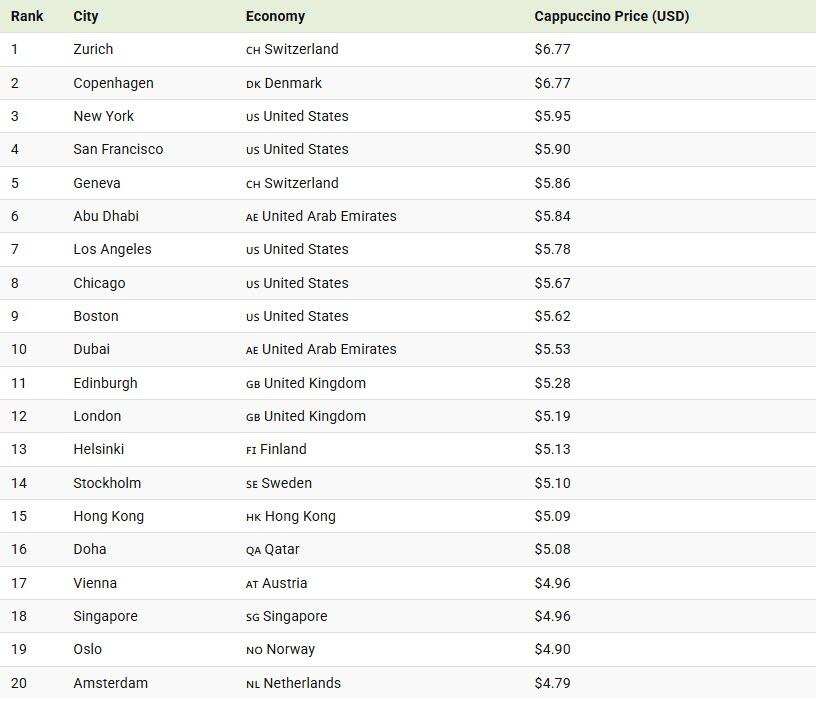
This visualization ranks the most expensive cappuccinos among the 69 major cities covered in Deutsche Bank’s Mapping the World’s Prices 2025 report.
It covers cappuccino prices in 2025, expressed in U.S. dollars for comparability.
Swiss and Nordic Cities Lead the Rankings
Zurich and Copenhagen share the top spot, with an average cappuccino price of $6.77. Switzerland’s high wages and cost of living, combined with a strong currency, push everyday purchases higher.
Geneva also ranks among the most expensive cities at $5.86, reinforcing Switzerland’s position as one of the costliest places in the world for daily consumption.
U.S. Cities Cluster Near the Top
Several U.S. cities appear prominently in the rankings. New York ($5.95) and San Francisco ($5.90) lead the pack, followed closely by Los Angeles, Chicago, and Boston.
Despite differences in geography and culture, cappuccino prices across these U.S. cities fall within a relatively narrow range, suggesting similar cost structures in large urban markets.
Europe’s Price Range—and Italy’s Exception
European cities show a wider spread. While London ($5.19), Stockholm ($5.10), and Helsinki ($5.13) rank among the pricier options, Vienna and Amsterdam sit below $5.00.
Notably, Italy stands apart. Even the most expensive cappuccino in Italy—found in Milan—costs just $2.15, while in Rome the average price is only $1.79.
If you enjoyed today’s post, check out Which Countries Drink the Most Wine? on Voronoi, the new app from Visual Capitalist.
Tyler Durden
Tue, 12/23/2025 – 05:45

Best kids’ paint brush set
Which kids’ paint brush sets are best?
Finding activities to keep your little ones busy and help them develop essential skills is always a good thing. Art activities like painting not only allow children to have fun and express themselves creatively, but they also encourage them to develop motor skills and learn to work independently.
If your children are interested in painting, they need the proper supplies to create their own works of art, and few supplies are as important as a kids’ paint brush set. You can find brushes in an array of sizes and shapes that can work for children of any age or skill level.
Our buying guide is packed with tips to help you find the best kids’ paint brush set for your budding Picasso. At the end, we’ve included a few specific product recommendations, like our top choice from Crayola, which features brushes that contain paint like a pen to eliminate the need for a paint set.
What to know before you buy a kids’ paint brush set
Number of brushes
Not all kids’ paint brush sets contain the same number of brushes. If you’re only shopping for one or two children, a simple set with four to eight brushes is probably all you need.
However, if you’re buying brushes for a classroom, a large family, or have kids who may go in a little hard on the brushes, try a larger set. You can find some with as many as 100 brushes, which can save you from having to buy brushes for a while.
Brush sizes
Kids’ paint brushes vary in size depending on your child’s age and the type of painting they’re doing. Larger brushes work well for younger kids or more basic painting projects, while small brushes are suitable for older children and detailed artwork.
You get the best value if you opt for a brush set that offers brushes in a few sizes. This allows kids of varying ages to use them and enables your children to work on different types of painting projects.
Durability
In general, kids don’t have the gentlest touch, which means they can be pretty hard on paint brushes. Make sure any set you choose contains sturdy, durable brushes that hold up well to regular use. Check out online reviews, and avoid any sets with brushes prone to breaking in half or losing bristles.
What to look for in a quality kids’ paint brush set
Brush shapes
Like professional brushes, kids’ paint brushes are available in different shapes. Most feature either round or flat bristles. Round brushes work best if your kids are working on detailed paintings that require more precision and control, while flat brushes work well for covering large areas quickly.
Some kids’ paint brush sets feature brushes in a single shape, while others offer a mix of shapes. It’s best to choose a set with various shapes to allow for more versatility.
Bristles
Professional brushes usually have bristles made of animal hair, but kids’ brush sets use synthetic materials for their bristles, with nylon a common option. You can also find some kids’ brushes with sponges at the end rather than bristles, which may be fun for some projects.
Handles
Kids’ paint brushes typically have handles made of wood or plastic. Wood is more durable, but plastic-handled brushes are less expensive.
Make sure the handles are comfortable and easy for your child to hold. Most kids have an easier time using brushes with wide handles.
Storage container
High-end kids’ paint brush sets may include a container for storing the brushes. Most come with just a simple plastic tub or pouch, but this can be an important feature to help your kids keep track of the brushes.
How much you can expect to spend on a kids’ paint brush set
You can pay between $5-$15 for a kids’ paint brush set. Sets with fewer brushes and less variety go for $6 or less, while a set made with higher-quality materials and a larger number and variety of brushes can cost between $7-$12. Sets that cost $13 and up are generally meant for kids who are serious about painting and do it often.
Kids’ paint brush set FAQ
Q. How should I clean my kids’ paint brushes?
A. Paint for children tends to be water-based, which means you can use warm water and mild dish soap to clean the brushes. Massage the mixture into the bristles well to remove all the paint, and rinse them thoroughly. Squeeze the excess water out of them, smooth the bristles into shape, and lay them out flat to dry.
Q. What type of paints should my kids use?
A. Water-based paints are best for kids because they’re nontoxic. They’re also easier to clean than oil-based paints. Acrylics, watercolors, and tempera paint are also suitable for kids.
Best kids’ paint brushes
Top kids’ paint brush set
What you need to know: These brush pens are filled with washable paint, making them much easier and less messy for kids to use.
What you’ll love: Contains nontoxic, washable paint, so there’s no need for separate paints. Paint flows smoothly without any drips. Offers five colors: red, blue, green, yellow, and purple.
What you should consider: Some users wish more colors were included.
Top kids’ paint brush set for the money
Creativity Street Round Brushes, Pack of 144
What you need to know: The large number of brushes for an affordable price makes this set perfect for a classroom or large family.
What you’ll love: The kit contains 144 brushes. Includes a plastic container for storage. The bristles don’t shed and pair well with acrylic paint.
What you should consider: It doesn’t offer different brush sizes and shapes.
Worth checking out
Crayola Kids Paint Brush Set (8ct)
What you need to know: This pack of eight kids’ paint brushes is suitable for acrylics, watercolor or tempura paints.
What you’ll love: They’re small and lightweight, making them easy to store or take with you. They’re long-lasting and come in assorted sizes.
What you should consider: These paintbrushes are thin, which may be hard for younger children to hold.
Prices listed reflect time and date of publication and are subject to change.
Check out our Daily Deals for the best products at the best prices and sign up here to receive the BestReviews weekly newsletter full of shopping inspo and sales.
BestReviews spends thousands of hours researching, analyzing and testing products to recommend the best picks for most consumers. BestReviews and its newspaper partners may earn a commission if you purchase a product through one of our links.
Distributed by Tribune Content Agency, LLC.
https://www.chicagotribune.com/2025/12/23/best-kids-paint-brush-set/

Today in Chicago History: Bulls coach Phil Jackson gets his 500th career win faster than any coach in NBA history
Here’s a look back at what happened in the Chicago area on Dec. 23, according to the Tribune’s archives.
Is an important event missing from this date? Email us.
Weather records (from the National Weather Service, Chicago)
High temperature: 62 degrees (1982)
Low temperature: Minus 21 degrees (1983)
Precipitation: 2.5inches (1871)
Snowfall: 10.2 inches (1961)
Elk Grove Village native Carol Rofstad was killed on Dec. 23, 1975, while walking to her sorority house at Illinois State University in Bloomington-Normal. Her death remains unsolved, despite fingerprints that were discovered in 2001. (Chicago Tribune)
1975: Twenty-one-year-old Carol Rofstad, of Elk Grove Village, was killed outside her sorority house at Illinois State University in Bloomington-Normal. Her death remains unsolved.
Chicago Bulls coach Phil Jackson earned his 500th NBA win against the Los Angeles Clippers on Dec. 23, 1997, at the United Center in Chicago. (Chicago Tribune)
1997: The Chicago Bulls defeated the Los Angeles Clippers 94-89 at the United Center, and earned coach Phil Jackson his 500th career victory faster than any coach in NBA history.
Jackson needed just 682 games — two fewer than previous record-holder Pat Riley — to become the 20th NBA coach to reach 500.
The game itself, however, was forgettable. Though it was the Bulls’ fifth straight win, they didn’t take their first lead until a Michael Jordan free throw put them up 82-81 with 3 minutes, 29 seconds remaining. They shot just 37% and also had 10 turnovers.
Illinois Attorney General Lisa Madigan is introduced before Gov. Bruce Rauner delivers his first State of the State speech at the Illinois Capitol House Chambers in Springfield on Feb. 4, 2015. (Zbigniew Bzdak/Chicago Tribune)
2015: Illinois Attorney General Lisa Madigan issued a 15-page opinion that online fantasy sports contests offered by FanDuel and DraftKings “clearly constitute gambling” and were illegal under state law.
The next day, New York-based FanDuel and Boston-based DraftKings filed separate lawsuits against Madigan.
Four years later, Illinois legislators wrote online wagering into a bill that legalized sports betting. Gov. JB Pritzker signed the Illinois Sports Wagering Act into law on June 28, 2019, and legal online sports betting in the state began almost one year later.
Madigan announced in 2017 she wouldn’t seek reelection.
Philip Esformes arrives on Aug. 7, 2015, at the 15th annual Harold and Carole Pump Foundation Gala held at the Hyatt Regency Century Plaza, in Los Angeles. (Rob Latour/Invision/AP)
2020: President Donald Trump commuted the sentence of the so-called king of Medicaid fraud Philip Esformes — who drove a Ferrari, crisscrossed the country on private jets and bribed the head men’s basketball coach at the University of Pennsylvania so that his son would be admitted to the school.
Esformes, who once controlled a network of more than two dozen health care facilities that stretched from Chicago to Miami, garnered $1.3 billion in Medicaid revenues by bribing medical professionals who referred patients to his Florida facilities, then paid off government regulators while vulnerable residents were injured by their peers, prosecutors said.
He housed elderly patients alongside younger adults who suffered from mental illness and drug addiction — sometimes with fatal results. In Esformes’ Oceanside Extended Care Center in Miami Beach “an elderly patient was attacked and beaten to death by a younger mental health patient who never should have been at (a nursing facility) in the first place,” prosecutors wrote in a presentencing memo.
How many presidential pardons or sentence commutations have been granted to people from Illinois?
Allegations of fraud and neglect piled up. A 2010 whistleblower lawsuit alleged that the giant pharmaceutical firm Omnicare Inc. paid millions in kickbacks to secure long-term contracts with Esformes’ facilities, the Tribune reported. The Tribune also found that families had filed 20 wrongful death lawsuits over a four-year period against seven of Esformes’ facilities in Miami-Dade County, including one case where a patient was allegedly attacked by a fellow resident, then sent to another Esformes-owned facility, where he suffered a catastrophic fall and died of a brain injury.
Esformes was arrested in October 2016 at his Miami estate and charged with a massive $1.3 billion Medicare and Medicaid fraud scheme that at the time was billed by the U.S. Justice Department as the largest single criminal health care fraud case ever brought to court.
A jury convicted Esformes of paying bribes, money laundering and other crimes but was unable to reach a verdict on the main count of conspiring to defraud the Medicare program for the elderly and indigent. At his sentencing hearing in January 2019, Esformes wept and pleaded for mercy, saying, “There is no one to blame but myself.” He was sentenced later that year to 20 years in prison.
Want more vintage Chicago?
Subscribe to the free Vintage Chicago Tribune newsletter, join our Chicagoland history Facebook group, stay current with Today in Chicago History and follow us on Instagram for more from Chicago’s past.
Have an idea for Vintage Chicago Tribune? Share it with Kori Rumore and Marianne Mather at krumore@chicagotribune.com and mmather@chicagotribune.com
https://www.chicagotribune.com/2025/12/23/chicago-history-december-23/
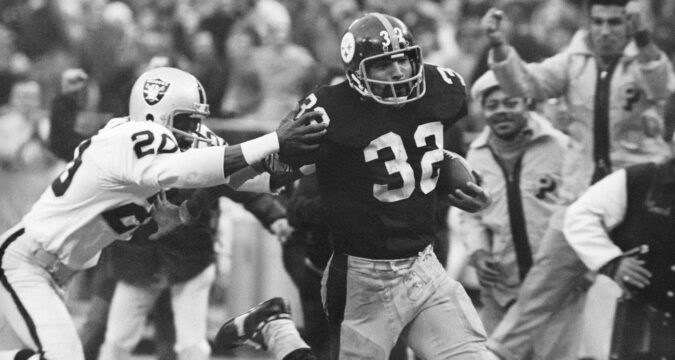
Today in History: The Immaculate Reception
Today is Tuesday, Dec. 23, the 357th day of 2025. There are eight days left in the year.
Today in history:
On Dec. 23, 1972, in an NFL playoff game between the Pittsburgh Steelers and the Oakland Raiders, Steelers running back Franco Harris scored a game-winning touchdown on a deflected pass with less than 10 seconds left. The “Immaculate Reception,” as the catch came to be known, is often cited as the greatest NFL play of all time.
Also on this date:
In 1823, the poem “Account of a Visit from St. Nicholas” was published anonymously in the Troy Sentinel of New York; the verse, more popularly known as “The Night Before Christmas,” was later attributed to Clement C. Moore.
In 1913, the Federal Reserve System was created as President Woodrow Wilson signed the Federal Reserve Act.
In 1941, during World War II, American forces on Wake Island surrendered to Japanese forces.
In 1948, former Japanese Premier Hideki Tojo and six other Japanese World War II leaders were executed in Tokyo after being tried for war crimes and sentenced to death by hanging.
In 1968, 82 crew members of the intelligence ship USS Pueblo were released by North Korea, 11 months after they had been captured.
In 1986, the experimental airplane Voyager, piloted by Dick Rutan and Jeana Yeager, completed the first nonstop, non-refueled round-the-world flight as it returned safely to Edwards Air Force Base in California.
In 2003, a Virginia jury sentenced teen sniper Lee Boyd Malvo to life in prison, sparing him the death penalty. Malvo and his older partner in crime, John Allen Muhammad, shot and killed 10 people over three weeks in October 2002, terrorizing the Washington, D.C., area. Muhammad was executed in 2009.
Related Articles
Chicago weather: How our 2025-26 seasonal snowfall compares with previous years
Today in Chicago History: Bears beat Packers in OT during their coldest game ever at Soldier Field
Today in History: ‘Subway Vigilante’ arrested
Must-have holiday gifts through the years, from teddy bears to Nintendo
Today in Chicago History: John Wayne Gacy arrested in suspected deaths of 33 boys and young men
In 2024, President Joe Biden announced he was commuting the sentences of 37 of the 40 people on federal death row, converting their punishments to life imprisonment weeks before Donald Trump, an outspoken proponent of capital punishment, was to begin a second term.
Today’s Birthdays: Former Emperor Akihito of Japan is 92. Actor-comedian Harry Shearer is 82. Retired U.S. Army Gen. Wesley K. Clark is 81. Actor Susan Lucci is 79. Distance runner Bill Rodgers is 78. Football Hall of Famer Jack Ham is 77. Political commentator William Kristol is 73. Author Donna Tartt is 62. Rock musician Eddie Vedder of Pearl Jam is 61. Singer, model and former first lady of France Carla Bruni is 58. Actor Finn Wolfhard is 23.
https://www.chicagotribune.com/2025/12/23/today-in-history-the-immaculate-reception/
Germany’s Debt-Fueled Illusions: Merz Humiliated, Economy In Freefall
Germany’s Debt-Fueled Illusions: Merz Humiliated, Economy In Freefall
Submitted by Thomas Kolbe
The year 2025 ends for the slap-prone German Chancellor with a resounding smack in Brussels. After the failed raid on Russian assets at Euroclear, Berlin now turns its gaze to the hoped-for comeback of the German economy. Yet here too awaits the next bitter realization for naïve statisticians: wealth cannot be printed with debt.
Whether the Chancellor finds any sense of fulfillment—or even joy—in his current job is difficult to discern. Not that Friedrich Merz, with his numerous political sleights of hand, has preserved any claim to professional happiness. And yet curiosity remains: what must the psyche of a man be like, who for nearly eight months has been led by social-democratic buccaneers such as Lars Klingbeil and Bärbel Bas by the nose through the political circus—exposed, humiliated, and repeatedly made ridiculous?
March into Command Economy
Merz’s grandiose promises of cutting bureaucracy, unleashing the economy in a vitalizing fall of reforms, and his bizarre economic patriotism à la “Made for Germany” evaporate at the slightest breeze of intra-coalition opposition. It reads like a naive comedy: the CDU and SPD camouflage reform policies, only to steer the central plan of transforming society and the economy into a green command economy with a military-industrial complex through increasingly rough seas to a safe harbor. The good old Erich—what would he have thought of what the old “FRG” has become?
The ongoing public humiliation of former BlackRock breakfast director Friedrich Merz reached a temporary peak on Friday in Brussels. At the EU summit, he received a resounding slap from the small Visegrád coalition led by Hungarian Prime Minister Viktor Orbán, ultimately preventing the expropriation of Russian assets at Euroclear.
For those who understand the significance of Euroclear and even vaguely grasp what it means to damage a pillar of the trust-based international financial market architecture, a sigh of relief was inevitable.
What threatened here was nothing less than a reckless kick against a system’s foundation—whether from ignorance, political incompetence, or an almost manic denial of reality regarding the long-lost war in Ukraine. Panic replaces reason, EU-Europe digs deeper into the spiral of debt and recession, whose accelerating spin now lifts once-prosperous cities like Stuttgart and Wolfsburg off their fiscal saddles.
In Brussels, Merz and his allies were shown a boundary—unmistakably. Thus, the circle closes on a disagreeable year 2025 for him. And everything suggests the coming year will offer little cause for optimism.
Toward the Sunset
The German economy alone ensures that 2026 will seamlessly continue the disaster of 2025. An honest economic assessment requires a willingness for an honest inventory. The state’s share of German GDP has long surpassed the magic mark of 50 percent. New borrowing next year—adjusted for the federal government’s accounting tricks—will amount to roughly 5.6 percent.
Merz’s relentless fight against the debt brake now forces even Bundesbank economists to a sober assessment. For the coming year, they forecast an official budget deficit of 4.8 percent—a figure indirectly confirming our estimate of actual new borrowing.
If one views the state as a consumer filling its deficits with a debt printer, then statistically reported zero growth means nothing more than the private economy—producing goods and services for real consumers—is shrinking dramatically.
To counteract this economic erosion, the federal government, in addition to its already high-deficit budget, channels special funds into two artificial economies: the green disaster economy and the freshly revitalized war sector. Over €50 billion per year is borrowed on the credit market for this purpose.
It is this mixture of economic ignorance, historical oblivion, and near-childlike faith in miracles that leaves one speechless. One can safely assume that no cabinet member comprehends that only capital saved from the economic process and transformed into investments on a free market creates wealth.
The Merz–Klingbeil duo is building a bubble economy ideologically committed to the green transformation and geopolitically following a historically fatal idea: the growth of a war economy.
The Silent Erosion of the Real Economy
This policy may further swell the public sector. Merely distributing these massive debt and credit programs puts tens of thousands to work at the expense of the productive population. The high regulatory tempo in Brussels and Berlin has forced the German economy to create roughly 325,000 new administrative positions over the past three years—solely to handle the flood of documentation and regulatory requirements. Paper piles upon paper: absurd, Kafkaesque, and economically destructive.
The state thus effectively outsources its own bureaucracy and distorts statistics on multiple levels. While administrative apparatuses grow, hundreds of thousands of industrial jobs have already been lost. The consensus estimate for economic growth in 2026 of just about one percent is the true disaster Berlin must now digest.
It matters little how much credit the state withdraws from the capital market or which incentives it creates to direct private capital into industrial wastelands—green steel or wind energy. In this environment, the private sector will shrink by at least four percent next year.
The Turning Point
For Friedrich Merz, this economic catastrophe is no longer merely a domestic political time bomb. If the downward spiral continues, media spectacles, ritualized bashing of entrepreneurs, hollow site patriotism, and endless “persevere” slogans will not suffice to explain to citizens why their exsanguination through taxes and labor markets continues to rise while no one addresses the causes.
At its core, this crisis is about correcting two fundamental ideological misdirections. The moment will come when Germany must abandon the leftist illusion of permanently acting as the world’s social office. This cut will coincide with the end of destructive climate socialism, which is either bankrupting German industry or pushing it into the arms of rationally managed locations.
The Visegrád group delivered a demonstrative kick to Merz’s shins. But the real dynamics extend further: a powerful opposition of conservative parties and governments—from Hungary, the Czech Republic, Slovakia, and Italy—is forming. They will eventually behead the climate-socialist Medusa of central planners. Yet, given the stiff headwinds and fierce resistance of Brussels’ powerful core, the birth of the liberating European Perseus may be a long and difficult labor.
Tyler Durden
Tue, 12/23/2025 – 05:00
https://www.zerohedge.com/markets/germanys-debt-fueled-illusions-merz-humiliated-economy-freefall

La pequeña comunidad cristiana de Gaza intenta mantener el espíritu navideño durante la tregua
Por MARIAM FAM
Attallah Tarazi recibió hace poco regalos de Navidad que incluían calcetines y una bufanda para protegerse del invierno en Gaza, y se sumó a otros cristianos palestinos para cantar himnos.
“Cristo ha nacido”, cantó el grupo en árabe. “Aleluya”.
Los regalos y los himnos ofrecieron al hombre de 76 años un atisbo de la celebración en una devastada Gaza, donde un frágil alto el fuego ha proporcionado algo de alivio, pero las pérdidas de la guerra entre Israel y Hamás y las dificultades continuas de las personas desplazadas están empañando muchas festividades tradicionales.
Tarazi y gran parte del resto de la pequeña comunidad cristiana palestina de Gaza tratan de recuperar algo del espíritu navideño a pesar de la destrucción e incertidumbre que los rodea. Se aferra a la esperanza y a la fe que, según él, le han sostenido durante la guerra.
“Siento que nuestra alegría por el nacimiento de Cristo debe superar toda la amargura por la que hemos pasado”, expresó. Lleva más de dos años refugiado en el complejo de la iglesia de la Sagrada Familia en Gaza, donde un grupo de parroquianos, incluidos miembros del coro, hizo una gira entre las personas desplazadas en estas navidades, comentó.
“En un momento tan glorioso, es nuestro derecho olvidar todo lo que es guerra, todo lo que es peligro, todo lo que es bombardeo”, indicó.
Pero para algunos, el costo es ineludible.
Este será el primer Navidad para Shadi Abo Dowd desde la muerte de su madre, quien fue una de las personas asesinadas en julio cuando un ataque israelí golpeó el mismo complejo de la iglesia católica donde vive Tarazi y que alberga a personas desplazadas. Israel emitió declaraciones lamentando el suceso y dijo que fue un accidente.
Abo Dowd dijo que su hijo resultó herido en el ataque, que también lastimó al sacerdote de la parroquia.
Antes de Navidad, el patriarca latino de Jerusalén, el cardenal Pierbattista Pizzaballa, visitó la Parroquia de la Sagrada Familia. Un comunicado del patriarcado dijo que la visita marcó el inicio de las celebraciones navideñas en “una comunidad que ha vivido y sigue viviendo tiempos oscuros y desafiantes”.
Sufrimiento y una situación “sin paz y sin guerra”
Abo Dowd, un cristiano ortodoxo que celebra la Navidad el 7 de enero, dijo que no planea celebrar más allá de los rituales religiosos y las oraciones. “No hay fiesta”, afirmó.
“Las cosas son difíciles. La herida sigue ahí”, dijo. “El sufrimiento y el dolor siguen ahí”.
“Todavía vivimos en un estado de sin paz y sin guerra”, apuntó.
Los ataques israelíes han disminuido desde que el acuerdo de alto el fuego entró en vigor en octubre, pero los ataques mortales no han terminado por completo. Israel y Hamás se han acusado mutuamente de romper la tregua y la segunda fase más desafiante aún no se ha implementado.
La guerra comenzó cuando milicianos liderados por Hamás irrumpieron en Israel el 7 de octubre de 2023, matando a unas 1.200 personas y tomando alrededor de 250 rehenes.
La ofensiva subsiguiente de Israel ha matado a casi 71.000 palestinos en Gaza, según el Ministerio de Salud de Gaza, que no diferencia entre civiles y combatientes, pero dice que alrededor de la mitad de las muertes fueron mujeres y niños.
El ministerio, que opera bajo el gobierno dirigido por Hamás, está compuesto por profesionales médicos y mantiene registros detallados que son considerados generalmente confiables por la comunidad internacional.
La ofensiva de Israel en Gaza también ha causado una destrucción generalizada y ha desplazado a la gran mayoría de los aproximadamente dos millones de residentes del territorio. En un ejemplo algunas de las muchas dificultades y necesidades del enclave y su gente, las recientes lluvias torrenciales inundaron campamentos de desplazados y colapsaron edificios ya gravemente dañados.
“Siempre les digo a mis hijos: ‘Dios solo da las batallas más duras a sus soldados más fuertes’”, dijo Abo Dowd. “Nos estamos aferrando a nuestra fe cristiana y a nuestro país, y amamos a nuestro país”.
Él y otros conocen a muchos cristianos entre aquellos que huyeron de Gaza durante la guerra y más que esperan irse si se les da la oportunidad. Le preocupa el efecto sobre la presencia cristiana y sobre el tejido social de Gaza. “Es una tragedia”, dijo.
Sus hijos quisieran estudiar en el extranjero. “Son jóvenes. ¿Qué se quedarán a hacer? No hay futuro”.
Una Navidad sin muchas caras familiares
La partida de muchos familiares y amigos significa que la Navidad no se siente igual para Wafa Emad ElSayegh, de 23 años.
Él y miembros de su familia se reunieron con otros en el complejo de la iglesia ortodoxa griega de Gaza para poner decoraciones. Pero la ausencia de amigos que escaparon de Gaza alimentó su nostalgia.
“Solíamos estar juntos en todo”, dijo ElSayegh, quien ahora se aloja con su familia en la casa de una tía que dejó Gaza durante la guerra.
Su parte favorita de la Navidad era la unión: las reuniones familiares, las celebraciones que, según dijo, atraían a cristianos y algunos musulmanes, y la emoción de los niños recibiendo regalos.
“Había celebraciones, canciones y una alegría indescriptible que, desafortunadamente, no hemos sentido en mucho tiempo”, dijo. Y con muchos familiares lejos, dijo que el ambiente navideño habitual no se puede recrear.
Alegría en medio del dolor
Elynour Amash, de 35 años, trata de llevar algo de esa alegría a sus hijos “a través de la decoración y el encendido del árbol para que puedan sentir que la alegría es posible a pesar de todo el dolor”.
“Mis hijos sienten un poco de alegría, como respirar después de un largo período de asfixia”, dijo en respuestas escritas a The Associated Press. “Están felices de estar celebrando sin miedo a una explosión cercana y porque algunos chocolates y dulces han regresado a sus vidas, además de alimentos de los que habían estado privados durante mucho tiempo”.
Está agradecida de que su hogar aún esté en pie, pero las escenas de personas desplazadas en tiendas de campaña que no pueden protegerlas del frío y la lluvia a menudo la hacen llorar.
No siente que la guerra haya terminado de verdad.
“Aún se oyen sonidos de explosiones y disparos, y el miedo no ha abandonado los corazones. Hay una preocupación continua de que el alto el fuego no dure”. Ve el impacto en su hijo menor, que tiembla cuando oye ruidos fuertes.
“Es como si la guerra viviera dentro de él”, dijo. “Como madre, ese dolor es indescriptible”.
También le preocupa que algún día los cristianos puedan desaparecer de Gaza. Pero, por ahora, “nuestra presencia, por pequeña que sea, es un testimonio de amor, firmeza y fe en esta tierra”, dijo.
Tarazi está decidido a quedarse.
Al principio de la guerra perdió a una hermana, quien fue una de las personas asesinadas cuando un ataque aéreo israelí alcanzó el complejo de la iglesia ortodoxa que albergaba a personas desplazadas. El ejército israelí dijo que había atacado un centro de mando de Hamás cercano. Tarazi dijo que un hermano también murió después de no poder recibir la atención médica necesaria debido a la guerra.
Reza por la paz y la libertad para el pueblo palestino. “Nuestra fe y nuestra alegría por el nacimiento de Cristo son más fuertes que todas las circunstancias”, afirmó.
___
La cobertura de religión de Associated Press recibe apoyo a través de la colaboración de AP con The Conversation US, con financiamiento de Lilly Endowment Inc. AP es el único responsable de este contenido.
___
Esta historia fue traducida del inglés por un editor de AP con la ayuda de una herramienta de inteligencia artificial generativa.
Un gran ataque ruso en Ucrania deja al menos tres muertos y corta el suministro eléctrico
Por ILLIA NOVIKOV
KIEV, Ucrania (AP) — Rusia lanzó más de 650 drones y tres docenas de misiles contra Ucrania en un ataque a gran escala que comenzó durante la noche y se extendió pasado el amanecer del martes, dijeron las autoridades. Al menos tres personas murieron, incluido un niño de cuatro años.
El bombardeo golpeó hogares y la red eléctrica en 13 regiones de Ucrania, causando apagones generalizados en temperaturas gélidas, dijo el presidente ucraniano, Volodymyr Zelenskyy, al día siguiente de que describiera el reciente progreso en la búsqueda de un acuerdo de paz como “bastante firme”.
El bombardeo demostró la intención del presidente ruso, Vladímir Putin, de continuar con la invasión de Ucrania, expresó Zelenskyy en una publicación en la aplicación de mensajería Telegram. Funcionarios ucranianos y europeos se han quejado de que Putin no participa con sinceridad en los esfuerzos de paz liderados por Estados Unidos.
“El ataque es una señal extremadamente clara de las prioridades rusas. Un ataque antes de Navidad, cuando la gente quiere estar con sus familias, en casa, a salvo”, dijo Zelenskyy. “Un ataque, de hecho, en medio de negociaciones que se están llevando a cabo para poner fin a esta guerra. Putin no puede aceptar el hecho de que debemos dejar de matar”.
El presidente de Estados Unidos, Donald Trump, lleva meses presionando por un acuerdo de paz, pero las negociaciones se han atascado ante las demandas muy dispares de Moscú y Kiev.
El enviado estadounidense Steve Witkoff dijo el domingo que había tenido conversaciones “productivas y constructivas” en Florida con representantes ucranianos y europeos. Trump fue menos efusivo el lunes, cuando dijo que “las conversaciones están avanzando”.
Reportes iniciales de los servicios de emergencia ucranianos indicaron que el niño murió en la región noroeste de Zhytomyr, mientras que un dron mató a una mujer en la región de Kiev, y Zelenskyy informó de otro civil fallecido en la región occidental de Khmelnytskyi.
Las autoridades en las regiones occidentales de Rivne, Ternopil y Leópolis, así como en la región norte de Sumy, informaron de daños a la infraestructura energética o cortes de energía tras el ataque.
En la región sureña de Odesa, Rusia atacó la infraestructura energética, portuaria, de transporte, industrial y residencial, según el jefe regional Oleh Kiper.
Un barco mercante y más de 120 hogares resultaron dañados, dijo.
___
Esta historia fue traducida del inglés por un editor de AP con la ayuda de una herramienta de inteligencia artificial generativa.

Non-US Citizens More Likely To Have Devices Checked
Non-US Citizens More Likely To Have Devices Checked
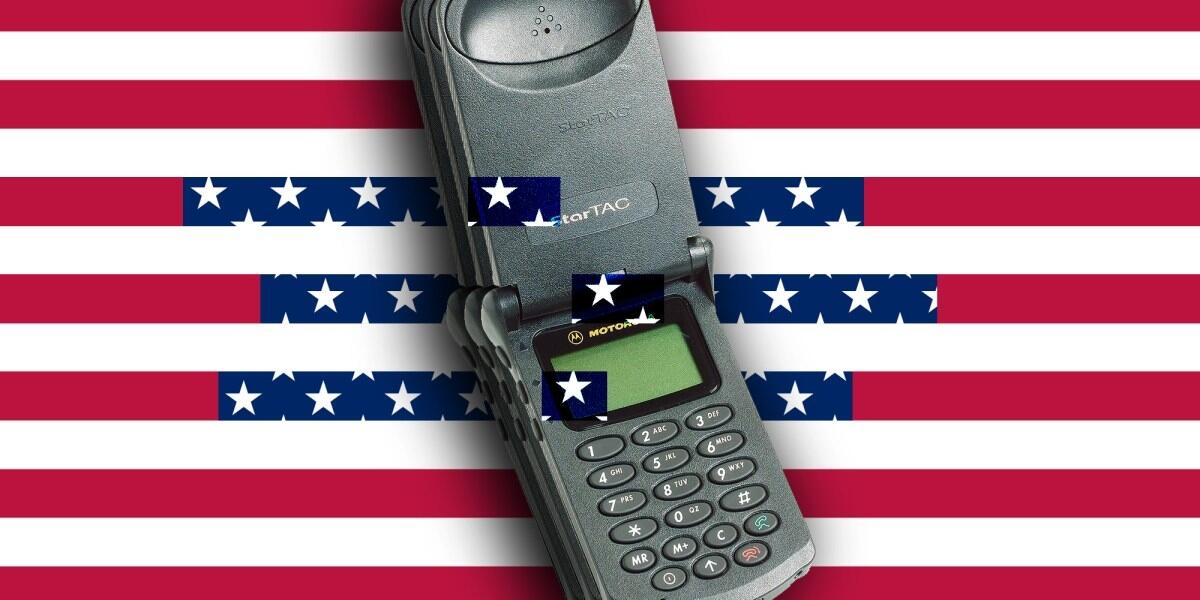
Tourists heading to the United States could soon have to disclose the past five years of their social media activities to authorities during the ESTA process. Where providing such information was previously only mandatory for longer-term visas, U.S. Customs and Border Protection have now submitted a new regulatory proposal to make it an essential part of short-term tourists and business travelers’ applications too. The move would be a part of a wider package of data collection measures which authorities say are necessary for security reasons. The decision is not yet legally binding, but could start to come into force from February.
The new regulation would move the inspection process to a pre-travel stage. Currently, the CBP can demand a media search of entrants’ electronic devices at random at the border, without needing a warrant or any specific reason. More “advanced” searches, which happens when a CBP or ICE official connects the device to external equipment in order to review, copy, and/or analyze its contents, requires reasonable suspicion of criminal activity or a “national security concern”. CBP officers are also able to “detain” an electronic device or copies of information contained within it, usually up to a maximum of five days.
As Statista’s Anna Fleck reports, data from the CBP shows that non-U.S. citizens are over three times more likely to have their devices checked at the U.S. border than those who hold a U.S. passport. Of the 55,318 media searches of electronics devices checks in the fiscal year of 2025, running from October 1, 2024 to September 30, 2025, 41,728 were of non-U.S. citizens, while 13,590 were of U.S. citizens.
You will find more infographics at Statista
On average, searches have historically been relatively rare. Of the total 419 million passengers processed at U.S. ports of entry last year, around 0.01 percent had their electronic devices searched. Ports of entry include international airports, road and rail crossings on land borders and major seaports, and are places where travelers can legally enter the country.
However, the number of searches, which includes the checking of mobile phones, computers, cameras, or other electronics, has been on the rise over the past decade. An increase in annual passenger footfall likely plays a part, with the dip in the number of device checks in 2020 and 2021 mirroring a decrease in travelers those years due to pandemic-related restrictions.
But this reason alone does not explain why the number of searches in 2025 nearly tripled since 2016, and increased more than six fold since 2015. In the latter year, around 382 million travelers were processed at U.S. ports of entry and the devices of 8,503 travelers were checked, working out to an average of around 0.002 percent.
It remains to be seen how the number of checks will change over the next few years with the Trump 2.0 administration. While checks generally increased under Biden too, the new proposed regulations and string of cases of U.S. tourists and work visa holders having been detained on arrival to the U.S. this year have raised concerns that there has been a shift, with the country now carrying out greater scrutiny than before.
Tyler Durden
Tue, 12/23/2025 – 04:15
https://www.zerohedge.com/geopolitical/non-us-citizens-more-likely-have-devices-checked
New NATO Hub To Open In Romania, Doubling Weapons Deliveries To Ukraine
New NATO Hub To Open In Romania, Doubling Weapons Deliveries To Ukraine
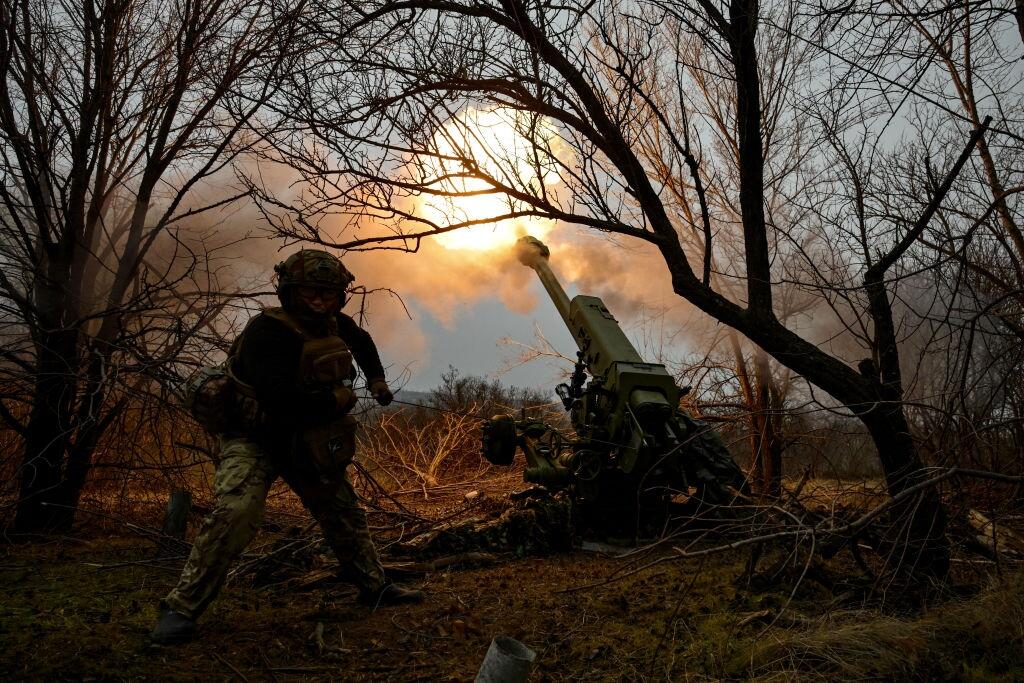
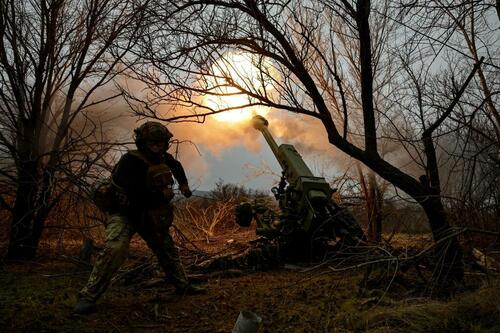
Starting in January 2026, a second NATO hub will begin operating in Romania, doubling the transit of weapons to Ukraine, including through the PURL (Prioritized Ukraine Requirements List) mechanism.
Right after Russia invaded Ukraine in 2022, a similar hub was opened in Jasionka, Poland, to serve as a key logistics center for all international aid flowing to Kyiv — military, humanitarian, and medical. Funds flow into Jasionka from Europe and the United States, writes Do Rzeczy.
The opening of the second hub reporting directly to NATO was confirmed by NATO’s deputy commander for support to Ukraine, General Mike Keller, who also informed press that in the past year, Ukraine received around 220,000 tons of military aid – approximately 9,000 trucks, 1,800 railway cars, and some 500 aircraft carrying weapons and military equipment.
“This is actually quite positive news, considering the independence of arms supplies to Ukraine from a single logistics center in Poland. This concerns urgently needed air defense assets, and above all, missiles, ammunition, etc.,” Defense Express experts assessed.
The current hub in Poland is located approximately 80 kilometers from the Polish-Ukrainian border. From there, goods, previously subjected to security checks, including explosives and counterintelligence equipment, are transported to the Ukrainian border.
For over two years, all these tasks were performed by a special support inspectorate – a team of four services under the overall leadership of the Military Counterintelligence Service – the police, the Central Bureau of Police Investigation, the Military Counterintelligence Service, and a dozen or so officers of the Military Gendarmerie.
Tyler Durden
Tue, 12/23/2025 – 03:30
https://www.zerohedge.com/geopolitical/new-nato-hub-open-romania-doubling-weapons-deliveries-ukraine