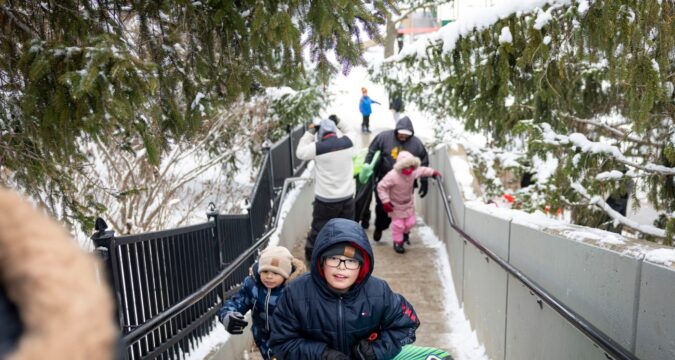
Monday evening at a packed Christkindlmarket in downtown Chicago, tourists and locals alike rushed to finish their holiday shopping — ears tucked under muffs and hats, necks and chins hidden behind large scarves and hands stashed away in puffy coats or holding hot drinks, all in an effort to stave off the freezing temps. But that’s about as festive as the weather will be this week in the city.
On Christmas Day, the only thing blanketing Chicago rooftops will likely be fog, and the only thing falling from the sky might be an intermittent drizzle. Meteorologists are forecasting no snow in the Chicago area on Christmas Eve or Christmas Day. Rather, temperatures will be unseasonably warm in the 40- to 50-degree range.
Typically, Chicago has a white Christmas about once every three to four years, but it has only experienced one in the past seven. That was 2022, and even then, it barely qualified with 1 inch of snow.
“Everybody’s always like, ‘We don’t get winters like we used to,’” said Judah Cohen, a research scientist at the Massachusetts Institute of Technology, whose research focuses on snow and winter climate. “You remember when it’s snowing, but you’re blocking out when it’s warm and foggy and drizzly, when it’s not the Christmas you want.”
As human activity, such as burning fossil fuels, releases heat-trapping gases into the atmosphere, global climate change is making U.S. winters overall warmer and shorter. Chicago has experienced it too, with average seasonal temperatures warming by an average of 4.5 degrees since 1970.
A few degrees difference might not seem like much, but it could mean the difference between dreary rain and magical snow around the holidays. The likeliest scenario for Thursday is dry, but the National Weather Service forecast “can’t completely rule out” a light rain, said Gino Izzi, senior meteorologist at the Chicago office.
While all three winter months are warming in Illinois, December is doing so at a faster rate, said Trent Ford, the state climatologist.
Fog in the Chicago area will tamp Thursday temperatures down a bit. Closer to St. Louis, however, the high will probably break into the 70s. The day is on track to be the warmest Christmas in Illinois since 2019, Ford said. According to data from the National Weather Service, the normal average temperature for the date is 28.2 degrees, and the normal snowpack is a meager third of an inch.
“Part of this is just weather variability,” Ford said. “When you track weather on one specific day, like Christmas Day or New Year’s Day, any given year, (it’s) just sort of random.”
Historically, the probability that the Chicago area has more than 1 inch of snowfall on Dec. 25 has been low for the date at around 35%. It mirrors national trends: According to data from the National Oceanic and Atmospheric Administration, snow blanketed just 36% of the contiguous U.S. on Christmas between 2003 and 2024. The last time Chicagoans woke up to more than 2 inches of snow was the morning of Dec. 25, 2017.
Almost two-thirds of over 2,000 locations across the country get less snow nowadays than they did in the early 1970s; another 36% have seen an increase in snowfall totals, according to an assessment last year by science education nonprofit Climate Central.
But white Christmases won’t necessarily become a thing of the past. Even in a changing climate, snowfall trends can be tricky to predict, and outlier local weather systems with heavy snow remain a possibility, defying seasonal and even daily forecasts. Cohen called these “regular oscillations” in weather.
Trucks dump snow into the Chicago River at Wacker Drive and Dearborn Street on Dec. 26, 1950. The trucks were privately owned trucks. City snow removal crews were to begin their work the night before. On Christmas Day in 1950, 5.1 inches blanketed the ground at Midway Airport. (Chicago Tribune archive)
For instance, the most snow Chicago has ever gotten on Christmas Day was 1950, when 5.1 inches blanketed the ground at Midway Airport, despite meteorologists forecasting light snow.
Bouts of bitter cold also don’t contradict global warming, Cohen said. “You have to try to separate (that) from the fact that the whole climate system is much warmer than it used to be.”
Despite early season record-breaking snowfall, the Chicago area is not on track for a white Christmas, a “great example,” he said, of the “Dr. Jekyll and Mr. Hyde” element — that is, the sometimes opposing impacts — of climate change on weather.
A snowy, cold start to winter follows a very warm fall. How are Illinois seasons changing?
Chicago just had its snowiest and “quickest” start to winter since 1978, receiving 17.1 inches by Dec. 8 — with 8.4 inches on Nov. 29 and 4.6 inches on Dec. 7 — compared with a total of 17.6 inches over the entirety of last season.
Cohen noted a growing “asymmetry” in U.S. winters over the last three decades — most often expressed in mild, less snowy starts through mid-January, when the trend reverses toward an increased risk of severe cold and snowstorms later in winter.
Izzi said it’s normal for a December to have “some pretty substantial variability.”
“We had a pretty brutal start, beginning late November into the first half or so of December, where it was just a lot of cold weather and snow, and the pattern has flipped,” he said.
Related Articles
Chicago weather: How our 2025-26 seasonal snowfall compares with previous years
Chicago’s 10 largest snowfalls since 1886 — and how the Tribune covered them
Will Chicago see a white Christmas? Here’s what more than 150 years of weather data predict for Dec. 25.
Besides leading to overall warmer, shorter winter seasons in the United States, climate change is heating the Arctic at a faster rate than the rest of the world. The scientific consensus is that this, in turn, has weakened the polar vortex — a persistent band of frigid air high up in the atmosphere above the North and South Poles — allowing cold snaps and arctic blasts to reach farther south in more unpredictable ways, even as the planet warms.
“When you (have) a weaker, disruptive polar vortex, the chance of severe winter weather — so, extreme cold and heavy, disruptive snowfall — does increase,” Cohen said.
Not all cold winter blasts are related to this polar vortex, which is high in the second level of the atmosphere. Some are caused by a lower-hanging jet stream that has recently been very active and, “for lack of a better term, wavy,” Ford said.
“It just so happens that the way the jet stream and the timing of these systems is set up, Christmas Day and Christmas Eve fall on the warm part, not the cold part,” of the pattern, he said.
Locations near large bodies of water, such as the Great Lakes, might also see more intense lake-effect snow, which happens when cold air from the north moves across relatively warmer open water. As the planet warms, so have the Great Lakes — Lake Michigan’s average surface water temperature in October hovered around 4.5 degrees higher than the 30-year average, according to NOAA.
Snow covers Maggie Daley Park on Nov. 30, 2025, after Chicago recorded over 8 inches of snow. (Brian Cassella/Chicago Tribune)
A warmer-than-normal lake for the start of winter evaporates more easily and can produce more snow, at least until it freezes over.
Even though Chicago is by a large lake and gets lake-effect snow, it doesn’t get as much as places downwind from a Great Lake like Buffalo in New York, Erie in Pennsylvania, and Kalamazoo, Sault Ste. Marie and Marquette in Michigan, which are all seeing upward trends in snowfall.
Looking to the future on a warming planet, scientists have projected that lake-effect snow will still occur. But the Great Lakes region can expect a shortened lake-effect snow season by the end of the century.
In the short term, the New Year may kick off with much more seasonally appropriate weather, according to meteorological outlooks, Ford said.
“Much more bullish on cooler weather versus what we’re going to see this week,” he said.
https://www.chicagotribune.com/2025/12/23/white-christmas-climate-change-chicago/


