Category: News

Woman survives after being shot in head by boyfriend, Chesterton Police say
Chesterton Police were greeted by a woman covered in blood and screaming on the front porch of a South 18th Street residence early Saturday morning.
The woman later told police that she and her boyfriend had argued and that he fired a handgun as she was fleeing. One bullet glanced off a cellphone she was holding and struck the left side of her head, causing a skull fracture, according to a probable cause statement filed in Porter County Superior Court.
It was the start of a standoff outside a multi-family house in the 100 block of S. 18th Street that lasted more than four hours.
The Porter County Emergency Response Team fired pepper gas into the house, causing Ian Patrick Toole to surrender at 6:50 a.m. Saturday
Toole, 37, now faces a Level 1 felony charge of attempted murder and additional felony charges of aggravated assault, domestic battery and strangulation. The charges state that Toole fired a .380 caliber three times, with one shot hitting his girlfriend.
The woman was taken to South Bend Memorial Hospital, where she is in serious but stable condition, Police Chief Tim Richardson said.
There were a number of people at the residence because Toole and his girlfriend had spent Friday night and into Saturday morning at a Portage bar, celebrating his 37th birthday, charging documents state.
When later interviewed by a Chesterton Police detective, Toole estimated that he had consumed at least 20 beers and several shots of liquor, the court record says.
A number of the couple’s friends were staying over at the S. 18th Street apartment, shared by Toole and his girlfriend.
The friends who were staying at the apartment later told police that they heard Toole and his girlfriend argue over allegations that Toole was unfaithful. They could hear loud crashing noises and what sounded like items being thrown. And then they heard multiple gunshots, the court record says.
One witness said he saw Toole, who apologized and then sat down on the floor in his room that was in disarray from the previous fight, court documents said.
When interviewed at the hospital, the woman said that she had seen a text message on Toole’s phone and confronted him about his infidelity.
Toole became enraged and struck the woman multiple times in the face and then choked her, the court document says.
She scratched Toole on the face and was able to get away and run toward the front door. She was near the front door when Toole fired the gun, according to court documents.
“(She) recalled falling to the ground and stated that Ian attempted to place the handgun into her right hand,” the court document says, noting she believed that Toole was trying to make it look like she shot herself. Investigators later determined that Toole was about 10 feet away from his girlfriend when he fired, court documents say.
When Toole was later confronted by a Chesterton police detective, he stated, “he did not remember any of it.” However, he acknowledged that his girlfriend was a truthful person, the court document says.
The Porter County ERT Team tried to contact Toole using sirens, drones and a loudspeaker announcement in an attempt to draw him out. All of the others were out of the apartment when the pepper gas was used. A .380 caliber handgun was found inside the apartment, court documents say.
Toole is being held in the Porter County Jail. His bond is scheduled to be set at an initial hearing, according to an online court docket.
Jim Woods is a freelance reporter for the Post-Tribune.
“I Flagged Them All”: Attorney Says US Gov’t Investigating Somali Welfare Fraud In Ohio
“I Flagged Them All”: Attorney Says US Gov’t Investigating Somali Welfare Fraud In Ohio
Allegations of welfare fraud involving Minneapolis daycare centers tied to Somali operators have circulated in the news cycle for years with limited traction; however, it was not until a high-visibility, bombshell investigation by citizen journalist Nick Shirley that the topic was reignited and thrust back into the news cycle. The focus is now shifting from Democrat-run Minneapolis to what is being framed as a potentially nationwide welfare fraud epidemic.
On Sunday, Breitbart News published an interview with Ohio attorney Mehek Cooke, who alleges that members of the Somali community in Ohio have defrauded millions of dollars from the state’s Medicaid program.
“So these individuals tried to report the fraud that was happening in Ohio and eventually came to me saying that we are watching providers rubber-stamp paperwork for home health.
And there are many states like this, Pennsylvania and others too, where you can go in and say, ‘My aging parent needs home health care. I want to provide it.’
The state will, as long as a doctor has approved it, continue to pay you. It could be for 10 hours, 12 hours, up to 24 hours when it is critical care.
So you could sit at home without caring for an elderly parent who really does not need it and make about $75,000 to $90,000 a year. Now you add two parents, that is $180,000. Now you add your in-laws, $250,000.
You continue to add this and you wonder, what services are actually being provided? So a lot of providers came to me and said fraud is occurring because we refused to rubber-stamp this paperwork.
So they went to other providers in their home health care networks saying, ‘We will make it worth your while.’ Well, that sounds like a kickback to me.
So we really need to investigate the Medicaid system, how much it has expanded since the Somali population arrived, and who truly needs critical care, because that is meant for the disabled, the elderly, and people who genuinely need it, not for people to live off the system.
And that is what is happening in Ohio. I think it is ridiculous. I think it is despicable. But authorities are now looking at it, from the Attorney General’s office to the U.S. Attorney’s office.
I flagged them all because these are Ohio tax dollars and we have to take it seriously. I am tired of people telling me, ‘Well, this is the way it has always been. It is subjective, and we cannot really check.’
No, you can. Audit America. Audit Ohio now.”
.@MehekCooke: Taxpayer-funded medical fraud is also widespread in Ohio.
“We really need to investigate the Medicaid system and how much it’s increased since the Somalian population came.” pic.twitter.com/8pJCzjK4qo
— Breitbart News (@BreitbartNews) December 28, 2025
Elon Musk, the former DOGE head who was investigating this kind of fraud on the federal level, noted, “The fraud of your taxpayer money is happening nationwide and is liberally applied to attract illegal (and some legal) immigrants who will reliably vote Democrat. The more you look, the more you find. And you don’t need to be a world-class detective to figure it out. This is brazen, daylight robbery.”
Rep. Ismail Mohamed (D-OH):
Bragging about naming a street in Ohio after the Father of Somalia…
Bragging about Somalian’s infiltrating the City, State, and Federal level, and says he’s in a Group Chat with them and their main objective “Our main objective is to discuss all… pic.twitter.com/vidX6mCKPh
— Papo (@Papo352) August 15, 2025
Remember, it was the Democratic Party that threw a fit when DOGE began investigating fraud, waste, and abuse on the federal level. And now we know why. What comes next is likely an expansion of DOGE-esque investigations (perhaps with an army of citizen journalists) aimed at blue states suspected of massive welfare fraud schemes.
Tyler Durden
Mon, 12/29/2025 – 14:40
The Consumption Conundrum
The Consumption Conundrum
GDP, released last week, showed that the economy grew by a larger-than-expected 4.3%.
Powering the strong economic growth was personal consumption, which rose by 3.5%.
Consumers are spending!… What’s unusual about that statement is that consumer sentiment remains historically weak.
Typically, there is a strong correlation between personal consumption and consumer sentiment.
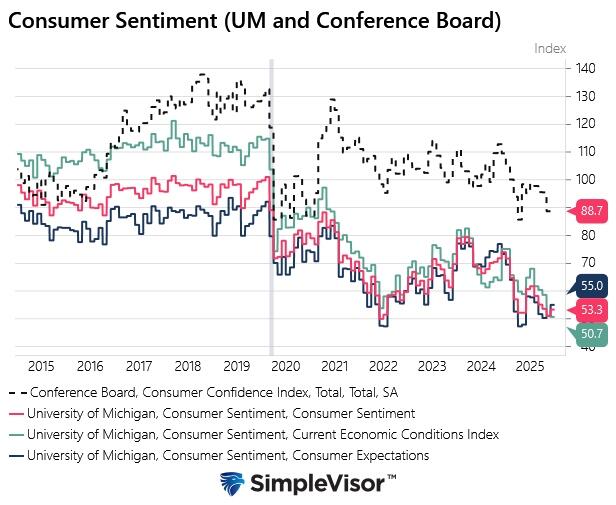
As RealInvestmentAdvice.com shares below, the University of Michigan and the Conference Board consumer sentiment indexes are at or near 10-year lows.
Moreover, they are generally worsening, yet personal consumption continues to grow strongly.
Can such a divergence continue?
To help answer that, consider the five bullet points below, which explain why personal consumption has been strong.
Wealth Effect: U.S. stock markets will post their third 20%+ increase in a row.
Non-discretionary Spending: The mix of spending is leaning towards non-discretionary items. For instance, spending on housing, healthcare, insurance, and travel is increasing as a share of total spending. Many of these expenditures are unavoidable, not confidence-driven impulse purchases. For example, healthcare spending accounted for nearly 20% of consumption.
Credit: Rising use of credit cards, buy-now-pay-later, and home equity loans boosts spending in the short term.
Savings: Real personal income was flat, thus consumers are using savings, which fell to a historically low 4.7% rate, or credit to meet their needs. Neither is sustainable over the longer run.
Inflation: Even if the inflation rate is normalizing, the higher prices of goods and services weigh on consumers’ psyche, in turn making sentiment worse. However, its impact on consumption is not as significant.
But here’s the real deciding factor…
Tyler Durden
Mon, 12/29/2025 – 14:20
https://www.zerohedge.com/personal-finance/consumption-conundrum
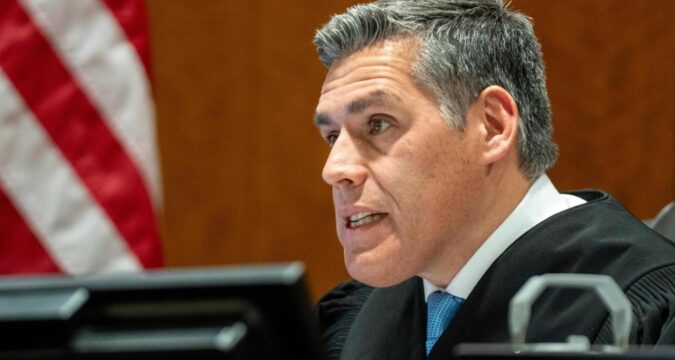
Judge orders release of transcript from closed hearing for man accused of killing Charlie Kirk
A Utah judge on Monday ordered the release of a transcript from a closed-door hearing in October over whether the man charged with killing Charlie Kirk must be shackled during court proceedings.
State District Judge Tony Graf said the transcript must be posted on the court docket by the end of the day. Attorneys for media outlets including The Associated Press had argued for details of the closed hearing to be made public.
Prosecutors have charged Tyler Robinson with aggravated murder in the Sept. 10 shooting of the conservative activist on the Utah Valley University campus in Orem, just a few miles north of the Provo courthouse. They plan to seek the death penalty.
Defense attorneys for Robinson in early October requested that he be allowed to appear in court in civilian clothes and without restraints, to prevent any bias against him among potential jurors.
Days after an Oct. 24 closed door hearing on the matter, Graf ruled that Robinson could appear in civilian clothes but must wear restraints. Utah court rules require defendants who are in custody to be restrained unless otherwise ordered.
Graf wrote in an Oct. 27 order that restraints for Robinson would protect the safety of court staff and the defendant, by allowing him to be quickly secured if court proceedings were disrupted.
But the judge said Monday that public transparency was “foundational” to the judicial system before ordering details of the closed hearing to be released. The judge ordered limited redactions to remove discussions of security protocols in the closely watched case.
Graf also ordered the release of an audio recording of the hearing, again with redactions.
Lawyers for the media wrote in recent filings that an open court “safeguards the integrity of the fact-finding process” while fostering public confidence in judicial proceedings. Criminal cases in the U.S. have long been open to the public, which the attorneys argued is proof that trials can be conducted fairly without restricting reporters.
Graf has said in a separate order that Robinson’s restraints could not be shown by media outlets that publish photographs of court proceedings or broadcast them.
Graf briefly stopped a media livestream of a hearing earlier this month and ordered the camera be moved after Robinson’s attorneys said the stream showed the defendant’s shackles.
In a separate ruling Monday, Graf denied a request from attorneys for the media who sought to intervene in the case. The judge said members of the press do not need to be formal parties in the proceedings to access court records.
Robinson was not present in court Monday but appeared via audio link from the Utah County Jail. In a separate ruling on
A preliminary hearing, where prosecutors will lay out their case against him, is scheduled for the week of May 18.
https://www.chicagotribune.com/2025/12/29/judge-transcript-closed-hearing-charlie-kirk-killing/

Pace expects a dozen electric buses in Lake County in early 2026: ‘It strengthens our transit system for the long-term’
A 10-stall electric bus charging station with an array of solar panels atop its roof, along with a pair of overhead high-speed chargers, is now a permanent part of Pace North Suburban Bus’s North Division garage as the organization moves toward an all-electric fleet by 2040.
Though there is one electric bus there now, Maggie Daly Skoggsbakken, Pace’s chief communications officer, said she anticipates there will be 10 to 12 operating out of the North Division garage in Waukegan in the first half of 2026.
“Part of our mission is to reduce our carbon footprint, and the solar panels, along with the electric fleet, will do that,” Skoggsbakken said. “The solar panels help provide energy to light the grounds and the facility, so it will lower our energy costs.”
Pace executives, along with federal, state and local officials, celebrated the completion of the initial phase of converting the garage into a facility capable of charging a full fleet of battery-electric buses on Dec. 22 at Pace’s North Division garage in Waukegan.
Skoggsbakken said the event marked the end of the first phase of Pace’s move into an all-electric fleet — creating an exterior charging station — and the start of the second stage — completing renovation of the interior for maintenance of electric vehicles by the end of 2027.
As Pace transitions from diesel to a fully electric fleet over the next 15 years, she said its North Division, based in Lake County, is the pilot program and will be the first to operate an all-electric fleet.
Pace Suburban Bus personnel and an array of public officials celebrate the opening of Pace’s electric bus charging station on Dec. 22 in Waukegan. (City of Waukegan)
“It’s a good size for it due to the size of the routes, so we can test how everything works,” Skoggsbakken said, referring to the North Division. “The area has been underserved, and this will help support it.”
U.S. Rep. Brad Schneider, D-Highland Park, was one of the officials at the event. He secured $1.92 million through Congress’s Community-Based Funding program two years ago to help pay for the charging station and some of the buses.
“Pace is now expanding the vital infrastructure needed to support zero-emission buses here in Waukegan,” Schneider said in a text. “That means cleaner air, quieter streets, and more reliable transit for the entire community and the families who depend on Pace every day. It strengthens our transit system for the long-term.”
Waukegan Mayor Sam Cunningham said in a text that he is glad Pace picked the city for its first all-electric bus facility. It benefits the environment and the people living in the community, he said.
Electric buses can get a quick charge at this overhead charging apparatus at the Pace bus garage in Waukegan. (City of Waukegan)
“This project puts Waukegan at the forefront of clean public transportation in the region,” Cunningham said. “Once on the road, the electric buses will help improve air quality, reduce emissions, and move us toward a cleaner, more sustainable public transportation system.”
For state Rep. Rita Mayfield, D-Gurnee, the event was a homecoming of sorts. She once worked for Pace at its Waukegan facility on 10th Street. It was her first full-time job at age 18. She started as a typist and worked her way into several responsible positions. She also learned how to drive a bus. Pace paid for her undergraduate and graduate education.
“It’s exciting they are doing this in Waukegan and not somewhere else,” Mayfield said. “The electric buses will provide clean air for the staff to breathe. This is good for everybody.”
With 50 buses on order, Skoggsbakken said Pace hopes to have the first wave of approximately 20 in the first half of 2026. Some will go to other areas, but she anticipates 10 to 12 in Lake County.
Aggressively continuing to seek grants to pay for the program over the next 15 years, she said Pace has already received a $27 million grant from the Illinois Environmental Protection Agency and the $1.92 million from Schneider. Initial funding of $12.5 million came from Gov. J.B. Pritzker’s Rebuild Illinois program.
The North Division currently employs 70 bus drivers, nine mechanics and eight members of its support staff. It operates 14 routes carrying 4,937 riders each weekday, according to a Pace news release.
https://www.chicagotribune.com/2025/12/29/pace-electric-buses-lake-county/

Black Privilege: Canadian Judge Reduces Sex Offender’s Sentence Over Race
Black Privilege: Canadian Judge Reduces Sex Offender’s Sentence Over Race
A former university football player who choked a woman until she was almost unconscious and forced another one to give him a blowjob was given a reduced sentence by a Canadian judge of just two years in prison because he’s black and was ‘feeling intense pressure’ at the time of the attacks.
“It should be noted that but, for the contents of the Impact of Race and Culture Assessment (IRCA), the pre-sentence report and all the mitigating factors surrounding Omogbolahan (Teddy) Jegede, this sentence would have been much higher,” Justice Frank Hoskins said in his Nova Scotia Supreme Court decision last Wednesday, the National Post reports.
The author of an Impact of Race and Culture Assessment, a report funded under a new initiative from the Trudeau Liberals, wrote that Jegede was feeling intense pressure around the time of the assaults and did not have culturally appropriate support to turn to.
Of note, IRCAs are relatively new in Canadian law – and have become popular thanks to an initiative which began under the Justin Trudeau liberals.
The attacks happened in 2022 and 2023 at residences at St. Francis Xavier University in Antigonish, N.S. – with one woman testifying that Jegede choked her, and the other testifying that she was forced to perform oral sex. Both women said they were physically dominated by Jegede, who is much larger than they are.
In addition to his two-year jail sentence, Hoskins added three years of probation – which can be reduced if Jegede makes significant progress in counseling.
The Crown had requested a sentence of up to 36 months, while Jegede’s defense asked the judge to reduce his sentence to community service.
“In my view, this is a case where the need for denunciation is so pressing the incarceration is the only civil way in which to express society’s condemnation of Mr. Jegede’s conduct,” said Hoskins, noting that Jegede came from a strong, church-going family with strict parents that had stable careers. The now-convicted sex offender told the court that he grew up feeling loved by his family.
He then began a degree in kinetics at St.FX, however those studies were interrupted by his sex crimes and subsequent charges.
Jegede was born in Lagos, Nigeria and immigrated to Canada in 2010. His mother said that the transition to Canada was a significant adjustment for the family, and their youngest son “experienced bullying in elementary school due to his accent and racial identity as a black child.”
The Real Victim?
To prepare for his trial, an IRCA was written that looked at this kind of cultural factor, and noted declines in Jegede’s classroom performance and mental health in his 2nd and 3rd years at St. FX. Jegede told the author that he struggled with a sense of isolation because he’s black in a predominantly white university town.
“I grew up around black people in Brampton and Fort McMurray. Many of them were immigrants, which allowed us to relate to each other on many levels, especially culture. It was like that until I moved to Antigonish to attend university,” he said.
Judge Hoskins, reading from the IRCA, said in his decision: “The absence of adult mentors or role models further exacerbated Mr. Jegede’s vulnerability. His parents had hoped his football coach would provide guidance, but this need went unmet.”
The judge added that the IRCA “provided valuable insight. It has provided me with an understanding of Mr. Jegede’s background from a social, cultural perspective,” but then circled back to the “two very serious sexual assault and offences against two different victims at the same school, in similar circumstances, approximately five months apart, which is concerning, because it suggests that Mr. Jegede may be dangerous … In other words, this is not an isolated incident involving one victim, the nature of both offences and their immediate lasting consequences make them very serious offences.”
Hoskins noted that the “primary aggravating factor, in this case, is the violence and serious evasive nature of the sexual assaults, particularly the offence involving (one of the victims), where she was forced to provide Mr. Jegede oral sex, while her movements were being forcefully controlled by (him).“
The judge also addressed the defense’s request for community service, saying “I’m in the view that I cannot exclude a federal period of incarceration as a fit and proper punishment for these offences,” and arrived at the 24 month sentence by determining 18 months for the more violent and invasive of the two sexual assaults, and six months for the other.
Tyler Durden
Mon, 12/29/2025 – 14:00
https://www.zerohedge.com/political/black-privilege-judge-reduces-sex-offenders-sentence-over-race

Oswego OKs variance for painting project at 1870s-era building in village’s downtown
Oswego trustees recently granted a variance from village code to allow a petitioner to paint the brick and natural stone facade of a 1870s-era building at the corner of Main and Washington streets in the village’s downtown.
The petitioner requested the village’s approval to paint the exterior of the building at 76-78 Main St. to create a cohesive look for the building, village officials said.
The village’s code prohibits the painting of brick, limestone or other natural stone to “retain the natural colors of the materials.” However, if the facade was painted prior to the adoption of the ordinance, the exterior can be repainted as part of normal maintenance, Oswego Development Services Director Rod Zenner said in his report to the Oswego Village Board.
“The petitioner started painting the structure as part of an exterior maintenance project several weeks ago,” Zenner said. Staff discovered that the brick was being painted in violation of the village ordinance, he said.
“The petitioner was not aware of this restriction in the code. By the time staff and the petitioner discussed the situation, the painting of the brick was nearly completed,” Zenner said, adding the petitioner subsequently filed for a variance.
Village staff recommended denial of the variance.
“The intent of the code is to preserve the look of brick and natural stone materials. These natural materials weather well in the elements and maintain their attractive look for a long period of time. Once painted, the materials lose their natural character and have to be repainted regularly to maintain a clean and attractive appearance,” Zenner said.
The petitioner had informed the village staff that they painted the brick to “create a cohesive look to the structure” since the upper half of the building had been altered over time to remove or cover the brick.
Staff said “the preservation of natural brick and stone” is important to maintain “the architectural design of structures” and “to preserve the character, especially for historic structures in the downtown.”
“Brick can last for hundreds of years,” Zenner said.
Village Trustee Jennifer Hughes suggested revising the code.
“If the primary issue is the condition of the brick, in some respects I question whether this provision should remain in the ordinance,” Hughes said. “If we are going to issue (a variance) every time we have bad brick, why have it.”
She further stated the existing code places building owners potentially in an “awkward position” of having to know a zoning code that applies uniquely to this type of structure.
“If we are going to issue a variance anyway, I don’t understand why we have to regulate it,” she said.
The petitioner’s request for the variance was granted.
Linda Girardi is a freelance reporter for The Beacon-News.

Feds Fund Online Game ‘Bad Vaxx’ To ‘Psychologically Inoculate’ Vaccine Resistance
Feds Fund Online Game ‘Bad Vaxx’ To ‘Psychologically Inoculate’ Vaccine Resistance
U.S. taxpayer funds are being used by federal health agencies to develop and test online psychological games designed to condition how people—especially younger audiences—interpret and respond to vaccine skepticism.
An August Nature Scientific Reports study reveals that the project was funded by the Centers for Disease Control and Prevention (CDC) under the U.S. Department of Health and Human Services, through a CDC award administered by the American Psychological Association.
The paper states that the funding totaled “$2,000,000 with 100% funded by CDC/HHS.”
The grant supporting the project is titled “COVID—INOCULATING AGAINST VACCINE MISINFORMATION,” award number 6NU87PS004366-03–02.
That award has already handed out over $4.3 million in taxpayer funds since its activation in 2018.
The project language mirrors the study’s conceptual framework: dissent is treated as exposure to a pathogen, and resistance to dissent is treated as immunity.
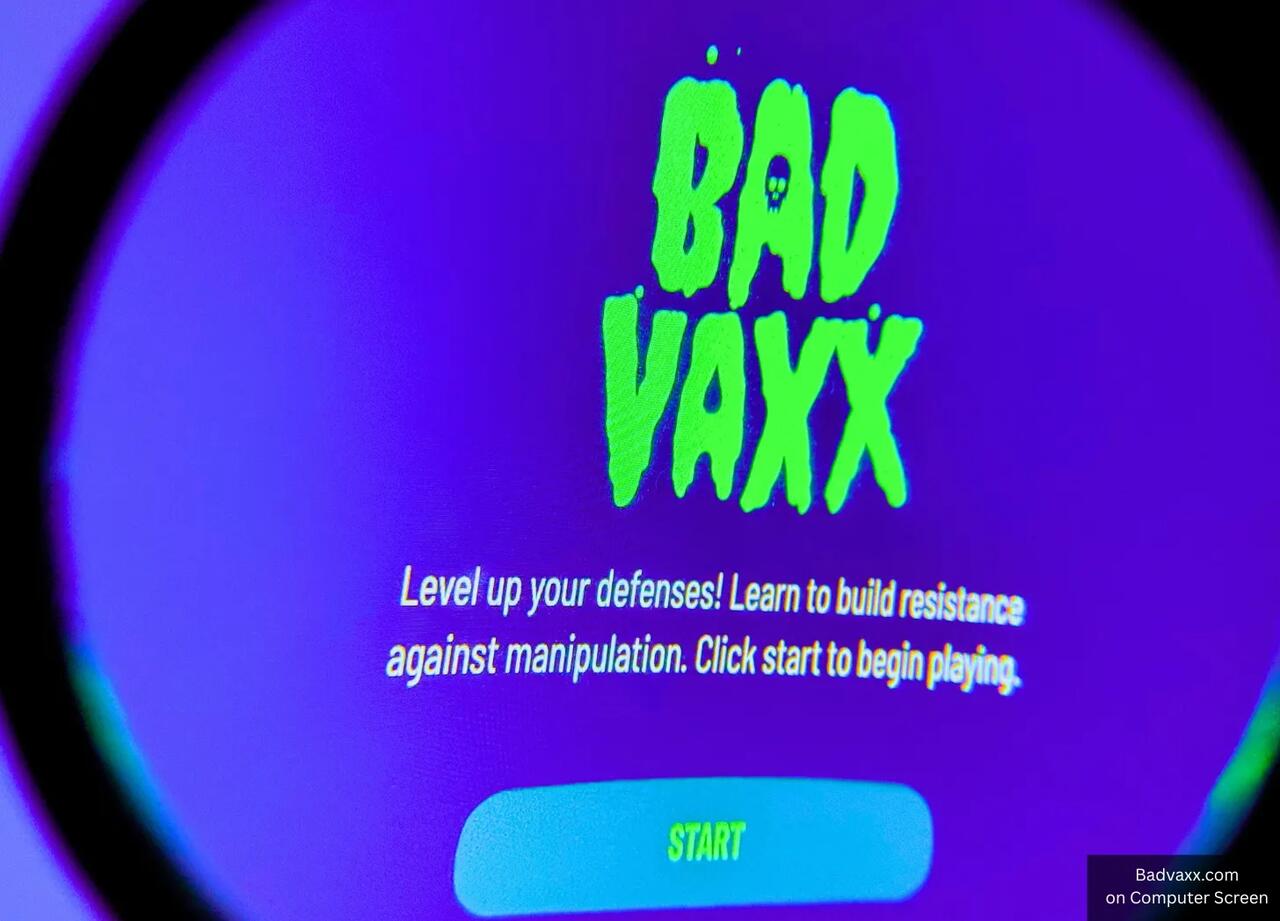
The government-funded study centers on the creation and evaluation of an online game called Bad Vaxx.
According to the authors, the purpose of the game is not to examine disputed vaccine claims or to compare competing evidence, but to reduce what they define as “vaccine misinformation” by shaping how players cognitively process vaccine-critical content.
This is despite the CDC’s own VAERS data confirming over 2.7 million injuries, hospitalizations, and deaths linked to vaccines since 1990.
The study authors explain their premise at the outset:
“Vaccine misinformation endangers public health by contributing to reduced vaccine uptake.”
From this premise, the study moves directly to intervention design.
“We developed a short online game to reduce people’s susceptibility to vaccine misinformation.”
The paper frames this approach as a form of psychological prevention, borrowing language from immunology rather than education or debate.
“Psychological inoculation posits that exposure to a weakened form of a deceptive attack… protects against future exposure to persuasive misinformation.”
The Bad Vaxx game operationalizes this concept by training players to recognize four specific “manipulation techniques”: what it refers to as emotional storytelling, fake expertise, the naturalistic fallacy, and conspiracy theories.
These techniques are treated as characteristic of vaccine misinformation as a category.
“The game trains people to spot four manipulation techniques, which previous studies have identified as being commonly used in the area of vaccine misinformation.”
The study does not include a corresponding examination of whether similar persuasive techniques may be used in vaccine-promoting messaging, government communications, or pharmaceutical advertising.
Ironically, the Bad Vaxx project itself relies on the same persuasive architecture it claims to neutralize—emotional framing, authority cues, and repetition—embedded in a gamified format designed to shape intuition rather than invite scrutiny.
The classification of “vaccine misinformation” is established in advance and applied only to information critical of injectable pharmaceutical products.
Throughout the paper, vaccine skepticism is framed as a behavioral and social risk rather than as a possible response to uncertainty, evolving evidence, or institutional error.
The taxpayer-funded authors write:
“Susceptibility to misinformation about COVID-19 predicts lower compliance with public health regulations and lower willingness to get vaccinated.”
The choice of a game as the delivery mechanism is emphasized as a strength of the intervention.
The authors repeatedly describe the format as “entertaining,” “immers[ive],” and scalable, highlighting its ability to shape intuition rather than deliberation.
“A practical, entertaining intervention in the form of an online game can induce broad-scale resilience against manipulation techniques commonly used to spread false and misleading information about vaccines.”
Games function by rewarding correct pattern recognition, reinforcing desired responses, and reducing analytical friction.
The study’s outcome measures reflect this design: discernment scores, confidence ratings, and willingness to share content, rather than independent evaluation of claims or evidence comparison.
The researchers also emphasize the potential reach of such interventions.
“The Bad Vaxx game has the potential for adoption at scale.”
This matters because the funding source is not an academic foundation with no policy stake.
The CDC is the primary federal agency responsible for vaccine schedules, promotion, and uptake.
Yet the study does not address how this institutional role shapes the definition of misinformation used in the intervention, nor does it acknowledge the conflict inherent in a public health authority funding psychological tools aimed at managing disagreement with its own policies.
The dystopian nature of the project emerges from the structure itself: state funding, psychological conditioning, asymmetric definitions, and a delivery system designed to bypass debate in favor of intuition.
What the paper documents, in concrete terms, is the use of taxpayer funds to develop and validate a behavioral intervention—delivered through a medium optimized for psychological conditioning—that trains users to reflexively distrust a predefined category of speech, while exempting vaccine-promoting institutions from equivalent scrutiny.
Tyler Durden
Mon, 12/29/2025 – 13:40

Aurora Kwanzaa celebration ‘all about unity’
The African American Men of Unity group offered its 25th annual Kwanzaa Celebration at the Prisco Community Center in Aurora on Saturday night.
Organizers said the event, “a celebration of family, community and culture,” offered music, storytelling, entertainment, food and more.
Kwanzaa, observed daily from Friday, Dec. 26, through Thursday, Jan. 1, celebrates African-American culture and was launched in 1966 by Maulana Karenga, a professor and activist, following the Watts Riots in Los Angeles the previous year.
Ricky Rodgers of Aurora, director of African American Men of Unity, spoke about the origins of the celebration as well as some of the seven principles of Kwanzaa and “how important it is to apply them to daily life.”
“This was something that Dr. Karenga created in order for the African-American community to have a holiday of its own that it could share with other people,” he said.
“There are principles that include unity, self-determination, purpose, responsibility, creativity and faith,” Rodgers added of the week-long celebration. “Kwanzaa takes place over seven days and it starts on Dec. 26 through Jan. 1 and we light a candle each day.”
Rodgers said Aurora’s event always stresses “how important it is for us to embrace culture.”
“That’s definitely a critical component of this celebration and just giving people hope,” he said. “This year, it’s no mystery that we get the victory – that’s going to be our theme for this fiscal year and having a connection to the most-high God – that’s the main thing that we have to focus on. In 2026, that’s going to help us overcome and get through anything that we’re going to encounter because there is a lot going on and what people are going through.”
Saturday’s program began with the Black National Anthem followed by an invocation and then the lighting of candles, with music and dancing afterwards.
David Smith of Aurora said he has partnered “with Ricky Rodgers and the African American Men of Unity for many years and this has been a great, awesome program in our community.”
“I’m excited to be here. To be a part of it again and I hope we break records,” Smith said on Saturday as he watched the crowd fill the room at the Prisco Center. “I think the Kwanzaa principles are more important than ever because of what they represent. Right now, more than ever, they’re necessary because unity is something that we all need because we’re fighting against so many pressures and powers that are trying to destroy and distract and break us apart. It’s all about unity and hopefully we’ll bring that all home here in the city of Aurora.”
Smith said for him, the highlight each year “is seeing all the people that come out. The different ethnicities that come out.”
“It’s all about unity and coming together,” he said.
Terry Smith of Aurora said this was the fourth time she has come to the Kwanzaa celebration in Aurora.
“I look forward to learning more about our history. I love it,” she said. “I believe we need our seven principles more than ever and I look forward to everything about this. It’s special. It’s almost like another Christmas for me.”
Terry Smith, left, and Sharon Woodson, both of Aurora, share a moment Saturday, Dec. 27, 2025, during the annual Kwanzaa Celebration at the Prisco Community Center in Aurora. (David Sharos/For The Beacon-News)
Sharon Woodson of Aurora likewise said this was her fourth year at the event and that she “comes out every year to see the African dance and learn about the history.”
“I love the African dance and the storytellers,” she said. “Having the Pan-African event is very important because our children need to know our history as well because, if they don’t know our history they don’t know where we come from.”
David Sharos is a freelance reporter for The Beacon-News.
https://www.chicagotribune.com/2025/12/29/aurora-kwanzaa-celebration-all-about-unity/

Trump indicates the US ‘hit’ a facility that he tied to alleged drug boats
WASHINGTON — President Donald Trump has indicated that the U.S. has “hit” a facility in South America as he wages a pressure campaign on Venezuela, but the U.S. offered no other details.
Trump made the comments in what seemed to be an impromptu radio interview Friday.
The president, who called radio host John Catsimatidis during a program on WABC radio, was discussing U.S. strikes on alleged drug-carrying boats in the Caribbean Sea and eastern Pacific Ocean, which have killed at least 105 people in 29 known strikes since early September.
“I don’t know if you read or saw, they have a big plant or a big facility where they send the, you know, where the ships come from,” Trump said. “Two nights ago, we knocked that out. So, we hit them very hard.”
Trump did not offer any additional details in the interview, including what kind of attack may have occurred. The Pentagon on Monday referred questions to the White House, which did not immediately respond to a message seeking comment.
Defense Secretary Pete Hegseth or one of the U.S. military’s social media accounts has in the past typically announced every boat strike in a post on X, but they have not posted any notice of any strike on a facility.
The press office of Venezuela’s government did not immediately respond Monday to a request for comment on Trump’s statement.
Trump for months has suggested he may conduct land strikes in South America, in Venezuela or possibly another country, and in recent weeks has been saying the U.S. would move beyond striking boats and would strike on land “soon.”
In October, Trump confirmed he had authorized the CIA to conduct covert operations in Venezuela. The agency did not immediately respond to a message seeking comment Monday.
Along with the strikes, the U.S. has sent warships, built up military forces in the region, seized two oil tankers and pursued a third.
The Trump administration has said it is in “armed conflict” with drug cartels and seeking to stop the flow of narcotics into the United States.
Venezuelan President Nicolás Maduro has insisted the real purpose of the U.S. military operations is to force him from power.
White House chief of staff Susie Wiles said in an interview with Vanity Fair published this month that Trump “wants to keep on blowing boats up until Maduro ‘cries uncle.’”
Associated Press writers Konstantin Toropin in Washington and Regina Garcia Cano in Caracas, Venezuela, contributed to this report.
https://www.chicagotribune.com/2025/12/29/trump-us-hit-facility-alleged-drug-boats/