Category: News
Bitcoin Helps USD’s Reserve Status “In A Strange Way”: Coinbase CEO
Bitcoin Helps USD’s Reserve Status “In A Strange Way”: Coinbase CEO
Authored by Brayden Lindrea via CoinTelegraph.com,
Coinbase CEO Brian Armstrong has claimed Bitcoin provides healthy competition for the US dollar, which in turn pressures policymakers to maintain fiscal discipline and helps preserve the greenback’s dominance.
“[Bitcoin] provides a check and balance on the dollar in the sense of if there’s too much deficit spending or inflation in the US, people will flee to Bitcoin in times of uncertainty,” Armstrong argued in an interview on Tetragrammaton with Rick Rubin on Thursday.
“It might be okay to have 2-3% inflation if the economy is growing at 2-3% but if inflation outstrips the growth of the economy, you’ll eventually lose the reserve currency status, and that would be a massive blow to the United States.”
He said that Bitcoin indirectly keeps the dollar in check by ensuring the Federal Reserve and financial regulators avoid actions that could undermine confidence in the US economy.
“So I actually think in a strange way, Bitcoin is helping extend the American experiment,” the Coinbase boss concluded.
Bitcoin is good for USD.
It creates competition in a way that’s healthy for the dollar, which helps to provide a check and balance against high inflation and deficit spending. pic.twitter.com/iHjQCJVqCb
— Brian Armstrong (@brian_armstrong) December 28, 2025
America’s debt is growing at $6B a day, nearing $38T
US national debt has boomed to $37.65 trillion, and is now rising by $70,843 per second — or nearly $4.25 million per minute — according to the US Congress Joint Economic Committee’s debt dashboard.
In early October, JPMorgan touted Bitcoin and gold as the “debasement trade” amid increased uncertainty in the dollar.
Bitcoin soared to a $126,080 high on Oct. 10 but has since retraced 30% to $88,210, while gold has continued its tear, setting its latest high of $4,545 per ounce on Friday.
The Trump administration signed an executive order to establish a Strategic Bitcoin Reserve in March, a move that several US senators said could mitigate the nation’s mounting debt.
However, the reserve currently stockpiles seized Bitcoin without purchasing any and the Bitcoin Act of 2025 bill — which purports to support the SBR — is still in the early legislative stages in Congress.
Stablecoins may do better at preserving dollar dominance
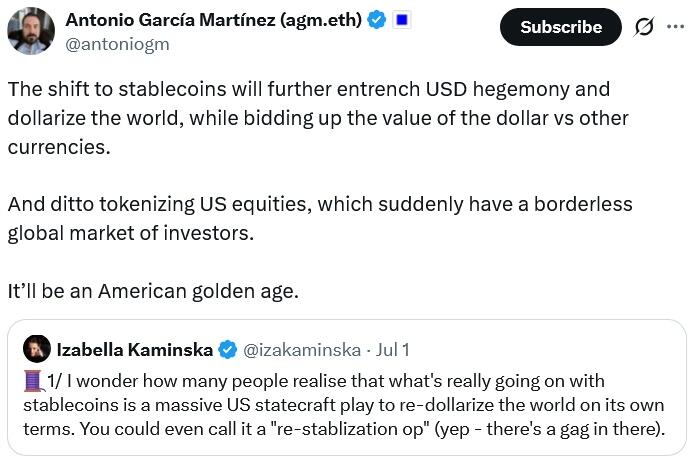
Other industry pundits argue that stablecoins have a bigger role in cementing the US dollar’s status as the reserve currency than Bitcoin.
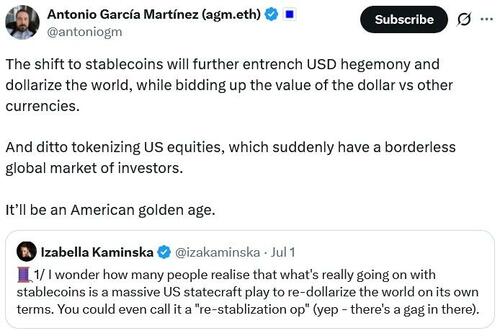
In addition to creating strong demand for US debt, stablecoins are pushing the US dollar into the hands of individuals and businesses worldwide, Polygon Foundation CEO Sandeep Nailwal said last month.
“Dollarisation 2.0 is happening in real time — from LatAm to Africa, entire economies are being rewired around digital dollars.”
Source: Antonio García Martínez
The US passed the GENIUS Act in mid-July, seen as one of the most comprehensive stablecoin frameworks to date.
The stablecoin market currently sits at $312.6 billion, a figure that the US Treasury estimated in April would reach $2 trillion by 2028.
Tyler Durden
Mon, 12/29/2025 – 13:00
https://www.zerohedge.com/crypto/bitcoin-helps-usds-reserve-status-strange-way-coinbase-ceo

US pledges $2 billion for UN humanitarian aid as Trump warns agencies must ‘adapt or die’
GENEVA — The United States on Monday announced a $2 billion pledge for U.N. humanitarian aid as President Donald Trump’s administration slashes U.S. foreign assistance and warns United Nations agencies to “adapt, shrink or die” in a time of new financial realities.
The money is a small fraction of what the U.S. has contributed in the past but reflects what the administration believes is still a generous amount that will maintain America’s status as the world’s largest humanitarian donor.
“This new model will better share the burden of U.N. humanitarian work with other developed countries and will require the U.N. to cut bloat, remove duplication, and commit to powerful new impact, accountability and oversight mechanisms,” Secretary of State Marco Rubio said on social media.
The pledge creates an umbrella fund from which money will be doled out to agencies and priorities, a key part of U.S. demands for drastic changes across the U.N. that have alarmed many humanitarian workers and led to severe reductions in programs and services.
The $2 billion is only a sliver of traditional U.S. humanitarian funding for U.N.-coordinated programs, which has run as high as $17 billion annually in recent years, according to U.N. data. U.S. officials say only $8 billion to $10 billion of that has been in voluntary contributions. The United States also pays billions in annual dues related to its U.N. membership.
“The piggy bank is not open to organizations that just want to return to the old system,” Jeremy Lewin, the State Department official in charge of foreign assistance, said at a press conference Monday in Geneva. “President Trump has made clear that the system is dead.”
The State Department said “individual U.N. agencies will need to adapt, shrink, or die.” Critics say the Western aid cutbacks have been shortsighted, driven millions toward hunger, displacement or disease, and harmed U.S. soft power around the world.
A year of crisis in aid
The move caps a crisis year for many U.N. organizations, including its refugee, migration and food aid agencies. The Trump administration has already cut billions in U.S. foreign aid, prompting the agencies to slash spending, aid projects and thousands of jobs. Other traditional Western donors have reduced outlays, too.
The U.S. pledge for aid programs of the United Nations — the world’s top provider of humanitarian assistance and biggest recipient of U.S. humanitarian aid money — takes shape in a preliminary deal with the U.N. Office for the Coordination of Humanitarian Affairs, or OCHA, run by Tom Fletcher, a former British diplomat and government official.
Fletcher, who has spent the past year lobbying U.S. officials not to abandon U.N. funding altogether, appeared optimistic at the deal’s signing in Geneva.
“It’s a very, very significant landmark contribution. And a month ago, I would have anticipated the number would have been zero,” he told reporters. “And so I think, before worrying about what we haven’t got, I’d like to look at the millions of people whose lives will be saved, whose lives will be better because of this contribution, and start there.”
Even as the U.S. pulls back its aid contributions, needs have ballooned worldwide: Famine has been recorded this year in parts of conflict-ridden Sudan and Gaza, and floods, drought and natural disasters that many scientists attribute to climate change have taken many lives or driven thousands from their homes.
The cuts will have major implications for U.N. affiliates like the International Organization for Migration, the World Food Program and refugee agency UNHCR. They have already received billions less from the U.S. this year than under annual allocations from the Biden administration — or even during Trump’s first term.
Now, the idea is that Fletcher’s office — which has aimed to improve efficiency — will become a funnel for U.S. and other aid money that can be redirected to those agencies, rather than scattered U.S. contributions to a variety of individual appeals for aid.
Asked by reporters if the U.S. language of “adapt or die” worried him, Fletcher said, “If the choices are adapt or die, I choose adapt.”
US seeks aid consolidation
U.S. officials say the $2 billion is just a first outlay to help fund OCHA’s annual appeal for money. Fletcher, noting the upended aid landscape, already slashed the request this year. Other traditional U.N. donors like Britain, France, Germany and Japan have reduced aid allocations and sought reforms this year.
“This humanitarian reset at the United Nations should deliver more aid with fewer tax dollars — providing more focused, results-driven assistance aligned with U.S foreign policy,” U.S. Ambassador to the United Nations Mike Waltz said.
At its core, the changes will help establish pools of funding that can be directed either to specific crises or countries in need. A total of 17 countries will be initially targeted, including Bangladesh, the Democratic Republic of the Congo, Haiti, Syria and Ukraine.
Two of the world’s most desperate countries, Afghanistan and Yemen, are not included, with U.S. officials citing aid diversion to the Taliban and Houthi rebels as concerns over restarting contributions.
Also not mentioned on the list are the Palestinian territories, which officials say will be covered by money stemming from Trump’s as-yet-incomplete Gaza peace plan.
The U.N. project, months in the making, stems from Trump’s longtime view that the world body has great promise but has failed to live up to it and has — in his eyes — drifted too far from its original mandate to save lives while undermining American interests, promoting radical ideologies and encouraging wasteful, unaccountable spending.
“No one wants to be an aid recipient. No one wants to be living in a UNHCR camp because they’ve been displaced by conflict,” Lewin said. “So the best thing that we can do to decrease costs, and President Trump recognizes this and that’s why he’s the president of peace, is by ending armed conflict and allowing communities to get back to peace and prosperity.”
Lee reported from Washington. Associated Press writer Farnoush Amiri contributed from New York.
https://www.chicagotribune.com/2025/12/29/us-un-humanitarian-aid-trump/
Nick Shirley Effect Fuels Calls For Crowdfunded Citizen Journalist Grant Program To Expose Democrat Fraud Nationwide
Nick Shirley Effect Fuels Calls For Crowdfunded Citizen Journalist Grant Program To Expose Democrat Fraud Nationwide
The Democratic Party entered Monday morning facing a massive firestorm following the viral spread of citizen journalist Nick Shirley’s on-the-ground bombshell investigation into alleged Somali-linked daycare centers siphoning taxpayer funds and operating as apparent front companies.
Shirley’s exposé earned 111 million views on X within three days, significantly increasing public awareness of what appears to be large-scale welfare fraud in Minnesota. The magnitude of the alleged welfare fraud suggests systemic failures in Democrat-run government oversight, with a high probability that irregularities occurred at the local, county, and potentially state levels.
The Democratic Party’s propaganda machine would usually be firing on all cylinders in corporate media outlets at about now to counter the welfare fraud narrative, labeling anyone who investigated or even questioned the suspiciously run Somali-linked child daycare, adult and autism care, home health care, and non-emergency medical transportation industries raking in taxpayer funds as “racists” and “fascists.”
Well, Forbes appears to have received its marching orders.
Truly amazing headline work here @Forbes. A+ stuff. pic.twitter.com/NXtRLNmmHt
— Western Lensman (@WesternLensman) December 29, 2025
Continued silence from much of the corporate media only reinforces what we already know: MSM acts less as news organizations and more as de facto public relations firms for Democrats.
Not CBS
Not PBS
Not CNN
Not ABC
Not MSNBC
Not Fox News
Not 60 Minutes
Not New York Times
Not Washington Post
Not Associated Press
But an independent Journalist on 𝕏, exposed millions of Fraud with a hoodie and a camera
KEEP GOING NICK SHIRLEY pic.twitter.com/40RX4wW3go
— MAGA Voice (@MAGAVoice) December 27, 2025
Shirley’s exposé was a left-field event for Democrats, as it exposed state-level fraud – something Elon Musk and DOGE had been attempting to uncover and dismantle at the federal level. Instead, recall that earlier this year, Democrats mobilized the protest-industrial complex of dark-money-funded NGOs against Musk and Tesla. There was even alarming left-wing terrorism against Tesla showrooms.
Let’s not forget what happened here…
Remember when a Tim Walz appointee murdered the only lawmaker who tried to stop the fraud in Minnesota?
Is it starting to make sense now? pic.twitter.com/q4NBuUUNfD
— Bruce (@Bpeters1558) December 28, 2025
What America First is beginning to understand is that the success of exposing welfare fraud in Minnesota through a citizen-journalist model needs to be replicated across blue states in a coordinated blitz campaign that overwhelms whatever narrative control the Democratic Party’s propaganda machine still retains.
SPAC King Chamath Palihapitiya on X wrote, “I trust @Cernovich instincts here. If he thinks a grant program can unlock tens of investigative journalists to uncover the breadth and scale of California, many people will support it.”
Palihapitiya’s response was directed at an X user’s idea about a crowdfunding grant program to support citizen journalists who expose fraud in California.
I trust @Cernovich instincts here. If he thinks a grant program can unlock tens of investigative journalists to uncover the breadth and scale of California’s fraud, many people will support it.
Cerno? https://t.co/yoWfLMV8Lb
— Chamath Palihapitiya (@chamath) December 28, 2025
What could soon emerge is an early, crowdfunded, DOGE-like network of citizen journalists – funded by tech bros, supported by private investigators, guided by tips and prior research, and aimed at systematically exposing and documenting alleged Democratic Party fraud across blue states. Such an effort could flood the news cycle with so many egregious fraud cases that Democrats would face immense difficulty mounting any compelling counter-narrative. This is info war gearing up before midterm election cycle.
Tyler Durden
Mon, 12/29/2025 – 12:40

Community news: Cancer support groups, orchids, art and more
NIPSCO hosts annual holiday giving campaign
This holiday season, Northern Indiana Public Service Company LLC (NIPSCO) celebrated its 13th annual Hope for the Holidays campaign. Through generous grant support from the NiSource Charitable Foundation, NIPSCO donated $239,425 to 23 local organizations. Additionally, employees contributed more than 800 new toys to seven local Toys for Tots chapters. Donations from the campaign were distributed to a range of organizations committed to providing food security, sustaining families and housing services. Through these contributions, organizations were able to operate warming centers and to provide essential support such as coats and winter garments, holiday dinners and toiletries for those in need. Among the local organizations benefiting from the Hope for the Holidays campaign are: Salvation Army Michigan City; Salvation Army La Porte County; Family Promise of Porter County; Hobart Food Pantry; North Township Trustee’s Office; city of Gary; and Greater Hammond Community Services. More information can be found at NIPSCO.com/GivingBack.
Franciscan Health offers cancer support groups
Franciscan Health is offering free cancer support groups for patients and their caregivers across Northwest Indiana throughout 2026. Franciscan facilitators will help guide the discussion. Space is limited and registration is required. Participants may attend as many sessions as they’d like and need not be Franciscan Health patients to attend. In the interest of the health and safety of attendees and patients, attendees may be asked to wear masks. The Crown Point support group will meet from 12:30 to 1:30 p.m. on the second Wednesday of each month beginning Jan. 14 in the Burrell Cancer Center Conference Room at the Franciscan Health Main Street Outpatient Center, 1201 S. Main St., Crown Point. Attendees should use the Burrell Cancer Center entrance on Court Street. To register and for more information, call 219-757-6202 or email robyn.caban@franciscanalliance.org. The Munster Support Group will meet from 11 a.m. to noon on the third Monday of each month beginning Jan. 19 at the Franciscan Health Cancer Center Munster, 701 Superior Ave. in the St. Clare Conference Room. Attendees should enter Door T in the Cancer Center. To register and for more information, call 219-922-4056 or email robyn.caban@franciscanalliance.org. The Michigan City Support Group meets from 5 to 6 p.m. on the first Monday in February, April, June, August, October and December in the Community Room at the Franciscan Health Woodland Cancer Care Center, 8955 W 400 N, Michigan City. For more information and to register, call 219-861-5820. Franciscan Health Michigan City also offers informative classes for cancer patients, survivors and their families on a variety of topics from self-care to healthy eating to spiritual care. Classes take place from 2 to 3 p.m. on the first Wednesday of January, March, May, July, September and November beginning March 4 in the Community Room at the Franciscan Health Woodland Cancer Care Center, 8955 W 400 N, Michigan City. For more information or to register, call 219-861-5820.
Master Gardeners offer Zoom program, ‘Orchids 101’
Join the Lake County Master Gardeners at 6 p.m. Jan. 15 for the Zoom program “Orchids 101” with Dr. Scott Stewart. Learn practical tips and clear guidance to grow thriving, long-lasting plants. Program topics include: how to choose healthy orchids; the proper balance of light, water and humidity; the best beginner-friendly orchid varieties; repotting, fertilizing and long-term care essentials; and how to diagnose and fix common problems. There will also be a live Q&A. Stewart has served as a core member of the North American Native Orchid Conservation Center, is a long-time member of the American Orchid Society and has taught orchid propagation and conservation workshops around the world. Contact lakecountymastergardeners@gmail.com to reserve a space or register at https://docs.google.com/forms/d/e/1FAIpQLScs7_AU1k0dmHAAd6nzg8Uci-uau7iyKYpqM_-ejWagIfuGQA/viewform?usp=header.
Miller Beach arts district hosts annual community show
Miller Beach Arts and Creative District (MBACD) is hosting the exhibition VOICES: The MBACD Annual Community Show through Jan. 16 at the Marshall J. Gardner Center for the Arts, 540 S. Lake St., Gary. A free Artist Talk will be held at 1 p.m. Jan. 11. In response to the query, “How can artists use their creative voices in uncertain times?”, ten artists offer their perspectives on hope, caution, and responsibility toward self, community and world issues in the exhibition. Gallery hours are 11 a.m. to 2 p.m. Tuesday through Saturday; 2 to 4 p.m. Sunday; closed Monday. More information can be found at millerbeacharts.org.
https://www.chicagotribune.com/2025/12/29/community-news-cancer-support-groups-orchids-art-and-more/

The AI Arms Race Is Cracking Open The Nuclear Fuel Cycle
The AI Arms Race Is Cracking Open The Nuclear Fuel Cycle
Authored by Michael Kern via OilPrice.com,
The abstract “cloud” of artificial intelligence possesses a massive, structural demand for 24/7 “baseload” power that is equivalent to adding Germany’s entire power grid by 2026, a need intermittent renewables cannot meet.
Decades of underinvestment have resulted in a widening uranium supply deficit, with mined uranium expected to meet less than 75% of future reactor needs and an incentive price of $135/lb required to restart mothballed mines.
Big Tech hyperscalers are privatizing energy security by locking in clean baseload nuclear power via long-term agreements, effectively making the public grid’s “service” secondary to the “compute-ready” requirements of major platforms.
We are seeing a violent collision between two worlds: the high-speed, iterative world of artificial intelligence and the slow, grinding, capital-intensive world of nuclear physics.
Data from a survey of over 600 global investors reveals that 63% now view AI electricity demand as a “structural” shift in nuclear planning. This isn’t a temporary spike or a speculative bubble. It is the physical footprint of every Large Language Model (LLM) query finally showing up on the global balance sheet.
For years, the energy narrative was dominated by “efficiency.” We were told that better chips would offset higher usage. That era is over. Generative AI doesn’t just use data; it incinerates energy to create it.
Why the “Efficiency” Narrative Failed
The “Reverse-Polish” reality of AI is that the more efficient we make the chips, the more chips we deploy, and the more complex the models become. This is Jevons Paradox playing out in real-time across the data centers of Northern Virginia and Singapore.
When you look at the energy density required for an AI hyperscale center, you aren’t looking at a traditional office building. You are looking at a facility that pulls as much power as a mid-sized city, but does so with a 99.999% uptime requirement.
Traditional demand models simply didn’t account for a single industry deciding to double its power footprint in less than five years. S&P Global Energy recently highlighted that data center electricity consumption could hit 2,200 terawatt-hours (TWh).
Intermittent renewables…the darlings of the corporate ESG report…cannot provide the 24/7 “baseload” these machines require…
The hyperscalers have realized that if they want to dominate AI, they need to secure physical atoms before the other guy does.
The $135 Ceiling and the Mining Reality Gap
While the demand side is moving at the speed of software, the supply side is stuck in the mud of 20th-century industrial timelines.
The uranium market is currently a “two-speed” machine. On one hand, you have short-term spot price volatility that makes traders nervous. On the other, you have a long-term supply deficit that is widening like a canyon.
Data suggests that mined uranium will meet less than 75% of future reactor requirements.
We are living through the consequences of twenty years of underinvestment. After 2011, the world essentially stopped looking for uranium. We lived off the “secondary supply”…old Cold War warheads and utility stockpiles. Those stockpiles are now effectively exhausted.
More than 85% of investors surveyed anticipate uranium prices hitting the $100–$120/lb range by 2026. Some are looking at $135/lb.
I see these numbers, and I don’t see “growth.” I see a desperate incentive price. $135 isn’t a sign of a healthy market… it is the price required to beg miners to reopen mothballed pits and navigate the ten-year permitting hellscape required for a greenfield project.
Mining is a “boots-on-the-ground” reality that doesn’t care about digital timelines.
Who Collects the Equity and Who Pays the Bill?
There is a massive shift happening in the power dynamics of infrastructure. For decades, nuclear power was a public service…state-funded, state-regulated, and built for the citizen.
Now, we are seeing the “Private Platform” era of nuclear energy. When a hyperscaler signs a twenty-year Power Purchase Agreement (PPA) with a nuclear utility, they are effectively “locking in” the best, cleanest baseload power for private profit.
The question we aren’t asking: who pays for the grid upgrades to support this?
The hyperscalers want the green electrons to satisfy their net-zero pledges, but the physical copper and transformers required to move that power often fall on the rate-paying public or the state. We are witnessing the privatization of energy security.
If 63% of investors are right and AI is the new driver of nuclear planning, the “public service” aspect of the grid is about to become a secondary concern to the “compute-ready” requirements of Big Tech.
The equity is being collected by the tech platforms and the uranium miners. The risk is being socialized by the grid.
The Geopolitical Reality of Uranium Supply
We cannot talk about the uranium market without talking about the “Iron Fist” of state policy. The West is currently trying to rebuild a supply chain that it intentionally dismantled.
The U.S. and Europe are aggressively pushing “sustainable finance frameworks” to include nuclear, but they are doing so while facing a massive bottleneck in enrichment and conversion capacity…much of which is still tied to Russian state interests.
China, South Korea, and the UAE aren’t waiting for the market to “find a price.” They are treating nuclear as a matter of national survival. China is currently building more reactors than the rest of the world combined.
They understand something the West is only just realizing: you cannot run a 21st-century economy on 19th-century energy densities.
If the uranium supply remains constrained, we won’t just see higher prices. We will see a geopolitical scramble for “off-take” agreements. The nation that secures the uranium secures the AI lead.
The “vibe” of energy abundance is a lie…We are entering an era of energy rationing by price.
The Technical Friction: Steel vs. Code
The most significant gap in the current market “bull case” is the technical audit of the hardware.
The survey data shows that investors are betting on “restarts” and “greenfield developments” to close the supply gap. But you can’t just pour money into a hole and expect uranium to come out the next day.
Uranium mining is plagued by:
Water Management Issues: Especially in places like Kazakhstan (the world’s largest producer), where sulfuric acid shortages have already hampered production targets.
Labor Scarcity: We have a generation of mining engineers who were told nuclear was dead. They didn’t go to school for this.
The Enrichment Bottleneck: Even if you have the yellowcake, you need to turn it into fuel. The West’s capacity to do this is currently maxed out.
Sprott Asset Management correctly notes that utilities can only defer procurement for so long. Eventually, they have to buy. When they do, they will find a market where the physical steel and the chemical reagents are in shorter supply than the capital.
The “catch-up trade” of 2026 isn’t just about price. It’s about the reality that we forgot how to build big things in the physical world.
The Bill for the Utopia
We are being sold a vision of AI-driven abundance…health breakthroughs, autonomous cities, and limitless productivity.
But to get that utopia, we need to solve a uranium deficit that has been building for twenty years.
We need to build reactors at a pace not seen since the 1970s.
And we need to do it while the primary producers are facing technical and geopolitical headwinds.
The $100–$120/lb range is just the beginning. If the supply response doesn’t materialize…and given the 15-year lead times, why would it? We are looking at a permanent state of high-cost energy for everyone who isn’t a trillion-dollar tech company.
We are finally moving from a world of “clicks” back to a world of “kilowatts”…And the kilowatts are getting very, very expensive.
Tyler Durden
Mon, 12/29/2025 – 12:20
https://www.zerohedge.com/ai/ai-arms-race-cracking-open-nuclear-fuel-cycle

Column: Toll hikes toll for thee, suburbanites
Riders of mass transit in the region received an early Yule present when Gov. JB Pritzker signed the latest overhaul of the system into law on Dec. 16, unlike users of the tollway system who got coal in their Christmas stockings.
The gift was CTA, Metra and Pace commuters will see no impending fare increases. Some transit riders haven’t seen ticket hikes since 2018.
Tollway drivers — mainly suburbanites in the six counties of Lake, Cook, DuPage, Kane, McHenry and Will — on the other hand, face 45-cent toll increases, which will increase the cost of driving between open-road tolling junctions and ramp plazas up to 90 cents and more. Commercial vehicles, aka semi rigs, are expected to be hit with 30% toll hikes.
How many remember when 10-cent tolls were supposed to be temporary when the original three tollways opened in 1958? Once the highways’ construction bonds were paid off, motorists were told they would become like other state roads: Free in order to roam the magnificent miles of Illinois.
That never happened as the toll-supported system expanded into an interconnecting 12-county, 292-mile regional expressway grid where construction seems unending, like current work on the Tri-State Tollway around the hub with the Reagan Memorial Tollway (Interstate 88). Auto and truck traffic has grown exponentially with an enlarged tollway footprint.
That is why the pockets of suburban drivers were picked by the Democrat-led supermajority in the Illinois legislature to give mass transit an annual $1.5 billion injection of state cash. In addition to higher tolls, gasoline-tax receipts and interest money from the state’s road fund will be redirected to mass transit, along with an increase in the regional sales tax by .25%.
A lone suburban Republican, state Sen. Seth Lewis, R-Bartlett, who represents mainly DuPage County, voted for the massive law, which replaces the Regional Transportation Authority with the Northern Illinois Transportation Authority and takes effect on June 1, 2026. Headline writers across the region now have to replace RTA with NITA over future newspaper stories about mass transit.
We’ve gone from three letters to four in our transit acronyms. Now that’s progress.
A few Lake County folks may recall that the bill authorizing the original RTA was drafted by John Conolly, a Republican state senator from Waukegan. That was back in the early 1970s and was in reaction to passenger bus companies stopping service and railroads seeking to end commuter rail runs.
Pritzker crowed during the bill signing at Chicago’s Union Station that the law, “makes transit safer and more reliable.” Tell that to the eight passengers on the CTA whose lives were snuffed out in 2025 while on city Els.
Riding CTA trains and buses must be some of the most dangerous exploits in Illinois. So perilous in fact that the administration of President Donald Trump threatened to withhold federal funding if the CTA didn’t come up with a security plan to keep passengers safer.
The threat by the Federal Transit Administration earlier this month came after a female CTA passenger was badly burned after being set on fire by another rider. Federal officials said that incident and other violence on the Chicago-centric system merited the action.
To tackle violence across Metra, CTA and Pace, the Cook County Sheriff’s Office is forming a task force to coordinate law enforcement response as each agency currently is in charge of its own security network. Also, as part of the anti-violence campaign, the Chicago Police Department will up its manpower commitment to patrols on CTA trains and buses, and at platforms and bus stops.
Yet, the Chicago Tribune reported late last week that despite the perception that riding the CTA seems perilous, violent crime is actually down 5% in 2025 on the million or so trips taken by commuters during the year. Ridership across the NITA system, though, remains below figures tallied before the COVID-19 pandemic.
As the lame-duck RTA board approved 2026 budgets for the trio of agencies at its Dec. 18 session, Chairman Kirk Dillard of Hinsdale, a former state lawmaker, echoed Pritzker’s words: “Safety is our paramount concern right now. Now that our bill is passed, it’s all about safety.”
That and waiting to spend that newfound money, thanks to Democrat lawmakers. The budget, promising no service cuts, appropriates $4.32 billion for operations and $9.25 billion in infrastructure improvements.
No service cuts and no fare increases. What better way to greet the new year for the region’s commuters? Except for those using the tollways.
Charles Selle is a former News-Sun reporter, political editor and editor.
sellenews@gmail.com
X @sellenews
https://www.chicagotribune.com/2025/12/29/selle-column-toll-hikes-suburbs/

Russia ‘Confidently Advancing’ In Ukraine, Over 30 Settlements Captured In December: Putin
Russia ‘Confidently Advancing’ In Ukraine, Over 30 Settlements Captured In December: Putin
Russian President Vladimir Putin has made clear to both his citizens and to the world that the ‘special military operation’ in Ukraine will continue on until all goals are achieved, and that his forces are advancing ‘confidently’.
He chaired a televised meeting with the country’s top military officials, focused on a status update regarding Ukraine, and crucially coming the day after Presidents Trump and Zelensky met in Florida in a failed effort to reach breakthrough on the proposed peace deal. Moscow is pressing ahead with its goal of fully capturing and pacifying the four Ukrainian regions it declared part of the Russian Federation in fall of 2022 via a ‘popular referendum’.
“The goal of liberating the Donbas, Zaporizhia and Kherson regions is being carried out in stages, in accordance with the plan of the special military operation,” Putin described before underscoring, “The troops are confidently advancing.“
At the meeting it was also announced that Russian troops have made more gains in the last 24 hours, especially the capture of Dibrova village in Donetsk region.
According to an update of the meeting via RT translation, battlefield gains of the past month are significant:
In December, Russian forces liberated over 700 square kilometers of territory, taking some 32 settlements under control, Gerasimov said at the meeting. This month, the military has shown the highest rate of progress in the entire outgoing year, he noted, adding that troops are advancing “along virtually the entire frontline.”
“The adversary is not undertaking any active offensive actions. They have concentrated their main efforts on strengthening their defenses and are attempting to slow the pace of our advance by conducting counterattacks in isolated areas and using drones en masse,” Gerasimov said.
The Kremlin has at the same time reiterated that it is not interested in a ‘Plan B or Plan C’ in terms of a peace deal, but that it only seeks lasting political settlement. This will of course include international recognition of its territories in the Donbass.
According to highlights the Russian president’s speech after his meeting with top defense officials, via a TASS and Al Jazeera compilation:
Attempts by Ukraine to interfere with the Russian army in Kupiansk must be decisively suppressed.
The capture of Siversk allows for the development of offensives towards the cities of Sloviansk and Kramatorsk.
Prospects for the complete capture of the Donbas territory have been discussed.
Expansion of the security zone along the Russian-Ukrainian border is on the table.
Troops have broken through the Ukrainian defences and are advancing towards the city of Zaporizhzhia.
Putin tells Russian generals:
It’s necessary to continue the operation to gain control of the city of Zaporizhzhia. pic.twitter.com/AT0XkCbkV5
— Clash Report (@clashreport) December 29, 2025
Putin, surrounded by his generals, is making clear to the world that he remains in the driver’s seat – with all the leverage on the field of battle – and that Zelensky has no cards to play.
Tyler Durden
Mon, 12/29/2025 – 12:00

The Market Risk In 2026 If Growth Projections Fail
The Market Risk In 2026 If Growth Projections Fail
Authored by Lance Roberts via RealInvestmentAdvice.com,
There is a rising market risk in 2026 that is largely overlooked as we wrap up this year. As discussed in the “Fed’s Soft Landing Narrative,” optimism about 2026 is running high.
Currently, investors are pricing in strong economic growth, robust earnings, and a smooth path of disinflation. Notably, Wall Street estimates suggest a significant acceleration in corporate profits, particularly among cyclical stocks and small- to mid-cap sectors. To wit:
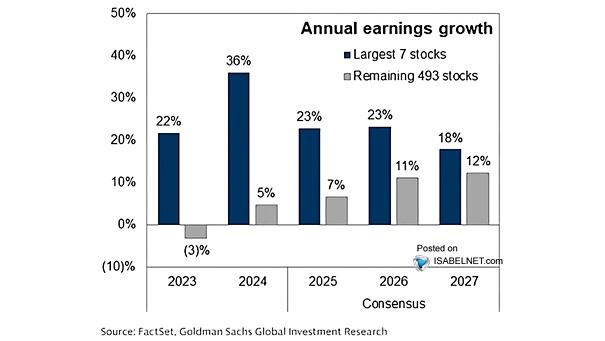
“Wall Street currently expects the bottom 493 stocks to contribute more to earnings in 2026 than they have in the past 3 years. This is notable in that, over the past three years, the average growth rate for the bottom 493 stocks was less than 3%. Yet over the next 2 years, that earnings growth is expected to average above 11%.”
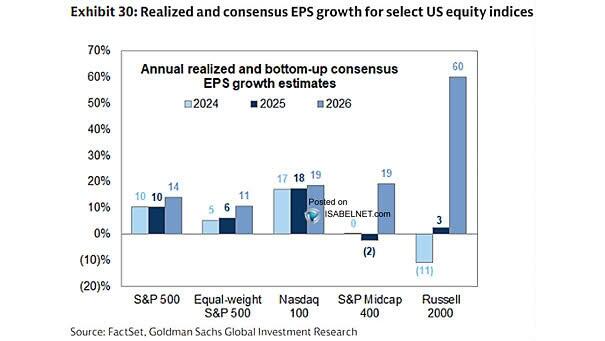
“Furthermore, the outlook is even more exuberant for the most economically sensitive stocks. Small and mid-cap companies struggled to produce earnings growth during the previous three years of robust economic growth, driven by monetary and fiscal stimulus. However, next year, even if the Fed’s soft landing narrative is valid, they are expected to see a surge in earnings growth rates of nearly 60%.”
There is nothing wrong with having an optimistic outlook when it comes to investing; however, “outlooks can change rapidly,” which is a significant market risk, particularly when expectations and valuations are elevated.
Notably, these forecasts rest on an assumption that the economy will not only avoid recession but reaccelerate in the face of waning inflation. As noted, equity markets have responded by pushing valuations higher across major indexes, with price-to-earnings ratios well above historical medians. Simultaneously, investors have rewarded narratives built on the idea of a soft landing and a return to pre-pandemic trends.
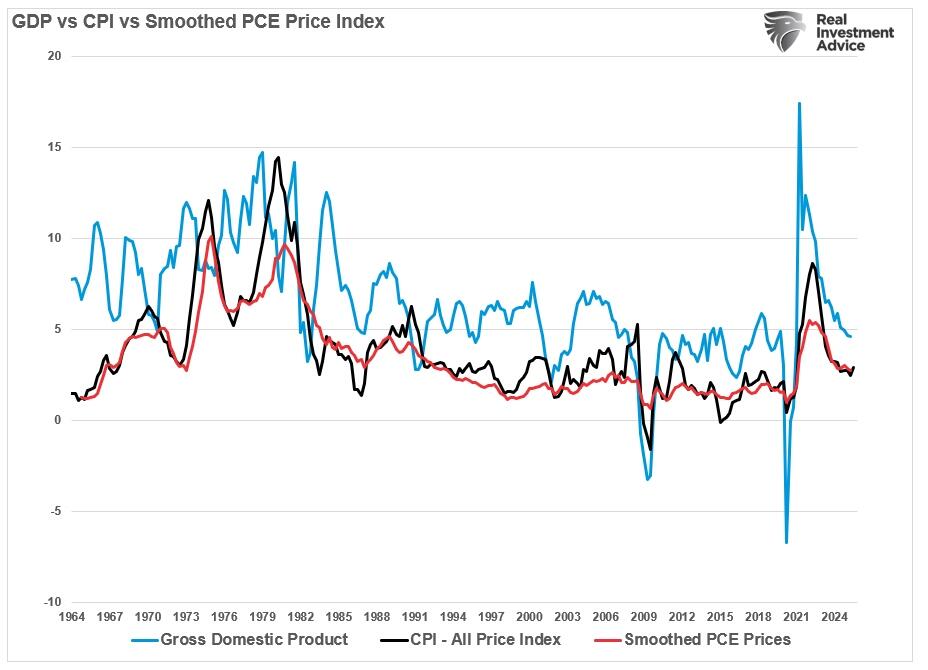
However, this narrative appears to overlook the trends in recent economic data. Inflation expectations have moderated, not because of increased demand, but due to weaker consumption and cooling labor dynamics. As recent economic data indicate, disinflation has accompanied slower GDP growth and a decline in personal consumption momentum. If the economy were indeed set to reaccelerate, these trends should be increasing rather than returning to historical averages.
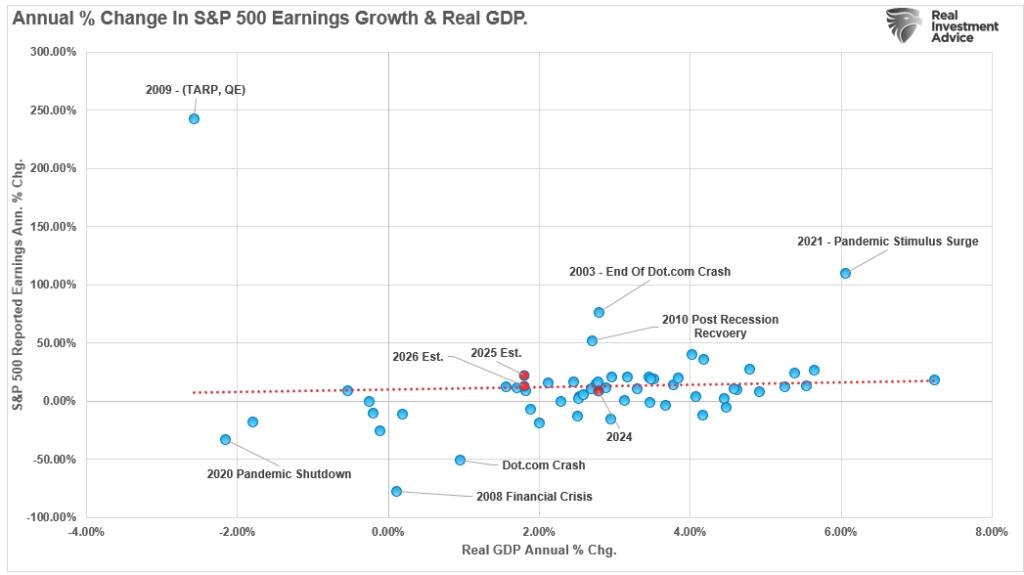
The soft landing thesis posits a benign cycle in which inflation declines, growth remains stable, and earnings increase. Yet, that outcome would be historically rare. When inflation falls this quickly, it typically reflects a slowdown in demand rather than policy success. Additionally, the strong relationship between economic growth and earnings should not be dismissed. That disconnect exposes investors to market risk if growth does not materialize as expected and valuations are reconsidered.
With analysts expecting strong revenue growth and margin expansion despite rising input costs, global uncertainty, and declining employment, a market priced for perfection leaves little room for earnings misses or growth shocks. If those optimistic assumptions fail, market risk could rise abruptly.
Let’s dig in.
Structural Headwinds
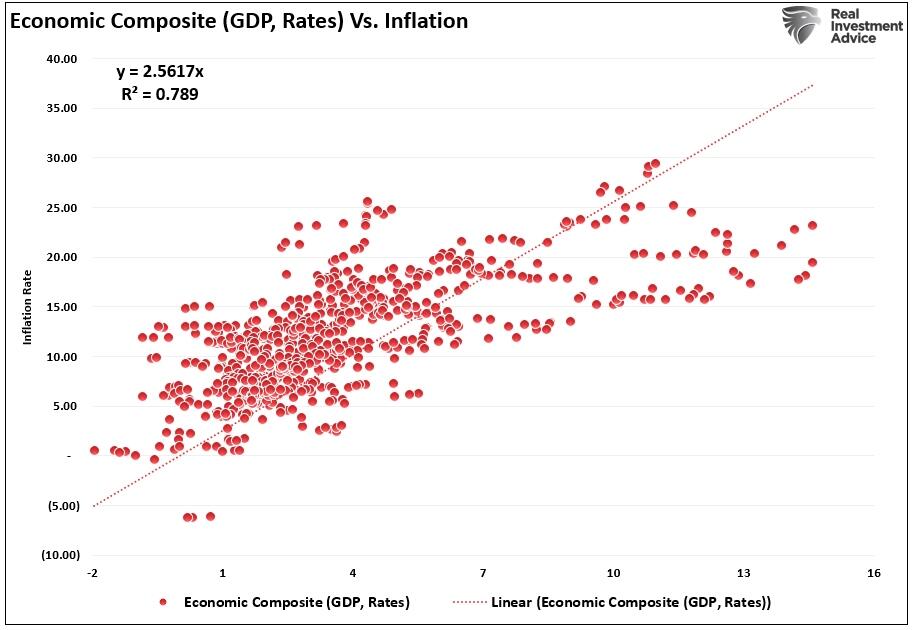
As noted above, earnings growth is fundamentally tied to economic growth. When demand exceeds supply, companies expand output, raise prices, and increase profits. As discussed recently, this is why, without inflation, there can not be economic growth, increasing wages, and an improving standard of living. In other words, for there to be stronger economic growth and rising prosperity, prices must increase over time. Such is why the Fed targets a 2% inflation rate, thereby supporting 2% economic growth and stable employment levels.
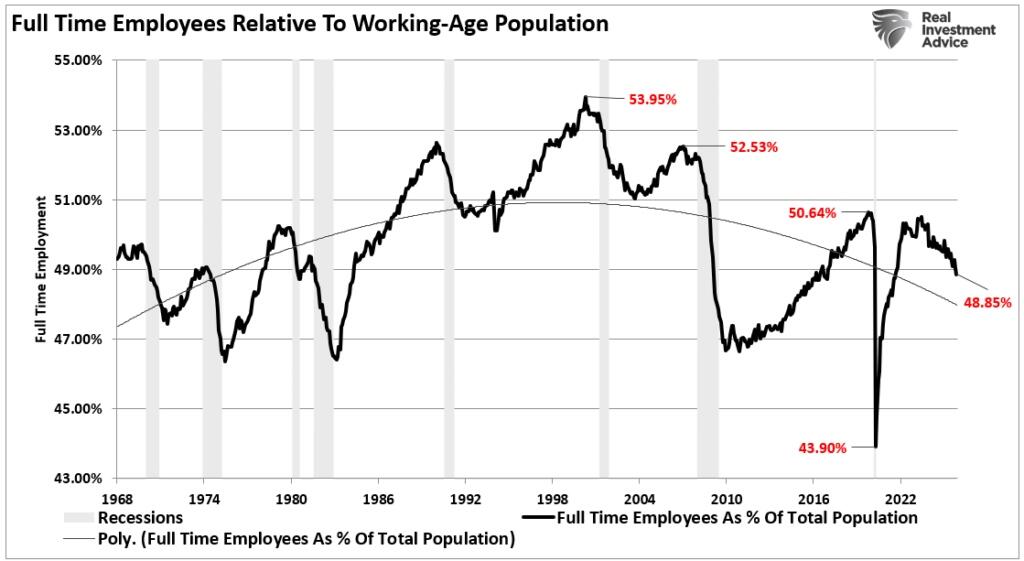
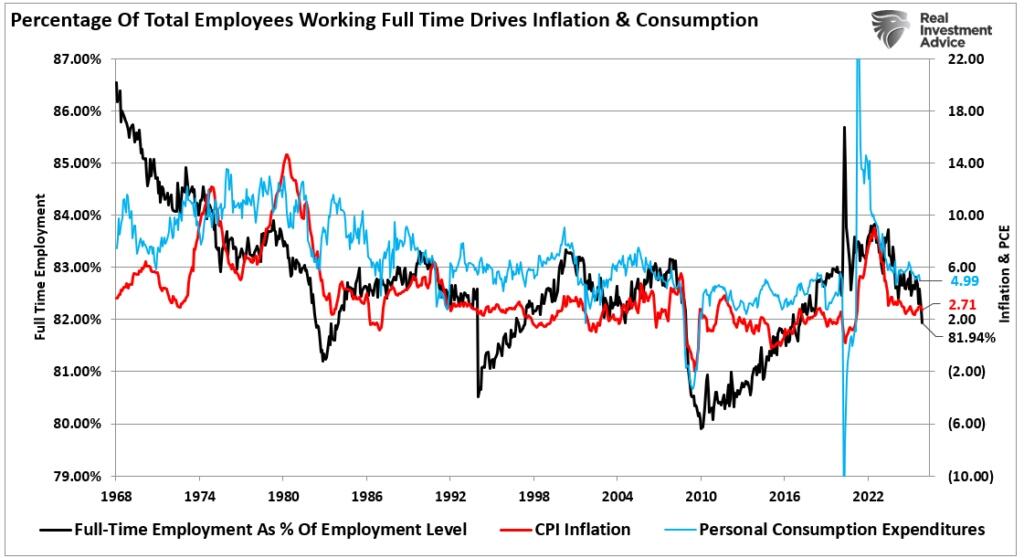
However, the employment data over the last year doesn’t tell a story of substantial employment, rising wages, or a trend suggesting a more robust economic outlook. Instead, the latest data confirmed a deceleration in economic activity, as full-time employment (as a percentage of the population) declined.
The importance of full-time employment should not be readily dismissed. Full-time employment pays higher wages, provides family benefits, and allows for an expansion of consumption. The decline in full-time employment currently is normally associated with recessions rather than expansions. Economic growth, inflation, and personal consumption are trending lower, given that employment, particularly full-time employment, supports economic supply and demand.
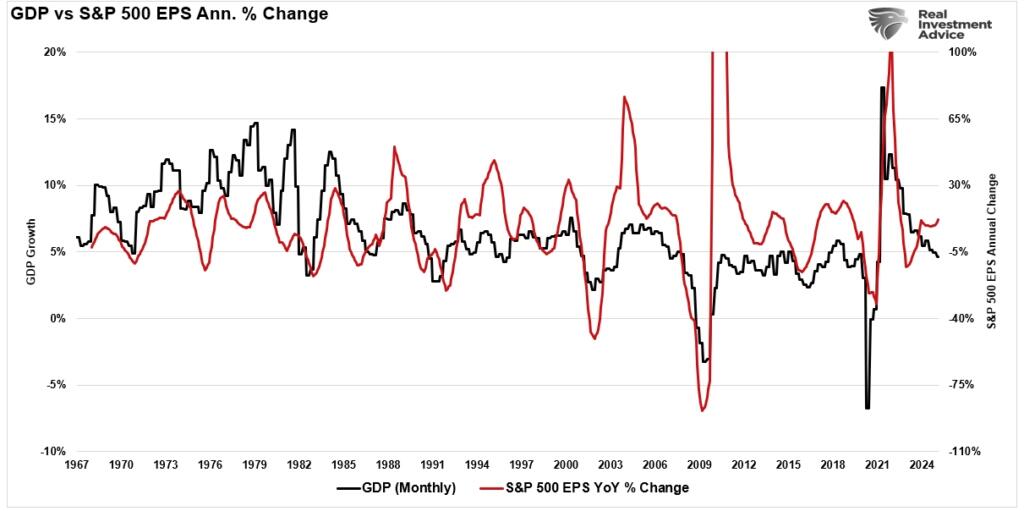
Furthermore, economic growth relies heavily on consumer spending, which accounts for nearly 70% of U.S. GDP. For that consumption to persist or grow, consumers must have rising incomes, which come from employment and wage growth. Without job creation or real wage increases, consumption growth stagnates, and the earnings narrative breaks down. As shown, when economic growth declines, so do earnings growth rates.
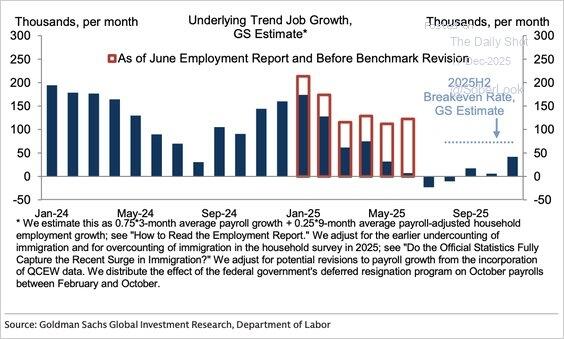
Recent employment data show cracks in this cycle. While headline job numbers suggest continued hiring, the quality and composition of those jobs are weakening. Today we see part-time workers filling full-time positions, often with lower pay and fewer benefits. Labor force participation remains below pre-pandemic levels, and many prime-age workers are not returning. Most notably, the negative revision of every monthly employment report in 2025 further undermines the “strong economy” narrative.
Even where wages are rising nominally, inflation-adjusted wages tell a different story. Real wage growth has been flat or negative in several key sectors. As housing, energy, and service prices remain high, the squeeze of disposable income increases. As such, consumers compensate by drawing down savings or using credit, both of which are unsustainable long-term strategies.
The market risk in 2026, is that for corporate earnings to accelerate and meet Wall Street’s expecations, the consumer must be healthy. That means rising real wages and broad-based job creation. Without those pillars, top-line revenue growth slows, and margin pressures increase. Analysts projecting double-digit earnings growth into 2026 are assuming a demand-driven economy without the income growth needed to support it. That assumption is increasingly fragile. Without real economic growth, earnings become a product of financial engineering or cost-cutting, not organic expansion. Markets are pricing in a demand surge that the employment data do not confirm.
If this disconnect persists, Wall Street will revise earnings expectations lower.
Valuation Fragility
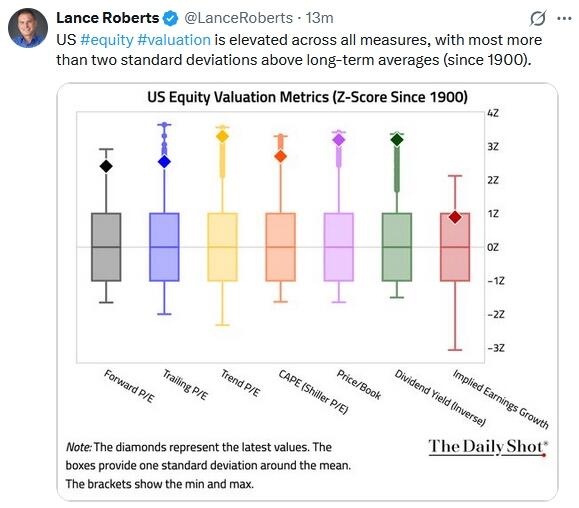
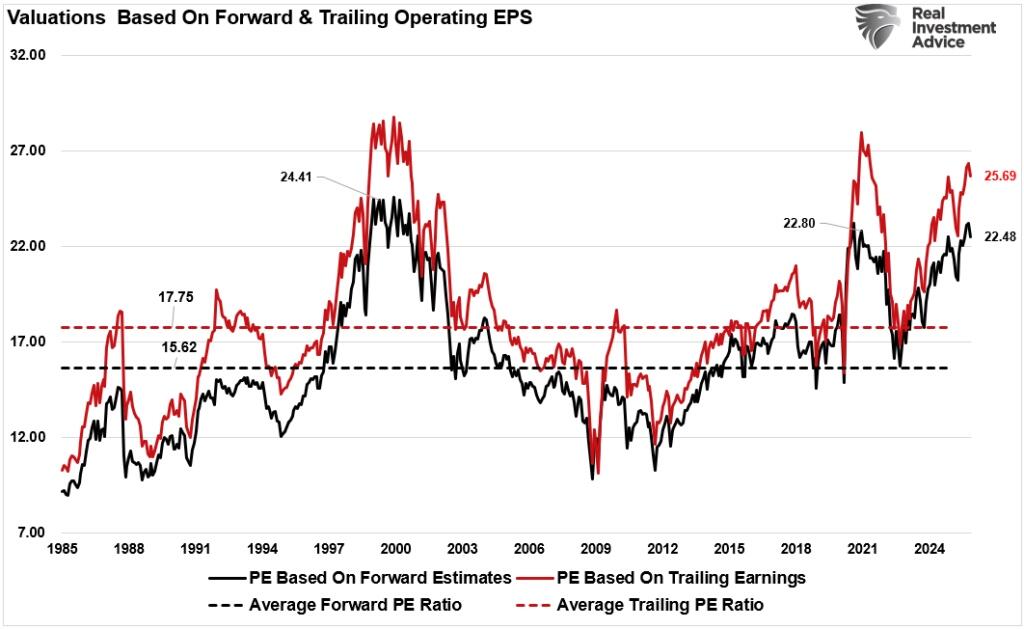
That last sentence is the most crucial. With valuations near cycle highs, (the S&P 500 trades at over 22x times forward earnings, which is well above its long-term average), such assume strong earnings growth and low discount rates. Yet both assumptions are vulnerable. If economic growth undershoots, earnings revisions will follow. Historically, earnings have tended to lag behind the economic cycle. As consumption softens, revenue growth stalls. Margins then compress, especially for companies with high labor or financing costs, and with narrow market breadth and concentration in mega-cap names, the market risk is a sudden repricing of those expectations.
Credit risk premiums remain compressed across all asset classes, from high-yield to investment-grade, which reflects a belief in Fed control and continued monetary easing. If those beliefs are shaken, volatility will return. Market participants are not expecting a scenario where all risk assets decline simultaneously, including stocks, crypto, precious metals, and international markets.
Implications for Investors
The market risk for investors is not a 2008-style collapse. However, a far more likely scenario is a long period of underperformance. That underperformance will likely be a function of earnings disappointment, weak growth, and multiple compression. Market analysts are currently pricing the market for acceleration. But those views may struggle is stagnation, and the “path of least resistance,” shifts from upward momentum to sideways drift or correction.
As such investors should continually monitor and assess the risk they are taking in portfolios.
Reassess exposure to high-multiple equities and overconcentrated sectors. While technologty drives index performance, valuations are high and if growth expectations are too high, tech earnings will likely fail to meet them. The same applies to consumer discretionary stocks tied to fragile spending.
Consider a more defensive position, focusing on free cash flow, balance sheet strength, dividends, and pricing power.
Add bonds to your portfolio to protect prinicpal and create income. Furthermore, in the event of a risk-off rotation, investors will seek the safety of bonds to reduce portfolio risk. Being there before the correction occurs can be beneficial to outcomes.
Liquidity should always be a priority. If risk aversion returns, liquidity conditions can tighten quickly. Investors consider a scenario where risk assets (stocks, commodities, metals, and cryptocurrencies) decline sharply as risk resets
A prudent approach is to reduce exposure to narrative-driven assets and increase allocations to quality. Investors should favor sectors with consistent earnings, low leverage, and stable dividends. Cash remains underappreciated as a strategic tool, and with real yields positive and volatility likely to rise, liquidity is a source of optionality.
The next two years will test the soft landing thesis. If growth falls short, earnings disappoint, or inflation returns, markets will face a reset. That reset may not be dramatic, but it will be painful for those overexposed to the current consensus.
The best defense is valuation discipline, risk awareness, and a willingness to question the prevailing narrative.
Tyler Durden
Mon, 12/29/2025 – 11:40
https://www.zerohedge.com/markets/market-risk-2026-if-growth-projections-fail

Lake County business officials hope to build on strong 2025: ‘One of the most dynamic economic transformations in Chicagoland’
Walking into a retail store in Lake County, customers are not likely to find products made by Libertyville and Round Lake Park-based Belle Aire Creations, but there is a good chance that there is already something in their home with a scent or flavor made by the business.
Working with partners who manufacture other products, Belle Aire gives those goods their fragrance or flavor, according to the company website. A Belle Aire product can also neutralize an unpleasant smell.
“Our scents or flavors are pretty much anywhere you are,” Belle Aire Chief Operating Officer Jason Dhaliwal said.
Belle Aire is one of a number of businesses that have helped spur economic growth over the past year in Lake County, along with a growing workforce and collaboration among a variety of people contributing to the ecosystem.
“Lake County is leading one of the most dynamic economic transformations in Chicagoland,” Kevin Considine, the president and CEO of Lake Partners, said. “With over $1.7 billion in new investment, and thousands of jobs created and retained over the last five years, the region is proving its strength.”
Part of the county’s industrial growth, Dhaliwal said, Belle Aire more than tripled the size of its workforce in the past five years, going from 63 employees in 2000 to now more than 200.
Founded by two brothers — Richard and Charles David — and a third partner, Don Conover Sr., in 1982, the second generation of the families is now running Belle Aire. Dhaliwal said Stacey David became CEO in 2016.
Dhaliwal said Belle Aire was originally based in Mundelein, but outgrew its space, moving its manufacturing operation to Round Lake Park in 2021 and opening a separate facility for its corporate headquarters and creative center in Libertyville the following year.
Focusing on what Dhaliwal said is the middle market, Belle Aire was purchased by Switzerland-based Givaudan on Dec. 1. The now parent company makes similar products for a larger market. He said little will change for Belle Aire.
“We are assured the people who are still here will continue to have jobs,” Dhaliwal said. ”We’re a middle-market company. What we do is relationship-based. Big companies do things differently.”
Colorado-based Tolmar, Inc., a specialty pharmaceutical company manufacturing drugs including those treating cancer, is opening a research laboratory at Rosalind Franklin University’s Innovation and Research Park, according to a news release from the school. It already has executive, sales and marketing offices in Buffalo Grove.
“At Rosalind Franklin, Tolmar gains world-class research space and the chance to collaborate with leading scientists and research cores,” Stace Porter, Tolmar’s senior vice president of development operations, said in the release.
Earlier this year, Fortune Brands consolidated its headquarters for its far-flung companies — Moen Faucets, Master Lock and others — expanding its 135-person Deerfield operation into space where more than 1,000 may eventually work.
Considine said another element of business growth — particularly in the industrial sector — comes from places like Lake County Workforce Development and the College of Lake County. Between coursework and training programs, local people can fill needed positions.
“They have very quietly been on a tear,” Considine said. “They are preparing people for needed, well-paying jobs.”
Jennifer Serino, the executive director of Lake County Workfree Development, said the operation uses a variety of programs to “fill the talent gap” for employers in the area. They involve direct training of both new and existing personnel. It often includes paying six months of wages during the learning process.
“We help people learn new skills,” Serino said. “We do new product training for existing employees. We help people returning to the workforce learn new skills which are relevant today.”
Serino said a lot of the programs are funded by the US. Department of Labor Workforce Innovation and Opportunity Act.
https://www.chicagotribune.com/2025/12/29/lake-county-business-year/

Nigerians Applaud Trump’s Military Strikes On Islamic Terrorists
Nigerians Applaud Trump’s Military Strikes On Islamic Terrorists
Trump’s military strikes against Islamic terror groups in Nigeria have been met with overall applause by Nigerian citizens and migrants residing in the US. Authorities say the groups have links to jihadist networks in Mali and Niger and their members have settled in border communities, recruiting young people and imposing brutal controls.
Associated Muslim militants were responsible for numerous attacks on Christian communities and schools in the country in early 2025, including the coordinated massacre of 280 Christian farmers in the village of Yelwata; many victims burned alive or hacked to death. It was one of the worst single incidents of Christian slaughter in the past decade.
In a national statement, Nigeria’s information ministry said “precision strike operations” had been carried with the “explicit approval” of President Bola Tinubu and with “the full involvement of the armed forces of Nigeria”. Trump brought global exposure to the attacks on Christians in the region, accusing the Nigerian government of apathy in the face of genocide.
The event is being framed as a “joint operation” between Nigeria and the US, however, it is likely that international attention forced the hand of the current regime to cooperate with US military operations. Nothing would have been done about the militants had Trump not stepped in.
Many Christian Nigerians abroad and migrants in the US are optimistic about the country’s prospects for peace and have applauded the strikes. Nigeria is 56% Muslim and 43% Christian. The northern provinces, controlled by Muslims, have instituted Sharia Law despite the country having a “secular constitution.” This has created religious tensions across the nation and helped to enable escalating Islamic militant attacks.
It’s good to see at least one group of third world migrants showing appreciation for US efforts.
The establishment media in the west, however, is not happy about Trump’s efforts in Africa, and has been working diligently to deny that the conflict is driven by religious motives. Though they are forced to admit that the strikes have had a positive effect on Nigeria’s Christian population, they continue to frame the killings of villagers as “land disputes” (take note of the seemingly scripted propaganda planted in the AP report below).
The motives of the media are obvious; third world immigration is an integral part of the multicultural agenda to destabilize the west and admitting that Islamic migrants might be a security hazard hurts that agenda. They could not be more transparent, given the fact that journalists immediately tried to make the issue about immigration once news of the strikes hit the new feeds.
Western journalists have accused Trump of hypocrisy because of his block on immigration from a number of African nations including Nigeria. They argue that Trump does not really want to help Christians because he won’t allow Nigerians to come to the US to escape the sectarian violence.
However, simply claiming to be Christian is not enough to gain US citizenship. Trump’s position is clear – Third world populations need to fix their own countries rather than running to the US. Despite the socialist “melting pot” narrative, America has never been obligated to take on the refugees of the world. The Trump Administration’s intervention in Nigeria only shows that the President is serious about those people staying where they are so they can repair or replace their broken government.
In July as Trump ramped up criticism of the Nigerian government’s handling of the situation, NPR attempted to paint the attacks as a “land dispute” over access to cattle grazing areas. They repeated the Nigerian Foreign Ministry’s claims that the events had “nothing to do with religion.” In almost every case of Christians being hunted by Muslim militants, the media is on the side of the governments that allow the attacks to happen.
A number of western media platforms dismiss or marginalize the attacks on Christian villages in Nigeria, claiming that “most victims are Muslims.” What they don’t mention is that most Muslim “victims” are largely rival militants fighting for a superior position. Christians have not involved themselves in the power struggle, yet, they are specifically targeted for extermination.
Reports from the International Society for Civil Liberties and Rule of Law (Intersociety) state that over 7,000 Christians were killed in Nigeria in the first 220 days of 2025. The bottom line is, Christians are disproportionately targeted by Islamic violence in Africa and African governments are content to let it happen.
Tyler Durden
Mon, 12/29/2025 – 11:20
https://www.zerohedge.com/geopolitical/nigerians-applaud-trumps-military-strikes-islamic-terrorists