Category: News

Outreach workers pass out free fentanyl detection devices to help screen drugs, reduce risk of overdose
A young man approached a card table set up under the Green Line tracks on the city’s West Side and asked the woman behind it if she had any clean needles or naloxone, a medication that can reverse the effects of an opioid overdose.
While rummaging through a box of supplies in search of those items, the woman also handed him another small package: a fentanyl detection device, which is designed to screen illicit drugs for the presence of that highly potent — and potentially fatal — substance.
Fentanyl, a synthetic opioid 100 times stronger than morphine, is often mixed in with other narcotics or pressed into counterfeit pills, posing a high risk of overdose for unsuspecting users and the leading cause of death for Americans aged 18 to 45, according to the Drug Enforcement Administration.
The woman, who works for the local nonprofit West Side Heroin/Opioid Task Force, briefly explained how the device works as the man slipped the package into his coat pocket.
“It’s pretty cool,” she added. “Stay safe.”
Roughly a dozen outreach workers for the task force fanned out across the West Side on a recent weekday to distribute fentanyl detection devices, one of several drug harm mitigation strategies the organization uses to try to keep the community safer as well as prevent overdoses.
Outreach workers distribute Defent, a fentanyl detection device, and other supplies to people along West Lake Street on Dec. 30, 2025, outside the West Side Heroin/Opioid Task Force offices in Chicago’s West Garfield Park neighborhood. (Brian Cassella/Chicago Tribune)
“They absolutely test what’s in their drugs. They want to know what’s in their drug supply,” said the Rev. Fanya Buford-Berry, director of the task force. “Some people purchase heroin thinking it’s heroin but then they find out there’s fentanyl in it.”
The Centers for Disease Control and Prevention lauds fentanyl testing as “an important harm reduction tool.” While abstinence from drugs is the only way to prevent overdose, testing can help decrease the risk of overdose when used in concert with other harm reduction strategies.
“Look for organizations in your city or state that distribute (fentanyl testing strips), keep them on you, and use them,” the CDC says on its website.
The task force usually passes out kits that include fentanyl detection strips inside plastic sandwich bags, along with sterile water and little paper condiment cups, which are used to perform the test; illicit pills should be crushed first before testing.
A small amount of drugs are then placed in the clean, dry containers and mixed with a small amount of water, according to instructions on the CDC’s website. The test strips are placed in the water for 15 seconds and then taken out and left on a flat surface for a few minutes, before reading results.
On this particular day, the task force also distributed a newer product called Defent, an all-in-one, prepackaged portable fentanyl detection device that looks similar to a COVID or pregnancy test and eliminates a few of the typical testing steps.
The device is sold by the private California-based company Defense Diagnostics Inc., and hundreds of them were recently donated to the task force for local distribution. The single-use product typically retails for $10, with discounts when multiple devices are purchased at the same time.
Some task force workers conjectured that the ease of use and convenience of a prepackaged device might prompt more folks to test their drugs, especially those who are younger.
Outreach workers from the West Side Heroin/Opioid Task Force pass out Defent, a fentanyl detection device, along West Lake Street during an outreach event on Dec. 30, 2025. (Brian Cassella/Chicago Tribune)
Defense Diagnostics CEO and founder Ahmad Hussain, who was raised in west suburban Carol Stream and attended DePaul University, said the all-in-one fentanyl detection device is “designed to be used on the go.”
“No matter where they are, whether it’s a musical festival … service workers, people who work in night life, college students — it’s been very beneficial for those audiences,” he said. “This is just a way for people to make informed decisions.”
Hussain said he was motivated to create the product after fentanyl killed his 19-year-old cousin about a decade ago.
“The more and more you talk about it, you realize most people are no further than a couple degrees separated from an opioid tragedy,” he said.
The devices were also distributed over the summer at Lollapalooza in Grant Park, Hussain added.
“Because they have such a wide range of music, for us, we saw it as an opportunity to cover many demographics and it was such a big event, it was just a way to increase awareness across a larger range of groups of people.”
The CDC cautions, though, that while fentanyl testing can reduce harm it still has some limitations.
For example, fentanyl might not be detected if it is in the drugs but no trace happens to be in the sample that’s tested, which is known as “the chocolate chip cookie effect.” Just as one bite of a cookie might not happen to contain chocolate chips, one small sample of drugs might not include fentanyl even if the larger supply is tainted, the agency’s website explains.
Testing might not identify some analog drugs, powerful synthetic opioids that are chemically similar to fentanyl; it also can’t reveal how much fentanyl is in a supply, just that its presence is detected, the CDC added.
The agency urges use of fentanyl testing in combination with other steps to mitigate harm such as never using drugs alone and not mixing different drugs, as well as always keeping the overdose reversal medication naloxone, also known by the brand name Narcan, on hand and at home.
“Don’t rely on a previous source or experience,” the CDC warns. “Knowing where your drugs come from doesn’t mean they’re safe. And even if you have used drugs before, your body could react differently every time.”
The CDC website also includes information on drug treatment and recovery.
Outreach worker Brianna Allen explains how Defent, a fentanyl detection device, works to people along West Lake Street on Dec. 30, 2025, outside the West Side Heroin/Opioid Task Force offices in Chicago’s West Garfield Park neighborhood. (Brian Cassella/Chicago Tribune)
Members of the task force also routinely connect folks with those services locally, Buford-Berry said.
But harm reduction strategies such as fentanyl testing can be critical for people who aren’t ready to seek treatment or begin recovery, as well as in the event of a relapse.
“When you’re ready for care, we’ll get you into care,” she added. “Until then, we want to make sure people stay alive. Every day a person is allowed to stay alive, they can choose recovery. They can’t choose recovery if they’re dead.”
In mid-December, President Donald Trump signed an executive order that designated illicit fentanyl to be a “weapon of mass destruction” as opposed to previous language classifying the opioid crisis as a nationwide public health emergency.
“Illicit fentanyl is closer to a chemical weapon than a narcotic,” the executive order said. “Two milligrams, an almost undetectable trace amount equivalent to 10 to 15 grains of table salt, constitutes a lethal dose. Hundreds of thousands of Americans have died from fentanyl overdoses.”
However, many drug harm reduction and recovery advocates in Illinois as well as across the nation have condemned this reclassification, fearing that the language implies someone struggling with addiction could face harsher penalties for using fentanyl.
“Advocates who lost children, friends and family to overdose have advocated against this approach, as it could stop someone from asking for help during an overdose emergency,” said a Dec. 29 statement from the Illinois Harm Reduction and Recovery Coalition.
The coalition — whose members include the West Side Heroin/Opioid Task Force as well as the Aids Foundation of Chicago, the Sex Worker Outreach Project Chicago and other local organizations — was formed in 2017 to fight stigma surrounding drug use and promote life-saving substance abuse strategies.
The coalition’s statement noted that the executive order doesn’t mention drug treatment or overdose prevention strategies.
Adam Rangoon talks to people along West Lake Street during an outreach event on Dec. 30, 2025, outside the West Side Heroin/Opioid Task Force offices in Chicago’s West Garfield Park neighborhood. (Brian Cassella/Chicago Tribune)
“The bottom line is clear: fentanyl is a public health crisis,” the statement added. “This (executive order) offers no proven solutions for the overdose crisis — its intention is to expand war powers, not lifesaving solutions. Declaring fentanyl a weapon of mass destruction justifies reckless violence while ignoring the proven health solutions that actually reduce overdose deaths of Americans.”
Across the state, public health authorities have recently launched a variety of harm reduction initiatives designed to decrease the risk of drug overdoses.
The Chicago Department of Public Health offers free Narcan, fentanyl testing kits and drug harm reduction training.
Cook County officials in September began a campaign dubbed “Get Naloxone,” featuring digital marketing, billboards and posters in English and Spanish.
Rush University Medical Center began hosting Narcan nasal spray training sessions for barber college students in summer 2024, enlisting prospective barbers and beauticians in the fight to combat the opioid epidemic.
Narcan vending machines dispense the overdose reversal medication for free at a half-dozen CTA stops across Chicago.
A new law that took effect Thursday requires libraries across Illinois to stock supplies of medications that can reverse opioid overdoses; libraries must also “take reasonable steps” to ensure a staff member who has been trained to recognize and respond to opioid overdoses is always present.
“We know this is just a realistic part of a library’s work,” Ellen Riggsbee of the Evanston Public Library told the Tribune, a few days before the law went into effect. “It’s a public library and we have to ensure the safety of everybody who comes in.”
https://www.chicagotribune.com/2026/01/05/fentanyl-detection-reduce-overdose/

Jennifer Obel: Why the success of the gay romance series ‘Heated Rivalry’ matters
I am a 56-year-old woman who loves romance fiction, so I fell for “Heated Rivalry.” My daughter introduced me to the streaming adaptation. She texted me about it with the confidence of someone who knew I would understand why it mattered. I raised my daughters to believe that sex can be a source of connection and pleasure, something to claim without embarrassment or shame.
We loved “Heated Rivalry,” first as readers and later as viewers, when the story moved from page to screen on HBO Max. It surged into the cultural mainstream. What began as erotic fantasy deepened into something else: a public story about intimacy, courage and what love is allowed to look like.
Part of the draw is obvious. The series is sexy and unapologetically physical. Viewers are pulled in by desire, by chemistry and by bodies on-screen. That isn’t incidental. Sex has always been one of the ways people cross lines they are told must remain fixed. What matters is not the novelty, but what keeps them watching.
In “Heated Rivalry,” a confident Russian professional hockey player named Ilya is drawn to his quieter rival, Shane, who is still coming to terms with his sexuality. What begins as attraction slowly becomes attachment, then commitment. By the time another player, Scott Hunter, stands before a national championship crowd and kisses the man he loves, the moment feels earned rather than provocative.
Fans watched that scene unfold in sports bars, a place long associated with rigid ideas of masculinity, and no one felt the need to look away. The show’s fifth episode, titled “I’ll Believe in Anything,” earned a 9.9 out of 10 rating on IMDb and drew widespread attention for its emotional depth.
Watching the show, I felt a flush, then curiosity, then attention. Two men inhabited their bodies with confidence as their relationship took shape. What held me wasn’t the spectacle but clarity. That kind of portrayal still feels rare. Once seen, it recalibrates what viewers expect to be allowed to witness.
None of this occurred outside today’s political moment. It unfolded squarely within it.
When President Donald Trump banned transgender Americans from serving in the military, he did more than reverse a policy. He told capable service members that their willingness to risk their lives for their country was irrelevant — that their identity alone rendered them disposable. It was a misuse of state power to declare that some Americans count less, even when they serve with honor.
At the same time, his administration moved to weaken federal protections for gay and lesbian Americans. Safeguards in health care, housing, employment and education were eroded. Equality was no longer treated as a right. Civil rights became provisional, dependent on politics rather than principle.
Against that backdrop, a sport long coded as immutably masculine was transformed, without controversy, into a setting for tenderness and love between two men. Viewers accepted that inversion without hesitation.
Who embraced “Heated Rivalry” matters. The series didn’t break through because heterosexual men suddenly came around. Most did not. It became a shared cultural touchstone among women and the LGBTQ+ community. Research has consistently shown that heterosexual women are more comfortable with homosexuality than heterosexual men, whose acceptance drops sharply when intimacy involves other men. For viewers already practiced at reading emotional nuance, watching two men love each other openly — even in locker rooms or on the ice — felt honest.
“Heated Rivalry” doesn’t argue with skeptics. It moves past them. Cultural change often begins by deepening the convictions of those already willing to see.
No one mandated that choice. There was no policy, no program, no government directive. Cultural acceptance matters politically because once people recognize a life as familiar and real, it becomes harder for the state to treat that life as disposable.
It is often said that politics follows culture. If that’s true, then culture becomes political the moment people decide who belongs and whose lives are worth defending.
Trumpism depends on exclusion — the idea that people may belong only if they conform to a narrow definition of who counts. Inclusion becomes something to manage, not a right to assume.
In communities ravaged by Immigration and Customs Enforcement raids, concealment has become a survival strategy. Living through Operation Midwest Blitz in Chicago, I gave my dearest friend a yarmulke. He is a light-skinned Hispanic man; in Trump’s America, he was safer looking Jewish than Hispanic. I begged his mother to wear a blond wig to hide her dark hair. The family now leaves their home only for work. Visibility has become a risk.
When audiences fall in love with “Heated Rivalry,” they are signaling whose lives deserve care and whose futures remain imaginable — including those pressured to shrink their lives.
Scott Hunter did not just win a championship. He carried his trophy around the rink, then did something braver. He brought the man he loves onto the ice and made his private life public, refusing to let success require silence or shame.
That moment illustrates what resistance can look like — against an administration that thrives on fear and against the lie that some love must be hidden to be acceptable.
Trump offers a smaller country, defined by boundaries rather than belonging. But Americans keep making a different choice. Long before laws change, people decide collectively who they are willing to stand beside in public. Increasingly, they choose an America larger than fear and stronger than the exclusion being sold to them as a restoration.
Jennifer Obel is a retired oncologist who writes about the intersection of medicine, ethics and public policy.
Submit a letter, of no more than 400 words, to the editor here or email letters@chicagotribune.com.
https://www.chicagotribune.com/2026/01/05/opinion-heated-rivalry-sex-connection-romance/

Editorial: A positive change for Venezuela but a diminishment of US moral authority for years to come
No sooner had the new year dawned than President Donald Trump introduced a new level of stress to the world, grabbing the leader of a sovereign nation without congressional approval, hauling Nicolás Maduro, the president of Venezuela, off to a New York jail cell and installing Secretary of State Marco Rubio as the de facto viceroy of Venezuela. All while trapping well-heeled American elites on Caribbean beaches as weekend, return-to-work flights from the region were nixed by the Federal Aviation Administration, citing safety concerns.
What a year. And it’s only Jan. 5.
Predictably, America’s left-wing mayors howled in protest at the weekend actions. New York’s Zohran Mamdani expressed concern for the Venezuelans in New York and accused Trump of violating international law. Mamdani let it be known he had called Trump to register his opposition to this actions, the honeymoon between those two men apparently having come to a swift conclusion. That was, of course, purely a performative act, as was the Chicago Teachers Union’s weekend “stop the bombings” rally with various socialist co-sponsors and Chicago Mayor Brandon Johnson’s statement that “the illegal actions by the Trump administration have nothing to do with defending the Venezuelan people; they are solely about oil and power.”
The problem the socialist mayors faced immediately was that many of the Venezuelans they claimed to be defending looked pretty happy to see the former bus driver and union leader go, not least because of the illegitimacy of his election in the first place, not to mention his presiding over a corrupt government known for its human rights abuses and diminishment of press freedoms. All that and grinding poverty, too. No wonder there was dancing in the streets and talk of a free Venezuela.
Moreover, it looks pretty clear that Trump’s notably clean removal operation was something of an inside job. The Miami Herald reported that the Venezuelan Vice President (and supposed Maduro loyalist) Delcy Rodríguez, had “reached out” (so to speak) to the Trump administration, suggesting she might just be a more acceptable leader when it comes to U.S. interests.
Reportedly, there were secret talks held in Qatar, with a member of the UAE’s ruling royal family in the room, along with Rodríguez’s brother. One can assume the U.S. interest in Rodríguez, at least in the short term, was to leave someone in power who could manage the “transition” without totally blowing up and rebuilding Venezuela, not to mention getting more useful information on the seemingly nonchalant but actually increasingly paranoid Maduro’s whereabouts.
“She’s essentially willing to do what we think is necessary to make Venezuela great again,” Trump told reporters of Rodríguez. Translation: She will do what we want because she knows who is in charge. Rodríguez, however, is already showing signs that she won’t be so easily controlled.
Purely observationally, the events in Caracas offer yet another lamentable reminder of how much the liberal, old world order has disintegrated in the age of Trump and Putin. We now live on a planet dominated by raw, authoritarian, executive, centralized power, with subnational figures like mayors (not to mention members of the U.S. Congress and European leaders) all reduced to bleating inconsequentially on the sidelines.
Simply put, Maduro was deemed by Trump to be incompatible with U.S. interests, which naturally includes the extraction of oil and the disruption of the supply of illegal drugs, so the administration simply unleashed the power of the U.S. military to go in and remove him. This will appeal to those who believe in American exceptionalism; there are similarities with Trump’s interventionist plan for a Gaza more aligned with U.S. and Israeli (and UAE) interests.
Tacitly, the action sends a message to other nations with similarly incompatible governments that the U.S. won’t hesitate to take invasive action. How one feels depends really on how benign one feels U.S. interests to be, globally speaking.
If that were not enough, Trump openly stated a desire now to “run” a sovereign nation of some 28 million people, although Rubio walked that back some on Sunday morning.
Aside from being yet another example of Trump’s inconsistency, seemingly going from isolationist to interventionist over the Mar-a-Lago holiday buffets, any such “running” requires a confidence in the wildly impulsive Trump that we simply do not have, and nor should those who won’t miss the Venezuelan status quo. Congressional approval for this kind of action exists for good reasons, including the need for a clear plan for the aftermath.
We don’t lament Maduro’s exit for a moment and we’ll even allow that the removal action, if those are the right words, was impressive and reasonably light on collateral damage (although some 40 lives were lost). But the consequences likely will extend far into the future and far beyond Venezuela.
What moral authority does the U.S. now have if, say, China, removes the Taiwanese leadership, deeming it incompatible with Chinese interests? Not much. And this action surely weakens the moral argument against Vladimir Putin, though Ukrainian President Volodymyr Zelenskyy is now hoping Russia’s leader is the next authoritarian Trump takes out.
Howling in protest does little, of course. Elections have consequences. Maduro is gone from Venezuela and he will not be missed. We will have more to say as events unfold but, at this juncture, we urge the Trump administration to stop this hubristic talk of running things, involve the U.S. Congress in its plans for the future of Venezuela and focus on empowering the Venezuelan people and their democratically elected leaders.
Submit a letter, of no more than 400 words, to the editor here or email letters@chicagotribune.com.

Editorial: When it comes to growth, we wish all of Chicago’s was humming like O’Hare
At the end of 2025, American Airlines announced 100 new daily flights for the coming spring at Chicago’s O’Hare International Airport. To be clear, that’s not 100 more than at the same point in the spring of 2025 (we wrote about that prior growth at that time), but a further 100 new departures added to what already was on sale for 2026.
It’s a significant and somewhat unexpected commitment to Chicago, American’s third-largest hub, a huge turnaround from where American was in regard to Chicago in 2023, and pretty much confirmation that United Airlines has not forced American to retreat from Chicago, as United’s leadership had reportedly bragged would be the case.
United, Chicago’s hometown airline, is still bigger at ORD, of course. And some of what American has been doing here is returning service to prepandemic levels. But meaningful new growth from American at our big airport was announced last week, including new flights to Midwest airports like Erie, Pennsylvania, and Lincoln, Nebraska, and more service to the likes of San Francisco, Las Vegas and Savannah, Georgia. Finally, American seems to have gotten over its obsession with Charlotte, North Carolina.
Benefits for Chicago are many. Since airline fares are determined by inventory and what the market will bear, more capacity means lower fares. So, of course, does competition like this great fight between United and American at O’Hare. New convenient nonstops from smaller cities means more people will choose to visit.
Expanded service to Paris, to cite another growing route on AA, means more international tourism, since people flying through a city sometimes add a stopover. All of this means more money spent at airport concessions and the like, feeding the local economy and creating jobs. And more people eyeballing our beautiful skyline as they come in to land, ready to come back and stick around.
Add to this a very efficient holiday performance at the airport, despite a variety of ongoing construction projects, and it adds up to the most effective department in Mayor Brandon Johnson’s Chicago, notwithstanding our soft spot for Streets and Sanitation, which hauls away our Christmas trees.
The contrast is especially striking between the airport and the Department of Cultural Affairs and Special Events, which should have ensured that national TV audiences saw a much more robust New Year’s Eve celebration than actually was the case; it was, alas, a bit of a rinky-dink celebration that signaled worry and lack of ambition, neither of which are qualities that this city of broad shoulders and powerful artists needs to broadcast. We should grow the event next year.
Indeed, in a city where discussions of growth are all too rare from our leaders (Johnson prefers to define those fighting for the city’s future as “the oligarch class” who must be resisted), the airport really is the brightest spot and about as far from rinky-dink as an airport can be. We’d be in far bigger trouble without O’Hare.
The place is not perfect. We still think the international greeting area in Terminal 5 is a missed opportunity; the space is underwhelming, unwelcoming and confusing for those transferring to domestic flights, at least for the next several years.
Airport transportation remains weak. At the car rental and bus center, we watched several shivering people follow a promising sign out to Metra’s “O’Hare transfer station” around the corner, assuming that meant actual train service to downtown beyond the one train a day after about 10 a.m. Not the case, alas.
Travelers arrive to Terminal 1 at O’Hare International Airport the day before Thanksgiving, Nov. 26, 2025. (Armando L. Sanchez/Chicago Tribune)
And we’re perplexed that the international terminal has almost no commercial advertising, despite the huge number of affluent travelers passing through the sterile areas. The art is all very nice, but most airports use that space to make money and the city owns this one.
But while there is work to do, you can also see that work being done. Concessions have markedly improved, the TSA operation is atypically smooth compared with other airports and you can even drive to the airport by car now without massive delays, thanks to the end of the Kennedy Expressway construction. That will get even better with the building of the proposed western entry point to the airport, long another weakness. Somehow at O’Hare, things that languish elsewhere get fixed.
But what matters most here is the choice and frequency of flights, both domestic and international. In that regard, O’Hare is booming with more international destinations likely to come from American once it takes more deliveries of its lower cost Airbus A321XLR, including (we’ve been tacitly promised) the return of at least one daytime flight to Europe.
Most Chicagoans feel proud when their flight attendants say, “Welcome to Chicago’s O’Hare International Airport,” as a big bird touches down and well they should. It’s a world-class operation thanks to effective management and to two of America’s most famous corporations, United and American Airlines.
May they battle on here in 2026!
Submit a letter, of no more than 400 words, to the editor here or email letters@chicagotribune.com.

Waymo, Santa Monica Sue Each Other Over Charging Stations
Waymo, Santa Monica Sue Each Other Over Charging Stations
Waymo, the Bay Area-based autonomous vehicle company and the city of Santa Monica, California are suing each other over the overnight use of charging stations for Waymo cars.
Santa Monica has asked a judge to order Waymo not to use charging stations operated by Voltera from 11 p.m. to 6 a.m., or to take other measures to be less of a nuisance, after residents complained that noise and light from recharging made the town like a “mini-Las Vegas” or “living next door to a spaceship,” KABC-TV reports.
In their suit against the city, meanwhile, Waymo – a subsidiary of Google’s parent company Alphabet, seeks relief to prevent city officials from interfering with the company’s charging operations along Santa Monica’s Broadway.
“Waymo has demonstrated a consistent commitment to being a good neighbor, including by consulting with regulators to mitigate noise concerns … the City has been unwilling to authorize simple improvements to respond to neighbors’ feedback … Waymo and Voltera remain in full compliance with all local requirements and will continue our operations accordingly,” a Waymo spokesperson told the outlet.
City officials released their own statement explaining that they filed suit because Waymo did not agree to changes in operations for the charging stations that would not have involved shutting them down.
“This is not about opposing Waymo or EV charging. It is about enforcing long-standing nuisance laws that apply to every business when operations substantially interfere with public health, safety, and quality of life,” officials told the outlet.
Tyler Durden
Mon, 01/05/2026 – 05:45
https://www.zerohedge.com/technology/waymo-santa-monica-sue-each-other-over-charging-stations

Today in Chicago History: It’s a girl! First child born to Bears owner George Halas.
Here’s a look back at what happened in the Chicago area on Jan. 5, according to the Tribune’s archives.
Is an important event missing from this date? Email us.
Front page (of the Business section) flashback: Jan. 6, 2021
Macy’s announced on Jan. 5, 2021, it was closing the department store chain’s flagship store inside Water Tower Place. (Chicago Tribune)
Macy’s announced plan to close its store in Water Tower Place on Michigan Avenue.
Weather records (from the National Weather Service, Chicago)
High temperature: 56 degrees (1890)
Low temperature: Minus 18 degrees (1884)
Precipitation: 0.80 inches (1929)
Snowfall: 8.7 inches (2014)
Virginia Halas McCaskey with Terry Bradshaw after the Chicago Bears beat the New Orleans Saints 39-14 to win the NFC Championship game on Jan. 21, 2007, at Soldier Field in Chicago. (John Smierciak/Chicago Tribune)
1923: A baby girl was born to Chicago Bears owner and coach George Halas. Virginia Halas McCaskey was the principal owner of the team until her death in February 2025 at 102.
Who is Virginia McCaskey? 8 things to know about the owner of the Chicago Bears.
“I had assumed — and so had Min (Minnie, his wife) — that the new arrival would be George Stanley Halas Jr.,” the founder and owner of the Bears said in the 1979 book “Halas by Halas: The Autobiography of George Halas.” “I already had visions of drawing my son into the thick of the Bears. We didn’t even have a name for a girl. After some searching we decided on Mary Barbara, for her two grandmothers. But my brother Frank already had appropriated those names for his daughter.”
1937: Mayor Edward Kelly appointed five men to function as the newly created Chicago Housing Authority.
An abandoned brickyard at 2600 N. Narragansett Ave. was turned into the first ski area within Chicago, which opened in early 1968. Little snow, however, forced its closure and it was leveled for the next establishment on the site, Brickyard Mall. (Chicago Tribune)
1968: Thunder Mountain, the first ski resort within Chicago’s city limits, opened.
Dan Fitzpatrick, of Bensenville, shops for Craftsman tools at the Sears store in the Oakbrook Center mall on Black Friday, Nov. 23, 2018. (Antonio Perez/Chicago Tribune)
2017: Sears sold the Craftsman brand to Stanley Black & Decker.
Sears timeline: Rise, fall and restructuring of a Chicago icon over 130 years
Want more vintage Chicago?
Subscribe to the free Vintage Chicago Tribune newsletter, join our Chicagoland history Facebook group and follow us on Instagram for more from Chicago’s past.
Have an idea for Vintage Chicago Tribune? Share it with Kori Rumore and Marianne Mather at krumore@chicagotribune.com and mmather@chicagotribune.com
https://www.chicagotribune.com/2026/01/05/january-5-chicago-history/

Today in History: Door plug blows off Alaska Airlines plane
Today is Monday, Jan. 5, the fifth day of 2026. There are 360 days left in the year.
Today in history:
On Jan. 5, 2024, a door plug on Alaska Airlines jetliner blew out shortly after takeoff from Portland, Oregon, forcing the 171 passengers and six crew to don oxygen masks before the pilots made an emergency landing. No one was seriously hurt, but the sudden depressurization left a gaping hole in the Boeing 737 Max 9 aircraft.
FAA seeks $3.1 million in fines from Boeing over safety violations, 2024 midair panel blowout
Also on this date:
In 1896, an Austrian newspaper reported the discovery by German physicist Wilhelm Röntgen of a new type of radiation that came to be called “X-ray.”
In 1925, Democrat Nellie Tayloe Ross of Wyoming took office as America’s first female governor.
In 1933, construction began on the Golden Gate Bridge; the bridge was completed in May 1937.
In 1953, Samuel Beckett’s two-act tragicomedy “Waiting for Godot,” considered a classic of the Theater of the Absurd, premiered in Paris.
In 1957, President Dwight D. Eisenhower proposed assistance to countries to help them resist communist aggression in what became known as the Eisenhower Doctrine.
In 1972, President Richard Nixon announced the Space Shuttle program, directing NASA to produce a reusable vehicle that would boost manned space exploration while bringing down its costs. (The first shuttle launched in 1981 and the last in 2011.)
In 1980, “Rapper’s Delight,” by The Sugarhill Gang, became the first hip-hop song to reach the Billboard Top 40, helping to popularize the emerging musical genre.
Related Articles
Today in Chicago History: Fox’s WFLD-Ch. 32 begins broadcasting
Today in History: Burj Khalifa opens
Today in Chicago History: Feds charge longtime Ald. Edward Burke with extortion
Today in History: Elizabeth Holmes convicted
Today in Chicago History: Oprah Winfrey debuts on ‘AM Chicago’
In 2022, Australia denied entry to tennis star Novak Djokovic, who was seeking to play for a 10th Australian Open title later in the month; authorities canceled his visa upon his arrival in Melbourne because he failed to meet the requirements for an exemption to COVID-19 vaccination rules.
Today’s Birthdays: Actor Robert Duvall is 95. Filmmaker Hayao Miyazaki is 85. Actor Vinnie Jones is 61. TV personality Carrie Ann Inaba is 58. Rock singer Marilyn Manson is 57. Actor-filmmaker Bradley Cooper is 51. Actor January Jones is 48. Actor Brooklyn Sudano is 45. Actor Mike Faist is 34. Actor and model Suki Waterhouse is 34. Actor Walker Scobell is 17.

40% Of All Babies Born In Vienna Do Not Have An Austrian Passport
40% Of All Babies Born In Vienna Do Not Have An Austrian Passport
The demographic landscape of Vienna is shifting rapidly, with a record number of newborns lacking Austrian citizenship despite being born within the country. According to recent data from Statistics Austria, 40.5 percent of babies born in the capital do not have Austrian citizenship — a figure that has doubled from 20 percent just two decades ago.
In several Viennese districts, the statistics are even more striking. In areas such as Favoriten, Ottakring, and Rudolfsheim-Fünfhaus, the share of non-Austrian newborns has surpassed 50 percent. While these children are born on Austrian soil, they are not legally considered citizens, according to data from Heute newspaper.
This data comes at a time when 40.9% of all of Vienna’s population is foreign-born. Over 50 percent have both parents born overseas.
Those born without a passport do not automatically receive Austrian citizenship, as they do in the United States. Instead, there is a process, and in a number of cases, these people do not go on to obtain Austrian citizenship and have issues with voting and sometimes even staying in the country. Leftist politicians have called for these citizens to receive automatic citizenship.
In addition, of the approximately 60 percent of those born in Vienna with an Austrian passport, many of these births are to those with a migration background who also have Austrian citizenship.
🇦🇹Austria
Vienna has seen incredible demographic changes, especially in the last decade.
40.9% of its population is foreign born. Over 50% have both parents born overseas.
This year, for the first time ever, over half of first-graders do not understand German (50.9%). pic.twitter.com/P0P7dJVj5Q
— Remix News & Views (@RMXnews) December 17, 2025
In short, the demographics of Vienna are rapidly changing. As Remix News reported last month, for the first time ever, over 50 percent of first-graders do not understand German, a major milestone in the troubled Vienna school system.
Another milestone was also reached last year, with Muslims outnumbering Christians for the first time in the Vienna elementary school system.
Muslim students now account for 41.2 percent of all students, while Christian students fell to 34.5 percent. The trend is only growing, and is accompanied by rising problems, including violence in schools, anti-Semitism, and contempt for women.
Meanwhile, the right-wing Freedom Party of Austria (FPÖ) is raising the alarm about the rapid demographic change in Austria and Vienna.
“Austrians will soon be strangers in their own country,” said Hannes Amesbauer, security spokesman for the FPÖ.
FPÖ National Council member Maximilian Weinzierl, the FPÖ youth spokesperson and federal chairman of the Freedom Party Youth said:
“What we as the FPÖ have been warning about for decades, but which was always dismissed as right-wing scaremongering, is now reality: Immigration has completely overrun our country….41.2 percent of Muslim students – that’s no longer a minority, that’s the new majority. And it’s not just that Austrian children have become a minority in schools. Even together with other Christian European migrants, they are fewer than non-European Muslims. This is the direct result of replacement migration, asylum abuse, and the denial of reality by the SPÖ, ÖVP, and Greens.
In more and more school classes, German is a second language, and our values are becoming increasingly secondary. Our children are being marginalized by migrants. This is no longer immigration, this is displacement.”
Vienna has seen an incredible demographic transformation in recent decades, with an extreme acceleration in just the last 10 years.
Tyler Durden
Mon, 01/05/2026 – 05:00
https://www.zerohedge.com/geopolitical/40-all-babies-born-vienna-do-not-have-austrian-passport
Production For Security 2026
Production For Security 2026
Submitted by Peter Tchir of Academy Securities
ProSec 2026
We will do a “traditional” outlook for 2026, covering all major markets, but we really wanted to highlight ProSec and define more carefully what we think it means for you as corporations, policy makers, and asset managers.
Production for Security:
RESILIENCY. We haven’t used the word “resiliency” as much as we could have and will use it more going forward. Being resilient, whether at the nation, state, or corporate level, will become a fixture in decision making.
ProSec is already in the process of supplanting “traditional” ESG as an overarching theme in decision-making and planning.
As much as we’ve tried to instill our view on how big, broad, and important the scope of ProSec is, we have failed to do that – so far.
While not critical to ProSec we do believe that as the world adopts a “Pre-War” mentality, it helps accelerate ProSec as it imbues a degree of “sacrifice for the greater good” while also imparting a sense of “urgency.”
ProSec is already going global and getting left behind on this initiative will be problematic for countries, companies, and investors.
Resiliency as a Driving Force Behind ProSec
To some degree we can describe ProSec as being the answer to “What If?”
What if global shipping is disrupted?
It has happened for reasons “out of our control.” COVID was not on anyone’s radar screen. Even the Evergreen blocking the Suez Canal was an “unforeseen” accident. Will markets react the same the next time around to companies exposed to that risk? What if some companies have “planned” for this and have more robust supply chains – less use of shipping, using a variety of shipping lanes, only shipping with countries they are very close to – physically or politically? If a “competitor” has prepared and you haven’t, and it occurs again, it is difficult to see markets being as “understanding” as they were when it was deemed farfetched.
Legend has it that the disaster recovery plan for one incredibly large hedge fund was to use other offices as disaster recovery sites. It had the advantage of being global, so if something happened in a region that took out the main office, and the disaster recovery site, it would still be covered. It had the advantage of all sites being up to date. Nothing worse than getting to the disaster recovery site and realizing that the internet is too slow and you were running obsolete versions of software. The plan made a lot of sense. It did not cover the contingency of grounding all U.S. flights for days. To the extent the story is true (and I have no reason to doubt it), I can assure you that this fund revamped their plans to cover even more contingencies as well as other highly unlikely, but still possible scenarios. They increased their RESILIENCY as they absorbed new information.
It happened because a “bad actor” behaved badly. Prior to the invasion of Ukraine by Russia, we could explain being “asleep at the switch” in terms of this type of risk. Iran and its proxies attacking more aggressively in the Middle East has not caused major disruptions, but it has caused some level of disruption, and seemed like a more foreseeable event than Russia’s invasion. The U.S. has just “blockaded” Venezuela. Actually, we did not “blockade” Venezuela as that is an act of war according to international law, but we have changed the nature of doing business with Venezuela.
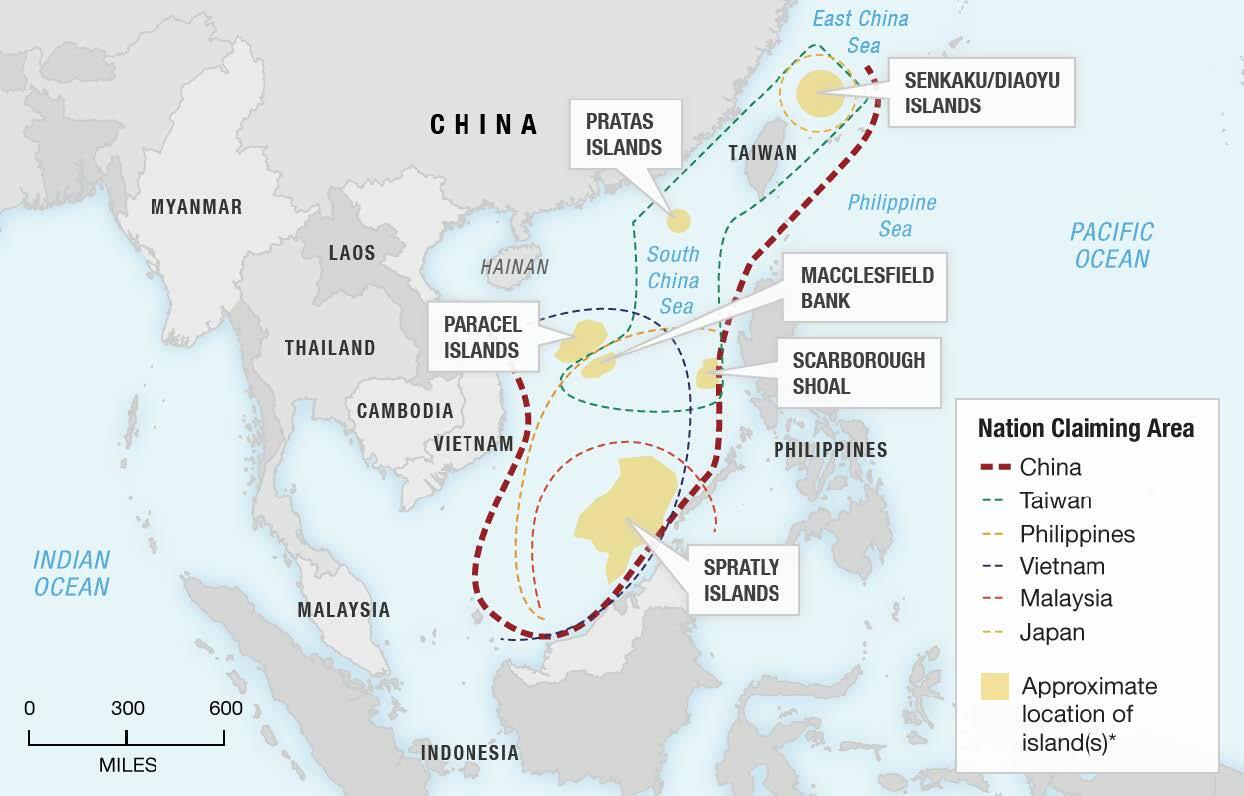
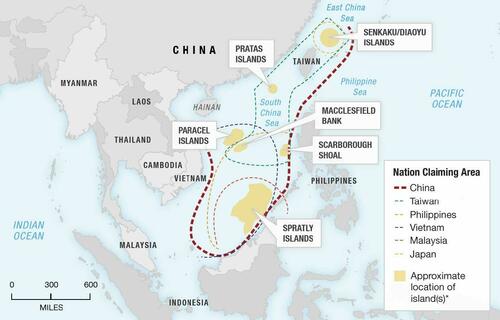
The People’s Armed Forces Maritime Militia (PAFMM). We used GROK for some of this information, but it is all very consistent with topics we’ve discussed in the past. Let’s start with this map from GROK attributed to npr.org to explain some potential risks.
It (PAFMM) often operates in coordination with the PLA Navy (PLAN) and China’s Coast Guard (CCG) as part of a “joint defense” approach involving military, law enforcement, and civilian elements. In peacetime, it contributes to gray-zone tactics—coercive actions short of open warfare—such as swarming disputed features, harassing foreign vessels, or establishing a de facto presence to bolster territorial claims in the South China Sea and East China Sea. Western analyses describe it as enabling China to advance its interests while maintaining plausible deniability, as vessels appear to be civilian. Chinese sources emphasize its role in leading fishing activities, collecting oceanic information, supporting island/reef construction, and participating in drills for national defense and disaster relief.
They have had as many as 400 ships active at any one time. According to GROK the “professional” component consists of 100-200 purpose-built boats (presumably larger and more sophisticated ones). There have been estimates that the total number of ships available is in the thousands. While not set up to attack, in the traditional sense, they can make sea travel perilous, not only by getting in the way, but also by dumping things like nets and logs overboard to foul propellors, etc.
The main focus today is Taiwan, because of our dependance on Taiwan for chips (a recurring theme of our 2026 Outlook), but it seems almost naïve to believe that there isn’t a bigger risk to shipping than just the concern around Taiwan’s chips (which in and of itself is a risk unless we become more “resilient” or diverse in our chip businesses).
We didn’t even touch on China’s control, ownership, and equipment in many ports across the globe as a potential future risk, but it certainly is.
While we might not lose sleep every night worrying about shipping lanes, it seems prudent to plan for the worst if the cost to diversifying shipping lanes is small.
Considering the latest National Security Strategy, the potential safety of shipping should be a consideration when building new facilities. That gives the nod to North, South, and Central America, especially if you are not already overly exposed to the region.
What if the flow of processed or refined rare earths and critical minerals is cut off?
Clearly this would be a risk if shipping with China is disrupted. But given what we’ve seen with the trade negotiations, it seems easy to play out scenarios where China decides to curtail shipments of their own volition.
These scenarios are by no means the base case, but do you really believe they have a zero probability of occurring? That there is no set of circumstances in the next few years under which China decides it is in their best interest to reduce shipments of these materials? Antimony is used in every munition and we remain highly dependent on China for this.
I am more focused on the refined and processed versions. China controls about 60% of the extraction/mining of what is broadly categorized as rare earths and critical minerals. They control about 90% of the processing and refining.
They can shut us off from the raw resources, but we could, in most cases, source them elsewhere. However, what good does it do if we have to ship them to China to be refined and processed?
I know I don’t always do a good job of highlighting the importance of these “things.” It is almost easy to dismiss some as they are “only a small part” of a bigger item. When we think “big picture,” it is easy to forget the importance that these little parts play in the grand scheme of things. Often, they are not just a little portion, but a large portion – when you are talking about batteries for instance.
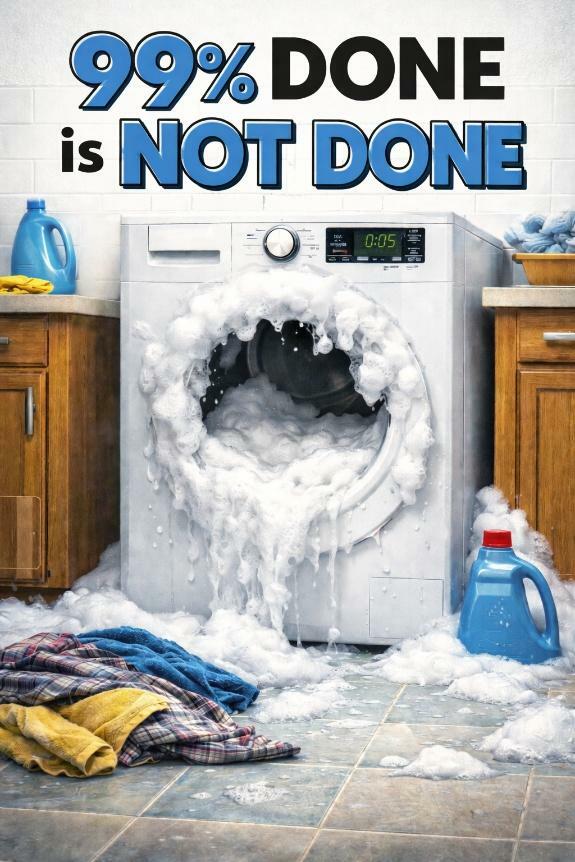
With the help of OpenAI I have tried to bring the CEO of Whirlpool’s comments (made during COVID) to life.
This is maybe too “casual” or even too “obvious” as of course a washing machine needs a door, but that doesn’t make the point irrelevant (just my choice of graphics).
So much of our industrial production could grind to a halt, just because some small amount of processed/refined rare earths or critical minerals (that we depend on China for) doesn’t make it to our factories. It doesn’t only have to be to our “domestic” factories; this applies to factories anywhere around the globe, maybe even within China, if they decide to go down this path.
Again, it isn’t our base case, but becoming more RESILIENT, aka ProSec, goes a long way towards mitigating this risk.
While we don’t need to be completely “self-sufficient,” the more we can produce on our own, the more likely China won’t try to cut us off.
Energy and electricity production.
Germany and Russian Natural Gas. Enough said.
We need to think about resiliency. We need realistic and cost effective contingency plans. The “irony” of this is the more independent one becomes, the less chance one becomes the target of an adversary or competitor. It is effectively Economic Deterrence.
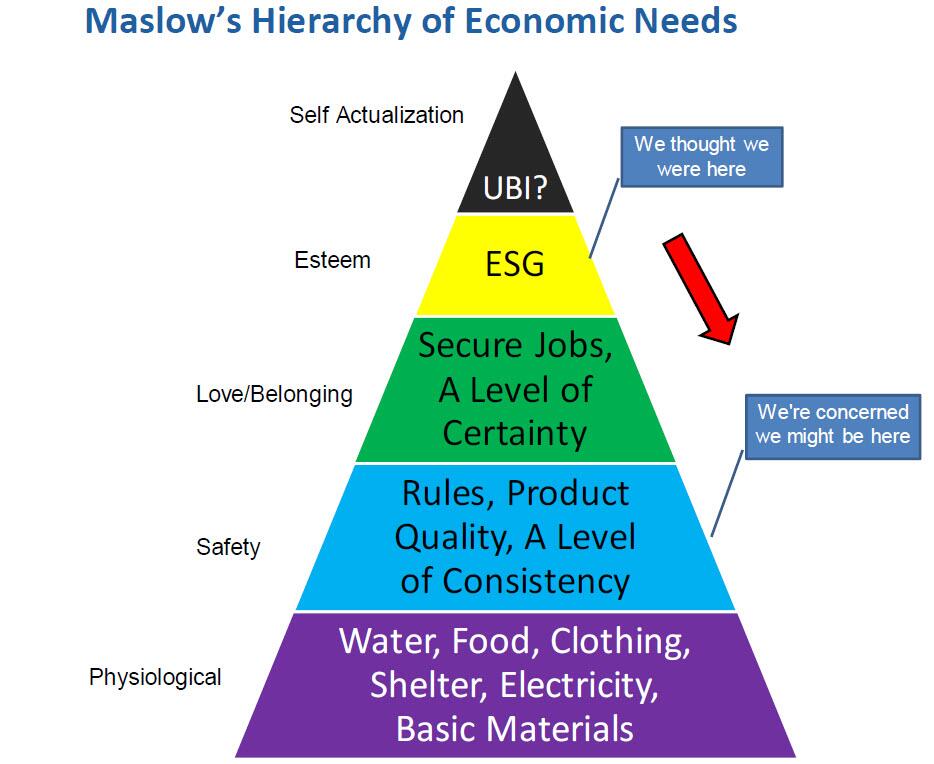
Maslow’s Hierarchy of Economic Needs
Of all the things I learned in college, being able to open a bottle of beer with another beer and Maslow’s Hierarchy of Needs might be the two most useful things I learned (though to be honest, growing up in Canada, I think we learned the beer bottle thing in high school, but I digress).
I don’t know what “self-actualization” really is, but Universal Basic Income seems right up there. I previously thought we were in the “Esteem” stage. That let us think about things differently. The concern I have is that we were being overly “altruistic” in our vision because we thought we had the levels below us covered. The crumbling foundation is what has become apparent, first gradually, and then suddenly.
We have published on many of these themes going back to 2018. They aren’t completely new.
COVID did change a little of how we think and behave, especially towards China.
The Biden administration saw the need for the CHIPS ACT.
But all of these things seemed more like an attempt to patch a crack, rather than determining that the entire foundation might be crumbling and needs to be completely redone!
ProSec and ESG are Compatible
Despite how the previous section might come across, much of what “we” were trying to achieve with ESG will remain in place. But the lens through which we look at ESG will be changing with “true” Sustainability (Resiliency, Independence, Security, etc.) taking center stage.
The ProSec Industries.
Let’s take a “quick” look at how we see the ProSec economy developing around specific industries.
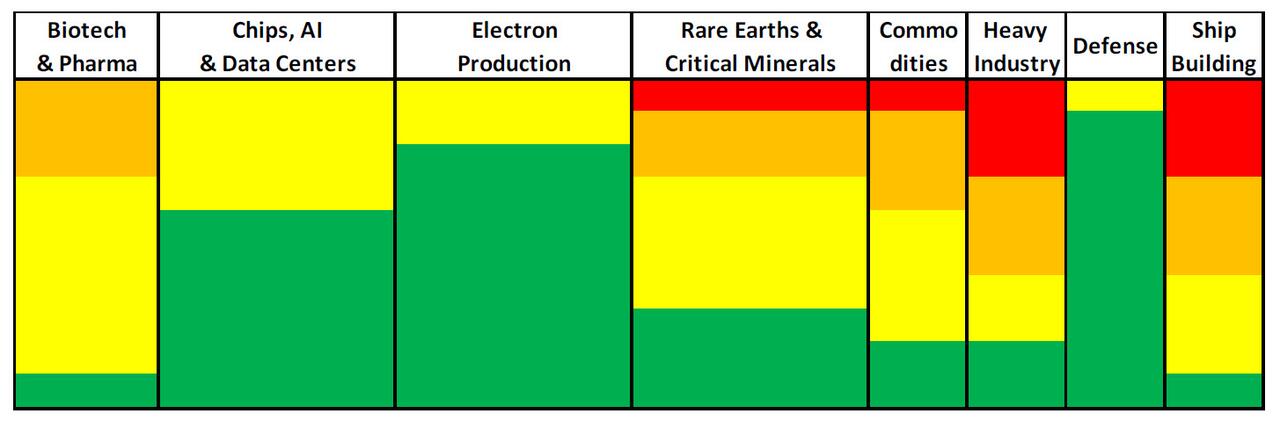
This chart is intended to do a few things:
Make you wish that I’d figured out how to use AI to make this chart more professional.
Highlight the industries with some sense of relative importance (column width).
Highlight how much can be done easily (green), with some effort (yellow), facing some real hurdles (orange), and some that might not be achievable (red).
Biotech and Pharma.
As a “talking point,” reducing healthcare costs is easy. The complexity of the system makes it difficult. Same for “manufacturing at home.” On the surface it is “easy,” but there are a lot of difficulties. Hundreds, and even thousands of drugs are produced. We can kind of get away with saying “steel” and it covers the topic reasonably well (though purists would argue about the type of steel, etc.). But “drugs” is just too vague. There are the components, the base, and precursor drugs. There are the complex drugs we actually ingest or take. There are drugs with multiple delivery methods. The delivery methods themselves are sometimes separated from the drug itself. Patents. There is a focus here, but it is so complex that I think only slow progress will be made.
For the “green” section of this industry, look no further than the GLP-1 drugs. They have the benefit of being topical and potentially have incredibly widespread application. Certainly, interest in them is widespread. The combination of “big and public” makes them an ideal candidate for an administration to focus on. Lots of headlines and manageable. Away from that, it seems like it will be a slog to get a lot of manufacturing done here. It will happen over time (we had immense success getting the COVID vaccines produced here – regardless of your view on the vaccines themselves).
My best guess is that the admin will focus on the pharmacies next, rather than the manufacturers, as that industry is concentrated, and well known to the public, so easier to get a lot of “bang for the buck” on the political front. While I think this is an incredibly important ProSec industry, I think it will not be front and center in 2026 for opportunities.
Chips, Data Centers, and AI.
These industries are doing incredibly well in their own right. Demand is there. In terms of ProSec™ the goal of the administration will be to bring more and more production home. There are a lot of opportunities in this space. The industry leaders should continue to do well and get government support. That support might come in many forms. Some of it may be through increased government use of the services. The government (in all facets, including state, local, defense, and healthcare) will spend in this sector.
Regulatory help is another avenue the government will pursue. Whether paving the way for data centers, the power generation required, or even allowing products to be exported, to earn money, and to fund domestic growth, there will be support from the administration.
INTC continues to stand out in this sector. While I would like rules in place to regulate state investments, those are not really in place (and would likely be pushed to the limit by this admin, even if they were in place). I find it difficult to see a world where the government doesn’t try to support the taxpayers’ investment in this company. For full disclosure, INTC was my biggest single stock holding in 2025 and will be again in 2026. It was up 86% in 2025. Can it repeat that? Who knows, but while I think any stock in this space has potential, with those focused on manufacturing in the U.S. getting the most government support, the direct investment leads me to suspect that extra support will be given here.
Much of this chart is “green” and even “yellow” as a lot remains in our control. Look for a “shift” in the industry as it moves to where the energy (electricity) and fresh water are located. Tasks that require low latency will remain in locations that can offer that speed, but applications that allow for more latency will move to where the electricity is.
The administration is likely going to take a closer look at quantum computing. I briefly pulled up WQTM (a quantum ETF) and some of their holdings jumped out at me – QBTS, IONQ, RGTI, and ARQQ to name a few. I have not spent much time on this, but some of these stocks seem to fit the “lottery ticket” theme in ProSec™ (companies with a small enough market cap, that a direct investment by the U.S. taxpayers could help the stock “pop,” similar to the investment in MP – though that stock is well off of its highs).
Electron Production.
There will be a focus on not only producing the electricity needed for AI, Data Centers, EVs, and industry, but also getting it to where it needs to go (transmission).
All forms of electricity generation will be used. Okay, maybe all forms other than wind, which this administration seems to really dislike.
Fusion. This is more the “future” and I haven’t poked around for tickers, but makes sense.
Fission. This is an area we have focused on a lot. The government is clearly promoting the growth of the nuclear power business. From allowing nuclear to be built on Army bases, to chatter about using Navy reactors more broadly, the government is working hard to jumpstart the nuclear industry. It has the longest lead time to build. There remains a “fear” factor associated with nuclear (I wonder what the world would look like had the nuclear industry hired the Bitcoin marketing team ). Despite those risks (too long and too much negative public opinion) I think the opportunities remain very good in this space.
URA is an ETF that focuses on Uranium. One way to bet on the rise of nuclear, here and abroad (Canada for example is ramping up efforts in this area), is through Uranium. The commodity itself, the miners, and the refiners could all do well if the nuclear industry really takes off. Worth looking through the holding of ETFs like this to assess what stocks might make sense.
Personally, I’m fascinated with the Small Nuclear Reactor space. It has been a roller coaster ride, and we need to see projects completed, in scale, but this fits our theme extremely well.
Coal and Natural Gas. While nuclear might become the backbone years from now, we are going to need rapid expansion of coal and natural gas burning facilities. Maybe not as clean as “we would like” but it is necessary (ProSec™ is trumping ESG – pun intended). Companies like GEV will continue to do well as will other companies that can step in and produce turbines and other equipment that these facilities will need. That industry compressed, as it was out of favor with “traditional” ESG, but will do well again as we try to harness all sources of electricity production.
One of the issues with coal and nat gas is getting it to where the electricity generation is. It is often one of the more difficult logistical issues that companies face when developing new facilities (less so when increasing size of existing facilities). It is right up there with regulatory approval, which remains an issue. So, maybe we will build the facilities where the resources are? We mentioned this earlier and will mention it again. When generating power for a city, you cannot really move the city. When generating power for something like a data center, maybe building the data center close to the power source is best?
Solar. From all the discussions I’ve had, it seems difficult to see the admin suddenly agreeing that wind is necessary. On solar, there is that real possibility. It seems impossible to believe that the electricity production industry isn’t telling the President and his team that solar needs to be part of his overall plan. Elon Musk literally tweets about the need for solar almost every day. While the solar plays may not have the upside of say nuclear, they should have less downside. Since they are “under-owned” as the government cuts back on subsidies, they could actually surprise to the upside. I like some of the more solar-focused companies.
Transmission and the Grid. We will need to make improvements to our transmission lines and the grid. Not just in terms of capacity but also “hardening” it – better cyber- threat security and possibly even better physical-threat security. Companies involved in transmission and the grid should do well.
Batteries. The use of batteries is only going to increase (especially if the admin reverses course on solar, where battery power is more of a necessity, due to the potential timing mismatches of power production versus use).
Utilities. Unregulated utilities probably have the edge here as more “traditional” utility users (individuals like you and me) are becoming concerned, perturbed, or even angry about the use of electricity by the AI/Data Center business.
Much of this sector is green and yellow as so much is in our control. Regulations might be the biggest hurdle to achieve the power needs, but I expect that hurdle will be lowered in an effort to ensure that the U.S. wins the AI and Data Center race.
Rare Earths and Critical Minerals. I need to connect with Michael Rodriguez, Academy’s Head of Sustainable Finance (where he has always focused on resiliency), to do a more thorough dive into this sector – plus this report is already getting long for you to read, and my fingers are starting to hurt from typing so much. We are trying to analyze the importance of the material, alongside potential commercial application/profitability. Some are crucial to the U.S. but not viable domestically. The reason this sector has some orange and red coloring has less to do with the “willingness” and more to do with the “ability.”
Focus on REFINING over Extraction.
Extraction is important. We will see more mining. We will see more facilities to do things like pumping out fracking water with high concentrations of lithium, and then evaporating the water to “extract” the lithium. But there are also markets where we can purchase the commodities themselves. South America and Africa come to mind, along with the “stans.” The latest National Security Strategy and the “transactional” nature of the admin fit this view well. Please see last weekend’s Africa T-Report for more thoughts.
Make no mistake, processing and refining is more important. The real bottleneck we face is that China controls so much of the processing and refining of these rare earths and critical minerals. Just like oil itself is relatively useless (gasoline and diesel are much more useful), the rare earths and critical minerals themselves are relatively useless. China did a good job of securing supplies of the raw resources. What China did a better job of (in my opinion) is convincing the world that “letting China do the dirty work” was somehow “greener” than doing the dirty work ourselves. Cynical? Yes, but out of sight, out of mind seems to have helped this industry flourish in China (also, China adopted their own version of Production for Security a long time ago).
Look for patents and unused mining rights. When we lived in an age where only price mattered and regulatory approval would have been the equivalent of a minor miracle, projects were not pursued. But that is so 2024. Whether you are private equity or a corporation, now is the time to revisit some ideas or proposals you saw or heard about that made no sense in a Pre-ProSec™ world.
Commodities. Similar to the above section, but with a lower priority. First, we need to “fix” our rare earths and critical minerals problem, then we can focus on commodities more generally. Some will get done, but that won’t be the highest priority. Again, focus on refining and processing over extraction. Commodities have less green and more yellow and orange than rare earths – precisely because the will and urgency aren’t there.
I like the “servicers” better than the producers. The producers should do well, but if ProSec works properly, other areas should too.
Heavy Industry. Steel. Aluminum. Chemicals. Nice to have, but gets complicated quickly. Also, project lead time is typically at the long-end of the spectrum. This seems more like a Phase 2 ProSec™ idea rather than something that will create immediate opportunities.
Defense. I will defer to our GIG members to opine on this more fully, but there will be a lot of opportunities with small/private companies developing “cutting edge” technology. There will remain a place for the “platforms” (aircraft carriers, state of the art fighter planes, etc.), but there are indications that drones, space, and anything autonomous are going to be the big beneficiaries of a Department of War that is to some extent repositioning itself (if not reinventing itself).
Ship Building. We need to make more ships. The U.S. Navy (as per my latest understanding) has plans to grow its fleet, albeit by small numbers. But despite that “plan,” the size of the Navy has been decreasing as ships are being retired faster than the replacements are being built. That is just the “traditional” Navy. Surface and underwater drones are going to play a major role going forward in shore defense (and attack). The Jones Act prevents non-U.S. built and flagged ships from shipping goods and commodities between two U.S. ports (one reason the Northeast imports a lot of gasoline while the South exports a lot of gasoline). I’ve been told the President doesn’t like the cruise ships in and around Florida (where he regularly sees them) flying foreign flags (on non U.S.-made ships). This industry is poised for government support.
Despite that rousing endorsement of this industry, very little is in green or even yellow. This will be a HEAVY LIFT. The skills, the materials, and the facilities are not readily available. This is more complex than ramping up electricity or getting a mine up and running. There are a lot of problems, not just hurdles, and shortages of skill and expertise will make this one more difficult to achieve. That could slow the admin down, as there isn’t quite the “easy” win we can see in some other areas. Yet it is critical and the “photo op” of breaking a bottle of champagne across the bow of the first ship built in a new yard would be impressive (though I suspect it will be the next President who would get to do that, given the time it is likely to take).
There are ways to invest in this sector, some of which would include defense stocks. I will also toss out BC (which I own) as a potential fit – especially if I’m correct on surface drones and other small watercraft being part of the defense plan going forward.
Maybe Ship Building should have just been a subset of Defense? Probably, but it probably deserves its own special section (and I don’t feel like re-organizing everything).
The Big Industrial, Transportation, and Infrastructure Companies. If we are even remotely correct on the importance of ProSec™ the build out will allow many companies to prosper.
While it might take time to get many projects on line, the build out will create jobs and wealth immediately. From railways, to massive vehicles, to pipelines, to equipment makers of all types, the opportunities will be there. The jobs and wealth will start with those building the facilities, as much as with the final projects. Accelerated Depreciation works great with this concept.
The X, Y, and Z of America First
I’m losing steam quickly (and I assume you the reader are too). So, we won’t belabor the point.
X is what can be done domestically and “reasonably” efficiently.
X will be a different percentage for each and every resource. Maybe in the U.S. potash can grow from the 10% range to the 25% range? But how much beyond this? There are limitations on how much can be produced domestically. While bananas are not part of ProSec™ we learned from tariff policy that it was kind of pointless tariffing them since we couldn’t supply significant quantities ourselves. While the goal might be 100% – that is highly unlikely. X also kind of represents the green and yellow in the charts above.
X will vary by country. Yes, today’s T-Report has been very focused on the U.S., but each country is headed in this direction and how much of a given thing you can produce yourself will vary greatly.
Y is what likely needs to be done in conjunction with partners.
Some things are just not available domestically.
Some things, while available, may be prohibitively expensive.
Economies of scale exist for a reason.
America First is NOT the same as Only America
Australia is striking deals with the U.S.
As USMCA negotiations begin, there are many clear and easy paths to see the U.S. working with Canada and Mexico (independently or collectively) to achieve ProSec™ related goals.
America First is the X. America not alone, is the Y.
Z is whatever is expedient.
Some things will be purchased as they fit the need. For some things, that may need to be very small. The size of Z will depend on the importance of the item and the relationship with the country producing the item.
It also allows me to revert from zee to zed depending on the audience.
There still will be plenty of global trade, but for ProSec related items, that trading relationship will be anything but transactional. It will be part of an overall plan to achieve true sustainability and resiliency.
Sovereign Wealth Fund
D.C. has gone quiet on the potential for a sovereign wealth fund. Can the idea of selling gold at spot prices to create “income” that can be invested in American companies get traction again? I certainly think so. I’d rather have that than a Bitcoin reserve.
Bottom Line
ProSec or Production for Security will:
Drive U.S. government policy.
Shape investor’s allocations and return profile.
Change how corporations (and banks) allocate their resources.
Change how governments across the globe think about their policy.
The one “sad” truth is to some extent all we need to do is look at how China has shaped their economy, and we have a pretty decent roadmap for what we need to do. It will vary by country, by company, and asset manager, but ProSec™ will be a dominant factor in 2026.
The exciting part is that it incorporates AI and Data Centers (because you cannot ignore those industries) and it also sets us up for a pivot or rotation into new sectors and companies and should spur a wave of not just M&A activity, but also a lot of private equity activity as well!
Tyler Durden
Mon, 01/05/2026 – 04:15
Germany’s Fiscal Illusion: Bond Markets Rebuke Merz’s Debt Spiral
Germany’s Fiscal Illusion: Bond Markets Rebuke Merz’s Debt Spiral
Submitted by Thomas Kolbe
Germany was long seen as a bastion of fiscal stability in the Eurozone. But the erratic fiscal policy of the Merz government is now creating tensions in the bond market. Risk premiums on traditional periphery sovereigns like Italy, Portugal and Spain relative to German Bunds are shrinking.
For months, something remarkable has been happening in European debt markets. Risk spreads on the key ten year sovereign bonds of countries such as Italy, Portugal and Spain versus the economic anchor Germany have been steadily falling. Spanish yields now sit only about 0.4 percentage points above German Bunds; Italian paper — from a country with around 125% debt to GDP — trades just about 0.7 points wider.
Capital is clearly shifting out of Germany into other European bond segments. Is the market pricing in catastrophic German fiscal policy?
Repricing German Policy
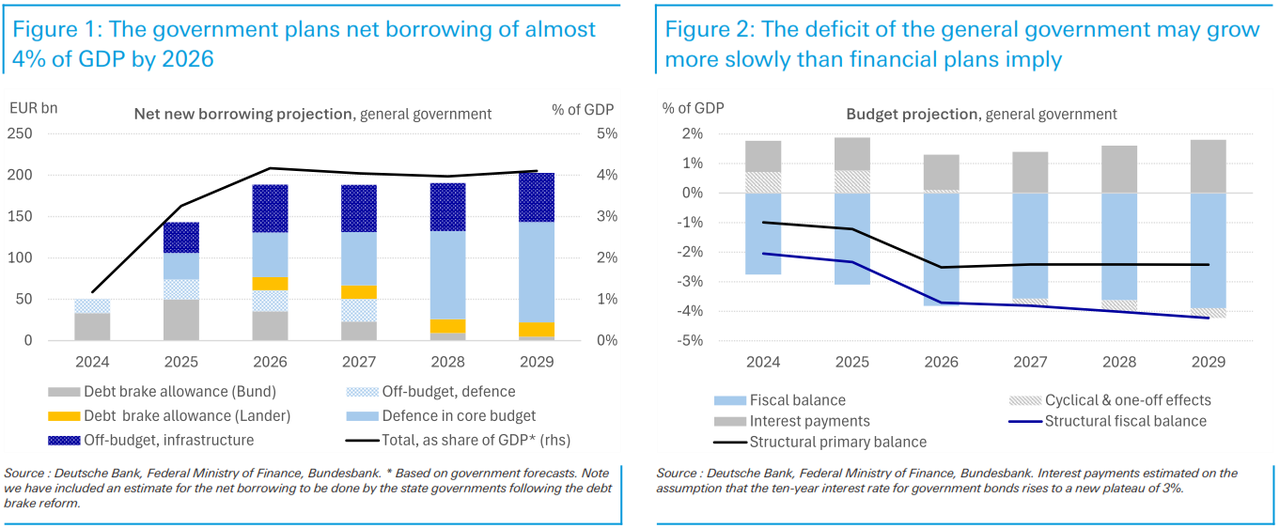
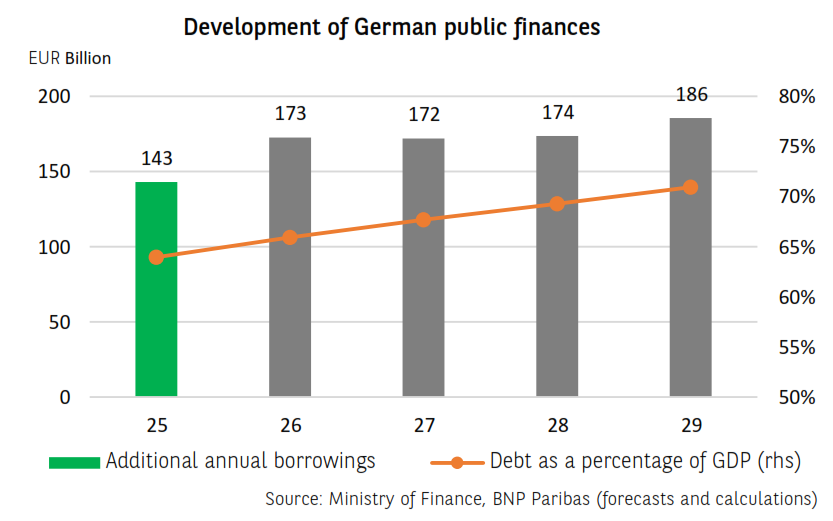
Germany’s debt strategy is unmistakably being reassessed by markets. With the so called special fund, Berlin has effectively thrust the country into a debt spiral virtually overnight. Over the next decade, more than €850 billion in new debt is to be issued — on top of a core budget already running a 2.5 – 3% deficit.
By decade’s end, Germany’s debt burden will likely hover near 85 – 90% of GDP — and nothing suggests an economic miracle will pull the nation out of this spiral. Miracles happen in fairy tales and children’s books — but even children’s book co author Robert Habeck didn’t achieve such an economic feat as Economics Minister.
Implicit obligations from pension and social systems aren’t even factored in — in Germany or elsewhere. What matters in the move in bond yields isn’t the absolute level, but the relative jump in German indebtedness, and markets are pricing exactly that. All this meets an economic reality with no meaningful extra value creation. German policy is pumping state credit — which will later surface as higher taxes and inflation — into an economic vacuum, just like centrally planned systems do.
Looking Ahead
Investors are watching German policy with hawkish scrutiny: the nuclear exit, sky high energy prices crushing industry, a migration policy that drains the welfare state like a vampire — all feed into German bund pricing. Bond markets are always a bet on the future — a judgment on national stability.
The consequence is clear: yields are rising. And they’ll keep rising. A mounting debt pile becomes ever more expensive — that’s how markets must respond.
These hard facts cannot be spun away by Kanzleramt spin doctors or orchestrated party media. German productivity has flatlined since 2018 — and is now declining. Industrial output has collapsed by about a fifth. Hundreds of thousands of manufacturing jobs have vanished while only the public sector expands, with the state’s share of the economy above 50%.
Germany is gearing toward a wartime economy that yields near zero benefits for real economic output. Alongside an already failed “eco economy,” this parasitic sector consumes resources, fosters make work, and feeds a nexus of extraction firms. It’s funded by ever rising levies that increasingly burden productive workers. Prosperity and economic substance are being systematically — purposefully — undermined by central planners in Berlin and Brussels.
This downward spiral is knowingly and ideologically accelerated by Chancellor Friedrich Merz’s government. The crisis is engineered as the solution — to bend the populace toward the climate socialist agenda and secure political power even as social stress rises. An ideological crash course — without doubt.
What seems lost on climate socialist planners like Merz is this: economic action and potential prosperity fundamentally depend on cheap, reliable energy. Germany’s current crisis — productivity collapse and industrial decay — speaks for itself. It happened without necessity and stands in economic history as a unique act of self inflicted vandalism.
That Merz and fellow climate socialists, using media plays, escalating censorship, and constant business bashing at events like employer forums, are trying to steer their political core through crisis shows only one thing: they fail to see this is a one way street. Climate socialism is the problem, not the solution — and markets along with German output are proving it.
Yet this mindset is typical for career politicians trapped in ideological echo chambers. We saw this with Economics Minister Robert Habeck — a party functionary mythologized by state affirming green media, utterly unversed in economics, and intellectually overwhelmed. He failed to understand how the crisis of subsidized sectors he inflated with bailouts came about.
Socialism is a recurring phenomenon in new guises. Climate socialism, like its predecessors, will fail through mass impoverishment. Harsh years lie ahead for Germany, and nothing seems able to prevent green vulgar socialism from metastasizing here. EU capitals have become adjunct outposts of Brussels’ cancerous core.
Some shifts are already visible. Italy, for example, has begun transferring gold reserves from its central bank to state vaults and is pursuing independent energy security via North African gas. At the bond market, this is rewarded: yields and risk premiums there are falling. Investors apparently see Italy as a “First Survivor” in a severe Euro crisis. Germany has no similar narrative.
Compounding this is Berlin’s almost unfathomable commitment to the Ukraine conflict without democratic mandate, accelerating fiscal decay. Merz plans to funnel around €11.5 billion from the 2026 federal budget directly into the Kiev black hole — a stance shared by Paris, London and Brussels — utterly detached from reality and dismissing even the possibility of a full U.S. pullback from the European theater.
This geopolitical folly echoes in bond markets. Germany’s leaders are playing Vabanque — without historical sense, responsibility, or foresight.
Those who hope that rising French and Belgian debt ratios (soon above 120% of GDP) can defuse hyper state growth via bond markets may be disappointed. Japan shows that even heavily domestically financed debt — at historically extreme ratios around 235% of GDP — can float for a while, though future obligations aren’t counted. Markets price in that the ECB will protect Eurozone debt by buying excess bonds — delaying collapse. But how exactly it intervenes now — since the “bazooka” of 2020 — is opaque and hidden. Risk premiums tell the tale.
That U.S. Treasuries trade at around a 1.3% premium over German bonds — and 60bp above Greek and Italian paper — is grotesque given Europe’s structural weaknesses. This stark mismatch between economic reality and bond pricing screams manipulation by Frankfurt central bankers.
Predicting when markets will finally downgrade a Eurozone pillar — likely France first — and bring the whole debt house of cards down is impossible. As Hemingway wrote in The Sun Also Rises:
“How did you go bankrupt?” “Two ways,” Mike said. “Gradually, then suddenly.”
* * *
About the author: Thomas Kolbe is a graduate economist. For over 25 years, he has worked as a journalist and media producer for clients from various industries and business associations. As a publicist, he focuses on economic processes and observes geopolitical events from the perspective of the capital markets. His publications follow a philosophy that focuses on the individual and their right to self-determination.
Tyler Durden
Mon, 01/05/2026 – 03:30
https://www.zerohedge.com/economics/germanys-fiscal-illusion-bond-markets-rebuke-merzs-debt-spiral