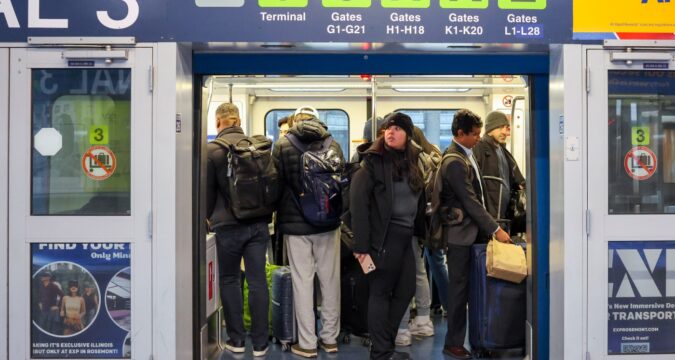
At the end of 2025, American Airlines announced 100 new daily flights for the coming spring at Chicago’s O’Hare International Airport. To be clear, that’s not 100 more than at the same point in the spring of 2025 (we wrote about that prior growth at that time), but a further 100 new departures added to what already was on sale for 2026.
It’s a significant and somewhat unexpected commitment to Chicago, American’s third-largest hub, a huge turnaround from where American was in regard to Chicago in 2023, and pretty much confirmation that United Airlines has not forced American to retreat from Chicago, as United’s leadership had reportedly bragged would be the case.
United, Chicago’s hometown airline, is still bigger at ORD, of course. And some of what American has been doing here is returning service to prepandemic levels. But meaningful new growth from American at our big airport was announced last week, including new flights to Midwest airports like Erie, Pennsylvania, and Lincoln, Nebraska, and more service to the likes of San Francisco, Las Vegas and Savannah, Georgia. Finally, American seems to have gotten over its obsession with Charlotte, North Carolina.
Benefits for Chicago are many. Since airline fares are determined by inventory and what the market will bear, more capacity means lower fares. So, of course, does competition like this great fight between United and American at O’Hare. New convenient nonstops from smaller cities means more people will choose to visit.
Expanded service to Paris, to cite another growing route on AA, means more international tourism, since people flying through a city sometimes add a stopover. All of this means more money spent at airport concessions and the like, feeding the local economy and creating jobs. And more people eyeballing our beautiful skyline as they come in to land, ready to come back and stick around.
Add to this a very efficient holiday performance at the airport, despite a variety of ongoing construction projects, and it adds up to the most effective department in Mayor Brandon Johnson’s Chicago, notwithstanding our soft spot for Streets and Sanitation, which hauls away our Christmas trees.
The contrast is especially striking between the airport and the Department of Cultural Affairs and Special Events, which should have ensured that national TV audiences saw a much more robust New Year’s Eve celebration than actually was the case; it was, alas, a bit of a rinky-dink celebration that signaled worry and lack of ambition, neither of which are qualities that this city of broad shoulders and powerful artists needs to broadcast. We should grow the event next year.
Indeed, in a city where discussions of growth are all too rare from our leaders (Johnson prefers to define those fighting for the city’s future as “the oligarch class” who must be resisted), the airport really is the brightest spot and about as far from rinky-dink as an airport can be. We’d be in far bigger trouble without O’Hare.
The place is not perfect. We still think the international greeting area in Terminal 5 is a missed opportunity; the space is underwhelming, unwelcoming and confusing for those transferring to domestic flights, at least for the next several years.
Airport transportation remains weak. At the car rental and bus center, we watched several shivering people follow a promising sign out to Metra’s “O’Hare transfer station” around the corner, assuming that meant actual train service to downtown beyond the one train a day after about 10 a.m. Not the case, alas.
Travelers arrive to Terminal 1 at O’Hare International Airport the day before Thanksgiving, Nov. 26, 2025. (Armando L. Sanchez/Chicago Tribune)
And we’re perplexed that the international terminal has almost no commercial advertising, despite the huge number of affluent travelers passing through the sterile areas. The art is all very nice, but most airports use that space to make money and the city owns this one.
But while there is work to do, you can also see that work being done. Concessions have markedly improved, the TSA operation is atypically smooth compared with other airports and you can even drive to the airport by car now without massive delays, thanks to the end of the Kennedy Expressway construction. That will get even better with the building of the proposed western entry point to the airport, long another weakness. Somehow at O’Hare, things that languish elsewhere get fixed.
But what matters most here is the choice and frequency of flights, both domestic and international. In that regard, O’Hare is booming with more international destinations likely to come from American once it takes more deliveries of its lower cost Airbus A321XLR, including (we’ve been tacitly promised) the return of at least one daytime flight to Europe.
Most Chicagoans feel proud when their flight attendants say, “Welcome to Chicago’s O’Hare International Airport,” as a big bird touches down and well they should. It’s a world-class operation thanks to effective management and to two of America’s most famous corporations, United and American Airlines.
May they battle on here in 2026!
Submit a letter, of no more than 400 words, to the editor here or email letters@chicagotribune.com.


